PM reportedly set to brief Trump on Iran's ballistic missile program • Israeli diplomatic source: Contents of planned meeting will only be discussed during said meeting
Prime Minister Benjamin Netanyahu and US President Donald Trump embrace on the Knesset plenum, October 13, 2025.(photo credit: MARC ISRAEL SELLEM/THE JERUSALEM POST)
Prime Minister Benjamin Netanyahu is expected to brief US President Donald Trump on Iran's expansion of its ballistic missile program
and options for military strikes at a meeting later this month, NBC
News reported on Saturday, citing a person with direct knowledge of the
plans and four former US officials briefed on the plans.
Israeli officials announced a meeting between Netanyahu and Trump on December 29,
where, according to the sources cited by NBC, Netanyahu would present
the argument that Iran's expansion of its ballistic missile program
poses a threat to the entire region, including various US interests.
This
comes a week after Trump hinted at potential talks with Iran while also
warning the country against reconstituting either its ballistic missile
or nuclear programs.
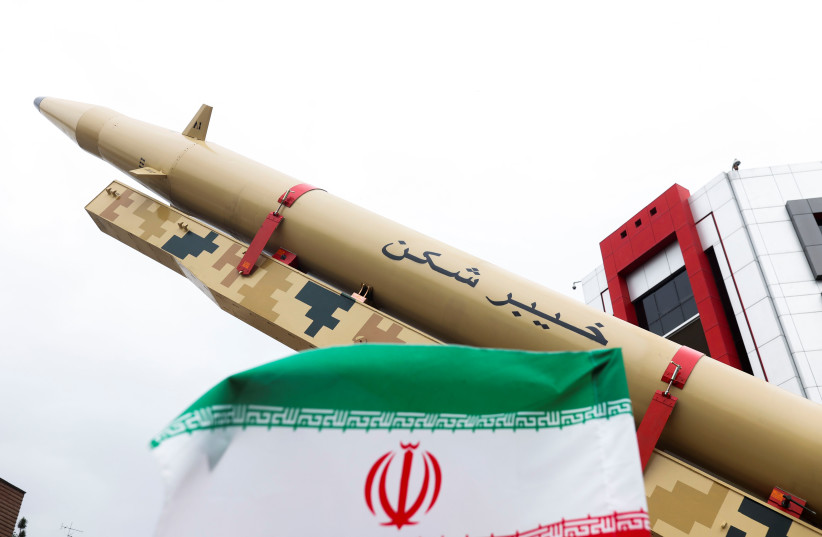
An Iranian missile is displayed during a rally marking the annual Quds
Day, or Jerusalem Day, on the last Friday of the holy month of Ramadan
in Tehran, Iran April 29, 2022. (credit: MAJID ASGARIPOUR/WANA (WEST
ASIA NEWS AGENCY) VIA REUTERS)“But if they do want
to come back without a deal, then we’re going to obliterate that one,
too,” Trump said. “You know, we can knock out their missiles very
quickly; we have great power.”
An
Israeli diplomatic source told Walla that "we will leave the content of
the meeting and the topics to be discussed for the meeting itself."
By buying vast amounts of Iranian oil at discounted rates, Beijing gives Tehran the hard currency it needs to fund Hezbollah, Hamas, the Houthis and other regional militias. The oil exports also permit Iran to stave off an economic crisis at home and avoid the financial collapse that sanctions on Iran alone were supposed to produce.
Iran uses Iraq not just as a
military platform but as a financial artery, moving funds through banks,
exchanging currencies, and availing itself of corrupt networks to
bypass sanctions. Without pressure on Iraq to clean up these financial
tributaries, Iran enjoys a back door that keeps it stomping ahead even
while under international pressure. It is a door the West has left open
for far too long.
Lebanon's weakness has allowed the Iranian regime to turn the
country into its most important forward base – felicitously right on the
border of Israel.
By buying vast amounts of Iranian oil at discounted rates,
Beijing gives Tehran the hard currency it needs to fund Hezbollah,
Hamas, the Houthis and other regional militias. The oil exports also
permit Iran to stave off an economic crisis at home and avoid the
financial collapse that sanctions on Iran alone were supposed to
produce.
Turkey, Qatar, Iraq, Lebanon, Yemen, China and other states that
allow Iran to maneuver are providing Tehran with exactly what it needs
to get back on its feet: safe geography, cash, energy markets, financial
loopholes, proxy shelters, and diplomatic cover.
Stopping the bellicosity of Iran's regime requires a broader
vision. Only when the external lifelines of Iran's regime are cut will
it finally feel the full weight of international pressure. Only then can
the Iranian people and the region move toward stability, security and
freedom, safe from Iran's destructive reach.
By buying vast amounts of Iranian oil at discounted rates,
Beijing gives Tehran the hard currency it needs to fund Hezbollah,
Hamas, the Houthis and other regional militias. The oil exports also
permit Iran to stave off an economic crisis at home and avoid the
financial collapse that sanctions on Iran alone were supposed to
produce. Pictured: The Iran-flagged oil tanker Clavel, docked at Shahid
Beheshti Port in Chabahar, Iran on February 25, 2019. (Photo by Atta
Kenare/AFP via Getty Images)
While everyone is focusing on Gaza, Russia and Ukraine, Iran has stealthily been rebuilding its war machine.
One of the most effective ways to slow the remilitarization of Iran's
brutal regime is not only to put direct pressure on the regime itself
but also to target the countries that allow it to operate freely, fund
its proxies, and expand its influence.
Iran's regime survives largely because it has external support that
enables it to move money, find recruits, transfer weapons, and, after
every round of sanctions, rebuild its war machine. If these countries
that are allied with Tehran were to face real consequences for enabling
Iran's ability to rearm and reassert itself, the threat it could pose
would dramatically shrink. Disempowering Iran requires cutting off not
just its internal power, but also the foreign platforms that help it to
finance itself, operate, and grow.
Iran's networks across the Middle East demonstrate how deeply the regime depends on other countries to advance its agenda. Recent discoveries
of Hamas activity in Turkey exposed that the group has been using
Turkish territory as a logistical and financial hub, benefiting from
Iran's sponsorship and direction. Findings by Israel reveal
that individuals affiliated with Hamas have been fundraising,
operating, and coordinating from Turkey -- using the country as a safe
bridge to move money and connect its proxy networks.
The case appears part of a larger pattern: Iran identifies countries
where the rule of law is weak, political cover is available, and
financial systems can be exploited, then builds layers of infrastructure
there. When these countries do not face consequences from the
international community, Tehran knows that even when pressure builds at
home, it can still expand abroad.
Iran's proxies are still anchored in states that reinforce their presence.
In Iraq, militias backed by Iran have for years operated with impunity, shaping security, the economy and the political landscape. These militias control border crossings, smuggling routes, and major economic contracts, giving Tehran a revenue stream and influence far beyond its borders. Iran uses Iraq not just as a military platform but as a financial artery, moving
funds through banks, exchanging currencies, and availing itself of
corrupt networks to bypass sanctions. Without pressure on Iraq to clean
up these financial tributaries, Iran enjoys a back door that keeps it
stomping ahead even while under international pressure. It is a door the
West has left open for far too long.
In Lebanon, an even clearer example, Hezbollah essentially functions as a branch of Iran while controllingports,
security agencies, border crossings and a large part of the country's
political system. Lebanon's weakness has allowed the Iranian regime to
turn the country into its most important forward base – felicitously
right on the border of Israel. Hezbollah receives funding, training and weapons from Iran, then uses Lebanon's political paralysis to keep itself from being held to account.
If no one applies pressure on Lebanon's political elites and
institutions, which tolerate and often enable Hezbollah's dominance,
Iran will continue enjoying its permanent military stronghold in the
country.
Outside the Middle East, China has been keeping Iran's regime in the style to which it is accustomed by purchasing
large amounts of Iranian oil – especially when sanctions are in place
and when the international community attempts to reimpose additional
restrictions. By buyingvast amounts
of Iranian oil at discounted rates, Beijing gives Tehran the hard
currency it needs to fund Hezbollah, Hamas, the Houthis and other
regional militias. The oil exports also permit Iran to stave off an
economic crisis at home and avoid the financial collapse that sanctions
on Iran alone were supposed to produce. When Iran has a world power
delighted to buy its oil unconditionally, sanctions lose their strength
at the exact moment when the international community is trying to
suffocate its unneighborly regional behavior.
Turkey, Qatar, Iraq, Lebanon, Yemen, China and other states that
allow Iran to maneuver are providing Tehran with exactly what it needs
to get back on its feet: safe geography, cash, energy markets, financial
loopholes, proxy shelters, and diplomatic cover. The current sanctions
regime is not working, and Tehran knows it.
The solution is unsurprisingly straightforward: the European Union
needs to join the United States in applying direct, coordinated, and
consistent political and economic pressure, not just on Iran but on the
governments, companies and institutions that help Iran circumvent
restrictions. When those countries realize that empowering Iran's regime
comes at the cost of losing access to the entire US and EU markets,
their calculus might change.
No country will most likely sacrifice the benefits of trading with
the West just to help Tehran continue to destroy the Middle East. The
pressure needs to be heavy enough that governments in Turkey, Qatar,
Iraq, Lebanon and even China are forced to reconsider whether the
relationship with Iran is worth the enormous economic risks.
Stopping the bellicosity of Iran's regime requires a broader vision.
Only when the external lifelines of Iran's regime are cut will it
finally feel the full weight of international pressure. Only then can
the Iranian people and the region move toward stability, security and
freedom, safe from Iran's destructive reach.
Dr. Majid Rafizadeh is a political scientist,
Harvard-educated analyst, and board member of Harvard International
Review. He has authored several books on the US foreign policy. He can be reached at dr.rafizadeh@post.harvard.edu
Nawaf Salam's comments came as tensions continued to boil along Lebanon's eastern border, where Israel accuses Hezbollah of ignoring calls for disarmament and carrying out ceasefire violations.
Lebanese Prime Minister Nawaf
Salam speaks to the press following the formation of the new government
at the presidential palace in Baabda, Lebanon. February 8, 2025. (photo credit: REUTERS/EMILIE MADI)
The
first phase of the plan to confiscate weapons from the Hezbollah
terrorist group south of the Litani River will end in a "few days,"
Lebanese Prime Minister Nawaf Salam said in a statement on Saturday.
Salam's
comments came as tensions continued to boil along Lebanon's eastern
border, where Israel accuses Hezbollah of ignoring calls for disarmament
and carrying out violations of a ceasefire agreed in November 2024.
Israel continued striking Hezbollah targets
across southern Lebanon since, while publicly urging Lebanese
authorities to fulfill a commitment under the truce to disarm Hezbollah,
warning that it would act "as necessary" if Lebanon does not take steps
against the Iran-aligned proxy terror group.
Rubio hopes for Hezbollah disarmament, 'strong' Lebanese gov't
On Friday, US Secretary of State Marco Rubio said on Friday the US hoped talks between Lebanese authorities and Israel would lead to a strong Lebanese government and see Hezbollah disarmed.
"We
are hopeful that talks between Lebanese authorities and Israelis will
create outlines and a way forward that prevents further conflict," Rubio
told a press conference.
A
day prior, officials from France, Saudi Arabia, and the US held talks
with the head of the Lebanese army in Paris aimed at finalizing a
roadmap to enable a mechanism for Hezbollah's disarmament.
A
US-backed ceasefire agreed in November 2024 required the disarmament of
Lebanon's Iran-aligned Hezbollah, beginning in areas south of the
river, the area adjacent to Israel.
CENTCOM forces used fighter jets, attack helicopters, artillery and more than 100 precision munitions.
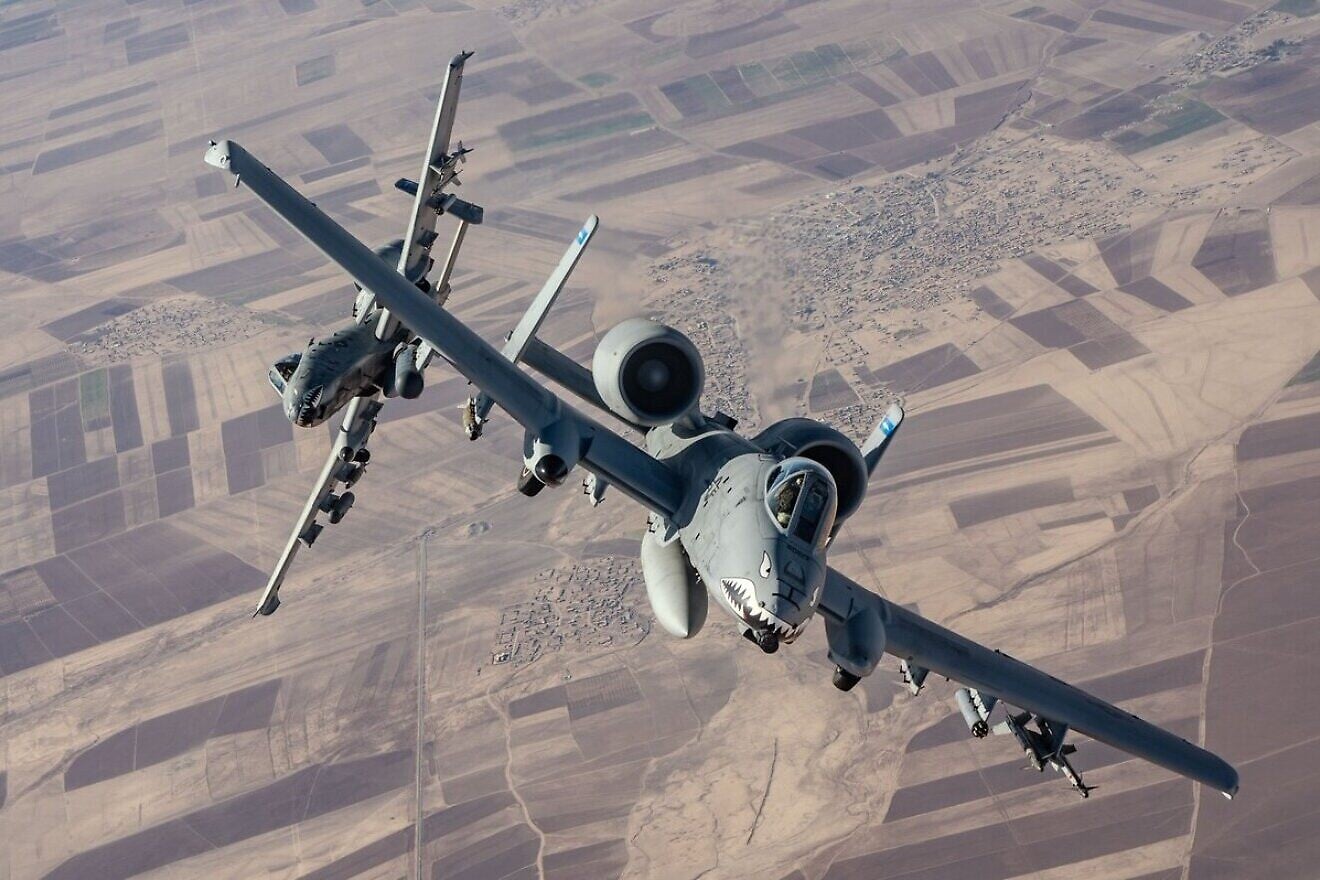
U.S.
Air Force A-10 Thunderbolt II close air support attack aircraft, aka
“Warthogs,” fly over the U.S. Central Command area of responsibility.
Credit: CENTCOM.
U.S. Central Command launched “Operation
Hawkeye Strike” against ISIS in Syria on Friday in response to last
week’s deadly attack on American and partner forces in Palmyra.
CENTCOM forces struck more than 70 targets
across central Syria using fighter jets, attack helicopters and
artillery, according to a statement. The operation used over 100
precision munitions to target known ISIS infrastructure and weapons
sites.
The Jordanian Armed Forces supported the operation with fighter aircraft.
U.S. Forces Unleash Massive Strike Against ISIS in Syria
TAMPA, Fla. – U.S. forces have commenced a large-scale strike against ISIS infrastructure and weapons sites in Syria. This massive strike follows the attack on U.S. and partner forces in Syria on Dec. 13.
“This operation is critical to preventing
ISIS from inspiring terrorist plots and attacks against the U.S.
homeland,” said Adm. Brad Cooper, commander of CENTCOM. “We will
continue to relentlessly pursue terrorists who seek to harm Americans
and our partners across the region.”
On Dec. 13, a “lone ISIS gunman” ambushed and killed two U.S. service members and an American interpreter in Palmyra, Syria.
Noureddine el-Baba, a Syrian Interior Ministry spokesman, told the state-run Syrian News Channel (Al-Ikhbariya) that the terrorist, who was part of the government security forces, was already being investigated, Time magazine reported.
After the attack, U.S. and partner forces
carried out 10 operations in Syria and Iraq, resulting in the deaths or
detention of 23 terrorists, CENTCOM said on Friday.
Over the past six months, U.S.-led forces
in Syria have conducted more than 80 operations targeting terrorists who
pose a direct threat to the United States and regional security, it
added.
Tonight, U.S. and Jordanian forces struck 70+ ISIS targets in Syria with 100+ precision munitions. Peace through strength. pic.twitter.com/XWWvfqBBFT
“Because of ISIS’s vicious killing of
brave American patriots in Syria, whose beautiful souls I welcomed home
to American soil earlier this week in a very dignified ceremony, I am
hereby announcing that the United States is inflicting very serious
retaliation, just as I promised, on the murderous terrorists
responsible,” U.S. President Donald Trump wrote on his Truth Social
platform early on Saturday.
“We are striking very strongly against
ISIS strongholds in Syria, a place soaked in blood which has many
problems, but one that has a bright future if ISIS can be eradicated,”
he stated.
He added that the government of Syrian President Ahmed al-Sharaa,
a former Al-Qaeda-linked terrorist who led the overthrow of longtime
dictator Bashar Assad last December, was “working very hard to bring
greatness back to Syria, and is fully in support.
“All terrorists who are evil enough to
attack Americans are hereby warned—you will be hit harder than you have
ever been hit before if you, in any way, attack or threaten the U.S.A.,”
concluded Trump.
U.S. Secretary of War Pete Hegseth early
on Saturday said the operation was meant to “eliminate ISIS fighters,
infrastructure and weapons sites,” adding, “This is not the beginning of
a war—it is a declaration of vengeance. The United States of America,
under President Trump’s leadership, will never hesitate and never relent
to defend our people.
“As we said directly following the savage
attack,” Hegseth continued, “if you target Americans—anywhere in the
world—you will spend the rest of your brief, anxious life knowing the
United States will hunt you, find you, and ruthlessly kill you.”
Bondi Beach shattered the lie that antisemitism is merely anti-Israel politics, revealing an older, eliminationist hatred aimed at Jews as Jews, far from any battlefield.
Bondi Beach is meant to be neutral ground. A place without history. A
democratic stretch of sand where politics dissolves into sunlight,
surf, and families pushing strollers toward the water. That illusion
died when Jews gathered there to light Hanukkah candles—and were
slaughtered for it.
The massacre belongs to a broader pattern that has accelerated since
Oct. 7, 2023: Jews targeted far from any battlefield, in the ordinary
spaces of civic life. Synagogues, campuses, cafés, city streets—and now a
beach—have become killing fields aimed not at a state, but at a people.
The mass murder at Bondi did not occur in a war zone or at a political
demonstration. It occurred at a religious gathering of the diaspora, in
full public view, and in daylight.
Bondi is evidence that the prevailing theory is wrong.
For years, Western academics have argued that antisemitism is
primarily a reaction to Israeli power, sharpened by Zionism’s
transformation of Jews from a vulnerable minority into a sovereign
people. Thus, Jewish vulnerability ends where the Jewish State begins,
and hostility toward Jews is reframed as antipathy for a political
project.
This intellectual architecture dominates elite universities, activist
spaces, and progressive politics. It is elegant in its abstraction. And
it collapses when confronted with Bondi Beach.
Nothing about the attack turned on Israeli policy or national
identity. The victims were not selected for their politics, their
citizenship, or their views on borders and settlements. The shooters
bypassed diplomatic and military targets entirely. Their fire was aimed
at something simpler and older: Jews celebrating as Jews.
They targeted Jewish people living peacefully 9,000 miles from Tel Aviv.
The horror exposed the foundational error in academic anti-Zionism:
the treatment of antisemitism as secondary—derivative, contingent, and
therefore negotiable. The violence is explained as if it is primarily
political, as if it will recede once Jews accept the “right”
constitutional arrangement. In the “anti-Zionists” framework, the Jew
becomes less a human being than a category in a seminar: settler,
native, citizen, majority, minority. The vocabulary is sophisticated.
The substitution is not.
Bondi Beach supplies the missing variable: eliminationist hatred that
does not require an Israeli policy dispute to ignite, and does not wait
for the Knesset to act before it kills.
This hatred did not originate with the modern Israeli state. It
culminated, catastrophically, in the Holocaust—an industrial-scale
attempt to eradicate the Jewish people in Europe precisely because they
lacked sovereignty or protection. The lesson drawn by Zionism was not
triumphalist but defensive: that Jewish survival required political
self-determination. That conclusion was tested immediately. In 1948, the
moment Israel declared independence, it was invaded by neighboring Arab
states that rejected not its borders or policies, but its existence.
The resulting war was not a response to “occupation” but to Jewish
statehood itself. Any framework that treats antisemitism primarily as a
reaction to Israeli power reverses cause and effect, mistaking a
centuries-old, lethal hatred for a modern political grievance.
To ignore that is not merely an academic blind spot. It is a moral hazard.
And it is a moral hazard close to home—in New York City, of all
places. The political rhetoric routinely employed by Zohran Mamdani
offers a simplified public version of this move: “hierarchy,” “universal
rights,” “decolonization.” The language sounds humane and hip. But it
avoids the central fact that for Hamas, Hezbollah, ISIS-style jihadism,
and the father-son terrorists who opened fire at Bondi, the objection is
not to a policy but to a people.
Bondi also undercut the most fashionable analogy in this debate:
South Africa. The assumption is that Israel can dissolve into a single
secular polity and follow a post-apartheid path. But that analogy rests
on a false premise: that the conflict is primarily about citizenship
rather than a religiously driven rejection of Jewish collective
existence. In South Africa, the demand was for equality. In much of the
antisemitic violence now spreading globally, the demand is erasure.
Since October 7, similar attacks and threats have multiplied across
Western cities, routinely explained away with euphemism rather than
named for what they are.
Bondi leaves little room for euphemism. Sand absorbs blood without consulting political theory.
This is why the Mamdani-style prescription that Jewish safety depends
on relinquishing sovereignty is more than misguided. It amounts to a
demand for unilateral disarmament at a moment when antisemitism is not
merely resurging but being rationalized, normalized, and operationalized
across the West.
None of this denies Palestinian suffering or limits debate over
Israeli policy. It merely insists on intellectual honesty. A framework
that interprets every Jewish death as an echo of political grievance is
not explanatory; it is evasive. It removes the victim from view so the
theory can survive unchallenged.
As Bernard-Henri Lévy has warned, we are living through an undeclared
state of intellectual emergency. Appeasement of violent radicalism does
not restrain it; it instructs it. And the refusal to name Islamist
antisemitism plainly—religious, ideological, and murderous—does not
protect Muslims or Jews. It protects only the illusion that language can
replace reality.
Bondi Beach exposed that illusion for what it is. The men who opened
fire were not responding to a policy or a border. They were acting on an
older hatred, aimed at a visible people gathered in public.
Any framework that cannot begin with that fact is not merely incomplete. It is complicit.
***
This article was originally published by RealClearPolitics and made available via RealClearWire.
Photo: SYDNEY, AUSTRALIA - DECEMBER 15: An
Israeli flag and flowers are laid outside Bondi Pavilion at Bondi Beach
as people gather to mourn in the wake of a mass shooting on December 15,
2025 in Sydney, Australia. Police say at least 16 people, including one
suspected gunman, were killed and more than a dozen others injured when
two attackers opened fire near a Hanukkah celebration at the
world-famous Bondi Beach, in what authorities have declared a terrorist
incident. (Photo by Audrey Richardson/Getty Images)
Eric Felten is a writer and reporter for RealClearInvestigations.
Israeli National Security Council official Joseph Draznin attended the talks in Naqoura, Lebanon.
The
United Nations Interim Force In Lebanon (UNIFIL) patrols along the Blue
Line Israeli border between Ras Naqoura and Labounieh, Lebanon, April
8, 2024. Credit: Pasqual Gorriz/U.N. Photo.
An Israeli official participated in a
meeting in Naqoura, Lebanon, on Friday aimed at ensuring the disarmament
of the Iranian-backed Hezbollah terror group.
“During the meeting, ways to promote
economic projects were discussed in order to underscore the mutual
interest in removing the Hezbollah threat and ensuring sustainable
security for residents on both sides of the border,” the Prime
Minister’s Office in Jerusalem said.
“The meeting is a continuation of the
security dialogue aimed at ensuring the disarmament of Hezbollah by the
Lebanese army,” it added.
Israeli National Security Council official
Joseph Draznin attended the talks, replacing Eli Resnick, who
represented Israel at the first meeting in Naqoura on Dec. 3.
Those talks came a day after the Israel Defense Forces warned that Hezbollah is rapidly rebuilding its capabilities in Lebanon despite ongoing airstrikes since a truce took hold last year.
The ceasefire went into effect on Nov. 27,
2024, following an intense two-month IDF military campaign that led to
the weakening of the Iranian terror proxy’s leadership. The deal was
cemented by the Israeli and Lebanese governments and five mediating
countries, including the United States.
The U.S. embassy in Beirut said Friday’s
meeting was geared toward “continu[ing] coordinated efforts in support
of stability and an enduring cessation of hostilities.”
According to the embassy, military
officials provided operational updates, emphasized enhancing
coordination, and agreed that a strong Lebanese Armed Force, responsible
for security south of the Litani River, is essential for success.
“Civilian participants, in parallel,
focused on setting conditions for residents to return safely to their
homes, advancing reconstruction and addressing economic priorities. They
underscored that durable political and economic progress is essential
to reinforcing security gains and sustaining lasting peace,” added the
statement.
The embassy said participants reaffirmed
that progress on security and political tracks remains mutually
reinforcing and essential to ensuring long-term stability and prosperity
for both parties, and they look forward to the next round of meetings
in 2026.
The House House Select Committee on the Chinese Communist Party cited case studies showing researchers from America’s leading institutions collaborated, whether knowingly or unknowingly, with Chinese scientists affiliated with Chinese government or military-linked laboratories.
China is exploiting the
U.S. Department of Energy to access and divert taxpayer-funded research
to bolster its own technological and military development, the House
Select Committee on the Chinese Communist Party warned this week in a
report.
The committee’s probe identified approximately 4,350
research papers, published between June 2023 and June 2025 that
acknowledged funding from the agency and involved relationships with
entities in China, including research institutions with close ties to
the Chinese military. About half of the publications “were conducted in
partnership with entities within China’s defense research and industrial
base,” the committee concluded.
Committee chair: "Exploited by China"
"This investigation reveals a deeply alarming problem: The
Department of Energy failed to ensure the security of its research, and
it put American taxpayers on the hook for funding the military rise of
our nation's foremost adversary,” the committee’s Chairman, John
Moolenaar, R-Mich., said in a statement.
“The department, which oversees critical research and
technological innovation, allowed research collaborations that were
exploited by China. The department must stop providing funding to
grantees who allow this exploitation and protect hard-earned taxpayer
dollars,” he continued.
Several awards, some that are still active, were carried
out in collaboration with research institutions in China that are known
to be affiliated with or part of China’s military research apparatus,
such as the Chinese Academy of Engineering Physics (responsible for
nuclear weapons research), the People’s Liberation Army’s (PLA) National
University of Defense Technology, and “state-owned enterprise defense
conglomerates.”
Some of these institutions are in the U.S. Commerce
Department’s entity lists for roles in Chinese military research or
engaging in human rights violations, the committee said. Take the
Chinese Academy of Engineering Physics, CAEP, which is labeled by the Commerce Department the leading entity of China’s nuclear program.
The committee cites numerous case studies to show how
researchers from America’s leading institutions collaborated, whether
knowingly or unknowingly, with Chinese scientists affiliated with
Chinese government or military-linked laboratories.
In one example of how U.S.-based research boosted China’s
military research efforts, the committee highlights the case of a
Stanford University professor who has collaborated for years for at
least two decades with a research institute affiliated with China’s
nuclear weapons program. The committee did not identify her, but she is
listed on Stanford's website as Wendy Mao, Stanford's Earth Sciences
Chair.
Mao’s work with the Center for High Pressure Science and Technology (HPSTAR), which was added to the U.S. Commerce Department’s entities
list in 2020 and is considered a subsidiary of the “technology complex”
leading China’s nuclear weapons program, was first exposed earlier this
month by the student-run The Stanford Review and reported by Just the News.
Though the research papers authored by Mao and HPSTAR do
not deal directly with nuclear weapons research, the kinds of
experimental techniques and theoretical knowledge required in their
geological and materials research could be used to study such materials
relevant to nuclear weapons, a respected materials scientist and
physicist told TheStanford Review.
Mao primarily conducts research into “the behavior of
materials under compression” with applications for Earth and planetary
studies and the development of new materials for “energy related
applications like hydrogen fuel storage and advanced batteries,” according to her faculty page.
HPSTAR, according to the Commerce Department,
is “owned by, operated by, or directly affiliated” with the Chinese
Academy of Engineering Physics (CAEP) which is the “technology complex
responsible for the research, development and testing of China's nuclear
weapons.” CAEP has been listed on the Entity List since 1997.
Not only has Mao purportedly conducted research alongside HPSTAR’s scientists, but she also served as a visiting scholar for the center from at least 2016 to 2019, an archive of the HPSTAR’s website shows. As of this writing, HPSTAR’s website is currently inaccessible.
Mao also has a familial connection to HPSTAR. Her father, a Taiwanese-American scientist Ho-Kwang Mao, founded the center in Shanghai in 2013
while he was simultaneously working for the Carnegie Institution in
Washington, D.C. His research focuses on the same area of study as his
daughter.
Chinese Gov says it's a "smear"
The Chinese Embassy in the United States pushed back on the
committee’s report. A spokesperson said the panel “has long smeared and
attacked China for political purposes and has no credibility to speak
of.
“A handful of U.S. politicians are overstretching the
concept of national security to obstruct normal scientific research
exchanges, a move that wins no public support and is bound to fail,” said Liu Pengyu, the spokesperson, in a statement to the Associated Press.
“Just in the past week, I have received three emails that
were forwarded to me from researchers in the community who had been
approached for recruitment by Chinese malign foreign talent recruitment
programmes,” Rebecca Keiser, the acting chief of staff of the National
Science Foundation, told lawmakers.
Commitee asks for "damage assessment"
Jay Tilden, director of counterintelligence at the energy department, said that American universities in particular were a key target in need of heightened security and called for the government to provide more resources to vet potential partners and invest in “US-born talent.”
The House China committee recommended that the Department
of Energy conduct a damage assessment of all the research grants it
identified. “This review should…assess whether any such advancements
were simultaneously or subsequently diverted to China’s military—due to
research collaboration…” the committee wrote.
The panel also suggested that Congress create a new federal
agency tasked with monitoring federally funded research and ensuring
proper security measures are followed, eliminating “duplicative efforts”
across all the federal grantmaking agencies.
Former FBI Director James Comey was charged with obstruction of justice and making a false statement to Congress. James was charged with mortgage fraud.
The Justice Department on Friday night appealed the dismissal of criminal cases against former FBI Director James Comey and New York Attorney General Letitia James.
The Trump administration vowed to appeal the decision, but tried to renew the case against James by trying to reindict her. The judge dismissed both cases after determining the federal prosecutor, Lindsey Halligan, was unlawfully appointed.
Comey was charged in September
with obstruction of justice and making a false statement to Congress in
2020. James was charged with mortgage fraud in connection to a property
she purchased in Virginia. Both pleaded not guilty.
U.S. District Judge Cameron Currie ruled last month that Halligan, a
former White House aide, was not eligible for the post and thereby “all
actions flowing from” Halligan’s appointment, including the indictments,
“constitute unlawful exercises of executive power and must be set
aside.”
Misty Severi is a news reporter for Just The News. You can follow her on X for more coverage.
AIDF is intended to serve as a living bridge made up of experts, recruiting stars from Israel’s hi-tech industry to bring the forefront of technology and creativity into the IDF’s decision-making.
IDF soldier illustrative.(photo credit: TPS-IL)
An
Artificial Intelligence Division for the IDF was established by the C4I
and Cyber Defense Directorate, under the command of Maj. Gen. Aviad
Dagan, and was done in response to the military's security failure on October 7.
The dramatic move within the C4I Directorate gave rise to the unique reserve unit AIDF.
This
unit is intended to serve as a living bridge made up of experts,
recruiting stars from Israel’s high-tech industry to bring the forefront
of technology and creativity into the IDF’s decision-making processes
across various units. The overarching goal is clear: efficiency and
effectiveness.
Interview with an AIDF official
Lt.
Col. N., head of a staff branch in the division and the officer leading
the establishment of AIDF, gave Walla an exclusive look at innovative
projects designed to streamline the IDF’s decision-making process across
a range of areas.
On
October 7, Lt. Col. N. left his home immediately after the first
launches and rushed to headquarters at the Kirya, where he was then
responsible for air defense domains within the C4I Directorate. A clear
objective stood before him: to sharpen IDF strikes against launch sites.
Later, he also took part in missions as a remotely piloted aircraft
operator.
Artificial intelligence and humanity. (credit: SHUTTERSTOCK)N.
was selected for his new role after working on multi-branch projects in
the field of AI. “After we built various projects in different domains,
we felt it was right to take a step forward and establish a division
that would move the IDF ahead in information projects that would help me
organize information better, make it accessible to all IDF personnel,
and certainly across different regions and bodies within the military.
This is a large organization with an enormous amount of information, and
into that we need to introduce AI capability.”
During
his service in the C4I Directorate, working with the Air Force and
diverse teams, he implemented an AI-based algorithm for an operational
home-front defense process. The process runs in real time and helps make
precise decisions in identification and interception capabilities
within the air-defense domain.
While
describing the new processes, N. also referred to the C4I Directorate’s
knowledge centers and talent pools: “Without these strong people, we
won’t be able to produce high-quality research and deliver things that
meet the battlefield at a very high pace. This touches all the joint
systems in the IDF. There are places where the Israeli military has no
competition, but there are many places where we operate in a changing,
transformative world at a dizzying pace.
"If
we try to advance only from within the IDF, we simply won’t be able to
deliver the required speed. Therefore, we created paths and lines of
thinking - how we manage to join the major companies developing the big
things and bring them, with the necessary adaptations, for military use.
One of the central steps is establishing the AIDF reserve unit, which
is currently in recruitment stages and will expand to about 100
positions in the first phase. Already today it’s showing initial, modest
sparks."
Project
“Osnat” is one of the processes Lt. Col. N. spoke about with pride. Its
goal is to construct scenarios and examine desired decision-making
processes. “Building an exercise is a very big task. You need to seat
several people to analyze certain enemy behavior, decide what you want
to practice, imagine the scenario, and then build an exercise within
that, including alternative developments that could occur.
"The project still has room to grow, but it’s already in use. Imagine a scenario of the IDF working alongside bodies like MDA,
the Israel Police, and the Fire and Rescue Service, and it actually
integrates into the way a complete IDF headquarters exercise is
conducted.”
IDF
Chief of Staff Lt.-Gen. Eyal Zamir conducting a situational assessment
in the Gaza Strip, December 7, 2025. (credit: IDF SPOKESPERSON'S UNIT)The second project operates in the worlds of contracts and procurement to save the IDF many millions of shekels.
“It’s
still in its early stages,” Lt. Col. N. said. “The challenge is very
big: finding the suppliers you want, understanding that your
requirements are valid, verifying that your price estimates are accurate
before you even go out to procurement. We’re talking about insane
efficiency gains. When you look at a large organization like the IDF,
the ability to go to procurement is faster and more precise, and with
more suppliers, and ultimately to deliver more value for less money.”
What is done with all the information?
The goal of the AI Division is to integrate into all IDF AI processes.
“The
IDF is a huge organization with many service members, and we generate
orders, instructions, directives, and information sources that reach a
wide range of fields. These things change all the time, and the
organization is young with high soldier turnover. Therefore, even before
the operational process, AI entering the organization increases the
IDF’s effectiveness by enabling the retrieval of information that
already exists within the organization itself, and integrating
information from many people.
"This
is true for the Operations Directorate, Military Intelligence, the
Technology and Logistics Directorate, the Manpower Directorate, and the
rest of the military. AI already exists in many places in the IDF, and
there is still enormous room for it to grow - especially in the worlds
of command and control,” said Lt. Col. N.
Building a situational picture against the enemy during critical moments brings up the painful moments of October 7.
“The
goal is to produce a picture that helps the person make a decision that
affects the battlefield. It’s super complex because today I can exploit
sensors that exist on almost every weapons system at a very high level
and with very high accessibility. The question is how one manages to
distill it into decision-making. That’s the challenge,” explained Lt.
Col. N. "We brought in a lot of information, and now the tip of the
pyramid is not the information itself, but deciding on the operation.
That’s where AI also comes in, and it will enter the worlds of detection and warning.”
The
next step is teaching the “machine” to analyze content learned from
video footage. “If I can turn it sufficiently well into text, and feed
it into the information pool along with all the other data - that’s one
step,” Lt. Col. N. clarified. He noted that a single camera doesn’t
interest him, but masses of videos like those that flooded social
networks at a time when the security system did not understand where the
main centers of terrorist activity were on October 7.
“I
can point to a phenomenon, tell you that someone is broadcasting a tone
of distress, that the nature of the reports presents an event that is
significant, which can all be achieved using AI.”
In
the Artificial Intelligence Division, they believe that the multitude
of projects will bring about a cultural change in the IDF as an
organization, as demonstrated by the joint project with the IAF in the
air-defense domain.
“The
mission of the AIDF unit will be to work across branches with the
various bodies. It will have a central place, and it will enable work in
different arenas in our way, to kick off projects, certainly in places
where there are no software houses that can provide a solution,” Lt.
Col. N. explained.
The C4I Directorate is already processing the onboarding of hi-tech stars it seeks to integrate into reserve service.
“Through
these actions, we’re already doing things differently to help,” Lt.
Col. N. said. “I believe in personal mission. I truly invite them and
anyone who wishes to come and take part. In these worlds, no one person
holds all the knowledge, and often the approaches we encounter in the
civilian space allow us to bring tremendous value. We’ve accumulated a
lot of information over the past two years. In some places, we’ve
managed to complete the process, and in others, less so. I hope that
together we’ll do the best work we can-and safeguard the security of the
state.”
Bangladesh is being pushed toward a destiny shaped not by democratic consensus, but by militant pressure.
Instead of reinforcing the
country's fragile democratic foundations or supporting groups resisting
extremism, US officials have embarked on a sweeping outreach campaign to
Bangladesh's most powerful Islamist movements -- groups long tied to
violence, sectarian hatred, and the darkest chapters of the nation's
past. The result is an emerging strategic catastrophe: the
legitimization of a coalition that once presided over genocide and now
seeks to impose a Taliban-style political order on the world's
fourth-largest Muslim-majority nation.
With Islamists and their partners dominating the polls, these
meetings amount to quiet recognition of a looming Islamist ascendancy.
US officials also met repeatedly with the hardline party Islami
Andolan Bangladesh (IAB), which openly vows to enforce sharia law
nationwide and says it admires the Taliban model.
Bangladeshi media report that in 2025 alone, diplomats from at
least 35 nations - from the US and UK to China, Russia, Saudi Arabia,
Turkey, Japan, and EU states - have sought meetings with Jamaat. Even
the group's student wing is reportedly being introduced to Western
delegations.
The Yunus-led interim administration has since allowed extremist
actors to regain legitimacy while presiding over intensifying attacks on
Hindus, Christians, political opponents, and independent journalists.
Bangladesh is being pushed toward a destiny shaped not by democratic consensus, but by militant pressure.
Washington's belief that Jamaat-e-Islami or its Islamist allies
can evolve into "responsible stakeholders" mirrors the same strategic
delusions that once empowered the Muslim Brotherhood in Egypt and
Islamist factions from Yemen to Tunisia.
The question is no longer whether Bangladesh's future is at risk,
but whether Western policymakers are willing to recognize the disaster
they are helping to create before it is irreversible.
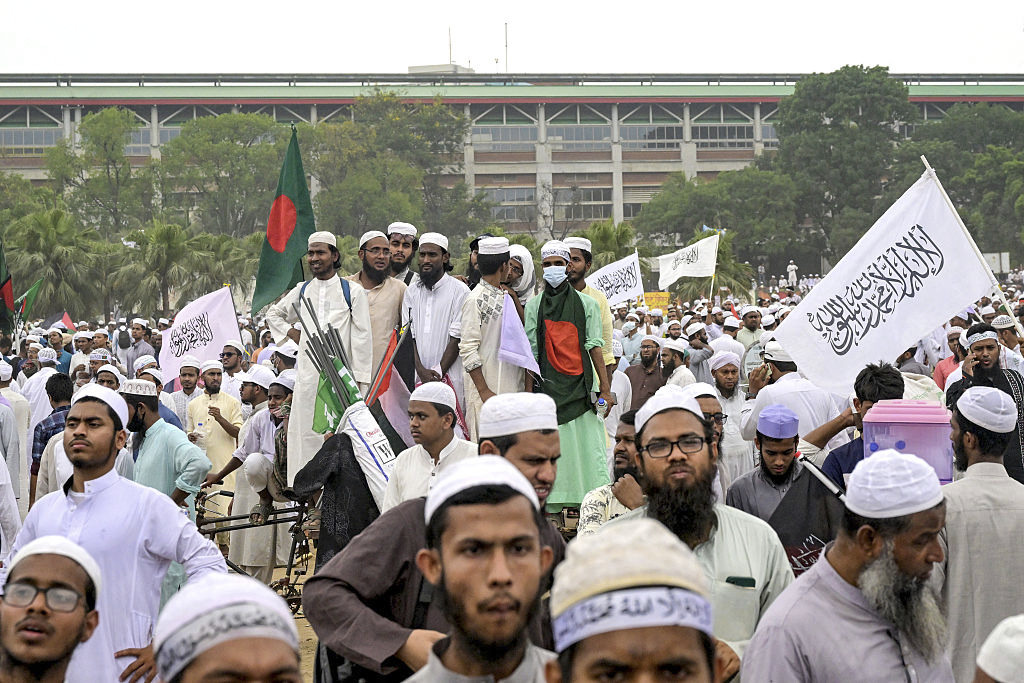
Instead of reinforcing the country's fragile democratic
foundations or supporting groups resisting extremism, US officials have
embarked on a sweeping outreach campaign to Bangladesh's most powerful
Islamist movements -- groups long tied to violence, sectarian hatred,
and the darkest chapters of the nation's past. Pictured: Participants at
an Islamist demonstration that drew hundreds of thousands of men, with
many carrying the Taliban flag, in Dhaka on May 3, 2025. The rally was
held to oppose a proposal to reduce legal discrimination against women.
(Photo by Munir Uz Zaman/AFP via Getty Images)
This month, an elderly Hindu couple in Bangladesh were murdered
in their home, their throats slit. This week, an Islamist group
targeted offices of India's High Commission in Bangladesh, causing India
to suspend visa services there.
Bangladesh is standing at the edge of a historic transformation, and, sadly, Washington is taking a perilous gamble.
Instead of reinforcing the country's fragile democratic foundations or supporting groups resisting extremism, US officials have embarked on a sweeping outreach campaign to Bangladesh's most powerful Islamist movements -- groups long tied to violence, sectarian hatred, and the darkest chapters of the nation's past. The result is an emerging strategic catastrophe: the legitimization of a coalition that once presided over genocide and now seeks to impose a Taliban-style political order on the world's fourth-largest Muslim-majority nation.
In recent months, US diplomats in Dhaka and visiting delegations from Washington have dramatically intensified their engagement with Bangladesh's Islamist forces, most prominently the Jamaat-e-Islami. In early 2025, US Embassy officials traveled to Sylhet to meet local Jamaat leaders -- a party directly implicated in mass murders, systematic rape, and repression during the 1971 Liberation War.
This Sylhet visit, not an isolated incident, appears part of a
sustained pattern of US interactions with Jamaat and its affiliates as
Bangladesh approaches elections in February 2026 -- the first since the
2024 uprising that toppled the government that was headed by the Awami League.
With Islamists and their partners dominating the polls, these
meetings amount to quiet recognition of a looming Islamist ascendancy.
Jamaat's long record leaves little room for doubt about its
intentions. Its diaspora networks have supported extremist causes for
decades; its senior leadership has publicly championed anti-Hindu,
anti-Christian, and anti-Jewish rhetoric; and its notorious student
wing, Islami Chhatra Shibir, was once ranked by Jane's Terrorism and Insurgency Centre as the world's third-most violent non-state armed group. Human rights reports from Australia and Canada have documented Jamaat-linked murders, petrol bombings, and sweeping attacks on Hindu neighborhoods.
Yet US engagement continues -- and is growing.
Throughout 2025, former ambassadors, senior US officials, and
representatives of publicly-funded American institutions such as the
International Republican Institute (IRI) and the National Democratic
Institute (NDI) held repeated meetings with Jamaat leaders.
The involvement of the IRI and NDI -- two vehicles of the US
political establishment -- marks a deeper policy continuity. For nearly
two decades, these institutions have facilitated Western engagement with
Islamist movements across the Middle East, North Africa, and now South
Asia.
In March, a US delegation sat down with Jamaat's top brass at its
headquarters. By June, the US Embassy had invited a formal Jamaat
delegation for discussions on "internal democracy" and "minority rights"
-- language astonishingly at odds with the group's ideological DNA.
In July, Tracey Ann Jacobson the US chargé d'affaires in Dhaka, paid a high-profile visit to Jamaat's leader, Shafiqur Rahman, a man who has called Jews "the enemy of humanity" and hailed Hamas commander Yahya Sinwar as a "hero". Months later, Rahman received
a US visa to meet American Jamaat networks and reportedly engaged with
both governmental and non-governmental actors across the United States.
US diplomats have not limited their attention to Jamaat. US officials also met repeatedly with the hardline party Islami Andolan Bangladesh (IAB), which openly vows to enforce sharia law nationwide and says
it admires the Taliban model. A coalition between Jamaat and IAB --
increasingly likely under the caretaker government -- would cement the
Islamists' grip on the political order.
The Bangladesh Nationalist Party (BNP), itself long aligned with
Jamaat, has participated in dialogues with American officials in London
and Washington, while BNP-Jamaat lobbying expenditures in the US run
into the millions.
From the early years of the "Arab Spring" to the rise of the 2012-13
Muslim Brotherhood regime in Egypt and the empowerment of Al-Islah in
Yemen, Washington's faith in "moderating" Islamists has produced a trail
of destabilized societies, collapsing pro-Western partners, and has
emboldened extremist networks.
IRI staff have met Jamaat, BNP and IAB figures multiple times
throughout 2025, including joint meetings with NDI personnel. These
efforts coincide with the interim regime of Muhammad Yunus – a
government openly favoring Islamist inclusion - and its attempts to cultivate Republican-aligned American institutions for international legitimacy.
A global race to court Jamaat
American overtures are part of a wider international scramble.
Bangladeshi media report that in 2025 alone, diplomats from at least 35
nations - from the US and UK to China, Russia, Saudi Arabia, Turkey,
Japan, and EU states - have sought meetings with Jamaat. Even the
group's student wing is reportedly being introduced to Western
delegations.
The message from foreign capitals appears clear: Jamaat may soon
govern Bangladesh, and preparing for that eventuality has become a
diplomatic priority.
An interim administration that enables extremism
The collapse of the Awami League government in 2024, after
Jamaat-backed protests, opened the door for Islamist normalization. The
Yunus-led interim administration has since allowed
extremist actors to regain legitimacy while presiding over intensifying
attacks on Hindus, Christians, political opponents, and independent
journalists.
In August 2024, a report released by the United Nations, stated
that BNP and "some members, supporters and local leaders" of
Jamaat-e-Islami were found to have committed a series of violent attacks
against political opponents as well as "members of the Hindu
community".
UN reports continue to log rising Islamist violence, including BNP–Jamaat-linked assaults on minorities.
Bangladesh is being pushed toward a destiny shaped not by democratic consensus, but by militant pressure.
Washington's belief that Jamaat-e-Islami or its Islamist allies can
evolve into "responsible stakeholders" mirrors the same strategic
delusions that once empowered the Muslim Brotherhood in Egypt and
Islamist factions from Yemen to Tunisia. The results of those
experiments -- repression, sectarianism, and regional instability -- are
now well documented, yet the United States appears ready to repeat
history in Bangladesh, a country of 180 million people perched between
South Asia's nuclear-armed rivals.
By legitimizing a theocratic alliance with a record steeped in blood,
the US is not moderating Islamists; it is emboldening them. The
question is no longer whether Bangladesh's future is at risk, but
whether Western policymakers are willing to recognize the disaster they
are helping to create before it is irreversible.
Salah Uddin Shoaib Choudhury is an award-winning
journalist, writer, and editor of the newspaper Blitz. He specializes in
counterterrorism and regional geopolitics. Follow him on X:
@Salah_Shoaib
Lectures focus on racism, white supremacy and cultivating belonging for 'minoritized' students
FOX EXCLUSIVE: More leaked PowerPoint
lectures from a first-year University of Illinois Urbana-Champaign class
show left-wing ideology interwoven into the fabric of the course.
Fox
News Digital obtained course material from weeks six and nine of EDUC
201, "Identity and Difference in Education," from a concerned student.
The course is taken by future teachers, and is part of the university's
education department.
Week nine's lecture is titled "Cultivating Belonging."
"Recent
data indicate that close to 40% of US high school students do not feel
connected to school. This sense of alienation is particularly acute
among students facing racism, LGBTQ+ students, and students with
disabilities. Evidence points to curricular and school structures that fail to engage many students as a primary reason students reject schooling
that devalues them, as opposed to rejecting school," says a slide early
in the presentation, quoting a paper from the Aspen Institute.
A
slide from a first semester 2025 lecture in an education course at the
University of Illinois Urbana-Champaign teaches about "cultivating
belonging."(Obtained by Fox News Digital)
The key to teaching about belonging, according to the presentation, is intersectionality.
"When
talking about belonging it's important to consider if we’re asking
students to conform to norms that don’t reflect their bodies of
knowledge (e.g., assimilation, erasure) or are we thinking about
belonging in culturally relevant and intersectional ways?" asks a slide
that is part of the lecture.
Another slide is called "Erasure of
Racially Minoritized Students." The entire slide is simply a quote from a
person named Xóchitl, identified as a ninth grader at Shields High School.
"When
you’re with your Mexican friends some white people don’t acknowledge
you when you’re in the hallways, and you see someone that you know and
it’s like they’re with their white friends, they don’t see you, but when
you’re playing sports, they know you’re there," Xóchitl's quote says.
"They start talking to you differently than when they talk to you
outside of sports."
Fox
News Digital reached out to the course's professor, Gabriel Rodriguez,
for clarification on the origin of the quote. He did not return a
request for comment.
Slide 14 of the lecture features a
three-minute video from Beverly Daniel Tatum, Ph.D., published by The
Root, a news outlet whose tagline is, "Black News and Black Views with a
Whole Lotta Attitude."
A
slide from an October 2025 education course lecture at the University
of Illinois Urbana-Champaign features a video of author Beverly Daniel
Tatum.(Obtained by Fox News Digital)
Tatum
is the author of "Why Are All the Black Kids Sitting Together in the
Cafeteria?" The book is a national bestseller. Tatum's video is titled,
"Why the Black Kids Still Sit Together."
"We're all influenced by
race and racism in our society," said Tatum in the video. Tatum is also
the president emerita of Spelman College, a historically Black college in Atlanta.
"If
you're growing up as a young person of color in the society, part of
that experience is to get messages from the wider world about who you
are racially, and how people are responding to that," she said.
"Residential segregation and school segregation
go together across," she said. "And to the extent that the schools and
the neighborhoods are segregated, it means that the social networks that
help you find employment, that help you access higher education, that
help you move up the economic ladder, are more limited — and that's a
problem."
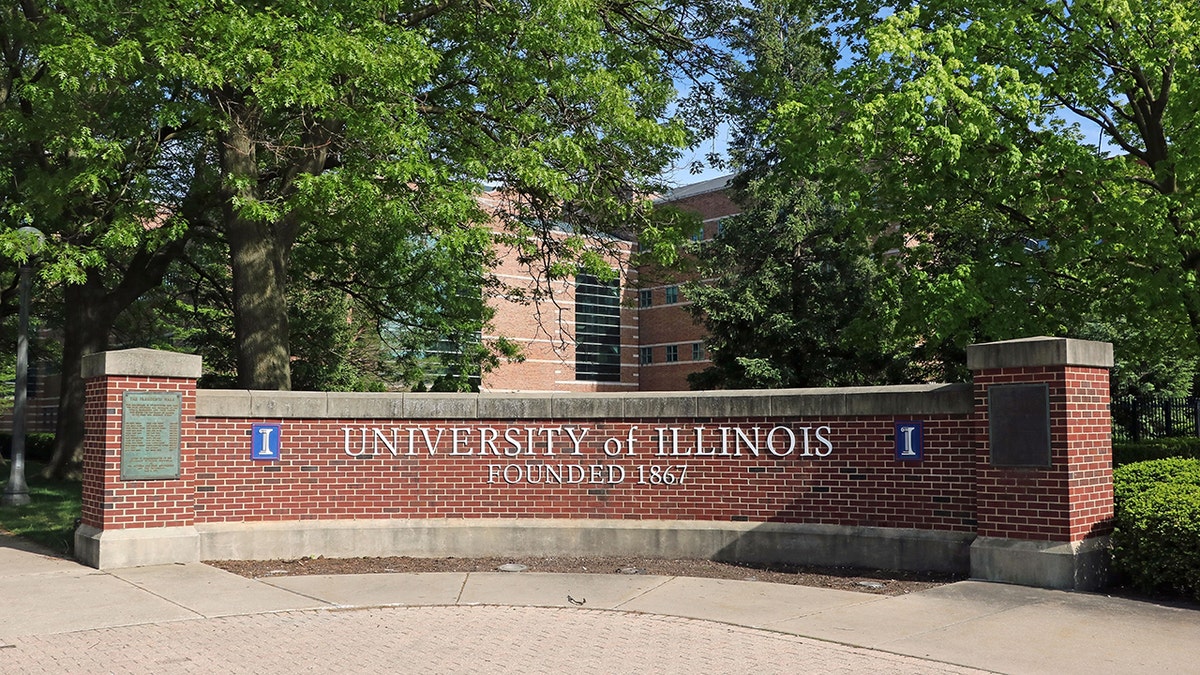
A
University of Illinois entry sign in Champaign, Illinois. The
University of Illinois is a state university in Urbana-Champaign,
Illinois. It offers teaching and research programs at both the
undergraduate and graduate levels to over 56,000 students. (Don and Melinda Crawford/UCG/Universal Images Group via Getty Images)
"We
are still dealing with racial hierarchies," Tatum continued. "We're
still dealing with white supremacy. We're still dealing with the kind of
systematic racism that impacts communities of color."
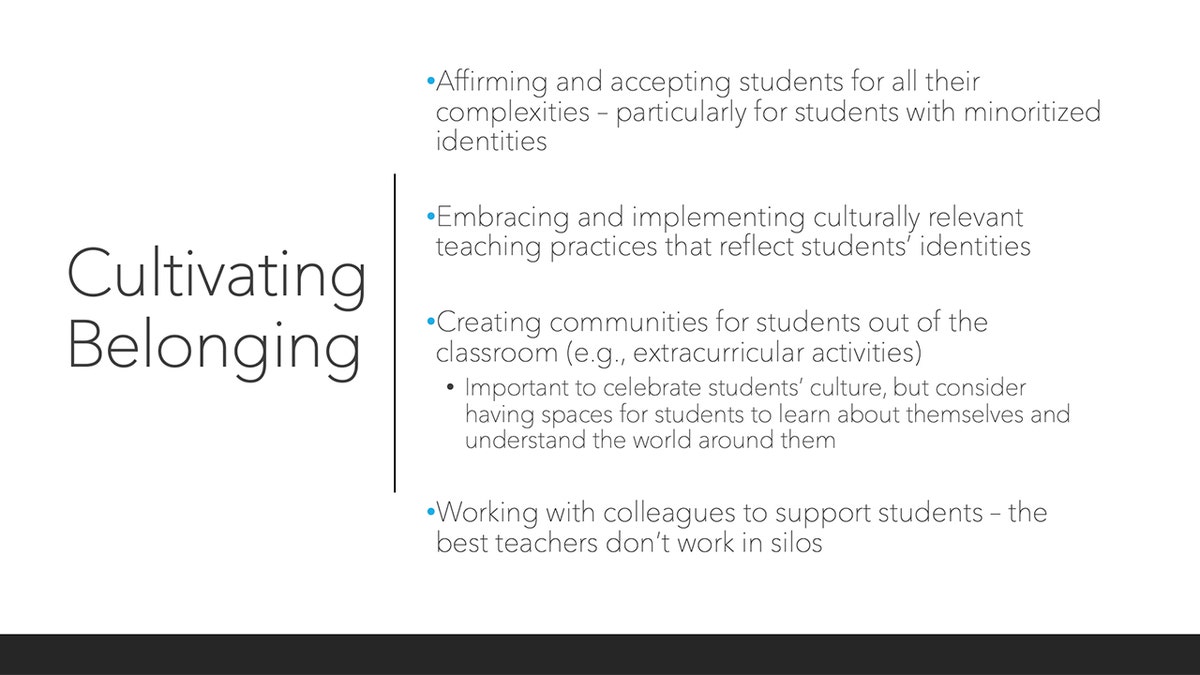
Toward the end of the lecture, a slide instructs the future educators on how to cultivate belonging.
"Affirming
and accepting students for all their complexities – particularly for
students with minoritized identities," says one point.
"Embracing and implementing culturally relevant teaching practices that reflect students’ identities," is another.
Week
six's lecture is called "Understanding the role of class in educational
inequality," and begins with a list of the top high schools in
Illinois.
It then discusses stereotypes of rural, suburban and
urban schools, noting that rural schools are often thought of as "poor"
and white, suburban schools are often thought of as "resource rich" and
white, and that urban schools are often thought of as "dysfunctional"
and "composed by students of color."
A slide from a lecture from September 2025 at the University of Illinois Urbana-Champaign focuses on stereotypes about schools.(Obtained by Fox News Digital)
"Class
inequality is increasing and part of everyday life in these contexts,"
says the next slide, followed by another slide quoting the author of a
book called "Radical Possibilities: Public policy, urban education, and a
new social movement," which says the federal government plays a
"proactive" role in maintaining the poverty of families and
neighborhoods where schools are "poorly funded, staffed, and
resourced..."
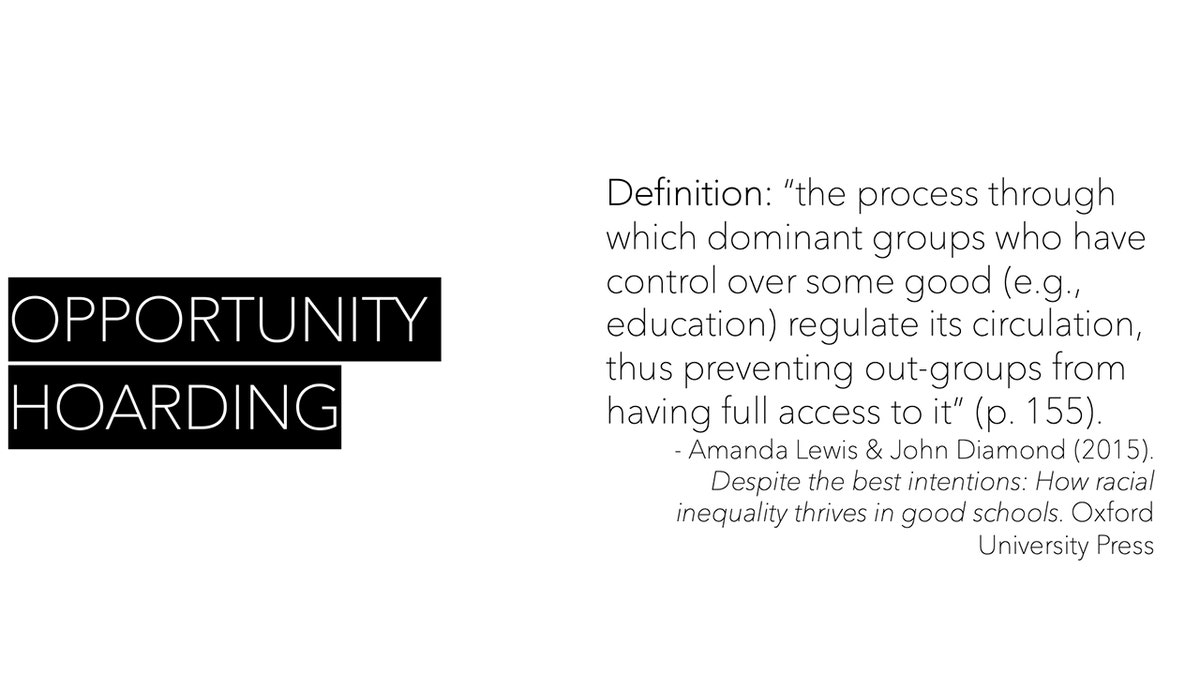
A concept called "Opportunity Hoarding," defined as
"the process through which dominant groups who have control over some
good (e.g., education) regulate its circulation, thus preventing
out-groups from having full access to it," is a major focus of the
lesson.
According
to the slides, that definition is derived from a 2015 book by Amanda
Lewis and John Diamond, called "Despite the best intentions: How racial
inequality thrives in good schools."
"Opportunity hoarding, such
as fundraising efforts of middle- and upper-middle class parents to
support school programming exacerbate existing resource gaps between
schools," one lecture slide says.
A slide from a September 2025 lecture at the University of Illinois Urbana-Champaign focuses on "opportunity hoarding." (Obtained by Fox News Digital)
"Opportunity
hoarding, such as resistance from middle- and upper-middle class
parents to de-track or to create open access to honors/AP courses
lessens educational opportunities for low-income students," says
another.
The University of Illinois Urbana-Champaign did not return a request for comment.
Lectures focus on racism, white supremacy and cultivating belonging for 'minoritized' students
Peter D'Abrosca is a reporter at Fox News Digital covering campus extremism in higher education.
Follow Peter on X at @pmd_reports. Send story tips to peter.dabrosca@fox.com.