Meanwhile, Washington has issued a short-term authorization permitting the sale of Iranian oil currently stranded at sea.
Nearly two dozen nations, most of them European, said in a joint
statement on Saturday that they are ready “to contribute to appropriate
efforts to ensure safe passage” through the Strait of Hormuz.
“We
condemn in the strongest terms recent attacks by Iran on unarmed
commercial vessels in the Gulf, attacks on civilian infrastructure
including oil and gas installations, and the de facto closure of the
Strait of Hormuz by Iranian forces,” read the statement of 22 countries.
“We
welcome the commitment of nations who are engaging in preparatory
planning,” the statement added, while urging an “immediate comprehensive
moratorium on attack on civilian infrastructure, including oil and gas
installations.”
The countries committed to helping the United
States are: Australia, Bahrain, Canada, the Czech Republic, Denmark,
Estonia, Finland, France, Germany, Italy, Japan, Latvia, Lithuania, the
Netherlands, New Zealand, Norway, Romania, Slovenia, South Korea,
Sweden, the United Arab Emirates and the United Kingdom.
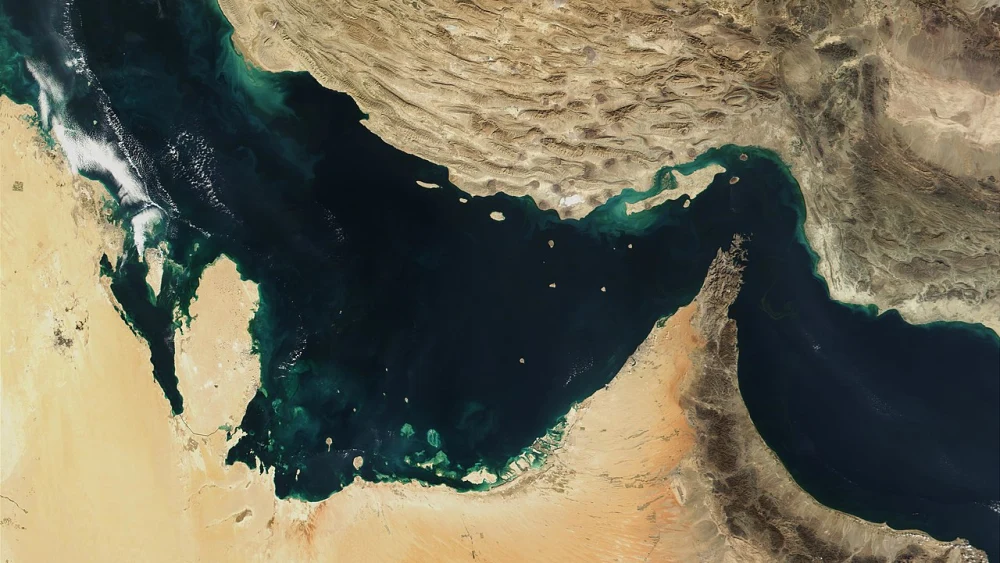
Some 20% of the world’s oil and gas flows routinely through the
Strait of Hormuz. The attacks on oil and gas infrastructure in Iran and
Gulf Arab states have led to rising energy prices globally.
Analytics firm Kpler recorded a decrease of 95% in the naval passageway from peacetime averages, AFP reported.
Meanwhile
on Friday, the Trump administration announced that it had temporarily
lifted sanctions on Iranian crude oil currently stranded at sea.
Explaining
the decision, U.S. Treasury Secretary Scott Bessent wrote on X that
sanctioned Iranian oil “is being hoarded by China on the cheap. By
temporarily unlocking this existing supply for the world, the United
States will quickly bring approximately 140 million barrels of oil to
global markets, expanding the amount of worldwide energy and helping to
relieve the temporary pressures on supply caused by Iran. In essence, we
will be using the Iranian barrels against Tehran to keep the price down
as we continue Operation Epic Fury.”
He said the short-term
authorization is strictly limited to oil that is already in transit and
does not allow new purchases or production. According to the Treasury
Department, the permit applies to oil loaded onto ships by 12:01 a.m.
Eastern Time on Friday, and will remain in effect until April 19.
“Further,
Iran will have difficulty accessing any revenue generated and the
United States will continue to maintain maximum pressure on Iran and its
ability to access the international financial system,” Bessent
continued.
The secretary added that “Any short-term disruption now
will ultimately translate into longer-term economic gains for
Americans—because there is no prosperity without security.”
Iran is the head of the snake for global terrorism, and through President Trump’s Operation Epic Fury, we are winning this critical fight at an even faster pace than anticipated. In response to Iran’s terrorist attacks against global energy infrastructure, the Trump…
— Treasury Secretary Scott Bessent (@SecScottBessent) March 20, 2026
The New York Times reported on Friday that Tehran has allowed
some friendly countries, including China, India, Pakistan, Malaysia and
Iraq, free passageway through the Strait of Hormuz.
Iranian legislators are mulling a transit fee for any ship crossing the narrow sea passage, the Times cited Iranian media as saying.
It
moreover cited the International Maritime Organization as reporting
that approximately 2,000 ships and 20,000 seafarers are currently
trapped in the area.
Since the start of the war on Feb. 28,
crossings through the Strait have plummeted from 130 vessels per day to
three or four daily, the report added.
"My operational assessment continues to be Iran's combat capability is on the steady decline," says Adm. Brad Cooper
The head of U.S. Central Command, Adm. Brad Cooper, said Saturday
that Iran’s ability to threaten the Strait of Hormuz has been "degraded"
and that U.S. forces "remain on plan to eliminate Iran's ability to
project meaningful power outside its borders."
Cooper said the U.S. carried out strikes using multiple 5,000-pound
bombs on an underground facility along Iran’s coastline. The site was
being used to store anti-ship cruise missiles, mobile launchers and
other equipment that presented a "dangerous risk to international
shipping."
"We not only took out the facility but also destroyed intelligence
support sites and missile radar relays that were used to monitor ship
movements," Cooper said in the video posted on X. "Iran's ability to
threaten freedom of navigation in and around the Strait of Hormuz is
degraded as a result and we will not stop pursuing these targets."
He also said that "we have built the most extensive air defense
umbrella in the world over the Middle East right now," adding that the
U.S. has hit 8,000 targets and 130 Iranian vessels in the three-week
war.
"My operational assessment continues to be Iran's combat capability is on the steady decline," he said.
The Strait of Hormuz is a critical artery for global commerce, with
about 20% of the world’s oil and gas supply passing through it under
normal conditions. Iran’s de facto blockade of the waterway, along with
repeated attacks on energy infrastructure across the region, has driven
energy prices sharply higher.
If Iran's regime and Hamas are allowed to recover, their primary strategic objective will likely become to rearm as quickly as possible, and we will be right back at war again.
The critical question is
whether we will stop at weakening the Iranian regime or Hamas or move
toward ensuring that they can never again recover as long-term threats
to their neighbors or global security. At this moment, leaving those
regimes in place – the ruling mullahs in Iran or Hamas in Gaza — is
probably the most dangerous option.
Authoritarian regimes such as Iran's, and terrorist groups such
as Hamas, Hezbollah, Islamic State and the Taliban, rarely respond to
setbacks by abandoning their ambitions. Instead, they pause, regroup,
and rebuild.
Russia and China, each with its own anti-American calculations,
could provide political cover, technological assistance, and indirect
support that would allow Iran to resume its nuclear program. China has
already been supplying Iran with "almost everything but troops" during
this war, and supplying Russia with military materiel for its war
against Ukraine.
If Iran's regime and Hamas are allowed to recover, their primary
strategic objective will likely become to rearm as quickly as possible,
and we will be right back at war again.
Stopping halfway through such efforts only allows threats to
reemerge dangerously in the future. History will judge whether these two
opportunities presented today were seized — or allowed to slip away.
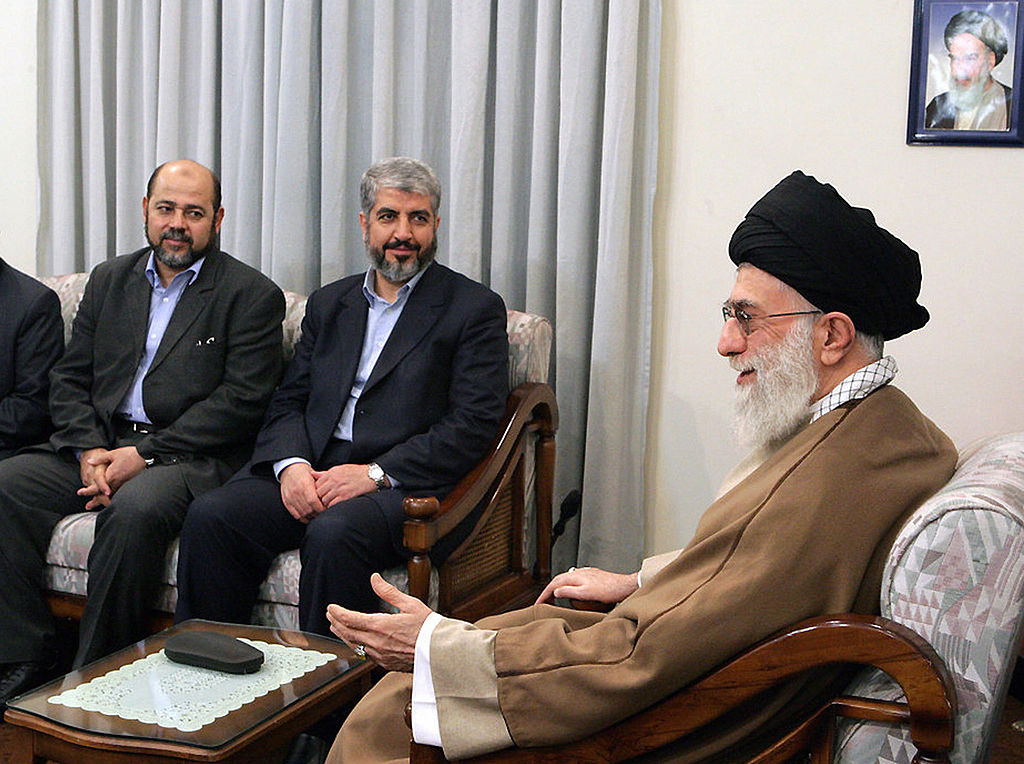
If Iran's regime and Hamas are allowed to recover, their
primary strategic objective will likely become to rearm as quickly as
possible, and we will be right back at war again. Pictured: Iran's then
"Supreme Leader" Ayatollah Ali Khamenei meets with Hamas leaders Khaled
Mashaal (center) and Mussa Abu Marzuk (left) in Tehran on February 1,
2009. (Photo by AFP via Getty Images)
What has taken place in recent weeks is nothing short of historic.
For decades, the Iranian regime and its proxies, including Hamas, have
operated with a sense of impunity. For decades, Iran's rulers have
expanded their regional influence, armed their proxy militias,
threatened their neighbors, and steadily advanced their weapons or mass
destruction programs. While various countries imposed sanctions and
Israel and the United States occasionally conducted limited military
responses, no large-scale effort was ever undertaken to fundamentally
weaken the political and military power deep inside Iran. That reality
has now changed dramatically.
Now, for the first time, both the Iranian regime and Hamas have
experienced direct and sustained military campaigns at a scale they had
long assumed would never occur.
Strategic air strikes have damaged key Iranian facilities, command
centers, and military infrastructure. Defense networks, missile
production facilities and launchers and military bases have been
targeted -- significantly limiting Iran's ability to project power
beyond its borders. Many elements of its naval capabilities have also
been struck, reducing its capacity to threaten international shipping
lanes and regional maritime security.
These developments already represent a remarkable shift in the
strategic balance of the Middle East. No American president or coalition
of countries had ever dared to seriously challenge the Iranian regime
or any of its proxies. The military infrastructures that both Iran and
Hamas had spent decades building and protecting, have now been
significantly degraded. Their leadership structures have been shaken,
and their ability to coordinate attacks, disrupted. These developments
demonstrate that malign actors, long viewed as untouchable, are in fact
quite vulnerable when confronted with sustained and coordinated
pressure.
Despite these achievements, however, the world now faces an extremely
dangerous turning point. The question is no longer whether the Iranian
regime or Hamas can be weakened — they clearly can. The critical
question is whether we will stop at weakening the Iranian regime or
Hamas or move toward ensuring that they can never again recover as
long-term threats to their neighbors or global security. At this moment,
leaving those regimes in place – the ruling mullahs in Iran or Hamas in
Gaza — is probably the most dangerous option.
Authoritarian regimes such as Iran's, and terrorist groups such as
Hamas, Hezbollah, Islamic State and the Taliban, rarely respond to
setbacks by abandoning their ambitions. Instead, they pause, regroup,
and rebuild. If the Iranian regime is allowed to survive this moment and
regain stability, it will almost certainly dedicate its remaining
resources to achieving what it has long sought: nuclear weapons. Such
weapons in Iran's hands would fundamentally change the strategic
landscape of the Middle East and provide the regime with a powerful
shield against future military pressure.
It would be naïve to assume that the Iranian regime and Hamas will
abandon their ambitions even after the destruction they have
experienced. On the contrary, the leaders in Tehran will most likely
conclude that their greatest strategic mistake was not obtaining nuclear
weapons sooner. If they had possessed nuclear deterrence before this
conflict, they might believe that the United States and Israel would
never have dared to launch such a campaign against them. This
realization could accelerate their determination to acquire nuclear
weapons at any cost.
There are several potential pathways through which the regime could
attempt to achieve this objective. One path is that Iran still possesses
hidden stockpiles of enriched uranium or possibly undisclosed
facilities capable of rapidly producing nuclear material. Over the
years, the regime has demonstrated considerable skill in concealing
aspects of its nuclear program. Even if many facilities have been
destroyed, the possibility that covert infrastructure remains cannot be
dismissed.
Another possibility involves rapid reconstruction of the nuclear
program once the conflict subsides. If the regime survives and external
pressure weakens, it could quietly rebuild its nuclear infrastructure in
secret locations. Advances in technology, as well as lessons learned
from past international inspections, could allow the regime to move
faster and more discreetly than before.
There is also the possibility of external assistance. Countries that
view the United States and its allies as strategic rivals may see value
in preserving the Iranian regime as a geopolitical partner. Nations such
as North Korea and Pakistan already possess nuclear capabilities and
have historically engaged in military technology exchanges with other
states. Russia and China, each with its own anti-American calculations,
could provide political cover, technological assistance, and indirect
support that would allow Iran to resume its nuclear program. China has
already been supplying Iran with "almost everything but troops" during this war, and supplying Russia with military materiel for its war against Ukraine.
If Iran's regime and Hamas are allowed to recover, their primary
strategic objective will likely become to rearm as quickly as possible,
and we will be right back at war again.
For Iran, a single nuclear weapon can destroy an entire city. In a
region as densely populated and strategically sensitive as the Middle
East, the consequences would be catastrophic not only to Israel but to
its neighbors in the Gulf. Even the possibility of nuclear weapons use
would introduce a level of instability and fear that would reshape
global politics.
Finally, today, the strategic landscape has shifted. The regimes have
been weakened and their military infrastructures severely damaged. This
situation represents a historic turning point. What has already been
accomplished by the United States and Israel is breathtaking. Stopping
halfway through such efforts only allows threats to reemerge dangerously
in the future. History will judge whether these two opportunities
presented today were seized — or allowed to slip away.
Dr. Majid Rafizadeh is a political scientist,
Harvard-educated analyst, and board member of Harvard International
Review. He has authored several books on the US foreign policy. He can be reached at dr.rafizadeh@post.harvard.edu
In a region too often dominated by arsonists, the United Arab Emirates stands for something rarer and far more valuable: order, courage, legitimacy, and the conviction that peace is not weakness, but strength.
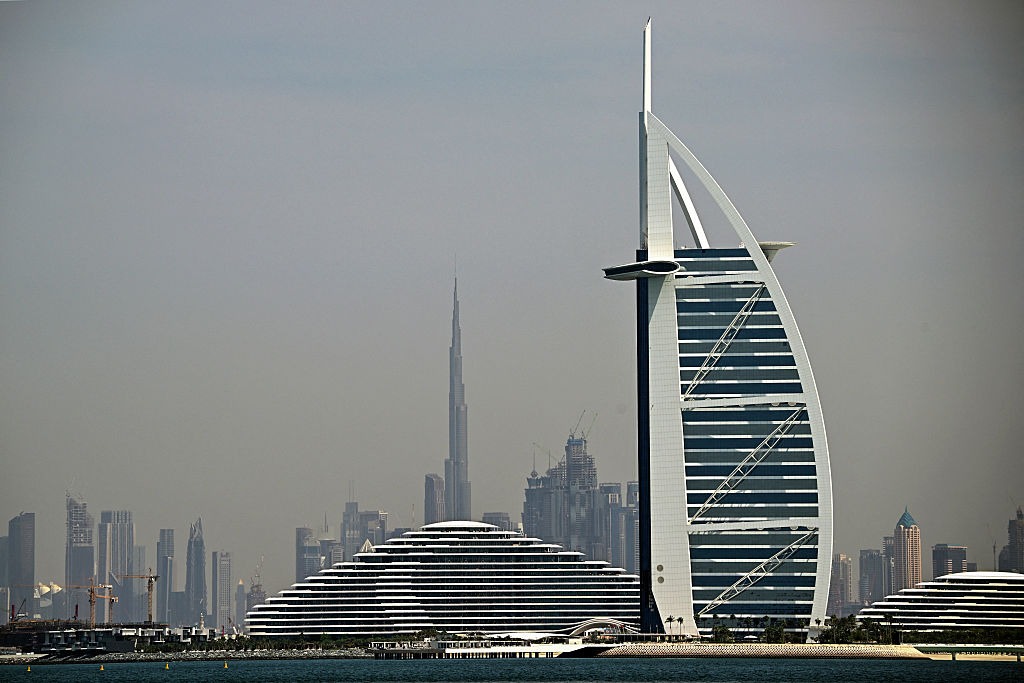
In a region too often dominated by arsonists, the United
Arab Emirates stands for something rarer and far more valuable: order,
courage, legitimacy, and the conviction that peace is not weakness, but
strength. Pictured: The city skyline is pictured in Dubai on March 11,
2026.(Photo by Giuseppe Cacace/ AFP via Getty Images)
At a time when much of the Middle East remains trapped between
revolutionary slogans and recurring violence, the United Arab Emirates
has chosen a different path: order over chaos, statehood over militias,
modernity over ideological ruin. For years, the UAE has worked to build a
future-focused nation anchored in innovation, economic dynamism,
strategic openness, and institutional strength. It has sought to project
the image — and the reality — of an Arab state confident enough to
embrace progress, invest in peace, and defend stability.
That is precisely why Iran and its proxies find the UAE so intolerable.
The success of the Emirates is not merely economic. It is political,
strategic, and civilizational. It demonstrates that an Arab country does
not need to surrender to the logic of militias, sectarian intimidation,
or permanent confrontation in order to be strong. It can be sovereign,
modern, secure, and globally connected. It can invest in opportunity
instead of grievance. It can build instead of destroy. That example is a
direct rebuke to the worldview promoted by the Iranian regime and the
armed networks it has spent decades cultivating across the region.
Recent events have made that reality impossible to ignore. The
dismantling by Emirati authorities of a terrorist network allegedly
linked to Iran and Hezbollah is not simply a law-enforcement success
story. It is the exposure of a method. The network reportedly operated
under fictitious commercial cover and was allegedly involved in money
laundering, terrorism financing, and activities threatening the
country's national security and financial stability. This is not
incidental. It reflects the deeper logic of Iranian power projection:
not merely open confrontation, but covert penetration; not only military
pressure, but financial infiltration; not just proxies on battlefields,
but shadow networks working quietly inside sovereign states.
In other words, Iran's aggression is not confined to missiles,
drones, or inflammatory rhetoric. It extends into the commercial sphere,
the banking sphere, and the strategic vulnerabilities of the modern
state. The aim is not only to intimidate, but to corrode. To create
insecurity from within. To force governments to operate under the
permanent shadow of destabilization.
What the UAE has shown is that it will not yield to that pressure.
This is what makes the Emirati response so important. The UAE has not
retreated into panic. It has not allowed aggression to derail its
national ambitions. It has not abandoned its model of development, its
investment climate, or its strategic commitment to regional stability.
Instead, it has responded as a serious state should respond: by
defending its citizens, protecting its territory, reinforcing its
institutions, and continuing to move forward.
That is resilience — not as a slogan, but as a governing doctrine.
Under international law, every sovereign state has the right, and
indeed the obligation, to defend its population and territory against
armed threats, covert subversion, and terrorist penetration. The UAE's
determination to protect its infrastructure, its economy, and its public
safety is therefore not an act of excess. It is an affirmation of
sovereignty and legality. A state does not need to apologize for
defending itself. Nor should it be expected to tolerate networks
designed to weaken its security from within.
This is where the credibility of His Highness Sheikh Mohamed bin
Zayed Al Nahyan becomes central. Under his leadership, the UAE has
become one of the clearest examples in the Arab world of disciplined
strength. He has guided the country with a strategic vision that rejects
both passivity and recklessness. The Emirati model under Mohamed bin
Zayed is not built on theatrical rage or ideological posturing. It is
built on patience, institutional seriousness, technological advancement,
and a clear understanding that national strength comes not only from
deterrence, but from the ability to build, endure, and inspire
confidence.
He has driven the UAE into modernity without allowing it to lose its
strategic bearings. He has strengthened the state without allowing
extremism to define its posture. He has shown that leadership in the
modern Middle East requires more than rhetoric: it requires composure
under pressure, clarity of purpose, and the ability to transform
national ambition into durable policy.
Nowhere is that clearer than in the UAE's commitment to peace with Israel.
For the Iranian regime and its regional clients, normalization,
coexistence, and regional cooperation are intolerable because they
threaten the very foundations of their political narrative. Peace
weakens the appeal of revolutionary confrontation. Prosperity undercuts
the politics of grievance. Partnership exposes the bankruptcy of endless
militancy. The Abraham Accords were therefore never merely diplomatic
symbolism. They represented a strategic reordering of the region — one
in which Arab states could openly choose cooperation, innovation, trade,
and stability over perpetual conflict.
The UAE has not allowed Iranian aggression to reverse that choice.
That matters profoundly. Because the true answer to Tehran's model is
not simply retaliation. It is the construction of an alternative order:
one based on sovereignty, lawful statehood, economic growth, and
pragmatic peace. Iran exports coercion. The UAE invests in connectivity.
Iran relies on proxies and destabilization. The UAE has chosen
development and strategic partnership. Iran thrives on fear. The UAE
continues to build a future.
That is why the Emirates deserves recognition. Not only for
dismantling covert threats and defending its citizens, but for refusing
to let intimidation dictate its destiny. The country's message is
unmistakable: the path to peace will not be abandoned, the march toward
modernity will not be halted, and a sovereign Arab state has every right
to defend itself while continuing to pursue prosperity.
In a region too often dominated by arsonists, the UAE stands for
something rarer and far more valuable: order, courage, legitimacy, and
the conviction that peace is not weakness, but strength.
"The year 2025 was marked by a deepening crisis for religious minorities in Pakistan, characterized by entrenched legal discrimination, rising mob violence, and a climate of near-total impunity for perpetrators." — 2025 report by "Voice of Pakistan Minority."
Pakistan, included by US
President Donald J. Trump in his "Board of Peace" for the Gaza Strip,
nevertheless continues to be one of the most dangerous countries for
Christians and other non-Muslims. International watchdog organizations
continue to rank Pakistan among the most difficult countries for
Christians.
The same day Masih was murdered, United States Commission on
International Religious Freedom (USCIRF) thankfully issued its 2026
report, in which it urged the US government to redesignate Pakistan as a
"Country of Particular Concern" (CPC), under the International
Religious Freedom Act of 1998, over systematic and ongoing violations of
religious freedom.
USCIRF also called for lifting an existing waiver that exempts
Pakistan from penalties available with the designation. In addition,
USCIRF calls for targeted sanctions on Pakistani officials and
government agencies responsible for severe violations of religious
freedom by freezing those individuals' assets and/or barring their entry
into the US under human rights-related financial and visa authorities,
citing specific religious freedom violations.
USCIRF additionally called for holding accountable individuals
who incite or participate in vigilante violence, targeted killings,
forced conversion, and other religiously based crimes. It noted: "The
U.S. Congress should incorporate religious freedom concerns into its
larger oversight of the U.S.-Pakistan bilateral relationship through
hearings, letters, resolutions, and congressional delegations and
advocate for the release of FoRB [Freedom of Religion or Belief]
prisoners in Pakistan."
Pakistan would seem hardly the most helpful member for any real "Board of Peace."
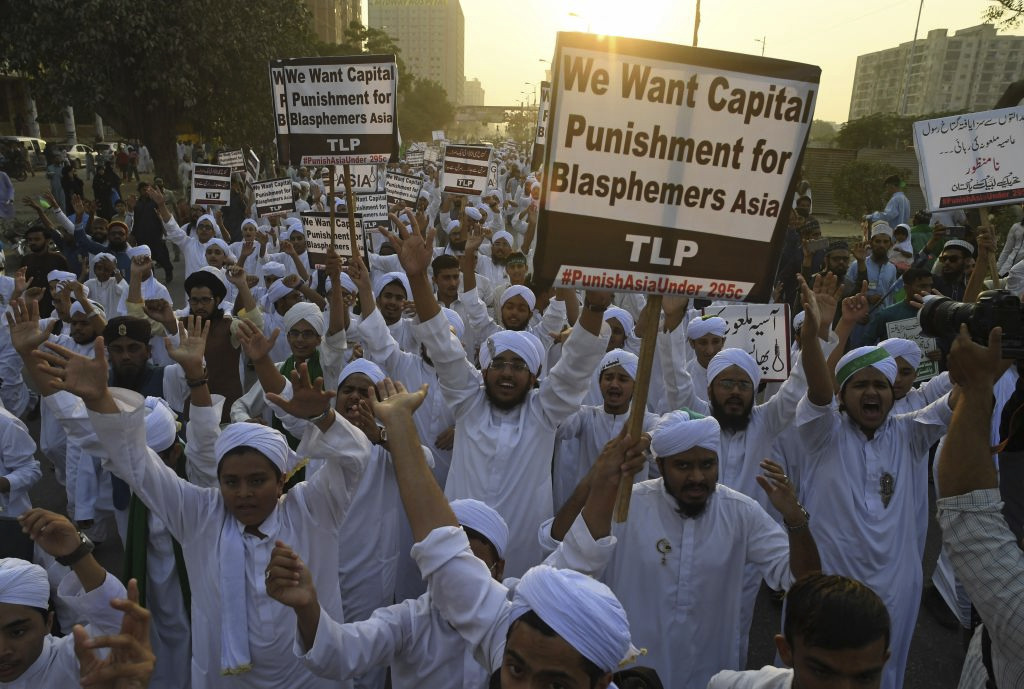
In March 2025, Zohaib Iftikhar, a Muslim, slit the throat of
his coworker, Waqas Masih, a 22-year-old Christian, after accusing him
of committing blasphemy by touching an Islamic textbook with "unclean
hands." Pictured: Thousands of people at a rally in Karachi, demanding
the execution of Asia Bibi, on November 21, 2018. Bibi, a Christian
woman, spent 8 years on death row because of a false accusation of
blasphemy, before being released and exiled. (Photo by Asif Hassan/AFP
via Getty Images)
Pakistan, included by US President Donald J. Trump in his "Board of
Peace" for the Gaza Strip, nevertheless continues to be one of the most
dangerous countries for Christians and other non-Muslims. International
watchdog organizations continue to rank Pakistan among the most
difficult countries for Christians.
On Open Doors' 2026 World Watch List, which assesses persecution faced by Christians worldwide, Pakistan again ranks
eighth. The report cited systemic discrimination, mob violence, forced
conversions, bonded labor, and gender-based abuses, noting that
perpetrators often act with impunity.
According to a 2025 report by the organization "Voice of Pakistan Minority":
"The year 2025 was marked by a deepening crisis for
religious minorities in Pakistan, characterized by entrenched legal
discrimination, rising mob violence, and a climate of near-total
impunity for perpetrators.
"Christians, Hindus, and other non-Muslim minorities faced a
combination of physical attacks, forced displacement, and structural
exclusion. The Christian community remained particularly vulnerable to
accusations of blasphemy that rapidly escalated into collective
punishment, with mobs burning churches, targeting homes, and destroying
livelihoods in affected neighborhoods. Hindus and smaller communities
continued to report forced conversions, abductions, and coerced
marriages of women and girls, often in contexts where access to
effective legal remedies was severely constrained by corruption,
intimidation, and bias."
On March 4, a 21-year-old Christian farmworker in Pakistan's Punjab Province, Marcus Masih, was tortured to death by his Muslim employers, who then tried to stage the murder scene as a suicide by hanging, the victim's brother said.
The same day Masih was murdered, United States Commission on International Religious Freedom (USCIRF) thankfully issued
its 2026 report, in which it urged the US government to redesignate
Pakistan as a "Country of Particular Concern" (CPC), under the
International Religious Freedom Act of 1998, over systematic and ongoing
violations of religious freedom.
USCIRF also called for lifting an existing waiver that exempts
Pakistan from penalties available with the designation. In addition,
USCIRF calls for targeted sanctions on Pakistani officials and
government agencies responsible for severe violations of religious
freedom by freezing those individuals' assets and/or barring their entry
into the US under human rights-related financial and visa authorities,
citing specific religious freedom violations.
USCIRF additionally called for holding accountable individuals who
incite or participate in vigilante violence, targeted killings, forced
conversion, and other religiously based crimes. It noted:
"The U.S. Congress should incorporate religious freedom
concerns into its larger oversight of the U.S.-Pakistan bilateral
relationship through hearings, letters, resolutions, and congressional
delegations and advocate for the release of FoRB [Freedom of Religion or
Belief] prisoners in Pakistan."
The Christian Daily International reported that Marcus Masih's murder reflects
broader vulnerabilities faced by religious minorities in Pakistan. The
country's stratified social system confines Christians, Hindus, and
other religious minorities to low-wage and dangerous jobs in informal
sectors. In recent years, several high-profile cases have underscored
these concerns.
In February 2025, Christian laborer Wasif George was abducted
by Muslim landowners, humiliated and paraded on a donkey after being
accused of stealing wood. Images and videos of the assault circulated
widely on social media. Despite pleas from his family, none of the main
perpetrators was arrested.
In March 2025, Zohaib Iftikhar, a Muslim, slit the throat
of his coworker, Waqas Masih, a 22-year-old Christian, after accusing
him of committing blasphemy by touching an Islamic textbook with
"unclean hands."
In May 2025, Christian laborer Kashif Masih
was tortured to death by a group of Muslims, including a former police
officer, over an unproven allegation of theft. The murder sparked
outrage among minority-rights groups, who criticized authorities for
failing either to prevent or promptly prosecute such crimes.
In June 2024, 18-year-old Catholic worker Waqas Salamat
was tortured to death by his Muslim employer and others for allegedly
leaving his job without permission. His family said he was subjected to
hours of eventually fatal electric shocks.
"In 2025, religious freedom conditions in Pakistan
continued along a troubling trajectory. The government continued to
enforce its strict blasphemy law, impacting people of all faiths,
including religious minorities. Increasing vigilante attacks and mob
violence targeting religious minorities, specifically Ahmadiyya Muslims
and Christians, contributed to an intensified climate of fear and
intolerance.
"Authorities continued to wield the blasphemy law and its death
penalty provision to punish those deemed to have insulted Islam."
In January 2025, four individuals were sentenced to death for allegedly posting blasphemous content on social media.
Also, a mentally challenged Christian man, Farhan Masih, was imprisoned on charges of blasphemy and terrorism. Despite being acquitted, he could not return to his village due to fear for his safety.
In March 2025, the Lahore High Court removed
from its case list Junaid Hafeez's appeal hearing related to charges of
blasphemy. Hafeez — a former visiting lecturer at the Department of
English Literature of the Bahauddin Zakariya University — was arrested
by police in 2013, and his trial started in 2014. Authorities have held
Hafeez in solitary confinement since 2014. He was sentenced to death in
2019 on blasphemy charges. His appeal against the sentence has been
pending since 2020.
In October, a high court finally acquitted
Christian pastor Zafar Bhatti of blasphemy charges after 13 years in
prison. Days after his release, after years of medical neglect, Bhatti
succumbed to cardiac arrest.
Violent attacks against religious minorities continue with impunity. Days after a Christian man's throat was slit
over a false blasphemy allegation arising from his refusal to renounce
his faith, a Hindu man, Nadeem Naath, a 56-year-old Hindu, was shot to death in Peshawar by a Muslim, Muhammad Mushtaq, after refusing to convert to Islam, on March 29.
Last September, two gunmen attacked
Christian pastor Kamran Naz as he traveled to Islamabad to lead a
church service. He had previously received death threats and was accused
of "proselytizing among Afghan refugees."
Reports of forced conversions among Hindu and Christian girls in Punjab and Sindh Provinces persisted throughout 2025.
In February, a 12-year-old Christian, Saba Shafique, was reportedly abducted in Sindh Province, forcibly converted to Islam, and married to a 35-year-old man, Muhammad Ali.
In July, the Sindh Human Rights Commission expressed
concern about the abduction and forced conversion to Islam of a
15-year-old Hindu girl, Shahneela. Her uncle said in a police report
that two armed men had forcibly entered the family's home in Matli and
kidnapped Shahneela.
Additionally, although Pakistan's constitution establishes Islam as
the state religion, a 1974 amendment declared Ahmadis as non-Muslims,
thereby excluding them from political representation and equal voting
rights.
"Throughout Pakistan, authorities continued to impose
restrictions on Ahmadiyya Muslims' ability to practice their faith and
allowed for assaults against Ahmadiyya mosques. In February, a mob of
TLP members destroyed minarets of an Ahmadiyya mosque in Sialkot without
police intervention. In October, three gunmen attacked an Ahmadiyya
mosque in Rabwah, wounding six worshipers. No group claimed
responsibility for the attack.
"In March, authorities arrested dozens of Ahmadiyya Muslims,
including children, for offering Friday prayers. Days later, police
issued two First Instance Reports against two dozen Ahmadiyya Muslims,
based on a complaint from TLP members that the community was sacrificing
animals for Eid-ul-Adha.
"In April, a mob affiliated with the TLP stormed an Ahmadiyya mosque
to prevent the community from offering Friday prayers. During the
attack, the mob beat to death an Ahmadiyya man, Laeeq Cheema. Police
allegedly did not intervene to stop the attack."
Christian community members criticized
the Pakistani government for failing to deliver justice and
accountability for the 2023 Jaranwala attacks, during which mobs
destroyed homes belonging to Christians and churches, after allegations
of blasphemy.
Last June, Christian communities accused
authorities of ignoring evidence after a Pakistani court acquitted 10
Muslims involved in burning a church during the 2023 Jaranwala attacks.
In August, victims of those attacks held protests to mark the two-year
anniversary and repeated calls for government action.
In May, Pakistan's National Assembly unanimously passed
the Islamabad Capital Territory Child Marriage Restraint Bill to curb
child marriages and, by extension, the forced conversions of underage
girls. Under this legislation, those who facilitate or coerce a child
into marriage, including family members or clerics, can face up to seven
years' imprisonment. The question remains: Will anyone actually enforce
this law?
Pakistan's Council of Islamic Ideology strongly opposed the bill and
declared it "un-Islamic" for not conforming with Islamic injunctions.
Jamiat Ulema-i-Islam-Fazl (JUI-F) chief Maulana Fazlur Rahman called for
rallies protesting the law. Leaders of the Mili Yakjethi Council (MYC)
similarly condemned the bill, calling it "un-Islamic" and
unconstitutional.
In 2025, several attacks or threats of violence against places of worship took place.
In February, the US Embassy in Islamabad reported that
Tehreek-e-Taliban (TTP) threatened to attack Faisal Mosque. In response,
the embassy prohibited US employees from traveling to the area. In
March, at least six people, including a chief clerk, were killed by a
suicide attack after Friday prayers at an Islamic seminary in northern
Pakistan.
Pakistan's estimated population is 252 million, of which 96.5% are
Muslim (85-90% Sunni and 10-15% Shi'a) and 3.5% belong to other
religious communities, including Christians and Hindus, and perhaps fewer than 200 elderly Jews, if that, who might try to pass as Parsis.
Pakistan would seem hardly the most helpful member for any real "Board of Peace."
Uzay Bulut, a Turkish journalist, is a Distinguished Senior Fellow at Gatestone Institute.
Magen David Adom paramedics were earlier dispatched to a scene in northern Israel to treat five individuals for mild, shrapnel-related injuries.
View of Dimona, in southern Israel. August 13, 2016.(photo credit: MOSHE SHAI/FLASH90)
A
building in Dimona collapsed as a result of an impact from an Iranian
munition on Saturday evening after sirens sounded in southern and
northern Israel.
Israeli media reported that the shrapnel potentially hit a school in the southern Israeli city.
Magen
David Adom teams are treating some 20 people with mild injuries from
shrapnel at various locations in Dimona. Notably, a 10-year-old child is
in moderate condition.
Israel
Police and Border Guard officers were dispatched to conduct scans for
shrapnel that reportedly fell in the Negev region and the western
Galilee area after the IDF intercepted the missiles.
Earlier,
MDA paramedics were dispatched to a scene in northern Israel to treat
five individuals for mild, shrapnel-related injuries.
Footage
circulated from Israeli media showed impacted buildings, and reported
that at least three people were injured in Ma'alot.
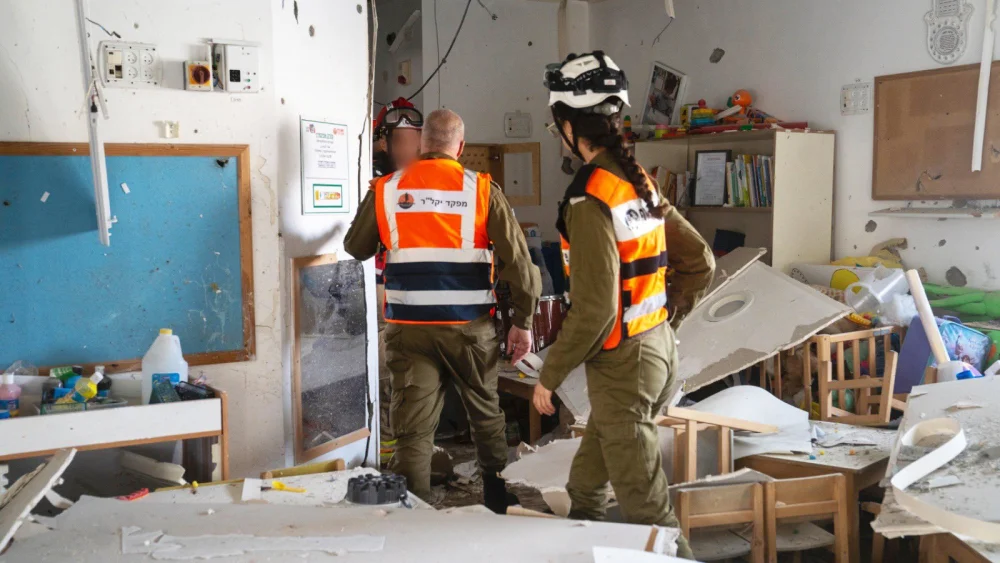
Earlier on Saturday, a kindergarten in Rishon Lezion was reportedly damaged after a suspected cluster missile launched from Iran targeted the Gush Dan area in central Israel.
Security forces working at the Kindergarten damaged during an Iranian missile barrage. (credit: AVSHALOM SASSONI)
Initial
reports suggest that shrapnel caused significant damage tothe
structure, with no direct missile impact reported. MDA said a man in his
70s was lightly injured while making his way to a shelter. The Shamir
Medical Center said a man in his 40's was treated for mild injuries
sustained from a blast in Rishon Lezion.
The
missile is believed to have weighed around 100 kilograms, according to
Hebrew media, though this has not been officially confirmed. The
incident appears to be another example of a splitting warhead, which has
been used in previous missile strikes on central Israel.
Initial
reports suggested over 20 impact sites across central Israel, including
in Rishon Lezion, Bnei Brak, Shoham, and Rosh Ha'ayin. MDA later
confirmed at least seven impact sites in Rishon Lezion, including damage
to two residential buildings.
The IDF said Home Front Command search and rescue forces were operating at several impact sites and urged the public to avoid gathering in these areas.
In
a missile barrage launched from Lebanon targeting northern Israel early
Saturday afternoon, a residential building in Metula was damaged. No
injuries were reported.
Sirens
sounded across northern Israel on Saturday afternoon amid reports that
several drones had entered Israeli territory from Lebanon. The IDF said
it was working to intercept the threats. No injuries were reported.
“The strength of the home front is what allows us to keep going"
Defense
Minister Israel Katz said on Saturday that Israel would continue its
campaign against Iran for as long as necessary, stressing that the
operation would not be halted by the upcoming Passover holiday.
Talking
to reporters at a missile impact site in Rishon Lezion, Katz said
Israel’s ability to press ahead depends in large part on the resilience
of the civilian home front, and said the fighting would continue until
its objectives are met.
“The
strength of the home front is what allows us to keep going, and we will
continue until the objectives are achieved,” he said.
Katz
said 11 impact sites had been identified in the city, and accused Iran
of using weapons that amount to a war crime. Katz added that such
conduct was consistent with what he described as the behavior of a
terror regime.
Education system in Rishon Lezion to remain closed, mayor says
“We
will restore everything to its original state,” Rishon Lezion Mayor Raz
Kinstlich said while visiting the site of the struck kindergarten on
Saturday morning.
“The
windows were blown out, with some landing on the other side of the
street,” he said. “This is a kindergarten, a place where children were
supposed to learn,” he continued, emphasizing that, fortunately, the
children were not at the kindergarten during the strike, as schools are
closed on Shabbat.
"There’s
a hole in the ceiling. You can see it outside. Until I feel secure, the
education system in Rishon Lezion will not return. I want to thank the
residents for their discipline.”
Iran has launched dozens of missiles with cluster munition warheads at Israel since the beginning of Operation Roaring Lion,
posing a challenge for Israel's missile defense shield, as they need to
be hit before they split and disperse into smaller explosives.
Cluster
munitions open in mid-air and scatter as many as several hundred
"bomblets" over a wide area. They often fail to explode, creating
virtual minefields that can kill or injure anyone who finds them later.
Shrapnel hits Jerusalem's Old City
On Friday, sirens rang across the country as Iran launched a missile barrage
targeting large areas in central Israel and the Jerusalem area.
Shrapnel fell in the Jewish Quarter of Jerusalem's Old City and Rehovot,
causing damage but no major injuries. MDA reported that an elderly
woman was injured while running to the shelter, and another elderly man
was treated for minor injuries in Rehovot.
Later,
a second barrage hit Rehovot, injuring a woman and starting a fire in a
building. Two others were treated for shrapnel injuries, and several
others for panic-related causes. Shrapnel also fell in the Judean
Foothills, with two people lightly injured.
In Haifa, shrapnel caused damage at the Bazan oil refinery, prompting controlled explosions over the weekend.
On
Thursday night, additional missile strikes caused shrapnel damage in
Jerusalem and northern Israel, but no casualties were reported.
Reuters and James Genn contributed to this report.
“This is a war crime, but it is not surprising because the Iranian regime is a terrorist regime,” Defense Minister Israel Katz said at the scene.
A bomb from an Iranian cluster
munition struck a kindergarten in Rishon Letzion, south of Tel Aviv, on
March 21, 2026. Credit: IDF.
Iran and Hezbollah in Lebanon continued to fire missiles at Israel on
Saturday, wounding at least one person and damaging property, including
a kindergarten in the central city of Rishon Letzion.
The morning strike in Rishon Letzion was caused by a cluster munition whose bombs struck 11 sites in the city.
פיצוץ ענק באמצע גן הילדים: תיעוד רגע הפגיעה בזירה בראשון לציון @hadasgrinberg
“We were lucky there were no children here. A major disaster was
averted,” Deputy Mayor Avi Haim was quoted as saying while visiting the
scene.
The mayor, Raz Kinstlich, told Ynet that as long as incidents such as this can occur, the city will not reopen its education system.
“Tell
me if you would send your children to a kindergarten like this.
Granted, it’s Saturday, but it could have happened on a Sunday [when
schools are open]. Look at the time of day this happened—children were
supposed to be there,” Kinstlich was cited as saying.
Shamir
Medical Center (formerly Assaf Harofeh Medical Center), located in the
nearby city of Be’er Ya’akov, said that a man in his 40s was lightly
wounded by the shock-wave from the cluster bomb, the report added.
Defense
Minister Israel Katz visited the kindergarten and told reporters at the
scene that the country’s education system will be reopened in a
controlled manner, avoiding unnecessary risks while allowing the economy
to function.
“I came to strengthen the mayor of Rishon Letzion
and the residents of the city. There are 11 impact sites in the city as a
result of the use of this weapon [a cluster bomb],” public broadcaster Kan quoted Katz as saying.
“This
is a war crime, but it is not surprising because the Iranian regime is a
terrorist regime. The fighting will continue as long as necessary;
there are very significant achievements. The amazing and unprecedented
cooperation between Prime Minister [Benjamin] Netanyahu and [U.S.
President Donald] Trump, on both the diplomatic and operational levels,
needs to continue. We are doing everything to eliminate Iran’s offensive
capabilities,” he said.
The Israel Defense Forces posted images and footage on X of the damage in Rishon Letzion.
Soon after the Iranian attack, Hezbollah in Lebanon fired 10 rockets at
northern Israel, with one projectile scoring a direct hit on a building
in the Jewish state’s northernmost town of Metula. No injuries were
reported.
The new cartel boss Juan Carlos Valencia González possession of dual citizenship presents challenges for U.S. intelligence surveillance, which led the Mexican government to his predecessor.
A California-born U.S. citizen whose mother is a Mexican national and is reportedly part of a drug and money laundering cartel herself, has now taken the helm
of Mexico’s most dangerous cartel as the Supreme Court is set to
consider a Trump administration challenge to the very birthright policy
that granted him that citizenship.
Multiple reports indicate that the 41-year-old Juan Carlos
Valencia González, a dual U.S. and Mexican citizen, took charge of the
notorious "Jalisco New Generation" cartel (CJNG) in the aftermath of a
Mexican special forces raid that took out the cartel’s former boss, El
Mencho, last month.
The raid was the most direct action Mexican authorities
have taken against the cartels in coordination with the United States,
which, under President Donald Trump, ramped up pressure on the drug
trafficking organizations after naming them designated foreign terrorist
organizations.
U.S. intelligence helped locate past cartel kingpin in Mexico
As a result, the American administration has increased
surveillance of the cartels and, at times, has threatened to take direct
military action if Mexico didn’t step up. It was reportedly U.S.
intelligence that provided Mexico with the location of El Mencho,
precipitating the successful operation.
CJNG was shepherded to prominence by that former leader,
Ruben Nemesio Oseguera Cervantes, known as “El Mencho,” and grew
into Mexico’s most powerful and well-equipped
cartel. Based in Mexico’s coastal Jalisco state, the cartel’s network
operates a global drug trafficking empire spanning from China to North
Africa and has for years smuggled drugs into the United States.
But now, with El Mencho dead, and his biological son in an American prison
for life, the cartel has turned to Valencia González, his stepson, to
assume leadership of the sprawling enterprise. Valencia González’s
American citizenship is likely to complicate the U.S. government’s
efforts to gather intelligence but could also stand in the way of any
future military strikes against him as head of CJNG.
"Exploiting U.S. birthright citizenship" author says
The ascension of a U.S. citizen to head of the designated
terrorist organization also comes at the same time that the Supreme
Court is considering a Trump administration challenge to U.S. birthright
citizenship under the Fourteenth Amendment, which, under the current
interpretation, grants citizenship to most children born in the
country–just like Valencia González.
“This is another example of adversaries exploiting the U.S.
birthright citizenship for their benefit, to the detriment of America,”
investigative journalist and author Peter Schweizer told Just the News. Last month, Schweizer’s new book, The Invisible Coup, outlined the ways in which China in particular exploits the standard by encouraging birth tourism.
Schweizer pointed to the similar example of infamous drug
lord Joaquín “El Chapo” Guzmán of the Sinaloa cartel. El Chapo’s wife,
Emma Coronel, traveled to Los Angeles to give birth
in the United States in 2011. Though she was already a U.S. citizen,
giving birth in the country would ensure that she wouldn’t have to apply
for citizenship for her children later, which would require her to provide their father’s name.
“A US citizen who has a baby in another country must apply
for citizenship for the child through the consulate, which would have
been complicated by being married to the most famous criminal in North
America,” Schweizer wrote in his book. “It was easier [for her], as a US
citizen, to travel freely to the United States, give birth here, and
leave the father’s name blank on the birth certificate.”
Mark Morgan, the former acting commissioner of U.S. Customs
and Border Protection, said the ascension of a birthright American
citizen to the head of a Mexican cartel lens Creedence to the Trump
administration's effort to end the concept.
"It's something we don't talk enough about ... just simply
because you're born here does not mean that you fully assimilated, and
does not mean your allegiance is to this country," he said. "So it's a
righteous issue for the Trump administration to push back on."
SCOTUS to hear arguments in Trump v. Barbara
The U.S. Supreme Court is currently considering a challenge to the Trump administration’s efforts to end birthright citizenship. The court will hear oral arguments in the case, Trump v. Barbara, on April 1.
The president issued an executive order intended to prevent
babies born in the United States from automatically receiving U.S.
citizenship if their parents are in the country illegally or only
temporarily. However, the order was challenged and never went into
effect.
The challengers argue that the order contradicts the Fourteenth Amendment’s citizenship clause,
which provides that “[a]ll persons born or naturalized in the United
States, and subject to the jurisdiction thereof, are citizens of the
United States and of the State wherein they reside.”
The Trump administration argues that the amendment’s
framers only intended for the clause, which was added to the
Constitution in 1868, to grant citizenship to former slaves and their
children.
How Valencia González came to U.S. citizenship: a family's tale
Valencia González was born in Santa Ana, California to Rosalinda González Valencia, reportedly a drug kingpin in her own right and known as La Jefa, Spanish for “the boss” for her association with the “Cuinis” gang which later allied with the Jalisco New Generation Cartel.
Though details of La Jefa’s early life are murky, she was
born in Mexico in the 1960s where her family grew avocados in a
plantation field. Later, she and several of her 18 siblings eventually
moved to the United States, possibly illegally. The Department of
Homeland Security did not respond to inquiries about La Jefa’s
immigration status.
It was there that she gave birth to Valencia González,
whose father was Armando Valencia Cornelio, head of the Milenio Cartel,
for whom several of her siblings worked. Valencia Cornelio was arrested by Mexican authorities in 2003 but the public record is vague on his fate. He was designated by the United States under the Kingpin Act as a significant foreign narcotics trafficker in 2004.
At some point, La Jefa and Valencia Cornelio separated, and
she returned to Mexico. She married El Mencho in 1996, uniting her clan
with the growing CJNG and putting Valencia González into the cartel’s
line of succession.
Emerging as a globe-spanning drug trafficking empire
CJNG rose to power in Jalisco following a dispute with El Chapo’s Sinaloa cartel. The U.S. Department of State has
described CJNG as a “transnational organization with a presence in
nearly every part of Mexico” that traffics fentanyl, engages in
extortion, smuggles migrants, steals oil and minerals, and trades in
weaponry.
Since building its globe-spanning drug trafficking empire, the group has also increasingly employed military grade weaponry
like drones, improvised explosive devices, and rocket-propelled grenade
launchers, posing a novel problem for Mexican authorities and the
United States, Just the News previously reported.
Recent battles between CJNG and rival cartel cells have
terrorized villages, some within just a few hundred miles of the U.S.
border. The use of drones in particular has made them more dangerous,
which they use to drop explosives on their enemies, both Mexican police
and rivals.
Surveillance requires approval from the U.S. Attorney General and the Foreign Intelligence Surveillance Court
Juan Carlos Valencia González’s U.S. citizenship creates
hurdles for American intelligence agencies that did not exist when
targeting his predecessor, El Mencho. Under U.S. law, surveillance and
data collection on American citizens abroad are subject to stricter
regulations.
While high-resolution CIA drone surveillance was
instrumental in the operation that eliminated El Mencho, using similar
methods against a U.S. citizen requires additional steps, including
seeking approval from the U.S. Attorney General and convincing the
Foreign Intelligence Surveillance Court that Valencia González is acting
as an “agent of a foreign power,” The Wall Street Journal reported. President Trump’s designation of CJNC as a foreign terrorist organization could smooth this process, however.
Previously, the Obama administration cited the 2001 congressional authorization
for the use of force against terrorist groups deemed responsible for
the 9/11 attacks to justify the strike. Currently, no such authorization
exists for the use of force against Mexican cartels.
Mexican authorities have been reluctant to take President
Trump up on his offer of U.S. military assets to strike against the
cartels, and a future strike against Valencia González would certainly
spark constitutional questions. The Constitution recognizes a right to a
“speedy and public trial.” Advocacy groups have also argued that the extrajudicial killing of American citizens abroad is in violation of the Fifth Amendment right to due process.
When President Barack Obama ordered a drone strike against
Anwar al-Awlaki, a U.S.-born cleric who assumed leadership of Yemen’s
al-Qaeda branch, the administration justified the strike as an act of self-defense against a terrorist organization.
"If the Radical Left Democrats don’t immediately sign an agreement to let our Country, in particular, our Airports, be FREE and SAFE again, I will move our brilliant and patriotic ICE Agents to the Airports where they will do Security like no one has ever seen before," he wrote.
President Donald Trump on Saturday said he is prepared to deploy
Immigration and Customs Enforcement (ICE) agents to airports across the
United States if congressional Democrats do not agree to pass a bill
that ends the Department of Homeland Security shutdown.
In a social media post, Trump warned that ICE agents could be reassigned to handle airport security.
"If the Radical Left Democrats don’t immediately sign an agreement to
let our Country, in particular, our Airports, be FREE and SAFE again, I
will move our brilliant and patriotic ICE Agents to the Airports where
they will do Security like no one has ever seen before, including the
immediate arrest of all Illegal Immigrants who have come into our
Country, with heavy emphasis on those from Somalia, who have totally
destroyed, with the approval of a corrupt Governor, Attorney General,
and Congresswoman, Ilhan Omar, the once Great State of Minnesota. I look
forward to seeing ICE in action at our Airports," Trump wrote.
The post came as lawmakers remain deadlocked over funding for DHS, including aviation security.
The dispute has already strained airport security operations, resulting in long lines.
The DHS shutdown began about 4 and a half weeks ago.
Free speech invites falsehoods—but censorship invites tyranny; the answer is not silencing voices, but sharpening minds.
Recently, I was asked by an acquaintance if I
had noticed any changes on the social media platform X (née Twitter)
since its purchase by Elon Musk. I had not much mused on the matter;
however, I figured the exercise could not hurt and might even prove
beneficial.
Long ago, I had minimized my use of the platform under the old
Twitter regime, largely limited to the posting of articles written for
American Greatness, among other sundry sites. Even at that, I was on the
cusp of ending my use of Twitter due to its increasing level of
censorship. Only the rigmarole of deleting my account prevented my
taking a final bow and exiting the platform.
Then, Mr. Musk appeared. His announced intention was to purchase the
platform to protect and promote free speech. To date, he has succeeded,
despite the elitists and their leftist, bureaucratic minions’ siren song
of censorship. After a moment of reflection, I replied to my
acquaintance (on an X “chat,” in fact):
True, but a free speech platform
historically attracts propagandists and dissemblers. The biggest
difference between Twitter and X is the willingness of the former’s
owners to abet the elitists’ war on free speech and Mr. Musk’s adamant
promotion and protection of free speech and the inherent freedom of
conscience. (This is not to say he does so in all regards, communist
China being a notable example.) The answer to the demands to limit free
speech due to “disinformation” and other sundry rationalizations is not
censorship. It is to promote critical thinking so people can make up
their own minds.
As noted, it is a lie as old as time, with a bogus justification
proffered by heinous, murderous regimes from communists to fascists: “We
will keep you safe from those radicalized by disfavored speech.”
Insidiously, the temptation flatters the listener by claiming that,
while they can handle free speech, there are faceless, dangerous
“others” who cannot. Consequently, everyone is asked to curtail their
right to free speech for a greater level of purported safety.
Today, from the EU to the American Left, demands abound to succumb to
this deceitful ploy. Bemoaning “hate speech,” “disinformation,” and
“misinformation,” they have often rebranded speech they dislike with
this fraught connotation, and all to enforce the tenets of their
ideology.
The loss of free speech and the concomitant freedom of conscience of
others are welcomed by these elitists, for it advances their ideological
agenda. And, of course, there is the practical imperative: free speech
is the greatest guard against authoritarianism and tyranny. It is why
free speech is a God-given, constitutionally enumerated, protected
right, as are the rights of a free press and the freedom of religion—the
bedrocks of the inherent right to the freedom of conscience.
Now it should become obvious why elites and radicals both seek to
curb free speech. As history proves, those calling for censorship are
the dangerous ones, and they are already radicalized. If people fail to
reject their temptation to erode the sanctity of free speech, it will
not merely be those whose speech is disfavored that will be endangered.
Eventually, the bell of repression will toll for all, and no one will be
safe from these lethal elitists, radicals, and their censorious
regimes. Bluntly, censorship is the ultimate step to authoritarianism,
and those who engage and/or promote this execrable exercise in thought
control must be stopped.
But they must not be silenced. The proponents of free speech must
never engage in that which they oppose, lest they become rightfully
branded as hypocrites and, in fact, do as much, if not more, to damage
the support for free speech than its opponents.
How, then, to promote free speech in the teeth of the censorious? Promote and protect critical thinking.
The marketplace of ideas is crowded, increasingly so every day, and
the motives and aims are as diverse as humanity itself. While sifting
through the diurnal data deluge can seem a daunting task to many, it is
one that must never be delegated to the government or anyone else. You
must be the filter, and the only way to do that is to think critically.
If you refuse to assert your rights and cede them to someone else to do
it for you, you are no longer a sovereign citizen; you are a serf.
Moreover, this is not merely a call for the teaching and learning of
civics and history or other essential educational endeavors. It is a
call to engage in lifelong learning—not merely by simply reinforcing
one’s confirmation bias, but by challenging it; by seeking out
alternative points of view and ideas to test your beliefs and
assumptions; and by buttressing or modifying them as the truth emerges
out of the confluence of divergent streams of sources.
Thus, those who seek to curtail speech are the most radical danger to
our free republic. Where promoters of censorship have risen to power,
their barbarous rule has imprisoned and butchered millions upon millions
of dissidents for the “crime” of speaking—and thinking—freely. Why?
Because for such censorious, lethal regimes and radicals, their most
ardent adversary is a critically thinking, ever-vigilant sovereign
citizen.
Be it wrapped with an iron fist or with a bow, whenever the
temptation to cede any and all of your rights to free speech arises, it
must be rebuffed. You are the filter. Therefore, promote critical
thinking, not censorship, lest one day you may find yourself
canceled—and, if history is any guide, perhaps quite literally.
* * *
An American Greatness contributor, the Hon. Thaddeus G. McCotter
(M.C., Ret.) served Michigan’s 11th Congressional District from 2003 to
2012. He served as Chair of the Republican House Policy Committee and as
a member of the Financial Services, Joint Economic, Budget, Small
Business, and International Relations Committees. Not a lobbyist, he is
also a contributor to Chronicles, a frequent public speaker and
moderator for public policy seminars, and a co-host of “John Batchelor:
Eye on the World” on CBS radio, among sundry media appearances.
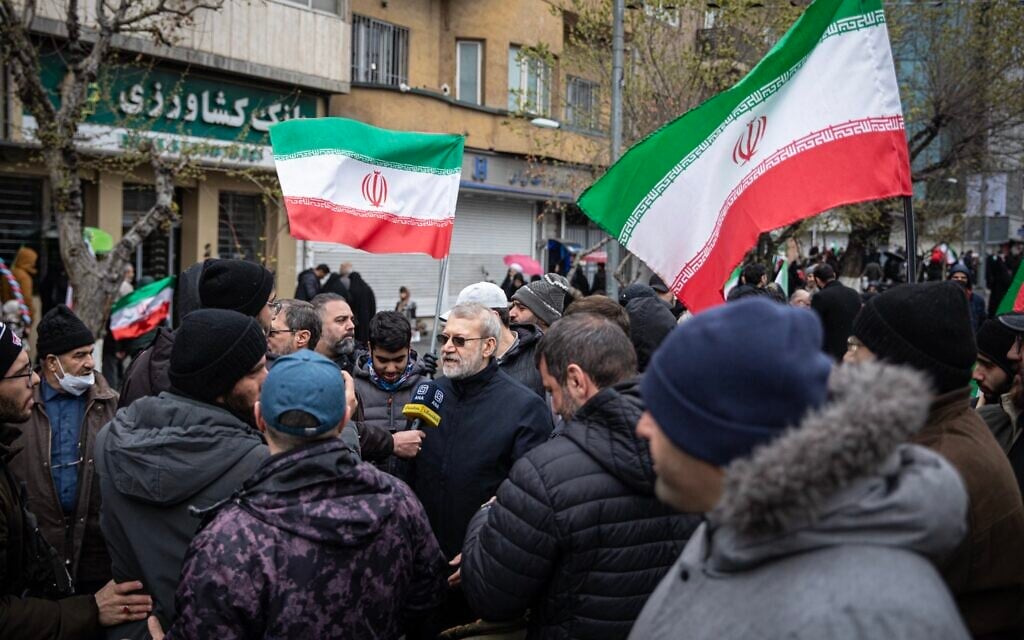
Ali Khamenei’s handpicked deputy was believed to be coordinating Tehran’s war effort. Israel hopes his assassination will bring protesters out on ancient Persian holiday
Ali Larijani (center) participates in a Quds Day anti-Israel march in
Tehran on March 13, 2026, the last time he was seen alive in public. (X,
used in accordance with clause 27a of the copyright law)
Iran confirmed
on Tuesday that Israel had overnight assassinated Ali Larijani, one of
the most important Iranian officials who had survived the US-Israeli
strikes thus far.
Larijani, the secretary of Iran’s National Security Council, was the
regime’s key figure after the assassination of supreme leader Ali
Khamenei by Israel on February 28. He was Khamenei’s handpicked deputy,
and many viewed him as the de facto leader of the Islamic Republic
following Khamenei’s death.
Khamenei “saw Larijani as the man who would inherit the Islamic
Revolution and continue it,” said Jonathan Schanzer, senior vice
president at the Foundation for the Defense of Democracies. “And that
obviously has been seriously disrupted.”
An establishment insider who hailed from one of the country’s leading
clerical families, Larijani had been tasked with taking the lead on
Iran’s most pressing issues. He oversaw Iran’s efforts to reach a
nuclear deal with the United States, and is widely believed to have
personally directed the deadly crackdown on anti-government protests in
January.
“Larijani was one of the first Iranian leaders to call for violence
in response to the legitimate demands of the Iranian people,” said the
US Treasury as it announced sanctions against him.
A former member of Iran’s Revolutionary Guards, Larijani served as
chief nuclear negotiator from 2005 to 2007, defending what Tehran says
is its right to enrich uranium. He once described European incentives to
abandon nuclear fuel production as “exchanging a pearl for a candy
bar.”
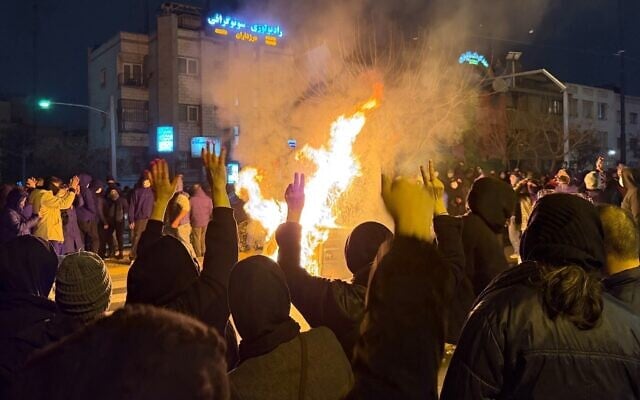
In this photo obtained by The
Associated Press, Iranians attend an anti-government protest in Tehran,
Iran, January 9, 2026. (UGC via AP)
In 2005, he headed the Supreme National Security Council (SNSC) for the first time.
Israel’s President Isaac Herzog on Tuesday accused him of
masterminding the kidnapping and killing of IDF soldiers in 2006 that
sparked the Second Lebanon War. “That morning he took a flight out of
Lebanon,” said Herzog. “He was there as head of the national security
council of Iran — he came to plan with [Hassan] Nasrallah this
operation, to give him the okay.”
Larijani was speaker of the parliament from 2008 to 2020, during
which time Iran negotiated and signed a nuclear deal with the US and
five other powers in 2015.
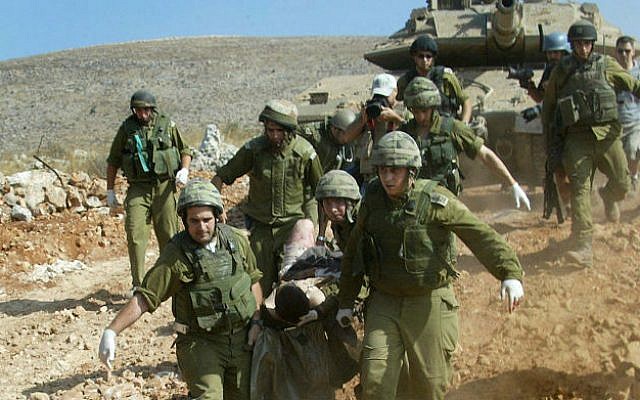
Soldiers evacuating a wounded comrade during the Second Lebanon War, on July 24, 2006 (photo credit: Haim Azoulay/ Flash 90)
He also ran unsuccessfully for president in 2005. He later sought to
contest the 2021 and 2024 presidential elections but was barred both
times by the Guardian Council, which cited issues including lifestyle
standards and family ties abroad.
Larijani was appointed last August as secretary of the SNSC once
again, following the 12-day air war between Iran and Israel that the US
joined.
Khamenei, to whom Larijani had always shown loyalty, sent him last
month to Oman to prepare for indirect nuclear talks with the US. He also
made several trips to key ally Moscow in recent months to discuss a
range of security issues.
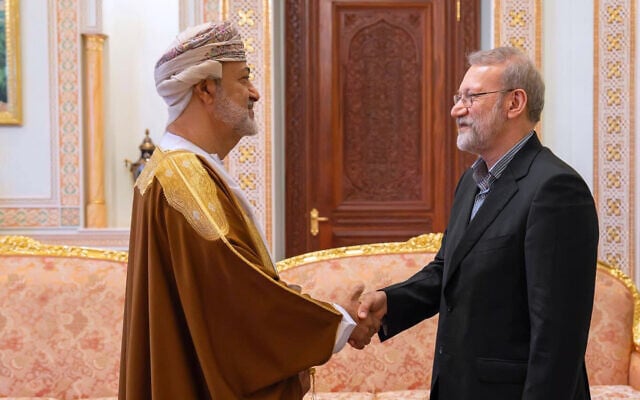
In this photo released by
state-run Oman News Agency, Oman’s Sultan Haitham bin Tariq, left,
shakes hands with Iran’s Secretary of the Supreme National Security
Council Ali Larijani during their meeting in Muscat, Oman, February 10,
2026. (State-run Oman News Agency via AP)
“His status and influence extended far beyond any formal position he
had,” said Meir Ben-Shabbat, once Prime Minister Benjamin Netanyahu’s
national security adviser and now head of the Misgav Institute for
National Security & Zionist Strategy.
Since Khamenei’s death, said Ben-Shabbat, Larijani “managed the fight
against Israel and served as the chief coordinator of Iran’s security
bodies.”
‘Unprecedented crisis’
The pressing question now is what practical effect Larijani’s
assassination will have on the Islamic Republic’s ability to continue
mounting a coherent military response to the US-Israeli aerial
onslaught, and potentially on its very survival.
Before Larijani’s death, dozens of other senior Iranian officials had
been killed in 18 days of bombing, including head of the Islamic
Revolutionary Guard Corps’ Basij Force, Gholamreza Soleimani, who died
in a separate strike Monday night.
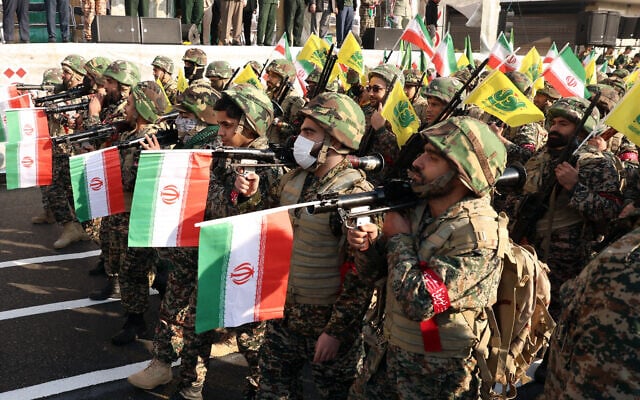
Members of Iranian paramilitary
forces (Basij) march with weapons and their national flag during a rally
in Tehran, January 10, 2025. (AFP)
The strikes, said Ben-Shabbat, “continue the process of severing and
dismantling the chain of ideological, political, and operational command
and control of the Iranian regime, placing it in an unprecedented
crisis.”
Right now, it’s not at all clear who’s running things. Khamenei’s son
Mojtaba was selected as Iran’s third supreme leader, but he is believed
to have been injured in the airstrike that killed his father, and
hasn’t been seen since.
That doesn’t automatically equal the end of the regime. Iran’s
proxies Hamas and Hezbollah have both suffered a series of Israeli
decapitation strikes and operations, and are both still functioning.
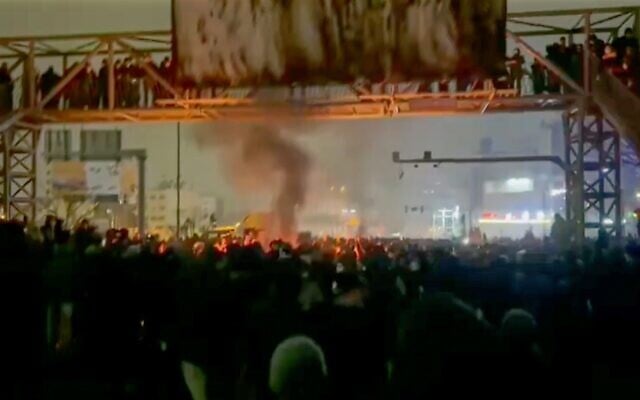
But they didn’t have to contend with an angry populace that wants to tear down their regime.
In this frame grab from footage
circulating on social media from Iran shows protesters taking to the
streets despite an intensifying crackdown as the Islamic Republic
remains cut off from the rest of the world in Tehran, Iran, Jan. 9,
2026. (UGC via AP)
Larijani’s death, said Michael Makovsky, president and CEO of the
Jewish Institute for National Security of America, “has to hearten the
Iranian people, and encourage them more at some point to rise up again
against the regime.”
Netanyahu is looking to take advantage of the strike immediately. In
an English-language message to the Iranian people on Tuesday night, he urged them to “celebrate the Festival of Fire.”
The holiday of Chaharshanbe Suri, marked on Tuesday evening and seen
by the Islamic Republic as pagan though it’s of Zoroastrian origin,
often features anti-regime protests. “Celebrate and Happy Nowruz,” said
Netanyahu, reassuring Iran’s people that “we’re watching from above.”
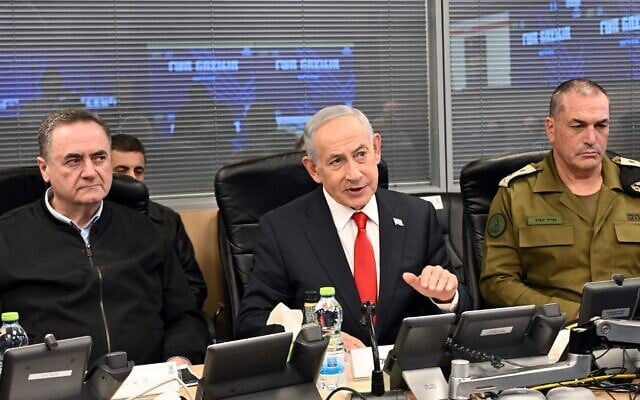
Prime Minister Benjamin Netanyahu at the IDF’s Kirya military headquarters on March 17, 2025. (Haim Zach/GPO)
“The culling of the top leaders is absolutely going to have an impact
on the way the Iranian people view what happens next,” said Schanzer.
No one knows exactly what the next stage of the war will bring, and
whether the killing of Larijani will be enough to get Iranian protesters
back out onto the streets.
Even if it isn’t, Israel’s ability to locate the most important
figure in the Iranian regime 18 days into war is evidence of how deeply
its intelligence has penetrated the most sensitive reaches of the
Islamic Republic. There are — it appears — more surprises from Israel on
the way.