▼

Sunday, October 18, 2026

CENTCOM: IRGC not paying troops due to US economic pressure on Iran - JNS Staff


by JNS Staff

The export of crude oil through the Strait of Hormuz has largely returned to pre-war level, according to Adm. Brad Cooper.


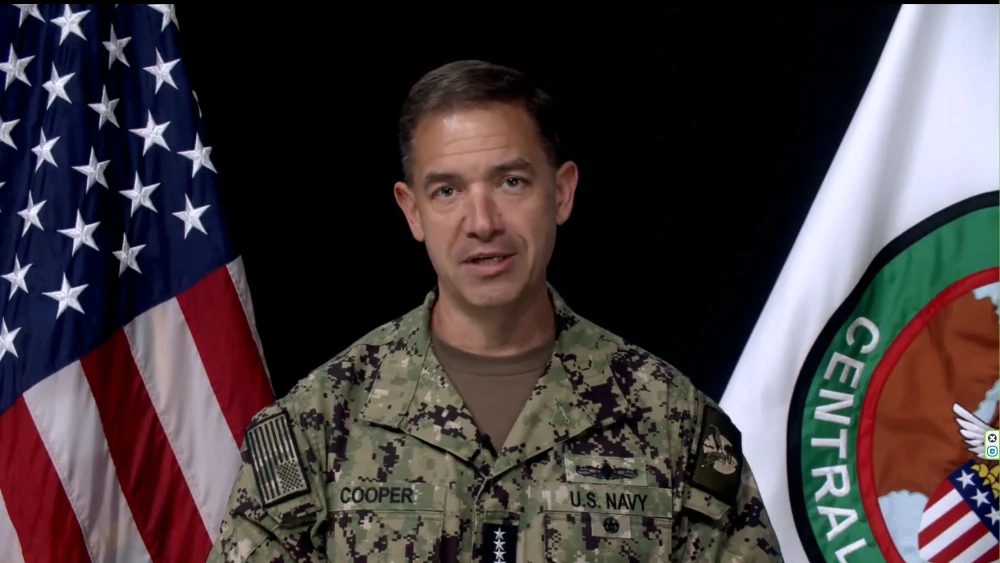
Adm. Brad Cooper delivers a summary of the first 38 days of “Operation Epic Fury” on April 9, 2026, in Washington D.C., the U.S. Credit: Courtesy of CENTCOM.
Adm. Brad Cooper delivers a summary in Washington, D.C., of the first 38 days of “Operation Epic Fury” against Iran, April 9, 2026. Credit: Courtesy of CENTCOM.


The “compounding” effect of America’s economic suffocation campaign against Iran is being felt across all sectors of its economy, including its military and the Islamic Revolutionary Guard Corps, commander of the U.S. Central Command Adm. Brad Cooper said in a recorded message on Friday.

“The financial strain on Iran’s military has become so significant that there are reports of Iran-aligned militia groups across the region withholding payments to their soldiers in order to funnel money back to the IRGC, which also is not paying its troops,” Cooper stated.

The Islamic regime is feeling “economic pain” and the IRGC is “increasingly showing signs of greater desperation as a result,” the admiral continued.

Payments, including pensions, are being withheld by the Iranian regime from workers in industries such as oil and energy, manufacturing, steel and heavy industry, he said.

Meanwhile, the IRGC continues to attack commercial vessels in the Strait of Hormuz, having killed 20 civilian mariners since the war began on Feb. 28, Cooper said, citing data from the U.N.’s International Maritime Organization.

Despite these attacks, the commander continued, the strategic waterway “remains open for business.”

Over the past week, approximately 400 merchant ships and 100 million barrels of crude oil have transited the strait, in addition to the 1.3 billion barrels that were transported in recent months, Cooper said.

These figures, totaling approximately 14 million barrels per day, roughly match the volume of crude oil that transited the choke point pre-war. However, that is less than the total of 20 million-21 million barrels per day that flowed through the strait when refined petroleum products are taken into account, according to analytics platform Kpler.

American forces initially launched a naval blockade on Iranian ports on April 13. It was temporarily lifted on June 18, when an interim U.S.-Iran agreement took effect, only to be re-imposed on July 14.

On Aug. 24, Washington initiated “Operation Economic Outcast,” also known as “Economic D-Day,” against the Islamic Republic, which added more sanctions and financial measures against Iran.

As Cooper elaborated in his recorded message, CENTCOM, in close coordination with “interagency partners,” has in recent months delivered “severe blows” to the Iranian regime in three main areas: oil exports, digital financing and payroll for security forces.

U.S. forces have thus far prevented Iran from exporting at least $25 billion worth of crude oil, he said.

CENTCOM has also frozen $350 million in digital cryptocurrency assets.

As a result, the Iranian government is finding it difficult to pay salaries to its troops and employees.

‘The single greatest financial offensive ever’

On Aug. 24, U.S. Treasury Secretary Scott Bessent said that the Trump administration’s comprehensive economic campaign against Iran is aimed at severing “every economic lifeline” sustaining the Islamic Republic.

Bessent described the campaign, announced earlier by U.S. President Donald Trump, as “the single greatest financial offensive ever marshaled against an adversary,” saying the president had created the conditions to use every available federal agency and authority against Tehran.

He also said that U.S. military action had destroyed nearly all of Iran’s military factories and buried its nuclear program.


JNS Staff

Source: https://www.jns.org/news/u-s-news/centcom-irgc-is-not-paying-its-troops-due-to-us-economic-pressure-on-iran

Follow Middle East and Terrorism on Twitter
France Aflame: Rioters devastate historic landmark as protests rock Paris - Nicholas Ballasy


by Nicholas Ballasy

ATR reported that French broadcasters CNews and Europe 1 in western Paris had their office windows smashed due to protesters throwing projectiles.


Rioters angered by rising costs clashed with police, blocked roads and set fires in major cities across France on Saturday ahead of the presidential election.

In Limoges, a town three hours south of Paris, the historic town hall built in late 1800s was set afire and mostly destroyed by demonstrators.

"The roof has collapsed onto lower floors, except the west wing, and two-thirds of the exterior has already disappeared," local official Maurice Barate, told AFP.

Meanwhile, AFP reported that French broadcasters CNews and Europe 1 in western Paris had their office windows smashed when protesters threw projectiles.

Police shot a "water cannon and teargas after hundreds of protesters, most wearing face masks and some setting off fireworks, confronted them at several locations," AFP reported.

The protestors, angered by the rising cost of living, have also tried to block roads, reports said. 

Police had to push out protesters who entered the town hall of France's second-largest city of Marseille, reports said.  


Nicholas Ballasy

Source: https://justthenews.com/world/europe/protestors-french-cities-clash-police-break-windows-block-roads

Follow Middle East and Terrorism on Twitter
Syria Is Rebuilding an Army Before It Rebuilds Syria - Pierre Rehov


by Pierre Rehov

A year after he declared this supposed "necessity," al-Sharaa announced at the UN that the Golan Heights "will remain Syrian" – possibly so that Syrians will once again be able to shoot down at Israeli farmers on the plain below.


  • Al-Sharaa, it appears, is directing most of the state's resources, foreign aid included, toward a large standing army and new weapons systems, while concealing the scale of the effort.

  • Western governments and al-Sharaa do not attach the same meaning to the word "stability."

  • Middle Eastern alignments rarely outlive the enemy that produced them... Iran and its militias spent years fighting the insurgency that carried him to power. None of that says what a stronger Syrian state will do in ten years.

  • In September 2025, al-Sharaa told reporters that a security deal with Israel, modeled on the 1974 disengagement agreement, was a "necessity."

  • A year after he declared this supposed "necessity," al-Sharaa announced at the UN that the Golan Heights "will remain Syrian" – possibly so that Syrians will once again be able to shoot down at Israeli farmers on the plain below. Al-Sharaa added the complaint that "Israel is launching attacks against Syria. There have been 500 air strikes, more than 1,200 incursions, and 300 detentions. This is at odds with the orientation we're seeing at global level."

  • Al-Sharaa, however, forgot to mention why. Ever since al-Sharaa overthrew the Assad regime, Christians, Druze, Alawites and other minorities have been victims of attacks that are reportedly "genocidal" – all while al-Sharaa's plan for the radical Islamization of Syria surges ahead.

  • The Trump administration's removal of Syria from the list of state sponsors of terrorism seems to have been based on wishes rather than any kind of facts on the ground. Perhaps the administration still hopes -- although, after its run-in with Iran, it really should have learned better -- that rewarding good behavior before it takes place will somehow magically cause it to spring into being simply does not work. Gifts in good faith, especially to supposedly former terrorists, can simply get pocketed in expectation of the next ones.

  • At this point, al-Sharaa's demand [that Golan Heights "will remain Syrian"] is tantamount to expecting the United States to return its southwest to Mexico.

  • Israel, evidently motivated by survival, treats its northern frontier as a question of capabilities rather than of declared intentions....

  • The wager is that investment and honors will pull al-Sharaa toward moderation. It may pay off, but its beneficiary, al-Sharaa, is using part of the proceeds to build an armed power of his own.

  • Israeli security sources concede that a chance to lock in border arrangements was missed when al-Sharaa was weak and newly installed, and now assess that a confrontation is a matter of time.

  • A channel to Damascus has bought Washington influence that isolation never could, but it should not buy amnesia: al-Sharaa's past is documented, his diplomacy is real, and the army now taking shape belongs to the same man.

  • Whether Ahmed al-Sharaa has changed since the world knew him as al-Jolani will occupy biographers. Israel's planners have stopped asking. They are counting his brigades.

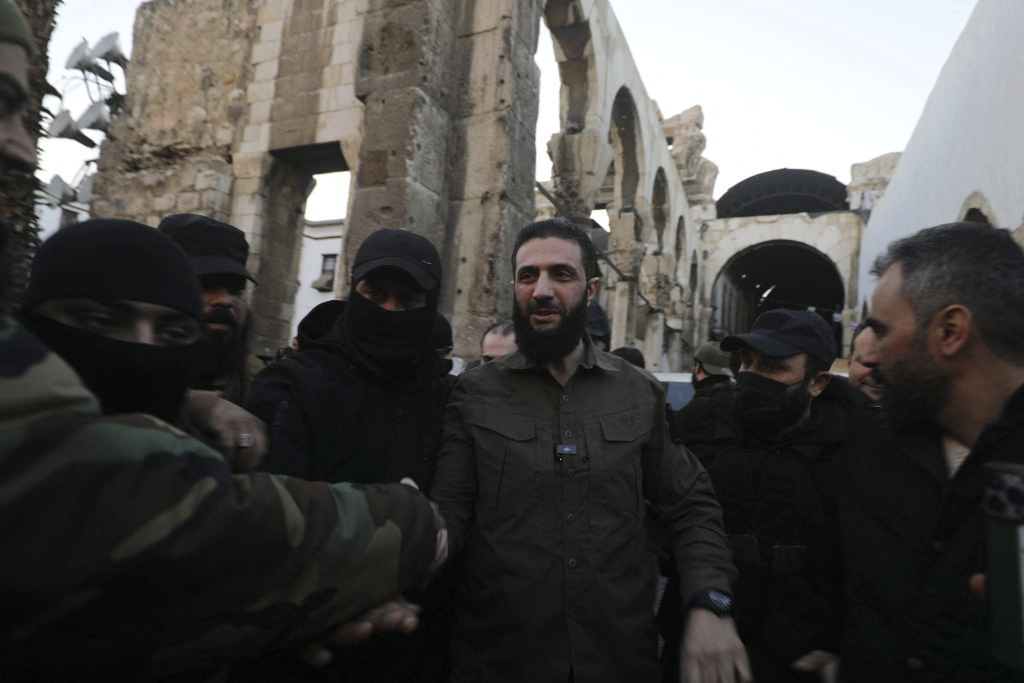
Pictured: Syrian President Ahmed al-Sharaa, it appears, is directing most of the state's resources, foreign aid included, toward a large standing army and new weapons systems, while concealing the scale of the effort. Pictured: Al-Sharaa is greeted at the Umayyad Mosque in Damascus on December 8, 2024. (Photo by Abdulaziz Ketaz/AFP via Getty Images)

Ahmed al-Sharaa inherited a country in ruins. War halved the size of Syria's economy and left nine people out of ten below the poverty line. According to serious Israeli sources, the priority in Damascus has little to do with reconstruction.

Al-Sharaa, it appears, is directing most of the state's resources, foreign aid included, toward a large standing army and new weapons systems, while concealing the scale of the effort. His forces are not yet rated as capable, but they have held brigade-level exercises, are being organized into brigades with divisions to follow, and are seeking air defenses able to restrict the Israeli Air Force. This is the army Israel gutted in December 2024, when 480 strikes in two days destroyed an estimated 80 percent of Assad's strategic arsenal. It is being rebuilt with money meant to rebuild the country.

Al-Sharaa has spent two years trying to persuade the world that he is no longer Abu Mohammad al-Jolani. He joined al-Qaeda in Iraq after America's 2003 invasion, spent five years in the American prison at Camp Bucca, and returned to Syria in 2011 to found the Nusra Front. The United States designated him a global terrorist in May 2013, and put a $10 million bounty on him, which was lifted only in December 2024.

He broke with al-Qaeda in 2016 and recast himself as a nationalist. After Damascus fell on December 8, 2024, the military fatigues gave way to suits. In May 2025, President Donald Trump met him in Riyadh the day after announcing the lifting of sanctions, and in November he became the first Syrian president ever received at the White House, where Syria joined the coalition against the Islamic State.

The gamble had a rationale: isolation threatened to turn a wrecked state into another permanent failure. Saudi Arabia and Turkey lobbied for lifting sanctions, and Europe saw a path to stabilizing the country and sending Syrian refugees home. In May 2025, the European Union lifted its economic sanctions. In December 2025, the US Congress repealed the Caesar Act, and on August 24, 2026, Washington removed Syria from its list of state sponsors of terrorism, a designation it had carried since 1979. Germany, which reopened its Damascus embassy in March 2025 and hosted al-Sharaa in Berlin a year later, now leads the European aid effort.

Western governments and al-Sharaa do not attach the same meaning to the word "stability." Europe needs a Syria calm enough to justify sending back refugees. Saudi Arabia and the United Arab Emirates want Damascus locked out of Iran's orbit, and Washington wants a partner against the Islamic State. Al-Sharaa needs all of them, and Israeli assessments hold that he is using them for something larger: restoring Syria as a regional military power.

His planning is apparently aimed at the moment, once his buildup is complete and the American presence in Iraq has thinned, when he can strike Hezbollah in Lebanon and the pro-Iranian militias in Iraq. Those targets are Israel's enemies too, but that does not make the army taking shape in Damascus an Israeli asset. As one security official put it:

"Ahmed al-Sharaa wants to build Syria under his leadership into a regional power that will look in every direction. The moment he decides to, he will also direct military force against Israel."

Middle Eastern alignments rarely outlive the enemy that produced them. Al-Sharaa's hostility toward Iran and Hezbollah follows from his own history: Iran and its militias spent years fighting the insurgency that carried him to power. None of that says what a stronger Syrian state will do in ten years.

In September 2025, al-Sharaa told reporters that a security deal with Israel, modeled on the 1974 disengagement agreement, was a "necessity."

A year after he declared this supposed "necessity," al-Sharaa announced at the UN that the Golan Heights "will remain Syrian" – possibly so that Syrians will once again be able to shoot down at Israeli farmers on the plain below. Al-Sharaa added the complaint that "Israel is launching attacks against Syria. There have been 500 air strikes, more than 1,200 incursions, and 300 detentions. This is at odds with the orientation we're seeing at global level."

Al-Sharaa, however, forgot to mention why. Ever since al-Sharaa overthrew the Assad regime, Christians, Druze, Alawites and other minorities have been victims of attacks that are reportedly "genocidal" – all while al-Sharaa's plan for the radical Islamization of Syria surges ahead.

The Trump administration's removal of Syria from the list of state sponsors of terrorism seems to have been based on wishes rather than any kind of facts on the ground. Perhaps the administration still hopes -- although, after its run-in with Iran, it really should have learned better -- that rewarding good behavior before it takes place will somehow magically cause it to spring into being simply does not work. Gifts in good faith, especially to supposedly former terrorists, can simply get pocketed in expectation of the next ones.

Israeli Foreign Minister Israel Katz immediately replied to al-Sharaa, "The Golan under Israeli sovereignty is an integral part of the State of Israel forever."

At this point, al-Sharaa's demand is tantamount to expecting the United States to return its southwest to Mexico.

Israel, evidently motivated by survival, treats its northern frontier as a question of capabilities rather than of declared intentions: the red lines it carried into the American-mediated talks that resumed in August after a six-month freeze include: a demilitarized Syrian Golan, no Turkish military activity in Syria and no strategic weapons systems in Syrian hands.

Al-Sharaa has not simply exchanged one patron for another. Turkey made his rise possible and, under an August 2025 training agreement, is to supply weapons systems to the new army, yet Israeli officials do not expect him to hand Syrian bases to Recep Tayyip Erdogan, even if that is what Erdogan expects. When Israel bombed the Abu al-Duhur air base on August 18 to forestall a Turkish deployment, the American envoy called the strike an "unnecessary escalation," while Israeli sources judged that it had spared al-Sharaa a choice he preferred not to make.

Russia has not left either. In August, Russia and Syria agreed to convert Russia's military bases in Syria, Tartus and Hmeimim, into joint training centers with Russian forces remaining, and in September a Russian convoy docked at Tartus for the first resupply under the deal.

Saudi Arabia and the United Arab Emirates have their own reasons for courting al-Sharaa. Assad's fall shattered the corridor Iran spent decades building through Iraq, Syria and Lebanon. Gulf money can make the loss permanent. Saudi Arabia and Qatar paid off Syria's World Bank arrears in April 2025; a Saudi delegation signed $6.4 billion in agreements that July, and DP World took a 30-year, $800 million concession on the port of Tartus. The wager is that investment and honors will pull al-Sharaa toward moderation. It may pay off, but its beneficiary, al-Sharaa, is using part of the proceeds to build an armed power of his own.

Israel now faces a problem less simple than Assad, who was hostile but familiar and dependent on Iran and Russia.

Israeli security sources concede that a chance to lock in border arrangements was missed when al-Sharaa was weak and newly installed, and now assess that a confrontation is a matter of time.

The communication cell agreed in Paris in January still exists. Mossad chief Roman Gofman met with Syrian Foreign Minister Asaad al-Shaibani in Amman in August. The Israeli defense establishment is intensifying intelligence collection on Syrian forces and preparing for a broad operation should the buildup threaten Israel's freedom of action.

A channel to Damascus has bought Washington influence that isolation never could, but it should not buy amnesia: al-Sharaa's past is documented, his diplomacy is real, and the army now taking shape belongs to the same man.

Whether Ahmed al-Sharaa has changed since the world knew him as al-Jolani will occupy biographers. Israel's planners have stopped asking. They are counting his brigades.


Pierre Rehov, who holds a law degree from Paris-Assas, is a French reporter, novelist and documentary filmmaker. He is the author of six novels, including "Beyond Red Lines", "The Third Testament" and "Red Eden", translated from French. His latest essay on the aftermath of the October 7 massacre " 7 octobre - La riposte " became a bestseller in France. As a filmmaker, he has produced and directed 17 documentaries, many photographed at high risk in Middle Eastern war zones, and focusing on terrorism, media bias, and the persecution of Christians. His latest documentary, "Pogrom(s)" highlights the context of ancient Jew hatred within Muslim civilization as the main force behind the October 7 massacre.

Source: https://www.gatestoneinstitute.org/22923/syria-rebuilding-army

Follow Middle East and Terrorism on Twitter

How could Israel help Saudi Arabia defend against the Houthis - and at what cost? - analysis - Seth J. Frantzman


by Seth J. Frantzman

Any cooperation against the Houthis can increase the regional defense connections and defense infrastructure. This helps defend against Iranian-backed threats and Iran’s direct threats.


Members of Houthi security forces sit on a rock at the site of a rally held to commemorate Mawlid, marking the anniversary of Prophet Muhammad's birthday, in Sanaa, Yemen, August 25, 2026.
(photo credit: REUTERS/Khaled Abdullah)

There is increased discussion about how Israel might help Saudi Arabia against the Iranian-backed Houthis. If there is help, how might it take shape, and what might be most effective?

This also comes in the context of questions about whether Saudi Arabia will join the Abraham Accords. Questions about this have persisted since the Accords began in 2020. However, Riyadh has taken a wait-and-see approach, preferring that Israel make positive moves on the Palestinian issue.

US President Donald Trump has said that Saudi Arabia may be accepting help from Israel. Asked about whether he thought Saudi Arabia might normalize ties with Israel, he said, “I do, I think they will. Israel’s been very helpful to Saudi Arabia.” The comments come days after Saudi Arabia appeared to downplay whether Israel would support them.

This comes in the context of the Houthis increasing attacks on Saudi Arabia. The US has not joined the fighting but may be supporting the Saudis in various ways, such as via intelligence. The US has so far chosen not to join strikes on the Houthis. The Trump administration carried out strikes on the Houthis in March and April 2025. The administration eventually concluded that it was better to do a deal with the Houthis than continue strikes.

On October 18, Israel’s Walla had a piece by Amir Bohbot, asking whether Israeli aid to Saudi Arabia would be an opportunity or a potential powder keg. “Security sources confirmed to Walla that the quality of Israeli intelligence is improving, but at the same time the Houthis are causing heavy damage. The security establishment is aware that there is an opportunity to strengthen relations, but is not addressing the issue for fear of inflaming the situation.”

MEMBERS OF Houthi security forces patrol the site of a demonstration, attended by predominantly Houthi-supporting protesters, in solidarity with Palestinians, in Sanaa, Yemen, on July 11.
MEMBERS OF Houthi security forces patrol the site of a demonstration, attended by predominantly Houthi-supporting protesters, in solidarity with Palestinians, in Sanaa, Yemen, on July 11. (credit: KHALED ABDULLAH/REUTERS)

Anadolu, a Turkish pro-government media outlet, noted on October 13 that “Saudi Crown Prince Mohammed bin Salman has rejected an Israeli push to join the military campaign against Yemen's Houthi group, despite efforts to secure Riyadh's approval through US mediation.” Anadolu said it based this on a report in Israel’s Haaretz. “Another source familiar with the matter said Israel hoped military cooperation with Saudi Arabia would strengthen bilateral ties and pave the way for a future normalization agreement,” the report said. “There was no immediate comment from Saudi authorities on the report.”

Saudi Arabia needs Israeli aerial defense systems

Ynet noted on October 18, in a piece by Ron Ben Yishai, that “the Saudis urgently need early-warning radar systems and air-defense batteries capable of countering different types of aerial threats, including Iron Dome, David's Sling, and even Arrow 2 interceptors. The Houthis are attacking Saudi Arabia with ballistic missiles, cruise missiles, and explosive-laden drones, requiring a combination of defensive capabilities.”

The analysis also noted that “Trump sees a chance to revive Saudi-Israel normalization as the Houthis strike Riyadh; Israel is sharing intelligence, but Riyadh's demand for Palestinian statehood talks and Israel's need for its own defenses make a deal far from certain.” It also added that Trump may see an “opportunity for greater Israeli assistance, potentially generating enough goodwill in Riyadh to persuade the Saudis to abandon their longstanding condition for normalization: negotiations with the Palestinians toward a two-state solution. For now, however, there is considerable reason to doubt that Trump's comments signal a meaningful breakthrough in Israeli-Saudi relations.”

Walla noted that “security sources confirmed to Walla that as time goes by, the contribution of Israeli intelligence is increasing, with the Houthis in the background causing heavy damage to the Saudis throughout the country.”

The report went on to say that “as first published in Walla, the IDF is assisting Saudi Arabia on the intelligence front in the fight against the Houthis in aspects of warning, a target bank, and building a situational picture.” It added that “Israel sees this as a positive process that will intensify once the US decides how it will decide on the Iranian issue: If the US attacks Iran, the latter may attack the countries of the region, including Israel. If the Americans continue with the economic sanctions (there is a slim chance of a political agreement without further conflict), they could also lead to escalation in the region.”

Houthis targeted shipping they claimed was linked to Israel after Oct. 7

The overall story now points to potential increased Israeli involvement and support. It’s worth noting that the Houthis began attacks on Israel soon after the Hamas attack on October 7. The Houthis began by attacking ships they claimed were linked to Israel. The Iranian-backed group claimed that it was targeting Israeli ships and vessels linked to Israel, although many of the ships attacked had no direct Israeli ownership or operational connection.

One of the most prominent incidents occurred on November 19, 2023, when Houthi forces seized the Galaxy Leader, a vehicle carrier, in the Red Sea. Armed men boarded the ship from a helicopter and diverted it to Yemen. The vessel was operated by a Japanese company and linked through its ownership structure to Israeli businessman Abraham Ungar. None of its 25 crew members were Israeli nationals. They remained detained until January 2025, when the Houthis released them following the Gaza ceasefire agreement.

The seizure marked the beginning of a wider campaign against international shipping. The Houthis subsequently expanded their declared targets to include vessels traveling to Israeli ports and ships associated with American and British interests.

The Houthis also carried out ballistic missile attacks on Israel. Israel responded by striking dozens of Houthi targets in 2025. This illustrates how there has already been an Israeli campaign against the Houthis. The US has also carried out a campaign.

Saudi Arabia has also fought the Houthis since 2015. That means that all the players know the Houthi threat and capabilities. The Saudis have worked with Egypt, the UAE, and others in the past against the Houthis. It appears Riyadh will work with Egypt and the UAE again. Israel has ties with the UAE and Egypt via peace treaties. Israel also already works closely with US Central Command.

Any cooperation against the Houthis can increase the regional defense connections and defense infrastructure. This helps defend against Iranian-backed threats and Iran’s direct threats. For instance, when Iran carried out large missile attacks on Israel in 2024, many countries cooperated against the threat. 


Seth J. Frantzman

Source: https://www.jpost.com/middle-east/article-912048

Follow Middle East and Terrorism on Twitter

Predictions of Gaza’s death toll were wrong - why is no one being held accountable? - Micha Danzig


by Micha Danzig

Gaza’s own mortality figures raise questions about years of predictions of mass death, famine, and disease that failed to materialize.


Palestinians inspect the site of an Israeli airstrike that destroyed a residential building in Gaza City, September 6, 2025; Illustrative.
(photo credit: REUTERS/DAWOUD ABU ALKAS)


In late September, Gaza’s Hamas-run Health Ministry published its 2025 mortality report, the first since the war began to purport to count every death in Gaza.

Of 24,650 deaths, it attributed 17,286 to “war operations,” without separating combatants from civilians, and 1,584 to accidents. Independent analyst Eirik Schrøder-Bråtane calculated that the remaining 5,780 nonviolent deaths roughly matched Gaza’s prewar annual nonviolent toll. The ministry also recorded 50,227 births.

This was 2025: the year Israel halted aid for 11 weeks after Hamas refused to extend the truce and release more hostages, following a six-week ceasefire during which 25,200 trucks delivered nearly 450,000 tons of aid. Israel said Hamas was seizing and selling supplies to finance its war. By September, Israel counted over two million tons delivered during the war.

It was also the year UN officials warned of babies dying by the thousands and the IPC, the UN-backed hunger monitor, declared famine in Gaza City.

Yet the ministry’s own figures show nothing resembling the mass-mortality footprint those warnings suggested: no surge in nonviolent deaths from hunger, disease, or other indirect causes.

A PALESTINIAN WOMAN flees with her triplet children from the area of Shifa Hospital, moving southward in the Gaza Strip, last week.
A PALESTINIAN WOMAN flees with her triplet children from the area of Shifa Hospital, moving southward in the Gaza Strip, last week. (credit: REUTERS/Ramadan Abed)

Andrew Fox, a former British Army officer and senior fellow at the Henry Jackson Society, argued in 2024 that Gaza’s war toll was being padded with natural deaths. Now, he wrote, the famine allegations and other claims had been “debunked by Hamas’s own numbers.” The modelers who predicted hundreds of thousands of deaths, he added, “should lose their careers.”

Then he said: “They won’t. They’ll get a free pass.”

That may be the safest prediction anyone has made about this war.

For years, Israel’s accusers have issued confident predictions of mass death and confident counts of massacres. The headlines circle the globe. When the predictions fail, or the numbers collapse, the correction barely travels at all.

On May 20, 2025, the UN’s humanitarian chief, Tom Fletcher, told BBC Radio 4 that 14,000 babies in Gaza “will die in the next 48 hours” unless aid reached them. Within a day, the UN clarified that the figure meant roughly 14,100 projected cases of severe acute malnutrition among young children under age 5.

Not deaths. Not babies. Not 48 hours.

The report does show deterioration: infant mortality of 15.8 per 1,000 live births and under-five mortality of 33.4, both worse than before the war. But in the year of the UN’s warnings, Gaza’s infant mortality roughly matched Egypt’s peacetime rate of 16.1, and both its rates sat below the global average. Worse, yes. Mass death, no.

In February 2024, researchers at the London School of Hygiene and Tropical Medicine and Johns Hopkins projected as many as 85,750 excess deaths in Gaza over six months in a worst-case scenario of escalating war and epidemic disease. Activist outlets ran headlines like “Israel Could Kill 85,000 More Gazans in 6 Months,” and a lead author told US news program Democracy Now! that the escalation scenario was “currently what’s happening in Rafah.” That epidemic never came.

In Sudan’s largely forgotten war, the same London School found the dead going uncounted: some 26,000 violent deaths in Khartoum State alone in the first 14 months, more than monitors had recorded for the entire country, and over 61,000 deaths from all causes.

In Gaza, the alarm far outran the dead. In Sudan, the dead outran the alarm.

In March 2024, the IPC projected famine in northern Gaza by the end of May if fighting and severe aid restrictions continued. By June, its own Famine Review Committee found the evidence did not indicate famine.

The IPC declared famine in the Gaza Governorate in August 2025, over Israel’s objections to its methodology. Somalia’s 2010-2012 famine killed an estimated 258,000 people, including 133,000 children under five. At its peak, it killed about 30,000 people a month.

Incentive to inflate numbers

Gaza’s Health Ministry, an arm of Hamas with every incentive to inflate, reported 455 malnutrition deaths across nearly two years of war, fewer than Somalia’s famine killed in half a day at its height.

By the IPC’s own threshold, two deaths per 10,000 people a day, the declared famine should have killed about 9,000. Hamas’s own ministry counted fewer than 200, across all of Gaza, fewer than the US records in four days.

Rafah followed a familiar pattern. Before Israel entered the city in May 2024, the Palestinian Authority’s Foreign Ministry warned an assault would bring “the annihilation of about 1.5 million Palestinians.” The EU’s then-foreign-policy chief, Josep Borrell, scoffed at evacuating civilians: “Where? To the moon?” Within three weeks, about a million people had evacuated Rafah. There was no annihilation and no apology.

The pattern is older than this war, and it only ever runs in one direction.

In April 2002, during Israel’s operation in Jenin, PA negotiator Saeb Erekat told CNN that Israeli troops had killed more than 500 people. The UN secretary-general’s own report later counted 52 Palestinians dead, at least half of them terrorists, along with 23 Israeli soldiers, and found the 500 figure unsubstantiated. By then, the “Jenin massacre” had entered the world’s vocabulary.

Operation Cast Lead followed the same arc. Hamas initially acknowledged fewer than 50 dead combatants. The since-discredited 2009 Goldstone Report cited a Palestinian Centre for Human Rights tally identifying just 236 of the dead as combatants. Then, in November 2010, Hamas interior minister Fathi Hammad acknowledged that up to 700 men from Hamas’s military wing and security forces had been killed, close to Israel’s count of 709.

Abroad, the dead were nearly all civilians. At home, they were Hamas martyrs.

On October 17, 2023, Hamas’s health authorities instantly blamed Israel for the Ahli hospital explosion and reported nearly 500 dead. American, British, French, and Canadian intelligence assessments concluded that a misfired Palestinian rocket was the likely cause; US intelligence put the toll at a fraction of the ministry’s tally. The New York Times later conceded that its early coverage had relied too heavily on Hamas’s claims.

The progressive Left, which prides itself on following the science, rarely asks why so many catastrophic predictions and claims about Israel fail. A growing faction of the populist Right, the so-called “woke Right,” recycles Hamas figures and UN forecasts it would ridicule on any other subject.

The method works because the claims and predictions do their work before they can be tested. Put Israel in the dock. Push for sanctions or an arms embargo. Pressure Israel, but not those sworn to its destruction. By the time the evidence arrives, the damage is done.

Tom Fletcher still runs the UN’s humanitarian office. The IPC has not retracted its 2025 famine declaration. Newsrooms still headline the forecasts and bury the accounting.

In most fields, predictions this consequential would at least produce an audit. When the subject is Israel, they produce the next failed prediction.


Micha Danzig
is an attorney, former IDF soldier, and former NYPD officer. He writes widely on Israel, Zionism, antisemitism, and Jewish history. He serves on the board of Herut North America.

Source: https://www.jpost.com/opinion/article-910868

Follow Middle East and Terrorism on Twitter

Western leaders back a two-state solution, but do Palestinians even want one? - Cookie Schwaeber-Issan

by Cookie Schwaeber-Issan

World leaders continue to champion a two-state solution, but the rejection of Israel by influential Palestinian voices raises questions about whether lasting peace is possible.


Britain's Foreign Secretary Ed Miliband speaks at the House of Commons in London, Britain, September 8, 2026.
(photo credit: House of Commons/Handout via REUTERS)


You’d think that British Foreign Secretary Ed Miliband, who just happens to be Jewish, would have heard the “From the river to the sea” chant, shouted by many of his citizens, at one of their almost daily anti-Israel protests.

The phrase, which represents the entire State of Israel, from the Jordan River to the Mediterranean Sea, means that any officially approved Palestinian state, to those protesters, would have to comprise that full area, including Judea, Samaria and Gaza.

That unnegotiable demand is not just coming from the shouters on the street. It is the final goal of Hamas, Hezbollah, Iran, and anyone who assumes leadership of Palestinians.

While some might be tempted to point to PLO head Mahmoud Abbas, arguing that he has advocated for a two-state solution, that contention is contradicted and completely undermined by the educational indoctrination given to Palestinian children who are taught, from an early age, that Israel is occupying Arab land and that the enemy must be eradicated.

So, for all intents and purposes, the spoken commitment of “From the river to the sea” wholeheartedly negates a two-state solution.

British Foreign Secretary Ed Miliband arrives to attend a cabinet meeting at 10 Downing Street in London, Britain, September 8, 2026.
British Foreign Secretary Ed Miliband arrives to attend a cabinet meeting at 10 Downing Street in London, Britain, September 8, 2026. (credit: REUTERS/Isabel Infantes)

Nonetheless, for whatever reason, Miliband has said that “when it comes to the attempt to destroy the two-state solution, this party, this movement, this government says, ‘we will not let you succeed.’”

My question is, how do you square those two things – a growing protest movement that insists the State of Israel must be entirely replaced by a Palestinian one, with no Jewish presence, and a government minister who assures everyone that no one will succeed in extinguishing the aspiration of a two-state solution?

Unless I’m wrong, each of those concepts is diabolically opposed to the other. One supposes the good will of both sides, endeavoring to commit to peaceful coexistence and ready to make whatever compromise it takes for the sake of ending the long-standing conflict.

While the other immediately dispenses with all pretense, publicly declaring that there will be no compromise, no attempts at sharing the geographic area, and no getting along with those they clearly despise.

So, where do you go from there? Because Miliband and his government are, essentially, pushing a policy that’s being drowned out by the voices on the street who are, in no way, supportive of the idea.

Of course, Miliband is not alone. He shares the company of UN Secretary-General Antonio Guterres, along with an overwhelming majority of UN member states.

Leaders from France, Canada, and Australia are also on board with the two-state solution. And shockingly, the official policy of the US agrees with that position.

Needless to say, many Arab states, such as Saudi Arabia, Jordan, Morocco, the UAE, Qatar, and Egypt, support the idea as well. Those Arab League members base their assumption on pre-1967 borders, with east Jerusalem as the capital of a Palestinian state.

So what we’re witnessing is a stalled status quo, paralyzing the possibility of all progress, because while a significant part of the global leadership still promotes a two-state solution, the ones who would be instrumental in approving such a deal are laser-focused on the whole pie, and not just one piece.

How can there be any resolution to one of the world’s biggest conundrums when two sides are dug in deeply, believing that their particular philosophy is the only proposition that is acceptable?

That leaves us with only one conclusion. This falls into the category of unsolvable problems that are simply too complex and too emotionally charged to figure out.

When coming to that obvious reality, it’s tempting to ask ourselves why, then, would someone like Miliband, and all the others, continue to back a losing proposition, knowing, in advance, that the likelihood of its implementation is zero?

Here is a speculative answer. The whole concept of a two-state solution is very compatible with the social construct of virtue-signaling. That is because the idea of two states for two peoples sounds reasonable, moral, ethical, and even noble. It plays into the idea that there can be an equitable solution for both sides, resulting in a real win-win situation.

The cost of indoctrination

What is missed by those leaders, who are clearly attempting to inflate their own goodness, is the vast reservoir of hatred and contempt, welling up inside of the individuals who have been part of a centuries-long experiment of indoctrination, from cradle to grave.

The toxic and lethal education they received, both at home, in school, and at their mosques, did the trick, painting Jews as demons who must be eradicated at all costs. Losing one’s life for the sake of diminishing their numbers is the greatest sacrifice that can be made.

Consequently, it’s no wonder that such a society, dedicated to the end of another one, cannot build anything productive or contribute to others through its own achievements and accomplishments.

Because when you are obsessed with destruction, the thought of rising to greatness is completely counterproductive and immaterial to the goal of finally doing away with an avowed enemy. It’s the reason that their youth will never live to inherit the realization of their dream, if that were possible.

Everything is secondary to eliminating the evil in their backyard, and that is the tragedy completely missed by world leaders who have spent decades trying to fit a round peg into a square hole.

So, if you think about it, the thing that is standing in the way of “peace in our time between Jews and Arabs” is the personal need of those in power to appear virtuous, magnanimous, and the ones who possess the highest moral standards.

By forcing the rest of us to cling to a losing prospect, precious time is wasted, young lives are snuffed out, and nothing moves forward. It is the ultimate prolonging of conflict, almost deliberately designed to remain the world’s thorn in the side, as useless and feigned efforts are expended to resolve the mother of all unescapable quagmires.

Don’t even bother asking the question of why they can’t see this for what it is, because they clearly are deeply invested in playing the game of who can appear the most civilized and principled exemplary figures, each vying for that top honor.

Yet, they are outed by the continuing conflict, which will only result in more bloodshed. And, sadly, there’s absolutely no honor in that!

The writer, a former principal of Jerusalem elementary and middle schools, was a member of Kibbutz Re’im from 1994 to 1999. She is the author of Mistake-Proof Parenting, based on the time-tested wisdom found in the Book of Proverbs, available on Amazon. 


Cookie Schwaeber-Issan

Source: https://www.jpost.com/opinion/article-911411

Follow Middle East and Terrorism on Twitter

Elon Musk Takes Flight While the Left Takes Offense - Roger Kimball


by Roger Kimball

The left is not just indifferent to innovations like Musk’s flying cars. No, they actively hate such things.


I have been interested in Teslas since a neighbor told me about the cars back in 2013, a year after the Model S made its debut. It was quite some time before I saw one for real. I agreed with my friend that they were spiffy-looking cars. Then I saw the video of Elon Musk revealing the Model S P85D in the fall of 2014. I was hooked.

As I noted the following year, I am in some ways an unlikely enthusiast for Elon Musk. From the beginning of his career, Musk has said that his two governing passions are “sustainable transport” to battle “global warming” and finding a way to make mankind an interplanetary species, beginning with a space colony on Mars. “For my part,” I wrote,

the word “sustainable” has me reaching, if not for my revolver, then at least for an air-sickness bag. I regard the whole Green Lobby as a cocktail composed of three parts moralistic hysteria mixed with a jigger of high-proof cynical opportunism (take a look at Al Gore’s winnings from the industry) fortified with a dash of beady-eyed left-wing redistributionist passion. You can never be Green enough, Comrade, and if the data show a 20-year “hiatus” in global warming (so much for Michael Mann’s infamous hockey stick), that’s no reason not to insist that capitalist powerhouses like the United States drastically curtail their CO2 emissions right now, today, while giving egregious polluters like China a decade or more to meet its quotas.

No, when it comes to energy, I often quote, sometimes with attribution, the Manhattan Institute’s Robert Bryce: what the world needs now is cheap, abundant energy, period, full stop, end of discussion. My motto is: frack early, frack often. Do you want to help the poor/clean up the environment/save the spotted wildebeest? Then you need economic growth, and to achieve that you need energy, which at the moment means you need fracking. Q.E.D.

As for making mankind an interplanetary species, I quoted the end of Robert Frost’s great poem “Birches”:

Earth’s the right place for love:
I don’t know where it’s likely to go better.
I’d like to go by climbing a birch tree,
And climb black branches up a snow-white trunk
Toward heaven, till the tree could bear no more,
But dipped its top and set me down again.
That would be good both going and coming back.

I haven’t changed my mind about either. But my enthusiasm for Elon Musk is undimmed. I remain excited by all things Tesla—the cars, the robots, the software, and autonomous driving. My only disappointment is Musk’s decision last winter to retire the Model S. I have owned a few and have loved them all. At the moment, there is no real successor to that elegant, well-appointed, and gratifyingly zippy sedan.

Then there is SpaceX, whose products include not only rockets (they are now responsible for some 90 percent of the world’s space launches) but also Starlink, which is providing internet access to even the remotest areas, and Starshield, a military application of that satellite network. Soon, Starlink will be providing internet and telephone service directly to your mobile phone and other devices. When I wrote about Musk in 2015, he had yet to catch or reuse rocket boosters. Now he has done both.

All along this journey, churls, doubters, and naysayers have dogged Musk’s footsteps. Electric cars would never be more than a novelty. Really, Tesla was a sort of joke. For the last few years, the Tesla Model Y has been the best-selling car in the world. A similar roster of establishment executives once upon a time lined up to belittle SpaceX. They are much quieter and less numerous now.

Musk’s latest venture was unveiled last week on October 15 in Waco, Texas. In 2011, Musk’s friend Peter Thiel, reflecting on the moribund state of innovation in the U.S., famously said, “We wanted flying cars; instead, we got 140 characters.” That was several years before Musk acquired the company formerly known as Twitter (now X); his transformation of that platform from a left-wing censorship tool into an ideologically neutral (and financially viable) friend of free expression has not received the attention it deserves. But the main event on Thursday was the fruit of a collaboration between Tesla and SpaceX. Tesla first announced the long-awaited new Roadster in 2017, with initial production scheduled for 2020. In the years since, the car grew bolder and more technologically advanced. On Thursday, Musk and his colleagues unveiled a vehicle that could not only hang upside down but also could, for a short distance, fly.

The response to this extraordinary feat divided neatly along ideological lines. The left hated it; the right loved it. This X commentator got it exactly. “A car flew last night,” he wrote. “An actual car, flipping in midair on cold gas thrusters and landing on its wheels.” In short, he continued,

Elon Musk’s companies built a sports car that does what science fiction promised for a century. The same man lands rockets on barges and builds the machines that carry our astronauts. That is what one free mind, and the thousands of minds he employs, can produce.

Bernie Sanders says billionaires should not exist. He looks at the man who makes cars fly and concludes the problem to solve is that such men keep too much of what they create. He has spent five decades in government producing nothing, yet he claims the moral authority to dispose of the men who produce everything. A man who seeks unearned control over the lives and property of others is corrupt in the fullest meaning of the word, and that corruption runs deeper than any bribe.

The bottom line? “A flying car is what men do when they are free. A wealth tax is what politicians do to the men who built it. One of them needs the other to survive, and it isn’t Musk.” Touché.

The commentator Glenn Reynolds quotes that last bit in his Substack article “Flying Cars and Those Who Hate Them.” “The thing about the left,” Reynolds writes, “is, it’s made up largely of people who aren’t great at doing things. They don’t get rich by building things or doing things. They get rich, when they do, by declaring problems, getting the government to throw money at them, and then stealing some (sometimes pretty much all) of that money for themselves and their NGOs. There’s nothing for them in flying cars.”

But that is only part of the story. The other part has to do with the economy of jealousy and résentiment. That is to say, the left is not just indifferent to innovations like Musk’s flying cars. No, they actively hate such things. Why? Partly it’s because of the light such innovations shine upon their own paltriness and affronted sense of “self-importance.” “When Elon does something cool,” you see, “they’re offended because they feel diminished by that.” There is a political side to this equation as well. Thus it is that Reddit “is actively banning videos of the Tesla Roadster,” calling them “political.”

Reynolds cuts to the chase in his essay: “[R]emember that if it was up to the left, Elon would be in jail and his money would be fed to corrupt NGOs. Luckily, it’s not up to the left. Cool things are what Americans do. Let’s stay Americans.”

The commentator Robby Starbuck made a kindred point. As you watch the video of the new roadster hanging upside down, flying over a line of cars, and gently landing on the ground, Starbuck warned, “Remember that if it was up to Democrats, Elon Musk would be in prison and his money would be seized to fund their NGOs and DEI pet projects.”

This would mean an end to all the advancements at his companies. They’d quickly waste the money and target a new wealthy job creator to jail and steal money from. Leftism is the enemy of innovation and human advancement.

There’s no single larger threat to our species surviving and advancing than leftist ideology. It’s anti-child, anti-family, anti-innovation, anti-prosperity, anti-tradition, anti-white, anti-liberty, anti-strength, and anti-Christian.

Musk creates reusable rockets. The EU struggled mightily for years to produce a bottle cap that would remain tethered to its bottle after being opened. Was this not, as one wag put it, a “radical, beautiful innovation that will change the course of humanity”? Musk creates self-driving cars and a roadster that can fly. Emmanuel Macron proudly shows off a “futuristic” Citroën concept car that has light bulbs.

What is happening far transcends party politics. Still, since we are on the run-up to an important election, allow me to ask that you bear in mind that there are significant differences between the parties and what they have to offer. As one canny observer put it, “The ‘far-right’ is developing flying cars, self-landing spaceships, and unrivaled military tech.” Savor those scare quotes around the phrase “far-right.” Then ponder what the other side is all about. “The far-left don’t know what a woman is, sterilize themselves, kill their babies, and hate their own race. A godless death cult that only destroys.”

In my view, that about sums it up. Keep it in mind. 


Roger Kimball

Source: https://amgreatness.com/2026/10/18/elon-musk-takes-flight-while-the-left-takes-offense/

Follow Middle East and Terrorism on Twitter

South Korea traps, prosecutes ex-Trump ambassador for comments on U.S. soil, American media ignore - Greg Piper


by Greg Piper

Trial started Friday against U.S. citizen Morse Tan for his 2025 remarks in D.C. about criminal allegations against South Korea's president as a minor. "I believe the content regarding President Lee is true," Tan reportedly told the trial.


President Trump's first-term U.S. ambassador-at-large for global criminal justice went on trial Friday in South Korea for criminal defamation charges, stemming from his inflammatory comments – on American soil — about South Korea's president 16 months earlier.

America's putative ally quickly banned Morse Tan from leaving the country at all when he arrived as an election monitor this spring, with the country's courts citing him as a flight risk, causing Tan to miss his grandmother's funeral this month.

Yet American mainstream media have been eerily quiet for the past five months about the criminal proceedings against Tan, a former law school dean at Liberty University, whose former president gave candidate Donald Trump an early political boost with evangelicals.

This is despite months of high-profile interventions by federal lawmakers including current and former House Foreign Affairs Committee leaders, recurring coverage in Christian publications, and the stark divide between the countries on legal protections for political speech.

The National Association of Christian Lawmakers is activating its network "to help bring attention to his situation," which has received "almost no substantive reporting" from major U.S. TV networks or national news outlets, and "encourage appropriate diplomatic action," chief legal officer Bob Ballinger told Just the News Thursday. 

"Whatever one's opinion of Tan's statements," which referred to contested reports of criminal behavior by President Lee Jae Myung as a minor, "the treatment of an American citizen over speech made in America deserves national scrutiny," Ballinger said. 

Tan's unnamed lawyer sought the indictment's dismissal on the trial's first day, arguing South Korean courts don't have jurisdiction over a U.S. citizen for comments on U.S. soil, and even if they did, "there was no disclosure of false facts, nor was there any awareness that the statements were false" or "intent to defame," SBS News reported.

"I believe the content regarding President Lee is true," Tan said for himself in the trial, pleading not guilty and introducing himself as a social activist, according to SBS.

The proceeding is a "show trial" that could land him seven years in prison, Tan told the Daily Caller, one of the only secular U.S. media outlets to show an interest, last month. As President Trump's former ambassador, Tan's ordeal is "a punch in Trump's face," he said.

The State Department told the conservative publication it "stands ready to raise our concerns directly with foreign governments when they use criminal defamation or similar laws to punish U.S. citizens for political speech,” especially "for statements made in the United States," but declined to speak about Tan's case specifically.

"The U.S. side requested a smooth resolution despite our explanation of legal enforcement," Foreign Minister Cho Hyun told the National Assembly’s Foreign Affairs Committee meeting Aug. 18 when Tan's case was mentioned, The Chosun Daily reported. 

A lawmaker had asked Cho about a House Foreign Affairs Committee letter days earlier protesting Tan's prosecution. "This was not a protest but an effort to address disagreements in South Korea-U.S. relations step by step," Cho said.

Tan's plight recalls the arrest of Irish comedian Graham Linehan, creator of the cross-Atlantic hit British sitcoms Father Ted and The IT Crowd, upon arrival to the U.K. for criticizing gender ideology months earlier in America. That prompted Reform UK Leader Nigel Farage to warn Americans with similarly stated views they could be arrested on U.K. visits.

America's progenitor hasn't stopped at written or spoken words in criminalizing speech, launching multiple criminal proceedings against pro-life activist Isabel Spruce-Vaughan for silently praying near abortion clinics. She pleaded not guilty to the latest charges this month and faces trial in January.

Democratic super-lawyer Marc Elias, who is trying to import foreign speech codes into the U.S., recently threatened North Carolina's North State Journal with a defamation lawsuit for asking the reelection campaign of Democratic Gov. Roy Cooper whether the 69-year-old has any health problems that might interfere with another term, as did President Biden.

'It is said' president was involved in horrific crimes as youth

Tan called South Korea a "rising dictatorship" at the Conservative Political Action Conference in 2025, and told the Christian Post this August that the country suffers "massive infiltration by Chinese Communist Party and North Korean spies, operatives and agents." 

But his real troubles started at a Washington, D.C., press conference in June 2025 on alleged fraud in South Korea's presidential election weeks earlier, hosted by the Korean Conservative Political Action Conference, which partners with CPAC. 

"We're talking about somebody who has had 12 lawsuits filed against him, five that are still going on," Tan said, referring to President Lee, and "a corrupt system" that blocks Lee's prosecution "as president unless he's exonerated."

"I don't think [this] has gotten a lot of coverage, but it is said" that the president, "as a youth, was involved in gang raping and murdering a young lady and as a result was put in juvenile detention and therefore was not able to attend junior high," Tan said.

The second defamation charge refers to Tan answering "a series of questions" about his prior comments at a public event in South Korea in July of this year, he told the Daily Caller.

The indictment filed against Tan says prosecutors checked Lee's juvenile detention records, which are "not publicly disclosed except for judicial or investigative purposes," and determined Tan's claims were false, Korea JoongAng Daily reported in July.

Newswire AFP deemed the allegations "baseless" but cut off Tan's quote, which used the Trumpian passive phrasing "it is said," to portray Tan as personally accusing Lee of crimes. AFP said the claims have been "previously disproven in court."

'Could change perceptions' of South Korea's adherence to 'rule of law'

"We have significant concerns" about South Korea's exit ban on Tan, "who thankfully remains in good health and positive spirits" as verified by a congressional delegation that met with him in July, House Foreign Affairs East Asian and Pacific Affairs Subcommittee Chair Young Kim, R-Calif., wrote to Korean Ambassador Kang Kyung-wha Aug. 13.

After arriving in the country as an election monitor in a "privately organized effort," according to Kim, "Tan faced remarkably unfair treatment" from the government over his statements, raising "serious concerns about freedom of expression and due process."

He spoke as "a private American citizen while in the United States," Kim wrote. His First Amendment rights "must be respected" or South Korea's behavior "could affect perceptions" of the country's adherence to "representative government, individual liberty, freedom of expression, and the rule of law."

GOP Reps. Brian Mast, of Florida, and Chris Smith, of New Jersey, the current and former House Foreign Affairs Committee chairs, respectively, also signed the letter along with fellow Republican Rep. Michael Cloud, of Texas, who serves on the Oversight Committee's Foreign Affairs Subcommittee.

Without referring to Tan, House Judiciary Committee Chair Jim Jordan, R-Ohio, wrote to Korea Media and Communications Commission Chair Kim Jong-cheol a week before Kim's letter to the Korean ambassador, to express concerns about how Korean law could chill American speech.

When the National Assembly amended the Information and Communications Network Act last year, it gave courts the "unprecedented power to punish news outlets and social media users for spreading 'false or manipulated information' and extract damage awards of up to five times any alleged harm," Jordan wrote.

The change also gave the commission power to impose roughly $656,000 in fines on news outlets and users that it deems to have spread such information, Jordan said, seeking a briefing with the commission "to better understand the KMCC’s approach to enforcing this law." 

Former Kansas GOP Sen. Sam Brownback, first-term President Trump's former ambassador-at-large for international religious freedom, blasted South Korea for its "shocking" treatment of his former colleague last month.

"If he were traveling to North Korea or Russia, I wouldn't be surprised at all" by the exit ban, Brownback told the Christian Post. Brownback said he's "really concerned" about the country's arrests and prosecutions of religious leaders, which is "a horrible trend line for that democracy."


Greg Piper

Source: https://justthenews.com/nation/free-speech/south-korea-traps-prosecutes-ex-trump-ambassador-comments-us-soil-american-media

Follow Middle East and Terrorism on Twitter