by Pierre Rehov
The only question left is whether Washington and its allies possess the clarity, the courage, and the strategic vision to welcome it.
While the international community says it champions democracy, stability, and self-determination, Somaliland ticks every box. Yet it stays unrecognized, largely because diplomats cling to the fiction of Somalia's territorial integrity — even though that unity exists only on paper. This is not principle at work. It is bureaucratic inertia. It has become a costly strategic error.
Denying recognition sends exactly the wrong signal: that building a functioning democracy in hard conditions earns you nothing.
The only question left is whether Washington and its allies possess the clarity, the courage, and the strategic vision to welcome it.
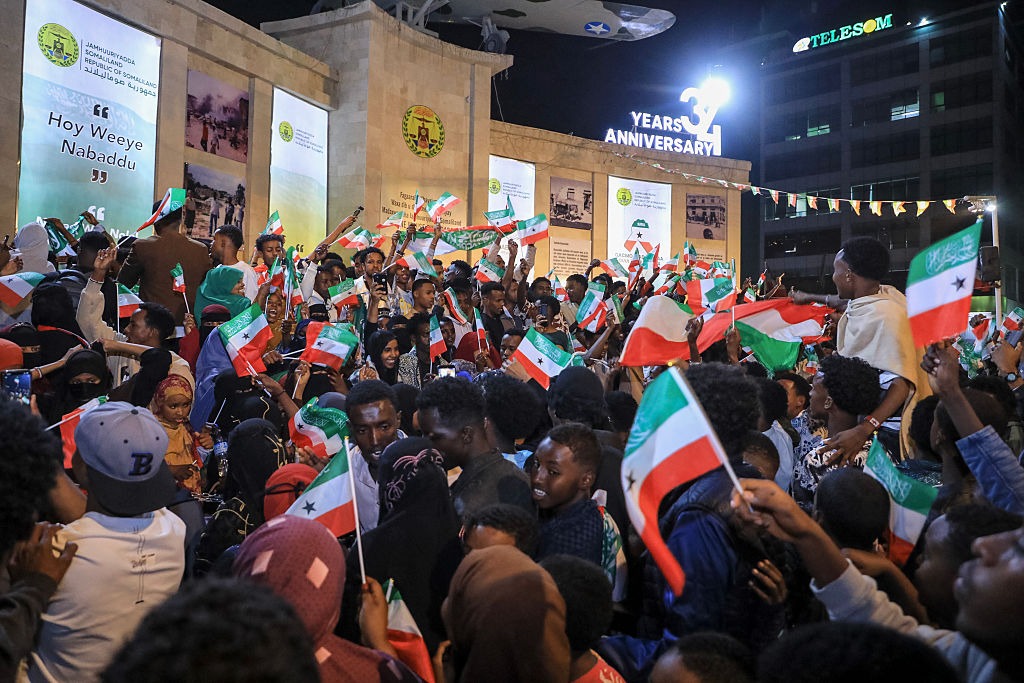
Washington should take note. Somaliland has achieved what its neighbor, Somalia, could not: relative order, internal cohesion, and institutional resilience. Official recognition would not just fix a diplomatic anomaly. It would unlock a genuine strategic asset — economic development, infrastructure projects, intelligence sharing, and potentially a forward U.S.-Israeli military presence. Such a base on Somaliland's coast would help monitor shipping lanes, deter piracy, counter jihadists, and contain Iranian influence from Yemen. It would send a powerful message: stability brings rewards.
Somaliland has never aligned with Islamist movements or hostile powers. Instead, it has repeatedly sought pragmatic partnerships with the West, offering security cooperation and investment opportunities. It understands the threats — from piracy to jihadism to great-power competition — and has shown through deeds, not words, that it belongs in the camp that builds stable institutions rather than tears them down.
At this time, when the Free World faces authoritarian expansion, ideological extremism, and its own internal divisions, it cannot afford to overlook its natural allies. Somaliland is one of them. It is not perfect, and it faces real challenges, but it has consistently aligned itself with the principles Western leaders claim to defend.
For decades the United States has poured military, financial, and political resources into neighboring Somalia with painfully limited results. Somalia remains trapped in the classic pattern of a failed state — fragmented authority, deep corruption, and persistent jihadist threats. Meanwhile, right next door, Somaliland has held multiple peaceful transfers of power, including the most recent presidential election on November 13, 2024. In that vote, opposition candidate Abdirahman Mohamed Abdullahi (commonly known as Irro) of the Waddani party defeated incumbent Muse Bihi Abdi. The transition was orderly, observed by international monitors, and certified without violence.
Geographically, Somaliland is crucial. It sits astride the Gulf of Aden, right beside the Bab el-Mandeb Strait — one of the world's most critical maritime chokepoints. Roughly a fifth of global petroleum trade passes through these waters, linking the Red Sea, the Suez Canal, and the Indian Ocean. Across the strait lies Yemen, where Iranian-backed Houthis have repeatedly disrupted shipping. To the northwest sits Djibouti, already packed with foreign military bases from the United States, China, France, and others. In this volatile corridor, a reliable partner is not optional. It is essential.
The strategic map of the 21st century is being redrawn right now — in the Red Sea, the Horn of Africa, and the Arabian Peninsula – all central arenas in the contest between open societies and authoritarian powers. Every alliance matters.
Somaliland already governs itself, secures its territory, and manages its own foreign relations. The real question is whether the international system can adapt to reality or will keep pretending otherwise while strategic rivals fill the vacuum.
There is a moral dimension here too. For more than 30 years, Somaliland's people have chosen democratic institutions over militias and ballots over bullets. In a region long defined by conflict, that choice was never guaranteed — it required hard work, political maturity, and a deliberate rejection of the path taken by Somalia, their neighbor to the south. Denying recognition sends exactly the wrong signal: that building a functioning democracy in hard conditions earns you nothing.
In Somalia, Mogadishu still struggles to project authority beyond a few besieged districts, constantly harassed by Al-Shabaab, the al-Qaeda affiliate that controls large rural areas and stages deadly attacks on the capital. Somaliland, by contrast, maintains internal security, secures its borders, and has kept jihadist groups largely at bay. This stability did not come by accident. It is the direct result of deliberate governance, clan reconciliation, and open, democratic governance.
Somaliland is not begging for charity. It is offering a genuine partnership.
In December 2025, Israel became the first country in the world to formally recognize Somaliland. Prime Minister Benjamin Netanyahu and Somaliland's President Abdirahman Mohamed Abdullahi Irro, signed a joint declaration establishing full diplomatic relations. This was a clear strategic signal that Jerusalem sees Somaliland as a serious partner in a region increasingly shaped by Iranian proxies, Turkish influence, and Chinese expansion.
While the international community says it champions democracy, stability, and self-determination, Somaliland ticks every box. Yet it stays unrecognized, largely because diplomats cling to the fiction of Somalia's territorial integrity — even though that unity exists only on paper. This is not principle at work. It is bureaucratic inertia. It has become a costly strategic error.
There will always be voices of opposition to everything. European capitals, bound by risk aversion and outdated legal doctrines, prefer theoretical borders to practical realities. Some regional players prefer chaos or ideological expansion. Somali political elites in Mogadishu fear that formal recognition would simply confirm what everyone already knows on the ground: the supposedly unified Somali state no longer exists in any meaningful sense.
Somaliland exists. This simple fact has stood unchallenged for more than three decades. Since May 18, 1991, when clan elders and leaders of the Somali National Movement gathered in Burao to declare independence after the fall of Siad Barre's regime, this breakaway territory has built a functioning state in one of the world's toughest neighborhoods. It has its own government, its own currency, its own security forces, and — most impressively — its own track record of democratic elections. Yet for much of the international community, Somaliland remains a geopolitical ghost: stable, democratic, and quietly successful, but still officially invisible.
The only question left is whether Washington and its allies possess the clarity, the courage, and the strategic vision to welcome it.
Pierre Rehov, who holds a law degree from Paris-Assas,
is a French reporter, novelist and documentary filmmaker. He is the
author of six novels, including "Beyond Red Lines", "The Third
Testament" and "Red Eden", translated from French. His latest essay on
the aftermath of the October 7 massacre " 7 octobre - La riposte "
became a bestseller in France. As a filmmaker, he has produced and
directed 17 documentaries, many photographed at high risk in Middle
Eastern war zones, and focusing on terrorism, media bias, and the
persecution of Christians. His latest documentary, "Pogrom(s)"
highlights the context of ancient Jew hatred within Muslim civilization
as the main force behind the October 7 massacre.
Source:

No comments:
Post a Comment