by Brother Lunk
A “surprise” attack recast: how power, intelligence, and omission converged to manufacture Pearl Harbor—and the war Americans would not otherwise choose.
The question was what we should do. The question was how we should maneuver them into the position of firing the first shot without allowing too much danger to ourselves.
—Diary of Henry Stimson, U.S. Secretary of War, November 25, 19411
Propaganda comes in many forms. Modern life bombards us with it at every turn, every day, everywhere, in every sphere of life. But the greatest of all propaganda is not defined by mere narrative control; it cannot be found in the production of any poster, film, book, news article, or school curriculum. Rather, the supreme act of propaganda is to manipulate history itself in furtherance of a narrative end; to produce a story rather than merely control it or report it; to precipitate an advantageous event that may then serve as a load-bearing column for a particular version of history. The infamous Japanese attack on Pearl Harbor in December 1941—the catalyst and proximate cause of America’s entry into World War II—was exactly this sort of event. Roosevelt and his inner circle not only knew about the impending attack well ahead of time but actively engineered and enabled its success in order to manipulate the American people into war. In short, Pearl Harbor was, at its core, a propaganda operation.
The common mythology of Pearl Harbor goes something like this: on the morning of December 7, 1941, the Roosevelt administration was engaged in ongoing, good-faith peace negotiations with Imperial Japan. After the latter carried out her dastardly, unprovoked surprise attack, the United States was forced to enter World War II. Since the Japanese were working with Adolf Hitler in an Axis bent on world domination, the U.S. was forced to go to war with Germany, too. Notice how nicely this narrative fits into the broader 20th-century story of the U.S. utterly destroying all her enemies and conquering the world in self-defense.
The problem with that story, however, is that every part of it is wrong, and the opposite is true. The “negotiations” in question were anything but good-faith; by December 7, they were already at an end for all intents and purposes, and war was assured, as all the key players in Washington well knew. Japan’s attack was neither a surprise nor unprovoked: Roosevelt’s aim for over a year prior was not to avert war but to foment it by way of an unambiguous American casus belli (ideally, a direct naval attack by the Germans).2 War with Hitler—who had no desire for war with the United States and had for two years been resolutely avoiding it despite multiple provocations in the North Atlantic—was not a secondary consequence of the attack on Pearl Harbor, but, in fact, its main intended purpose and utility for the American and British statesmen who precipitated it.
Since the late 1930s, Roosevelt had been making preparations for war with Germany long before her first territorial conquest. After the fall of France in May of 1940, Roosevelt’s primary stated geopolitical concern was that a German-occupied Britain could open the way for an invasion of the American homeland.3 The notion was obviously fantastical; there is no evidence that Hitler had any such designs on either country.
Even after his initial victories in the west, when Britain appeared at her weakest, Hitler rejected “the desirability of demolishing the British Empire, which he consider[ed], even today, to be an important factor in world equilibrium.”4 He viewed war with England as an unpleasant chore, confiding to Walther Hewel of the Foreign Office: “I do not want to conquer her . . . I want to force her to accept my friendship . . .”5 The half-hearted planning of Operation Sealion (seaborne invasion of Britain) was not begun until July of 1940, after Britain’s rejection of Hitler’s last of many attempts for a negotiated peace. Hitler viewed the English as Aryan co-ethnics and had long admired the British Empire (Lives of a Bengal Lancer was among his favorite movies and required viewing in the SS for its depiction of “how a superior race must behave”6), even pledging Germany to its protection in the new European order after the Polish question was resolved.7 From the beginning, Hitler’s expansionist aims were always eastward, for Lebensraum in Poland and the Soviet Union.
Regarding the United States, his desire was for a regional Monroe Doctrine that would ensure Europeans retained control over European affairs.8 Only late in the war with America (which he privately considered “a tragedy”9) did he resolve to ensure the United States would be excluded from world politics for all time.10 He never had any serious intent to invade. Nor was Germany at all involved in Pearl Harbor, some sharing of naval technologies between Germany and Japan notwithstanding. Hitler was informed of the attack for the first time on the afternoon of December 7 by his press chief Otto Dietrich, who learned of it from a Reuters broadcast.11
Nonetheless, even after Pearl Harbor, the Roosevelt administration always saw Germany, not Japan, as the primary geopolitical threat, and all its major decisions of the war were based on this assumption.12 It explains why, for instance, even as late as early 1942, U.S. military power was mostly concentrated in Europe, not the Pacific,13 and why, in the immediate wake of Pearl Harbor, Roosevelt joined in lockstep with Churchill in a “Germany first” strategy despite the public’s far greater desire for retribution against Japan (13 percent of Americans and 50 percent of G.I.s favored extermination of the Japanese race14). Note also that this antipathy preexisted Nazi invasions and war crimes and was not a function of them—the administration aligned itself with the Soviet Union against Nazi Germany at a time when the former had already committed millions of political murders, and the latter had not.
But Roosevelt had a major problem: Americans. Before December of 1941, domestic opinion on entering the war in support of Britain hovered between ambivalence and decisive opposition, including from diverse pressure groups like the America First Committee, progressive Protestant flagship Christian Century, and millions of everyday citizens (especially in the traditional isolationist Midwest) who detested communism and opposed giving any aid to the Soviet Union.15 Roosevelt’s repeated efforts to “educate” American opinion on the German threat had mostly failed.16 Undeterred, he knew a direct attack on the U.S. was the only way to make it happen: the only way to generate enough popular will to sustain the American people through the sacrifice of a generation of young men on the altar of global liberalism in yet another European slaughter. In a meeting a month before the attack, he asked his cabinet whether they believed the American people would support military intervention in the case of a Japanese attack on British Malaya or the Dutch East Indies. The cabinet unanimously answered in the affirmative, but Roosevelt himself remained unconvinced that such an attack would be sufficient. According to Attorney General Francis Biddle, he expressed hope for an “incident” in the Pacific involving American forces directly.17
Roosevelt’s critics were never unwise to his dangerous conflict of interests. Many were already suspicious by early 1941 that Roosevelt was making secret plans with Churchill to bring the U.S. into the war against the will of the people.18 Pearl Harbor was still burning when rumors began circulating that he had intentionally instigated the attack, as many wondered with Senator Tom Connally: “How did they catch us with our pants down, Mr. President?” To deflect accusations of malfeasance, the administration made a number of assertions, ranging from speculation to outright falsehood. Their defense hinged on a few key claims, including negligence by the Army and Navy commanders in Hawaii, laxity and poor discipline among the personnel there (later investigations would disprove both these claims, to Roosevelt’s great frustration), and most importantly: no warning.19
 Background to Betrayal
For decades prior to the attack, it was taken as a matter of obvious fact at all levels of the U.S. War Department that the American naval forces in Hawaii would be among Japan’s first targets at the outset of any potential conflict. As one former U.S. intelligence official wrote:
For thirty-two years . . . Japanese naval strategy . . . envisaged [a naval] showdown with the Americans . . . For more than three decades, the Japanese fleet trained and exercised for such an engagement . . . [specifically] an attack on the American fleet in Hawaiian waters at the outset of hostilities” (emphasis added).20
U.S. Fleet commander Admiral Frank Schofield made the same observation:
[Japan] will strike where the fleet is concentrated. The enemy will use carriers as the basis of his striking force. The enemy may make raids on Hawaiian Islands.21
As did General Sherman Miles, chief of the U.S. Army Military Intelligence Division in 1941:
[An air attack] on Pearl Harbor had been . . . a source of study for twenty years in Hawaii and in the War Department . . . That Hawaii could be attacked if Japan went to war was obvious to everyone.22
From 1932 onward, U.S. war games were designed on this basis, and even included the exact scheme of maneuver Japan would employ in December of 1941. In the 1932 games, the “Japanese” aircraft carriers and carrier-based planes crossed the remote “vacant sea” of the north Pacific, then turned south to achieve total surprise on Oahu, destroying the entire U.S. Pacific Fleet at anchor.23 The disastrous results of the exercise were no secret to the Japanese, who in turn reorganized their own navy with special emphasis on carrier-based air power. By 1941, Japan would boast the largest carrier fleet in the world, with 11 in active service (while the U.S. had only seven). The War Department’s acute awareness of Hawaii’s vulnerability was further heightened in 1938, when an internal study concluded that “there can be little doubt that the Hawaiian Islands will be the initial scene of action” if war came with Japan. In 1941 alone, the U.S. conducted three separate war games in which the “Japanese” forces attacked the U.S. Fleet in Hawaii.24
Yet, after the fall of France in May of 1940, Roosevelt made the strange decision to station most of the U.S. Fleet at Pearl Harbor indefinitely. The ostensible reason for the move was to intimidate Japan with a show of naval power, but its only effect was to make a successful attack on America’s most valuable naval assets both easier and more likely. U.S. Fleet Commander Admiral James Richardson (with the widespread support of the War Department, Navy leadership, and other U.S. Military planners) strongly protested the administration’s move, arguing that anchoring the fleet in Hawaii (as opposed to California) introduced unnecessary risk to U.S. forces, as the position offered no protection from air and sea attack, and was hopelessly indefensible. His outspoken opposition was ill-received by the administration, and Admiral Richardson was soon relieved of duty and replaced by Admiral Husband Kimmel in January of the following year.25
A few months after the fleet’s relocation, Lieutenant Commander Arthur H. McCollum, director for Far East Asia at the Office of Naval Intelligence (ONI), authored a now-infamous five-page memo in October of 1940 (classified until 1994) forwarding a strategy to incite a direct Japanese attack on the U.S. (as well as British and Dutch holdings in the Pacific) in order to compel a still-reluctant America into the war. Addressed to two of Roosevelt’s most trusted advisors, the memo detailed an eight-step plan to counter Japanese influence in East Asia, including increased material assistance to the British and Chinese, relocation of American supplies and materiel to the far east, and increased economic pressure on Japan. To this last end, the crippling American oil embargo on Japan, beginning in August of 1941, which The New York Times called “the most drastic blow short of war” and many observers called Roosevelt’s backdoor entrance to war against Hitler, was perhaps the most decisive step.26 McCollum ended the note with this revealing prediction: “if by these means Japan could be led to commit an overt act of war, so much the better.”27 By December of 1941, all eight steps would be accomplished.
Roosevelt consistently told a very different story to the American public than his preparations for war would indicate. In addition to his military and diplomatic preparations, he spent a great deal of time and effort to turn U.S. opinion in favor of intervention, while remaining ostensibly committed to neutrality. From May of 1940 onward, Churchill’s covert British Security Coordination—occupying two floors of Rockefeller Center—would employ political warfare, forgery, and propaganda to this end, with Roosevelt’s clear blessing. The Tyler Kent affair is one illustration of the lengths to which his and Churchill’s governments were willing to go to keep their deception secret.
In October of 1940, London-based American diplomat Tyler Kent discovered and attempted to publish secret communications between Roosevelt and Churchill, indicating the former’s intent to circumvent the Neutrality Acts to aid Britain militarily, but was arrested before he could do so. In 1945, near the end of Kent’s five-year imprisonment under the British Official Secrets Act, his mother reported to The San Francisco Examiner that she had feared for her son’s life ever since a U.S. congressman telephoned her saying Kent would be in grave danger “the minute he left England.” Other foreign sources told her the same, adding that Kent possessed “knowledge which a certain country wanted to keep suppressed” concerning “current international relations [and] global viewpoints of top British-American statesmen at the time the U.S. was neutral.” According to Kent’s mother—close to a nervous breakdown from fear at the time of the article’s publication—two attempts had already been made by taxi drivers to run him down in the street. The contents of Kent’s recorded messages have never been revealed.
The same month as Kent’s imprisonment, Roosevelt reaffirmed his false desire for neutrality at a speech in Philadelphia:
“We will not participate in foreign wars, and we will not send our army, naval or air forces to fight in foreign lands outside of the Americas, except in case of attack” (emphasis added).
Yet in August of 1941, at the Atlantic Conference (where Roosevelt and Churchill discussed their postwar global vision), Churchill noted the “astonishing depth of Roosevelt’s intense desire for war.” He gave details via cable to his cabinet:
“The President . . . said that he would wage war but not declare it, and that he would become more and more provocative. If the Germans did not like it, they could attack…. Everything was to be done to force an incident . . . he obviously was very determined that [the U.S.] should come in” (emphasis added).28
And to Australian leaders, Churchill gave the following account of the meeting:
“You should . . . be aware that the general impression derived . . . at the Atlantic meeting was that, although the United States could not make any satisfactory declaration on the point, there was no doubt that in practice we could count on United States support if, as a result of Japanese aggression, we became involved in war with Japan.”29
Churchill’s accounts establish three important facts. First, Roosevelt was clearly committed to entering the war with or without the approval of Congress (let alone the American public). Second, Roosevelt would attempt to “force an incident” with which to bring the U.S. into the war. Third, and most crucially, they reveal that Japanese aggression would be considered a valid pretext for U.S. intervention in support of Britain against Germany.
The table was thus set in three respects: militarily and diplomatically, an attack by Japan was all but certain; domestically, the American people were primed to accept the potential legitimacy and necessity of U.S. involvement; and internationally, Roosevelt’s allies were reassured of eventual U.S. intervention and able to plan accordingly. Roosevelt knew where he wanted to go, and he knew how to get there. The only missing piece was the “incident” itself.
Streams of Intelligence and Evidence of Foreknowledge
As any intelligence professional well knows, one of the most important methods for determining the accuracy and relevance of collected information is that of quantifying sources. A single man saying a thousand times that there’s a monster in the woods may be no cause for alarm—he could easily be mistaken, crazy, or have some ulterior motive to deceive you. You’d be justified in dismissing the claim, absent any other evidence. However, a thousand people saying there’s a monster in the woods is an altogether different matter. When multiple, independent streams of reporting indicate the same piece of information—especially when collected by different parties, with different methods, and in different times and places—the odds that that information is true (in full or in part) are increased exponentially.
In the case of Pearl Harbor, the number, diversity, and precision of warnings and indicators of impending attack render any notion of “surprise” unsustainable. They came from both foreign and domestic sources, through military, civilian, and diplomatic channels, and included details not only of Japanese grand strategic aims, but specific operational plans.
From the beginning, Japan’s designs on Pearl Harbor were never much of a secret—again, both countries knew it was the obvious first move. The first explicit warning came shortly after the Japanese began planning the attack in January of 1941, when several members of the Imperial War Ministry divulged the development to the U.S. Ambassador Joseph Grew: “The American Fleet will disappear.” This information was forwarded by the State Department to Roosevelt personally, and is preserved in the files of the War Department.30
In the same month, Kilsoo Haan of the underground Sino-Korean People’s League first told Colonel George Patton of the plan. He would send Secretary of State Cordell Hull similar warnings in March and October, specifying the attack would happen before Christmas.31 In November, convinced the State Department was uninterested in his information, Haan contacted Senator Guy Gillette and reporter Eric Sevareid, who forwarded the warnings to the State, War, and Navy Departments: “[Gillette] said that Haan had contacted him in late November, telling him that the Japanese Fleet had sailed under battle orders, east, not south, to attack Pearl Harbor or the Panama Canal.”32 Sevareid similarly recalled:
“A young Korean-American would often drop into my Washington office. He was in touch with the anti-Japanese Korean underground. ‘Pearl Harbor,’ he kept telling me, ‘before Christmas,’ but he could get no audience at the State Department.”33
We can be certain high-level State Department personnel received at least one (though probably more) of Haan’s four warnings, as confirmed by a memo from special adviser Stanley Hornbeck to Cordell Hull from late October, in which Hornbeck commented:
“Mr. Haan has from time to time furnished . . . information which proved authentic and also of value. We cannot dismiss Haan or information given by him.”34
Haan’s final desperate warning would come on December 4, when he reported in a phone call with U.S. diplomat Maxwell Hamilton that the attack would come that weekend.35
Haan was not the only foreign source who tried and failed to prevent disaster at Pearl Harbor. Other warnings came from Serbian national Dušan “Duško” Popov, an MI6 double agent (codename “Tricycle”), who regularly passed intelligence to the British and Americans after infiltrating the Abwehr (German intelligence service) in 1940. In August of 1941, Popov arrived in Hawaii with instructions to gather intelligence on military installations and defensive capabilities there. The same month, Popov said in an interview with the FBI that he believed this information was intended for use by Japan in planning an upcoming air attack on Pearl Harbor with carrier-based torpedo bombers.36 He added that, to the same end, two Germans had shown Japanese naval personnel in Taranto (a coastal city in southern Italy) a precise method for launching torpedoes from the air at ships anchored in shallow water. Popov’s report was passed to J. Edgar Hoover, who, in turn, passed it to the ONI and Edwin Watson, one of Roosevelt’s senior aides. British intelligence officials later commented that they considered the information “a strong indication” of an imminent attack on Pearl Harbor, adding that “it seems incredible that Pearl Harbor should not have been on the alert for a surprise . . . air raid.”37
Equally ignored were the warnings of Richard Sorge, a German journalist turned head of a Soviet spy ring in Japan, who, in October of 1941, radioed his superiors in Moscow: “Japanese air force attacking United States Navy at Pearl Harbor probably dawn November six. Source reliable.”38 In May of 1951, John O’Donnell of The New York Daily News published an exposé on Sorge, quoting his previously undisclosed confession that this information was relayed by the Kremlin to top personnel in Washington, including Army Chief of Staff George Marshall and Chief of Naval Operations Harold Stark.39
British intelligence (which, as we have seen, worked closely with U.S. intelligence both before and during the war) also sent clear warnings to U.S. government and military personnel on numerous occasions in the six months leading up to the attack. However, what complicates the matter is that Churchill ordered millions of intelligence documents—about 90 percent of all those in Britain—to be destroyed, and the rest sealed.40 As these lost documents would have contained the specifics of what British intelligence knew, when they knew it, and (most importantly) when they informed the Americans, we must instead look to other sources to glean this information, including testimonies and written accounts by those involved.
One such warning came in June of 1941, when U.S. Army Major and undercover agent Warren Clear received word from British intelligence in Singapore that Japan planned to attack Pearl Harbor. He wrote in 1967 that “my evidence will show that Washington D.C. had solid evidence prior to [Pearl Harbor] that Japan would . . . [attack] Hawaii.”41 The same month, a U.S. military attaché in Mexico corroborated Clear’s information, adding that Japan was building “[midget] submarines for attacking the American fleet in Pearl Harbor.”42 The U.S.S. Ward would spot and sink one of these five submarines at 6:45 a.m. on December 7, the opening shot of the Pacific War. Clear, still subject to military regulations at the time of the 1945 Congressional investigation of the attack, was prohibited by his superiors from appearing before the committee.43
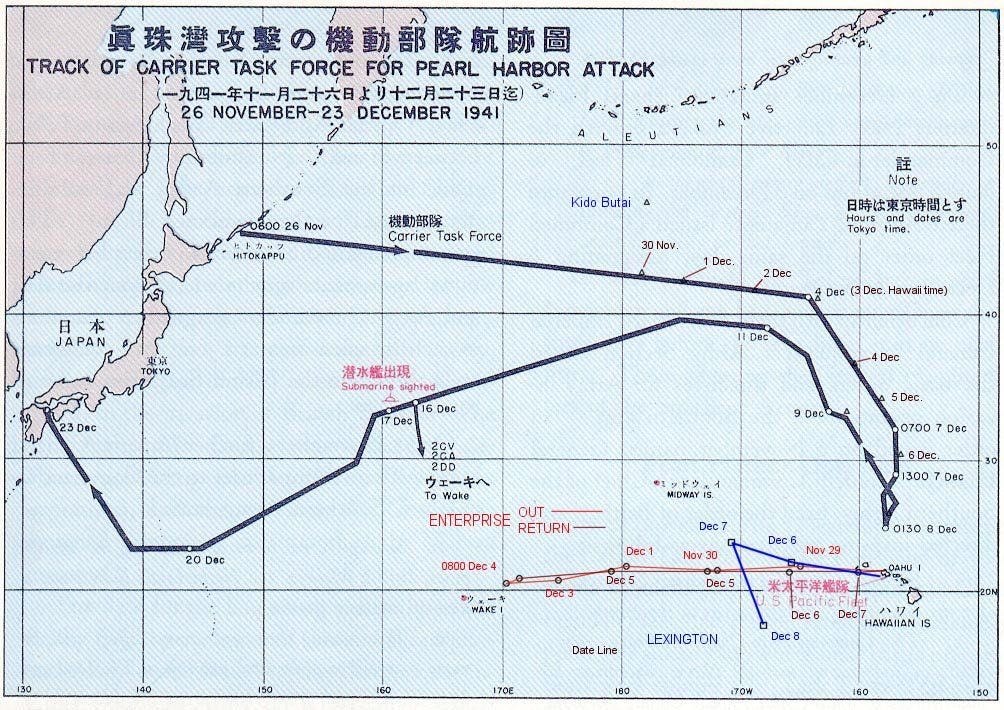
Another warning came on November 25, 1941, when Admiral Yamamoto sent a radio transmission to the Japanese naval task force with orders to set out from Hitokappu Bay on the morning of the next day and “attack the main force of the United States fleet in Hawaii and deal it a mortal blow.”44 The message was decoded by the British the same day,45 and the Dutch two days later. When the U.S. decoded the transmission has never been disclosed,46 though there is evidence its contents reached Roosevelt almost immediately. Around 3 a.m. on the following morning (November 26), Churchill sent an urgent, secret message directly to Roosevelt. The contents of the message have likewise never been disclosed, though common sense would suggest it almost certainly concerned the momentous radio intercept of the previous day. Unsurprisingly, mere hours later, the Roosevelt administration moved to abandon its previous peace proposal to the Japanese, and Admiral Kimmel at Pearl Harbor received a “suggestion” from Stark that he dispatch the two aircraft carriers located there (the U.S.S. Enterprise and Lexington) to reinforce Midway and Wake Island. Both carriers would thus be absent from port on December 7, and spared from destruction.
Yet another warning came on December 5, when British intelligence in Singapore determined (likely via radio direction finding) that the Japanese fleet had turned south toward Hawaii. Later accounts from British official Victor Cavendish-Bentick (chair of Britain’s Joint Intelligence Committee) confirm the fleet’s change in direction was quickly relayed to Washington. Years later, Cavendish-Bentick wrote:
We knew that they changed course. I remember presiding over a J.I.C. meeting [on December 5, 1941] and being told that a Japanese fleet was sailing in the direction of Hawaii, asking ‘Have we informed our transatlantic brethren?’ and receiving an affirmative reply . . . [We had given] the U.S. authorities . . . ample time to at least send most of the fleet out of Pearl Harbor.”47
William Casey of the Office of Strategic Services (and later, chief of the CIA) revealed the same in his 1989 memoir, The Secret War Against Hitler: “The British had sent word that a Japanese fleet was steaming east toward Hawaii.”48 With reference to the above and other indicators collected and relayed between November and December of 1941, the commander of British intelligence in Singapore wondered in a meeting with his staff the day after the attack, “With all the information we gave them, how could the Americans have been caught unprepared?”49
One commonly cited explanation for the administration’s inaction is that Allied naval intelligence forces simply could not have known about the incoming attack based on radio communications because the Japanese fleet maintained complete radio silence en route to Pearl Harbor.50 If there was no communication, no intercepts could possibly have been collected, no radio direction finding could possibly have yielded any results—so the argument goes. But this is flatly untrue. While the fleet commander, Admiral Nagumo Chuichi, did indeed order absolute silence when the task force assembled on November 25, the order was subsequently modified a day later to allow radio communications by the fleet’s main striking force in cases of “extreme emergency,” and left those of other parts of the fleet (such as supply, repair, and hospital ships) to the discretion of their respective commanders.51 As both Japanese and American records confirm, numerous radio transmissions sent between November 26 and December 7 were from one part of the fleet to another.52
Those who would try to explain away the government’s inaction in defense of the official narrative on Pearl Harbor may attempt to simply dismiss all the above warnings as speculative, hearsay, unverifiable, or otherwise unreliable due to their foreign origin. The same cannot be said for those warnings that came directly from authoritative sources within the U.S. intelligence apparatus itself, of which there were many.
In September of 1941, Tokyo began sending frequent encrypted messages to Japanese spies in Hawaii requesting precise locations and dispositions of American warships. These several dozen “bomb plot” messages (as they came to be known) were regularly intercepted by U.S. Naval Intelligence between September and December, and—as they were sent using the already-broken JN-19 encryption—usually deciphered in Washington immediately (at least in part). Though Japanese intelligence collection efforts of this sort were not limited to Pearl Harbor, nothing comparable in volume and precision to the bomb plot messages was intercepted concerning any other port.53
After November 14, the intercepted communications between Tokyo and Hawaii grew even more detailed and clearly indicated a coming air attack. They concerned specific information on American weapon systems and methods of air defense at Pearl Harbor, including barrage balloons and torpedo nets.54 One intercept from December 3 gave information on the moorings of U.S. warships at anchor, ending with “so far they do not seem to be alerted.” Another from December 5 said: “no barrage balloons sighted . . . No indications of air or sea alert.” And on December 6: “there are no barrage balloons up, and there is an opportunity left for a surprise attack against these places.”55 MacArthur’s intelligence chief, Charles Willoughby, later remarked:
“The sequence of messages…beginning with November 14, would have led instantly to the inescapable conclusion that Pearl Harbor naval installations were a target for attack . . . for some sort of naval seaborne sortie.”56
The official position of the U.S. Government (and the one still accepted by most writers) is that none of the above naval intercepts were deciphered prior to December 7. But this claim is directly contradicted by witness testimony, declassified NSA documents, and the 1945 congressional inquiry.57 One American cryptanalyst in the Philippines wrote in November of 1941: “We are reading enough current traffic to keep two translators very busy.”58 Churchill even lauded the success of the American codebreakers in his memoir The Grand Alliance, where he wrote: “from the end of 1940 the Americans had pierced the vital Japanese ciphers, and were decoding large numbers of their military and diplomatic telegrams.”59 Furthermore, top personnel in Washington (including the Chief of Naval Operations, Director of Naval Intelligence, Director of War Plans, Secretary of the Navy, and others at the White House and State Department) received daily briefings on pertinent radio intelligence.60 Roosevelt himself was noted by several biographers to have been an obsessive reader not only of intelligence summaries, but also field reports and diplomatic and military intercepts, and was personally briefed on raw decrypts twice daily.61
Yet the contents and implications of these many intercepts, by and large, never made it to General Short and Admiral Kimmel in Hawaii, whose defensive preparations were primarily against submarine attack and sabotage.62 The chiefs of Naval Intelligence and Communications wanted to send them, but were (after a bitter dispute in Washington) prevailed over by Admiral Richmond Turner, Chief of Naval War Plans, who successfully prevented them from doing so. The ostensible reason for keeping them secret was that if Short and Kimmel learned of the decoded intercepts, Japan might learn of them too, and change their codes in turn. But this excuse fell apart when it was revealed in 1942 that Short and Kimmel’s counterparts in Manila (MacArthur and Hart) were given full access to the intercepts.63
Relatedly, warning messages based on the diplomatic and naval intercepts (tagged as “OPNAV war warnings”) went out from the Office of Naval Operations in Washington to all Pacific outposts (including Pearl Harbor) three times before December 7, on November 24, 27, and 29. But despite the intercepts’ clear indication that Hawaii was the target, Short and Kimmel were told Japan was expected to target other U.S. bases, not their own; the OPNAV messages identified only the Philippines, Kra Peninsula, Thailand, Borneo, Guam, and Samoa as “possible objectives.”64 According to Marshall and Stark, when drafting the dispatches for November 27, there was debate over whether to issue a “final alert” for Hawaii, but none was sent, nor did any of the subsequent dispatches constitute a final alert.65 Even on the morning of December 7, every Pacific outpost received warning messages from Washington of imminent attack (and was thus able to prepare for an assault) except Pearl Harbor.66 Time and again, Short and Kimmel were specifically kept in the dark about the gravity of their situation. The strategic assessments of top personnel in the Roosevelt administration leave little doubt as to why.
As the bomb plot messages indicate, information regarding the alertness and defensive posture at Pearl Harbor was critical to the Japanese. But for that reason, it was also critical to U.S. planners. Roosevelt’s Chief of Intelligence, Sherman Miles, had correctly assessed that Japan would only carry out its attack on an unprepared target.67 Keeping the commanders in Hawaii uninformed was thus an operational necessity for an administration that aimed to capitalize on the propaganda value of burning ships and dead servicemen on the front page of every newspaper in America. When asked during the Congressional inquiry why warnings concerning Japanese intercepts were so long withheld from Pearl Harbor (despite many protests by lower-ranking officers), Army Chief of Staff George C. Marshall testified: “they must not send anything that would produce an operational reaction . . . for attack or defense.”68
In 1991, the NSA declassified the “Pre-Pearl Harbor Naval Despatches,” a partial collection of 188 Japanese intercepts indicating a coming attack on Pearl Harbor in heavily (and permanently) censored form.69 It remains unclear—and likely always will—exactly how many of these messages were decoded and translated before December 7, mainly because roughly 100,000 government documents containing this information (as well as the full set in uncensored form) apparently “[could] not be located.”70
But we know the number was not trivial, and certainly not zero, as the U.S. Government maintains. It was substantial enough that both ONI director Captain Alan Kirk and leading Navy cryptologist Laurance Safford proposed as early as October sending the bomb plot messages to Admiral Kimmel at Pearl Harbor to warn him of imminent attack. Their requests were denied, and Kirk was replaced shortly after.71 Safford, often referred to as the “father of U.S. naval cryptology,” remained convinced until his death in 1973 that the government had actionable knowledge of the Japanese plan and failed to act.72
Contra Safford, Roosevelt did take action. His actions just didn’t include providing adequate warning to Pearl Harbor; they were directed elsewhere. In early November, he summoned to the White House Don Smith, director of the War Service for the American Red Cross, to discuss a “top secret matter.” Smith’s daughter recounted the meeting in 1995:
At this meeting, the President advised my father that his intelligence staff had informed him of a pending attack on Pearl Harbor, by the Japanese. He anticipated many casualties and much loss; he instructed my father to send workers and supplies to a holding area at a P.O.E. [port of entry] on the West Coast, where they would await further orders to ship out; no destination was to be revealed. He left no doubt in my father’s mind that none of the Naval and Military officials in Hawaii were to be informed, and he was not to advise the Red Cross officers who were already stationed in the area. When he protested to the President, President Roosevelt told him that the American people would never agree to enter the war in Europe unless they were attack [sic] within their own borders . . . He [Smith] was privy to Top Secret operations and worked directly with all of our outstanding leaders. He followed the orders of his President and spent many later years contemplating this action, which he considered ethically and morally wrong” (emphasis added).
That Roosevelt (perhaps in some effort to salve his own conscience) would explicitly divulge the conspiracy to Smith sounds almost fanciful, and one might at first sight be justified in dismissing the story, but for one thing: records from the Hawaii Chapter of the Red Cross’s Annual Report indicate there was in fact a surge of medical personnel and supplies to Pearl Harbor just before Dec 7.
It remains unclear exactly how far in advance Roosevelt knew of the precise date of the attack, though the Don Smith meeting (and subsequent just-in-time delivery to Pearl Harbor) suggests it was over a month. Further supporting this estimate is the account of the Japanese minister in Budapest who, hours before the attack, informed Tokyo:
On 6th (November), the American minister presented to the Government of this country a British Government communique to the effect that a state of war would break out on the 7th of December.
At 7:20 a.m. on Saturday, December 6, Japanese Foreign Minister Shinegori Togo sent Ambassador Kichisaburo Nomura in Washington message 901 (what would become known as the “pilot message”), containing forewarning of Tokyo’s coming reply (message 902) to the American ten-point “peace proposal” of November 26, as well as instructions for Nomura on when to relay the reply to his U.S. counterparts.73 The proposal in question constituted Cordell Hull’s final ultimatum, demanding Japan’s full withdrawal from China and Indochina.74 Nomura, as well as Japanese envoy Saburo Kurusu, had already, days prior, made their country’s unwillingness to accept the proposal and plans to go to war with the U.S. clear to Hull, who later testified, “Ambassador Nomura and Mr. Kurusu talked emphatically about the urgency of the situation and intimated vigorously that this was Japan’s last word.”75 The pilot message’s indication of Japan’s coming rejection of the proposal was no surprise, because no one involved actually expected Japan to consider the terms.
The pilot message emphasized secrecy by the ambassador, as “the situation [was] very delicate,” and stressed that he must “make every preparation to present it to the Americans just as soon as [he received] instructions.”76 Intelligence workers decoded and translated the pilot message by 2 p.m. on the same day, and the majority of message 902 shortly after.77
Also at 2 p.m., Dutch attaché to the ONI Johann Ranneft noted in his diary, “they show me on the map the location of 2 Japanese carriers departed from Japan on easterly course.” He later added: “At 1400 . . . At my request, they show me the location of the 2 carriers west of Honolulu.” He said an ONI member commented, “This is the Japanese task force proceeding east,” adding that it was halfway between Japan and Hawaii on December 2nd.78 Ranneft’s note is supported by the account of Seaman Robert Ogg (who later went by “Seaman Z” to conceal his identity) of the Navy’s San Francisco office. According to Ogg, the carriers’ location was known at ONI on December 6 because his unit had traced them via radio direction finding (further disproving the fleet’s supposed radio silence) to a point near Pearl Harbor a few days prior. Ogg’s account was in turn corroborated by his superior, Lieutenant Ellsworth Hosner, the former adding that their chief, Captain Richard McCullough, gave the reports of their findings directly to Roosevelt.79
Intelligence workers correctly assessed that the contents of messages 901 and 902 left no doubt that Japan would reject the American proposal, and negotiations were at an end. Specifically, they took them to mean Japan would certainly attack the next day, simultaneous to a formal declaration of war.80 One member of the Army Signal Intelligence Service later wrote:
“Shortly after midday on Saturday, December 6, 1941 . . . [we] knew that war was as certain as death . . . it was known in our agency that Japan would surely attack us in the early afternoon of the following day . . . Not an iota of doubt.”81
On the evening of December 6, there was again debate in Washington over whether to send Short and Kimmel a final alert in light of the pilot message. Navy Secretary Frank Knox drafted one for Kimmel and believed it to have been sent, but once again, it never was. The morning of the attack, Marshall and Stark’s staffs pressed them a third time to issue a final alert, but Marshall delayed, and Stark refused outright. The warning Marshall finally did send Kimmel—which arrived only after the attack was already over—still did not constitute a final alert.82
At 9:30 p.m. on December 6, Navy cryptographer Alwin Kramer arrived at the White House with messages 901 and 902, specifying “the President should see [them] as quickly as possible.”83 Lieutenant Lester Schulz hand-delivered them shortly thereafter to Roosevelt, at the time in a meeting with special advisor and confidant Harry Hopkins (later revealed to be one of the most important Soviet wartime agents in the U.S.84). Schulz noted Roosevelt’s relaxed demeanor as he read and discussed the messages with Hopkins, commenting, “This means war.” Hopkins added that it was “too bad” that Japan would have the advantage of firing the first shot rather than the U.S., to which Roosevelt replied, “No, we can’t do that. We are a democracy and a peaceful people. But we have a good record.” Schulz later testified: “The impression that I got was that we could not make the first overt move. We would have to wait until it came.”85
Schulz also noted that neither Hopkins nor the president made any mention of warning the Pacific commanders before the attack, which was now certain to come the next morning—though the latter did find time to pen a quick letter to Emperor Hirohito in the interim, a (by all accounts, pointless and insulting) last-minute plea for peace.86 Shortly before receiving news of the attack the following afternoon, Roosevelt shared the letter with Chinese ambassador Hu Shih, commenting, “That will be fine for the record.” Hu later told a reporter that Roosevelt told him that morning he was sure Japan would attack.87
In the words of one biographer, this “record” with which Roosevelt was so concerned had to do with ensuring “the United States would have clean hands, leaving the isolationists without effective argument against American intervention on the side of the British and Dutch.”88 To the very end, Roosevelt’s chief motivation was not the preservation of American lives but his own political ends, to be realized through the propaganda value of thousands of avoidable American deaths.

After Infamy
At 7:52 a.m. Pacific time, on the sleepy Sunday morning of December 7, 1941, the anti-aircraft guns were unmanned at Pearl Harbor. No barrage balloons were in the air, no torpedo nets were in the water. American warships were bunched closely together in the harbor with limited ranges of fire, battle positions empty. Fighter planes were unequipped and unready for takeoff, and pilots were unready to fly them. Soldiers, sailors, and Marines were still following a peacetime routine, many off on weekend shore leave.89 At 7:53 a.m., air commander Mitsuo Fuchido radioed to the Japanese flagship Akagi, “Tora! Tora! Tora!” to confirm that complete surprise at Pearl Harbor had been achieved. At 7:55 a.m., the air raid siren sounded across the base, and by 9 a.m., more than 2,400 Americans were dead or mortally wounded. By 4 p.m. Eastern, Roosevelt had his war. On December 23, the last of the sailors trapped aboard the sunken U.S.S. West Virginia finally drew his last breath.
Of all the above warnings and indicators, none was made known to the commanders at Pearl Harbor; the “surprise attack” worked exactly as intended. According to one Gallup poll, in the days following December 7, American public opinion shot to 97 percent approval for entering the war, up from only 52 percent in late November. By the morning of December 8, newspapers across America were reporting lines around the block at local recruiting stations, many staying open around the clock for men waiting to enlist. In a 2001 interview, 101st Airborne veteran Paul Rogers aptly summarized the common sentiment of the American fighting man by the afternoon of that fateful day: “It wasn’t like Korea or Vietnam, we [were] attacked, and it was a feeling of, you know, maybe we’re just dumb country people, but a lot of us volunteered.” By the time a Congressional committee published 20 clear warnings in 1946 (the number would later grow to over 23090), the war had already been won with the slogan “Remember Pearl Harbor!” The administration’s story was already (and remains) established history, even authoritatively declared “the law of the land” by a federal court of appeals.91
Yet it is simply inconceivable that given the knowledge of high-level administration officials in Washington prior to December 7, their in-depth understanding of Japanese war plans, their many warnings from foreign and domestic sources, and the hundreds (or thousands—again, the U.S. Government has ensured we will never know exactly) of naval, diplomatic, and civilian intercepts collected and decoded over the previous months, that the attack was in any way a surprise. It was definitely one for the poor souls in Hawaii—sacrificed as unwitting pawns in Roosevelt’s Machiavellian game—but certainly not to Roosevelt, his Cabinet, his General Staff, or the Washington intelligence apparatus.
The Army Pearl Harbor Board reached a similar conclusion in 1942. On the clear pattern of discrepancy between the sworn testimony of key witnesses and their own actions and written records in the months preceding the attack, the board commented sarcastically:
“We must . . . conclude that the responsible authorities . . . all expected an attack on Pearl Harbor . . . [but] when testifying after the Pearl Harbor attack, they did not expect it.”92
Indeed, the attack itself was not the end of the propaganda operation—in many respects, it was only the beginning. Ever concerned with their “record,” Roosevelt and his few dozen closest operatives faced a new challenge: preserving the official story in the public eye against an immediate onslaught of questions, investigations, and inquiries as to how Pearl Harbor could have possibly been caught so unprepared.
Attempting to head off the Congressional investigation that was sure to come, Navy Secretary Frank Knox conducted the first official inquiry in the days immediately following the attack. After questioning dozens of relevant personnel in Hawaii, Knox was shocked to discover that no warning message from the Navy Department ever arrived on the evening of December 6, and included this key fact in his initial report. As it suggested negligence in Washington, Roosevelt coerced him to remove it from the report before release, giving him “verbatim wording,” according to Knox’s aide Frank Beatty.93 The revised report made no mention of it. Roosevelt was more interested in scapegoating than allowing the public to discover the truth of how Pearl Harbor was left so unprepared, and according to Knox, desired only evidence which showed dereliction of duty by Short and Kimmel—none of which Knox found.94
The second major inquiry—and the one which would do most to cement the administration’s narrative in the public memory—began on December 16, when Roosevelt appointed a special commission headed by Supreme Court Justice Owen Roberts. Roberts’s reputation as a jurist inspired confidence in the American people. The San Francisco Chronicle lauded his appointment, writing:
“From such a board we shall learn the truth, the whole truth, and nothing but the truth, and whatever action it recommends will be just and fair and constructive.”
Representative Carl Vinson was so impressed by Roberts that he opted to forgo altogether an investigation by the Naval Affairs Committee.95
But the American people were once again mistaken in their trust, and Roberts, too, was misled. Though nominally in charge of the commission, Roberts received instruction from Roosevelt throughout its execution, as well as from Stark, Marshall, and Secretary of War Henry Stimson—all people who should have been the subjects of the investigation.96 One disillusioned member of the commission, Admiral William Standley, later complained that Roberts ran it “as crooked as a snake” and was, like Knox, directed only to find evidence against Kimmel and Short.97 Marshall and Stark withheld from Roberts their efforts to keep Kimmel and Short uninformed of the impending attack, falsely telling him the commanders in Hawaii were fully aware of all developments affecting their commands. Roberts later said that, during his investigation, he mistakenly believed Kimmel and Short had received “every document that could have bearing on the situation at Pearl Harbor.”98 Unable to defend themselves due to the suppression of key exculpatory evidence, Short and Kimmel were found guilty of grave errors in judgment and dereliction of duty, while officials in Washington were exonerated. Stark’s successor, Admiral Earnest King, later wrote:
“[The Roberts Commission] did not get into the real meat of the matter but merely selected a ‘scapegoat’ to satisfy the popular demand for fixing the responsibility for the Pearl Harbor debacle . . . Admiral Kimmel . . . and General Short were ‘sold down the river’ as a political expedient.”99
Based on the commissions’ conclusions, Roosevelt directed court-martial charges be brought against Short and Kimmel, and the American people were provided an explanation for the disaster as simple and succinct as it was false: Short and Kimmel received orders to defend Pearl Harbor and failed to execute them; officials in Washington did their utmost to save American lives, but their warnings fell on deaf ears.100 It proved largely irrelevant that extensive investigations by the Army Pearl Harbor Board in 1942 and Naval Court of Inquiry in 1944 disproved this story entirely. These were kept secret, while only the Roberts Commission was allowed for public consumption. By the time their contents were released, the war was already over, and everyone had moved on. The lie had been shouted, the retraction whispered. Even today, over eighty years later, the lie has yet to be displaced in the public consciousness.
It is indeed a uniquely striking (though not surprising) feature of the Pearl Harbor story that the initial “neutrality before surprise attack” narrative remains as strong as ever despite the clear evidence of willful negligence largely revealed through the government’s own investigations. George Victor, author of The Pearl Harbor Myth, believes the disconnect is basically an emotional problem: “A nation often pulls itself out of [crisis] by creating myth—a melodramatic account, mixing fact and fantasy—which becomes a sacred part of its history.”101 The attack on Pearl Harbor is, in many ways, less a historical memory than a mythological one: it unified the people of the nation in one of their darkest hours, and became the central justification of their great sacrifice in the Second World War—one of their proudest achievements. As with all other ahistorical popular perceptions of that war—like the notion that the Allies fought to save the Jews, or that Nazism arose purely because of one man’s sheer adeptness at public speaking—it is unlikely that any number of revisionist treatments of the subject unearthing secret alliances, hidden plans, and ulterior motives will do much to dislodge the creedal myths.
Defeat at Pearl Harbor was the result of a criminal conspiracy at the highest levels of government to manipulate the American people. The evidence is there, and has been for decades. As John Adams said, “facts are stubborn things.” But propaganda, too, is a stubborn thing.
* * *
This article was originally published on June 30, 2025, on Substack. Brother Lunk can be followed there at Lunkstack and on X.
Joint Committee on the Investigation of the Pearl Harbor Attack, vol. 11 (Congress of the United States, 1946), 5433.
Ibid., vol. 16, 2518; John Toland, Adolf Hitler, 1st ed. (Anchor, 1976), 691.
George Victor, The Pearl Harbor Myth: Rethinking the Unthinkable (Potomac Books, 2007); “Franklin D. Roosevelt ‘Arsenal of Democracy’ Address, 29 December 1940.”
Toland, Adolf Hitler, 1st ed., 614.
Ibid., 620.
Ibid., 391.
Ibid., 552.
Ibid., 631.
Ibid., 695.
Ibid., 771.
Ibid., 694; MilitaryHistoryNow.com, “Hitler and Pearl Harbor—How News of Japan’s Surprise Attack on the U.S. Pacific Fleet Rocked the Third Reich.”
Kent Roberts Greenfield and Center Of Military History, Command Decisions (Center Of Military History, United States Army, 1990), 11.
Frank Freidel, “World War II: Before Pearl Harbor,” Current History 35, no. 206 (1958): 211–15.
Arthur N. Feraru, “Public Opinion Polls on Japan,” Far Eastern Survey 19, no. 10 (May 17, 1950): 101–3, https://doi.org/10.2307/3023943.
Toland, Adolf Hitler, 691.
A. J. P. Taylor, The Origins of the Second World War (Penguin, 1964), 9.
Joint Committee on the Investigation of the Pearl Harbor Attack, vol. 11 (Congress of the United States, 1946), 5420; Richard Collier, The Road to Pearl Harbor—1941 (Atheneum Books, 1981), 209.
Frank P. Mintz, Revisionism and the Origins of Pearl Harbor (University Press of America, 1985), 10.
=Victor, The Pearl Harbor Myth, 11–12, 18; Edwin T Layton, John Costello, and Roger Pineau, And I Was There: Pearl Harbor and Midway; Breaking the Secrets (Naval Inst. Press, 2006), 335; Gordon W. Prange, Donald M. Goldstein, and Katherine V. Dillon, Pearl Harbor: The Verdict of History (Open Road Media, 2014), 558.
Ladislas Fargo, The Broken Seal: “Operation Magic” and the Secret Road to Pearl Harbor (Westholme, 2012), 124.
Ibid., 127.
Joint Committee on the Investigation of the Pearl Harbor Attack, vol. 34 (Congress of the United States, 1946), 57.
Ibid., vol. 2, 821–22, 866–67; vol. 3, 1218; Edward S. Miller, War Plan Orange: The US Strategy to Defeat Japan, 1897–1945 (Naval Institute Press, 2007), 14–16.
Joint Committee on the Investigation of the Pearl Harbor Attack,, vol. 5, 2136.
John Flynn, The Final Secret of Pearl Harbor (Health Research, 2006).
Toland, Adolf Hitler, 691.
Robert B Stinnett, Day of Deceit: The Truth about FDR and Pearl Harbor (Touchstone, 2001), 6–9.
Frederick W. Marks, Wind over Sand (University of Georgia Press, 1990), 165.
Sir Paul Hasluck, The Government and the People: 1942–1945 (Australian War Memorial, 1952), 530–31, 534, 539–40.
Joint Committee on the Investigation of the Pearl Harbor Attack, vol. 14, 1042.
John Toland, Infamy, 1st ed. (Doubleday, 1982), 260–61.
Victor, The Pearl Harbor Myth, 36.
Alan Landsburg Productions and Films Incorporated, “War Comes at Pearl Harbor,” Internet Archive, 1978.
Joint Committee on the Investigation of the Pearl Harbor Attack, vol., 2861.
John Toland, Infamy, 2nd ed. (University of California Press, 1986), 349–50; John Costello, Days of Infamy (Beyond Words/Atria Books, 1994), 356–57.
Dusko Popov, Spy/Counterspy (Weidenfeld & Nicolson, 1974), 148–69; Joseph E Persico, Roosevelt’s Secret War: FDR and World War II Espionage (Random House, 2002), 139.
Victor, The Pearl Harbor Myth, 35.
Ladislas Farago and Emerson F. Hurley, Burn after Reading (Pickle Partners Publishing, 2019), 173; Hans Otto Meissner, The Man with Three Faces (Ace Books, 1956), 218.
Shimizu Ryotaro, “Richard Sorge and the Japanese Attack on Pearl Harbor in 1941,” National Institute for Defense Studies, no. 249 (December 22, 2022).
Richard J Aldrich, Intelligence and the Far Eastern War : Britain, America and the Politics of Secret Service (Cambridge University Press, 2000), 385–86.
Toland, Infamy, 1st ed., 261.
Joint Committee on the Investigation of the Pearl Harbor Attack, vol. 31, 3217.
Victor, The Pearl Harbor Myth, 73.
Joint Committee on the Investigation of the Pearl Harbor Attack, vol. 1, 180.
William .J Casey, The Secret War against Hitler (Regnery, 1988), 7.
Victor, The Pearl Harbor Myth, 256.
Constantine Fitzgibbon, Secret Intelligence in the Twentieth Century (Stein & Day, 1976), 255.
William J Casey, The Secret War against Hitler, 7.
James Rusbridger and Eric Nave, Betrayal at Pearl Harbor: How Churchill Lured Roosevelt into World War II (Michael O’Mara, 1991), 146–54; John Costello, Days of Infamy, 320.
Stanley Weintraub, Long Day’s Journey into War (Dutton, 2001), 670; Michael Gannon, Pearl Harbor Betrayed (Henry Holt; Godalming, 2003), 182–83; Gordon W. Prange, Donald M. Goldstein, and Katherine V. Dillon, Pearl Harbor: The Verdict of History, 53–54.
Victor, The Pearl Harbor Myth, 37.
Ibid., 44.; Donald M. Goldstein and Katherine V. Dillon, The Pearl Harbor Papers (Potomac Books, 1993), 225, 243.
Joint Committee on the Investigation of the Pearl Harbor Attack, vol., 795; Ladislas Fargo, The Broken Seal, 230.
Joint Committee on the Investigation of the Pearl Harbor Attack, vol., 269.
Stinnett, Day of Deceit, 6–9.
Joint Committee on the Investigation of the Pearl Harbor Attack, vol. 9, 4381; vol. 16, 2290; Don Whitehead, The FBI Story (Government Printing Office, 1959), 344.
Joint Committee on the Investigation of the Pearl Harbor Attack, vol., 3335.
Timothy Wilford, Pearl Harbor Redefined (University Press of America, 2001), 20.
Winston Churchill, The Grand Alliance (Rosetta Books, 1989), 642.
Joint Committee on the Investigation of the Pearl Harbor Attack, vol. 2, 448; vol. 26, 300.
Callum Hoare, “World War 2: Secret Document Warned of Japan’s Pearl Harbor ‘Plot,’” November 29, 2020, https://www.express.co.uk/news/world/1366111/world-war-2-pearl-harbour-secret-us-intelligence-franklin-roosevelt-japan-germany-spt; Gordon W. Prange, At Dawn We Slept: The Untold Story of Pearl Harbor (Penguin Books, 1991).
Victor, The Pearl Harbor Myth, 18.
Joint Committee on the Investigation of the Pearl Harbor Attack, vol. 39, 19–21.
Frederick D. Parker, Pearl Harbor Revisited (Center for Cryptologic History, National Security Agency, 2017), 70–73; Victor, The Pearl Harbor Myth, 296.
Victor, The Pearl Harbor Myth, 301.
Valarie J Anderson, Pearl Harbor’s Final Warning (Voleander Press, 2021).
Joint Committee on the Investigation of the Pearl Harbor Attack, vol. 2, 877.
Ibid., vol. 3, 1343–44; vol. 4, 1963, 2002; vol. 29, 2454.
Victor, The Pearl Harbor Myth, 41.
Ibid.
Edwin T Layton, John Costello, and Roger Pineau, And I Was There: Pearl Harbor and Midway; Breaking the Secrets (Naval Institute Press, 2006), 166; Costello, Days of Infamy, 189.
“The Safford Documents: Books & Publications Section: Acquisitions Archives: NCF Acquisitions: NCF & Museum: Community: National Cryptologic Foundation,” cryptologicfoundation.org, n.d.; “Laurance F. Safford Papers – Archives West,” archiveswest.orbiscascade.org, n.d.
Joint Committee on the Investigation of the Pearl Harbor Attack (Congress of the United States, 1946), vol. 33; vol. 10, 4926–30.
“Papers Relating to the Foreign Relations of the United States, Japan, 1931–1941, Volume II – Office of the Historian,” history.state.gov, n.d.
Joint Committee on the Investigation of the Pearl Harbor Attack, vol. 2, 434.
Ibid., vol. 33; vol. 10, 4926–30.
Victor, The Pearl Harbor Myth, 274–75.
Toland, Infamy, 1st ed., 272–83.
Stinnett, Day of Deceit, 189–90.
Victor, The Pearl Harbor Myth, 274–75; Joint Committee on the Investigation of the Pearl Harbor Attack, vol. 8, 3556–57; vol. 9, 3983; vol. 39, 228.
Victor, The Pearl Harbor Myth, 275.
Ibid., 17, 301.
Adolph A. Hoehling, The Week before Pearl Harbor (Norton, 1963), 117–18.
“The Venona Secrets: Exposing Soviet Espionage and America’s Traitors,” Institute of World Politics,” www.iwp.edu, n.d.; “Harry Hopkins, Soviet Agent,” Washington Times, January 4, 2001, https://www.washingtontimes.com/news/2001/jan/4/20010104-020500-7670r/.
Joint Committee on the Investigation of the Pearl Harbor Attack, vol. 10, 4661–63.
Ibid.; David Bergamini, Japan’s Imperial Conspiracy (William Morrow, 1971), 882.
Gordon William Prange, Donald M Goldstein, and Katherine V Dillon, December 7, 1941 (McGraw-Hill, 1988), 247; Helen Lombard, While They Fought: Behind the Scenes in Washington, 1941–1946 (Charles Scribner’s Sons, 1947), 10.
Ed Cray, General of the Army (Rowman & Littlefield, 2000), 252.
“Unprepared for Attack: December 7, 1941, Pearl Harbor,” December 7, 2019, https://pearlharbor.org/blog/unprepared-for-attack-december-7-1941/.
Victor, The Pearl Harbor Myth, 10.
Charles Austin Beard, President Roosevelt and the Coming of the War (Yale University Press, 1948), 210.
Joint Committee on the Investigation of the Pearl Harbor Attack, vol. 39, 77; vol. 4, 1963.
Ibid., vol. 8, 3824.
Edwin T. Layton, John Costello, and Roger Pineau, And I Was There: Pearl Harbor and Midway; Breaking the Secrets (Naval Institute Press, 2006), 335; Prange, At Dawn We Slept, 588–89.
Prange, At Dawn We Slept, 594–95.
Joint Committee on the Investigation of the Pearl Harbor Attack, vol. 22, 1; Costello, Days of Infamy, 253.
Toland, Infamy, 1st ed., 30–36, 321.
Ibid., 30; Costello, Days of Infamy , 253.
Layton, Costello, and Pineau, And I Was There, 352.
Victor, The Pearl Harbor Myth, 28.
Victor, The Pearl Harbor Myth, 10
Brother Lunk
Source: https://amgreatness.com/2026/04/02/roosevelts-war-the-pearl-harbor-conspiracy-the-making-of-a-myth/
No comments:
Post a Comment