The "Middle East and Terrorism" Blog was created in order to supply information about the implication of Arab countries and Iran in terrorism all over the world. Most of the articles in the blog are the result of objective scientific research or articles written by senior journalists.
From the Ethics of the Fathers: "He [Rabbi Tarfon] used to say, it is not incumbent upon you to complete the task, but you are not exempt from undertaking it."
According to the Iranian opposition outlet, Masoud Khamenei, the ayatollah’s third son, has taken over management of the supreme leader’s day-to-day responsibilities.
Iran's Supreme Leader Ayatollah
Ali Khamenei adjusts his eyeglasses during a press conference after
casting his ballot for the parliamentary runoff elections in Tehran on
May 10, 2024.(photo credit: Atta Kenare/AFP via Getty Images)
Iranian
Supreme Leader Ayatollah Ali Khamenei moved to a fortified underground
shelter containing a series of tunnels in Tehran after senior security
and military officials warned of an increased likelihood of an American
strike, Iran International reported on Saturday afternoon.
According
to the Iranian opposition outlet, Masoud Khamenei, the ayatollah’s
third son, has taken over management of the supreme leader’s day-to-day
responsibilities and is serving as the primary channel for communication
with the regime government’s executive branches.
The Iranian assessment that a US attack has become more likely comes after US President Donald Trump said on Friday that American ships were en-route to waters near the country.
Trump: US ships sailing towards Iran
The US “has a lot of ships heading towards Iran," Trump said, adding that he "hopes we don't have to use them.”
Also on Friday, a senior Iranian official stated that Iran will treat any attack "as an all-out war against us," a message that the Islamic Republic has been repeating in recent days.
An
Iranian crosses a street next to a billboard bearing the portrait of
Iranian supreme leader Ayatollah Ali Khamenei and a quote reads in
Persian 'Sing Oh Iran' at the Enqelab Square in Tehran on July, 9, 2025.
(credit: AFP VIA GETTY IMAGES)
On
Tuesday, the Iranian Students News Agency, quoting Iran's national
security parliamentary commission, reported that any attack on Khamenei
would trigger a declaration of jihad.
Prior to that, on Sunday, Iranian President Masoud Pezeshkian stated that a US strike on Khamenei “is tantamount to all-out war against the Iranian nation.”
Reports
of chances of a US strike against the Iranian regime have been
returning after Trump seemed to back away from the possibility last week
when he claimed that the killings in Iran’s crackdown on nationwide protests were subsiding, and that he believed there were no plans for large-scale executions.
Since
then, reports of Iran’s violence against protesters have continued to
emerge from the country, despite ongoing internet blackouts. On Friday,
the US Treasury Department imposed new sanctions against the country in
response to its crackdown against demonstrators.
While
the true number of people killed in the unrest remains unknown,
US-based Iranian rights group HRANA’s tally confirmed early on Saturday
the deaths of 5,137 people.
James Genn and Tobias Holcman contributed to this report.
Through words, Trump has broken a long-standing taboo in American policy. He has spoken directly to the Iranian people, not as passive subjects trapped behind borders, but as political actors whose struggle is important
For decades, Iranian leaders
grew accustomed to Western caution, diplomatic hedging, and carefully
measured statements designed to avoid escalation. They learned that
repression at home would provoke criticism but rarely consequences. They
learned that terrorism abroad would be condemned but tolerated. They
learned that nuclear deception would lead to negotiations, not
punishment.
Trump combines two instruments that authoritarian regimes fear
more than anything else: open moral alignment with their victims and
credible willingness to use force.
Through words, Trump has broken a long-standing taboo in American
policy. He has spoken directly to the Iranian people, not as passive
subjects trapped behind borders, but as political actors whose struggle
is important.... This matters. Authoritarian regimes depend on isolating
their populations psychologically, convincing them that they are alone,
forgotten, invisible. When the president of the United States openly
recognizes their struggle, this wall of isolation cracks.
Most importantly, military consequences were not just threats but were made explicit and carried out.
For years, US presidents, for their own convenience, pretended
that protests in Iran were just isolated economic grievances or
temporary outbursts, and pretended that regime survival was the same as
legitimacy.
Any country that chooses to do business with the regime should
understand that it is indirectly financing torture, executions, and
crushing democratic aspirations.
Military pressure must remain credible: deterrence saves lives.
When a regime believes it can massacre protestors without consequence,
it will do so. When it fears international retaliation, it hesitates.
Trump's explicit warnings regarding executions and escalation altered
calculations in Tehran. When Trump hesitates, Iran resumes executions.
Removing the mullahs' fear would be a gift to the regime.
Moral pressure must remain constant. The Iranian people must
continue to hear that their struggle is seen, respected, and supported.
Silence kills hope. Recognition strengthens it.
President Donald Trump has altered the psychological balance
of power between Washington and Tehran in a way no previous American
leader had dared to do. For the first time since the establishment of
the Islamic Republic, Iranian leaders face a U.S. president who they
believe is willing to act on his threats. The Iranian regime for the
first time understands that mass executions, regional escalation, or
accelerated nuclear weapons development will no longer be met with
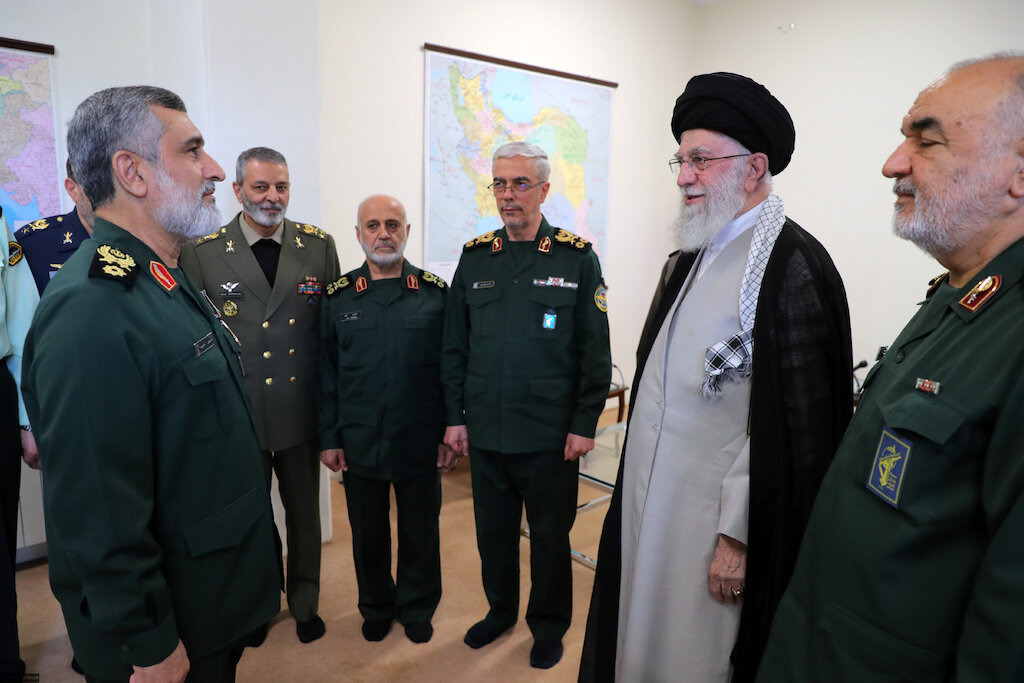
statements of concern but with force. Pictured: Iran's Supreme Leader
Ayatollah Ali Khamenei meets with senior commanders of the Islamic
Revolutionary Guard Corps in Tehran on October 6, 2024. (Image source:
Office of the Iranian Supreme Leader)
Never in its forty-six-year history, thanks to the Trump
administration and Israel, has the Iranian regime been weaker. Never,
since Ayatollah Ruhollah Khomeini's 1979 Islamic Revolution, has the
clerical system faced such a convergence of internal rebellion, economic
collapse, military vulnerability, and psychological defeat. Never have
the mullahs appeared so exposed and so afraid of their own population.
This historic weakening is the outcome of sustained pressure and — above
all — the courage of the Iranian people, who have risen against a
system that has ruled them for generations through prisons and
executions.
The foundations of the Islamic Republic — its claim to divine
legitimacy, its violence, its image of invincibility, and its control
over the economy — are all eroding at the same time. Regimes rarely
collapse simply because people dislike them. They fall when fear changes
sides. Today, fear is no longer only for the population; it has reached the highest offices of the regime.
For that reason, this moment is not the time for hesitation or
compromise, but to intensify pressure. History shows that authoritarian
systems often survive not because they are strong, but because their
opponents become impatient, divided, or discouraged too early. Iran
today stands at a crossroads. One path leads to democratic
transformation. The other leads to the survival of one of the most
brutal ideological regimes of the modern era.
If one examines the landscape honestly, only three actors are truly
planning the end of this radical authoritarian system and toward the
possibility of freedom in Iran. The rest of the international community,
at best, watches from a distance; at worst, it enables the regime
through trade, diplomatic normalization or silent complicity. The three
decisive forces are President Donald Trump and his administration, the
government of Israel under Prime Minister Benjamin Netanyahu, and the
Iranian people themselves.
Trump has altered the psychological balance of power between
Washington and Tehran in a way no previous American leader had dared to
do. For decades, Iranian leaders grew accustomed to Western caution,
diplomatic hedging, and carefully measured statements designed to avoid
escalation. They learned that repression at home would provoke criticism
but rarely consequences. They learned that terrorism abroad would be
condemned but tolerated. They learned that nuclear deception would lead
to negotiations, not punishment.
This pattern, under Trump, changed dramatically. For the first time
since the establishment of the Islamic Republic, Iranian leaders face a
U.S. president who they believe is willing to act on his threats. This
is a strategic shift. Trump combines two instruments that authoritarian
regimes fear more than anything else: open moral alignment with their
victims and credible willingness to use force.
Through words, Trump has broken a long-standing taboo in American policy. He has spoken
directly to the Iranian people, not as passive subjects trapped behind
borders, but as political actors whose struggle is important. Trump
publicly encouraged protestors, praised their courage, and framed their
movement as a legitimate fight for freedom. This matters. Authoritarian
regimes depend on isolating their populations psychologically,
convincing them that they are alone, forgotten, invisible. When the
president of the United States openly recognizes their struggle, this
wall of isolation cracks.
Through actions, Trump has reinforced his words with tangible pressure. Sanctions were treated as economic weapons designed to suffocate the regime's financial arteries. Officials involved in repression were targeted. Most importantly, military consequences were not just threats but were made explicit and carried out.
The Iranian regime for the first time understands that mass
executions, regional escalation, or accelerated nuclear weapons
development will no longer be met with statements of concern but with
force. This dual strategy — moral clarity combined with strategic
coercion — has produced something unprecedented: genuine fear at the top of the Iranian state, with reports indicating
that regime leaders are now wiring huge amounts of money abroad in an
apparent effort to safeguard assets against the regime's potential
collapse.
Israel constitutes the second pillar of this historic pressure. For
years, Tehran portrayed itself as the untouchable center of a regional
axis, shielded by the Western reluctance to escalate. That illusion has
been shattered.
Israeli military actions against regime assets and infrastructure —
especially those connected to the nuclear program — have shown the
regime that its skies are penetrable, its secrets exposed, and its defenses irrelevant.
The significance of Israel's actions strikes at the mythology of the
Islamic Republic. The regime has long cultivated the image of divine
protection, presenting itself as a power that cannot be challenged. When
Israeli operations reached deep into Iranian territory, that narrative
collapsed. The population saw that the regime could not protect its own
most sensitive installations. The elite saw that decades of propaganda
could be undone in three hours.
This military humiliation had a psychological effect that sanctions
alone could never achieve. It told ordinary Iranians that the Islamic
Republic, which claimed absolute authority over their lives, could not
even guarantee its own security. It told the ruling class that their
monopoly on force was conditional. The most decisive force in this
historic moment, however, was neither Washington nor Jerusalem. It was
the Iranian people.
For years, US presidents, for their own convenience, pretended that
protests in Iran were just isolated economic grievances or temporary
outbursts, and pretended that regime survival was the same as
legitimacy. The recent waves of demonstrations in Iran have revealed a
society that no longer asks for reform. They demand an end to the regime.
These protests -- ignited
by the destruction of consumer purchasing power and the impossibility
of living in silence while a corrupt elite enriches itself -- quickly became political. Chants shifted from complaints about prices to rejection of the entire system.
The regime responded by killing thousands of civilians and arresting many more. Entire neighborhoods have been terrorized. Internet blackouts attempt to suffocate coordination.
Despite all this, much of Europe and the broader Western world remain silent -- a form of complicity. European governments speak endlessly of human rights while maintaining
diplomatic and commercial relationships with the most violent regimes
on Earth. They condemn repression in carefully calibrated language while
avoiding confrontation. They worry about "stability" while ignoring
that the Iranian regime deliberately destabilizes entire regions, funds
wars beyond its borders, supplies weapons to Russia for use against Ukraine, and has orchestrated assassinations and terror plots on European soil itself.
The irony here is that Europe also suffers from the regime's policies
— through terrorism, refugees and security threats — yet hesitates to
support the one force capable of eliminating the source: the Iranian
people. Instead, it offers statements, conferences, and moral
flapdoodle.
This is why relentless economic pressure on Tehran must be
maintained. Sanctions should not be designed for evasion and headlines,
but as mechanisms that genuinely disrupt the financial capacity of
Iran's security services, its Islamic Revolutionary Guard Corps, and its
institutions of repression. Any country that chooses to do business
with the regime should understand that it is indirectly financing
torture, executions, and crushing democratic aspirations.
Military pressure must remain credible: deterrence saves lives. When a
regime believes it can massacre protestors without consequence, it will
do so. When it fears international retaliation, it hesitates. Trump's
explicit warnings regarding executions and escalation altered calculations in Tehran. When Trump hesitates, Iran resumes executions (such as here, here, here and here). Removing the mullahs' fear would be a gift to the regime.
Moral pressure must remain constant. The Iranian people must continue
to hear that their struggle is seen, respected, and supported. Silence
kills hope. Recognition strengthens it.
Only three forces are actively pushing history in the direction of
freedom: the United States, Israel, and the Iranian people themselves.
Together they have created the greatest threat to the Islamic Republic
since its birth.
The opportunity must not be wasted. The Iranian regime is cornered.
To relax now would be to offer it time to rebuild its machinery of
repression. Either the West stands with a population seeking freedom
from a savage, fundamentalist authoritarian system, or it stands by
while that system reasserts control through blood.
Dr. Majid Rafizadehis a political scientist,
Harvard-educated analyst, and board member of Harvard International
Review. He has authored several books on the US foreign policy. He can be reached at dr.rafizadeh@post.harvard.edu
The 34-page document, signed by Defense Secretary Pete Hegseth, constitutes a strategic message to Israel, solidifying its position as the United States' most senior partner in the Middle East.
This picture taken 26 December 2011 shows the Pentagon building in Washington, DC.(photo credit: Staff/AFP via Getty Images)
The Pentagon
published its National Defense Strategy for 2026 on Friday, outlining a
return to the "peace through strength" doctrine, recognizing Israel as a
"model ally" in the Middle East, prioritizing the defense of the
American homeland, and placing an unprecedented demand on allies to bear
the burden of security.
The
34-page document, signed by Defense Secretary Pete Hegseth, constituted
a strategic message to Israel, solidifying its position as the United
States' close partner in the Middle East and officially confirmed the
results of the campaign against Iran.
Unlike
previous strategies that sought to balance relationships in the region,
the new document placed Israel at the center of American strategic
thinking. The strategy defined Israel as a “model ally,” a country that
does not ask the United States
to fight on its behalf, but demonstrates both the willingness and the
ability to defend itself independently, and is therefore deserving of
unequivocal support.
The
document sharply criticized the Biden administration, which, according
to the report’s authors, “tied [Israel’s] hands” rather than empowering
it after the October 7 attack.
In a notable policy shift, the United States committed to removing
bureaucratic and political obstacles in order to ensure Israel’s
military superiority, based on the understanding that Israeli strength
is a key pillar of regional stability.
The
strategy also formally and explicitly echoed the success of “Operation
Midnight Hammer,” stating that Iran’s nuclear program has been
“obliterated,” a wording characteristic of US President Donald Trump.
The
Pentagon, heaquarters of the U.S. Department of Defense, is seen from
the air on February 8, 2025, in Washington, DC. (credit: David Ake/Getty
Images)
Pentagon: Iran's 'axis of resistance' has been 'severely degraded'
The report noted that the “axis of resistance” built by Tehran,
including Hezbollah and Hamas, has been “severely degraded” following
intensive Israeli operations backed by the US. According to the new
strategy, the regime in Tehran is at its weakest point in decades,
enabling the US to reduce its direct military presence in the region and
rely instead on a regional alliance led by Israel and Saudi Arabia.
Beyond
the Middle East, the document redrew US global priorities, placing
“homeland defense” at the top of the list. For the first time, the
report directly linked national security to border security and
instructed the military to act against drug cartels and terrorist
organizations in the Western Hemisphere, using language reminiscent of
the “Monroe Doctrine.”
On
the European front, the document delivered a pointed message to NATO
members. While Russia was defined as a “persistent but manageable
threat,” the United States made clear that it will no longer bear the
burden of defending Europe alone.
The
strategy set a new target of 5% of GDP for defense spending by allied
countries and stated that the US will provide “critical but more limited
support,” while European countries will be required to assume primary
responsibility for conventional defense on the continent.
Regarding
China, which wasdefined as the central challenge, the US approach
shifted from “confrontation” to deterrence “through strength.” The US
declared that it does not seek to block China’s growth or change its
policy, but rather to prevent it from dominating the Indo-Pacific.
The
document emphasized the need to revitalize the American defense
industrial base as a prerequisite for winning the great-power
competition, and promised massive investments in advanced technologies
and munitions production.
The
most symbolic yet significant change seen in the report was the return
to use of the historic name “War Department,” a move that, according to
Secretary Hegseth, is intended to “restore the warrior ethos” to the US
military and to focus on one mission: victory in wars.
BEHIND THE LINES: As Syrian forces push into Kurdish regions, the Syrian Democratic Council calls for urgent global intervention to prevent a massacre.
Soldiers ride on a tank as Syrian government forces make their way to the city of Hasakeh in northeastern Syria on Tuesday.(photo credit: BAKR ALKASEM/AFP via Getty Images)
"Regarding Rojava – in the event of government forces seeking to enter our regions – the region will enter a total resistance situation.
The people, for now, are mobilized,” Îlham Ehmed, a top official of the
Kurdish-led Democratic Autonomous Administration of North and East
Syria, told reporters in a briefing on Tuesday. Ehmed, who is co-chair
of the Syrian Democratic Council (SDC),
is one of the two most senior officials of the Syrian Kurdish de facto
autonomous zone (the other is Gen. Mazloum Abdi) and the de facto
foreign minister of the area.
“We need international support in this matter. For the right of the Kurdish region not to be attacked,” she continued.
“There
are certain figures in Israel engaged in communication with our side,”
Ehmed said later in the same briefing. “We expect their support. If
these conversations lead to support, we will be happy to accept it from
wherever it comes.”
It has been a dramatic week for the Syrian Kurds,
in which they have found themselves abruptly plunged into a war for
survival. Still, the broader trend lines had for a while become
increasingly visible. They pointed toward the imposition by the Islamist
authorities in Damascus of power east of the Euphrates.
An
“agreement” in which the Kurdish-led administration essentially
consented to its own dissolution rapidly collapsed over disputes
regarding the timing of the handover of authority. The government then
apparently decided to settle the matter by force.
A
young man takes a selfie with members of the Syrian army following the
withdrawal of the Kurdish-led Syrian Democratic Forces (SDF), in Tabqa,
Syria, January 18, 2026. (credit: REUTERS/KARAM AL-MASRI)
Two incompatible authorities
The
sudden thrust of Damascus’s forces across the Euphrates River last week
was in many ways tactically surprising but strategically inevitable.
Since the Sunni jihadist Hay’at Tahrir al-Sham (HTS) organization seized
power in Syria on December 8, 2024, two incompatible governing entities
in Syria have uneasily co-existed. The first is the Syrian government
of President Ahmed Sharaa, which rules Damascus and now the rest of
Syria west of the Euphrates River, aside from areas in the southwest
held by Israel, and a small de facto Druze autonomy in Sweida.
The second is the Kurdish-led autonomous administration in which Ehmed serves.
Long-term
consensual co-existence between these two entities was never likely.
Sharaa, the former Abu Mohammed al-Julani, is very clearly set on
creating a centralized, authoritarian, Sunni Islamist regime in Syria,
under the tutelage of Turkey and with the support of Qatar and Saudi
Arabia. This project ruled out any acquiescence to the de facto
partition of the country and the continued existence of the secular,
West-oriented Kurdish-led authority. What had held the government in
check until now was a tacit US guarantee to the Kurds. Once that
disappeared, an offensive soon followed.
In
the early days, following HTS’s arrival in Damascus on December 8,
2024, the two very different authorities eyed one another uneasily. The Syrian Democratic Forces (SDF),
the armed forces of the Kurdish-led authority, have formed the de facto
guarantor of Syria east of the Euphrates since the final demise of the
ISIS “caliphate” in 2019. But their military strength, in cooperation
with the US-led global coalition, and the relative efficiency and
solidity of their administrative structures, never translated into
diplomatic recognition and acceptance.
HTS,
in its early days in power, presided over almost an opposite
arrangement. It was rapidly recognized by all key Western and regional
countries as the legitimate government of Syria. But in practice,
Sharaa’s organization in the first weeks and months ruled over a chaotic
vacuum, in which, while it was the official authority, it had little in
the way of real administrative capacity.
I
visited Syria a month after Bashar al-Assad’s fall. I traveled through
the SDF-held area and crossed into the government zone at the Tabqa Dam,
on the Euphrates. The contrast between the staid discipline of the
SDF’s position and the euphoric chaos of the new government’s checkpoint
was very notable.
At
the former, bored Kurdish conscripts checked and waved us through. At
the latter, a gaggle of bearded Sunni jihadis, seemingly still euphoric
and astonished at their victory and the situation in which they found
themselves, seemed almost like they were play-acting as they checked our
documents and let us pass. There were more fighters than were needed at
the checkpoint. There was a sound system blaring out nasheeds, Islamic
religious songs, at the government checkpoint. Many of the fighters were
chewing seeds.
My
friend Fares, a former fighter of the SDF who had volunteered to drive
us through the Badia desert that separates western and eastern Syria,
was not impressed. He smiled dutifully as we passed through, the way you
do at checkpoints. Then, as we pulled away, he said to me in English,
“Those songs they’re playing there, those are ISIS songs. Any Syrian
would recognize them.”
Damascus consolidating its power
For
as long as the early chaos prevailed, the SDF area could assume that it
would be left alone. But Sharaa and his colleagues have not wasted
time, and much has changed in the intervening year. They have
consolidated their authority within the capital and its environs, with
the active help of their key Turkish patrons.
They
have transformed the jihadi militia leaders who backed up their victory
into division commanders in their new army. They have secured the
support and recognition of the Trump administration above all, and of
European and regional powers.
As
a result, they evidently now felt ready to attempt a reunification of
the country by force. The result is that the two groups of men that I
saw at sleepy adjacent checkpoints a year ago, and the organizations
they represent, are now at war. But with the government/Sunni jihadist
side now backed by Turkey, and the Kurds no longer aligned with
Washington, it is a somewhat one-sided affair.
Damascus’s
forces, having crossed the Euphrates, rapidly conquered the
majority-Arab Raqqa and Deir ez-Zor provinces. The SDF-aligned “military
councils” in these areas quickly went over to the government side. The
oil and gas fields of Deir ez-Zor are now in Sharaa’s hands. The Sunni
Islamists are on the edge of the Kurdish-majority Hasakeh province. The
SDF-linked authorities have issued a general mobilization in this area
to which Kurd official Îlham Ehmed referred.
Further
west, the government army and the Sunni tribal host that follows it
have surrounded the town of Kobanî and its surrounding villages, from
two sides (the sealed Turkish border is the third). “Julani has
approached the city on an axis of five kilometers or less,” a resident
of the area told me on Tuesday. Kobanî is under a full siege.
So what will happen next?
“There is a need,” Ehmed said, “for an urgent and immediate intervention. Without it, a disaster could happen.
“Footage
seen in recent days has been difficult to watch,” she continued.
“Damascus’s forces have decapitated women – both fighters and civilians.
There is great fear now among women. ISIS has been rebuilt and sent
against our regions. Turkey has trained a new generation and
indoctrinated them to hate Kurds.”
I
have seen the footage that Ehmed was talking about. It includes the
dreadful desecration of corpses, the harassment and tormenting of female
prisoners, and, yes, the evidence that efforts to behead Kurdish women
have taken place. We have this footage because the jihadi perpetrators
are proud of it and place it online.
So
the Syrian Kurds, who fought and defeated the Islamic State a decade
ago, are now mobilized in their heartlands and prepared for a new jihadi
assault. The assault this time is carrying the banners of the
internationally recognized authorities in Damascus.
Government
forces, equipped with tanks and artillery, but accompanied by a tribal
Islamic horde, are waiting at the edge of Hasakeh. The broader strategic
direction of events seems clear – toward the eclipse of the SDF and the
assumption by the Damascus authorities of rule over northeastern Syria,
for better or for worse.
The
urgent question now is whether that can be achieved without one of the
large-scale massacres with which the authorities in Damascus have
increasingly become associated.
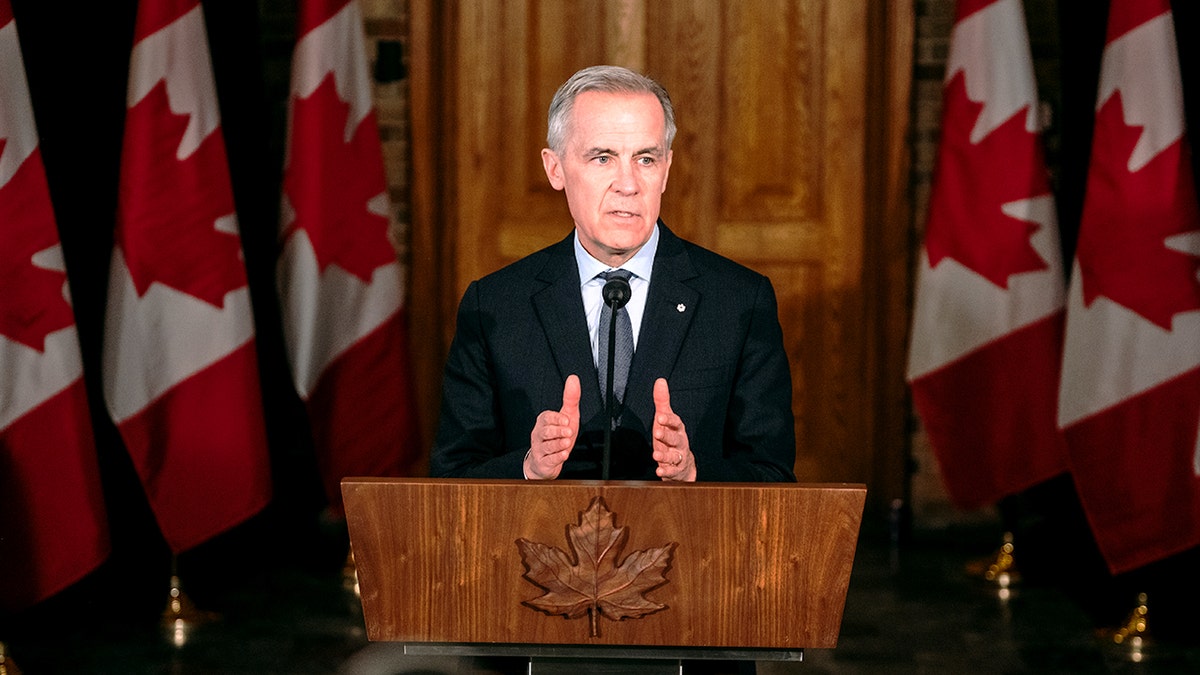
President Donald Trump warns 'Governor Carney' against making Canada a port for Chinese goods entering US
President Donald Trump
threatened on Saturday that he would implement 100% tariffs on Canada
if it strikes a deal to become a "drop off port" for China.
"If Governor Carney thinks he is going to make Canada a "drop off port"
for China to send goods and products into the United States, he is
sorely mistaken. China will eat Canada alive, completely devour it,
including the destruction of their businesses, social fabric, and
general way of life," Trump wrote on Truth Social.
"If
Canada makes a deal with China, it will immediately be hit with a 100%
tariff against all Canadian goods and products coming into the U.S.A.,"
the president added.
Trump referred to Canadian Prime Minister Mark Carney
as a "governor," echoing comments he made while campaigning for a
second term about annexing America’s northern neighbor. He previously
used the same term when speaking about Carney’s predecessor, Justin
Trudeau.
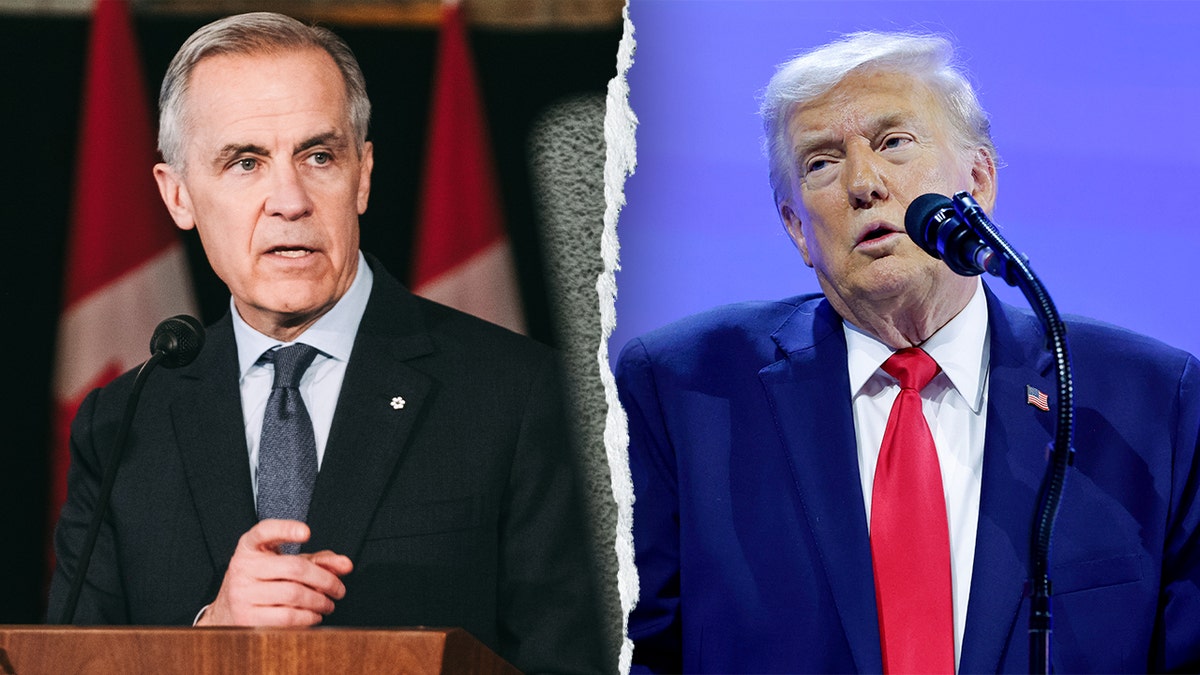
Tensions
between Canadian Prime Minister Mark Carney and U.S. President Donald
Trump flared after the World Economic Forum in Davos, Switzerland.(Renaud Philippe/Bloomberg via Getty Images; Chip Somodevilla/Getty Images)
Carney made his first official visit to China earlier this month as he and Chinese President Xi Jinping work together to forge an improved bond between their countries.
During
the Jan. 14-17 visit, the leaders of the two nations reached an
agreement that would allow up to 49,000 Chinese electric vehicles to
enter the Canadian market at a lower tariff rate of 6.1%, Carney's office announced.
"At
its best, the Canada-China relationship has created massive
opportunities for both our peoples. By leveraging our strengths and
focusing on trade, energy, agri-food, and areas where we can make huge
gains, we are forging a new strategic partnership that builds on the
best of our past, reflects the world as it is today, and benefits the
people of both our nations," Carney said in the statement.
Additionally,
by March 1, China is expected to drop its tariff on Canadian canola
seed to a combined rate of 15%. Carney's office said that Canada expects
that its canola meal, lobsters, crabs, and peas will not be subject to
relevant anti-discrimination tariffs beginning March 1 "until at least
the end of this year."
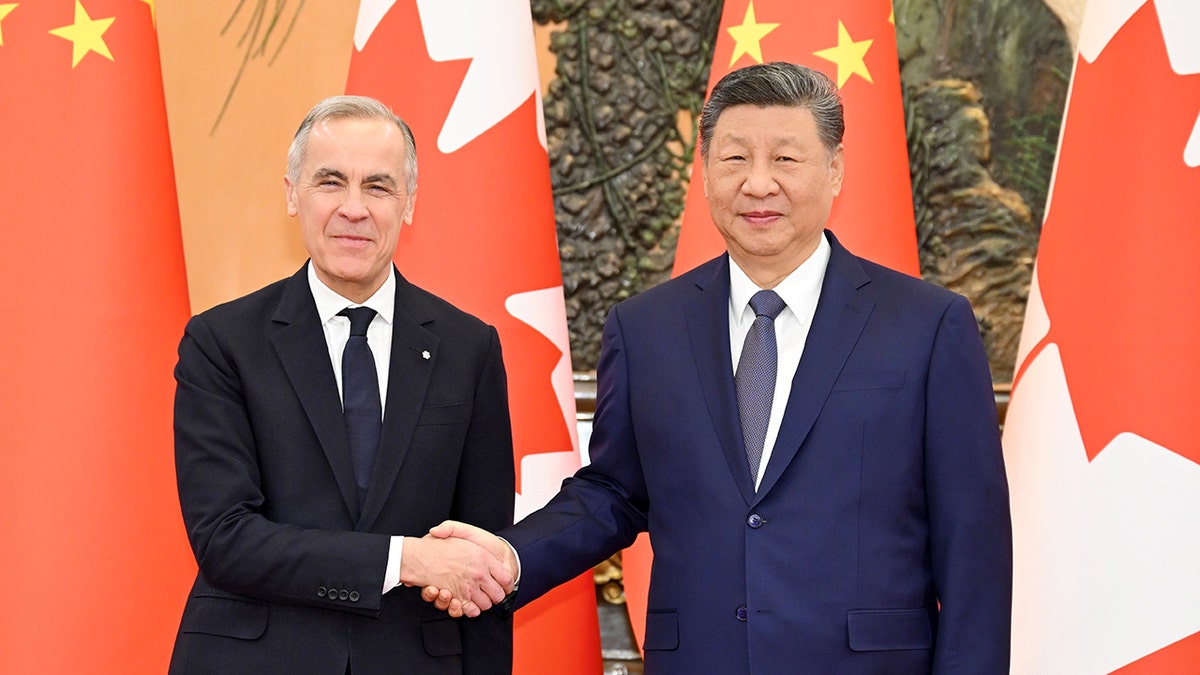
Chinese
President Xi Jinping hosts Canadian Prime Minister Mark Carney for a
meeting held at the Great Hall of the People in Beijing on Jan. 16,
2026.(Xie Huanchi/Xinhua via Getty Images)
It is unclear what deal would trigger a response from Trump in the wake of the ones made during Carney's trip to China.
Tensions between Carney and Trump have flared in recent days, as the leaders took swipes at one another at the World Economic Forum in Davos, Switzerland — and at home after the conference.
Carney, fresh off his trip to China, delievered a speech
that garnered international attention. While he did not mention Trump
by name, he made a reference to the U.S., saying that "rules-based order
is fading." Many, including the U.S. president, saw this as a jab at
Trump.
"Every day we’re reminded that we live in an era of
great-power rivalry," Carney said. "That the rules-based order is
fading. That the strong can do what they can, and the weak must suffer
what they must."
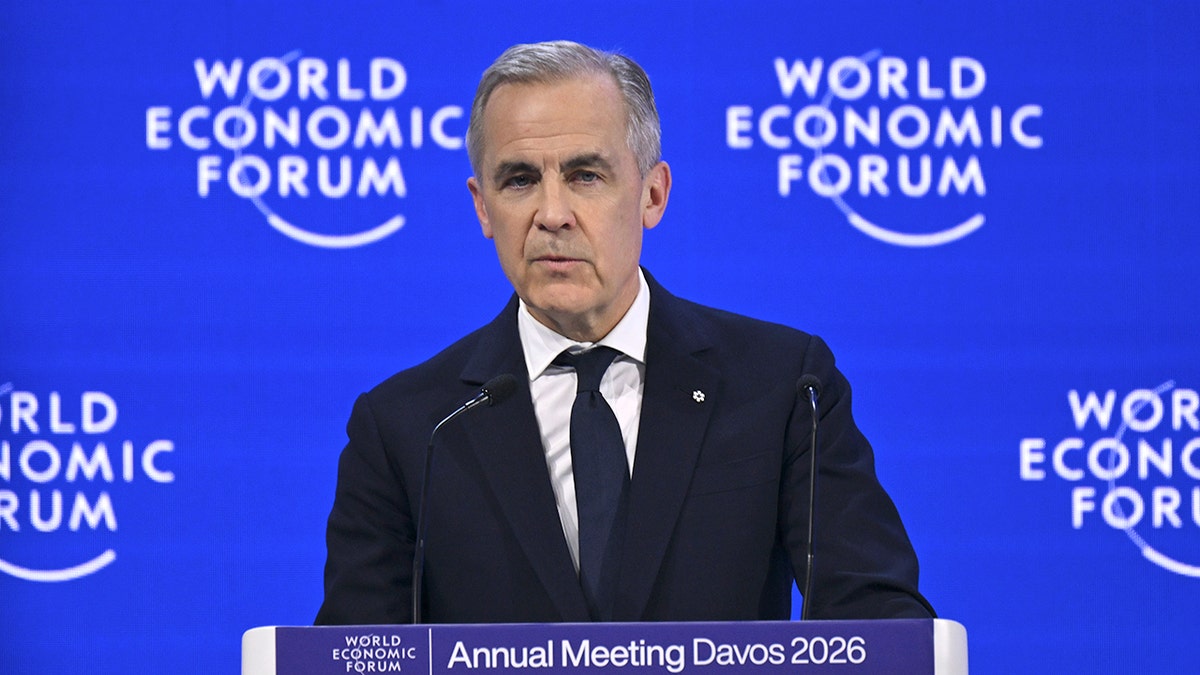
Canadian
Prime Minister Mark Carney delivers a speech at the World Economic
Forum Annual Meeting held in Davos, Switzerland, on Jan. 20, 2026. (Harun Ozalp/Anadolu via Getty Images)
He
admitted that there were benefits to U.S. leadership on the world
stage, but painted the entire concept of a rules-based international
order as a falsity that is actively failing. Additionally, in his
address, Carney urged middle powers, like Canada, to assert themselves
and take the opportunity to "build a new order that embodies our
values."
"Middle powers must act together because if you are not at the table, you are on the menu," Carney said.
When
delivering his address on Wednesday, Trump did not shy away from taking
aim at Carney. He said that Canada "should be grateful" because the
country gets "a lot of freebies" from the U.S., though he did not say
what he was referring to.
"I watched your prime minister
yesterday. He wasn't so grateful," Trump said. "Canada lives because of
the United States. Remember that, Mark, the next time you make your
statements."
In another apparent swipe at Carney, Trump issued an "open letter" to the Canadian leader on Truth Social revoking Canada's invitation to join the Board of Peace, a U.S.-led council tasked with managing Gaza's post-war future.
"Please
let this Letter serve to represent that the Board of Peace is
withdrawing its invitation to you regarding Canada’s joining, what will
be, the most prestigious Board of Leaders ever assembled, at any time.
Thank you for your attention to this matter!" Trump wrote on Truth Social.
The inauguration of the Board of Peace took place after Carney had already departed, according to The Associated Press.
Prime
Minister Mark Carney delivers remarks in Quebec City, Quebec, on Jan.
22, 2026, following his recent participation at the World Economic Forum
in Davos.(Renaud Philippe/Bloomberg via Getty Images)
Upon his return to Canada, Carney addressed a cabinet retreat and took the opportunity to reject Trump's claim.
"Canada
and the United States have built a remarkable partnership in the
economy, in security, and in a rich cultural exchange," Carney said on Thursday while speaking in Plains of Abraham, Québec, during a cabinet retreat.
"But
Canada doesn’t ‘live because of the United States’," he said,
referencing Trump's remark. "Canada thrives because we are Canadian. We
are masters in our own house. This is our country. This is our future.
The choice is ours."
Fox News Digital reached out to the White House and Carney's office for comment.
Rachel Wolff is a breaking news writer for Fox News Digital and FOX Business.
From the Arctic flight path of Russian and Chinese intercontinental ballistic missiles to the Arctic shipping lanes increasingly packed with Russian warships, Greenland's importance has surged.
President Donald J. Trump saw
what Europe could not, or perhaps would not: that Greenland is not a
quaint curiosity; in the 21st century, it is an essential security asset
and industrial necessity for the West.
From the Arctic flight path of Russian and Chinese
intercontinental ballistic missiles to the Arctic shipping lanes
increasingly packed with Russian warships, Greenland's importance has
surged.
The European Union, sadly, still seems to be having trouble
emerging from doctrinaire fantasies about its military preeminence,
green transitioning, and the illusion that the "Great Replacement" of
Europeans and their values -- by immigrants and their values --
is merely a "conspiracy theory." Instead, Europe is continuing to betray
its industrial base and toss away strategic opportunities.
Trump's push, no matter how undiplomatically articulated, was
consistent with a straightforward reality: You cannot safeguard Western
security or technological superiority if the strategic routes by land,
sea and sky, as well as essential raw materials, are controlled by your
adversaries.
The great European flaw -- from which it hopefully will soon
recover -- is that its political, economic and industrial policies are
rooted in wishful thinking rather than in hard material realities.
Europe's best move would be to allow the United States, which has
both the will and the capability, to secure a foothold in Greenland
that allows it, along with its allies, to shape and protect the future
of the West.
China's dominance in rare earth processing is not a theoretical
risk — it is a concrete vulnerability for Western economies. Greenland
offers a chance to diversify the supply and break dependence on a
self-declared enemy.
Europe's leaders, meanwhile, chase their vainglorious dreams....
just as these leaders still keep believing -- or pretending to -- that
millions of immigrants from a totally different culture will adopt the
laws and values of the West.
Europe's dismissive reaction is more than incomprehension; it is symptomatic of a terrifying atrophy.
In the Arctic, and beyond, Trump is right -- and Europe, once again, is too vain to learn.
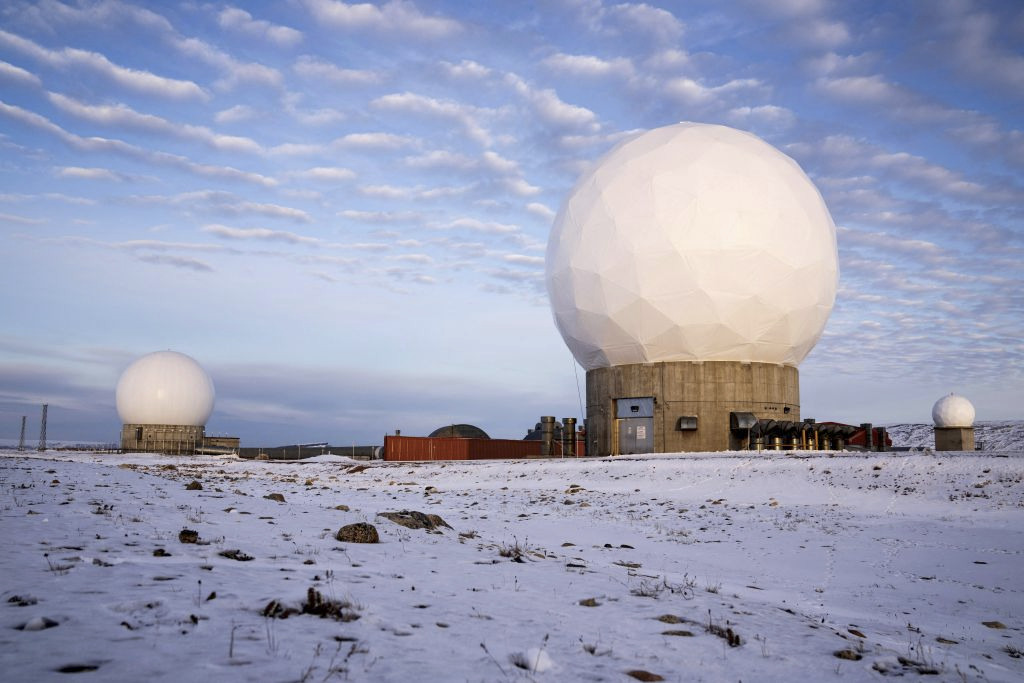
President Donald J. Trump saw what Europe could not, or
perhaps would not: that Greenland is not a quaint curiosity; in the 21st
century, it is an essential security asset and industrial necessity for
the West. Pictured: The US Space Force's Pituffik Space Base, in
Greenland, photographed on October 4, 2023. (Photo by Thomas
Traasdahl/Ritzau Scanpix/AFP via Getty Images)
For decades, the world treated Greenland as a sentimental footnote in
Arctic mythology rather than a linchpin in global security and modern
technology. This was strategic negligence with real consequences.
By contrast, President Donald J. Trump saw
what Europe could not, or perhaps would not: that Greenland is not a
quaint curiosity; in the 21st century, it is an essential security asset
and industrial necessity for the West. "Everything comes over
Greenland. If the bad guys start shooting, it comes over Greenland," he said.
From the Arctic flight path of Russian and Chinese intercontinental
ballistic missiles to the Arctic shipping lanes increasingly packed with Russian warships, Greenland's importance has surged.
The US purchase of Alaska from Russia in 1867 was also ridiculed as a "folly."
The European Union, sadly, still seems to be having trouble emerging
from doctrinaire fantasies about its military preeminence, green
transitioning, and the illusion that the "Great Replacement" of
Europeans and their values -- by immigrants and their values --
is merely a "conspiracy theory." Instead, Europe is continuing to betray
its industrial base and toss away strategic opportunities.
Greenland's geopolitical significance was obvious to Trump before it
became fashionable to talk about the Arctic as a new theater of
great-power competition. Unlike the Brussels bureaucrats who mock and
ignore both President Trump and the potential danger, Trump recognized
three facts early:
Greenland constitutes a strategic military platform for
defending both the Western Hemisphere and Europe, and for monitoring
adversaries across the Arctic.
Melting Arctic ice will open up sea routes that could redefine maritime aggression as well as opportunities for global commerce.
Greenland sits atop some of the world's richest deposits of rare earth elements and critical minerals — materials essential for everything from electric vehicles to missiles and microchips.
In 2019, Trump formally raised the idea of acquiring Greenland from
Denmark — not as an offbeat real estate idea, but as a strategic
imperative for the United States and the West. Even if the political
optics are clumsy, the logic is sound: keeping these assets out of
Chinese or Russian hands -- as well as their ability to use the Arctic
for nuclear and ballistic missile attacks on the West, not to mention
integrating Greenland's assets into the Western supply chain -- is
vital.
According to multiple sources, Greenland has deposits of rare earth
minerals among the largest outside China, and hosts 25 of the 34
minerals deemed "critical raw materials" by the European Commission.
Rare earth elements — neodymium, dysprosium, terbium — are essential
for permanent magnets in electric motors, smart electronics, and defense
systems such as radar and precision guidance of air assets. Today,
China controls roughly 70% of global rare earth production and 90% of processing capacity, giving Beijing disproportionate leverage over the global tech supply chain.
Trump's push, no matter how undiplomatically articulated, was
consistent with a straightforward reality: You cannot safeguard Western
security or technological superiority if the strategic routes by land,
sea and sky, as well as essential raw materials, are controlled by your
adversaries.
Europe's positive response is most welcome. Prior to this week, for
example, while the US had moved to secure mining investment — the
Trump-era Export-Import Bank considered a $120 million loan to fund the
Tanbreez rare earth mine in Greenland — European politicians were negotiating memoranda of understanding and long-term value chains that only delay real production.
The great European flaw -- from which it hopefully will soon recover
-- is that its political, economic and industrial policies are rooted in
wishful thinking rather than in hard material realities.
It was not always so. Europe for centuries led the way in upholding
civil liberties, equal justice under law, and the values of individual
liberty that spring from the Judeo-Christian tradition, the Reformation
and the Enlightenment. Europe was once a leader in heavy industry: cars,
steel, coal, and defense manufacturing. Today, Europe struggles to keep
up with global competitors in sectors that require strategic minerals.
Instead, the technocrats in Brussels fixate on ideological goals — often
at odds with cultural and economic viability as well as industrial
competitiveness.
The European Union's decision to phase out combustion engines by 2035
epitomizes this disconnect. In Brussels, electric vehicle (EV) mandates
were hailed as a triumph of green policy. For many policymakers in
France and Germany, it was a moral high ground: a cleaner planet, fewer
emissions. What could possibly go wrong?
The scientific reality, alas, tells a more nuanced story. Electric
vehicles produce zero tailpipe emissions, yet their environmental
footprint is not the utopian "silver bullet" that most Europeans assume.
EVs require extensive mining, processing, and battery production
— all of which consume energy and raw materials, the application of
which can be just as damaging to the planet even if sourced from half a
world away.
Moreover, the claim that EVs solve particulate pollution is
overstated: they still emit particles from tire and brake wear — and
because they are heavier than traditional cars, non-tailpipe particulate
concerns persist.
The European Parliament's own studies
acknowledge the "environmental challenges throughout the life cycle of
battery electric vehicles," noting that carbon footprints depend heavily
on raw material extraction, production methods, and electricity
sources.
Europe traded industrial strength for half-baked environmental virtue
signaling, and now must source more and more critical materials — such
as those found in Greenland — just to keep its green fantasies alive.
This disconnect highlights two core challenges:
Europe lacks secure supply chains. Dependence on Chinese rare earth elements undermines strategic autonomy.
Europe's industrial policies, driven by environmental ideology
rather than material science, risk hollowing out its manufacturing base.
Meanwhile, Trump's America is not afraid to focus on where security
for the West, chips for the West and rare earths for the West actually
lie.
Today, international news outlets highlight Greenland's burgeoning
role in great-power politics. Melting sea ice will open Arctic shipping
lanes, and both Russia and China are increasing their Arctic presence.
Greenland's geographic position — guarding the gateway between the
Arctic and Atlantic — makes it invaluable for missile interception,
military surveillance, and future naval operations.
Western analysts confirm what Trump grasped years earlier: Greenland
is not remote; it is central. It lies at the intersection of climate
change's strategic effects, great-power competition, and the global scramble for critical minerals.
Rather than laugh or dismiss Trump's interest as "absurd," European
leaders might have asked a more serious question: Why was Trump so
intent on it? Today we have answers — and they vindicate Trump's
instinct.
From a geopolitical lens, the competition for Arctic influence is real. China, although at its closest point is 900 miles
from the Arctic, quixotically brands itself a "near-Arctic state" and
has sought a presence through scientific expeditions and infrastructure
investments. Russia maintains military facilities. Europe's best move
would be to allow the United States, which has both the will and the
capability, to secure a foothold in Greenland that allows it, along with
its allies, to shape and protect the future of the West.
Many Europeans, sadly, will remain content with soft power and
diplomatic protests. In 2026, US Treasury Secretary Scott Bessent even
suggested that European "weakness" justified increased American presence
in Greenland -- a statement that, for all its bluntness, reflected
Europe's default strategic vacuum.
Critics of Trump's Greenland policy often frame it as brash or
impractical. Viewed objectively, it is grounded in three hard realities:
Control of strategic geography matters in a multipolar world.
Critical minerals are national security assets.
Policies divorced from reality -- including the erosion of Western
values by migrants, many of whom at best are conflicted about
assimilating -- invite decline.
These are principles that any serious global power must recognize. Europe has yet to fully grasp them.
Rare earth elements power wind turbines, electric vehicle motors,
fiber-optic communication, defense systems, and advanced semiconductors.
China's dominance in rare earth processing is not a theoretical risk —
it is a concrete vulnerability for Western economies. Greenland offers a
chance to diversify the supply and break dependence on a self-declared enemy.
Trump's effort to involve the U.S. Export-Import Bank in financing
Greenland's Tanbreez rare earth mine is evidence of an administration
that connects mineral security to national security — a connection
Brussels bureaucrats still struggle to make.
Europe's leaders, meanwhile, chase their vainglorious dreams. As
their economies sink, these leaders still insist on green regulations,
assuming that the raw materials their regulations require will be
plentiful, without even first securing them, just as these leaders still
keep believing -- or pretending to -- that millions of immigrants from a
totally different culture will adopt the laws and values of the West.
To sustain EV production at scale, batteries require lithium, cobalt,
nickel, and rare earth elements — yet Europe, lacking domestic sources,
keeps relying on foreign supply chains that are increasingly
unreliable.
This view appears to be a genuine strategic blind spot. While
American policymakers debate hard choices over Greenland, European
policymakers debate emission targets and bureaucratic carbon accounting.
Those matters are not unimportant, but they are insufficient when
divorced from the physical realities of production and supply.
Europe's obsession with ideology over industry has consequences:
Loss of auto industry competitiveness as EV mandates make production more expensive and dependent on imported materials.
Increased reliance on foreign sources, especially China, for critical inputs like rare earth elements.
A strategic deficit in Arctic influence at a time when climate change may begin to reshape global trade routes.
Compare this with Trump's approach: bold, unapologetically strategic,
and grounded in material interest. Trump did not simply call Greenland
"important"— he acted. Whether through investment, diplomatic pressure,
or territorial negotiation, his policy treats Greenland as what it is: a
linchpin in the emerging Arctic century.
Greenland is not a romantic artifact from some explorer's diary. It
is a geographic chokepoint with defense implications, a repository of
minerals that will power future technologies, and a strategic fulcrum in
the Arctic's geopolitical contest. Trump's focus on Greenland is not
whimsy — it is realism.
Europe's dismissive reaction is more than incomprehension; it is
symptomatic of a terrifying atrophy. While Brussels applauds itself for
lofty climate goals and soft power diplomacy, Trump identifies what
truly matters: power, resources, geography, and readiness to act.
In a world where strategic competition between the US, China, and
Russia intensifies, Europe's fixation on ideological policies rather
than material security reveals a profound misunderstanding of the
geopolitical game. Trump saw past the fog of political correctness;
Europe sadly still remains lost in it.
History will remember this period not for what Europeans dreamed, but
for what was accomplished by those who understood the stakes. In the
Arctic, and beyond, Trump is right -- and Europe, once again, is too
vain to learn.
Pierre Rehov, who holds a law degree from Paris-Assas,
is a French reporter, novelist and documentary filmmaker. He is the
author of six novels, including "Beyond Red Lines", "The Third
Testament" and "Red Eden", translated from French. His latest essay on
the aftermath of the October 7 massacre " 7 octobre - La riposte "
became a bestseller in France. As a filmmaker, he has produced and
directed 17 documentaries, many photographed at high risk in Middle
Eastern war zones, and focusing on terrorism, media bias, and the
persecution of Christians. His latest documentary, "Pogrom(s)"
highlights the context of ancient Jew hatred within Muslim civilization
as the main force behind the October 7 massacre.
Libertarian slogans collapse when ideology excuses monopoly power: letting Netflix swallow WBD isn’t free-market principle—it’s crony capitalism dressed up as freedom.
In 2014, when I wrote the book Liberty Risen: The Ultimate Triumph of Libertarian-Republicans,
many reviewers couldn’t understand why I wrote it. I was not (and still
am not) a libertarian. So, did I write to support specific Libertarian
candidates and/or causes? Or to help further the relevance of
libertarian ideology within the GOP?
The truth is that the book was an objective assessment of where the
GOP was heading, given the confluence of wealthy donors and frustrated
youth who mutually identified as Libertarian—at the time, Senator Rand
Paul (R-Ky.) was even the hip choice for President. Often missed,
however, was the fact that the book contained an implicit warning that
the Libertarian ideology had yet to prove whether its rise would be
beneficial or detrimental to the party and the country.
The current controversy surrounding Netflix’s purchase of Warner
Bros. Discovery (WBD)—and the Americans for Tax Reform’s (ATR) support
for it—proves the jury is still out.
“The left has always gravitated to cultural institutions, such as the
media and the arts. For leftists who regard politics as their secular
religion, they have no compunction about using art for political aims. Netflix has a penchant for doing precisely that: Exhibit A is their multi-million-dollar, multi-year production deal with the Obamas.
“If the merger goes through with WBD, doubtless Netflix will
continue—both subtly and not so subtly—to inundate their even more
massive audience with leftist narratives and continue their woke
proselytizing of the American people. But it will not end there.
“Not only will the left flood the marketplace with ideological
narratives, but it will also ensure that differing, dissenting
narratives are silenced. Indeed, much of it will be done through
self-censorship, lest one run afoul of the Netflix entertainment
Net-Trust.”
Libertarians were unmoved by these arguments and other arguments
against this massive corporate accumulation of market share and the
means to dominate American culture. Instead, as typified by ATR’s online
commentary piece by Mike Palicz and press release
by its president, Grover Norquist, the economic libertarian response
offered was less than laissez-faire and more like blasé-faire—a cry of
“freedom… or something” juxtaposed to a picture of Sen. Elizabeth Warren
(D-Mass.), who opposes the merger.
As an admitted admirer of Mr. Norquist, I believe his paean to free
markets is characteristically well stated: “Antitrust law exists to
protect the competitive marketplace, not as a cudgel for politically
favored businesses to prevent their competitors from doing things, nor
does it exist for self-promoting politicians to punish their political
enemies.”
The problem is that his statement is inapplicable to the proposed merger, which will constrict the free market. (In full disclosure, I also disagree with Mr. Norquist and ATR’s opposition to President Trump’s tariff policies. This should come as no surprise, as I am a native Detroiter who still lives near the “Arsenal of Democracy.”)
Equally, in the commentary piece, Mr. Palicz advocates for using the
“consumer welfare standard” in determining the merits of the merger. I
concur. However, I disagree with his analysis. Sometimes size and its
consequences do matter. If allowed, the Netflix-WBD merger will restrict
consumer choice and entertainment options and raise prices for
streaming. Maybe these problems will not arise immediately or all at
once, but they will. Guaranteed.
But what of Sen. Warren’s support? Does her opposition mean that
principled Republicans and Libertarians must support the merger? Are
Sen. Warren’s public pontifications infallible progressive orthodoxy
that renders Republican and Libertarian agreement right-wing heresy?
Hardly. Everyone from President Donald J. Trump to Florida Gov. Ron DeSantis to conservative stalwart Sen. Mike Lee
has cautioned against the merger. Thus, all Sen. Warren’s opposition
means is that a broken clock can be right once a day. (I do not concede
the second instance absent further proof.)
Fundamentally, what such libertarian-based support for the
Netflix-WBD merger misses is so patently obvious that it is evidently
overlooked: political ideology is interfering with the capitalist profit
motive not in the enforcement of antitrust law, but within the proposed Netflix-WBD merger.
As I stated in Chronicles piece opposing the merger:
“[I]f WBD chose Netflix because of cultural and political alignment
instead of seeking a sale that would produce the best return for
shareholders, it would constitute a potential ‘Revlon’
violation. This violation stems from a 1985 legal case involving Revlon
Inc. that went to the Delaware Supreme Court, which held that a
company’s board of directors must seek the best value for shareholders
in the event of a hostile takeover. If Paramount or others offered a
better deal and the WBD board accepted a lesser bid, shareholders could
bring immediate breach-of-duty lawsuits.”
Therein is the rub, both for the Libertarian supporters of the merger
and Libertarianism in general. Letting Netflix buy WBD isn’t
“libertarian”; it’s lunacy.
When ideology blinds one to the real-world consequences of an issue,
it is easy to lose one’s way. Ideology and its ill-conceived application
to the real world are not a life hack; they are a slippery slope to
rock bottom, where everything you hoped to protect rests in ruins.
Allowing this Netflix-WBD merger to go through will lay one more
shovelful of dirt upon the grave of free markets and consumer choice,
further the spread of crony capitalism and the advent of the servile
state, and speed not the triumph but the defeat of
libertarian-republicans and all we mutually cherish.
Come on, Libertarians. Oppose the Netflix-WBD merger. Defend free markets by, of, and for free people!
***
The Hon. Thaddeus G. McCotter (M.C., Ret.) served Michigan’s
11th Congressional District from 2003 to 2012. He served as Chair of the
Republican House Policy Committee and as a member of the Financial
Services, Joint Economic, Budget, Small Business, and International
Relations Committees. A guitarist, not a lobbyist, he is a contributor
to American Greatness and Chronicles; a frequent
public speaker and moderator for public policy seminars; and a co-host
of the “John Batchelor: Eye on the World” radio show and podcast, among
sundry media appearances.
The jury found that officials from Marlin Independent School District, outside of Waco, unlawfully retaliated against parents who publicly complained about the district and violated their constitutional rights.
(The Center Square) -
In what is considered a landmark
win for parental rights and free speech, a federal jury found that
officials from Marlin Independent School District, outside of Waco,
unlawfully retaliated against parents who publicly complained about the
district and violated their constitutional rights.
Five plaintiffs were awarded more than $7.5 million in damages,
including $4 million in punitive damages against Marlin ISD’s former
superintendent, Dr. Darryl Henson, and Marlin ISD’s Chief of Police John
Simmons.
The unanimous verdict came after the district was taken over by the
state in 2017. Henson was hired during the state take over. In 2022, the
district improved its accountability rating for the first time in 10 years with 28% of student being at grade level. By 2024, grades had improved and a transition began with the state takeover slated to end Jan. 31, 2026.
The lawsuit was filed by the Pacific Justice Institute on behalf of
parents Monica Johnson, Clifford and Brandolyn Jones and their children,
Praiyer and Addai Jones.
The lawsuit stems from Henson delaying a May 2023 high school
graduation, claiming only five seniors were eligible to graduate. The
Joneses and their son publicly criticized the decision; Brandolyn
Johnson created a petition calling for Henson’s removal.
A series of events ensued, including Johnson being removed from a
public meeting; the district issuing a criminal trespass warning barring
her from all Marlin ISD property; lowering Praiyer’s and Addai’s grades
after the school year ended; and prohibiting Johnson’s daughter, Class
of 2023 valedictorian Me’Kia Mouling, from delivering her valedictorian
speech at the postponed graduation, PJI said.
“School officials also changed Me’Kia’s class rank and repeatedly taunted Ms. Johnson about it during a public meeting,” PJI said.
At trial, jurors heard testimony that nearly the entire senior class
had been eligible to graduate on time, contradicting Marlin ISD claims.
Prior to suing, the parents filed a complaint with the Texas
Education Agency and filed a grievance with Marlin ISD. Prior to a new parental rights law,
which changes the grievance process, grievances filed with school
districts demanding investigations and resolutions could be investigated
by those whom the grievances were filed against. In this case, Hensen
“investigated himself,” ruling against the parents, PJI said in court.
The parents received “cease and desist” letters from West &
Associates LLP, the law firm of state Sen. Royce West, D-Dallas,
representing Marlin ISD. The letters state their social media posts
about the district were defamatory and threatened legal action.
Not soon after, the parents sued Marlin ISD in February 2024, arguing
their First and Fourteenth Amendment rights were violated. Addai Jones
also brought a claim under Section 504 of the Rehabilitation Act, which
prohibits discrimination against the disabled who participate in
federally funded programs.
A few months later, the district claimed that
for 14 months it “endured a relentless campaign of misinformation, with
baseless claims and defamatory statements spread across social media,
local news and national platforms.”
The jury unanimously disagreed.
The jury awarded nominal and compensatory damages, in addition to
punitive damages of $254,762 against Simmons and $3,753,437 against
Henson.
“This verdict sends a clear message that public officials cannot use
their authority to silence parents or punish students for speaking out,”
PJI’s lead attorney, Janelle Davis said. “School districts are
entrusted with educating children, not intimidating families who demand
accountability. The Constitution protects the right to challenge
government misconduct, and this jury affirmed that principle.”
PJI President Brad Dacus said, “This jury stood up for the First
Amendment and reminded every school district that the Constitution is
not optional. The jury’s decision reinforces that public school
officials are not above the law and will be held accountable when they
violate the constitutional rights of parents and students.”
In response to the unanimous verdict, Marlin ISD issued a statement
saying, “The District is currently reviewing the verdict with its legal
team to evaluate all post-trial motions. It is important to note that
under federal law, there are rigorous standards for municipal liability
and qualified immunity. … Because this remains an active legal matter
pending further judicial review, the district will have no further
comment at this time.”