by Amir Bohbot
The moves, reported since late Friday, came as US officials and regional militaries coordinated on contingency planning for possible Iranian retaliation.
 |
Iran tensions escalated on Sunday, with foreign reports over the past two days citing US carrier movements, bomber activity at Diego Garcia, and reinforced air defenses across the Gulf, according to multiple regional and American media accounts.
The moves, reported since late Friday, came as US officials and regional militaries coordinated on contingency planning for possible Iranian retaliation. No official US confirmation was available on the reported deployment of guided-missile submarines.
US President Donald Trump stated repeatedly over the past week that Iran had halted executions of citizens and postponed the hanging of hundreds of protesters. This was read by some as a temporary pause in a plan to strike the extremist regime in Tehran. However, in the last two days, foreign outlets reported intensified, covert preparations for a large-scale operation.
American media, including Gulf-based outlets, reported that the United States confirmed the USS Abraham Lincoln had sailed from the South China Sea toward the Middle East, a clear statement of intent. The carrier is accompanied by destroyers and missile ships equipped with hundreds of launchers capable of striking targets across Iran with unprecedented force. Despite the reports, no official US confirmation of the arrival of guided-missile submarines in the area was found.
Additional reports said bombers landed at the joint US-UK base on Diego Garcia. The base has unusually long runways that enable heavy strategic bombers, such as B-2-class aircraft, to launch long-range strike sorties across the Middle East, with emphasis on hardened and underground targets and regime command centers.
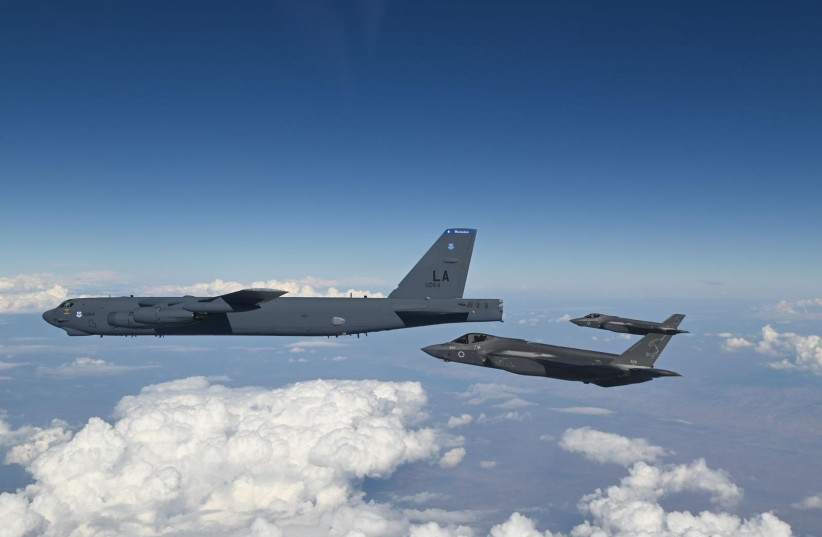
Open-source tracking of regional air traffic indicated that, in the past two days alone, more than a dozen US heavy military transport aircraft flew toward the Gulf. According to assessments, they carried substantial logistics, rescue components, and munitions systems.
Meanwhile, reports grew that nonessential British and American personnel were evacuated from the Al Udeid base in Qatar in support of a potential Iran operation. In parallel, the US military reinforced Patriot and THAAD batteries across Gulf states as part of preparations for an Iranian response.
Regional coordination and electronic warfare indicators
Washington tightened and augmented joint command centers with regional partners, including Israel. At this stage, the activity is assessed as situational updates and contingency planning to blunt potential Iranian retaliation.
Military officials confirmed that over the past two days, the IDF Operations Directorate, the Planning Directorate, and Israel’s defense attaché in Washington intensified contacts with counterparts, focusing on CENTCOM and the Pentagon, to prepare for multiple scenarios.
On social media, reports noted GPS disruptions over Iranian airspace and the apparent use of electronic warfare intended to test systems that degrade Iranian radars and other sensors.
Trump’s escalated rhetoric and calls for regime change
In parallel with reported military movements, Trump intensified public pressure on Tehran. In recent days, he urged “new leadership in Iran” and described Supreme Leader Ali Khamenei as “a sick man” who “should stop killing people,” while saying all options remain on the table. He has also warned of “grave consequences” if the crackdown continues and has portrayed the reported pause in executions as the result of mounting international pressure.
Amir Bohbot
Source: https://www.jpost.com/middle-east/iran-news/article-883679

1 comment:
Only a DEAD mullah is a good mullah !!!!!!!!!!!!!!!!!!!!!!!!!!!!!!!!!!!!!!!!!!
Post a Comment