Saturday, May 13, 2017

Academic Global Warming Advocates and the Power of Incoherent Jargon - Norman Rogers


by Norman Rogers

-- real scientific journals, don’t fill their pages with advocacy for a single point of view.

The great enemy of clear language is insincerity. When there is a gap between one's real and one's declared aims, one turns, as it were, instinctively to long words and exhausted idioms, like a cuttlefish squirting out ink. -- George Orwell
Nature Climate Change is a monthly magazine that is devoted to supporting the idea that we face a man-caused climate disaster that will surface at some future date. The magazine presents itself as if it is a scientific journal. But scientific journals, real scientific journals, don’t fill their pages with advocacy for a single point of view.

The April 2017 issue of Nature Climate Change carries a commentary: The food-energy-water nexus and urban complexity. The title is an indication of things to come. “food-energy-water” is abbreviated as “FEW.” Obviously, people need food, energy and water. But, why are these grouped together? People need lots of other things, for example: police, transportation, housing, and education. Is water a more urgent problem than, say, education? Some people think so. When I lived in Chicago there were true believers wandering on Michigan Avenue, proselytizing for the supposed future global warming-caused water crisis. This a few blocks from one of the great fresh-water inland seas of the world. These true believers were, no doubt, less interested in the education crisis represented by the failing public schools of Chicago.
According to the article:
“The world’s FEW systems are significantly stressed and already experiencing shortfalls due to their interactions with global anthropogenic processes such as urbanization and climate change”
Okay -- urbanization, the migration of poor rural people to cities, is an anthropogenic process. In fact, everything that people and societies do is an anthropogenic (man-caused) process. Urbanization in the U.S. was largely finished by the 50s and instead we had migration out of the cities to the suburbs. But, is “climate change” a man-caused process? Not unless you believe that carbon dioxide is the great controller of the Earth’s climate.

The authors explain some of their thinking with this quote:
“National and human security approaches illuminate contrasting aspects of FEW security and their epistemological and ontological differences lead to differing proposed response options, and can hinder communication and incorporation of insights and lessons across disciplines. These differences need to be carefully elicited to avoid the risk of theoretical and practical incompatibility of inconsistency.”
I have tried to translate this into plain English, but it defies a translation that makes sense.
When the authors occasionally descend into the real world, they appear to embrace conspiracy and be badly misinformed:
“While the energy security of consumers would benefit more from distributed [solar] installations, utilities and their investors have supported regulations, business plans, and technology designs that favor industrialized, large-scale plants managed by a few.”
Utilities have little to fear from rooftop solar installations because the utilities can supply power much cheaper than these installations can. What the utilities object to is a state enforced requirement to buy this power at the retail price of power. Utilities need to buy power wholesale and sell it retail in order to be able to operate. So it is not a conspiracy of capitalists against rooftop solar. If you own a cow, the state does not require that dairies buy your milk at the same price they sell milk. Rooftop solar does not provide consumers with a backup source of power for the simple reason that in the vast majority of cases, for technical reasons, the rooftop power will not work if the power grid is not working. At least, if you have a cow, you can drink the milk.

A favorite academic trick is to restate the obvious in pompous, obscure language. For example:
“A nexus approach to interdependencies among food, energy and water security is promising in many ways. It call on us to go beyond academic and policy silos and look at how are efforts to attain one goal may prevent achievement of others. It provides a vision within which an interrelated set of goals and outcomes can be defined. It can help to determine key thresholds below which urban users become FEW insecure, or beyond which FEW systems are unsustainable.”
All this really says is that we should plan carefully and consider all contingencies.

It is not surprising that the three academics who wrote this drivel are supported by government subsidies (see: here, here and here). Certainly it is a worthy thing to study ways to provide security and resilience for our cities. However, if you start with an unchallenged belief in imaginary global warming, you are going to end up making things worse. Substituting wind or solar power for conventional power plants does not provide greater energy security, for obvious reasons. Worrying about fashionable, imaginary water shortages distracts from real urban problems such as crime or broken families. Worrying about food security is fairly comical given the obesity epidemic. There are real threats to the urban world, such as electromagnetic pulse. But that threat is largely ignored.

Nature Climate Change is published by the same company that publishes Nature, a scientific journal begun in 1869, has published some of the most original and important research of the last century and a half. The company is in no position to not pay homage to global warming mythology. If the company dared to publish works openly skeptical of the global warming religion there would be a furious counterattack by the largely academic customer base. It’s all about money, the vast flows of money that global warming disaster predictions have bought to a large segment of academia.

When an academic discipline runs out of progress, fake progress is substituted. Fake progress consists of restating well-known truisms in a more obscure, abstract and pompous form. For example, there is a trend in sociology called grand theory. Established sociological ideas are restated in tortured and obscure language. The Polish émigré sociologist Stanislav Andreski remarked that the communist government of Poland saw no need to censor grand theory. Obscure, abstract theorizing was no threat to Polish communism.

One investigator attempted to confirm 100 published psychology papers. Only 39% were confirmed. This illustrates the great pressure to publish; to publish something or anything. The low quality of academic investigations is well known. The government agencies that finance academia are complicit in the vast outpouring of academic garbage.

I’m not claiming that everything academic is fake or that we should cut off all the money to academia. Generally, the softer the discipline, the greater the rot. Climate science prediction is weak scientifically. Sociology is very far down the road to irrelevance and has become largely a promoter of left-wing dogma, but with honorable exceptions.


Norman Rogers writes often on climate and politics. He has a website.

Source: http://www.americanthinker.com/articles/2017/05/academic_global_warming_advocates_and_the_power_of_incoherent_jargon.html

Follow Middle East and Terrorism on Twitter

Copyright - Original materials copyright (c) by the authors.

No Civil Rights without Civility - E. W. Jackson


by E. W. Jackson

It is the disease of leftist extremism and intellectual quackery that is ravaging most American universities.

When Betsy DeVos stood up to speak at Bethune-Cookman University's 2017 commencement in Daytona Beach, graduating students booed and turned their backs. It was despicable behavior. The president of the school rebuked the students and defended his guest, but to no avail. This should raise in all of our minds this question: what in the world are they teaching them at that school?

Until the last few decades, black Americans were taught by our parents to show hospitality and civility. It was "yes sir" and "yes ma'am." We addressed our parents and their friends with "Miss" or "Mister" in front of the name. All people were to be treated well when they entered your home. Civility was a cultural mandate.

Rev. Dr. Martin Luther King reflected this in his dignified approach to the civil rights struggle. Unlike Malcolm X, King made no violent threats, lobbed no insults, and never engaged in name-calling. He was leading a revolution that would turn the nation upside-down, yet he never personally attacked anyone. Some of this is rooted in the Christian ethic "Do unto others as you would have them do unto you." Manners used to be intrinsic to black culture.

What we witnessed at Bethune-Cookman University, a southern historically black college, was further proof of widespread cultural deterioration. First, Betsy DeVos is a dignitary holding high office. Her position should have been respected even if she was not. As much as I disagreed with President Obama and his policies, I would never have treated him or any member of his Cabinet disrespectfully. Apparently, the students of Bethune do not believe that Mrs. DeVos deserves such courtesy. What has happened to the culture of the black community, that young people feel justified in behaving so abominably? It is the disease of leftist extremism and intellectual quackery that is ravaging most American universities. In college graduating classes, one expects to see mature individuals ready to make their way in the world, and we are presented instead with spoiled brats having temper tantrums and acting like mobs. It was a sad day in the history of B-CU, and it will take a long time to erase the stain.

Those students who dishonored the secretary and their school did not study her biography or what she has done with her life and resources. All they know is that she is an appointee of President Donald Trump. President Trump, they have been told, is a racist. Therefore, Betsy DeVos is a racist, and there is no point in hearing what she has to say. They have accepted slander and shibboleths as truth. It is not their fault that the far left seeks to indoctrinate them, but it is their fault when they believe everything they are told.

What happened to four years of rigorous intellectual exploration and debate? The once sacred halls of academe are being defiled by groupthink and propaganda. HBCUs are not immune to the decline of academic standards and the rise of what George Orwell called "the thought police." We must all think alike, and if anyone dares contradict our way of thinking, he must be silenced and punished.

Ironically, they were booing and insulting a woman who has done more for black children in America than any liberal ever will. That includes the National Federation of Teachers, the Florida Education Association, and the present iteration of the NAACP, all of which expressed outrage that she was invited to be commencement speaker. What exactly is their contribution to a better education for inner-city kids? The once effective NAACP has become nothing more than a subsidiary of the morally bankrupt Democratic Party. The teacher unions have no interest in improving education for black students. Their goal is to keep students captive to failing public schools so the unions can continue to collect dues on teacher salaries. They serve money and power, not students.

Betsy DeVos, wealthy heiress who could be squandering her time in luxurious pursuits, has spent decades trying to ensure that children in failing schools get a good education. She is one of the heroes trying to stop politicians, bureaucrats, and union hacks from jamming poor children into schools that do not teach them reading, writing, history, science, math, or critical thinking. For teacher unions and their allies, Betsy DeVos is the most dangerous woman in America because she dares to expand educational options for black students.
If those Bethune-Cookman grads understood who Secretary DeVos is and what she has been trying to do for the better part of her adult life, they would have given her a standing ovation instead of turning their backs.

Institutions of higher learning ought to inoculate students against indoctrination, but that seems unlikely any time in the near future. In the meantime, perhaps they could at least manage to instill some civility. 

E. W. Jackson

Source: http://www.americanthinker.com/articles/2017/05/no_civil_rights_without_civility.html

Follow Middle East and Terrorism on Twitter

Copyright - Original materials copyright (c) by the authors.

Jonathan Pollard returns to court with new hope - Gil Hoffman


by Gil Hoffman

Spy’s rabbi: Change now possible due to new administration.

Jonathan and Esther Pollard

Jonathan and Esther Pollard. (photo credit:Courtesy) 


American Israeli spy Jonathan Pollard will be returning to court next week for the first time since President Donald Trump’s election, with new hope his 30-year legal saga could soon come to an end.

Oral arguments in New York’s Second Circuit Court will take place starting Wednesday on Pollard’s appeal of US District Judge Katherine Forrest’s decision to keep in place restrictive parole conditions. Those conditions were imposed when Pollard was released from prison on November 20, 2015, after the former US Navy analyst served 30 years of a life sentence for spying for Israel.


Pollard’s lawyer Eliot Lauer submitted an appeal in November in an effort to remove conditions that prevent Pollard from leaving his New York home after 7 p.m. or before 7 a.m., force him to submit any computer he uses for inspection, and require him to wear a GPS monitoring device that forces him to violate the Sabbath.


Forrest ruled that Pollard’s parole commission had a rational basis for imposing the conditions, including his expressed desire to leave the United States for Israel. But Lauer argued that the parole conditions were arbitrarily imposed and harm Pollard’s ability to work and rehabilitate himself.

“I believe our appeal has substantial merit,” Lauer told The Jerusalem Post. “I am always hopeful of good results.”

National Council of Young Israel executive vice president emeritus Rabbi Pesach Lerner, Pollard’s rabbi and confidant, said how the court deals with the case will speak volumes about whether or not there has been a fundamental change in Washington toward Israel since the Trump administration took office.

“For 30 years, the courts have routinely ignored the facts and circumstances of the Pollard case in order to follow an extra-legal agenda driven by elements in Washington hostile to Israel,” Lerner said. “The Pollard case has been routinely used by these hostile officials as a dagger pointed at the heart of the US-Israel special relationship and as an explicit warning to the American Jewish community. Unfortunately the courts have studiously avoided doing anything that would insulate their proceedings from this political agenda.”

Lerner said the parole restrictions were unduly harsh and served no other purpose other than being politically driven, punitive and vindictive, following 30 years in prison for a life sentence that he called Draconian and a travesty of justice.

“If indeed there has been a sea change toward Israel and the American Jewish community with the advent of the Trump administration, then it will be reflected in the ability of the Second Circuit to respond freely and honestly to the facts and the circumstances of the case, and to cut the Gordian knot that keeps Pollard chained in America unfairly and unjustly,” Lerner said.

Lerner said he was skeptical because the case “has been so egregiously politicized for decades,” but he was cautiously optimistic that “with a new administration in place, a change for the better is possible.”

Asked whether Pollard would return to his previous approach of seeking presidential commutation of his life sentence if the appeal failed, Lerner said he did not know, but in his answer, he indicated that rejecting the appeal could prove that turning to the president directly might be necessary.

He said that if the court failed to rectify the injustice of Pollard’s situation and chose instead to affirm the government’s imposition of the parole restrictions, then Pollard and his confidants will know that change may have come to Washington, but it has not filtered down to the security establishment and the courts in any meaningful way.

“To date, the US Department of Justice, the parole commission and the intelligence community have not demonstrated any willingness to depoliticize the Pollard case,” Lerner said. “Their gross misrepresentations and lies continue unabated in order to serve other purposes, entirely political.

It is time for the courts to depoliticize the case and to rule on the merits of Pollard’s appeal.”

Figures close to Pollard have spoken with advisers to Trump about allowing him to move to Israel and fulfill his dream of living in the Jewish state, sources close to Pollard said in November.

“We have been in touch,” a source close to Pollard said.

“Now we wait and pray.”


Gil Hoffman

Source: http://www.jpost.com/Diaspora/Jonathan-Pollard-returns-to-court-with-new-hope-490534

Follow Middle East and Terrorism on Twitter

Copyright - Original materials copyright (c) by the authors.

Napolitarianism Under Fire - Lloyd Billingsley


by Lloyd Billingsley


Even Democrats want to dump the University of California’s corrupt anti-conservative zealot.


From 2009-2013, Janet Napolitano headed the U.S. Department of Homeland Security but as president of the University of California she has been unable to prevent violent thugs from quashing free speech on UC campuses. Napolitano has also remained silent during the smear surge against UCLA professor Keith Fink, but that should come as no surprise.

Janet Napolitano made her public debut in the 1991 smear campaign against Clarence Thomas, in an effort to keep the conservative African American off the Supreme Court. The lead smearer, Anita Hill, accused Thomas of sexually harassing her and Napolitano, then with a Phoenix law firm, represented Hill in the matter.

The false accusations of Napolitano’s client supplied ammo for white Democrats Howard Metzenbaum, a former Communist; Ted Kennedy, who sought support from the USSR against Reagan; and Robert Byrd, a former high-profile Ku-Klucker. Napolitano’s representation of Anita Hill came up in 1993 when president Clinton appointed her as a U.S. attorney.

In the confirmation proceedings, Napolitano interrupted Hill’s witness Susan Hoerchner, who after an off-the-record conversation, “suddenly developed amnesia,” about parts of her story that contradicted Hill. Napolitano refused to answer questions whether she had persuaded Hoerchner to change her testimony.

Napolitano’s great achievement as Arizona attorney general was to ban Christmas displays on public property. As Arizona governor, she inclined to cronyism, appointing to the state supreme court her campaign attorney Scott Bales, a liberal Democrat who also worked at her former law firm. Napolitano vetoed seven bills intended to fight illegal immigration but her anti-conservative zealotry came to the fore during her stint as Department of Homeland Security boss.

Like the 44th president, Napolitano believed that radical Islam was not the primary threat. She expunged the word “terrorism” from the DHS lexicon and purged experts showing the connection between terror and jihad. She put out the DHS report Rightwing Extremism: Current Economic and Political Climate Fueling Resurgence in Radicalization and Recruitment, a sweeping indictment of conservatives for preferring limited government and constitutional measures such as the Second Amendment.

Napolitano’s DHS failed to track Tamerlan Tsarnaev’s bomb training and despite warnngs failed to keep him out of the country. In 2009 Farouk Abdulmutallab, a protégé of Anwar al-Awlaki on a terrorist watch list, managed to buy a one-way ticket with cash and board the plane with a bomb in his underwear. Napolitano claimed “the system worked” in this case.

Napolitano began releasing detainees from immigration jails and distorted the numbers. She claimed that the border was more secure than ever when it wasn’t, attacked state efforts to step up enforcement, and ridiculed the idea of a border wall. On her watch the number of those crossing the border illegally increased and her tenure at DHS, said Sen. Jeff Sessions, was “defined by a consistent disrespect for the rule of law.”

Napolitano’s JD is her only advanced degree and she has never been an educator. On the other hand, her record as a politically correct liberal Democrat made her the ideal choice to head the University of California. In that post Napolitano maintained the same disrespect for the rule of law she showed as DHS boss.

In 1996, California voters passed the California Civil Rights Initiative (Proposition 209), barring racial and ethnic preferences in university admissions. Napolitano derided the measure as a “legal barrier,” to “diversity.” The UC system, like the state, has always been diverse but Napolitano means the politically correct orthodoxy that all groups must be represented according to their proportions in the population. That ignores factors such as personal differences, effort and choice, which is why such proportionality is nowhere evident.

Napolitano appears to believe she is president of the United States, hailing a “partnership” with Mexico and, in effect, acting as an agent of the Mexican government. She made the UC a sanctuary system, founding and funding the UC Center for Undocumented Student Legal Services. President Napolitano has ruled that UC campus police will not cooperate with federal authorities.

As a result of this sanctuary policy, the 4,000 or so illegals now in the UC system are the most protected and pampered in the country. They pay in-state tuition and Napolitano granted them a $25.2 million aid package running through 2019. On the other hand, Napolitano has made no cuts in the UC’s vast and bloated bureaucracy.

She beats the drum for tuition hikes but as the state auditor recently revealed, maintains a secret slush fund of $175 million. As Republican assemblyman Dante Acosta pointed out, Napolitano’s office spent the money “on things such as administrator bonuses and renovating the homes of campus chancellors.” Napolitano even interfered with the auditors and when this emerged she lamely claimed “we could have handled this better,” and so forth.

“President Napolitano is not worthy of the public’s trust,” explained Democratic assemblywoman Sharon Quirk-Silva. “It’s time she resigned.” The case is strong and the slush fund is hardly the only reason.

President Napolitano has done nothing to counter the Jew-hatred now raging across UC campuses. Violent thugs attacking conservative speakers and smashing up buildings have nothing to fear from the inept former Homeland Security boss. And when politically correct UC cadres smear free-speech champions such as Keith Fink, the president looks the other way.

Janet Napolitano got her start smearing Clarence Thomas, so she doubtless approves of the current smear campaign and all the oppressive measures on her watch. Call it Napolitarianism. This is what happens when you hire a corrupt political hack to run a once-great university.


Lloyd Billingsley is the author of Barack ‘em Up: A Literary Investigation, and Bill of Writes: Dispatches from the Political Correctness Battlefield.

Source: http://www.frontpagemag.com/fpm/266674/napolitarianism-under-fire-lloyd-billingsley

Follow Middle East and Terrorism on Twitter

Copyright - Original materials copyright (c) by the authors.

Thursday, May 11, 2017

'Hate Spaces': The Politics of Intolerance on Campus - FrontPageMag.com


by Frontpagemag.com 


A disturbing, in-depth look at the new campus Brownshirts.


Americans for Peace and Tolerance (APT) has released a new documentary called Hate Spaces: The Politics of Intolerance on Campus to address the worsening anti-Semitic environment on our country's college campuses.

APT is a Boston-based non-profit organization dedicated to promoting peaceful coexistence in an ethnically diverse America by educating the American public about the need for a moderate political leadership that supports tolerance and core American values in communities across the nation.

Hate Spaces goes beyond the by-now familiar accounts of a hostile school environment to document the dynamics on campus that perpetuate the problem. It illustrates how anti-Semitism is being made fashionable at many American universities through the on-going academic de-legitimization of Israel, the normalization of hatred in the name of social justice, the growth of Muslim students on campus, and massive donations of Arab oil money to universities.

The film includes commentary and analysis from distinguished writers and academics including:

• Alan Dershowitz of Harvard
• William Jacobson of Cornell
• Richard Landes of Boston University
• Bret Stephens of The Wall Street Journal
• the Freedom Center's own Caroline Glick of The Jerusalem Post
Connecticut College Professor Andrew Pessin says this of the film:
Hate Spaces is an essential and timely film. Campus antisemitism, masquerading as anti-Israelism, is on the rise. Responding to this phenomenon requires a deep and honest analysis of its causes. Hate Spaces does this meticulously, thoroughly, and grippingly. A must-see for all those concerned about the worsening situation on campus.”
Please check out the trailer above.

Frontpagemag.com

Source: http://www.frontpagemag.com/fpm/266677/hate-spaces-politics-intolerance-campus-frontpagemagcom

Follow Middle East and Terrorism on Twitter

Copyright - Original materials copyright (c) by the authors.

Europe: Denying the Threat of Islamic Imperialism - Maria Polizoidou


by Maria Polizoidou

The enemy is already inside the gates; many European regimes seem unaware that there is even a threat.

  • The UN report and Erdogan's rhetoric both evidently expresses the Muslim world's thoughts about what it apparently thinks should be the fate of Israel and Europe. So far, not a single Muslim state has condemned or opposed Erdogan's aggression against Judeo-Christian civilization.
  • The enemy is already inside the gates; many European regimes seem unaware that there is even a threat.
  • The logic of much of Europe's religious and political community seems to be that if the elephant in the room is spoken to nicely and made to look cute and adorable, people will not think of it as a threat to their safety.
The Western world can no longer ignore the problem of the latest the elephant in the room: Islamic imperialism. Europe has come to such a state of free speech trials, threats of censorship or, out of fear, self-censorship, that it seems to prefer putting the safety of its citizens at risk than admit that this elephant exists.

Meanwhile, Muslim countries make not the slightest effort to hide their intentions, as recent actions of 18 such states at the United Nations illustrate. They cooperated in the preparation of the report released in March by the U.N. Economic and Social Commission for Western Asia (UNESCWA), which accused Israel of "the crime of apartheid," despite knowing full well that such a baseless claim would be rejected by the world body now that Donald Trump is at the helm of the free world. The reason they went ahead with it anyway was to convey to the West that delegitimizing the Jewish state was merely the first step in a master plan to unravel all of Judeo-Christian civilization and values.

For a body such as UNESCWA to declare the State of Israel in an official Institute's report, as being guilty of "the crime of apartheid" according to international law, shows that Islamic expansionism is a real and an active political problem.

UNESCWA must have had some idea, before publishing the report, that such a loopy conclusion could not be adopted, even by the UN, which has been doing its utmost to rewrite historical facts. In the last few years, UNESCO has repeatedly declared pre-Islamic historical sites Islamic.

Nevertheless, UNESCWA proceeded to pass this surreal political concoction, probably to declare to the Western world again its attempts to delegitimize the State of Israel and all the freedoms it represents in the Judeo-Christian world that might threaten the expansion of Islam.

It was an attempt to project power.

Recep Tayyip Erdogan's Turkey, which even before his new, absolute powers, wanted to represent all of Sunni Islam, shows to the Western world the true face of Islamic imperialism and the conventional, irregular and cyber war it appears to have declared on the Christian world.

The UN report and Erdogan's rhetoric both evidently expresses the Muslim world's thoughts about what it apparently thinks should be the fate of Israel and Europe. So far, not a single Muslim state has condemned or opposed Erdogan's aggression against Judeo-Christian civilization.


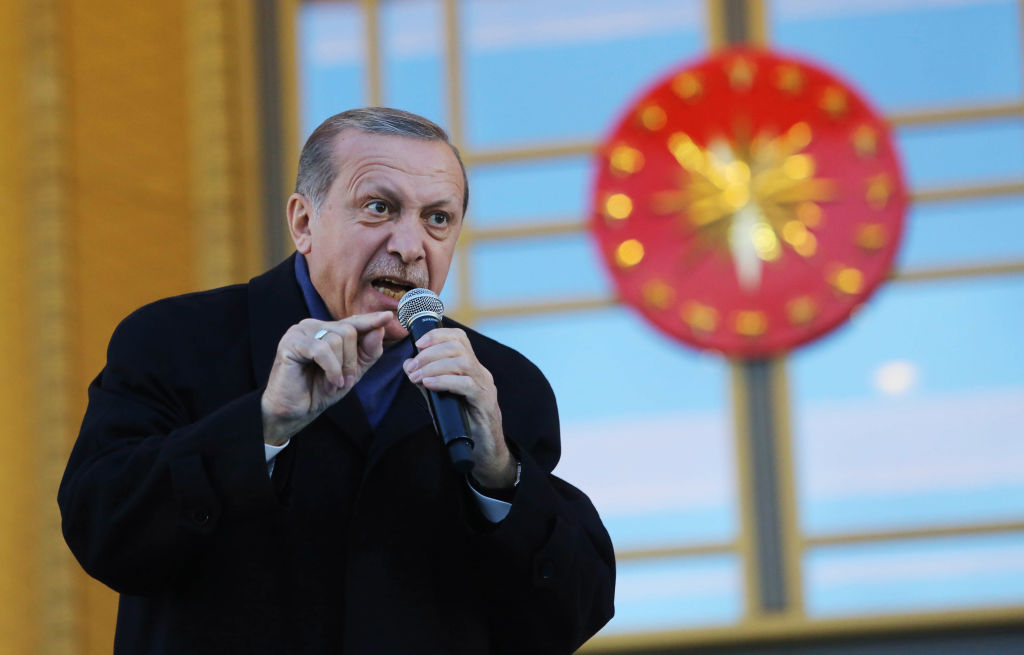
Turkish President Recep Tayyip Erdogan gives a speech in Ankara on April 17, celebrating his victory in the referendum the previous day, which granted him new, absolute powers. (Image source: Getty Images)

According to Turkish Minister of Foreign Affairs Mevlut Cavusoglu, "[T]here will soon be religious wars inside Europe". The enemy is already inside the gates; many European regimes seem unaware that there is even a threat.

Corrupted elites, with the help of many in the international community, try to suffocate Israel economically; and the biased and dishonest media seem to be trying to hide from the public that they work as proxies of Islamic imperialism, promoting Islamic ideology and condemning the values of the West.

Pope Francis and Greek Orthodox Patriarch Bartholomew use Jesus's phrase "Love each other as I have loved you" as a religious justification to love people who are ordered -- under threat of eternal hellfire -- not only never to love you, but to have nothing whatever to do with you, apart from trying to win you over to their firmly-held belief:
"O you who have believed, do not take the Jews and the Christians as allies. They are [in fact] allies of one another. And whoever is an ally to them among you - then indeed, he is [one] of them." -- Qur'an 5:51
The logic of much of Europe's religious and political community seems to be that if the elephant in the room is spoken to nicely and made to look cute and adorable, people will not think of it as a threat to their safety.

Left-wing ideologues and unwitting fellow travelers hide the nature of the elephant. This was the approach of President Obama, who, along with European leaders, provided space in which the elephant could operate, grow and undermine the fabric of Western societies.

Key to this enabling has been a Western focus on fake politics -- such as the obsession with issues such as transgender bathrooms and rights for women who are already blessed with rights -- while Islamists are actually oppressing gays and women in the most rigid fashion.

The Obama administration metamorphosed real politics into fake politics, where people talk -- instead of about freedom and democracy -- about feminism, gender studies, transgender bathrooms, feeling offended and endless vaginology.

Christian leaders have also been trying to deflect from the threat. Both Pope Francis and Greek Orthodox Patriarch Bartholomew I use Jesus's phrase, "Love each other as I have loved you" to disguise and minimize it.

Meanwhile, the elephant in the room gets bigger and bigger and is ready, according to the Turkish president's statements, to destroy the house.

The West seems addicted to prettying up terrorist organizations such as the Muslim Brotherhood or the PLO. Wishing away danger is nothing new to the West. It was not until President Ronald Reagan exposed the Soviet Union as an "evil empire," for example, that the threat of Communism began to be taken seriously. Within six years, the USSR collapsed.

The behavior of many Western political leaders, jumping from one definition to another about the "true nature of Islam," has so far been disastrous. The tenets of Islam are there or all to see; people in the West seem not to want to look.

What are we Westerners doing trying to tell Muslims what their religion is, in the first place? Do they try to tell us what "real Christianity" is?

Sadly, too much of what we have seen of Islam in the West has been violent. Countless attacks, with shouts of "Allahu Akbar" have been claimed in the name of Islam. In terms of what their religion stands for, you at least have to give them credit for being forthright. We in the West are the ones who have lied.

Ultimately, if we do not confront this problem, this problem will confront us.
Maria Polizoidou, a reporter, broadcast journalist, and consultant on international and foreign affairs, is based in Greece.
Source: https://www.gatestoneinstitute.org/10236/europe-islamic-imperialism

Follow Middle East and Terrorism on Twitter

Copyright - Original materials copyright (c) by the authors.

Preacher At Al-Aqsa Mosque Calls To Annihilate The Jews, Destroy The Palestinian Authority And Arab Rulers - MEMRI


by MEMRI

More spiritual enlightenment from the religion of peace and tolerance

Palestinian preacher Ali Abu Ahmad, speaking at an Al-Aqsa Mosque rally, said that the occupation of Palestine by the Jews, the "vilest" and "most despicable and cowardly of creatures," was due to the fall of the Caliphate, and called upon Islamic armies to mobilize their forces "to finish off the monstrous entity of the Jews." His prayers to "annihilate all the Jews," to "destroy the [Palestinian] Authority of shame and disgrace," and to "destroy the rulers of the wicked [Muslim] mini-states" were answered by cries of "amen." A video-clip of the address was posted on the Internet on May 6.
 MTV 6010.JPG

Ali Abu Ahmed: "The cause of the prisoners in the prisons of the occupation is not detached from the cause of the people of Palestine, and the cause of the Islamic nation, the mother of all causes - which is the fact that there is no Caliphate. Indeed, servants of Allah, with the fall of the Caliphate Palestine was occupied by the Jews, the vilest of creatures, and the place of the Prophet's nocturnal journey was defiled, blood was spilled, the honor of women was violated, the elderly were humiliated and the children were killed - by the Jews, the most despicable and cowardly of creatures.
[…]
 MTV 60101.jpg

"Oh armies of the Islamic nation, if you take up arms in order to please your masters and your rulers, know that the rulers of the wicked (Muslim) mini-states have let you down, after they turned toward America and the West. On the other hand, if you take up arms to please Allah - and we believe that this is the reason - your time has come. The time for you to mobilize your armies has arrived, in order to come to the aid of the prisoners, and of the place of the Prophet's nocturnal journey in Palestine, and in order to support Muslims everywhere. It is time for you to mobilize in order to finish off the monstrous entity of the Jews.
[…]
"Oh Allah, destroy the rulers of the wicked (Muslim) mini-states!"
All: "Amen."
Ahmed: "Oh Allah, destroy the (Palestinian) Authority of shame and disgrace!"
All: "Amen."
 MTV 60102.jpg

Ahmed: "Oh Allah, annihilate all the Jews!"
All: "Amen."
 MTV 60103.png

Ahmed: "Oh Allah, enable us to kill them!"
All: "Amen."
 MTV 60104.png

Ahmed: "Oh Allah, bestow upon us the honor of the Caliphate soon!"


MEMRI


Source: https://www.memri.org/tv/al-aqsa-mosque-preacher-calls-annihilate-jews

Follow Middle East and Terrorism on Twitter

Copyright - Original materials copyright (c) by the authors.

Assad's Hollow Crown: A Journey through Regime-Held Syria - Jonathan Spyer


by Jonathan Spyer

The traffic was on the roads, the shops were open, pictures of the dictator and his family were everywhere. But all was far flimsier and more brittle than it initially appeared.

Originally published under the title "Assad's Hollow Crown." All photos by author.


A military checkpoint, Damascus, Old City.


The mortar shells came early in the morning. At about 5. At regular intervals. Solemn and sinister. They were a reminder of how close it all was. We were in the old city of Damascus. There was still fighting in Jobar, about two kilometers away. The rebels had also counter-attacked from the east, from the suburbs in eastern Ghouta, in the previous week. A shell had landed in the precinct of the Umayyad Mosque. This was not in accordance with the line being promoted by the regime, according to which the rebellion was on the verge of defeat. But there it was.

The old city was tense, behind a veneer of strained normality. There were checkpoints every hundred meters or so. These were maintained not by the army, but by the National Defense Force (NDF), an Iranian-sponsored paramilitary force created to fill the gap presented by the Assad regime's lack of loyal manpower. Young men mostly, with a sprinkling of older types and a very few girls. Supervised by Mukhabarat officers with pistols in their belts. They were suspicious of foreigners. There had already been a number of suicide attacks by members of the jihadi organizations in regime-controlled areas.

The old city of Damascus has an atmosphere of strained normality.

For the most part, though, the atmosphere of strained normality held. Undoubtedly, fear of the regime played its part in the exaggerated professions of loyalty and love for Bashar that one would hear. But there was also justified fear of the Islamist rebels, and what their advance would mean. And, of course, there was mainly fatigue, and the desire of people to live in their own private circle, and willingness to cope with any governing authority which appeared able to provide for that. The Syrian pound had plummeted in value since the start of the war – from 48 pounds to the US dollar in March 2011 to 625 to the dollar now. There were long queues each morning to buy subsidized bread at the state bakeries. The traffic was on the roads, the shops were open, pictures of the dictator and his family were everywhere. But all was far flimsier and more brittle than it initially appeared.

I should explain first of all how I came to be in Damascus. I have been writing about Syria now for over a decade. I have visited the country numerous times since the outbreak of its civil war in mid-2011. My visits, though, were always to the areas controlled by the Sunni Arab rebels or the Kurdish separatist forces. This was a notable gap in my coverage. I wanted to remedy it.

The Assad regime makes it hard for journalists to acquire visas.

The Assad regime makes it hard for journalists to acquire visas. The authorities are keen consumers of media, and keep track of the names of reporters who have spent time among their enemies. The number of journalists who have managed to report from both the government and rebel sides is very small. I had tried on a number of occasions to acquire a visa, but made little progress.

Finally, a colleague suggested the idea of joining a delegation of foreign supporters of the regime. With the war going its way since late 2015, the Syrian government has begun to cautiously open up to visitors. But like other authoritarian regimes, it prefers to welcome these in groups, and under careful supervision.

I made contact with the organizers of one of these delegations. The process was surprisingly straightforward.

We met in Beirut and then crossed the border. The tour was organized in cooperation with the Syrian Ministry of Information, so a representative of the ministry would be with us at all times. The participants were a varied bunch. Some pro-Assad true believers, some younger travelers. Mainly from the West, but a couple also from Jordan.

The Assad supporters represented that strange axis in contemporary Western politics where far left meets radical right. A British man on the delegation was fulsome with praise for Assad's social welfare system. The West, he declared, was fearful of Arab socialist regimes such as Assad's Syria and Gaddafi's Libya coming to form an example for Western publics. And later, "The Rothschilds control the banking system in all the world. There's five countries where the banking system is not controlled by them. Iran, Syria, China, Russia and North Korea."

"Syria refused to make peace with Israel," another participant, a young woman from Jordan, told me, "so they decided to start the war and bring down the Syrian government. They will only allow puppet Arab governments who do what they say – like Jordan and Saudi Arabia."

Both rebels and regime claim the war in Syria is the result of an Israel-linked conspiracy.

"There was the Iraq war, of course. And then there was the war of 2006, which was supposed to defeat the resistance. Then when this failed, they decided to try the 'Arab Spring' instead."

This message – that the war in Syria is the result of an Israel-inspired conspiracy intended to foment internal unrest and split the country into enfeebled cantons – is the central talking point of regime spokesmen. I would hear it again and again in Syria. Ironically, I had heard a precise mirror image of this theory from Syrian rebel commanders on the Turkish-Syrian border a few months earlier. In their telling, the conspiracy involved a nefarious alliance between the Iranians, the Assad regime and Israel.

In the case of the rebels, such claims come in Islamic garb, giving them a more contemporary feel. With the regime supporters, the justifications are wrapped in the antique tones of the old secular Arab nationalism of the 1960s and '70s. Ironically, of course, behind the nationalist rhetoric of Syria being the last defiant fortress of pan-Arab resistance and so on, the Assad regime is today entirely dependent for its survival on non-Arab forces – namely Russia and Iran.

Contrary to its Arab nationalist rhetoric, the Assad regime is entirely dependent on non-Arab support.

Indeed, perhaps the most striking and immediately apparent element in regime-controlled Syria is the yawning gap between the rhetoric of the regime, the impression it wants to give, and the underlying reality. I'm not referring to the gulf between the gaudy ideological proclamations and the reality of a brutal police state. This should be obvious. What I mean is the gap precisely between the attempt to convey the impression of a powerful, consequential Arab nationalist regime and the fragmented, enfeebled reality of a regime dependent on other forces both above and below it, and controlling only a part of the territory over which it claims sovereignty.

Syria today remains effectively divided into six enclaves. The government controls Damascus, the three major cities to its north – Homs, Hama and Aleppo, and the western coastal area. There are two rebel held enclaves – Idleb province in the north west, and parts of Dera'a and Quneitra in the south west. The Kurds control a large area in the north east and an isolated canton further west (Afrin). The Islamic State organization, meanwhile, holds a diminishing area in the east and south. There is an additional Turkish-supported rebel enclave between the towns of Azaz and Jarabulus on the Syria-Turkey border.


The regime has been advancing since the intervention of Russian air power on its behalf in September, 2015. But the advance is slow, and it remains doubtful if Assad will ever have sufficient strength to reunite the entire country under his rule.

By itself, the regime is very weak. The Russian contribution is decisive in the air. Iran and its proxies are the key element on the ground. The Assad regime from the outset has rested on a narrow base of available support. The Iranians have trained the auxiliary forces that make up the numbers, like the NDF that guards the Damascus old city. Teheran's proxies – Lebanese Hizballah, the Iraqi Shia militias, the Afghan Fatemiyun and others – play a vital role on the ground.

Without Russian and Iranian assistance, a total regime victory is impossible. The unanswered question at present is what the Russians want. They, above any other force, control the direction of the war between Assad and the rebellion against him. In the meantime, Russian paratroopers in uniform stroll cheerfully through Damascus and Aleppo, and the regime-controlled part of Syria has effectively become a proxy, or puppet of Moscow and Teheran's interests.

Controlled from above, the Assad regime is also subject to fragmentation from below. There are over a hundred pro-regime militias active in the Syrian war. They constitute around half of the available troop strength available to the regime. These militias are not mere servants of Assad. Rather, they are centers of power and resources for the men that control them. Some are small local groups, numbering just a few dozen fighters. Others are countrywide and make use of heavy weapons including armor and artillery.

So the "regime" side in Syria today isn't really a single entity at all. It is a coalition of interests, of which Assad and the power structure around him constitute only a single part. But it is in the interests of all these elements that the Assad regime present itself as a single, united and sovereign force. The regime's antique Pan-Arab nationalist rhetoric, and the echoes it finds among some elements in the West and the Middle East are a part of this.

Aleppo


A house destroyed by aerial bombing, Aleppo.


We entered Aleppo via the Sheikh Najjar industrial district in the east of the city. The destruction wrought by Russian air power on formerly rebel-controlled eastern Aleppo is chilling, awe-inspiring in its proportions. Whole neighborhoods reduced to rubble and rendered uninhabitable. Moscow employed the means of total war on the city. What remains is mostly silence. Just a few families have returned and are living among the ruins.

I have been in Sheikh Najjar once before. That was in the summer of 2012, when the rebellion had just broken into the city. I remembered it as we walked among the desolation.

It had been before the rebellion had taken on its definitively Sunni Islamist character – though the signs had already been prominently there. I remembered the constant noise, the government planes overhead, the commanders of the long defunct Tawhid and Afhad al-Rasoul brigades in the Shaar and Saif al-Dawli neighborhoods, the terrified civilians in the basement of the Dar al-Shifa hospital, as the regime aircraft dropped their bombs outside.

Dar Al-Shifa is long since destroyed, of course. The civilians have gone too. Replaced by silence, and ruins.


Bustan al-Qasr neighborhood, Aleppo.

A massive poster of Bashar Assad and his brother Maher is mounted at the entrance to the Aleppo Citadel. "Congratulations on your victory, O Aleppo." it reads. Another, seen all over the western part of the city, depicts a stern, helmeted member of the security forces and reads "Aleppo is in our eyes. This has a double meaning in Arabic – "we are watching Aleppo," but also "Aleppo is precious to us." This is the way the Assad regime speaks to its subjects. A threat, lightly coated in a sickly sweet rhetoric.

Western Aleppo, nevertheless, appears superficially untouched by the war. The rebels, entirely lacking in air power and with only primitive, improvised artillery, were never able to make a serious impression on it. But the regime's hold is narrower than it appears. Even now, the rebels are not far from the city. They are located just north west of Aleppo in Kafr Hamrah and Huraytan. The strained normality of the street scene in the west of the city is punctuated every so often by deep, ominous booms of artillery fire from somewhere not very far off. The war is not over. Nor has it gone away.

Homs


A single highway snakes its way south of Aleppo through regime-controlled territory, with the rebels to the west and Islamic State to the east. At its narrowest point, near the town of al-Sa'an, the government controlled area is just a few kilometres wide. You must take this road to get from Aleppo to Homs.

The devastation in Homs is, as in Aleppo, breathtaking. Whole neighborhoods turned into wasteland, rendered uninhabitable. Homs was one of the nerve-centers, the heartlands of the revolt against Assad. Destroying the rebellion there meant destroying much of the city itself. This the Russians have undertaken and largely achieved.

Our guide in Homs was an ebullient Alawi Syrian lady called Hayat Awad. Hayat was brimming with vim and confidence and contempt for the 'terrorists', as she called the rebels. But she wore a pendant around her neck, showing the face of one of her sons who had died fighting the rebellion while serving in Assad's army.


Destruction in Homs city.

Hayat trudged with us through the endless dead streets where the rebellion had lived and been destroyed, dispensing the official regime version of the conflict as she did so. "They destroyed everything at the behest of the Jews," she declared, "because the Zionists want to claim that they have the oldest culture, but they were not able to do this because Syria has a history 7,000 years old." We were in a Christian church damaged in fighting between the rebels and regime in the Homs old city at the time.

Casual anti-Semitism of this kind is common and entirely mainstream in the Arab world. No logic is required for it. Consider the claim: Sunni Arab jihadi fighters in Homs had deliberately set about destroying the Christian heritage in the area because the jihadis are in alliance with a broader Jewish and Zionist plan to destroy non-Jewish cultural heritage in the Middle East. This is part of a Jewish plan to pretend that theirs is the oldest culture in the area, or the world. Such an idea is obviously insane. It is also to be found among the mainstream of discussion in regime-controlled Syria.

Hayat Awad declared this in front of a small audience consisting for the most part of people who would declare themselves progressives, leftists and liberals in their own Western homes. Not a word of protest.

While we were in Homs, a "reconciliation" deal was under way. The rebels were set to leave the last neighborhood of the city under their control, al-Waer. These agreements are part of the regime strategy to reduce the area of the country under the control of the rebellion. They involve laying siege to the area in question and then offering the rebels and their supporters the option of leaving for Idleb, which is under the control of rebel organizations. In the case of al-Waer, the rebels and their supporters were being permitted to leave in exchange for the lifting of the rebels' own siege on two isolated Shia villages in Idleb province – Fu'a and Kafriya. The deal was delayed after a rebel group attacked a convoy of civilians coming from these villages in Rashidin, at the entrance to Aleppo, but has since been implemented.

Acres of ruined and empty houses stand as a warning of the strength and tactics of pro-regime forces.

Some observers of the Syrian war consider that these deals amount to a form of ethnic cleansing or depopulation, whereby Sunni Arab populations are being systematically induced to leave the government-controlled area. No evidence of a clear and consistent plan on the part of the regime or its backers has yet emerged in this regard. Indeed, the regime continues to accept refugees seeking to enter its zones of control from rebel areas, so claims of a general strategy of sectarian expulsion are unproven. In Daraya, Moadamiya, Zabadani, and Aleppo City, the evidence shows that residents were given the choice of evacuation to Idleb or residence in nearby regime controlled areas. But in Homs city, specifically, it is clear that only very small numbers of civilians have been permitted to return. Some accounts suggest that only people who actively sought to reach regime territory have been allowed to return to their neighborhoods. Hence the acres of ruined and empty houses stand as a warning of the strength available to the regime and its backers and the tactics they are prepared to employ.

In one of the ruined houses we found remnants left by the retreating rebel fighters. Some shell casings, and a Saudi-produced theological book about Ramadan, entitled "Spirit of the Fast." A sort of testimony or warning to those who might celebrate the destruction as a victory – that this other, Sunni Arab, Islamist Syria, despite it all, is not yet destroyed.

Damascus


In a meeting with a serving general of the Syrian Arab Army, I asked what the regime's strategy was for re-uniting the country. The general, seated behind a picture of his younger self with Rifaat Assad, and puffing on an enormous cigar, responded that "No conclusion of the war can come without the decision of 'official Syria'." This vague reply was revealing of the large gap between the regime's proud rhetoric, and the diminished extent of its power.

I received similar replies to the same question from ministers in Bashar Assad's government with whom we met in the course of our time in Damascus. Mohammed Tourjman, information minister, said that the "reconciliation" process and the "liberation" of occupied areas would continue. Only "ISIS and Nusra," in his telling, refuse to be part of the reconciliation, and these are regarded internationally as terrorist organizations (with the implication that they could be dealt with by purely military means). And with regard to the de facto division of Syria, "We have absolute faith that this is a temporary situation." All this after an introduction in which the minister too spoke of "a plan to divide Syria into cantons, and keep us weak, to the benefit of the Zionist entity." Again, this is a clear declaration of intent, but the reconciliation process at least as of now is mainly trimming the edges of the regime-controlled zone, not fundamentally altering the balance of forces between the sides.


A poster commemorating the death of SSNP member Naim Salim Hadad, killed fighting Syrian rebels, Homs.

Ali Haidar, Minister of Reconciliation Affairs, who handles much of the practical aspect covering the transport of rebels from "reconciled" towns was equally vague in response to this question. Reunification will only come, he suggested, when "foreign powers stop supporting the Syrian organizations." No plan for how to achieve this. Haidar, incidentally, is not a Ba'athist. He is the leader of the Syrian Social Nationalist Party (SSNP). This party, founded in 1932, is a fascist-style group, even down to its swastika-style emblem, which he was wearing in his lapel during our meeting. The party's literature refers to Syrian rebels as "internal Jews."

It is tempting but probably superfluous to dwell on these grotesque aspects of the Syrian government. The regime in its self-presentation openly resembles the European totalitarian governments of mid-20th century Europe. This holds an ugly fascination for some Europeans and other Westerners. But the posturing and the rhetoric is mostly without weight, like a cheap tin pendant that only from a distance resembles solid metal. Holding up this fragile structure are a variety of other forces more deserving of attention.


The author at Hamidiyeh Market, Damascus.

On our last night in the city, a member of the delegation was threatened at gunpoint by a drunken Russian journalist. The authorities in the area said they could do nothing, because the man was Russian. This small episode says more about the true state of affairs in government-controlled Syria than all the regime's verbiage. The Assad regime's servants do not enjoy unquestioned sovereignty even in their own capital. The regime is today largely a hollow structure. The vigorous regional ambitions of Iran and Russia, and the smaller but no less notable intentions of a vast variety of pro-regime militia commanders must be factored into any assessment of regime capabilities and intentions.

The closeness of the Sunni Arab rebels to the regime's urban centers, and the absence of Assad's power from almost the entirety of the country's east are further testimony to the erosion of the regime. It is a very long way from the days when Hafez Assad ran Syria as his "private farm," as a Syrian Kurdish friend of mine once put it. The Assad regime cannot be destroyed for as long as Moscow and Teheran find a reason to underwrite its existence. But the mortar shells landing in Damascus in close succession are an unmistakable testimony to its reduced and truncated state. The anachronistic rhetoric of its officials and its supporters does not succeed in disguising this reality. Assad is wearing a hollow crown.


Jonathan Spyer, a fellow at the Middle East Forum, is director of the Rubin Center for Research in International Affairs and author of The Transforming Fire: The Rise of the Israel-Islamist Conflict (Continuum, 2011).

Source: http://www.meforum.org/6686/assad-hollow-crown

Follow Middle East and Terrorism on Twitter

Copyright - Original materials copyright (c) by the authors.