The "Middle East and Terrorism" Blog was created in order to supply information about the implication of Arab countries and Iran in terrorism all over the world. Most of the articles in the blog are the result of objective scientific research or articles written by senior journalists.
From the Ethics of the Fathers: "He [Rabbi Tarfon] used to say, it is not incumbent upon you to complete the task, but you are not exempt from undertaking it."
Naim Qassem said the Washington-backed Israel-Lebanon agreement is "null" and warned that tying Israel's withdrawal from southern Lebanon to Hezbollah's disarmament crosses "red lines."
Hezbollah Secretary-General Naim Qassem gives a televised
speech from an unknown location in this still image obtained from a
video released December 5, 2025; illustrative.(photo credit: Al Manar TV/REUTERS TV/via REUTERS )
Hezbollah chief Naim Qassem
said on Saturday that the Israel-Lebanon framework agreement signed in
Washington is "null," a "humiliation" and a surrender of sovereignty,
and should be replaced by the Iran-US memorandum.
Qassem
said in a statement that any attempt to link Israel's withdrawal from
southern Lebanon to the group's disarmament crossed "all red lines."
“We say to the Lebanese authorities, it is time for you to retract your sins that are destroying Lebanon,” Qassem asserted.
Signing of trilateral framework agreement
The United States, Israel, and Lebanon signed the trilateral framework agreement aimed at combating Iran-backed Lebanese terrorist group Hezbollah on Friday, after days of US-mediated talks in Washington.
According to a US State Department statement, the agreement outlines a structured process for disarming Hezbollah,
dismantling terrorist infrastructure, and enabling the IDF to withdraw
from Lebanon in phases as the threat posed by Hezbollah is removed.
Additionally,
the US will take measures to enhance the capabilities of the Lebanese
Armed Forces and support Lebanon's military efforts against Hezbollah.
The agreement received praise from both Israeli and Lebanese officials.
Israeli
Prime Minister Benjamin Netanyahu described it as “a major achievement
for the State of Israel” in a public video address.
Lebanese
President Joseph Aoun referred to the signing as “the first step on the
path to restoring Lebanon's sovereignty” in a post on X/Twitter on
Friday, following the framework's signing in Washington.
Goldie Katz and Reuters contributed to this report.
The Rent Guidelines Board passed the rules in a 7-1 vote, and they will impact about one million rent-controlled apartments for tenants with one-year or two-year leases.
A New York City housing authority voted Thursday to freeze rents for up to two years.
The Rent Guidelines Board passed the rules in a 7-1 vote, and they
will impact about one million rent-controlled apartments for tenants
with one-year or two-year leases, Reuters reported.
Mayor Zohran Mamdani, who has vowed to enact socialist policies in
the city including price controls and government-run grocery stores,
appointed six of the board's nine members since he took office.
Hours before the vote, Christina Smyth, who was appointed by
Mamdani's predecessor, said Mamdani had stacked the board and resigned.
Smyth said the outcome was predetermined by the mayor and accused the
board of failing to be unbiased as required by law.
Human nature did not suddenly become flawed when Europeans arrived.
oday, the word colonialism is treated almost like a curse
word. Mention it in a classroom, on social media, or in many political
circles, and you’ll immediately hear words like exploitation, racism,
oppression, genocide, and theft. For many people—especially younger
generations—colonialism has become history’s ultimate villain, the
so-called “original sin” from which nearly every modern problem
supposedly springs.
As a conservative, I’ve always thought this view was far too simplistic.
Now, before anyone starts sharpening their pitchforks, let me be
clear: colonial powers absolutely committed injustices. Wars were
fought. Peoples were conquered. Resources were taken. Some populations
were devastated. These are historical facts, and serious people should
acknowledge them honestly.
But history is rarely a Disney movie with obvious heroes and villains.
The uncomfortable truth is that conquest, expansion, and empire are
as old as humanity itself. Long before Europeans sailed across oceans,
empires were rising and falling all over the world. African kingdoms
conquered neighboring tribes. Arab empires expanded across North Africa
and the Middle East. The Mongols swept across Asia and Europe. The
Aztecs ruled over subject peoples through military force and tribute.
The Romans practically turned conquest into an art form.
Human beings have always expanded when they had the power to do so.
What makes Western colonialism different is not simply that it
conquered territory. What makes it unique is that the very civilization
responsible for much of modern colonialism also produced the ideas that
eventually challenged and condemned it: individual rights,
constitutional government, abolitionism, freedom of speech, and the
belief that all people possess inherent dignity.
That irony is almost never discussed.
In modern culture, colonialism is often presented as though it
produced nothing except suffering. But history is more complicated than
that. Alongside exploitation came institutions and systems that still
shape much of the modern world.
Railroads. Modern medicine. Universities. Scientific advancement.
Written legal codes. Representative government. Modern banking systems.
International trade networks. Infrastructure. Public sanitation.
Advances in engineering and agriculture.
None of this means colonialism was wholly good. It wasn’t. But neither was it wholly evil.
Here’s a question that almost nobody asks: What would the world look like if colonialism had never happened?
Would globalization exist in its present form? Probably not.
Would international trade be as extensive? Almost certainly not.
Would many of the technologies, institutions, and political systems
that billions of people depend upon today have spread as rapidly? Again,
probably not.
Entire continents might have remained isolated from one another for
much longer. Scientific discoveries would have traveled more slowly.
Modern medicine might not have spread as quickly. International
commerce, for all its flaws, would likely be far less developed.
The modern world as we know it—our interconnected global economy,
worldwide communication networks, international legal norms, and shared
scientific knowledge—was shaped in significant ways by centuries of
exploration, trade, migration, conquest, and yes, colonialism.
History doesn’t offer us the luxury of running controlled
experiments. We cannot rewind time and discover what a world without
colonialism would have looked like. But we should at least acknowledge
that many things people take for granted today emerged from that
complicated historical process.
So why has colonialism become such a dirty word?
Part of the reason is understandable. During the twentieth century,
scholars and activists rightly highlighted abuses and atrocities that
had often been ignored or minimized. This correction was necessary.
But somewhere along the way, nuance disappeared.
Increasingly, colonialism became not simply something that happened
in history, but a catch-all explanation for virtually every modern
inequality and social problem. In some circles, it has become an
all-purpose moral framework: if something is wrong in the world,
colonialism is assumed to be the root cause.
That narrative is emotionally satisfying because it clearly
identifies victims and oppressors. But it can also oversimplify history
and unintentionally strip people of agency.
A society that constantly teaches people that all of their problems
originated generations ago risks creating a culture of grievance rather
than one of responsibility and self-determination.
As conservatives, many of us believe that while history matters,
personal responsibility matters too. Nations, communities, and
individuals cannot remain forever imprisoned by the failures and
injustices of previous generations.
Another problem with modern anti-colonial thinking is that it often
romanticizes the societies that existed beforehand, as though
pre-colonial civilizations were peaceful utopias living in perfect
harmony.
They weren’t.
Like all human societies, they were capable of extraordinary
achievements and extraordinary cruelty. They waged wars. Practiced
slavery. Conquered rivals. Established hierarchies. Expanded territory.
Human nature did not suddenly become flawed when Europeans arrived.
None of this excuses wrongdoing. It simply reminds us that history is messy because people are messy.
The real lesson of colonialism is not that one civilization was
uniquely evil. It is that power has always shaped history. Every
civilization, given sufficient strength, expands its influence
politically, economically, culturally, or militarily.
The question for us today is not whether colonialism was entirely good or entirely bad. It was neither.
The better question is this: Can we study history
honestly—recognizing both the suffering and the achievements—without
reducing the entire human story to a simplistic morality play?
We view dealings with Iran from one election to another, whereas Iran views its wars as a global matter that affects everything and runs on a cosmic timetable.
Recently, I watched the 1966 epic Khartoum,
with Charlton Heston and Laurence Olivier. Khartoum dramatizes the
struggle between British General Charles Gordon and the Sudanese
religious leader Muhammad Ahmad (the Mahdi) during the 1880s siege of
Khartoum. In the film, the Mahdi informs General Gordon that Allah has
commanded him to pray at every major mosque in the world and kill all
who refuse to submit to him.
Whether
entirely accurate or not, the scene captures a challenge secular
governments have faced throughout history: confronting movements that
view political objectives not as interests to be negotiated, but as
divine commands to be fulfilled. How little has changed.
If
the West wants to understand Iran, it must begin with a simple but
uncomfortable truth: Iran does not see its proxies as separate entities.
It sees them as extensions of Iran itself—armed, funded, trained, and
ideologically fused to the Islamic Republic. Attack a proxy, and in
Iran’s eyes, you have attacked Iran and, by extension, its divine
destiny. This is not a metaphor. It is Iran’s fundamental doctrine.
Western
analysts routinely miss this. They treat Hezbollah, the Houthis, Hamas,
and an entire constellation of Iraqi and Syrian militias as independent
actors with local agendas. Iran does not. Iran sees its roughly 20–30 proxy and partner militias as the instruments through which it intends to shape—and ultimately dominate—the regional order.
These
groups operate not only across the Middle East, but in Asia, Africa,
Europe, and even North America, where Iranian operatives and
proxy-linked networks have carried out surveillance and assassination
plots for decades. We tend to gloss over this reality because it
reflects a level of dedication and strategic patience that American
political leaders have often lacked, creating an immense blind spot.
Consider Hezbollah.
Its centrality to Iran’s strategy is not subtle. Hezbollah attacks
Israel, Israel retaliates, and Iran uses the resulting crisis to extract
concessions or shift diplomatic pressure.
Many
Americans fail to appreciate that Hezbollah attacks have disrupted the
lives of hundreds of thousands of Israelis living in the North for
years. Meanwhile, the Lebanese people—a majority of whom do not want Hezbollah exercising such influence in their country—are trapped.
What
matters, though, at least to Iran, is that to challenge Hezbollah is,
in effect, to challenge Iran itself. That is the point that must be
understood if we are to prevail, hopefully through negotiation, but if
necessary, through war.
This
misunderstanding of Iran’s proxy system bleeds directly into the debate
over the U.S.–Iran MOU and the broader question of how to negotiate
with Tehran. Much commentary on the subject is earnest but lacking a
good grounding in Iranian geopolitics and history.
It
misses the structural reality: geopolitics and timing determine what is
possible, and good negotiators begin by distinguishing between what is
ideal and what is achievable. If the gap between the parties is too
large at the outset, no amount of diplomatic finesse can bridge it.
The JCPOA
violated basic principles of sound negotiation because Iran understood
that the United States wanted a deal more than Iran needed one. That
imbalance shaped the outcome from the beginning.
To
understand why Iran behaves this way, one must understand what Iran
believes itself to be. Iran is not merely a state. It is a revolutionary theocracy, and that identity is not a rhetorical flourish. It is the regime’s raison d’être.
The Islamic Republic’s constitution embeds Ayatollah Khomeini’s doctrine of velayat-e faqih—guardianship
of the jurist—which asserts that Islamic clerics must rule the state so
that God’s law can be implemented. This is not merely a domestic
principle. The revolution was conceived as a universal one, intended to
spread beyond Iran’s borders and challenge political systems the regime
regards as illegitimate, which includes many other Muslim countries.
This
is not a secret, intra-Iran concept. Iran’s leaders have said all this
repeatedly. The revolution, they insist, is not simply Iranian; it is
global in aspiration. It is meant to awaken the oppressed, topple
un-Islamic governments, and export the Islamic Republic’s model wherever
possible.
The
Supreme Leader is not merely a political figure but the interpreter of
God’s will. The IRGC is not merely a military force but the instrument
charged with protecting and exporting the revolution. Support for
proxies is not framed as a strategy but as obedience to God—a religious
duty to defend the oppressed and wage jihad against injustice.
Once
this worldview is understood, Iran’s behavior becomes far more
predictable. The regime consistently overreaches because it believes
three things with absolute conviction:
·Allah is on its side.
·America is weak, impatient, and unwilling to sustain casualties.
·The Iranian people are instruments of divine will, and their suffering is acceptable—even necessary—in service to the revolution.
Iran’s
worldview is not unique in history; other regimes have fused divine
purpose with national destiny. Imperial Japan’s wartime application of Bushido is one example.
When
governments become convinced that history, destiny, or God is on their
side, they can absorb levels of pain that would break more conventional
regimes. That is why sanctions, domestic unrest, and military pressure
often fail to produce the outcomes Western policymakers expect. The
regime has demonstrated repeatedly that it is willing to sacrifice tens of thousands of its own citizens rather than deviate from what it views as its revolutionary mission.
This
ideological rigidity shapes every negotiation. The Obama administration
spent more than two years securing the JCPOA, and Iran is likely to use
the same playbook now: delay, stall, and wait out the American
political calendar. Iran has no comparable calendar. It does not need to
appease voters. It believes time is on its side because God is. All it
must do is survive the current American administration, whatever its
posture.
The
United States, by contrast, is often impatient—eager for closure, eager
for de-escalation, eager for a “solution” that Iran may view merely as a
temporary expedient that can be “agreed to” for whatever time is
useful.
This
is the asymmetry that defines U.S.–Iran relations. It is not merely a
matter of tactics but of worldview. If we fail to understand the Iranian
theocracy’s ethos, we misinterpret everything we see. We negotiate from
a position of weakness despite overwhelming strength. We allow Iran to
dictate the terms of engagement because we misunderstand the nature of
the adversary. This is not a knock on our president; what the public
sees and hears is not necessarily what is occurring behind closed doors.
Iran’s
proxies are not bargaining chips. They are the mechanism through which
the Islamic Republic advances what it believes to be the Will of Allah.
Until Western policymakers grasp this fully, every negotiation risks
being lost before it begins, Iran will continue to outwait, outmaneuver,
and outlast us, not because it is stronger, but because it is more
patient, more ruthless, and more ideologically committed.
This is the nature of the beast.
God Bless America!
Image created using AI.
Author,
Businessman, Thinker, and Strategist. Read more about Allan, his
background, and his ideas to create a better tomorrow at 1plus1equals2.com.
MILITARY AFFAIRS: Brig.-Gen. Yael Grosman tells The Post why the IDF sees space as the next battlefield, while other IDF sources detail advances in AI, cyber, electronic warfare, and more.
‘CHARGING INTO SPACE’: IDF Technology and Digital Chief
Brig.-Gen. Yael Grosman tells the ‘Post’ in an exclusive interview that
Israel understands it cannot compete on future battlefields without a
robust space approach that fully covers all of the world’s data and
content.(photo credit: IDF Spokesperson’s Unit)
The IDF
is charging into space in order to be ready for challenges expected in
future wars, IDF Technology and Digital Chief Brig.-Gen. Yael Grosman
told The Jerusalem Post in a recent exclusive interview.
Regarding the significance of space as the next great battlefield of war, she said, “There is a data
revolution. We need to bring data and capabilities that the IDF needs
everywhere, not just regarding the war that was, but the war that will
be. This means we need to be organized differently.”
She explained that Israel understands it cannot compete on future battlefields without a robust approach to space that will fully cover all the worlds of data and content.
Referring to IDF Chief of Staff Eyal Zamir’s
mid-January five-year plan for the future of the IDF and its
highlighting of space, Grosman stated, “The IDF chief said we cannot
ignore space.
“We are receiving lots of energy and resources to pursue our interests in space since his declaration,” she continued.
A
technologist with the Israeli military's Matzpen operational data and
applications unit works at her station, at an IDF base in Ramat Gan,
Israel. (credit: NIR ELIAS/REUTERS)
While
Israel began space-related programs around 45 years ago, Grosman noted,
the country has come a long way in both satellite communications and
satellite surveillance.
The
Defense Ministry has supported her argument on this, announcing that it
took over 12,000 photos of Iran during the 12-day June 2025 operation
and over 50,000 photos during the 2026 Iran war.
According
to Grosman, the new satellite communications technology has also been a
huge part of how the air force can operate its fresh big data
capabilities so far away from Israel’s borders.
In
the future, she said Israel will need to and will be able to launch
multiple payloads for satellites to hold and relay even larger data
transfers, as well as new tasks in space.
With the Post
noting that Russia, China, and Iran have all worked on ways to attack,
damage, jam, or drag satellites in space, Grosman responded, “There are
threats from space. We work with people who have a lot of power at the
Defense Ministry and with the broader defense establishment. We can all
bring forward achievements,” Grosman said.
She
preferred not to address the question of having a separate new space
command, which the US established in 2019. Rather, Grosman said that
what was important was a mechanism to include all the different pieces
of Israel’s space ecosystem.
This
would ensure that, whether work is needed on communications,
surveillance, the electromagnetic spectrum, attacking and defending
satellites (more and more countries are working on this aspect), or new
engineering techniques to increase satellite payloads, all efforts are
maximized and coordinated.
Grosman also sees the future of space warfare as a major realm in which she has a significant hand in managing for the IDF.
Electromagnetic spectrum
In
December 2025, the IDF reorganized its C4I and Cyber Defense
Directorate, with a new AI-focused brigade and an expanded electronic
warfare apparatus that enhanced the military’s defensive cyber
capabilities, including against drone attacks.
Sfeira is the name of the new brigade responsible for electromagnetic spectrum issues, among other things.
According
to sources, actions related to the spectrum are among the most
underreported stories of the recent Iran war, with major implications in
both Tehran and Lebanon.
Over
the course of the June 2025 war with Iran, around 25% of 1,100 drones
launched at Israel were taken out by the 5114th Spectrum Warfare
Battalion, which operates electronic warfare capabilities, according to
IDF officials.
Since
the reorganization, for the first time, four out of five brigadier
generals running full brigade-size units are women, of whom Grosman is
the most senior as the top deputy to the head of Communications and
Technology commander Maj.-Gen. Aviad Dagan.
Israel from space (credit: NASA/BARRY WILMORE)
Impact on Operation Roaring Lion
In
the months leading up to February 28, the IDF was on close to a war
footing when it came to Grosman’s Communications Command as it could be.
In
many ways, even though around eight months passed between both events,
Operation Roaring Lion was an extension or round two of the June 2025
war between the parties involved.
“We
learned many lessons about fighting a war with Iran from Operation
Rising Lion. We learned a new approach to utilizing military force,
focusing on certain specific areas of warfare and information,” Grosman
said.
“This
allowed us to achieve dozens of percentages of new war-related
solutions,” she explained, while keeping some of the classified lessons
confidential.
Other top IDF officials told the Post that the air force had struck 2,600 critical targets in Iran’s defense industries during the 2026 war.
When
the air force hunted such a monumental volume of targets, it relied on a
digital platform that Grosman’s brigade had provided.
“We
are building and operating the IDF’s information factory. The
Communications Command already had a data center and databases. Now the
air force, military intelligence, and the ground forces have their own
databases under regulation and are using digital architecture, which
will lead to increasing the IDF’s effectiveness and better use of the
data,” Grosman said.
During
Operations Rising Lion and Roaring Lion, Grosman’s brigade was able to
collect and transfer (via communications platforms) substantial amounts
of data over long distances such that “we made the third circle [of
countries at a far distance] the same as the first circle [countries on
Israel’s border].”
“There
is no magic. You need satellites to provide communications, take
pictures, relay data over thousands of kilometers, and record thousands
of kilometers of footage,” she said.
“This
requires creativity in areas like physics, in how to use electricity,
and in other areas to make sure MAHA [the air force commander] can act
in Iran as if it’s a first circle country ... We make sure that all of
the arms of the IDF can take action where and when they want to,”
Grosman noted.
But she warned that Iran had also adapted and was constantly making its own adjustments.
IDF
Technology and Digital Chief Brig.-Gen. Yael Grosman speaks during a
conference (credit: RAMI SHELUSH/THE MARKER/VIA IDF SPOKESPERSON'S UNIT)
The power of AI in war and the need to keep adapting
This led to how rapidly the Communications Command facilitated data sharing over the last almost three years of war.
It was explained to the Post
that this war was so dominated by the digital sphere in guiding the
invasion maneuvers that it is hard to imagine future wars without these
changes.
A
major focus of the Communications Command going forward will be
adapting to the expected challenges of AI, such as those anticipated for
2035, rather than limiting planning to the situation in 2026.
Combining
major developments in cyber, AI, and quantum computing, the
Communications Command views the world as entering an extreme period of
radical change.
Asked
how the IDF can be in a good place with AI, given that, more broadly in
Israel, the consensus is that the Jewish state has fallen behind in AI
and in building data centers in recent years, IDF officials emphasized
the military’s unique capacities and context.
According
to Grosman, the new AI brigade is evaluating all kinds of IDF
technological needs, including data centers, software, and various
operational models to deliver solutions on the front lines.
She
noted that “Brig.-Gen. B” is the head of the AI brigade, handling
service provision, infrastructure, modeling the IDF’s current uses and
future needs, enhancing AI capabilities, and determining how best to
employ data science.
Questioned
about how the new division’s efforts with AI work clash with efforts in
the civilian sector by the Artificial Intelligence Directorate in the
Prime Minister’s Office, led by former Brig.-Gen. (res.) Erez Askal, IDF
officials responded that where the parties can work together, they do,
and where they need to keep their work separate, they stay separate.
Cybersecurity: The defense of one’s ‘crown jewels’
Next, the Post
questioned IDF sources about whether the military is more challenged in
an era when almost anyone can use AI to become a larger and more
sophisticated cyber threat.
Grosman
agreed with top commercial cybersecurity officials who say they invest
significant resources in confronting cyber threats on the digital
battlefield before hackers can reach their own cyber perimeters.
The
Communications Command wants to know what is happening outside the
digital perimeter in order to enable preemptive self-defense.
Expressly, it wants cyber warfare to be conducted in the enemy’s digital “territory,” rather than in Israel’s.
In that sense, internal digital-perimeter cyber defenses are only one element of a broader cyber defense strategy.
A
common metaphor used by commercial cybersecurity experts in the past
was to recommend fiercely defending a company’s technological “crown
jewels,” even though that is now difficult to do.
Given
the IDF’s unique technologies, it is likely to effectively defend a
sort of “diamond crown jewel” from nation-state hackers.
Why did humanitarian aid fail?
In
the field of humanitarian aid to civilians, the Communications Command
said that all information assists with a variety of jobs.
These
include distributing information, humanitarian concerns for both
Israeli and Palestinian civilians, and efficiently distributing warnings
to limit threats from Israel’s enemies.
IDF
sources were pressed about July-August 2025, when top military
officials themselves admitted a large-scale series of errors leading to
serious food insecurity in parts of Gaza.
This
food insecurity was so severe that Israel dropped its months-long
limits on food and other aid items, which had been set to try to prevent
Hamas from controlling that aid.
They
were asked how this food insecurity came about and whether the IDF’s
data was so accurate regarding humanitarian aid in Gaza.
Responding,
the Communications Command said that the data cannot always be analyzed
perfectly or applied exactly to the real world.
For
example, if Hamas wants to seize humanitarian aid, algorithmic
calculations about distributing food aid made back at an IDF base cannot
prevent that.
But sources added that the IDF complies with whatever the government’s policy is regarding food aid or anything else.
Ofek 19 satellite being launched into space (credit: Screenshot/DDR&D Multimedia, Israel Ministry of Defense )
The drone threat
Regarding the drone threat to the IDF, all activity detected by sensors is funneled into a digital data “factory,” the Post has learned.
Not
all anti-drone solutions need to be kinetic, using huge amounts of
firepower; softer, more cost-effective power is also available.
According
to the Communications Command, combating drones is a complex area of
warfare and defense that involves significant data sharing and
communications.
Given that the IDF can weave together all sensor data, it can synergize such information.
After three years, the Post learned, the IDF had obtained substantial value from the massive amounts of data reviewed.
The
information it has collected from the constant rounds of fighting has
enabled the IDF to develop new tools for warfare and analysis.
Case
in point, the data can be used to defend against regular drones, FPV
drones, and cluster munitions, even though the military has acknowledged
that there is not yet a comprehensive answer to combating FPV drones.
On
the positive side, Grosman said that “one of the central reasons many
soldiers are still alive has been the data collected using AI digital
platforms” for analyzing enemy threat patterns, trajectories, and
scenarios.
The
army does not claim that it has a complete answer to the new FPV
remotely, manually, and directly operated drone threat, something which
could still take some months or years to solve.
One
item that has been years in the making and which the Communications
Command is in the process of completing, or may have just completed, is
the move of many of its units to a new campus in the Beersheba area.
Portions
of the command, other IDF units, and the Israel National Cyber
Directorate have been relocating to the area on a rolling basis
throughout the 2020s, but large additional moves are expected soon.
According to the Communications Command, the new location in the South will also enhance the IDF’s capabilities in various ways.
The controversial disease guru must be muttering under his breath, ‘Thanks, Tulsi.’
Tulsi Gabbard, U.S. director of National Intelligence,
recently declassified records concerning U.S.-funded biological
laboratories overseas. She has reopened a debate that many Americans
thought had ended with the COVID-19 pandemic.
According to information released by the Office of the Director of National Intelligence, the United States supported or funded more than 120 biological research laboratories
in over 30 countries. Many of these facilities conducted what some
contend were legitimate public health and disease surveillance
work. Yet the disclosures also revive longstanding concerns about
oversight; transparency; gain-of-function research; and America’s
decision to collaborate with foreign laboratories, including facilities
located in countries that are strategic adversaries.
For years, Americans were assured that international biological
research partnerships were essential for preventing future
pandemics. Today, however, many are asking a different question: Why
would the United States share sensitive pathogen research with
countries such as China, particularly when that knowledge could
theoretically be used for military or biological weapons purposes?
The most famous foreign biolab was China’s Wuhan Institute of
Virology, given millions of dollars involuntarily by U.S. taxpayers
through grants administered by EcoHealth Alliance and the National
Institutes of Health, which supported coronavirus research involving bat
viruses and their potential ability to infect humans. The
stated goal was to better understand how viruses might jump from
animals to people before a pandemic occurred. So they replicated in a
lab what that might look like and created COVID-19, which apparently
escaped from the Wuhan lab, killing millions of people worldwide. Truth
also was killed in the process.
Supporters viewed the research as prudent preparation. Critics
viewed it as playing with fire. Cynics question if it was all
intentional to test how fast a novel new virus would spread and how
quickly a vaccine could be administered to end the experimental plague.
The COVID-19 experience raises a fundamental national security
question. China is not simply another scientific collaborator. It is
America’s principal geopolitical competitor. So why would the United
States fund and entrust to China the world’s most cutting-edge
bio-weapon research to discover which viral mutations make pathogens
more transmissible to humans? Do we believe for one moment that the
Chinese Communist Party would allow its scientists to keep secret
research “secret” from their secret police? This would be laughable if
it weren’t for the death of millions of people from COVID-19.
Did Anthony Fauci mislead Congress? It depends on what your definition of gain-of-function is.
Fauci, then-director of the National Institute of Allergy and Infectious Diseases and the de facto COVID-19
spokesman during the pandemic, repeatedly testified that the National
Institutes of Health (NIH) had not funded gain-of-function research at
the Wuhan Institute of Virology. However, we now see that that simply
was not true. The NIH simply funded an entity that in turn funded
Wuhan. In a sense, it’s like hiring a hit man but saying you’re
innocent because you did not pull the trigger.
Critics of Dr. Fauci argue that though those statements may have
relied upon narrow regulatory definitions, they created a broader public
impression that no taxpayer-supported research had enhanced dangerous
viral capabilities, which runs contrary to the COVID-19 Final Report filed by the House Oversight Committee.
From this perspective, Fauci’s testimony amounted to what some
describe as “technically accurate but practically misleading.” Critics
contend that Congress, journalists, social media companies, and the
public were left with an understanding that differed substantially from
the underlying facts.
Fauci’s bureaucratic defenders see the issue differently. They note
that gain-of-function research has specific regulatory definitions and
that Fauci consistently testified according to those definitions. Under
the framework used by NIH officials at the time, supporters argue, the
Wuhan-related grants did not qualify as prohibited gain-of-function research.
But psychobabble is still psychobabble. Government officials
frequently choose words that are technically defensible while still
leaving audiences with a mistaken impression. But deceptive “truth” is a
net lie. Americans deserve better than this from our leaders.
The consequences extended far beyond a congressional hearing
room. During the pandemic, Americans who questioned official narratives
found themselves marginalized. Social media platforms restricted or
removed content. Videos disappeared from YouTube. Facebook users
experienced their pages being throttled (reduced
distribution). Individuals who suggested that COVID-19 may have
originated from a laboratory were frequently labeled “conspiracy
theorists” and publicly shamed by Anthony Fauci and other “experts” —
who authored some of the wildest theories on the origins of COVID-19,
including insisting that it likely originated in an exotic animal wet
market, selling monkey meat!
This raises a troubling question: Were Americans discouraged from
asking reasonable questions because government officials and major
institutions prematurely declared certain topics settled?
In a free society, scientific debates should be resolved through
evidence and open inquiry, not through censorship or appeals to
authority. And public officials need to remember that they work for “we
the people,” not the other way around.
There is another side to this debate that deserves careful
consideration. Many Americans argue that all gain-of-function research
should be banned immediately. Their reasoning is straightforward: If
modifying pathogens creates any meaningful risk of accidental release,
why conduct such experiments at all?
Yet national security, some argue, is rarely that simple, contending
that America’s adversaries may not share the same ethical
concerns. China continues investing heavily in biotechnology and synthetic biology. Advances in gene-editing technologies have made sophisticated biological research more accessible than ever before.
A fair comparative question might go like this: Just because someone
else jumps off of a bridge, should we? But in the case of bioweapons,
it’s more like someone pushing someone else off the ledge.
Regardless of the path we take in the future, at bare minimum,
Americans deserve to know which laboratories received taxpayer funding,
what pathogens were studied, what foreign governments were involved, and
what safeguards were in place. After all, it’s our money.
Congress should demand a comprehensive accounting of all U.S.-funded
overseas pathogen research. Lawmakers should require public disclosure
of foreign partners, biosafety standards, military affiliations, and any
experiments involving potentially pandemic pathogens.
The COVID era demonstrated that secrecy, bureaucratic word games by
the nearly omnipresent Anthony Fauci during the epidemic, and widespread
governmental and scientific suppression of legitimate questions can
erode public confidence faster than any virus.
The American people are capable of handling the truth. The question
now is whether Washington is willing to provide it. And if so, will and
should Anthony Fauci or any other collaborators in the creation and
spread of COVID-19 see prison time for the deaths of millions of people?
Jerry McGlothlin is a writer on topics including
technology, politics, and global health. His articles have been
published by American Thinker, Newsmax, and The Christian Post.
President Volodymyr Zelensky says he's launching a "40-day influence operation" to force Moscow to sign a peace deal
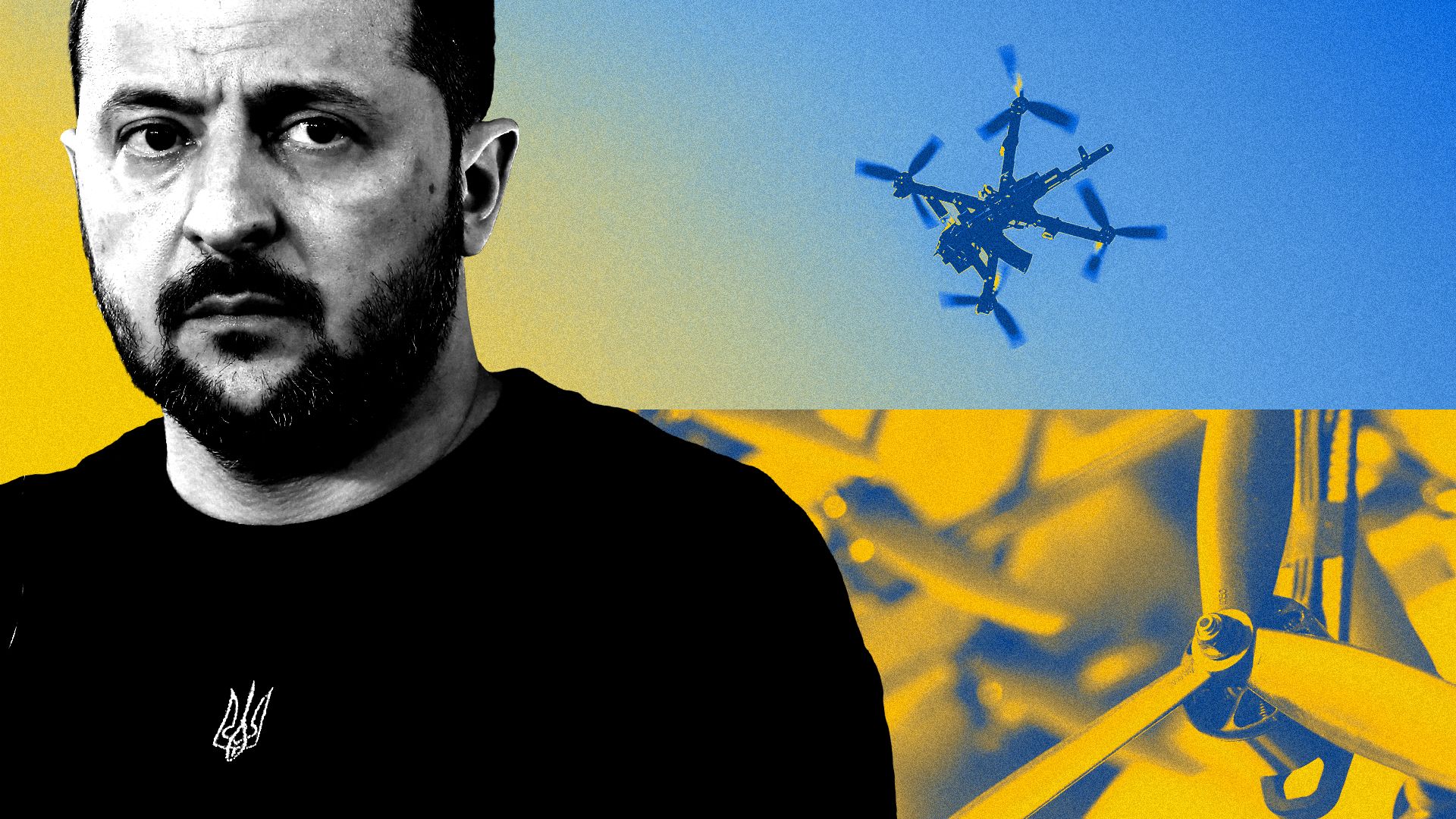
Photo illustration: Brendan Lynch/Axios. Photos: Viktor Kovalchuk and Serhii Mykhalchuk/Global Images Ukraine via Getty Images
Ukraine's sustained and sophisticated drone warfare
has knocked out refineries, tilted the battlefield balance and brought
the war home to some Russians for the first time in four years of
fighting.
Why it matters: With Ukrainian confidence running high, and Russia
struggling to provide fuel to its cities and supplies to its troops,
President Volodymyr Zelensky says he's launching a "40-day influence
operation" to force Moscow to sign a peace deal.
Driving the news: Hours after Zelensky's announcement on Thursday came one of the largest drone attacks of the war, targeting 12 regions of Russia as well as occupied Crimea.
Russian
authorities said at least 660 Ukrainian drones were intercepted.
Explosions were reported at a chemical plant in the Tula region.
That
came a week after a massive explosion at Moscow's largest refinery,
which filled the sky with black smoke. Residents reportedly took shelter
in basements and emerged to "black rain" in parts of the city. The
refinery is likely to remain offline until 2027, sources told Reuters.
At
least three more Russian refineries were hit this week, among other
targets. Zelensky's announcement of a 40-day operation suggests there's
much more to come.
What they're saying: "If Ukraine burns, your Moscow will burn too," Zelensky said as the refinery fire raged.
"There
are many difficulties [for Russia], all because Putin refuses to end
his war and to hear our proposals for a meeting, genuine negotiations,
and a dignified peace," he said earlier this week.
Putin, for
his part, insists Russia is ready to negotiate peace — on its terms. He
acknowledged earlier this month that Ukraine's drone strikes were
causing some damage, but said they would fail to divide society.
"Strikes
against civilian infrastructure — what are they aimed at? To
destabilize society ... to create a sense of uncertainty about the
actions of the Russian armed forces," Putin said this week.
The intrigue: President Trump,
who met Zelensky at the G7 last week and spoke to Putin beforehand,
remarked that Ukraine was now "doing pretty well" in the war.
Two
officials who attended the summit said Trump expressed frustration with
Putin and even signaled he could walk back the "Anchorage
understandings," under which the U.S. accepted Russia's demand that it
would control Ukraine's Donbas region under any deal.
"Trump
was skeptical about everything regarding Putin, and talked about
pressure on Russia, but other leaders do not believe he will actually do
something about it," one official told Axios.
Between the lines: The
U.S.-led diplomacy on Ukraine has stalled due to a combination of the
war in Iran and frustrations after the failure of several previous
rounds.
It's unclear whether Zelensky's drone campaign can actually provide fresh momentum for peace talks.
While
it's piling pressure on Moscow, some analysts argue it will harden
sentiments in Russia that Ukraine must be fought and defeated.
Zoom in: The
impact of Ukraine's long-distance strikes appears to be sharpest in
Russian-occupied Crimea, where authorities have halted all fuel sales
and on Friday declared a state of emergency.
Ukraine has struck power stations in Crimea and transport links connecting the peninsula to Russia.
What to watch: Ukraine is also using drones to disrupt supply lines to Russian troops at the front.
Russian
forces are continuing to try to push forward in eastern Ukraine, but
progress has been slow and reported casualties high.
[T]he extreme and ongoing protection of her Stasi-related files raises legitimate and troubling questions.
Did Angela Merkel Work for
the Stasi? Officially, no.... She has repeatedly stated that she refused
recruitment attempts, notably in the late 1970s when applying for an
academic position.
Unofficially, however, the extreme and ongoing protection of her
Stasi-related files raises legitimate and troubling questions. In March
2026, the Berlin Administrative Court upheld the Federal Archives'
refusal to grant access to any documents concerning her, even to
researchers. This decision shields one of modern Europe's most
consequential leaders from full historical scrutiny -- decades after the
fall of the Berlin Wall.
Both of Merkel's political mentors in 1989-1990 were thus
long-term Stasi collaborators.... Merkel's ascent from relative
obscurity to Bundestag member in December 1990, then to Cabinet
minister under Kohl, remains one of the most meteoric and least
scrutinized in German history.
Yet no full file has ever been released publicly -- and the 2026 court ruling ensured it stays that way.
The Stasi Records Act (Stasi-Unterlagen-Gesetz) prioritizes personal data protection over research interests...
The court did not even require the archives to confirm the existence of files or review them in camera.
This is the same legal framework that allows victims and
researchers wide access to files on ordinary citizens and confirmed IMs
-- but apparently not for Germany's former chancellor.
The court's decision is not merely cautious -- it is an
intellectual and moral outrage that undermines the very purpose of the
Stasi archives: confronting the past to safeguard democracy.
[T]he ruling creates a two-tier system: ordinary former East
Germans must live with full exposure of their Stasi files, while the
elite -- especially the long-serving chancellor whose policies shaped
modern Germany's migration crisis, energy dependence on Russia, and EU
direction -- receive extraordinary protection.
By shielding Merkel's files, German institutions send a dangerous
message: some pasts are too sensitive for the public. In an age of
declining trust in elites, this breeds legitimate suspicion. If there is
"nothing to hide," why the extraordinary legal fortress?
The extreme and ongoing protection of former German
Chancellor Angela Merkel's Stasi-related files raises legitimate and
troubling questions. A democracy that protects its powerful against the
truth ceases to be a democracy and returns to the era of suspicion --
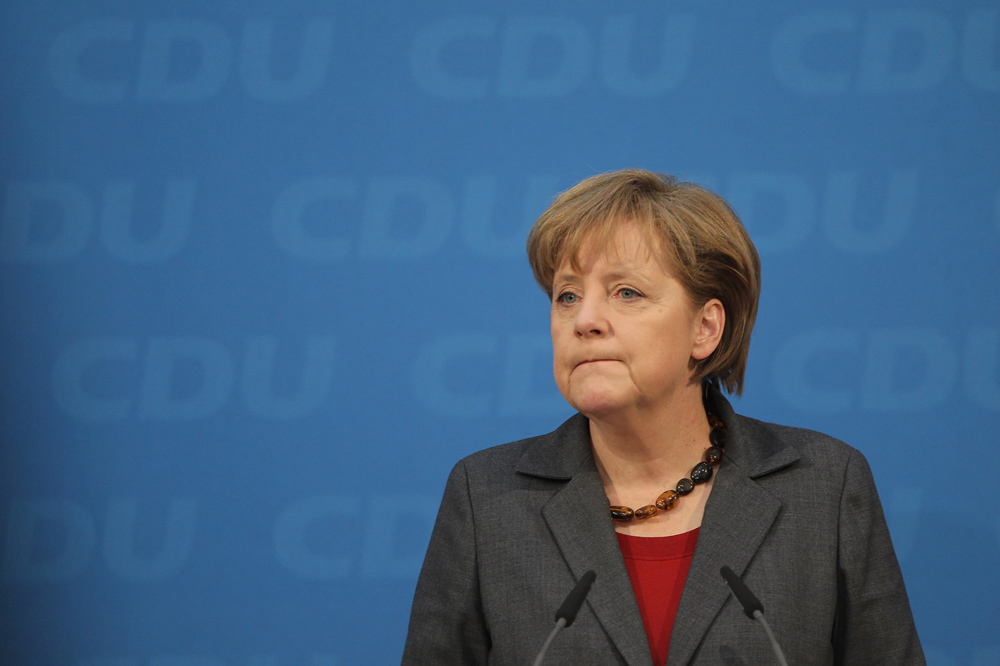
exactly the trademark of the Stasi. Pictured: Merkel in 2018.
The Ministry for State Security (Stasi),
the infamous secret police of the communist German Democratic Republic
(GDR), was one of the most ruthless and pervasive instruments of
repression ever created in Europe. Operating as the iron fist of the
communist dictatorship, the Socialist Unity Party of Germany (SED), the Stasi maintained a suffocating web of surveillance over its own population. Nearly 91,000 full-time officers and up to 189,000 unofficial collaborators (Inoffizielle Mitarbeiter, IM) -- meaning roughly one in every six or seven East Germans -- was spying on family, colleagues, or friends.
Through systematic psychological destruction known as Zersetzung
(subversion), the Stasi ruined lives without leaving visible traces.
They destroyed careers, marriages and mental health through targeted
disinformation, anonymous letters, workplace sabotage and relentless
harassment. Political prisoners were tortured in notorious facilities
such as Hohenschönhausen, the Stasi prison outside Berlin, where
thousands were broken or murdered.
The Stasi kidnapped dissidents abroad, collaborated with
international terrorists (including the Red Army Faction (Baader-Meinhof
Group) and Palestinian
groups), trafficked weapons, and ran a vast network of forced labor and
industrial espionage that stole Western technology on a massive scale.
By 1989, it had amassed
more than six million files on individuals -- a monstrous archive of
betrayal and fear that turned an entire society into a prison of mutual
suspicion. Even today, the full horror of this perfected totalitarian
machine remains only partially exposed, its surviving architects and
beneficiaries often shielded by post-reunification silence.
Did Angela Merkel Work for the Stasi?
Did Angela Merkel Work for the Stasi? Officially, no. There is no
publicly confirmed evidence that Merkel was a Stasi employee or one of
the formal Inoffizielle Mitarbeiter (IMs). She has repeatedly stated that she refused recruitment attempts, notably in the late 1970s when applying for an academic position.
Unofficially, however, the extreme and ongoing protection of her
Stasi-related files raises legitimate and troubling questions. In March
2026, the Berlin Administrative Court upheld
the Federal Archives' refusal to grant access to any documents
concerning her, even to researchers. This decision shields one of modern
Europe's most consequential leaders from full historical scrutiny --
decades after the fall of the Berlin Wall.
The Facts on Record: Merkel's Rapid Rise Amid Stasi Networks
Angela Merkel (née Kasner), born in 1954 in Hamburg, West Germany and
raised in Templin, East Germany, is the daughter of Protestant pastor
Horst Kasner (known as "the Red Pastor"), who moved his family to the
GDR because he embraced the "idea" of communism. Kasner was an advocate
for the separation from the West German church and Christian-socialist
reconciliation. His Evangelical Church was actively collaborating
with communist authorities. Merkel studied physics, earned a doctorate
in quantum chemistry, and worked at the Academy of Sciences in
Berlin-Adlershof until 1990.
Key documented elements that fuel suspicion:
Free German Youth (FDJ) Involvement: Merkel served as Secretary for Agitation and Propaganda (Agitations- und Propaganda-Sekretärin)
in the FDJ at the Academy of Sciences in Berlin-Adlershof, where she
worked from 1978 onward -- a role that typically required close
alignment with the communist regime and cooperation with the Stasi. The
position required promoting the state's communist ideology, organizing
political training, and monitoring the political loyalty of colleagues.
Holders of such roles were always recruited by or worked closely with
the Stasi. Merkel has downplayed this as "cultural affairs," but
contemporaries dispute her account. Her former colleagues asserted she
indeed propagated Marxist-Leninist ideology among students and colleagues.
In East Germany, an IM (Inoffizielle Mitarbeiter) was an unofficial collaborator -- an informant -- who delivered private information to the Ministry for State Security.
Wolfgang Schnur: In late 1989/early 1990, during the Wende (the peaceful revolution), Schnur -- a long-time Stasi informant since the mid-1960s who reported on church and opposition figures -- founded the Democratic Awakening (Demokratischer Aufbruch) party. He personally recruited
the then-unknown 35-year-old Merkel as press spokeswoman in February
1990. Schnur was exposed as a Stasi IM just days before the March 18,
1990 elections, leading to the party's collapse. Merkel distanced
herself but benefited directly from his patronage.
Lothar de Maizière: After Schnur's fall, Merkel moved seamlessly to
the East German branch of West Germany's Christian Democratic Union
(CDU) under Lothar de Maizière, the last Prime Minister of East Germany
(April-October 1990). De Maizière, who negotiated German reunification
with West German Chancellor Helmut Kohl, was himself exposed
in December 1990 as a Stasi informant (registered since at least 1981,
with files linking him to surveillance of the church and West German
contacts). Merkel served as his deputy government spokeswoman. He
resigned from the Germany's federal government shortly after unification
when the allegations surfaced.
Both of Merkel's political mentors in 1989-1990 were thus long-term
Stasi collaborators. Both had close ties to her father's church network,
itself deeply engaged in collaboration with the totalitarian regime.
Merkel's ascent from relative obscurity to Bundestag member in
December 1990, then to Cabinet minister under Kohl, remains one of the
most meteoric and least scrutinized in German history.
Yet no full file has ever been released publicly -- and the 2026 court ruling ensured it stays that way.
The Court's Reasoning: Privacy Above Historical Truth
In March 2026, the Berlin Administrative Court dismissed
a lawsuit brought by Marcel Luthe (a researcher and former politician)
seeking access to Merkel's Stasi files. The court ruled that:
Merkel was not proven to be a Stasi collaborator, so she does
not fall under the categories allowing broader disclosure. The reasoning
is quite ironic, given that the investigation is specifically aimed at
determining whether or not Merkel did actually collaborate with the
Stasi.
Merkel was not a sufficiently significant "person of contemporary history" (Person der Zeitgeschichte) before 1990 to justify overriding privacy protections.
The Stasi Records Act (Stasi-Unterlagen-Gesetz) prioritizes personal data protection over research interests when no clear collaboration exists.
Releasing files could harm Merkel's privacy rights,
although as Chancellor (2005-2021), she was one of the most powerful
figures in Europe for 16 years.
The court did not even require the archives to confirm the existence of files or review them in camera. Luthe was ordered to pay around €20,000 in costs.
This is the same legal framework that allows victims and researchers
wide access to files on ordinary citizens and confirmed IMs -- but
apparently not for Germany's former chancellor.
Why This Ruling Is a Legal and Democratic Aberration
The court's decision is not merely cautious -- it is an intellectual
and moral outrage that undermines the very purpose of the Stasi
archives: confronting the past to safeguard democracy.
First, Merkel was politically active before 1990. She held a
leadership position in the FDJ at a major research institute, joined the
DA party during the revolution, and served as its spokeswoman. By early
1990, she was already transitioning into high politics. Her claim that
she was a "private person" with no public relevance until after
unification strains credulity.
Second, the two men who launched Merkel's career were both exposed
Stasi informants and she had been a staunch Marxist, following in the
footsteps of a father whose entire church was possibly a Stasi front.
In any transparent democracy, this network would demand full
disclosure, not a blanket of secrecy. The public has a legitimate
interest in understanding whether Merkel benefited from, navigated, or
was protected by these compromised circles.
Third, the ruling creates a two-tier system: ordinary former East
Germans must live with full exposure of their Stasi files, while the
elite -- especially the long-serving chancellor whose policies shaped
modern Germany's migration crisis, energy dependence on Russia, and EU
direction -- receive extraordinary protection.
Vergangenheitsbewältigung? (Coming to Terms with the Past)
This concealment is the opposite of Vergangenheitsbewältigung
(coming to terms with the past), the principle Germany claims to uphold
since the Nazi era. By shielding Merkel's files, German institutions
send a dangerous message: some pasts are too sensitive for the public.
In an age of declining trust in elites, this breeds legitimate
suspicion. If there is "nothing to hide," why the extraordinary legal
fortress?
Germany's democracy deserves better than selective amnesia. If there
is really "nothing to hide," why such an impenetrable legal shield
around a former chancellor? The full opening of Merkel's Stasi-related
documents is not a matter of harassment -- it is a matter of historical
justice and public accountability.
A democracy that protects its powerful against the truth ceases to be
a democracy and returns to the era of suspicion -- exactly the
trademark of the Stasi.
Drieu Godefridi is a jurist (University Saint-Louis,
University of Louvain), philosopher (University Saint-Louis, University
of Louvain) and PhD in legal theory (Paris IV-Sorbonne). He is an
entrepreneur, CEO of a European private education group and director of
PAN Medias Group. He is the author of The Green Reich (2020).


.jpg)