by Jeff Dunetz
The ancient Greeks, Romans, and Muslims all said that Jerusalem Is Jewish, So why is there a problem?
Personal Note: Sunday
was Yom Yerushalayim, Jerusalem Day when supporters of Israel celebrate
the day during the 6-Day-War when Israel reunited the holy city of
Jerusalem, and for the first time in almost 20 years Jews had access to
the holy sites in East Jerusalem. For me, the holiday is a split
decision. I am ecstatic that Jerusalem is united, but saddened that
I celebrate the day here in my home office rather than in Jerusalem.
According
to UNESCO, the Palestinians, and the Muslim States, Israel, and the
Jewish People have no right to Jerusalem. It is this fake belief that
until Donald Trump became president, kept the U.S. from recognizing
Jerusalem as the capital of Israel and the Jewish world. Most of the
world outside America continues to believe the Palestinian/Muslim
propaganda that ignores that the ancient Greeks, Romans, Christians,
and even the ancient Muslims, reported Jerusalem and the Temple Mount
were the property of the Jewish people.
Let’s start out with the
basics. Jerusalem was NEVER part of a Palestinian State because there
was never an independent state of Palestine. After the Bar Kochba revolt
in 135 CE, the Romans punished the Judeans (Jews) for revolting for the
second time in sixty years. They changed the name of the Judean’s
country from Judea to Syria Palaestina (after the ancient enemy of the
Jews, the Philistines who came from the Greek islands
and anyway, were destroyed a thousand years earlier). At the same time,
they changed the name of the holy city from Jerusalem to Aelia
Capitolina (literally Capitoline Hill of the House of Aelius).
After
the Romans threw out many of the Jews, the holy land was ruled by the
Byzantine Empire, the Ottoman Empire, and finally, the British mandate
before it once again became a Jewish State in 1948. During all that
time, the holy land including Jerusalem had a very large population of
Jews.
During the period of 135 CE through 1948 (which was when
Jordan began to occupy Jerusalem) there were large populations of Jews
in Jerusalem. In fact, beginning with the earliest information available
(1844), there were more Jews in Jerusalem than any other faith. (See Menashe Harel, “The Jewish Presence in Jerusalem through the Ages” in Sinai and Oestericcher, eds., Jerusalem, John Day, 1974.)
To
the ancient Muslim, Greek, and Roman pagan authors, Jerusalem was a
Jewish city. Their text indicates the unanimous agreement that Jerusalem
was Jewish by virtue of the fact that its inhabitants were Jews, it was
founded by Jews, and the Temple located in Jerusalem was the center of
the Jewish religion.
These ancient texts disprove recent attempts
by Muslims and others to deny the historic connection of the Jewish
people to Jerusalem and the location of the Temple in Jerusalem, through
fabrications and lies. Below are just some of the examples from Greek
and Roman times originally published in a November 2008 Report issued by the JCPA:
- Some
writers recall distinctive Jewish customs, such as the absence of
representations of the deity, male circumcision, dietary laws and the
observance of the weekly day of rest, the Sabbath. Indeed, in 167 BCE,
the Greek Seleucid King Antiochus IV ordered Jews to place an idol of
Zeus in the Temple, outlawed circumcision, demanded the sacrifice of
swine and forbade Sabbath observance (I Maccabees 1:41-50). He thus
desired to eliminate those unique features of the Jewish religion which
had been noted by pagan writers.
- In an account by
Hecataeus of Abdera (c. 300 BCE), Jerusalem appears toward the
conclusion of his counter-Exodus account and before his description of
Jewish society and practices. He attributes the expulsion of the Jews to
the pestilence which the Egyptians blamed upon the presence of
foreigners, not only Jews, who caused the natives to falter in religious
observance. “Therefore, the aliens were driven from the country.” While
some went to Greece, most “were driven into what is now called Judaea …
at that time utterly uninhabited … on taking possession of the land, he
[Moses] founded, besides other cities, one that is the most renowned of
all, called Jerusalem. In addition, he established the temple that they
hold in chief veneration, instituted their forms of worship and ritual,
drew up their laws and ordered their political institutions.”
- Several
of the selections in Against Apion which include the anti-Exodus
narrative also provide descriptions of the interior and exterior of the
Temple and some of its rituals. For example, Hecataeus states that in
the center of the city is an enclosure where there is “a square altar
built of heaped up stones, unhewn and unwrought.” The Temple itself is
“a great edifice containing an altar and a lampstand, both made of gold …
upon these is a light which is never extinguished … there is not a
single statue or votive offering, no trace of a plant in the form of a
sacred grove, or the like.”Hecataeus “On the Jews”, in Against Apion I,
198-199; Stern, I, V, No.12, 36-37
- And in his account
of Titus’ siege of Jerusalem, Tacitus describes the Temple as “… built
like a citadel, with walls of its own … the very colonnades made a
splendid defense. Within the enclosure is an ever-flowing
spring.”[Tacitus, Historiae V:12:1 (Stern, II, XCII, no. 281) 22,30.
- In
addition to physical descriptions, the authors mention the religious
aspect of the Temple which differed radically from Greek and Roman
paganism. In the text preserved by Diodorus, Hecataeus mentions the
priests and their duties in the Temple and even describes a worship
service and sacrifice.
- Similarly, the first-century Roman
historian Livy remarks that the Jews do not state “to which deity
pertains the temple at Jerusalem, nor is any image found there since
they do not think the God partakes of any figure.”Hecataeus, in
Diodorus, Aegyptiaca, Bibliotheca Historica XL, 3, 4-6; Stern, I, V, No.
11, 26-28.
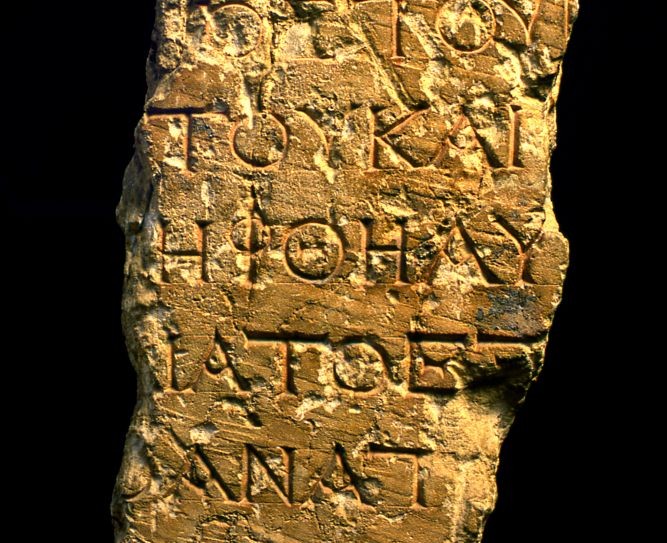 From The Second Temple, Warning In Greek delineating a section of the Temple complex which was off-limits to Gentiles
It
is noteworthy that an earlier capture of Jerusalem by the
Greek-Egyptian King Ptolemy, son of Lagus, provided an opportunity for
the obscure Agatharchides of Cnidus (second century BCE) to remark about
the fact that “the people known as Jews, who inhabited the most
strongly fortified of cities, called by the natives Jerusalem” lost
their city because they would not defend it on the Sabbath. Josephus
includes this selection in Against Apion as one of the early pagan
critiques of the Jewish Sabbath which Agatharchides deemed as “folly,”
“dreams,” and “traditional fancies about the law.”
The Palestinian
Arabs point to the fact that there is little archeological evidence
that either Temple existed, which ignores the very convenient fact that
there is no digging allowed on the Temple Mount in respect of its
holiness to the Muslims. But when the Muslims dug up part of the Temple
Mount to add to their Mosque, they dumped the tons of dirt with
artifacts outside the holy city.
From The Second Temple, Warning In Greek delineating a section of the Temple complex which was off-limits to Gentiles
It
is noteworthy that an earlier capture of Jerusalem by the
Greek-Egyptian King Ptolemy, son of Lagus, provided an opportunity for
the obscure Agatharchides of Cnidus (second century BCE) to remark about
the fact that “the people known as Jews, who inhabited the most
strongly fortified of cities, called by the natives Jerusalem” lost
their city because they would not defend it on the Sabbath. Josephus
includes this selection in Against Apion as one of the early pagan
critiques of the Jewish Sabbath which Agatharchides deemed as “folly,”
“dreams,” and “traditional fancies about the law.”
The Palestinian
Arabs point to the fact that there is little archeological evidence
that either Temple existed, which ignores the very convenient fact that
there is no digging allowed on the Temple Mount in respect of its
holiness to the Muslims. But when the Muslims dug up part of the Temple
Mount to add to their Mosque, they dumped the tons of dirt with
artifacts outside the holy city.
The Jerusalem Islamic Waqf, the institution overseeing the al-Aqsa Mosque compound, carried out excavations on the Temple Mount between 1996 and 1999 as part of the construction of a subterranean mosque in an area known as Solomon’s Stables. Tens of thousands of tons of dirt —
roughly 400 truckloads — were excavated by heavy machinery, without the
supervision of archaeologists, and were dumped outside the Old City.
Archeologists have been sifting through the dirt for years (the project’s called the Temple Mount Sifting Project),
and have found artifacts from the Holy Temples. For example in 2005 an
archaeologist found what is now known as the Gaalyahu Seal which in
Hebrew says belonging to Gaalyahu son of Imer. The house of Imer was a
well-known priestly family at the end of the First Temple period,
roughly from around the 7th – 6th Centuries BCE.
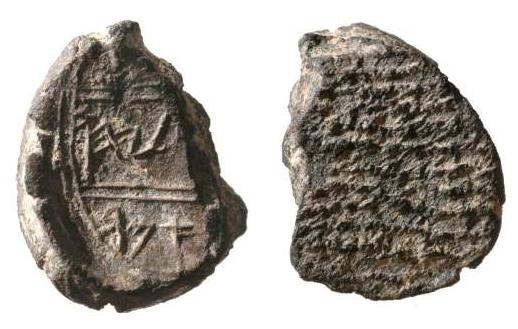 There are references to the Jewish Temple in texts the Muslims consider sacred.
The Qur’an refers
to the existence of both temples in verse 17:7. In this passage, the
Qur’an deals with God’s punishment of the Children of Israel for their
transgressions:
(We permitted your enemies)
To disfigure your faces,
And to enter your Temple
As they had entered it before,
And to visit with destruction
All that fell into their power.
The word translated as “Temple” by Abdullah Yusuf Ali (and by the influential translator Marmaduke Pickthall before him) is masjid.
This word, which is usually translated as mosque, has the meaning of a
sanctuary wherever it appears in a pre-Islamic context. The usual Muslim
exegesis of this verse (including that of Abdullah Yusuf Ali) holds
that it refers to the destruction of the First and Second Temples.
Muslim tradition is especially adamant about the existence of the First Temple, built by Solomon,
who appears in the Qur’an as a prophet and a paragon of wisdom. Verse
34:13 is an account of how Solomon summoned jinn (spirits) to build the
Temple:
They worked for him
As he desired, (making) Arches,
Images, Basons
As large as wells,
And (cooking) Cauldrons fixed
(In their places)
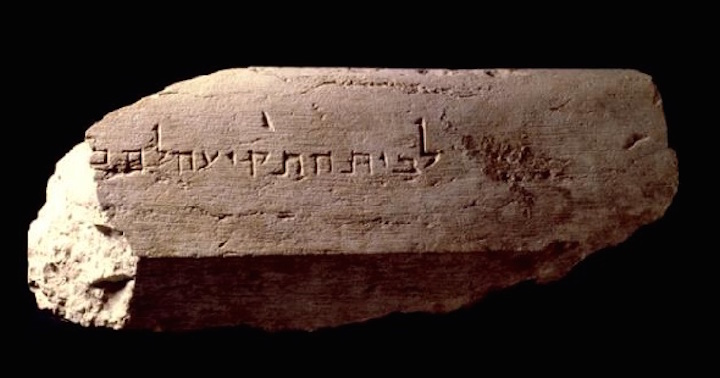 Found
By the Southern Wall of the Temple Mount-From Second Temple Inscribed,
“To the Place of Trumpeting.” The spot where the Priests blew the Shofar
to announce the Beginning and end of the Sabbath and Holidays.
The
very verse in the Quran that makes the Temple Mount holy to Muslims
also proves that the spot was occupied by the Jewish Temple:
The Islamic sanctity of the Haram al-Sharif [what the Muslims call the Temple Mount] is based upon verse 17:1
Found
By the Southern Wall of the Temple Mount-From Second Temple Inscribed,
“To the Place of Trumpeting.” The spot where the Priests blew the Shofar
to announce the Beginning and end of the Sabbath and Holidays.
The
very verse in the Quran that makes the Temple Mount holy to Muslims
also proves that the spot was occupied by the Jewish Temple:
The Islamic sanctity of the Haram al-Sharif [what the Muslims call the Temple Mount] is based upon verse 17:1
Glory to (Allah)
Who did take His Servant
For a Journey by night
From the Sacred Mosque
To the Farthest Mosque
This
is the textual proof of the isra’, the earthly segment of the Night
Journey of the Prophet Muhammad: overnight, Muhammad was miraculously
transported, round-trip, from “the Sacred Mosque” (al-Masjid
al-Haram)-that is, the Ka’ba (or its vicinity) in Mecca-to “the Farthest
Mosque” (al-Masjid al-Aqsa). Later Muslim tradition came to identify
“the Farthest Mosque” with Jerusalem. But during Muhammad’s lifetime, no
mosque stood in Jerusalem; the Muslims conquered the city only several
years after his death. Abdullah Yusuf Ali’s commentary on this
verse summarizes the traditional explanation: “The Farthest Mosque,” he
writes, “must refer to the site of the Temple of Solomon in Jerusalem on
the hill of Moriah.“
When Muslims did build a mosque on
this hill, Muslim tradition holds that it was built deliberately on the
verified site of earlier sanctuaries. According to Muslim tradition,
when the Caliph Umar visited Jerusalem after its conquest, he searched
for David’s sanctuary or prayer niche (mihrab Dawud), which is mentioned
in the Qur’an (38:21). (David was believed to have chosen the site on
which Solomon built.)
When Umar was satisfied he had located it,
he ordered a place of prayer (musalla) to be established there. This
evolved into a mosque-precursor of the later Aksa Mosque. Thus began the
Islamization of the complex that later came to be known as the Haram
al-Sharif. It became the tradition of Islam that Muslims restored the
site to its earlier function as a place of supplication venerated by all
the prophets, including Abraham, David and Solomon.
Then there is Koran, Sura 2:145, “The Cow”
“…They
would not follow thy direction of prayer (qiblah), nor art thou to
follow their direction of prayer; nor indeed will they follow each
other’s direction of prayer…”
Commentators
explain that “thy qiblah” (direction of prayer for Muslims) clearly
refers the Ka’bah of Mecca, while “their qiblah” (direction of prayer
for Jews) refers to the Temple Mount in Jerusalem.
This Koranic
passage appears to show that the holiness of Jerusalem a Jewish concept,
and should not be confused with an Islamic concept, as the 13th-century
Arab biographer and geographer Yakut noted: “Mecca is holy to Muslims, and Jerusalem to the Jews.”
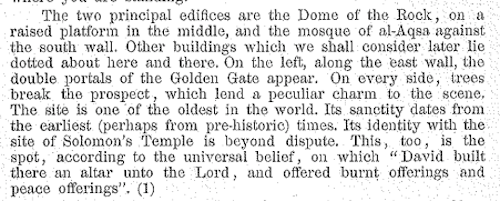
The Official 1925 Supreme Moslem Council (Wakf) Guide Book To Al-Ḥaram Al-Sarif (Temple
Mount) recognized the presence of the Jewish Temples atop the Mount.
Shown below is paragraph two which appears on page four, it says, “It’s
[the Temple Mount] identity with the site of Solomon’s Temple is beyond
dispute.” Now 90 years later the head of the Wakf is disputing it.
 And
let’s not forget that the Jewish Temple is mentioned in the Christian
Gospels which pre-date Islam. For example, in Mark 12:40 and Luke 20:47
Jesus accused the Temple authorities of thieving and this time names
poor widows as their victims, going on to provide evidence of this in
Mark 12:42 and Luke 21:2. Dove sellers were selling doves that were
sacrificed by the poor who could not afford grander sacrifices and
specifically by women. Note: Luke refers to the writer of the Gospel of
Luke, NOT the last Jedi.
According to Mark 11:16, Jesus then put
an embargo on people carrying any merchandise through the Temple—a
sanction that would have disrupted all commerce. In the Gospel of John
2:15-16 Jesus refers to the Jerusalem Temple as “my Father’s house”,
thus, making a claim to being the Son of God.
And
let’s not forget that the Jewish Temple is mentioned in the Christian
Gospels which pre-date Islam. For example, in Mark 12:40 and Luke 20:47
Jesus accused the Temple authorities of thieving and this time names
poor widows as their victims, going on to provide evidence of this in
Mark 12:42 and Luke 21:2. Dove sellers were selling doves that were
sacrificed by the poor who could not afford grander sacrifices and
specifically by women. Note: Luke refers to the writer of the Gospel of
Luke, NOT the last Jedi.
According to Mark 11:16, Jesus then put
an embargo on people carrying any merchandise through the Temple—a
sanction that would have disrupted all commerce. In the Gospel of John
2:15-16 Jesus refers to the Jerusalem Temple as “my Father’s house”,
thus, making a claim to being the Son of God.
He
poured out the coins of the money changers and overturned their tables;
and to those who were selling the doves He said, “Take these things
away; stop making My Father’s house a place of business.”
What
does this all mean? Ancient text, Muslim text, and Christian text all
agree with the Jewish text that there was a holy temple on top of Mount
Moriah in Jerusalem. So it’s well past time for the Europeans and other
world Governments to stop denying Muslim, Christian, and Jewish
history, press the BS button on UNESCO and point out the truth.
No
amount of lies, not from UNESCO, not from the Palestinians, not from
any UN committee or any world leader–no one except the Lord God himself,
can take Jerusalem away from the Jewish people.
Jeff Dunetz is also a contributing reporter to TruthRevolt.org and MRCTV.org. He is also the political columnist for The Jewish Star, and co-host of the weekly radio show, The Hump Day News Report on the 405 Radio Network.
Source: http://www.israelnationalnews.com/Articles/Article.aspx/23973
Follow Middle East and Terrorism on Twitter

 At the Secret Life of Muslims site, we are told that "one helpful rule for being a Muslim on the internet -- [is] don't read the comments." Thus, the viewer is already set up to censor any comments that might be factual about Islam.


