Sunday, August 2, 2026

Trump calls off attack on Iran, citing progress on deal to open Strait of Hormuz and end nukes - John Solomon


by John Solomon

Trump said Israel "joins me in this commitment. Get to work, everybody, and get it DONE."


World War II," Trump wrote on Truth Social. "Despite this, we have just been asked by Iran, and other Middle Eastern Countries, to hold off any attack in that the perimeters of a deal has been agreed to.

"This would include the Immediate, Complete, and Total OPENING OF THE HORMUZ STRAIT, and an end to Iran’s nuclear threat. Based on this request, I have agreed, for the future benefit of the WORLD and, likewise, the survival of a successful and prosperous Iran, to cancel the attack, subject to being able to rapidly make a DEAL," he added.

"The Country of Israel joins me in this commitment. Get to work, everybody, and get it DONE." 


John Solomon

Source: https://justthenews.com/government/security/trump-calls-attack-iran-citing-progress-deal-open-strait-hormuz-and-end-nukes

Follow Middle East and Terrorism on Twitter

Trump administration creating ‘incubators’ to develop new tech to counter drone terror attacks - Amanda Head


by Amanda Head

Terrorism through drone warfare is the new frontier of attack, and the U.S. is combatting the threat on multiple fronts.


Drone warfare is at the forefront of every nation's developing defense technology and the Trump administration is utilizing private sector "incubators" to bring America's best and brightest together to protect the country, including one new company's groundbreaking product to counter malign drones within seconds.

"We are acting as an incubator, as a catalyst for all of those potential solutions in the private sector...a competition for the best athlete to find out not only what drones we need, because we're not going to be buying drones from other countries, we're going to be building them here for our war fighters, the first-person view drones (FPV) that are used to attack our enemies, but also for the defensive measures," Dr. Sebastian Gorka, Senior Director for Counterterrorism at the National Security Council, told Just The News

One such anti-drone technology that has emerged is Space Eyes' Morpheus Counter-Unmanned Aerial System (C-UAS) that combines advanced radio-frequency signal processing, artificial intelligence, and quantum-resistant security to detect, classify, and neutralize airborne threats within seconds.

"We just hosted one of the largest sporting events we've ever seen in the world with FIFA and that (drone warfare) was at the forefront," Derek Gordon, President of National Security at Space Eyes told Just The News

"But a few years ago, the countermeasures were not what they are now. Criminals are always trying to be a step ahead of law enforcement in their techniques, and the US government as a whole spends an exorbitant amount of resources on countering something that costs the enemy a few dollars to make. So, without the partnership of private industry, this problem wouldn't be solved," Gordon said.

Funding the fight against drones

Exorbitant resources are currently hanging in the balance. On July 22, the House of Representatives narrowly passed its $1.15 trillion National Defense Authorization Act (NDAA) for fiscal 2027, authorizing Defense Department programs and related activities. The Senate version remains stalled after a failed cloture vote.

The same day, the House advanced a reconciliation budget resolution with roughly $60 billion in additional defense funding, mainly for Iran conflict costs and munitions. It falls far short of the administration’s $350 billion request and faces an uncertain Senate path. The NDAA authorizes spending but does not appropriate funds.​​​​​​​​​​​​​​​​​​​​​​​​​​​​​​​​​​​​​​​​​​​​​​​​​​

"We just have to make sure our defense department is adequately funded, and it's funded for the right things. We have to make sure we're not fighting the last war and end some of the contracts we put in place 10 or 15 years ago, and make sure we have a robust defense against drones both in the battlefield and at home," Rep. Glenn Grothman, R-Wis., told Just The News.

Grothman also made a suggestion to close the gaps between federal funding and drone attacks in towns across America. "I think this is something that would be a good thing for Mike Johnson to look at. Provide some assets or perhaps to fund some drones for local governments as well."

Drone warfare is here to stay 

The soft launch of drone warfare emerged during the Russia-Ukraine war. Both sides have heavily relied on drone warfare for reconnaissance, targeting enemy positions, and conducting direct attacks. 

Ukrainian forces pioneered the use of inexpensive FPV drones for precision strikes, while Russia has deployed Iranian-made Shahed drones for long-range assaults. This technology has transformed the battlefield, enabling low-cost attrition and reducing the need for manned aircraft in many scenarios.​​​​​​​​​​​​​​​​​​​​​​​​​​​​​​​​​​​​​​​​​​​​​​​​​​ FPV drones are "first-person view" drones, remote-controlled quadcopters that stream real-time video from an onboard camera directly to pilot goggles.

Since Russia’s full-scale invasion of Ukraine in 2022, nations including Israel, Iran, Sudan, Ethiopia, Mali, Myanmar, India and Pakistan have employed drone warfare in conflicts ranging from the Gaza war and Iran-U.S. clashes to African civil wars and border skirmishes, using one-way attack drones, FPV models and other systems for surveillance, precision strikes and low-cost attrition.

Additionally, during the October 7, 2023 attack on Israel, Hamas used drones primarily for surveillance, dropping explosives and grenades on positions, and some one-way attacks, alongside paragliders, rockets, and the main ground invasion that killed at least 1,200 people and took 251 hostages.

Fury from the sky abroad...but also here at home

Drone warfare can be used not only on the battlefield, but also here on U.S. soil to carry out mass-casualty events.

In June, the FBI thwarted an alleged plot to attack the UFC Freedom 250 event at the White House with explosive-laden drones and snipers targeting officials and attendees. Authorities learned of the scheme on June 10 and arrested multiple suspects in a multi-state operation. The event, attended by President Donald Trump and others, proceeded without incident.​​​​​​​​​​​​​​​​​​​​​​​​​​​​​​​​​​​​​​​​​​​​​​​​​​

That catastrophe was foiled, but as Texas State Senator Phil King told Just The News, "What stops somebody from sitting in the parking lot at the local airport and trying to fly a drone into a 747 as it takes off?" King is a former police officer and serves as Chairman of the Texas Senate's Select Committee on Homeland and Border Security, keeps a keen eye on drone warfare and technology and how it's utilized on the southern U.S. border in Texas. 

He highlighted how some drones, like the Griff Aviation 300, have a maximum load capacity of nearly 500 pounds. However, to transport deadly drugs like fentanyl, that capacity is hardly needed. One pound of fentanyl is roughly 450,000 mg, which equates to 225,000 lethal doses. It's estimated to be 100 times more potent than morphine. 

King warned further about the public safety aspect of drone warfare. "What stops them from flying into that football stadium?" King queried. "I am really shocked at the amount of threat risk that we have there, and I don't think there's going to be any one way to deal with it. I think you're going to see a lot of Skunk Works. There's a lot of creativity going on in law enforcement, local law enforcement agencies."

"How would America change if someone built a few drones by downloading the information off the net on their 3D printer or just going to the store and buying them, program them with some kind of explosive or chemical or something, and at the same minute just flew them into three high school football games," King continued. "America would change forever."

Prison drone drops

Authorities report a growing use of drones to smuggle contraband into prisons. Unmanned aircraft have dropped packages containing drugs, cellphones, weapons and other banned items over facility walls in multiple states and countries. 

Prison officials say the deliveries undermine security and fuel violence inside. Agencies are responding with detection technology, netting and restricted airspace rules to counter the threat, but no doubt as the technology progresses, the countermeasures must also.​​​​​​​​​​​​​​​​​​​​​​​​​​​​​​​​​​​​​​​​​​​​​​​​​​


Amanda Head
is White House Correspondent for Just The News. You can follow her here.

Source: https://justthenews.com/government/security/combatting-fury-skies-drone-warfare-necessitates-new-protection-technology

Follow Middle East and Terrorism on Twitter

Erdogan's Courtship of President Trump - Con Coughlin


by Con Coughlin

Although Turkey tested the S-400 following its delivery and has not returned it to Russia, the Turkish government claims that the system is in storage and has hinted that it could possibly be moved to another country for safekeeping. What could possibly go wrong?


  • Trump's remarks were seen as a rebuke to Israeli Prime Minister Benjamin Netanyahu, who is — quite rightly — opposed to F-35 sales to Turkey on the grounds that it could ultimately prove a direct threat to Israel's security, as well as to Cyprus and Greece, which Erdogan has repeatedly threatened.

  • Turkey was suspended from the multinational F-35 program during Trump's first term in 2019, after acquiring Russia's S-400 air defence system. The purchase of the S-400 also prompted US sanctions against Turkey's defence industry, imposed in 2020.

  • Although Turkey tested the S-400 following its delivery and has not returned it to Russia, the Turkish government claims that the system is in storage and has hinted that it could possibly be moved to another country for safekeeping. What could possibly go wrong?

  • Trump has even praised Erdogan for the role he has played in Syria, where his support for Syrian President Ahmed al-Sharaa, an Islamist former al-Qaeda terrorist now presenting himself to the world as a "moderate," was crucial to Sharaa's overthrowing the Assad regime in December 2024.

  • Meanwhile the terrorists who make up Sharaa's regime have reportedly "gotten their hands on a modern military" and have been persecuting Christians, Alawites, Kurds and Druze.

  • Trump's willingness to engage with Erdogan overlooks numerous troubling issues which, far from indicating that Ankara can be treated as a reliable ally of Washington, show that, under Erdogan's leadership, Turkey's policy is generally aimed at undermining American efforts to bring peace to the region.

  • While the US, together with a number of key regional allies such as Jordan, has worked hard to persuade Hamas's terrorist leadership to disarm (a key demand in Trump's 20-point peace plan to end the Gaza war), Erdogan and his Islamist allies in Qatar have tried to dissuade Hamas from disarming.

  • The Trump administration's goals of disarming Hamas completely and ending its involvement in Gaza have, in fact, been constantly undermined by Erdogan. He has supported numerous counter-proposals, such as the suggestions that Hamas give up its weapons to the Palestinian Authority (PA) or that the weapons be transferred to some kind of "secure storage" under supposed oversight.

  • Both proposals, which have been rejected by Israel, were seemingly designed with the aim of preserving Hamas' rule in Gaza.

  • Reports that "Turkey was prepared to provide Iran with aerial military support if Kurdish militias had invaded the country during the Israeli-US war on Iran" have laid bare the extent of Erdogan's unmistakable double dealing on the Iran issue.

  • Trump might believe that Erdogan could prove to be a useful ally in terms of helping to achieve the Trump administration's objectives in the Middle East and beyond. The reality, however, is that, in terms of his overall attitude towards the US and its objectives in the region, the Turkish leader deserves to be treated more as an enemy than an ally.

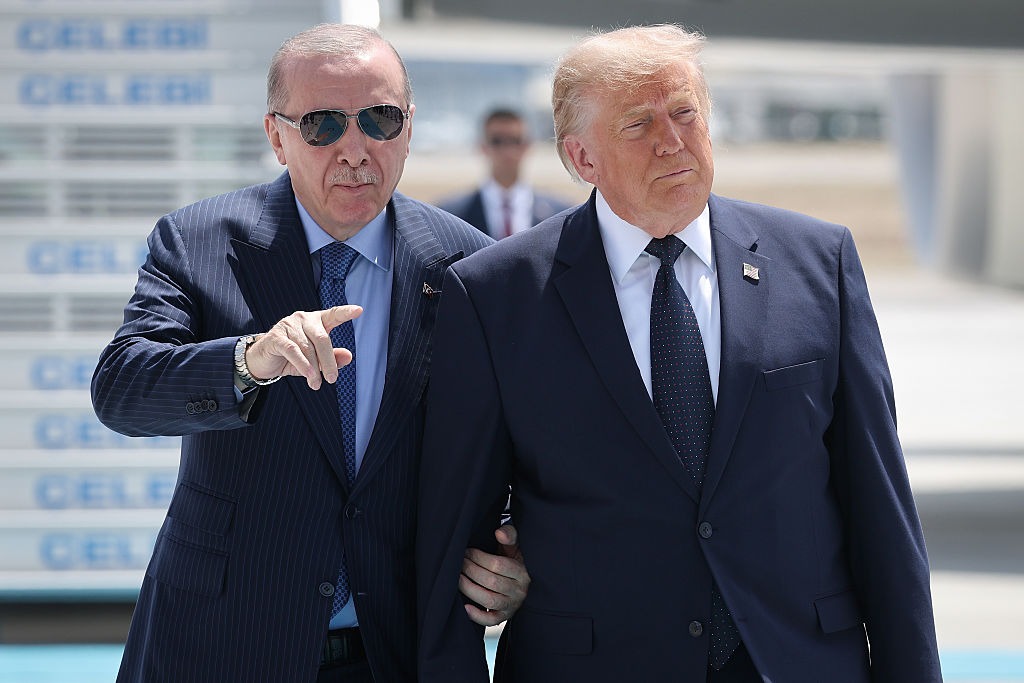
Turkish President Recep Tayyip Erdogan's latest attempt to persuade the Trump administration to provide Ankara with state-of-the-art F-35 stealth warplanes is just the latest example of the Turkish leader's willingness to indulge in double-dealing as part of his long-running campaign to establish Turkey as a dominant force in the Middle East. Pictured: Erdogan escorts US President Donald Trump at Etimesgut Air Base on July 7, 2026 in Ankara, Turkey. (Photo by Win McNamee/Getty Images)

Turkish President Recep Tayyip Erdogan's latest attempt to persuade the Trump administration to provide Ankara with state-of-the-art F-35 stealth warplanes is just the latest example of the Turkish leader's willingness to indulge in double-dealing as part of his long-running campaign to establish Turkey as a dominant force in the Middle East.

Erdogan's courtship of US President Donald Trump has so far succeeded to the extent that the American leader has publicly described Turkey as being "a tremendous ally for me" and also saying that he regards Erdogan as a personal friend.

Trump made the comments in response to the widespread criticism he has received over his announcement, made at the recent Nato summit held in Ankara, that he is considering reversing Turkey's suspension from the F-35 program, which was imposed during his first term.

Speaking to reporters, Trump declared: "He's a friend of mine. And nobody tells me what we should be selling or not. Turkey has been a tremendous ally for me. "

Trump's remarks were seen as a rebuke to Israeli Prime Minister Benjamin Netanyahu, who is — quite rightly — opposed to F-35 sales to Turkey on the grounds that it could ultimately prove a direct threat to Israel's security, as well as to Cyprus and Greece, which Erdogan has repeatedly threatened.

Turkey was suspended from the multinational F-35 program during Trump's first term in 2019, after acquiring Russia's S-400 air defence system. The purchase of the S-400 also prompted US sanctions against Turkey's defence industry, imposed in 2020.

Although Turkey tested the S-400 following its delivery and has not returned it to Russia, the Turkish government claims that the system is in storage and has hinted that it could possibly be moved to another country for safekeeping. What could possibly go wrong?

Erdogan has previously described Turkey's removal from the F-35 program as unjust, arguing that restoring Ankara's participation would strengthen Nato's collective security.

Irrespective of the concerns expressed by Israel and some Nato leaders about Trump's openness to selling F-35s to Ankara, the US president appears determined to forge closer ties with Erdogan in the belief that he can be a valuable ally on a variety of fronts, from limiting Russian President Vladimir Putin's expansionist aims to resolving seemingly intractable problems in the Middle East.

A key factor in Trump's reasoning appears to be his belief that, having one of the most powerful militaries in the region, Turkey can play a key role in helping the Trump administration to achieve some of its key objectives in the Middle East, from ending the Iran war to resolving the Gaza crisis.

Trump has even praised Erdogan for the role he has played in Syria, where his support for Syrian President Ahmed al-Sharaa, an Islamist former al-Qaeda terrorist now presenting himself to the world as a "moderate," was crucial to Sharaa's overthrowing the Assad regime in December 2024.

Meanwhile the terrorists who make up Sharaa's regime have reportedly "gotten their hands on a modern military" and have been persecuting Christians, Alawites, Kurds and Druze.

Trump's willingness to engage with Erdogan overlooks numerous troubling issues which, far from indicating that Ankara can be treated as a reliable ally of Washington, show that, under Erdogan's leadership, Turkey's policy is generally aimed at undermining American efforts to bring peace to the region.

The Trump administration's attempt to implement a lasting ceasefire in Gaza is a case in point. While the US, together with a number of key regional allies such as Jordan, has worked hard to persuade Hamas's terrorist leadership to disarm (a key demand in Trump's 20-point peace plan to end the Gaza war), Erdogan and his Islamist allies in Qatar have tried to dissuade Hamas from disarming.

The Trump administration's goals of disarming Hamas completely and ending its involvement in Gaza have, in fact, been constantly undermined by Erdogan. He has supported numerous counter-proposals, such as the suggestions that Hamas give up its weapons to the Palestinian Authority (PA) or that the weapons be transferred to some kind of "secure storage" under supposed oversight.

Both proposals, which have been rejected by Israel, were seemingly designed with the aim of preserving Hamas' rule in Gaza.

Trump's announcement last week that a deal had finally been reached on the "complete disarmament" of Hamas has, therefore, been achieved despite the decidedly unhelpful interventions of Turkey and its ally Qatar, a fact the White House would be well-advised to take on board in any future dealings with Ankara.

Erdogan's involvement in another of the key Middle East challenges facing Trump -- namely, ending the Iran war -- also cannot be interpreted as helping the Trump administration secure a successful outcome.

Reports that "Turkey was prepared to provide Iran with aerial military support if Kurdish militias had invaded the country during the Israeli-US war on Iran" have laid bare the extent of Erdogan's unmistakable double dealing on the Iran issue.

During the early phase of the Iran conflict, the Trump administration gave serious consideration to backing a Kurdish-led military revolt against the ayatollahs, a move that was bitterly opposed by Erdogan. That the Turkish leader was prepared to deploy Turkish warplanes against US-backed militias in Iran would have meant that he was, in effect, launching military action to thwart American objectives -- a move that is hardly consistent with Erdogan being "a tremendous ally".

Trump might believe that Erdogan could prove to be a useful ally in terms of helping to achieve the Trump administration's objectives in the Middle East and beyond. The reality, however, is that, in terms of his overall attitude towards the US and its objectives in the region, the Turkish leader deserves to be treated more as an enemy than an ally.


Con Coughlin is the Telegraph's Defence and Foreign Affairs Editor and a Distinguished Senior Fellow at Gatestone Institute.

Source: https://www.gatestoneinstitute.org/22762/erdogan-courts-trump

Follow Middle East and Terrorism on Twitter

Iran: Can Trump Win the War? - Amir Taheri


by Amir Taheri

As far as one can make out, a consensus is emerging in Iran today that this regime must go...


  • The regime that Ayatollah Ruhollah Khomeini founded has been and shall remain dangerous for the people of Iran, the region and beyond, without closing the strait or developing the bomb.

  • As far as one can make out, a consensus is emerging in Iran today that this regime must go...

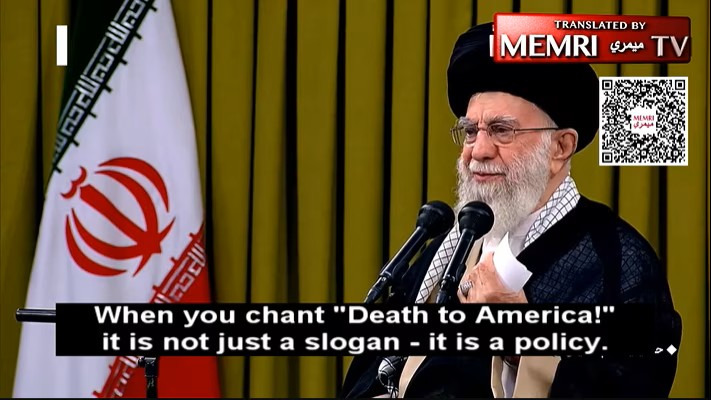
The regime that Khomeini founded has been and shall remain dangerous for the people of Iran, the region and beyond, without closing the strait or developing the bomb. Pictured: Iran's then "Supreme Guide," Ayatollah Ali Khamenei, gives a speech on November 1, 2023, televised on Iran's Channel 1. (Image source: MEMRI)

More than a year after the latest phase of the US-Israel war against Iran started with a 12-day mass bombing, a consensus is emerging among pundits that President Donald Trump, who casts himself as the commander-in-chief in this conflict, cannot win it.

One sign that Trump himself may have reached the same conclusion is his recent efforts to put some daylight between himself and his ally, Israeli Prime Minister Benjamin Netanyahu.

Another sign that Trump may be thinking of throwing in the towel is the purge of his swearing-infested vocabulary of the catchphrase "regime change".

He now talks of two objectives: reopening the Strait of Hormuz and stopping Iran's nuclear project.

The first of those objectives was achievable, albeit, as is often the case with the Islamic Republic of Iran, on no firm basis under the 14-Point Islamabad Memorandum of Understanding.

Elements within the leftover Islamic regime in Tehran who thrive on the continuation of the conflict sabotaged that by attacking ships passing through the Strait of Hormuz. The aim was seemingly for empty bragging by a humiliated bunch. Yet, they succeeded in provoking Trump into ordering a new round of aimless bombings.

Tehran has made its imaginary control of Hormuz a matter of honor but left the idea of charging a transit toll for an unknown future. If and when things return to normal, Iran, under any regime, won't be able to defy the whole world and become a pariah in its neighborhood by closing the strait, let alone imposing a toll.

Trump's second objective is to stop Tehran's nuclear project.

Here, Israel seems to be on board. Defense Minister Israel Katz said last week that "the great and arrogant Persian empire that threatened and acted to destroy Israel has collapsed," adding that what remains to be done is to prevent Iran from getting nuclear weapons, rebuilding capabilities that threaten Israel and continuing support for its terrorist proxies.

In that context the so-called "reformist wing" of the Tehran regime known as the "New York Boys" has revived the ghost of President Barack Obama's 2015 JCPOA "nuclear deal", the one that Trump tore up during his first term as president.

Former Foreign Minister Mohammad Javad Zarif, who negotiated the JCPOA, has penned an article in Foreign Affairs suggesting a second life for the zombie accord.

As a sweetener, he suggests that a fatwa sensibly issued by the late "Supreme Guide" Ali Khamenei forbidding the making of the bomb be passed as a law by the Islamic Majlis (Iran's ersatz parliament). It is necessary to remember that Obama based his decision on that fatwa, which neither he nor anyone else has ever seen.

Will Trump rise to that bait? I hope not.

A fatwa by a mullah could be cancelled by another mullah, and a law passed by a dubious parliament could be annulled by the next dubious parliament.

The regime that Ayatollah Ruhollah Khomeini founded has been and shall remain dangerous for the people of Iran, the region and beyond, without closing the strait or developing the bomb. Thus, even if Trump secures paper accords on those two realities, he won't be able to claim that he won a war that it seems he never wanted.

The year-long conflict has shown that a quick, straight military victory isn't on the cards, and even if it were, it wouldn't produce lasting results; Afghanistan and Iraq being two examples. In fact, in the past 80 years or so, the only war in which the US achieved lasting victory was in Grenada.

Having said all that, I still think that Trump can win this war provided he sets clear aims for it. The minimalist goal could be a change of behavior by the Khomeinist regime, which is easier said than done but not impossible.

The maximalist goal could be regime change, which paradoxically may have a better chance of being achieved than any time since the Islamic Republic was founded 47 years ago.

As far as one can make out, a consensus is emerging in Iran today that this regime must go, but not thanks to foreign military intervention. The war has done immense and, in some cases, irreparable damage to the Iranian economy and the nation's industrial, scientific and civilian infrastructure. People we talk to in various parts of Iran do blame the US and Israel but end up pointing to what they term "delusional" and "provocative" behavior of the regime.

During the war, the regime's repressive machinery has been seriously downgraded in both physical and financial terms, not to mention political authority. One theme echoed is that a regime that couldn't protect its top leadership echelon had no business provoking a war that has led to so much destruction. In this war, many parts of Iran that had experienced no wars for up to 1,000 years have directly seen what war does. At least four million people across the county have lost their jobs while over a million small and medium businesses have gone under.

The economic mafia survives but is less able to buy loyalty or silence dissent. The latest public executions are supposed to restore fear but have so far had the opposite effect, as seen in last week's mass protests in Isfahan and Qazvin.

To achieve either of the goals mentioned above, Trump must end this war.

This does not mean walking away with a worthless paper accord as Jimmy Carter did in 1979 and Barack Obama in 2015, thus bestowing a measure of legitimacy on a regime that hasn't earned it. Nor does it mean giving it a free hand to brag, browbeat and bully people inside and outside Iran.

Without throwing the buoy of normalization at the leftover clique, Trump could let the Iranian people settle their own score with their oppressors either by tipping the balance in favor of those in the current power struggle who seek a change of behavior toward a measure of normality or those who urge straight regime change.

Orson Welles once wrote, "If you want a happy ending, that depends, of course, on where you stop your story."

That is also true of wars.

Gatestone Institute would like to thank the author for his kind permission to reprint this article in slightly different form from Asharq Al-Awsat. 


Amir Taheri 
was the executive editor-in-chief of the daily Kayhan in Iran from 1972 to 1979. He has worked at or written for innumerable publications, published eleven books, and has been a columnist for Asharq Al-Awsat since 1987. He graciously serves as Chairman of Gatestone Europe.

Source: https://www.gatestoneinstitute.org/22763/can-trump-win-iran-war

Follow Middle East and Terrorism on Twitter

‘We believe Hamas will not disarm,’ Israeli-backed militia figure in Gaza tells ‘Post’ - Dana Ben Simon


by Dana Ben Simon

Dismantling armed militias could discourage locals from working with Israel, says a Gaza resident. "People will think twice for fear of being abandoned."


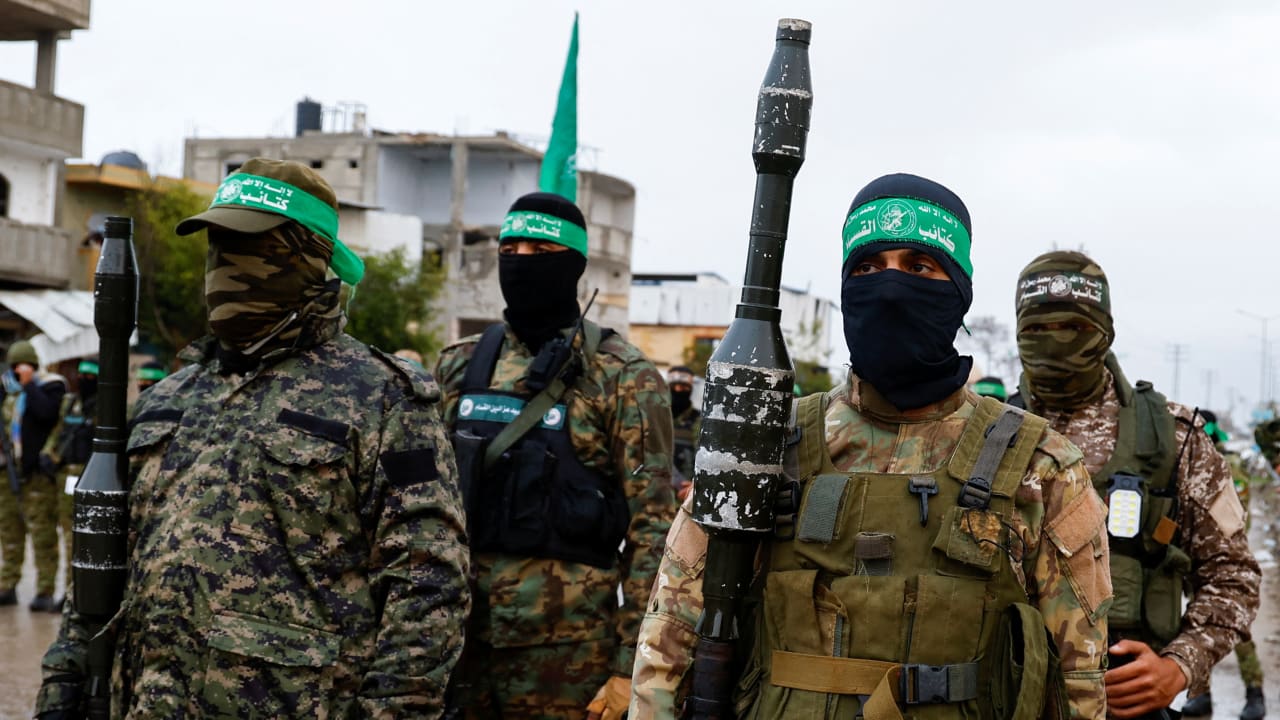
Palestinian Hamas terrorists stand guard on the day of the handover of hostages held in Gaza since the deadly October 7 2023 attack, as part of a ceasefire and a hostages-prisoners swap deal between Hamas and Israel, in Rafah in the southern Gaza Strip, February 22, 2025.
(photo credit: REUTERS/Hatem Khaled)

The disarmament plan announced by the Board of Peace and approved by Hamas "will not be implemented," a Palestinian source in Gaza affiliated with Israeli-backed militias told The Jerusalem Post.

For Hamas, handing over its weapons would be a suicidal step. "If there are no weapons, there is no Hamas," the source told the Post over the weekend.

According to him, those in Gaza who have suffered under Hamas oppression are waiting for a chance to take revenge, which is one reason why Hamas believes it must keep its weapons. "Families, clans, and even ordinary people who were targeted by Hamas are waiting to settle scores with the organization, no matter how long it takes," he said.

"People who were tortured, abused, or whose relatives were killed by Hamas will never forgive and never forget. Today, they cannot fight Hamas because the organization is armed. But even if it takes five or 10 years, people will seek to hold Hamas members accountable," he continued. "Hamas is aware of this threat, and that's why they need their weapons to protect themselves and cannot afford to disarm."

Ghazi Hamad, a member of Hamas's Political Bureau, told Arab media outlets that the organization agreed to store weapons with the Palestinian technocratic committee, known as the National Committee for the Administration of Gaza (NCAG), the transitional body tasked with managing post-war Gaza under the mandate of US President Donald Trump's Board of Peace.

The inaugural Board of Peace meeting at the U.S. Institute of Peace in Washington, DC, US, February 19, 2026.
The inaugural Board of Peace meeting at the U.S. Institute of Peace in Washington, DC, US, February 19, 2026. (credit: KEVIN LAMARQUE/REUTERS)

Hamas agreement to deal is 'empty talk'

Hamad, who has been part of Hamas's negotiating delegation in Cairo, said that the agreement is a comprehensive package, not limited to weapons, and stressed that Hamas will fulfill its obligations only if Israel meets its commitments, pointing to Israeli withdrawal. "The issue of collecting weapons is a Palestinian matter. Israel will have no role in it," he stressed.

Hamad claimed that the agreed formula was intended to "save the people of Gaza from more destruction, war, and displacement."

The agreement stipulates that heavy weapons, including manufacturing sites, tunnels, and warehouses, will be collected and stored by the NCAG. At the same time, individual arms will be regulated under Palestinian law and regulations.

The militia-affiliated Gaza source dismissed Hamas's apparent acceptance of the deal as "empty talk", arguing that the terror group is simply trying to buy time and ensure its own survival. "The agreement is meaningless; it will not happen," he claimed. "They have almost no heavy weapons left."

"Hamas cares only about Hamas," he continued. They will not comply with the demand for full disarmament because they want to stay in power. For Hamas, not having weapons means risking its existence. They know that the moment they lose their grip, they will not be able to return to power," he added.

However, some Palestinians expressed cautious optimism, suggesting the agreement may be a good sign that could move post-war Gaza arrangements in the right direction and help break the current stalemate.

"Hamas realizes now that there is no hope for it to remain in power in Gaza," one Palestinian resident from Gaza City told the Post.

"At least at this stage, I think Hamas is serious about storing the weapons," he said.

"But it will not be easy for Hamas to relinquish its ideology and it may eventually try to regain control," he added. "This depends on to what extent the other partners, the technocratic committee, and the players entering Gaza can restrain Hamas and prevent it from reclaiming authority."

Disarming Israeli-backed militias in Gaza sends 'troubling messages'

A key demand from Hamas, stipulated in article 10 of the plan, calls for the dissolution of armed groups in Gaza, referring to Israeli-backed militias set up in the strip to combat the terror organization.

"Weapons of the militias shall be decommissioned and stored under NCAG authority according to an agreed-upon timetable. Members of those militias shall not be integrated in the security and police services," the agreement read.

"We came to fight Hamas," the Gaza militia-affiliated figure said. "Our problem is with Hamas, not with anyone else. If it truly gives up its weapons, stops ruling Gaza, and there is real change, then maybe we can be part of the arrangements of the new deal. But as long as Hamas remains, even with only rifles, we will continue to fight it. What matters is what happens on the ground," he asserted.

The Gaza resident argued that dissolving the Israeli-backed militias, as required by the agreement, sends a troubling message to anyone considering future cooperation with Israeli security agencies.

"If these groups are disbanded now, it will be difficult for the Israelis to find people willing to work with them," he claimed, in comments to the Post. "Those who worked with Israel or supported it would now be exposed to reprisals by Hamas because they are seen as traitors. Also, in the eyes of the people, they are unwelcome."

From the very beginning, he said, these armed groups have had no respect among the Palestinian public. "People in Gaza do not see them as legitimate, and they lack popular support. So, in the end, both sides will turn their backs on them, and that could also damage Israel's ability to recruit people; they will think twice before taking that risk for fear of being abandoned," the resident said.

The militia source, however, rejected that claim. "Israel will never abandon us. It will continue to support us," he said, pointing to Israel's past support for members of the South Lebanon Army as proof. "We believe Israel will protect us; our safety is guaranteed," he said. 


Dana Ben Simon

Source: https://www.jpost.com/middle-east/article-904304

Follow Middle East and Terrorism on Twitter

Gender ideology suffers setbacks in counseling and medicine with legal settlements, reopened case - Greg Piper


by Greg Piper

Health system pays fired physician assistant $410,000, introduces religious accommodations to opt out of "gender affirming care," preferred pronouns. Michigan "conversion therapy" law falls and Washington's is back in court.


The application of gender ideology to psychology and medicine suffered blows in the Midwest and West Coast this past week, as Michigan and its flagship university threw in the towel in separate litigation and Washington found itself dragged back into court.

The Great Lakes State agreed its statutory ban on so-called conversion therapy for minors — "client-driven" conversations with a counselor to resolve gender confusion — is unconstitutional in light of the Supreme Court's Chiles decision this spring against a "materially identical" Colorado law as applied to talk therapy, Thursday's court order says.

The 6th U.S. Circuit Court of Appeals previously blocked Michigan's law as a "content- and viewpoint-discriminatory restriction upon speech." 

Michigan Catholic Charities branches and counselor Emily McJones have "demonstrated success on the merits" of their discrimination claims, U.S. District Judge Jane Beckering wrote in the stipulated judgment.

A Christian counselor perduaded the federal judge who threw out his lawsuit against Washington's doppelganger of Colorado's law to resurrect it, over the objections of The Evergreen State and Equal Rights Washington, which intervened in the case.

U.S. District Judge Tiffany Cartwright took two months to grant Brian Tingley's motion to reopen the case in light of Chiles, which rejected the 9th Circuit's reasoning in upholding Washington's law.

That occurred a week after Tingley filed a motion for preliminary injunction. He and a broad range of religious and secular supporters failed to get SCOTUS to review the case in 2023.

Oregon suddenly backed off a $90,000 fine against counselor Frank Canepa for refusing to affirm his client's lesbian relationship in the wake of Chiles as well.

Heartening medical professionals who oppose so-called gender affirming care, University of Michigan Health-West paid physician assistant Valerie Kloosterman $410,000 for firing her for refusing to help patients get puberty blockers, cross-sex hormones and surgical removal of healthy body parts and for spurning their preferred pronouns.

It's a long-delayed victory for Kloosterman, who sued nearly four years ago on both religious and medical grounds. The 6th Circuit returned the case to Judge Beckering's court a year ago, saying she should have denied UMHW's proposed arbitration "after a year of litigation and after the defendants got a preview of how the merits might progress in court."

Kloosterman's lawyers at First Liberty Institute showed the settlement to Just the News to confirm its terms as they described it Wednesday, on the condition that the agreement remain unpublished.

She's keeping more than half the settlement for herself — $125,000 each for "non-economic (emotional distress) damages" and for lost wages — while First Liberty gets $147,433 and co-counsel Clement & Murphy $12,567.

UMHW is also adopting a "Religious Accommodation Policy" that protects employees from compelled speech and participation in medical care related to gender identity and pledges no adverse action against them for seeking accommodations, as long as they state their objections to the health system and supervisors.

"In mandatory trainings, employees will not be required to personally affirm statements about gender identity that violate their sincerely-held religious beliefs," it says. They don't have to "perform or assist" in "gender transition treatments" including procedures, medications and referrals, or use pronouns in a way that violates their religious belief or conscience.

The health system will publish the written policy alongside others, promulgate it to employees and incorporate it in UMHW's annual mandatory training for the next three years. 

"All I wanted to do was provide the best care possible to my patients without being forced to violate my Christian beliefs," Kloosterman said, praising the new policy for letting employees "provide excellent care consistent with their medical judgment" and recognize patients as "created in the image of God."

Payments coming to Catholic Charities as 'prevailing parties' 

The latest moves in litigation stem from judicial rebukes to the President Biden-nominated judges who sided with the states— directly from her appeals court in Beckering's cases and indirectly in Cartwright's from SCOTUS overruling the 9th Circuit.

Michigan's law remained blocked, and the case put on hold as SCOTUS considered Kaley Chiles' challenge to Colorado's law.

The stipulated judgment signed by Beckering confirms that Catholic Charities are the "prevailing parties" in their content- and viewpoint-discrimination claim, making them eligible for attorney's fees, costs and expenses. Those amounts have already been resolved in a separate settlement, and religious liberty law firm Becket didn't answer a request by Just the News to see it.

Michigan's "surrender confirms that the Constitution and the best available science are on the side of counselors who help children find peace with their bodies," Becket senior counsel Luke Goodrich said. "States still trying to censor that care should take note.”

Judge Cartwright's resurrection of the Washington lawsuit is only documented in a July 30 "minute entry" following a hearing on counselor Tingley's motion to reopen. She reopened only the first count, denial of Tingley's free speech rights.

The state is depriving young people suffering through the "epidemic of mental health issues" a counselor "who shares their faith," Alliance Defending Freedom Senior Counsel Johannes Widmalm-Delphonse, representing Tingley before the court, said after the reopening. "We’re pleased the court reined in Washington state’s ideological crusade."

Repeatedly conflates coercive practices with talk-only, client-led therapy

Washington Attorney General Nicholas Brown unsuccessfully argued the Chiles precedent "is not an extraordinary circumstance that justifies re-opening the judgment," citing the state's "compelling interest" in protecting minors from "physical and psychological harms posed by conversion therapy."

His opposition repeatedly conflates talk-only, client-led practices like Tingley's — upheld 8-1 by the Supreme Court in Chiles — with the verbally and physically coercive practices originally understood as conversion therapy. (Equal Rights Washington's one-paragraph brief says it "incorporates by reference the arguments" in Brown's filing.)

"It doesn’t work: over the past several decades, it has been thoroughly discredited by leading medical and mental health organizations, providers, and academic researchers," Brown wrote.

"Research overwhelmingly concludes that it increases depression and suicidal ideation," he said, citing a 2020 study by the LGBTQ youth nonprofit Trevor Project in the peer-reviewed American Journal of Public Health. Its research is often challenged: Science journalist Jesse Singal said the group relies on unproven assumptions and "irrelevant citations."

Because Cartwright's ruling was consistent with 9th Circuit precedent and those of "most" other federal appeals courts at the time — "every other court to consider a state law restricting conversion therapy as part of professional licensing schemes had upheld the law" — the judgment should stand, Brown wrote.

He noted SCOTUS rejected reopening "a prisoner’s habeas petition on statute of limitations grounds" even after it changed "the interpretation of the governing law’s statute of limitations," because the district court's ruling was consistent with its appeals court's "then-prevailing interpretation" of the law.

"Nearly five years have passed from this Court’s dismissal order and the Chiles decision" and the state and public have "significant interests" in a judgment protecting minors from conversion therapy, Brown wrote, again ignoring Tingley's actual practice.

He claimed the law "passes constitutional muster under a strict scrutiny analysis" because it "addresses a compelling interest, is narrowly tailored, and is the least-restrictive alternative."

If Cartwright disagrees, she should limit Tingley's relief to the exact claim in Chiles, an "as-applied free speech challenge," Brown said. SCOTUS "did not address third-party standing, free exercise, or vagueness at all." 


Greg Piper

Source: https://justthenews.com/nation/religion/gender-ideology-suffers-setbacks-counseling-and-medicine-legal-settlements-reopened

Follow Middle East and Terrorism on Twitter

Five Toronto police officers disciplined for glorifying Oct. 7 on official podcast - JNS Staff


by JNS Staff

“We expect accountability that reflects the seriousness of these findings, along with meaningful reforms to ensure this never happens again on an official Toronto police platform,” CIJA said.


Toronto Police Car
Credit: Toronto Police Service.

Five Toronto police officers, including two who were Muslim liaison officers at the Toronto Police Service, were disciplined for saying on an official police podcast on March 10, 2025, that Oct. 7 was inspiring an “unbelievable” number of people to convert to Islam, the National Post reported.

The Post reported that Farhan Ali and Haroon Siddiqui, the liaisons, and three supervisors were found to have committed professional misconduct in an official report dated June 3. An investigation document was received July 31, it reported.

B’nai Brith Canada said that it “welcomes the findings included in the York Regional Police investigation into the inappropriate comments made by Toronto police officers on a podcast in 2025.” (JNS sought comment from the Toronto Police Service and the York Regional Police.)

“These comments concerned many in the Jewish community, and as the findings reveal, they violated the high standards we must all expect of our law enforcement officers,” the group said. “It is concerning that, according to the report, the officers in question declined to provide written evidence or participate in the investigation in a meaningful fashion.”

“This incident underscores the importance of antisemitism training for all police officers, as the Ontario inspector general of policing recognized in his recent, first-ever notice of issue,” B’nai Brith said.

The Centre for Israel and Jewish Affairs, the advocacy arm of the Jewish Federations of Canada-UIA, stated that when the podcast, Project Olive Branch, published the program, “we said the issue went far beyond a deeply insensitive episode.”

“It raised serious questions about police impartiality, oversight and public trust at a time when the Jewish community is experiencing unprecedented levels of antisemitism and increasingly looking to law enforcement for protection,” CIJA said. “That’s why we, alongside the Canadian Antisemitism Education Foundation, called for a formal investigation under the Community Safety and Policing Act—not simply an apology.”

“An independent investigation has now substantiated misconduct, finding sufficient evidence that the officers’ conduct and the failures in oversight undermined public trust in policing,” it stated. “The matter has been referred to the professionalism committee for penalty.”

“We expect accountability that reflects the seriousness of these findings, along with meaningful reforms to ensure this never happens again on an official Toronto police platform,” CIJA said. 


JNS Staff

Source: https://www.jns.org/news/world/five-toronto-police-officers-disciplined-for-glorifying-oct-7-on-official-podcast

Follow Middle East and Terrorism on Twitter

Court upholds staggering fines, digital scarlet letter for woman who outed males in women's soccer - Greg Piper


by Greg Piper

Supreme Court of Australia's most populous province says Kirralie Smith and her women's rights group Binary committed "transgender vilification."


If you refer to transgender people by their sex online, Australia might pass on compelling the platform to censor your speech, at least if posted from abroad. Say it Down Under, though, and you risk fines approaching six figures and a digital scarlet letter.

The New South Wales Supreme Court upheld fines of $95,000 Australian – roughly $66,000 U.S. – against women's sports activist Kirralie Smith and her group Binary Australia, as well as a court-written statement to be posted on their social media accounts for three months, for "transgender vilification" against male soccer players on women's teams.

That vilification consisted of outing the players as males, whom Football New South Wales allows to compete against women under a 2023 "gender diversity policy," and posting public materials about them from their teams and league.

By contrast, an administrative review board overruled eSafety Commissioner Julie Inman Grant when she ordered X to block a post by Canadian gender-critical activist Chris Elston, which called an Australian female activist who identifies as a man a "woman."

In January and February 2023, Smith outed Stephanie Blanch as male in a Binary article, which included a photo of the player, and on social media by posting nameless photos of Blanch and identifying Blanch's team "on numerous occasions," sometimes linking her article, according to the ruling. It says Blanch has played on a women's teams since 2016. 

In late March that year, Smith outed Riley Dennis as male "on a number of occasions" on social media, "including naming her by nominating where her name fell on a reproduced leaderboard of sporting results," the ruling says, always using female pronouns for the male athletes. It says Dennis has played on women's teams since 2022.

The court ordered Smith to pay Blanch and Dennis roughly $38,000 and $28,000 U.S., respectively, and post the judgment against Smith "on all social media pages and websites over which she has control, including Facebook, Instagram and X," the ruling says. 

They must be "featured" and "pinned" posts on social media, and "published prominently" on Smith-controlled websites. The male athletes were reportedly born Nicholas and Justin, respectively, and YouTube personality Dennis's username still includes the athlete's so-called deadname, Justin.


The compelled speech says Smith and Binary "incited hatred towards, serious contempt for, or severe ridicule of a soccer player on the ground that she is a transgender person," and were ordered to pay damages, remove posts and cease the "offending behaviour."

Just the News could not find an archived version of the Jan. 20, 2023, article about Blanch, long removed from Binary, nor Smith's social media posts referenced in the ruling. 

A lower court had ordered the removal of the article and posts that link to it, as well as posts with photos of Blanch and the "leaderboard" showing Dennis's dominance. It also gagged Smith from identifying either as "a transgender person playing on a women’s sports team."

The male athletes' photos are now circulating widely, however, with X owner Elon Musk agreeing with British comedian Graham Linehan that the victors are "the worst of men."

"There’s no amount of money, no judgements, nothing that will turn any man into a woman," Smith told supporters after the ruling. She won't be "gaslit," intimidated or threatened in her campaign for "freedom of speech, for truth speech, and for women’s sex-based rights."

Smith didn't say whether she's planning an appeal to the High Court, the country's final judicial body. "I’ll have a lot more to say about that in the coming weeks," Smith said. "I will never comply with a lie."

Court doubled penalty after creator of women-only app appealed

NSW's financial penalty nearly matches that issued a year ago by a British Columbia nursing regulator against nurse Amy Hamm for expressing similar sentiments, starting with an "I (heart) J.K. Rowling" billboard Hamm put up to celebrate the gender-critical Harry Potter creator.

It follows Federal Court of Australia rulings against Sall Grover for blocking Roxanne Tickle, a male who identifies as a woman, from Grover's women-only networking app Giggle. 

The trial judge found Grover "indirectly" violated the Sex Discrimination Act, which added "gender identity" and removed definitions of "man" and "woman" in 2013. The full court, which hears appeals, doubled Grover's penalty to roughly $14,000 American this spring, finding that she "directly" discriminated against Tickle. Grover is appealing to the High Court.

Last week NSW Legislative Council lead candidate Lyle Shelton nominated Grover for the Australian Human Rights Commission's Human Rights Medal as a "champion of freedom of expression" for demanding that Australians "be free to discuss women's rights respectfully and without fear."

Another women-only space, a pole dancing studio on the Gold Coast, is facing a new lawsuit seeking roughly $21,000 U.S. by a male identifying as a woman. 

"We are putting our bodies in these vulnerable positions" and "prone to wardrobe malfunctions," owner Nomes Whitney told 7NEWS. "Having a biological male in that space just makes you so much more self-conscious."

Invoking the Queens of Pole Fitness and Dance lawsuit, Grover warned in an Australian op-ed Tuesday that "institutionalised misogyny dressed up as human rights" would continue in Australia until the government amends the law to enforce sex-based rights.

"Each time a woman-only space defends its boundary, the machinery of the state is used against it,' forcing women to "prove why females deserve privacy from males," Grover wrote.  "How many more human rights complaints are queued up to destroy women’s lives and livelihoods?"

Asked men for help getting league's attention about this 'bloke'

Gender-critical Reduxx reported that Binary's Smith started calling attention to male athletes in women's football, as it's known in Australia, in the wake of injuries to female players.

In an X post preceding her article on Blanch, Smith reportedly asked local men for their help getting the league to listen to their concerns about "a bloke [Blanch] playing on the women’s team in Wingham." 

She posted photos she attributed to the team's Facebook page that show the male "receiving an award for playing in the women’s division." The NSW deemed this vilification.

Two months after NSW police issued a restraining and gag order against Smith for speaking to the media about Dennis, Reduxx posted video of Dennis allegedly injuring a female player so badly she could only play for 8 minutes after returning to the field in the second half. 

Binary had previously spurred thousands of complaints against Football NSW for the presence of at least five males in women's competition, according to Reduxx

It first unmasked Dennis as the alleged subject of a Daily Mail article on an unnamed "trans woman football player," with pixelated photos, whose Football NSW domination and alleged injuries to female competitors had sparked backlash against the league.

Public broadcaster ABC reported that Smith couldn't offer evidence of Dennis injuring a competitor during cross-examination at trial, saying she unsuccessfully "tried to clarify who it was, what the game was, how it happened and was there any evidence."


Greg Piper

Source: https://justthenews.com/accountability/whistleblowers/court-upholds-staggering-fines-digital-scarlet-letter-woman-who-outed

Follow Middle East and Terrorism on Twitter

Greatest antisemitic terrorist threat in Europe stems from jihadist terrorism, new report finds - Mathilda Heller


by Mathilda Heller/b>

The ICCT, together with the Security and Crisis Center (SACC) of the EJC, conducted a one-year monitoring exercise between 1 January and 31 December 2025 of offline manifestations of antisemitism.


Police officers stand guard as demonstrators take part in a pro-Palestine protest, on the day of the celebrations to mark the 35th anniversary of Germany's Unification Day, in Saarbruecken, Germany, October 3, 2025. 


The greatest antisemitic terrorist threat in Europe stems from jihadist terrorism, a new analysis of real-life antisemitic incidents by the International Centre for Counter-Terrorism (ICCT) and the European Jewish Congress (EJC) has concluded.

The ICCT, together with the Security and Crisis Centre (SACC) of the EJC, conducted a one-year monitoring exercise between 1 January and 31 December 2025 of offline manifestations of antisemitism across all European Union member states, as well as the UK and Switzerland.

In total, 254 incidents were identified over the course of the year. It is, however, likely that the real figure was much greater, as many victims do not report the incidents.

The distribution of incidents was relatively even across 2025, with an average of 21 incidents per month. Peaks were recorded in December, with 36 incidents, and in September, with 33 incidents, while the lowest number was recorded in February, with nine incidents.

ICCT and EJC said this pattern demonstrates that antisemitism is not merely an event-driven phenomenon that spikes around specific geopolitical developments, but a “persistent feature of everyday life affecting Jewish communities across Europe.”

People attend a demonstration against anti-Semitism at the Place de la Bastille, in Paris, France, June 20, 2024.
People attend a demonstration against anti-Semitism at the Place de la Bastille, in Paris, France, June 20, 2024. (credit: REUTERS/Johanna Geron)

Likewise, antisemitic incidents were recorded across all monitored countries. The four most populous European countries, Germany (58 incidents), France (54 incidents), Italy (29 incidents), and the UK (27 incidents) also recorded the highest numbers of cases. Germany and France alone accounted for nearly half of all registered incidents.

When adjusting for population size, there was a slight change in the pattern: France recorded the highest incidence rate, followed by Bulgaria and Greece. Physical attacks were particularly common in France, and vandalism dominated in Italy and the Netherlands.

Within the monitoring, actual incidents of antisemitic terrorism were comparatively rare. Throughout 2025, Europe witnessed two attacks linked to IS-inspired jihadist terrorism: a stabbing attack near the Holocaust Memorial in Berlin in February, in which the perpetrator later stated that he had intended to kill Jews, and the Yom Kippur attack in Manchester.

Vandalism accounted for the highest share of antisemitic incidents

By far, the most common category was vandalism, accounting for more than half of all recorded incidents, with 131 out of 254 cases. Most acts of vandalism targeted Holocaust memorials, accounting for 41 incidents. Other common targets included synagogues, with 23 incidents, and Jewish cemeteries, with 11 incidents.

Vandalism was followed by physical attacks, with 48 incidents. Although generally falling short of the threshold of terrorism, a number of these attacks involved weapons, most commonly knives as well as blunt objects such as bottles.

FURTHERMORE, 40 incidents were classified as hate speech, 21 as harassment, while 14 could not be attributed to any of the predefined categories.

ICCT and EJC also tracked state legal responses following the antisemitic incidents. Authorities opened an investigation in approximately 75% of cases.

In 36 cases, primarily involving assaults or harassment, perpetrators were temporarily detained at the scene. In the case of the terrorist attack in Manchester, the perpetrator was shot dead by police. While authorities generally demonstrated a willingness to investigate incidents, in approximately 66% of all cases no perpetrators had yet been identified at the time of writing.

Of the 31 cases that proceeded to court, seven resulted in prison sentences, two resulted in fines, and three concluded with acquittals.

ICCT and EJC concluded that, though only a relatively small share of the 254 antisemitic incidents was terrorist in nature, the terrorist threat facing Jewish communities in Europe is significant and spans across multiple ideological milieus.

European Jewish communities face significant terror risk

Although terrorist attacks represented only a small proportion of the 254 incidents recorded, the report warns that the terrorist threat facing Jewish communities in Europe is significant and spans across multiple ideological milieus.

As demonstrated by the series of attacks in Europe carried out by Harakat Ashab al-Yamin al-Islamia (HAYI), presumably linked to Iran, “state-backed terrorism constitutes a significant threat to Jewish life in Europe,” the report said.

The report, however, argues that the greatest antisemitic terrorist threat currently stems from jihadist terrorism. This includes jihadist groups such as al-Qaeda and IS, the Afghanistan-based IS affiliate Islamic State Khorasan Province (ISKP), and also Hamas. There has recently been a coordinated law-enforcement endeavor to bring down a Hamas ring running out of multiple countries, especially Germany and the Netherlands.

About the extreme Left in Europe, ICCT and EJC said this primarily involved vandalism and property damage, while indiscriminate mass-violence plots are less likely.

ICCT and EJC said that online antisemitism persists at high levels; their monitoring demonstrates that antisemitism also frequently manifests itself through real-world incidents.

As such, the two organizations said it is essential that policymakers and civil society actors adopt a clear and proactive stance against all forms of antisemitism.

This includes not only consistently speaking out against antisemitic behavior, but also strengthening policies aimed at protecting Jewish life as part of European societies.


Mathilda Heller


Source:
https://www.jpost.com/diaspora/antisemitism/article-904357

Follow Middle East and Terrorism on Twitter
Draft dodgers will either 'enlist or go to prison,' Netanyahu says in closed-door meeting - report - Keshet Neev, James Genn, Jerusalem Post Staff


by Keshet Neev, James Genn, Jerusalem Post Staff

Further, KAN reported that Netanyahu acknowledged the draft law was unsuccessful and that it would not be brought back in the next government.


 LIKUD LEADER BENJAMIN Netanyahu shakes hands with United Torah Judaism MK Yitzhak Goldknopf in the Knesset last week. If Netanyahu’s promise of a full budget for all haredi educational institutions is realized, the already-low incentive to provide core studies will disappear entirely.
LIKUD LEADER BENJAMIN Netanyahu shakes hands with United Torah Judaism MK Yitzhak Goldknopf in the Knesset last week. If Netanyahu’s promise of a full budget for all haredi educational institutions is realized, the already-low incentive to provide core studies will disappear entirely.
(photo credit: YONATAN SINDEL/FLASH90)

Prime Minister Benjamin Netanyahu reportedly told officials on Sunday that if re-elected, he would not advance the contentious law that seeks to freeze the arrests of haredi (ultra-Orthodox) draft evaders, which his coalition recently passed last month.

Netanyahu said the legislation was unsuccessful and that it would be discontinued in the next government, according to a Sunday KAN report.

The report further added that Netanyahu had said draft evaders who do not study Torah will either “enlist or go to prison.”

The Knesset passed the contentious bill last month that seeks to temporarily freeze arrests of haredi draft evaders, a measure that was expected to remain in effect for at least six months. The High Court of Justice later froze the law and is still set to determine whether to strike it down.

The passage of the bill in its final readings came following severe legal warnings that the legislation was unbalanced and would not increase haredi enlistment amid the IDF’s severe manpower shortage, as well as outrage from bereaved families and reservists.

Prime Minister Benjamin Netanyahu attends a Knesset vote on a bill to freeze arrests of haredi draft evaders, in Jerusalem, July 14, 2026
Prime Minister Benjamin Netanyahu attends a Knesset vote on a bill to freeze arrests of haredi draft evaders, in Jerusalem, July 14, 2026 (credit: CHAIM GOLDBERG/FLASH90)

Haredi parties push for legislation not to increase haredi enlistment

Netanyahu had also reportedly said during the Sunday meeting that the law freezing draft-dodger arrests was meant to be only a temporary solution, intended to “lower the flames and increase the number of recruits among the haredi public,” according to the KAN report.

The prime minister also said in the meeting that after the next elections, he plans to establish a “broad national government” that will pass a “full conscription law that meets the IDF’s needs,” a separate N12 report added.

The haredi parties have continuously encouraged Netanyahu’s coalition to advance legislation that would not increase haredi enlistment.

Various attempts at developing a conscription law throughout the government’s term have been highly controversial, with critics arguing that the legislation was primarily intended to appease the haredi parties in Netanyahu’s coalition, rather than increase enlistment.

Defense Minister Israel Katz had arrived at the plenum to vote in favor of the haredi arrest freeze legislation in its final readings. Netanyahu had also joined the plenum ahead of the vote, appearing to support the legislation.

IDF Chief of Staff Lt.-Gen. Eyal Zamir had warned, ahead of the legislation’s passage, that implementing such a law would create an array of national security problems.

Zamir has also warned in recent months that the IDF could soon collapse if no solution is found for the manpower shortage.

Spokespeople from both the Prime Minister’s Office and Netanyahu’s ruling Likud party did not immediately respond to The Jerusalem Post’s request for comment on the reports of Netanyahu’s Sunday remarks.

Opposition party leaders criticize the bill, calling it 'political spin'

Opposition party leaders in the bloc seeking to replace Netanyahu in the upcoming elections sharply criticized the premier’s reported remarks, accusing them of being political spin.

Yashar party leader Gadi Eisenkot, a leading rival candidate, said that “Netanyahu continues to hold the public in contempt. The public won’t buy this latest spin, which stems from his fear of the polls.”

Addressing his words to the prime minister, he said: “Netanyahu, for four years you blocked a genuine conscription law. With your own hands, you strengthened draft dodgers and deserters at the expense of those who serve. You had so many opportunities to rise to the occasion – to be a leader. You failed.”

Former prime minister Naftali Bennett, who leads the Together party, called Netanyahu’s remarks a “pathetic spin.”

“These spins do not work on our soldiers, our reservists and their families, or anyone who understands that IDF enlistment is an existential necessity,” Bennett said.

Yisrael Beytenu party leader MK Avigdor Liberman said that Netanyahu was “feeding everyone nonsense and trying to divert the public conversation away from his failures. One thing is certain, he has no government without the draft dodgers.”

Yisrael Beytenu had filed a petition to the High Court against the legislation following its passage, calling to strike it down.

Democrats party leader Yair Golan also sharply criticized Netanyahu’s statements, noting, “The leaks from these ‘closed-door meetings’ are just another pathetic and cynical spin by a man who has lost all connection to Israel’s security.”

“The IDF is desperately short of combat soldiers, the reserve system is buckling under the strain, and Netanyahu continues to lie brazenly, simply to stop his party from bleeding mandates,” Golan added.

Yoaz Hendel, who leads The Zionist Home-The Reservists along with Chili Tropper, also denounced the PM, saying, “No matter how many promises Netanyahu makes before the elections, the public (who serve in the military) will not forget.”

“We will not forget the surrender to the haredi parties. We will not forget the political protection he paid for them, or the abandonment of security in favor of the integrity of government,” he said.

“We will not forget the contempt for Torah... we will not forget the blasphemy in passing laws that abrogate the obligation to go to war as a mitzvah. We will not forget that they kept the military small and prevented us from winning,” Golan warned. 


Keshet Neev, James Genn, Jerusalem Post Staff

Source: https://www.jpost.com/israel-news/politics-and-diplomacy/article-904323

Follow Middle East and Terrorism on Twitter