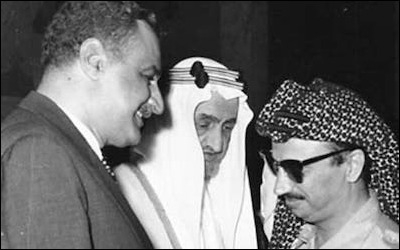
 Egyptian
president Gamal Abdel Nasser (left) with the PLO's Yasser Arafat
(right) and Saudi King Faisal, September 1970. Despite Nasser's
celebrated championing of the Palestinian cause, he often seemed
indifferent to the Palestinians during his early career. |
Nearly fifty-one years after his death, Egyptian president Gamal
Abdel Nasser remains a celebrated figure for his staunch championing of
pan-Arabism in general and the Palestinian cause in particular. The
Mahmoud Darwish Museum in Ramallah has organized a forum celebrating
Nasser's legacy in the struggle against Israel[1]
while a Palestinian columnist claimed that if the Egyptian president
were alive today, the Arab world would continue its march toward unity
and the "liberation of Palestine."[2]
Some dissenting voices notwithstanding,[3]
Nasser's popularity among Palestinians seems to live on because of fond
recollections of his fiery pledges to destroy Israel and refusal to
make peace with the Jewish state. Yet recently declassified documents
reveal that Nasser's championing of the Palestinian cause was largely
driven by ulterior motives of personal aggrandizement and pan-Arab
leadership. Indeed, as illustrated by his acceptance of U.N. Resolution
242 in November 1967 and the Rogers Plan of July 1970, as well as his
private contacts with Soviet, American, and British interlocutors among
others, Nasser seemed amenable to dropping the Palestinian cause for a
separate Egyptian-Israeli agreement that would restore the Sinai
Peninsula to Cairo's rule.
Years of Indifference, 1952-54
Nasser experienced combat firsthand as a 30-year-old major in the
1948 Arab-Israeli war, blaming Egypt's poor military performance on King
Farouk whom he perceived as a corrupt British lackey. "I felt from the
depths of my heart that I hated war," he wrote in his memoirs. "Not only
this particular war in which we were engaged, but the idea of war
itself. I felt that humanity does not deserve the honor of life if it
does not strive with all its heart in the cause of peace."[4]
Nasser's celebrated championing of the Palestinian cause
notwithstanding, he not only did not endorse this cause during his early
career, but he often seemed indifferent to the Palestinians and
reluctant to confront Israel. In the early 1950s, U.S. and British
intelligence reports deemed Nasser a moderate who would not eschew
possible agreement with Israel.[5]
Indeed, in 1952, Nasser reportedly engaged in clandestine talks with
Israel, and while these talks failed to produce any results, they
revealed a sense of pragmatism and interest in a political agreement.[6]
In August 1954, Nasser told the French daily Le Monde that
Egypt needed peace to focus on domestic issues and that Washington could
facilitate peace between Israel and the Arab states.[7]
In a conversation with a pro-Israeli British politician, Nasser said
that he had no desire to destroy Israel and that "the idea of throwing
the Jews into the sea is propaganda."[8] He reiterated this claim to a New York Times correspondent and in a Foreign Affairs article: "A war would cause us to lose, rather than gain, much of what we seek to achieve."[9]
Reinforcing Nasser's ostensible aversion to war, Yitzhak Rabin
recalled an encounter with the future Egyptian president during local
military negotiations during the 1948 war:
Nasser was sitting next to me. He looked at the emblem of
the Palmach and asked me what it meant, and I explained. Then he told
me the war we are fighting is the wrong war against the wrong enemy at
the wrong time. And I remember that, because he didn't say it in
private.[10]
What then produced the sea change in Nasser's attitude toward the
Palestinian problem in the mid-1950s? While some scholars cite Israel's
failed 1954 sabotage operation in Egypt as the turning point,[11]
it is more plausible to ascribe the change to Nasser's ambitious
pursuit of power and prestige. His flirtation with different ideologies
on the way to power, the grandiose vision of Egypt's geopolitical role
espoused in his memoirs, and his calculated embrace of pan-Arabism all
point in this direction.
By shunning the Islamist way, Nasser became an obstacle to the realization of Muslim Brotherhood goals.
|
As a teenager in the mid-1930s, Nasser spent some time in the ultranationalist Young Egypt Party,[12]
and in the following decade, as a young officer, he joined the Muslim
Brotherhood and was active in its paramilitary organization at-Tanzim
al-Khass (The Special Apparatus). According to Maj. Khaled Mohieddin, a
fellow member of the "Free Officers," which would topple the monarchy in
July 1952, Nasser met Brotherhood founding-leader Hassan Banna in 1947
and swore allegiance to the Islamist movement on a pistol and copy of
the Qur'an. This, nevertheless, did not prevent Nasser from leaving the
Brotherhood after the 1948 war when it no longer served his political
needs and later launching a sustained purge against the organization
following an assassination attempt on his life in October 1954 by the
Brotherhood, which realized that his regime had no intention of
establishing an Islamic state in Egypt. By shunning the Islamist way,
Nasser became an apostate or disbeliever in Brotherhood eyes and an
obstacle to the realization of its goals that had to be removed. "Nasser
used and abused the Ikhwan for his own selfish interests," lamented a
senior Brotherhood official.[13]
In his search for power and glory, Nasser sought a new cause that
would elevate Egypt's and his own stature. "We cannot look at the map of
the world ... without realizing Egypt's position on the map and her
role by the logic of that position," he wrote in his book, The Philosophy of the Revolution.
Can we fail to see that there is an Arab zone surrounding us? ... Can
we possibly ignore the fact that there is an African continent, which
we have been made part of by fate? ... Can we ignore the fact that there
is an Islamic world with which we are united by bonds of religious
principles reinforced by historical realities? ... It always strikes me
that in this area in which we live is a role running around aimlessly
looking for a hero to give it being ... The role is there. Its
characteristics have been described. This is the stage. By the laws of
geographical circumstance, we alone are able to play it.[14]
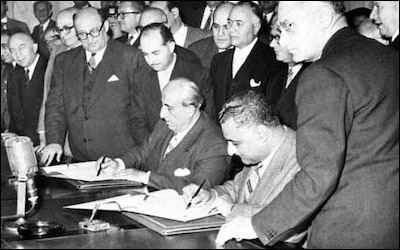 Egyptian
president Gamal Abdel Nasser (right) signs a pact with Syrian president
Shukri Quwatli, forming the United Arab Republic, February 1958. Nasser
championed the doctrine of pan-Arabism, which viewed the Palestinians
not as a nation but as part of a unified Arab state. |
Leadership of the Islamic world was difficult to achieve given
Nasser's relentless persecution of the Brotherhood. African leadership
was also out of reach given Egypt's relative marginality in the
continent and the African nations' sympathy for Israel and its national
liberation struggle against the British, plus Israeli aid programs to
the continent. And so, the "Arab zone" constituted Nasser's most
promising avenue to power and glory. To achieve this goal, he opted to
champion the doctrine of pan-Arabism, which had dominated inter-Arab
politics since the fall of the Ottoman Empire, envisaging the creation
of a unified vast Arab state on the ruins of the Ottoman Empire.
Be that as it may, Nasser's endorsement of the Palestinian cause was
not particularly motivated by concern for Palestinian national rights,
for pan-Arabism viewed the Palestinians not as a distinct nation
deserving a state of its own, but as an integral part of the prospective
unified Arab state. As the eminent historian Philip Hitti told an
Anglo-American commission of inquiry on Palestine in 1946, "There is no
such thing as Palestine in history, absolutely not." A decade later,
Nasser told a Western journalist, "The Palestinians are useful to the
Arab states as they are ... Can you imagine yet another nation on the
shores of the eastern Mediterranean!"[15]
Consider, for example, his treatment of the 250,000-strong
Palestinian population of the Gaza Strip (many of them refugees), which
was occupied by Egypt during the 1948 war. Though in September 1948, the
Arab League (with the sole objection of Transjordan) proclaimed the
formation of an All-Palestine Government whose jurisdiction was to
extend over the country's entire territory from the Jordan River to the
Mediterranean Sea, it was effectively an Egyptian puppet that had no
actual authority. Nasser, who inherited this charge from the monarchy,
did little to change this state of affairs and, in 1959, dropped the
pretense of Palestinian sovereignty altogether and abolished the
All-Palestine Government.[16]
Nor did Nasser do much to improve the economic and political lot of
the Gaza inhabitants, let alone advance them toward statehood. Unlike
the West Bank Palestinians, who were given Jordanian citizenship and
were incorporated into the kingdom's socioeconomic fabric (albeit with a
good measure of discrimination), Gazans were not offered Egyptian
citizenship but rather were kept in squalid camps as a political and
propaganda tool against Israel. A string of Egyptian governors ensured
their subservience through heavy-handed restrictions on political
activities and freedom of movement. This situation did not change until
the strip was captured by Israel during the June 1967 war.
Apex of Support, 1955-66
Whatever his true sentiments about the Palestinians, Nasser was
keenly aware that winning the pan-Arab mantle required escalating his
anti-Israel rhetoric and policies as this ideology rejected the
existence of a Jewish state on what it considered a part of the
"pan-Arab patrimony."
Since he was reluctant to be drawn into an all-out war with Israel,
in late 1954, Nasser began using Egyptian-trained Gazan Palestinian
terrorists (dubbed fedayeen) for attacks on civilian targets within Israel,[17]
which he lauded as heroic acts of sacrifice to expedite Israel's
destruction. "Egypt has decided to dispatch her heroes, the disciples of
Pharaoh and the sons of Islam, and they will cleanse the land of
Palestine," he gloated in a well-publicized speech on August 31, 1955.
"There will be no peace on Israel's border because we demand vengeance,
and vengeance is Israel's death."[18]
Rather than bring about Israel's demise, the fedayeen raids triggered
a sustained Israeli retaliatory campaign against Egyptian military
targets in Gaza, which killed scores of Egyptian soldiers and humiliated
the Egyptian military and the Egyptian president. They also played a
key role, together with a vast Egyptian-Soviet arms deal signed in 1955,
in driving Israel to join Britain and France in the October-November
1956 Suez War, during which it defeated the Egyptian armed forces in
Sinai and occupied the peninsula within a week.
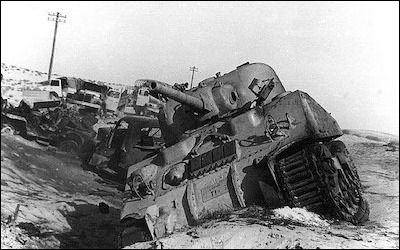 Destroyed
Egyptian tanks, Sinai, 1956. Despite defeat by Israel, Britain, and
France in the October-November 1956 Suez War, Nasser was able to
consolidate his pan-Arabism mantle with anti-Israel rhetoric and
policies. |
Fortunately for Nasser, the performance of the Anglo-French forces
that landed in the Suez Canal was far less impressive, which allowed him
to present the war as a glowing Egyptian victory against a "tripartite
aggression" and to consolidate his regional and international position.
Armed with this newfound preeminence, Nasser intensified his propaganda
campaign against Israel. At some times, he simply reverted to standard
euphemisms for Israel's destruction such as "the liberation of
Palestine" and "the restoration of the full rights of the people of
Palestine." He declared, "If the refugees return to Israel, Israel will
cease to exist."[19]
On other occasions, he claimed that, just as Arab divisions had led to
the 1948 "disaster," so the elimination of the traces of Western
colonialism in the region, first and foremost, the "malignant
imperialist Zionist implant," would only be achieved through complete
pan-Arab unity. In the words of an official 1962 charter outlining
Egypt's socioeconomic and political philosophy:
The insistence of our people on liquidating the Israeli aggression on
a part of the Palestine land is a determination to liquidate one of the
most dangerous pockets of imperialist resistance against the struggle
of peoples. Our pursuit of the Israeli policy of infiltration in Africa
is only an attempt to limit the spread of a destructive imperialist
cancer.[20]
Nasser's information department circulated an anti-Semitic tract, which denigrated Jews as "cheats, thieves, and murderers."
|
In yet other instances, Nasser's propaganda contained straightforward
anti-Jewish bigotry. In 1965, for example, the Egyptian information
department circulated an anti-Semitic tract in Africa titled, "Israel,
The Enemy of Africa," which vilified Judaism and denigrated Jews as
"cheats, thieves, and murderers." To support their bigoted claims, the
authors cited two notorious anti-Semitic screeds, the Russian Protocols of the Elders of Zion and Henry Ford's The International Jew.[21]
For its part, the journal of the Egyptian military described freemasons
as a secret Jewish society seeking to eliminate Christianity by "luring
young Christians 'into the arms of Jewesses' and into moral ruin."[22]
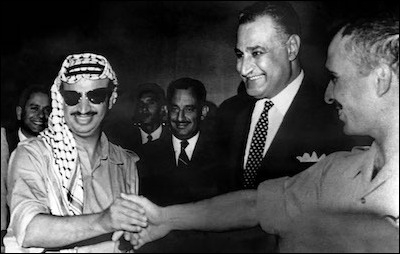 Cairo
1970: (Left to right) Yasser Arafat is welcomed by Nasser and Jordan's
King Hussein as the chairman of the Palestine Liberation Organization,
which Nasser created as a ploy to give him full control of this cause. |
No less importantly, in 1964, Nasser created, with Soviet assistance,
the Palestine Liberation Organization (PLO) and appointed the
Lebanese-born Ahmad Shukeiri, a former Syrian and Saudi ambassador to
the U.N., as its chairman. On the face of it, this was a bold move to
promote the Palestinian national cause; in fact, it was a shrewd ploy to
give the Egyptian president full control of this cause as Yasser
Arafat's rival Fatah organization, established a few years earlier,
quickly pointed out.[23]
Indeed, even the Palestinian National Charter, one of the PLO's
founding documents rejecting Israel's legitimacy and urging its
destruction, defined Palestine as part of the "Arab homeland" and tied
its "liberation" to the pan-Arab cause, which by that time had come to
be fully associated with Nasser:
Arab unity and the liberation of Palestine are two complementary
goals; each prepares for the attainment of the other. Arab unity leads
to the liberation of Palestine, and the liberation of Palestine leads to
Arab unity. Working for both must go side by side.[24]
At the same time, the Palestinian charter renounced claims to "any
territorial sovereignty over the West Bank in the Hashemite Kingdom of
Jordan, [and] on the Gaza Strip,"[25]
thus effectively excluding these areas, occupied respectively by Jordan
and Egypt since the 1948 war, from the territory of the would-be
"liberated" Palestine. (Four years later, this exclusion was removed
from the revised version of the charter, following the West Bank and
Gaza's capture by Israel during the June 1967 war.)[26]
When addressing Western audiences, Nasser downplayed Palestinian calls for Israel's destruction.
|
By fronting the PLO, Nasser sought to appear simultaneously radical
and moderate so as to boost his pan-Arab stature on the one hand, and to
maximize political and economic gains from Moscow and Washington (as
well as the Arab states) on the other. Thus, while addressing Western
audiences, Nasser would downplay Palestinian calls for Israel's
destruction as hyped talk, noting the 1949 armistice agreements as proof
that Cairo had effectively accepted the reality of Israel's existence.[27]
But while addressing Arab audiences, particularly in such radical
states as Syria, Iraq, and Algeria, he stressed Egypt's championing of
the Palestinian struggle for Israel's destruction while refraining from
the specifics of the "liberation of Palestine." Thus, for example, he
argued in a November 1965 speech that Egypt's objective was to destroy
Israel yet refused to say how and when this would be achieved on the
pretext that elaborating on this issue would only benefit Israel.[28]
Eight months later, addressing a large crowd, Nasser claimed that Egypt
and the Arab world's real strength lay in their overwhelming
demographic superiority over Israel and that the only way to "liberate
Palestine" was to mobilize a four-million-strong Arab army to fight and
destroy Israel.[29]
Such vague statements led one U.S. intelligence report to conclude that
"Nasser's main stance vis-à-vis Israel has been the defense of Egypt
from, rather than an attack of Egypt on, Israel."[30]
Nonetheless, by May 1967, Nasser's Palestine policy and the
anti-Israel hype he stirred in the Arab world drove him into a series of
highly provocative moves that triggered a preemptive Israeli strike. He
moved large Egyptian forces into the demilitarized Sinai Peninsula;
expelled the U.N. peacekeeping force that had been deployed along the
Israeli-Egyptian border since the 1956 war; blockaded the Straits of
Tiran to Israeli shipping, which the U.N. deemed illegal and an act
justifying war; and signed a military defense pact with Jordan that
implied war was imminent.[31]
"We knew that, by closing the Gulf of Aqaba, it might mean war with
Israel. [If war comes] it will be total, and the objective will be to
destroy Israel," Nasser acknowledged a week before the outbreak of
hostilities.[32]
An Egypt-first Policy, 1967-70
As it was, not only was Israel not destroyed in the war that ensued
on June 5, 1967, but in the swiftest military campaign of modern
history, it routed the Egyptian, Jordanian, and Syrian forces in six
days and captured vast territories three times its size, including the
Gaza Strip with its 500,000-strong Palestinian population and the West
Bank and its 800,000 Palestinian residents. Faced with this humiliating
defeat, the Egyptian president quickly changed his foremost foreign
policy goal from "destroying the Jewish state" to "eliminating the
consequences of aggression"—an ambiguous phrase that did not specify
what this action entailed and which territories Egypt would liberate.
Should it prioritize the liberation of Sinai that was an integral part
of its territory? And if so, did it include Gaza, which was outside
Egypt's border and had never been considered part of the motherland? Did
Nasser suggest that Egypt should help Jordan and Syria "eliminate the
consequences of aggression" in Jerusalem, the West Bank, and the Golan
Heights, or was the restoration of these territories the sole
responsibility of the two states? Would the territories be liberated
through the use of force, diplomacy, or both? And would Nasser reject a
political solution with Israel that only entailed the return of the lost
Egyptian territories? Nasser's deliberately vague language was thus a
strategic choice designed to provide the greatest possible flexibility
in entertaining a political arrangement with Israel without excluding
the military option.
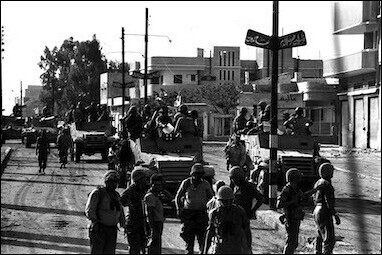 Israeli
troops enter Gaza, June 6, 1967. During clandestine talks following the
Six-Day War, recently declassified documents reveal that Nasser engaged
in discussions often without mentioning the fate of the Palestinians. |
By way of "eliminating the consequences of aggression," Egypt
participated in the U.N. deliberations on the conflict in the summer and
autumn of 1967 where it insisted on a total Israeli withdrawal to the
prewar lines. Concurrently, clandestine talks were held and plans were
floated by various foreign officials and mediators to end the state of
war between Egypt and Israel. And while none of these private
initiatives matured into full-fledged peace agreements, recently
declassified documents reveal willingness by Nasser not only to
entertain a political settlement with Israel but also to accept an
arrangement based on the Egyptian-Israeli border.[33]
Discussions of such an agreement often occurred without Nasser
mentioning the fate of the Palestinians, or if he did, by insinuating a
more pragmatic approach that offered refugee compensation rather than
repatriation in Israel (the standard euphemism for the Jewish state's
demographic subversion). Nor did Nasser make open threats to destroy
Israel during these private talks, and seldom did they appear in his
public speeches at the time.
Nasser reportedly agreed
to allow Israeli shipping through the Strait of Tiran, provided the
negotiations were conducted in private.
|
Thus, for example, a U.S. intelligence memo disclosed that as early
as June 1967, in response to several messages from undisclosed third
parties, Nasser reportedly agreed to recognize Israel and to allow
Israeli shipping through the Strait of Tiran, provided the negotiations
were conducted in private by personal emissaries of U.S. president
Lyndon Johnson and France's Charles de Gaulle rather than the normal
diplomatic channels. Egypt was also to be economically rewarded for its
concessions.[34]
Nasser repeated his purported readiness for concessions in a July 11
meeting with the Soviet deputy foreign minister, Yakov Malik, with the
contingency that the Suez Canal remained closed to Israeli shipping. "In
such conditions, giving Israel the right of shipping in the Canal would
be for us a new blow," he reasoned. "We can accept any political
solution, personally I agree to anything, but not to the passage of
Israeli ships through the Canal."[35]
Nasser's purported readiness to recognize Israel's existence
signified a sea change from his decade-long, vociferous commitment to
its destruction though his insistence on private, indirect talks
indicated his reluctance to admit this change publicly; indeed, at a
later stage of this covert exchange, he backtracked on his ostensible
readiness to recognize Israel's existence. Yet his seeming willingness
to give secret diplomacy a chance without conditioning it on the
resolution of the Palestinian problem (but rather on preventing Israeli
shipping in the canal), insinuated a crystalizing "Egypt-first"
approach.
This shift was also indicated by the Egyptian president's response to
the draft agreement prepared by his Yugoslav counterpart and close
associate Josip Tito for the forthcoming U.N. General Assembly's annual
session in September 1967. According to the envisaged agreement, which
was to be guaranteed by the four great powers (the United States, the
Soviet Union, Britain, and France), Israel was to withdraw from the
territories conquered during the 1967 war in return for an end to the
state of belligerency and navigation rights in the Tiran Straight and
the Suez Canal. The Golan Heights were to be demilitarized while
Jerusalem, including the Old City, was to be partitioned along national
and religious lines. The Gaza Strip was to revert to Egypt, and the West
Bank was to return to Jordanian rule with some border modifications in
favor of Israel.[36]
Though this latter stipulation closed the lid on the idea of
Palestinian independence, the Egyptian foreign minister, Mahmoud Riad,
suggested in a conversation with his Italian counterpart on September 4
that the plan could serve as a basis for a settlement provided the U.N.
Security Council ensured Israel's withdrawal to the pre-June 1967 lines.[37] Had this scenario come to fruition, "the PLO would have been finished. Absolutely finished," to use Arafat's candid admission.[38]
While Tito's plan was never put to a General Assembly vote due to insufficient support,[39]
Nasser's tacit readiness to drop the Palestinian cause while contenting
himself with satisfying Egypt's direct interests was repeated yet again
with his grudging acceptance of Security Council Resolution 242 of
November 1967, which established the "land for peace" formula as the
cornerstone of future Arab-Israeli peace negotiations and accepted
Israel's right to a peaceful and secure existence. And while Nasser
interpreted the resolution's call for Israel's withdrawal "from
territories occupied in the recent conflict" as requiring withdrawal
from all territories captured during the war, he acquiesced in its
effective "partition of Palestine and the sovereign existence of Israel
in that part of Palestine it has held since 1949"[40]
as well as its exclusion of the possibility of Palestinian statehood.
Indeed, the resolution did not even mention the Palestinians by name but
rather spoke of the need for "achieving a just settlement of the
refugee problem,"[41]
which not only considered the Palestinian issue a humanitarian rather a
national problem but could also be interpreted to include the
near-million Jewish refugees driven from the Arab states during and
after the 1948 war. Small wonder that the PLO rejected Resolution 242 as
a "Zionist plot."[42]
Nasser was prepared to subordinate the Palestinian cause to Egypt's national interest.
|
If Nasser was prepared to subordinate publicly the Palestinian cause
to Egypt's national interest, he was even more forthcoming in this
respect in private. In a meeting with U.S. secretary of state Dean Rusk
on October 2, 1967, the utmost sacrifice Riad was prepared to make on
behalf of the Palestinians was to keep the Suez Canal closed until
Israel either helped resettle the refugees or provided reparations. When
Rusk noted that PLO chairman Shukeiri had threatened to cut the throats
of Palestinians unless all refugees agreed to return, Riad dismissed
this as hollow words and bragged that Egypt "could remove Shukeiri."[43]
These blunt remarks, which would never have been uttered in public,
implied that the PLO, which Nasser established, was an expendable
foreign policy tool that could be disposed of once it had outlived its
usefulness for Egypt's national goals.
Former U.S. treasury secretary Robert Anderson was similarly
impressed by his meetings with Nasser on October 31 and November 2.
Though told by the Egyptian president that the Arab leaders could not
negotiate directly with Israel due to the "Three Nos"—no negotiations,
no recognition, and no peace with Israel—adopted by the Khartoum summit
on September 1, Anderson felt that Nasser seemed interested in an
Egyptian-Israeli agreement, mediated and guaranteed by the two
superpowers, which would restore Sinai and, presumably, Gaza to Egyptian
control.
Speaking of Palestinian refugees, Nasser said, "Let us settle with them by agreeing to pay them compensation."
|
Reflecting his nascent Egypt-first approach, Nasser did not raise the
issue of the other territories lost during the war, including
Jerusalem, leaving responsibility for their return to Jordan and Syria.
With regard to the Palestinians, Nasser repeated the refusal to allow
Israeli shipping through the canal before resolution of the Palestinian
refugee problem though he indicated that there was room for flexibility
on this point.[44]
When Anderson doubted that Israel could ever agree to repatriate the
refugees in its territory, Nasser appeared surprisingly flexible. "All
right, then, let us settle with them by agreeing to pay them
compensation," he said, "let us try to be practical and, if we all want
peace, and we do, then let us find a way to settle our differences and
live in peace."[45]
Nasser reiterated the same theme a month later in an oral message to
President Johnson's personal emissary, New York attorney James Birdsall,
in which he asked that Washington influence Israel to withdraw from
Arab territories in exchange for an Egyptian-Israeli non-belligerency
pact. Backtracking from past public demands for refugee repatriation,
Nasser now accepted that a solution to the problem could be found
"consistent with the continued existence of Israel."[46]
Repeated to visiting British politicians,[47]
the significance of these messages cannot be overstated. The
repatriation of the refugees was perhaps the foremost pan-Arab article
of faith regarding the resolution of the "Palestine problem" and the
standard euphemism for Israel's destruction through demographic
subversion. And here was the leader of the most powerful Arab state and
the widely acknowledged champion of the pan-Arab cause, who had been
articulating this precept as late as June 1967, not only renouncing it
(albeit in private) for the sake of cutting a separate deal but also
apparently amenable to acquiescence in the existence of the "Zionist
entity."
Conclusion
By the time of his death on September 28, 1970, Nasser's Palestine
policy seemed to have come full circle: from apathy and indifference, to
full embrace and support, to disengagement and reversion to an "Egypt
first" policy. As late as July 1970, he agreed to entertain a new peace
plan espoused by U.S. secretary of state William Rogers, telling a
senior PLO official, "I am going to accept it. You are free to reject
it—that is your right. But whatever you decide, do not criticize me."[48]
He was similarly dismissive of his Arab peers' fiery Palestine
rhetoric. "You issue statements, but we have to fight," he told an
all-Arab summit in Cairo a few days before his death. "If you want to
liberate, then get in line in front of us ... but we have learnt caution
after 1967, and after the Yemenis dragged us into their affairs in
1962, and the Syrians into war in 1967."[49]
Had Nasser been truly committed to the Palestinian cause—and for that
matter to the pan-Arab ideal—he would not have entertained dropping
this cause for the sake of a separate Egyptian-Israeli deal. Instead,
just as he had been associated with the Young Egypt Party and the Muslim
Brotherhood in pursuit of his grandiose ambitions, Nasser championed
the Palestinian cause so long as this helped catapult him to pan-Arab
leadership and maintain this role. The Palestinians, like the
Brotherhood, were expendable pawns that could be disregarded or
discarded once their usefulness to Nasser's—and by extension
Egypt's—goals had been exhausted.
As more primary sources on Egyptian history and foreign policy become
available, it is possible that Nasser's image and legacy will undergo
further change. And yet, it is also entirely possible that these
revelations will not make much of an impact as many Egyptians,
Palestinians, and other Arabs continue to view Nasser as an
incorruptible, towering symbol in the tenuous era of decolonization. As
one Egyptian academic put it, "At the end of the day, Nasser was the
leader that the vast majority of people truly related to; he was the
strong leader that people looked up to."[50]
Michael Sharnoff is
associate professor at the National Defense University's Near East South
Asia Center for Strategic Studies. He is author of Nasser's Peace: Egypt's Response to the 1967 War with Israel. The views expressed are solely those of the author.
[1] "Gamal Abd an-Nasir fi Filastin," al-Ayyam (Ramallah), Jan. 17, 2017.
[2] Bassem Barhoum, "Law Kana Abd an-Nasir Hadiran," al-Hayat al-Jadida (Ramallah), Jan. 17, 2018.
[3] See, for example, Muhammad Shehada, "Egypt Has Always Held the Palestinians of Gaza in Contempt," Haaretz (Tel Aviv), Feb. 19, 2018; Abdullah al-Arian, "Egypt and Palestine in the Age of Sisi," Aljazeera TV (Doha), June 25, 2014.
[4] Abdel Nasser, "Nasser's Memoirs of the First Palestine War," Walid Khalidi, trans., Journal of Palestine Studies, Winter 1973, pp. 3-32.
[5] P.J. Vatikiotis, Nasser and His Generation (London: Croom Helm, 1978), p. 249.
[6] Ido Yahel, "Covert Diplomacy between Israel and Egypt during Nasser's Rule: 1952-1970," SAGE Open, Oct. 2016.
[7] "Gamal Abd an-Nasir bi-Ayoon Falastinia," Masr al-Arabia (Giza), July 27, 2015.
[8] Janet Morgan, The Backbench Diaries of Richard Crossman (London: Hamish Hamilton and Jonathan Cape, 1981), p. 287.
[9] "Hadith ar-Ra'is Gamal Abd an-Nasir li-Murasil Jaridat 'New York Times' fi-l-Qahira," Aug. 20, 1954, Gamal Abdel Nasser Digital Archive (hereafter GANDA); Gamal Abdel Nasser, "The Egyptian Revolution," Foreign Affairs, Jan. 1955.
[10] Reuters, Feb. 1, 2017.
[11] Leonard Weiss, "The Lavon Affair: How a False-Flag Operation Led to War and the Israeli Bomb," Bulletin of the Atomic Scientists, July 2013, pp. 58-68.
[12] Cynthia Farahat, "The Arab Upheaval: Egypt's Islamist Shadow," Middle East Quarterly, Summer 2011, pp. 19-24.
[13] Fawaz Gerges, Making the Arab World: Nasser, Qutb, and the Clash that Shaped the Middle East (Princeton: Princeton University Press, 2018), pp. 91, 166.
[14] Gamal Abdel Nasser, The Philosophy of the Revolution (Cairo: Ministry of National Guidance, 1954), pp. 58-9.
[15] Efraim Karsh, Palestine Betrayed (New Haven: Yale University Press, 2010), pp. 39-40; Karsh, "The Palestinians' Real Enemies," Middle East Quarterly, Spring 2014.
[16] Avi Shlaim, "The Rise and Fall of the All-Palestine Government in Gaza," Journal of Palestine Studies, Autumn 1990, pp. 37-53.
[17] Lela Gilbert, "An 'Infidel' in Israel," The Jerusalem Post, Oct. 23, 2007; Kameel Nasr, Arab and Israeli Terrorism: The Causes and Effects of Political Violence, 1936-1993 (London: McFarland and Co., 2007), p. 40.
[18] Middle Eastern Affairs, Dec. 1956, p. 461.
[19] See, for example, Nasser's interview with Zuercher Woche, Sept. 1, 1961, as quoted in Harris O. Schoenberg, A Mandate for Terror: The United Nations and the PLO
(New York: Shapolsky Books, 1989), p. 239; "Answers by President Gamal
Abdel Nasser at Free Discussion Held at Arab Socialist Union Youth
Training Camp at Helwan, Cairo, Nov. 19, 1965," Arab Political Encyclopedia, Documentation Research Centre, Information Department, July-Dec. 1965, p. 54.
[20] The Charter (Cairo: Information Department, 1962), p. 115; see, also, "Kalimat ar-Ra'is Gamal Abd an-Nasir bi-Munasabat Ziyarat al-Wafd al-Filastini bi-Dimashq," Mar. 24, 1959, GANDA.
[21]
"Nasser's Anti-Jewish Propaganda," Congressional Record, U.S. Senate,
July 8, 1965; General CIA Records, CIA-RDP67B00446R000400170011-8.
[22] "Nasser's Anti-Jewish Propaganda"; General CIA Records; "Personality of the Month: Nasser El-Din Nashashibi," This Week in Palestine, Aug. 9, 2014.
[23] Efraim Karsh, Arafat's War (New York: Grove Atlantic, 2003), pp. 36-40.
[24] "Palestine National Charter of 1964," Permanent Observer Mission of Palestine to the United Nations, New York, art. 12.
[25] Ibid., art. 24.
[26] "The Palestinian National Charter: Resolutions of the Palestine National Council, July 1-17, 1968," The Avalon Project, Yale Law School, New Haven.
[27]
"Record of Conversation Held in the Foreign Office on 13 October at
3:30 p.m.: Anglo/UAR Relations - Sir D. Foot's Visit to Cairo, Oct. 16,
1967," FCO 39/256: Parliamentary Visits to United Arab Republic (1967),
U.K. National Archives, London; Foreign Office, North and East African
Department and Successors: Registered Files (V and NA Series)
(1967–1972), U.K. National Archives; United Arab Republic, Political
Affairs (External), File No. VK 3/7, U.K. National Archives.
[28] "Answers by President Gamal Abdel Nasser," Arab Political Encyclopedia, p. 54.
[29]
"Khitab ar-Ra'is Gamal Abd an-Nasir min Istad al-Iskandariyya fi
Mu'tamar al-Ittihad al-Ishtiraki Ihtifalan bi-l-Eidd ar-Rabi'a Ashara
li-l-Thawra," July 26, 1966, GANDA.
[30]
"Nasser's Public States RE: Israel," n.d., The Papers of William
Averell Harriman, Arab-Israeli Crisis 1967, Box 432, Folder 9, Library
of Congress, Manuscript Div., Washington, D.C.
[31] Egypt and Syria had signed a defense pact in 1966.
[32] The Washington Post, May 27, 1967.
[33] Yehuda U. Blanga, The US, Israel, and Egypt: Diplomacy in the Shadow of Attrition, 1967-70 (London: Routledge, 2020); Yahel, "Covert Diplomacy between Israel and Egypt during Nasser Rule."
[34] "Memorandum from the Director of the Bureau of Intelligence and Research (Hughes) to Secretary of State Rusk," Foreign Relations of the United States, 1964–1968 (hereafter FRUS), Vol. XIX: Arab-Israeli Crisis and War, 1967 (Washington D.C.: Office of the Historian, 2004), July 3, 1967, doc. 339.
[35] "Polish Record of Meeting of Soviet-bloc Leaders (and Tito) in Budapest (excerpts)," Wilson Center Digital Archive, Washington, D.C., July 11, 1967.
[36] "Rejection by Israel," Arab Report and Record, Sept. 1-15, 1967, p. 287; The New York Times, Sept. 2, 1967.
[37]
"Letter from Foreign Minister Fanfani on his Recent Conversation with
UAR Foreign Minister," Sept. 8, 1967, Middle East Crisis Files, U.S.
National Archives, College Park, Md. (hereafter NACP), 1967, vol. IV;
"Control Group Data to Rusk Correspondence in ME Crisis, May-Sept.
1967," Record Group 59, Box 19, NACP.
[38] Alan Hart, Arafat: A Political Biography (Bloomington: Indiana University Press, 1989), p. 357.
[39]
"Riad Meets Yugoslav, Indian Ambassadors," Sept. 13, 1967, Cairo
Domestic Service, FBIS/UAR, Sept. 14, 1967, B1; "Yugoslav Proposals for a
Peace Settlement in the Middle East," Israel State Archives,
Israel-Cyprus Relations, 1961-1967, no. 200.
[40] "Airgram from the Department of State to the Embassy in the Soviet Union," Dec. 17, 1969, Middle East Region and Arabian Peninsula, 1969-1972, Jordan, September 1970, vol. 24, doc. 16, FRUS.
[41] "United Nations Security Council Resolution 242," The Avalon Project, Yale Law School, New Haven.
[42] Efraim Karsh and Asaf Romirowsky, "Land for War," The Wall Street Journal, Aug. 5, 2011.
[43] "Secret Section Two of Two USUN, Oct. 4, 1967," Central Foreign Policy Files, 1967-1969, Record Group 59, Box 2556, NACP.
[44]
"Briefing of Robert B. Anderson, Nov. 2, 1967," ibid.; "For the
Secretary of State (Eyes Only) Attention of the President from Anderson,
Oct. 31, 1967," ibid.
[45] "Telegram [text not declassified] to the White House," Nov. 3, 1967, Arab-Israeli Crisis and War, 1967, doc. 500, FRUS.
[46] "Message from President Nasser, Dec. 27, 1967," Central Foreign Policy Files, 1967-69, Record Group 59, Box 21529, NACP.
[47]
"Beeley Mission Cairo, Oct. 12, 1967," Central Foreign Policy Files,
1967-1969, Record Group 59, Box 2556, NACP; "1041/67 Dispatch No. 7,
Oct. 30," FCO 39/270: Sir Harold Beeley's Visit to Cairo (1967), U.K.
National Archive.
[48] Hart, Arafat, p. 315.
[49] Vatikiotis, Nasser and His Generation, p. 245.
[50] Dina Ezzat, "Nasser: A National Hero or Founder of a Military State?" Ahram Online (Cairo), July 23, 2012.


.jpg)