The "Middle East and Terrorism" Blog was created in order to supply information about the implication of Arab countries and Iran in terrorism all over the world. Most of the articles in the blog are the result of objective scientific research or articles written by senior journalists.
From the Ethics of the Fathers: "He [Rabbi Tarfon] used to say, it is not incumbent upon you to complete the task, but you are not exempt from undertaking it."
Hundreds of the tech giants' employees sign a public letter demanding that the companies pull the plug on Project Nimbus, a multi-year contract to supply cloud services to the Israeli government and military.
Hundreds of Google and Amazon employees have signed a public letter
demanding that the tech giants cancel Project Nimbus, a billion-dollar
contract to provide public cloud computing services to Israel.
In the letter, published by The Guardian on Tuesday, the
authors state that they were "morally obliged" to speak out against the
project, calling on Amazon and Google to cancel the contract and sever
all ties with the Israeli military.
"We cannot look the other way, as the products we build are used to
deny Palestinians their basic rights, force Palestinians out of their
homes and attack Palestinians in the Gaza Strip – actions that have
prompted war crime investigations by the international criminal court,"
the letter states.
According to the letter, 90 employees at Google and 300 at Amazon had
signed the missive, but wished to remain anonymous "because we fear
retaliation."
The letter goes on to state that the tech giants' "aggressive"
pursuit of military and law-enforcement contracts, including Nimbus, was
part of a "disturbing pattern of militarization, lack of transparency
and avoidance of oversight."
Moreover, the letter states, Nimbus involved the sale of "dangerous
technology" to the Israeli military and government, and had been "signed
the same week that the Israeli military attacked Palestinians in the
Gaza Strip – killing nearly 250 people, including more than 60
children."
The letter was referring to the 11-day conflict in May between Israel
and terrorist groups in the Gaza Strip, which was sparked by the launch
of a rocket barrage at Jerusalem on May 10. For more than the following
week and a half, Hamas and Palestinian Islamic Jihad launched nearly
4,400 rockets at Israel (some 700 of which came down inside Gaza),
according to the Israeli military. In response to the indiscriminate
rocket fire, Israel launched "Operation Guardian of the Walls," striking
more than 1,500 terror targets in the Strip.
"The technology our companies have contracted to build will make the
systematic discrimination and displacement carried out by the Israeli
military and government even crueler and deadlier for Palestinians," the
letter states.
This technology "allows for further surveillance of and unlawful data
collection on Palestinians, and facilitates the expansion of Israel's
illegal settlements on Palestinian land," it continues.
The authors conclude by stating, "We condemn Amazon and Google's
decision to sign the Project Nimbus contract with the Israeli military
and government, and ask them to reject this contract and future
contracts that will harm our users. We call on global technology workers
and the international community to join with us in building a world
where technology promotes safety and dignity for all."
Google and Amazon won the $1.2 billion contract following a public
tender process, beating out Microsoft, Oracle and IBM. According to Mike
Daniels, vice president of Google Cloud's Global Public Sector, the
agreement will deliver cloud services to all Israeli government
entities, from ministries to state-owned companies. The project will run
for an initial period of seven years, with Israel having the option to
extend it for up to 23 years in total, Daniels said in a statement in
May.
by Ariel Kahana , Dmitriy Shapiro and News Agencies
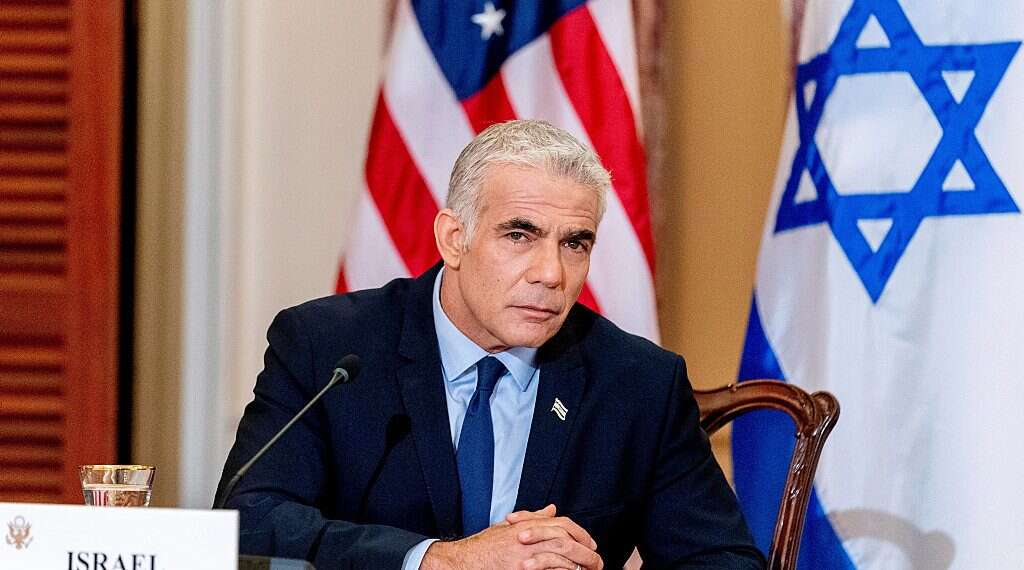
"That is not only our right; it is also our responsibility. Iran has publicly stated it wants to wipe us out. We have no intention of letting this happen," Foreign Minister Yair Lapid says in joint press conference with US US Secretary of State Antony Blinken and United Arab Emirates Foreign Minister Sheikh Abdullah Bin Zayed Al Nahyan.
Foreign Minister Yair Lapid at the State Department in Washington, Oct. 13, 2021 |
Photo: Reuters.Andrew Harmik/Pool
Israeli officials believe the Biden administration should set a
timetable in regards to Iran and possible nuclear negotiations with the
Islamic republic, Israel Hayom has learned. Additionally,
Israeli officials believe the US must prepare an alternative plan if
nuclear talks either aren't renewed or fail.
With that, in an effort to avoid tensions with the White House, which
were rife during the Obama-Netanyahu years, Israeli officials have
presented their position in a moderate manner. The Israeli echelon still
believes that the US decision to renew nuclear talks with Iran is, in
and of itself, a mistake, and not enough to eradicate the Iranian
danger. However, senior Israeli officials have made it clear that the
ongoing dialogue with the Biden administration is being conducted
through a "mutual understanding that [the sides] agree on certain things
and don't agree on others," with a desire not to emphasize the
disagreements.
As part of this continuous discourse with the Biden administration,
Foreign Minister Yair Lapid on Wednesday took part in a historic
trilateral meeting with US Secretary of State Antony Blinken and United
Arab Emirates Foreign Minister Sheikh Abdullah Bin Zayed Al Nahyan.
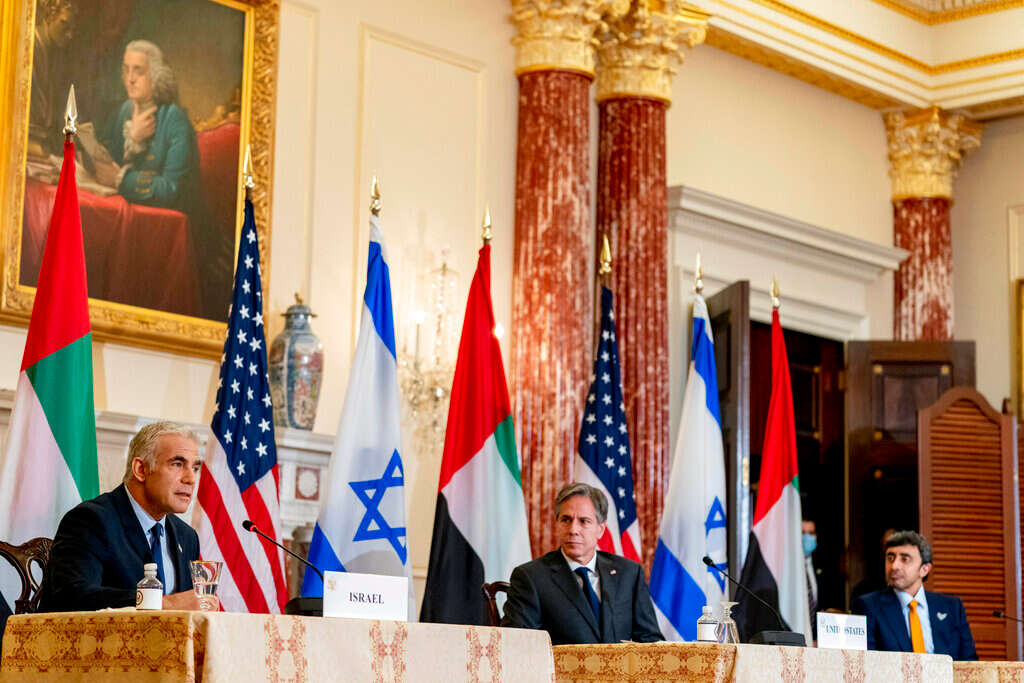
Foreign
Minister Yair Lapid, left, with US Secretary of State Antony Blinken,
center, and United Arab Emirates FM Sheikh Abdullah bin Zayed
al-Nahyanin, right, at a joint news conference at the State Department
in Washington, Wednesday, Oct. 13, 2021 (AP/Andrew Harmik/Pool)
The three followed up the meeting with a joint press conference,
seated three abreast in the State Department's Benjamin Franklin Room.
Blinken barely mentioned Iran during his opening remarks, but Lapid
brought it into the conversation in his call for an alternative to the
2015 Iran nuclear deal, also known as the Joint Comprehensive Plan of
Action (JCPOA), which may include the use of force.
"At the center of my visit here is the concern about Iran's race to
nuclear capability," he said. "Iran is becoming a nuclear threshold
country. Every day that passes, every delay in negotiations brings Iran
closer to a nuclear bomb."
Israel, said Lapid, reserves the right to act on Iran at any given
moment to prevent the Iranian regime from acquiring a nuclear weapon.
"There are moments when nations must use force to protect the world
from evil," he said. "If a terror regime is going to acquire a nuclear
weapon we must act. We must make clear that the civilized world won't
allow it. If the Iranians don't believe the world is serious about
stopping them, they will race to the bomb.
"Israel reserves the right to act at any given moment in any given
way," Lapid said. Israel has previously bombed nuclear sites in Iraq and
Syria.
"That is not only our right; it is also our responsibility," he
added. "Iran has publicly stated it wants to wipe us out. We have no
intention of letting this happen."
Blinken addressed Iran when asked by reporters, setting low
expectations as to whether there will be any concrete action into
re-entering the JCPOA as many expect another round of indirect
negotiations later this month.
He said while all three leaders believe that Iran cannot be allowed
to acquire a nuclear weapon, the United States favors a diplomatic
pathway. Yet he sounded less confident about whether or not Iran was
willing to cooperate.
"But as we've had occasion to discuss in recent weeks, despite the
fact that we've made abundantly clear over the last nine months that we
are prepared to return to full compliance with the JCPOA if Iran does
the same, what we are seeing – or maybe more accurately not seeing from
Tehran now – suggests that they're not," said the secretary of state.
"And time is running short because, as we've also had an opportunity to
discuss together, we are getting closer to a point at which returning to
compliance with the JCPOA will not in and of itself recapture the
benefits of the JCPOA, and that's because Iran has been using this time
to advance its nuclear program in a variety of ways, including enriching
uranium to 20% and even 60%, using more advanced centrifuges, acquiring
more knowledge. And so that runway is getting shorter."
Blinken said that the allies are looking at "other options" of what
to do if Iran does not rejoin negotiations, while never going as far to
acknowledge that other options could be military ones.
"I would like to start by repeating what the secretary of state just
said," stated Lapid. "Yes, other options are going to be on the table if
diplomacy fails. And by saying other options, I think everybody
understands here, in Israel, in the Emirates and in Tehran what it is
that we mean."
The European Union coordinator on Iran, Enrique Mora, planned to
visit Tehran on Thursday, a trip that diplomats from Britain, France and
Germany, a group known as the E3, said came at a critical time.
"The nuclear situation has worsened continuously and seriously," said
one E3 diplomat, alluding to Iran's accelerating enrichment of uranium
to higher fissile purity, a possible pathway to a nuclear bomb.
"This therefore is from our E3 point of view not a 'business as
usual' but a visit in [the] context of a deep crisis in the JCPOA," the
diplomat added.
While officials have made similar past statements, taken together the
comments suggested a more coercive rhetorical stance toward Tehran if
it refused to resume compliance with the deal called the Joint
Comprehensive Plan of Action (JCPOA).
Earlier, the US special envoy for Iran, Rob Malley, said Washington
was ready to consider "all options" if Iran is unwilling to return to
the 2015 deal, which was negotiated under then-President Barack Obama
and then-Vice President Joe Biden, who is now the US president.
The phrase "all options," is typically intended to include the possibility – however remote – of military action.
Some analysts, however, read the comments less as a tougher stance on
Iran and more as a reflection of the uncertainty about whether the
Ebrahim Raisi government will return to talks and, even if it does,
whether it will agree to revive the deal.
The State Department said Malley would travel to the United Arab
Emirates, Qatar and Saudi Arabia from Oct. 15-21 to coordinate with Gulf
allies.
"We will be prepared to adjust to a different reality in which we
have to deal with all options to address Iran's nuclear program if it's
not prepared to come back into the constraints," Malley said in a
virtual appearance at a Washington think tank.
"There is every possibility that Iran will choose a different path,
and we need to coordinate with Israel and other partners in the region,"
he added.
"I will be traveling to Saudi Arabia, UAE and Qatar in just a matter
of days to talk about efforts to come back to (JCPOA) and what options
we have to control Iran's nuclear program if we can't achieve that
goal."
Blinken began the press conference by touting the accomplishments
between the two nations, who were two of the first signees of the
US-brokered Abraham Accords, signed on the White House lawn on Sept. 15,
2020.
"The UAE-Israel relationship has, I think it's fair to say,
flourished this past year," said Blinken. "This May, Israel opened an
embassy in the UAE – the first it has ever had to a Gulf nation. And a
few days ago, Israel's new ambassador to the UAE presented his
credentials. In July, the UAE opened an embassy in Israel, the first
Gulf state to take that action."
Blinken said the Biden administration strongly supports developing
relationships between the nations that joined the agreement – Bahrain,
Sudan and Morocco as well – and looks to expand the circle of countries
normalizing relations with Israel in the years ahead.
"We believe that normalization can and should be a force for
progress, not only between Israel and Arab countries and other countries
in the region and beyond but between Israelis and Palestinians," he
said. "As [US] President [Joe] Biden has said, Israelis and Palestinians
equally deserve to live safely and securely and to enjoy equal measures
of freedom, prosperity, democracy. The president has also been clear
that a two-state solution is the best way to ensure Israel's future as a
Jewish and democratic state, living in peace alongside a viable,
sovereign, and democratic Palestinian state."
'I'm going to visit soon to meet a friend, but also a partner'
Two new trilateral working groups were launched during the meeting,
according to Blinken, with the first group to focus on religious
coexistence.
"This is a moment of rising antisemitism, rising Islamophobia, and we
want Israel, the United Arab Emirates and the United States to work
together to build tolerance and ensure that all religious groups can
worship in their traditional ways without violence, without
intimidation, without discrimination," said Blinken.
The second working group will focus on water and energy, which
Blinken said are critical for all three countries in the face of climate
change. He said he was pleased that Israel had joined the Agriculture
Innovation Mission for Climate – a joint initiative between the United
States and UAE to "catalyze new investment in climate-smart
agriculture," with Israeli and Emirati companies already planning
collaborations on renewable projects.
Both the UAE and Israel have made pledges to cut down emissions by
2050 – Israel by 85% and the UAE aims to reach net-zero emissions.
Lapid and Al Nahyan were optimistic about the accords and their
relationship, calling each other friends. When asked by a reporter about
when he'll visit Israel, Al Nahyan replied that Lapid had invited him
to do so during their meeting.
"Foreign Minister Yair was kind enough to invite me to visit Israel,
and I'm going to visit soon to meet a friend but also a partner," said
Al Nahyan. "We need to not only celebrate this relationship but look at
new avenues of cooperation."
"I look forward to seeing you in Israel soon," he said to Lapid.
Lapid responded: "In Israel, the door is open to you. My wife is looking forward to having you over for dinner.
"His Highness Sheikh Abdullah and I have become friends and partners.
Our friendship is based on shared values, on moderation, on religious
tolerance, on the importance of fighting terror and radicalization,"
said Lapid. "The partnership is based on economics, progress and
technological excellence. This partnership isn't just between Jews and
Arabs, but between citizens of the world who want to be partners in the
fight against climate change, against poverty, against the pandemic that
has taken the lives of millions."
US Deputy Secretary Wendy Sherman also met with Foreign Ministry
Director-General Alon Ushpiz, where the two covered largely the same
subjects as Lapid and Blinken.
Selling off resources, purging top officials, and defaulting on debt.
It seems that the Chinese economy is falling, and there may be no
one to bail them out. In a wave of recent reports, we see the
contraction of the national economy, especially intense in the north.
There have been blackouts and power failures across the area, and while
the problems began in factories they have now spread to homes, a trend
that is forecast to spread as time passes.
The most alarming case is that of the real estate colossus
Evergrande, whose debt is so large that default is a real possibility,
and thereafter a rash of defaults across the world. Evergrande is a
global threat, menacing a worldwide outburst of indebtedness, with all
the dreadful consequences that go along with it.
Evergrande is not the only menace. As The Epoch Times wrote
recently, dictator Xi seems to be saying that he doesn't want a society
that is individualistic, but rather a mass of citizens who see their
role as supporting and following the state. He has purged hundreds of
thousands of top officials from Party ranks in the recent past, and
promises to do more of the same in the near future. The state has been
selling commodities for the first time in a decade, and released oil
from its strategic reserves for the first time in ten years. The Chinese
are selling off their resources.
On October 4th, Evergrande, unable to meet its obligations,
suspended sales of its stock. Over the past 20 years, more than 20
percent of the French Jewish population has left France, with a notable
increase of those emigres going to Israel. The French are not happy with
public education in their home country, and much prefer Israeli
methods.
Evergrande is the biggest company to suspend trading to date, and it
will resume activity next week, following a week's suspension of stock
market activity. What will happen? Xi seems eager to put an end to
unbridled trading, and to bring Chinese manufacturers under ever more
rigid state control. When Jack Ma, the founder and CEO of Alibaba made a
public speech that was critical of the nation's (that is, of Dictator
XI's) crackdown on Chinese business, he disappeared for several days.
Ma has since been a low-profile actor, and Xi has focused on relations
with Taiwan, warning the island that it was only a matter of time before
China undertook military action against it. This goes hand in hand with
the mainland's efforts to pressure Taiwan's government into
reintegrating with the People's Republic. The United States was
meanwhile increasing military sales, and sending top Defense Department
officials to Taipei. As an American expert on Taiwan put it, this
arrangement favored increased Western influence. "You can't divorce the
technology completely from the society that produced it."
Xi was evidently trying to resist. But Taiwan has elected a new,
nationalist administration that has vowed to advance the country's
ability to defend itself, and the growing friendship with America
indicates that Biden is willing to play ball in that game.
History and common sense tell us that for a nation to survive, it
must secure and control critical natural resources. In recent decades,
Western nations have increasingly ignored this imperative in order to
pursue dubious environmental goals dressed up as science, but more often
the consequence of cultural ideals, political agendas, or profitable
industries supported by government subsidies.
The current rise in the costs of energy in the U.S. and Europe is a
flashing red light warning us that irresponsible energy policies are
threatening the global economy, with dangerous consequences for our
freedom, security, and way of life.
History provides us with examples of what happens to a state when it
loses control of a critical resource. Ancient Athens depended on
imported grain to feed its people. Recognizing the importance of foreign
grain, the Athenians controlled the ports and sea-lanes that
facilitated grain transport from the Black Sea region. Its dependence on
those imports in fact led to its defeat by Sparta in the 27-year-long
Peloponnesian War. Sparta’s naval victory at Aegospotamai at the mouth
of the modern Dardanelles cut off Athenian imports from the Black Sea.
Faced with starvation, the Athenians capitulated.
Twenty-two centuries later, the West faced a similar, though not as
disastrous, challenge–– the 1973-74 Arab Oil Embargo. OPEC cut off
imports of oil to the U.S. and other nations for supporting Israel
during the 1973 Arab-Israeli, or Yom Kippur War. Dependent on imported
oil, the U.S. faced the “oil shock”: gasoline prices rising 43%, gas
rationing, long lines at gas-stations, a tripling of oil costs per
barrel, stagflation, a stock market crash, and further damage to the
global economy. The silver lining of this crisis was the development of
policies and measures intended to wean the U.S. from its dependence on
imported oil.
The current energy crisis, with oil prices recently rising to $80 a
barrel, is much different from the Athenian grain crisis or Arab oil
embargo, both of which were the consequence of war. But it is a serious
one, affecting the world’s richest economies. As Ellie Gardey writes in American Spectator Online,
“Economists are predicting that Europe and Asia will face a cataclysmic
energy crisis when winter weather collides with drastically higher
energy prices and shortages of oil, natural gas, and coal. There are
warnings about widespread blackouts in Europe, factory shutdowns in
China, and economic chaos in poorer countries like Bangladesh and
Pakistan.”
The pandemic’s effect on supply chains is part of the problem, but
the more significant factor is the decades-long assault on carbon-based
energy on the pretext of catastrophic global warming. Germany, the EU’s
largest economy and the world’s fourth largest, is the bellwether for
Europe’s economies. After the Fukusima nuclear disaster in 2011, Germany
recklessly decommissioned all its nuclear power plants, which provided
nearly 30% of the country’s energy, and mandated they be replaced by
“green” energy like wind and solar.
But as Texas learned this past winter when power outages killed at
least 80 people, those sources of energy are highly unreliable fixes
when fuels like natural gas that power generators become unavailable.
Yet Europe’s powerful environmental lobby continue to block and delay
new coal-fired plants or allow hydraulic fracturing (fracking) for
extracting shale oil. As a result, they are dependent on Russian natural
gas, and hence subject to Vladimir Putin’s geopolitical ambitions.
For now the U.S. is in better shape to weather the fuel crisis
thanks to the fracking revolution, and Donald Trump’s relaxation of bans
on oil development on public lands and waters, and his support for
innovations like fracking that have made the U.S. potentially energy
self-sufficient and the top oil producer in the world. Trump also left
the Paris Climate Accords, the latest act of globalist virtue-signaling
that will do nothing to mitigate the alleged apocalypse humanity will
face if temperatures rise more than a couple of degrees in the next few
decades.
The Biden administration, of course, has reversed most of these
policies and renewed the progressives’ war on coal. Now the goal is for
electricity generation to be carbon-free by 2035, at the cost of who
knows how many trillions of dollars. He has tried to put a moratorium on
oil-leases on public lands, cancelled the Keystone XL pipeline, and
rejoined the useless Paris Climate accords. More humiliating, he has
lobbied OPEC to produce more oil in order to stabilize prices––so much
for our goal to achieve energy independence, first set as a response to
the 1973 Arab Oil Embargo. The consequences of this squandering of
Trump’s support for domestic oil production can be seen in current
rising energy costs, with regular gas as much as twice as high in some
states as it was in 2020.
Why have the richest, best educated, most technologically
sophisticated nations in history violated the obvious lesson delivered
by history and common sense––that a nation’s security depends on
controlling and enhancing the supplies of its most important resources?
Today’s crisis reflects naïve or self-interested claims about the
relationship of human behavior to the environment. For most of humanity
before the modern period, nature was an arena of destructive, inhuman
forces that had to be propitiated, but also controlled and exploited in
order for people to survive. The idealization of nature as a beneficent
mother from whom our technology, industry, and cities have estranged us
arose in the West with the 18th-century Romantic movement.
The impact of early industrialization’s “Satanic mills,” as William
Blake put it, on the landscape and human life and labor; the growth of
cities shrouded in coal smoke and crowded with the destitute; and
finally, the shrinking of rural populations and the number of people
required to produce food for the rest–– all popularized Romantic
idealizations of nature as a soothing balm for the psyches of those,
mainly comfortable poets and the growing middle class, who felt
traumatized by modernity.
This powerful myth, now in its fourth century, has saturated our
culture and, through environmental lobby, influenced our government
policy. The notion that human beings, in their efforts to survive and
improve their material existence, threaten the survival of the natural
world––the rationale for policies mitigating catastrophic global
warming––goes back even farther, to the ancient myth of the Golden Age.
This was the time before technology, laws, private property, and war,
when the earth unasked bestowed on us all we needed to survive and
flourish. Or as the Roman poet Ovid put it, when the earth “untouched by
the hoe and unwounded by the plow herself gave all things.”
Unfortunately, that age passed and deteriorated into the Iron Age,
when people rend and tear “mother earth” with their iron tools to grow
food and mine gold. Then come cities, private property, technology,
seafaring, tyranny, crime, and war, all generated by what Ovid called
the “wicked lust for having.” These ancient longings and ideals are
obvious in popular culture, especially in movies like Avatar, Pocahontas, or Dances with Wolves, the
latter two box-office hits in the 90s, the decade when the “global
warming” industry was just beginning its growth into today’s most
important and lucrative global ideology.
Despite the dubious science behind anthropogenic, catastrophic
global warming, in a few weeks the next global-warming gab-fest comes
to Glasgow, just as winter weather will start exposing the fecklessness
of subjecting energy policy to utopian schemes such as achieving
net-zero carbon emissions by 2050. Of course, the Biden administration
will be there, and no doubt sign on to expensive, economy-wounding
schemes for reducing carbon that China––whose emissions of CO2 are
greater than those of the U.S. and the other developed nations
combined–– will game, subvert, or out-right ignore.
Holding our energy policy hostage to a dubious hypothesis about a
global climate we as yet do not understand sufficiently––not to mention
indulging mythic longings and dreams that are the luxuries of the
prosperous well-fed––is dangerous. The first obligation of a government,
and the people who select the officers of that government, is to
protect the nation’s security and interests, particularly its economy––
and the cheap energy that powers it–– that funds their way of life.
The global warmists’ pipe-dreams have already cost us billions of
dollars in sketchy research and subsidies for “alternative energy” that
is decades from achieving, if ever, its promise to make fossil fuels
obsolete. The Biden administration has already jeopardized our security
abroad with its feckless appeasement in Afghanistan, compromised our
safety and citizenship with its virtual open borders policy, and
threatened our economy not just with proposed trillions in new spending,
but with its war on fossil fuels and fantasies of “net zero” carbon
that will cost trillions more and severely damage our economy.
That’s what happens when a people are guided by bad science rather than their own common sense, prudence, and skepticism.
Bruce Thornton is a Shillman Journalism Fellow at the David Horowitz Freedom Center.
Justice Greenberg's opinion of kneeling during the National Anthem was simply not acceptable to the righteous Left - it had to be silenced for the greater good.
A day after I suggested that before too long those statues and
memorials to Justice Ruth Bader Gingsburg would be torn down, this comes
out. Part of the comments had already been public, but crucially they were made in 2016,
before the Cult of George Floyd completely redefined America and people
were purged from public life and fired from their jobs for a fraction
of what she said.
Justice Ruth Bader Ginsburg, never shy to weigh in on the
controversies of the day, said she thinks “it’s really dumb” for San
Francisco 49ers quarterback Colin Kaepernick and others to refuse to
stand for the national anthem.
Of Kaepernick and others she says, she thinks their actions are “dumb and disrespectful”.
“I would have the same answer if you asked me about flag
burning. I think it’s a terrible thing to do, but I wouldn’t lock a
person up for doing it. I would point out how ridiculous it seems to me
to do such an act.”
Since our society now has the attention span of a hummingbird, this
was quickly forgotten. But now that Katie Couric, on the last stage of
her misbegotten career is flogging her own memoir, we heard about the
comments that were edited out.
Ginsburg went on to say that such protests show a 'contempt for a
government that has made it possible for their parents and grandparents
to live a decent life.'
She said: 'Which they probably could not have lived in the
places they came from...as they became older they realize that this was
youthful folly. And that's why education is important.'
Even in 2016, this was dangerous territory.
RBG was entitled to say it. After all she was the daughter of an
immigrant who grew up much less well off than Colin Kaepernick. But she
was also a lady in her eighties who was echoing an older liberalism that
was now being rejected. There had been such tensions before during her
interviews. And this raises the question of how many of those interviews
were edited. Especially considering what came next.
Couric writes that she was 'conflicted' because she was a 'big RBG fan', referring to Ginsburg's moniker.
But Couric writes in her memoir that she thought the justice,
who was 83 at the time, was 'elderly and probably didn't fully
understand the question.'
Couric called a friend, David Brooks, a New York Times
journalist, who advised her that Ginsburg probably didn't understand the
question, even though she was still serving on the Supreme Court at the
time.
However David Westin, the former head of ABC News, advised Couric to keep it in.
'She's on the Supreme Court. People should hear what she thinks,' he said, according to Couric.
According to Couric, she 'wanted to protect' Ginsburg and felt
that the issue of racial justice was a 'blind spot' for her.
Brooks' condescension is a little surreal. If he thought that RBG
was that mentally out to lunch, shouldn't he have encouraged the
exposure of an unqualified justice?
But that's not the interesting part.
The day after the sit-down, the head of public affairs for the
Supreme Court emailed Couric to say the late justice had 'misspoken' and
asked that it be removed from the story.
Asking that comments which would raise questions about prejudicing a
court case be removed would be one thing, but there's no realistic
scenario in which this would have become a Supreme Court case. Did the
request to remove the comments come from RBG or from some political
operatives who were concerned with controlling narratives, or who were
riding herd on RBG?
Any of those scenarios would raise a good deal of questions, especially during the Biden era.
Freedom of religion is only upheld when we stand up and protect it from outrageous threats, such as that of a Muslim uprising.
A fundamental constitutional right in the United States, embodied in
its first amendment, is the freedom of religion. Freedom of prayer is
clearly part of freedom of religion. Part of freedom of prayer is the
freedom to pray in public spaces. Anyone opposing the right of Jewish
prayer, therefore, would be deemed anti-Semitic in America.
This brings us to Israel. Before the opening of the US embassy in
Jerusalem, I helped organize the first Jewish afternoon prayer service
there, with no concern that it would spark any kind of controversy. In a
way, I was right; I found out later that a video of it had garnered
more than 10,000 views.
Subsequently, thanks to the Abraham Accords, which recently passed
their one-year anniversary, Jewish services and events were even
celebrated publicly in the United Arab Emirates and Bahrain. It was a
sign of those Muslim-majority countries' acceptance of freedom of Jewish
observance that is so fundamental to the groundbreaking peace deals.
Meanwhile, however, such open Jewish prayer is not permitted at
Judaism's holiest site – the Temple Mount in Jerusalem. Indeed, Israel
actually enforces a ban on organized Jewish prayer, and even audible
individual Jewish prayer at the site, while permitting Muslims to pray
freely there.
This policy, established by Moshe Dayan after Israel's victory in the
1967 Six-Day War, who gave authority over the holy sites to the Islamic
Waqf, continues to be enforced, due to pressure by the Palestinian
Authority, Jordan and Egypt. Jordan also prohibits public Jewish prayer
at the tomb of Moses's brother, Aharon Hakohen, which is located near
Petra. The Jordanian parliament even held a moment of silence for the
terrorists who murdered two Israeli policemen guarding the Temple Mount.
Amman has also given safe haven to Ahlam Tamimi, who participated in
the 2001 Sbarro pizzeria bombing in Jerusalem, in which 15 Israeli and
American citizens were killed and more than 100 others were wounded. It
has refused US requests for her extradition.
Together with Egypt, Jordan also endorsed a 2016 UNESCO resolution
denying any Jewish connection to the Temple Mount, referring to it as a
solely Muslim site. The resolution also referred to the Western Wall as
Al-Baraq Plaza, and did not acknowledge any connection to Judaism.
This is not surprising, because if you deny that two Jewish temples
existed on the Temple Mount, then you deny any Jewish connection to the
Western Wall, as well. Nor is it surprising, thus, that on more than one
occasion, there have been incidents of Muslims on the Temple Mount
throwing stones on Jewish worshipers at the Western Wall below – because
they oppose Jewish prayer, too.
Acquiescence to opposition to Jewish prayer goes way back. It was
also instituted by Britain in its 1928 White Paper, which prohibited the
blowing of the shofar at the Western Wall. The reason that the British
gave was that such a ritual would offend and incite the Muslim world.
The decree led to Britain's attempt each year to arrest Jews blowing
the shofar at the end of Yom Kippur, in violation of the law. Recently,
many of those – who are still alive – had a reunion at the Western Wall
to remember their act of religious freedom against the anti-Semitic
British decree.
Last week, Jerusalem Magistrates Court Judge Bilha Yahalom ruled that
the silent prayer of Jews on the Temple Mount is allowed, saying it
cannot be deemed a "criminal act."
Sadly, Israeli Public Security Minister Omer Barlev announced that
the government was appealing the ruling, on the grounds that it
"endanger(s) the public peace and could cause a flare-up."
He further elaborated that though "the state advocates freedom of
worship and prayer for all … in view of the security implications, the
status quo must be upheld that the prayer of Jews on the Temple Mount
will take place next to the Western Wall and the prayer of Muslims will
take place in al Haram Al Sharif."
Bar Lev's appeal was successful. The Jerusalem District Court
overturned Yahalom's ruling. According to some reports, Biden
administration pressure was behind the appeal.
This runs counter to former US President Donald Trump's "Peace to
Prosperity" plan, which – in a historic first – said that Jewish prayer
should not be prevented on the Temple Mount.
In an article in the September issue of Commentary, Rabbi Meir
Soloveitchik wrote: "The hard truth is that in the past 54 years since
the miraculous moment when Jews returned to ancient Jerusalem, the
sacred city has itself been rebuilt – but the destruction of the
remnants of the Temple has gotten worse. The Waqf has destroyed much
archeological evidence of the Temple that once was there, and many
Palestinian leaders have denied that the Temple stood there in the first
place."
Many Orthodox rabbis oppose Jews ascending to the Temple Mount for
religious reasons. But those rabbis should make clear to those who hold a
different theological position that they should support the right of
Jews to pray there freely.
It is a travesty that the State of Israel is not protecting this right.
Freedom of religion is only upheld when we stand up and protect it
from outrageous threats, such as that of a Muslim uprising. It is time
for the Israeli government to do its job and safeguard the right of Jews
to pray at their holiest site.
In a rare move, pro-Iranian militias based in Syria issue a joint statement explicitly threatening Israel and the United States following an alleged airstrike Wednesday night on a base near the city of Palmyra.
Pro-Iranian militias operating in Syria explicitly threatened Israel
and the United States in a joint statement Thursday morning following an
alleged Israeli airstrike Wednesday night on a base near the city of
Palmyra in the province of Homs. The statement claimed that four militia
members were killed in the strike and that others were wounded.
Syria's defense ministry said on Thursday that one of its soldiers has been killed and three wounded.
According to the statement, which was published by Hezbollah-affiliated news outlet Al Mayadeen, the alleged Israeli attack targeted a recruitment center and several other facilities serving the militias in eastern Syria.
"On [Wednesday] night, Israeli and American planes launched an
aggression against positions belonging to the resistance alliance near
the city of Palmyra. The targets were a youth recruitment center and
other service facilities. As a result of the attack, several mujahideen were martyred and others were wounded," the statement said.
"Accordingly, we declare three things. First, our mission and
presence in Syria are of utmost legitimacy and are at the behest and
oversight of the Syrian country, with the aim of fighting the takfiri
project (a reference to radical Sunni Islamic groups) led by the
Islamic state group. Second, for years now, the Israeli and American
enemy has attacked us in an effort to drag us into side-battles that are
not the purpose of our presence in Syria. The Zionists' excuse is that
they are attacking precision weapons that represent a threat to their
thievish entity," the groups added in their statement.
"Third, in accordance with the fact that the attack was carried out
from Jordanian territory and occupied territory by the Americans in
Syria, we have made the decision to retaliate for the blood of our
fighters who were killed and wounded. The response will be harsh," the
militias warned.
State-run television initially quoted an unidentified Syrian military
official as saying the strike occurred shortly before midnight and
targeted a telecommunications tower and some posts around it, only
causing material damage.
The Britain-based Syrian Observatory for Human Rights, an opposition
war monitor, said the strikes hit an airbase known as T4, adding that
Iran-backed militiamen based there were targeted.
Residents of Palmyra said on social media that loud explosions were
heard in the south of the city and that fires erupted in several areas.
The strikes came five days after Syrian state media reported that Israeli strikes in Homs province wounded six soldiers and killed at least two members of a pro-Iranian militia.
Over the past years, Israel is believed to have been behind many strikes inside government-controlled parts of Syria.
Israel has staged hundreds of strikes against Iran-linked military
targets in Syria over the years but rarely acknowledges or discusses
such operations.
Israel views Iranian entrenchment on its northern frontier as a red
line, and it has repeatedly struck Iran-linked facilities and weapons
convoys destined for Lebanon's Hezbollah terrorist group.
"It's not about 'religious freedom' or 'diversity,' as Mayor Reker claims. The mosque operators want visibility. They celebrate the muezzin as a show of power over their neighborhoods." —Ahmad Mansour, Israeli-Arab and German Islam expert.
The city of Cologne, once a
stronghold of Christendom in Germany, has authorized mosques in the city
to begin sounding Muslim calls to prayer over outdoor loudspeakers. The
move, ostensibly aimed at promoting multicultural diversity and
inclusion, represents a significant step toward the cultural
normalization of Islam in Germany. It is taking German multiculturalism
into uncharted territory.
Critics say that comparing Islamic prayer calls to church bells is a false equivalence because the muezzin proclaims religious slogans such as "there is no god but Allah" and "Allahu Akbar" ("Allah is the Greatest").
"The Muslim call to prayer is not like the ringing of church
bells, which are a reminder of a scheduled worship service. Instead, it
is a creed and a statement of political Islam, which has unfortunately
been abused in many ways in recent years. The call 'Allahu Akbar' is not
only a call to prayer, but it has also become the battle cry of jihad
by Islamist terrorists." — Necla Kelek, Turkish-born German Islam
expert.
"It's not about 'religious freedom' or 'diversity,' as Mayor
Reker claims. The mosque operators want visibility. They celebrate the muezzin as a show of power over their neighborhoods." —Ahmad Mansour, Israeli-Arab and German Islam expert.
"The Muslim call to prayer, the muezzin call, is now
permitted in Cologne. Cologne's Lord Mayor Henriette Reker calls this a
'symbol of diversity.' For me it is the opposite — a sign of
discrimination.... In 2015, I had to flee from Bangladeshi Islamists
because I publicly criticized Islamism. When I hear 'Allahu Akbar' from
loudspeakers in Germany, I think of a lot, just not diversity.... The muezzin
call reminds me of the killing of my six blogger friends by Islamists
and the brutal repression of minorities.... This call from the speakers
of conservative mosques is above all a show of power. The fact that the
city of Cologne now allows the muezzin call with reference to
tolerance is a sign of false tolerance for me." — Shammi Haque, a
Bangladeshi-born journalist in exile in Germany.
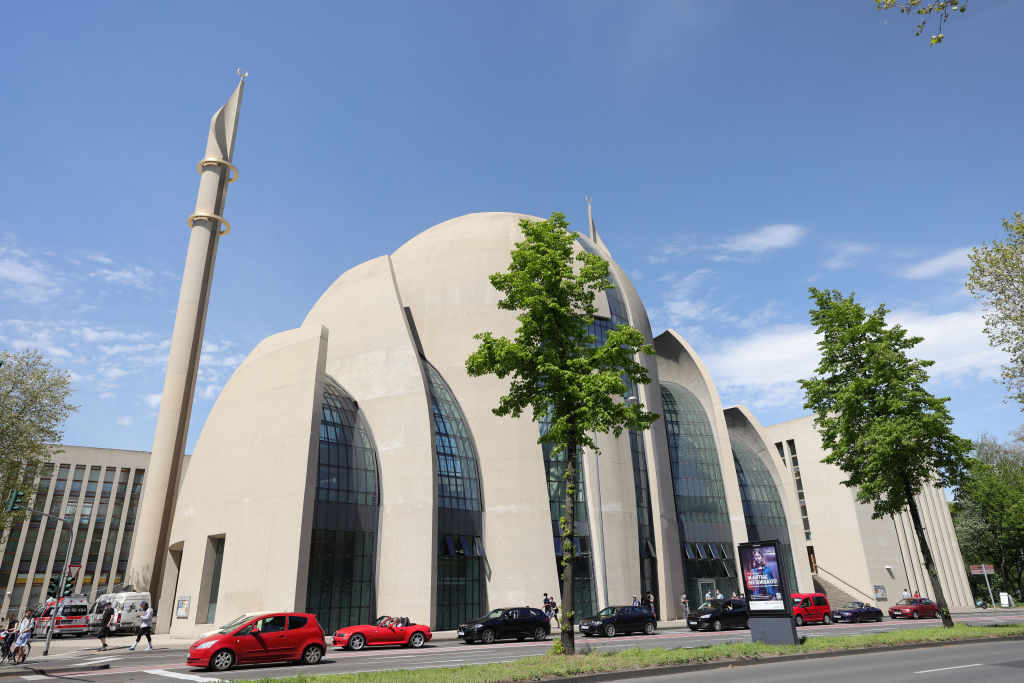
The
city of Cologne, once a stronghold of Christendom in Germany, has
authorized mosques in the city to begin sounding Muslim calls to prayer
over outdoor loudspeakers. Pictured: The Cologne Central Mosque. (Photo
by Andreas Rentz/Getty Images)
Acceding to demands from Islamic organizations sponsored by the
Turkish government, the city of Cologne, once a stronghold of
Christendom in Germany, has authorized mosques in the city to begin
sounding Muslim calls to prayer over outdoor loudspeakers. The move,
ostensibly aimed at promoting multicultural diversity and inclusion,
represents a significant step toward the cultural normalization of Islam
in Germany. It is taking German multiculturalism into uncharted
territory.
Observers believe that Cologne — famous for its cathedral, the
largest Gothic church in northern Europe — is establishing a national
precedent, and that many of the more than 3,000 mosques in Germany will
soon also begin publicly calling Muslims to prayer. They say that German
towns and cities will evoke the sounds and images of the Islamic Middle
East.
Effective immediately, all mosques and Islamic centers in Cologne may
apply for a permit to call the Muslim faithful to prayer for five
minutes every Friday between noon and 3pm. The sonorous prayer calls
(known as adhan
in Arabic) can be heard from great distances when amplified through
outdoor loudspeakers atop minarets, the tower-like structures on
mosques.
The prayer calls are part of a so-called model project (Modellprojekt)
that will last for two years, after which a decision will be made on
whether to make the Muslim calls to prayer a permanent feature of life
in Cologne.
A press release issued by the City of Cologne on October 7 stated:
"While in Christian churches the bells are rung to call
the believers to worship together, in Muslim mosques it is the call of
the muezzin [the person who calls Muslims to prayer] that serve
this purpose. Friday prayer is of central importance in Islam. For many
years, Islam, like many other religions, has been an integral part of
German society, so the question of allowing calls to prayer at mosques
has been and is repeatedly discussed nationwide.
"After initial talks between the city and local mosque communities
and a legal review, a model project is now starting in Cologne,
initially limited to two years: Upon request and subject to conditions,
the mosque communities who wish to do so can call their believers to
midday Friday prayers.
"In practice, every mosque community that wants to participate in the
project must submit an application to the city administration. The
formal approval to practice the call for the midday Friday prayer at the
respective mosque is then determined by a contract under public law.
The contract concluded in this way contains individual requirements that
must be met by the applicant mosque community. The call to prayer on
Fridays can only be made between 12 p.m. and 3 p.m. (the noon Friday
prayer varies depending on the calendar) and for a maximum of five
minutes. The volume of the call is also set with a different maximum
decibel limit depending on the location of the mosque.
"It should also be noted that the surrounding neighborhood must be
informed by the mosque community in advance by means of a flyer about
the call to prayer. In addition, a contact person for the neighborhood
must be named for each municipality who can answer questions or receive
complaints.
"The project will be closely monitored by the city administration. At
the end of the two-year project period, the city and the mosque
communities involved will jointly evaluate their experiences in order to
decide on this basis whether the new regulation can be extended."
Cologne Mayor Henriette Reker, a political independent who in 2015 was stabbed in the neck and nearly killed by a German man opposed to her multiculturalism, said:
"I am pleased that with this model project we are taking
into account the legitimate religious interests of the many Muslims in
our cosmopolitan city, thus setting a sign of mutual acceptance of
religion and making a commitment to the constitutionally protected
freedom of religion, but also to accept the interests of Muslims who
live here.
"Muslims, many of them born here, are an integral part of Cologne's
urban society. Anyone who doubts this is questioning Cologne's identity
and our peaceful coexistence. When we hear the call of the muezzin in addition to the church bells in our city, it shows that diversity is valued and lived in Cologne."
"Much discussion because of the model project muezzin
prayer call. Cologne is the city of (religious) freedom and diversity.
Those who arrive at the central train station are greeted by the
cathedral and accompanied by church bells. Many Cologne residents are
Muslims. To allow the muezzin call is for me a sign of respect."
Critics say that comparing Islamic prayer calls to church bells is a false equivalence because the muezzin
proclaims absolutist religious slogans such as "there is no god but
Allah" and "Allahu Akbar" ("Allah is the Greatest"). The standard adhan can be translated as:
"Allah is most great. I testify that there is no god but
Allah. I testify that Muhammad is the prophet of Allah. Come to prayer.
Come to salvation. Allah is most great. There is no god but Allah."
The Turkish-born German Islam expert Necla Kelek, in an essay for the Berlin-based magazine Cicero, wrote that the adhan reflects the ideology of Islamism:
"At the request of Islamic associations such as the
mosque operator Ditib, which is managed by the Turkish government, the
Islamist Milli Görüs or the Central Council of Muslims representing the
Muslim Brotherhood, the Cologne city administration has agreed that from
now on the 35 mosques in Cologne may broadcast every Friday by
loudspeaker the following call to prayer: 'Allahu Akbar. I testify that
there is no god but Allah. I testify that Muhammad is the messenger of
Allah. Come to prayer! Come to salvation! Allahu Akbar, Allahu Akbar."
"The Muslim call to prayer is not like the ringing of church bells,
which are a reminder of a scheduled worship service. Instead, it is a
creed and a statement of political Islam, which has unfortunately been
abused in many ways in recent years. The call 'Allahu Akbar' is not only
a call to prayer, but it has also become the battle cry of jihad by
Islamist terrorists. The Taliban have just conquered Afghanistan with
shouts of 'Allahu Akbar.'
"When someone shouts 'Allahu Akbar' on the street, in a train station
or in front of a football stadium, people flinch, feel threatened and
fear a bomb or knife terror attack. The call to prayer seems to have
been discredited by extremist Muslims themselves and also to have become
a symbolic call for terror."
Kelek also wrote that by allowing the prayer calls, Cologne's mayor, a woman, was encouraging the discrimination of Muslim women in Germany:
"Above all, who do the muezzin call to prayer? The
men. The Muslim community is a society divided into men and women.
Women are not called to prayer. If they really want to, they can pray in
separate adjoining rooms on the balcony so that the men cannot see them
and are not disturbed by them....
"Mayor Reker talks about diversity, prescribes gender asterisks and
watches as an archaic worldview is lived in the mosques, the 'men's
houses.' It conjures up a diversity that in reality is neither lived nor
desired, especially in mosques. Unfortunately, this means that she does
not perceive the fears and wishes of her urban population for
freedom....
"It is with regret that I note that German politicians are practicing
symbolic politics in matters of Islam. Again and again they submit to
the political demands of the Islamic associations in the hope of
pacifying them in order to win them over as democratic partners. It has
never been more important to focus on content-related discussions so
that reforms that are urgently needed for our peaceful coexistence also
succeed. It is time to strengthen the secular forces in the Islamic
community."
Bundestag Member Michael Kuffer, an expert on homeland security, told the Bild newspaper that comparing church bells to the Islamic call to prayer is erroneous:
"On the one hand the adhan is a call to prayer,
but on the other hand it is also a battle cry. Unfortunately, it has
been misused and turned it into a slogan of violent Islamism.
"You must make a distinction between the practice of religion on the
one hand and, on the other hand, the cultural dimension, for example,
church bells. I think that we are fooling ourselves.
"It is a complete leveling of things that are simply not comparable!
This is a completely wrong understanding of liberality, of integration
and also of respect for others."
Alexander Yohannes, Deputy Chairman of the Christian Democratic Union (CDU) in Cologne, tweeted:
"It is highly problematic to portray the muezzin
call as a sign of respect and diversity. It is not about ringing church
bells in a neutral way, but rather about an exclusive religious
denomination that is loudly represented to the outside world.
Misunderstood tolerance!"
Turkish-born Alawite Birgül Akpinar, a member of the CDU in Baden-Württemberg, wrote:
"The call of the muezzin not only calls to the
Islamic compulsory prayer, but also proclaims the claim to power of the
Islamic belief five times a day. More religion in the public space does
not mean diversity, but more potential for conflict!"
Turkish-born German lawyer and Muslim feminist Seyran Ateş tweeted:
"Church bells can be rung by women. In the mosques in
question, however, the voice of a woman will never be heard. Only
religious patriarchy gets a vote. And that is deafening loud in too many
communities. Just as the headscarf cannot simply be equated with the
cross necklace, one cannot call for the muezzin just because
churches are allowed to ring their bells. Those who do this are helping
conservative Muslims to implement their misogynist agenda.
"From now on every Friday in Cologne: 'There is no other
god but Allah!' But Islamization supposedly does not occur at all in
Germany... We have been warning against it for years! The muezzin call is a claim to power. Step by step, the Christian West is being given away."
Ahmad Mansour, an Israeli-Arab and German Islam expert, accused the
mayor of Cologne of ignoring the real problem. "It's not about
'religious freedom' or 'diversity,' as Mayor Reker claims," he toldBild. "The mosque operators want visibility. They celebrate the muezzin as a show of power over their neighborhoods."
Shammi Haque, a Bangladeshi-born journalist in exile in Germany wrote:
"The Muslim call to prayer, the muezzin call, is
now permitted in Cologne. Cologne's Lord Mayor Henriette Reker calls
this a 'symbol of diversity.' For me it is the opposite — a sign of
discrimination. The muezzin call reminds me of torture, agitation and blood. He scares me.
"In 2015, I had to flee from Bangladeshi Islamists because I publicly
criticized Islamism. When I hear 'Allahu Akbar' from loudspeakers in
Germany, I think of a lot, just not diversity.
"The muezzin call reminds me of the killing of my six blogger friends by Islamists and the brutal repression of minorities. The muezzin
call says: 'Allah is great, there is no other god but Allah.' For me,
this reputation stands for the fact that diversity is NOT tolerated,
that people of different faiths are NOT respected. This call from the
speakers of conservative mosques is above all a show of power.
"The fact that the city of Cologne now allows the muezzin call with reference to tolerance is a sign of false tolerance for me."
The Central Council of Ex-Muslims in Germany (Zentralrat der Ex-Muslime Deutschland), in an open letter to Mayor Reker, concurred:
"We — men and women from Islamic countries — escaped to
Germany and found shelter from religious persecution here. More than a
few of us have experienced, in our countries of origin, public
executions while the Islamic call for prayer sounded. On behalf of our
relatives and friends who have been imprisoned, tortured and executed,
we ask you to listen to the other side of Islamic reality. Every prayer
call brings all these terrible memories to me and also to many others
from Iran, Iraq, Afghanistan, Syria and Saudi Arabia. Even though we
live safely here, the call of prayer creates within us a strong mental
pressure and retraumatization. We therefore strongly protest against
your decision!"
Beyond Cologne
Cologne's muezzin project involves (to date) the largest
number of mosques in a single German municipality, but individual
mosques, including some in Dortmund, Düren, Hamm, Siegen and Oldenburg,
among others, have been sounding Muslim prayer calls for years.
In Wipperfürth, an industrial town situated 40 kilometers (25 miles)
north-east of Cologne, the Fatih Camii Mosque — run by the
Turkish-Islamic Union for Islamic Affairs (DITIB), a branch of the
Turkish government that controls over 900 mosques in Germany — has been
publicly sounding calls to prayer since 2013. Mayor Michael von Rekowski said he wanted to show the world that Wipperfürth "takes pride in being an intercultural and interreligious community."
The Turkish-run Central Mosque in the northern German town of
Rendsburg, situated 100 kilometers (60 miles) north of Hamburg, has been
calling Muslims to prayer since 2010, when Social Democratic Mayor
Andreas Breitner authorized the muezzin
to broadcast prayer calls through three loudspeakers mounted on the top
of two 26-meter (85-foot) minarets attached to each side of the mosque.
The German newspaper Die Zeitreported
that Rendsburg was engaged in a "holy war" after a local citizen's
group gathered nearly a thousand signatures from residents opposed to
the prayer calls. The group, which goes by the name "No Public Prayer
Calls" [Kein öffentlicher Gebetsruf], argued that the existence
of the mosque was more than sufficient to guarantee Muslims their
constitutional right to the freedom of religion, and that the subsequent
demands for a muezzin publicly to call the faithful to prayer was excessive. The group also argued that the Koran makes no mention of the need for muezzin, making the Muslim position superfluous. The mosque eventually relented and limited the calls to prayer to Fridays only.
Similar conflicts have been raging in other German localities, including in the Westphalian town of Hereford, where, according to Die Welt, the call of the muezzin has become a "psychological burden." In the western German town of Oer-Erkenschwick, where a mosque was banned by a local court from broadcasting prayer calls, that ban was recently overturned by a higher court. The mosque's muezzin may resume his prayer calls.
In the city of Neumünster, the Turkish-run Fatih Mosque has been publicly calling
Muslims to prayer three times a day for more than 15 years. According
to the local imam, Celebi Kilicikesen, a Turk who speaks little German,
"sometimes child pranksters turn the loudspeaker volume all the way up
and then the neighbors complain. Otherwise there have been no problems."
In Bavaria, Florian Hahn, Vice Secretary General of the Christian Social Union (CSU), concluded:
"In Bavaria we do not want such model tests. They are not
part of our Western tradition. Also, calls to prayer are not needed to
practice the Islamic religion."
Hahn's appeal may be too little too late. During the Coronavirus pandemic lockdowns, Bavarian authorities authorized
more than a dozen mosques in Munich and other parts of Bavaria to
broadcast public calls to prayer. It seems unlikely that the mosques
will give up the rights already conferred.
The debate about Islam in Germany is only beginning. The Muslim
population of Germany has surpassed six million to become approximately
7.2% of the overall population of 83 million, according to calculations by Gatestone Institute.
A recent Pew Research Center study on the growth of the Muslim population in Europe estimated
that by 2050, Germany's Muslim population could reach 17.5 million, or
20% of the overall population if mass migration from Africa, Asia and
the Middle East continues apace.
Christopher Columbus's expeditions were, first and foremost, about circumventing the Islamic sultanates surrounding and terrorizing Europe.
Another Columbus Day has come and gone. Although it was "celebrated"
with the usual vitriol and outraged "wokeism" concerning the Italian
explorer's alleged "genocide" against the natives, one influential voice
came to Columbus's defense: on October 11, Florida Republican Gov. Ron
DeSantis signed a proclamation, an excerpt of which follows:
Columbus stands a singular figure in
Western Civilization, who exemplified courage, risk-taking, and heroism
in the face of enormous odds; as a visionary who saw the possibilities
of exploration beyond Europe; and as a founding father who laid the
foundation for what would one day become the United States of America,
which would commemorate Columbus by naming its federal district after
him.
All this is true. Columbus stands for and is a reminder
of something else that is little known and often forgotten: he was a
crusader — an avowed enemy of the jihad. His expeditions were, first
and foremost, about circumventing and ultimately retaliating against the
Islamic sultanates surrounding and terrorizing Europe — not just
finding spices.
When he was born, the then more than 800-year-old war with Islam
— or rather defense against jihad — was at an all-time high. In 1453,
when Columbus was two years old, the Turks finally sacked
Constantinople, an atrocity-laden event that rocked Christendom to its core.
Over the following years, the Muslims
continued making inroads deep into the Balkans, leaving much death and
destruction in their wake, with millions of Slavs enslaved. (Yes, the
two words are etymologically connected, and for this very reason.)
In 1480, the Turks even managed to invade Columbus's native Italy, where, in the city of Otranto, they ritually beheaded 800 Christians — and sawed their archbishop in half — for refusing to embrace Islam.
It
was in this context that Spain's monarchs, Ferdinand and Isabella —
themselves avowed crusaders, especially the queen, who concluded the
centuries-long Reconquista of Spain by liberating Granada of Islam in
1492 — took Columbus into their service.
They funded his ambitious voyage in an
effort to launch, in the words of historian Louis Bertrand, "a final and
definite Crusade against Islam by way of the Indies" (which of course
went awry and culminated in the incidental founding of the New World).
Many
Europeans were convinced that if only they could reach the peoples east
of Islam — who if not Christian were at least "not as yet infected by
the Mahometan plague," to quote Pope Nicholas V — together they could
crush Islam between them. (The plan was centuries old and connected to
the legend of Prester John, a supposedly great Christian monarch
reigning in the East who would one day march westward and avenge
Christendom by destroying Islam.)
All this comes out clearly in
Columbus's own letters. In one, he refers to Ferdinand and Isabella as
"enemies of the wretched sect of Mohammet" who are "resolve[d] to send
me to the regions of the Indies, to see [how the people thereof can help
in the war effort]." In another written to the monarchs after he
reached the New World, Columbus offers to raise an army "for the war and
conquest of Jerusalem."
Nor were Spain and Columbus the first to implement this
strategy. Once Portugal was cleared of Islam in 1249, its military
orders launched into Muslim Africa. "The great and overriding
motivation behind [Prince] Henry the Navigator [b. 1394]'s explosive
energy and expansive intellect," writes historian George Grant, "was the
simple desire to take the cross — to carry the crusading sword over to
Africa and thus to open a new chapter in Christendom's holy war against
Islam." He launched all those discovery voyages because "he sought to
know if there were in those parts any Christian princes," who "would aid
him against the enemies of the faith," to quote a contemporary.
Does
all this make Columbus and by extension Ferdinand and Isabella — not to
mention the whole of Christendom — "Islamophobes," as those few modern
critics who mention this Islamic backdrop often accuse?
The answer is yes — but not in the way that word is used today. While the Greek word phobos
has always meant "fear," its usage today implies "irrational
fear." However, considering that, for nearly a thousand years before
Columbus, Islam had repeatedly attacked Christendom to the point of
swallowing up three quarters of its original territory,
including for centuries Spain; that Islam's latest iteration, in the
guise of the Ottoman Turks, was during Columbus's era devastating the
Balkans and Mediterranean; and that, even centuries after Columbus,
Islam was still terrorizing the West — marching onto Vienna with 200,000 jihadis in 1683 and provoking America into its first war as a nation — the very suggestion that historic Christian fears of Islam were "irrational" is itself the height of irrationalism.
Note: The above account on Columbus was excerpted from and is documented in the author's Sword and Scimitar: Fourteen Centuries of War between Islam and the West.Raymond
Ibrahim is a Shillman Fellow at the David Horowitz Freedom Center, a
Judith Rosen Friedman Fellow at the Middle East Forum, and a
Distinguished Senior Fellow at the Gatestone Institute.
As has now become embarrassingly clear for all to see, Israel has become the only hope for the hungry workers in the Gaza Strip -- who have been abandoned not only by their leaders, but by the rest of their Arab brothers as well.
The fact that a large number
of Palestinians are desperate to work in Israel is a sign of the failure
of Hamas and the Palestinian Authority to improve the living conditions
of their people despite the massive sums of money they receive from
various sources, including the United States, European Union and United
Nations.
Instead of holding Hamas responsible for what he called the
"tragedy" in the Gaza Strip, al-Amsi and other Palestinians choose to
blame Israel.
This view is in keeping with the longstanding habit of the
Palestinian leadership to evade their responsibility for thievery and
non-governance by blaming Israel for everything.
Many Palestinians and Arabs, however, are no longer buying this
nonsense and know exactly who is trying to help and who has not done a
thing to end their suffering.
"Thousands of Palestinians, including those with [academic]
degrees, are fighting for a job in Israel. I guarantee you that if
Israel announced that it wants workers from Algeria, they would cross
the Sahara [Desert] on foot to work in Israel to escape the hell they
are living in at home." — Hoda Jannat, Syrian journalist and political
analyst, Twitter, October 7, 2021.
As has now become embarrassingly clear for all to see, Israel has
become the only hope for the hungry workers in the Gaza Strip -- who
have been abandoned not only by their leaders, but by the rest of their
Arab brothers as well.
The
fact that a large number of Palestinians are desperate to work in
Israel is a sign of the failure of Hamas and the Palestinian Authority
to improve the living conditions of their people despite the massive
sums of money they receive from various sources, including the United
States, European Union and United Nations. Pictured: Palestinian men in
the northern Gaza Strip gather to apply for permits to work in Israel,
on October 6, 2021. (Photo by Mahmud Hams/AFP via Getty Images)
Palestinians in the Hamas-ruled Gaza Strip are excited. Israeli authorities have decided
to allow thousands of them to work in Israel. The news about the
Israeli decision spread like wildfire, prompting tens of thousands of
Palestinians to converge on the offices of the chambers of commerce
throughout the Gaza Strip in the hope of obtaining a permit to work in
Israel.
The scenes of Palestinian scrambling to receive permits to work in Israel have angered and embarrassed many Palestinians and Arabs, many of whom believe that Palestinian leaders are not doing enough to end the suffering of the Palestinians.
The fact that a large number of Palestinians are desperate to work in
Israel is a sign of the failure of Hamas and the Palestinian Authority
to improve the living conditions of their people despite the massive
sums of money they receive from various sources, including the United,
European Union and United Nations.
Instead of providing job opportunities to the young people and
university graduates, Hamas, an offshoot of the Muslim Brotherhood
organization, has been preoccupied with amassing and manufacturing
weapons and digging tunnels that would be used to attack Israel.
Instead of building schools and hospitals and industrial zones, Hamas
has been investing millions of dollars in arming and training its
military group, Izaddin al-Qassam. Hamas prefers to spend money on any
Palestinian who is prepared to join the jihad (holy war) on Israel than
on an unemployed university graduate in the Gaza Strip.
Hamas has no problem allowing Palestinians to work in the "Zionist entity" as long as its leaders are enjoying a luxurious life in Qatar.
The only problem Hamas and its supporters have is when photos and
videos of the desperate job-seekers appear on various social media
platforms. Hamas and its supporters are so embarrassed that they are now
beginning to float around conspiracy theories regarding those behind
the documentation of the Palestinians who rushed to apply for permits to
work in Israel.
The head of the General Federation of Palestinian Trade Unions, Sami al-Amsi, said
that "there are certain parties that are not innocent" behind the lines
of thousands of workers in front of the chambers of commerce in the
Gaza Strip. He is apparently trying to create the impression that
anti-Palestinian parties sent the thousands of workers to apply for jobs
in order to embarrass the Palestinians.
The dire economic situation in the Gaza Strip -- 65% unemployment and
80% poverty -- was the main reason, al-Amsi said, for the Palestinians'
"thirst" to work in Israel.
Instead of holding Hamas responsible for the unemployment and poverty, al-Amsi and other Palestinians choose to blame Israel.
This view is in keeping with the longstanding habit of the
Palestinian leadership to evade their responsibility for thievery and
non-governance by blaming Israel for everything.
Many Palestinians and Arabs, however, are no longer buying this
nonsense and know exactly who is trying to help and who has not done a
thing to end their suffering. A Saudi activist, Ibn al-Arab, commented on Twitter:
"The Muslim Brotherhood folks [Hamas] in the Gaza Strip
were always cursing Saudi Arabia, even though the kingdom donated a
billion dollars for the reconstruction of the Gaza Strip. Today, they
want to become workers for the occupation. The [Palestinians] are a
people without dignity. I deeply regret supporting the Palestinians in
the past."
Palestinian writer Lina Ibrahim wrote
that the scenes of the Palestinians applying for permits to work in
Israel "expose the shame" Hamas has brought to the Gaza Strip. In
addition to the high rate of unemployment and human rights violations,
she said, "young people are unable to get married because of Hamas's
violation of their basic right to work in the Gaza Strip."
Syrian journalist and political analyst Hoda Jannat posted a photo of
the Palestinians at one of the registration offices along with the
following comment:
"This is the Gaza Chamber of Commerce. Thousands of
Palestinians, including those with [academic] degrees, are fighting for a
job in Israel. I guarantee you that if Israel announced that it wants
workers from Algeria, they would cross the Sahara [Desert] on foot to
work in Israel to escape the hell they are living in at home."
"The Gaza Strip needs to be liberated from the Hamas
gang. The truth is being revealed to the world. Workers from the Gaza
Strip express their joy at the issuance of work permits in Israel. The
rate of unemployment has reached 50%, most of them young people. One of
them said that after he heard the news [that Israel was accepting
workers], he couldn't sleep all night."
Yaseen Izeddeen, a Palestinian activist from the Gaza Strip, however, wrote that the scenes of thousands of Palestinians applying for jobs in Israel were "unacceptable."
"How will we liberate our land while when we go to sweep
the streets of the settlers, wash their underwear and build their
settlements? I was expecting Hamas to ask the [Palestinian] workers in
the West Bank to stop working in Israel, and not allow permits for the
people in the Gaza Strip!"
Interviews with some of the poor job-seekers revealed the sad reality of living under Hamas.
"For the past 15 years, we have not worked, no income," said one worker.
"In the Gaza Strip, there is no work, no life, I have children who are taller than me and I cannot get them married," remarked another worker.
An official in the Chamber of Commerce in Gaza City, who preferred not to be named, said
that on the first day of registration more than 10,000 people applied
for permits to work in Israel. He expected the number to double in the
coming days. Thousands of others have applied in other registration centers in different parts of the Gaza Strip.
The Palestinian Authority, headed by Mahmoud Abbas, also bears
responsibility for what many describe as the economic and humanitarian
crisis in the Gaza Strip. Four years ago, Abbas imposed
a series of sanctions on the Gaza Strip in the hope that the
Palestinians there would revolt against Hamas. He cut off the salaries
of thousands of civil servants and halted financial aid to many
impoverished families. He also contributed to the increase in the rate
of unemployment by firing many civil servants.
Repeated appeals by Hamas and other Palestinians to lift the
sanctions have been ignored by Abbas and others in the international
community. As far as many international parties are concerned, why hold
Abbas and the Palestinian Authority responsible for their crimes when
you can conveniently pass the blame onto Israel?
The desperate Palestinians who are now lining up to work in Israel
are the victims of failed Palestinian leaders. They are the victims of
the corruption and incompetence of the Palestinian Authority and Hamas.
These Palestinians are also the victims of the ongoing conflict
between the two rival parties, a conflict that has left the Palestinians
with two separate mini-states in the West Bank and Gaza Strip.
Palestinian leaders who are inciting violence against Israel on a daily
basis have no problem begging Israel to allow Palestinians to work in
Israel.
One final question: Where is the responsibility of the Arab countries
towards their Palestinian brothers? Why isn't Egypt, for example,
opening up its shared border with the Gaza Strip to allow Palestinians
to come and work in Egypt? Why don't the Arab governments allow the
Palestinians, who are knocking on Israel's door for help, to go and work in Arab countries?
There is, sadly, only one answer: The Arabs want the Palestinians to
remain Israel's problem. If Palestinian leaders could not care less
about their own people, why would any Arab ruler step up?
As has now become clear for all to see, Israel has become the only
hope for the hungry workers in the Gaza Strip -- who have been abandoned
not only by their leaders, but by the rest of their Arab brothers as
well.