Former
President Donald Trump faced a contempt hearing Tuesday to address
claims from Manhattan District Attorney Alvin Bragg’s office that he
repeatedly violated a gag order from the federal judge overseeing his
prosecution, marking the latest development in a string of fights over
his public speech amid his myriad civil and criminal trials.
Judge Juan Merchan deferred judgement
Tuesday on whether to hold Trump in contempt, but appeared skeptical of
the arguments from his attorneys who argued that Trump's remarks did
not run afoul of his restrictions.
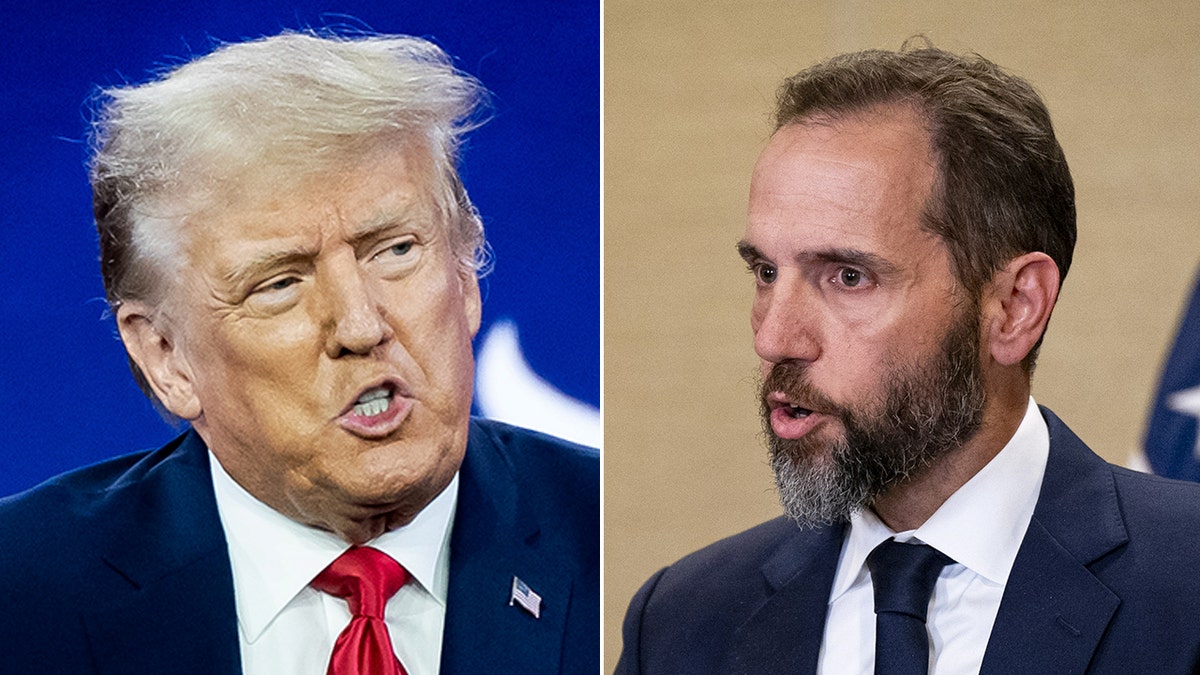
Trump currently faces four criminal prosecutions, including that of
Bragg, two from special counsel Jack Smith, and one from Fulton County
(Ga.) District Attorney Fani Willis. On the civil side, he remains mired
in litigation over New York Attorney General Letitia James’s civil
fraud case and has also faced civil action from E. Jean Carroll over
defamation and sexual battery claims.
Of those, Trump has been subjected to gag orders in Smith’s D.C.
election case, Bragg’s prosecution, and James’s civil case, each of
which have limited his ability to comment publicly on the allegations
against him and the key players in the proceedings.
Trump has broadly contended that each of the cases are part of a
wider political witch hunt designed to derail his 2024 bid to return to
the White House and has steadfastly denied any wrongdoing. The former
president has long taken aim at the leading prosecutors, notably lumping
Willis, Smith, Bragg, and James into the so-called “Fraud Squad” last year in an August ad.
But his messaging around the gag orders has seen him recast his legal
woes as a form of political pseudo-martyrdom that has even seen him
invoke the legacy of South African dissident and later President Nelson
Mandela.
James’s civil fraud case
Judge Arthur Engoron issued the first of the gag orders
last October as part of James’s case in which she alleged that Trump
had manipulated the value of his assets to secure favorable loan terms
and lower insurance premiums.
Prompting that gag order was a post Trump made on Truth Social in
which he dubbed Engoron’s chief clerk “Schumer’s girlfriend” in
reference to Senate Majority Leader Chuck Schumer. That initial order
barred all participants in the case from making public statements about
members of the court staff.
A month later, however, Engoron issued a second gag order
that also applied to his attorneys and barred comment on his
communications with court staff. The order followed Trump attorney
Christopher Kise informing the court that it may pursue a mistrial due
to a report from Breitbart News suggesting that Engoron’s clerk, Allison
Greenfield, had violated judicial ethics rules against excessive
political donations.
Two weeks later, Trump secured a temporary stay on the gag order, with Judge David Friedman curtailing the restrictions against his public speech, though an appellate court reinstated the gag order by month’s end. He requested in December that the New York Court of Appeals conduct an “expedited review” of the matter, though in January it declined to toss the order.
Throughout the process, Trump ran afoul of Engoron’s orders and
incurred judicial fines over the violations. Though Trump had long
criticized the case as partisan in nature, the imposition of fines saw
him begin to assert the judge’s complicity.
He incurred one fine after calling Engoron a "very partisan judge”
and making a reference to Greenfield. The penalty, however, led to a significant escalation
of his rhetoric, with Trump claiming that the judge had “GONE CRAZY IN
HIS HATRED OF 'TRUMP,'" and that he was “trying to protect RACIST A.G.
Letitia James, who has no case, lost the appeal, but has a tyrannical
and unhinged Trump Hating Judge.”
“This is Judicial Misconduct, coupled with Prosecutorial Misconduct,
and somebody from the State of New York must step in and stop this
Complete & Total Miscarriage of Justice!" he added at the time.
Smith’s election case
U.S. District Judge Tanya Chutkan issued the second gag order just
weeks after Engoron as part of Smith’s prosecution over Trump’s efforts
to challenge the 2020 presidential election. Smith first sought the order in September, citing Trump’s past criticism of prosecutors.
"This is not about whether I like the language Mr. Trump uses. This
is about language that presents a danger to the administration of
justice," Chutkan said
at the time. "His presidential candidacy does not give him carte
blanche to vilify public servants who are simply doing their jobs.”
Trump promptly appealed the order and linked limitations on his
public commentary to the rights of his supporters to hear his opinions.
"By restricting President Trump’s speech, the Gag Order eviscerates
the rights of his audiences, including hundreds of millions of American
citizens who the Court now forbids from listening to President Trump’s
thoughts on important issues," his attorneys argued at the time. Chutkan
temporarily stayed the order while he appealed.
Trump’s attempts to directly link his own free speech with the rights
of American voters appeared to resonate with an unlikely backer in the
form of the American Civil Liberties Union, which argued against the gag order on grounds that it was overly vague.
“The obvious and unprecedented public interest in this prosecution,
as well as the widespread political speech that it has generated and
will continue to generate, only underscores the need to apply the most
stringent First Amendment standard to a restraint on Defendant’s speech
rights,” the ACLU also asserted.
Chutkan reimposed the gag order the following day, which prompted Trump to appeal to the D.C. Circuit Court of Appeals, which granted a temporary stay in early November. A three-judge panel of that court heard arguments on the matter later in the month and appeared critical of the order’s scope. Ultimately, the judges upheld the order,
but narrowed its scope to bar Trump from discussing “known or
reasonably foreseeable witnesses” and permitted Trump to criticize Smith
himself. The panel further limited Trump’s restrictions to comments
“made with the intent to materially interfere with, or to cause others
to materially interfere with” the case. The appeals court denied a bid from Trump to rehear the matter en banc in January.
District Attorney Bragg’s “hush money” case
Bragg’s case has witnessed the most recent gag order against Trump as
well as some of his most pointed rhetoric on the subject to date.
Prosecutors initially sought
the gag order in February in light of Trump’s “long history of making
public and inflammatory remarks about the participants in various
judicial proceedings.” Trump’s team retorted
at the time that it “"would be unconstitutional and unlawful to impose a
prior restraint on President Trump’s First Amendment speech.”
Judge Juan Merchan imposed the gag order in late March, but Bragg subsequently asked him to expand its scope
after Trump raised concerns over the judge’s daughter’s employment with
a left-wing organization. Trump had previously sought Merchan’s recusal
over his daughter, Loren’s, employment with Authentic, which boasts
both President Joe Biden and Vice President Kamala Harris as clients.
Merchan obliged Bragg.
Early in the process, Trump’s rhetoric focused on the judge’s
daughter and suggested that Merchan’s decision-making was influenced by
her.
"So, let me get this straight, the Judge’s daughter is allowed to
post pictures of her ‘dream’ of putting me in jail, the Manhattan D.A.
is able to say whatever lies about me he wants, the Judge can violate
our Laws and Constitution at every turn, but I am not allowed to talk
about the attacks against me, and the Lunatics trying to destroy my
life, and prevent me from winning the 2024 Presidential Election, which I
am dominating?" he said in March.
"Maybe the Judge is such a hater because his daughter makes money by
working to 'Get Trump,' and when he rules against me over and over
again, he is making her company, and her, richer and richer. How can
this be allowed?"
As the trial approached in April, however, Trump’s remarks grew sharper, with him indicating a willingness to accept imprisonment for speaking what he deemed “truth.”
“If this Partisan Hack wants to put me in the 'clink' for speaking
the open and obvious TRUTH, I will gladly become a Modern Day Nelson
Mandela - It will be my GREAT HONOR,” he posted. “We have to Save our
Country from these Political Operatives masquerading as Prosecutors and
Judges, and I am willing to sacrifice my Freedom for that worthy cause.”
Last week, Bragg asked Merchan
to fine Trump $3,000 for alleging violating the gag order over his
categorization of witnesses Stormy Daniels and Michael Cohen as "two
sleaze bags who have, with their lies and misrepresentations, cost our
Country dearly!”
The following day, Bragg moved to hold Trump in contempt.
Is it working?
The evolution of Trump’s rhetoric from criticizing prosecutors over
bias to claiming political martyrdom and essentially daring the courts
to throw him in prison appears to have resonated somewhat with unlikely
audiences.
Amid the trial, Trump visited Harlem and found a degree of public support, a visit that led to viral videos of black and Latino residents gathering in his support. Outlets such as the Financial Times
subsequently published articles attesting that Trump’s appeals to the
issues facing New York, especially on the crime and economic situations,
had resonated. His status as a defendant and alleged victim of judicial
malfeasance, moreover, also appears to have struck a chord.
“Here’s the sad part about it... It gives credence to the argument
Trump made during a speech weeks ago where he talked about black folks
relating to him and his plight,” ESPN personality Stephen A. Smith said of Trump’s New York case during a Friday appearance on NewsNation.
“Now, what the h--- would black folks have in common with a guy who was
born on third base thinking he hit a home run, born with a proverbial
spoon in his mouth? It’s the legal system.”
“This man right here, who’s the presumptive GOP nominee is in a
position to literally get back into the White House because of what
you’re doing to him we find fairly relatable to things that have been
done to folks in our community. And it’s happened for decades,” he went
on. “There’s no escaping that fact and Trump pointing it out and being
accurate in doing so in perhaps the height of embarrassment for the
Democratic Party.”
Speaking on the John Solomon Reports podcast in an interview
set to air Wednesday, pollster John McLaughlin highlighted the public
perception of the cases against Trump, contending that clear majorities
saw the cases as politically motivated.
"We're what 196, 195 days away from the election today, where 66% of
all voters see these indictments against Donald Trump as political," he
said, adding that "56% think Joe Biden has played a role in these
indictments ordering them against President Trump."
"54 to 36, they say that a double standard of justice in the United
States... 53% to 34%, they believe Joe Biden's training put Donald Trump
in jail," he went on.
"[Biden] is driving the narrative against [Trump] with these trials
where if you watch MSNBC, CNN and the mainstream networks, you think
this is a legitimate, you think it's legitimate, it's not," McLaughlin
contended. "And everybody else, the majority of Americans are getting
this that, you know what they're trying to do here is wrong."
The pollster further pointed to the overwhelmingly Democratic jury
pool in New York City and the participation of a former Biden Department
of Justice official in the prosecution.
"So it's completely rigged. You know, like these other indictments
that [were] directed by Biden and his supporters, and it's all about
stopping Donald Trump from winning reelection because we're heading the
pulse," McLaughlin concluded.
Ben Whedon is an editor and reporter for Just the News. Follow him on X, formerly Twitter.