Thursday, August 14, 2025

IDF chief of staff articulates ‘new strategic approach’ - Canaan Lidor


by Canaan Lidor

“We are operating according to a new strategic concept—we will not allow threats to


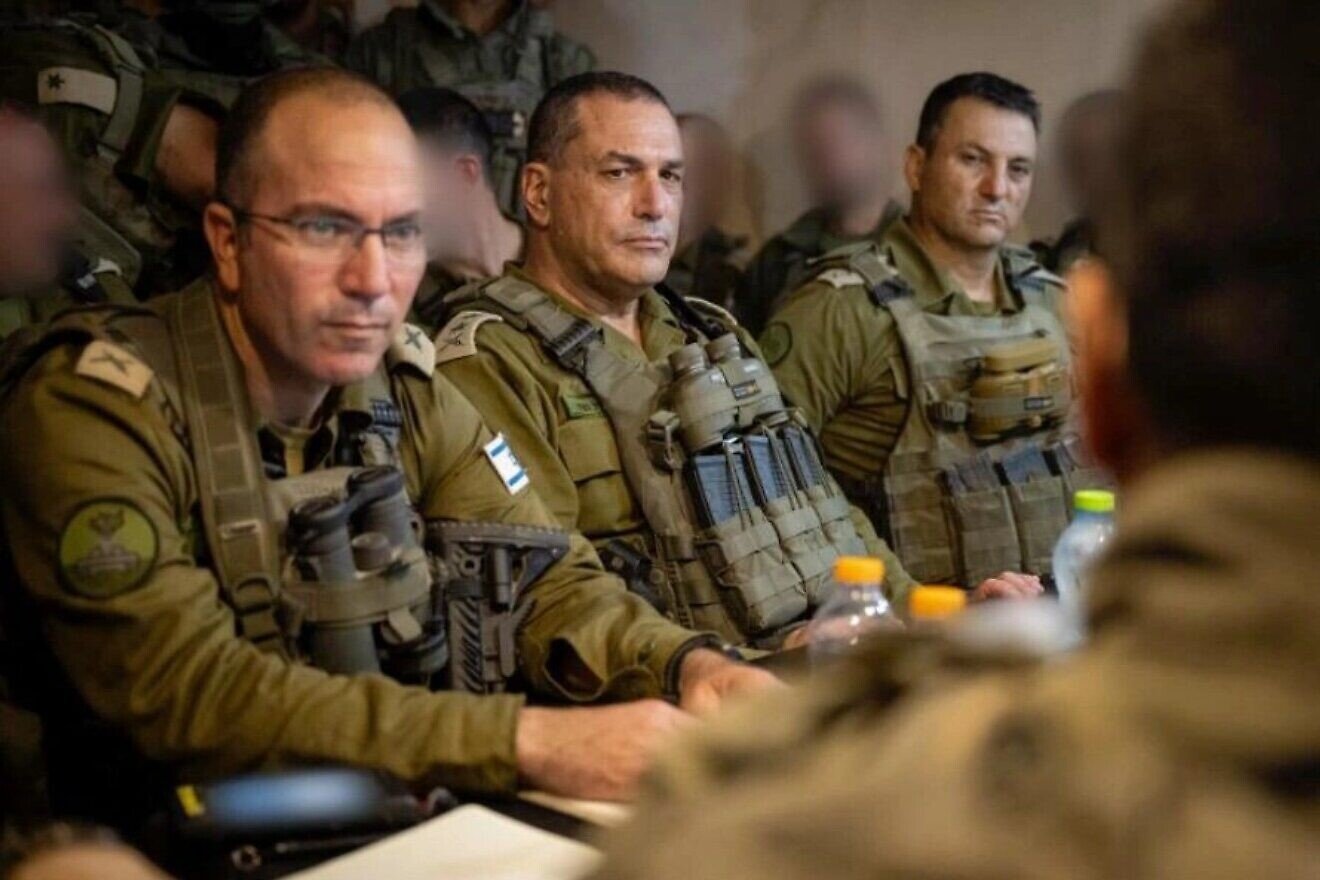
Israel Defense Forces Chief of Staff Lt. Gen. Eyal Zamir (center) holds a situational assessment in the Gaza Strip, Aug. 1, 2025. Credit: IDF.

IDF Chief of Staff Lt. Gen. Eyal Zamir said on Wednesday that there had been a “profound shift” in Israel’s national security concept in the aftermath of the Hamas-led Oct. 7, 2023 massacre.

During a tour of Israel’s northern front, including Southern Lebanon, where the IDF has maintained a limited deployment since September 2024, Zamir said that Israel’s policy was “no longer containment and waiting, but the use of force in pursuit of contact.” There is also a new understanding among Israel’s security forces “that neutralizing the threat also requires striking at its sources,” he added.

Zamir was joined on his tour of Southern Lebanon by 91st Division Commander Brig. Gen. Yuval Gaz and other senior officers, according to the IDF Spokesperson’s Unit. He met with both active-duty and reserve troops deployed in the area.

“Thanks to your actions, the operational achievements have been preserved, enabling the continued protection of northern communities. The reason we are here today is because we changed the security reality in the northern arena,” he said.

Zamir stressed that the IDF’s current posture was proactive, with forces striking targets and thwarting threats across multiple fronts, including Lebanon, Gaza, Syria, Yemen, Judea and Samaria, and in monitoring developments in Iran. 

Since the Nov. 26, 2024 ceasefire that ended a year of hostilities sparked when Hezbollah began firing rockets into Israel on Oct. 8, 2023, the IDF had killed over 240 Hezbollah terrorists in 600 airstrikes, mostly south of the Litani River, he noted.

These “enforcement actions” were “unprecedented,” he added.

“We are in the midst of a multi-arena war, adapting concepts to the threats. We are in all the arenas—launching strikes, all on our own initiative,” he said.

He noted that the army had approved new plans on Wednesday morning to achieve full operational control of Gaza City. 

“Our central mission is to safeguard the security of the state, protect civilians and defend the northern communities. We will not go backwards,” he said. “We are operating according to a new strategic concept—we will not allow threats to grow.” 


Canaan Lidor

Source: https://www.jns.org/zamir-articulates-new-strategic-approach-for-the-idf/

Follow Middle East and Terrorism on Twitter

‘Shut it down’: Bombshell FBI timeline exposes political interference in Clinton corruption probe - John Solomon and Jerry Dunleavy


by John Solomon and Jerry Dunleavy

Kid gloves vs. brass knuckles: Newly-declassified timeline shows how the investigation of the Clinton Foundation was hamstrung by FBI and DOJ while baseless Russia collusion marched foward in both agencies against Donald Trump.


FBI Director Kash Patel has uncovered a bombshell memo written in 2017 chronicling the extensive political obstruction that career agents in three cities faced from their own bosses and the Obama Justice Department during the 2016 election as they probed whether Hillary Clinton engaged in a pay-to-play corruption scheme involving her family foundation.

"Shut it down!" then-Deputy Attorney General Sally Yates is quoted as demanding in the detailed timeline of political impediments that agents in New York City, Little Rock, Ark., and Washington D.C. reported. 

The agents tried to get the help of federal prosecutors to determine whether or what crimes occurred while Hillary Clinton served as Secretary of State, most notably, because at that time, her family foundation solicited hundreds of millions of dollars from foreign and U.S. interests with business before her department.

The timeline — written by a DOJ lawyer assigned to the FBI under former bureau Director James Comey — was recently secured by top aides to Patel along with several corroborating internal emails and was obtained by Just the News. Together, they make clear that both the DOJ and former Deputy FBI Director Andrew McCabe placed significant impediments in front of agents who believed they had evidence to justify a public integrity criminal case.

The declassified timeline revealed that as early as February 2016, the Justice Department “indicated they would not be supportive of an FBI investigation.” The timeline also shows that, in mid-February 2016, McCabe ordered that “no overt investigative steps” were allowed to be taken in the Clinton Foundation investigation “without his approval” — a command he allegedly repeated numerous times over the coming months.

You can read the timeline here:

Declassified Timeline on Clinton Foundation Investigation

The roadblocks just kept coming, the timeline shows, to the great frustration of the agents and the U.S. attorney's office in Little Rock, which had moved to a fully predicated criminal investigation.

Patel's discovery of the memo and related emails comes at a sensitive time as Attorney General Pam Bondi has approved the use of a strike force and a grand jury to investigate whether law enforcement and intelligence abuses over the last decade amounted to a criminal conspiracy to protect Democrats like Clinton and Joe Biden while inflicting harm on Trump and his followers.

Officials told Just the News that DOJ also has secure potential cooperation from current and former prosecutors and agents who were willing to assist any investigation in possible obstruction of the Clinton probes.

"Shut it down!" No explanation given

The timeline detailed how Yates ordered one of the federal prosecutors to “shut it down” likely in the March 2016 timeframe. Federal prosecutors in the Southern District of New York (SDNY) and Eastern District of New York (EDNY) purportedly said in August 2016 that they “would not support the investigation” into the Clinton Foundation, according to the timeline, and that “no explanation was given.”

Once the investigation had essentially been delayed for a year and dragged past the November 2016 election, the timeline shows that DOJ officials under Trump then began to raise their “concerns regarding the statute of limitations” around the investigation, with one still unnamed official saying that they “wanted to close this chapter and move forward.”

Yates did not immediately respond to a request sent to her via her law firm email, and McCabe did not immediately respond to a request for comment sent to him through George Mason University. The Clinton Foundation did not immediately respond to a request for comment sent through its website.

McCabe was the Assistant Director in Charge of the FBI’s Washington Field Office, but he soon ascended to Deputy Director of the FBI under Comey, where the Justice Department inspector general said he “had an active role in the supervision of the Midyear [Clinton emails] investigation, and oversight of the Clinton Foundation investigation, until he recused himself from these investigations on November 1, 2016” — just days before the election. By that time, most political fallout against Hillary Clinton from the FBI's probes had been neutralized. 

Inspector General Horowitz noted that his investigation “found that McCabe did not fully comply with this recusal in a few instances related to the Clinton Foundation investigation.”

No matter where agents turned to get support to investigate Clinton's alleged corruption, they were thwarted, the memo located by Patel reveals.

The timeline stated that, in July or August 2015, an FBI supervisory special agent at the Washington Field Office “had a brief discussion” with a member of the U.S. Attorney’s Office for the District of Columbia “regarding the Clinton Foundation allegations” which had been focused on by the book Clinton Cash by Peter Schweizer. At the time, an investigator whose name remains redacted “was in the process of attempting to predicate an investigation based on the allegations.”

An unnamed investigator “may have had one or two brief discussions” in the fall of 2015 with an assistant U.S. attorney in the nation’s capital and with a member of DOJ’s Public Integrity Section, according to the timeline, where the Clinton Foundation was “likely ancillary” and “with the intention of informing” the redacted DOJ officials that an investigator “was continuing to study the matter to possibly predicate an investigation.”

The preliminary investigation begins

A meeting between multiple FBI agents and DOJ officials whose names are redacted, including staff from the Criminal Investigative Division and the Office of General Counsel, was held “to discuss the opening of the Clinton Foundation investigation.” An unnamed official whose identity was redacted “authorized all three field offices to open investigations but to not take any investigative steps until the matter was discussed with DOJ.” The FBI’s Criminal Investigative Division “advised the search/access parameters for their investigation were limited in scope” and that the Criminal Investigative Division “would not be able to share” certain redacted information “with the CF investigative team.”

The timeline stated that the FBI’s New York field office “initiated a Preliminary Investigation” on January 22, the Little Rock field office “initiated a Full Field Investigation” on January 27, and the Washington field office “initiated a Preliminary Investigation" on January 29, 2016.

The Durham report previously said the FBI’s Little Rock investigation was launched in part due to an intelligence product and corroborating financial reporting that a particular commercial "industry likely engaged a federal public official in a flow of benefits scheme, namely, large monetary contributions were made to a non-profit, under both direct and indirect control of the federal public official, in exchange for favorable government action and/or influence."

The special counsel said the FBI investigation in the nation’s capital was opened “as a preliminary investigation, because the Case Agent wanted to determine if he could develop additional information to corroborate the allegations in a recently-published book, Clinton Cash by Peter Schweizer, before seeking to convert the matter to a full investigation.”

Offers of contributions to Clinton Foundation for preferential treatment

Durham also said the FBI’s Little Rock and New York investigations “included predication based on source reporting that identified foreign governments that had made, or offered to make, contributions to the Foundation in exchange for favorable or preferential treatment from Clinton.”

Despite that evidence, the FBI  timeline stated that DOJ “indicated they would not be supportive of an FBI investigation” on February 1, 2016.

The timeline said that personnel from the FBI’s Little Rock office raised concerns that a redacted official “may not want to be a party to the briefing because of conflicts of interest” during an early February 2016 meeting. A redacted Little Rock official “expressed these concerns due to the possibility that” another redacted official “was believed to be a supporter of the Democratic Party and possibly the Clintons.”

There was a meeting between officials from the New York and Washington field offices, and possibly the Little Rock field office, on February 17, 2016 according to the timeline. McCabe “led the meeting” and “was advised” by the New York field office about a confidential human source (CHS) “who possibly had information on the matter.” During this meeting, McCabe “directed that no overt investigative steps were to be taken on the CF investigation without his approval.”

McCabe demands pre-approval of any investigation into Clintons

The timeline stated that the FBI’s Criminal Investigative Division reiterated that “all overt investigative steps related to the CF investigation” would “require” McCabe’s approval, “with the exception of speaking to open CHSs” during a February 22, 2016 meeting. The inquiry was further hobbled during the meeting when the FBI offices were “directed not to open or recruit any new CHSs, and no additional overt investigative steps were authorized.”

The Durham report previously said that, in late February 2016, a “meeting was convened at FBI Headquarters to discuss the Foundation investigations” — and McCabe initially ordered the closure of all the investigations before backtracking slightly to hamper the investigations by requiring his personal approval for any significant investigative actions.

The Durham report said “McCabe initially directed the field offices to close their cases, but following objections, agreed to reconsider the final disposition of the cases.”

Paul Abbate, then the assistant director in charge of the Washington Field Office, described McCabe as "negative," "annoyed," and "angry" about the Clinton Foundation cases, with McCabe saying that "they [the DOJ] say there's nothing here" and with McCabe asking "why are we even doing this?"

Durham said that, at the end of the meeting, Services Branch Executive Assistant Director Randall Coleman “directed that for any overt investigative steps to be taken, the Deputy Director's [McCabe’s] approval would be required.”

The declassified timeline showed that the FBI’s Little Rock office “sent an email” to the Criminal Investigative Division “requesting concurrence” to “obtain supporting documents” for the investigation on March 1, 2016, but the Little Rock investigators “never received permission to seek the documents.” The timeline also said that, possibly in March 2016, the U.S. Attorney’s Office for the Eastern District of Arkansas informed the FBI’s Little Rock investigators that Yates “ordered” the federal prosecutors to “shut it down.”

Lynch and Comey looked for ways to end the Clinton emails investigation

Obama Attorney General Loretta Lynch met with former President Bill Clinton on Lynch’s plane on the tarmac of a Phoenix airport on June 27, 2016. Lynch and Bill Clinton both claimed to the DOJ watchdog that they did not discuss the Midyear Exam investigation or any other DOJ investigations during their lengthy and private conversation.

Lynch later admitted to the DOJ inspector general that the meeting “went on and on” and “that it was just too long a conversation to have had.” After the meeting, the DOJ’s ethics office concluded that Lynch did not have to recuse herself and Lynch decided not to voluntarily recuse herself either. Lynch claimed to Horowitz that stepping aside would have created a “misimpression” that she and Bill Clinton “had discussed inappropriate topics, or that her role in the Midyear investigation somehow was greater than it was.”

The Obama attorney general told a reporter at the start of July 2016 that she ”fully expect[ed]” to accept the recommendation of the career FBI agents and DOJ prosecutors who conducted the Clinton emails investigation, and said that “I’ll be briefed on [the findings] and I will be accepting their recommendations.”

Comey clears Hillary, sets sights on Trump

Comey cleared Hillary Clinton of criminal wrongdoing for transmitting classified information on an insecure and private email server in a speech on July 5, 2016 — just weeks before greenlighting the Crossfire Hurricane investigation in late July 2016. Comey claimed of the Clinton case at the time that Clinton’s email practices were “extremely careless” and that “although there is evidence of potential violations of the statutes regarding the handling of classified information, our judgment is that no reasonable prosecutor would bring such a case.”

Comey listed Clinton’s numerous missteps, including the fact that 110 emails in 52 email chains contained classified information at the time they were sent or received by Clinton, but he recommended against charging her with any crimes.

Disgraced fired FBI special agent Peter Strzok later testified to Congress in 2018 that the FBI "did not have access" to Clinton Foundation emails that were on Clinton's private server because of a consent agreement "negotiated between the Department of Justice attorneys and counsel for Clinton."

Horowitz’s 2018 report concluded Comey’s actions seemingly exonerating Clinton were “extraordinary and insubordinate” when he announced Clinton wouldn’t be charged. “We concluded that Comey’s unilateral announcement was inconsistent with Department policy and violated long-standing Department practice and protocol by, among other things, criticizing Clinton’s uncharged conduct,” the DOJ inspector general concluded. "We also found that Comey usurped the authority of the Attorney General, and inadequately and incompletely described the legal position of Department prosecutors.”

The timeline said the FBI field offices in Little Rock and the nation’s capital were “directed to close their investigations” while the New York office “was advised no overt investigative action was to take place” unless McCabe authorized it.

Strzok had exchanged a host of anti-Trump texts in 2016 with now-former FBI lawyer Lisa Page, with whom he was having an affair. Horowitz wrote, “We did not have confidence that Strzok’s decision to prioritize the Russia investigation over following up on the Midyear-related investigative lead discovered on the Weiner laptop was free from bias.”

Strzok wrote in his 2020 book "Compromised" that “of course” he prioritized the Trump-Russia investigation over the Clinton emails investigation because “there was simply no equivalence between Midyear and Crossfire.”

Horowitz’s report in 2018 detailed multiple instances in which McCabe “lacked candor” with Comey, FBI investigators, and inspector general investigators, including while under oath, about his authorization to then leak sensitive information to The Wall Street Journal in late October 2016 that revealed the existence of the FBI investigation into the Clinton Foundation (while not revealing how McCabe had put the inquiry in leg-irons for nearly a year).

The Horowitz report concluded “the evidence is substantial” that McCabe misled investigators “knowingly and intentionally” about leaking to the media. Comey said he did not permit McCabe to tell the media, and Horowitz wrote that McCabe’s actions were “designed to advance his personal interests at the expense of Department leadership” and “violated the FBI’s and the Department’s media policy and constituted misconduct.”

The timeline said that in a conference call on October 25, 2016, McCabe was also “reminded that EDNY had previously stated not interested in pursuing CF matter, but then changed to no legal process… until after the election.”

McCabe talked to a redacted official about the Journal article which had included details about the Clinton Foundation inquiry and about his “concern over leaks and need to advise folks of media policy” during an October 30, 2016, meeting, according to the timeline. McCabe, as he well knew, had been the source of the Clinton Foundation leak.

It was only the next day — November 1, 2016 — that McCabe “sent an email recusing himself from the Clinton Foundation Investigation,” according to the timeline. McCabe had successfully slow-walked the inquiry all the way up to just prior to Election Day 2016.

"DOJ told them to stand down"

DOJ personnel allegedly “indicated” on August 2, 2017, that U.S. attorneys “have the autonomy and discretion to pursue any investigation deemed appropriate” and that the U.S. Attorney’s Office for the Eastern District of Arkansas “does not require DOJ concurrence to move forward,” according to the timeline.

The timeline stated that an official said on August 11, 2017 that “they continue to fully support” the Little Rock field office on the matter and “reiterated it was ‘the right thing to do’ since the allegations were like any other PC case that would be worked, albeit this matter was more sensitive than others.” Nonetheless, an official whose name is redacted said that they were “going to wait until DOJ gave them concurrence to proceed” because “DOJ had told them to stand down last year.”

The final entry in the timeline comes on August 23, 2017. That day, the Criminal Investigative Division received a phone call from a redacted investigator “who requested follow-up information concerning” the “19 CF bank accounts” which had been obtained by the FBI’s Los Angeles field office “during a separate Campaign Finance Fraud investigation.”

Investigation into Clinton Foundation snuffed out soon after.

Memos penned by McCabe and declassified earlier this year show how McCabe kept the Trump-Russia investigation alive and then escalated it after Comey’s removal by Trump in 2017. The memos show McCabe facilitated the FBI’s targeting of Lt. Gen. Mike Flynn, met with Vice President Mike Pence and other White House officials about the Flynn allegations, refused to publicly shoot down false media stories on collusion, opened a baseless collusion investigation into Trump himself after Comey was fired, ratcheted up the Trump-Russia investigation as the acting FBI director, helped successfully push for a special counsel to take the reins, and more.

Then-Attorney General Jeff Sessions fired McCabe in 2018 just before he was set to retire.

“Andrew McCabe FIRED, a great day for the hard working men and women of the FBI — A great day for Democracy,” Trump tweeted just after midnight after McCabe’s 2018 firing. “Sanctimonious James Comey was his boss and made McCabe look like a choirboy. He knew all about the lies and corruption going on at the highest levels of the FBI!”

Kid gloves vs. brass knuckles

The differences in how the Justice Department and FBI handled cases related to Clinton and Trump were stark — publicly exonerating Clinton for her mishandling of classified information when using a private email server as secretary of state and not even allowing the Clinton Foundation investigation to get off the ground, while launching a sprawling and baseless Russia collusion inquiry into the Trump campaign and the candidate (and then the president) himself.

Special Counsel John Durham later pointed out that “the immediate opening of Crossfire Hurricane as a full investigation contrasts with the care taken in connection with the investigation of the Clinton Foundation and other matters.” 

John Solomon and Jerry Dunleavy

Source: https://justthenews.com/government/federal-agencies/shut-it-down-bombshell-fbi-timeline-chronicles-political-interference

Follow Middle East and Terrorism on Twitter

Who Has Been Busy Destroying Democracy? - Victor Davis Hanson


by Victor Davis Hanson

Democrats decry “destroying democracy” while dismantling long-standing institutions, weaponizing agencies, and undermining the very systems they claim to defend.


“Destroying democracy”—the latest theme of the left—can be defined in many different ways.

How about attempting to destroy constitutional, ancient, and hallowed institutions simply to suit short-term political gains?

So, who in 2020, and now once again, has boasted about packing the 156-year-old, nine-justice Supreme Court?

Who talks frequently about destroying the 187-year-old Senate filibuster—though only when they hold a Senate majority?

Who wants to bring in an insolvent left-wing Puerto Rico and redefine the 235-year-old District of Columbia—by altering the Constitution—as two new states solely to obtain four additional liberal senators?

Who is trying to destroy the constitutionally mandated 235-year Electoral College by circumventing it with the surrogate “The National Popular Vote Interstate Compact?”

Does destroying democracy also entail weaponizing federal bureaucracies, turning them into rogue partisan arms of a president?

So who ordered the CIA to concoct bogus charges of “collusion” to sabotage Trump’s 2016 campaign, the 2016-2017 transition, and the first 22 months of Trump’s first term?

Who prompted a cabal of “51 former intelligence officials” to lie to the American people on the eve of the last debate of the 2020 election that the FBI-authenticated Hunter Biden laptop was instead the work of a “Russian intelligence operation?”

Who ordered the FBI to connive and partner with social media conglomerates to censor accurate news deemed unhelpful to the 2020 Biden campaign?

Who pulled off the greatest presidential coup in history by using surrogates in the shadows to run the cognitively debilitated Biden presidency, then by fiat canceled his reelection effort, and finally anointed as his replacement the new nominee Kamala Harris, who had never won a single primary delegate?

Who ordered FBI SWAT teams to invade the home of a former president because of a classification dispute over 102 files out of some 13,000 stored there?

Who tried to remove an ex-president and leader of his party from at least 25 state ballots to deprive millions of Americans of the opportunity to vote for or against him?

Who coordinated four local, state, and federal prosecutors to destroy a former and future president by charging him with fantasy crimes that were never before, and will never again be, lodged against anyone else?

Who appointed a federal prosecutor to go after the ex-president, who arranged for a high-ranking Justice Department official to step down to join a New York prosecutor’s efforts to destroy an ex-president, and who met in the White House with a Georgia county prosecutor seeking to destroy an ex-president—all on the same day—a mere 72 hours after Trump announced his 2024 reelection bid?

Who but the current Democrats ever impeached a president twice?

Has any party ever tried an ex-president in the Senate when he was out of office and a mere private citizen?

When have there ever been two near-miss assassination attempts on a major party presidential candidate during a single presidential campaign?

Who destroyed the southern border and broke federal law to allow in, without criminal or health background audits, some 10–12 million illegal aliens?

Who created 600 “sanctuary jurisdictions” for the sole purpose of nullifying federal immigration law, in the eerie spirit of the renegade old Confederacy?

Who allowed tens of thousands of rioters, arsonists, and violent protestors over four months in 2020 to destroy over $2 billion in property, kill some 35 people, injure 1,500 police officers, and torch a federal courthouse, a police precinct, and a historic church—all with de facto legal impunity?

How do the purported destroyers of democracy find themselves winning 60–70 percent approval on most of the key issues of our times, while the supposed saviors of democracy are on the losing side of popular opinion?

How does a president “destroy democracy” by his party winning the White House by both the popular and Electoral College vote, winning majorities in both the Senate and House by popular votes, and enjoying a 6–3 edge in the Supreme Court through judges appointed by popularly elected presidents?

So what is behind these absurd charges?

Three catalysts: one, the new anguished elitist Democrat Party alienated the middle classes through its Jacobin agenda and therefore lost the Congress, the Presidency, and the Supreme Court, and now has no federal political power.

Two, the Democrat Party is polling at record lows and yet remains hellbent on alienating the traditional sources of its power—minorities, youth, and Independents.

Three, Democrats cannot find any issues that the people support, nor any leaders to convince the people to embrace them.

So it is no surprise that the panicked Democrats bark at the shadows—given that they know their revolutionary, neo-socialist agenda is destroying them. And yet, like all addicts, they choose destruction over abandoning their self-destructive fixations.


Victor Davis Hanson is a distinguished fellow of the Center for American Greatness and the Martin and Illie Anderson Senior Fellow at Stanford University’s Hoover Institution. He is an American military historian, columnist, a former classics professor, and scholar of ancient warfare. He has been a visiting professor at Hillsdale College since 2004, and is the 2023 Giles O'Malley Distinguished Visiting Professor at the School of Public Policy, Pepperdine University. Hanson was awarded the National Humanities Medal in 2007 by President George W. Bush, and the Bradley Prize in 2008. Hanson is also a farmer (growing almonds on a family farm in Selma, California) and a critic of social trends related to farming and agrarianism. He is the author of the just released New York Times best seller, The End of Everything: How Wars Descend into Annihilation, published by Basic Books on May 7, 2024, as well as the recent  The Second World Wars: How the First Global Conflict Was Fought and Won, The Case for Trump, and The Dying Citizen.

Source: https://amgreatness.com/2025/08/14/who-has-been-busy-destroying-democracy/

Follow Middle East and Terrorism on Twitter

Another Al-Jazeera Reporter Was a Hamas Terrorist; Al-Jazeera Should Be Designated a Foreign Terrorist Organization - Bassam Tawil


by Bassam Tawil

The IDF has disclosed intelligence information and countless documents found in Gaza confirming the military affiliation of six Al-Jazeera journalists with Hamas and Palestinian Islamic Jihad.


  • The television network al-Sharif worked for, Al-Jazeera (Arabic), has always served as the official mouthpiece of the Muslim Brotherhood organization and its affiliates, including Hamas.

  • Al Jazeera is owned by the government of Qatar, the Gulf state that has long been endorsing the Muslim Brotherhood and providing shelter for the leaders of Hamas.

  • A press badge or vest is not -- and should not be -- a shield for terrorism.

  • Even the BBC, widely known for its bias against Israel, has acknowledged that al-Sharif worked for Hamas.

  • "Hamas's entire defense system relies on disguising its fighters—posing as health workers, journalists, or ordinary civilians. That's their weapon. They never admit that anyone killed was a Hamas member; it's always 'civilians,' as if Israel never kills Hamas fighters." — Brother Rachid, X, August 12, 2025.

  • When it comes to Qatar's Al-Jazeera, it should come as no surprise that another one of its employees has been exposed as an Islamist terrorist.

  • The IDF has disclosed intelligence information and countless documents found in Gaza confirming the military affiliation of six Al-Jazeera journalists with Hamas and Palestinian Islamic Jihad.... The documents provide unequivocal proof... of the integration of Hamas terrorists within Qatar's Al- Jazeera media network.

  • Al-Jazeera (Arabic) is not -- and never was -- a real news organization. Since its founding, the television network has been promoting radical Islam and glorifying terrorism against Israel.

  • As such, Al-Jazeera, like the Muslim Brotherhood, should be designated a Foreign Terrorist Organization.

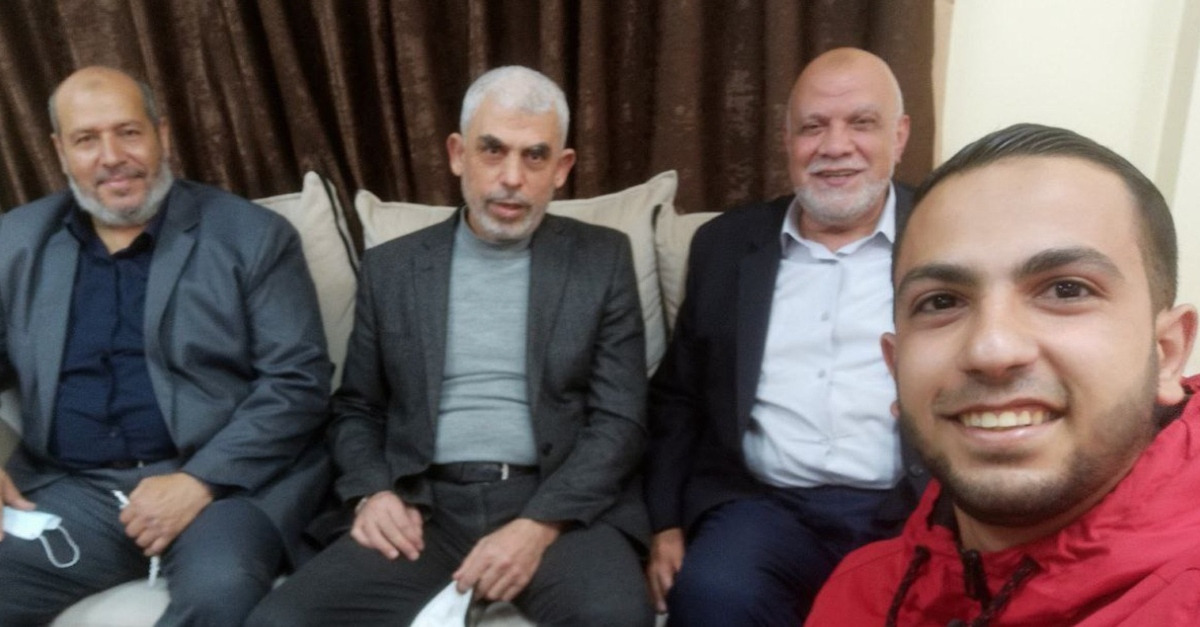
Anas al-Sharif, the Al-Jazeera (Arabic) "journalist" who was killed by the IDF in Gaza this week, never concealed his affiliation with Hamas. Al-Sharif was recruited by Hamas on December 3, 2013, and served as the commander of a rocket-launch squad. A press badge or vest is not -- and should not be -- a shield for terrorism. Al-Jazeera (Arabic) is not -- and never was -- a real news organization. Since its founding, it has been promoting radical Islam and glorifying terrorism against Israel. Pictured: Al-Sharif (R) smiles for a selfie with senior Hamas officials, including the late Hamas leader Yahiya Sinwar (2nd from left). Photo by Anas al-Sharif.

Anas al-Sharif, the Palestinian "journalist" who was killed by the Israel Defense Forces (IDF) this week, never concealed his affiliation with the Iran-backed Hamas terror group. Before and after his death, photos of al-Sharif continually socializing with top Hamas leaders appeared on social media platforms. Al-Sharif was also known for his public support for terrorism against Israel.

The television network al-Sharif worked for, Al-Jazeera (Arabic), has always served as the official mouthpiece of the Muslim Brotherhood organization and its affiliates, including Hamas.

Al Jazeera is owned by the government of Qatar, the Gulf state that has long been endorsing the Muslim Brotherhood and providing shelter for the leaders of Hamas.

A press badge or vest is not -- and should not be -- a shield for terrorism.

Al-Sharif was not killed because of his alleged journalistic work. He was killed because of his affiliation with Hamas, a group designated as a Foreign Terrorist Organization by the US and several other Western countries. Those who rushed to condemn the killing of al-Sharif should have looked at the man's posts and statements, especially on social media, to see that he was a proud member of Hamas who celebrated the murder of Jews.

In one of his Telegram posts, from January 27, 2023, al-Sharif celebrated the murder of seven Jews by Palestinian terrorists outside a synagogue in Jerusalem. The posts show a bullet casing, with the tip replaced by the Dome of the Rock. The caption, from Quran 17:5, reads: "We sent against them our servants of great might and strength."

That Quranic verse is historically used to describe God sending warriors to punish enemies. The imagery in the post ties the act of murdering the seven Jews to the defense of the al-Aqsa Mosque – an apparent effort to frame the murders as a sacred duty.

"This is not the language of a neutral observer or a humanitarian," commented the award-winning British investigative journalist David Collier.

"It is not the language of a Palestinian journalist. It is the language of someone who sees terrorism through a religiously sanctified lens, and a person who glorifies, legitimizes and celebrates the murder of these innocent Jews as part of a glorious religious duty. This is not journalism. This is not just a cartoon celebrating 'resistance.' This is jihadist propaganda, religiously justifying a brutal murder. His own public output shows he was not simply a 'journalist,' and this post is clear evidence he is not a semi-secular or moderate voice – but a man who views the world and the conflict through a genocidal jihadist vision."

Al-Sharif was recruited by Hamas on December 3, 2013, and served as the commander of a rocket-launch squad in the northern sector of the Gaza Strip. His Hamas ID number was 305342. On April 7, 2017, he was wounded in his left eye and ear during a Hamas training exercise – but remained in the organization with a salary of $200 dollars a month. A document seized by the IDF shows that al-Sharif was a member of Hamas's Nukhba (Elite) Battalion in East Jabaliya in the Gaza Strip.

Even the BBC, widely known for its bias against Israel, has acknowledged that al-Sharif worked for Hamas:

"Anas al-Sharif, who has been a familiar face on Al-Jazeera for much of the war, worked for a Hamas media team in Gaza before the current conflict, the BBC understands."

In other social media posts, al-Sharif praised the Hamas-led October 7 massacre against Israel and took smiling selfies with Hamas leaders.

On October 7, 2023, while thousands of Hamas terrorists and "ordinary" Palestinians who invaded Israel from the Gaza Strip were slaughtering Israelis and foreign nationals, al-Sharif posted on his Telegram account:

"9 hours [have passed] and the [Hamas] heroes are still roaming the country (Israel) killing and capturing...Allah, Allah, how great you are."

Because of his membership in Hamas, al-Sharif was regularly given unlimited access to the terror group and its activities. Last year, for instance, he was the only "journalist" to document the release of Israeli female hostage Agam Berger.

"Al-Sharif was a journalist only on the surface," remarked terrorism expert Brother Rachid.

"In reality, he was a Hamas fighter using journalism as a cover while waging jihad (holy war). He was even quoting the Quran 9:111 to justify it: 'Indeed, Allah has purchased from the believers their lives and wealth in exchange for Paradise. They fight in the cause of Allah, so they kill and are killed. [It is] a true promise binding upon Him in the Torah, the Gospel, and the Quran. And who is more faithful to His Promise than Allah? So rejoice in the transaction you have made with Him. And that is the great triumph.'"

Brother Rachid also wrote:

"Hamas's entire defense system relies on disguising its fighters—posing as health workers, journalists, or ordinary civilians. That's their weapon. They never admit that anyone killed was a Hamas member; it's always 'civilians,' as if Israel never kills Hamas fighters. Even the 'journalists' follow strict orders never to say who's Hamas and who's not. The only exceptions are a few top commanders like Muhammad Deif or Sinwar—and even then, only after Israel announces it first. They denied Deif's death for days at the start. So don't expect them to admit Anas Al-Sharif was one of them—they hide their operatives' identities to protect their cover, and they always will."

In another post, Brother Rachid revealed that al-Sharif saw Jews and Christians as an enemy:

"To all the Westerners who thought Anas was a cute, innocent journalist – besides being a member of Hamas, he openly declared his hatred for Jews and Christians."

On August 17, 2024 al-Sharif wrote: "And the Jews and the Christians will never be pleased with you until you follow their religion." On August 18, 2024 he wrote:

"Fight them [Jews and Christians]; Allah will punish them by your hands and will disgrace them and give you victory over them and satisfy the hearts of the believers (Quran 2:6)."

Al-Sharif was not the only Palestinian journalist working for Hamas. Last year, it turned out that three of four Israeli hostages rescued by IDF special forces from the central Gaza Strip were being held at the home of Abdallah Aljamal, a Palestinian journalist and member of Hamas terror group.

Aljamal had previously been a spokesman for the Hamas-run Labor Ministry and had contributed to several news outlets.

In the Gaza War, numerous articles by Aljamal were published by the Palestine Chronicle, while hostages Almog Meir Jan, Andrey Kozlov and Shlomi Ziv were being held captive in his home. The fourth hostage, Noa Argamani, was rescued from a nearby building.

Aljamal also wrote for Al-Jazeera's website.

Argamani, Meir Jan, Kozlov and Ziv had been abducted from the Supernova music festival near the Israeli community of Re'im on the morning of October 7.

No journalist, as every Palestinian child knows, can operate in the Gaza Strip without the approval and backing of Hamas. This has been true since 2007, when the terror group seized control of the Gaza Strip and forcibly ousted the Palestinian Authority. The only Palestinian journalists allowed to work in the Gaza Strip were those who supported Hamas or were members of the group.

When it comes to Qatar's Al-Jazeera, it should come as no surprise that another one of its employees has been exposed as an Islamist terrorist.

The IDF has disclosed intelligence information and countless documents found in Gaza confirming the military affiliation of six Al-Jazeera journalists with Hamas and Palestinian Islamic Jihad, the second-largest terror group in the Gaza Strip. They are: Anas Jamal Mahmoud al-Sharif, Alaa Abdul Aziz Muhammad Salama, Hossam Basel Abdul Karim Shabat, Ashraf Sami Ashour Saraj, Ismail Farid Muhammad Abu Omar, and Talal Mahmoud Abdul Rahman Aruki.

The documents include personnel tables, lists of terrorist training courses, phone directories, and salary documents for terrorists. The documents provide unequivocal proof that these individuals serve as military operatives for the terrorist organizations in Gaza, and of the integration of Hamas terrorists within Qatar's Al- Jazeera media network.

The term "Al-Jazeera journalism" is an oxymoron. Al-Jazeera (Arabic) is not -- and never was -- a real news organization. Since its founding, the television network has been promoting radical Islam and glorifying terrorism against Israel.

As such, Al-Jazeera, like the Muslim Brotherhood, should be designated a Foreign Terrorist Organization.

Terrorists masquerading as journalists are not only a disgrace to the profession; they also endanger the lives of real journalists. In future wars, if they are all wearing press vests, it will be difficult to distinguish between a terrorist and a real journalist.

Al-Sharif chose to engage in terrorism instead of journalism. He chose to be a "martyr" in Hamas's jihad to murder Jews and eliminate Israel. Israel helped him achieve his goal of martyrdom.


Bassam Tawil is a Muslim Arab based in the Middle East. His work is made possible through the generous donation of a couple of donors who wished to remain anonymous. Gatestone is most grateful.

Source: https://www.gatestoneinstitute.org/21832/al-jazeera-terrorist-organization

Follow Middle East and Terrorism on Twitter

IDF reservist at GHF's aid project: Far from perfect, but not a Gaza 'death trap' - frontlines - Michael Starr


by Michael Starr

MILITARY AFFAIRS: The SDS system is not the “deadly trap" story from Hamas’s Gaza Health Ministry data, but it’s far from perfect. For the safety of civilians, the plan needs improvement.


Displaced Palestinians carry food parcels as they raid trucks carrying humanitarian aid in Khan Yunis, in the southern Gaza Strip on August 9, 2025.
(photo credit: AFP VIA GETTY IMAGES)

The truth about Gaza Humanitarian Foundation (GHF) aid sites has been grossly distorted, with a good-intentioned but flawed project seeking to alleviate the suffering of civilians in a war zone instead being represented by news outlets and NGOs as “killing fields” in which IDF soldiers unnecessarily and indiscriminately shot Palestinians patiently queuing in lines.

For a significant portion of my third tour in Gaza as an infantry reservist, I was one of the soldiers tasked with securing the area around a safe distribution site (SDS) in the south of the Strip.

Leaving a war zone to come back to Israel means entering a different world, but I also found a completely different reality from what I knew was represented online. The narrative being circulated far from the field had familiar details warped to the point of falsehood, or factual but told without vital context.

In warfare, it is just and necessary to avoid harming civilians as much as possible while achieving one’s objectives. While it is chiefly the responsibility of the opponent to feed its population, it is righteous to try to relieve the pangs of hungry civilians – but without the counterproductive and conflict-lengthening move of providing succor to enemy forces.

I did not see mass starvation in Gaza. Of the tens of thousands of civilians, there was no one close to the emaciated state of hostage Evyatar David.

Palestinians carry aid supplies they collected from trucks that entered Gaza through Israel, in Beit Lahia, in the northern Gaza Strip August 10, 2025.  (credit: Dawoud Abu Alkas/Reuters)
Palestinians carry aid supplies they collected from trucks that entered Gaza through Israel, in Beit Lahia, in the northern Gaza Strip August 10, 2025. (credit: Dawoud Abu Alkas/Reuters)
But as with every conflict, there is food insecurity. While there are many Gazans who can be seen in Instagram and TikTok videos with no shortage of food, they are likely those in the areas least touched by the war. Many Gazans live in unfortunate states, and the neediest among the internally displaced are desperate, facing malnutrition and even prolonged hunger.

The strategy was made clear to us with briefings at the battalion and company level: With the contracting of the GHF, the IDF sought to prevent a severe humanitarian situation for civilians while avoiding resupplying enemy combatants through vulnerable and compromised aid organizations.

The IDF believed that part of Hamas’s control over the population and its remaining territory was through its near monopoly over food and other humanitarian aid items, and hoped the project would be able to disrupt the vulturous profit model of selling aid and squeezing civilians for international propaganda consumption.

The belief that the GHF threatened Hamas governance and legitimacy in the Strip seemed to have been validated not only by the flurry of hyper-fixated news coverage and hit pieces but also by the steady increase of threats and violent attacks against foreign and Palestinian GHF aid workers.

While the assessment about the need for and impact of an alternative aid system was proven, implementing the vision has been difficult because it has relied on the poor logistics of the IDF and placed soldiers in Schrodinger’s battlefield.

The area around SDS sites is still enemy territory, and there are still forces in play seeking to visit death upon our men. While Hamas and its ilk were largely routed from the area, we were still finding stashes of weapons, uniforms, and combat vests, and tunnels and suspected booby-traps were still being demolished.

An enemy force that perfidiously removed its uniforms and concealed itself among civilians was still in play. At the same time that we were supposed to secure and hold ground, as with any war, soldiers were also expected to act as policemen and security in an area populated by civilians. Such is a task that soldiers were not trained for, and it operates along rules and sensibilities that are difficult to meet under the specter of war.

Frustration of reservists

Much of the frustration of reservists about the SDS sites comes from this uncertain dichotomy. What was expected was for soldiers to turn their steel against armed Hamas fighters, but instead, the military operation with an aid side endeavor had become a humanitarian mission with uncertain security expectations.

Yet while this felt like no task for a soldier, it was difficult to argue with the results of hundreds of thousands of people having more consistent access to food.

The GHF site we were tasked with securing was situated about a kilometer from an idyllic-looking seaside town that seemed to have been largely unscathed. It was also a few hundred meters from our outpost and the same distance from a bombed-out house on a hill that had been converted into a semi-occupied strongpoint.

Aid seekers were supposed to travel down a road from the town to the SDS, leaving behind vehicles beyond a security barrier that also served as a marker for what not to cross when the zone and aid site were closed.

Once at the SDS, aid seekers were intended to queue along one path to the site to receive aid and exit out a second to return to the town.

Fences, barbed wire, and warning signs were placed to prevent civilians from entering military zones. We were also promised that a biometric system would be established to ensure people would not take more than needed, and terrorist operatives would be unable to visit without being identified.

Yet no battle plan survives contact with the enemy, and more often than not, the great enemy of plans is not an opposing force but the friction of reality.

Once the GHF site opened, a daily deluge of tens of thousands – if not hundreds of thousands – of Gazans would descend upon the aid in a scene comparable to that of a zombie apocalypse film. Columns of dust accompanied more people than could fit in most stadiums as they attempted to enter the site and grab aid. Most came on foot, but others rode on bikes, scooters, peddle carts, and makeshift horse- or donkey-drawn carriage contraptions.

The road is just one avenue of approach, as, if unhindered, the Gazans would and at times did overrun the forward strongpoint and tear down barriers.

The stories told by some of the more malicious news outlets about Palestinians being shot while peacefully queuing are ludicrous not only because live-fire warning shots were only employed on the extremely rare occasion that Gazans in the aid site yard deviated toward the closed military zone that was out of their way, but also because I never once saw anything resembling a line or queue.

While it’s impossible not to feel sympathy for the people who have to gather food in such a manner, the sites are controlled chaos, with Palestinian aid seekers constantly seeking to overrun the compound, save for the intervention of armed security contractors.

The contractors use stun grenades to warn off belligerent men who attempt to enter the site in situations like when there are special distributions for women or children. Palestinian aid workers have also used mace to repel aid seekers who refused to leave the site.

Desperation was not the only driving factor leading to such behavior. War profiteering, criminality, and Hamas oppression are also driving forces. It soon became obvious during the scrums for aid that certain items were being sought out. Trades and sales were being made in the SDS forecourt yard, and at times a bazaar was opened, complete with ramshackle stalls. If such a trade was being made in front of the GHF site, it seemed likely to us that more hoarding and black market trade was going on inside the town.

While, when the SDS distribution was over, Gazans were supposed to stay beyond a concrete block boundary on the road, young men would risk the night to try to sneak as close as possible, many so they could get first crack at the best aid items. Some would dig trenches in the ground so they could sleep there without the IDF’s knowledge.

Some were probably motivated by the fear that if they didn’t get to the site first, they wouldn’t get anything, but the number of people who left empty-handed was nominal.

Many likely risked entering a military zone and approaching an IDF outpost so they could get in and out as soon as possible and avoid theft and robbery by fellow aid seekers. We saw aid seekers steal from one another, and one site had a stabbing.

Brawls over aid were not uncommon, and larger men could be seen waiting on the periphery, not joining the rush with the others. A group of boys who were detained for sneaking past the boundaries before dawn explained to interrogators that men on the edge of town would take their packages unless they came early.

It was unclear whether these were just robbers or Hamas operatives. With Hamas issuing threats to anyone who took aid from the GHF, the rush and sneaking for food was likely also informed by terror.

The safety and security concerns of tens of thousands of people barreling down on one point should be obvious to anyone living in a country like Israel, which saw both the results of a stampede crush in Meron and the human wave attack of October 7.

It is necessary to maintain order in such a situation, so that there are no stampede deaths, which did occur at one GHF site, though during a panic when a security contractor was stabbed by a terrorist. It would only take a few hundred people, let alone a few thousand, to surprise and overwhelm a dozen soldiers, security contractors, or a nearby outpost staffed only with a few dozen reservists.

This concern is even more profound at night, when Gazans attempt to sneak toward the aid site so they can be the first to get aid and secure the best products.

Among the tens of thousands of aid seekers could easily hide a cell of terrorists for a surprise attack. Indeed, GHF personnel were wounded by terrorists when one of them threw a grenade from among the throngs of aid seekers.

Near our SDS site, a Nukhba terrorist was detained from among aid seekers, along with two October 7 looters. It would only take a single terrorist to join the crowd and leave an IED in an often-used patrol route or position. If the site were to be overrun, then the safety of the aid workers would be jeopardized, as would the project.

Allowing the site to be overrun would allow hoarders to take as they please, leading to many being deprived of aid. Worse, it could mean that undercover Hamas operatives could raid the sites with the ease with which they raid UN aid trucks.

Like the need for humanitarian aid, the need for order and security was clear, but the means to achieve it were imperfect. The primary means given to our force was warning shots.

While some news outlets have misleadingly characterized the standard operating procedure as deliberately firing at crowds, shots were almost exclusively warning shots fired at sand dunes and concrete barriers.

From the first orders received until the last, it was emphasized to our reservist infantry unit that we did not want to kill any civilians, and otherwise would be counterproductive to the mission.

Yet, at the same time, this operation was occurring in a war zone, with all the dangers that this entails, a detail those stabbing soldiers in the back with pens tend to forget or ignore.

In some circumstances, if warning fire was repeatedly ignored by a person in a threatening trajectory, then live fire was directed at legs. Thankfully, I never had to employ this measure. On rare occasions, sniper teams did employ lethal force, such as against a machete-wielding man who ignored warning shots and entered our forward strongpoint.

Our experience is in stark contrast to the idea propagated by certain actors that the IDF was commonly deliberately shooting aid seekers to death.

The problem, however, is that warning shots are by nature a flawed and risky measure. Live bullets are live bullets, and any mistake or negligence can cost lives. If distance is misjudged, someone panics, the bullet skips, or the surface one fires at isn’t as solid as presumed, then a warning shot can result in a hit.

There are just too many rifles and too many projectiles in play for there not to be tragic accidents. I knew where each of my bullets fell, and never fired a shot if I thought there was a risk I would hit a civilian, but there is no doubt that at some of these SDS sites, terrible mistakes with live-fire warning shots occurred. I know of one mistake that occurred at our site.

Many soldiers don’t believe that they should be put in the situation by army brass where their only tool is so unreliable.

Yet when these warning shots ceased to be employed for a time, the results were chaos. A video circulated online showing warning shots falling close to Palestinians, and when officers in offices saw the reality of the tool they were asking infantrymen in the sands of Gaza to employ, the practice was frozen while under review.

As soon as the boundaries around the SDS sites stopped being enforced, the aid sites were overrun several times. One aid site saw GHF personnel injured in an attack.

Aid shipments to the SDS sites were delayed or halted because of the insecure situation for the drivers and workers, and aid seekers who came to the GHF compound at the appropriate hours found that everything had already been taken.

We tried to limit warning shots to designated marksmen and snipers, and the chaos was only rolled back by the resumption of warning shots.

There is also the problem of an alternative to live warning shots that is suitable to a war zone. This was not a riot in a city street or by angry farmers in the West Bank, but still a battlefield. Rubber bullets or riot shields and truncheons require extremely close range with the target.

Keeping in mind, again, the proven propensity for terrorists to hide among aid seekers and civilian populations, getting that close would put soldiers well within the sights of anyone who wished to harm them by way of rifle, pistol, knife, or grenade. Tear gas or skunk spray may come with legal problems, as they could be classified as illegal chemical weapons when used by a military force in a war.

Elements of our battalion have attempted to use sirens and quadcopters to scare people off, and while sometimes successful, this can’t be replicated on a large scale.

Some teams have been used to try to catch trespassers, but this also comes with the danger of getting too close and being encircled by massive crowds. While we gathered significant intelligence about booby-traps and tunnels from those with terrorist affiliations, there is a limit to how many people we can detain at a time.

The problems of the use of force and the aid seeking aren’t simply a matter of lack of clarity. The GHF personnel speak to the Gazans all the time, and from a distance, tell them with bullhorns not to approach. We’ve tried to send back detainees with clear messages to other Gazans about not crossing the boundaries until the SDS is open. We’ve tried raising a flag on our outpost when the SDS is open. We’ve built additional barriers in fields so that it’s more visible where the boundaries are.

The idea proposed by some of the outlets was that some aid seekers were wandering into the closed or military zone at night. This is unlikely, given the clear topographic distinction between the urban landscape of their town and the long stretches of sandy fields leading up to the well-illuminated IDF and GHF bases.

The reality is that there are profiteers, adventurers, and desperate people who are willing to risk their lives for financial gain or decent access to food. The reality is that even live-fire warning shots are treated with a cavalier attitude by some, acting as if it is a game because they know we are reluctant to shoot anyone. When the quadcopters fly over, they do little dances.

There are times when a lack of clear communication does become an issue, when the scheduling is changed. While often well-meaning, expansions and additions to the GHF operations often result in confusion among the populace.

Changing the time of distribution, even if it is multiple times a day, can create a lack of clarity on the expectations of when the Gazans can approach. When there were female hygiene product distribution hours, there was confusion by men about when they could come.

Yet there is sense in the growing pains and trials of the GHF, as it attempts to figure out the best way to feed as many hungry people as possible. Opening multiple times a day and building more aid sites would result in less congestion and chaos. Flooding the market with products and preventing scarcity could undermine war profiteering and hoarding practices.

The most vital glaring need is the biometric system that was promised, which would further prevent such practices. While the benefit of these sites is that any Hamas operatives can only grab as much food as a single man can carry, rather than commandeer and monopolize a truckload, a system to prevent access entirely would further degrade their logistical capabilities.

The answer is likely not one of tactics, but rather strategy. Soldiers do not want to harm civilians, and do not want to have to deal with them in their endeavor to fight Hamas.

This frustrating dynamic that we were never trained for should be avoided altogether by completely separating civilians from combatants. While the world might not like the idea, and it would require the IDF to reinvent logistics divisions and operations, the building of a closed humanitarian zone where civilians could be registered and filtered through without terrorists would allow them to live in peace without getting caught up in the fighting.

Without civilians in regions held by Hamas, the fighting would be significantly less complicated. In such a humanitarian zone, food could be distributed without the need to trek through temporary humanitarian corridors, and could also establish the groundwork for a new governance structure for Palestinians without Hamas.

The reality of the SDS system is not the “deadly trap” narrative that has been developed from the data of the Hamas-run Gaza Health Ministry, but it is also far from a perfect situation, and for the good of innocent civilians, the plan needs to be improved. With the more recent changes in aid shipments since I’ve left Gaza and returned to civilian life, hopefully the situation has improved.

Yet despite all the problems, people were getting fed by the SDS sites, and they appreciated it. Something that shocked me, and which the other news outlets didn’t report, was the response of Gazans to IDF soldiers as they left the GHF compound.

I don’t know if it was genuine or a type of white flag, but Gazan aid seekers were waving, blowing kisses, and performing heart signs with their hands as they left. People in a “killing field” wouldn’t act like that. With all the matters that need to be fixed, at the end of the day, I did see smiling children with food.


Michael Starr

Source: https://www.jpost.com/israel-news/defense-news/article-864268

Follow Middle East and Terrorism on Twitter

Iranian regime faces existential danger after US-Israeli airstrikes - analysis - Reuters


by Reuters

Conceding to Trump demand for nuclear shutdown would rupture Islamic Republic leadership


The flags of Israel and Iran
(photo credit: SHUTTERSTOCK)


Weakened by war and diplomatic deadlock, Iran’s clerical elite stands at a crossroads: defy pressure to halt its nuclear activity and risk further Israeli and US attack, or concede and risk a leadership fracture.

For now, the Islamic Republic establishment is focusing on immediate survival over longer-term political strategy.

A fragile ceasefire ended a 12-day war in June that began with Israeli air strikes, followed by US bunker-busting bombings of three underground Iranian nuclear sites.

Both sides declared victory, but the war exposed the military vulnerabilities and punctured the image of deterrence maintained by a major Middle East power and Israel's arch regional foe.

Three Iranian insiders told Reuters the political establishment now views negotiations with the US - aimed at resolving a decades-long dispute over its nuclear ambitions - as the only way to avoid further escalation and existential peril.

The strikes on Iranian nuclear and military targets, which included killings of top Revolutionary Guard commanders and nuclear scientists, shocked Tehran, kicking off just a day before a planned sixth round of talks with Washington.

Traffic moves past a large banner depicting Iranian commanders and scientists killed in Israeli strikes during the 12-day war between Iran and Israel, at Tajrish Square in the capital Tehran, June 30, 2025. (credit: Atta Kenner /AFP via Getty Images)

While Tehran accused Washington of "betraying diplomacy," some hardline lawmakers and military commanders blamed officials who advocated diplomacy with Washington, arguing the dialogue proved a "strategic trap" that distracted the armed forces.

However, one political insider, who, like others, requested anonymity given the sensitivity of the matter, said the leadership now leaned towards talks as "they’ve seen the cost of military confrontation."

President Masoud Pezeshkian said on Sunday that resuming talks with the United States "does not mean we intend to surrender," addressing hardliners opposing further nuclear diplomacy after the war. He added: "You don’t want to talk? What do you want to do? ... Do you want to go (back) to war?"

His remarks were criticized by hardliners including Revolutionary Guards commander Aziz Ghazanfari, who warned that foreign policy demands discretion and that careless statements could have serious consequences.

Ultimately, Supreme Leader Ayatollah Ali Khamenei holds the final say. Insiders said he and the clerical power structure had reached a consensus to resume nuclear negotiations, viewing them as vital to the Islamic Republic’s survival.

Iran's foreign ministry did not immediately respond to requests for comment.

Dynamics and external pressure

US President Donald Trump and Israeli Prime Minister Benjamin Netanyahu have warned they will not hesitate to hit Iran again if it resumes enrichment of uranium, a possible pathway to developing nuclear weapons.

Last week, Trump warned that if Iran restarted enrichment despite the June strikes on its key production plants, "we’ll be back”. Tehran responded with a vow of forceful retaliation.

Still, Tehran fears future strikes could cripple political and military coordination, and so has formed a defense council to ensure command continuity even if the 87-year-old Khamenei must relocate to a remote hideaway to avoid assassination.

Alex Vatanka, director of the Iran Program at the Middle East Institute in Washington D.C., said that if Iran seeks to rapidly rebuild its nuclear capacity without securing diplomatic or security guarantees, "a US–Israeli strike won't just be possible - it will be all but inevitable."

"Re-entering talks could buy Tehran valuable breathing room and economic relief, but without swift US reciprocity it risks a hardline backlash, deepening elite divisions, and fresh accusations of surrender," Vatanka said.

Tehran insists on its right to uranium enrichment as part of what it maintains is a peaceful nuclear energy program, while the Trump administration demands a total halt - a core sticking point in the diplomatic standoff.

Renewed United Nations sanctions under the so-called "snapback" mechanism, pushed by three European powers, loom as a further threat if Tehran refuses to return to negotiations or if no verifiable deal to curb its nuclear activity results.

Tehran has threatened to quit the nuclear Non-Proliferation Treaty. But insiders say this is a pressure tactic, not a realistic plan - as exiting the NPT would telegraph an Iranian race for nuclear bombs and invite US and Israeli intervention.

A senior Western diplomat said Iran’s rulers were vulnerable as never before, and any defiance was a gamble liable to backfire at a time of rising domestic unrest, impaired deterrence power and Israel's disabling of Iran's militia proxies in wars around the Middle East since 2023.

Mounting anxiety

Among ordinary Iranians, weariness over war and international isolation runs deep, compounded by a growing sense of failed governance. The oil-based economy, already hobbled by sanctions and state mismanagement, is under worsening strain.
People ride on a motorcycle as a view shows the aftermath of an Israeli strike on Evin Prison that took place on June 23, after the ceasefire between Israel and Iran, in Tehran, Iran, June 29, 2025.  (credit: MAJID ASGARIPOUR/WANA (WEST ASIA NEWS AGENCY) VIA REUTERS)
People ride on a motorcycle as a view shows the aftermath of an Israeli strike on Evin Prison that took place on June 23, after the ceasefire between Israel and Iran, in Tehran, Iran, June 29, 2025. (credit: MAJID ASGARIPOUR/WANA (WEST ASIA NEWS AGENCY) VIA REUTERS)
Daily blackouts afflict cities around the country of 87 million people, forcing many businesses to cut back. Reservoirs have receded to record lows, prompting warnings from the government of a looming “national water emergency.”

Many Iranians - even those opposed to the Shi'ite theocracy - rallied behind the country during the June war, but now face lost incomes and intensified repression.

Alireza, 43, a furniture merchant in Tehran, said he is considering downsizing his business and relocating his family outside the capital amid fears of further air attack.

"This is the result of 40 years of failed policies," he said, alluding to Iran's 1979 Islamic Revolution that toppled the Western-backed monarchy. "We are a resource-rich country, and yet people don't have water and electricity. My customers have no money. My business is collapsing."

At least 20 people across Iran interviewed by phone echoed Alireza's sentiment - that while most Iranians do not want another war, they are also losing faith in the establishment's capacity to govern wisely.

Despite broad discontent, large-scale protests have not broken out. Instead, authorities have tightened security, ramped up pressure on pro-democracy activists, accelerated executions, and cracked down on alleged Israeli-linked spy networks - fueling fears of widening surveillance and repression.

However, sidelined moderates have resurfaced in state media after years of exclusion. Some analysts see this as a move to ally public anxiety and signal the possibility of reform from within, without "regime change" that would shift core policies.


Reuters

Source: https://www.jpost.com/middle-east/iran-news/article-864229

Follow Middle East and Terrorism on Twitter