Saturday, August 29, 2026

Hasan Piker incites millions against Jews, and the silence is deafening - opinion - Micha Danzig


​ by Micha Danzig

An influencer with a massive following sits in front of the camera, victim-blaming Jews, and the world stays silent


Influencer and political commentator Hasan Piker is introduced during a campaign rally in Wisconsin in August.
(photo credit: JOSHUA LOTT/GETTY IMAGES)


On a recent live stream, with a photo of Jewish Michigan congressional candidate Jeremy Moss on screen behind him, Twitch personality Hasan Piker told his millions of followers that US Jews “have it coming.”

Those who “keep putting this idea out there that they are singularly invested in Israel” should expect that “eventually someone’s going to come around and take action, not against the State of Israel, mind you, but against American Jews,” he said.

Piker called Israel “Jewish ISIS,” saying that Jews were “making antisemitism worse.”

Antisemitism has historically come in two forms. One is transactional: “Renounce whatever it is we are telling you to renounce and safety will supposedly follow.” The other is fixed: “You are the problem regardless of what you renounce, because your identity itself is the offense.”

Mistaking one for the other is how societies miss what’s happening until it is too late. Piker’s rhetoric looks like the first kind. It also smuggles in the second.

Hasan Piker attends a press conference during Web Summit Qatar 2026 at the Doha Exhibition and Convention Center in Doha, Qatar, Feb. 3, 2026.
Hasan Piker attends a press conference during Web Summit Qatar 2026 at the Doha Exhibition and Convention Center in Doha, Qatar, Feb. 3, 2026. (credit: Noushad Thekkayil/NurPhoto via Getty Images)

The transactional version has a long pedigree. In 1789, as France debated citizenship for Jews who had lived there for centuries, Count Stanislas-Marie-Adélaide de Clermont–Tonnerre delivered the sentence that would define it: “To the Jews as a nation, nothing. To the Jews as individuals, everything.”

In other words, he offered full citizenship in exchange for dissolving the national parts of Jewish identity, an offer Jews “could not refuse.” Every generation since has been handed some version of this, in French, in Russian, and now in the argot of Twitch.

Even the offer’s predecessor, religious-based antisemitism, was never as clean as it pretended. Medieval Europe held out baptism as the door out of persecution. Spain tested that promise and broke it.

After the mass forced conversions of the 14th and 15th centuries, the limpieza de sangre, “the purity of blood,” statutes barred anyone with Jewish ancestry, however distant, from public office, the priesthood, and social standing.

The room marked “convert, and you are free” had a false bottom. Blood, not belief, was the real test.

Sharansky’s litmus test for identifying modern-day antisemitism

Natan Sharansky, the Soviet dissident who spent years in the Gulag for wanting to live as a free Jew in Israel, built a test for recognizing this pattern in real time.

Does the rhetoric demonize Jews or the Jewish state, casting them as uniquely evil? Does it delegitimize Jewish self-determination, treating a Jewish homeland as illegitimate in a way no other nationalism is questioned? Does it apply a double standard, holding Jews or Israel to scrutiny applied to no one else?

Piker’s stream clears all three, and the double standard is easy to prove. US politicians Abdul El-Sayed and Rashida Tlaib have built careers around identification with the Palestinian Arab cause, and have each made claims about Israel that were false or badly distorted.

Imagine a streamer showing their photo and saying Arab Americans “putting this idea out there” should expect that “someone’s going to come around and take action” against them or accuse them of “making Islamophobia worse.” That would be denounced widely and instantly as incitement. No one would call it a warning.
Piker said the Jewish version of that sentence about Moss.

Moss answered for himself. “A California podcaster will not lecture me about what Oakland County’s Jewish community should and shouldn’t believe,” he said, adding that Jews “won’t be gaslit that we’re responsible for the antisemitic harm upon us.”

Rep. Hillary Scholten identified it for what it was. “Calls for violence against American Jews … unacceptable. Full stop,” she said.

El-Sayed, whose Senate campaign Piker spent months building, could only offer that antisemitism is “a scourge” in the abstract, without naming what Piker said or disavowing him.

Multiply that by the rest of the Democratic Party, the country’s largest, and the silence gets harder to explain. A handful spoke up. The overwhelming majority of a party that claims fighting racism and bigotry as a core value said nothing about an allied influencer telling millions that American Jews were inviting violence against themselves.

That gap between the outrage this would generate against any other minority and the silence Piker got from his own coalition is the double standard operating in real time, on screen.

The International Holocaust Remembrance Alliance’s working definition of antisemitism identifies both denying Jewish self-determination and holding Jews collectively responsible for Israel’s actions as antisemitic.

Piker did both – and named individuals. “Collectively” is a crucial term here because it marks the point where his rhetoric moves beyond a supposed bargain for safety and becomes more sinister.

When Wilhelm Marr coined “antisemitism” in 1879, he rebranded a hatred that had worn religious clothing for a thousand years into something claiming to be secular and scientific – race, not sin.

He took the false bottom already built into limpieza de sangre and made it official doctrine, a fixed, hereditary trait no conversion could erase. That closure metastasized into Nazi racial law under which converted Jews and decorated Jewish veterans of the First World War still had no path out. The category itself had become the crime.

Piker’s language borrows from both hateful traditions at once. On the surface, he offers a transaction: stop being “invested” in Israel, and the danger recedes. That is Clermont-Tonnerre’s structure.

But “Jewish ISIS” is a distinct kind of accusation. ISIS denotes a terrorist movement; attaching the label to a democracy makes sense only if “Jewish” bears the moral weight of the claim.

The phrase does more than condemn a state. It merges Jewish self-determination with an image of absolute evil. Stripped of its polemical language, the logic echoes Marr’s: An identity treated as inherently corrupt and collectively culpable.

Jew hate is back out in the open, justified and legitimized by all and any excuse

This is also why the “anti-Zionism isn’t antisemitism” argument collapses so often on contact with reality. When anti-Israel rhetoric singles out Jews alone among all peoples on Earth as the one group undeserving of self-determination, and treats Jewish support for that state as evidence of a nefarious group trait, it isn’t a carve-out from antisemitism.

It is antisemitism in fashionable disguise, exactly as it was in Inquisition Spain, Clermont-Tonnerre’s Paris, and Marr’s Germany.

Piker’s own words supply the final tell. He never said he wanted to harm Jews. He said other people will, and that Jews will have brought it on themselves simply by existing and believing what many of them do. He sounded like a bystander describing a forecast.

But Piker is the one seeding the cloud.

Call this what it is. Piker did not warn Jews. He indicted them, collectively, for the crime of existing as they are, then dressed the indictment up as a safety warning. It is the oldest accusation in the book, updated for a platform that rewards it with millions of views instead of pulpits.

Jews have absorbed both forms of this hatred before, sometimes offered by the same movement in the same breath. Most know the difference when they hear it, even when people around them pretend not to. This time, the accusation had a name, a face, and millions of witnesses. Let the record reflect it.

What should concern everyone, Jewish or not, is that this happened to an individual who was called out by name.
The hypocrisy is clear: An equivalent threat made against Arab Americans over the rhetoric of their most visible leaders would be denounced immediately and near universally. Every politician, network, and platform that let this pass also fit

Sharansky’s test, though probably not with the answer they imagined.


Micha Danzig
 is an attorney and a former IDF soldier and NYPD officer. He writes widely on Israel, Zionism, antisemitism, and Jewish history. He serves on the board of Herut North America.

Source: https://www.jpost.com/opinion/article-906837

Follow Middle East and Terrorism on Twitter

Syria: Turkey's New Battleground Against Israel - Con Coughlin


​ by Con Coughlin

Erdogan has stated that "Jerusalem is ours," and as recently as March 30, 2025, "May the Lord make Zionist Israel destroyed and devastated."


  • Turkey's continued financial support for Hamas and its provision of safe haven to Hamas terrorists only adds to Israel's view of Turkey as a hostile actor, an attitude that is not helped by Erdogan's constant use of anti-Israel rhetoric in political campaigning and official communications. In June, for example, Turkey's interior minister called for the "liberation of Jerusalem."

  • Israel's intelligence establishment, though, presented the US with evidence that Erdogan has other ambitions, which include expanding and solidifying Turkey's military presence at Syrian bases previously used by the Assad regime's Iranian and Russian allies.

  • In addition, Erdogan has stated that "Jerusalem is ours," and as recently as March 30, 2025, "May the Lord make Zionist Israel destroyed and devastated."

  • Erdogan published a 758-page document that outlines his long-term phased plan to take over "Israel, the Middle East and the Free world."

  • Amichai Chikli, Israel's Minister of Diaspora Affairs, said, "Ahmed al-Sharaa's military is Erdoğan's military. Al-Sharaa's ideology is Erdoğan's ideology. Erdoğan and al-Sharaa's ideology is Al Qaeda and ISIS ideology," and cited what he described as their barbaric treatment of non-Muslim minorities in the region.

  • [I]t is vital that Erdogan not be allowed to pursue his expansionist aims in Syria and certainly not to have F-35 stealth fighter jets.

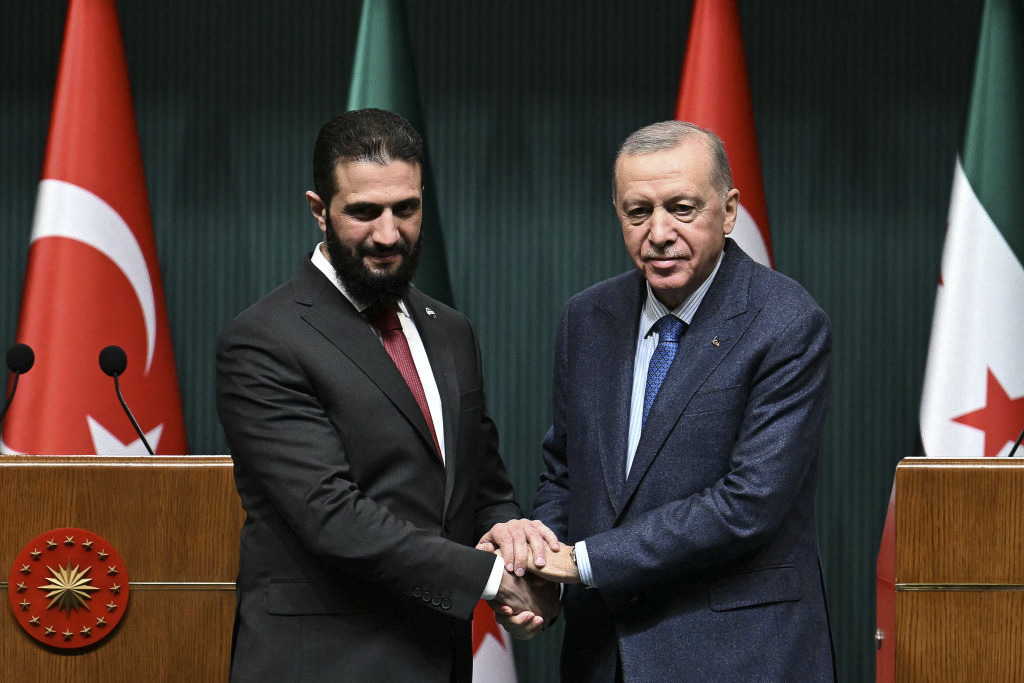
Israel has become increasingly concerned about Turkish President Recep Tayyip Erdogan's attempts to expand his influence in neighbouring Syria, where he played a key role in helping the country's Islamist president, Ahmed al-Sharaa, to overthrow the Assad regime and seize power in December 2024. Pictured: Al-Sharaa shakes hands with Erdogan during a press conference in Ankara, Turkey on February 4, 2025. (Photo by Ozan Kose/AFP via Getty Images)

Amid deepening tensions between Turkey and Israel over Turkish President Recep Tayyip Erdogan's attempts to extend his influence over Syria, Israel's decision to strike a Syrian air base on the outskirts of Idlib is designed to send a clear signal to the Turkish leader to rein in his ambitions.

Since the overthrow of Syrian dictator Bashar al-Assad in December 2024, Syria has increasingly become the focus of the deepening hostility between Israel and Turkey.

In particular, Israel has become increasingly concerned about Erdogan's attempts to expand his influence in neighbouring Syria, where he played a key role in helping the country's new Islamist president, Ahmed al-Sharaa, to overthrow the Assad regime and seize power in December 2024.

Despite repeated Israeli warnings, Erdogan has taken little notice of Israel's concerns, and has continued to expand Turkey's presence into northern Syria, ostensibly to counter the efforts of Kurdish separatists to establish their own autonomous state.

Israel's intelligence establishment, though, presented the US with evidence that Erdogan has other ambitions, which include expanding and solidifying Turkey's military presence at Syrian bases previously used by the Assad regime's Iranian and Russian allies.

It is significant, therefore, that the Israeli airstrikes launched against a Syrian air base in the northern city of Idlib on August 18 took place just hours after a visit by a Turkish delegation to the base. The Turkish officials appear to have been undertaking a reconnaissance mission of the base to assess its suitability for use by the Turkish military.

Syria's state-run Ekhbariya television, citing a military source, reported that Israel had ⁠carried out eight air strikes on the runway and storage facilities at the Abu al-Duhur base in northwest Syria.

The attacks, which were seen as a warning sign to Turkey to stop its military expansion in Syria, drew a sharp response from the Trump administration, which has emerged as a surprise supporter of the new jihadist Syrian regime, and criticised what it called an "unnecessary escalation."

A statement subsequently issued by Israeli Prime Minister Benjamin Netanyahu said the aim of the attack was to stop Turkish military forces from deploying at the base. The statement said Israel and Syria had "agreed to a status quo in security matters" but that Damascus was "on the verge of breaching" the agreement by allowing Turkish troops to deploy at the airbase.

Israel had "repeatedly warned Syria" of the risk, the statement said, but "Syria chose to ignore these warnings."

Turkey dismissed the allegations as "frivolous".

The airstrikes nevertheless highlight the mounting concern within Israeli intelligence circles over Erdogan's expansionist designs in Syria.

Erdogan is one of the Middle East's most enthusiastic supporters of the extreme Islamist Muslim Brotherhood movement, as well as Islamist terror groups such as Hamas, among others. The Turkish leader was instrumental in helping Syria's jihadist Hayat Tahrir al-Sham organisation seize power in Damascus under the leadership of al-Sharaa, who previously had close affiliations with Osama bin Laden's al-Qaeda organisation.

After al-Sharaa was installed as Syria's new president -- a move backed by US President Donald J. Trump as well as other Western leaders -- Israel's intelligence establishment has become increasingly concerned about Turkey's growing influence in Syria, which Israel regards as posing a direct threat to its security.

Israeli officials increasingly regard Erdogan's aggressive posture, both domestically and across the region, as a matter of concern, as they do his constant efforts to reclaim the legacy of the Ottoman Empire.

Turkey's continued financial support for Hamas and its provision of safe haven to Hamas terrorists only adds to Israel's view of Turkey as a hostile actor, an attitude that is not helped by Erdogan's constant use of anti-Israel rhetoric in political campaigning and official communications. In June, for example, Turkey's interior minister called for the "liberation of Jerusalem."

In addition, Erdogan has stated that "Jerusalem is ours," and as recently as March 30, 2025, "May the Lord make Zionist Israel destroyed and devastated."

Erdogan published a 758-page document that outlines his long-term phased plan to take over "Israel, the Middle East and the Free world."

Amichai Chikli, Israel's Minister of Diaspora Affairs, said, "Ahmed al-Sharaa's military is Erdoğan's military. Al-Sharaa's ideology is Erdoğan's ideology. Erdoğan and al-Sharaa's ideology is Al Qaeda and ISIS ideology," and cited what he described as their barbaric treatment of non-Muslim minorities in the region.

Also increasingly questioned is the neutrality of Tom Barrack, US Ambassador to Turkey and Special Envoy to Syria (here, here and here), amid announcements of his departure. It is to be hoped that he will not be granted a "key role" managing US policy in Syria and Iraq.

In an attempt to defuse tensions between Jerusalem and Ankara on the Syria issue, Israel and Turkey conducted talks in Azerbaijan in 2025 intended to agree on an understanding about the two countries' priorities in post-Assad Syria.

While details of the meeting were not made public, the two countries reached broad agreement on a status quo, the essence of which was to respect full Syrian sovereignty over its territory.

Despite this arrangement, Israeli intelligence officials have become increasingly uneasy about Erdogan's plans to expand and entrench Turkey's presence in the country.

Turkish forces currently occupy about 5,000 square kilometres of territory in northern Syria. Turkey has also reportedly taken control of Syrian military and naval bases previously used by Iran and Russia under the Assad regime, at a time when Moscow and Tehran were close allies of Damascus.

There are also concerns about Turkey's wider role in the region after it emerged that Erdogan personally intervened with Trump to block a proposed US-Israel operation whereby thousands of Kurdish fighters, supported by American air cover, would invade Iran with the aim of overthrowing the mullah regime, a plan many Israeli officials believe had a good chance of success had it not been for Erdogan's intervention.

Another potential threat that Syria could pose to Israel's long-term security concerns is the recent discovery of an undeclared nuclear base by the International Atomic Energy Agency (IAEA), where inspectors found several tons of nuclear material which Rafael Grossi, the IAEA's head, said "could be put to bad use."

These are among the many reasons that Israeli security officials are becoming so concerned about Turkey's deepening involvement in post-Assad Syria. They are increasingly of the view that, if Israel is to safeguard the future security of its people, it is vital that Erdogan not be allowed to pursue his expansionist aims in Syria and certainly not to have F-35 stealth fighter jets.


Con Coughlin is the Telegraph's Defence and Foreign Affairs Editor and a Distinguished Senior Fellow at Gatestone Institute.

Source: https://www.gatestoneinstitute.org/22815/syria-turkey-israel

Follow Middle East and Terrorism on Twitter

Iran's President admits US sanctions are hurting the economy - Israel National News


​ by Israel National News

Iranian President Masoud Pezeshkian admits US sanctions are hurting Iran's economy, days after insisting the measures would achieve nothing.


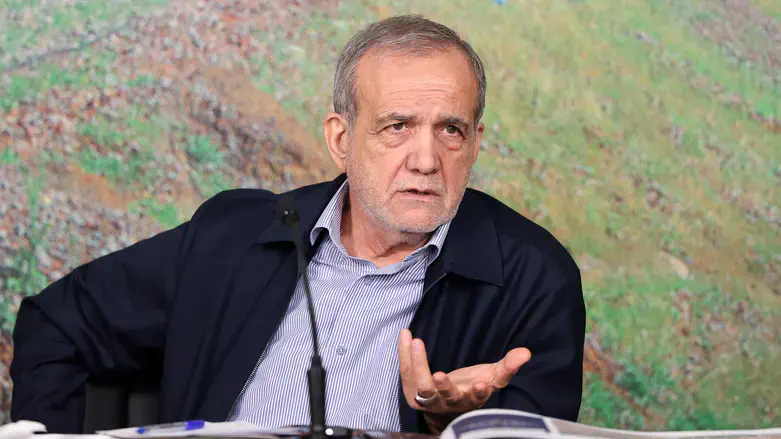
Masoud Pezeshkian
Masoud Pezeshkian                                                       ZUMA Press Wire via Reuters Connect


Iranian President Masoud Pezeshkian has acknowledged that US sanctions are having a significant impact on Iran's economy, reversing comments he made earlier this week that dismissed their effectiveness.

Speaking to Iranian state television late Friday, Pezeshkian addressed claims that sanctions have no effect, saying, “Some say sanctions have no effect at all; to those people, I really don’t know what to say."

He added, “We are in a war situation, and we must accept these wartime conditions."

Pezeshkian said Iran's imports and exports have declined by between 25% and 35% in recent months as the United States maintains a naval blockade of Iranian ports. He also called for an increase in the price of petrol to reflect the decline in trade.

“We should raise the price of the third-tier quota... For example, from 5,000 tomans to 10,000 tomans," he said. The third-tier quota is one of several fuel consumption rates used to determine the price paid by Iranian consumers.

Iran is a major oil producer and has among the world's lowest petrol prices due to extensive government subsidies. Any increase in fuel prices is therefore politically sensitive.

Iranian Vice President Mohammad Jafar Ghaempanah said Wednesday that the US blockade had prevented Tehran from importing sufficient petrol to compensate for a shortfall in domestic production. That same day, however, Pezeshkian had insisted that the latest US sanctions “will not achieve anything."

“We will stand firm against economic pressures, as we have done so far and will continue to do," he told Iranian state media at the time.

Pezeshkian's latest remarks came four days after US Treasury Secretary Scott Bessent announced plans for what he called the “economic asphyxiation" of Iran under "Operation Economic Outcast." Bessent warned that countries refusing to join the US campaign could face consequences.

Iranian officials have rejected the US pressure campaign. Economy Minister Ali Madanizadeh said Tehran was prepared to withstand the sanctions and predicted Washington would suffer “another defeat". He also said the Iranian government had developed a two-year strategy to manage the economic pressure.

“They have done everything they could to test the determination of the Iranian people and the country's officials, but they have failed every time. It seems they wished to suffer yet another defeat," Madanizadeh told Iranian state television.

“We've been waiting for these plans for a long time, and the government is and was ready and has a two-year plan to manage these events," he added.

Deputy Foreign Minister Kazem Gharibabadi likewise argued that the expanded US economic campaign demonstrated that Washington had failed to achieve its military objectives.

“If Washington has achieved its goals, why is there a need for ‘the largest financial invasion in history’?" he asked, portraying the measures as evidence of US failure.


Israel National News

Source: https://www.israelnationalnews.com/news/432414

Follow Middle East and Terrorism on Twitter

CBC allows reporters to describe 9/11 attacks as terrorism without attribution after backlash - Mathilda Heller


​ by Mathilda Heller

As previously reported by The Jerusalem Post on Thursday, the CBC circulated a memo last week to reporters and editors instructing them not to refer to the attacks as “terrorist attacks.”


A sign is seen at the Canadian Broadcasting Corporation building in Toronto, March 25, 2009.
(photo credit: REUTERS/MARK BLINCH)

Following an international outcry about a memo advising reporters to not refer to 9/11 as 'terrorism,' CBC has announced it has revised its editorial guidelines on the matter.

As previously reported by The Jerusalem Post on Thursday, the Canadian Broadcasting Corporation (CBC) circulated a memo last week to reporters and editors instructing them not to refer to the attacks as “terrorist attacks.”

The memo was authored by Basem Boshra, senior director of journalistic standards and public trust at CBC News, and sent to reporters and editors.

CBC spokeswoman Kerry Kelly told the Post that it is the practice of the CBC to “exercise extreme caution before using the words terrorist and terrorism" and that the memo was a reminder of the "longstanding practice that favors the use of these terms with attribution in our reporting."

CBC News will adjust its 9/11 language guidance 

However, on Friday, Chuck Thompson, Head of Public Affairs at CBC, informed the Post that CBC News will adjust its 9/11 language guidance.

World Trade Center on September 11, 2001 (R)
World Trade Center on September 11, 2001 (R) (credit: REUTERS/Sara K. Schwittek)

In a new editor's blog, Boshra (the author of the original memo), noted that "CBC News finds itself once again in a swirl of confusion about how our journalists use the words 'terrorist' and 'terrorism,' this time about the al-Qaeda attacks on New York, Washington, D.C., and Pennsylvania on Sept. 11, 2001."

He noted that the memo caused significant concern, anger and hurt for people who "believe CBC News seeks to minimize or obscure the horror of that day and who was behind it," but said that "that is the last thing we want to do."

"CBC News has never said what happened on Sept. 11, 2001, was not terrorism, as some commentators have stated in recent days. We have reported fully and accurately on the reasons and motivations for those attacks as determined by police, governments and an independent commission."

"CBC's reporting on terrorism, wherever it occurs, has always been guided by the principle of attribution, and like other major news organizations, it has been our practice for decades," he said

Future reporting on other events will continue to require attribution

However, following the uproar, Boshra said that "after reviewing our current language guidance, we have decided to adjust it to clarify that direct attribution is not required for describing the historic events of 9/11 as terrorism."

"We are doing so to remove what has unfortunately (and unintentionally) become an impediment to clarity and public understanding," he said.

Future reporting on other events will continue to require attribution; the new guidance only changes the rule for 9/11. 


Mathilda Heller

Source: https://www.jpost.com/diaspora/antisemitism/article-906971

Follow Middle East and Terrorism on Twitter

Christian leaders urge Trump to create legal pathway for Jewish Canadians facing antisemitism - Nicholas Ballasy


​ by Nicholas Ballasy

The National Association of Christian Lawmakers and its partners asked the administration to direct the State Department and Department of Homeland Security to develop “lawful, secure, and appropriately expedited pathways” for eligible Jewish Canadian nationals and their immediate family members.


A coalition of Christian lawmakers, faith leaders and civic organizations urged President Donald Trump to establish a legal immigration and humanitarian pathway for Jewish Canadians who fear persecution resulting from rising antisemitism in Canada.

In a letter sent to Trump, the National Association of Christian Lawmakers and its partners asked the administration to direct the State Department and Department of Homeland Security to develop “lawful, secure, and appropriately expedited pathways” for eligible Jewish Canadian nationals and their immediate family members.

The letter pointed to what the signatories described as a growing climate of harassment, intimidation, vandalism, threats and violence targeting Jewish communities in Canada since the Oct. 7, 2023, Hamas attack on Israel.

“These numbers represent more than statistics,” the letter read. “They represent families who increasingly question whether they can safely send their children to Jewish schools, worship openly, display their faith publicly, or continue building their lives in communities where they no longer feel secure.”

The group said any immigration program should have remain subject to existing law and national-security screening, including identity, criminal-history, medical and admissibility checks.

The letter also cited growing interest among Jewish Canadians in relocating to the United States. 

Advocates working with affected families reportedly said more than 2,000 Jewish Canadians had expressed interest in moving because of concerns about their safety, the letter said.

The authors pointed specifically to Oklahoma, writing that Jewish and Christian leaders in Tulsa had offered to help receive Jewish Canadian families. Oklahoma Gov. Kevin Stitt had also communicated his willingness to welcome Jewish families seeking safety and opportunity, according to the letter.

The coalition argued that potential immigrants should not be viewed solely as refugees, but as prospective members of American communities.

“They bring talent, faith, family values, entrepreneurship, and a sincere desire to contribute to the Nation that offers them safety and religious liberty,” the letter said.

The signatories applauded Trump for his stated efforts to combat antisemitism and defend religious liberty while urging him to take decisive action on this particular issue.

“Religious liberty must be more than a principle we proclaim; it must be a principle we are willing to defend,” the letter concluded. 


Nicholas Ballasy

Source: https://justthenews.com/government/white-house/christian-leaders-urge-trump-create-legal-pathway-jewish-canadians-facing

Follow Middle East and Terrorism on Twitter

Iran's Regime: 'The Only Solution Is to Build a Nuclear Bomb and Fire It' - Majid Rafizadeh


​ by Majid Rafizadeh

What Happens After President Trump Leaves Office?


  • "The only way to save the country... is building an atomic bomb and firing it, no other way is left for us. We should create a tsunami whose waves hit the American coasts." — Iranian cleric Mohammad Bagher Kharrazi, secretary-general of Iran's proxy, Hezbollah, and closely tied to Iran's current Supreme Leader Mojtaba Khamenei

  • The real question needs to be: What happens after Trump leaves office?

  • The regime's character — Islamist, anti-Western, anti-American and expansionist — has not changed. If Western powers are truly serious, they must work to completely eliminate Iran's present regime.

  • Recent developments show the danger of permitting recovery. Iran's army is claiming that weapons systems damaged in the 2026 war have already been "rebuilt" -- either domestically or after having been imported, and with a shift toward offensive capabilities. Satellite imagery and intelligence assessments reveal rapid reconstruction of missile bases, tunnel entrances, production facilities, and infrastructure — faster than many anticipated. Israeli officials have expressed surprise at the speed of recovery in ballistic missile capabilities. Leaving these arsenals in place would simply make further military efforts more dangerous both for US bases and allies in the Gulf. Any rebuilding of Iran's military infrastructure must be disrupted; leaders driving this belligerency need to be removed from power.

  • Economic isolation also remains critical, as US Treasury Secretary Scott Bessent has laid out, complete with universally enforced secondary sanctions. The European Union should close remaining diplomatic and commercial channels that provide legitimacy or revenue.

  • The West should not have to wait for Iran to acquire a nuclear weapon -- when it would be impossible to stop, which is why the regime wants one -- before taking Iran's threats seriously. The war with the Iranian regime -- to contradict those who claim it was a war of choice – is anything but that. Iran, China and Russia have been trying to take down Western civilization for decades. Only Trump had the vision and the determination to take on these threats.

  • For both US and international security, it is obligatory for the world's leading superpower, the United States of America, to prevent Iran from obtaining nuclear weapons and to protect countless lives. Iran's regime must not be allowed to rebuild its military or remain in power. Every available measure needs to be pursued until the Islamic Republic of Iran is totally dismantled. For decades, half-measures have failed.

  • The alternative is for the West's nuclear-capable adversaries -- whose "only solution" will assuredly put the world at risk -- to succeed in their mission.

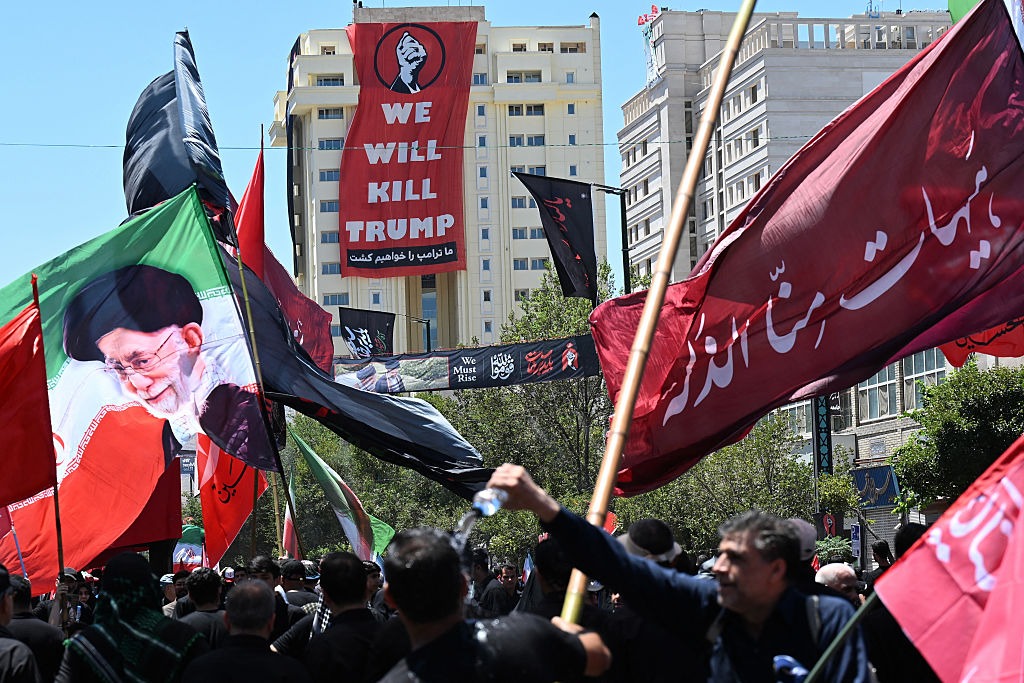
In the ideology of Iran's ruling establishment, nuclear weapons are still openly contemplated not just as a deterrent but as instruments of mass destruction. If an extremist regime acquires a nuclear weapon, the question is: What happens afterwards? The regime's character — Islamist, anti-Western, anti-American and expansionist — has not changed. If Western powers are truly serious, they must work to completely eliminate Iran's present regime. Pictured: Crowds gather for the funeral procession of Iran's late Supreme Leader Ali Khamenei, in Mashhad, on July 9, 2026. (Photo by Wakil Kohsar/AFP via Getty Images)

For anyone who has ever harbored doubts—and for those who still do—that Iran's regime stands against humanity, peace, and the basic norms of civilization, the latest remarks from hard-line Iranian cleric Mohammad Bagher Kharrazi -- secretary-general of Iran's proxy, Hezbollah, and closely tied to the current Supreme Leader -- should be impossible to ignore. "The only way to save the country... is building an atomic bomb and firing it," Kharrazi recently declared, "no other way is left for us.... We should create a tsunami whose waves hit the American coasts".

In the ideology of Iran's ruling establishment, nuclear weapons are still openly contemplated not just as a deterrent but as instruments of mass destruction. If an extremist regime acquires a nuclear weapon, the question is: What happens afterwards?

Iran's primary target, of course, remains Israel. Iranian leaders and their proxies have long framed the Jewish state's destruction as a religious and strategic mission, if not obligation. Israel's compact size, roughly the same as New Jersey (22,000 sq. km.), means that even a single nuclear weapon would cause catastrophic destruction. Moreover, nuclear weapons capability — or the materials and know-how — could be easily transferred to proxies such as Hamas, Hezbollah, the Houthis, or others. These groups have already attacked civilians, shipping, and their neighboring states not even involved in a dispute. A nuclear-armed Iranian regime, or one that arms its network, also assures a regional arms race – already begun by Saudi Arabia trying to build the infrastructure for uranium enrichment, for "peaceful purposes," of course -- at least until they are not.

US President Donald J. Trump has not treated Iran's nuclear ambitions as an ordinary diplomatic disagreement. He has repeated that "Iran Cannot Have a Nuclear Weapon." A regime whose voices openly discuss building and "firing" nuclear weapons, with scenarios of tsunamis against America, cannot be trusted with such capability. This is the language of ideological fanaticism from a theocracy that has spent nearly half a century exporting its revolution, funding terrorism, and crushing dissent at home, complete with the slaughter of "at least 42,000" of its own citizens in just two days, on January 8 and 9, 2026.

The problem is compounded by the fact that Iran's brutal Islamic Revolutionary Guard Corps (IRGC) regime itself remains firmly in place. Iran's new leadership structure has continued to elevate hard-line figures with deep IRGC backgrounds. Under Supreme Leader Mojtaba Khamenei, key security and military posts have been filled with veteran IRGC hardliners — the old guard of anti-American, anti-Israeli ideologues associated with the era of Qasem Soleimani. Appointments of men such as Mohsen Rezaei to the Supreme National Security Council and Ahmad Vahidi to lead the IRGC, rather than signaling any pragmatic shift, instead point to the commitment of Iran's current leaders to outlast Trump's term of office.

The real question needs to be: What happens after Trump leaves office?

Meanwhile, repression inside Iran continues. UN High Commissioner for Human Rights Volker Türk reported that at least 56 people had been executed on national-security charges since March 19, including 27 allegedly involved in the protests earlier this year. Human rights organizations have also documented expedited trials and death sentences against protesters.

The regime's character — Islamist, anti-Western, anti-American and expansionist — has not changed. If Western powers are truly serious, they must work to completely eliminate Iran's present regime.

Recent developments show the danger of permitting recovery. Iran's army is claiming that weapons systems damaged in the 2026 war have already been "rebuilt" -- either domestically or after having been imported, and with a shift toward offensive capabilities. Satellite imagery and intelligence assessments reveal rapid reconstruction of missile bases, tunnel entrances, production facilities, and infrastructure — faster than many anticipated. Israeli officials have expressed surprise at the speed of recovery in ballistic missile capabilities. Leaving these arsenals in place would simply make further military efforts more dangerous both for US bases and allies in the Gulf. Any rebuilding of Iran's military infrastructure must be disrupted; leaders driving this belligerency need to be removed from power.

Economic isolation also remains critical, as US Treasury Secretary Scott Bessent has laid out, complete with universally enforced secondary sanctions. The European Union should close remaining diplomatic and commercial channels that provide legitimacy or revenue.

The West should not have to wait for Iran to acquire a nuclear weapon -- when it would be impossible to stop, which is why the regime wants one -- before taking Iran's threats seriously. The war with the Iranian regime -- to contradict those who claim it was a war of choice – is anything but that. Iran, China and Russia have been trying to take down Western civilization for decades. Only Trump had the vision and the determination to take on these threats.

For both US and international security, it is obligatory for the world's leading superpower, the United States of America, to prevent Iran from obtaining nuclear weapons and to protect countless lives. Iran's regime must not be allowed to rebuild its military or remain in power. Every available measure needs to be pursued until the Islamic Republic of Iran is totally dismantled. For decades, half-measures have failed.

The alternative is for the West's nuclear-capable adversaries -- whose "only solution" will assuredly put the world at risk -- to succeed in their mission.


Dr. Majid Rafizadeh is a political scientist, Harvard-educated analyst, and board member of Harvard International Review. He has authored several books on the US foreign policy. He can be reached at dr.rafizadeh@post.harvard.edu

Source: https://www.gatestoneinstitute.org/22818/iran-regime-nuclear-bomb

Follow Middle East and Terrorism on Twitter

Trade analyst: Tariffs cost Americans $200 billion a year, add $147 to school supplies - Morgan Sweeney


​ by Morgan Sweeney

As summer winds down and students head back to the classroom, parents are paying more to fill their carts with notebooks, backpacks and other school supplies – about $147 more, according to one trade analyst.


(The Center Square) -

Tariffs will cost Americans about $200 billion per year, according to the National Taxpayers Union, and school supplies aren’t exempt from the heightened costs getting passed on to the American consumer.

As summer winds down and students head back to the classroom, parents are paying more to fill their carts with notebooks, backpacks and other school supplies – about $147 more, according to one trade analyst.

The Center Square’s Greg Bishop spoke Thursday with Bryan Riley, director of the National Taxpayers Union’s Free Trade Initiative, on The Center Square’s news show “The States” about how tariffs are affecting the economy.

“Almost everything is driven up by the cost of tariffs,” Riley told Bishop.

But costs aren’t driven up uniformly, Riley said. Tariffs impact some goods more than others.

“In some cases, it’s a big chunk. For clothing, it's a big chunk. In other cases, it’s kind of like getting nickel-and-dimed. Everything, almost everything, costs a little bit more, and it’s a policy that really hurts those lower income households the most, who are least able to afford the cost of the tariffs,” Riley said.

The National Taxpayers Union calculated the added cost to some common kids’ items around this time of year – things like new shoes for sports, calculators, notebooks, writing utensils and new clothes.

On average, tariffs have added $18.80 to the cost of sports footwear, $4.90 to calculators, $0.85 to notebooks and $5.13 to clothing. The average cost of writing utensils increased slightly, from $0.1 to $0.5.

“One of the defenses of these tariffs historically has been, ‘Oh, it's just a little bit, and you won't even notice it when you buy that can of food and when you buy that pack of pencils. But it all adds up,” Riley said.

And that added cost can be especially substantial when the buyer is a school district, which is supported by taxpayer dollars.

“Go to the grocery store, buy a can of beans. It's not going to affect you much. But if you're a school district and you're feeding thousands of kids, that really affects your bottom line, and it directly comes out of the taxpayers’ wallet,” Riley said.

Bishop also spoke to economist Orphe Divounguy after the Bureau of Labor Statistics released its Personal Income and Outlays report for July.

Divounguy confirmed what consumers are feeling: Costs are rising.

“The average household is spending roughly $2,900 more per year to buy the same basket of goods than they did a year ago,” Divounguy said.

But Divounguy also noted other factors besides tariffs.

“You have record government spending that’s pushing interest rates higher. You have the war on the other side of the world that’s affecting oil prices,” Divounguy said.

“If you look at the overall economy right now, if you look at Q2 GDP numbers, what you see is that outside of AI spending, the AI build-out, there isn't much else growing in this economy anymore, and I think that is concerning,” Divounguy said. “Unless you get relief on the tariff front, unless you get relief on the gas front and oil, the energy front, unless you get government to make some adjustments that will result in lower interest rates, not higher interest rates, the consumer is going to continue to feel the pinch.” 


Morgan Sweeney

Source: https://justthenews.com/nation/states/center-square/trade-analyst-tariffs-cost-americans-200-billion-year-add-147-school

Follow Middle East and Terrorism on Twitter

Health Care for All?—Don’t Surrender Your Health Care to the Lords of the Lockdown - Thaddeus G. McCotter


​ by Thaddeus G. McCotter

Medicare for All would turn the lessons of COVID into a permanent surrender of Americans’ health care, liberty, and sovereignty to the Lords of the Lockdown.


Memory is a tricky thing. It can conveniently forget or gloss over your painful experiences of the past. In the case of the COVID-19 pandemic, the Lords of the Lockdown are banking on it.

Indeed, as noted previously, in his own obstinate way, Dr. Anthony Fauci’s tight-lipped non-testimony before a Senate hearing that garnered a contempt of Congress charge was intended to distance both himself and Leftist “experts” from evoking within citizens nightmarish memories of what these and “trust the science” Stalinists foisted upon our free people.

The Left’s entire “woke” movement has developed a bout of convenient amnesia. It is typified by this statement from Representative Alexandria Ocasio-Cortez (D-N.Y.): “I have a local city councilman that has this saying: ‘Woke 1 was crazy’ … I think that during, especially during COVID, I think that the doors were really open in trying to entertain any and every policy that was going to get us to a better place.”

As the article’s author, Jarret Stepman sagely noted, “the problem with peak woke, which Ocasio-Cortez eagerly took part in, wasn’t just over-the-top rhetoric. No, their worst ideas were being forced on the country by our most elite institutions, not just a few isolated crackpots. And they were leading us straight to perdition … The truth is they haven’t changed at all.”

And the radical Left’s long march into the iron grip of socialism continues. Thus, as exemplified by Dr. Fauci and Rep. Ocasio-Cortez, the Left’s COVID-19 denials and diversions are not merely an exercise in retroactive damage control. They are cynically designed to preserve the Left’s future radical aims—such as, Stepman reminds us, “doing things like rationing medicine based on race.”

Let us examine one of the Left’s past and future aims through the prism of its current siren song of “Medicare for All” (formerly “single payer,” formerly “National Health Insurance,” and still “government-run health care”).

As introduced in the House by Rep. Pramila Jayapal (D-Wash.) and in the Senate by Sen. Bernie Sanders (D-Vt.), these “Medicare for All” bills establish a national health insurance program that is administered by the Department of Health and Human Services (HHS). And when they say “all,” they are not talking about all citizens. They are talking about all those who reside in the United States.

Moreover, these bills empower the HHS secretary to further expand coverage; they do not state that a covered individual must legally reside in the U.S. to receive taxpayer-subsidized health care, including “gender-affirming care” and an “abortion.”

Consequently, under the Left’s government-run health care, American citizens are going to be paying more for fewer services and be subject to rationing due to the increased demand spurred by an ever-expanding pool of patients, many of them non-citizens residing in the United States.

Yet this is but one of the pitfalls awaiting those unable to resist the Left’s proffer of “free” government-run health care, and it underscores why the Left is bent upon pushing a mendacious narrative regarding “Woke 1” and COVID.

For what citizens must trade for government-run health care is their liberty and prosperity. Specifically, the sovereign citizens must grant to the government—including its bureaucrats and sundry minions—the ultimate power over their health care … the ultimate power of life or death over them.

And make no mistake: once government gets such power over citizens, they become just another statistic to be balanced against budgetary demands. Sure, the Left will argue that is what insurance companies presently do. But they are also subject to regulation by the government.

When government controls your health care, it will be run by the Lords of the Lockdown, and they will treat patients according to the Left’s “Woke 2” philosophy, which will be “Woke 1” on steroids. Rationing medical care based on race, social cancellations and punishments for not getting vaxxed, “comparative effectiveness” panels to save government money, active euthanasia, et al., will become the invidious norm.

And, unlike insurance companies, when the government runs health care, there will exist no redress, reform, or alternative. It is as my friend, the Learned One, sagely remarked about “universal health care”: “the Woke Left’s single payer proposal will necessarily lead to the government making all of the decisions affecting who gets treated, for what, and at what cost, as well as how in hell we’ll be able to pay for it.”

Succinctly, then, “Medicare for All” is government-run health care for everyone, regardless of citizenship. One supposes this is bitterly fitting because the adoption and implementation of “Medicare for All” would mean Americans have traded their sovereignty for serfdom within the suffocating embrace of the Woke collective’s ideologically driven, government-dictated health care

Photo: Former NIAID Director Anthony Fauci Testifies Senate Committee On Homeland Affairs WASHINGTON, DC - JULY 29: Former director of National Institute of Allergy and Infectious Diseases (NIAID) Anthony Fauci is sworn in before testifying to Senate Homeland Security and Governmental Affairs Committee hearing on July 29, 2026 in Washington, DC. Fauci was expected to be questioned about his diary entries during his handling of the Covid-19 pandemic. (Photo by Anna Moneymaker/Getty Images)


Thaddeus G. McCotter  (M.C., Ret.) is an American Greatness contributor. The Hon. Thaddeus G. McCotter represented Michigan’s 11th Congressional district from 2003 to 2012 and served as Chair of the Republican House Policy Committee. Not a lobbyist, he is a frequent public speaker and moderator for public policy seminars, and a Monday co-host of the "John Batchelor Show" among sundry media appearances.

Source: https://amgreatness.com/2026/08/29/health-care-for-all-dont-surrender-your-health-care-to-the-lords-of-the-lockdown/

Follow Middle East and Terrorism on Twitter

Trump breaks Big Four meat processor grip, restores ranchers’ freedom to process - Amanda Head


​ by Amanda Head

After discontent from the cattle industry and many Republican allies, the latest move to help both ranchers and consumers is a shock to the entrenched ag system.


After cattle country stresses over President Donald Trump's plan to flood the market with cheaper foreign ground-beef trimmings, the 47th president posted that four giant processors have made life “miserable” for American ranchers and that he is authorizing farmers to process their own food if desired or necessary. 

"Trump wants to remove some of the red tape and costs associated with setting up USDA inspected facilities for small producers or areas of the country that don’t have USDA processors to be able to sell their protein to consumers in a legal way," grazier Derek Lange told Just The News last week. 

"Consumers want to buy beef from ranchers and be a part of their story." 

Lange, who runs Citrus Cattle Company in California's Central Valley, spoke about the difficulties of dealing with red tape and getting the meat processed for the consumer.

One of the biggest challenges I had when trying to develop our direct-to-consumer beef business was finding a USDA processor for an operation my size," he said.

"We haul our finished beef two-and- half hours away in order to have our beef USDA processed per the current regulations. To have our beef USDA processed, it costs two and a half times what it would cost at a local custom butcher.

"The way we remove power from the 'Big 4' is to give US ranchers a way to be competitive in the marketplace, and I think Trump understands this.”

Four firms – Tyson, Cargill, JBS and National Beef – handle about 85% of U.S. fed-cattle slaughter. 

Ranchers often face only two to four local buyers, thin cash markets and long hauls to distant plants. Custom processors are booked months ahead and charge $1.20–$1.60 a pound. 

That bottleneck has long squeezed what producers get paid relative to grocery prices, raised shipping and wait costs, and left many ranchers dependent on a few packers they say set the terms. 

Agriculture Secretary Brooke Rollins responded within minutes to Trump’s post Friday. 

“We are on it Mr. President,” she said, promising announcements on Monday to waive processing red tape, let ranchers sell across state lines, back small plants, and fight consolidation – a sudden pivot from import relief to DIY slaughter.​​​​​​​​​​​​​​​​​​​​​​​​​​​​​​​​​​​​​​​​​​​

Tariff-free trimmings are bad for business

Trump announced on Aug. 21 that in an effort to lower beef prices for Americans, he was authorizing the import of 300,000 metric tons of lean beef trimmings with no out-of-quota tariff for 90 days beginning Tuesday. The administration noted that the foreign suppliers committed to selling the beef at 25% below current market price.

Concerns immediately emerged over the import's effect on American ranchers. Allowing 300,000 metric tons of lean beef trimmings in tariff-free for 90 days at a discount would add sudden supply that competes with U.S. cattle, especially cull cows used for grinding. Cattle markets dropped immediately after the announcement. 

American ranchers already face a herd at 1950s lows after drought, high feed costs and liquidation. And rebuilding takes years and needs strong prices to justify keeping heifers instead of selling them. 

Extra cheap imports blunt those signals, shrink margins against packer power, and risk delaying expansion. Industry groups and cattle-state senators say the short-term consumer price play trades away the only durable fix: a larger American herd.

The discontent was not universal, however. 

Lange told Just The News: "I was not too concerned when I heard Donald Trump announce the import of 300,000 tons of beef trimmings to help offset beef costs for taxpayers. Trump is making an effort to help folks with their grocery bills."

Lange also said that most of the tariff-free imported beef will come from Brazil, which was already the case. 

"Brazil is already a major importer of beef to the US and so it’s business as usual," he said. "It doesn’t affect the restocking rates or consumption rates that really determine the long-term price predictions for the market that we are in.”

More freedom for ranchers 

If ranchers can legally slaughter, process, and sell their own beef – especially across state lines – they gain another path besides the Big Four. More small and on-farm outlets mean extra bids for cattle, shorter hauls and a chance to keep more of the retail dollar by selling quarters, hamburger or boxed beef direct. 

Easier inspection rules and support for small plants could cut the cost and delay of getting meat to market. 

That competition is meant to loosen packer leverage, give producers pricing power and reward local processing, instead of forcing every animal through a handful of giant plants. 

How far federal law can actually change remains unclear. 

Forthcoming announcements from Rollins

Rollins has already teased a series of announcements that she vowed to be rolled out Monday, dovetailing off of the president's post. She boasted that American ranchers produce the highest-quality beef in the world and argued that the ability to feed and fuel the country is a matter of national security. 

Monday's announcement, she teased, will include waiving red tape in meat processing, expanding ranchers’ ability to sell across state lines and rescinding outdated guidance that has boxed smaller operators out of the market. 

The USDA (the U.S. Department of Agriculture) would also add technology for faster safety data, she said, so plants can move product without waiting on paperwork. 

Rollins promised “real support” for small processors through funding and deregulation, plus a fight against consolidation so those plants can compete. 

She also said the administration would expand truth in labeling. 

“The world is hungry for American beef,” she wrote, with “much more to come.”​​​​​​​​​​​​​​​​​​​​​​​​​​​​​​​​​​​​​​​​​​​​​​​​​​ 


Amanda Head

Source: https://justthenews.com/government/white-house/trump-breaks-big-fours-grip-and-restores-ranchers-freedom-process

Follow Middle East and Terrorism on Twitter

Mainstream media pushes 'catastrophic climate' narrative, contradicting leading UN climate panel - Kevin Killough


​ by Kevin Killough

While mainstream media coverage of climate change has declined in the Trump-era, some outlets continue to state that storms, floods and droughts are increasing.


Climatologist Judith Curry announced earlier this year she would no longer maintain her influential “Climate Etc.” blog. 

“Climate stupidity” had lost, and it was time to move on, Curry, who has a doctorate in geophysical sciences, wrote in a final entry, 

While the issue of whether climate change is indeed real, or to what extent it is, remains open to debate. Meanwhile, the news media has retreated from its previous focus on climate stories. 

Studies show coverage of climate change has declined in frequency, and news organizations such as The Washington Post and NPR, have significantly downsized their climate desk. 

Some outlets, however, appear to be continuing as if nothing changed. For example, the Associated Press on Monday published a lengthy article that follows the old “climate crisis” script. 

“Scientists have long warned that the world will experience more intense extreme weather events like heat waves, storms, floods and droughts," wrote Peter Prengaman, the newswire service's global climate and environmental news director. "But what once seemed like the realm of fiction is now discussed as a possibility, even an inevitability.” 

The narrative doesn't resonate with audiences like it used to, as evidenced by the declining coverage, which coincides with the changeover from the Biden administration to the Trump administration, and the claim that storms, floods and droughts are increasing is in direct contradiction to the findings of the influential Intergovernmental Panel on Climate Change (IPCC). 

The group is an advisory body of the United Nations for assessing the science related to climate change. It was created to provide international policymakers with regular scientific assessments on climate change. 

No detected change for most extremes

The IPCC’s assessment reports are full of dense, highly technical material that’s difficult for those outside the research community to digest, so most people are informed about trends in extreme weather by the mainstream media, which spent years claiming that hurricanes, tornadoes, floods and droughts are increasing all across the world. 

A recent poll by the left-leaning nonprofit Data for Progress found that 61% of all likely voters, including 72% of Democrats, believe the number of extreme weather events has increased over the past five years. 

In the U.S., according to the IPCC, there has been an increase in the frequency of heat waves. For flooding, drought, winter storms and hurricanes, there has been no detected change. There has also been a decrease in the frequency of cold extremes. 

Globally, heatwaves have increased, according to the IPCC, and cold extremes have declined. For tropical cyclones, tornadoes, drought and flooding, there have been no detected changes. There has also been no detected change in storms, which includes tropical cyclones, extratropical cyclones, and severe convective storms. 

One-stop resource

Climate researcher Roger Pielke Jr. published a website this month that attempts to present the global data on extreme weather trends in a format that's more accessible to a larger audience than the IPCC's assessment reports. It tracks 57 variables across eight types of extremes for every continent. 

Last month, Pielke published a dashboard website that focuses on extreme weather trends in the U.S. The U.S. Extreme Weather and Climate Change Dashboard tracks 32 variables across seven types of extremes: heat waves, tornadoes, flooding, drought, winter storms, wildfire, and hurricanes. 

“I am aiming to have a single place where people can get official data on trends in various metrics of extreme weather that have significant societal impacts. So the characteristic megafauna so-to-speak of extreme weather events,” Pielke told Just the News. 

Pielke’s research has been cited by each of the IPCC’s three working groups, and he’s often been invited to testify before Congress to summarize IPCC research. In May 2024, he was invited to testify before the Senate Committee on the Budget on what the IPCC says about drought. 

The Environmental Protection Agency had a Climate Change Indicators website, which, like Pielke’s dashboards, housed data on heat waves, coastal flooding, wildfires, snowfall, and droughts. The Trump administration removed it as part of a purge of 80 climate-related websites. 

So, Pielke set out to build a website housing this data, which he said is much more comprehensive than the EPA’s Climate Change Indicators site was.  

AI made the dashboards possible

Pielke’s been researching extreme weather and its impacts since he did his post-doctoral work at National Center for Atmospheric Research in the 1990s, and he said he’s always envisioned a resource like the dashboards. Thanks to artificial intelligence, he explained, he was able to create the site without a team of researchers and a lot of funding. 

“It is truly amazing what is possible,” he said. 

The dashboards provide only trend data measuring whether a change has occurred. They don’t undertake what’s called attribution, which looks at why the trends exist, such as contributions from human emissions. Pielke said everything on the dashboards is mainstream science. 

“Everything on the site is widely used, consensus science and consistent with the most recent IPCC,” he said. 

The dashboards also provide data on the area burned by wildfires in the U.S., which has also increased. Global data on wildfires doesn’t have a long enough history to draw any conclusions. 

“The IPCC does not assess wildfire counts or area burned, but I included that because people are interested,” Pielke said. 

Good response, Pielke says

He said the response to the dashboards was better than he expected, and he expected a lot of response. 

“I get lots of traffic, and the sites (US and global) are being used and discussed around the world. People like data, and they like the truth. So I have a ready audience,” Pielke said. 

The one group he’s yet seen any interest from, he said, is reporters working on the climate beat, whose reporting on trends in extreme weather often run contrary to the findings of the IPCC. 

Pielke is not a contrarian, and he argues that climate change poses risks over time. 

He’s also expressed support for efforts to decarbonize the economy. However, he has long criticized the media for its misrepresentations of extreme weather trends. 

His efforts to present science and correct alarmist narratives have gotten him labeled a “climate denier.” The dashboards, Pelke said, are an extension of his ongoing effort to correct what he says is misinformation. 

“I hope it can be used as a resource for people to get the facts, should they want them, and to hold others accountable when they misrepresent the evidence,” he said. 

Pielke said the websites aren’t done, and he will continue to develop and improve them over time based on feedback and suggestions.  


Kevin Killough

Source: https://justthenews.com/politics-policy/energy/ap-article-follows-old-climate-crisis-script-contradicts-ipcc-science-trends

Follow Middle East and Terrorism on Twitter