Thursday, December 8, 2016

Hope and despair in the Persian Gulf - Dr. Reuven Berko


by Dr. Reuven Berko

It turns out that the Sunni Gulf states actually hope for U.S. protection, not confrontation, and hope that President-elect Trump will change U.S. policy in their favor.

U.S. President Barack Obama's mystifying remarks this week warning of damage to both property and persons should there be a confrontation with Islam, along with his calls to shut down Guantanamo Bay, reflect a disconnect from what is happening in the Middle East, since other than an all-out war against radical Islamist organizations and their operatives, no one intends to confront Islam on an individual or state level. At the twilight of his tenure, they are fearful in the Persian Gulf, but they are also optimistic.

An indication of both the fear and the hope is a two-day conference of the Cooperation Council for the Arab States of the Gulf, which came to a close Wednesday night in Manama, Bahrain. The summit was characterized by a fear of abandonment, the consequence of an Obama administration perceived to have neglected America's Arab friends. It turns out that the Sunni Gulf states actually hope for U.S. protection, not confrontation, and hope that President-elect Trump will change U.S. policy in their favor.

The Persian Gulf is dominated not just by the fear they have been abandoned by the U.S., but by the fear that the U.S. has substituted their alliance with an alliance with a new Iranian partner, a "second-tier contractor" for regional order. Now the Gulf waits with baited breath for the return of the No. 1 superpower (for now), and they have high hopes the incoming president will help protect the region.

The Gulf Cooperation Council comprises six member states: Kuwait, Saudi Arabia, the United Arab Emirates, Oman, Bahrain and Qatar. The council was established on May 25, 1981 in Abu Dhabi following the Iran-Iraq War, which served to expose their vulnerability to territorial, economic and religious greed, especially on the part of Iran. This coalition aims to bolster economic and security cooperation among the Gulf states to protect them from external threats to their territories, their religious places and their resources.

The 37th GCC summit is an expression of the vigilance these states require to protect themselves from the challenge presented by terrorist organizations that threaten them at home, but mostly from the increasingly aggressive behavior of Iran. 

Participants at the summit pointed to the chaos and Iranian and Russian involvement in the region in light of America's absence. Media reports that accompanied the conference mentioned the disaster in Aleppo and warned that an Egyptian engineering battalion was assisting the Syrian regime and that Iranian planes had hit Turkish military forces. From their perceptive, the lack of an American presence has enabled Iran to get involved in Syria, Iraq, Yemen and Libya, and for other hostile actors, like Russia, to help fill the vacuum.

And indeed, Iranian involvement in the region has been accompanied by that country's increasing harassment of the Gulf states, including provocations by Iranian Shiite pilgrims during the Haj in Saudi Arabia, the discovery of spy networks and Iranian subversion in Saudi Arabia and other Arab countries, the conquest of islands and outposts in the Persian Gulf, provocative behavior by the Iranian Navy (including toward U.S. forces) and overt military support to the Houthis in Yemen, who are attacking targets in Saudi Arabia, including shooting missiles toward Mecca and Medina, the two holiest cities in Islam.

The attempt to establish a common operative military body for the Gulf states failed despite the threat presented by the Houthi rebels in Yemen, who represent Iran's violent infiltration of the peninsula. Initial reports in the Arab media point to the failure of the Gulf states to overcome internal sectarianism and issues of self-interest. The exclusion of Al Jazeera, which is owned by Gulf Council member Qatar, from the summit was symbolic of this alienation. Nevertheless, the conference was given legitimacy through the attendance of British Prime Minister Theresa May and her call for the establishment of a road map for strategic cooperation because "Gulf security is our security." 

At the summit, Great Britain was a pillar of support for the Arabs. The assembled called for Iran to end its involvement in terror, subversion and the internal affairs of Gulf states. The states agreed there is no military solution in Iraq and Syria, only negotiations. They were also in agreement on the need to help Iraq in its fight against Islamic State and the need for an international effort to find a solution for Yemen. The Palestinian issue -- and the widely held belief that Palestinian Authority President Mahmoud Abbas is the heart of the Arab people -- did not receive any mention from the Arabs or the British, whom Abbas recently called "Balfour criminals."

The prevailing fear in the Gulf is not just that they have been abandoned by the U.S., but that the U.S. has substituted a new Iranian partner in their place.


Dr. Reuven Berko

Source: http://www.israelhayom.com/site/newsletter_opinion.php?id=17829

Follow Middle East and Terrorism on Twitter

Copyright - Original materials copyright (c) by the authors.

The Dragon of Islamic Terrorism - Dex Quire


by Dex Quire

Novels tracking fundamentalist religious groups transplanting themselves into secular urban zones in the West go unwritten. Movies showing much of life under Islam go unfilmed. Satire of Muslim fundamentalism goes unproduced, while mockery of Christianity abounds.

  • The dragon's first major tongue-dart at the West was the death threat -- a fatwa with a bounty issued in 1989 by Iran's Supreme Leader, Ayatollah Khomeini -- on Salman Rushdie, a British citizen, for his novel, The Satanic Verses.
  • What the dragon learned with that initial thrust! The West was so genteel. The United Nations issued condemnations on -- paper! Diplomats wrote scare-letters. Politicians said harrumph.
  • How different if politicians and diplomats in the West had delivered the simple and forceful message back to the Ayatollah: Unless you remove this threat, we will cancel all diplomatic visas.
"The worst part of the dragon is in the tail." You do not have to know what it means; it gives off a spooky authority. This thought was written by Guillermo Cabrera Infante, the great Cuban writer who knew something about dragons' tails: he had confronted Fidel Castro and lived to tell about it. While on a diplomatic mission to Brussels in 1965, he denounced Castro, abandoned his post and lived out a life of exile in London until his death in 2005. He never went back.

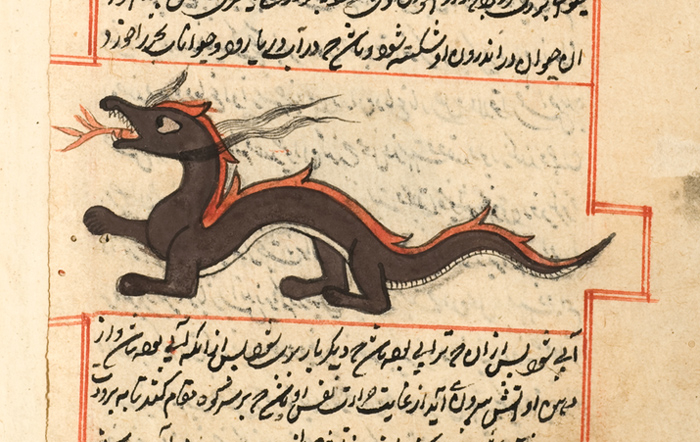
For a minute, let us call the dragon Islamic Terror (we shall get back later to the tail). There is much about the dragon we do not know: where he lives exactly, his vulnerabilities, his comings and goings, his next attacks, his feeding schedule. We do know that he foments terror and inspires fear. From the front part of the dragon, his snout, emerges a tongue flick -- tasting the air, sensing out fresh victims. His first major tongue-dart at the West was the death threat -- a fatwa with a bounty issued in 1989 by Iran's Supreme Leader, Ayatollah Khomeini -- on Salman Rushdie, a citizen of Britain citizen, for his novel, The Satanic Verses.

What the dragon learned with that initial thrust! The West was so genteel. The United Nations issued condemnations on -- paper! Diplomats wrote scare-letters. Politicians said harrumph.


(Image source: wikia.com)

Rushdie, on the other hand, was forced into hiding under armed, protective custody. Khomeini -- who had just shoveled half a million young Iranians into a war with Iraq -- in addition to exterminating thousands of "enemies of the Islamic Revolution" -- also learned a lot about us. The response of the West was phlegmatic. The vast apparatus of publishing and communications zipped itself into a giant mouse suit and decided it looked great (so lifelike). Penguin Books chose not to print its address in the paperback edition of The Satanic Verses, as if that would hide it. Major book chains refused to stock the novel and libraries "disappeared" it from their shelves. Fellow novelists from around the world, from the safety of their hearths, proclaimed, "We are all Salman Rushdie."

Even dragons know that novels, feeble though they may be, are the carriers of culture, core samples of a civilization's memory. The dragon learned that in the West, it did not matter that fighter aircraft sear the skies at patriotic festivals, that nuclear submarines flow through ocean canyons, that warships ride the world's watery trails. The West was not about to stick up for those who traversed the holies of Islam; instead, it clenched in fear and never unclenched.

How different the world would be if, in 1989, every publisher -- large and small -- had published some portion of The Satanic Verses on their front pages. How different if politicians and diplomats in the West had delivered the simple and forceful message back to the Ayatollah: Unless you remove this threat, we will cancel all diplomatic visas. But they did not, and this is now our world.

Novels tracking fundamentalist religious groups transplanting themselves into secular urban zones in the West go unwritten. Movies showing much of life under Islam go unfilmed. Satire of Muslim fundamentalism goes unproduced, while mockery of Christianity abounds. Comedians such as Penn Jillette, Sara Silverman, and Monty Python's Michael Palin -- entertainers who have grown wealthy proclaiming their atheism or mocking Christianity and Judaism -- openly confess their fear of Islam; really just open confessions of cowardice. It should cover us in shame. "Cowardice," wrote the novelist Mikhail Bugokov, in the darkest days of Stalin's 1930s, "is the worst sin."

The dragon doubtless now knows more about us than we know about him. But if we can reassert our freedoms -- faith, speech, ideas, laughter and definitely mockery -- we can still avoid his tail.
Dex Quire is a Seattle writer whose latest novel is Crocodile Words.
Source: https://www.gatestoneinstitute.org/9506/dragon-islamic-terrorism

Follow Middle East and Terrorism on Twitter

Copyright - Original materials copyright (c) by the authors.

How The Establishment Will Try To Destroy Trump - Ann Coulter


by Ann Coulter

The war is already underway.

Shortly before Thanksgiving, New York Times columnist Frank Bruni wrote a column that should chill you to the bone.

Titled “Donald Trump’s Demand for Love,” Bruni said: “I had just shaken the president-elect’s normal-size hand and he was moving on to the next person when he wheeled around, took a half step back, touched my arm and looked me in the eye anew. ‘I’m going to get you to write some good stuff about me,’ Donald Trump said.”

Bruni is a fabulous writer, but if he ever writes good stuff about you, Mr. President-elect, YOU WILL HAVE FAILED.

I assume this was just our president-elect doing something he gets the least credit for, which is being nice. But you can never be too careful.

The Times is in total opposition to Trump’s stated goal to make America great again. Trump has got to know — not next year, but by 5 p.m. today — that anyone pursuing his agenda will incite rage, insanity and spitting blood from that newspaper.

There’s a long and tragic history of Republicans who won the war but lost the peace by trading results for respectability.

The first President Bush not only promised not to raise taxes, but also laid out the steps Democrats would take to get him to break that promise. “And the Congress will push me to raise taxes,” he said in his iconic 1988 convention speech, “and I’ll say no, and they’ll push, and I’ll say no, and they’ll push again, and I’ll say to them, ‘Read my lips: No new taxes.’”

He was a good prognosticator! Congress did exactly as he’d anticipated. But instead of saying “no,” Bush caved.

That betrayal cost the GOP its most popular issue. As the Times’ Michael Wines put it (shortly before Bush predictably lost his re-election bid), with the president’s sellout, Republicans gave up “a political weapon so fearsome that it had destroyed three Democratic presidential candidates in 12 years.”

The Times had spent months hectoring Bush about the “yawning deficit,” denouncing his “obdurate refusal” to raise taxes, and promising “political popularity” for the “needed” tax hike. But the moment Bush raised taxes, the Times couldn’t stop crowing about his broken promise.

That was always the whole point. Not the “yawning deficit.” Not raising revenue. But to get the GOP to give up its most potent issue.

Trump has just annihilated 16 far more experienced Republican rivals, the Clinton machine and the entire media/Hollywood/Wall Street complex by raising the one issue no other politician would touch: putting America’s interests first on immigration.

What promise do you think they want Trump to break?

Luckily for the country, Trump doesn’t seem obsessed with what the elites think of him. But his advisers include just the type of Republicans whose second-tier law schools make them particularly susceptible to the cheap respectability of establishment media approval.

Trump has been a politician for only a little more than one year. He has no experience with the tricks that will be played to get him to betray voters on his signature issue. The first president Bush knew what was coming — and he still broke his promise.

Manifestly, if anyone in Washington seriously wanted to build a wall, deport illegals, return criminal aliens to their own countries, end the anchor baby scam and prevent jihadists from immigrating here to kill Americans, it would have been done already.

Nearly every promise Trump made on immigration is 100 percent within the power of the president. For example:

It is already the president’s job, as commander in chief, to protect the borders.

It is already the Department of Defense’s job to build border walls.

It’s already the law that citizenship is not acquired by being born on U.S. soil to an illegal alien. (No Congress has ever passed such a law, nor has the Supreme Court ruled that they are.)

It is already the secretary of state’s duty to rescind visas from countries that refuse to take their criminals back.

It is already the president’s job to prohibit the entry of any class of immigrants he deems “detrimental to the interests of the United States.”

It is already the president’s job to remove immigrants who commit crimes, entered our country through fraud (i.e., every single refugee), are in the country illegally or who become public charges.

None of those things have ever been done before for one reason: The entire Washington establishment is unalterably opposed to enforcing our immigration laws.

Trump will have no trouble enacting the rest of his agenda. If congressional Republicans are good for anything, it is to repeal Obamacare, cut taxes and regulation, confirm good judges and protect the Second Amendment. No one but Trump would have done it, but not even Nancy Pelosi is going to attack Trump for keeping jobs in America.

Only when it comes to immigration will Trump be Gary Cooper, out there alone against every powerful entity in America. Just as he was during the campaign.

On immigration, Trump will be furiously opposed by: Democrats, Republicans, the permanent bureaucracy, the Chamber of Commerce, George Soros, The Wall Street Journal — in fact, the entire media, except four webpages, six bloggers and five talk-radio hosts — and hundreds of taxpayer-funded immigrant grievance groups. And that’s just off the top of my head.

He’ll even be opposed by his own hand-picked U.N. ambassador! (It is an amazing fact that at the 2016 State of the Union, both the Democratic president’s address, and the Republican governor’s response, attacked candidate Trump’s immigration proposals.)

There’s a reason millions of Americans were showing up at Trump’s rallies chanting, “Build the Wall!” and not, “End Obamacare!” “Cut taxes!” “Save the Second Amendment!” — or any other slogan that could have been chanted just as easily at a Jeb! Rally.

There are only a handful of people in the entire country with the knowledge and ability to enforce our immigration laws. Any Cabinet appointees likely to impress The New York Times aren’t going to get it done. They won’t have to expressly defy Trump. They just won’t do it.

Perhaps they’ll make some showy effort at deporting illegals — and then back down at the first La Raza lawsuit. Or they will allow career government lawyers to submit briefs in court that cite all the wrong cases. Or they’ll wait for Speaker Paul Ryan’s approval to do anything. Or they’ll be moved by a Nikki Haley speech about the vibrant diversity of Somali refugees. Or they’ll be scared off by Washington bureaucrats who say, You can’t do that!

But if Trump chooses from among the few people who know how to get it done (Kris Kobach, Kris Kobach or Kris Kobach), his promises will be kept. He can relax. He can spend all his time playing golf, living in Trump Tower, yelling at American CEOs trying to outsource jobs — and engaging in appalling conflicts of interest with his businesses.

He could even shoot someone on Fifth Avenue. (I propose GOP consultant Rick Wilson!)
Trump is down to his last wish from Aladdin. He can impress The New York Times, or he can make America great again. But he can’t do both.


Ann Coulter

Source: http://www.frontpagemag.com/fpm/265078/how-establishment-will-try-destroy-trump-ann-coulter

Follow Middle East and Terrorism on Twitter

Copyright - Original materials copyright (c) by the authors.

Israel, Cyprus and Greece ties forge ahead with trilateral rescue unit - Herb Keinon


by Herb Keinon

Israel PM Netanyahu, Greek PM ALexis Tsipras and Cyprus President Anastasiades agreed on the new force on a trilateral summit held on Thursday.


Israeli PM Netanyahu, Greek PM Tsipras and Cyprus President Anastasiades in a trilateral summit
Israeli PM Netanyahu, Greek PM Tsipras and Cyprus President Anastasiades in a trilateral summit. (photo credit:KOBY GIDEON/GPO) 


Israel, Greece and Cyprus have agreed to the formation of a joint emergency and rescue force that will deal with disasters such as fires, floods and earthquakes, Prime Minister Benjamin Netanyahu said Thursday at a trilateral meeting with Greek Prime Minister Alexis Tsipras and Cyprus President Nicos Anastasiades.

After meeting separately with each of the leaders, Israeli PM Netanyahu said that the assistance Cyprus and Greece extended to Israel last month in putting out the fires across the country was both “invaluable” and “deeply appreciated.”

This is a “concrete example of how this cooperation can save lives,” he noted, adding that other countries were invited to join the emergency force that will be set up.

Thursday's trilateral meeting was the second in less than 12 months, and a sign of the strategic relationship that has developed between the three countries. The last meeting was held in January in Nicosia, and the next will be held in Salonika.

Netanyahu lauded the relationship as one of “genuine friendship and sympathy of our three peoples to each other.”

Up until the early 2000's Greece and Cyprus were among the most critical countries toward Israel in Europe. This changed, however, in the middle of the last decade with Israel's discovery of natural gas in the Mediterranean, and because of a sharp deterioration in Israeli-Turkish ties.

Tsipras said that cooperation between the two countries “is a strategic choice” for Greece and a “lever of growth.” He said that he was both “happy and proud” of the role Greek firefighting pilots played in putting out the fires that ravaged the country last month.

Tsipras added that he held meaningful and sincere discussions with Netanyahu about strengthening ties, and global developments, saying: “We were honest in expressing our disagreement.” The relationship, he said, was based on honesty. 

Regarding energy issues, which always play a dominant role in discussions between the three countries, he said that Greece aims to “be an energy transit center for Israeli and Cypriot natural gas to Europe.”

According to Tsipras, teams from the countries will discuss the Eastern Mediterranean pipeline, with emphasis on the strategic importance of the recent purchase of two gas fields from Israel by Greek companies.

One Israeli source said this purchase was important for Greece in that it gave them a practical stake and concrete involvement in the natural gas finds in the region.

Tsipras referred to talks underway to find a solution to the northern Cyprus issue, saying that given the other crisis in the region, it is “more imperative than ever” to find a “liveable and just solution.” He supported Anastasiades in his efforts. He also said that it was also “imperative” to resume Israeli-Palestinian talks that will lead to a two state solution.

Anastasiades thanked Israel for its support in the current diplomatic efforts to solve the northern Cyprus issue, and also referred to the importance of creating a climate to allow the resumption of negotiations that would “recognize the security of Israel” and at the same time “lead to the creation of a Palestinian state.”


Herb Keinon

Source: http://www.jpost.com/Israel-News/Politics-And-Diplomacy/Israel-Cyprus-and-Greece-ties-forge-ahead-with-trilateral-rescue-unit-474816

Follow Middle East and Terrorism on Twitter

Copyright - Original materials copyright (c) by the authors.

Wednesday, December 7, 2016

Michael Flynn and What he Means for Trump's Foreign Policy - Caroline Glick


by Caroline Glick


Why Tehran is worried.


Originally published by the Jerusalem Post. 


In the US and around the world, people are anxiously awaiting US President-elect Donald Trump’s announcement of his choice to serve as secretary of state. There is no doubt that Trump’s choice for the position will tell us a great deal about the direction his foreign policy is likely to take.


But the fact is that we already have sufficient information to understand what his greatest focus will be.


Trump’s announcement last week that he has selected Marine General James Mattis to serve as his defense secretary is a key piece of the puzzle.


Mattis has a sterling reputation as a brilliant strategist and a sober-minded leader. His appointment has garnered plaudits across the ideological spectrum.


In 2013, US President Barack Obama summarily removed Mattis from his command as head of the US Military’s Central Command. According to media reports, Mattis was fired due to his opposition to Obama’s strategy of embracing Iran, first and foremost through his nuclear diplomacy. Mattis argued that Iran’s nuclear program was far from the only threat Iran constituted to the US and its allies. By empowering Iran through the nuclear deal, Obama was enabling Iran’s rise as a hegemonic power throughout the region.


Mattis’s dim view of Iran is shared by Trump’s choice to serve as his national security adviser. Lt. General Michael Flynn’s appointment has been met with far less enthusiasm among Washington’s foreign policy elites.


Tom Ricks of The New York Times, for instance, attacked Flynn as “erratic” in an article Saturday where he praised Mattis.


It is difficult to understand the basis for Ricks’ criticism. Flynn is considered the most talented intelligence officer of his generation. Like Mattis, Obama promoted Flynn only to fire him over disagreements regarding Obama’s strategy of embracing Iran and pretending away the war that radical Islamists are waging against the US and across the globe.


Flynn served under Obama as the director of the Defense Intelligence Agency. He was fired in 2014 for his refusal to toe the administration’s mendacious lines that radical Islam is not the doctrine informing and inspiring the enemy, and that al-Qaida and its fellows are losing their war.


What Obama and his advisers didn’t want to hear about the US’s enemies and about how best to defeat them Flynn shared with the public in his recently published book Field of Fight, which he coauthored with Michael Ledeen, who served in various national security positions during the Reagan administration.


Flynn’s book is a breath of fresh air in the acrid intellectual environment that Washington has become during the Obama administration. Writing it in this intellectually corrupt atmosphere was an act of intellectual courage.


In Field of Fight, Flynn disposes of the political correctness that has dictated the policy discourse in Washington throughout the Bush and Obama administrations. He forthrightly identifies the enemy that the US is facing as “radical Islam,” and provides a detailed, learned description of its totalitarian ideology and supremacist goals. Noting that no strategy based on denying the truth about the enemy can lead to victory, Flynn explains how his understanding of the enemy’s doctrine and modes of operation enabled him to formulate strategies for winning the ground wars in both Iraq and Afghanistan.


And win them he did. As he explains in his book, Flynn oversaw the transformation of the US’s strategies for fighting in both theaters from strategies based on top-down decapitation of the enemy’s leadership to a groundup destruction of the terrorist networks.


Flynn’s strategy, which worked in both countries, was based on the premise that it wasn’t enough to kill “high value” targets. The US needed to develop a granular understanding of the terrorist networks from the village level up the line. Only by taking out the local terrorist leaders would the US be able to destroy the ability of the likes of al-Qaida, the Iranian-controlled Shi’ite militias and the Taliban to quickly mobilize new forces and reignite fighting shortly after every successful US operation.


Flynn’s book contributes three essential insights to the discussion of the global jihad. First, he explains that the Bush and Obama administrations were both unable to translate military victories on the ground into strategic victories because they both refused to join their military war with a war of ideas.


The purpose of a war of ideas is to discredit the cause for which the enemy fights. Without such a war, on the one hand the American people sour on the war because they don’t understand why it is important to win. On the other hand, without a war of ideas directed specifically at the Islamic world, Muslims worldwide have continued to be susceptible to recruitment by the likes of ISIS and al-Qaida.


As Flynn notes, the popularity of radical Islam has skyrocketed during the Obama years. Whereas in 2011 there were 20,000 foreign recruits fighting for ISIS in Iraq and Syria, by 2015, the number had risen to 35,000.


Flynn’s second contribution is his forthright discussion of the central role the Iranian regime plays in the global jihad. Flynn chronicles not only Iran’s leadership of the war against the US in Iraq and Afghanistan. He shows that their cooperation is global and predates 9/11 by several years.


Flynn recalls for instance that in 1996 British troops confiscated an al-Qaida training manual written by Iranian intelligence in a terrorist training facility in Bosnia. Six Iranian “diplomats” were arrested at the scene.


Flynn is unflinching in his criticism of the Obama administration’s moves to develop an alliance with Iran. And he is almost equally critical of George W. Bush’s war against terror.


For instance, Flynn argues, “It was a huge strategic mistake for the United States to invade Iraq militarily.”


Iran, he said was the main culprit in 2001 and remains the main enemy today.


“If, as we claimed, our basic mission after 9/11 was the defeat of the terrorists and their state sponsors then our primary target should have been Tehran, not Baghdad, and that method should have been political – support of the internal Iranian opposition.”


Flynn’s final major contribution to the intellectual discourse regarding the war is his blunt identification of the members of the enemy axis. Flynn states that the radical Islamic terrorist armies operate in cooperation with and at the pleasure of a state alliance dominated by Russia and Iran and joined by North Korea, Venezuela and other rogue regimes. Flynn’s frank discussion of Russia’s pivotal role in the alliance exposes the widely touted claims that he is somehow pro-Russian as utter nonsense.


In Flynn’s view, while Russia is Iran’s primary partner in its war for global domination, it should not be the primary focus of US efforts. Iran should be the focus.


In his words, the best place to unravel the enemy alliance is at its “weakest point,” which, he argues, is Iran.


Flynn explains that the basic and endemic weakness of the Iranian regime owes to the fact that the Iranian people hate it. To defeat the regime, Flynn recommends a strategy of political war and subversion that empowers the Iranian people to overthrow the regime as they sought to do in the 2009 Green Revolution. Flynn makes the case that the Green Revolution failed in large part because the Obama administration refused to stand with the Iranian people.


Flynn is both an experienced commander and an innovative, critical, strategic thinker. As his book makes clear, while flamboyant and blunt he is not at all erratic. He is far-sighted and determined, and locked on his target: Iran.


Whoever Trump selects as secretary of state, his appointment of Mattis on the one hand and Flynn on the other exposes his hand. Trump is interested in ending the war that the forces of radical Islam started with the US not on September 11, 2001, but on November 4, 1979, with the seizure of the US embassy in Tehran.


With Mattis and Flynn at his side, Trump intends to bring down the Iranian regime as a first step toward securing an unconditional victory in the war against radical Islam.


Caroline Glick is the Director of the David Horowitz Freedom Center's Israel Security Project and the Senior Contributing Editor of The Jerusalem Post. For more information on Ms. Glick's work, visit carolineglick.com.

Source: http://www.frontpagemag.com/fpm/265067/michael-flynn-and-what-he-means-trumps-foreign-caroline-glick

Follow Middle East and Terrorism on Twitter

Copyright - Original materials copyright (c) by the authors.

The Regional Vision Of Iran's Islamic Regime And Its Military-Political Implementation, Part I - A. Savyon, Y. Carmon, and U. Kafash


by A. Savyon, Y. Carmon, and U. Kafash

The Ideological Doctrine: Exporting The Revolution; Iran As 'Umm Al-Qura'

Introduction

Since its beginning, the regime of Iran's Islamic Revolution has championed the idea of exporting its Revolution to the entire Muslim world. This doctrine is rooted in the thinking of the Revolution's founder, Ayatollah Ruhollah Khomeini, particularly in his book Al-Hukuma Al-Islamiyya ("The Islamic Government," Beirut, 1979). In the book, he presented his perception negating the existence of peoples and states in Islam, and aspiring to actualize Islamic unity. Khomeini defined himself as a Muslim, not as an Iranian or a Shi'ite, and the Revolution as Islamic, not Iranian or Shi'ite. In his view, nationalism is an imperialistic plot to weaken and divide the Islamic world, and Islamic unity is the way to restore Islam to its greatness. The regime in Iran is the jumping-off point for a "comprehensive Islamic Revolution," and exporting the Revolution is the tool for attaining Islamic unity.


Ayatollah Ruhollah Khomeini (image: Fars)


This concept, which Iranian revolutionary ideologues have called Umm Al-Qura – one of the names of Mecca – considers Iran the true Mecca, that is, Iran is the religious, spiritual, and political center of the Muslim world. These ideologues have set out a vision and a mission to spread revolutionary Shi'ite Islam across the geographic and religious region of the Islamic world.

According to this doctrine, Iran appropriates the leadership role of the Sunni Islam that is based on Mecca and on that city's historic role in Islamic history, as part of the generations of political and religious struggle between the Shi'a and the Sunna. This constitutes also an additional layer in the intra-Islamic philosophical discussion on what form an Islamic regime should take, and of how to rebuild the Islamic world after centuries of repeated defeat by Western civilization.

In principle, it is an overall Islamic view, shared by both Sunnis and Shi'ites, that Islam not only defines sovereign borders but also demands the loyalty of Muslims living outside the borders of the Islamic state and their obedience to this state's ruler.[1] Thus, it is no wonder that the concept of Umm Al-Qura as the political-religious center of the entire Islamic world was developed in the modern era by the Sunni thinker Abd Al-Rahman Al-Kawakibi in the late 19th century, on the eve of the collapse of the Ottoman Empire, the last Islamic caliphate. In his book Umm Al-Qura, published in 1901, Al-Kawakibi proposed a doctrine for rehabilitating the status of Islam and the Muslims, which centered on restoring the Arabs, who have a separate and unique ethnic identity not shared by the other Muslim peoples, as leaders of the Islamic world, and also on bringing Muslims back to the original Salafi Islam. In Al-Kawakibi's thought, two ideological aspects had nourished two different movements in the Arab and Muslim world of the modern era: the anti-imperialist national Arab movement, and the Islamic Salafi movement, from which emerged the various Islamic jihadi movements.

Al-Kawakibi (image: Aljazeera.com)
The Umm Al-Qura concept was espoused, and upgraded, by Iranian revolutionary ideologues, who adapted it to the needs of Iran's Islamic Revolution. For example, Ayatollah Sadeq Taqi Mesbah Yazdi published, in the autumn of 1996, an article titled "The Authorities of the Ruler of the Jurisprudent [Vali-e Faqih] Outside The Borders [Of the State]," in the Islamic Regime journal of the Center of Scientific Research of the Assembly of Experts.[2] In his article, Mesbah Yazdi stressed that Muslims are obligated to pledge allegiance (i.e give ba'ya) and obey the worthy Islamic ruler regardless of geographic borders, ethnic affiliation, linguistic association, or anything else. He said: "From the point of view of Islam, the main element for the unity of the ummah and Islamic society is the unifying of faith, and there is no validity at all in the unity of states and in the existence of geographic borders, whether natural or agreed-upon... If a certain Islamic state is run by the Rule of the Jurisprudent, its ruler has supremacy... Therefore, his order is binding for every Muslim, and even Muslims in non-Islamic countries must obey him."[3]

Ayatollah Mohammad Taqi Mesbah Yazdi (image: Farsnews.com)
It should be noted that the Iranian ideologues' view of the Umm Al-Qura concept is not aimed against the imperialist West – that is, the U.S, Israel, and so on – as it is camouflage for Iran's effort to expand the hegemonic Iranian-Shi'ite territory within the Islamic world at the expense of the historic Sunni hegemony that has prevailed in the Middle East for 14 centuries. Although hatred for America, the Great Satan, and Israel, the Little Satan, as well as antisemitism, are central elements in the ideology of the Islamic revolutionary regime in Iran, the concept of Umm Al-Qura, which deals with the historic Shi'ite-Sunni conflict, is not directed against them.


Burning Israeli and American flags (image: ISNA, Tasnim, Iran, July 1, 2016)

The hatred for the U.S. and Israel are two ideological focal points that serve the concept of Umm Al-Qura as camouflage for the Iranian-Shi'ite aspiration to expand Iranian hegemony at the expense of the Sunni hegemony in the region. Dialogue with the U.S., the Great Satan, and even with Israel is possible and has been carried out in the past when necessary, but the Iranian-Shi'ite hostility towards Sunni Islam in the region and the struggle against are existential issues as far as revolutionary Iran is concerned.

Iranian spokesmen take care not to present the Umm Al-Qura concept as an Iranian doctrine aimed at expanding Iran's hegemony. In order to conceal their real aim, and to keep Sunni Muslims in the dark and recruit them to join the Iranian struggle for regional hegemony, Ayatollah Khomeini coined the saying "The path to Jerusalem goes through Karbala" – that is, the struggle for the ultimate Islamic goal (Jerusalem) goes through Iranian control of areas that historically been part of Sunni hegemony (Karbala in Iraq). This slogan is reiterated by Iranian regime officials and the Iranian military leadership today as well. Thus, even Iranian-Shi'ite involvement in fighting the Sunni Islamic State (ISIS), which is presented by the Iranian regime as a justified struggle against terrorism, constitutes effective cover for the Iranian-Shi'ite striving for regional hegemony, by deliberately eliminating every center of Sunni power in the arena of the fighting – Iraq, Syria, and Yemen – so as to create a contiguous swath of Iranian hegemony from the Indian Ocean to the Mediterranean.[4]

This strategy was not completely clear, because Iran had refrained from direct involvement in Sunni-Shi'ite conflicts, acting only via proxies – and its spokesmen have publicly denied such action and stressed that Iran has never started a war against its neighbors. But it was recently revealed when Iran began direct military involvement in Sunni-Shi'ite areas of conflict. In the past few years, senior Iranian officials have begun to express this strategy openly.

Thus, for example, Ali Younesi, advisor to Iranian President Hassan Rohani and a former intelligence minister, stated, in March 2015, that Iran was once again an empire as it had been in the past, and that its capital, Iraq, was "the center of Iranian heritage, culture, and identity."  He stressed that the Iranian Islam is the pure Islam, with no Arabism, racism, or nationalism.[5]

Ali Younesi, advisor to Iranian President Hassan Rohani (image: En.alalam.ir)
Ali Akbar Velayati, advisor to Iranian Supreme Leader Ali Khamenei, said in February 2013: "Iran has planned defensive positions outside its borders and linked its fate to the fate of the Islamic countries, and therefore will support people such as [Syrian President] Bashar Al-Assad to the end."[6]

Ali Akbar Velayati (image: Farsnews.com)
Ayatollah Mohammad Baqr Kharazi, director-general of Hezbollah Iran and part of the elite of the Iranian regime, presented a plan in 2010 for establishing "Greater Iran" in the Middle East, Central Asia, the Caucasus, and Afghanistan, in the first stage, and for creating a union of Islamic countries under Iran's leadership.[7] In 2013, he promised that if he were elected president he would restore Tajikistan, Armenia, and Azerbaijan to Iranian sovereignty.[8]

Ayatollah Mohammad Baqr Kharazi, director-general of Hezbollah (image: ISNA, Iran, February 9, 2013)
On May 2, 2014, Yahyah Rahim Safavi, security advisor to Iranian Supreme Leader Ali Khamenei and former commander of Iran's Islamic Revolutionary Guard Corps (IRGC), said: "Iran's line of defense against Israel stretches to South Lebanon, and our strategic defensive depth reaches to the Mediterranean and above Israel's head."[9]

Ali Saeedi, Khamenei's representative in the IRGC, said in August 2015 that Iran's strategic depth is in Yemen, Lebanon, Gaza, Bahrain, and Syria.[10]

Ali Saeedi (image: Press.tv.ir)
IRGC commander Ali Ja'fari said on September 15, 2014 that "the missions of the [IRGC elite unit] Qods Force are outside Iran's borders and it aids the revolutionary movements, the resistance movements, and the oppressed worldwide. Whether in Syria, Iraq, or Lebanon, if there is a need for help, we will help."[11]

IRGC commander Ali Ja'fari (image: En.trend.az)
Mohammad Ali Falaki, retired IRGC general and an associate of the Iranian military elite, discussed, in August 2016, the Shi'ite Liberation Army that Iran established for the war at its three battle fronts in the Middle East – Syria, Iraq, and Yemen – under the command of Qods Force leader Qassim Soleimani and the oversight of Leader Khamenei.[12]

Hossein Hamdani, former IRGC commander in Tehran, revealed, at a May 2014 regime conference in Hamadan, the extent of Iran's involvement in Syria. He said that Iran was operating in Syria out of concern for the interests of the Islamic Revolution and that it had established popular militias, called the Second Hizbullah, in 14 districts in Syria, with a total of 70,000 members.[13]

Hossein Hamedani (image: Iranbriefing.net)
Mehdi Taeb, head of Khamenei's Ammar Base think tank and the brother of IRGC intelligence director Hossein Taeb, said in March 2013 that Syria is "the 35th district [of Iran] and a strategic district for it," and stressed that losing it would lead to the loss of Tehran.[14]

Mehdi Taeb (image: Nowruziran.wordpress.com)
Additionally, the escalation in the Iran-Saudi clash in its various aspects, both political and military, has also exposed additional aspects of this strategy (see Appendix: MEMRI Reports On Iran-Saudi Conflict).

Beyond these verbal statements, Iran's approach is manifested on the ground in its military involvement in the various areas of the fighting in the region – Iraq, Syria, Lebanon, and Yemen – and in its tremendous investments and in the heavy price it is paying in Shi'ite casualties, from both Iran and the entire Muslim world.[15]

This paper is in two parts: Part I, below, will review the Umm Al-Qura concept, while Part II, forthcoming, will review its implementation by the Iranian regime in the Islamic region.

Part I – The Concept Of Umm Al-Qura

The Concept Of Umm Al-Qura In The Thought Of Mohammad-Javad Larijani

In the winter of 1996, Mohammad-Javad Larijani, a senior Iranian regime official, who is the secretary of Iran's Judiciary High Council for Human Rights and an advisor to Khamenei, as well as a member of the prominent Larijani family, three of whose members hold top positions in Iran, published an article titled "The Political Boundaries" in the Islamic Regime journal of the Center of Scientific Research of the Assembly of Experts.[16] He described the article as an expansion of Ayatollah Mesbah-Yazdi's Autumn 1996 article "The Authorities of the Ruler of the Jurisprudent [Vali-e Faqih] Outside The Borders [Of the State]" in the same publication. Larijani wrote:

Mohammad-Javad Larijani (image: Press.tv.ir)
"A state in which the Islamic regime is in complete control has a select status, called Umm Al-Qura. The most important, and the major, unique aspect of Umm Al-Qura is that the Islamic regime was established [in that state] and that its leader the worthy one and his authority extends throughout the entire Islamic ummah. That is, this leader is worthy of leading the entire Islamic ummah, even though in practice his leadership is only actualized, for now, in Umm Al-Qura."

Larijani went on to explain that the Muslims in Iran, as well as Iran's Assembly of Experts, must make decisions concerning the selection of the leader and his actions, with the understanding that a worthy and chosen leader serves not only them in Iran, but the entire Muslim ummah.

This concept forces is actually forcing the worthy leader chosen by Iran on the entire Islamic world. This is also a one-time selection; in the case of Ayatollah Khomeini, it was made by the people, but this was not so with the selection of Khamenei, who did not even have the religious rank necessary to become Supreme Leader.

Larijani continued: "Although the leader of Umm Al-Qura officially rules only a certain state [Iran], the entire Islamic ummah must obey him... Any defeat or victory by Umm Al-Qura is a defeat or victory for Islam. Therefore, if Umm Al-Qura is attacked, the entire Islamic ummah must rise to defend it... The Islamic ummah is a collection of people who have chosen Islam as the foundation of their actions, and believe in it. Therefore, everyone in the Islamic ummah has a responsibility towards Umm Al-Qura – even if they live in infidel lands and are distant from it."

Larijani then analyzed various situations in which there is more than one Islamic regime or worthy leader, and examined the question who should be the leader worthy of ruling the Islamic state.
Ideologically confronting what he sees as the Western championing of individualism aimed at promoting the hegemony of Western liberal economic order, Larijani stated that under the Islamic doctrine there must be "a unified Ummah with one consolidated regime." This, he added, "will be seen as a peak for the new Islamic culture."

He then sets out several phases for actualizing this vision:

"Phase one: Creating awareness of the need to revive Islam in the life of the individual and society.
"Phase two: Making an effort to establish Islamic regimes in several states in today's Islamic world. These efforts would naturally come from the people... Sometimes it will be possible to use tools that already exist, such as parliamentary elections and so on, and sometimes there should be street demonstrations, so that this movement will achieve results...

"The third phase begins when the people in several important states in the Islamic world succeed in establishing an Islamic regime. In this situation, the Islamic regimes should be …reorganized… and  included in a unified regime in the [Islamic] Ummah...

"Here we must pay attention to a critical foundation of our Islamic logic – that we are obligated to carry out this mission...[17]

Mohammad Javad-Larijani's 2007 Interview With Iranian Daily Resalat 

In a February 2007 interview, Larijani explained additional aspects of the Umm Al-Qura concept to the Iranian daily Resalat, underlining again the supremacy of the Islamic state and its existential interests over the problems of oppressed Muslims at the edges of the Islamic region and over dealing with them as a priority. Reiterating Ayatollah Khomeini's saying, "The road to Jerusalem goes through Karbala," he explained that the Umm Al-Qura concept is aimed at reconciling two interests that appear to contradict each other: the interest of Iran as a state with defined borders, and the overall Islamic interest which is supranational.

He explained that what qualifies an Islamic state for the special status of Umm Al-Qura is not how Islamic a state is, but whether its defeat would be considered a defeat of all Islam. According to this definition, he said, the fall of the Saudi or Pakistani regime would have no ramifications for Islam as a whole, but the fall of the Islamic rule in Iran would be a defeat for the entire Islamic world: "If we are defeated, it will be said that the [entire] Islamic rule was defeated. According to this view, we become Umm Al-Qura."

Larijani also reiterated that when a certain place, such as present-day Iran, attains the status of Umm Al-Qura, all Muslims are "obligated to defend it... Defending Umm Al-Qura is not a mission just for the Iranians, but for every Muslim. If, God forbid, the Islamic regime in Iran is destroyed and becomes a monarchy, as it was in the past, Iran will no longer be Umm Al-Qura... Today, the logic of our actions is the logic of Umm Al-Qura... [Therefore] we believe that if Iran is attacked or if its interests are jeopardized, it is other states' Islamic duty to assist it – because the defeat of Iran is the defeat of Islam."[18]

Iranian Regime Officials Talk About Implementing The Concept of Iran As Umm Al-Qura In Our Time

IRGC Deputy Commander Hossein Salami said in a November 27, 2016 interview with Basij Week TV: "In fact, the idea to create the Basij was a divine prophecy [delivered] to the Imam [Khomeini], and can be seen as a wondrous miracle, as it is an innovation by the Imam. That is, the creation of the Basij was not based on any previous model or experience; it was created out of Imam Khomeini's profound internal understanding, true prophecy, profound wise thought, and view of the future. The Imam Khomeini envisioned a Basij of the Islamic world. This idea and thought was later realized by the leader of the Revolution [Khamenei], and, gradually, this great defense institution has crossed the borders of Iran.

"If you look today at the arena of regional developments, you will clearly see the blessed tree of the Basij at different points of the Islamic world. For instance, Hizbullah in Lebanon has become a powerful defensive apparatus in the eastern Mediterranean, and defender of the honor and independence of the people in Lebanon – even of other Muslims and of the Palestinians. This is an example of a Basij in a different country in the Muslim world.

Deputy Commander of Iran’s Islamic Revolution Guards Corps (IRGC) Brigadier General Hossein Salami(image: Press.tv.ir)
"Additionally, when you currently look at Ansarollah – the fighting Muslim people in Yemen – which stands against America's criminal policy that is being implemented by Saudi Arabia, [you can see] that they have created an infinite and powerful channel of resistance near the Yemeni Red Sea. This is another example from the blessed tree of the Basij in the Muslim world.

"Likewise, if you look at the developments in Syria... Without the expansion of the Basij model in the society in Syria, which recruits the people's desires and beliefs to support national security [there] and the regime that rules in Syria – the current developments in Syria would have benefitted the Zionist regime, and America and its regional allies...

"Obviously, also in the other Islamic countries, like Bahrain and Afghanistan, we are seeing the first signs of the Basij. The Basij is broadening its reach and presence in the political, security, cultural, and social arenas of the Muslim world and within its expanding borders. Therefore, we have gained a prominent role in this global creation, and this process is unstoppable.

"We have exported the Basij philosophy or the Basij model... According to the Basij philosophy, the Muslim world does not think much of geographic borders. The borders are being removed. The Basij is the symbol of globalization of religious and revolutionary faith in the Islamic world; therefore, according to the Basij logic, geographic borders [are set by] faith in the goals, beliefs, and thoughts [of Islam]...

"In our society, the Basij is mightier than all political streams, that is, the Basij is not within or in the framework of [any] political stream. Rather, it is part of the Islamic Revolution's discourse, which is rooted in the philosophy, thought, and discourse of the Rule of the Jurisprudent."[19]

Ayatollah Ahmad Alam Al-Hoda, Khamenei's representative in Khorasan, said on November 24, 2016: "Restricting [the role of] the Basij and IRGC [just] to the military level [inside Iran] is a plot [against Iran and against Islam]... [since] today, our fighters are fighting in Iraq and Syria, because this is not just defense of Iran, but rather of Islam and the Revolution. The true goal is the spread of Islam and the Revolution – and the Basij defends them."[20]

Ayatollah Ahmad Alam Al-Hoda (image: Ifpnews.com)
Yahya Rahim Safavi, advisor to Khamenei, said at a November 29, 2016 commemorative service for the 500 Iranians who died in Chalus during the 1980-88 Iran-Iraq War: "Syria, Lebanon, Iraq, and Yemen have copied their models from the Iranian Basij. In Syria, our youth have created a popular Basij comprising the Syrian people, who have fought terrorist elements for 68 months... Allah willing, in this century we will witness the revelation of the might of Islam, made up of [an Islamic] government [in Iran] and Islamic nations. Iran will be the central axis of this tremendous might."[21]

Major General Yahya Rahim Safavi, a top military adviser to Leader of the Islamic Revolution (image: Press.tv.ir)

APPENDIX – MEMRI Reports On The Iran-Saudi Conflict

MEMRI Special Dispatch No. 6622, Iran, Saudi Arabia Clash Swords In U.S. Press, September 21, 2016.
MEMRI Special Dispatch No. 6607, Following Rafsanjani Call To Moderate Iranian Policy Vis-a-vis Saudi Arabia, Khamenei Delivers Virulently Anti-Saudi Speech, Sparking Increased Conflict With Kingdom, September 12, 2016.
MEMRI Special Dispatch No. 6260, Saudi-Iranian Tensions As Depicted In Cartoons, January 13, 2016.
MEMRI Inquiry & Analysis No. 1215, Unprecedented Tension Between Saudi Arabia, Iran Following Execution Of Shi'ite Cleric Nimr Al-Nimr, January 4, 2016.
MEMRI Special Dispatch No. 6251, Iran Furious Over Saudi Arabia's Execution Of Shi'ite Sheikh Nimr Al-Nimr, January 4, 2016.
MEMRI Special Dispatch No. 6183, Iran Threatens Saudi Arabia: 'The IRGC... Will Take Vengeance' On The Al-Sa'ud Regime; 'Our Responses Will Be... Harsh And Decisive', November 10, 2015.
MEMRI Inquiry & Analysis No. 1144, Iran Threatens Saudi Arabia; Khamenei: Iran Will Answer Saudi Arabia 'A Blow With A Blow', October 2, 2015.
MEMRI Special Dispatch No. 5918, IRGC Weekly To Saudis: 'Iran Has Many Options For Harming Saudi Arabia... All [It] Needs To Do Is Use A Single One Of [Them] So That Nothing Remains Of The Entity Named The Aal-Saud Regime Or Of Saudi Arabia Itself', December 30, 2014.
MEMRI Special Dispatch No. 5858, Associates Of Iranian Supreme Leader Khamenei: Saudi Arabia Is The Source Of Scheming Against The Islamic World; The Al-Saud Family Is Of Jewish Origin – And Its Turn To Fall Has Come, October 14, 2014.
MEMRI Inquiry & Analysis No. 1108, Iran's New Strategy Of Diversion: Persuading The Sunni Camp To Fight Israel, Not Iran, July 31, 2014.
MEMRI Inquiry & Analysis No. 1068, Iran Calls For Violent Shi'ite Reaction Against Saudi Arabia, February 12, 2014.

*A. Savyon is Director of the MEMRI Iran Media Project; Y. Carmon is President of MEMRI; U. Kafash is a Research Fellow at MEMRI.  


[1] This is also the perception of the Sunni Islamic State (ISIS), which demands an oath of allegiance from every Sunni Muslim outside its borders.
[2] Ayatollah Mohammad Taqi Mesbah Yazdi, "The Authorities of the Ruler of the Jurisprudent [Vali-e Faqih] Outside The Borders [Of the State]," in the Islamic Regime journal, Year 1, Part I, Autumn 1996, pp 82-96. The journal was published by the Assembly of Experts' Center of Scientific Research; on July 24, 2006 it was posted on Hawzah.net.
[3] Ayatollah Mohammad Taqi Mesbah Yazdi, "The Authorities of the Ruler of the Jurisprudent [Vali-e Faqih] Outside The Borders [Of the State]," in Islamic Regime, Year 1, Part I, Autumn 1996, p. 85 and p. 92, respectively.
[4] See MEMRI Daily Brief No. 109, Two Presidents, One Fatal Historic Move, November 4, 2016.
[6] Yjc.ir, February 8, 2013.
[9] Mehr (Iran), May 2, 2014.
[11] Tasnim (Iran), September 16, 2014.
[15] It should be noted that Iranian Supreme Leader Ali Khamenei emphasized that the 2011 Arab Spring was in fact an "Islamic Awakening," in order to apply Iranian Islamic Revolution terminology and goals to the Sunni uprisings against dictatorships.
[16] Mohammad Javan Larijani, "The Political Boundaries," Islamic Regime journal,, Year 1, Part II, Winter 1996, pp. 37-49. The journal was published by the Assembly of Experts' Center for Scientific Research, and was posted on July 24, 2006 on Hawzah.net.
[17] Mohammad Javan Larijani, "The Political Boundaries," Islamic Regime journal,, Year 1, Part II, Winter 1996, pp. 37-49.
[18] Resalat (Iran), February 12, 2007.
[19] Tasnim (Iran), November 27, 2016.
[20] Tasnim (Iran), November 24, 2016.
[21] ISNA (Iran), November 29, 2016.

A. Savyon, Y. Carmon, and U. Kafash

Source:  http://www.memri.org/reports/regional-vision-iran%E2%80%99s-islamic-regime-and-its-military-political-implementation-part-i-%E2%80%93

Follow Middle East and Terrorism on Twitter

Copyright - Original materials copyright (c) by the authors.