Saturday, November 29, 2025

Why Does No One Object to Having Eight Officially Islamic States but Apparently Cannot Tolerate One Small Jewish State? - Nils A. Haug


by Nils A. Haug

Israel's immediate enemy is violent extremist Islam -- particularly the brand espoused by ideological offshoots of the Muslim Brotherhood such as Hamas, Hezbollah, the Houthis, Qatar, Syria and Iran. Their worldview seems to be that "Islam is a faith and a ritual, a nation and a nationality, a religion and a state, spirit and deed, holy text and sword."


  • Jewish have been rooted to Israel (Zion) for nearly 4,000 years....

  • Israel's immediate enemy is violent extremist Islam -- particularly the brand espoused by ideological offshoots of the Muslim Brotherhood such as Hamas, Hezbollah, the Houthis, Qatar, Syria and Iran. Their worldview seems to be that "Islam is a faith and a ritual, a nation and a nationality, a religion and a state, spirit and deed, holy text and sword."

  • The world is not just getting less safe for Jews. It is also rapidly becoming less safe for Christians, Hindus and Muslims deemed by other Muslims not Muslim enough. Unfortunately, many in the West appear not to believe that yet. Meanwhile, the doctrines of the Muslim Brotherhood are being spread throughout Europe and Canada, and most recently in New York, Michigan, Minnesota, Texas, the heart of America, and Australia.

  • "To place any religion beyond criticism just because some Muslims may feel offended is to ignore, as Salman Rushdie puts it, 'the battle against fanatical Islam, which is highly organised, well-funded, and which seeks to terrify us all, Muslims as well as non-Muslims, into cowed silence'." — Quadrant,, September 16, 2025.

  • When the Third Reich pushed people into gas showers, or during the massacres of October 7, 2023, no one asked the victims if they were "rightist," "leftist," or "centrist." For the Jews, Christians and other "infidels," although many seem not to believe it yet, the choice is all or nothing: either survival or elimination. In this respect, Zionism – the safety of Israel – is the for persecuted Jews, the only sanctuary.

  • If Jews are to be criticized for defending their minute piece of real estate on Earth, so be it: they hold the moral high ground; their critics and enemies do not.
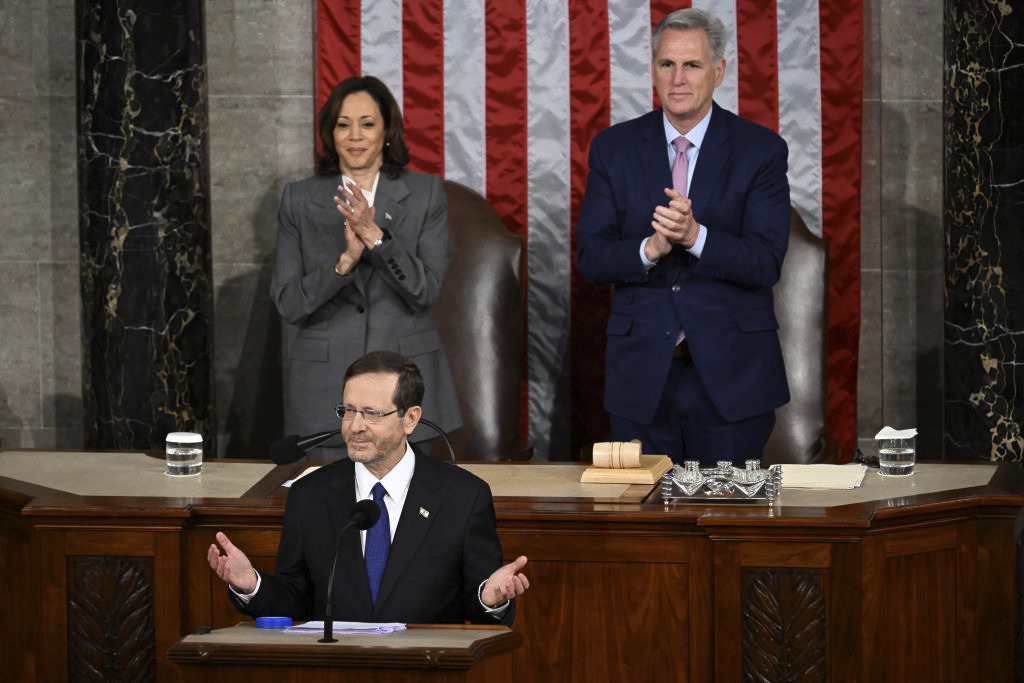
On November 10, 2025, Israel's President Isaac Herzog unapologetically stated that Zionism is "the national liberation movement of the Jewish people; a return to an indigenous homeland after millennia of persecution." Pictured: Herzog addresses a Joint Meeting of Congress in the House Chamber of the US Capitol in Washington, DC, on July 19, 2023. (Photo by Saul Loeb/AFP via Getty Images)

On November 10, 2025, Israel's President Isaac Herzog unapologetically stated that Zionism is "the national liberation movement of the Jewish people; a return to an indigenous homeland after millennia of persecution."

This statement follows the response of his father, Chaim Herzog (then Israel's Ambassador to the United Nations) in 1975 to an antagonistic UN General Assembly on its shameful resolution that "Zionism is a form of racism and racial discrimination":

"Zionism is nothing more – and nothing less – than the Jewish people's sense of origin and destination in the land linked eternally with its name."

These two assertions 50 years apart, from father and son -- both serving as presidents of Israel in their times -- could not make any clearer: Israel is the rightful and eternal ancestral homeland of the Jewish people. Any notion to the contrary must therefore be considered a "direct assault on the Jewish people's identity, history, and fundamental right to self-determination."

Much of the world nevertheless seems eager to believe lies about Israel being a "racist," "apartheid," "genocidal" and the domain of oppressor settler-colonialists -- despite the inconvenient fact that the Jews fought colonialism, administered by the British, and still being inflicted, although at least now, mercifully, from afar.

Jews have been rooted to Israel (Zion) for nearly 4,000 years, backed by a promise in Genesis 15:18 that God made to the ancient fathers of all Jews: Abraham:

"On the same day the LORD made a covenant with Abram, saying: 'To your descendants I have given this land, from the river of Egypt to the great river, the River Euphrates.'"
(New King James translation)

Muslims have been around only since the exploits of Mohammed -- who died in 632 AD. All the same, there seem to have been some extraordinary efforts to predate events and ascribe an Islamic identity to Jesus (Qur'an 3:52), who died well before 632 AD, and even to the Jewish patriarch, Abraham:

"Abraham was neither a Jew nor a Christian, but he was one inclining toward truth, a Muslim [submitting to Allah]. And he was not of the polytheists."
(Qur'an 3:67, Sahih International translation)

What is accurate is that Abraham, like other Jews, was not a polytheist.

Theodore Herzl, in 1897, in Switzerland, at the First Zionist Congress, founded modern political Zionism, after seeing how easily France could betray its Jews during the false charges of treason in court-martial of Captain Alfred Dreyfus, who was unjustly sent to prison for five years.

At the time, Herzl saw a similar scapegoating of Jews as prevail today:

  • Jews were being persecuted in Western Europe for being Jews, particularly in Germany and Austria as well as in England and France.
  • Many Jews in Eastern Europe were persecuted, particularly in Russia.
  • Few world leaders endorsed the idea of a Jewish state. German Kaiser Wilhelm II supported the idea for a few weeks, possibly as a way of ridding Germany of Jews, but backed out as soon as the Ottoman Empire rejected the idea.

Eventually, 50 years after the 1897 Zionist Congress, the United Nations voted for the creation of the Jewish state. Herzl's dream became a reality: the age-old prayer, "Next year in Jerusalem," became a reality. It is this reality that much of the world now seeks to destroy.

"We are not interlopers. We are not colonizers. We are not strangers to the land of Israel. The land of Israel and the people of Israel stand together. It's part of the same equation, and they can't be separated," stated Israeli Ambassador to the United States Yechiel Leiter.

It would be considered laughable for the natives of any other country to be asked to defend their right to exist; why are Jews expected, after almost 4,000 years on the land, to explain their rights to Israel being their homeland? Nevertheless, many politicians in today's societies keep trying to put Jews on the defensive as they never would if their own countries' "right to exist" were questioned. Does anyone ask if Germany has a right to exist? Or Kazakhstan?

The late Nobel Peace Prize laureate Elie Wiesel stated in 1978 that, over many thousands of years, "the Jew has been at the mercy of a society in which persecuting him first and murdering him later has at times led to sainthood or power."

It is for this reason that Zionism is essential to the Jewish people, Wiesel continued:

"There was a time when the Jews of Germany were told: We have nothing against you, our resentment is directed solely against the Jews of Poland, who refuse to be assimilated. Later the Jews of France were told: You have nothing to fear, our measures are aimed only at German Jews, they are too assimilated. Later the Hungarian Jews were reassured: We are not interested in you but in your coreligionists in France; they are making trouble there...

"It was all a lie, and now we know it. They meant all of us, everywhere and always."

To live in Israel as a Zionist is, Wiesel said, "a badge of honor."

The land of Israel has been at the core of Jewish identity ever since each of the twelve tribes were allocated specific lands of their own. To the early Israelites, now Jews, their land meant everything. Canadian Rabbi Tzvi Freeman wrote:

"In Biblical Israel, every citizen was landed. If you were a descendant of one of the twelve tribes, you owned a plot of land. If you sold it, it came back to you—or to your inheritors—on the jubilee year, which occurred every 50 years. You were tied to the land and the land was tied to you. Inheritance of land was through the paternal line—just as tribal affiliation is patrilineal."

In view of today's uncomfortable reality that jihadists do not seem even slightly interested in disarming or giving up murdering Jews, it appears that a strong and secure Israel will come only through a dynamic policy of self-defence -- one that will be able to meet those striving for the country's elimination with determination. Israel's immediate enemy is violent extremist Islam -- particularly the brand espoused by ideological offshoots of the Muslim Brotherhood such as Hamas, Hezbollah, the Houthis, Qatar, Syria and Iran. Their worldview seems to be that "Islam is a faith and a ritual, a nation and a nationality, a religion and a state, spirit and deed, holy text and sword." In other words, a totalitarian and overbearing force, merging state, politics, and religion under a militant theocracy subject to Sharia law, any contravention of which might mean death.

The world is not just getting less safe for Jews. It is also rapidly becoming less safe for Christians, Hindus and Muslims deemed by other Muslims to be not Muslim enough (such as here, here and here). Unfortunately, many in the West appear not to believe that yet. Meanwhile, the doctrines of the Muslim Brotherhood are being spread throughout Europe and Canada, and most recently in New York, Michigan, Minnesota, Texas, the heart of America, and Australia.

Jihadist conquest, which commenced some 600 years ago, continues endlessly. Quadrant noted:

"To place any religion beyond criticism just because some Muslims may feel offended is to ignore, as Salman Rushdie puts it, 'the battle against fanatical Islam, which is highly organised, well-funded, and which seeks to terrify us all, Muslims as well as non-Muslims, into cowed silence'."

Nazi ideology is also making a comeback – as witnessed by the global platform afforded Nick Fuentes -- "Hitler," he said, was "very, very cool" -- by Carlson Tucker, who asked Fuentes no challenging questions. In early November, in Australia, a neo-Nazi cohort was granted permission to demonstrate outside the New South Wales parliament. The West's radical leftist-Islamist crowd grows ever-more vociferous and aggressive in their criticism of "Zionism" – supposedly a politically correct euphemism for Israel and Jews.

Israel's former Minister of Strategic Affairs, Ron Dermer, wrote in his November 2025 letter of resignation:

"One hundred generations of Jews dreamed of living in a time when the Jewish people would have a sovereign state. Four generations were blessed to realize this dream. With this privilege comes a sacred responsibility: to secure this dream for future generations."

Author and educator Rabbi Uri Pilichowski wrote:

"The State of Israel was politically stablised to be the final place of refuge, where no Jew would ever have to flee again. Israel is a Jewish issue because it will be the place that all Jews will eventually flee to when their current country begins to persecute them."

Why does no one seem to mind having eight officially Islamic states (Afghanistan, Brunei, Iran, Mauritania, Oman, Pakistan, Saudi Arabia, and Yemen) and 18 states where Islam is the state religion (Algeria, Bahrain, Bangladesh, Comoros, Djibouti, Egypt, Iraq, Jordan, Kuwait, Libya, Malaysia, Maldives, Morocco, Qatar, Somalia, Syria, Tunisia, and the United Arab Emirates), and one officially Anglican State, England, but apparently cannot tolerate one small Jewish state?

There is no place, in an existential conflict over Israel and its people, for a "right wing," "left wing" or "centrist" Israel. When the Third Reich pushed people into gas showers, or during the massacres of October 7, 2023, no one asked the victims if they were "rightist," "leftist," or "centrist." For the Jews, Christians and other "infidels," although many seem not to believe it yet, the choice is all or nothing: either survival or elimination. In this respect, Zionism – the safety of Israel – is the for persecuted Jews, the only sanctuary.

The Jewish nation will overcome all obstacles thrown at them. "Together we will do it," Prime Minister Benjamin Netanyahu pledged. "And with God's help, together we will win."

As the leaders in the West increasingly lose their moral compass and kneel to appease the radical Jew-haters in their midst, the Jews, after millennia of persecution and prejudice, go to Israel, their rightful homeland for peace, safety, and sanctuary. If Jews are to be criticized for defending their minute piece of real estate on Earth, so be it: they hold the moral high ground; their critics and enemies do not.


Nils A. Haug is an author and columnist. A Lawyer by profession, he is member of the International Bar Association, the National Association of Scholars, the Academy of Philosophy and Letters. Dr. Haug holds a Ph.D. in Apologetical Theology and is author of 'Politics, Law, and Disorder in the Garden of Eden – the Quest for Identity'; and 'Enemies of the Innocent – Life, Truth, and Meaning in a Dark Age.' His work has been published by First Things Journal, The American Mind, Quadrant, Minding the Campus, Gatestone Institute, National Association of Scholars, Jewish Journal, James Wilson Institute (Anchoring Truths), Jewish News Syndicate, Tribune Juive, Document Danmark, Zwiedzaj Polske, Schlaglicht Israel, and many others.

Source: https://www.gatestoneinstitute.org/22072/tolerate-one-small-jewish-state

Follow Middle East and Terrorism on Twitter

Qatar's Campus Conquest: Importing Muslim Brotherhood Policies in a War for the Future of the West - Salah Uddin Shoaib Choudhury


by Salah Uddin Shoaib Choudhury

ISGAP's latest report highlights a crucial and overlooked fact: the ruling family of Qatar has pledged Bay'ah -- a spiritual oath of loyalty -- to the Muslim Brotherhood, the intellectual parent of modern political Islam. This ideological commitment drives Qatar's global influence operations and informs the direction of its foreign funding.


  • According to a shocking new report by the Study of Global Antisemitism and Policy (ISGAP), as well as Jihad in America: The Grand Deception, a 2012 film by the Investigative Project on Terrorism, the Muslim Brotherhood, along with its major patron, Qatar, has a dangerous ideological agenda aimed at undermining the West from within.

  • ISGAP's latest report highlights a crucial and overlooked fact: the ruling family of Qatar has pledged Bay'ah -- a spiritual oath of loyalty -- to the Muslim Brotherhood, the intellectual parent of modern political Islam. This ideological commitment drives Qatar's global influence operations and informs the direction of its foreign funding.

  • Qatar's influence does not end with funding. ISGAP identifies the Muslim Students Association (MSA) -- founded by Muslim Brotherhood activists -- as the primary vehicle for campus-level ideological entryism. Operating on 600+ US campuses, the MSA works closely with Students for Justice in Palestine (SJP). Since the Hamas atrocities of October 7, 2023, these groups have mobilized some of the most aggressive anti-Israel activism, including disruptions, protests and dissemination of pro-Hamas messaging.

  • According to ISGAP's Executive Director, Charles Small, the Muslim Brotherhood aims to isolate Israel and weaken US-Israel ties, fragment US society through antisemitism and campus radicalization, and challenge democratic norms and replace them with Islamist ideological frameworks.

  • Qatar's campaign is not confined to the United States. A credible security source, cited in a report by the Usanas Foundation, a "geopolitics and security affairs organization" based in India, indicates that Doha is funding Islamist-aligned academia, media, and campus activism across India, the United Kingdom, and EU nations.

  • Money is flowing to journalists, professors, and influencers in India who promote political Islam under the guise of "Palestinian activism".

  • Unless democracies take decisive action -- through transparency laws, foreign-funding oversight, campus reform, and ideological vigilance -- Qatar's anti-democratic ideological offensive will continue hollowing out the foundations of free societies throughout the world.

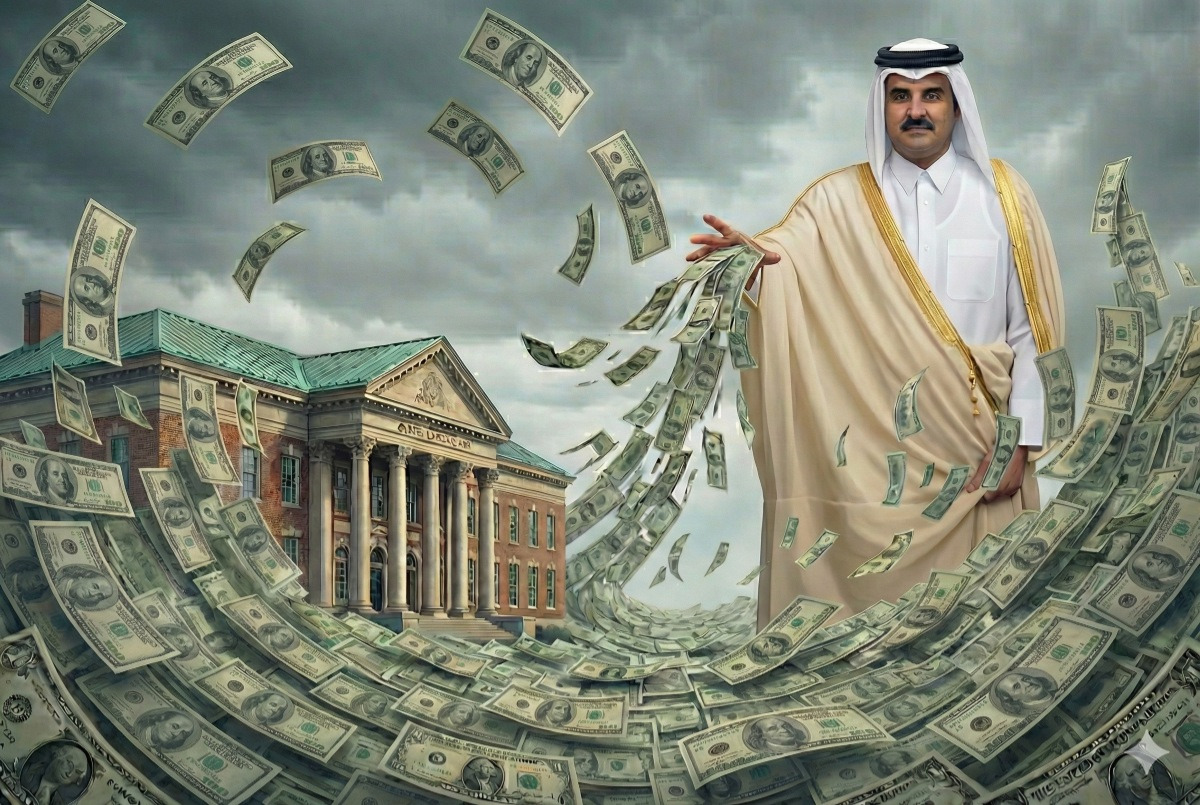
Qatar continues to conduct one of the most extensive foreign influence operations in modern history. Through hundreds of billions of dollars -- estimated at up to a trillion dollars -- funneled into Western universities, research centers, media platforms and political advocacy networks, Qatar has become the leading global patron of the Muslim Brotherhood in pushing an ideological agenda aimed at reshaping democratic societies from within. (Image source: Google Gemini)

Qatar continues to conduct one of the most extensive foreign influence operations in modern history. Through hundreds of billions of dollars -- estimated at up to a trillion dollars -- funneled into Western universities, research centers, media platforms and political advocacy networks, Qatar has become the leading global patron of the Muslim Brotherhood in pushing an ideological agenda aimed at reshaping democratic societies from within.

New findings by the Institute for the Study of Global Antisemitism and Policy (ISGAP) show that Qatar's funding is not benign philanthropy; it is a strategic investment in Islamist soft power, with far-reaching consequences for the United States, India, Europe, and beyond. According to a shocking new report by the Study of Global Antisemitism and Policy (ISGAP), as well as Jihad in America: The Grand Deception, a 2012 film by the Investigative Project on Terrorism, the Muslim Brotherhood, along with its major patron, Qatar, has a dangerous ideological agenda aimed at undermining the West from within.

ISGAP's latest report highlights a crucial and overlooked fact: the ruling family of Qatar has pledged Bay'ah -- a spiritual oath of loyalty -- to the Muslim Brotherhood, the intellectual parent of modern political Islam. This ideological commitment drives Qatar's global influence operations and informs the direction of its foreign funding.

Charles Asher Small, ISGAP's Executive Director, told the New York Post that Qatar is using universities, cultural institutions and educational programs "to promote its ideology" and advance the Brotherhood's decades-long strategy of infiltrating Western society.

Massive funding of Western universities:

Qatar has poured extraordinary sums into elite American institutions:

  • Cornell University: Over $10 billion in total funding for its Doha medical school, averaging $156 million annually since 2012.
  • Georgetown University: More than $1 billion, heavily influencing Middle East studies and diplomatic training programs.
  • Texas A&M University: $1.3 billion, including hundreds of research projects - at least 58 with potential dual-use military applications.

In one contract reviewed by ISGAP, Qatar secured all intellectual property rights related to certain research at Texas A&M's Qatar campus. The university began closing the campus earlier this year, which analysts link to the growing scrutiny of Qatari influence.

Campus networks: MSA, SJP and ideological penetration

Qatar's influence does not end with funding. ISGAP identifies the Muslim Students Association (MSA) -- founded by Muslim Brotherhood activists -- as the primary vehicle for campus-level ideological entryism. Operating on 600+ US campuses, the MSA works closely with Students for Justice in Palestine (SJP). Since the Hamas atrocities of October 7, 2023, these groups have mobilized some of the most aggressive anti-Israel activism, including disruptions, protests and dissemination of pro-Hamas messaging.

Through them, Qatar and the Muslim Brotherhood gain:

  • A pipeline into elite student leadership
  • Influence over academic discussions on the Middle East
  • Control over sentiment around Israel and antisemitism
  • Long-term access to future political, media and tech elites

Infiltration of K-12 schools

Qatar Foundation International (QFI), Doha's US affiliate, has penetrated American K-12 schools. In one notable incident, a QFI-sponsored classroom map replaced Israel with "Palestine" in a Brooklyn public school.

QFI's curriculum material and grants give Qatar access to the political formation of American children -- an alarming development largely overlooked by policymakers.

The Muslim Brotherhood's blueprint for transforming the West

ISGAP's report, "The Muslim Brotherhood's Strategic Entryism into Western Society", argues that the Brotherhood is halfway through a long-term plan to reshape Western society by embedding Islamist ideology in universities, think tanks, political institutions, media networks and social movements.

According to Small, the Muslim Brotherhood aims to isolate Israel and weaken US-Israel ties, fragment US society through antisemitism and campus radicalization, and challenge democratic norms and replace them with Islamist ideological frameworks.

Escalating global reach: India, UK and Europe

Qatar's campaign is not confined to the United States. A credible security source, cited in a report by the Usanas Foundation, a "geopolitics and security affairs organization" based in India, indicates that Doha is funding Islamist-aligned academia, media, and campus activism across India, the United Kingdom, and EU nations.

Al Falah University -- linked to extremist elements -- is suspected of having received Qatari funds.

Money is flowing to journalists, professors, and influencers in India who promote political Islam under the guise of "Palestinian activism".

Anti-Hindu narratives and pro-Hamas messaging reflect a coordinated ideological push.

Similar patterns are emerging in London, Paris, Brussels and Berlin - where Qatar-backed groups are at the forefront of anti-Israel demonstrations and pro-Brotherhood messaging.

A direct threat to democratic society

Dr. Small warns that the Muslim Brotherhood's agenda - heavily financed by Qatar - includes the destruction of Israel, the subjugation of women, the targeting of LGBTQ communities, and the dismantling of equality under the law.

The Brotherhood's worldview fundamentally rejects the democratic idea of equal rights for all citizens, regardless of gender, religion or ethnicity.

To confront the challenge posed by Qatar's global influence operations, democratic governments should adopt the following measures:

  1. Mandatory transparency for foreign funding of universities. All foreign grants and contracts should be publicly disclosed, with penalties for nondisclosure.
  2. Prohibit funding from states aligned with extremist ideologies. Governments should ban or strictly regulate donations from entities linked to the Muslim Brotherhood.
  3. Investigate ideological networks on campuses. Organizations such as the MSA and SJP - which openly coordinate with Islamist movements - require deeper scrutiny.
  4. Designate the Muslim Brotherhood as a terrorist organization. This step, already taken by the State of Texas, would restrict the Brotherhood's ability to operate legally across Western countries.
  5. Protect K-12 education from foreign influence. QFI and similar organizations should be barred from funding or shaping public-school curricula.

Qatar's massive global influence operation represents one of the most serious ideological threats facing the democratic world today. Through its ideological loyalty to the Muslim Brotherhood and strategic funding in the West, Qatar is reshaping Western educational institutions, influencing political discourse, and fostering hostile attitudes toward democratic values and Western allies, especially Israel.

Unless democracies take decisive action -- through transparency laws, foreign-funding oversight, campus reform, and ideological vigilance -- Qatar's anti-democratic ideological offensive will continue hollowing out the foundations of free societies throughout the world.


Salah Uddin Shoaib Choudhury is an award-winning journalist, writer, and Editor of the newspaper Blitz. He specializes in counterterrorism and regional geopolitics.

Source: https://www.gatestoneinstitute.org/22079/qatar-campus-conquest-muslim-brotherhood

Follow Middle East and Terrorism on Twitter

A Day That Will Live in Infamy for Child Gender Ideology - Kurt Miceli


by Kurt Miceli

The HHS’s final review left critics empty-handed, underscoring that current medical evidence overwhelmingly backs protecting children from risky, irreversible sex-change treatments.


Perhaps no issue in modern society is more divisive or emotional than whether children should receive sex-change treatments. Yet Nov. 18 could very well be remembered as the day when that debate was largely settled.

That’s the day when the U.S. Department of Health and Human Services issued its final report on the medical evidence regarding child sex-change treatments. HHS released an early version of the report in May, but in the intervening months, it directly asked skeptical physicians and medical associations to scrutinize its conclusions.

Amazingly, none of them could disprove HHS’s conclusion that the medical risks to children far outweigh any potential benefits of sex-change treatments. So-called “gender-affirming” treatments can have lifelong consequences for children’s physical and mental health, including infertility, sterility, sexual dysfunction, metabolic disorders, surgical complications, depression, and more. HHS is therefore right to urge that children be protected from such treatments, instead pursuing therapy for conditions, like depression and autism, that commonly accompany gender confusion.

Rarely will you see a more honest or humble approach to such a tricky medical issue. When HHS released its initial report in May, critics, including some of the most prominent medical groups, condemned the report. HHS could have ignored them, but it didn’t. It asked critics to offer a peer review – a foundational step in determining the accuracy of scientific findings.

Federal officials reached out to groups like the American Academy of Pediatrics, the Endocrine Society, and the American Psychiatric Association, inviting them to analyze the report and explain what it got wrong. All three organizations have strongly supported giving children access to invasive and irreversible treatments such as puberty blockers, cross-sex hormones, and sex-change surgeries. They also vehemently opposed HHS’ initial report in May, with the American Academy of Pediatrics condemning the 409-page document within hours of its release.

Despite the HHS outreach, the Academy and the Endocrine Society refused to submit a peer review. That’s telling: When given the chance to offer evidence in support of child sex-change treatments, they declined. If they had good arguments to back their position, they would have eagerly presented them, and rebutted those of the HHS report.

The American Psychiatric Association, to its credit, did submit a peer review. But it was surprisingly devoid of substance. It noted that the initial report didn’t list its authors, even though blinded peer review is common practice in scientific publishing. The APA also seems to have missed critical parts of the report, claiming that HHS didn’t describe its methodology when in fact it did. All told, the APA couldn’t find any substantive errors in the HHS report. Nor did it criticize the report’s discussion of psychotherapy as an alternative to hormones and surgeries.

Other critics who separately published reviews didn’t identify errors or omissions, either. They broadly claim that HHS is misrepresenting the evidence, but they only point to select studies while ignoring the report’s detailed analyses of these studies, showing their methodological problems. More importantly, the critics ignored the systematic reviews that have led other countries to restrict children’s access to transgender treatments. At the end of the day, none of the critical reviewers disprove or even engage substantively with the central conclusions of the HHS report.

Other peer reviewers agreed with the HHS report. That includes a former president of the Endocrine Society, who called its review method “particularly helpful.” He also said the report “reasonably reflect[s]” the current state of evidence. Yet the medical association he once led refused to supply evidence to the contrary, endorsing child sex changes on effectively baseless grounds.

No doubt, some people will be tempted to reject the HHS report because it was issued under the Trump administration. Yet the report itself wasn’t authored by political appointees or partisan hacks. The list of authors is now publicly known, and it includes highly respected medical doctors and Ph. D.s from MIT, Duke University, Baylor College of Medicine, and the University of South Florida. It also includes a variety of experts from medical associations and academic institutions, including liberals. Together, they earnestly and thoroughly reviewed the science, and their conclusions have now withstood strong scrutiny.

Put simply, the latest HHS report is the most comprehensive and evidence-based review of child sex-change treatments in the world. It lends support to the Trump administration’s efforts to stop child sex changes; it also justifies the 27 states that have limited children’s access to such treatments. Without a doubt, this debate isn’t over, given how politically and emotionally charged it is. But on Nov. 18, it became abundantly clear that the best medical science supports protecting children.


Photo: WASHINGTON DC - APRIL 1:The Health and Human Services seal on a door of the office building in downtown Washington DC on April 1, 2025. On this day the Trump Administration started laying off HHS staffers. (Photo by Robb Hill for The Washington Post via Getty Images) 


Kurt Miceli

Source: https://amgreatness.com/2025/11/28/a-day-that-will-live-in-infamy-for-child-gender-ideology/

Follow Middle East and Terrorism on Twitter

Trump tells airlines to consider Venezuelan airspace closed - Greg Norman


by Greg Norman

FAA issued warning last week about airlines flying over Venezuela


President Donald Trump told airlines on Saturday to consider the airspace above Venezuela closed.

"To all Airlines, Pilots, Drug Dealers, and Human Traffickers, please consider THE AIRSPACE ABOVE AND SURROUNDING VENEZUELA TO BE CLOSED IN ITS ENTIRETY," Trump said in a post on Truth Social.

Trump's comments come about a week after the Federal Aviation Administration (FAA) warned airlines about flying over Venezuela. The FAA issued a notice urging airlines to "exercise caution" due to the "potentially hazardous situation" in the region. 

"Operators are advised to exercise caution when operating in the Maiquetia flight information region at all altitudes due to the worsening security situation and heightened military activity in or around Venezuela," the FAA advisory had said.

SOME INTERNATIONAL AIRLINES CANCEL VENEZUELA FLIGHTS AFTER FAA WARNING OVER SAFETY CONCERNS

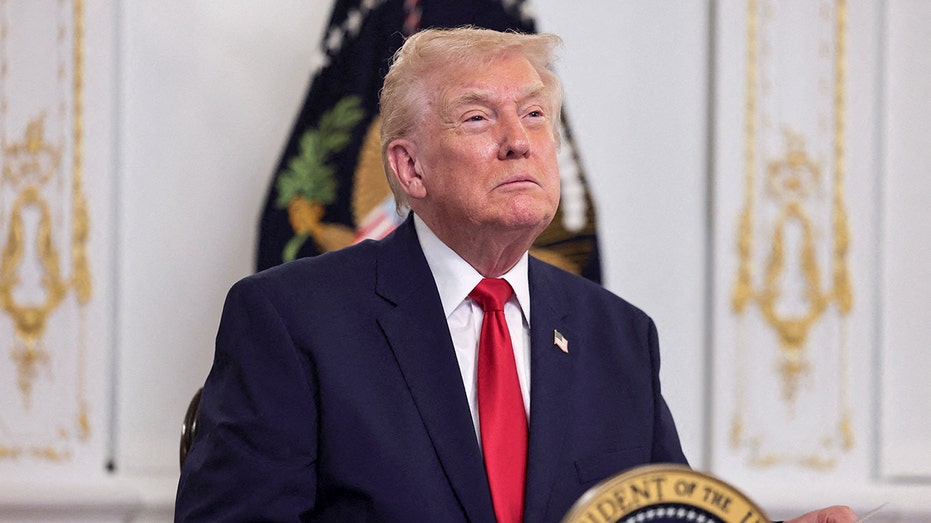
President Donald Trump speaks to service members

President Donald Trump participates in a call with service members on Thanksgiving, in Palm Beach, Fla., on Nov. 27, 2025.  (Anna Rose Layden/Reuters / Reuters)

"Threats could pose a potential risk to aircraft at all altitudes, including during overflight, the arrival and departure phases of flight, and/or airports and aircraft on the ground," it added, requesting airlines to provide at least 72-hour advance notice to the FAA if they plan to fly through the area.

Some international airlines then canceled their flights to Venezuela following the FAA's warning.

When asked for a response Saturday to Trump's message, the FAA directed FOX Business to its Nov. 21 notice.

FAA WARNS AIRLINES ABOUT FLYING OVER VENEZUELA: ‘POTENTIALLY HAZARDOUS SITUATION’

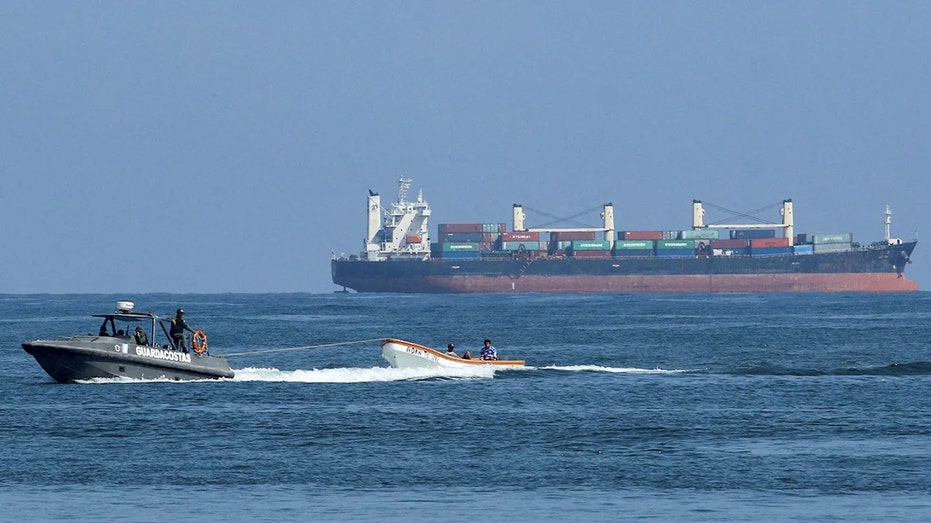
Venezuela Navy boat patrols waters

A coast guard boat of the Venezuelan Navy operates off the Caribbean coast on Sept. 11, 2025.  (Juan Carlos Hernandez/Reuters / Reuters)

Direct flights from U.S. passenger and cargo carriers to Venezuela have been suspended since 2019, but some airlines still fly over the country on their South American routes, according to Reuters. 

"Since September 2025, there has been an increase in Global Navigation Satellite System (GNSS) interference in the Maiquetia Flight Information Region (SVZM FIR), as well as activity associated with increasing Venezuela military readiness," the FAA also said.

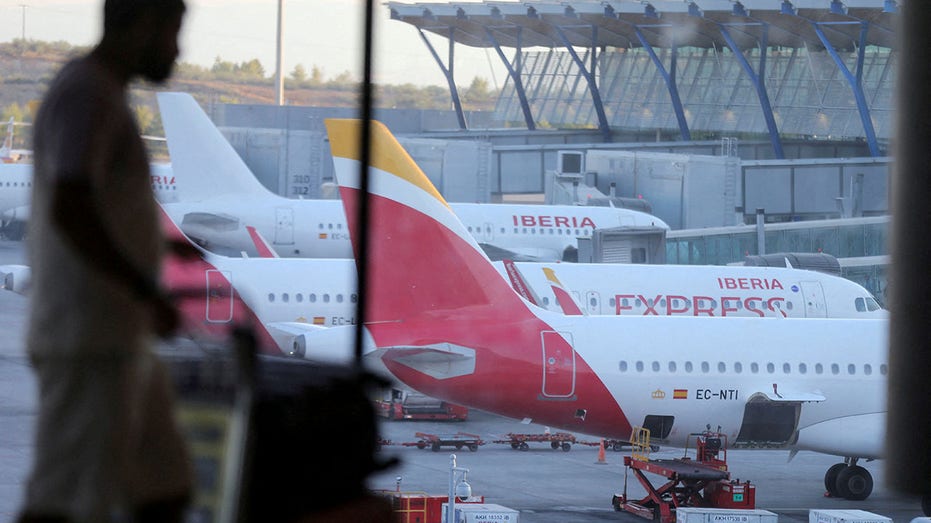
Iberia airplanes on a runway

Iberia Airlines of Spain said it was canceling its flights to Venezuela indefinitely. (Reuters/Isabel Infantes/File Photo / Reuters)

"Some civil aircraft recently reported GNSS interference while transiting the SVZM FIR, which, in some cases, caused lingering effects throughout the flight. GNSS jammers and spoofers can affect aircraft out to 250 nautical miles and can impact a wide variety of critical communication, navigation, surveillance, and safety equipment on aircraft," the FAA continued. 


Greg Norman

Source: https://www.foxbusiness.com/politics/trump-tells-airlines-consider-venezuelan-airspace-closed

Follow Middle East and Terrorism on Twitter

Trump terminates all Biden documents authorized through autopen - Misty Severi


by Misty Severi

Trump alleged that Biden's team in the White House largely used the autopen without the former president and that all orders without Biden's personal signature are canceled.


President Donald Trump announced Friday that he was terminating all executive orders and documents that former President Joe Biden allegedly used an autopen to sign, claiming the former president did not actually authorize its use.

Biden's alleged use of the autopen to sign controversial orders and pardons in his final months at the White House has been under scrutiny this year by the Republican-led congress and White House. 

Trump alleged that Biden's team in the White House largely used the autopen without the former president and that all orders without Biden's personal signature are canceled.

"Any document signed by Sleepy Joe Biden with the Autopen, which was approximately 92% of them, is hereby terminated, and of no further force or effect," Trump wrote on Truth Social. "The Autopen is not allowed to be used if approval is not specifically given by the President of the United States.

"I am hereby cancelling all Executive Orders, and anything else that was not directly signed by Crooked Joe Biden, because the people who operated the Autopen did so illegally," he continued. "Joe Biden was not involved in the Autopen process and, if he says he was, he will be brought up on charges of perjury." 

The post comes after Attorney General Pam Bondi opened an inquiry into Biden's use of the autopen last month and has promised accountability after Congress released a bombshell report accusing his administration of a cover-up and declaring some of the pardons and executive actions legally invalid.


Misty Severi is a news reporter for Just The News. You can follow her on X for more coverage.

Source: https://justthenews.com/government/white-house/trump-terminates-all-biden-documents-authorized-through-autopen

Follow Middle East and Terrorism on Twitter

Inside a Hezbollah tunnel: LAF shows deserted terror hideout to international media - Guy Alster


by Guy Alster

The tunnel contained what appeared to be a small medical room, a kitchen, a ventilation system, water tanks, and preserved food supplies.


Entrance to a Hezbollah tunnel in Lebanon.
(photo credit: REUTERS)

Foreign journalists were granted rare access to a Hezbollah tunnel near the Israeli border on Friday, part of a media tour organized by the Lebanese military to underscore what it says are efforts to reduce the group’s military presence in the country's south.

The tunnel, located in Wadi Zibqin, a long-time Hezbollah stronghold, was shown to dozens of international reporters. Inside, it included what appeared to be a small medical room, a kitchen, a ventilation system, water tanks, electrical wiring, and preserved food supplies.

Brig.-Gen. Nicolas Thabet, who commands the Lebanese Army’s sector south of the Litani River, accompanied the tour and emphasized the stakes involved.

“We will not give up our objectives, whatever the difficulties may be,” he said. “The army is sacrificing greatly” in what he described as “one of the most dangerous areas in the Middle East.”

LAF-backed visit comes after Tabatabai's death

Lebanese military officials said the tunnel is one of many former Hezbollah positions in the area that have either been struck or are now under army control. No Hezbollah operatives were seen during the visit.

In August, a deadly explosion at a weapons depot near the tunnel killed six Lebanese Army sappers. The blast was reportedly triggered by stored ammunition.

The tour coincided with renewed tensions following the death of senior Hezbollah commander Haytham Ali Tabatabai, who was killed in an Israeli Air Force strike in Beirut’s Dahiyeh neighborhood on Sunday.

Hezbollah Deputy Secretary-General Naim Qassem claimed that the group had the right to retaliate.

"We have the right to respond, and we will determine the timing," Qassem said. "The assassination of Tabatabai was a blatant act of aggression."

Qassem also claimed that Hezbollah had faced a number of infiltrations and that this was organized by enemies in the United States and from the Arab world.

"The enemy did everything in its power to end the resistance, but it failed. It faced a humble group that was able to confront the tyrannical Israeli-American aggression," he claimed. 


Guy Alster

Source: https://www.jpost.com/middle-east/article-876588

Follow Middle East and Terrorism on Twitter

Australia’s Jews face lurking antisemitism after October 7 in a once 'goldene medina' - Michael Starr


by Michael Starr

DIASPORA AFFAIRS: Zionist Federation of Australia president Jeremy Leibler on how Australian Jews were shocked by both the wave of antisemitism post-October 7 and the silence that followed.


Australian Jewry has been confronted by the reality that antisemitism never went away, Zionist Federation of Australia president Jeremy Leibler told the ‘Post.’ Here, protesters hold placards and flags during a rally against antisemitism at The Domain in 2024, in Sydney.
(photo credit: LISA MAREE WILLIAMS/GETTY IMAGES)


The wave of antisemitism that sprang in the wake of the October 7 massacre shocked Australian Jews who believed that antisemitism was an endangered rather than dormant sentiment after the Holocaust, Zionist Federation of Australia president Jeremy Leibler explained in an interview with The Jerusalem Post.

Australian Jewry has been confronted by the reality that antisemitism never went away, as they have endured ostracization from polite society, arson and vandalism, and the acceptance of the situation by a silent majority.

Australia was a “goldene medina” for Holocaust survivors after World War II, with thousands migrating to the land Down Under, bestowing it with the largest proportion of Holocaust survivors outside of Israel. It was a community where many grew up without “experiencing any real antisemitism,” according to Leibler.

Shift in perspective after October 7

Before the 2023 Hamas-led pogrom in southern Israel and its global reaction, Leibler rejected the idea that antisemitism “never goes away.”

“I grew up living in a society that was easygoing and never experienced it [antisemitism] at all, even though I was very visibly Jewish,” said Leibler. “But I think that they were probably right, that while we didn’t feel it [antisemitism], it was there, because [of] the speed at which those who harbored these feelings were then given permission to allow them to be ventilated and articulated, because of these false accusations of genocide thrown at Israel and Zionists – and we are a very Zionist community. It didn’t take much for the memory of the Holocaust, which perhaps kept that antisemitism under the table, to [be superseded]. And once it’s out of the bag, it’s very difficult to put back in.”

The Australian Jewish community has been the victim of a wave of arson and vandalism targeting Jewish residences, vehicles, schools, and synagogues. Here, people pass the burnt front entrance of the East Melbourne Synagogue in Melbourne, in July. (credit: WILLIAM WEST/AFP)
Australian Jewry had to accept that antisemitism had been lurking under the surface of society, said the ZFA head, and that two years of turbulence suggested that life would not be as it once was for the community.

The most troubling manifestation of antisemitism, in Leibler’s opinion, was not the arson, vandalism, or graffiti, but the disdain shown in otherwise “polite circles around the dinner tables, around the boardrooms, in progressive spaces, in universities, in the arts sector.

“I actually find that a lot more confronting because these are people who otherwise are the beneficiaries of enormous Jewish support, not just philanthropic support, but in many, many respects they work with us,” said Leibler. “I’m a lawyer and my firm has a very, very large public interest law pro bono practice where we do work both for the Jewish community, but also in the arts. And we found very, very quickly after October 7, within a week or two before Israel had even responded, we found a very significant proportion of that client base were explicitly antisemitic. They were accusing Israel of genocide before they’d responded. They issued statements attacking Israel without condemning Hamas.”

Leibler related that one artist facility that was built in partnership with the Victoria state government and Jewish philanthropy had an exhibit in the days after the October 7 massacre in which a fringe indigenous group held signs stating “white dog Jews” and that “Israel should be wiped off the map.”

The institution called the incident antisemitic, but refused to condemn Hamas, on the basis that art shouldn’t be political – but Leibler finds that principle applied only one way. Jewish artists have found themselves unable to get work, facing a “silent shadow banning.” Venues are canceling shows because they are targeted on social media and can’t afford a boycott.

“These are industries that Jewish donors, artists, have really built in Victoria,” said Leibler. “And that sense of betrayal from people – not from the Muslim community, not [from those] that have skin in the game – people who have been in our houses, often artists whose paintings are hanging on our walls in our offices, in our homes, forget picking up the phone to say, ‘Are you okay? Are your family and your friends okay?’ but turned on us in a way.”

The ZFA president said that this “betrayal” had been traumatic for the community, in some ways more so than physical acts of violence.

Others have remained silent when confronted by the anti-Israel campaign in Australia. Leibler thought that the protests that erupted after October 7 would backfire, as Australian streets were “effectively invaded” by marches of tens of thousands of people with no Australian flags. The protests made cities impassable on weekends, extracting tolls on small businesses. He expected ordinary Australians to demand an end to them.

“What I didn’t appreciate was the extent to which ordinary well-meaning people would be intimidated by the mob,” said Leibler. “They would be intimidated into silence, to turning the other way. And I think that’s one of the most disappointing aspects of the way in which the Australian Jewish community has experienced the post-October 7 world.”

Those who held their tongues on the protests represented a silent majority, in Leibler’s estimation, who were outraged by the protests and recognized Israel was fighting a war on behalf of Western democratic values. He had conversations to that effect, but only in private.

Leibler argued that the protests created an environment in which arson attacks were inevitable. Chanting for a globalized intifada was violent, and intifadas feature the bombing of synagogues.

“That is what globalizing the intifada looks like,” said Leibler. “Once it’s out of the bag; once you’ve normalized this; once you’ve normalized the idea that anyone who is a Zionist is now a genocide supporter; once you stop calling those things out, it’s difficult to put back in, back in the box.”

A wave of violence against Australia's Jews

THE AUSTRALIAN Jewish community has been the victim of a wave of arson and vandalism targeting Jewish residences, vehicles, schools, and synagogues. On March 10, Australian authorities claimed that many antisemitic incidents in the greater Sydney area had been conducted by a criminal organization as part of a plot to distract and manipulate police into deals giving leaders reduced prison sentences. Yet on August 26 the Australian Security Intelligence Organization (ASIO) revealed that Iran had orchestrated at least two of the attacks, including one that had previously been connected to the criminal organization.

“We’re still waiting for some results on the investigation for what’s happened with the Iranian network,” said Leibler. “It is complex because it is not uncommon for foreign actors to use local criminals to carry out attacks.”

Australian Jews on the other side of the world becoming a target of a foreign actor was another unsettling element in the new Australian environment.

In response to the attacks and antisemitism, instigated from abroad or homegrown, law enforcement and state and federal governments have been protective, and while political leaders have been well-meaning, they have been slow to understand and respond, Leibler assessed. They face political pressure from a Muslim community that is larger than the Jewish constituency, and misunderstood how antisemitism on the Left could manifest.

“I think there is no question that the government failed to understand what was happening on the ground and how it was impacting the Jewish community. I don’t believe that the Australian government or either the federal level or the state level are motivated by antisemitism or are antisemitic. I know that to be fundamentally not true. But that doesn’t excuse failures to properly address antisemitism,” said Leibler.

“On the one hand, the federal government has announced and provided over $100 million in funding for the Jewish community for security for schools. And they have taken other steps. They appointed an antisemitism envoy. So they recognize that there is a problem.”

The right leadership early on in the post-October 7 protest phenomenon would have prevented the manifestation of the same degree of antisemitism and radicalism.

Though in Leibler’s estimation delayed, legislative packages against radicalism and aggressive protests had been passed in Victoria and New South Wales, and anti-Nazi and terrorism support laws had been passed at the federal level. The ZFA noted that NSW Premier Chris Minns had shown “outstanding” political leadership during trying times.

However, Leibler noted that legal reforms aren’t the key prescription.

“I think what we need is leadership. What we need is our political leaders to draw a line in the sand and say, ‘free speech is sacred,’ but when it crosses into incitement, violence, to have the clarity to be able to say, when we have people marching through the streets of Victoria, New South Wales, chanting, ‘globalize the intifada,’ and ‘from the river to the sea,’ that these are inherently violent calls to action,” said Leibler.

“Now, they got there eventually. The prime minister did say that chants like ‘from the river to the sea’ were inherently violent. The head of ASIO, the equivalent of Mossad, said the same thing. But it was too late. The genie was out of the box, and we didn’t have enough leadership at all levels, not just political, within our universities.”

Australia's shift in anti-Israel policy a 'death by a thousands cuts'

WHILE APPRECIATIVE of many of the domestic efforts of the Australian governments, Leibler said the shift in foreign policy toward Israel has been disconcerting.

“There’s been a very noticeable shift in policy from the Australian government, really from before October 7,” said Leibler. “And it’s been slow, and it sort of, in some ways, felt like death by a thousand cuts.”

Australia’s August 11 announcement of intentions to recognize a Palestinian state set Canberra-Jerusalem ties into a tailspin, leading to an exchange of insults, including personal attacks on Prime Minister Anthony Albanese by his counterpart Benjamin Netanyahu. Leibler doesn’t think that such types of comments are productive.

“I think what we need to do is deal with these issues on their merits. And... we have legitimate criticism to make of these shifts in policies, and that’s where we should focus.

“The government has made several decisions which we fundamentally disagree with, but we also have to recognize that immediately after October 7, they were actually very strong, and they came out very strongly that Israel has a right to defend itself, Hamas has to be removed from power, the hostages must be released.

“And then we saw this sort of slow descent and increasing initially with increased focus on humanitarian aid. And then, I think, eventually, while their positions never really fundamentally changed vis-à-vis the role of Hamas or release of hostages, it was a question of rhetoric and emphasis. And what we heard was this constant focus on humanitarian aid, which is fine,” said Leibler. “One can be a supporter of Israel’s right to exist and express concern about the suffering of innocent Palestinians. Where we might disagree is where the moral blame lies for that suffering. But I think the government, and probably because of local political pressures, got that balance fundamentally wrong.”

Leibler also thought the government made a mistake when MK Simcha Rothman was denied entry into Australia on August 18, ostensibly due to the rhetoric that he used. Leibler said that one can disagree with Rothman’s positions and remarks, but banning a sitting democratically elected official when other far worse actors had been permitted entry was hypocritical. The decision also had a cooling effect on other Israelis, with a message that the country was not welcome to Israeli visitors.

“That basically sends us a message that Jewish life in Australia is not secure, because we all have friends, family, relatives in Israel. Our schools are entirely, and youth movements are entirely, dependent on shlihim [emissaries] and educators coming to Australia,” said Leibler.

For the Australian Jewish community, which is “overwhelmingly Zionist and connected to Israel,” it’s another concern as the uncertainty grows about the trajectory of the country, and what lies just beneath the surface.


Michael Starr

Source: https://www.jpost.com/diaspora/antisemitism/article-876470

Follow Middle East and Terrorism on Twitter

Inward fury: How Iran has changed domestic oppression after Israel-Iran war - Alex Winston


by Alex Winston

IRAN AFFAIRS: Unable to change the outcome of battle, the Islamic Republic moved quickly after the June 24 ceasefire to reassert its authority at home.


Naz Gharai, from Tehran, is covered in red paint as protesters call on the United Nations to take action against the treatment of women in Iran, following the death of Mahsa Amini while in the custody of the morality police, during a demonstration near UN headquarters in New York City on November 19
(photo credit: YUKI IWAMURA/AFP via Getty Images)


For almost five decades, the authorities in Iran have held the population in a grip of fear, with many scared of speaking out for fear of retribution.

When Israel and Iran descended into their 12-day conflict in June of this year, many also incorrectly predicted it was the end of the Islamic Republic’s regime. In a matter of hours, Israel took control of the skies over Tehran. It targeted some of the regime’s highest enforcers within the Islamic Revolutionary Guard Corps (IRGC), though it refrained from striking at the country’s political leaders, including Supreme Leader Ayatollah Ali Khamenei.

Unable to change the outcome of battle, the Islamic Republic moved quickly after the June 24 ceasefire to reassert its authority at home. Its security and intelligence forces returned to familiar routines, albeit with new techniques, and the response has shaped daily life for Iranians far more deeply than the brief clash with Israel.

Domestic pressure leads to domestic oppression

“The domestic oppression machine operates in a different silo,” Iranian journalist and analyst Khosro Isfahani, who spent years documenting human rights abuses before leaving Iran in 2021, told The Jerusalem Post. “It was very brutally deployed.”

Whenever the regime feels domestic pressure, be it from protests or economic emergencies, “its immediate response is mass deployment,” Isfahani, who is a senior research analyst of the National Union for Democracy in Iran, an NGO that represents the Iranian-American community in pursuit of US policy toward Iran based on the values of human rights and democracy, explained.

A young woman without wearing a hijab flashes a victory sign while standing in front of a burning dumpster.The nationwide protests started after the death of Mahsa Amini, a 22-year-old girl who died under the custody of the Islamic Republic's Morality Police on September 16th, 2022 in Tehran, Iran. (credit: ANONYMOUS/Middle East Images/AFP via Getty Images)
However, the nature of that repression has changed since the sweeping uprisings of 2022 under the Woman, Life, Freedom movement. The streets of Tehran and other major cities no longer feature the widely filmed morality police vans dragging women away. The authorities learned that some forms of spectacle carry too much risk and have replaced them with quieter measures.

“Instead of beating you in front of cameras,” Isfahani said, “they take away your right to education or deny you access to banking. The oppression has changed shape. It is a slower burn.”

There are fewer scenes of public confrontation, but more consequences delivered through paperwork, digital surveillance, fines, and sudden bans from university or public services. The state appears calmer on the surface, even as it reaches more deeply into people’s personal lives.

One of the biggest changes since the June conflict is the way authorities handle gatherings. In the past, events featuring mixed groups of young men and women, Western music, or anything mildly transgressive were often shut down immediately and participants arrested. Today, many such events go ahead without incident. Videos circulate online showing cafés hosting DJs and street corners with young people dancing.

“Three days later, the Intelligence Ministry, the police, the IRGC, somebody arrives,” Isfahani explained. “The people in the video are arrested, the business is shut down, and those involved are banned from education or public services.”

The regime is no longer trying to prevent such gatherings from occurring. It is letting them happen, then using them as evidence to punish those involved. This approach creates uncertainty. People do not know which incident will come back to haunt them or when the knock on the door will arrive.

Attempted rise of Persian nationalism

Alongside these measures, Iranian officials have attempted to revive a form of Persian nationalism aimed at soothing public discontent and redirecting attention. Earlier this month, the government unveiled a large statue of the ancient Sasanian King Shapur I at Tehran’s Enghelab Square, showing the Roman Emperor Valerian kneeling before him. The statue has been accompanied by posters around the city carrying the slogan, “You Will Kneel Before Iran Again.”

The purpose of this sudden prominence of ancient Persia in a regime that remains allied to strict Shia Islam is clear. The authorities hope to evoke national pride at a moment when they are struggling to deliver economic stability and a sense of direction for the republic. Isfahani highlighted that even Khamenei has encouraged this messaging recently, with eulogists promoting patriotic anthems that place Persian heritage above religious ideology.

As in many previous crises, religious minorities have been singled out for especially harsh treatment, and it was no different after the 12-day war.

“It has affected religious minorities most severely,” Isfahani stated. “Baha’is, Jews, Christian converts, these communities are always the first scapegoats.”

The examples are disturbing to those who hear them. A Jewish man was arrested because he belonged to a WhatsApp group dedicated to Torah study. The security forces treated Hebrew text in the chat as evidence of espionage for the Jewish state.

“This is a Torah study group,” Isfahani said, recalling the absurdity of the allegation. “The evidence that they use against [the Christian] community again is as ridiculous as in the case of that Jewish man. Having a copy of the Bible is evidence of you acting against the regime.”

Another case involved an Iranian-American Jewish grandfather detained for visiting Israel many years earlier for his child’s bar mitzvah. According to Isfahani, roughly 35 Jews were arrested in the period after the war.

Ethnic minorities have experienced similar treatment. The Baloch in the southeast and the Kurds in the northwest have long been viewed with suspicion by Tehran, and the aftermath of the war merely intensified skepticism of their loyalty among the regime. The Baloch community in particular has faced a wave of arrests and raids following clashes between militant groups attempting independence and security forces.

The Foundation for Defense of Democracies has tracked these developments closely. According to its mapping, hundreds of protest incidents have taken place in cities across the country in the months following the conflict. These range from full-on protest gatherings, such as Ministry of Energy employees gathering to demand unpaid wages, to scattered demonstrations over collapsing living conditions, and bold, individual acts of dissent such as anti-Khamenei banners hung from pedestrian bridges.

Ordinary Iranians arrested for social media posts

Since September 2022, the FDD estimates that 26,331 Iranians have been arrested, though many of the more prominent cases in international media have been in the past few weeks.

The FDD’s tracking shows multiple cases of ordinary Iranians detained for comments made on social media. The pattern shows a society whose frustrations never fully disappear, even when the risks are immense.

The case of 19-year-old Bita Shafiei is a prime example. After she recorded a video supporting Crown Prince Reza Pahlavi, son of the deposed shah, security agents arrested both her and her mother, who had been detained in the past. They have since disappeared into the system, their whereabouts unknown.

Names of other detainees continue to emerge from Iran, as more and more are arrested, people such as Kaveh Mehdizadeh, Kivan Mehdadi, and Mino Roozhda, none of whom you will have heard of, and none of them with any recognizable crime. But each and every arrest affects not just the future of those apprehended; it instills in their families, their neighbors, their friends the same fear of the regime, thereby deterring further dissidents.

Iran’s execution rate has also risen sharply since the war, continuing the regime’s long-term pattern in which executions serve as a tool for intimidation. Isfahani said the numbers are higher than at any point in recent memory, and they increased again in the months after the war.

Some of the executed were accused of spying for Israel or other hostile states. According to Isfahani, these accusations rarely match reality.

“Almost all of the cases [of executions for spying for Israel] that appear in official media are, in my view, random individuals who had nothing to do with any intelligence activity. Based on past cases and the evidence we’ve gathered, when the Islamic Republic genuinely catches someone spying, they never publicize it. Those executions usually take place inside a secure facility, often the nuclear site if someone is a nuclear scientist, carried out in front of the person’s colleagues to send a message. The regime never reports those deaths.

“What they do announce are executions of ordinary people arrested for things as trivial as a social media post or being in a group chat where someone joked about hating the Islamic Republic. Comments like that are presented as proof of espionage for Israel. They use these types of comments by these individuals as evidence of them spying for Israel.”

The regime treats these cases as a signal, both to its own population and to foreign governments, that it is prepared to act ruthlessly, based on suspicion alone.

Despite the risks, unrest continues beneath the surface. Teachers, pensioners, steel workers, medical staff, and energy workers frequently gather to demand salaries they are owed or to protest staggering inflation.

Although permitted and smaller in nature, these gatherings still show genuine dissatisfaction with a government already facing deep economic and environmental crises. Not every dissident in the regime need love Israel or wish the republic to fall. Some are just after a better standard of living.

Large-scale uprisings, however, require a spark or moment that galvanizes ordinary citizens. “In 2022, it was the killing of a woman over her hijab,” Isfahani recalled. “In 2019, it was the sudden fuel price increase. We are waiting for the next mistake.”

One of the biggest developments since the war is the rapid expansion of digital monitoring. The Islamic Republic has purchased large quantities of surveillance technology from China, including AI-enabled CCTV systems and advanced facial-recognition tools. After the June conflict, these technologies were rolled out at remarkable speed.

Whereas once, a woman who violated hijab rules would be stopped by the morality police and thrown into the back of a van, often now the allegation comes via digital means. Fines arrive automatically. Some find themselves called to court or see their access to public services restricted without ever encountering a police officer.

The authorities have discovered that monitoring people remotely carries fewer risks for them than public confrontation.

“The regime is changing the type of oppression that it has always done,” Isfahani told the Post. “It’s becoming more targeted, more sophisticated in response to the new conditions that it’s facing. But it’s not going anywhere in terms of lowering oppression.”

Even as arrests mount, the regime has made a concerted effort to present a different picture to the outside world. Videos of Jewish celebrations circulate widely, to give the impression of religious freedom within the country. Foreign documentarians, such as Tucker Carlson or Max Blumenthal, with sympathetic views toward the regime, are invited to show Iran as a tolerant society where minorities thrive. But it is a false narrative that is easy for Iran watchers to dismiss.

For ordinary Iranians, the war changed nothing about the forces that govern their lives.

Iran today faces many growing pressures. The economic crises and environmental disasters, such as the lack of water, have led President Masoud Pezeshkian to such drastic measures as announcing a planned evacuation of Tehran. Inflation and unpaid wages across many sectors all affect daily life.

Surveillance expands, arrests continue, and political space narrows further. Officials know how quickly things can unravel, and many now in power will remember how quickly the shah fell when public sentiment finally moved against him.

“The pressure is increasing gradually,” Isfahani said. “The people have not given up. We are waiting for the trigger.”

The 12-day conflict with Israel ended six months ago, but ordinary Iranians are still feeling its internal consequences. Behind closed doors, the Islamic Republic appears more nervous, more suspicious, and more inclined to confront its own people than ever.

Many feel that the next moment of rupture will come eventually. For now, the country holds its breath.


Alex Winston

Source: https://www.jpost.com/middle-east/iran-news/article-876444

Follow Middle East and Terrorism on Twitter