The "Middle East and Terrorism" Blog was created in order to supply information about the implication of Arab countries and Iran in terrorism all over the world. Most of the articles in the blog are the result of objective scientific research or articles written by senior journalists.
From the Ethics of the Fathers: "He [Rabbi Tarfon] used to say, it is not incumbent upon you to complete the task, but you are not exempt from undertaking it."
Trump says the U.S. is prepared to carry out a "second wave" attack but it "probably" won't be needed
President Trump announced on
Saturday that the U.S. is going to run Venezuela until the process to a
new government plays out after the capture of its current leader,
Nicolas Maduro.
"We're there now, but we're going to stay until such time as the
proper transition can take place," Trump said at a news conference after
the U.S. strikes that led to Maduro's capture. "We're going to run it
essentially."
Trump said there will be a "group of people" announced at a later
date who will be running the country until the transition occurs.
Trump also said the U.S. is prepared to carry out a "second wave" attack but it "probably" won't have to happen.
Trump warned that all military options remain on the table if needed.
"Very importantly, the embargo on all Venezuelan oil remains in full
effect. The American armada remains poised in position, and the United
States retains all military options until the United States demands have
been fully met and fully satisfied," he said.
Trump is also not ruling our boots on the ground.
"We are not afraid of boots on the ground. We had boots on the ground
last night. We are not afraid of it. We’re going to run the country
right. It’s going to make a lot of money. They stole our oil," he said.
He revealed that he had many conversations with Maduro before he was
captured. Trump recalled telling Maduro he had to "surrender." Trump
said he thought Maduro was close to surrendering and probably wishes he
did now.
Trump was asked how regime change in Venezuela is considered an "America First" policy, which was one of his campaign themes.
"We have to be surrounded by safe, secure countries," he said. "That is America First."
Trump also said Maduro and his wife are on a ship currently on their way to the U.S.
They will face trial in New York or Florida, he said.
World leaders split as Cuba condemns 'criminal attack,' while Argentina's Milei cheers 'long live freedom'
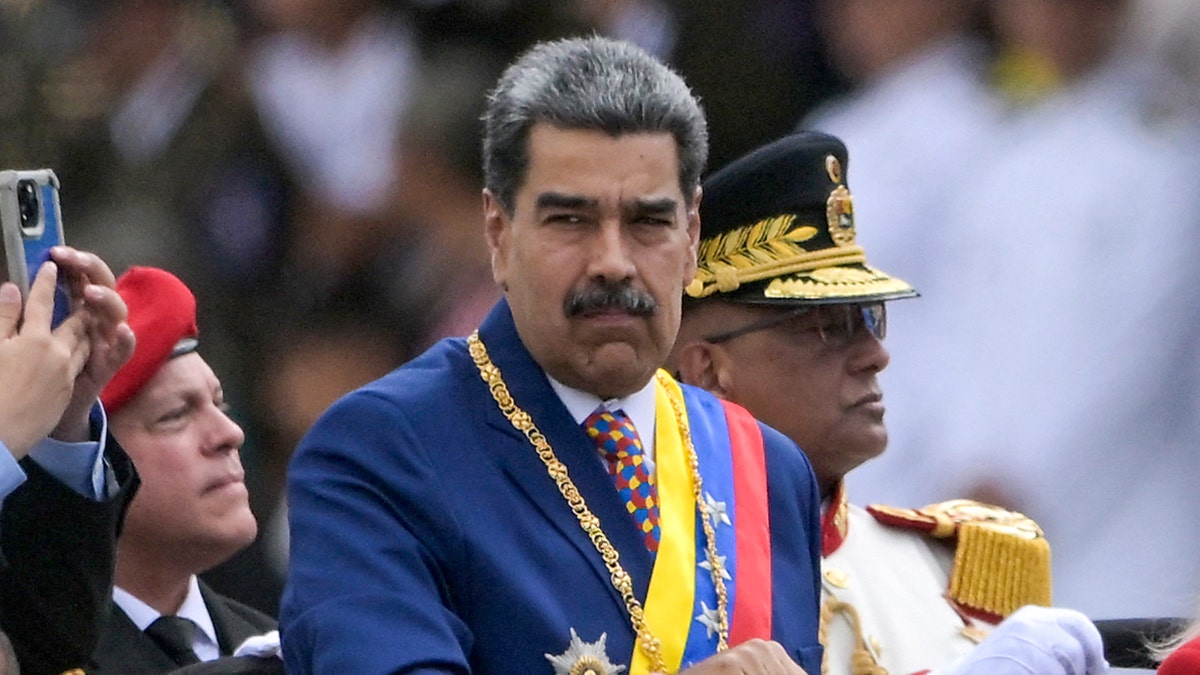
World leaders were sharply divided Saturday after the United States launched a large-scale strike on Venezuela and President Donald Trump announced that the country’s leader, Nicolás Maduro, had been captured and flown out of the country.
Cuban President Miguel Díaz-Canel Bermúdez condemned what he called a "criminal attack," writing on X
that, "Our zone of peace is being brutally assaulted." Communist Cuba
is a supporter of the Maduro government and has been a longtime
adversary of the United States.
Colombian President Gustavo Petro
said his government viewed the reports coming out of Venezuela "with
deep concern," and he warned against further escalation, claiming the
U.S. strikes risked destabilizing the region.
"The Colombian Government rejects any unilateral military action that could aggravate the situation or put the civilian population at risk," Petro wrote on X.
World
leaders react with condemnation, concern, and praise after the U.S.
launches a strike on Venezuela as Trump claims Maduro was allegedly
captured.(JUAN BARRETO/AFP via Getty Images)
Petro
said Colombia is taking preventive measures to "protect the civilian
population" and "preserve stability on the Colombian-Venezuelan border,"
although he did not provide exact details.
Mexico also condemned
the U.S. military intervention in Venezuela, saying it was a "clear
violation" of international law and urging an end to what it described
as "any acts of aggression" against Venezuela.
"Latin America and the Caribbean is a zone of peace," a statement released by the Mexican foreign ministry reads. The statement was shared by Mexican President Claudia Sheinbaum on X.
It warned that any military action puts regional stability at "serious risk."
Brazilian
President Luiz Inácio Lula da Silva also blasted the military action,
saying the bombings and the reported capture of its president crossed
"an unacceptable line."
"These acts represent a most serious
affront to Venezuela’s sovereignty and yet another extremely dangerous
precedent for the entire international community," Lula said, warning the strike risked plunging the world into "violence, chaos, and instability."
Russia,
too, criticized the strikes, calling them an act of "armed aggression"
against Venezuela. Moscow warned the move risked further escalation and
urged dialogue instead.
"Latin America must remain a zone of
peace, as it proclaimed itself in 2014. Venezuela must be guaranteed the
right to determine its own destiny, free from any destructive — let
alone military — external interference," the Russian government said in a
statement.
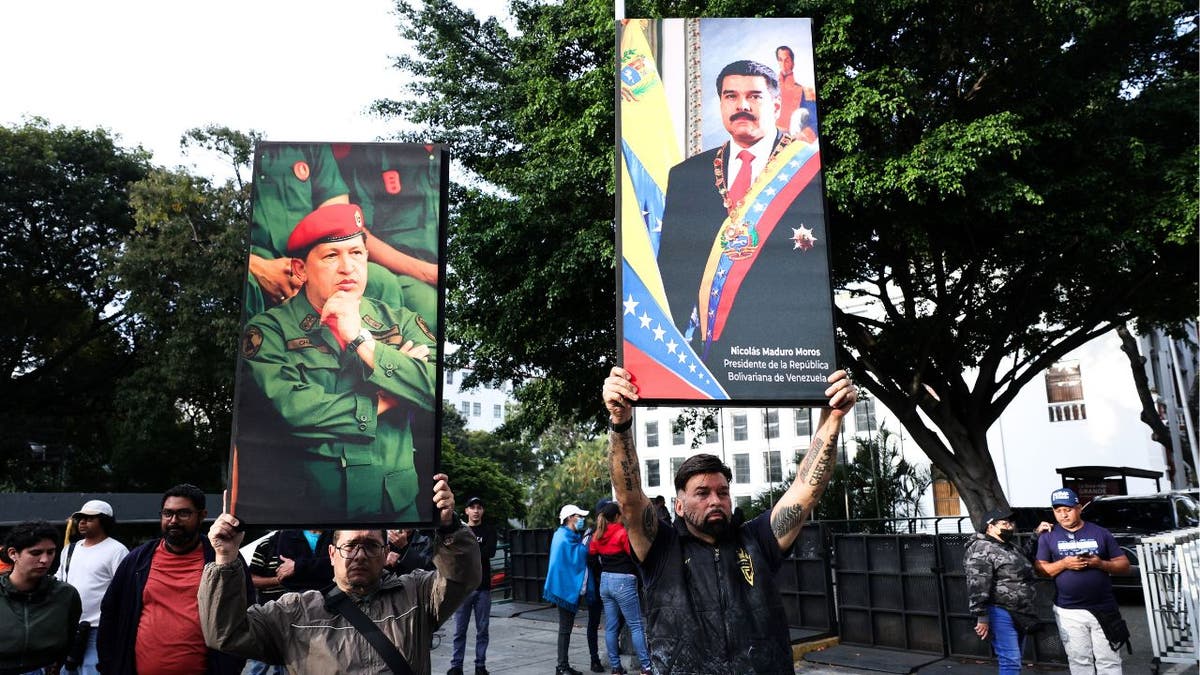
Demonstrators
hold posters of Venezuelan President Nicolás Maduro, right, and late
former President Hugo Chávez during a rally in Caracas, Venezuela.(Jesus Vargas/Getty Images)
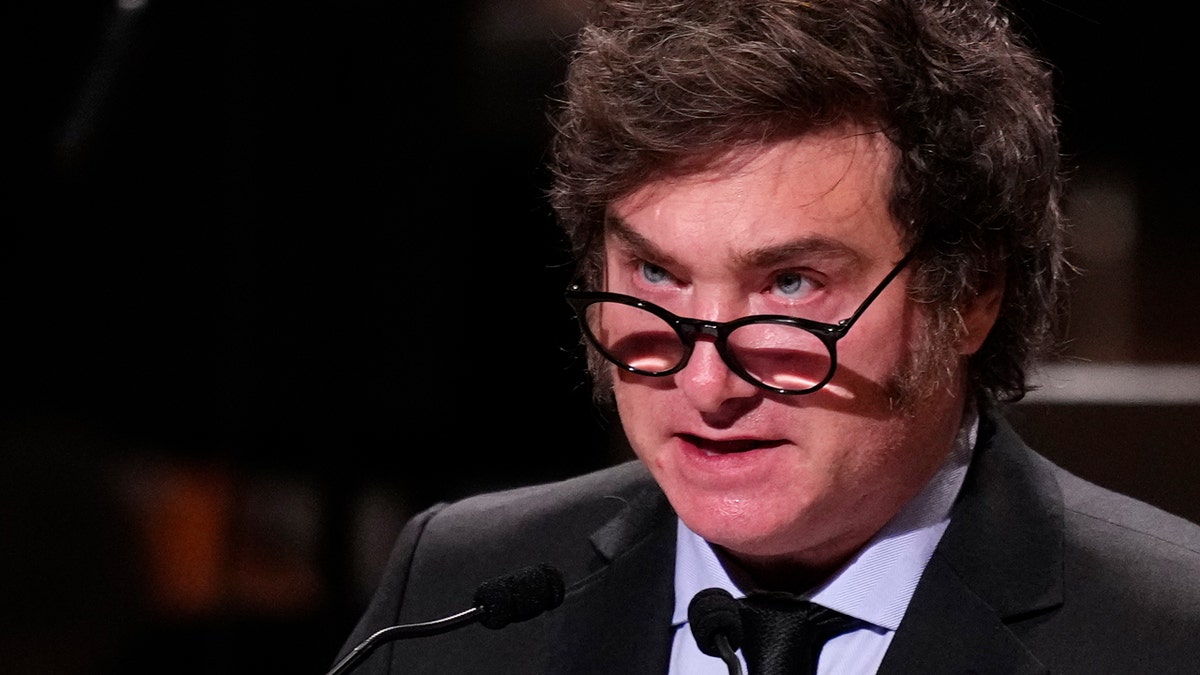
Meanwhile,
President Javier Milei of Argentina, a close ally of Trump, praised the
news by sharing a previous video of him denouncing Maduro's
"narco-terrorist" regime as a regional threat and urging Latin American
leaders to back U.S. pressure to end it.
"Long live freedom, dammit!" Milei wrote, using his signature pro-freedom chant.
Gideon
Sa'ar, Israel's minister of foreign affairs, also commended the
operation and hailed Trump for acting "as the leader of the free world."
"In
this historic moment, Israel stands with the freedom-loving Venezuelan
people, who have suffered under the illegal tyranny of Maduro," Sa'ar wrote
on X. "Israel celebrates the removal of the dictator who led a network
of drugs and terrorism and hopes that democracy returns to the country
and friendly relations between the states. The people of Venezuela
deserve to exercise their democratic rights. South America deserves a
future free from the axis of terrorism and drugs."
In Europe,
European Council President António Costa said he was following
developments in Venezuela "with great concern," urging de-escalation and
respect for international law.
"The European Union calls for
de-escalation and a resolution in full respect of international law and
the principles enshrined in the Charter of the United Nations," Costa
said, adding that the bloc would continue to support a "peaceful,
democratic, and inclusive solution" in Venezuela.
In the U.K.,
Reform leader and staunch Trump ally Nigel Farage questioned the
legality of the attack but said it may lead to a favorable outcome.
Argentina
President Javier Milei praised the news by sharing a previous video of
him denouncing Maduro's "narco-terrorist" regime as a regional threat.(AP Photo/Natacha Pisarenko)
"The American actions in Venezuela overnight are unorthodox and contrary to international law
— but if they make China and Russia think twice, it may be a good
thing," Farage wrote. "I hope the Venezuelan people can now turn a new
leaf without Maduro.
Meanwhile, in Venezuela, the government called on citizens to mobilize against what it labeled an "imperialist attack," urging, "People to the streets!"
Regional
reaction elsewhere in Latin America was muted in the early hours after
the strike, with several governments remaining silent as uncertainty
grew over who was in control in Caracas.
The Associated Press contributed to this report.
Michael Dorgan is a writer for Fox News Digital and Fox Business. You can send tips to michael.dorgan@fox.com and follow him on Twitter @M_Dorgan.
The announcement comes after US President Donald Trump confirmed that morning that Maduro, along with his wife, had been captured as American airstrikes slammed into targets across Venezuela.
Venezuela's President Nicolas
Maduro gestures during a rally to mark the anniversary of the Battle of
Santa Ines, in Caracas on December 10, 2025.(photo credit: Federico PARRA / AFP via Getty Images)
“Nicolas
Maduro and his wife, Cilia Flores, have been indicted in the Southern
District of New York,” Bondi wrote on X/Twitter. “Maduro has been
charged with Narco-Terrorism Conspiracy, Cocaine Importation Conspiracy,
Possession of Machineguns and Destructive Devices, and Conspiracy to
Possess Machineguns and Destructive Devices against the United States.”
The announcement comes after US President Donald Trump confirmed that morning that Maduro, along with his wife, had been captured as American airstrikes slammed into targets across Venezuela.
Bondi
went on to express, on behalf of the American Justice Department, her
gratitude to Trump “for having the courage to demand accountability on
behalf of the American People.” She also thanked the military personnel
who conducted the operation to extract Maduro and his wife.
In
a later post on the social media platform, Bondi shared a link to the
unsealed indictment, signed by Jay Clayton, the US attorney for the
Southern District of New York.
Attorney
General Pam Bondi and FBI Director Kash Patel arrive for a news
conference on the January 6th pipe bomber at the Department of Justice
on December 4, 2025 in Washington, DC. (credit: Andrew Harnik/Getty
Images)According to American media, Maduro was
captured by the US Army’s Delta Force, the special forces unit
responsible for the killing of former Islamic State leader Abu Bakr
al-Baghdadi in 2019.
US capture of Maduro comes after US told Venezuelan leader to leave
The
assault on Venezuela comes at the height of years of mounting tensions
between Washington and Caracas, and, as recently as early last month,
Maduro was told in a phone call with President Donald Trump that he had one week to leave Venezuela.
According to Reuters, at the time, Trump told the South American leader that he had a week to leave the country.
JD Vance: Maduro 'newest person to find out Trump means what he says'
Following
Bondi's announcement, US Vice President JD Vance asserted that Trump
had offered Maduro various avenues to avoid the current situation, and
the Venezuelan president is the latest person to learn that Trump "means
what he says."
The president offered multiple off ramps, but was very clear throughout this process: the drug trafficking must stop, and the stolen oil must be returned to the United States. Maduro is the newest person to find out that President Trump means what he says.
"The
president offered multiple off ramps, but was very clear throughout
this process: the drug trafficking must stop, and the stolen oil must be
returned to the United States," Vance wrote. "Maduro is the newest
person to find out that President Trump means what he says. Kudos to our
brave special operators who pulled off a truly impressive operation."
Maduro and wife will be taken to New York, says Trump
Trump,
who later on Saturday confirmed Maduro's indictment while speaking to
Fox News, said that Maduro and his wife were taken to a ship after their
capture and are set to be taken to New York.
Regime Change Would Transform the Middle East—But Not Necessarily for the Better
Economic strain and widespread unrest are converging in Iran as pressure mounts on the Islamic Republic. Sajjad Vesagh/Tayebi Yousef Mazahibir, CC BY 2.5 , via Wikimedia Commons.
What Happens if Iran’s Regime Falls from Power?
As Iranian protests reportedly turn violent, the Islamic Republic
faces its greatest crisis since its founding more than 46 years ago.
While
previous protests involved elites or smaller segments of society, the
current unrest is spreading across Iranian society, including
traditionally supportive elements.
Even Islamic Revolutionary
Guard Corps veterans suffer the consequence of runaway inflation and the
Iranian rial’s hemorrhaging value.
The closure of the Tehran Bazaar is often the harbinger of government collapse if not revolution.
It is increasingly likely that Supreme Leader Ali Khamenei’s legacy will be the collapse of the Islamic Republic.
If the Iranian public has its say, his son Mojtaba will also hang.
The Fall of Iran: What Happens Next?
The reverberations of the Islamic Republic’s collapse will reshape the region.
The
likelihood of a smooth succession in Iran is slight. There is no
centralized leadership to the current protest movement, and as the
collapse of the Georgetown conference demonstrated, the diaspora
opposition leaders and groups are more polarized than ever.
Rather
than build bridges, Crown Prince Reza Pahlavi’s team has chosen instead
the slash-and-burn tactics and exaggerated claims of credit preferred
by groups like the Mojahedin-e Khalq. The 50,000 registered regime
defectors Pahlavi claimed just six months ago appear little more than a
fevered dream; Iranians are on the street, but there is no indication
that they are doing so at Pahlavi’s direction.
Still, even
Syria-like chaos will neuter Iran’s ability to threaten the region.
Traditionally, when the Iranian regime is under threat, its security
forces retreat from the periphery toward Tehran; they do not lash out at
the region if it means leaving core interests exposed.
Who Wins?
The primary beneficiaries of regime collapse will, in the short term, be both Iraq and the Gulf Arab states.
The
Islamic Republic has, since the U.S.-led ouster of Iraqi President
Saddam Hussein’s regime, repeatedly impinged on Iraqi sovereignty.
Secretary of State Colin Powell’s State Department and George W.
Bush-era National Security Council official Zalmay Khalilzad naively
believed Iranian promises that it would take a hands-off approach to
post-war Iraq; by the time they were willing to acknowledge they were
wrong, it was too late. A deliberate see-no-evil approach marked
President Barack Obama’s subsequent willingness to withdraw from Iraq
and engage Iran diplomatically.
More Winners and Losers
While the Islamic Revolutionary Guard Corps will remain a potent
force based simply on the resources they have stolen and squirreled
away, regime collapse will lead to a ticking clock on the willingness of
Iraqis to listen to them. Immediate losers will be Hadi al-Amiri’s Badr
Corps, Qais al-Khazali’s Asa’ib Ahl al-Haq, and Nouri al-Maliki’s
ambition to return to the premiership, as well as Patriotic Union of
Kurdistan leaders Bafil and Qubad Talabani’s leverage of the Islamic
Republic against their Kurdish rivals. Rumors of Iraqi Hashd al-Shaabi
involvement in countering Iranian protesters will cause generational
antagonism among Iranians toward their Iraqi Shi’ite co-religionists.
The
Gulf Arab states may benefit in the short term, but could quickly lose
some of their relevance. In 1981, the Gulf Cooperation Council (GCC) was
formed to coordinate policy and defense among the frontline Gulf
emirates, sultanates, and monarchies: Kuwait, Saudi Arabia, Bahrain,
Qatar, the United Arab Emirates, and Oman. The GCC consistently
underperformed. Even 45 years later, their militaries lack
interoperability. Internal antagonism toward Qatar for its sponsorship
of Sunni extremist groups and, more recently, the Saudi-Emirati rivalry
has ensured that dysfunction rather than solidarity characterizes any
effort to stake common positions.
The Gulf Arab states may benefit in the short term, but could quickly lose some of their relevance.
The Islamic Republic’s collapse might exacerbate GCC divisions,
especially if Riyadh and Abu Dhabi take their rivalry, already playing
out in Sudan and Yemen, into Iran, with both Gulf states funding and
arming different proxies. With the threat of the Islamic Republic’s
“export of revolution” removed, there will be little reason for the GCC
to continue to exist. Its six members will end the pretense of unity.
Qatar will solidify its ties with Turkey, and the United Arab
Emirates-Saudi Arabia rivalry could even lead to military skirmishes.
Absent the threat of Iranian irredentism, Bahrain will thrive; while it
lacks oil, it will be even better positioned to be the Singapore of the
Persian Gulf.
The United Arab Emirates will also benefit in the
short term. It has long served as a repository for no-questions-asked
investment. But, should Iran collapse, then it could expect billions of
dollars to pour into the country as regime officials desperately seek to
protect their stolen assets. Such financial flows will likely draw
international attention that could spark a longer-term diplomatic crisis
between Abu Dhabi and Washington.
Should civil war erupt in
Iran—and its likelihood is high—then the Arab Gulf states must also be
prepared for hundreds of thousands, if not millions, of Iranian
refugees. The first wave will be upper- and middle-class Iranians who
can afford apartments in Sharjah, if not posh hotels in Dubai. With
time, however, more working-class and rural Iranians will begin to flee
by dhow and speed boat across the Persian Gulf, perhaps overwhelming the
Emirates and its Gulf neighbors.
Oman is typical: Rather than
plan for Iran’s fall, Muscat prefers wishful thinking that diplomacy can
resolve any internal disputes before violence erupts.
Within
Washington, there may be too much optimism that the Islamic Republic’s
collapse will resolve the Houthis’ fight. Such a belief misunderstands
the Houthis: while the Islamic Revolutionary Guard Corps co-opted the
group, it did not create it. Indeed, the Houthis have intellectual and
political roots in Yemen’s Imamate that predate Iran’s 1979 Islamic
Revolution. While southern Yemen rejects the Houthis, they do have a
constituency in northern Yemen, which is one reason why the U.S.-backed
Presidential Leadership Council has failed to end the Houthi scourge.
Within Washington, there may be too much optimism that the Islamic Republic’s collapse will resolve the Houthis’ fight.
Hezbollah might also survive in some form. Israel defeated
Hezbollah’s military, but it is harder to uproot its ideology. A recent
research trip to Lebanon confirmed that Hezbollah did not surrender, but
rather internalized the lesson that they must revert to their pre-2000
covert cell structure. Perhaps they will no longer wield drones and
missiles, but plastique and AK-47s can be equally dangerous in the hands
of experienced users.
Many in Israel expect they can renew the
warm ties they enjoyed with Iran before the 1979 Islamic Revolution.
This, too, is wishful thinking. Many Iranians will resent Israel’s
suspected association with the Mujahedin-e Khalq in subsequent years, as
well as the tendency of some Israelis to support “South Azerbaijan”
separatism. While Crown Prince Reza Pahlavi’s visit to Israel won cheers
in Washington, Jerusalem, and among some diaspora Iranians, Israel’s
subsequent bombing campaign against Iran offended many Iranian
nationalists. Decades of propaganda also take their toll. Egyptians
remain overwhelmingly anti-Israel decades after the Camp David Accords;
it is unrealistic to believe that generations of Iranians fed
anti-Israel conspiracies will switch sides overnight.
Perhaps the
biggest long-term winner of the Islamic Republic’s collapse will be
Turkey. Just as Qatar replaced Saudi Arabia as a financier for Islamic
extremism, Turkey has transformed itself into an ideological engine that
seeks to export its own brand of Islamist extremism with an
aggressiveness akin to 1980s-era Iran. President Recep Tayyip Erdoğan
will see Khamenei’s collapse not as a warning about his own future, but
rather as an opportunity to expand Turkey’s own revolutionary export and
terror sponsorship.
What will emerge is not a more peaceful
Middle East, but simply a change in the flavor of the extremism most
threatening to regional security and U.S. interests.
A Time of Change in Iran? Chaos or Crisis?
Regime change in Iran will be welcome. The devil we know is not
always better than the devil we do not. But, any tendency on the part of
the White House and Washington think tanks to see Iran’s collapse as a
“Hail Mahdi” pass to security and a peaceful Middle East will be
embarrassingly naïve.
Islamists Use ‘Moderation’ and ‘Woke’ Ideologies to Achieve ‘Totalitarian’ Goal
An explosive investigation shows that the European Union has directed
substantial taxpayer funding to affiliates of the Muslim Brotherhood,
enabling them to advance an Islamist agenda.
"[N]on-violent Islamists are frequently
misidentified as ‘moderate allies’ against radicalization, despite
advocating a totalitarian ideology that is fundamentally hostile to
European liberal democratic values.”
Tommaso Virgili, report co-author.
Released at a press conference
in the European Parliament on December 8, the investigation report
“reveals in forensic detail” how the EU continues to legitimize Muslim
Brotherhood (MB) affiliates by granting groups “significant funding,
preferential treatment, and access to powerful networks within the EU
institutions and the broader EU ecosystem.”
The report, titled “Unmasking the Muslim Brotherhood: Brotherism, Islamophobia and the EU,”
published by the European Conservatives and Reformists Group, a
center-right political group in the European Parliament, and co-authored
by Florence Bergeaud-Blackler and Tommaso Virgili, finds that the EU
allows MB-affiliates to “game the system” by parroting project goals,
exploiting administrative loopholes, and “using language that mirrors
grant priorities to secure funding.”
Brotherhood Combines Wokism With Wasatiyyah
The MB combines a notional commitment to the “Woke” idea of intersectionalism with the doctrine of Wasatiyyah
(“middle way”), which it portrays as a theology of moderation, while
simultaneously promoting a separatist ideology based on a rigid
interpretation of Islam to leverage funding, the report explains.
The
Brotherhood’s “labyrinth” operates as “a network of semi-independent
groups” who take advantage of EU “officials’ unfamiliarity with this
totalitarian religious-ideology,” and “play a clever game of dominoes,
leveraging legitimacy in one member state to gain credibility in another
or at the European level, then using that to charm more grant-making
bodies.”
The 27-page dossier laments that EU monitoring systems
are “toothless when it comes to catching deviations from a grant’s
purpose,” that “a few missteps are brushed off as one-offs,” and that
officials who push back risk being labeled racist or “Islamophobic.” The
MB is thus able to obtain funding and legitimacy that “other
totalitarian groups would never dream of getting.”
Charlie Weimers, a Swedish representative to the European Parliament. (Wikimedia photo.)
“In liberal democracies, it is legal to leverage freedoms
of religion, speech, and association to promote totalitarian ideologies
that would abolish those very freedoms,” Charlie Weimers, Member of the
European Parliament (MEP) for Sweden, notes in his foreword to the
report.
“This is not speculation. This is not ideology. This is
evidence. For years, Brotherhood-affiliated organizations have benefited
from EU and national funding streams,” Weimers told the press
conference.
EU Funnels Millions to MB Coffers
The
report details cases of “egregious” EU funding, including the sum of €23
million (from 2007 to 2020) given to the European Network Against
Racism (ENAR), previously led by Michaël Privot, “a former sworn member
of the Muslim Brotherhood who later denounced his affiliation.” ENAR is a
regular partner and consultant in initiatives on climate change,
migration, and “Islamophobia” sponsored by the EU and its agencies.
The European Muslim Union,a
French-based organization founded by German convert Andreas Abu Bakr
Rieger, known for explicitly praising the Holocaust in 1993, received
over €1 million to support more 16 Erasmus+ projects, including the
project “Let’s say stop to Islamophobia!” (Erasmus+ is a youth
development organization managed by the European Commission.)
The
EU gave Islamic Relief Worldwide (IRW) and its local branches more than
€40 million despite the close ties between Islamic Relief Palestine with
Hamas and with the Gaza Zakat Committee (IZS), a Hamas-led charity
whose website describes its officials as “soldiers for Jerusalem.”
EU Turns a Blind Eye to MB-Linked Antisemitism
The
European Commission ignored the charity’s antisemitism even though
statements such as “Lay the bodies of the Jews on the top of the
mountains, so that no dog in Palestine must suffer hunger” and
references to Jews as “apes and pigs” have led IRW’s entire board to
resign, banks to close their accounts, and governments to halt
cooperation, the report noted.
The Forum of European Muslim Youth and Student Organisations (FEMYSO) received €288,856 of EU funding between 2007 and 2019. Focus on Western Islamism (FWI) recently reported that FEMYSO had been identified by France as a “key player” in the MB.
In
May 2024, the French Interior Ministry named FEMYSO “as a training
structure for high-potential leaders within the Muslim Brotherhood
movement,” describing the forum as preparing “a new generation of
activists committed to extending the Brotherhood’s influence into
political, social, and academic spheres.”
The Al Sharq Forum, an
MB affiliate which claims that it “aims to consolidate the values of
pluralism and justice,” received €1.9 million for a project titled “When
Authoritarianism Fails in the Arab World,” even though its founder and
director, Wadah Khanfar—a prominent leader in the Hamas Office in
Sudan—celebrated the October 7 massacre. In 2022, Al Sharq got more than
€100,000 as coordinator of four projects under the Erasmus+ scheme
mentioned above.
Lead Co-Investigator Explains MB Strategy and EU Failure
Speaking to FWI,
the report’s co-author, Virgili, explained how “the persistent support
of Brotherhood-linked actors by the EU is the result of a systemic
failure driven by three converging factors.”
“First, these
entities and individuals operate under a veil of denial; they not only
conceal their affiliations but also master institutional language, using
the right ‘buzzwords’—such as diversity, inclusion, and minority
rights—to seduce unsuspecting political allies and appear perfectly
aligned with democratic values. This makes deep, evidence-based research
essential to unmask their true ideological loyalty,” Virgili said.
“Second,
the EU’s monitoring mechanisms are dangerously fragmented and
insufficient: we see instances where one Commission branch may flag or
investigate an organization, while another simultaneously certifies or
funds it—often through ‘indirect management’ schemes that lack rigorous
oversight,” the researcher warned.
“Finally, there is a critical
lapse in political judgment among public officials: while there is a
clear consensus to deny public support to neo-Nazi or far-right
extremists, non-violent Islamists are frequently misidentified as
‘moderate allies’ against radicalization, despite advocating a
totalitarian ideology that is fundamentally hostile to European liberal
democratic values,” he stressed.
The MB has “used these funds not
to promote integration, tolerance, or cohesion, but to entrench
separatism, propagate antisemitism, support terrorism, and promote a
political-religious vision incompatible with democracy and our European
way of life,” MEP Weimers told the press conference.
Jules Gomes is a biblical scholar and journalist based in Rome.
With the weapons it is supplying to Russia, Iran's drones and related technologies are already devastating Ukraine. This alone should dispel any illusion that Iran's ballistic missile program is a purely regional issue.
These missiles – now part of
reportedly the largest missile arsenal in the Middle East – can reach
not only regional targets but also the U.S. and Europe, a senior Iranian
lawmaker has openly boasted. The regime does not just brag about these
weapons; it uses them.
This trajectory should deeply concern the United States, Europe,
and other democracies. A regime that openly calls for the destruction of
Israel, supplies weapons to violent proxies, and supports Russia's war
effort against Ukraine cannot be allowed to expand such a missile
capability unchecked.
Hezbollah in Lebanon, the Houthis in Yemen, and other armed
groups aligned with Iran have all benefited from Iran's "beneficence."
With the weapons it is supplying to Russia, Iran's drones and
related technologies are already devastating Ukraine. This alone should
dispel any illusion that Iran's ballistic missile program is a purely
regional issue.
Increased sanctions, unified pressure, and a clear willingness to
keep all options -- especially a military one -- on the table are not
acts of aggression. They are measures of responsibility in the face of a
growing and irrefutable threat.
Since the end of Iran's 12-day war with Israel, there has
been mounting evidence that its regime has been ramping up missile
production. These missiles – now part of reportedly the largest missile
arsenal in the Middle East – can reach not only regional targets but
also the U.S. and Europe, a senior Iranian lawmaker has openly boasted.
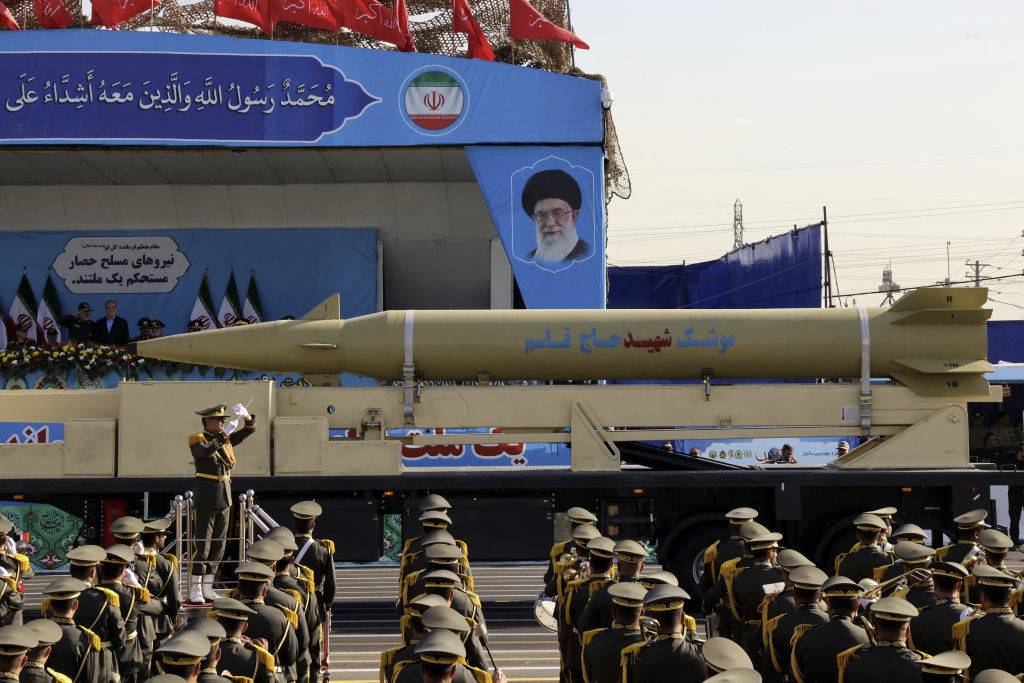
Pictured: Iran's President Masoud Pezeshkian looks on as a 'Qasem
Soleimani' missile is displayed during a military parade in Tehran, on
September 21, 2024. (Photo by Atta Kenare/AFP via Getty Images)
Since the end of Iran's 12-day war with Israel, there has been mounting evidence that its regime has been ramping up
missile production. Tehran's perspective is straightforward: if its
nuclear program has become more vulnerable, then its missile arsenal
must increase as a compensatory tool of power.
It is no secret that the Iranian regime has been accelerating and expanding its ballistic missile program at an alarming pace, and has invested
heavily in improving the range, accuracy, survivability, and payload
capacity of its missiles. These missiles – now part of reportedly the largest missile arsenal in the Middle East – can reach not only regional targets but also the U.S. and Europe, a senior Iranian lawmaker has openly boasted.
Such statements – far from rhetorical – appear part of a purposeful
strategy of intimidation and coercion aimed at democracies and U.S.
allies alike. While much global attention has understandably focused on
Iran's nuclear ambitions, the regime's ballistic missile program has
quietly emerged as its most immediate credible threat.
This trajectory should deeply concern the United States, Europe, and
other democracies. A regime that openly calls for the destruction of
Israel, supplies weapons to violent proxies, and supports Russia's war
effort against Ukraine cannot be allowed to expand its missile
capabilities unchecked.
It would be a mistake to conclude that because the 12-day war significantly damaged
key elements of Iran's nuclear infrastructure, that the threat from the
Iranian regime has therefore been neutralized. During that war, when
Iran launched missiles at Israel, the mullahs used these weapons directly against civilians – most likely a war crime -- not at military targets.
Equally troubling is that over the years, Tehran has transferred
missile systems, components, and technical expertise to its network of
regional proxies and militias. Hezbollah in Lebanon, the Houthis in
Yemen, and other armed groups aligned with Iran have all benefited
from Iran's "beneficence." These weapons transfers have transformed
local militias into strategic actors threatening international shipping
lanes, civilian populations, and critical infrastructure far beyond
their borders. Iran's missile program, therefore, is not just
"defensive," as it claims. It is the backbone of a transnational strategy designed to destabilize the Middle East and challenge Western interests.
Iranian officials have repeatedly emphasized -- presumably to project power
-- that their missiles can reach U.S. bases and European targets. When
democracies respond to such threats with hesitation, they end up
emboldening the behavior they are trying to prevent. Iran surely has
learned over time that ambiguity and delayed responses often work in its
favor, allowing it to advance its capabilities incrementally while
avoiding disruptive consequences.
With the weapons it is supplying
to Russia, Iran's drones and related technologies are already
devastating Ukraine. This alone should dispel any illusion that Iran's
ballistic missile program is a purely regional issue. It is a source of
instability that now stretches from the Middle East to Eastern Europe,
undermining international norms and fueling conflicts far beyond Iran's
borders.
The Iranian regime today possesses the largest ballistic missile arsenal
in the Middle East, and these missiles are central to its strategy of
intimidation, proxy warfare, and regional domination. Even without a
nuclear warhead, such weapons can alter strategic calculations across
multiple regions. Ignoring this reality risks repeating past mistakes
that allowed the problem to grow until the costs of action became far
higher.
So, the question facing democracies is: Are we just going to sit and
watch? If the answer is no, then the flow of funds sustaining the regime
must be significantly curtailed, and sanctions targeting Iran's
shipping networks, financial institutions, and procurement channels must
be expanded and rigorously enforced.
As oil exports remain Tehran's primary source of revenue, the
enforcement of existing sanctions—particularly on Chinese purchases of
Iranian oil — have to become far more serious. Without sustained
pressure on this revenue stream, Iran will continue to finance missile
production, proxy warfare, and repression at home.
European governments must move beyond rhetorical concern and align
their policies accordingly. Fragmented enforcement only creates
loopholes that Iran exploits with remarkable efficiency.
The West must have a serious discussion—in close consultation with
Israel, the United Arab Emirates and Morocco — about deterrence beyond
sanctions. If Iran continues to expand its ballistic missile production
and openly threatens other nations, policymakers must ask whether the
same logic that justified action against nuclear infrastructure also
applies to missile production capabilities. This is not a call for
reckless escalation, but rather for credible consequences that convince
Tehran its current stance carries unacceptable costs.
Iran uses its weapons directly, transfers them to militias, or
leverages them to coerce and intimidate other nations. Increased
sanctions, unified pressure, and a clear willingness to keep all options
-- especially a military one -- on the table are not acts of
aggression. They are measures of responsibility in the face of a growing
and irrefutable threat.
Dr. Majid Rafizadeh is a political scientist,
Harvard-educated analyst, and board member of Harvard International
Review. He has authored several books on the US foreign policy. He can be reached at dr.rafizadeh@post.harvard.edu
All around Iran, citizens rise against tyranny, taking a risk for freedom and a better future.
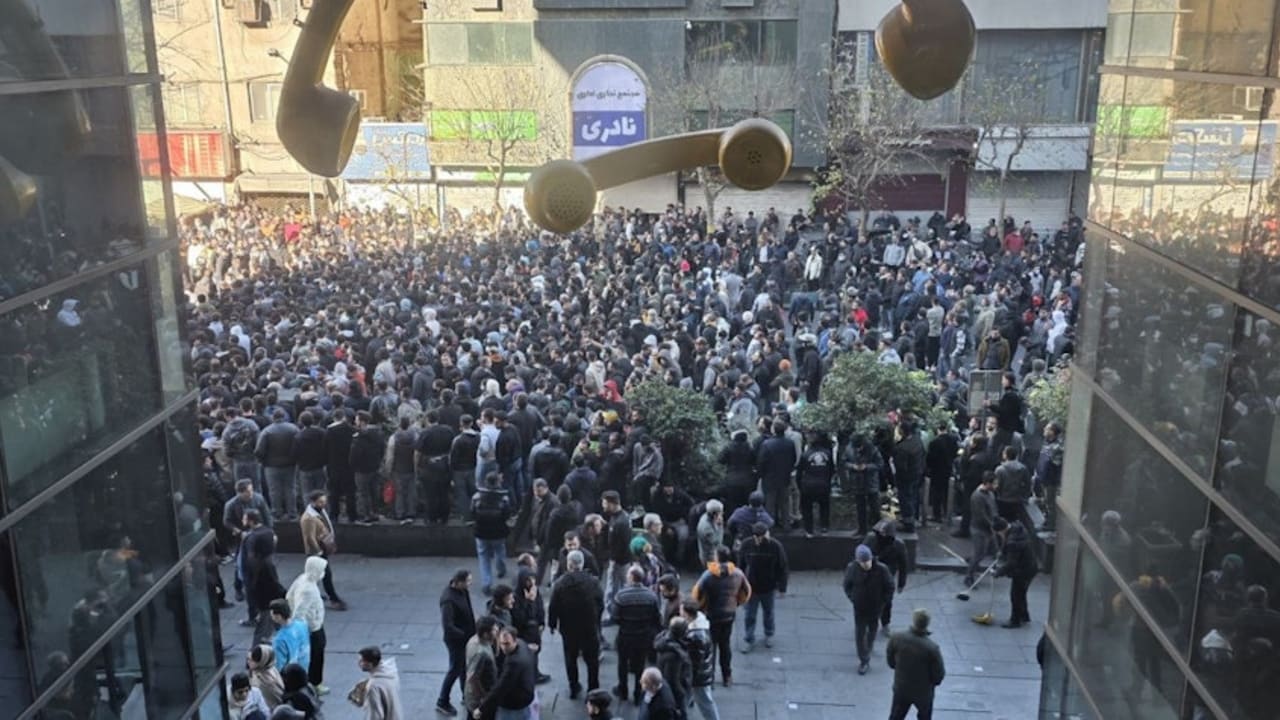
Iranians protest on a main street in Tehran, December 30, 2025(photo credit: SOCIAL MEDIA/VIA SECTION 27A OF THE COPYRIGHT ACT)
Is it possible that after 47 long and oppressive years of ayatollahs, backed by the iron fist of the Iranian Revolutionary Guard, the winds of freedom will finally sweep across the former Persian Empire?
So
little is being reported about what could end up being one of the
biggest stories of the 21st century, making it even more of a mystery.
The grassroots revolution began the week between Christmas
and New Year’s – a time when festivities are in full swing. But,
nonetheless, this is a major development that cannot be minimized.
The
last attempt of Iranians to reclaim their beloved country, hijacked in
1979 by Islamic extremists who overthrew the Pahlavi dynasty, failed
despite the massive demonstrations of 2022 in at least nine provinces,
including Tehran.Responsible for that huge civil uprising was the death
of Mahsa Amini, after having been arrested by Iran’s morality police for
improperly wearing her hijab head covering. That unconscionable act
became the impetus for the rage expressed by the local population for
the tragic and violent death of one helpless 22-year-old woman.
No
longer willing to live under the tyranny of the mullahs, Iranians took
to the streets, finally revolting against the lack of freedom and
intolerable way of life that they had endured over the last 43 years.
Unwilling
to release their tight grip, the IRGC began a campaign of lethal force,
using live ammunition and tear gas against their own people, killing
over 550, 69 of whom were children. Everything from torture to sexual
violence was employed on the estimated 20,000 who had been arrested.
‘A MONSTER’ – Members of the IRGC attend a ground forces military drill
in the East Azerbaijan province of Iran in 2022. (credit: IRGC/WANA
(West Asia News Agency)/Handout via REUTERS)The
government, in an effort to ease the tensions, agreed to mass pardons in
2023, but it was too late. A freedom movement had begun. And, although
it took a couple more years to rise even stronger, the people were
clearly not going back to their quiet corner.
'We want the mullahs gone'
Now,
they’ve returned in full force, shouting, “We want the mullahs gone.”
Fed up with the massive financing of Hezbollah and Hamas by their
government, they are no longer willing to put up with the dire economic
situation, the direct result of proxy wars.
Their frenzied chant, “Neither Gaza nor Lebanon, My Life for Iran,” expresses their refusal to put up with Iran’s support of terrorism to the detriment of its own citizens.
And
that is why many believe that the failed experiment of an extremist,
authoritarian, and theocratic government is about to come to an end.
Between the collapse of their currency and the ensuing hyperinflation,
rising to 40% annually, most Iranians are unable to afford everyday
necessities, causing the level of poverty to rise to nearly 50%.
When
people are faced with such harsh living conditions, the only thing left
to do is rebel, because life hardly seems worth it when all hope is
taken away. It’s all simply become intolerable – high unemployment
rates, poor infrastructure, constant energy shortages, total lack of
water supplies, crippling sanctions placed on the country, and, worst of
all, the lack of all freedoms.
It’s
no wonder that Iranians are willing to die to remove the scourge from
their midst. The iconic figure of one, single man, sitting in the middle
of an Iranian street as security forces approached him, was posted on
Instagram as a reminder of the courage it takes to battle evil.
But
as the regime barely hangs on, fearing that their end is near, there
are growing concerns that their last act of defiance may be to strike
Israel, reasoning that if they go, so, too, must the Jewish state. And
that is why we are on high alert, prepared for any possible surprise
attack.
As
the protest enters its fifth day (at the time of writing), everyone is
waiting to see what will happen. The day before, young people stormed
the government buildings in the south of the country, while the IRGC
shot back at them.
But
backed by both the Mossad as well as Crown Prince Reza Pahlavi, the
exiled Iranian opposition political figure, Iranian citizens are being
encouraged to continue their fight until they prevail and oust their
oppressors.
As
life comes to a halt throughout Iran, with the boarding of all shops
and a pause in almost every daily activity, there is renewed hope that
this time, the people might have a shot at breaking the 47-year rule,
which has kept them imprisoned and smothered in a way they are no longer
willing to accept.
So,
Iran is in the throes of their own Tiananmen Square rebellion, risking
their lives for the sake of the dream of being a free people. And while
the government is trying to put a humane face on the protests by
sounding as if they’re listening to the outcries of the people, it’s
clear that, from their perspective, the supreme leader, along with his
extreme religious rulers, has no intention of easing up their strong
control over every aspect of the lives of Iranians.
So,
no one is taken in by the feigned sound of “reasonable” government
voices claiming that they are listening and possibly willing to
compromise.
This
regime must be completely shattered and dismantled before any changes
can take place, and that would mean either a full-on coup or
self-imposed exile of Iran’s ruling class, so that a new government can
be installed.
Of
course, if this happens, it will be a major game-changer in the Middle
East, because those fighting against Israel will lose their financing as
they continue to fight Israel. A lack of money will certainly have its
effect on the ideological motivation of terrorists who suddenly find
themselves hungry.
A new Iranian government will also put an immediate end to the threat of nuclear warfare against Israel
– the greatest concern, which caused the US to join forces with the
Jewish state and bomb their development facilities in a preemptive
strike, severely setting them back by months or even years.
Imagining
a peaceful Iran is as good as it gets – not only in the Middle East,
but throughout the world. Because if Iran had succeeded in developing
their nuclear arsenal, no one would have been safe.
The
year 2026 holds so much promise for Iranians, Israelis, vulnerable
Middle East countries, the US, and all of Europe. May it be the first
gift of a new year with the bright spot of hope amid a world that has
gone mad!
Cookie Schwaeber-Issan is a former Jerusalem elementary and middle school principal. She is the author of Mistake-Proof Parenting, based on the time-tested wisdom found in the Book of Proverbs, available on Amazon.
If Arab and Afghan Proxies Act with the Brutality They Showed in 2019, Iranian Security Forces Will Further Turn on the Regime
A squad of Iraqi militia in a 2019 file photo. Shutterstock
On January 2, 2026, Persian social media exploded with rumors that the Islamic Republic was bringing Iraq’s Popular Mobilization Forces (Hashd al-Sha’abi) into Iran to crack down on protests. There are also rumors
of Afghan forces attacking demonstrators inside Iran. Where there is
smoke, there is likely fire. The Iranian regime resorted to using its
foreign proxies in the past and likely does so now. At best, however, it
might be a short-term patch but in the longer term, it will worsen the
situation for the regime.
Many photos and videos show the [Iranian]
security personnel taking a soft approach and even encouraging people to
join the movement.
In 2019, the government ended protests in ten days, killing 1,500 in that short period. However, the regime had to rely
heavily on its foreign proxies. Things were different in 2022. The
protests lasted for months because, by the regime’s standards, the
crackdown was diluted. The regime killed approximately 500 over two
months, a much slower rate than in 2019, although the regime
subsequently increased its numbers by executing prisoners it accused of
participation. In 2022, most officers in Zahedan reportedly refused to
deploy to Tehran to suppress the protests, and a small number agreed
only on the condition that they would not need to use force. A leaked
government memorandum showed
that many Islamic Revolutionary Guards Corps commanders were
sympathetic to the people and also warned Supreme Leader Ali Khamenei
that some of their junior officers were among the demonstrators.
On paper, the Islamic Republic retains the manpower to clear the streets easily. But many photos and videos show the security personnel taking a soft approach and even encouraging
people to join the movement. Outside observers have confirmed the
deaths of eight protesters after five days, a much slower rate than in
the past. The regime’s pleas for a “dialogue” with the protesters also
suggest a lack of confidence in its suppression forces.
The Islamic Republic used Popular Mobilization Forces and other foreign mercenaries in the past.
So, too, does the regime’s choice to employ foreign proxies. The
Islamic Republic used Popular Mobilization Forces and other foreign
mercenaries in the past. In 2019, their brutality caused criticism, even
within the government. First, mercenary cruelty exceeded the tolerance
of regime personnel. A perverted sense of nationalism also dictates that
nobody gets to kill their compatriots but they themselves. Finally,
regardless of their views on regime change, the security forces shared
many of the protesters’ grievances.
Today, Khamenei’s inner circle
faces a conundrum. If Arab and Afghan proxies act with the same
brutality as they did in 2019, then Iranian security forces will further
turn on the regime. Many, though not all, within the armed forces
deploy just to create an environment of fear, using their uniforms and
gear to deter protests without extreme violence. Others are bystanders,
at the scene to follow orders, but unwilling to do more than observe. If
they see Arab and Afghan forces use lethal and gratuitous violence on
their compatriots, some may use their arms to protect fellow Iranians.
This might happen during this wave of protests or the next. Either way,
use of excessive violence by foreign proxies will transform this
possibility into an inevitability.
The regime’s decision-makers are aware of this problem. That they accept its risk exposes their desperation.
Sadly, in the Qur'an, slavery is condoned and used as a justification for rape, male control of women, and other abuse.
"[T]he Baqt treaty ...
imposed an annual payment of 360 slaves on the Christian kingdom of
Nubia [based along the Nile river].... By 1877, when there were said to
be upwards of 6,000 slave-traders operating in the region, the British
government estimated in a report to the Egyptian authorities that around
30,000 slaves per annum were being sent across the Red Sea from the
East African coast to the Arabian peninsula alone." — Justin Marozzi,
British historian, in his 2025 book Captives and Companions: A History of Slavery and the Slave Trade in the Islamic World.
"For Arabic-speakers along the Nile Valley, both the terms Nubi (Nubian) and Sudani (Sudanese), meaning black, were synonymous with 'slave.'" — Justin Marozzi, Captives and Companions.
"A lasting and painful irony...is that the northern Arab Sudanese
do not consider themselves black, reserving that pejorative term for
their dark-skinned Sudanese and South Sudanese compatriots, in addition
to Africans from further afield, who for centuries they enslaved." —
Justin Marozzi, Captives and Companions.
Then followed the disgraceful betrayal of the black Africans of
Sudan by the government of the African National Congress, with Cyril
Ramaphosa both as deputy president (2014-2018) and as president, up to
today.
"By the dying years of the twentieth century... slavery was once
again thriving in Sudan. For the National Islamic Front of Omar
al-Bashir, the then president of Sudan (in office 1993-2019), it was an
effective weapon of war against his black southern Sudanese
compatriots." — Justin Marozzi, Captives and Companions.
"When the country split in 2011, it was estimated that over
35,000 South Sudanese people remained enslaved in Sudan. In Darfur the
Janjaweed militia ran amok, committing numerous atrocities. One
eyewitness, Neimat al Mahdi, recalled how the Janjaweed would enter the
village of an African tribe, kill all the men and rape the women,
mocking them afterwards with the age-old racial slur: 'You should
celebrate, you slave. You are going to give birth to an Arab.'" — Justin
Marozzi, Captives and Companions.
"Whichever way you looked across the nineteenth-century Dar al
Islam ["Land of Islam"], slavery coolly returned your gaze." — Justin
Marozzi, Captives and Companions.
Sadly, in the Qur'an, slavery is condoned and used as a justification for rape, male control of women, and other abuse.
In 2015, South Africa's ruling African National Congress
refused to implement the arrest warrant issued for genocide by the
International Criminal Court against Sudan's then President Omar
Al-Bashir when he visited South Africa -- a "shameful failure", as
reported by Amnesty International. On January 4, 2024, South African
President Cyril Ramaphosa continued this alliance when he welcomed
Bashir's military appointee, General Mohamed Hamdan Dagalo ("Hemedti"),
the commander of Sudan's murderous and genocidal militia, the Rapid
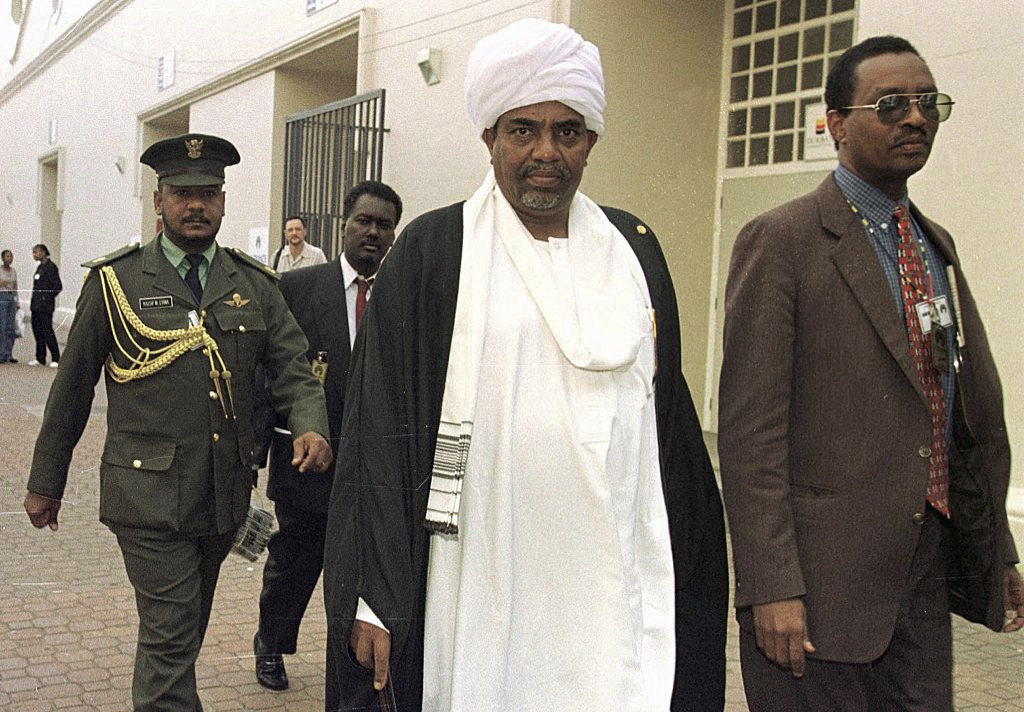
Support Forces. Pictured: Al-Bashir (foreground) arrives at a press
conference during a visit to Durban, South Africa, on September 3, 1998.
(Photo by Odd Andersen/AFP via Getty Images)
The African National Congress (ANC) government in South Africa has a
shameful record in its response to the worst genocidal and racist crisis
now continuing in Africa.
"Is South Africa's voice... loud enough in addressing the recent conflict in Sudan?" asked
journalist Nkanyezi Ndlovu recently. "While condemnation [of the war in
Sudan] is noted, what other diplomatic steps has South Africa taken,
not only as an African superpower but also as the current G20
President?"
These are crucial points, but reflecting on the people of South
Africa's response to what Ndlovu accurately calls the "humanitarian
crisis" in Sudan, the reality is far more damning.
First, it is essential to remember that when Jacob Zuma was president
between 2009-2018, with Cyril Ramaphosa his deputy president
(2014-2018), the ANC government refused to implement the arrest warrant
issued for genocide by the International Criminal Court against Sudan's
then President Omar Al-Bashir when he visited South Africa in June 2015
-- a "shameful failure", as reported by Amnesty International. Effectively, on this issue, the ANC government aligned itself with Bashir in opposition to the ICC.
On January 4, 2024, President Cyril Ramaphosa continued this
effective political alliance when, in Pretoria, he welcomed Bashir's
military appointee, General Mohamed Hamdan Dagalo (known as "Hemedti"),
the commander of Sudan's murderous and genocidal militia, the Rapid
Support Forces.
The British historian Justin Marozzi in 2025 published an essential book, Captives and Companions: A History of Slavery and the Slave Trade in the Islamic World. Marozzi, fluent in Arabic, summed up his understanding of the Sudan issue in "The shocking truth about slavery in the Islamic world today", published in London's Daily Telegraph on July 3, 2025. The article begins:
"Up to 17 million people have passed through the slave
trade in the Muslim world since the 7th century. Tragically, the
practice lives on."
In his book, Marozzi makes it clear that nowhere else on the
continent more than Sudan -- right up to today -- have black Africans
suffered for so long under a foreign colonialist and imperialist power,
and its descendants. The following is a long but crucial passage from Captives and Companions (pp. 332-34):
"Slavery in Sudan long preceded the Ottomans [masters of
Turkey and the Ottoman empire since the 15th century]. It antedated
Islam by more than a millennium. One of the earliest references to it
comes from Herodotus, writing in the fifth century BCE. Discussing the
Persian Great King Cambyses' invasion of Egypt in 525 BCE, the Greek
historian recorded that the biennial tribute imposed on the ancient
kingdom of Kush (northern Sudan and southern Egypt) included five
'Ethiopian' slave boys.
"In 652, almost 1,200 years later, the conquering, faith-spreading
Muslim Arabs struck their first diplomatic treaty in this region.
According to Al Maqrizi, the fifteenth century Egyptian historian, the Baqt
treaty ... imposed an annual payment of 360 slaves on the Christian
kingdom of Nubia [based along the Nile river].... By 1877, when there
were said to be upwards of 6,000 slave-traders operating in the region,
the British government estimated in a report to the Egyptian
authoriities that around 30,000 slaves per annum were being sent across
the Red Sea from the East African coast to the Arabian peninsula alone.
"In the mid-tenth century, the Coptic [Christian] Bishop of Al
Ashmunain, Severus Ibn al Muqaffa (d. 987), reported that Muslims were
plundering and enslaving and selling their captives in Egyptian
markets....
"When Muslim states started to be established along the central Nile
and Sudanic states from the sixteenth century, they took up where their
pagan and Christian predecessors left off, raiding along their borders
and enslaving their neighbours. For Arabic-speakers along the Nile
Valley, both the terms Nubi (Nubian) and Sudani (Sudanese), meaning black, were synonymous with 'slave'. Bilad al Sudan,
the Land of the Blacks, referred to all sub-Saharan territories in
general, but it is from that Arabic term that the nation of Sudan takes
its name.
"A lasting and painful irony, which has had baleful consequences, is
that the northern Arab Sudanese do not consider themselves black,
reserving that pejorative term for their dark-skinned Sudanese and South
Sudanese compatriots, in addition to Africans from further afield, who
for centuries they enslaved.
"The great arterial link between Egypt and Sudan, the enduring
commercial thread that bound these two states together in a nexus of
slaving as the market and source for enslaved Africans respectively, was
the Darb al Arbain, as the Arabs knew it, the Forty Days' Road.
The easternmost of the great north-south trans-Saharan routes, this was
an 1,100-mile road from Kobbei in Darfur to Upper Egypt, running through
a string of oases so that water was always available within two to
three days.
"Like slavery itself, the Darb al Arbain long predated Muslim
Arabs and was trodden successively by Egyptian pharaohs, Persian
temple-planners, Macedonian invaders, fort-building Romans and Ottoman
traders. Caravans of camels - groaning under loads of elephant and
hippopotamus ivory, rhinoceros horn, gold, ostrich feathers and eggs,
animals skins, plants, civet, aromatic oils, incense and gum Arabic,
salt, alum, natron and cowrie shells - dutifully padded alongside lines
of African slaves on foot, often in chains, togther with the odd
'exotic' animals destined for a royal court. They plied the track
towards Egypt....
"Conditions for the slaves along the Darb al Arbain varied from humane to appalling."
Then followed the disgraceful betrayal of the black Africans of Sudan
by the government of the African National Congress, with Cyril
Ramaphosa both as deputy president (2014-2018) and as president, up to
today.
"By the dying years of the twentieth century... slavery was once again thriving in Sudan.
"For the National Islamic Front of Omar al-Bashir, the then president
of Sudan (in office 1993-2019), it was an effective weapon of war
against his black southern Sudanese compatriots. From 1989 to 2011 he
presided over the systematic enslavement of Sudanese and South Sudanese
from the border region, arming, financing, transporting and supporting
slave-taking militia raids into the Nuba Mountains, Abyei and [19th
century Arab slave-master] Zubayr's former stronghold of Bahr al Ghazal.
"Men were routinely killed, women and children enslaved. Boys were
trafficked to Libya, Qatar and Saudi Arabia. Non-Muslims were forcibly
converted to Islam, and existing Muslims were forcibly Arabized. They
were sold into the slave trade, renamed and forced to travel hundreds of
miles from home, separated from their families, beaten, abused and
foced to work for no pay. Many of the women and children were subjected
to sexual abuse and torture.
"When the country split in 2011, it was estimated that over 35,000
South Sudanese people remained enslaved in Sudan. In Darfur the
Janjaweed militia ran amok, committing numerous atrocities. One
eyewitness, Neimat al Mahdi, recalled how the Janjaweed would enter the
village of an African tribe, kill all the men and rape the women,
mocking them afterwards with the age-old racial slur: 'You should
celebrate, you slave. You are going to give birth to an Arab.'
"The International Criminal Court issued two arrest warrants for
Bashir in 2009 and 2010, the first time a sitting head of state had been
indicted by the ICC. The court quoted the perpetrators of attacks
aganst civilians, especially from the Fur, Masaalit and Zaghawa tribes,
telling their victims: 'the Fur are slaves, we will kill them'; 'You are
Zaghawa tribes, you are slaves'; 'we are here to eradicate blacks (nuba )'.
"Bashir is accused of war crimes, crimes against humanity and
genocide in Darfur. At the time of writing, reportedly he remains held
in a hospital in Merowe, 200 miles north of Khartoum, and is one of the
ICC's longest-running fugitives from justice.
"Whichever way you looked across the nineteenth-century Dar al Islam
["Land of Islam"], slavery coolly returned your gaze." (pp. 353-54)
Sadly, in the Qur'an, slavery is condoned and used as a justification for rape, male control of women, and other abuse.
"He gives you this example, drawn from your own lives: do
you make your slaves full partners with an equal share in what We have
given you?" (Qur'an 30:20, Abdel Haleem translation)
"Allah makes this comparison. On the one hand there is a helpless
slave, the property of his master. On the other, a man on whom We have
bestowed Our bounty, so that he gives it both in private and in public.
Are the two alike? Allah forbid! Most men have no knowledge." (Qur'an
16:75, N.J. Dawood translation)
South Africans need to reflect on this. There is a moral duty for
South Africans to acknowledge the 14 centuries of Islamic jihad against
black Africans, and its genocidal character -- not least since the
massacre by Islamists of unarmed Jewish civilians in Sydney, Australia
on December 13, while celebrating the religious festival of Chanukah.
Paul Trewhela, a journalist formerly in his native
South Africa, was incarcerated as a political prisoner in Johannesburg
and Pretoria from 1964-67. He subsequently worked in exile as a school
teacher in the UK and Ireland, and co-founded and co-edited the banned
exile magazine, Searchlight South Africa, published in London. He authored the book, Inside Quatro: Uncovering the Exile History of the ANC and SWAPO (2009), published in South Africa.