Saturday, February 7, 2026

Syria's Genocidal 'Peace': Trump's 'Friends' Have Been Setting Him Up with Jihadists Faking Tolerance - Uzay Bulut


by Uzay Bulut

Next Stop, Gaza


  • It is hard to tell which, so far, is the greatest scam of the century: "Climate Change" while watching North America enjoying its global warming; Putin's protestations of wanting peace while demolishing Ukraine, or the trap being lubricatively laid for US President Donald J. Trump throughout much of the Middle East.

  • The "success" being brought to Syria -- slaughtering non-Muslims -- appears to be the same kind of "success" being brought into Gaza, after Trump leaves office, of course. Some of Trump's "friends" and devoted donors, such as Qatar, Saudi Arabia, Indonesia and Pakistan, appointed to his "Board of Peace," do not even recognize Israel.

  • Trump's vision seems to be that economic prosperity will supersede jihadist ideology and deradicalize "all ships" -- but what if it does not? As can be seen in Qatar, one can be rich and radical – and able to buy even bigger weapons, whether nuclear, broadcastable or financial. Qatar, which runs its state-owned Al-Jazeera television network at an estimated cost of billions of dollars, has, according to reports, donated more than $1 billion to Washington, DC's Georgetown University alone. Georgetown happens to specialize in training future diplomats. Just what information will these future diplomats be exporting

  • In Syria, the recent assaults on its Christians, Kurds and Yazidis are the third ethnic cleansing campaign that the army and affiliated militias under al-Sharaa have conducted since he took over Syria in December 2024. The others targeted the Alawites, Yazidis and Druze.

  • Al-Sharaa's regime, after taking almost full control of the country, has been largely dismantling the Kurdish autonomous region that controlled Syria's northeast for over a decade, while the US administration has abandoned its allies – the Kurds and the SDF – who had courageously fought ISIS and helped liberate Syria from ISIS occupation.

  • Videos on social media show al-Sharaa-affiliated forces abducting Kurdish women, mocking them as "gifts" (sex slaves) and massacring Kurds.

  • The city of Kobani, still controlled by Kurds, is currently encircled on three sides by al-Sharaa's army and affiliated militias, while the border with Turkey remains closed. Al-Sharaa's armed forces, according to the Kurdish media, also targeted the region's sole source of power, the Tishrin Dam, thereby cutting off the city's electricity and water supply since January 15.

  • "[Al-Sharaa's] ultimate goal is an Islamist dictatorship in Syria. It was made clear after it leaked from the meeting between him and the Kurds when he asked Mazloum Abdi [SDF leader]: 'why did you let the Christians form their own police force?'" — Rafael Issa, a Christian born in Syria and the founder of the Levantine Greek Association, to Gatestone, January 2026.

  • "The US should investigate what is really going on in Syria, and not use Tom Barrack's [U.S. Ambassador to Turkey and Special Envoy for Syria] point of view. Tom Barrack is obviously working for his own interests." — Rafael Issa to Gatestone, January 2026.
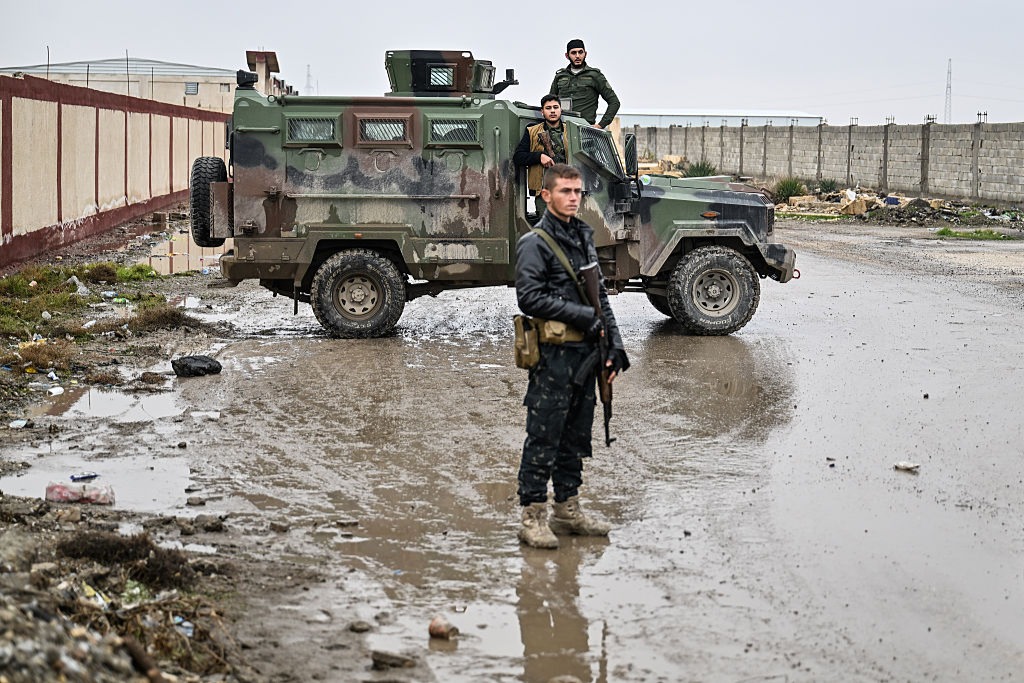
In Syria, Ahmed al-Sharaa's regime, after taking almost full control of the country, has been largely dismantling the Kurdish autonomous region that controlled the northeast for over a decade, while the US administration has abandoned its allies – the Kurds and the SDF – who had courageously fought ISIS and helped liberate Syria from ISIS occupation. Pictured: Syrian regime forces block a road as they take over Al-Aqtan prison near Raqqa, on January 23, 2026. (Photo by Abdulmonam Eassa/Getty Images)

It is hard to tell which, so far, is the greatest scam of the century: "Climate Change" while watching North America enjoying its global warming; Putin's protestations of wanting peace while demolishing Ukraine, or the trap being lubricatively laid for US President Donald J. Trump throughout much of the Middle East.

Start at Syria. It was Turkish President Recep Tayyip Erdogan who reportedly groomed al- Syrian President Ahmed al-Sharaa for Western consumption, and it was Saudi Arabian Crown Prince Mohammed bin Salman who persuaded Trump, during his visit to Riyadh May 2025, to give Sharaa, a former Al Qaeda operative, "a chance at greatness" – presumably meaning to bring peace to Syria:

"And I'm very pleased to announce that Secretary Marco Rubio will be meeting with the new Syrian foreign minister in Turkey later this week. And very importantly, after discussing the situation in Syria with the Crown Prince, your Crown Prince, and also with President Erdogan of Turkey who called me the other day and asked for a very similar thing, among others and friends of mine, people that I have a lot of respect for in the Middle East, I will be ordering the cessation of sanctions against Syria in order to give them a chance at greatness.

"Oh, what I'd do for the Crown Prince."

The "success" being brought to Syria -- slaughtering non-Muslims -- appears to be the same kind of "success" being brought into Gaza, after Trump leaves office, of course. Some of Trump's "friends" and devoted donors, such as Qatar, Saudi Arabia, Indonesia and Pakistan, appointed to his "Board of Peace," do not even recognize Israel.

Trump's vision seems to be that economic prosperity will supersede jihadist ideology and deradicalize "all ships" -- but what if it does not? As can be seen in Qatar, one can be rich and radical – and able to buy even bigger weapons, whether nuclear, broadcastable or financial. Qatar, which runs its state-owned Al-Jazeera television network at an estimated cost of billions of dollars, has, according to reports, donated more than $1 billion to Washington, DC's Georgetown University alone. Georgetown happens to specialize in training future diplomats. Just what information will these future diplomats be exporting?

In Syria, the recent assaults on its Christians, Kurds and Yazidis are the third ethnic cleansing campaign that the army and affiliated militias under al-Sharaa have conducted since he took over Syria in December 2024. The others targeted the Alawites, Yazidis and Druze.

Al-Sharaa's Islamist government is currently targeting Kurds and the Kurdish-led Syrian Democratic Forces (SDF) in the country's northeast. Since January 6, an estimated 150,000 people, mainly Kurds, Christians, and Yazidis, have been internally displaced by Syria's armed forces.

Al-Sharaa was head of the terrorist group Hay'at Tahrir al-Sham (HTS), and before that, he led Syrian al-Qaeda (also known as the Jabhat Al-Nusra or the Nusrah Front), a US-designated Foreign Terrorist Organization. HTS, based on its affiliation with al-Qaeda and ISIS, was blacklisted as a terrorist organization by the UN Security Council and the European Union. Last year, the US State Department, presumably as part of its effort to facilitate the consolidation of al-Sharaa's rule, delisted it as a terrorist organization.

Al-Sharaa became Syria's self-proclaimed president after a jihadist offensive, spearheaded by HTS and supported by the Turkish government, overthrew the Assad regime in November 2024. A $10 million bounty for al-Sharaa's capture was removed by the Biden administration on December 20, 2024.

The regime forces' current attacks against the Kurds started on January 6 in the Kurdish-majority neighborhoods of Sheikh Maqsoud and Ashrafieh in the northern part of Aleppo.

On January 18, regime forces seized Raqqa, the former capital of ISIS, and controlled by Kurds since the defeat of ISIS. There, al-Sharaa's forces released thousands of ISIS terrorists from prison.

Al-Sharaa's regime, after taking almost full control of the country, has been largely dismantling the Kurdish autonomous region that controlled Syria's northeast for over a decade, while the US administration has abandoned its allies – the Kurds and the SDF – who had courageously fought ISIS and helped liberate Syria from ISIS occupation.

Videos on social media show al-Sharaa-affiliated forces abducting Kurdish women, mocking them as "gifts" (sex slaves) and massacring Kurds.

One Kurdish woman and SDF fighter was reportedly videotaped being beheaded, and another, Deniz Ciya, thrown from a tall building.

Another video circulating online shows a Syrian Arab Army (SAA) militiaman displaying a severed hair braid of a female fighter, presumably killed, from the Syrian Democratic Forces (SDF) and framing it as a trophy.

In Turkey, protests in solidarity with Syrian Kurds, such as in the city of Mardin, were violently crushed.

In Germany, an Arab supporter of the Syrian Islamists publicly celebrated the murder of Kurds by chanting songs associated with calls to kill the Kurds.

In Belgium, a man attacked and wounded multiple people with a knife at a Kurdish demonstration, leaving some in critical condition.

Despite a ceasefire agreed on January 20 between al-Sharaa's regime and the Kurdish-led SDF, regime forces and affiliated factions continued attacking areas controlled by Kurds.

On January 30, after al-Sharaa's forces captured swathes of northern and eastern Syria from the Kurds, forcing them to retreat, his regime ⁠and Kurdish forces declared an "integration deal."

The city of Kobani, still controlled by Kurds, is currently encircled on three sides by al-Sharaa's army and affiliated militias, while the border with Turkey remains closed. Al-Sharaa's armed forces, according to the Kurdish media, also targeted the region's sole source of power, the Tishrin Dam, thereby cutting off the city's electricity and water supply since January 15.

As a result, northeastern Syria is facing a rapidly accelerating humanitarian crisis. There is a severe shortage of bread and a collapse of basic services.

On January 27, local officials and international observers warned that food security for approximately 150,000 civilians is in immediate jeopardy, compounded by a lack of fuel, electricity, and a record-breaking winter storm.

Meanwhile, Syria's Islamists have also been targeting Christians. The X account of Greco-Levantines Worldwide reported on February 1:

"Eli Najjar Taqla, a 21-year-old Antiochian Greek Christian from Muhardeh, was killed in a shooting that has deepened fears among Syria's Christian communities. His death is not seen as an isolated incident, but part of growing concerns over insecurity and the spread of weapons."

On the same day, Antiochian Greeks assembled in Damascus beside the Holy Cross Greek Church to protest the murder and ongoing targeting of Christians in Syria.

Amid this violence and siege, Syrian Christians fear they could be next in an ethnic cleansing campaign.

Eiad Herera, spokesman of the Antiochian Greek Organization, told Gatestone:

"Christians have tended to remain politically silent after what they witnessed and experienced following December 8. This silence is driven by sectarian and radical abuses and rhetoric, Islamist hegemony over both society and state, and clear as well as implicit threats—some of which were carried out, most notably in the Saint Elias Church bombing. This is how Christians are responding to the new reality.

"What makes their fears particularly credible is what other minorities have experienced. The massacres against Alawites in March, the genocidal attempt against the Druze in July, and the most recent attacks on Kurdish communities have reinforced the belief that no minority is safe.

"Christians, alongside other minorities, see that the international community and major powers remain largely silent about what is happening in Syria, especially as regional powers such as Turkey and some Arab states support al-Sharaa's authority.

"Christians fear the normalization of jihadist governance under softer branding. They fear selective justice, where crimes against minorities are ignored or quietly settled. They fear ideological control over education and the imposition of beliefs on their children. They also fear that Western governments, exhausted by Syria, will accept "stability" at the expense of pluralism.

"The long-term goal remains ideological dominance. Al-Sharaa's own trajectory—from an al-Qaeda affiliate to a self-declared "national leader"—does not represent a theological rupture, but rather a tactical evolution. "Governance has become the new battlefield. Sharia-informed authority, centralized control, and the marginalization of non-conforming identities are consistent features of this model.

"What is happening in Syria today suggests there is no perfect solution, but there are clearly bad ones we must stop pretending will work. A centralized Islamist state would guarantee future violence, even if temporarily quiet. A return to Assad-style authoritarianism would be equally disastrous."

Rafael Issa, a Christian born in Syria and the founder of the Levantine Greek Association, told Gatestone:

"[Al-Sharaa's] ultimate goal is an Islamist dictatorship in Syria. It was made clear after it leaked from the meeting between him and the Kurds when he asked Mazloum Abdi [SDF leader]: 'why did you let the Christians form their own police force?'

"Federalism was an idea we initially thought of. Each for his own, but with surprisingly high levels of extremism we have witnessed so far, division is the only plausible solution. The areas of the coast inhabited by religious and ethnic minorities should be separated from Damascus.

"The US should investigate what is really going on in Syria, and not use Tom Barrack's [U.S. Ambassador to Turkey and Special Envoy for Syria] point of view. Tom Barrack is obviously working for his own interests.

"If the US government does not want to continue the forming of basically a Sunni Islamic state, they should support the separation of Syria's coast from Damascus because the minorities in Syria are not willing to give their lives for an Islamic state that treats them like cattle – that is, for a state that will sooner or later take them to the slaughter."

Meanwhile, according to a report by Kurdistan24 detailing the conditions within Kobani, the population of central Kobani has nearly doubled in recent weeks as displaced persons from Raqqa, Tabqa, and various frontline villages seek refuge from ongoing instability. This demographic surge has placed unsustainable pressure on the city's limited resources.

The human cost of the siege has already turned lethal. The Democratic Autonomous Administration of North and East Syria (DAANES) announced that at least one child recently died in a Kobani hospital due to a critical lack of medical oxygen.

Health facilities are reportedly functioning solely on emergency generators, and medical professionals warn that diesel reserves are almost entirely depleted.

In addition, the Kurdish Red Crescent reported on January 24 that five children, including an infant, died in the city specifically due to exposure to the extreme cold. The fatalities are linked to a significant drop in temperatures and a total lack of heating fuel, which has also allowed for the rapid spread of respiratory and chest illnesses among children.

Monitoring groups such as the Syrian Observatory for Human Rights have corroborated these reports, describing the situation as a "major humanitarian catastrophe" where citizens lack access to medicine for chronic conditions like diabetes and hypertension.

On January 27, the organization Genocide Watch issued a report entitled "Genocide Emergency: Rojava and Northern Syria:"

"Rojava (the Kurdish-led Autonomous Administration of North and East Syria) is facing a coordinated campaign of annihilation. Following the collapse of the Assad Regime and Ahmed al-Sharaa's (Abu Mohammed al-Julani) rise to power, Damascus's conflict with the Kurds has been revived.

"Since mid-January 2026, forces of the Syrian transitional government, joined by allied local tribal militias, have engaged in siege tactics, spreading terror, and mass displacement. The government forces are attacking the very conditions needed for Kurdish survival, through cuts to water and electricity, food scarcity, blocked access routes, displacement, violence and humiliation. We are witnessing a convergence of destruction and destabilization from multiple directions.

"Kobani is a symbol of Kurdish resistance, the city where the Kurds were besieged by the Islamic State (ISIS) and triumphed. Today that same city is being pushed towards collapse.

"People have been melting snow to drink water. Four Kurdish children have died from cold exposure as the siege by government forces tightens, according to the Kurdish Red Crescent. A statement from the United Nations Office for the Coordination of Humanitarian Affairs (OCHA) describes Kobani as cut off, with civilians facing growing shortages.

"The siege by the Syrian military is especially dire for internally displaced persons (IDPs), who have the least protection and the fewest survival options. Deprivation is not 'collateral' when it is systematic, prolonged, and lethal. This is a humanitarian disaster caused by siege conditions.

"Fighting and coercion are producing more displacement in and around northern Syria, including Aleppo. Humanitarian reporting describes families fleeing violence in freezing temperatures with urgent needs for shelter, food, heating, and protection. Local agreements intended to protect civilians are being undermined. Documentation by Syria-focused accountability groups warns of dangerous escalation affecting civilian neighborhoods...

"International abandonment is now explicit. The United States has again abandoned the Kurds, while Damascus demands the full "integration" of the SDF into the State's forces, without credible guarantees for Kurdish civilian protection or self-administration.

"Genocide is not only mass killing. It is also the deliberate destruction of a group's ability to live, as stated in Article II, act (c) of the UN Convention on Genocide.

"Kurds are being punished for seeking autonomy, their aspiration branded as illegitimate. Kurdish identity is being attacked through symbolic violence. The campaign is coordinated and escalating into a humanitarian disaster."

Nadine Maenza, former chair of the United States Commission on International Religious Freedom (USCIRF), told Gatestone:

"In my conversations with Christians living in northeast Syria, most are terrified as they watch Syrian security forces advance. Recent videos have intensified that fear. Footage circulating appear to show Syrian security forces and aligned fighters beheading SDF fighters, including women, and executing civilians—including the parents of a family after they admitted they were Kurdish.

"For Christians, Yazidis, and other vulnerable communities, these images reinforce a clear message: if forces with a record of abuses take control of the northeast through violence, their families may be next. They want to keep living in a region with religious freedom and where communities coexist in relative peace. They do not want the Syrian government to import the sectarian violence that has devastated so much of Syria into the northeast.

"The U.S. has a decisive role in these negotiations, and Syria's religious and ethnic minorities are counting on Washington to press for a settlement that delivers durable peace and stability—for their communities and for Syria as a whole."


Uzay Bulut, a Turkish journalist, is a Distinguished Senior Fellow at Gatestone Institute.

Source: https://www.gatestoneinstitute.org/22259/syria-genocidal-peace

Follow Middle East and Terrorism on Twitter

Iran's Araghchi says missile program 'cannot be negotiated,' claims it is 'purely defensive' - Tobias Holcman, Goldie Katz


by Tobias Holcman, Goldie Katz

"The missile issue is purely defensive” for the Iranian regime and “cannot be negotiated, neither now nor in the future,” Araghchi asserted.


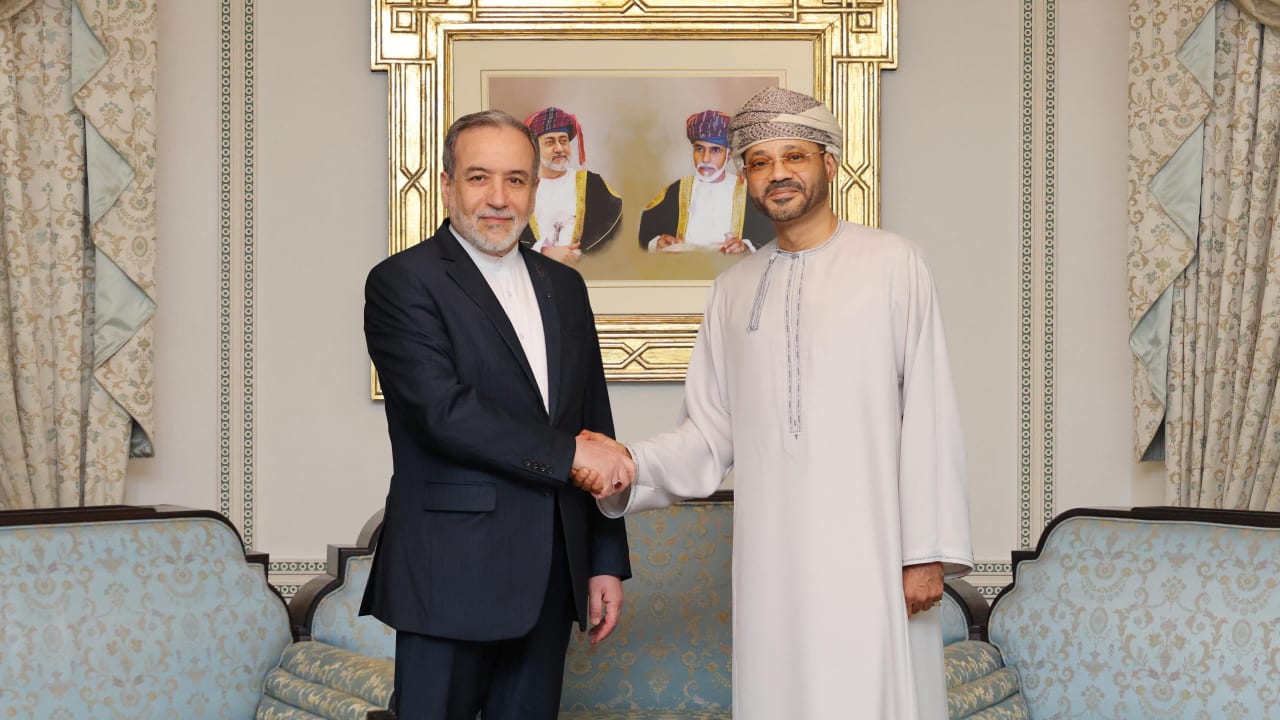
Iranian Foreign Minister Abbas Araqchi meets with Omani Foreign Minister Sayyid Badr Albusaidi in Muscat, Oman, February 6, 2026.
(photo credit: Omani Ministry of Foreign Affairs/Handout via REUTERS)


Iranian Foreign Minister Abbas Araghchi said that Iran’s ballistic missile programs are permanently non-negotiable because the weapons are strictly "defensive," in a Saturday interview with Qatari state-run news agency Al-Jazeera.

The interview followed the United States-Iran nuclear discussions held in Muscat, Oman, on Friday.

"The missile issue is purely defensive” for the Iranian regime and “cannot be negotiated, neither now nor in the future,” Araghchi asserted.

Prior to the talks, Iran was resistant to the possibility of discussing ballistic missiles, urging that the talks focus on Iran’s nuclear program, an issue Araghchi clarified “will only be resolved through negotiations.”

The process of enriching uranium for nuclear use is “an undeniable right” for the regime, Araghchi claimed, adding that they will not allow for enriched material to be removed from Iran.

Iranian missiles are displayed in a park in Tehran, Iran, January 31, 2026 (credit: MAJID ASGARIPOUR/WANA
Iranian missiles are displayed in a park in Tehran, Iran, January 31, 2026 (credit: MAJID ASGARIPOUR/WANA (WEST ASIA NEWS AGENCY) VIA REUTERS)

While Araghchi asserted that a permanent halt to uranium enrichment “is outside the scope of the negotiations,” he told Al-Jazeera that “the level of enrichment depends on [Iran’s] needs” and that the Islamic Republic was ready to reach a "reassuring agreement."

He emphasized that "the course of negotiations must be free from any threats or pressure,” adding that he hopes to find the sentiment reflected in the US approach to negotiations.

"There is still a long way to go to build trust," Araghchi said, and added, "We are ready to reach an agreement on the issue of enrichment."

Araghchi slams Israel

Separately, in a speech at the Al Jazeera Forum in Doha, Araghchi criticized Israel, calling it an "expansionist project that requires that neighboring countries be weakened militarily, technologically, economically, and socially."

Araghchi said that this means that "the Israeli regime permanently enjoys the upper hand."

"Under this project, Israel is free to expand its military arsenal without limits, including weapons of mass destruction that remain outside any inspection regime. Yet, other countries are demanded to disarm," Araghchi told the Forum.

He cited the sanctions and punishments against Iran for its missile and nuclear projects as proof that Israel is being treated differently, saying that these were not policies based on security and non-proliferation, but on the objective of maintaining Israel's military superiority.

"It is the enforcement of permanent inequality. Israel must have military intelligence and a strategic edge. And others must remain vulnerable," he concluded.

Iran, US hold nuclear talks

Araghchi was present in Muscat, Oman, in the early hours of Friday morning for the US-Iran talks, according to the Islamic Republic News Agency.

United States Special Envoy Steve Witkoff arrived in Muscat on Thursday evening, according to Israeli state broadcaster KAN News.

Oman's Foreign Minister Badr bin Hamad al-Busaidi held separate meetings with officials from the US and Iran, marking a departure from previous Iran‑US talks, which have used a shuttle-diplomacy approach.

"Very serious talks mediating between Iran and the US in Muscat today," said Busaidi after confirming the ending of the talks, and added, "It was useful to clarify both Iranian and American thinking and identify areas for possible progress. We aim to reconvene in due course, with the results to be considered carefully in Tehran and Washington."

"The consultations focused on preparing the appropriate conditions for resuming diplomatic and technical negotiations, while emphasising their importance, in light of the parties’ determination to ensure their success in achieving sustainable security and stability," Oman's Foreign Ministry stated.

James Genn contributed to this report.


Tobias Holcman, Goldie Katz

Source: https://www.jpost.com/middle-east/iran-news/article-885862

Follow Middle East and Terrorism on Twitter

China Bombshell: Patel says Biden-era FBI ‘buried’ truth about CCP’s ties to biolab on US soil - Jerry Dunleavy and John Solomon


by Jerry Dunleavy and John Solomon

FBI boss raises concerns Biden-era bureau may have 'buried' truth about Chinese Communist Party ties to dangerous biolabs on U.S. soil, cites 40% increase in Chinese espionage arrests.

FBI Director Kash Patel says his agency has resumed an aggressive counterintelligence offensive against China and its Communist Party (CCP) that had been sidelined during the Biden presidency but is concerned the prior administration may have "buried" the truth about dangerous biolabs on U.S. soil tied to Beijing. 

“This FBI, under this leadership, has prioritized the threat against it by the CCP against us, and we've taken swift action,” Patel said Friday in an interview with the Just the News, No Noise television show that focused on China’s threat to U.S. national security and the bureau’s efforts to handle the Chinese Communist Party.

The FBI boss said the renewed efforts have already resulted in a 40% increase in Chinese espionage arrests in the first year of the second Trump administration.

“What we did in the last year with President Trump and the attorney general and the Department of Justice is reprioritize our dynamic threat landscape, going after and disrupting and looking after the criminal activity from the CCP,” he explained.

Just the News reported this week that an illegal biolab in California searched by local, state, and federal authorities in 2023 and a separate hazardous lab inside a Las Vegas garage raided by the FBI over the weekend are both tied to a Chinese national currently awaiting trial for fraud, false statements, and adulteration of medical devices, according to court filings, police officials and members of Congress.

Just the News also reported on findings by the conservative American Accountability Foundation that raised concerns that at least 20 Chinese scientists ensconced inside American academia and at cutting-edge U.S. labs appear to be members of the CCP, are affiliated with Chinese projects aimed at stealing U.S. technology, or are involved with universities or companies tied to the People’s Liberation Army and Beijing's defense sector.

NIH boss concerned labs were 'flying under the radar'

Those research ties are even more concerning given the discoveries in 2023 in Reedley, Calif., and 2026 in Las Vegas, Nev., of the two illicit, makeshift biolabs that are suspected of using dangerous pathogens, said Dr. Jay Bhattacharya, the director of the National Institutes of Health.

"When you do research like this, potentially in an environment where there's very little biosecurity, you're posing hazards to everyone around you. And the fact is these were completely flying under the radar screen," Bhattacharya told Just the News.

"We need a better system for detecting and preventing these kinds of labs from popping up, so that they don't cause the kind of havoc, the sort of the worst kinds of stories," he added.

Bhattacharya declined to speculate on the motivations behind setting up risky biolabs in California and Vegas, but stressed that “it's very, very dangerous what defined the kinds of agents that have been reported publicly."

Concerns Biden-era FBI misled public on biolab ties to China

Patel promised complete transparency on the Vegas lab incident but raised concern that his predecessor, former Director Christopher Wray, and others in the Biden administration may have misled the public about the Chinese government's ties to the California biolab incident in 2023.

"If you recall, a similar incident in Reedley, California from a few years ago was evidently buried by the prior administration, and they said it had no connection to the CCP," he said.

“When we discovered that, we took swift action to course correct the intelligence and figure out why the American public was misled by individuals in this institution, including my predecessor. We're going to get to the bottom of it. We're just awaiting the lab results, and we're going to keep going," he said.

He added that under his leadership the FBI would not do the same with information about the Vegas lab.

“We knew about this information and worked with the state law enforcement authorities there in Las Vegas to execute these search warrants and collect over 1000 samples of material that has now been sent back to the FBI lab for analysis,” Patel said. “And this is something that we're going to keep continuing to uncover." 

Jia Bei Zhu was arrested in 2023 on allegations he was running an illegal biological laboratory in Reedley, Calif. On Saturday, the FBI and local police raided a similar biolab in Vegas, arresting the home’s property manager, Ori Salomon. Police and lawmakers say the two labs are closely connected.

Congress had its own concerns

The House Select Committee on the CCP had highlighted Zhu’s links to the Chinese government and the CCP in a 2023 report.

The report said that, prior to coming to North America, Zhu “served as the Vice Chairman of a PRC state-controlled enterprise” which had ties to “a company involved in military-civil fusion for the PRC.” The House report also said that Zhu “served as Chairman” of another Chinese company “whose directors included an executive for a PRC defense firm.”

The House report also said that, once in the U.S., Zhu hired “Accountant 1” to help him set up and run several companies in the U.S., and that “Accountant 1” had also “incorporated and performed work for organizations whose leadership is linked to CCP leadership and to the United Front Work Department.”

The report also pointed to Zhu “stealing American intellectual property and transferring it to the PRC” while in Canada, and said that Zhu and his associates had been “purchasing counterfeit test kits from the PRC and re-selling them in the United States” as being “Made in the USA.”

While he engaged in this criminal activity, the House report said that Zhu was also “receiving unexplained payments” — totaling more than one million dollars — “via wire transfer from PRC banks.”

The House report released in 2023 saved most of its criticisms for the CDC, but shed some light on why the FBI allegedly shut down its own inquiry.

The House report said that local code enforcement officer Jesalyn Harper “referred the matter to Fresno County and to the Federal Bureau of Investigation.”

“Approximately two months later and according to local officials, the FBI informed her that it had closed its investigation because the Bureau believed that there were no weapons of mass destruction on the property,” the report said. “The FBI continued to engage with local officials. As detailed later in this report, Zhu was subsequently charged with federal offenses relating to fraud and false statements in an FDA-led investigation.”

The House report argued that the “CDC’s response was inadequate and raises serious questions about its standard practices.”

“At a minimum, the Reedley Biolab shows the profound threat that unlicensed and unknown biolabs pose to our country,” the 2023 report said. “At worst, this investigation revealed significant gaps in our nation’s defenses and pathogen-related regulations that present a grave national security risk that could be exploited in the future.”

Biden administration decision to shut down China Initiative inside FBI boomerangs

Patel said Friday that “this FBI has made it a priority to continuously get after” the threat posed by the CCP, “and you saw that when we raided the lab with the state authorities in Las Vegas. And once those test results are back, we'll go public with what we found, and we'll also be talking to our partners in Congress to say, hey, this intelligence that you were given and this summary you were given previously was dead wrong, and I'm not going to mince any words about that.”

The FBI director said China had malign intentions toward the U.S., and so “what we have to do is continuously work the interagency process to make sure that we are attacking every point in which the CCP is coming into our country to attack us. And we're not going to stop.”

He excoriated the Biden administration for shutting down the China Initiative, the FBI's main counterintelligence effort to find Chinese security threats inside academia, saying it has led to an explosion of CCP activities on U.S. soil.

"This is just another disastrous example of failing to protect national security by the Biden administration. Who takes down an initiative against our number one adversary, the CCP, when they are not only conducting counterespionage activities here in the homeland against Americans, but also overseas, and importing illegal bio pathogens to harm our way of life?" Kash asked.

"That is an intentional poor decision to the detriment of our national security. President Trump came in and said we're reversing course. We don't necessarily need a new initiative. We just need the FBI all in against the CCP, and that's what we've done," he said.

Patel says Chinese students in Michigan sought to “attack” U.S. industry

Patel on Friday also pointed to a string of federal arrests linked to Chinese students at the University of Michigan who had engaged in a scheme to smuggle biohazardous pathogens into the U.S. for experimentation.

“Just last year in Michigan, we arrested three individual researchers at the University of Michigan who were trying — not trying, did — import illegally biohazardous materials and pathogens into the United States of America to not only destroy our ability to successfully have scientific labs that are pro-America, but also attack our agricultural and bioseed industry. And so we've been on it since then.”

The Justice Department announced in June that two Chinese nationals — Yunqing Jian and Zunyong Liu — had been charged with “conspiracy, smuggling goods into the United States, false statements, and visa fraud.” Jian had been a scholar at the University of Michigan while her boyfriend, Liu, had been at a Chinese university.

The DOJ said the bureau had “arrested Jian in connection with allegations related to Jian’s and Liu’s smuggling into America a fungus called Fusarium graminearum, which scientific literature classifies as a potential agroterrorism weapon.”

The DOJ also announced in September that Chengxuan Han of China had “pleaded guilty to three smuggling charges and to making false statements to U.S. Customs and Border Protection Officers.” The DOJ said that “Han sent multiple packages to the United States from the PRC containing concealed biological material” and that “these packages were addressed to individuals associated with a laboratory at the University of Michigan.”

Federal investigators announced in November that Jian had “pleaded guilty to charges of smuggling a biological pathogen into the United States and then lying to FBI agents about it.”

The DOJ then announced that same month that three additional Chinese scholars were charged with a “conspiracy to smuggle biological materials into the United States and for making false statements” to CBP officers, calling it “the latest charges in a long string of cases stemming from University of Michigan international research activities.”

Better vetting of Chinese academics on U.S. soil

Bhattacharya also spoke about the Trump administration’s efforts aimed at more aggressively vetting Chinese scientists working inside the United States.

“For the last several decades, the U.S. has had a close collaboration with Chinese scientists… I don't think it's an exaggeration to say that the U.S. funded the rise in the Chinese biomedical research enterprise,” Bhattacharya said. “And some of that involved, essentially, the Chinese authorities taking advantage of that investment. You know, there are stories of foreign influence in universities going back now a couple of decades.”

The NIH announced in May of last year the “lack of transparency” in NIH-backed research “is particularly concerning in the case of foreign subawards, in which the United States government has a need to maintain national security.” The federal agency said that the NIH “must ensure it can transparently and reliably report on each dollar spent” and so it was “establishing a new award structure that will prohibit foreign subawards from being nested under the parent grant.”

The NIH said at the time that it “will not issue awards to domestic or foreign entities that include a subaward to a foreign entity” including China.

“We need safeguards that make sure that the American investments don't result in threats and harms to America,” Bhattacharya said Friday. “And I think a lot of the investments we made in China and other countries of concern, in retrospect, probably there should have been much better safeguards in place.” 


Jerry Dunleavy and John Solomon

Source: https://justthenews.com/government/security/biolab-buried-biden-current-fbi-all-ccp-inquiries-dropped-prior-admin-patel

Follow Middle East and Terrorism on Twitter

Appeals court sides with Trump admin with mass detention ruling - Misty Severi


by Misty Severi

Although the ruling is a victory for the Trump administration, the ruling could still be appealed to the Supreme Court after other courts signaled it disagreed with the interpretation.


A federal appeals court delivered a victory for the Trump administration on Friday night by backing its mass detention policy that locks up most people it intends to deport.

The three-judge panel on the Fifth Circuit Court of Appeals in Texas split on the ruling with two judges ruling that the Trump administration had the correct interpretation of the immigration law when it comes to the ability to detain people that will be deported, according to Politico

“That prior Administrations decided to use less than their full enforcement authority … does not mean they lacked the authority to do more,” Judge Edith Jones, who was appointed by President Ronald Reagan, wrote for the majority.

The case centers on the interpretation of a statute that requires migrants who are still "applicants for admission” to be held without bond while seeking admission to the United States. 

The law was previously interpreted as new illegal migrants and not those who have been in the country illegally for years, but the Trump administration said in July that anyone targeted for deportation would be treated as an “applicant for admission," and therefore subject to detention.

Judge Dana Douglas, who was appointed by former President Joe Biden, claimed in her dissent that the ruling would require as many as two million migrants residing in the United States to be detained without bond.

“Straining at a gnat, the majority swallows a camel,” she wrote. “The government’s proposed reading of the statute would mean that, for purposes of immigration detention, the border is now everywhere. That is not the law Congress passed, and if it had, it would have spoken much more clearly.”

Although the ruling is a victory for the Trump administration, the ruling could still be appealed to the Supreme Court after other courts signaled they disagreed with the interpretation.


Misty Severi is a news reporter for Just The News. You can follow her on X for more coverage.

Source: https://justthenews.com/government/courts-law/appeals-court-sides-trump-admin-mass-detention-ruling

Follow Middle East and Terrorism on Twitter

Trump prods Congress to nationalize election integrity, but Supreme Court may deliver first - Just the News Staff


by Just the News Staff

Nation's nine justice could reshape election integrity when it comes to redistricting and post-Election Day ballot counting.


President Donald Trump is facing some conservative backlash after calling on congressional Republicans to “nationalize” election integrity in states he claims are plagued by corruption. But two of his biggest wishes — ending racially gerrymandered districts and banning ballot counting after Election Day — could be delivered instead by the Supreme Court. 

Trump first floated the idea of nationalizing elections during a podcast interview Monday with Dan Bongino, the president’s former deputy FBI director. In the interview, Trump urged Republican lawmakers to take control of election administration in as many as 15 states, though he did not identify which states he had in mind. 

He argued that federal intervention is warranted when states fail to ensure fair and transparent elections.

“The Republicans should say, ‘We want to take over,’” Trump said. “We should take over the voting, the voting in at least many —15 places. The Republicans ought to nationalize the voting.”

The following day, Trump reiterated the proposal during remarks to reporters in the Oval Office, again alleging widespread election corruption. “Look at some of the places—there’s horrible corruption on elections—and the federal government should not allow that,” he said. “The federal government should get involved.”

Trump’s comments revived a long-running debate over the constitutional limits of federal power in election administration.

Under Article I, Section 4 of the U.S. Constitution, states are charged with determining the “Times, Places and Manner” of congressional elections, though Congress retains authority to alter those regulations. Presidential elections are governed by a similar division of authority, with states overseeing election mechanics while Congress sets the date on which presidential electors are chosen.

MAGA influencer Steve Bannon endorsed the president’s call to action and went even further, calling for Immigration and Customs Enforcement officials and U.S. military troops to be deployed to polling sites. 

House Speaker Mike Johnson (R-La.) also echoed the president’s concerns about election integrity during a telephone town hall with constituents.

“We had three House Republican candidates who were ahead on election day,” Johnson said. “Every time a new tranche of ballots came in, their leads were magically whittled away until they were lost. It just looks on its face to be fraudulent.”

But some prominent Republicans pushed back on Trump's plan, warning  his proposal would violate constitutional principles and upend the traditional decentralized election system.

Senate Majority Leader John Thune (R-S.D.), the top Republican in the Senate, told reporters he was “not in favor” of the president’s plan. Sen. Rand Paul (R-Ky.) and Sen. Ron Johnson (R.-Wis.) likewise rejected the idea, dismissing it as unconstitutional.

But Trump may not need Congress to advance core components of his election agenda.

Several of his top election-related priorities—such as eliminating race-based congressional districts and putting an end to vote counting after Election Day—could be achieved through Supreme Court rulings as early as this summer. 

One such case, Louisiana v. Callais (consolidated with Robinson v. Callais), could be decided any day now.

The high-stakes dispute centers on whether Louisiana’s 2024 congressional map, which created a second majority-Black district to comply with Section 2 of the Voting Rights Act, amounts to an unconstitutional racial gerrymander under the 14th and 15th Amendments of the U.S. Constitution. The case was initially argued in March 2025, held over, and reargued in October 2025 with a renewed focus on the constitutionality of race-conscious redistricting.

Court watchers widely expect the conservative-leaning Court to rule at least partially in favor of the challengers, a decision that could significantly narrow when and how states may consider race in drawing congressional districts. The Court could also weaken the practical force of Section 2 of the Voting Rights Act and reshape redistricting nationwide ahead of the next round of map-drawing.

The Court is also set to opine on another issue central to Trump’s election agenda: counting votes after Election Day.

In late March, the Supreme Court is scheduled to hear oral argument in Watson v. Republican National Committee, a case challenging Mississippi’s law that permits absentee ballots postmarked by Election Day to be counted if they are received within five business days. See Miss. Code Ann. § 23-15-637(1)(a).

Three federal election-day statutes—2 U.S.C. § 7, 2 U.S.C. § 1, and 3 U.S.C. § 1—designate the Tuesday after the first Monday in November, in certain years, as “the day for the election” of Members of the U.S. House and Senate and the President. And under the Supremacy Clause of the U.S. Constitution, federal law preempts conflicting state law.

At issue is whether those federal election-day statutes conflict with—and therefore preempt—Mississippi’s absentee-ballot deadline. The U.S. Court of Appeals for the Fifth Circuit concluded that they do, holding that federal law requires ballots to be both cast by voters and received by election officials by Election Day.

On that basis, the court ruled that the federal statutes override Mississippi’s postmark-based deadline. The Supreme Court will now decide whether that interpretation is correct.

The Republican National Committee argues that the ordinary meaning of “the day for the election” resolves the case, requiring final receipt of ballots by Election Day. Mississippi counters that the statutes impose only a casting deadline, not a receipt deadline.

A wide array of political parties and voting-rights organizations have weighed in through amicus briefs, advancing competing legal and policy arguments over the permissibility of counting ballots received after Election Day.

A decision in Watson is expected by June 2026, just months before the midterm elections. A ruling in favor of the Republican National Committee could invalidate postmark-based ballot deadlines nationwide, forcing states to discard ballots that arrive after Election Day in the upcoming midterm elections.

With multiple high-stakes election cases on the Court’s docket and the midterms approaching, Trump may yet find a viable path to advancing his election agenda with the help of the Supreme Court rather than Congress. 


Just the News Staff

Source: https://justthenews.com/politics-policy/elections/trump-prods-congress-nationalize-election-integrity-supreme-court-may

Follow Middle East and Terrorism on Twitter

Can US-Iran war be averted as Tehran obfuscates in Oman talks? - analysis - Jacob Wirtschafter


by Jacob Wirtschafter

“Iranian officials often say they want negotiations, but when negotiations start, they hesitate,” said Serhan Afacan, head of the Center for Iranian Studies in Ankara.


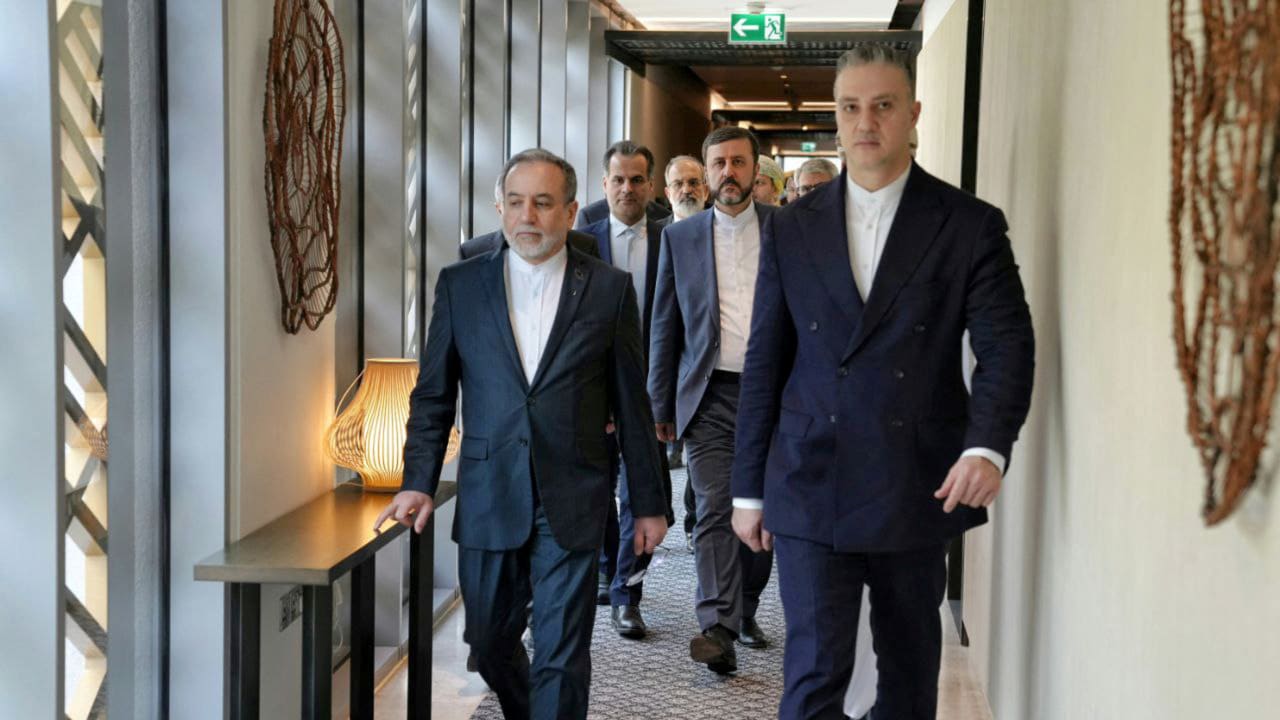
Iranian Foreign Minister Abbas Araqchi and his accompanying delegation depart for the site of the talks in Muscat, Oman, February 6, 2026.
(photo credit: Iranian Foreign Ministry/WANA (West Asia News Agency)/ Handout via REUTERS)


US-Iran nuclear talks concluded their first round Friday after 90 minutes, with Iran's Foreign Minister Abbas Araghchi warning against American "adventurism."

For more stories from The Media Line go to themedialine.org

The brief procedural meeting, mediated by Oman’s foreign minister, Badr bin Hamad Al Busaidi, in separate sessions with Iranian and US delegations, focused on what Oman’s foreign ministry described as “preparing appropriate circumstances for resuming diplomatic and technical negotiations.”

Gulf states worked to prevent the talks from collapsing. Israeli officials were positioned for a breakdown that could reopen the path to military pressure.

That helps explain why Gulf governments intervened last week to rescue talks on the brink of cancellation after Iran demanded a venue change.

Regional diplomats and analysts interviewed in Ankara, Dubai, and Manama said Gulf states pressed Washington to accept Iran’s request to move talks from Istanbul to Oman to prevent an immediate collapse that would have left military escalation as the only option.

Jared Kushner looks on as US Special Envoy Steve Witkoff shakes hands with Omani Foreign Minister Sayyid Badr Albusaidi in Muscat, Oman, February 6, 2026.
Jared Kushner looks on as US Special Envoy Steve Witkoff shakes hands with Omani Foreign Minister Sayyid Badr Albusaidi in Muscat, Oman, February 6, 2026. (credit: Omani Foreign Affairs Ministry/Handout via REUTERS)

Negotiations were initially planned for Istanbul, with Turkish mediation and a broader framework addressing Iran’s missile program, regional proxies, and human rights alongside the nuclear issue.

Iran rejected that structure, insisting on a bilateral format limited to nuclear issues and conducted through Oman. US officials initially pushed back.

Regional pressure mounted. Qatar’s Prime Minister Sheikh Mohammed bin Abdulrahman Al-Thani spoke with Araghchi about “reducing tension.” Kuwait urged “common sense.” The UAE's senior diplomat, Anwar Gargash, warned that the region “does not need another confrontation.” Axios reported that nine countries urged Trump administration officials not to walk away.

The reason for the urgency was fear that diplomatic collapse could trigger missile strikes on US bases or energy infrastructure across the Gulf.

Iran’s insistence on Oman was not merely procedural.

Friday’s format followed Iran’s demands: Al-Busaidi met separately with Araghchi, then with US special envoy Steve Witkoff and presidential adviser Jared Kushner. The indirect channel kept both sides insulated.

Araghchi’s warning against “adventurism,” delivered to Iranian state media after the session, signaled Tehran remains focused on managing US military pressure.

Iran says it wants negotiations, then shys away when given the opportunity

“Iran is very sensitive about respect,” said Serhan Afacan, head of the Center for Iranian Studies in Ankara. “Iranian officials often say they want negotiations, but when negotiations start, they hesitate.”

That pattern creates risk and results in talks that continue without progress while Iran uses the diplomatic process as cover and Israel readies for the collapse of negotiations.

Mahdi Ghuloom, a Dubai-based researcher at the Observer Research Foundation Middle East, said Iran viewed Muscat as uniquely credible precisely because it doesn’t seek public diplomatic credit or align closely with Washington’s regional agenda. When talks briefly moved to Rome last year, Iranian officials complained about excessive media presence and exiled opposition protests.

“Oman isn’t just a communication channel for Iran,” Ghuloom told The Media Line. “It also advocates for Iran’s position in the Gulf as a state that should be engaged, even if there are disagreements over how much engagement is appropriate.”

From a Gulf perspective, Oman’s value lay less in brokering breakthroughs than in preventing miscalculation, though Friday’s procedural round raises questions about whether even that limited goal can be sustained.

Mostafa Ahmed, a researcher at Al Habtoor Research in Dubai who specializes in Gulf security frameworks, described the current engagement as “decompression” rather than resolution.

“Oman’s facilitation is valued precisely because it offers a discreet, credible intermediary function rather than a promise of comprehensive reconciliation,” he said in an email exchange.

US officials describe diplomacy in binary terms: a deal or failure. Gulf states view the process itself as security infrastructure.

Ahmed distinguished between “resolution” and “decompression.” The Oman track, he told The Media Line, is a decompression measure that “allows both parties to navigate their domestic political cycles without inciting a kinetic crisis that the region cannot afford.”

Iranian Foreign Minister Abbas Araqchi meets with Omani Foreign Minister Sayyid Badr Albusaidi in Muscat, Oman, February 6, 2026. (credit: Iranian Foreign Ministry/WANA
Iranian Foreign Minister Abbas Araqchi meets with Omani Foreign Minister Sayyid Badr Albusaidi in Muscat, Oman, February 6, 2026. (credit: Iranian Foreign Ministry/WANA (West Asia News Agency)/ Handout via REUTERS)

Gulf states accepted Iran’s insistence on sequencing — nuclear issues first, regional issues later — because “they simply need the talks to remove the nuclear accelerant from the equation,” Ahmed said.

If Iran uses the time bought by procedural talks to advance its nuclear program, the eventual confrontation may be worse than the one Gulf states worked to prevent.

Ghuloom said most Bahrainis hope Oman’s mediation will work “because Bahrain would be among the biggest victims of any escalation.” Bahrain cannot participate directly because it does not have diplomatic relations with Iran.

Israeli officials told local media they expect the Muscat talks to collapse. Israeli Prime Minister Benjamin Netanyahu convened an emergency cabinet meeting ahead of negotiations, moving it up from Sunday.

Ghuloom said from Israel’s perspective, the Trump team “ended the last war and its objectives too early.” Installing the former shah’s son has attracted Israeli support, “but those goals are very hard to achieve. The perception may be that advancing military objectives through US engagement is the most realistic path.”

If Iran delays substantive engagement through procedural rounds, Israel’s assessment may prove correct.

Afacan told The Media Line that for Turkey, Israel is currently perceived as a more immediate threat than Iran. “As a result, there is no unified regional view on which actor represents the primary source of instability.”

Abraham Accords states continue to see Iran’s nuclear program as an existential threat.

Gulf officials say Iran’s credibility will be judged by behavior, not meetings.

Ahmed outlined three thresholds: maritime conduct in the Strait of Hormuz, infrastructure targeting, and proxy discipline. “Gray zone harassment” in the Strait signals that Iran views talks as cover rather than as a means of de-escalation. Kinetic targeting of energy or desalination infrastructure would be “an irreversible breach of the decompression framework.”

For Bahrain, hosting the US Fifth Fleet near residential areas, the stakes are high. “The damage from escalation could be deadly,” Ghuloom said, noting “Iran-supported components operating in Bahrain.”

The 90-minute procedural session suggests talks may be cover, not restraint.

The vulnerability is not hypothetical. In the 10 days before Friday’s talks, Bahrain accelerated civil defense preparations.

On Jan. 27, the US Fifth Fleet base conducted a mass casualty drill involving Naval Security Forces, the base’s Fire and Emergency Department, and Bahraini first responders.

Four days later, on Jan. 31, Bahrain tested its wireless emergency alert system nationwide. At 9:30 p.m., mobile devices received notifications labeled “Emergency alert: Severe.” The Interior Ministry had announced the test four hours earlier.

That same day, Iran announced live-fire naval drills in the Strait of Hormuz for Feb. 1-2.

The alert system, approved by Bahrain’s Civil Defense Council on Jan. 15, expands the existing siren infrastructure tested previously in June 2025.

Bahrain’s Interior Minister Sheikh Rashid bin Abdullah Al Khalifa said the National Emergency Strategy focuses on coordination among government agencies and partnerships with regional and international organizations.

The drills and alerts show Bahrain preparing for scenarios where mediation fails.

Friday’s brevity was not a setback. It was the strategy.

Gulf states are preparing for “managed stagnation”: negotiations that continue without breakthrough but prevent high-intensity conflict.

Ahmed described two scenarios: continued talks in which “the process becomes a container for tensions,” or “compartmentalized breakdown,” in which negotiations collapse but escalation remains geographically limited. “The planning focuses on aggressive neutrality and ensuring GCC territories are explicitly decoupled from any offensive postures,” he said.

No one is planning for a comprehensive settlement.

Oman’s statement referenced “resuming” negotiations but provided no timeline. Talks that exist in perpetual preparation allow both sides to claim engagement while avoiding compromises.

Iran’s pattern —demanding negotiations, then hesitating when they begin—suggests even Oman’s mediation may only postpone confrontation.

For Bahrain, hosting the US Fifth Fleet close to residential areas, the stakes are immediate.

“The damage from escalation could be deadly,” Ghuloom said.


Jacob Wirtschafter

Source: https://www.jpost.com/middle-east/iran-news/article-885870

Follow Middle East and Terrorism on Twitter

Fauci Fallout: New NIH chief says all gain-of-function research stopped, no lockdowns in future - John Solomon


by John Solomon

Gain of function research is a controversial form of science that tries to enhance deadly viruses and bacteria to make them more deadly in an effort to study future pandemic responses.


The new National Institutes of Health chief declared Friday that the Trump administration won't pursue lockdowns in future pandemics and his agency has stopped all forms of dangerous gain-of-function research, ending two controversial legacies of the Dr. Anthony Fauci era inside the government's premier health research institution.

"As far as the NIH, we've paused every single project that even is anywhere within the vicinity of something that could be gain of function, and the White House is working on a policy ...(that) will make it so that it never happens again," Dr. Jay Bhattacharya, the NIH director, told the Just the News, No Noise television show.

"Nowhere in the United States Government will we invest in a project that poses a risk of catastrophic harm to the American people ever again," he added.

Gain of function research is a controversial form of science that tries to enhance deadly viruses and bacteria to make them more deadly in an effort to study future pandemic responses.

It was stopped by President Barack Obama but then revived in 2017 under Fauci's leadership, and it is believed to be behind a lab leak in Wuhan, China, that the FBI and other federal agencies believe may have started the COVID-19 pandemic in 2020.

Bhattacharya said the Biden administration had confusing rules that left the possibility of such risky research to continue to slip through, and he has put a clear mandate in place.  

"What we're doing is we're saying there has to be a comprehensive risk assessment of every single project that has anywhere close to the vicinity of being dangerous gain of function," he explained. "And if it's dangerous gain of function, the answer is, 'No, you can't do it.'"

He said the NIH model is going to be the center of a larger government-wide policy being finalized by the White House.

"So we're headed toward a comprehensive policy for the entire federal government where that's the case. As far as the NIH is concerned, I've already implemented a policy like that, where we pause dozens of grants, and as soon as the new policy comes up, we'll submit them to the new independent board that's going to be looking at this," he said.

Bhattacharya said the government still has much work to do to reform pandemic preparations from the failures of COVID-19 outbreak, but that one tactic used then and favored by Fauci -- full community lockdowns -- will certainly not be used under this Trump administration.

"I think I can tell you that the appetite for lockdowns in this administration is basically zero. So I don't think we would have the same kind of approach. But we do need to have a national conversation about what happened during COVID, especially during the Biden administration, with the vaccine mandates and all that.

Pandemic prevention "shouldn't just be some secret plan sitting in the government vault that you pull out if something terrible happens," he said.

"We saw during COVID every single person's life was affected in some, mostly for the worse," he added. "...I'll tell you under my watch, I will never advocate and the NIH will not be advocating for lockdowns ever again." 


John Solomon

Source: https://justthenews.com/politics-policy/health/fauci-fallout-new-nih-chief-says-all-gain-function-research-stopped-no

Follow Middle East and Terrorism on Twitter