Thursday, January 30, 2025

Gabbard’s DNI nod walks a tightrope over the precipice ahead of key hearing - Ben Whedon


by Ben Whedon

The expiration of Section 702 led to a dispute between the House GOP Judiciary and Intelligence Committees last year, with the pro-surveillance Intelligence panel winning out and shutting the door on major reform.


Tulsi Gabbard, the Hawaii Democrat-turned-Republican, faces a tense confirmation hearing this week as intelligence hawks raise concerns over her skepticism of surveillance practices and Democrats push narratives of pro-Kremlin sympathies.

A stalwart privacy advocate and social moderate, Gabbard unsuccessfully sought the Democratic presidential nomination in 2020, earning attention for her exchanges with former Vice President Kamala Harris. She later left the party and helped President Donald Trump prepare for his own debate with Harris. Gabbard joined the Republicans during the 2024 campaign and received Trump’s nod to head the nation’s intelligence apparatus.

Her nomination received cheers from privacy advocates and MAGA-aligned critics of the intelligence community, many of whom hope she will work alongside FBI Director-designate Kash Patel to substantially uproot the nation’s intelligence apparatus and end practices that raise serious questions about politicization in the agencies.

The Senate Intelligence Committee will question Gabbard on Thursday in what is sure to be a contentious row. The panel is stacked with intelligence hawks, including some Republicans who have expressed public concerns over her past opposition to Section 702 of the Foreign Intelligence Surveillance Act (FISA), which allows for the warrantless surveillance of foreigners abroad. 

With the confirmation of Defense Secretary Pete Hegseth concluded, Gabbard’s confirmation appears poised to mark the next battle between Trump’s MAGA disruptors and the old guard GOP of the Washington establishment.

Surveillance powers

Gabbard has long been critical of Section 702, sharing the concerns of conservative Republicans on the Judiciary Committee that it allows for the collection of information on Americans in the process. An American speaking with a foreigner under surveillance, for instance, would see their half of the conversation swept up in intelligence gathering and ultimately entered into the Section 702 intelligence database.

The expiration of Section 702 led to a dispute between the House GOP Judiciary and Intelligence Committees last year, with the pro-surveillance Intelligence panel winning out and shutting the door on major reform. Gabbard’s opposition to Section 702 was such a point of concern for Republicans that she ultimately reversed her position amid the nomination process.

“Section 702, unlike other FISA authorities, is crucial for gathering foreign intelligence on non-U.S. persons abroad. This unique capability cannot be replicated and must be safeguarded to protect our nation while ensuring the civil liberties of Americans,” she told CNN earlier this month. “If confirmed as DNI, I will uphold Americans’ Fourth Amendment rights while maintaining vital national security tools like Section 702 to ensure the safety and freedom of the American people.”

That about-face could serve to assuage establishment concerns, but she will likely need to persuade Republican members of the panel that she will be able to balance privacy and national security concerns in the post. The 9-8 Republican-led panel includes two potential swing votes: Sens. Susan Collins, R-Maine; and Todd Young, Ind; according to The Hill. She is not expected to secure any Democratic support.

Past Assad comments

Gabbard in 2017 visited Syria and met with now-ousted Syrian President Bashar al-Assad, whose regime fell just weeks ago amid a surprise offensive from the Al-Qaeda derivative Tahrir al-Sham. She had previously insisted Assad was not an enemy of the United States and voiced opposition to American intervention in the Syrian Civil War. Gabbard herself is a veteran, having served in Iraq and was awarded the Combat Medical Badge.

On non-intervention, she is well in-line with Trump himself, who called for the U.S. to remain uninvolved in the Syrian conflict and has further pressed for an end to the Ukraine conflict. Assad was a stalwart ally of Russia and Gabbard’s past positions led many Democrats to paint her as a “Russian asset.” Her subsequent alignment with Trump has done little to alleviate Democratic suspicions.

Biden's FBI puts her on "watch list"

But the more influential Republicans appear disinterested in playing along with another “Russia-gate” and Committee Chairman Tom Cotton publicly repudiated such accusations, saying on Monday that “The smears against Tulsi Gabbard—including by Hillary Clinton—are disgraceful. Tulsi served for more than 20 years honorably, she passed every background check, and she's a patriot with integrity. She doesn't deserve to have her integrity impugned.”

Gabbard has continued to serve as a lieutenant colonel in the U.S. Army Reserve since 2021. She also served as a Democratic member of the U.S. House of Representatives from Hawaii from 2013 to 2021.

Of concern to some Democrats are Gabbard’s past issues with federal intelligence due to her foreign travel. She previously went public with allegations that the Biden administration had subjected her to political targeting by placing her on a “watch list.” The New York Times on Tuesday published an article outlining the issue. She was subject to additional security after she attended an event at the Vatican held by a European figure who was on an FBI watch list. 

Also included in the article was an incident in which American intelligence intercepted a call from a member of Hezbollah indicating Gabbard had met with “the boss” during her 2017 trip to Syria, though that figure remains unidentified. Gabbard has denied meeting with anyone from Hezbollah.

A public or private vote?

Gabbard's chances may receive a boost as Trump allies pressure Cotton to hold a public vote on her nomination. The panel does not typically hold open votes, though its members may disclose their own decisions. 

Turning Point USA Founder Charlie Kirk on Tuesday posted that "the vote for Tulsi Gabbard might be done privately in a SCIF [sensitive compartmented information facility] - with the vote tallies kept secret from the American people."

The prospect of a secret ballot in which Republicans with reservations might vote against Trump’s chosen nominee while maintaining privacy has Trump’s supporters livid. Thus far, however, the breakdown of Gabbard’s support remains unclear and will likely not become apparent until the vote. Should she receive the committee’s stamp of approval, she will then face a floor vote in the upper chamber.


Ben Whedon

Source: https://justthenews.com/government/security/thugabbards-dni-nod-precipice-ahead-pivotal-hearing

Follow Middle East and Terrorism on Twitter

Federally funded puppy 'poison' challenges science panic over Trump admin review of research - Greg Piper


by Greg Piper

"The government cannot be a welfare program for everybody doing low quality, low credibility, irreproducible, low value of information research," says epidemiologist who supports reform of NIH "study sections."


The sky is falling for some anonymous National Institutes of Health employees, scientists and institutions that receive federal research grants in response to the Trump administration's 12-day "pause" on document releases from the Department of Health and Human Services, which halts the work of NIH grant review panels.

Careers are at risk, innovation is at stake, life-saving research could be threatened, they say. But a pause might be good for man's best friend.

The animal-cruelty watchdog that exposed the National Institute of Allergy and Infectious Diseases' funding of gruesome experiments on puppies worldwide, with which its former director Anthony Fauci was confronted at a House hearing last year, published more records of federally funded puppy experiments this week, this time in China.

The Freedom of Information Act production to the White Coat Waste Project shows federal contracts for research in Chinese labs through May for "the evaluation of pharmacokinetics of compounds from dystonia" using beagles, mice and rats.

NIH kicked in $124,200 and Department of Defense an unspecified amount, the latter only mentioned in a single sentence: NIH's National Center for Advancing Translational Sciences "has received a DoD award to specifically fund animal studies delineated in this award." 

Researchers would use about 300 beagles a week, chosen because they are "docile, cute and easy to domesticate," the applicant's solicitation says.

The dry scientific language obscures the cruelty of the experiments, testing "poison" drugs on "puppies as young as 8 months old" by repeatedly shoving tubes in their mouths and restraining them "for hours on end," WCW said, posting pictures of the poor pups. 

Another contract from NIH's National Institute on Drug Abuse shows $108,000 spent on 240,000 mice and rats in the research. WCW Senior Vice President Justin Goodman pointed Just the News to another $2.1 million in subawards to the same contractor, Pharmaron, in 2024, in another tab on the same USASpending.gov page.

"In all, we’ve uncovered that at least 26 animal laboratories in China" – some controlled by the Chinese Communist Party and linked to its military – "have active approvals to receive taxpayer dollars from the NIH, DOD, and other government agencies," WCW said. 

Fauci at his hearing before the House Select Subcommittee on the Coronavirus Pandemic last year played down the importance of his admission that he never read grant applications as director before approving them and called the previous puppy experiments "humane."

Goodman urged President Trump "to pick up where he left off and defund all of China’s animal labs once and for all," referring to his first-term cutoff of funding to the Wuhan Institute of Virology, judged the more likely source of SARS-CoV-2 by the FBI, Department of Energy and — disclosed this week — the CIA.

Sen. Joni Ernst, R-Iowa, and Rep. Nicole Malliotakis, R-N.Y., also called on Trump to cut foreign funding of such research in response to WCW's findings.

"Especially following the CIA’s determination that COVID came from a lab in Wuhan, we must clip the wings on the batty studies of pandemic potential," Ernst said. “It's alarming that American tax dollars are still funding cruel dog testing and other animal labs in Communist China" after the House COVID panel exposed and cut off Wuhan funding, Malliotakis said.

The Department of Health and Human Services' pause on documents and communications until Feb. 1, allegedly including the work of NIH "study sections" that make funding decisions, prompted wailing and gnashing of teeth in the science media.

STAT News conveyed the fears of "more than two dozen researchers at institutions nationwide" that a short wait for clarity on the new administration's research priorities "has cast many early-career scientists into limbo" and could threaten "medical and biotechnology innovation" in the U.S. long term.

“It's so devastating and short-sighted," Hofstra University psychologist Emily Barkley-Levenson told The Scientist. University of Kentucky neuroscientist Shannon Macauley said COVID-19 was less disruptive to the grant review process.

"The various directives have shaken the vast community of extramural scientists NIH supports," Science reported, quoting a senior NIH official calling them "devastating." 

Anonymous NIH staffers told Forbes this was the first time "politics" has entered the agency and the intention of the pause was to "scare us, to demoralize us, and to set science back … our job is literally to enable research to save lives, what the heck?”

Former Senate Finance Committee investigator Paul Thacker cited his own sources within NIH's upper ranks to criticize the portrayal of the pause.

"This is a manipulation tactic by the NIH Director’s office to tar the new administration," an official in that office told Thacker. "The memo doesn’t say anything about private meetings, and they shut down these study sections to scare everyone into believing [research] studies will shut down and labs will shutter."

The communications pause didn't stop NIH from confirming to STAT the appointment of its new acting director, Matthew Memoli, formerly director of the Laboratory of Infectious Diseases Clinical Studies Unit who won an agency award for a national study of undiagnosed COVID cases, until Trump's nominee Jay Bhattacharya is confirmed.

University of Pittsburgh Associate Senior Vice Chancellor Jeremy Berg, a former NIH institute director, told STAT that Memoli's criticisms of the COVID response were "scientifically driven" but worried that he wasn't qualified to be director, having little experience applying for funding before joining NIH, and having got the job by publicly pushing back on mandates and Fauci.

Memoli quickly issued a memo to staff clarifying clinical trials had not stopped at NIH and for funding recipients and they can continue related actions for research predating Trump's inauguration, but only promised "additional guidance" would soon follow on pending grants.

He's a vocal critic of the government's response to COVID who opposes vaccine mandates, is himself unvaccinated and has complained that reporters who interviewed him during COVID ignored the context he gave about past flu pandemics.

He has blamed "money and expediency" for much of the reluctance by current and hopeful grant recipients to undertake potentially contrary research to federal narratives, and said he himself has been accused of promoting vaccine hesitancy by citing federal data.

University of California San Francisco epidemiologist Vinay Prasad waved off the handwringing in the science community over the alleged pause on NIH study sections, calling them "groups of mediocre scientists" based on low citations of their papers.

"NIH seeks mediocre ideas that tread along established lines and not highly novel views," he wrote. "The government cannot be a welfare program for everybody doing low quality, low credibility, irreproducible, low value of information research."

In a subsequent essay, Prasad said the study section membership reflects NIH's fealty to "woke" science. "There are thousands of NIH grants on the topics of diversity. Many are redundant, merely documenting things we already know" but not "useful solutions … we need better therapies, period."

 
Greg Piper

Source: https://justthenews.com/government/federal-agencies/federally-funded-puppy-poison-challenges-science-panic-over-trump-admin

Follow Middle East and Terrorism on Twitter

We just witnessed the Supreme Court's breathtaking hypocrisy - opinion - Douglas Altabef


by Douglas Altabef

The Supreme Court has failed the most basic test of judiciousness, showing itself to be rash, tone-deaf, and ultimately unaccountable.


JUSTICE MINISTER Yariv Levin and Attorney-General Gali Baharav-Miara attend a farewell ceremony for retiring acting Supreme Court president Uzi Vogelman, last October. Levin has been appropriately adamant that Justice Yitzhak Amit’s case should be investigated, the writer maintains. (photo credit: OREN BEN HAKOON/FLASH90)
JUSTICE MINISTER Yariv Levin and Attorney-General Gali Baharav-Miara attend a farewell ceremony for retiring acting Supreme Court president Uzi Vogelman, last October. Levin has been appropriately adamant that Justice Yitzhak Amit’s case should be investigated, the writer maintains.
(photo credit: OREN BEN HAKOON/FLASH90)

It is often said that wrongdoers ultimately trip themselves up. In that spirit, we have just seen a prime display of self-revelatory guilt with our Supreme Court’s handling, or rather, non-handling of the elevation of Justice Isaac Amit to president of the court.

Traditionally, the succession to the presidency of the court, a position of great discretion and influence, is determined by seniority. Thus, Amit was in line for the appointment.

However, something not at all funny happened on the way to the forum: Charges of conflict of interest were raised in the handling of various business and even judicial matters concerning Amit.

There were multiple charges that he heard cases involving lawyers who were representing him in other private familial matters, and even heard a case in which his own brother had an interest.

Amit did not apprise his fellow jurists of any of his involvement with these matters, let alone seek to either recuse himself or to receive approbation from his fellow jurists.

 Supreme Court Justice Yitzhak Amit arrives at to the Committee for the Appointment of Judges which votes on his appointment as President of the Supreme Court, in Jerusalem on January 26, 2025. (credit: Chaim Goldberg/Flash90)Enlrage image
Supreme Court Justice Yitzhak Amit arrives at to the Committee for the Appointment of Judges which votes on his appointment as President of the Supreme Court, in Jerusalem on January 26, 2025. (credit: Chaim Goldberg/Flash90)

What emerges is a pattern of arrogant disregard for the avoidance of conflicts of interest. In what must be seen as a self-revealing awareness of something amiss, Justice Amit appears as “Mr. Goldfriend,” his name before he changed it, in cases where he has a private interest or involvement.

In the real world, when someone goes to such lengths, there has to be some kind of awareness of something amiss. As current US Sen. Adam Schiff of California said back in 2020, you don’t pardon innocent people. Similarly, you don’t have to use an alias if you are doing everything by the book.

The idea that Justice Amit engaged in no criminality is completely beside the point. By virtue of his position, complete probity is an absolute, unshakeable, and non-negotiable requirement.

Justice Amit has fallen far short of that standard.

BUT WHAT is even more troubling than what Amit did is the reaction or rather the non-reaction of his peers and others in the judicial establishment. Where was the outcry or even the questioning of his fellow justices?

One would have thought that, in the interest of protecting the integrity of the court, other justices would have urged a pause in the process of elevating Amit, so that the charges could have been investigated. Such a pause would have enabled the air to be cleared, or not.

Regardless, given the obsessive concern with the need to constantly examine and investigate the prime minister, there should have been a commensurate concern for the actions of someone set to occupy a position of comparable importance and significance.

Yet, our attorney-general, a divisive figure in her own right, was very quick to say, “No problem here, folks.” She declared that no investigation was required. Why, we do not know, other than to assume that she is beholden to the court and she cannot abide Justice Minister Yariv Levin, who has been appropriately adamant that Amit’s case be investigated.

In a saner, more balanced and self-limiting environment, this matter would have been handled very differently. A truly judicious judiciary would have immediately sought to ensure that the air was cleansed, that no taint nor question could attach to the actions of those standing at the pinnacle of probity and rectitude in our country.

Remember, we are talking about a court that has arrogated to itself almost superhuman responsibility: It has determined that it can apply its own standards of judgment, substituting its own reason and assessment of legislation for the intentions of the legislators themselves.

This is a body that will hear and opine as to anything it sees fit, brought to it by anyone it chooses to entertain.

Precisely because it has unabashedly accrued such great power and discretion unto itself, the flip side should naturally follow, and that flip side is strict accountability. 

The fact that no one on the court, that the attorney-general, that the Bar Committee, that no one has stood up to say, “wait,” is a telling and a damning reality.

Politicization of the Supreme Court

Quite simply, the Supreme Court has allowed itself to be viewed as yet another political player, interested in preserving the perquisites of its power. It has willingly and unashamedly lowered itself, trading in on its great and irreplaceable asset: integrity.

Only the most biased and partisan defender of the court can view all of this without cringing. I predict that for most Israelis the Amit affair will stand as a seminal event, a Rubicon that the court itself has crossed, a self-inflicted wound that will have the effect of subjecting the court to greater scrutiny and criticism.

“From the great more is expected” is a pillar of Jewish ethics. The Supreme Court has held itself out to be great, to be the ultimate arbiter of decency and democracy and all things proper in Israel. Yet it has failed the most basic test of judiciousness, showing itself to be rash, tone-deaf, and ultimately unaccountable.

The citizens of Israel might not be steeped in the intricacies of judicial interpretation, but they know hypocrisy when they see it, and Israel has just witnessed breathtaking hypocrisy.


Douglas Altabef is the chairman of the board of Im Tirtzu and a director of the Israel Independence Fund.

Source: https://www.jpost.com/opinion/article-839819

Follow Middle East and Terrorism on Twitter

Mounting Disobedience in Our Schools - Larry Sand


by Larry Sand

School discipline is declining, and the education establishment is clueless about how to improve things.


In a December Education Week poll, teachers and administrators disclose that student behavior is worsening. Since pre-pandemic 2019, “there’s been a pronounced spike in behavior problems, ranging from minor classroom disruptions to more serious student fights broadcast on social media.”

The survey results reveal that 72% of educators say that students in their classroom, school, or district have been misbehaving either “a little” (24%) or “a lot” (48%) more than in the fall of 2019, the last semester before the COVID-19 shutdowns began.

The problem in Los Angeles is particularly grim. In the 2023-2024 school year, the district’s School Experience Survey shows that just 58.5% of elementary students, 55.2% of middle school students, and 51.6% of high school students reported feeling safe in their schools—a significant drop from previous years. Their fears are justified as “fighting and physical aggression increased by 16.8% from the 2022-2023 school year to 2023-2024, while threats surged by 28.5%.”

Nevada is ineptly dealing with the issue by moving problem kids to another school, and a former paraprofessional is suing the Washoe County School District over claims that “the system shuffles dangerous students between schools without adequately alerting staff about their behavior and terminated him in retaliation.”

A North Carolina school district tried to improve discipline by implementing a policy for which it paid a non-profit over $800,000 to help it create. Winston-Salem/Forsyth County Schools had fewer short- and long-term suspensions for the school year and no expulsions, part of a broader shift toward “equitable discipline.”

Didn’t work. The district reported a higher crime rate than the previous year. Critics say the changes have made conditions worse for students because the disrupters are not removed from class.

Then, there is the ongoing education establishment assertion that cops in school are not necessary. But, in reality, teachers don’t want them removed. A Heritage Foundation survey found that only 7% of teachers responded affirmatively to the question, “Do you think defunding school resource officers will make schools safer?”

Similarly, an EdWeek Research Center poll from 2020 found that only 20% of teachers, principals, and district leaders completely or partly agreed that armed police officers should be eliminated from public schools.

Parents aren’t fond of the idea, either. In Los Angeles, a district-commissioned survey found that 72% of Asian American and Pacific Islander parents, 67% of Hispanic parents, 54% of white parents, and 50% of black parents agreed that a police presence makes schools safer.

No matter. The education bureaucracy, heavily influenced by the teachers’ unions, prefers the touchy-feely method of dealing with kids who act out, regardless of its efficacy.

In Los Angeles, the school district cut 133, or about 40%, of its school cops in favor of kinder and gentler “climate coaches” in 2021. It was also decided that police would no longer patrol campuses and would only be called upon to respond in person during emergencies.

What should be done?

Capturing real-time police activity has become very popular in recent times. A poll from the University of Maryland showed that nearly 90% of respondents support body cameras, including 85% of Republicans, 86% of independents, and 94% of Democrats. This is consistent with a Cato Institute poll, showing that 89% of Americans support “requiring police officers to wear body cameras to record their on-duty interactions.

If it’s a good idea for cops, why not teachers, who are entrusted by the government to perform a public service?

In fact, a few schools in England already use the technology as a way to reduce attacks against teachers. Larry Davis, deputy headteacher of Southfields Academy in Wimbledon, said the use of body cameras by a small number of staff “had improved behavior and lessened the number of dangerous confrontations since they were introduced at the start of the school year.” Also, a school official said police “found evidence from the body cameras was more useful in making arrests, and that their presence was deterring disruptive behavior….”

Another alternative to the status quo is the “No Excuses” model. Writing in RealClearInvestigations, Vince Bielski describes a typical day at the Columbus Collegiate Academy Main, a charter school in Ohio, where orderliness is on display. “Students in khakis and blue tops carrying bulging backpacks walk briskly in line through the front doors of the single-story brick building—looking like young people who really want to be there.”

“In class after class, the predominantly black and Latino student body appears seriously engaged, with pencils in hand or fingers on keyboards. Teachers move rapidly through lessons. Hands shoot up to answer questions. No one is fooling around or disturbing others, which seems remarkable for a middle school full of teenagers.”

Columbus Collegiate Academy Main is not unique, but one of 1,000 or so high-performing urban charters that run on the No Excuses model. Its rules for behavior require students to sit up at their desks, remain silent unless called upon, and respect each other, which creates conditions for optimal learning.

The “No Excuses” model originated in the 1990s when anarchy in urban schools made learning impossible. The zeitgeist hasn’t changed much since then.

Bielski continues, “Lessons are tightly scripted to the clock to squeeze in as much learning as possible. Teachers, rather than students, move through the shiny, clean hallways from classroom to classroom during the day because it takes less time and creates less commotion. Kids change rooms for classes like physical education.

“In the first three days of the school year, students learn the rules of behavior, such as keeping their eyes on the teacher and a pencil at the ready, and why those rules are key to meeting high academic standards. Then they practice these skills, like how to show respect to teachers and peers, before they open a textbook.”

Parents obviously like this style as there is a waiting list to get into the school, whose students are chosen by lottery.

What a concept! Now, if we can just cut out all the touchy-feely, race-obsessed, anti-cop edu-fads and return to basics, we just may have a world-class education system as we once did.

***

Larry Sand, a retired 28-year classroom teacher, is the president of the non-profit California Teachers Empowerment Network – a non-partisan, non-political group dedicated to providing teachers and the general public with reliable and balanced information about professional affiliations and positions on educational issues. The views presented here are strictly his own.

Source: https://www.foxnews.com/us/billion-dollar-cartel-ops-face-disruptions-amid-border-crackdown-us-issues-highest-level-travel-advisory

Follow Middle East and Terrorism on Twitter

Jihadist Terror: Alive and Well in Africa - Nils A. Haug


by Nils A. Haug

In a strategy described as ISIS's "global long game", the movement aims to permeate all of Africa. Currently, its affiliates successfully operate in "Egypt's Sinai Peninsula, Somalia, Mozambique, and West Africa."


  • "The number of Christians intentionally murdered, let alone tortured, raped, kidnapped and forcibly converted to Islam far exceeds the number of Gazans killed unintentionally as Israel directs its fire at terrorists who hide behind civilians. Indeed, Israel is defending its population from the very same jihadist assaults faced by African Christians." — Charles Jacobs and Uzay Bulut, Gatestone Institute, December 25, 2024.

  • Africa, it seems, is simply not a priority for the West at this time -- and that appears exactly why China, taking advantage of this vacuum, is making deep inroads throughout Africa (and the other unprioritized continent, South America) economically, financially, and politically – predominantly through their "Belt and Road" seductive-sounding loan initiatives, many of which turn out to be debt-traps.

  • In a strategy described as ISIS's "global long game", the movement aims to permeate all of Africa. Currently, its affiliates successfully operate in "Egypt's Sinai Peninsula, Somalia, Mozambique, and West Africa."

  • Hence, it is imperative that the West, particularly the US and Europe, significantly increase its presence in Africa. Only in this way is there a chance of containing Islamist jihadism, and ensuring that democracy prevails on the world's second-largest continent; one with a population that could soon reach two billion.

  • Accordting to Lt. Col. Joseph G. Bruhl of the US Army's Southern European Task Force, Africa, "In 2019, Russia held the first-ever Russia-Africa summit—hosting 45 African heads of state. China holds a similar event called the Forum on China–Africa Cooperation. The U.S. hosts no such initiative." Why not?

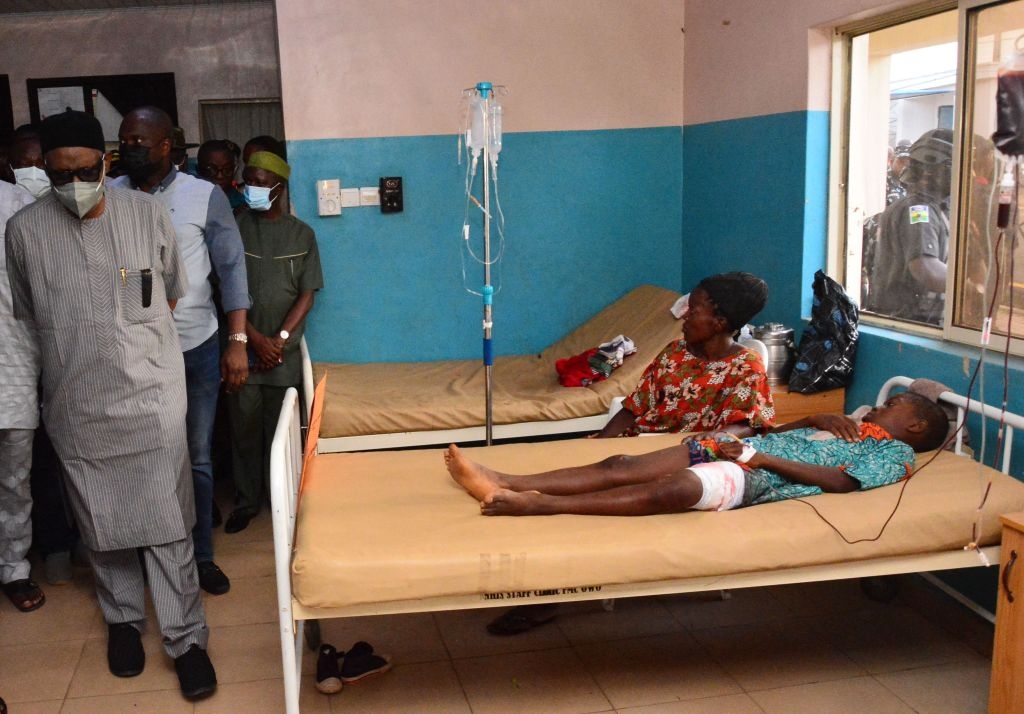
Islamist extremists are focusing anew their efforts to establish a global Caliphate, through their usual tactics of terror and upheaval, by permeating the continent of Africa. Pictured: State officials walk past wounded survivors of a jihadist attack on St. Francis Catholic Church in Ondo State, Nigeria, in which they murdered 50 Christians, on June 5, 2022. (Photo by AFP via Getty Images)

With Iran awaiting its fate from Western powers concerned about its nuclear advancement, Middle Eastern jihadist groups have faced crippling defeat through brilliantly planned retaliation by Israel -- aided, to an erratic extent, by the United States and United Kingdom.

Islamist extremists are focusing anew their efforts to establish a global Caliphate, through their usual tactics of terror and upheaval, by permeating the continent of Africa.

A report from the US-based Foreign Policy Research Institute notes that in 2024, although, a primary exponent of terror, Islamic State, "is no longer anchored in the Middle East, many of its most prolific and active branches are now located in Africa, where ISIS branches regularly claim attacks in the Democratic Republic of Congo, Egypt, Mozambique, and Nigeria."

In a similar vein, the Africa Report this month called Africa "a growing breeding ground for terror activities," and quoted security analyst Beverly Ochieng saying: "Islamic State has in recent months publicised Africa as the go-to destination for activities and presence."

The accompanying map reveals escalating jihadist efforts in numerous African countries, most of which do not have the resources or ability to counter those often ruthless efforts. Even the vaunted African Union says, in an exposé, that it "lacks a coherent plan to fight terrorism" -- on the increase in the region.

As expected from radical Islamists, Christians in those nations are marked for elimination. "Africa has become the epicenter of radical Islamic terrorism," Charles Jacobs and Uzay Bulut point out.

"The number of Christians intentionally murdered, let alone tortured, raped, kidnapped and forcibly converted to Islam far exceeds the number of Gazans killed unintentionally as Israel directs its fire at terrorists who hide behind civilians. Indeed, Israel is defending its population from the very same jihadist assaults faced by African Christians."

The constant attacks upon defenseless Christians in Africa is shamefully ignored by most of the world's press. Intelligence agencies of the West's major powers are, no doubt, aware of this situation, but at this crucial stage for the Indo-Pacific, the Middle East and Ukraine, priorities are understandably focused elsewhere. Africa, it seems, is simply not a priority for the West at this time -- and that appears exactly why China, taking advantage of this vacuum, is making deep inroads throughout Africa (and the other unprioritized continent, South America) economically, financially, and politically – predominantly through their "Belt and Road" seductive-sounding loan initiatives, many of which turn out to be debt-traps.

The main instigator of jihadist terror in Africa still appears to be the Islamic State (ISIS). With ideologically like-minded groups – most of which are active iterations of the broader Muslim Brotherhood movement, promoted by Qatar through its Al-Jazeera television network – their ultimate aim is an Islamic Caliphate under Sharia law. ISIS is affiliated with Al-Shabaab – one of a number of splinter groups who operate in different regions of Africa. Al-Shabaab is predominantly active in Somalia, from where the group instigates attacks in Mozambique - a country that has common borders with Zambia, Zimbabwe, Malawi, Tanzania, South Africa, and Swaziland – all of which are highly vulnerable to Islamic influence and jihadist terror.

In a strategy described as ISIS's "global long game", the movement aims to permeate all of Africa. Currently, its affiliates successfully operate in "Egypt's Sinai Peninsula, Somalia, Mozambique, and West Africa." In short, from the most northernly part of Africa (Egypt, Algeria, Libya, Tunisia), extending south through Somalia to Mozambique -- while likely aiming for the southernmost tip of South Africa, Cape Point. In West Africa, ISIS has representation and influence in Nigeria, Mali, Central African Republic and Democratic Republic of Congo, and Mozambique in the east. The group uses violence wherever it goes.

The ultimate objective of Islamic jihadists, appears to be to penetrate the United States. Al-Qaida's leader Dr. Ayman Al-Zawahiri, declared:

"The military work is to target firstly the head of global infidels America, and her ally Israel, and then her local allies who rule our countries. Targeting America aims at exhausting and haemorrhaging it, in order for it to end like the Soviet Union did, and isolate itself due to its military, human, and economic losses, and subsequently ease its grip on our countries, and its allies to begin falling one after another."

Furthermore, all Westerners are targets for attack. Al-Zawahiri continues:

"If you can kill a disbelieving American or European — especially the spiteful and filthy French — or an Australian, or a Canadian, or any other disbelievers waging war, including the citizens of the countries that entered into a coalition against the Islamic State, then rely upon Allah and kill him in any manner or way."

Consequently, it is in the interests of the West, especially the United States as the dominant military power and protector of global freedom, that assistance be rendered to those African countries, which, faced with Islamic jihadist terror, desire help. The reality in Africa is that there is no standing army in the 54-nation continent, south of the Sahara, which is capable of successfully countering and eliminating these terror attacks.

In Nigeria, the most populous country, the nation's Christians suffer continual attacks by ISIS, originally a splinter group of Boko Haram. Since 2009, more than 350,000 Nigerians have been murdered by Boko Haram, at least 30,000 of them under the nearly ten-year rule of Nigerian President Muhammadu Buhari, who admitted having failed to keep his promise of securing Nigeria:

"In his inaugural address, Mr Buhari vowed to tackle 'head on' the Boko Haram insurgents who at the time had taken over several local government areas in Borno, Adamawa and Yobe states.

"He vowed to crush Boko Haram within three months and recover all the territories it had seized."

Despite apparently half-hearted efforts to eradicate the threat, Nigeria's military does not make much headway, reportedly largely due to corruption and "failure to address the root cause":

"Experts say that it is not that people in the north-east sympathise with Boko Haram and its splinter group, the Islamic State's West Africa Province, but that neglect from the authorities and desperation often drive people into the hands of the militants....

"He points to a lack of good governance that leaves the population impoverished, frustrated and uneducated as 'one huge root cause'".

The Africa Report of January 10, 2025, reports:

"Security experts say the Islamic State (IS) jihadist militant group is capitalising on issues such as severe governance challenges, political instability and weak institutions in Africa to surge and make territorial gains in regions across the continent."

The same contention applies to the East African nations of Tanzania, Kenya and Mozambique, and many others. While there are many paramilitary groups or private military contractors, as they prefer to be called, in Africa which engage in countering terrorism, these are often for-profit or politically affiliated; generally, to specific political entities who, for their own purposes, sub-contract them out.

South Africa, arguably the wealthiest country in Africa, nevertheless finds the ANC government poorly equipped and trained militarily and ill-prepared for jihadist incursions.

The US Department of State wrote in its "Country Reports on Terrorism 2022: South Africa":

"South Africa's border security is challenging because of its numerous land, sea, and air ports of entry for international travellers. Multiple South African law enforcement agencies police its borders, but they often are stove piped. Inadequate communication and equipment limit their border control ability."

Immensely mineral-rich and strategically located, Africa is a continent of vital importance to the West. It extends from the Mediterranean in the north to the Indian Ocean in the south. It is urgent that Western leaders appreciate the danger of further entrenchment of Islamist jihadism on the continent. That dubious statesman, Robert Mugabe of Zimbabwe, was one of the first to warn of the insidious increase in Islamism in Africa.

Hence, it is imperative that the West, particularly the US and Europe, significantly increase its presence in Africa. Only in this way is there a chance of containing Islamist jihadism, and ensuring that democracy prevails on the world's second-largest continent; one with a population that could soon reach two billion. At the same time, China's efforts in Africa also need containing.

Concerning China's and Russia's African agenda, Lt. Col. Joseph G. Bruhl of the US Army's Southern European Task Force, Africa, wrote:

"Instead of a problem to be solved, China and Russia view Africa as an opportunity to be seized. From 2007-2017, U.S. trade with Africa dropped by 54% while China's grew by 220%. While Russia's total investment in Africa pales in comparison to the U.S. and China, it's growing—by 40% since 2015. In 2019, Russia held the first-ever Russia-Africa summit—hosting 45 African heads of state. China holds a similar event called the Forum on China–Africa Cooperation. The U.S. hosts no such initiative."

Why not?


Nils A. Haug is an author and columnist. A lawyer by profession, he is member of the International Bar Association, the National Association of Scholars, a faculty member at Intercollegiate Studies Institute, the Academy of Philosophy and Letters. Dr. Haug holds a Ph.D. in Apologetical Theology and is author of 'Politics, Law, and Disorder in the Garden of Eden – the Quest for Identity'; and 'Enemies of the Innocent – Life, Truth, and Meaning in a Dark Age.' His work has been published by First Things Journal, The American Mind, Quadrant, Minding the Campus, Gatestone Institute, National Association of Scholars, Jewish Journal, James Wilson Institute (Anchoring Truths), Document Danmark, and others.

Source: https://www.gatestoneinstitute.org/21345/africa-jihadist-terror

Follow Middle East and Terrorism on Twitter

Mexico—Friend, Enemy, Neutral, or Something Else? - Victor Davis Hanson


by Victor Davis Hanson

After years of U.S. appeasement, Mexico exploits open borders, drug trade, and remittances—it's time for America to enforce real consequences and reclaim control.


Mexican nationals, likely cartel members, recently crossed the border and shot and wounded an American hiker. Did they assume that Joe Biden was still president, and so it was still a veritable open season on Americans without consequences?

Mexico also recently balked at allowing a U.S. transport plane to land, returning its own nationals apprehended as illegal aliens.

Was its attitude that Alejandro Mayorkas was still Homeland Security Secretary and thus working with Mexico to ensure that millions of illegal aliens could stay in the U.S. indefinitely?

After four years of Biden’s appeasement, Mexico seems to assume that it has a sovereign right to encourage the flight of millions of its own impoverished citizens illegally into the U.S. and further assumes that it can fast-track millions of Latin Americans through its territory and across our border.

Mexico either cannot or will not address the billions of dollars of raw fentanyl products shipped in—mostly from China—and then processed for export to the U.S. by its cartels across a nonexistent border.

Mexico seems to have little concern that some 75,000 Americans on average die from mostly Mexican-imported fentanyl each year—more deaths in just the last decade than all the Americans killed in action during World War I, World War II, the Korean War, and the Vietnam War combined. Who then is our friend, and who is our enemy?

This appalling death toll is in part due to the deliberate efforts of the cartels to mask fentanyl as less deadly narcotics or camouflage the poison by lacing it into counterfeit prescription drugs.

Mexico encourages its expatriate illegal aliens to send back some $63 billion per year in remittances. That huge sum constitutes one of Mexico’s largest sources of foreign exchange, surpassing even its tourist and oil revenues.

These billions are often subsidized by U.S. taxpayers. America’s local, state, and federal governments provide billions of dollars in food, housing, and health care entitlements that allow Mexico’s citizens, illegally residing inside the U.S., to free up the cash to be sent home.

According to U.S. census data, almost every year, the trade deficit with Mexico has increased from about $50 billion twenty years ago to $160 billion today.

That astronomical figure neither includes the $63 billion American outflow in remittances nor the multi-billion income from the cartels’ illicit drug sales in the U.S.

Although one would never know it from the rhetoric of Mexican politicians, the entire Mexican economy, both legal and illicit, hinges on America accepting a worsening asymmetrical relationship.

Yet the U.S. has a lot of leverage with Mexico to ensure that it no longer assumes a permanent huge trade surplus with the U.S., turns a blind eye to massive fentanyl shipments that kill thousands of Americans, encourages its own citizens to enter their neighbor’s country illegally, and counts on massive cash remittances from the U.S.

Loud rhetoric, threats, and ultimatums do not work.

Usually, they earn Mexico’s furious retorts about Yanqui imperialism and ancient bitterness about a lost Aztlán.

Former Mexican President Andrés Manuel López Obrador used to brag about the millions of illegal aliens that were residing in the U.S. He further advised expatriate Mexican-Americans not to vote for Republicans, whom he felt one day might close the border.

Obrador rarely reflected on why millions of his own citizens were fleeing his own country—only that it was a “beautiful” thing that they did.

Did Obrador hate Trump more for challenging him by trying to stop the illegal influx or Biden for embarrassing him by welcoming millions of them into the U.S.?

So, what should be the U.S. response to Mexico’s passive-aggressive policies?

Smile, praise Mexico as our greatest trading partner, and then quietly inform them that illegal aliens will be bussed to the border.

Once there, they could be given a generous care package, escorted through a border door, and left on the Mexican side from which they entered and thus could then be escorted in caravans home in the same manner that they arrived.

To maintain cordial relations and politely gain Mexico’s attention, we need a radical change in tone and action beyond just ending catch-and-release, finishing the wall, and making refugee status requests possible only in the home country of the applicant.

Rather than worry about who is sending remittances, why not politely place a 20 percent tax (about $12 billion) on all cash sent from the U.S. to Mexico?

We could also hail our mutual friendship and then reluctantly slap tariffs on imported assembled goods until the two-way trade is roughly balanced.

Who knows, once the U.S. is respected again and not considered an easy mark, Mexico could once again become a fine and reciprocal friend to the United States.


Victor Davis Hanson

Source: https://amgreatness.com/2025/01/30/mexico-friend-enemy-neutral-or-something-else/

Follow Middle East and Terrorism on Twitter

Wednesday, January 29, 2025

Fifty Years of Using International Law Against Israel: A Social Justice Narrative Takeover - Tirza Shorr


by Tirza Shorr

A collection of UN resolutions made Palestinian political violence a legitimate form of political expression. UN resolutions provide justification, reinforcement, and prestige for Palestinian terrorism – including that of Hamas. Both sides now “equal,” the UN began using the terminology “a cycle of violence” when referring to IDF clashes with terrorists.


Fifty Years of Using International Law Against Israel: A Social Justice Narrative Takeover
On November 10, 1975, the UN General Assembly declared that “Zionism is a form of racism and racial discrimination.” (UN Photo/Teddy Chen)

Institute for Contemporary Affairs

Founded jointly with the Wechsler Family Foundation

Vol. 25, No. 4

  • The year 2025 marks the 50th anniversary of UN General Assembly Resolution 3379, which declared that Zionism is a form of racism. Nonbinding UN resolutions fuel international court lawfare against Israel, which has only increased following Hamas’s October 7, 2023 massacre. The result has been the endowment of moral and political legitimacy to terrorist aggressors, negating the fundamental values of the international system.

  • A collection of UN resolutions made Palestinian political violence a legitimate form of political expression. UN resolutions provide justification, reinforcement, and prestige for Palestinian terrorism – including that of Hamas. Both sides now “equal,” the UN began using the terminology “a cycle of violence” when referring to IDF clashes with terrorists.

  • The politicized international courts are conducive to the “narrative” approach that reinterprets history and disregards a legal, adjudicated examination of evidence, favoring social justice. The “critical justice” reinterpretation of law views facts through the lens of corrective narratives. Therefore, terms such as “occupation,” “invasion,” and “blockade” are not interpreted conventionally, but in a way that will afford “social justice.”

  • Alternatively, direct efforts to remold definitions are employed: on December 11, 2024, Ireland requested that the UN broaden its definition of “genocide,” so that Israel would be found guilty in the ICJ case.

  • Israel has become the “canary in the coal mine” at the UN – an indigenous people in their ancestral homeland uniquely targeted for “colonialism.” The democratic majority rule principle has been usurped to compel the now outnumbered West to subvert the UN’s original vision.


This study honors the memory of JCFA’s dear friend and associate Olga Meshoe Washington, South African attorney and Israel advocate, CEO of DEISI (Defend Embrace Invest Support Israel) and Board Member of IBSI (the Institute for Black Solidarity with Israel), with whom JCFA has partnered in its joint diplomatic-educational “Promise” project. (* See more about Olga Meshoe Washington below.)


The year 2025 marks the fiftieth anniversary of United Nations General Assembly (UNGA) Resolution 3379, which declared that Zionism is a form of racism. The resolution was passed after a decade-long process of Soviet and Arab lobbying to delegitimize Israel’s existence.

The vote reflected a process. In the 1960s, the UN redefined “racism,” while its 1970s “postcolonial” resolutions allowed terrorism to be reinterpreted as “armed resistance.” The Palestinian cause shoehorned itself into the Third World by claiming that “Palestine” was “colonized.”1 This narrative persists due to popular ideological trends spread by academia and media.

Nonbinding UN resolutions fuel international court lawfare against Israel, which has only increased following Hamas’s October 7, 2023 massacre. UN demands will be made as political statements even when practically impossible.

For instance, on September 18, 2024, the UNGA adopted a resolution calling on Israel to “end the occupation” or be boycotted within a year. On November 20, 2024, a UN Security Council (UNSC) draft resolution called for an Israeli ceasefire with no hostage release condition.2

A South Africa-led “genocide” case against Israel is still pending at the International Court of Justice,3 and the International Criminal Court has issued arrest warrants for Israeli Prime Minister Benjamin Netanyahu and former Defense Minister Yoav Gallant for “war crimes.”4 The claims are not factual;5 they rest on an overarching narrative of “racist,” “colonialist” Israel.6

Neo-Marxist, postmodern, Critical Theory, and postcolonial thought school advocates7 have pushed this narrative while simultaneously encouraging the deconstruction of conventional law and history to further it. This intellectual climate now envelops the UN and the international courts.8 Since the UN is the global arbiter of what is “politically correct,” the result has been the endowment of moral and political legitimacy to terrorist aggressors, negating the fundamental values of the international system.9

The UN’s Postcolonial Resolutions: Legitimizing Terror and the Erasure of Israel

In the 1960s, post-colonialists Frantz Fanon and Jean-Paul Sartre justified terrorism as freedom fighting.10 In the 1970s, Michel Foucault’s “discursive power” and Jacques Derrida’s linguistic “deconstruction” became the building blocks of today’s radical movements, including its legal branches, which adopted “social justice” legal interpretations.11 The “father of postcolonial studies,” Palestinian-American professor Edward Said, a Foucauldian, claimed that Israel was the last bastion of colonialism in his 1979 book The Question of Palestine.12

These ideas were assimilated by what was to become the heavily postcolonial “Non-Aligned Movement” (NAM) UN member majority of the 1970s. Backed by the Soviets and Arabs, Palestine Liberation Organization Chairman Yasser Arafat transformed the Palestinian refugee cause into a “colonial” one to gain NAM (and Western left) solidarity, making for the UN majority needed to pass a series of pro-Palestinian resolutions.13

At UN committees, Israel’s enemies depicted it as an expansionist aggressor that had invaded Africa to occupy Sinai in 1973, though that war was defensive.14 By 1974, Arafat labeled Israel “colonialist, imperialist, and racist” in his sensationalist “holster” speech, the first time a terrorist was platformed at the UN.15

About one month later, the UNGA passed Resolution 3236, advocating for the “Inalienable Rights of the Palestinian People,” including self-determination, national independence, sovereignty, and recognition of the right of return or compensation for Palestinians. Using the territorial ambiguity of post-1967 Resolution 242, Palestinian advocates suggested that “from the River to the Sea” was a legitimate aim of self-determination. Using the same bloc, UNGA Resolution 3379 passed in 1975 declaring “Zionism is a form of racism and racial discrimination,”16 resting on a 1960s definitional expansion of “racial” discrimination.17

By 1977, non-aligned states lobbied the UN to modify the 1949 Geneva Convention’s laws of war to accommodate national liberation movements in Additional Protocols.18 In 1979, the UNGA approved an exception to the international convention against taking hostages in cases “in which people are fighting against racist regimes in the exercise of their right of self-determination.”19

By 1982, the UNGA’s Resolution 37/43 reaffirmed “the legitimacy of the struggle of peoples for independence, territorial integrity, national unity and liberation from colonial and foreign domination and foreign occupation by all available means, including armed struggle.”20 This strengthened the Palestinian claim that Jewish resettlement in Israel21 was “colonization.”22

In 1984, NAM advocated for considering armed combatants from national liberation movements civilians, not militants, to protect them from legal prosecution.23

With “terrorism” still undefined by the UN,24 this collection of resolutions made Palestinian political violence a legitimate form of political expression. Both sides now “equal,” the UN began using the terminology “a cycle of violence”25 when referring to IDF clashes with terrorists. Though Israel advocates assert that the resolutions are inapplicable to the Palestinian-Israeli conflict, the global discourse has already reinterpreted them using the postcolonial meta-narrative.26 The anti-Israel bias is not just technical, due to bloc voting, vote trades, and appointments – but due to a major ideological, interpretive shift that holds the Palestinian narrative above the UN Charter’s stated raison d’etre.

Changing the Narrative

The UN’s closed-circuit system, which culls evidence from its “independent advisors” and “special rapporteurs” (activists such as Francesca Albanese, Michael Farkhi,27 and Ardi Imseis28) has facilitated “social justice” readings of international public law.

The politicized international courts are conducive to the “narrative” approach that reinterprets history and disregards a legal, adjudicated examination of evidence, favoring social justice.29 The “critical justice” reinterpretation of law views “facts” through the lens of corrective narratives that reverse historically “unjust” hierarchies of power, thereby transforming political realities.30 Therefore, terms such as “occupation,” “invasion,” and “blockade” are not interpreted conventionally, but in a way that will afford “social justice.”31 Alternatively, direct efforts to remold definitions are employed: on December 11, 2024, Ireland requested that the UN broaden its definition of “genocide,” so that Israel would be found guilty in the ICJ case.32

Conclusion

UN resolutions are biased and political, as are the international courts that demand “compliance with international law.” The international courts’ disproportional caseload has focused on African states, while powerful states enjoy immunity.33 The Russia- and China-dominated UNSC may freely elect to refer cases to the ICC based purely on political considerations.34

When the ICC issued a warrant for Russian President Vladimir Putin’s arrest in March 2023 for war crimes,35 the Kremlin dismissed its jurisdiction. Former Russian President Dmitry Medvedev threatened to target the ICC in The Hague with hypersonic missiles,36 and Russia’s top investigative body opened a criminal case against the ICC prosecutor and case judges.37

The West’s heavy funding of the international system seems unjustified, considering its poor outcomes. The UN has failed to prevent mass murder in Cambodia, Burundi, Uganda, Syria, Iraq, and Kurdistan, and fails to advocate for individual rights or against terror.38 UN resolutions provide justification, reinforcement, and prestige for Palestinian terrorism – including that of Hamas.39 The twisted moral standard helps explain why Ireland, Spain, Norway, Slovenia, and Armenia recognized the “State of Palestine” following Hamas’s October 7, 2023 massacre.40

Israel has become the “canary in the coal mine” at the UN – an indigenous people in their ancestral homeland uniquely targeted for “colonialism.” The democratic majority rule principle has been usurped to compel the now outnumbered West to subvert the UN’s original vision. Though today, some Western states are willing to sacrifice Israel’s rights to self-defense and self-determination as a guilt offering for “colonial sins,” in the future, this precedent is likely to rebound on their sovereignty.

* * *

* Olga Meshoe Washington stressed how United Nations Resolution 3379 – “Zionism is racism” was an antisemitic relic of Soviet propaganda that “shifted the libel and the attacks against Israel from a geopolitical space to a human rights space,” aiming to deny Israel’s right to self-determination.

Likewise, Olga emphasized the falsehood of the apartheid claim against Israel and its misappropriation of South African history. She said in December 2023: “So people now march on the streets proudly saying that they are upholding human rights values by protesting the fact that Israel is an apartheid state…it’s an affront to Black people who really suffered apartheid. It also erases our history. If everything becomes apartheid, what truly is apartheid?…it also acts as a smokescreen to really address the suffering of…the people in Gaza at the hands of Hamas.” (JCFA War Room interview, during the Swords of Iron War, with Lt.-Col. (res.) Maurice Hirsch), https://jcpa.org/video/the-true-cost-of-the-israel-apartheid-narrative/ December 13, 2023 16:37-17:17.

See also Olga Meshoe Washington, “The Israel-Apartheid Lie and the Appropriation of South Africa’s History,” in Israelophobia and the West: The Hijacking of Civil Discourse on Israel and How to Rescue It, Dr. Dan Diker, editor, https://jcpa.org/israelophobia-and-the-west/ )

We are deeply grieved at the early passing of Olga, a true friend and ally to Israel and the Jewish people. May her memory be blessed.

* * *

Notes

  1. Yohanan Manor. To Right a Wrong: The Revocation of UN General Assembly Resolution 3379 Defaming Zionism. UNKNO: 1998. Introduction. On the tailwind of resolutions aimed at Portugal, which still held colonies in Africa, Guinea-Bissau, Cape Verde, and Angola until 1975, the Soviets shoehorned and sealed the Palestinian issue into the post-colonialist Third World UN agenda. States feared an OPEC-style oil embargo for not voting with the Arab-Soviet bloc on Israel, ensuring the “yes” vote of a majority of African and other developing states. “Zionism is Racism” was repealed in Resolution 4686 in 1986 and retracted in 1991. Palestinians or their representatives made claims of racism and imperialism against Israel earlier: Fadel Jamali in 1947, and Ahmad Shukairy in 1961. Though world Jewry and Israel were taken aback by 3379, it culminated in a decade of Soviet and Arab-promoted “Zionism is racism” language in minor committees and conference statements of UN-associated bodies.↩︎

  2. The E-10-initiated (Algeria, Ecuador, Guyana, Japan, Malta, Mozambique, Republic of Korea, Sierra Leone, Slovenia, and Switzerland) draft resolution S/2024/835 was vetoed by the United States, citing concerns over the absence of provisions conditioning the release of hostages as a prerequisite for a ceasefire. All 14 other members, including the United Kingdom and France, supported the resolution. It recalls resolutions 2712, 2720 (2023), 2728, and 2735 (2024) on the Palestinian question. The United States vetoed it.↩︎

  3. On October 28, 2024, South Africa (joined by Chile, Turkey, Spain, Mexico, and “Palestine”) filed a 750-page claim with 4000 annexes for the first case mentioned above in the ICJ, documents still not released to the public. Their preliminary documents used incendiary terms such as “75-year apartheid” “56-year occupation” and “16-year blockade.”↩︎

  4. The International Criminal Court ruling of November 21, 2024, issued warrants for Israeli Prime Minister Benjamin Netanyahu and (now former) Defense Minister Yoav Gallant on suspicion of war crimes and crimes against humanity (for not allowing food and medical aid to enter Gaza, and Israel’s purportedly intentional attacks on civilians). Israel claimed in pretrial that the ICC has no jurisdiction on “Palestine”; the court rejected this. See https://jcpa.org/the-icc-arrest-warrants-are-an-illegal-action-in-violation-of-the-icc-statute/. Eliminated Hamas terror leaders Ismail Haniyeh, Mohammed Deif, and Yahya Sinwar were also charged. The court issued a warrant for the deceased Deif.↩︎

  5. https://www.icj-cij.org/node/204092

    https://www.jpost.com/international/article-830757 Kenyan Special Advisor on the Prevention of Genocide Alice Wairimu Nderitu, a global expert, opined that the IDF’s war on Hamas was not genocide; the UN subsequently failed to renew her work contract. Though UN Secretary-General António Guterres’s office claimed that her term simply ended and that it is unusual for special advisors to serve more than one term, UN special advisors often serve a second three-year term. (Some examples include Adama Dieng, the UN Special Adviser on the Prevention of Genocide from 2012 to 2020; Cristina Duarte, Special Adviser on Africa in July 2020, currently serving her second term; Jeffrey Sachs, Special Adviser on the Millennium Development Goals from 2002 to 2016; Jane Holl Lute, Special Adviser on Relocation of Camp Hurriya Residents Outside of Iraq from 2014 to 2016; and David Nabarro, the Special Adviser on the 2030 Agenda for Sustainable Development and Climate Change from 2016 to 2018.)↩︎

  6. A 2023 opinion piece title succinctly expressed it: “International Courts Won’t Stop Israel’s Occupation but They Can Shift Narratives.”https://www.middleeasteye.net/news/international-courts-wont-stop-Israels-occupation-but-can-shift-narratives↩︎

  7. For example, radical academic, BDS activist, Critical theorist, and queer theory originator Judith Butler has claimed that Hamas and Hizbullah are progressive left movements. See https://timesofindia.indiatimes.com/world/us/hamas-and-hezbollah-part-of-global-left-american-philosopher-judith-butlers-comment-resurfaces-on-social-media/articleshow/113943519.cms. Hamas’s “social justice” rebrand in the language of its 2017 annex is an obvious attempt to soften the genocidal Jew-hating narrative of its 1988 charter. See Jeffrey Herf https://yivo.org/cimages/jeffrey_herf_yivo_institute_presentation_2_26_2024.pdfHamas in 2017: The document in full | Middle East Eye↩︎

  8. See Michael Hanne and Robert Weisberg, eds., Narrative and Metaphor in Law (Cambridge University Press, 2018) and Why Historical Narrative Matters? – Public History Weekly – The Open Peer Review Journal↩︎

  9. UN Charter article 4 requires that United Nations membership be open to “all other peace-loving states which accept the obligations contained in the present Charter.” See https://jcpa.org/the-uns-world-of-the-absurd/ Narrative for Social Justice Initiative (N4SJ) — The Narrative Society; https://www.icc-cpi.int/news/situation-state-palestine-icc-pre-trial-chamber-i-rejects-state-israels-challenges↩︎

  10. Frantz Fanon’s Wretched of the Earth is considered a source for this logic. Sartre’s introduction to the book was equally influential. https://theconversation.com/postcolonial-prophet-or-advocate-of-barbaric-justice-a-new-take-on-the-life-and-times-of-influential-revolutionary-writer-frantz-fanon-227909 https://republic.com.ng/october-november-2021/fanons-anticolonial-influence/↩︎

  11. Derrida’s Justice and Foucault’s Freedom: Ethics, History, and Social Movements on JSTOR The importance of language reinterpretation was already sensed decades before by Stalin. During the Cold War, Soviets redefined “democracy” as communism, not Western representative republicanism. See Robert Tucker. https://www.jstor.org/stable/2008941↩︎

  12. The book followed his 1978 masterpiece Orientalism Orientalism: Edward Said’s groundbreaking book explained↩︎

  13. Egyptian President Gamal Abd-al-Nasser brought Palestinian representatives to the Africa-Asia Bandung conference in 1955, beginning this association and process. See Kirisci https://www.palestine-studies.org/en/node/1642957; Helena Cobban, The Palestinian Liberation Organisation: People, Power and Politics. Oxford, 1984, and Barry and Judith Rubin, Arafat (2003). USSR satellites, such as Cuba, Vietnam, and Algeria, empowered the Palestinians to denigrate the Jewish right to self-determination and suggest Israel’s replacement with a Palestinian state. See Mordechai Nisan https://www.researchgate.net/publication/261678466_The_PLO_and_Vietnam_National_Liberation_Models_for_Palestinian_Struggle↩︎

  14. Following the Yom Kippur War of 1973, Resolution 338 called for the end of hostilities and the implementation of Resolution 242 of 1967, which demanded the withdrawal of Israeli forces from territories occupied during the Six-Day War, implying that peace could be attained through territorial compromise. These resolutions were used by the Palestinians to claim that Israel refused to give up territories (though they were not defined in the resolution and were previously held by Jordan and Egypt, not “Palestine” – which never existed as a sovereign state, only a geographical territory), thus justifying armed resistance. http://unscr.com/en/resolutions/doc/338↩︎

  15. The PLO’s 1977 -Six Point Plan took on Soviet definitions of “democracy” and a “secular democratic state,” which would mean a socialist “one-state solution.” The 1974 10 Point Plan’s “combatant national authority” refers to a reconquered area to be used as a base to liberate Palestine, construed in Western terms as a compromise position repudiating the 1968 Palestinian National Charter’s commitment to total liberation of Palestine. However, it stated that the PLO will employ “all means,” including armed struggle, to “liberate Palestinian territory and to establish the independent combatant national authority for the people over every part of Palestinian territory that is liberated.” See Muhammad Muslih, The Origins of Palestinian Nationalism. Columbia, 1988. p. 17.↩︎

  16. Manor, ibid. On the tailwind of resolutions aimed at Portugal, which still held colonies in Africa, Guinea-Bissau, Cape Verde, and Angola until 1975, the Soviets shoehorned and sealed the Palestinian issue into the post-colonialist Third World UN agenda. States feared an OPEC-style oil embargo for not voting with the Arab-Soviet bloc on Israel, ensuring the “yes” vote of a majority of African and other developing states. “Zionism is Racism” was repealed in Resolution 4686 in 1986 and retracted in 1991. Palestinians or their representatives made claims of racism and imperialism against Israel earlier: Fadel Jamali in 1947, and Ahmad Shukairy in 1961. Though world Jewry and Israel were taken aback by 3379, it culminated a decade of Soviet and Arab-promoted “Zionism is racism” language in minor committees and conference statements of UN-associated bodies.↩︎

  17. In 1965 at the United Nations, the International Convention on the Elimination of All Forms of Racial Discrimination (ICERD), adopted in December 1965, was expanded based on the Declaration on the Elimination of All Forms of Racial Discrimination (1963), facilitating 3379. It entered into force on January 4, 1969. Article 1 – Definition of racial discrimination: “Any distinction, exclusion, restriction or preference based on race, color, descent, or national or ethnic origin which has the purpose or effect of nullifying or impairing the recognition, enjoyment or exercise, on an equal footing, of human rights and fundamental freedoms in the political, economic, social, cultural or any other field of public life.” The resolution was canceled, but the argument was repeated at the UN-associated Durban WCAR conference in 2001. See Joel Fishman, “‘A Disaster of another Kind’: Zionism=Racism, Its Beginning, and the War of Delegitimization against Israel,” Israel Journal of Foreign Affairs V: 3 (2011)↩︎

  18. The Convention has been used by the Palestinian cause to argue that terrorists are combatants and “prisoners of war” when arrested by Israeli security forces: https://palwatch.org/page/29247 https://palwatch.org/page/14111↩︎

  19. See Article 12 https://treaties.un.org/doc/db/terrorism/english-18-5.pdf http://cilj.co.uk/2019/11/25/the-inapplicability-of-the-geneva-conventions-to-self-determination-movements/#:~:text=1(4)%20of%20the%20Additional,recognised%20as%20international%20armed%20conflicts ; Ben Saul on hostages and Article 12 https://legal.un.org/avl/ha/icath/icath.htmlhttps://international-review.icrc.org/sites/default/files/S0020860400080657a.pdf https://ihl-databases.icrc.org/en/ihl-treaties/apii-1977/article-13?activeTab; https://ihl-databases.icrc.org/ar/ihl-treaties/api-1977/article-1?activeTab=↩︎

  20. Dore Gold, Tower of Babble (2004) p. 39.↩︎

  21. See https://ore.exeter.ac.uk/repository/bitstream/handle/10871/126540/HoganA.pdf?sequence=1&isAllowed=y↩︎

  22. In addition, Great Britain’s mandatory-era Balfour Declaration was referenced as a colonization attempt. See https://jcpa.org/legal-veracity-balfour-declaration/↩︎

  23. Gold, p. 39. The Pentagon rejected this approach, which would prevent counterterrorism efforts.↩︎

  24. Counter-Terrorism Module 4 Key Issues: Defining Terrorism↩︎

  25. Gold, p. 39.↩︎

  26. https://gtw.hypotheses.org/17828 (In the words of postmodernist Jean-Francois Lyotard)↩︎

  27. https://unwatch.org/legal-analysis-of-un-food-rapporteur-michael-fakhris-2024-report-to-un-general-assembly/↩︎

  28. https://www.youtube.com/shorts/aQc26Lg67ZU↩︎

  29. Critical Social Justice was popularized by Critical Race Theory, whose “parent” thought school is Critical Legal Theory, which pioneered legal narrative (“storytelling”). CRT’s international counterparts are Critical International Legal Theory and Third World Approaches to International Law.

    In postcolonial and neo-Marxist thought, colonialism and racism are integrally connected, as racism justifies colonial exploitation of the indigenous population. “Racial” becomes a magical full-coverage claim that aims to obliterate the guilty regime for its complete lack of moral, and therefore, political legitimacy, the fate of the former apartheid regime of South Africa. The racist or “apartheid” claim – even if it was not accurate regarding Israel – also has the power to justify terrorism as “armed resistance,” thereby building global solidarity with all “black and brown people.” Today, this sentiment is expressed by the “intersectionality” of marginalized peoples, inspired by Critical Legal theorist Kimberle Crenshaw. See https://www.heyalma.com/israel-guide/intersectionality-and-the-israeli-palestinian-debate/#:~:text=Intersectionality%20has%20also%20become%20a,justice%2C%20and%20particularly%2C%20feminismhttps://www.researchgate.net/publication/228205450_Legal_Storytelling_The_Theory_and_the_Practice_-_Reflective_Writing_Across_the_Curriculum↩︎

  30. See Naz Modirzadeh. https://papers.ssrn.com/sol3/papers.cfm?abstract_id=4406477 p. 110: Melbourne Law School public international law professor Anne Orford: “the recognition that international law is politics all the way down is not the end of the story, but the beginning of a new chapter.”↩︎

  31. https://jcpa.org/manipulating-the-truth-about-gaza/; https://gaza-aid-data.gov.il/main/↩︎

  32. https://x.com/just_whatever/status/1866917595330330892↩︎

  33. The Sum of Four Fears: African States and the International Criminal Court in Retrospect-Part I – Opinio Juris; Africa and the backlash against international courts- Africa and International Studies | BISA↩︎

  34. The international system’s lack of jurisdiction over brutal dictatorships explains why the ICC has never brought “war crime” charges against Syria’s Bashar al-Assad, Turkey’s Recep Tayyip Erdogan, or Iran’s Ali Khamenei, since these states are not Rome Statute signatories.↩︎

  35. For the unlawful deportation and transfer of children in Ukraine and Russia.↩︎

  36. https://www.newsweek.com/russia-medvedev-icc-hypersonic-missile-putin-arrest-warrant-1788805?form=MG0AV3↩︎

  37. https://apnews.com/article/russia-indictment-icc-prosecutor-judge-putin-260100f9ba533e15ebee3084dba74ff4?form=MG0AV3↩︎

  38. Dore Gold. Tower of Babble. p. 39↩︎

  39. https://jcpa.org/article/the-war-in-gaza-can-contemporary-international-law-cope-with-todays-terror/ Skyrocketing Palestinian terror in the 1970s included the hostage-taking and murder of 11 Israeli athletes at the Munich Olympics in 1972; in Kiryat Shmona, in 1974, with 18 dead, including eight children; in 1974 in Ma’alot, with 27 children killed at the school; at the Savoy in Tel Aviv in 1975, 11 dead; and the hostages taken at Entebbe in 1976.↩︎

  40. Similarly, following the First Intifada of December 1987, in November 1988, 78 states recognized Palestine. At a Palestinian National Council meeting in Algeria, the PLO claimed Jerusalem as a capital, citing UN General Assembly Resolution 181 (the partition of Palestine into Jewish and Arab states, initially rejected by the Arabs) and multilateral negotiations based on UN Security Council Resolution 242.↩︎


Tirza Shorr

Source: https://jcpa.org/article/fifty-years-of-using-international-law-against-israel-a-social-justice-narrative-takeover/

Follow Middle East and Terrorism on Twitter