by Shimon Sherman
Above the General Board is the Executive Committee, the primary strategic and decision-making organ, chaired by Trump, who retains veto power.
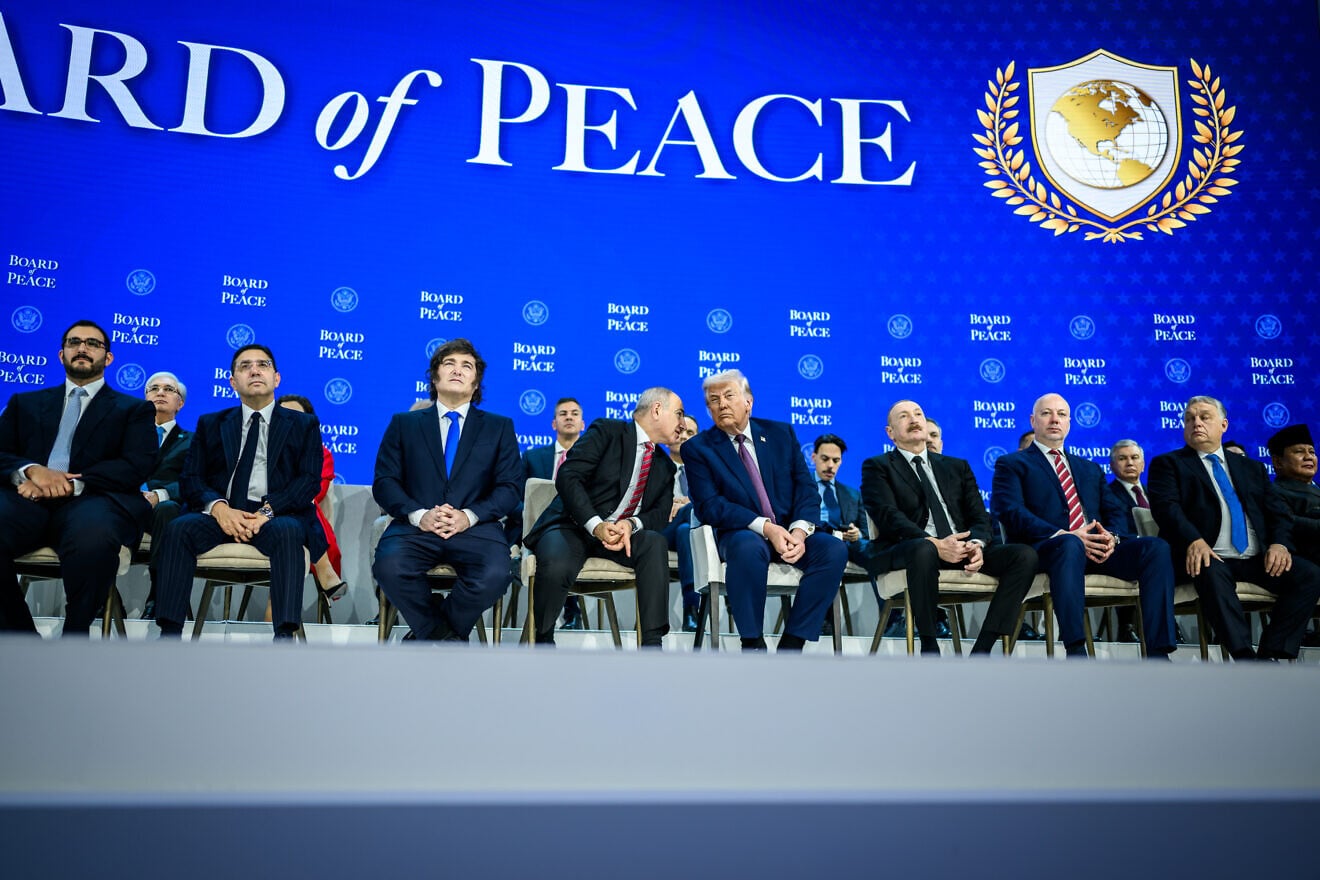 |
U.S. President Donald Trump participates in the
Board of Peace charter announcement and signing ceremony during the
World Economic Forum at the Davos Congress Center in Davos, Switzerland,
Jan. 22, 2026. Credit: Daniel Torok/White House. |
President Donald J. Trump signed the charter for the Board of Peace on Thursday at the World Economic Forum in Davos, marking the formal commencement of Phase 2 of the administration’s Gaza peace initiative.
According to the Trump administration, the signing ceremony, attended by regional leaders and global financial executives, transitions the focus of the U.S. strategy from the current ceasefire toward “demilitarization, reconstruction and civil administration” of the Gaza Strip.
Phase 2 establishes a new governing framework for the enclave, intended to replace Hamas and previous international aid structures with a centralized board of stakeholders. Under the terms of the charter, the Board of Peace is now the self-appointed primary authority responsible for directing reconstruction funds and overseeing the transition to a civilian government.
“The whole architecture of the current Trump plan is a very impressive effort which is unprecedented in many ways,” Col. (res.) Eran Lerman, vice president of the Jerusalem Institute for Strategy and Security (JISS), told JNS. “There have been ideas in this direction of an international oversight for many years, and this implementation is by far the most concrete and advanced of any of those programs.”
Lerman added, however, that the plan is in very early stages and “for now it only exists on paper.”
International oversight
The newly established Board of Peace is organized into a tiered hierarchy of multiple levels of oversight committees. At its base sits the General Board of Peace, a plenary body composed of heads of state.
While invitations have been extended to more than 60 nations, including everyone from the pope to Belarusian dictator Aleksander Lukashenko, only 35 countries have so far accepted membership. Notably, most European countries, including the United Kingdom, France and Germany, have declined a position on the board, leading to significant dominance of the Middle Eastern Arab states on the Board of Peace.
This assembly serves as the foundational body for the initiative’s international legitimacy, though the charter explicitly grants the chairman-for-life, U.S. President Donald Trump, sole authority to invite new members and appoint his own successor. Under the terms of the charter, while nations may accept a three-year rotating term at no cost, a $1 billion cash contribution to the Board’s fund secures a permanent seat.
Above the General Board is the Executive Committee, the primary strategic and decision-making organ. Chaired by President Trump, who retains absolute veto power, this committee is tasked with “operationalizing” the Board’s vision. Key members include U.S. Secretary of State Marco Rubio, who serves as the diplomatic lead, and senior adviser Jared Kushner, the principal architect of the administration’s “New Gaza” vision.
They are joined by U.S. Special Envoy Steve Witkoff, former British Prime Minister Tony Blair and private equity executive Marc Rowan of Apollo Global Management. Rounding out the committee are World Bank President Ajay Banga and U.S. Deputy National Security Advisor Robert Gabriel, providing a mix of institutional financial weight and operational strategy.
The final tier is the Gaza Executive Board, which functions as the direct link between the high-level strategists and the administration on the ground. The Executive Board includes many of the lower-level members of the Executive Committee in addition to regional players such as Egyptian intelligence chief Hassan Rashad; UAE Minister of State for International Cooperation Reem Al Hashimy; Ali al-Thawadi, a senior aide to the Qatari prime minister; and Turkish Foreign Minister Hakan Fidan.
Rounding out the Executive Board are Dutch diplomat Sigrid Kaag and Israeli-Cypriot real estate developer Yakir Gabay, who is expected to oversee the physical implementation of reconstruction projects.
On the ground administration
Directly bridging the gap between the Executive Board and the local administration is Nickolay Mladenov, the newly appointed high representative for Gaza and director of the Executive Board. A Bulgarian diplomat and former U.N. special coordinator for the Middle East peace process, Mladenov is tasked with the daily synchronization of governance, reconstruction and security efforts between the civil authorities in Gaza and the Executive Board.
“Most Israelis respect and trust Nikolay Mladenov. We came to know him when he was U.N. envoy,” Lerman observed. “He has a deep understanding of the Israeli position and has a deep criticism of the Palestinian Authority and its corruption. We have no difficulty accepting this appointment.”
Meanwhile, the civil administration of the Gaza Strip has been assigned to the National Committee for the Administration of Gaza (NCAG), a 15-member body of Palestinian technocrats. Under the terms of its mandate, the NCAG is responsible for restoring public services, managing infrastructure projects, and overseeing civil institutions.
The committee is chaired by Ali Shaath, a Gaza-born civil engineer who previously served as the Palestinian Authority deputy minister of planning and international cooperation, as well as the undersecretary for the ministry of transport and communications. Shaath belongs to a prominent Gazan clan with deep historical ties to Fatah.
Several key members of the NCAG have extensive histories within the Palestinian Authority’s administrative and security sectors. The interior and internal security portfolio is held by Sami Nasman, a veteran officer of the P.A.’s General Intelligence Service and a lifelong Fatah member.
Nasman, who was sentenced to 15 years in absentia by a Hamas-run court in 2016 for allegedly destabilizing the Strip, is tasked with managing Gaza’s local policing. Other members with P.A. backgrounds include Adnan Abu Warda (Justice), a former judge in the P.A.’s Supreme Constitutional Court, and Osama Al Saadawi (Housing), a former P.A. minister of state for entrepreneurship and empowerment.
The National Committee’s economy and trade portfolio is held by Ayed Abu Ramadan, the current head of the Gaza Chamber of Commerce. Abu Ramadan has also served as the director of the Palestine Islamic Bank, a financial institution that has historically had proximity to Hamas-controlled financial structures. Israeli security monitors have expressed concern that the Palestine Islamic Bank has facilitated transactions for Hamas-affiliated businesses.
While the NCAG is presented as a technocratic body, Hamas leadership in Cairo has publicly instructed its own administrative agencies to prepare to cede civil power to the committee, while simultaneously maintaining that its “military” wing will not be subject to the committee’s jurisdiction.
While the NCAG has responsibility over civil administration, the security and demilitarization component of the Trump plan is led by the International Stabilization Force (ISF), commanded by U.S. Maj. Gen. Jasper Jeffers. Jeffers, who recently served as a monitor for the Israel-Hezbollah ceasefire in Lebanon, is authorized to oversee security operations and the dismantling of military infrastructure.
However, the ISF currently operates without a standing army. President Trump has confirmed that no U.S. combat troops will be deployed to Gaza, and several potential contributors, including Azerbaijan, have declined to participate. While countries such as Italy and Indonesia remain in discussions regarding troop contributions, no commitments have been finalized.
“The ISF has no committed forces and exists only on paper,” Lerman explained. He went on to note that while Jeffers “has a very impressive record,” he is “operating by himself.”
Lerman added that “even if some troops were committed, I find it very difficult to believe that the ISF will at any point be in the position to march in and actively disarm Hamas. At this stage, the ISF is not a paper tiger but just a paper document.”
The ‘New Gaza’ plan
Beyond the various administrative structures, the Trump administration is seeking to couple this effort with a broad reconstruction plan. The economic and structural blueprint for the enclave’s future was presented by senior adviser Jared Kushner, who outlined a multi-phased redevelopment project estimated to require at least $25 billion in initial funding.
The “New Gaza” master plan, designed in part by Gabay, envisions the transformation of the Strip into a free-market economic hub by 2035. The plan’s stated goals include lifting Gaza’s Gross Domestic Product to $10 billion and raising the average annual household income to more than $13,000.
Central to the proposal is the creation of a Coastal Tourism Zone along Gaza’s Mediterranean shoreline. Renderings displayed at Davos featured approximately 180 mixed-use high-rise towers, including luxury hotels, villas and commercial spaces.
The inland areas are designated for residential neighborhoods, industrial complexes and data centers, spanning more than 25 square kilometers (around 6,200 acres). Supporting infrastructure projects include a new seaport, an airport, a freight rail line connected to a regional logistics corridor, and a “trilateral crossing” at Rafah to facilitate the movement of goods between Gaza, Egypt and Israel.
The reconstruction is set to begin with a 100-day “reconstruction sprint” focused on southern Gaza. The plan prioritizes the development of “New Rafah,” which is slated to include more than 100,000 workforce housing units, medical facilities and schools, with a target completion date for initial phases within three years.
To fund these projects, the U.S. administration has announced an international investment conference to be held in Washington in the coming weeks, where the Board of Peace hopes to secure significant commitments from the private sector and regional stakeholders.
Jerusalem’s concern
Jerusalem has maintained a complex response to the launch of the Board of Peace, rooted primarily in a lack of strategic coordination between Washington and the Prime Minister’s Office. On Jan. 17, the Prime Minister’s Office issued a formal statement asserting that the announcement regarding the Gaza Executive Board “was not coordinated with Israel and runs contrary to its policy.”
This friction was exacerbated by the unilateral nature of the Davos signing, which proceeded despite Jerusalem’s requests for further clarification on the board’s mandate and specifically its oversight of Israeli security interests.
A central point of Israeli contention is the inclusion of al-Thawadi and Fidan on the Executive Board due to Turkey’s and Qatar’s long-term support for Hamas. Government officials have argued that including nations that have historically hosted Hamas leadership effectively bolsters the terror group’s political standing. Prime Minister Netanyahu echoed these concerns in the Knesset, vowing once more on Jan. 20 that “there will be no Turkish or Qatari soldiers in the Gaza Strip.”
A primary concern within the Israeli security establishment is the requirement to begin reconstruction while Hamas remains partially armed.
In a recent analysis for the JISS, Col. (res.) Professor Gabi Siboni and Brig. Gen. (res.) Erez Winner wrote that the plan’s success depends on “steadfast adherence to Hamas’s disarmament, strict enforcement at every stage, and preventing any attempt by Hamas or regional actors to undermine its implementation.”
They argued that a transition to civilian-led reconstruction while terror tunnel networks are still being mapped creates a risk where the “start of the reconstruction process” begins before Hamas’s “military” capabilities are fully dismantled.
“Trying to move this plan forward without disarming Hamas is like producing Hamlet without the prince. Without that key element there is no plan and there is no normal future for Gaza,” Lerman said.
The return of the last remaining hostage, Border Police Master Sgt. Maj. Ran Gvili, also continues to serve as a nonnegotiable prerequisite for Israel’s full participation in the plan. Under what has been termed the “Ran Gvili Clause,” the Israeli government has signaled it will not allow the National Committee for the Administration of Gaza (NCAG) to fully function or reopen the Rafah crossing until Gvili’s remains are returned.
The Hostages and Missing Families Forum released a statement on Jan. 14, urging the prime minister to honor his private commitment that “Israel would not proceed to phase two of the deal until Gvili is brought home,” arguing that moving forward without his return would surrender Israel’s most significant source of leverage.
Analysts have further questioned the plan’s long-term viability, given the radicalized state of the Gazan population.
Michael Milshtein, head of the Palestinian Studies Forum at the Moshe Dayan Center for Middle Eastern and African Studies, has pointed out that current data shows support for “armed struggle” remains as high as 70%.
He suggested that social engineering projects through raw economic incentivization, such as the U.S. administration’s focus on $40 billion in investment, may fail to achieve de-radicalization.
Milshtein criticized the “misplaced belief that reality and public perception can be engineered mechanically, that economic incentives alone can reshape existence, and that these are reliable foundations for policy, a belief that was one of the core failures exposed on October 7.”
This assessment suggests that without a fundamental shift in Gazan civil discourse, the “New Gaza” vision may face a persistent internal threat that no amount of capital can neutralize.
Shimon Sherman is a columnist covering global security, Middle Eastern affairs and geopolitical developments. With a focus on investigative journalism and expert interviews, his work offers critical insights into the most pressing issues shaping international relations and security.
Source: https://www.jns.org/board-of-peace-explained-how-it-works-and-who-is-running-it/

No comments:
Post a Comment