by Yonah Jeremy Bob, Amichai Stein
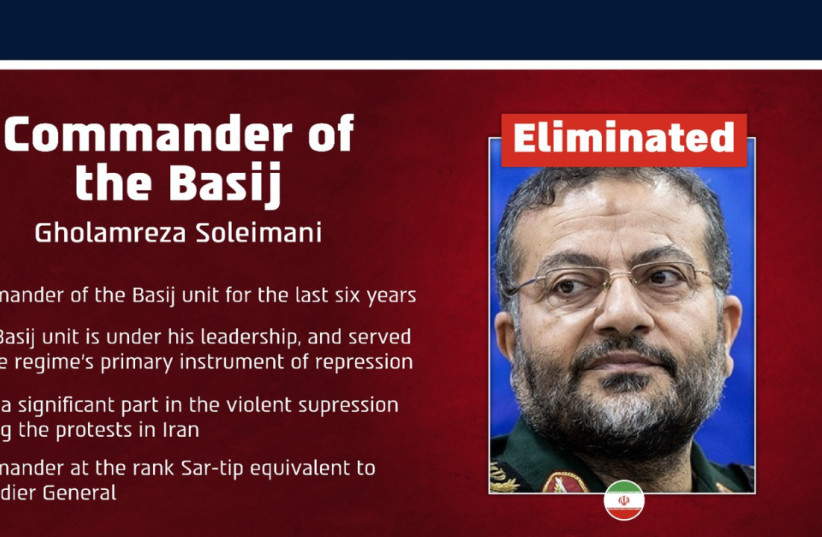
Basij commander Gholamreza Soleimani and deputy also killed in IDF strikes, officials say 'majority of the Basij leadership was eliminated overnight' • Netanyahu: Larijani was 'boss' of regime
 |
Iran's Supreme National Security Council Secretary Ali Larijani was killed in a targeted Israeli airstrike in Iran overnight, the IDF and Defense Minister Israel Katz confirmed on Tuesday afternoon.
Israeli confirmation of the assassination came after three separate sources confirmed to The Jerusalem Post he was targeted in what is the single most momentous targeted killing following the death of former supreme leader Ali Khamenei.
The military referred to Larijani as "the de facto leader of the Iranian terror regime."
Basij commander killed along with 'majority of leadership'
The IDF also confirmed it had assassinated the head of the Islamic Revolutionary Guard Corps' Basij paramilitary militia, Gholamreza Soleimani, and his deputy, Seyyed Karishi. The two were killed in a makeshift tent area, which had been set up to make it harder to follow them as opposed to in a known headquarters.
An Israeli official also confirmed to The Jerusalem Post that the majority of the Basij leadership was eliminated overnight in the Israeli airstrike.
The military also announced that it killed the IRGC's Aerospace Force chief.
Larijani was due to give public address in Iran on Tuesday
Iranian authorities stated that Larijani was due to give a public address on Tuesday, but two IDF sources expressed skepticism about his making a statement and expressed stronger optimism that the strike succeeded in killing him, before his death was announced.
After Larijani's death was confirmed, the Mossad Farsi account posted on X/Twitter, saying "In the end, people without mercy will die."
آدم های بی رحم بالاخره میمیرند
— Mossad Farsi (@MossadSpokesman) March 17, 2026
The Prime Minister's Office released an image later on Tuesday, which it said captured the moment in which Prime Minister Benjamin Netanyahu issued the order for the targeted assassinations.

Netanyahu also released a statement via video following confirmation of Larijani's death, calling him the "boss" of the regime, whom he called a "group of gangsters."
"We're undermining the regime, in the hope of giving the Iranian nation the opportunity to get rid of it," he said. "It won't happen all at once, it won't happen easily, but if we commit to it, we'll be able to give them the chance to take their fates into their own hands."
Larijani was 'de-facto leader' of Iran after Khamenei's killing
Some have viewed Larijani as the man running the Iranian regime since Ayatollah Ali Khamenei was assassinated by the IDF, along with Iran's military chief, IRGC chief, defense minister, and around 40 other top officials on February 28.
Larijani has been the Islamic regime's most public voice, responding directly to threats and comments by US President Donald Trump and others.
Whereas Mojtaba Khamenei has been technically appointed the next supreme leader, IDF and American intelligence have said he is badly wounded, and given a total lack of public appearances, doubts have been expressed about whether he is actually running the country.
Further, Larijani was promoted to run day-to-day operations for the country and all negotiations with the West over the conflict in the weeks before the war started.
Larijani, on March 1, announced that he would be heading an interim committee for running the country, given Khamenei's death. However, just because Larijani issued such a statement does not mean that he is for sure calling the shots.
The Iranian leader has had ups and downs with Khamenei, having been an IRGC commander, speaker of parliament, and a national security council chief, but then was disqualified from running for Iranian president to pave the way for Ebrahim Raisi's election in 2021, and was out of favor for a time.
However, in recent months, Larijani made a comeback as one of the older and still living top advisers to Khamenei, following so many top officials being killed in June 2025, and became Khamenei's number two, running the country's day-to-day security affairs and nuclear negotiations with the US.
If Larijani has been the number one official in Iran these last two weeks, and even if he is only one of the top few, killing or wounding him could significantly impact the overall strategic picture.
Besides Mojtaba Khamenei and Larijani, another figure who could be running much of the regime behind the scenes is Ahmad Vahidi, who was the IRGC deputy chief on the eve of the war.
Vahidi was announced on March 1 by the IRGC as its new leader.
Given the IRGC's centrality to running the regime's security forces, Vahidi being its new leader could position him as the current reigning authority for the regime.
This would be ironic because Vahidi has not been a known name or in the Iranian security forces' top ten until very recently.
He only became the IRGC deputy chief around two months ago, in December 2025.
Most of Iran's top leadership was killed in June 2025, and most of its current top leaders were also in some sense newer to their posts.
Vahidi was even below them, having been the Interior Minister from 2021 to 2024.
However, he had also been defense minister from 2009-2013, and served in other relatively high posts and has been an IRGC commander since the late 1980s.
President Masoud Pezeshkian has also made public statements relating to the Islamic regime's goals and priorities, but is viewed as too weak in his influence with the IRGC to be in overall control at this moment.
Yonah Jeremy Bob, Amichai Stein
Source: https://www.jpost.com/israel-news/defense-news/article-890225

No comments:
Post a Comment