Sunday, June 7, 2026

No Trust, No Illusions, No Nuclear Iran - Ahmed Charai


by Ahmed Charai

By generating several emergencies at once, Tehran hopes to divide America from its allies and distract from its nuclear ambitions. Washington must not allow that strategy to succeed.


  • Iran remains what it has long been: a state controlled by a narrow ruling clique that preserves its power through repression, intimidation, corruption, and support for armed groups.

  • Tehran's rulers operate according to the logic of a mafia state: Protecting the ruling network, intimidating opponents, threatening neighbors, exploiting disorder, and using negotiations to gain time or strategic advantage.

  • By generating several emergencies at once, Tehran hopes to divide America from its allies and distract from its nuclear ambitions.

  • Washington must not allow that strategy to succeed.

  • Restrictions cannot disappear through convenient expiration dates. Sanctions relief must be gradual, conditional, and reversible. There can be no secret facilities, delayed inspections, or endless arguments over obvious violations.

  • Enforcement is the agreement.

  • [Trump] prefers an agreement to another prolonged war, but he also understands that an agreement reached through weakness can produce an even greater conflict.

  • International law without enforcement is an appeal. International law backed by power is order.

  • American leadership is essential. Iran benefits whenever Washington's partners doubt American resolve or respond separately. The answer must be unity, credible deterrence, and a refusal to accept regional blackmail.

  • The Iranian people are not America's enemy.

  • Trust [for Iran's leaders] is unnecessary. Verification, deterrence, and the credible power to punish violations are indispensable.

Iran remains what it has long been: a state controlled by a narrow ruling clique that preserves its power through repression, intimidation, corruption, and support for armed groups. Pictured: A funeral procession featuring banners memorializing senior officers from the Islamic Revolutionary Guard Corps who were killed in Israeli strikes, in Tehran's Enqelab Square on June 28, 2025. (Photo by Majid Saeedi/Getty Images)

Iran remains what it has long been: a state controlled by a narrow ruling clique that preserves its power through repression, intimidation, corruption, and support for armed groups.

My judgment of the regime has not changed.

Tehran's rulers operate according to the logic of a mafia state: Protecting the ruling network, intimidating opponents, threatening neighbors, exploiting disorder, and using negotiations to gain time or strategic advantage.

Nothing in Iran's conduct justifies trust, and no future agreement should be mistaken for evidence that the regime has changed.

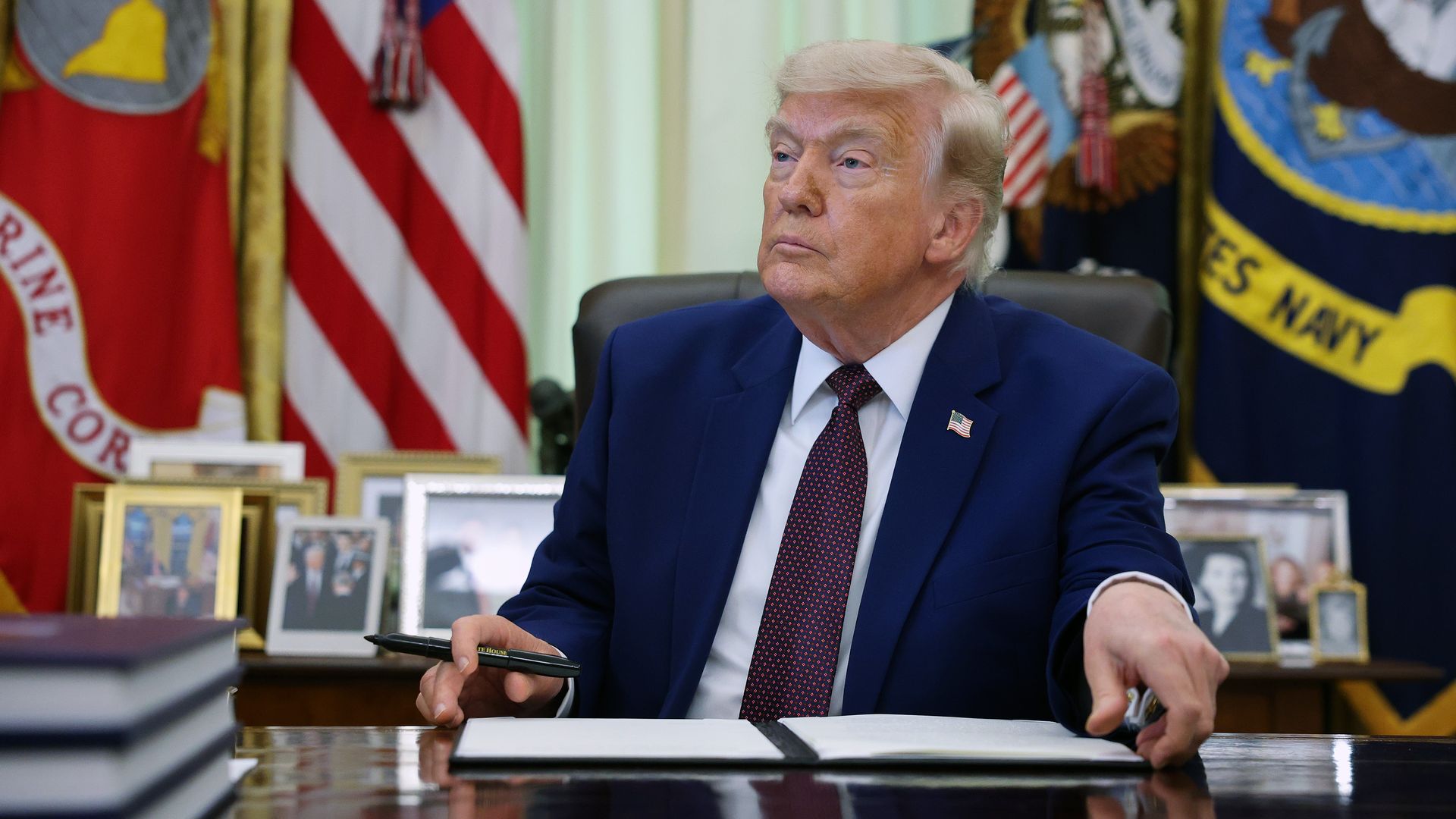
That is why President Donald Trump's approach matters.

Trump is not asking the world to trust Tehran or have us believe that its rulers are reliable partners. His method is direct: apply overwhelming pressure, establish an unmistakable red line, leave the door open to an agreement, and make clear that deception or refusal will bring serious consequences.

That red line is simple: Iran must never possess a nuclear weapon.

Iran's rulers have repeatedly tried to multiply crises and overwhelm diplomacy with competing demands.

They use armed proxies, threaten regional stability, challenge freedom of navigation, and create uncertainty across the Middle East.

By generating several emergencies at once, Tehran hopes to divide America from its allies and distract from its nuclear ambitions.

Washington must not allow that strategy to succeed.

Iran's terrorism, missile program, regional aggression, and abuse of its citizens all require sustained pressure. But none is more urgent than preventing the regime from acquiring a nuclear weapon.

Why?

A nuclear-armed Iran would transform intimidation into nuclear blackmail.

It would place Israel and America's Arab partners under permanent threat, accelerate a regional arms race, and give Tehran greater freedom to destabilize the region.

President Trump has consistently placed this danger at the center of his policy.

Any agreement must ensure that Iran can never build or possess a nuclear bomb. That is not faith in Tehran. It is an exercise of power against a regime that has earned distrust.

Negotiating with Tehran does not legitimize it.

Agreements are not rewards for good behavior or declarations of friendship.

The United States has often negotiated with dangerous adversaries because American interests required enforceable limits on their conduct. An agreement with Iran should be understood in exactly those terms: not as reconciliation, but as constraint.

Its credibility cannot depend on signatures, ceremonies, or promises from Iranian officials. It must depend on what Iran is required to do, how compliance is verified, and what consequences follow any violation.

Iran must disclose its nuclear materials and relevant facilities. Inspectors must receive immediate access. Restrictions cannot disappear through convenient expiration dates. Sanctions relief must be gradual, conditional, and reversible. There can be no secret facilities, delayed inspections, or endless arguments over obvious violations.

When dealing with an untrustworthy regime, enforcement is not a secondary provision. Enforcement is the agreement.

For too long, Western policymakers have treated pressure and diplomacy as opposites. They are not. Pressure gives diplomacy credibility. Deterrence gives negotiations purpose. Power creates the conditions in which an adversary may decide that compromise is preferable to confrontation.

Iran's rulers understand the difference between words and consequences. They have learned to ignore condemnations, exploit divisions among democratic nations, and prolong diplomacy while advancing their objectives.

Trump's method seeks to reverse that calculation. He prefers an agreement to another prolonged war, but he also understands that an agreement reached through weakness can produce an even greater conflict.

Iran must therefore face a clear choice: permanently abandon every path toward a nuclear weapon or confront the full economic, diplomatic, and military consequences of refusing.

That is not warmongering. It is realism.

International law without enforcement is an appeal. International law backed by power is order.

Keeping the nuclear issue at the center does not mean ignoring Iran's broader conduct. The United States must strengthen cooperation with Israel and its Arab partners, reinforce regional defenses, protect maritime commerce, and confront Iran's networks.

Tehran must not be allowed to attack through proxies and then deny responsibility, or use their violence as leverage.

American leadership is essential. Iran benefits whenever Washington's partners doubt American resolve or respond separately. The answer must be unity, credible deterrence, and a refusal to accept regional blackmail.

The Iranian people are not America's enemy.

They have paid a terrible price for a system that chooses repression and regional expansion over prosperity.

President Trump is right to pursue an agreement that permanently prevents Iran from obtaining a nuclear weapon. Such an agreement would not erase the regime's crimes, transform Tehran into a trusted partner, or eliminate the need for pressure against its regional activities.

But it could achieve the most urgent strategic objective: ensuring that Iran's ruling clique never possesses the weapon capable of turning aggression into nuclear blackmail.

Any agreement must therefore begin with the nuclear issue and end with enforceable guarantees that Iran will never acquire the bomb.

Trust is unnecessary. Verification, deterrence, and the credible power to punish violations are indispensable.

This editorial originally appeared in Newsmax 


Ahmed Charai 
is the Chairman and CEO of World Herald Tribune, Inc., and the publisher of the Jerusalem Strategic Tribune, TV Abraham, and Radio Abraham. He serves on the boards of several prominent institutions, including the Atlantic Council, the Center for the National Interest, the Foreign Policy Research Institute, and the International Crisis Group. He is also an International Councilor and a member of the Advisory Board at the Center for Strategic and International Studies.

Source: https://www.gatestoneinstitute.org/22586/no-trust-no-illusions-no-nuclear-iran

Follow Middle East and Terrorism on Twitter

A Strange War and its Bizarre Coverage - Amir Taheri


by Amir Taheri

Paris walls are plastered with posters shrieking "Trump, Netanyahu! Stop the War!" as if Iran was not involved except as a victim.


  • Because President Trump and Israeli Prime Minister Benjamin Netanyahu do not enjoy widespread popularity across the globe, MSM covers the war with a clear bias in favor of Iran.

  • Paris walls are plastered with posters shrieking "Trump, Netanyahu! Stop the War!" as if Iran was not involved except as a victim.

  • I also know no other country where the ruling elite is so different, in a negative way, than the mass of people it dominates.

  • What the MSM choose to ignore is the war within this war, one that the regime is waging against Iranian people.

  • To shed Lachrimae Amoris (lover's tears) for such a regime and depict it as an innocent victim because of partisan prejudices is a betrayal of both the Iranian people and the tragedy of this war. More importantly, it is a betrayal of the first victim of war: truth.

Because President Trump and Israeli Prime Minister Benjamin Netanyahu do not enjoy widespread popularity across the globe, the mainstream media cover the war with a clear bias in favor of Iran. Pictured: AFP photojournalist Atta Kenare photographs a regime-organized protest against the US and Israel in Tehran on April 27, 2026. (Photo by AFP via Getty Images)

In decades of journalism, part of it as a reporter covering a dozen or so wars in the Indian subcontinent, Indochina, the Middle East, Africa and Europe, I have never been as puzzled by media coverage of a conflict as I am today with how the Iran-US-Israel war is depicted in much of the mainstream media.

The first curious feature of this war is the absence of clearly identifiable battlefronts.

This is partly because it is a war almost exclusively waged through the skies. Even the war in Ukraine has some battlefields on the ground. In Lebanon, which is an offshoot of the current war, the Israeli army and Hezbollah fighters seldom come face to face.

Then there is the bizarre situation in which we see Iran sending more missiles and drones against its neighbors across the pond than against Israeli and American targets. For the past three weeks, Iran has made no attacks on Israel, focusing on targeting Gulf Cooperation Council (GCC) nations. And that is not to mention Iran's attacks on ringside spectators such as Jordan, Azerbaijan, Turkey and even Cyprus.

Another peculiar feature of this war is the targeting of civilian and/or dual-use infrastructure rather than purely military ones.

Iranian drones hit hotels in Dubai with the excuse that they may be hosting some US troops. The civilian terminal in Kuwait Airport was hit with the excuse that US military personnel on leave may pass through it.

Israel razes to the ground Beirut apartment blocks that housed hundreds of families, on suspicion that a single Hezbollah operative may be hiding there.

Then there is the fact that civilians account for the overwhelming majority of victims in Iran, Israel and the GCC countries.

Another interesting feature is the absence of non-partisan journalists covering this war.

In Iran, even local reporters are not allowed to report anything outside official handouts.

On the US side, President Donald Trump's Truth Social account sets the agenda as a 24/7 news agency.

In Vietnam, there were times when the White House would hear the news of the war first from reporters on the ground.

In the two US wars against Iraq, lone-ranger reporters from more than 20 countries were present alongside dozens more embedded with US and British fighting units.

In Ukraine, both Kiev and Moscow arrange occasional tours for foreign reporters, at times allowing some leeway to depict a credible picture of the war.

But the most curious feature of this war rarely seen in most previous conflicts is its depiction by the mainstream media (MSM) through a prism of ideological and/or partisan prejudices.

Because President Trump and Israeli Prime Minister Benjamin Netanyahu do not enjoy widespread popularity across the globe, the MSM cover the war with a clear bias in favor of Iran.

The subtext is a desire to see Trump and Netanyahu humiliated and, if possible, chased out of office. The MSM don't necessarily want Iran to emerge as winner but clearly hopes that Trump and Netanyahu get a bloody nose.

To achieve this goal, some depict Iran as an innocent though a bit naughty country given to boasting and bragging but certainly not deserving a thrashing.

Others depict Iran is a re-emerging "empire" to form a triangle with Russia and China as the other two angles of re-emerging empires to challenge the fading American empire.

Paris walls are plastered with posters shrieking "Trump, Netanyahu! Stop the War!" as if Iran was not involved except as a victim.

Moreover, European and American MSM try to portray Iran in rosy shades that make many Iranians uneasy to say the least. We read that Iran is number two in the world in terms of people with the highest IQ.

I don't know whether that is true or not. But I know that the top echelon of those ruling Iran since 1979 were certainly not luminaries. I also know no other country where the ruling elite is so different, in a negative way, than the mass of people it dominates.

In any case, a high IQ is no guarantee of having common sense, compassion, wisdom and humanity, without which no city can be run in a decent manner. It is reported that Josef Mengele had one of the highest IQs in Hitler's Reich.

The MSM beat the drums about Iran having more engineers per head of population than the US, Britain and France.

This may be true, but no one asks why.

The reason is that in Iran many academic disciplines are in dicey positions. Few students are keen on going for humanities and/or literature where many philosophers, sociologists, writers and poets from more than 50 countries are blacklisted.

Even if you wish to study economics, the key texts offered are from the late Ayatollah Ali Khamenei on "resistance economy", a set of speeches by "Imam" Ruhollah Khomeini and a pamphlet by the late Iraqi cleric Mohammad-Baqer al-Sadr called "Our Economics" plus old Soviet pamphlets against "capitalism" and "neoliberal economy."

To many young Iranians, the best option is to steer clear of such subjects and go for medicine or engineering, in which you can get on without pseudo-theological mumbo-jumbo.

Engineering as a career is also attractive because the regime has spent huge resources on developing the military industries launched in Iran in the 1970s while expanding the nuclear project that started in 1959.

The Khomeinist leadership also needed thousands of engineers to build scores of dams and canals to boost agricultural production and make Iran self-sufficient in food. This was done by drying up many rivers, lakes and wetlands while damaging the traditional qanat system dating back to 3,000 years ago. Engineers managed to boost farm production but led Iran to the edge of desertification.

All ideology-based systems of government favor subjects such as engineering. Hitler's Germany had more engineers than the Western democracies combined. They built beautiful motorways, cars and tanks and developed the first missile systems. The first man in space was sent by the Soviet Union. Today, the whole world admires what Chinese engineers have achieved.

What the MSM choose to ignore is the war within this war, one that the regime is waging against the Iranian people.

Since the war began last February, hundreds of Iranians have been executed on spurious charges while over 2,000 have been arrested across the country.

To shed Lachrimae Amoris (lover's tears) for such a regime and depict it as an innocent victim because of partisan prejudices is a betrayal of both the Iranian people and the tragedy of this war. More importantly, it is a betrayal of the first victim of war: truth.

Gatestone Institute would like to thank the author for his kind permission to reprint this article in slightly different form from Asharq Al-Awsat. 


Amir Taheri was the executive editor-in-chief of the daily Kayhan in Iran from 1972 to 1979. He has worked at or written for innumerable publications, published eleven books, and has been a columnist for Asharq Al-Awsat since 1987. He graciously serves as Chairman of Gatestone Europe.

Source: https://www.gatestoneinstitute.org/22585/strange-war-bizarre-coverage

Follow Middle East and Terrorism on Twitter

New Iraqi leader promises security deals for U.S. oil companies ahead of Trump meeting - John Solomon


by John Solomon

Iraqi civilian authorities say they would compensate international and U.S companies for losses resulting from attacks on their facilities if they originated within Iraq. 


Iraqi Prime Minister Ali al-Zaidi has told Kurdistan Regional Government (KRG) officials and international oil company executives that Baghdad is prepared to provide security guarantees to facilitate the rapid resumption of oil exports from the Kurdistan Region.

Zaidi is expected to visit Washington next month for a White House meeting with President Donald Trump, who supported his appointment as prime minister.

Ahead of the visit, Zaidi is seeking to demonstrate progress on key US priorities, including curbing Iran-backed militias and resolving longstanding financial and energy disputes between the federal government, the KRG, and U.S. energy firms operating in the Kurdistan Region of Iraq.

Guarantees would address internal threats

According to sources with knowledge of a meeting Wednesday in Baghdad, speaking only on condition of anonymity, the proposed security guarantees would address internal threats, specifically protection from Iran-aligned Iraqi militias that have targeted US and international energy facilities, Kurdish civilians and infrastructure, and U.S. partners in the Gulf in support of Iran.

The conflict with Iran, which began Feb. 28, has disrupted oil shipments through the Strait of Hormuz and sharply reduced Iraqi oil revenues. The resulting financial pressure has increased the urgency of restoring production and exports from the Kurdistan Region through the Iraq-Turkey pipeline.

A follow-up letter Thursday from the KRG Ministry of Natural Resources (MNR), obtained by Just the News, reaffirmed Zaidi’s commitment to providing “clear assurances regarding the security of oil and gas operations in the Kurdistan Region.” 

The Kurdish ministry urged international oil companies, including American firms, to resume production and exports in line with the prime minister’s request.

The letter also stated Iraq would compensate international and U.S. companies for losses resulting from attacks on their facilities if those attacks originated within Iraq. It further referenced Zaidi’s directive to the Ministry of Oil to continue negotiations with the KRG and international energy firms to resolve “all outstanding issues.”

Those issues include nearly $100 million owed by Baghdad to oil firms for production and exports conducted this year through the pipeline under a July 2025 agreement brokered by the Trump administration. The companies are also owed an estimated $1.5 billion in arrears dating to 2022 and 2023.

According to attendees at the June 3 meeting, who spoke to Just the News on condition of anonymity, these financial disputes were not discussed in detail. The meeting focused primarily on security matters, with economic issues deferred to future negotiations.

But attendees said they hoped Zaidi would resolve the back pay issues before he met with Trump to deliver concrete progress.

Zaidi’s willingness to provide security commitments to U.S. and international energy companies will be welcomed in both Erbil, the capital of Iraq’s Kurdistan Region, and Washington.

In March, KRG Prime Minister Masrour Barzani agreed to Baghdad’s request, backed by the Trump administration, to accept oil produced in Iraq into the KRG pipeline on the condition that the federal government guarantee protection from “outlaw groups and forces that continuously attack the Kurdistan Region with drones.”

Speaking Thursday, Barzani, who had requested that Zaidi meet with the oil companies, described the prime minister's recent statements as “encouraging” and said the new Iraqi government appeared committed to “turning a new page” by resolving longstanding disputes.

Industry sources close to the Trump administration told Just the News that while recent security-related steps are viewed positively, there is an expectation that Zaidi will address other outstanding commercial and energy disputes before meeting Trump.

Zaidi, by personally resolving the debts owed American companies and honoring the terms of the agreements signed between the KRG and the firms would open a new chapter in U.S.-Iraq economic ties and boost investor confidence, signaling a change from the previous Iraqi government.

The conflict with Iran has elevated Iraq’s importance in U.S.-Middle East policy. The appointment of Tom Barrack, one of Trump’s closest foreign policy advisers, as special envoy to Iraq underscores the administration’s focus on the country. Barrack, who also serves as US ambassador to Turkey and envoy to Syria, has cultivated relationships with Iraq’s key political actors, including Zaidi, as well as regional leaders.

Since taking office on May 16, Zaidi has moved quickly to bring Iran-backed militias, known collectively as the Popular Mobilization Forces (PMF), under greater state control before his Washington visit. This has been a central demand of the Trump administration, which had grown frustrated with what it viewed as delays by the previous Iraqi government.

On Friday, Iraq’s PMF chief Faleh al-Fayyadh said that a new committee had begun work toward “complete disengagement” of the militias from any other Iraqi political entities.

Two of the most influential pro-Iran factions remain holdouts

To date, the Saraya al-Salam militia affiliated with populist Shiite cleric Muqtada al-Sadr, along with Asaib Ahl al-Haq and Kataib al-Imam Ali, have agreed to the initiative.

Kataib Hezbollah and Harakat Hezbollah al-Nujaba, two of the most influential pro-Iran factions, remain holdouts.

Barrack has publicly praised Zaidi’s efforts as a “significant step forward, which represents the nascent foundation for a renewed Iraqi self-governance,” to date while noting that they are “only the beginning.”

Zaidi and Barrack have also gained the support of Supreme Judicial Council President Faiq Zidan, who last week called on the PMF’s to “join their brothers and lay down their arms."

His influence within the Coordination Framework—the coalition of Shiite political leaders that played a key role in Zaidi’s appointment—could prove critical in advancing the prime minister’s agenda.


John Solomon

Source: https://justthenews.com/politics-policy/all-things-trump/sunnew-iraqi-leader-seeks-security-deals-back-pay-us-oil-companies

Follow Middle East and Terrorism on Twitter

Is Saving Europe Still Possible? - Guy Millière


by Guy Millière

After every attack, the British government, along with other political leaders, take great care to condemn antisemitism. They also take great care each time to avoid saying who the perpetrators are. Their condemnations therefore amount to empty words. If you do not identify the source of the Jew-hate, how can you combat it?


  • The massacre of thousands of Israelis by the terrorist group Hamas on October 7, 2023 triggered an explosion of attacks on Jews in the United Kingdom.

  • "London has become a no-go zone for Jews...." — UK Commissioner for Countering Extremism Robin Simcox, BBC, March 8, 2024.

  • After every attack, the British government, along with other political leaders, take great care to condemn antisemitism. They also take great care each time to avoid saying who the perpetrators are. Their condemnations therefore amount to empty words. If you do not identify the source of the Jew-hate, how can you combat it?

  • In July 2025, on behalf of the United Kingdom, Starmer agreed to the publication of a communiqué — also signed by 28 other countries — falsely accusing Israel of depriving Palestinians of "human dignity" and perpetrating the "inhumane killing of civilians." The communiqué was – no surprise -- exploited by all of Israel's enemies, particularly those also falsely accusing Israel of genocide.

  • Starmer was just warming up. As if that were not odious enough, Starmer went on, in the name of the UK, officially to recognize a non-existent "State of Palestine."

  • Starmer recognized this fictitious "State of Palestine" even as Hamas still held power and hostages in Gaza. His weakness cannot be overstated.

  • He was -- along with the current leaders of France, Belgium, Ireland, Spain, Norway and Sweden -- just among the too many countries also recognizing an imaginary Palestinian State.

  • "The Palestinian people does not exist. The creation of a Palestinian state is only a means for continuing our struggle against the state of Israel for our Arab unity. In reality, today there is no difference between Jordanians, Palestinians, Syrians and Lebanese. Only for political and tactical reasons do we speak today about the existence of a Palestinian people, since Arab national interests demand that we posit the existence of a distinct Palestinian people to oppose Zionism. For tactical reasons, Jordan, which is a sovereign state with defined borders, cannot raise claims to Haifa and Jaffa, while as a Palestinian, I can undoubtedly demand Haifa, Jaffa, Beer-Sheva and Jerusalem. However, the moment we reclaim our right to all of Palestine, we will not wait even a minute to unite Palestine and Jordan." — Zoheir Mohsen, senior official of Palestine Liberation Organization, Trouw, March 31, 1977.

  • Meanwhile, Muslims continue to enter the UK, both legally and illegally. As their population continues to grow, they have been integrating less and less. Many appear to have come not only for employment opportunities and welfare benefits, but also to transform Great Britain into a country indistinguishable from the ones they left.

  • Some people might call that imperialism. The Portuguese and Spanish displaced the cultures of South America; England tried to bring its customs to its colonies, and so on. At the time, the countries overtaken did not have the means to stop these invasions. Today's Britons are not Aztecs.

  • Hatred of Israel and Jews, doctrinally imposed by the Qur'an and the hadith, is deeply entrenched within Muslim communities in Western Europe, and accommodated by much of non-Muslim society there.

Hatred of Israel and Jews, doctrinally imposed by the Qur'an and the hadith, is deeply entrenched within Muslim communities in Western Europe, and accommodated by much of non-Muslim society there. Almost all antisemitic acts in Britain are carried out by radicalized Muslims, yet it has become a problem to state that openly. Britons who question Muslim antisemitism are accused of "stirring up racial or religious hatred." Pictured: A demonstration supporting the Iranian regime in its war against Israel and the US, in central London on March 15, 2026. (Photo by Justin Tallis/AFP via Getty Images)

London. Sunday, May 10. A protest against rising anti-Semitism is organized in front of the prime minister's residence. About 20,000 people are present, mostly Jews. Secretary of State for Work and Pensions Pat McFadden, who addressed them, was jeered and booed. "I feel your pain," he told the crowd. The reply was, "Action, no more words."

When British Prime Minister Keir Starmer, a few days before the protest, visited Golders Green, a heavily Jewish area of London where two Jews had been stabbed on April 29, he was greeted with chants of "Keir Starmer, Jew Harmer."

Jews in the United Kingdom are no longer safe. The year 2025 saw 3,700 anti-Semitic incidents recorded — approximately ten a day. By the end of 2026, it looks as if the figures will be at least as high. In 2023, the figures were even higher. The massacre of thousands of Israelis by the terrorist group Hamas on October 7, 2023 triggered an explosion of attacks on Jews in the United Kingdom.

Violent attacks against Jews and Jewish institutions in London are on the rise. On March 23, an arson attack destroyed four ambulances belonging to a Jewish volunteer emergency medical service, Hatzola Northwest. On April 18, the Kenton United Synagogue in northwest London was firebombed. On April 29, there were the stabbings in Golders Green.

Jewish children are harassed on their way to school. It is dangerous to display any Jewishness. Men hide their skullcaps and women conceal the Star of David pendants they wear.

"London has become a no-go zone for Jews," UK Commissioner for Countering Extremism Robin Simcox said on March 8.

What is happening in London is happening throughout the UK, wherever Jewish communities exist. On October 2, 2025 — during the Yom Kippur holiday — a 35-year-old Syrian, Jihad Al-Shamie, plowed his car into a gathering of Jews who had come to pray at a synagogue in Manchester, then began slashing and stabbing them, and finally tried to force his way into the synagogue. He left two dead and three wounded.

Almost all antisemitic acts in Britain are carried out by radicalized Muslims, yet it has become a problem to state that openly. Britons who question Muslim antisemitism are accused of "stirring up racial or religious hatred."

After every attack, the British government, along with other political leaders, take great care to condemn antisemitism. They also take great care each time to avoid saying who the perpetrators are. Their condemnations therefore amount to empty words. If you do not identify the source of the Jew-hate, how can you combat it?

Hatred of Jews, of course, goes hand in hand with hatred of Israel. It is a sentiment shared by a large segment of the UK population.

Starmer, who, a few years ago, claimed to have purged antisemites and anti-Israel elements from the Labour Party – and for five minutes appeared to be a friend of Israel — now sharply criticizes country as well as its democratically elected government.

In July 2025, on behalf of the United Kingdom, Starmer agreed to the publication of a communiqué — also signed by 28 other countries — falsely accusing Israel of depriving Palestinians of "human dignity" and perpetrating the "inhumane killing of civilians." The communiqué was – no surprise -- exploited by all of Israel's enemies, particularly those also falsely accusing Israel of genocide.

Starmer was just warming up. As if that were not odious enough, Starmer went on, in the name of the UK, officially to recognize a non-existent "State of Palestine."

In the words of Zoheir Mohsen, wo was a senior Palestine Liberation Organization official from 1971-1979:

"The Palestinian people does not exist. The creation of a Palestinian state is only a means for continuing our struggle against the state of Israel for our Arab unity. In reality, today there is no difference between Jordanians, Palestinians, Syrians and Lebanese. Only for political and tactical reasons do we speak today about the existence of a Palestinian people, since Arab national interests demand that we posit the existence of a distinct Palestinian people to oppose Zionism.

"For tactical reasons, Jordan, which is a sovereign state with defined borders, cannot raise claims to Haifa and Jaffa, while as a Palestinian, I can undoubtedly demand Haifa, Jaffa, Beer-Sheva and Jerusalem. However, the moment we reclaim our right to all of Palestine, we will not wait even a minute to unite Palestine and Jordan."

Starmer recognized this fictitious "State of Palestine" even as Hamas still held power and hostages in Gaza. His weakness cannot be overstated.

He was -- along with the current leaders of France, Belgium, Ireland, Spain, Norway and Sweden -- just among the too many countries also recognizing an imaginary Palestinian State.

Stamer was also quick to declare on April 1, "This is not our war" -- as if Iran's pursuit of nuclear weapons and the threats through terrorism that the Iranian regime poses to the West are not matters of concern to the UK. Starmer must surely be aware that at least one Iranian group — Harakat Ashab al-Yamin al-Islamia (HAYI) — is directly responsible for numerous antisemitic attacks in the country. Starmer has never publicly condemned HAYI or any similar group.

Starmer further sought to deny the U.S. Air Force access to the joint US-UK airbase on Diego Garcia and RAF Fairford in Gloucestershire. His consent included the pitiful stipulation that the bases should be used for "defensive" missions only.

Several countries in Europe -- Spain, Italy, France, and Austria -- also barred U.S. Air Force aircraft from using their bases and airspace.

Many in the UK now see that unless a course correction is undertaken -- and fast --, the country is facing an extremely bleak future. British civilization itself appears positioned to perish.

On March 10, 2025, a protest march was organized by political activist Tommy Robinson -- one of the very few people in England consistently to speak out on behalf of the tens of thousands of British children who have been raped and trafficked by gangs of "Asian" migrants (a euphemism for Pakistani as well as others).

On May 16, 2026, Robinson organized a "Unite the Kingdom" march, which drew another massive crowd -- tens of thousands. Starmer claimed that Robinson and those who work with him peddle "hatred and division."

The day before the march, Starmer announced that "We've already blocked visas for far-right agitators who want to come here to spew their extremist views," -- but not, of course, for potential rapists.

The local elections on May 7 -- described in several British newspapers as an unofficial referendum on Starmer -- were a disaster for Starmer's Labour Party -- and a huge victory for Reform UK, the anti-immigration party created in 2018 as the "Brexit Party" by Nigel Farage. Labour lost more than 1,100 of the 2,300 council seats it had held. It also lost control of 35 councils it had held for decades. Reform UK won more than 1,400 council seats and gained control of 14 councils.

After such a rout, it was expected that Starmer would resign. So far, he has chosen to remain in his post. Four members of the British government, however, did resign; more than 80 Labour MPs urged him to quit.

The next elections for parliament are scheduled for 2029. If the government falls before then, elections would be held sooner. If they were held today, Reform UK would likely win, accompanied by a recovery of the endlessly mismanaged country (such as here, here and here).

Meanwhile, Muslims continue to enter the UK, both legally and illegally. As their population continues to grow, they have been integrating less and less. Many appear to have come not only for employment opportunities and welfare benefits, but also to transform Great Britain into a country indistinguishable from the ones they left.

Some people might call that imperialism. The Portuguese and Spanish displaced the cultures of South America; England tried to bring its customs to its colonies, and so on. At the time, the countries overtaken did not have the means to stop these invasions. Today's Britons are not Aztecs.

There are now officially almost four million Muslims in the UK (6% of the population). In 2001, there were only 1.59 million Muslims in the country (2.7% of the total population).

A Pew Research Center study estimated that under just a "medium" migration scenario, the Muslim population in the UK by 2050 could be around 16.7%–17.2%, approximately 13–13.5 million people.

Jews continue to leave Britain. According to the Institute for Jewish Policy Research, there are 313,000 Jews left in the UK (0.4% of the population), and the number falls every year.

The problem, in addition to the sharp shift in demographics, is also one of determination. In 404 BCE, it took only 30 men working on behalf of Sparta to bring down Athens, one of the great foundational civilizations of Western culture.

Even among non-radicalized Muslims, there is widespread acceptance of Sharia practices, such as the continual cover-up of sexual abuse crimes. There has been a consistently permissive attitude toward rape gangs by the police, the government and the judiciary -- all of whom are apparently terrified of being labeled racist. There has also been an increasing suppression of free speech -- the cousin of blasphemy laws -- as well as the rejection of Judeo-Christian traditions, such as Christmas, and a subversion of common law (such as finding that terrorists just have "mental health" problems. All this has been accompanied by a rise in hatred of Jews, of Israel, and of the culture of the West.

Meanwhile, the British economy continues to fall. The official unemployment rate is low, 4.9%. Mostly people seem to be exiting the labor market and becoming economically inactive, apparently content to live off welfare benefits and "free stuff." Almost 14 million British citizens (21% of the population) live in poverty, have an income below 60% of the national median, and struggle to afford food, housing and essential services.

As in the UK, the economies of most Western European countries are in decline. In 2000, the member states of the European Union collectively accounted for 20% of global GDP. By 2024, they represented only 15.2 %.

The birthrate among Muslim women everywhere in Western Europe is far higher than the birth rate among non-Muslim women.

In France, the birthrate is 1.56. In Germany, 1.35. In Italy, 1.14, and in Spain, 1.10.

The birthrate in the United Kingdom has also been falling. It is now 1.41 children per woman, well below the replacement level of 2.1. The birthrate among Muslim women is far higher. In the UK, even if polygamy is not allowed, a Muslim man's extra wives receive extra welfare benefits. If the polygamous marriage took place overseas, you see, that makes it all right. There are reports that sometimes each of the four wives has her own house -- presumably at the British taxpayers' expense.

What is happening in the United Kingdom is also happening throughout Western Europe -- and has established a foothold in the United States.

In France, antisemitic acts may not be as frequent as in the United Kingdom, yet they remain common: 1,320 incidents recorded in 2025—more than 3.5 each day. Jews in France make up slightly less than 1% of the population, yet, year after year, they are the victims of more than 50% of all anti-religious hate crimes.

In Belgium, the Jewish population is even smaller -- fewer than 30,000 -- but the number of antisemitic incidents nevertheless jumped from 57 in 2022 to 277 in 2024, a more than fourfold increase. A survey conducted in 2024 for the European Jewish Congress showed that many Belgians apparently do not even consider it antisemitic to scrawl graffiti on a synagogue, or to insult or threaten a Jew or person thought to be a "Zionist": 22% of respondents said they regarded such acts to be understandable, acceptable and legitimate.

In Germany, the Jews account for less than 0.2 percent of the total population, yet suffer a disproportionate number of anti-religious attacks – also on an upward trend: from 1,824 antisemitic attacks recorded in 2024 to 2,267 in 2025.

The same pattern can be seen across all of Western Europe. For years, virtually all antisemitic acts — as in the United Kingdom – have been perpetrated by radicalized Muslims. Again, most Western European politicians condemn "antisemitism" but without mentioning who the perpetrators are.

Hatred of Israel and Jews, doctrinally imposed by the Qur'an and the hadith, is deeply entrenched within Muslim communities in Western Europe, and accommodated by much of non-Muslim society there.

Every current Western European leader, just like Starmer, has stated — in varying terms —that the war in Iran is "not their war."

Lately in Western Europe, political parties with platforms like that of the right-of-center Reform UK are gaining ground. Several appear poised to win elections. They see -- and say aloud -- that in Europe, Western civilization could die. They are calling for national renewal.

The governments of some Central European countries -- Poland, Hungary, the Czech Republic, Slovakia -- have adopted a firm stance against immigration -- for which the European Union thoroughly excoriated them. Hungary experienced being occupied by the Ottoman Empire for nearly 200 years. Former Prime Minister Viktor Orbán -- who just lost an election -- did not want to see another Islamic occupation.

Central Europe still has one of the world's lowest Muslim populations (roughly between 0.1% and 1% of the total population). Jews living there face virtually no violent antisemitic attacks. Central Europe, however, is also seeing declining birthrates. In the Czech Republic, it fell to 1.28 children per woman. In Hungary, it now stands at 1.31; in Poland, the figure is 1.1.

Is saving Europe still possible? If the political parties that are seeking to preserve Western civilization prevail, probably yes -- but time is just about up.


Dr. Guy Millière, a professor at the University of Paris, is the author of 27 books on France and Europe.

Source: https://www.gatestoneinstitute.org/22577/saving-europe

Follow Middle East and Terrorism on Twitter

Record Gulf Coast exports push U.S. oil inventories lower - Allan Wallace


by Allan Wallace

Commercial crude oil stockpiles fell by 8 million barrels to a 22-year low of 434 million barrels in the week ended June 1, the U.S. Energy Department reported on Wednesday


(The Center Square) -

(The Center Square) - U.S. crude oil inventories, including commercial stockpiles and the nation's emergency reserves, fell by 16 million barrels last week to their lowest combined level in more than two decades, as strong demand for exports of American petroleum products continued in world markets.

Commercial crude oil stockpiles fell by 8 million barrels to a 22-year low of 434 million barrels in the week ended June 1, the U.S. Energy Department reported on Wednesday. At the same time, the U.S. Strategic Petroleum Reserve, stored primarily in four underground salt cavern systems in Texas and Louisiana, also fell by 8 million barrels in the week ended June 1, dropping to a 28-month low of 357 million barrels, the data showed.

Average U.S. gasoline prices have trended sharply lower in the last two weeks, dropping from $4.48 a gallon to $4.22 a gallon on Friday, providing some relief to drivers.

Although U.S. refineries produced a robust 9.4 million barrels per day of gasoline in the week ended June 1, only 215 million barrels of the motor fuel are currently held in commercial inventories, the lowest at this time of year since June 2014, energy department data shows.

In a bid to combat surging global energy prices, the Trump administration agreed in March to disburse 172 million barrels of oil from the nation’s reserve stockpile as part of a 400-million-barrel emergency release coordinated by the International Energy Agency across its 32 member nations.

In the United States, only about 50 million barrels of the planned 172 million barrels of crude oil have been released so far, noted Eric Smith, associate director of the Tulane Energy Institute.

Smith, formerly an operations officer at a private firm contracted to manage the Strategic Petroleum Reserve, told the Center Square that the remainder of the planned 172-million-barrel release will enter the region’s refining system in the weeks ahead.

"People sometimes forget the transport ships aren't just sitting at the dock waiting for someone to fill them up," said Smith. "It takes substantial time to contract vessels, secure clearances, and coordinate which specific crude grades to draw down."

International crude oil buyers, especially in Asia, are scrambling to replace supplies stranded in the Persian Gulf, and many have turned to U.S. producers, Energy Department data shows. In the seven days ended June 1, U.S. crude oil shipments jumped to 5.9 million barrels per day from 4.4 million barrels per day in the week prior.

U.S. crude oil exports reached an all-time high of 6.0 million barrels a day in the week ended May 15, according to U.S. Energy Information Administration data. In February 2026, before the outbreak of the conflict, U.S. crude oil exports averaged 4.16 million barrels per day.

Smith said draining the emergency reserves “doesn't solve the problem, it just delays the impact." The professor noted acute global shortages of premium refined products like kerosene and jet fuel. "Other countries are much more exposed to this Middle East downturn than the U.S. is, so they are aggressively pulling finished products out of our regional refineries."

To keep pace, U.S. refineries ran hot in the latest week, operating at 94.7% of capacity—well above the typical 90% to 92% seasonal average—as 16.9 million barrels of crude oil was processed.

Historically, summer driving demand peaks early to mid-August along with maximum tropical activity and increased heat stress on the machinery at refineries, heaping multiple vulnerabilities on energy supply chains. Smith noted, however, that the threat of storm-driven refining disasters is often misunderstood.

"Our regional refineries are incredibly robust installations that rarely suffer direct structural damage from hurricanes," Smith said, noting that utilities like Entergy have heavily hardened power grids. "The real vulnerability during an August storm isn't the physical plant; it's the surrounding infrastructure. If roads flood and power lines drop, refinery hands simply cannot get to the facility because they are stuck tending to their own homes, said Smith.

Several large refineries in Louisiana and Texas have delayed maintenance periods planned well in advance as they seek to profit while prices are high rather than take processing units offline for scheduled downtime.

PBF Chalmette in Louisiana and TotalEnergies Port Arthur in Texas, two of the Gulf Coast's largest gasoline producers, are now operating units past their scheduled service windows, according to news reports.

Smith said the Trump administration’s decision to waive Jones Act restrictions on energy cargoes was the silver lining for constrained U.S. energy markets. The temporary waivers have effectively added about 35 foreign-flagged vessels to the U.S. fleet, said Smith, with tankers primarily moving cargo from the Gulf Coast through the Panama Canal to California.

"Record U.S. exports are helping keep global markets well supplied right now," Phil Flynn, a senior energy analyst with the Price Futures Group, said in an interview on Fox Business on Thursday. Flynn noted that the heavy international draw on American supplies is leaving localized fuel markets everywhere more vulnerable to supply shocks. 


Allan Wallace

Source: https://justthenews.com/nation/states/center-square/record-gulf-coast-exports-push-us-oil-inventories-lower

Follow Middle East and Terrorism on Twitter

Deri: 'UTJ won't break up right-wing bloc' - Israel National News


by Israel National News

Aryeh Deri rejected the claim that the haredi parties had pushed for a sweeping exemption from military service for Haredim.


Aryeh Deri
Aryeh Deri                                                                                      Arie Leib Abrams/Flash90

Shas chairman Aryeh Deri last night ruled out the possibility that United Torah Judaism would leave the right-wing bloc and join a government with the left amid the crisis over the draft law.

“That will not happen," Deri stated in an interview on the program “A Conversation with Oded Harush" on Channel 14.

In his remarks, he expressed full identification with the anger within the Haredi public but emphasized that the struggle would continue within the current coalition:

“I say to those who study Torah - do not lose heart. You are the Sayeret Matkal of the Jewish people."

According to him, an absurd situation has been created in which the police, the Attorney General, and the Supreme Court are pursuing Torah students as criminals.

“Ben-Gurion and all governments throughout the generations understood that someone whose Torah study is his profession must have his status arranged and respected."

Deri rejected the claim that the Haredi parties sought a blanket exemption from enlistment:

“We have never advanced a law saying that someone who is haredi does not go to the army. We always said that only someone whose Torah study is his profession - only someone who studies - will continue studying."

Regarding haredim who are not studying, he noted that the effort is to ensure that someone who enters the army as a haredi person also leaves it as a haredi person, and he welcomed the military’s willingness to invest more in this issue than in the past.

When asked about his political identity, Deri did not hesitate: “Do I define myself as right-wing? Certainly."

He explained that although in the past Rabbi Ovadia Yosef supported peace processes based on considerations of saving lives (pikuach nefesh), his own view changed over the years.

“When I saw what happened here after the Labor Party collapsed and all the fragments of parties led by Lapid and others emerged - I understood that there are no longer values there. These are parties of ego, of people without ideological commitment." 


Israel National News

Source: https://www.israelnationalnews.com/news/428237

Follow Middle East and Terrorism on Twitter

‘Never, Ever’: Trump’s HHS becomes a protection powerhouse for America’s seniors - Amanda Head


by Amanda Head

In the age of smartphone cameras, viral videos and scams, victims of senior abuse and exploitation have splashed in public awareness.


The Department of Health and Human Services' (HHS) Elder Justice Coordinating Council (EJCC) has adopted a sweeping Federal Elder Justice Action Plan and is launching an aggressive “Never, Ever” awareness and prevention campaign, a powerful MAHA-aligned move to protect seniors’ dignity under Trump’s leadership.

“When federal agencies work together to streamline oversight and administrative processes, it strengthens protections for vulnerable seniors while improving accountability across the aging services continuum,” President and CEO of LeadingAge South Carolina, Kassie South, told Just The News.  

South, who has served decades as a senior health advocate, added, “Reducing burdens that hinder solutions enables providers and caregivers to focus less on paperwork and more on enhancing quality of life for residents. We appreciate the Administration’s commitment to pursuing reforms that support better outcomes and quality of life for older adults and their families.”

The "Never, Ever" initiative isn't just another awareness campaign during Elder Justice Awareness Month. It marks a decisive shift from policy to practice, uniting multiple federal agencies with states, local governments and community partners to combat growing problems in the senior sector: abuse, neglect, financial exploitation and scams that rob millions of seniors annually. 

The focus is zero tolerance for overlooking senior issues, emphasizing "never, ever" let it go unreported or accepting fragmented responses when unified action can deliver solutions. 

Under President Donald Trump, HHS has been tasked with implementing the Make America Healthy Again (MAHA) agenda across all applicable sectors, with this initiative serving as an extension of prevention-first leadership to America’s seniors.  

It also mirrors MAHA’s fight against chronic vulnerabilities, delivering quick wins, empowering communities, and ensuring that no senior is left behind in Trump’s vision of a healthier, stronger nation at every stage of life, including the golden years.

Practical implementation, ramped up enforcement

The program will rely on teamwork across 17+ federal agencies by creating shared strategies, training programs for police, prosecutors, and first responders, and rapid-response teams that help states and local Adult Protective Services investigate and intervene faster when abuse or neglect is suspected.

For public awareness, the “Never, Ever” campaign will run national public education efforts—like targeted ads, social media, community toolkits, and clear messaging—to make families and neighbors more alert, encourage reporting, and teach simple prevention steps, so people stop looking the other way. 

It ramps up enforcement by forging tighter federal-state partnerships to investigate and prosecute financial scams, nursing home neglect, and exploitation cases more aggressively. Finally, it drives immediate “quick wins” by spotting high-impact priorities (such as cutting underreporting), delivering better victim support services, and giving states flexible tools to test local solutions that actually deliver results on the ground. 

Neglect and abuse against seniors 

Neglect and abuse among seniors represent a growing crisis as America’s older population expands. Approximately 1 in 10 older adults experience some form of elder abuse each year, with estimates reaching as high as 5 million victims annually, according to The Nursing Home Abuse Center, a privately-owned advocacy and informational web resource that connects victims and their families with for-profit legal partners and personal injury law firms.

Neglect is among the most common forms, often intertwined with emotional and psychological abuse, which affects nearly 5% of seniors yearly and emotional neglect in up to 27% of cases, according to the World Health Organization.

In nursing homes alone, over 7,600 health citations were reportedly issued in 2023 for abuse, neglect, or exploitation. Only 1 in 24 cases is reported to authorities, which, if accurate, means the true scale is vastly undercounted. These issues have worsened post-pandemic due to isolation and caregiver strain, leading to serious physical injuries, higher mortality risk, and long-term psychological harm like PTSD in up to 60% of victims

Scams and Financial Exploitation

Scams and financial exploitation are surging, draining seniors’ life savings at alarming rates. Older Americans lose an estimated $27–28.3 billion annually to financial exploitation, with $27 billion in suspicious activity flagged in just one recent 12-month FDIC analysis. 

One in five seniors over 65 may fall victim to scams, reports Issues & Advocacy, with average losses around $120,000 per case and family members or trusted contacts responsible for the majority. FBI data shows elder fraud complaints rose 14% in recent years, with investment and impostor scams driving massive spikes — losses more than $10,000 reported by older adults quadrupled from 2020–2024. 

Underreporting is severe (as low as 1 in 44 cases for financial abuse), allowing the crisis to escalate as sophisticated AI-enabled scams target this vulnerable group, according to The National Adult Protective Services Association, a national non-profit 501(c)(3) organization.


Amanda Head
is White House Correspondent for Just The News. You can follow her here

Source: https://justthenews.com/government/white-house/never-ever-trumps-maha-turns-hhs-protection-powerhouse-americas-seniors

Follow Middle East and Terrorism on Twitter

ANTIFA members are throwing objects at police officers, mocking Kirk killing at TPUSA event: report - Nicholas Ballasy


by Nicholas Ballasy

TPUSA said that "protesters have been chanting 'f*ck Erika Kirk' and have been mocking Charlie’s assassination all morning."


Police are responding to a chaotic scene at TPUSA’s Women’s Leadership summit on Saturday.

"Police attempt to make an arrest as ANTIFA members swarm one of the entrances to TPUSA’s Women’s Leadership summit," TPUSA wrote on X.

"Multiple masked protesters wearing visible ANTIFA imagery have been hitting and throwing items at police," the post read. 

TPUSA said that "protesters have been chanting 'f*ck Erika Kirk' and have been mocking Charlie’s assassination all morning." 


Nicholas Ballasy

Source: https://justthenews.com/government/local/antifa-members-are-throwing-objects-police-officers-mocking-kirk-killing-tpusa

Follow Middle East and Terrorism on Twitter

Israeli diplomat urges action after two Canadian synagogues attacked in 24 hours - JNS Staff


by JNS Staff

“Expressions of concern must now be accompanied by decisive action,” said Israel’s consul-general in Toronto.


Pro-Palestinian activists protest for an eighth day at an encampment on the campus of McGill University in Montreal, May 4, 2024. Photo by Alexis Aubin/AFP via Getty Images.

Israel’s consul-general in Toronto on Saturday urged the Canadian government to take “decisive action” after two Canadian synagogues were attacked within 24 hours.

The assaults on Temple Emanu-El-Beth Sholom in Montreal and Congregation Mishkan Avraham in Toronto came “only days after Prime Minister Mark Carney publicly acknowledged that Canada is facing a severe antisemitism crisis and that Jewish Canadians are being disproportionately targeted,” Consul-General Idit Shamir wrote on X.

“These recent attacks demonstrate precisely why expressions of concern must now be accompanied by decisive action,” she added.

According to Shamir, the Jewish community has spent the past 2.5 years attending “countless announcements, roundtables, and consultations.”

“Yet synagogues are still being shot at. Firebombs are still being thrown,” she said. “Jewish schools, community institutions, and places of worship continue to require extraordinary security measures simply to function.”


Montreal police arrested a suspect Friday morning after an overnight arson attack targeting Temple Emanu-El-Beth Sholom. Canada’s CBC public broadcaster identified the suspect as Steven Luu, 38.

There were no injuries in the attack on the synagogue, which suffered minor damage before the blaze was extinguished. A window was also smashed, local media reported.

Over the weekend, a window at Toronto’s Congregation Mishkan Avraham was smashed with an unidentified object, in what local police are investigating as a possible hate crime, authorities said.

“We commend law enforcement agencies for their swift response and ongoing investigations,” Shamir tweeted. “Those responsible for these attacks must be identified, prosecuted, and held fully accountable.”

“A synagogue should never become a crime scene. A community should never have to wonder which Jewish institution will be attacked next. The time for symbolic gestures has passed. Canada must demonstrate, through concrete action, that antisemitic violence will be confronted with the full force of the law,” she declared.

Israeli Ambassador to Canada Iddo Moed denounced the attacks as “appalling, alarming, disgusting and shameful beyond words.”

“There cannot be any misunderstanding: demonizing Israel, legitimizing Israel, dehumanizing Israel all lead to unchecked intimidation, to extreme violence and even to destruction,” he wrote on X.

“Words matter, but also—the lack of words! Silence is not an option. Speak up and call this hate out!! Stand up against antisemitism!!” Moed concluded.

Moed told JNS in an interview on Tuesday that there is a connection between sustained, sharp criticism of Israel by the Canadian government and a rise in antisemitic incidents fueled by extremists.

“I don’t think this government is antisemitic, but I do think that continued criticism of Israel, along with neglecting to voice support in principle for the relationship, has an impact on antisemitism,” said the envoy.

Antisemitic hatred has surged in Canada since the Hamas-led Oct. 7, 2023, attacks, culminating in violent assaults, terrorist plots and shootings and firebombings targeting synagogues, schools, businesses and community centers.

A recent B’nai Brith Canada audit recorded 6,800 Jew-hatred incidents in 2025, about a 9% increase over 2024 and some 145% more than in 2022. The largest share of the incidents occurred in Ontario, per B’nai Brith’s statistics.

The Jewish organization has already recorded more incidents of violent antisemitism so far in 2026 than it did in all of 2025.


JNS Staff

Source: https://www.jns.org/news/antisemitism/israeli-diplomat-urges-action-after-two-canadian-synagogues-attacked-in-24-hours

Follow Middle East and Terrorism on Twitter