Saturday, September 14, 2013

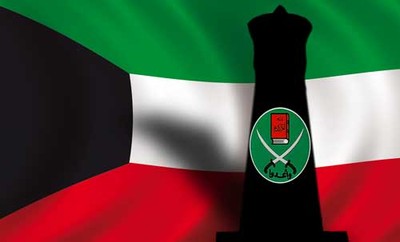
Kuwait Funding Muslim Brotherhood Growth in Western Mosques


by Abigail R. Esman


The completion of a new mosque in Amsterdam is doing more than opening the doors of worship to Dutch Muslims; it is opening new windows into unexpected avenues of terrorist financing and funding for the growth of radical Islam in the West.

For years, Western counterterrorism officials and pundits have expressed concern about the sponsorship of European and American mosques, Islamic schools, and other Muslim organizations by the Saudi government in efforts to its own extremist version of Islam, Wahhabism. Wahhabis adhere to strict, literal interpretations of the Quran and defend the use of violence against those who do not – Muslims and non-Muslims alike.

Now, however, it seems we've been so focused on the Saudis, we may have missed a potentially even greater source of radicalization, and certainly a fast-growing one: the Muslim Brotherhood. And the government of Kuwait, with ties to al-Qaida groups and Hamas, appears to be among the largest financiers of Brotherhood infiltration into Europe.

This is where the Amsterdam mosque comes in. Located in the largely Muslim neighborhood of Sloterdijk, the Blue Mosque has been the subject of controversy in the Dutch press since its conception. A report that the government of Kuwait was paying salaries to its imam and other officers recently propelled the mosque – and its organization – into the headlines. Those reports have since been challenged, but the gist of them remains true: through a pan-European organization called the Europe Trust, Kuwait is tying Dutch and other European Muslims directly into the Muslim Brotherhood via complex financial, non-profit and religious networks that stretch from Spain to Ireland – and across the Atlantic to New York.

Based in the UK, the Europe Trust is funded largely by Kuwait (with help from the UAE-based Makhtoum Foundation, about which, more later), and, according to the Middle East Quarterly, "channels money from the Persian Gulf to groups sympathetic to the Brotherhood in Europe, primarily to build mosques." Indeed, the Blue Mosque was funded entirely by Kuwait, working through the offices of the Europe Trust Nederland (ETN). Others have tied the Europe Trust to the Brotherhood as well; but particularly notable is the fact that the Trust is led by Ahmed Al-Rawi, a UK-based Muslim Brotherhood leader, and Nooh al Kaddo, a Dublin-based Iraqi who runs the Islamic Cultural Center of Ireland (ICCI), well known as a Brotherhood institution. The ICCI also houses the European Council of Fatwa and Research, whose director, the Egyptian cleric Yusuf al Qaradawi, has reportedly "defended suicide bombing and advocated the death sentence for homosexuals, according to the Irish Independent. (Kaddo, for his part, defends Qaradawi, describing his views in the Independent as "representative of Islamic teachings and not assumed to be a violation of same.")

But here's what else: al-Kaddo, who serves as a trustee of the Hamas-linked charity, Human Appeal International, also directs the largest mosque in Western Europe: the Al Salam mosque in Rotterdam, a controversial monument whose 50-meter high minarets form the highest point in the city. And like the ICCI, Al Salam (also known as Essalam) was financed entirely by Hamdan ben Rashid Al-Makhtoum, deputy ruler of Dubai and (conveniently) UAE Minister of Finance. Makhtoum, as it happens, also is a generous donor to Hamas-linked CAIR in the U.S. (The Sheik has also provided funds for other European mosques.)

Thirty-five miles away, Amsterdam's Blue Mosque also has al-Kaddo to thank for his efforts to secure the money that built it – an achievement made possible in part through his affiliation with Yahia Bouyafa, a member of the Muslim Brotherhood in the Netherlands and director (among other things) of the Federation of Islamic Organizations in the Netherlands (FION). FION, in turn, is a member of the Federation of Islamic Organizations in Europe (FIOE) – which the Global Muslim Brotherhood Daily Report identifies as a Brotherhood umbrella group that also embraces al-Kaddo's Europe Trust – and thus the Al Salam mosque in Rotterdam.

All in the same web. But there's more.

According to a fact sheet published by the Blue Mosque itself, a partnership developed early in the planning stages placed the ETN and FION – or al-Kaddo and Bouyafa – in charge of raising funds for the building. Bouyafa approached Kuwait's Ministry of Religious Affairs. But when his proposal was rejected, another local imam, Yassin Elforkani – suspected of ties to the Brotherhood – was called in to take over. With a few clever alterations to the construction and financing plan, Elforkani convinced Kuwait to provide the needed €2 million.

But with Kuwait now owning the building, sponsoring the ETN, and with extensive ties to Kaddo and Bouyafa (who has regularly exchanged places with Elforkani as director of FION and of the mosque board), the next step was inevitable: the appointment of Kuwaiti Minister for Religious Affairs (Awaqf) Mutlaq al-Qarawi, as chairman of the European Trust Nederland.

This means that one of the most active Muslim organizations in the Netherlands is now led not by a Dutch citizen, not even by a Dutch-speaking foreign imam, but by the government of Kuwait. More specifically, the Trust now sits in the hands of the Kuwaiti Ministry of Religious Affairs, which takes as its mandate spread of Islam to nonbelievers (dawah).

The Europe Trust has also not limited itself to Northern Europe: the NEFA Foundation has tied the group to properties in France, Greece, Romania, and Germany, where, NEFA notes, "funds for real estate purchased […] on behalf of a German Islamic association also came from the Makhtoum Foundation as well as the Awaqf Ministry [Ministry of Religious Affairs] in Kuwait and the Bayt al-Zakat in Dubai."

If all this sounds remote for Americans, too far across the oceans to matter very much, think again. According to a 2003 statement from former National Security and Counter-terrorism Coordinator Richard Clarke before the U.S. Senate Banking Committee, "several Al Qida operatives have allegedly been associated with the Kuwaiti Muslim Brotherhood," including 9/11 mastermind Khalid Sheikh Mohammed and Ramsi Yousef, a key figure in the 1993 bombing of the World Trade Center.

What's more, Clarke testified, "The Kuwaiti government allegedly provides substantial funding to charities controlled by the Kuwait Muslim Brotherhood, such as Lajnat al-Dawa. The U.S. Department of Treasury and the United Nations Security Council designated Lajnat al-Dawa on January 9, 2003 as a supporter of Al Qida. Lajnat al-Dawa and its affiliates had offices in the U.S. in Michigan, Colorado, and Northern Virginia."

If that's not enough, cables published by Wikileaks regarding the problems of policing money flowing to terrorist groups are even more damning. The New York Times summed up a series of these cables, which described Kuwait, the only Gulf country where terrorist funding has not been criminalized, as "a key transit point."

Other ties have been suggested between U.S. mosques and the Brotherhood, most notably the renowned Islamic Cultural Center in New York, founded by Egyptian-born Muhammad Abdul Rauf – father of former Ground Zero Mosque/Park51 imam Faisal Rauf – and funded in large measure by the Kuwaiti government.

Meanwhile, al-Kaddo, with continuing support from the Muslim Brotherhood in Kuwait, is gathering funds for even more mosques throughout Europe. While the ETN, he insists, does not define the positions of those mosques, it does use its power to hire, appoint, and fire each mosque's officers and imams – all carefully selected from an inside Brotherhood group – and many of whom have ties to Hamas or al-Qaida.

With Europe now becoming one of the richest resources for Islamic jihad, and with the free ability of its citizens to travel visa-free to the United States, the threat a growing, radicalized European Brotherhood network poses is a lot closer than it seems.


Abigail R. Esman, the author, most recently, of Radical State: How Jihad Is Winning Over Democracy in the West (Praeger, 2010), is a freelance writer based in New York and the Netherlands.

Source: http://www.investigativeproject.org/4160/kuwait-funding-muslim-brotherhood-growth-in

Copyright - Original materials copyright (c) by the authors.

NY Times censors Israel's victory in Yom Kippur War


by Leo Rennert


The 1973 Yom Kippur War comprised two distinct phases.

In the first couple of days of the war, a joint Egyptian-Syrian assault broke through Israeli defenses and chalked up major territorial gains in the Golan in the north and in Sinai in the south.  But from the third day on, Israel regrouped its forces and launched a highly successful counter-attack.  Not only did the IDF regain all lost territory, but it also crossed the Suez Canal, encircled Egypt's Third Army and broke through to the road to Cairo.  In the north, it not only recovered lost territory on the Golan but penetrated deep into Syria proper. By the time of the cease-fire, it was headed toward Damascus.

It was a great Israeli military victory albeit one that came at a huge cost - the loss of more than 2,500 Israeli soldiers.  Strategically, it signaled the futility of pan-Arab existential wars against the young Jewish state.   

But this is not how the New York Times tells the story on the 40th anniversary of the Yom Kippur War.  In an article by Jerusalem correspondent Isabel Kershner, it focuses entirely on the first phase when Israel's very existence seemed to hang in the balance, ignoring the IDF's remarkable recovery and eventual victory in the second part of the war.  ("40 Years After War, Israel Weighs Remaining Risks" Sept.13)

It's as if the history of World War II consisted only of the surprise attack on Pearl Harbor without any mention of who eventually emerged as the victor.

Thus, Kershner dwells on Israel's lack of preparedness and faulty intelligence - the attack "surprised and traumatized" Israel;, "a sense of doom spread through the country, many feared a catastrophe."  Israeli forces "struggled for days to contain, then repel the joint assault."  Israeli troops, of course, did far more than  just"repel" the joint attack by Egypt and Syria.  They thoroughly crushed the enemy.  It took American intervention and pressure on Israel to avert a complete Egyptian and Syrian calamity.

Kershner, however, ignores the full story of the Yom Kippur War.  She is more interested in pursuing her main theme -- that Israel remains beset by "latent questions about the reliability of intelligence assessments and risks of another surprise attack."  One gets the picture:  Israel still in a nervous crouch.

It's a familiar Israeli doom-and-gloom piece in the "news" pages of the New York Times.


Leo Rennert is a former White House correspondent and Washington bureau chief of McClatchy Newspapers

Source: http://www.americanthinker.com/blog/2013/09/ny_times_censors_israels_victory_in_yom_kippur_war.html

Copyright - Original materials copyright (c) by the authors.
Or Do We Do Pinpricks, After All?


by Abe Greenwald


The strike on Syria that the Obama administration has been talking about is perhaps not “unbelievably small,” as John Kerry said, but rather unbelievably unachievable. Here’s the Wall Street Journal on Syria’s Unit 450, “a branch of the Syrian Scientific Studies and Research Center that manages the regime’s overall chemicals weapons program”:

The U.S. wants any military strikes in Syria to send a message to the heads of Unit 450 that there is a steep price for following orders to use chemical weapons, U.S. officials said.
At the same time, the U.S. doesn’t want any strike to destabilize the unit so much that it loses control of its chemical weapons, giving rebels a chance to seize the arsenal.

Ah, of course, a Goldilocks-zone strike on a dictator’s chemical-weapons handlers (located at as many as 50 separate sites) in the midst of a civil war. Now, why didn’t the administration just explain it that way in the first place.
 
Abe Greenwald

Source: http://www.commentarymagazine.com/2013/09/13/or-do-we-do-pinpricks-after-all/

Copyright - Original materials copyright (c) by the authors.

Thursday, September 12, 2013

Mordechai Kedar: The Saudis are Trembling - Quietly


by Mordechai Kedar


Read the article in Italiano (translated by Yehudit Weisz, edited by Angelo Pezzana)
Read the article in en Español (translated by Shula Hamilton)
Read the article in en Français (translated by Danilette)

These days, the Arab media are full of reports about diplomatic activities regarding the Syrian issue, and commentators' articles dealing with this matter fill whole pages in the newspapers of the Arab world. They all try to ascertain if there will be an American military action, what its scope will be, how powerful it will be, what its goals will be, how long it will last, and especially, what the consequences of the action will be. But there is one important voice which is almost not heard at all in this whole chorus of analysts - the Saudi voice -  and it seems that someone there - the king? - may have imposed a gag order on the commentators.

To get a deeper understanding of the reason for this, I contacted a Saudi colleague, with whom I  am in contact occasionally. He is a member of the royal family, but is not in the inner circles of decision making. Nevertheless, he is well acquainted with the way the Saudi leaders think, he is aware of the considerations and feelings that drive it and has a deep understanding of what is said and what is not said there. At first he refused to speak, and only after a "preliminary conversation" did he consent. This is how it is in the Middle East: everything is based on personal relationships, and Arabic is the
entry bridge into the emotions of the region's people.

He preferred to speak about "The Gulf", not Saudi Arabia, in order to present a united front regarding the events in Syria and its environs. This is not exactly correct, because the positions of Saudi Arabia (which is the main supplier and supporter of the Salafi fighters in Syria) and those of Qatar (which stand behind the Free Syrian Army), are not identical, and  the United Arab Emirates is much more active than Oman. But despite the differences in approach among the members of the Gulf Cooperation Council, their basic attitudes are very similar.


My colleague hinted at an important aspect of Middle Eastern character, which is "murou'a" - "manliness". A man will always be sure to act according to rules of manly conduct, and will make every effort to avoid feminine patterns of behavior. Emotionality and whining are considered feminine qualities that express weakness, while a male is expected to keep a cool head and emotional balance and remain calm and functional even in difficult and complex situations. It seems that the Saudi government's silence during the last few days stems from this characteristic. One could say that the greater the internal emotional stress, the quieter and more relaxed the Arab man will try to appear. It relates to the obsession with honor, because if a man sounds like a woman he is considered contemptible.


The longer the conversation continued, the more open it became, and the more my colleague complained about the Western world in general and the United States in particular. "You (he included Israel in the Western world) speak all the time about human rights, so why are you quiet about what is happening in Syria? After chemical weapons have been used ten times, you still do not manage to find a reason to eliminate Asad? Are two hundred thousand fatalities not enough to bring you out of your complacency? Is issuing condemnations the only thing you can do? Making threats without carrying them out? You have all of the proof you need to do what you said you would do, so why are you not doing what you promised?" And then came the knockout question: "Is the Libyan's blood redder than the Syrians'? Or maybe Libyan oil is blacker than Syrian oil?" These things were said somewhat scornfully, because the coalition of Europe and America attacked Qadhaffi for less terrible things than Asad is doing.


I asked him: "So how should the Arab world deal with a mass murderer?" He answered with a rhetorical question: "Don't you know what Saudi Arabia has done and is still doing for the Syrian people?" He was referring to what Saudi Arabia usually does: it gives money, lots of money, for purposes that it believes in. Saudi Arabia - and all of the other Gulf countries - have poured many billions of dollars into the Syrian rebellion to pay the fighters, to buy weapons, ammunition, communication devices and civilian aid, and even to bring women to Syria in order to "serve" the fighters. Saudi Arabia funds training camps in other countries that train fighters to join the fight against Asad in Syria.


The Saudi activities are what put Asad into the military and emotional state where he felt that he had to use a doomsday weapon, a chemical weapon. And if it hadn't been used on August 21st, Damascus would have been conquered by trained, armed and equipped troops who came in from a neighboring country after Saudi Arabia had participated in funding their training, and they situated themselves the night before August 21 in the Eastern suburbs of Damascus. Asad understood that if he did not destroy these troops with gas - together with the citizens that the troops were hiding among, using them as human shields - the troops would take control of the government institutions in Damascus and his rule would come to an end, along with himself.


The Saudis were on the brink of victory, and Asad's use of gas took it away from them. That's why they are so angry with Asad, and with the West as well, which did not take the necessary steps immediately, to act without discussions, without votes, without Congress and without Parliament. They are concerned that Obama never intended to act in Syria, and all of his fiery speeches about red lines and what would happen if those red lines were crossed, were only words, which he had no intention of carrying out. My colleague used the expression "the roar of a mouse" to describe Obama's words.


But the Saudis cannot attack Obama personally, because they still depend on him to deal with the great, real, serious threat to their east, Iran. They heard the words of the "moderate", "reformist"  (my colleague laughed when he said these words) Iranian president very well when he said this week that Iran will not give up one iota of its nuclear rights. He attributes this declaration to the West's weak behavior in the Syrian issue. He used an Arabic expression meaning that Iran completely ignores the United States.


He doesn't believe that Asad will give up his chemical weapons, and he will do any sort of trick in order to conceal them and hide what he has in his stockpiles of death. The Russians have won a big victory over the United States, and they are taking advantage of Europe's lack of will to use force. And in general, what is all this business about giving up chemical weapons? Can a murderer's punishment be mitigated by confiscating the pistol that he used to commit murder? What kind of ethical or legal standard is that? Why don't they even issue an international arrest warrant against al-Assad to bring him to justice in the International Criminal Court? How is he different from Omar al-Bashir of Sudan and Milosevic of Yugoslavia?


According to my Saudi colleague, Iran is the big winner in the whole Syrian fiasco. Iran is reaping the fruits of its success in Iraq, because of the thousands of Americans that Iran killed in Iraq between the years 2003 and 2010, which will deter the United States from becoming involved in Syria. This is how Iran has acquired Iraq - where Iran now has unlimited control - and Syria. The Iranian Revolutionary Guards fight on Asad's side in Syria, despite it being a violation of Security Council resolutions, and no country does a thing.


The ruling family of Saudi Arabia is concerned, very concerned, that the weakness that the West conveys regarding Syria today will also be reflected in the way the West relates to Iran, and that if Iran takes some action against Saudi Arabia and the other Gulf countries in the future, the West will not have the strength and the courage to emerge from its impassivity and support Saudi Arabia on the day of reckoning. The Saudis are tense and concerned, and this is the reason for the quiet from Saudi Arabia during these trying days.


It may be that in the Middle East there are more countries whose leaders are quite concerned about the future of the Middle East and the world in general.


===============

Dr. Kedar is available for lectures


Dr. Mordechai Kedar
(Mordechai.Kedar@biu.ac.il) is an Israeli scholar of Arabic and Islam, a lecturer at Bar-Ilan University and the director of the Center for the Study of the Middle East and Islam (under formation), Bar Ilan University, Israel. He specializes in Islamic ideology and movements, the political discourse of Arab countries, the Arabic mass media, and the Syrian domestic arena.

Translated from Hebrew by Sally Zahav with permission from the author.


Additional articles by Dr. Kedar

Source: The article is published in the framework of the Center for the Study of the Middle East and Islam (under formation), Bar Ilan University, Israel. Also published in Makor Rishon, a Hebrew weekly newspaper.

Copyright - Original materials copyright (c) by the author.

"Tired of War"


by Douglas Murray


What better time is there to develop an even more voracious appetite than the very moment when the only people likely to stand up to you are too busily engaged in self-pity to notice your whirring centrifuges?

What does it mean for a nation to be "tired of war"? Those were the words that U.S. Secretary of State John Kerry used the in a major statement on Syria a fortnight ago and they were reiterated this week by President Barack Obama.

"Now, we know that after a decade of conflict, the American people are tired of war," Secretary Kerry said. He added, "Believe me, I am too." These are odd words to use in front of the international media., especially when you know that not only your allies and friends but all your foes -- including your most intransigent ones -- will be watching. What does it signal when the world's sole superpower expresses itself in such terms?

There can be little doubt that the train of thought Secretary Kerry expressed is part of the unfortunate zeitgeist. Everywhere in the West there is a sense that the last decade has been wearying. This may not matter all that much if you happen to be an exhausted Belgian or Swede: terrible for you, no doubt, but unlikely to have any wider consequence. What is concerning is when the only country in the world that really matters begins to feel and express itself in such a way.

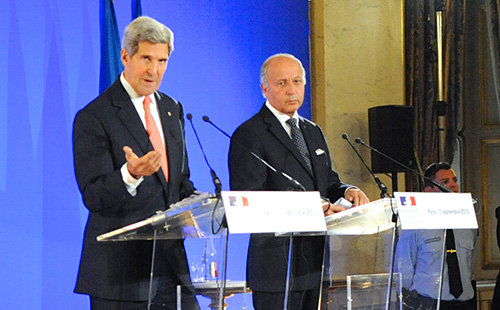
U.S. Secretary of State John Kerry and French Foreign Minister Laurent Fabius discuss Syria during a news conference in Paris, on September 7, 2013. [State Department photo/ Public Domain]

Countless historians and analysts of all political inclinations have pointed out that the sole superpower is going through something like the syndrome it went through after the war in Vietnam. There is something in this. But for all the similarities people can point to between post-Vietnam syndrome and post-Iraq/Afghanistan syndrome, the differences cry out to be considered.

Firstly this: that during the war in Vietnam, America lost almost 60,000 of her service personnel. During the decade of engagement in Iraq and Afghanistan, US troop casualties came to almost a tenth of that figure. What is even more striking is that during the Vietnam war the US army was a conscript army, drawn from across the country, classes and professions, whereas Iraq and Afghanistan were operations carried out solely by a professional, volunteer army.

This is a vast difference. A conscript army by definition affects every community, family and household in a country. Whereas volunteer armies tend to be dominated by people from particular areas, backgrounds and levels of income. So when somebody after the Vietnam conflict said they were "tired of war," they could easily have been speaking with real experience -- as Secretary Kerry, a veteran of the conflict, might have done. Most households were affected in some way.

But when someone today says he is "tired of war," let alone when a whole society says it is 'tired of war," what many -- if not most -- of these people mean is that they are fed of up reading about it every day. Or fed up with all that war stuff clogging up their television schedules.

A study done in the UK several years ago revealed an all-time low in the number of people in Britain who actually know anybody involved in the armed forces. The figure was almost in single digits. In other words, in vast expanses of the country there is nobody who knows anybody in the armed forces. I strongly suspect that the same findings could today be discovered in the U.S. Vast swathes of people, on the coasts and elsewhere, will be able to get through an average year while having no contact whatsoever with anybody actually serving their nation abroad.

Under such conditions there is something profoundly decadent about any such country, or its leadership, saying seriously that they are "tired" of war. Yet these were exactly the terms in which the U.S. sought to address to the nation over the question of involvement in Syria on the eve of this year's anniversary of 9/11: President Obama acknowledged that the nation was "sick and tired of war." He quoted this phrase, and another from someone writing to him who said that the nation was "still recovering from our involvement in Iraq."

Yet it wasn't all downbeat. The President tried to rally the nation by saying that "the burdens of leadership are often heavy, but the world is a better place because we have borne them." He then stressed that the nation was not, in fact, going to have to bear them. If he were inclined at any point to do something about Syria, it would be something "small," as Secretary Kerry also put it. No boots on the ground. No heavier involvement. Yet somehow not "pinpricks" either.

All of which is unlikely to make Assad tremble. But it hardly matters whether Assad trembles. What matters is what the other players in the region and the wider world make of all this. What matters is what Russia, China, and -- most pertinently -- Iran, will make of it. Iran has managed to keep off the front pages of world attention lately by the happy congruence of two circumstances: the election of a pseudo-moderate president, and the ongoing international dithering about what, if anything, to do about Syria. As it happens, Iran has already dipped its leg into the water of Syria by sending its proxy armies into the country. From their point of view, the reception could hardly have been more pleasing: they have managed to act without consequences.

There are many questions over what to do in Syria, and many questions over what is, or is not, effective to do. That debate should go on. But what should not go on is a period of intense naval-gazing by the Western powers. After all, what better time is there to develop an even more voracious appetite than the very moment when the only people likely to stand up to you are too busily engaged in self-pity to notice your whirring centrifuges?


Douglas Murray

Source: http://www.gatestoneinstitute.org/3972/tired-of-war

Copyright - Original materials copyright (c) by the authors.

Israeli President Peres: ‘Assad Cannot be Trusted’ to Honor Agreement on Chemical Weapons


by Zach Pontz


Israeli President Shimon Peres voiced skepticism Wednesday over a Russian proposal to place Syrian chemical weapons under international custodianship.

Speaking at the Israeli Navy graduation ceremony Wednesday, Peres said, “Assad cannot be trusted to honor the agreement” but expressed optimism that Washington and Moscow could impose conditions on the Syrian president that would force him to give up his chemical weapons.

“I know both President Obama and President Putin and I am convinced that if an agreement is reached it will be reliable, explicit and significant. The agreement must ensure that Assad has no chemical weapons,” he said.

A Congressional vote on whether or not the U.S. should strike Syria militarily in response to the chemical weapons attack it carried out in late August was postponed earlier this week after Russia, which has backed the Assad regime in its more-than two-year-old civil war, proposed a solution whereby Syria would relinquish control of it chemical weapons arsenal.


Zach Pontz

Source: http://www.algemeiner.com/2013/09/11/israeli-president-peres-assad-cannot-be-trusted-to-honor-agreement-on-chemical-weapons/

Copyright - Original materials copyright (c) by the authors.

Egypt's War On Hamas


by Khaled Abu Toameh


Hamas faces two options: either to initiate a new confrontation with Israel to create Arab and Islamic pressure on Egypt to halt its war, or to confront the Egyptian army in a direct military engagement by joining forces with the jihadis in Sinai.

For the past two months, the Egyptians have been at war not only with the jihadis in Sinai, but also in an all-out war with the Palestinian Hamas movement in the Gaza Strip.

This war is being waged on two fronts: in the media and along the border between the Gaza Strip and Egypt.

As far as Hamas is concerned, this is a war of survival that it cannot afford to lose.

An Egyptian army watchtower at Rafah, along the Gaza Strip border with Egypt, April 2009. (Photo credit: Marius Arnesen)

The Egyptian war is clearly hurting Hamas much more than the two military offensives launched by the Israel Defense Forces in the Gaza Strip since 2008.

Hamas officials in the Gaza Strip are now talking openly about the Egyptian war, which they believe is aimed at toppling their regime there.

The officials admit that they were not prepared for this war from the largest Arab country, which until last June was their main ally in the Arab and Islamic countries.

Since the ouster of Egypt's President Mohamed Morsi, the state-controlled media in Egypt has turned Hamas into the country's number one enemy.

Almost every day an Egyptian newspaper runs a story about Hamas's ongoing attempts to undermine Egypt's national security, and its involvement in terror attacks against the Egyptian army.

Hamas spokesmen in the Gaza Strip now spend most of their time denying the allegations and accusing the Egyptian media of waging a smear campaign not only against their movement,but all Palestinians.

The media offensive has been accompanied by a series of security measures that have convinced Hamas leaders they are in a state of war with Egypt.

Apart from banning Hamas representatives from entering Egypt, the Egyptian authorities have imposed severe travel restrictions on residents of the Gaza Strip.

The Rafah border crossing between Gaza and Egypt has been shut for most of the time over the past two months, with the Egyptian authorities citing "security reasons" for the closure.

But the most drastic measure taken by the Egyptians so far, which is really hurting Hamas, is the destruction of hundreds of smuggling tunnels along the border with the Gaza Strip.

The Egyptians are now in the process of creating a buffer zone between the Gaza Strip and Egypt after having razed several homes and leveled land along the border.

These are the same Egyptians who used to condemn Israel for every military strike aimed at thwarting rocket attacks from the Gaza Strip against Israeli cities and towns.

All these measures have prompted some Hamas officials to wonder whether Egypt was planning to launch a military operation inside the Gaza Strip under the pretext of combating terror.

Hamas believes that as part of this war, Egyptian intelligence officials are behind a new group called Tamarod [Rebellion] whose members have vowed to overthrow the Hamas regime in November. In recent weeks, Hamas arrested dozens of Palestinians in the Gaza Strip on suspicion of being involved with the new group, which carries the same name as the Egyptian movement that campaigned against Morsi.

The Egyptian security measures have thus far resulted in a severe shortage of basic goods and fuel in the Gaza Strip. Some Hamas leaders warned this week that the Gaza Strip is facing a humanitarian and economic crisis as a result of the Egyptian army's measures.

Until recently, Hamas leaders were careful not to engage in a direct confrontation with the new rulers of Egypt. But in recent days several Hamas officials are beginning to regard Egypt's security measures as an act of war against the Gaza Strip.

For now, the Egyptians do not want to admit that they are at war with Hamas, preferring instead to describe their measures as part of a campaign against terror. Hamas, for its part, has internalized the fact that it is at war with Egypt.

Hamas, as it is being pushed to the wall and increasingly isolated, faces two options: either to initiate a new confrontation with Israel to create Arab and Islamic pressure on Egypt to halt its war, or to confront the Egyptian army in a direct military engagement by joining forces with the jihadis in Sinai.


Khaled Abu Toameh

Source: http://www.gatestoneinstitute.org/3973/egypt-war-hamas

Copyright - Original materials copyright (c) by the authors.
The Violence We Don’t See


by Daniel Greenfield


Untitled2 

Lashawn Marten was playing chess when he announced, “I hate white people.” Then he began hitting random white people who were walking by. By the time he was done, several were wounded and one lay dead.

I have walked by countless times and seen the chess players sitting near the overhang of the Union Square subway entrance; mostly black men daring white passerby into a money game. At the fountain to the left, Moonies squat on a blanket and sing their sonorous chants. To the right, the remnants of Occupy Wall Street set up tables to collect money and dispense buttons.

In warmer weather, break dancers perform on the stairs and office workers sit beneath the statue of George Washington expelling the British and eat lunch. Elderly Puerto Rican men push makeshift wooden carts piled with unlabeled bottles of homebrewed soda pop.

Jeffrey Babbitt, the man Lashawn beat to death, looks familiar to me because he has that type of New York face that you pass on the street. You see it worn by plumbers and high school teachers. It’s the badge of the vanishing New York City working class.

No conclusions will be drawn from the murder. Lashawn Marten was obviously mentally ill. And if his mental illness took the form of violent racism toward white people, that is an incidental fact. The murder is an incident. The details are incidental. No conclusions will be drawn from what happened between the chess tables.

Incidents take place all around us, but patterns have to be articulated. The incident is insignificant. It’s the pattern that counts.

The incident is something we have to learn to get over so we can get back to shopping in downtown Manhattan or walking through Union Square. The pattern is a social problem that we must dedicate ourselves to fighting. The incident isn’t supposed to define our lives. The pattern is.

The murder of Chris Lane was an incident. The murder of Jeffrey Babbitt was an incident.

The Boston Marathon bombing was an incident. So was the Fort Hood Massacre. So was 9/11. No conclusions can be drawn from them and no pattern can be used to tie them together. They are to be processed separately and discarded as having no further meaning than the private pain of their victims.

The media is not that concerned with suppressing incidents. It is concerned with suppressing pattern awareness. No one can deny that the occasional racial murder takes place and that the perpetrators look like Obama’s sons. And no one can deny that Muslims sometimes set off bombs or fly planes into buildings. They deny only that these incidents form a pattern.

Every Muslim terrorist attack is met with media chatter about an Islamophobic backlash. The backlash never materializes, but it doesn’t need to. The mere repetition of it does the trick and sets the pattern. It tells readers that the attack is the incident, but the backlash is the pattern.

The attack is only an incident and not characteristic of Muslims while the backlash is a pattern and characteristic of our bigotry and intolerance.

White racism is a pattern. Black racism is an incident. Racism is characteristic of white people, but not of black people. The crowds passing through Union Square are subdivided into the oppressors and the oppressed. Their lives are color coded for morality and justice. Jeffrey Babbitt, who dreamed of being a motorman, loved comics and took care of his elderly mother, was an oppressor. His death is an incident that in no way detracts from the pervasive pattern of white racism.

Jeffrey Babbitt was an oppressor and Lashawn Marten was one of the oppressed. This social dynamic was imposed on them at birth. The occasional death of an oppressor in no way alters the fixed pattern of the oppressors and the oppressed.

The pattern of American intolerance is likewise unmoved by September 11 or by two Chechens who set off a bomb near an 8-year-old. The blood and ashes of 3,000 dead is nothing but a stain on the liberal pattern. More people die of cancer or in car accidents, the liberal can always answer. Numbers alone do not make a pattern. And if the pattern is not recognized, then it does not exist.

We live in this world of unreal patterns and real lives where inexplicable things happen all the time.

Overhead, I see two beams of pale light piercing the sky and reflecting at an angle. The towers of light remind us of an incident. Not a pattern. After over a decade of war, no one in authority will admit what we are fighting or why. All that ash and rubble, the twisted steel and the falling bodies, are not part of a pattern. But when a Muslim cabbie is stabbed by a drunk, that is a pattern.

Most of us see the real patterns, even if only hazily, like the beams of light cutting across the sky. And we see that the unreal patterns, the obsessions with Muslim backlashes and the martyrdom of Trayvon Martin, are unreal things. Not true patterns, but false patterns that reflect at an angle from the true light.

We do not speak of these true patterns. But we know them. They stir in us when the right moment appears. They keep us alive.

Millions walk through life with this double vision, the lenses of their minds blurring the real and the unreal, paying lip service to the grave threat that someone will spray paint a mosque while nervously studying the Muslim sitting in the seat in front of them or voting for Obama but moving out to the suburbs.

Patterns are power. The pattern-makers and pattern-dealers derive theirs from being able to dictate the problem and the solution. They are determined to understand things for us so that we will see the same patterns that they do. They know all too well that if we stop seeing their patterns, their cause and their power will die.

For now it is men like Jeffrey Babbitt or the spectators in the Boston Marathon and the soldiers at Fort Hood who die. They die caught in an invisible pattern that they cannot see.

We live in a world of phony patterns, of global environmental apocalypses made to order, of shadows and illusions, of phantom fears, panics and doubts. But even in the liberal world of ghosts and shadows, where rogue air conditioners and cow flatulence are a greater threat to the planet than the nuclear bomb, where Lashawn Marten was oppressed by the unconscious white privilege of Jeffrey Babbitt who died for what he did not even know he had and where Muslim terrorism is a phantom fear of bigots, these true patterns intrude.

Terrible acts of violence momentarily tear apart the illusory false patterns with blood and fire and reveal the terrible truth.

On September 11, thousands of New Yorkers standing at Union Square looked downtown to see a plume of smoke rising over Broadway. I was one of them. Some fell to making anti-war posters on the spot. Others enlisted in a long war. On another distant September, some New Yorkers came to the defense of a 62-year-old man being beaten to death for the color of his skin. Others walked on to the farmers’ market, bought their organic peaches while the liberal memes in their heads told them to see no evil.

Our lives are sharpest and clearest when we see the pattern. In moments of revelation, the comforting illusions are torn away and the true pattern of our world stands revealed.


Daniel Greenfield

Source: http://frontpagemag.com/2013/dgreenfield/the-violence-we-dont-see/

Copyright - Original materials copyright (c) by the authors.

Obama's Diplomatic Acrobatics


by Daniel Pipes


The Obama administration's diplomatic acrobatic over Syria of the past three weeks prove that the president and his team are in way over their heads, amateurs in the deadly game of war and peace. (One wonders if Valerie Jarrett is making the key decisions in this instance, as in so many others.)

Notice a difference? The crowd greeting Obama in Berlin in 2008.
Lurching from self-imposed trap (the "red line" statement) to self-inflicted crisis (the need for congressional approval), the administration erodes the credibility of the U.S. government and increases the dangers facing Americans. Enemies of the United States, its allies, and modern civilization itself will take succor in this ignominious performance and grow in strength.

That Obama seems driven to defend his own honor and credibility, regardless of cost, makes this episode particularly troublesome. A great country finds itself held hostage to the ego of a small man.

And the Berlin crowd for Obama in 2013.
In short, Americans are finally starting to see the consequences of electing and re-electing arguable the worst politician in modern times to inhabit the White House, consequences will only become more apparent in the years ahead. (September 11, 2013)


Daniel Pipes

Source: http://www.danielpipes.org/blog/2013/09/obama-diplomatic-acrobatics

Copyright - Original materials copyright (c) by the authors.

Destroying Norway’s Socialist Paradise?


by Bruce Bawer


vote 

It’s hard to believe now, but there actually was a time when I viewed journalism as a noble profession.

(I was very young.)

On Monday, Norwegian voters, by a convincing margin, turned out the socialists and opted for a new, non-socialist government. This was how the British daily the Independent – which is regarded in some circles as a serious paper – headlined the news:

“Norway election results: Anti-immigrant party with links to mass murderer Anders Behring Breivik set to enter government under Conservative leader Erna Solberg.”

Just below the headline, to underscore the most important part of the message – namely, that the Progress Party has “links” to Breivik – were two equally large pictures of Breivik, the murderer, and Siv Jensen, the head of the Progress Party, which won 16.3 percent of the vote in Monday’s parliamentary ballot. The Independent‘s reporter, Tony Paterson, devoted a considerable chunk of his text to a recap of the Breivik murders, and only several paragraphs into the piece did he make it clear that the nature of Breivik’s “links” to the party was that he’d supported it “in his youth,” but later turned away from it because it wasn’t “militant enough.”
That’s it.

Paterson also claimed that after the Breivik atrocities the Progress Party had “toned down its radical anti-Islamic rhetoric” (as if radicalism consisted in opposing, rather than imposing, things like forced marriage and honor killing) and “tried to present itself as a party of government” (as opposed to a party of what?).

“Polls,” Paterson wrote, “have shown that Progress appeals to one in seven of Norway’s voters.” Quick question: why cite polls when there was an election on Monday that tells you exactly how many Norwegian voters support the Progress Party!?

(And those voters did so, note well, in defiance of years of vicious, concentrated effort by the Norwegian media and political establishment to isolate the Progress Party and to brand its supporters as racists, bigots, and – since 2011 – associates of a mass murderer.)

The Independent wasn’t the only international media outlet that seemed determined to make Breivik the face of the Progress Party. The New York Times worked him into the second sentence of its article on the election results. So did Le Monde. Ditto the Toronto Globe and Mail, which perpetrated this disgusting affirmation: “The Progress party, which once had among its members Anders Behring Breivik, who killed 77 people in 2011 in a gun and bomb attack targeting Labour, came third in Monday’s poll, giving it a kingmaker role in coalition building.”

An NBC report did those newspapers one better, incorporating Breivik in its very first sentence. El Pais waited till its second paragraph to mention Breivik, but ran its story under a scare headline warning that the “ultra-right” Progress Party held the key to Norway’s next government (a statement that seemed to wildly contradict the claim, strenuously underscored throughout the story’s opening paragraph, that the Progress Party was the day’s “big loser”). Italy’s big paper, Corriere della Sera, went with the headline: “Vote shock in Norway: Breivik’s Party enters government.”

Meanwhile, next door in Sweden, Aftonbladet columnist Katrine Kielos went easy on the Breivik angle, but could barely contain her shock and disgust at the decision of the Norwegian electorate: “Who ever said that politics was fair?” Apparently implying that Siv Jensen was the second coming of Hitler, Kielos fulminated that it was “as if World War II never happened. This in the country that hands out the Nobel Peace Prize.”

And Britain’s Guardian, not to be outdone by its rival the Independent, hired a Norwegian sociology professor to pen a whole article – illustrated with a huge picture of Breivik – the only aim of which was to yoke the Progress Party to the insane killer.

The theme running through most of this coverage was clear: as a survivor of Breivik’s shooting spree told Paterson, the Progress Party’s “anti-immigrant rhetoric…will create a more hostile environment.”

Yes, hostile. We don’t want any hostility, do we? For, you see, under socialist rule, Norway is one big lovefest. Take these examples:

* Earlier this month, Oslo imams and police officials went on a buddy-buddy “team-building” exercise to strengthen their (supposedly) already powerful bonds of mutual respect and trust. Aftenposten depicted the whole thing as just plain adorable. (“Did you remember your sneakers?” one imam was quoted as asking another.) Only a wet blanket – a truly hostile type – would point out that this gaggle of clerics included the likes of Mehtab Afsar, who has argued aggressively that Islam should be exempt from criticism, and Ghulam Sarwar, who in an interview earlier this year expanded at length on his theory that negative images of Islam in the Western media can be traced to the nefarious influence of “the Jews.”

* Just before the election, the Norwegian government announced its plan to cover the salaries of 380 Somalian government officials. How magnanimous – and how typical of the loving spirit of the Stoltenberg regime! Who but a (yes) hostile observer would draw attention to the fact that Somalia is governed according to sharia law?

* Then there’s the story of Ola Thune, head of the homicide division at Norway’s National Criminal Investigation Service, who – as TV2 reported the other day – converted to Islam at “a beautiful ceremony in an Oslo mosque” where Thune (now known as Ola Amir) “pledged his allegiance to Allah in ringing Arabic.” Who but the most unbearably hostile individual would question the wisdom of having a Muslim convert at the highest level of Norway’s version of the FBI?

Community! Solidarity! These are Labor Party’s very slogans; anybody who’s paid the slightest bit of attention to the election campaign has heard Stoltenberg repeat them dozens of times – and has seen them echoed endlessly in the almost exclusively left-wing Norwegian media.

To be sure, when the subject shifts to Jews…well, consider the following.

In May, the proudly socialist Dagbladet ran a cartoon that showed a baby lying on a table, screaming in pain and bleeding profusely. While a rabbi sticks a giant fork in the infant’s head, the hand of another person, presumably a mohel, holds something that looks like a pair of hedge clippers, with which he’s just circumcised the newborn. A woman holding what is apparently meant to be a copy of the Hebrew Bible tells a cop: “Abuse? No, this is tradition! An important part of our faith!” The cop, smiling, replies: “Faith? Oh, well then it’s OK!” And another cop, also smiling and already halfway out the door, says: “Sorry for the interruption.”

It was far from the first anti-Semitic cartoon to appear in a major Norwegian newspaper. (Cartoons equating Jews with Nazis are a beloved staple of the Norwegian press.) But this particular cartoon happened to gain a degree of international attention, so much so that Dagbladet felt obliged to publish on its website an incredibly lame statement, composed in English, in which it defended its decision to run the cartoon, claimed to have “a long and consistent history of fighting antisemitism” (ha!), and insisted that “religious sentiments, dogmas or rituals cannot be exempt from criticism” – an argument that the same newspaper has rejected time and time in regard to Islam, notably in the case of the Danish Muhammed cartoons.

Indeed, Dagbladet, like other major Norwegian dailies, has consistently maintained that freedom of speech doesn’t give one the right to offend the most cherished religious beliefs of others. But by “others,” it means Muslims – not Jews. Among the latest examples of the paper’s valiant struggle against anti-Semitism was an August 26 editorial headlined “The cancerous tumor that is spreading.” The message was straightforward: all the troubles in the Middle East – Iran, Syria, Egypt, Libya, you name it – can be attributed to “the mother of all conflicts,” namely the one between Israel and Palestine. In other words, it’s all Israel’s fault.

Such is the beautiful, hostility-free social harmony that’s being threatened by the ascent of the Progress Party and Siv Jensen – a woman who, over the years, has gotten into hot water for such insufferably hostile activities as defending Israel’s right to exist, challenging the Labor Party’s chummy contacts with Hamas, and giving the keynote speech at a 2009 pro-Israel rally.

Then again, Stoltenberg and his socialist cronies will probably be back in power soon enough. Consider this: a new report shows that about 50% of the country’s Third World immigrants support Labor, while another 25% vote for the two parties on the far side of Labor – the Socialist Left and the Reds (i.e., Communists). After the new government takes control, any effort at significant immigration reform by the Progress Party is likely to be heavily watered down (if not killed outright) by other parties. Meaning that non-Westerners will continue to flow into Norway – and that the socialists will stand a better chance every day of being returned to power, so they can crush the “hostile environment” created by the Progress Party and reboot the left-wing, Islamophilic, anti-Semitic lovefest.


Bruce Bawer

Source: http://frontpagemag.com/2013/bruce-bawer/destroying-norways-socialist-paradise/

Copyright - Original materials copyright (c) by the authors.