Sunday, June 21, 2026

Trump threatens U.S. will charge toll fees in Strait of Hormuz if Iran doesn’t execute peace deal - John Solomon


by John Solomon

Trump's comments came as Vice President JD Vance departed the United States for direct and high stakes talks with Iran in Switzerland.


President Donald Trump ratcheted up the pressure on Iran on Saturday, threatening that the United States could charge toll fees to ships passing through the Strait of Hormuz if Tehran doesn't execute a peace deal within 60 days.

"There will be NO TOLLS in the Hormuz Strait for 60 days during the Cease Fire Period, and there will be NO TOLLS after the 60 day period has expired, unless they are imposed by and for the United States of America, should the deal not be completed, for services rendered as the Guardian Angel to the countries of the Middle East for purposes of both past, present, and future reimbursement of costs," Trump wrote on his Truth Social platform.

Trump's comments came as Vice President JD Vance departed the United States for direct and high-stakes talks with Iran in Switzerland.

The Strait of Hormuz -- one of the world's most important transit points for oil cargo -- has become a critical bargaining chip in the ceasefire negotiations as Iran's tensions with the United States and Israel remain high.

Trump’s statement appeared to warn Tehran it won't have the ability to charge ship tolls in any final deal with America.

Iran and the United States have signed a memorandum of understanding that imposes a 60-day ceasefire to give more time to negotiate a formal  peace treaty. 


John Solomon

Source: https://justthenews.com/politics-policy/all-things-trump/trump-threatens-us-will-charge-toll-fees-strait-hormuz-if-iran

Follow Middle East and Terrorism on Twitter

U.S. and Iran launch direct negotiations in Switzerland - Barak Ravid


by Barak Ravid

The talks took place despite Iran claiming on Saturday that it was shutting down the Strait of Hormuz in response to Israeli ceasefire violations in Lebanon. Given that backdrop, things could break down at any time.


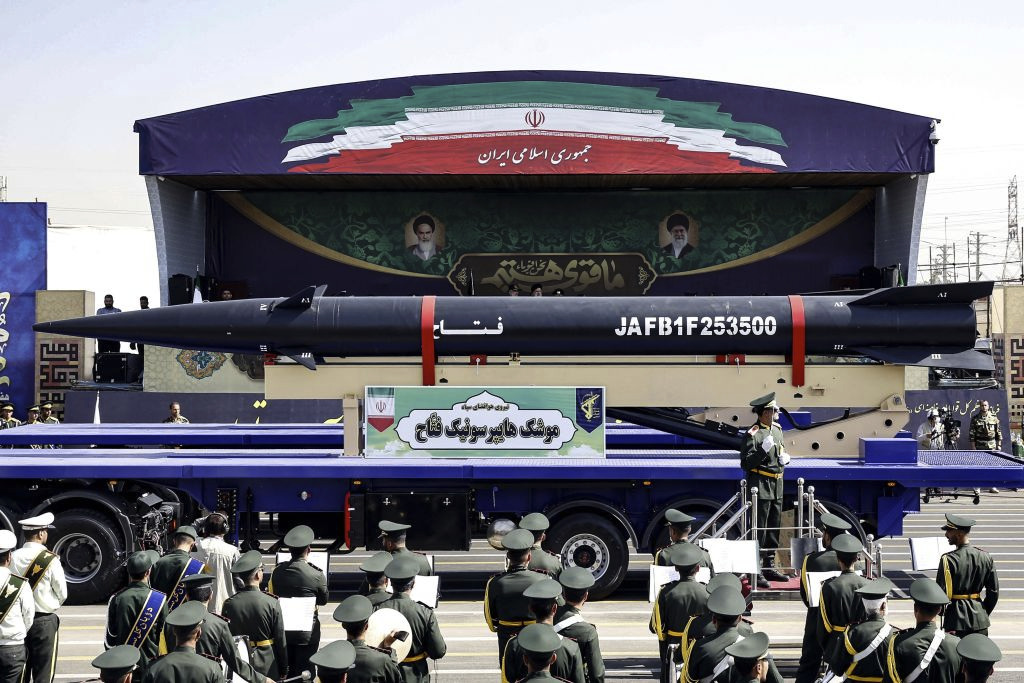
Vice President J.D. Vance speaks to reporters from Joint Base Andrews, in Maryland before hearing to Switzerland for negotiations with Iran.
Vice President J.D. Vance speaks to reporters from Joint Base Andrews, in Maryland before hearing to Switzerland for negotiations with Iran. Photo by Elizabeth Frantz/Pool/Getty Images

Vice President J.D. Vance and other U.S. negotiators met with their Iranian counterparts at the Bürgenstock ski resort in Switzerland on Sunday for the first round of talks over a deal to end the war, according to a diplomat with knowledge of the talks.

Why it matters: The "Lake Lucern summit" is the first round of direct talks between the U.S. and Iran since the Islamabad summit last April. It's supposed to launch 60 days of nuclear negotiations with the aim of limiting Iran's nuclear program.

  • The talks took place despite Iran claiming on Saturday that it was shutting down the Strait of Hormuz in response to Israeli ceasefire violations in Lebanon. Given that backdrop, things could break down at any time.
  • "I think we're going to hopefully make progress on the nuclear issue, make progress on the Lebanon ceasefire issue. Those are the two big things that I think we're going to be focused on," Vance told reporters on Saturday before leaving Washington.

Driving the news: Vance and White House envoys Steve Witkoff and Jared Kushner met on Sunday morning with the Prime Ministers of Pakistan and Qatar and Pakistan's top general, who is mediating talks between the U.S. and Iran.

  • Shortly after, the Iranian delegation — headed by Speaker of Parliament Mohammad-Bagher Ghalibaf and Foreign Minister Abbas Araghchi — held a similar meeting with the mediators.
  • Iranian state media reported that after the mediator meetings, the U.S. and Iranian delegations held a trilateral meeting with the Qataris, a diplomat with knowledge of the talks confirmed to Axios.

What they are saying: Vance said Saturday that the negotiations will last "a couple of days" and he will stay "for a day or two."

  • The VP said the first round is aimed at "getting the actual structure and negotiation in place."
  • He noted that there will also be working-level talks by technical experts that could continue in Switzerland after the first round of talks concludes.

The other side: The spokesman of the Iranian Foreign Ministry told Iranian state media on Sunday that the talks will focus on the ceasefire in Lebanon, the waivers the U.S. committed to issue in order to allow Iran to sell oil and the issue of Iran's frozen funds.

Between the lines: The U.S. would like the first round of talks to end with an Iranian invitation for UN inspectors to visit its nuclear sites, which were bombed by the U.S. and Israel, two regional sources with direct knowledge said. The last such visit took place in June 2025.

  • In return, the U.S. is willing to give Iran access to some of its frozen funds — starting with a $6 billion account in Qatar.
  • The Iranians would be able to use those funds to buy humanitarian goods, the sources said.

What to watch: On Saturday, ahead of the talks, Israel and Hezbollah announced they were recommitting to the ceasefire. Such statements have tended to be very short-lived. A similar ceasefire broke down within hours on Friday.

  • Vance acknowledged Lebanon could derail the negotiations, but said Secretary of State Marco Rubio is handling de-escalation efforts.
  • "Despite the headlines, things are actually getting better there, and things are slowing down a little bit. It's going to be something we're just going to have to continuously manage to ensure that Israel and Lebanon are both safe and secure," Vance said.

Editor's note: This story has been updated with additional information. 


Barak Ravid

Source: https://www.axios.com/2026/06/20/vance-iran-talks-switzerland

Follow Middle East and Terrorism on Twitter

Trump's Iran 'Deal' - Pierre Rehov


by Pierre Rehov

Only one question really matters: what does the agreement, if honored by Iran, deliver?


  • The 14-point text is unambiguous on the point the White House is most eager to fog. It commits the United States, "with regional partners," to develop a "plan with at least USD 300 billion for the reconstruction and economic development of the Islamic Republic of Iran" -- $3 billion of which has, according to the unsurpassed journalist, Lee Smith, already been sent to Iran through by way of the United Arab Emirates. The president has called reports of that figure "fake news" and insisted nobody is putting up "ten cents." The clause nevertheless sits prominently in the document he signed.

  • Only one question really matters: what does the agreement, if honored by Iran, deliver? It leaves enriched uranium inside Iran, concedes a right to enrichment that was recently a red line, permits the Iranian ballistic-missile program Trump now defends supposedly because other countries have missiles too, and pours reconstruction money into an economy whose ruling institution is the brutal Islamic Revolutionary Guard Corps (IRGC).

  • An interim framework can easily be a device for extracting one concrete concession -- opening the shipping lanes in the Strait of Hormuz -- while the other clauses quietly expire.

  • Trump has repeated that if the deal collapses he will return to force – but who will do that after he is no longer president?

  • Each Israeli reprisal can trigger an Iranian walkout, and each walkout hands Washington a legal pretext to resume the war it paused. If Trump, however, is reluctant to use force against Iran again now, why should anyone think that he would be more inclined to use it later?

  • Without a united opposition to inherit power and without an army to seize Tehran, talk of liberation is a consolation, not a strategy. The war degraded the regime; it did not remove it -- and nothing in this agreement will. In fact, the MOU promises to enrich the IRGC again so that it can tighten its hold on the Iranian people even more viciously.

  • So the memorandum sits there, looking like the clumsiest concession an American administration has made to a sworn enemy in a generation...

  • The regime in Tehran, which has waited out many American presidents and means to wait out another, is betting they are bluffing about everything except the check.

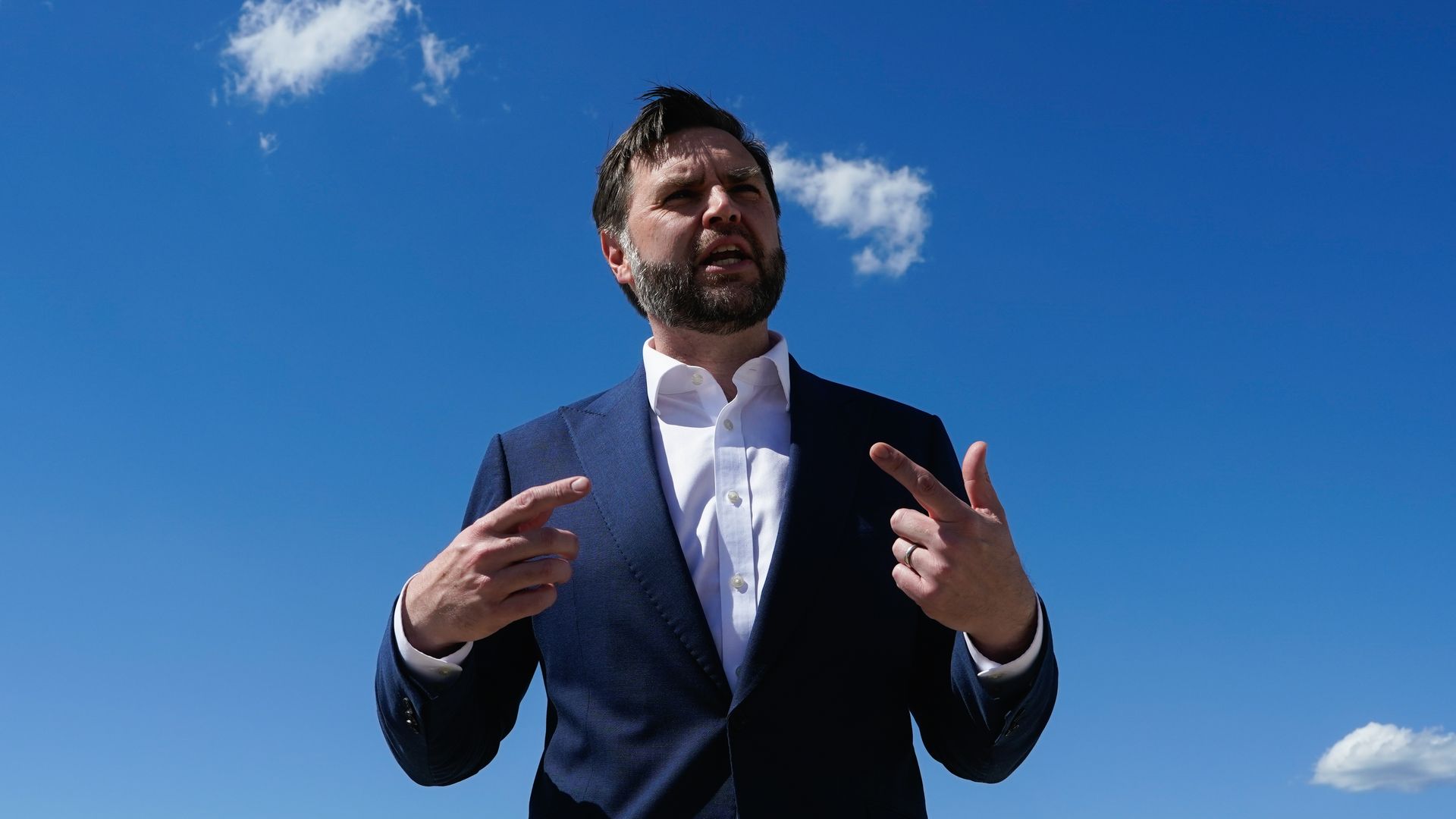
What does the agreement, if honored by Iran, deliver? It leaves enriched uranium inside Iran, concedes a right to enrichment that was recently a red line, permits the Iranian ballistic-missile program Trump now defends supposedly because other countries have missiles too, and pours reconstruction money into an economy whose ruling institution is the brutal Islamic Revolutionary Guard Corps. Pictured: A Fattah ballistic missile is displayed during the annual military parade in Tehran, on September 22, 2023. (Photo by AFP via Getty Images)

After a war launched in February to end the Iranian nuclear threat, the United States has agreed to a 60-day ceasefire, the reopening of the Strait of Hormuz, the lifting of its naval blockade, the unfreezing of Iranian assets, and an immense $300 billion reconstruction fund for the very regime the U.S. Air Force spent weeks degrading. The triumph turns out to be a recipe for everything Iran wanted and could not win on the battlefield.

The 14-point text is unambiguous on the point the White House is most eager to fog. It commits the United States, "with regional partners," to develop a "plan with at least USD 300 billion for the reconstruction and economic development of the Islamic Republic of Iran" -- $3 billion of which has, according to the unsurpassed journalist, Lee Smith, already been sent to Iran through by way of the United Arab Emirates. The president has called reports of that figure "fake news" and insisted nobody is putting up "ten cents." The clause nevertheless sits prominently in the document he signed.

To disclaim the funding by arranging for someone else to pay for it is a familiar maneuver. US Vice President J.D. Vance confirmed the transfer on CBS News and described a Gulf coalition that would finance Iran's recovery if Tehran behaved. Trump then turned and blamed Vance for the wording, saying that the statement "could have been a little more accurate." A vice president publicly scolded for telling the truth about his administration's own deal hardly projects strength or that the president is being straight with his public.

Vance answered not by reassuring the ally most threatened by the agreement, Israel, but by attacking it. In remarks aimed at Israel's government, he lashed out at members of Prime Minister Benjamin Netanyahu's cabinet as ungrateful, declared that Israel had only one leader in the world who was a friend -- which is far from true -- and claimed the Israel's weapons were paid for by American taxpayers, while omitting that much of the intelligence shared with America comes from Israel, as does much of the military know-how.

His condescension carried the rest of what one needs to know about him. This is the same Vance who told Ukrainian President Volodymyr Zelensky, "You are wrong" during a televised meeting at the White House, when Zelensky gently suggested that Ukraine needs stronger US support in battling the devastating invasion by Russia, an understatement if there ever was one. Russia continues to violate the 1994 Budapest Memorandum, in which it had guaranteed not to invade Ukraine if it gave up all its nuclear weapons – as it sadly did.

Here is the second-highest official in the United States telling Israel, which has just fought alongside America, to be quiet, be grateful, and that its survival is a favor it has not sufficiently repaid. American leaders have disagreed with Jerusalem for as long as the alliance has existed. Lecturing Israel about gratitude while handing its enemy $300 billion, and an agreement that all but guarantees its enemies the means to continue trying to destroy it, is a tack that is newer and nastier.

The arrogant tone might be tolerable if it were only distasteful. It rests, regrettably, on a falsehood about who won the war. The US campaign against Iran, dubbed Operation Epic Fury, was sold to the public as a feat of American airpower – which was real, spectacular and welcome. The targeting that made those strikes so precise did not come from satellites alone. It came from years of intelligence collected by Israel from inside Iran, which let the bombs find their marks. The men now telling Israel to be grateful are standing on the shoulders of the intelligence Israel handed them, without which the US could have gotten bogged down. That is the problem with the boast: Washington is presenting as its own a result it could not have accomplished by itself, and basing its diplomacy on the assumption that it could have done.

Only one question really matters: what does the agreement, if honored by Iran, deliver? It leaves enriched uranium inside Iran, concedes a right to enrichment that was recently a red line, permits the Iranian ballistic-missile program Trump now defends supposedly because other countries have missiles too, and pours reconstruction money into an economy whose ruling institution is the brutal Islamic Revolutionary Guard Corps (IRGC).

The scale is another factor that resists comprehension. The promised $300 billion fund is large enough to rebuild not only the economy of Iran but the apparatus of terrorist proxies controlled by it. Gulf analysts quoted in the Israeli media warn that the funds would free resources for Iran's proxy militias in Iraq, Syria, Lebanon, and Yemen. A regime that emerged from the war with the IRGC strengthened and its pragmatists dead is now to be financed back to dominance.

Probably no one actually believes that the agreement was ever meant to function as written. Washington has done this before. The three-phase plan for Gaza, announced with great solemnity, did accomplish the return of the remaining Israeli hostages in its opening stage, but then stalled, never advancing to the later phases meant to remake the territory. Phase one became the entire play. An interim framework can easily be a device for extracting one concrete concession -- opening the shipping lanes in the Strait of Hormuz -- while the other clauses quietly expire.

There is a more generous reading: If Trump signed in order to appear to give Iran everything, draw it to the table, and get the oil flowing before the midterms, all while knowing the structure would never hold, then the concessions are bait rather than surrender. The problem is that it seems from the memorandum of understanding (MOU) that most of the benefits to Iran are given up front, so the weak bargaining position that remains for the US can easily be dragged out by Iran past Trump's term in office.

Israel has stated plainly that it does not consider itself bound by the MOU so long as Hezbollah fires on its forces; it has kept striking Hezbollah strongholds in Lebanon.

Trump has repeated that if the deal collapses he will return to force – but who will do that after he is no longer president? If anyone imagines that a coalition of anyone will actually enforce anything after the first shot is fired by the IRGC, they are probably on some high-grade cannabis. We have already seen how that arrangement worked out in south Lebanon. It did not. That is why Israel is having to fight for its survival again there now.

Each Israeli reprisal can trigger an Iranian walkout, and each walkout hands Washington a legal pretext to resume the war it paused. If Trump, however, is reluctant to use force against Iran again now, why should anyone think that he would be more inclined to use it later? The weakness of it is that it depends on enemies who have spent 47 years learning to read American intentions better than Washington appears able to.

The optimistic reading is not the consensus even in Washington, and the unease inside the administration shows it. Secretary of State Marco Rubio, an Iran hawk of long standing and the official who ran the negotiations until the final week, vanished from public view the minute the deal was signed, then surfacing only as a glum figure behind the president at a press conference. A secretary of state who believes in this agreement would be trying to sell it. On Capitol Hill the reproaches were open: Senator Ted Cruz warned against handing billions to a regime that wants Americans dead. Senator Roger Wicker said the MOU negotiated away the victories of the war. The evangelical base that delivered Trump's coalition, and that regards the defense of Israel as scriptural obligation rather than policy preference, watched the administration, in the same week, scold Jerusalem and finance Iran.

Through all of this, one fantasy deserves to be retired. Regime change in Tehran has been wished for in every Western capital for nearly 50 years, but it was not the stated aim of this war -- apart from falsely promising the Iranians, who have been trying for years to remove their brutal regime, that "HELP IS ON ITS WAY." Instead, they seem to have decided to leave that dirty work to unarmed civilians with no weapons.

A regime falls when an organized force is ready to take power and when soldiers are willing to change sides -- and neither condition is yet in place in Iran. The Iranian opposition had been slaughtered, fractured and surveilled, and is leaderless, and the regime has spent decades locking every door. The United States will not deploy ground troops on Iranian soil. Without a united opposition to inherit power and without an army to seize Tehran, talk of liberation is a consolation, not a strategy. The war degraded the regime; it did not remove it -- and nothing in this agreement will. In fact, the MOU promises to enrich the IRGC again so that it can tighten its hold on the Iranian people even more viciously.

So the memorandum sits there, looking like the clumsiest concession an American administration has made to a sworn enemy in a generation, possibly exceeded only by having surrendered to the Taliban in Afghanistan. The danger is that this reading is the one being made in Beijing and Moscow: one where a superpower that bombs a country for weeks, then grants it $300 billion dollars and the right to nuclear weapons.

The US looks less like a chess player setting a trap than like a tired hegemon buying its way out of a war before an election. If China and Russia conclude that American threats expire on a domestic political calendar, the lesson will be applied again in Iran, as well as the Taiwan Strait and along the borders of Ukraine. Vance insulted an ally to defend the deal. Rubio disappeared. Trump denied what his own signature had endorsed. All three have staked their credibility on choosing not to finish what they had so brilliantly begun.

The regime in Tehran, which has waited out many American presidents and means to wait out another, is betting they are bluffing about everything except the check.


Pierre Rehov, who holds a law degree from Paris-Assas, is a French reporter, novelist and documentary filmmaker. He is the author of six novels, including "Beyond Red Lines", "The Third Testament" and "Red Eden", translated from French. His latest essay on the aftermath of the October 7 massacre " 7 octobre - La riposte " became a bestseller in France. As a filmmaker, he has produced and directed 17 documentaries, many photographed at high risk in Middle Eastern war zones, and focusing on terrorism, media bias, and the persecution of Christians. His latest documentary, "Pogrom(s)" highlights the context of ancient Jew hatred within Muslim civilization as the main force behind the October 7 massacre.

Source: https://www.gatestoneinstitute.org/22634/trump-iran-deal

Follow Middle East and Terrorism on Twitter

Who will stand with Israel against a new Iran deal? - Jonathan S. Tobin


by Jonathan S. Tobin

Back in 2015, the GOP and most Americans opposed Obama’s appeasement of Tehran. Now, Democrats are against Israel on any issue, and Republicans will not defy Trump.
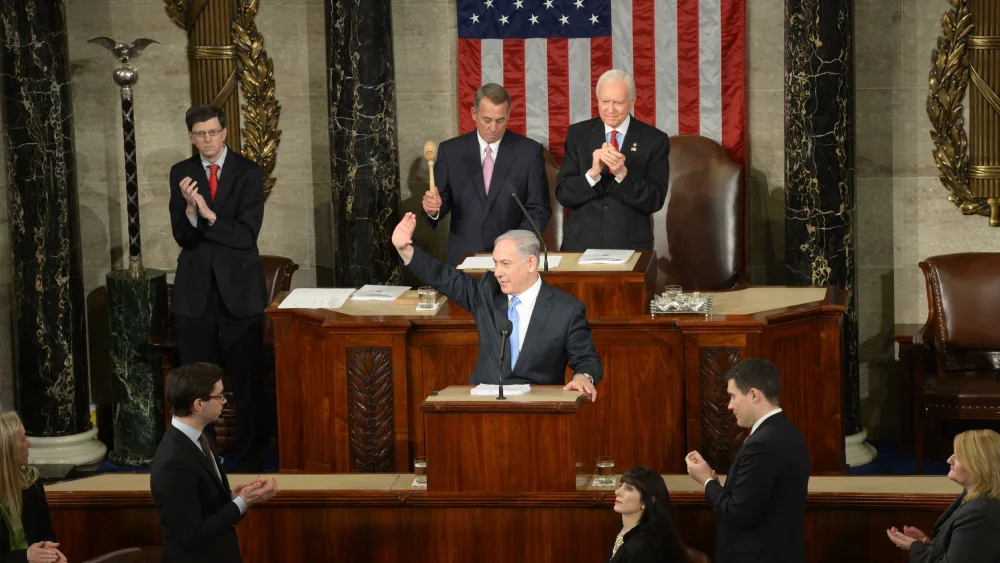
 

Netanyahu Congress joint session
Israeli Prime Minister Benjamin Netanyahu waves to the crowd during his address to a joint session of Congress in Washington, March 3, 2015. Photo by Amos Ben Gershom/GPO.

In the never-ending churning of news cycles, commentators and the public alike are always ready to overreact to each aspect of every story as they roll out. Under these circumstances, historical perspective is rarely part of anyone’s understanding of events. This was amply illustrated by the discussion about the United States signing a Memorandum of Understanding with Iran.

The deal, whose terms were at first kept secret and have since been revealed, will conclude, at least for the next 60 days, the war America and Israel waged on Tehran starting on Feb. 28.

Hysteria about the implications of the deal for Israel, which was cut out of the negotiations over the agreement, is probably unwise. It’s not clear how much of the Jewish state’s freedom of action to defend itself against Iran, as well as its Hezbollah auxiliaries in Lebanon and Hamas in Gaza, will be curtailed. Nor can we know for sure what President Donald Trump will do in the immediate future.

Trump’s priorities
His desire to end the fighting and for the renewed flow of oil to lower gas prices at the pump appears to be his main priority. For the moment, that seems to outweigh concerns about his desperation to get a deal that will accomplish these goals, which led him to strike a bargain that bears a troubling resemblance to the one former President Barack Obama concluded with Tehran in 2015.

Trump can always change his mind about that and order strikes once it becomes clear—as anyone who knows anything about the subject understands—that Iran’s leaders have no intention of keeping their word about not acquiring a nuclear weapon. Though his public comments about the agreement make that seem highly unlikely, given the president’s panic about his sinking poll numbers linked to the rise in gas prices. But it’s still theoretically possible. It’s also a dead certainty that it will continue its buildup of missiles and terrorism that threaten its neighbors and the West.

There is one thing, however, that can be said with absolute certainty about the current situation. Now that we know the deal is as bad as many feared, those who speak up against it are not only in no position to stop or even slow the process down. They will also be far more isolated than those who opposed Obama’s deal.

Simply put, unlike the situation 11 years ago—when a broad coalition of Democratic security hawks, Republicans and pro-Israel advocates spoke up against Obama’s disastrous Joint Comprehensive Plan of Action—critics of Trump’s Iran deal will be limited to the pro-Israel community. And they are likely to stand alone.

Unpersuasive advocates
Trump and Vice President JD Vance have been doing their best to fend off criticism of their decision to end the war with what the former described as a “peace deal” with the Islamist terror regime. That effort was undermined by their initial unwillingness to reveal details of the agreement—something that Vance claimed was due to sensitivities in the Muslim world, an excuse that raised even more concerns about its implications.

Trump’s supporters have been telling everyone who has criticized the deal in the days since it was announced to take a deep breath, and to wait and see what happens. There’s a certain logic to that. The structure of the accord appears to hinge on what will happen during a 60-day period when America lifts its blockade of Iranian ports so Tehran stops menacing shipping in the Strait of Hormuz. Yet now that the details are known—with unfrozen funds already flowing to Iran, no mention of Iranian missiles and terrorism in it, and no mechanism, other than a resumption of the war, to prevent a regime that can claim it forced Trump to back down from resuming its march to a nuclear weapon—optimism about it seems deeply unpersuasive.

In theory, Trump could reverse his decision, and sensible observers should not abandon all hope that he will. Accepting a terrible deal—and the terms of the agreement make it clear that the United States is doing almost all of the giving and Iran nearly all of the taking—would be out of character for a man who thinks of himself as having mastered “the art of the deal.”

With Trump’s characteristic hyperbole, he has characterized the results of the indirect negotiations conducted by Middle East special envoy Steve Witkoff and adviser/son-in-law Jared Kushner in flattering terms. He has even declared the Iranian negotiators to be “rational people” who are “nice to deal with,” even though the desperate-for-a-deal-at-any-price duo never actually sat down with them. But the man who spent the last decade rightly mocking Obama and his negotiators for their weakness and gullibility ought to be ashamed of accepting terms that seem to depend on Iran’s goodwill and trustworthiness.

Trump’s critics should acknowledge that not only is the current president far preferable to his Democratic predecessors or to any Democratic Party alternative when it comes to his approach to the Middle East and Israel. They should be equally willing to speak of the damage done to Iran’s military, nuclear and missile programs, and other war-making infrastructure both as part of the 12-day war last June and from the fighting since Feb. 28. The ability of a government that has been at war with the United States, Israel and the West since 1979 to inflict terror on the region and the rest of the world has been set back, perhaps by years.

At the same time, Israel is far stronger vis-à-vis its Islamist foes than it was on Oct. 6, 2023, before the Iranians and their allies launched their cruel war on the Jewish state with the atrocities of Oct. 7.

Still, it appears that Trump has kicked the can down the road with respect to ending the threat from Iran. And it is also almost certainly true that despite raising the hopes of Iran’s tortured people, he has nevertheless ensured the survival of a despotic regime that murdered tens of thousands of them in January. This means that the long war Iran has been waging on America, Israel and the West will continue. It will doom the world to years of more terrorism and the ever-present threat that it will be able to acquire the ability to inflict mass destruction on the Jewish state and moderate Arab countries that oppose it.

As such, this agreement deserves to be vigorously debated. And, to his credit, Trump has offered to submit any deal to Congress for its approval.

If so, that will make it equally clear that the political correlation of forces with respect to Iran is now very different from the situation in 2015 when Obama rammed his catastrophic JCPOA down the throats of an unwilling Congress and American people.

The JCPOA was unpopular
It should be recalled that Obama’s Iran policy was deeply unpopular. A Pew Research Institute poll taken in September 2015 showed that the Iran deal was opposed by a large plurality of Americans, with 49% opposing it and only 21% in favor, with 30% saying they did not know (an unsurprising result given that most Americans pay little attention to most foreign-policy issues). And the more Americans knew about the agreement, the less they liked it, something indicated by the fact that opposition to the deal increased over the course of the year.

Majorities in both Houses of Congress also opposed the JCPOA.

It was only approved by a sleight-of-hand bargain in which Obama and Sen. Bob Corker (R-Tenn.), the feckless Republican who chaired the Senate Foreign Relations Committee, agreed that it would be put to a vote, which required a two-thirds majority to kill it. This was the opposite of the constitutional requirement for a two-thirds majority to pass a treaty. The House voted 269-162 (with 244 Republicans and 25 Democrats voting no) not to approve the JCPOA, with an equally large majority in the Senate also ready to vote against it. But since that fell short of a super-majority, Obama’s signature foreign-policy “achievement” that guaranteed that Iran would eventually get a nuclear weapon snuck through.

Trump won’t have to resort to those kinds of legislative tricks.

More to the point, the party opposed to the sitting president will play a very different role in 2026 than it did in 2015.

11 years makes a big difference
A decade ago, Congressional Republicans were united against the Iran deal while Democrats were split on it. The GOP even went so far as to invite Israeli Prime Minister Benjamin Netanyahu to address a joint meeting of Congress that year, during which he gave an unprecedented address in which he urged its members to oppose Obama’s effort to enrich and empower an Iranian regime that threatened the United States as much as Israel.

It was only by making support for the measure a litmus test of loyalty to himself that Obama was able to rally most Democrats behind a policy of appeasement that all but the most hard-core left-wingers in the party had opposed only a couple of years earlier. In 2015, there were still pro-Israel Democrats willing to speak up against Obama, even though most of those who had once claimed that title, like Sens. Chuck Schumer (D-N.Y.) and Corey Booker (D-N.J.), failed to maintain that stance when push came to shove.

If anything, the current Democratic caucuses will be even more eager to terminate the war and appease Iran than they were then. While members of the opposition to the administration would seize on any pretext to thwart Trump, he can rely on them to support an end to the war. They will also be eager to do something that will be perceived as undermining Israel’s security.

By contrast, the House and Senate GOP caucuses today are, as they were in 2015, almost uniformly pro-Israel and hawkish on Iran, with only outliers like lame-duck Rep. Thomas Massie (R-Ky.) and his fellow libertarian Sen. Rand Paul (R-Ky.), the rare exceptions to that rule.

What will Republicans do?
That said, how many pro-Israel Republicans will vote against Trump on his Iran deal?

Doing so will not only require the temerity to oppose a president who doesn’t lightly brook opposition and often gets even with those who do so, no matter how long it takes. It will also mean risking being portrayed as warmongers or advocates for a policy that would raise gas prices. It’s far from clear that even the most ardent supporters of a strong Israel and those most interested in stopping Iran would think it wise to try to thwart Trump from ending a deeply unpopular war, even if it is clearly in America’s best interests.

Nor does it require much of an imagination to predict what Trump’s reaction would be to Netanyahu or any other Israeli or pro-Israel organization that advocated for Congress to turn down his version of Iran appeasement, as they did in 2015. It would make Obama’s spiteful attacks on those who opposed him on this issue seem quite tame by comparison.

Thus, while Israel’s strategic position in the Middle East is far stronger than it was in 2015, in the United States, opposition to an appeasement of Iran on Trump’s part would be minimal. Those voices decrying a deal that trusted Iran to keep its word or which would depend on an unlikely decision by this president or one of his successors to resort to the use of force against the Islamist regime would find themselves largely alone, abandoned by Republican friends and mocked by Democratic foes.

Don’t blame Netanyahu
There will be those who will blame this predicament on Netanyahu. His domestic opponents will claim that he depended too heavily on Trump’s friendship for Israel and that of the Republicans. And they will say he alienated Democrats.

This is both untrue and deeply unfair. Whatever one might say about Netanyahu when it comes to navigating the political landscape of his country’s sole superpower ally, the current alignment has little or nothing to do with his unpopularity in the United States or his judgment.

The drift by Democrats away from Israel is the result of the growing influence of toxic left-wing ideologies that falsely label it as a “white” oppressor state. Their willingness to accept and spread blood libels about Israel committing “genocide” in Gaza is not the product of Israeli behavior, but of the hijacking of the Democratic Party by antisemitic progressives. The prime minister had no chance of preserving a pro-Israel Democratic Party; the same would have been true of any Israeli leader.

That means that Israel and its friends are in a position where they have no choice but to rely on pro-Israel Republicans to preserve the alliance. That worked wonderfully so long as Trump was behaving—as he has done during the first five-and-a-half years of his two terms—as the most pro-Israel president since the founding of the modern Jewish state. But with Trump adopting a more equivocal stand in which he may be waving the white flag on Iran and bristling with resentment at Netanyahu’s refusal to stop defending his citizens, that leaves supporters of Israel isolated in the United States on this issue.

We must hope that it doesn’t come to that—and that Trump isn’t willing to go on deceiving himself and the American people about the dubious prospects for a policy that will preserve the despotic regime in Tehran and ensure that there will be more Middle East wars and bloodshed in the coming years.

But if he is determined to stand by his own Iran deal, it won’t just signal that the aggressive presidency of the past 17 months is about to become a lame-duck administration, even before the outcome of the midterm elections is known. It will also mean that Israel and its friends will largely stand alone when it comes to the debate about this latest appeasement of the Islamist regime of Iran that Trump has given a new lease on life. 


Jonathan S. Tobin is editor-in-chief of the Jerusalem News Syndicate, a senior contributor for The Federalist, a columnist for Newsweek and a contributor to many other publications. He covers the American political scene, foreign policy, the U.S.-Israel relationship, Middle East diplomacy, the Jewish world and the arts. He hosts the JNS “Think Twice” podcast, both the weekly video program and the “Jonathan Tobin Daily” program, which are available on all major audio platforms and YouTube. Previously, he was executive editor, then senior online editor and chief political blogger, for Commentary magazine. Before that, he was editor-in-chief of The Jewish Exponent in Philadelphia and editor of the Connecticut Jewish Ledger. He has won more than 60 awards for commentary, art criticism and other writing. He appears regularly on television, commenting on politics and foreign policy. Born in New York City, he studied history at Columbia University.

Source: https://www.jns.org/opinion/column/jonathan-s-tobin/who-will-stand-with-israel-against-a-new-iran-deal

Follow Middle East and Terrorism on Twitter

Military correspondents contradict Defense Minister Katz - Israel National News


by Israel National News

After Katz claimed there are no restrictions on IDF operations in Lebanon, military correspondents presented a starkly different picture: 'The rules of engagement in Lebanon are putting IDF forces at risk.'


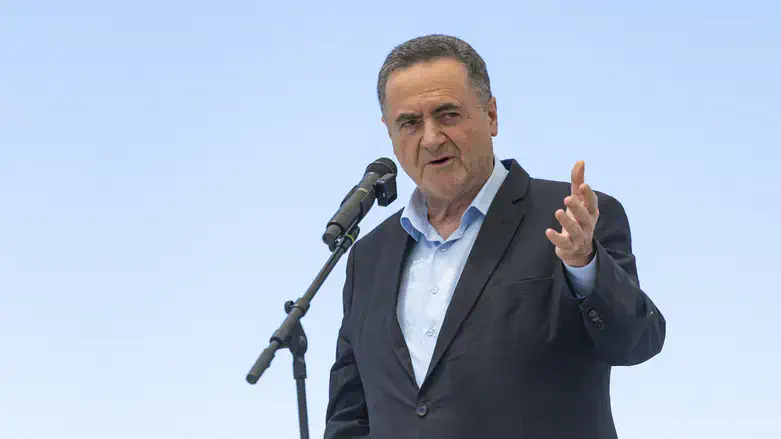
Defense Minister Israel Katz
Defense Minister Israel Katz                                                            Chaim Goldberg/Flash90

After Defense Minister Israel Katz declared that there "have never been any restrictions" on IDF troops operating in Lebanon to eliminate threats, several prominent Israeli military journalists publicly challenged his remarks on Sunday, arguing that the operational reality on the ground tells a different story.

Kan News military correspondent Roy Sharon sharply criticized the minister's statement, calling it a "bluff that endangers IDF forces in southern Lebanon."

"Removing an immediate threat is never restricted, in any sector, for any armed soldier," Sharon wrote. "But opening fire solely to remove an immediate threat-which is what the IDF is currently permitted to do-is self-defense. That's a major restriction, and you cannot fight this way in enemy territory."

Galei Tzahal military correspondent Doron Kadosh painted an even harsher picture, arguing that the situation on the ground differs significantly from the one described by Katz.

"What the Defense Minister isn't telling you," Kadosh wrote, "is that in practice, IDF soldiers in Lebanon are forced to wait for a threat to reach them before they are allowed to eliminate it."

According to Kadosh, troops may kill a terrorist approaching their position or strike a rocket moments before launch, but they are not authorized to target command centers or infrastructure where future threats are being prepared.

"If the terrorist is sitting in a command center in Nabatieh or Tyre, that isn't considered 'removing threats.' If Hezbollah is currently manufacturing 1,000 new rockets in an underground facility in the Beqaa Valley, that also isn't considered 'removing threats,'" he wrote.

Kadosh accused the Defense Minister of presenting an "alternative reality," adding that "there are restrictions on the use of fire by IDF forces in Lebanon-fairly severe restrictions imposed by Prime Minister Benjamin Netanyahu and Defense Minister Katz. That is the truth."

He further warned that "this situation is dangerous, and it must be stated plainly: the IDF's rules of engagement in Lebanon, imposed by the political echelon because of diplomatic constraints and American pressure, are putting IDF forces in southern Lebanon at risk. The warning signs are on the wall."

Political commentator Amit Segal also questioned Katz's statement, saying reports from soldiers serving along the "Yellow Line" do not match the Defense Minister's account.

"Soldiers on the Yellow Line describe a completely different reality," Segal wrote, "in which approval from the highest levels is required to act against terrorists observing them or against suspicious movements." 


Israel National News

Source: https://www.israelnationalnews.com/news/428957

Follow Middle East and Terrorism on Twitter
Paris bans rally as Iranian dissidents accuse France of bowing to Tehran - Eric J. Lyman


by Eric J. Lyman

Critics said the cancellation of the massive anti-Iran protest in Paris was the result of the French government "bowing" to pressure from Iran.


Tens of thousands of Iranian dissidents gathered Saturday in Paris for a demonstration that was supposed to be filled with historic symbolism: a city synonymous with revolution and resistance hosting a massive call for the oppressive regime in Iran to be toppled.

Instead, French authorities banned the march.

The result was a confrontation that transformed the annual gathering of the world’s largest Iranian dissident group into a debate about France and whether the government of President Emmanuel Macron yielded to security fears or pressure from Tehran. 

Former British Prime Minister Boris Johnson, one of the central speakers at the rally organized by the People’s Mojahedin Organization of Iran, better known as MEK, used his remarks to criticize France for making what he called a “tragic mistake” by canceling the demonstration, which was intended to be the first large-scale MEK gathering since the start of the Israel- and U.S.-led conflict with Iran earlier this year.

“If the voices of freedom are to be heard in Iran, then we in the West must allow those voices of freedom to be heard in our capitals and around the world,” Johnson told attendees, adding that he was “shocked and disappointed” by the decision to cancel the rally. 

Johnson brushed aside official French explanations that the rally was canceled because of extreme heat or possible counterdemonstrations, instead accusing France of “bowing cravenly and capitulating” to Tehran by preventing the opposition from holding the public demonstration organizers had been planning for months. 

According to MEK officials, French authorities initially granted permission for the march, then withdrew it shortly before the start. Organizers appealed, but the court upheld the ban after what MEK said were as many as 50,000 participants had already arrived in the French capital, and thousands more were reportedly turned away at Paris' airports.

Despite the ruling, "several hundred" demonstrators still gathered near the planned rally site, Place Vauban, according to news reports. MEK officials said police used force against peaceful participants, including elderly demonstrators and children, preventing them from assembling. 

News reports said that French authorities said the ban was imposed for security reasons, while the French Ministry of Foreign Affairs denied the decision was the result of pressure from the Iranian regime. 

MEK sources said at least 20 people were arrested and many more were injured, several of them badly.

Paris city hall and the ministry did not immediately return calls from Just the News seeking comment.

The confrontation gave added force to the message from Maryam Rajavi, president-elect of the National Council of Resistance of Iran, the political arm of the MEK. Rajavi said that Western governments have too often chosen either appeasement or military intervention rather than supporting an organized democratic opposition. 

“The overthrow of this regime is the responsibility of the Iranian people and their organized resistance,” Rajavi said. “No one else can accomplish this task on their behalf.”

Rajavi rejected both continued clerical rule in Iran and a return to monarchy, referring to Reza Pahlavi, son of the Iranian shah, who was overthrown in 1979. She repeated her belief that Iran should move toward becoming a democratic republic through a provisional government that would organize free elections for a national assembly within six months. 

Iranians in late 2015 began organizing against the Iranian authoritarian government largely over the country's struggling economy, and more specifically its currency. By February, the street demonstrations that started in Tehran's Grand Bazaar had spread across the country, which resulted in a violent military crackdown that killed thousands. 

The U.S. has so far in its war with Iran – whose end is now being negotiated – has thus far had no interest in regime change and is not expected to change that position.

Other speakers Friday framed Iran’s struggle as part of a wider confrontation between democratic movements and authoritarian regimes. 

Former Ukrainian Minister of Foreign Affairs Dmytro Kuleba made the link between Tehran’s domestic repression to its support for Russia in that country’s war with Ukraine, saying that Ukrainians understood the pressure of being attacked by a regime that “deceives, threatens, kills, tortures, and has no moral limits.”

Former European Council President Charles Michel gave a similar warning from a European perspective, arguing that “appeasement of dictatorship does not work.”

The choice of Paris for the rally carried revolutionary symbolism, dating from France’s strong backing of the U.S. revolutionary war and the French Revolution in the 18th Century to the recent signing of the memorandum of understanding between the U.S. and Iran at Versailles, near Paris, just days earlier and that led to a brief reopening of the Strait of Hormuz

The two-day gathering in France, which includes speeches from former heads of state and government, ministers and cabinet secretaries, parliamentarians, and military commanders. 


Eric J. Lyman

Source: https://justthenews.com/world/paris-bans-rally-iranian-dissidents-accuse-france-bowing-tehran

Follow Middle East and Terrorism on Twitter
UK Prime Minister Starmer considering resignation following another big election loss - Joseph Weber


by Joseph Weber

Calls for Starmer's resignation within his Labour Party started historic losses last month in local election across England, Scotland and Wales.


British Prime Minister Keir Starmer is reportedly considering resigning following a series of electoral losses, most recently political rival Andy Burnham on Friday winning a seat in Parliament, putting him in position to mount a formal leadership challenge.

Starmer considering whether to step down was first reported by the British newspaper The Observer.

He is reportedly talking about the matter with his wife and purportedly could make an announcement as early as this week. However, other news reports say he doesn't plan to resign or set out a timetable for a resignation.

Calls for his resignation within his Labour Party started historic losses last month in local elections across England, Scotland and Wales. 

In addition, Parliamentary aides resigned and called for Starmer's resignation on his own timetable.

However, he said at the time: "I’ve said repeatedly I’m not going to walk away ... ." 

Starmer has led the Labour Party since 2020 and became prime minister in 2024, according to FoxNews.com. 


Joseph Weber

Source: https://justthenews.com/politics-policy/elections/uk-prime-minister-starmer-considering-resignation-following-another-big

Follow Middle East and Terrorism on Twitter
Illegal immigrants across U.S. get financial aid for college - Esther Wickham


by Esther Wickham

Increased spending is heating up debate over who should receive state taxpayers-funded higher education benefits.


(The Center Square) -

State financial aid continues to expand within higher education, allowing money to go to eligible illegal immigrant students.

The increased spending is heating up debate over who should receive state taxpayers-funded higher education benefits.

Currently, around 21 states and the District of Columbia offer in-state tuition eligibility to certain illegal immigrant students, and 18 states and D.C. provide access to state financial aid programs, according to Higher Ed immigration.

For example, at a University of California school, the base in-state tuition is roughly $15,000 annually. For nonresidents, the base tuition is over $31,000, which means eligible illegal immigrants are essentially receiving $16,000 a year in aid.

The policies are part of a broader effort that has expanded over the past two decades to increase college access for immigrant students, including recipients of the Deferred Action for Childhood Arrivals program. DACA provides temporary protection from deportation and renewable work permits to certain immigrants who were brought to the U.S. as children.

More than 900,000 of these individuals are estimated to be eligible for DACA. In addition, over 500,000 illegal immigrant students are enrolled in U.S. colleges and universities.

Critics argue that the programs impose costs on taxpayers and divert limited higher education resources away from U.S. citizens.

A 2025 report by the Federation for American Immigration Reform estimated that education-related expenses associated with illegal immigration total $5.7 billion nationally.

Ira Mehlman, media director for FAIR, pointed to the 1996 Illegal Immigration Reform and Immigrant Responsibility Act, which specifically created a provision requiring any state offering in-state tuition rates to illegal immigrants to make the same benefit available to U.S. citizen students, regardless of which state they happen to live in.

States keep “finding new ways to provide benefits to illegal aliens,” Mehlman told The Center Square. “A lot of American students are being shut out of those state universities because those seats are now occupied by illegal aliens, and then taxpayers are being forced to pay for it.”

Texas pioneered this loophole that conditioned in-state tuition on having completed three years of high school in the state rather than looking at immigration status, Mehlman added.

Texas became the first state to adopt such a policy in 2001 through what became known as the Texas Dream Act.

In June 2025, the U.S. Department of Justice sued Texas, arguing the program violated federal law. A federal court subsequently blocked enforcement of the Texas Dream Act. The lawsuit is currently on appeal at the U.S. District Court for the Northern District of Texas.

Advocacy groups have sought to intervene, arguing the case was resolved without sufficient judicial review.

In Texas, state records show that colleges and universities distributed $635.2 million in state-funded gift aid to 133,989 students in 2023. According to a report by Every Texan, 3,566 Texas Dream Act students received $17.5 million in state-supported grants, accounting for less than 3% of total state gift aid distributed that year.

The taxpayer cost associated with the Development, Relief and Education for Alien Minors or DREAM Act program and others varies by state.

Lance Izumi, senior director of education studies at Pasadena-based Pacific Research Institute, argued that taxpayer-funded aid for illegal immigrant students raises concerns about fairness and state spending priorities.

"Government financial aid to illegal immigrant students is wrong on three counts: fairness, fiscal policy and planning for higher education's future," Izumi told The Center Square.

Izumi noted that American students collectively hold roughly $1.8 trillion in student loan debt and argued that taxpayer-funded scholarships for illegal immigrant students may reduce resources available for citizens.

"It is also not fair to give lower in-state tuition to an illegal immigrant who broke the law to enter this country, while denying that lower tuition to a law-abiding American citizen in another state," he said.

Izumi also questioned whether colleges facing enrollment declines have expanded outreach to Illegal immigrant students, partly to offset falling student populations.

“In reality, pushing illegal-immigrant enrollment is a way for adults in higher education to save their jobs by finding a new pool of potential students rather than addressing the core reasons for falling college enrollment: politicization of courses, economic irrelevance of many courses and majors, and deteriorating academic rigor,” Izumi said.

Kassandra Gonzalez, senior attorney with the Texas Civil Rights Project's Beyond Borders Program, working on the Texas lawsuit, told The Center Square that the issue is complicated because there is a distinction between immigrants who are "lawfully present" and those who have "lawful status."

“The misinformation and the frankly wrong narrative of this idea that dreamers or students who are able to take higher education with the Dream Act are taking opportunities from others is not the reality of economics,” Gonzalez said.

Immigrant students contribute to local economies and give back to their communities, Gonzalez added.

“I think the fiction that we hear in the immigration debate in general, like, ‘Oh, well, they're taking something from someone else,’ I always go back to, well, this idea that they don't pay taxes, or that these students aren't contributing. It's like there's actual data that they are giving back to the economy of Texas,” Gonzalez added.

According to Every Texan, immigrants in Texas who hold bachelor's degrees earn substantially higher incomes than those with only high school diplomas. The organization estimates that the higher earnings associated with a college degree generate additional state and local tax revenue.

The Every Texan report estimated that Texas Dream Act students enrolled in 2023 could ultimately generate more than $43 million in additional annual state and local tax revenue through higher educational attainment and earnings.

According to the California Budget and Policy Center, illegal immigrants paid an estimated $8.5 billion in state and local taxes in 2022.

That same year, California residents paid an average of $3,734.82 in state income taxes. With roughly 19.6 million taxpaying residents, that equates to about $73.2 billion in state income tax revenue, not including sales taxes or higher-income tax brackets.

Mehlman told The Center Square that tax payments do not place illegal immigrants with citizens when it comes to public benefits.

Just because illegal immigrants pay taxes, “that doesn’t put them on an equal footing with legal residents and citizens,” Mehlman said.

Along with Texas, several other states have expanded access to higher-education assistance in recent years.

California, Colorado, Connecticut, the District of Columbia, Hawaii, Illinois, Maryland, Massachusetts, Minnesota, Nevada, New Jersey, New Mexico, New York, Oregon, Rhode Island, Utah, Vermont, Virginia and Washington are among the jurisdictions that provide broad access to state financial aid and grant programs for illegal immigrant students who meet applicable eligibility requirements.

In New York, lawmakers enacted the José Peralta New York State DREAM Act, expanding access to state financial aid for eligible illegal immigrant students. The DREAM Act allows immigrant students to apply for state financial aid for undergraduate or graduate study at eligible colleges and universities.

The state's 2019-20 budget, when it was first enacted, included $27 million to support implementation of the DREAM Act.

New York is home to an estimated 21,250 Deferred Action for Childhood Arrivals, or DACA, recipients.

Through the DREAM Act, eligible illegal immigrant students may receive awards through the state's Tuition Assistance Program, which provides up to $5,665 annually.

For the 2025–26 budget, TAP alone provides more than $698 million annually to roughly 255,000 New York students. DREAM Act recipients are funded through these broader aid programs rather than through a standalone DREAM Act appropriation.

A New York City fact sheet reported that individuals eligible for the DREAM Act contributed an estimated $1.3 billion to the city's gross domestic product in 2017 and earned more than $873 million collectively, with average annual earnings of about $18,600.

In Illinois, access to state financial aid through House Bill 460 was signed into law by the Gov. J.B. Pritzker in December 2025.

The bill added in the Retention of Illinois Students and Equity Act, allowing eligible illegal immigrant students to apply for state-administered financial aid programs regardless of immigration status.

The change made illegal immigrant students eligible for state programs such as the Monetary Award Program grant, which provides need-based financial assistance for higher education.

Illinois allocated over $700 million for MAP grants during the 2024 fiscal year.

The states of Alabama, Georgia and South Carolina prohibit enrollment of illegal immigrant students into state financial aid programs, according to Higher Ed Immigration.

The Center Square reached out to the American Immigration Council and the U.S. Department of Education for comment but did not receive a response. 


Esther Wickham

Source: https://justthenews.com/nation/states/center-square/illegal-immigrants-across-us-get-financial-aid-college

Follow Middle East and Terrorism on Twitter

The Solstice of Our Discontent - Roger Kimball


by Roger Kimball

The consequences of history often arrive like starlight: events unfold in real time, but their true significance can take years to reach us.


I don’t recall exactly when it was that I learned that it took a bit more than eight minutes for the sun’s light to reach us here on Earth. Sometime before high school, I think. Anyway, that pedestrian fact made a deep impression on me. I knew that light traveled at a fixed speed and that its operation wasn’t (quite) instantaneous, although in our quotidian lives, it seemed almost so.

But the fact that the sunlight we see all about us is eight minutes old made a deep and disconcerting impression on my young self. Who knows what might have happened to the Sun in the meantime?

I began researching this phenomenon and was duly impressed by the awful (in the old sense) immensity of things. The sun’s light, traveling some 93 million miles, takes 8.3 minutes to arrive here.

Light from the Orion Nebula, wherever that is, takes about 1,500 years to reach us. Light from the Andromeda Galaxy takes 2.5 million years. Then, there are the lights from long-dead stars glimpsed by that astronomical peeping tom, the Hubble Telescope.

Until recently, the oldest light glimpsed was from a defunct star called Icarus. It shone when the universe was about 9.5 billion years old. A few years back, Hubble registered light from a star called Earendel, which flickered 12.9 billion years ago, when the universe was a mere 6 percent of its current age.

These are stupefying, incomprehensible numbers.

Blaise Pascal touched on the psychological—or is it the ontological?—coefficient of such contemplations in his Pensées. “Quand je considère la courte durée de ma vie, absorbée dans l’éternité précédente et suivante, le petit espace que je remplis, et même que je vois, abîmé dans l’infini immensité des espaces que j’ignore et qui m’ignorent, je m’effraie . . .” (“When I consider the short duration of my life, swallowed up in an eternity before and after, the little space I fill engulfed in the infinite immensity of spaces whereof I know nothing, and which know nothing of me, I am terrified.”)

Nietzsche gave tart expression to the physical reality behind Pascal’s anxiety in his remarkable early essay “On Truth and Lie in an Extra-Moral Sense.” “Once upon a time, in some out of the way corner of that universe which is dispersed into numberless twinkling solar systems, there was a star upon which clever beasts invented knowing,” he wrote. “That was the most arrogant and mendacious minute of ‘world history,’ but nevertheless it was only a minute. After nature had drawn a few breaths, the star cooled and congealed, and the clever beasts had to die.”

Such cosmic expressions of metaphysical angst have an aspect of adolescent self-indulgence about them. As Jeeves observed to Bertie Wooster, there’s something “fundamentally unsound” about Nietzsche.

Still, since 2026 began with some big bangs—ask Nicolás Maduro about the bang in Caracas, ask the Ayatollah Ali Khamenei (if you can find him) about the bang in Tehran—it is worth pondering some local, pedestrian ways in which things that have already happened may finally reveal themselves in their true significance. Gregory of Tours (ca. 539–94) began his sprawling History of the Franks with one of the most irrefragable sentences vouchsafed to humanity: “A great many things keep happening, some of them good, some of them bad.”

Here we are at the summer solstice, the halfway point of the year, and many things have happened, some good, some bad, and some, like the light emanating from a distant star, delayed in reaching us.

The year opened with Operation Absolute Resolve, the stunning military operation that simultaneously extracted Maduro from his fortified palace in Caracas, opened up Venezuelan oil to the U.S., and denied terrorist groups from Hamas, China, and Iran a safe haven in Venezuela. We are already feeling some of the benefits of that operation, but its full significance will, like distant starlight, take months or years to become fully manifest.

It is the same with the effects of Operation Epic Fury. In some 30 days, Trump destroyed Iran’s navy, its air force and air defense network, huge swaths of its drone and ballistic missile stockpile, and most of its military industrial infrastructure. He also eliminated Iran’s top leadership twice over, beginning with its Supreme Leader Ayatollah Khamenei, who was incinerated in the opening moments of the war. Trump and Secretary of the Treasury Scott Bessent mounted a concerted economic assault on Iran, depriving the murderous regime of some $500 million a day, partly in lost oil revenue, partly through Bessent’s pursuit of the leadership’s foreign accounts. In brief, Operation Epic Fury, in partnership with Israel’s Operation Roaring Lion, was perhaps the most successful military operation in history. As Mark Thiessen noted, “No president in 47 years has done more damage to the Iranian regime than Trump has.”

That news hasn’t filtered through the anti-Trump scrims that surround the legacy media. For them, destroying Iran’s military capability and eliminating its leadership counts as “capitulation.” That is a prominent meme in the bustling bazaar of anti-Trump static. Regarding the “Memorandum of Understanding” that is still being hammered out, Trump himself noted its provisional nature. “It’s a memorandum of understanding,” he said with some exasperation, “and if I don’t like it we’ll go back to shooting at them and dropping bombs on their head.”

Similarly, the fact that Trump has been a better friend to Israel than any previous U.S. president is suddenly recast as a betrayal of Israel. The hysteria is remarkable.

I thought that Mark Zell, Chairman of Republicans Overseas Israel, provided a useful corrective. In one post, he listed 40-odd things that Trump has done in his five and a half years as president to benefit Israel. In another post, he began by noting that “President Trump has not flipped or abandoned Israel. His support for the Jewish State and the Jewish People is incontestable.” He went on to make two important points. One, Trump’s exclusion of Israel from the Memorandum of Understanding was not (as some are claiming) a slight to Israel but rather a gift that “gives Israel a free hand to protect its vital national security interests in Lebanon, Syria, and even Iran.” Two, while admitting that there are aspects of the MOU that he doesn’t like, Zell also insisted that Trump is dealing with the political reality of an impending election. “President Trump,” Zell noted,

has decided that winning the November midterms and preventing the Dems from taking control of Congress is of paramount importance given the certainty that if this were to happen the opposition will seek to impeach him and derail his administration’s foreign and domestic policies for the balance of his second term.

That seems right to me. The “bottom line,” Zell concluded, is that “the relationship between Israel and the U.S. is strong and inviolable. Israel will protect its interests and so will the U.S. protect the American public, including 750,000 U.S. citizens in Israel.”

It may take a while for the light generated by these episodes to arrive in the tenebrous redoubts of anti-Trump animus. When it does, expect the anti-Trump zealots to blink and rub their eyes while looking around for additional reasons to repudiate their greatest benefactor. 


Roger Kimballl is editor and publisher of The New Criterion and the president and publisher of Encounter Books. He is the author and editor of many books, including The Fortunes of Permanence: Culture and Anarchy in an Age of Amnesia (St. Augustine's Press), The Rape of the Masters (Encounter), Lives of the Mind: The Use and Abuse of Intelligence from Hegel to Wodehouse (Ivan R. Dee), and Art's Prospect: The Challenge of Tradition in an Age of Celebrity (Ivan R. Dee). Most recently, he edited and contributed to Where Next? Western Civilization at the Crossroads (Encounter) and contributed to Against the Great Reset: Eighteen Theses Contra the New World Order (Bombardier).

Source: https://amgreatness.com/2026/06/21/the-solstice-of-our-discontent/

Follow Middle East and Terrorism on Twitter

COVID vaccine only 6.2% effective against 'major adverse cardiac events' in veterans: VA study - Greg Piper


by Greg Piper

Mainstream media, former surgeon general hype "nearly 40 percent" reduction in heart problems related to COVID itself, ignoring that it's only 1% of heart problems in study, and Washington Post botches core finding itself.


The COVID-19 vaccination rate ranges from 1-in-10 for children and pregnant women to 1-in-6 for adults, according to Centers for Disease Control and Prevention estimates, suggesting the heyday has long passed for jabs known immediately by President Biden's CDC to not completely stopping infection or transmission and yet portrayed as bulletproof the next two years.

The medical establishment and mainstream media continue hyping the protective abilities of the jabs based on research they may have misread or misrepresented, however.

Last season's immunizations worked wonders for veterans' heart health, according to Department of Veterans Affairs research published Monday in the Journal of the American Medical Association Internal Medicine.

Among more than a million vets who received a flu vaccine, those who also received a COVID vaccine – about a third – saw a 37.7% lower risk of "COVID-19–associated MACE," or major adverse cardiac events, according to the first result in the study, used in JAMA IM's social media. The abstract also touts a 23.7% "risk difference for all-cause MACE."


What the study buries: COVID-associated MACE was only 1% of all MACE, drastically limiting the benefit, and COVID vaccine effectiveness against MACE as a whole was only 6.2% and slightly better against hospitalization (6.6%) and death (7.1%). 

It would take 10,000 vaccinations to eliminate two COVID-associated MACE cases, the authors acknowledge, repeatedly calling that benefit "modest" and also describing the "absolute benefit" of COVID vaccination as "modest for the general cohort."

Both general and medical news publications ran with the "nearly 40 percent" COVID-related reduction, as The Washington Post phrased it, and ignored or buried the caveats in the study, including the lack of statistical significance in that finding for ages 75 and under.

Critics were quick to point out the treatment and control groups didn't appear to be well-matched, implying the former was healthier overall, and that the Post botched the core findings, overstating what the researchers said they found by more than sixfold.

Epidemiologist Vinay Prasad, who returned to the University of California San Francisco this spring after a contentious year as the Trump administration's top vaccine regulator, dug into the supplemental tables and found data that "invalidates the entire paper."

As an observational study rather than a randomized controlled trial, the researchers needed to create "two comparable groups whose only difference was COVID-19 vaccine receipt," but the supplemental data show they failed, Prasad wrote in his newsletter Tuesday.

"All cause mortality curves separate by day 10. That is simply impossibly fast," he said. "The MACE separates by week 5, and the all cause death separates by week 2. The only explanation is that the no vaccine group is fundamentally different from the outset of the study."

The Sensible Medicine newsletter, to which Prasad contributes, reiterated that the outcome could represent only the "healthy vaccinee effect," the well-documented phenomenon of healthier people being more likely to seek vaccination. "JAMA IM editor & peer review fail."

The journal even published a Prasad opinion three years ago on interventions that "work too fast," illustrating selection bias, as did the New England Journal of Medicine when Prasad and his more recently departed FDA colleague Tracy Beth Hoeg challenged a COVID booster study as possibly tainted by healthy vaccinee bias.

The Post prominently bungled the "nearly 40 percent" reduction in the subheadline for its report, incorrectly claiming the study found it applied to "events like heart attack and stroke," not just COVID-associated MACE. (The body of the article specifies this finding as MACE "linked to covid-19," suggesting an editor's mistake.)

Former Surgeon General Jerome Adams, who served in President Trump's first term, shared the Post's social media post about the study, which put the false claim in the image but the correct phrasing in the text itself.

"Given the clear evidence linking COVID vaccination to better CV outcomes, discouraging or limiting access to vaccination seems difficult to reconcile with a goal of making America healthier," Adams wrote, without correcting the claim in the image. Among those sharing his post: the actress Morgan Fairchild.

Adams "can't read a study properly," omitting that the research is "too confounded to be relied up[on]," wrote Vaccine Safety Research Foundation founder Steve Kirsch, once a prominent Democratic Party funder.

The Washington Post, which owner Jeff Bezos reportedly told President Trump was his worst investment ever, fixed its error without telling readers it goofed after former New York Times drug industry reporter Alex Berenson flagged the error in his newsletter and noted that COVID-associated MACE was roughly 1% of all-cause MACE in the study – about 5 in 350 cases per 10,000.

"Five years after the first catastrophic failure of the mRNA jabs, legacy media outlets are still using falsehoods to push the shots on a population that neither wants nor needs them," he wrote.

Other media accurately characterized the COVID-associated MACE reduction without specifying how small that population was among all-cause MACE, while either burying the 6.2% vaccine effectiveness finding late in the story, as The Hill did, or omitting it entirely, as industry publication STAT News did. 

Corresponding author Ziyad Al-Aly didn't answer when asked to respond to claims that the study didn't adequately match treatment and control groups, only made clear in the supplementary data, and buried the small proportion of COVID-associated MACE among the MACE results when touting the 37.7% lower risk.


Greg Piper

Source: https://justthenews.com/politics-policy/coronavirus/covid-vaccine-only-62-effective-against-major-adverse-cardiac-events

Follow Middle East and Terrorism on Twitter