The "Middle East and Terrorism" Blog was created in order to supply information about the implication of Arab countries and Iran in terrorism all over the world. Most of the articles in the blog are the result of objective scientific research or articles written by senior journalists.
From the Ethics of the Fathers: "He [Rabbi Tarfon] used to say, it is not incumbent upon you to complete the task, but you are not exempt from undertaking it."
DOJ forced Sing Tao US to register as Chinese foreign agent in August 2021
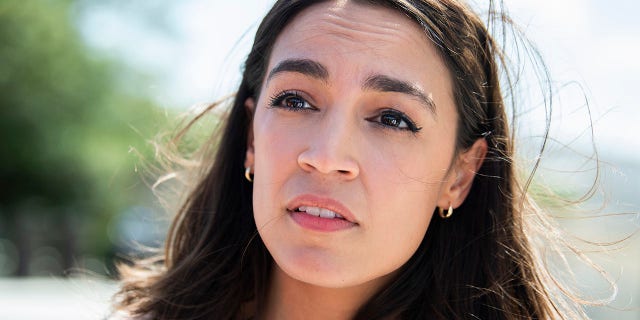
Democratic Rep. Alexandria Ocasio-Cortez and
a handful of other federal politicians - including two Democrats and
one Republican - have shelled out thousands in campaign payments to a
Chinese foreign agent, a Fox News Digital review of campaign finance
records has found.
Reps. Kevin Mullin,
D.-Calif., Grace Meng, D.-N.Y, and Nicole Malliotakis, R.-N.Y. joined
Ocasio Cortez in pushing campaign cash to Sing Tao U.S., a subsidiary of
the Hong Kong-based Sing Tao News Corporation Ltd, for advertising
expenses during the midterm election cycle.
Those campaigns, in other words, had sent their money to a Chinese-owned entity that the Department of Justice forced to register as a Chinese foreign agent in August 2021 as tensions rose between Washington and Beijing.
Rep. Ocasio Cortez's campaign has shelled out $1,500 to Sing Tao Newspapers, which is a Chinese foreign agent.
(Tom Williams/CQ-Roll Call, Inc via Getty Images)
After
the DOJ determined that Sing Tao U.S. constituted foreign political
activity, the campaigns had all disbursed their cash to the company.
Ocasio-Cortez's
campaign dropped nearly $1,500 on advertisements with Sing Tao
Newspapers during the midterm election cycle after it had registered as a
foreign agent, while Reps. Mullin, Meng, and Malliotakis paid between
$1,000 and $7,000 to various Sing Tao entities as part of their campaign
advertising expenses, Federal Election Commission filings show.
Sing Tao's United States operations include Chinese language publications in New York, San Francisco, and Los Angeles. It also has a radio station in Burlingame, California.
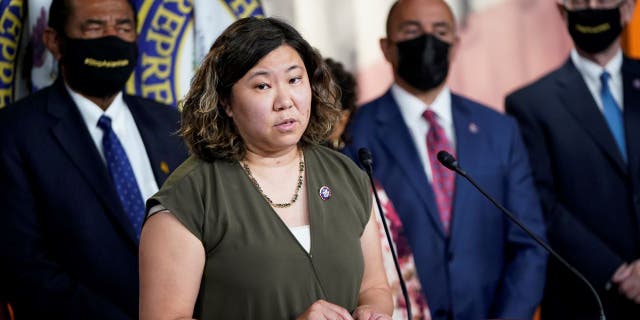
Rep. Grace Meng has also paid more than $1,000 to Sing Tao for advertising expenses.
The paper is considered pro-Beijing and receives more than half of its content from the Chinese company Star Production (Shenzhen) Limited, Axios previously noted.
While
Sing Tao U.S. has maintained it's free from Chinese Communist Party
influence, China's government maintains one of the "world's most
restrictive media environments, relying on censorship to control
information in the news, online, and on social media," the Council on Foreign Relations wrote.
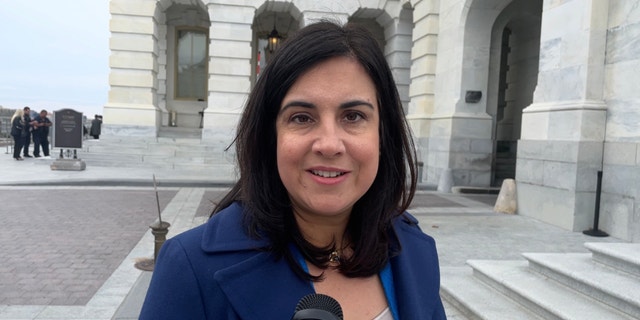
Rep. Nicole Malliotakis also dished out thousands to Sing Tao during the midterm elections.
(Fox News Digital / Jon Michael Raasch)
The Chinese government has
cut off media access to its citizens, monitored and squashed
publications, and thrown dissident journalists in prison as part of its
tight-knit media control operation.
None of the campaigns returned a Fox News Digital request for comment
Joe Schoffstall is a politics producer/reporter for Fox News Digital. Story tips can be sent to Joe.Schoffstall@Fox.com and on Twitter: @joeschoffstall
"This action undertaken by Israel goes against international law and [we] condemn it," the agency quoted the ambassador as saying.
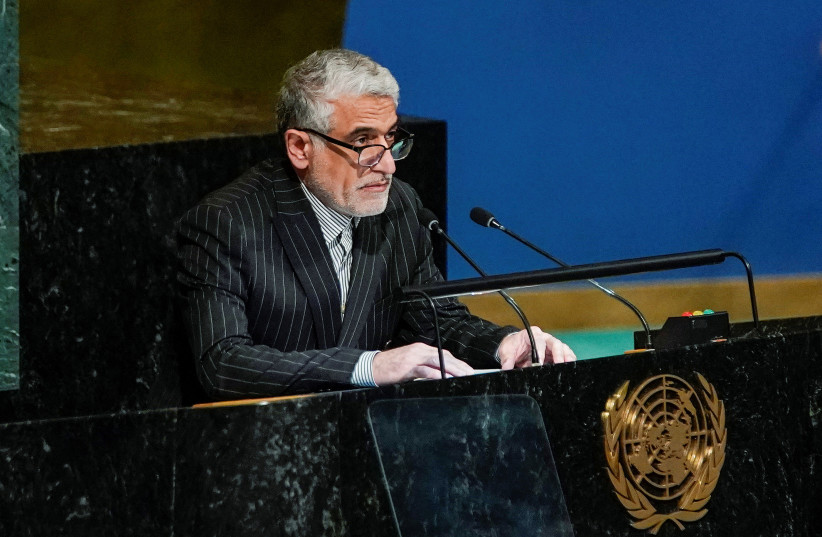
Iran’s Ambassador to the United Nations Amir Saeid Iravani speaks
to delegates before a vote on a resolution recognizing Russia must be
responsible for reparation in Ukraine at the United Nations Headquarters
in New York, US, November 14, 2022
(photo credit: REUTERS/EDUARDO MUNOZ)
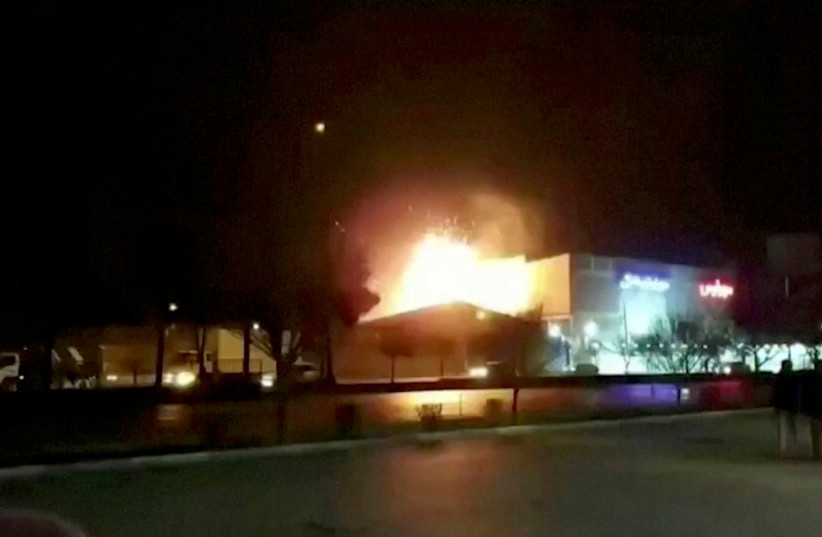
Iran blamed Israel for a drone attack on a military factory
near the central city of Isfahan, the semi-official ISNA news agency
said on Thursday, vowing revenge for what appeared to be the latest
episode in a long-running covert war.
In
a letter to the UN chief, Iran's UN envoy, Amir Saeid Iravani, said
primary investigation suggested Israel was responsible for the attack on Saturday night.
"Iran
reserves its legitimate and inherent right to defend its national
security and firmly respond to any threat or wrongdoing of the Zionist
regime wherever and whenever it deems necessary," Iravani said in the
letter.
"This action undertaken by the Zionist regime goes against international law."
The
attack came amid tension between Iran and the West over Tehran's
nuclear activity and its supply of arms - including long-range "suicide
drones" - for Russia's war in Ukraine, as well as months of
anti-government demonstrations at home.
Israel
has long said it is willing to strike Iranian targets if diplomacy
fails to curb Tehran's nuclear or missile programs, but it has a policy
of withholding comment on specific incidents.
Eyewitness footage shows what is said to be the moment of an explosion
at a military industry factory in Isfahan, Iran, January 29, 2023
(credit: POOL/WANA (WEST ASIA NEWS AGENCY) VIA REUTERS)
In
July, Tehran said it had arrested a sabotage team of Kurdish militants
working for Israel who planned to blow up a "sensitive" defence industry
center in Isfahan.
Attack on the Ifsahan defense facility
On January 29, there were four explosions at the site,
all of which appeared to specifically target a facility developing
advanced weapons. Despite the Islamic Republic claiming otherwise, the
damage goes far beyond the "minor roof damage" that it has also falsely
claimed before also in other incidents in recent years.
A
separate NourNews report on Wednesday said that by studying the
exploded components of the drones, the “manufacturer has been precisely
identified and important clues have been revealed.”
Several
nuclear sites are located in Isfahan province, including Natanz, the
centerpiece of Iran’s uranium enrichment program, which Iran accused
Israel of sabotaging in 2021. There have been a number of explosions and
fires around Iranian military, nuclear and industrial sites in recent
years.
Ukraine-Iran tensions heighten
The
Iranian Foreign Ministry summoned the Ukrainian Ambassador to the
Islamic Republic, Sergei Bordeliak, to discuss the recent statements of
the senior adviser to Ukraine's President Volodymyr Zelensky, Mykhailo
Podolyak, Russian state media outlet TASS reported on Monday.
Podolyak took to Twitter on Sunday to mock Iran after it suffered an apparently devastating drone attack at the Isfahan weapons facility in Isfahan, saying that "Ukraine did warn you."
War
logic is inexorable & murderous. It bills the authors &
accomplices strictly.Panic in RF - endless mobilization, missile defense
in Moscow, trenches 1000 km away, bomb shelters preparation.Explosive
night in Iran - drone & missile production, oil refineries. did warn
you
As
evidence of this apparent warning, Podolyak included a screenshot in
the Ukrainian version of his tweet - but not in the English one – of a
tweet he made on December 24, 2022.
Iran,
planning to boost missile, drone supplies for Russia, blatantly
humiliates the institution of international sanctions…Important to
abandon nonworking sanctions, invalid UN resolutions concept, & move
to more destructive tools – liquidation of plants, arrest of suppliers…
"Iran,
planning to boose missile, drone supplies for Russia, blatantly
humiliates the institutions of international sanctions.. Important to
abandon nonworking sanctions, invalid UN resolutions concept, & move
to more destructive tools – liquidation of plants, arrest of
suppliers."
The
ambassador, according to TASS, was asked to clarify Podolyak's
statement. There has, as of yet, been no public statement on the part of
Bordeliak or the Iranian government regarding the results of his
summons.
Believe it or not, the U.S. government has multiple reasons—none good—for keeping alive Iran’s existential war against Israel.
No one offers a reasonable explanation for Biden begging Iran to
rejoin the debunked, tawdry, ineffective, and cynical agreement to keep
nuclear weapons out of their hands, if just for a while. Israel keeps
providing updates on how close the Iranians are to completing their
weapons of mass destruction. The US government ‘cooperates’ with Israel,
holding joint exercises, but keeps weapons out of Israel’s hands that
could bring the Iranian project to a screeching halt; namely,
bunker-busters and the means to deliver them.
Speculation is rife, and facts are hard to come by. I have a theory about what’s going on, though.
The
United States government seems to want the Iranian conflict with Israel
to continue or to explode because peace has no value. Israel’s
defensive requirements keep the American arms industry buzzing along.
American aid to Israel (roughly $3 billion a year) mostly gets funneled
back into arms purchases from the United States, sales that might
otherwise flag under conditions of peace.
Moreover, cooperation
between Israel and the US arms companies gives the US government access
to Israeli innovation. American industry is perfectly capable of its own
innovation, but the integration between the government and its domestic
arms industry is cozy to the point of corruption. For both, cost
overruns and extended development times are very valuable commodities.
However, anytime America really needs to
do something, relying on Israeli innovations reduces time. For example,
think of the rushed development of US laser weapons that had been
dragging along for decades until it became important or, perhaps, even
imperative, given Russian and Chinese supersonic cruise missiles.
It’s
possible that America has abetted the Israel-Iran conflict for more
nefarious purposes than just polishing our arms industry. In the end, I
predict, Iran and Israel will have at it. They will go to war with
unknown consequences.
Both these nations hold their military
self-defense as critical to their national independence. If they can
weaken or destroy each other, that would be seen as a triumph for
Leftists and demonic Globalists, whose goal it is to ensure that no
nation should ever be able to defend itself.
The Russian-Ukraine war has been designed to weaken Russia just as a
conflict between Israel and Iran would weaken both sides. That is just a
fine outcome for American policy wonks. Even if Israel were to defeat
Iran, Israel’s loss of life, wealth, and vitality would weaken her as
well, all without American boots on the ground. In the same way, America
will fight to the last Ukrainian.
In the case of Israel’s defeat,
that, too, would be an acceptable outcome for American policy experts,
especially since it would reduce competition for American companies.
Israeli innovation offends American businesses and, especially,
intelligence agencies because Israel’s dominance in cybersecurity, water
management, and agriculture technology gives Israel greater expertise
than they have.
If poor countries can learn to feed themselves
with Israeli instruction and technology, what would happen to American
Agribusiness? If Israeli innovation can cure diseases, what would be
left of Big Pharma, where the only good drug is one that must be taken
forever?
The
most painful part of writing this essay occurred when I finally had to
admit to myself that the US government does not care about Israel’s
survival. The Jews have always been expendable and still are. The Jews’
attempt to survive in their own state is being undermined by US policies
that support continual conflict.
Forget about words of sympathy
from the US State Department after a tragic loss of life. All
meaningless! Regarding Israel, watch only what our government policies
support.
The insistence on a “two-state solution” supports continued conflict.
(Other factions in and out of government that favor one state of ‘all
its people,’ meaning anyone, Jewish or not, who ends up in Israel, no
matter their genocidal intent, would certainly cause continued conflict
because that would bring an end to a state for the Jews.)
US monetary support for the corrupt Palestinian Authority causes continued conflict.
The
US government’s acquiescence to the Palestinian policy of paying money
to those who murder Jews is a cause of continued conflict.
Contributions
to non-governmental organizations (NGOs) purposefully developed only to
criticize Israel cause continued conflict. Financial support for the
Iranian regime, which pays for terrorist projects inside Israel and
along its borders, causes continued conflict.
Pressing for a
return to the ‘67 borders causes continued conflict because those
borders caused the ‘67 Six-Day war in the first place.
Demands for
both parties to practice restraint cause continued conflict, making
slaughtering Jews leaving their synagogue on the Sabbath equivalent to
battling terrorists who receive funding from Iran and the Palestinian
Authority to murder unarmed civilians.
Machiavellianism,
narcissism, psychopathy, sadism, cultural decrepitude, and/or limited
intellectual capacity on the part of US career foreign policy experts
are all potential causes for continued conflict both for Israel and for
many other places around the world. What would these hordes of
pension-seeking policy wonks do to earn a living if peace broke out?
They might have to learn to solve problems instead of creating them.
Residents of Psagot warned to stay inside until further warning after possible infiltration.
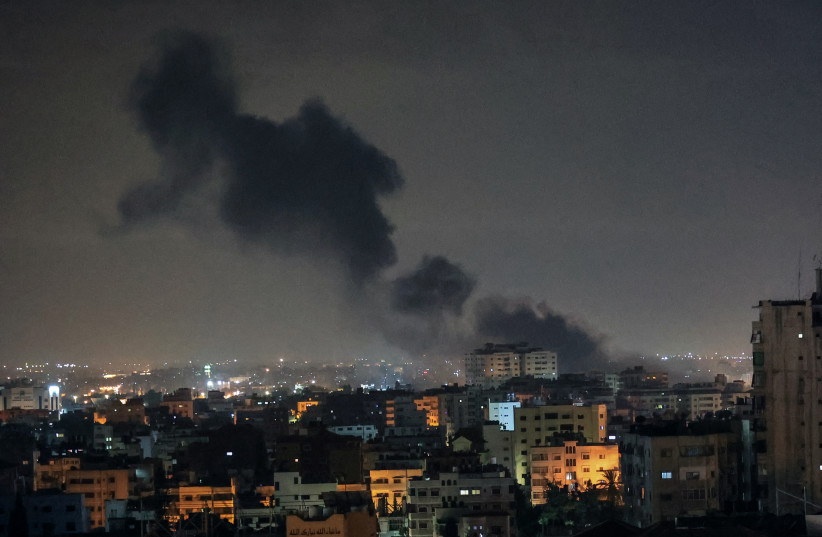
Smoke rises after an Israeli airstrike in the Gaza Strip, early on on February 2, 2023.
(photo credit: ATTIA MUHAMMED/FLASH90)
The IDF struck weapon production and storage facilities in Gaza overnight on Thursday after rocket sirens sounded in Sderot, Ibim and Nir Am at various points throughout the night.
Defense
Minister Yoav Gallant confirmed the strikes on Thursday morning, saying
"any shooting at the State of Israel or any attempt to harm the lives
of the residents of the south will be met with the strength of the IDF."
The
escalating violence between Israel and the various Palestinian militant
groups has continued despite appeals from the United States for calm
from both sides.
National
Security Minister Itamar Ben-Gvir had previously called for an
immediate meeting of the security cabinet to determine what action
should be taken in response to the rocket attack.
Local
residents in Sderot reported hearing a loud explosion shortly after the
sirens sounded and the IDF confirmed that the Iron Dome air defense
system intercepted a rocket that had been launched from the Palestinian
coastal enclave.
However,
the IDF announced on Thursday that the Iron Dome wasn't activated, as
11 rockets hit the open ground or exploded mid-air, while another firing
attempt failed.
"Any
shooting at the State of Israel or any attempt to harm the lives of the
residents of the south will be met with the strength of the IDF."
Defense Minister Yoav Gallant
The
Sderot Municipality said in a statement later on Wednesday that no
direct hits were reported in the city and the Sha’ar HaNegev Regional
Council also confirmed that no rockets landed within its jurisdiction.
דיווח ראשוני: הופעלה התרעה בעיר שדרות ובמרחב עוטף עזה. הפרטים בבדיקה
Islamic Jihad takes responsibility for Gaza Strip rocket launch
Palestinian
Islamic Jihad appeared to take responsibility for the launch on
Wednesday night, writing on pieces of paper attached to the rockets that
"[harming] female prisoners is a red line," in a video released shortly
after the rocket launch.
However,
the Democratic Front for the Liberation of Palestine also took
responsibility, saying it had launched rocket salvos at Israel early on
Thursday in response to the air strikes and the "systematic aggression"
against Palestinian prisoners in Israeli jails.
According
to the video, the attack was a direct response to another video
published by a Palestinian female prisoner in Damon Prison, who called
on Palestinian terrorist groups to "show determination to teach the enemy not to harm our women" after she claimed she was mistreated in the Israeli prison.
The Palestinian prisoners
at the prison, who were rioting and attempted to torch one of the
cells, according to the Israeli Prison Service, were then beaten and
sprayed with pepper spray, as per unconfirmed Palestinian reports.
Possible terrorist infiltration suspected in Psagot
Early Thursday morning, the IDF issued a Home Front Command warning for residents of the Psagot settlement in the West Bank.
The military advised all residents to remain in their homes and to lock their doors and windows.
It added that no one should leave their residence until it notifies the public that there is no longer a threat.
All traffic has been closed off from the area until further notice and motorists are advised to stay away from the area.
The
IDF issued the alert after a bag was found containing a knife and other
"suspicious" items, it said, adding that soldiers are currently
sweeping the area of the settlement to locate possible intruders.
Ben-Gvir, Israeli Prison Service and Palestinian threats
Since
entering office, National Security Minister Itamar Ben-Gvir, who
oversees the IPS, has made several moves aimed at imposing severe
restrictions on Palestinian prisoners jailed for involvement in
terrorist attacks.
Last week, a petition filed to the High Court claimed that the IPS barred medical staff in jails across Israel from giving updates to families on the health condition of prisoners
The
actions taken by the IPS and Ben-Gvir prompted Qadri Abu Bakr, chairman
of the Detainees and Ex-Detainees Affairs Commission, to declare that
Ben-Gvir's plans could lead to a “general insurrection” in Israeli prisons.
Meanwhile, in Iran, women are dying for the freedom not to wear the hijab.
Yesterday,
Wednesday, Feb. 1, was No Hijab Day, a Western feminist expression of
solidarity with Muslim women in the United States who are supposedly
oppressed and discriminated against (by those fictional but omnipresent
MAGA-hat-wearing thugs) because they wear the hijab. Accordingly,
Newark, N.J. city council President LaMonica McIveris
set to introduce a resolution declaring Wednesday World Hijab Day in the
City of Newark. McIver, of course, has all the proper Leftist
intentions: celebrating “diversity,” standing against “hatred,” and all
that. But this year in particular, her gesture is nothing short of
grotesque. In Iran, women are dying for the freedom not to wear the
hijab. And in Newark, witless Leftists are celebrating the symbol of
their oppression.
(NEWARK, NJ) — Newark Council President LaMonica McIver will introduce a resolution declaring February 1st #WorldHijabDay in the City of Newark.
Thank you, @LamonicaMciver, for standing up for Muslim women’s right to cover!
Back on Sept. 16, 2022, in Tehran, the Iranian morality police
arrested Mahsa Amini, a 22-year-old woman, for not wearing her hijab
properly. Amini later died in a hospital in Tehran, and numerous
Iranians charged that she had been tortured to death while in custody.
All over the country, protesters took to the streets to protest not
against the hijab laws, but against the repressive and brutal Islamic
Republic itself. Other women, and male protesters as well, were killed
as the Iranian regime ruthlessly applied the Qur’anic injunction to
“strike terror in the enemies of Allah” (8:60). The protests went on for
months until the regime began summarily executing protesters, and even
then some indomitably courageous Iranians continued to take to the
streets to demand their freedom.
It is against that backdrop that the Newark World Hijab Day
resolution will be introduced. For innumerable women in Iran, the hijab
is the most visible sign of their second-class status, and of the
brutality of the regime that will imprison them for years or even kill
them outright for daring to venture out in public without wearing it.
The Iranian authorities call their morality police the “Guidance
Patrol,” an Orwellian name that makes them sound like a bunch of benign,
avuncular individuals selflessly dedicated to helping young Iranians
avoid moral pitfalls and stay on the straight and narrow. A more
accurate name, however, would be the Terror Patrol, for the morality
that these officials enforce is not the virtuous person’s free choice of
the good, but the enforced obedience of those who are frightened into
submission.
Is that really what the city of Newark wants to celebrate? It’s
likely that LaMonica McIver didn’t consider what has been happening in
Iran even for one second before deciding to introduce her resolution.
She was just upholding the Left’s mythology about rampant “Islamophobia”
in the United States. Actual incidents of Muslim women being harassed
or discriminated against for wearing the hijab, however, are
extraordinarily hard to find. It’s much easier to find examples of
Muslim women in America who falsely claimed that they were being
harassed or discriminated against in order to score points on the Left’s
insane scale of victimhood worship.
In one such incident, an eleven-year-old girl in Toronto made
international headlines with her claim that a man had followed her and
cut her hijab with scissors. After an investigation, police concluded
that the attack never happened.
Likewise, Yasmin Seweid, a Muslim teen, claimed in December 2016 that
Trump supporters on a New York subway tore off her hijab and no one in
the packed subway car helped her. She, too, gained international media
attention, and she, too, made up the whole thing. Shortly before that, a hijab-wearing Muslim student at San Diego State University also falsely claimed that she was assaulted by Trump supporters. In July 2017, a Muslim in Britain falsely claimed that a man had pulled off her hijab in a “race hate attack.” In November 2016, a University of Michigan Muslim student claimed she
was “accosted by a white man who told her to remove her hijab or he
would set her ablaze with a cigarette lighter.” She also fabricated the
whole event. And there are many others of this kind, but the World Hijab
Day feminists, of course, have taken no notice.
Nor have they ever acknowledged the fact that women are far more
likely to be oppressed for not wearing the hijab than for wearing it,
and not just in Iran. In Mississauga, Ontario, a few years back, Aqsa
Parvez’s Muslim father choked her to death with her hijab after she refused to wear it. Amina Muse Ali was a Christian woman in Somalia whom Muslims murdered because she wasn’t wearing a hijab. Forty women were murdered in Iraq in 2007 for not wearing the hijab. Alya Al-Safar’s Muslim cousin threatened to kill her and harm her family because she stopped wearing the hijab in Britain. Amira Osman Hamid faced whipping in Sudan for refusing to wear the hijab. An Egyptian girl, also named Amira, committed suicide after
being brutalized by her family for refusing to wear the hijab. Muslim
and non-Muslim teachers at the Islamic College of South Australia were told they had to wear the hijab or be fired. Women in Chechnya were shot with paintballs by police because they weren’t wearing hijab. Other women in Chechnya were threatened by men with automatic rifles for not wearing hijab.
Such examples could be multiplied endlessly. When is LaMonica McIver
going to introduce a resolution recognizing the women who have been
brutalized and killed for not wearing the hijab? I won’t be watching the
news feeds for any word of that.
The worst nations and their rankings are: 1) North Korea, 2) Somalia, 3) Yemen, 4) Eritrea, 5) Libya, 6) Nigeria, 7) Pakistan, 8) Iran, 9) Afghanistan, 10) Sudan, 11) India.
Overall, the global
persecution of Christians remains higher than ever, with 360 million
believers suffering high levels of discrimination and violence.
These are among some of the findings of the World Watch List
2023, recently published by the international humanitarian organization,
Open Doors.
The worst nations and their rankings are: 1) North Korea, 2)
Somalia, 3) Yemen, 4) Eritrea, 5) Libya, 6) Nigeria, 7) Pakistan, 8)
Iran, 9) Afghanistan, 10) Sudan, 11) India.
" [A]pproximately 80% of the worst persecution around the globe takes place in the name of Islam...
Although the persecution in North Korea is worse, there is at
least hope for the Christians there: their ill treatment is entirely
connected to the regime of Kim Jong-un. Once he is gone, North Korea may
well become like South Korea, where Christianity is flourishing.
Conversely, the Muslim persecution of Christians is perennial,
existential, and far transcends this or that regime or ruler. It is part
of the history, doctrines and socio-political makeup of Islam -- hence
its tenacity and ubiquity.
In Somalia, "Christians from Muslim backgrounds are regarded as high-value targets and may be killed on the spot if discovered."
In most Muslim nations on the list, all three sectors of society
-- Muslim authorities, Muslim mobs and Muslim terrorists -- persecute
Christians to varying degrees.
In Afghanistan, "More than a year after the Taliban's takeover,
any promises they made about recognising freedoms have proved to be
false. Following Jesus remains a death sentence, if discovered."
In Pakistan, "roughly a quarter of all blasphemy accusations target Christians, who only make up 1.8% of the population."
In Egypt, "President al-Sisi regularly speaks positively about
Egypt's Christian community. However, the lack of serious law
enforcement and the unwillingness of local authorities to protect
Christians leave them vulnerable to all kinds of attacks...."
In the worst of these Sub-Saharan nations, Nigeria, "Christians are experiencing a genocide."
"China's model of oppression is spreading.... The apparent
success of China, especially in economic terms, is appealing to many
leaders around the world. The promise of growth and prosperity, while
being able to control all groups and individuals perceived as deviant,
has triggered the interest of leaders from all over the world, no matter
their ideological background."
Perhaps the most disturbing trend is that, since 1993, the
persecution of Christians has nearly doubled... and has already
increased by nearly 70% over the last six years, with no signs of
abating.
How long before this seemingly irreversible trend metastasizes
into even those nations currently celebrated for their religious
freedom?
The global persecution of Christians remains higher than
ever, with 360 million believers suffering high levels of discrimination
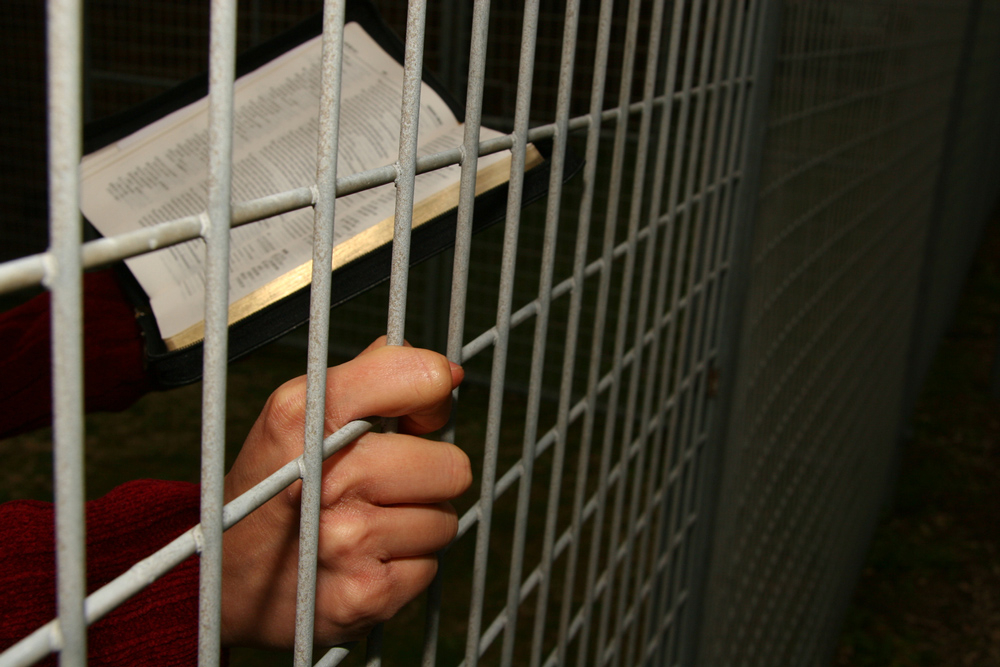
and violence. (Image source: iStock)
In 2022, 5,621 Christian around the world were "killed for faith related reasons."
Another 4,542 Christians were illegally detained or arrested, and 2,110
churches were attacked, many destroyed. Overall, the global persecution
of Christians remains higher than ever, with 360 million believers
suffering high levels of discrimination and violence.
These are among some of the findings of the World Watch List 2023,
recently published by the international humanitarian organization, Open
Doors. Each year, the World Watch List ranks the top 50 nations where
Christians are most persecuted for their faith by using data from
approximately 4,000 field workers and external experts to analyze the
persecution worldwide.
The report finds
that around the world, on average, one in seven Christians (14%) are
persecuted. In Africa, that number grows to one in five (20%), while in
Asia it is as much as two in five -- meaning 40% of all Christians are
persecuted there.
Christians suffer "extreme levels of persecution" in the top 11 of
the 50 nations. This persecution ranges from being assaulted, raped,
imprisoned or murdered on being identified as a Christian or attending
(usually underground) churches.
The worst nations and their rankings are: 1) North Korea, 2) Somalia,
3) Yemen, 4) Eritrea, 5) Libya, 6) Nigeria, 7) Pakistan, 8) Iran, 9)
Afghanistan, 10) Sudan, 11) India.
Coming in at #1, North Korea has "the highest levels of persecution ever seen," says the report:
"If discovered by the authorities, believers are either
sent to labour camps as political prisoners where the conditions are
atrocious, or killed on the spot—and their families will share their
fate as well. Christians have absolutely no freedom.... A new
'anti-reactionary thought law' makes it amply clear that being a
Christian or possessing a Bible is a serious crime and will be severely
punished."
Most of the "extreme persecution" meted out to Christians in nine of
the top 11 worst nations continues to come either from Islamic
oppression, or takes place in Muslim-majority nations. This means that
approximately 80% of the worst persecution around the globe takes place
in the name of Islam.
This trend affects the entire list, not just the top 11: the
persecution that Christians experience in 39 of the 50 nations also
comes either from Islamic oppression or occurs in Muslim-majority
nations. The overwhelming majority of these nations are governed by some
form of shari'a (Islamic law). It can either be directly
enforced by government or society or, more frequently, both, although
societies -- family members outraged in particular by relatives who have
converted -- tend to be more zealous in its application.
Although the persecution in North Korea is worse, there is at least
hope for the Christians there: their ill treatment is entirely connected
to the regime of Kim Jong-un. Once he is gone, North Korea may well
become like South Korea, where Christianity is flourishing. Conversely,
the Muslim persecution of Christians is perennial, existential, and far
transcends this or that regime or ruler. It is part of the history,
doctrines and socio-political makeup of Islam -- hence its tenacity and
ubiquity.
In the worst of the Muslim nations, Christianity has been so stamped
out over the years that there are no indigenous Christians to persecute,
only converts -- apostates, who, according to most interpretations of
Islamic law, deserve death. The wildly popular late Sunni cleric Yusuf al-Qaradawi noted on television that if not for the apostasy law, Islam would have died out long ago.
"Imams in mosques and madrassas state publicly that there
is no room for Christianity, Christians or churches. The violent
insurgent group al-Shabaab has repeatedly expressed its desire to
eradicate Christians from the country. Christians from Muslim
backgrounds are regarded as high-value targets and may be killed on the
spot if discovered."
Similarly, in Yemen (#3), "The population is overwhelmingly Muslim and it is illegal to convert from Islam to Christianity."
"Yemeni Christian converts are at great risk of being
killed, not just ostracised or expelled, by their families, clans and
tribes. Islamic extremist groups such as al-Qaeda and so-called Islamic
State threaten so-called 'apostates' with death if they do not return to
Islam. In other areas, including those controlled by Houthis, converts
risk imprisonment. In detention centres, Christian detainees have
reportedly suffered physical and mental torture."
In most Muslim nations on the list, all three sectors of society --
Muslim authorities, Muslim mobs and Muslim terrorists -- persecute
Christians to varying degrees.
"Libya is effectively a lawless land where both native
Christians and those passing through from other countries face extreme
violence. With no central government to maintain law and order, militant
Islamic extremist groups and organised crime groups both wield power.
They target and kidnap Christians, and some believers have been killed."
On the other hand, in Iran (#8), which is "ruled by an increasingly strict Islamic regime," the authorities are chiefly responsible.
"Iranian house church leaders and members have received
long prison sentences involving physical and mental abuse. Iranian
Christians may be banned from education, lose their jobs and find it
very difficult to get back into employment. For women, the situation is
even more precarious because Iranian law grants women few rights. For
trusting in Jesus, they are likely to be violently punished or divorced
by their husbands and have their children taken away from them, if their
faith is discovered."
In Afghanistan (#9), Islamic terrorists -- who also happen to be the authorities -- are chiefly responsible.
"The Taliban's takeover of power in August 2021 has
forced most Christians either further underground or away from the
country entirely. Many (if not all) house groups closed, with believers
forced to leave behind everything they own. More than a year after the
Taliban's takeover, any promises they made about recognising freedoms
have proved to be false. Following Jesus remains a death sentence, if
discovered."
In Pakistan (#7), every rung of society is responsible for the persecution.
"Christians in Pakistan are considered second-class
citizens and face discrimination in every aspect of life. Jobs that are
seen as low, dirty and degrading are reserved for Christians by the
authorities, who continue to push them to the margins of society. They
lack proper representation in politics ... [and] there are almost
constant attacks against individuals. Many do not feel safe to worship
freely.... [R]oughly a quarter of all blasphemy accusations target
Christians, who only make up 1.8% of the population. The number of
blasphemy cases is increasing, as is the number of Christian (and other
minority religion) girls being abducted, abused and forcibly converted
to Islam."
Similarly, in Egypt
(#35), which is "very high" in persecution, Christians "report that
freedom of religion violations are mostly experienced in the community."
"Incidents vary from Christian women being harassed while
walking in the street, to a mob of angry Muslims forcing a whole
community of Christians to move out, leaving their houses and belongings
to be confiscated.... President al-Sisi regularly speaks positively
about Egypt's Christian community. However, the lack of serious law
enforcement and the unwillingness of local authorities to protect
Christians leave them vulnerable to all kinds of attacks, especially in
Upper Egypt. Communal hostility and mob violence, in particular,
continue to cause difficulties."
Among some of the notable trends, the report asserts
that Christians in the Middle East have experienced little if any
improvement since the disempowerment of the Islamic State (ISIS).
"The church [in the Middle East] has not been able to
recover after the upsurge of Islamic State and the attempts of
extremists to wipe out Christianity entirely. Discrimination and
oppression coupled with crippling economic decline means the church is
losing hope, particularly for young people. In the Levant region of the
Middle East (Lebanon, Syria, Iraq, Israel/Palestinian Territories and
Jordan), the Christian community is shrinking due to deprivation,
discrimination and persecution. Ever since the Islamic State group (IS)
arrived on the scene, Christians in those areas of Iraq and Syria have
been struggling to earn a living; young Christians in particular face
high unemployment and continual hostility..."
In Sub-Saharan Africa, "Violence against Christians ... has reached new heights."
"Jihadists are destabilizing countries in West and
Central Africa. Entire countries are at risk of collapse into extremist
violence. 26 countries in Sub-Saharan Africa face high levels of
persecution.... The jihadist movement, which seeks to expand Sharia
across the continent, has forced Christians into constant motion, from
their homes to displacement camps, or to other countries. The insecurity
stemming from this experience of forced displacement makes Christians
even more vulnerable to further violence. Christian women, in
particular, can be easily targeted for sexual attack, while men are more
likely to lose their lives."
In the worst of these Sub-Saharan nations, Nigeria (#6), where "an ingrained agenda of enforced Islamisation" exists, Christians are experiencing a genocide.
"The violence is most pervasive in the north, where
[Muslim] militant groups such as Boko Haram, ISWAP and Fulani militants
inflict murder, physical injury, abduction and sexual violence on their
victims. Christians are dispossessed of their land and their means of
livelihood. Many live as internally displaced people or refugees. In the
Sharia states of northern Nigeria, Christians face discrimination and
exclusion as second-class citizens. Christians from a Muslim background
also face rejection from their own families, pressure to give up
Christianity, and often physical violence."
Although Islam continues to have the lions' share of persecution, the
rise of religious nationalism in non-Muslim nations—such as Myanmar
(#14) -- has also caused a number of nations normally unassociated with
persecution to rise in the ranks. Most notable among these is the
second most populous nation in the world, India (#11).
"In recent years there has been a big increase in
Hindutva, an ideology that believes only Hindus are true Indians....
Increasing numbers of [Indian] states are implementing anti-conversion
laws, supposedly to stop Hindus being forcibly converted to other
religions, but in reality they are often used as an excuse to harass and
intimidate Christians who are just doing things like distributing aid
or having a private church meeting. These laws do not seem to protect
Christians from being coerced back into Hinduism. Christians
increasingly experience social exclusion in their communities,
discrimination in the workplace, and have false accusations and rumours
spread about them."
As for the world's most populous nation, China (#16), Open Doors reports:
"In China, the use of digital surveillance technology is
spreading, adding to persecution and intimidation. Armed with sweeping
new rules on church use of the internet, implemented in March 2022,
authorities employed censorship, disinformation, and unblinking
surveillance to tighten their control of religious groups."
"China's model of oppression is spreading throughout
authoritarian states. The apparent success of China, especially in
economic terms, is appealing to many leaders around the world. The
promise of growth and prosperity, while being able to control all groups
and individuals perceived as deviant, has triggered the interest of
leaders from all over the world, no matter their ideological background.
Perhaps the most disturbing trend is that, since 1993, the persecution of Christians has nearly doubled:
"Since 1993, the World Watch List has revealed the scale
and severity of the persecution of Christians. In the last 30 years, the
number of countries where Christians suffer high and extreme levels of
persecution has almost doubled to 76 countries. Today, more than 360m
Christians suffer high levels of persecution and discrimination for
their faith. In Open Doors' World Watch List top 50 alone, 312m
Christians face very high or extreme levels."
Last year, 360 million Christians around the world also experienced "high levels of persecution and discrimination." That number represented a 6% increase from 2021, when 340 million Christians experienced the same degree of persecution; and that number represented a 31 % increase from 2020, when 260 million Christians experienced the same level of persecution; and that number represented a 6% increase from 2019, when 245 million experienced the same level of persecution; and that number represented a 14% increase from 2018, when 215 million was the number.
Worst of all, the persecution of Christians, which was already
horrific, has already increased by nearly 70% over the last six years,
with no signs of abating. For the first time since the inception of the
World Watch List 30 years ago, Nicaragua (#50) has now made the list.
How long before this seemingly irreversible trend metastasizes into
even those nations currently celebrated for their religious freedom?
The cost of ignoring the ethical dimensions of our sex identities.
If you’re like me you’ve probably had it with being afraid of the
sheer rise in power that the transgender movement has amassed in little
over two years. It has many people scared, truly scared. Scared of
saying (I’m going to say it): Biological men can never be real
women; men cannot have babies; referring to oneself as “they” is beyond
grammatically infelicitous, it renders one a nonsensical and a
conceptual non-entity; the transgender affirmation of adolescents, which
means agreeing to visiting a host of atrocities on a child’s body and
plying it with irreversible drugs, is child abuse; trans women
(biological men) have no business participating in (real) women’s sports. There I’ve said it all—at least as much as I care to for now. Why are people scared of offending trans people?
Misgendering another person, I am told, is the worst offense you can
commit against another human being—as bad as rape and murder. No
kidding. How did a small minority of people get to command the language,
protocols, norms and framing methods of an entire culture in so short a
space of time? Who handed all that power to them, and why?
The issue goes deeper if we look at the logical terminal point of
radical transgenderism. It is a form of moral decadence. Why? Because
ultimately it culminates in people signing up at the gender unemployment
line. To unemploy yourself from your gender or, some would say, to
recuse yourself from it, is to emancipate yourself from the moral
dimensions that come with your sex identities. For the sake of
rhetorical expediency, I shall say, yes: to unemploy oneself from one’s
gender identity as well. I have heard it said often that young people
are suffering from civilizational exhaustion, and that that is the
reason they are relinquishing their binary sex identities. It’s my
generation, however, and the ones preceding it that have a right to be
exhausted. The millennials and Generation Z that have no business
feeling civilizational exhaustion. It is Gen Z that has inherited a
technologically advanced civilization built for them. You’d expect more
adults to be coming out as trans if this were even a plausible
explanation for the rise of transgenderism. This is not the case.
But it is not just the case of individuals resigning from their
ethical roles. We have a case of Jesus Christ himself being canceled as a
cis-heteronormative patriarchal male and being queered and turned into a
gender neutral, non-binary, total Woke trans star. In a new production of Jesus Christ Superstar,
Jesus is played by a non-binary actor, someone who does not identify as
male or female, and Judas is played by a woman. The twelve apostles are
played by female or non-binary performers.
Jesus is the Son of God. He is Indubitably and immutably male. He
performed distinctly male roles. He protected both the weak and the
strong. He provided for the hungry and the soul-impoverished, and he
left behind an enduring legacy on which others could pin their
aspirational identities. When he acted, he did so decisively. He taught
men the art of problem solving, and he taught them how to fix things.
These are the responsibilities trans women (biological men) are
renouncing and walking away from.
But the confederacy of nihilists, and the army of global anarchists
behind this movement are not content to have a global movement of
she-men and he-men simply live their lives and even impose their
ideologies on society writ large.
What is the psychological result of queering and transitioning Jesus?
If his disciples are re-sexed and un-sexed by the fiat of folks who
think they can just exploit the Bible for politically expedient
purposes, it means not just that concepts of right or wrong,
unassailable truths and moral axioms are beyond the reach of destructive
ethical relativists and amoral anarchists. It also means that a new
form of idolatry has taken root in our culture and that it is beyond
moral reproach. The new idolatry I speak of is a “destructive will of a
group motivated by a desire to seek raw naked power through the force of
their feelings, which they impose on others with a moral mandate that
functions and behaves as if it were as invariable as the laws of
nature.”
We know we are living in a psychotic world when professors are
explicitly told that under no circumstances can they ever utter these
words in class: Men cannot give birth to children. We know the
psychosis is real when two men who look and act like linebackers, but
who identify as women, claim they are in a lesbian relationship because
they identify as women. We are forced to use the female pronoun to refer
to them, and wish them well in their lesbian relationship. We are
“mind-forced” to acknowledge that two biological women are in a
heterosexual relationship because one identifies as male and the other
as female.
The madness suffocates. One would have to have been in some form of
serious self-sequestration for the last two years not to have witnessed
this malarkey. To indulge in further examples will force the reader to
become a statistician of gutter trivia.
In the broadest and most fundamental of terms, transgenderism and its
medical ministrations constitute a radical form of medical, social and
cultural eugenics. Short of cloning another human being, the attempt to
change one’s sex (a biological impossibility) is the most audacious
eugenical act undertaken in human history. It takes a metaphysical
given—the chromosomal markers of a person that designate his or her sex
and gender—and attempts to reverse, alter and neutralize it.
The manner in which this radical form of eugenics manifests itself
and attempts to reverse an invariable law of nature is by way of taking a
very rare medical condition and normalizing it. This medical condition
caused by a DNA disorder gives birth to the hermaphrodite. This is an
extremely rare condition in humans, constituting—according to various
statistics—about 0.5 to 1% of all live births in the total world
population. It is a condition in which a single human being can possess
both male and female reproductive organs inside and outside of the body.
In every stage of human history, the birth of the hermaphrodite has
been met with absolute horror and metaphysical incredulity. The
condition was regarded as a bad omen presaging war, disaster or
pestilence. The infant was usually destroyed or left to die from
exposure, and blame was usually assigned to the parents for being guilty
of some irredeemable moral malfeasance.
Today’s trans woman with her intact penis, testicles, and bulging
cleavage is a symbol of a eugenically-crafted hermaphrodite, a strange
primeval androgyne that conjures up, in the minds of many, images of a
futuristic phenomenon that attempts to function and become a realistic
model for human life while remaining, in nature, something of a
metaphysical grotesquerie—a small percentage of aberrant birth defects
nature has spared most parents. The transgendered person not only
normalizes and legitimizes the figure of the hermaphrodite by conscious
intent, but those who go through the completion process become castrated
eunuchs – cold, abstract androids in the public consciousness. In the
minds of many, what is a medical rarity in nature becomes transmogrified
via a surgical procedure into a self-cutting figure who elicits myriad
unconscious fears: castration anxiety, self-mutilation, and traversing
gender, which means going beyond the creation of life itself. In the
public imagination, the trans person represents a closed system that
shuts down all reproductive life.
What sort of Satanic force is behind this movement? Who are its
members and who ultimately profits from a society of makeshift
hermaphrodites and non-reproducing trans men and women? Who benefits
from the moral and psychological confusion and mental pain of children
who are taught that transitioning from one gender to the next lacks any
moral gravitas, and that the decision is simply right because
it is rooted in inchoate feelings and sensations? Who benefits from the
protracted guilt, sadness and unalterable and regrettable bodily
mutilations suffered by the victims?
Why on earth did trans ideology become sacrosanct, and the people who
espouse it the new sacred cows in our culture? Who perverted and
sullied traditional ideologies and morality, cast aspersions against
their moral status to make room for the self-righteous claims and
demands behind the often punitive trans movements?
Indeed, if the Son of God, Jesus Christ, can make the decision that
God assigned him the wrong gender, and that he is free to reconceive of
himself as he ought to have been made, then the message is clear. For
the trans ideologues, God got it all wrong. He made a plethora of
mistakes. He got nature wrong and he misgendered broad swaths of people.
Under the guise of a new Woke religion new cults arise that will create
a new heaven and a new earth. These rebels are metaphysical
revolutionaries who believe they have every right to transcend God’s
will and the nature he endowed them with. Sacred. Reverence. Obedience.
All such virtues in relation to God are lost in the name of the shallow
ephemeral present, and the arid mental categories that inform anything
that is expedient and in the moment. They have killed the concept of God
and, therefore, in the spirit of Dostoyevsky, everything is possible.
Most of us know the answers to the questions I have posed. Few of us
have the courage to identify its evil and Satanic foundation, and to
root it out of existence. Perhaps it will take an extraordinary vanguard
and sentinel of our already existing, amazing earth to restore order
and expurgate the forces of evil running rampant: an authoritarian
strong man; an illiberal type who will realize that too many people have
been let into the future, that not everyone can be let into the future,
and that the over-democratization of all spheres of life ultimately
leads to rule by the depraved sensibilities of the lowest common
denominator among us.
Jason D. Hill is a professor of philosophy at DePaul University in Chicago,
specializing in ethics, social and political philosophy, American
foreign policy, and moral psychology. He is a Shillman Journalism Fellow
at the Freedom Center. He is also the host of an original podcast on
Frontpage, “The Jason Hill Show.”
Can this type of fire in the belly among Iranian protesters crystallize into an organizational movement coupled with genuine leaders?
This is a slightly abbreviated version of the original article.
Veteran
Iran experts have highlighted one crystal-clear difference between the
current nationwide uprising against the clerical regime and previous
protests: The revolt over the murder of 22-year-old Mahsa Amini on September 16 after she was arrested by the infamous morality police has sustainable momentum.
The morality police seized the young Iranian-Kurd Amini in Tehran because she was not in compliance with the Islamic dress code
that mandates she cover her hair with a hijab. The protests started as
an act of potent defiance against the regime's hardcore misogyny and
morphed into calls for the abolition of the theocratic state.
Over three months of protests have blanketed Iran's
31 provinces and resulted in not calls for soggy political reformism
(see the Green Movement example of 2009) but rather the dissolution of
the Islamic Republic of Iran.
Iranians are demanding, with a single-minded ferocity, "Death to the dictator." The dictator is the Islamic Republic's Supreme Leader, Ali Khamenei, who has ruled over the oil-rich country since 1989.
Jason Brodsky, an Iran expert and policy director of
the US-based United Against Nuclear Iran (UANI), told me, "The
revolutionary sentiment among significant segments of Iran's population
still continues. The Iranian people are finding creative ways to express
their disgust – with not only more demonstrations planned on January
19-20 but also the burning of government banners featuring Khamenei and
[Qasem] Soleimani and the hanging of their own banners above major
highways in the country. There is a fearlessness which is unprecedented,
and it will be difficult for the security forces to put that genie back
in the bottle."
The rage over Soleimani's death continues to fuel the
jingoism of Tehran's President Ebrahim Raisi, who declared in early
January, "We have not and will not forget the blood of martyr Soleimani.
The Americans must know that revenge is certain, and the murderers will
have no easy sleep."
Raisi was sanctioned by the US government for
his role in the massacre of 5,000 political prisoners in 1988, as well
as for the slaughter of roughly 1,500 demonstrators in 2019.
All of this helps to explain that Iran's clerical
regime is a high-intensity state-sponsor of international terrorism and
imposes violent repression on its citizens.
The US government under both Republican and
Democratic administrations has classified Iran's regime as the worst
international state-sponsor of terrorism.
Hamid Charkhkar, a professor of biomedical
engineering at Case Western Reserve University in Cleveland, who was
born in Iran, told me, "With the cold weather this winter and extreme
suppression by the regime, we currently see fewer protests on the
streets in major cities of Iran. However, people's anger against the
mullahs grows stronger by the day; soon, it will burst again and create a
much bigger and hopefully final blow to Ali Khamenei's throne. Iranians
witness directly that Raisi's government is utterly dysfunctional and
incompetent."
Charkhkar, who is a member of the Alliance Against
Islamic Regime of Iran Apologists, added that "Iran's economy has
worsened over last six months with the high inflation and the currency
losing its value. Recently, the government was also faced with severe
challenges in distributing natural gas to households as the extreme cold
weather hit most of the country."
Will the political movement, coupled with worsening
economic conditions, lead to an inevitable toppling of the Iranian
regime? Daniel Pipes, a prominent Mideast historian, who is the
president of the Philadelphia-based Middle East Forum, told me, "The protests in Iran
suffer from not having a leadership that can mold and direct the
widespread discontent into a political campaign; there's no equivalent
of [Ruhollah] Khomeini, 1978-79. For that reason, I am skeptical of its
chances to achieve a counter-revolution."
Pipes added, however, that "the protests have
excellent timing. For one, Khamenei's poor health means he could be gone
any day. For another, Iranian military support for Putin's invasion of
Ukraine has unprecedentedly turned Western opinion against Tehran. These
two wild cards give the protests an unpredictable opportunity."
A movement without infrastructure, a solid
organization, and tough leaders is a kind of one-hit wonder that fizzles
out. Hence, Pipes's focus on leadership and an organized political
campaign that can dislodge Khamenei's apparatus.
As Brodsky noted, there is a growing sense
among many protesters who want to topple the regime and are prepared to
fill the spirit of the slogan of the Spanish Civil War with meaning and
content: "Better to die on your feet than to live on your knees." The
pressing question is: Can this type of fire in the belly among Iranian
protesters crystallize into an organizational movement coupled with
genuine leaders?
International public pressure, especially from the
West, can at times influence a change in Iranian regime policies.
Brodsky said, "What also helps is that the Iranian diaspora is more
united than ever before. They amplify their compatriots' voices and are
moving the needle in Western capitals against the regime. We are seeing
this with the protest planned on January 16 in Strasbourg."
Massive Iranian regime violence targeting the
demonstrators might very well be on the horizon. Kiumars Heydari, the
commander of the regime's ground forces, announced on November 9 that
Khamenei only needs to give the green light, and opponents of the
regime, which Heydari called "flies," will be wiped out. He said the
demonstrators "will have no place in the country." In 2019, Khamenei
approved the use of spectacular levels of violence to crush peaceful
protests against the corruption of the regime.
The current crackdown since mid-September has
resulted in the clerical regime killing at least 522 people, according
to a January 15 report by the US-based Human Rights Activist News Agency
(HRANA). The report said that among those murdered were 70 minors and
68 members of the regime's security forces. The security apparatus of
the Islamic Republic has arrested roughly 20,000 people, and 110
demonstrators face the death penalty.
Iranian-American human rights activist Lawdan
Bazargan told me, "The Islamic regime of Iran is struggling with many
crises, including a currency crisis, inflation crisis, energy crisis,
sanctions crisis, internal fights, corruption, embezzlement, poor
management and, most importantly, a legitimacy crisis. The Islamic
regime of Iran is based on Shi'a ideology and demands subjugation and
blind obedience."
Bazargan said, "Sixty percent of the 80 million population of Iran
are under 30 years old. They have access to the Internet, social media,
and information. These young men and women do not believe the regime's
propaganda and demand change and emancipation. Hence, they are chanting
'Woman, life, freedom' in the streets of Iran and are willing to die for
these values. The end of this regime is imminent because the people of
Iran know that they don't want this brutal regime and know what they
want to replace it with.
"The regime has exhausted all its scare tactics.
Young prisoners such as Mohammad Hosseini and Mohammad Mehdi Karami, who
were executed recently, have become heroes among people, and their
memories are well alive. Additionally, the regime is losing all its
legitimacy, even among the majority of its supporters, as more athletes,
artists, and public figures speak out against the atrocities committed
by Khamenei and his thugs. The regime may kill more innocent, brave
Iranians, but Khamenei knows well that the end of his regime is near."
The notion that the Iranian regime is like a
chicken with its head slashed off, running around gasping for life and
is moments before passing out of existence, is now a widespread belief
among many Iranians in the diaspora. Without doubt, the regime's
legitimacy has vanished.
Europe and the United States have imposed human
rights sanctions on Iran's regime. The sanctions are somewhat of a shot
in the arm to help boost the protesters' morale. Yet the major Western
powers remain largely on the sidelines in the epic revolt against the
clerical regime.
Brodsky, of UANI, said: "The US government should be
leading a global campaign to pressure Iran, but I don't see it doing
much publicly in that regard. There have been significant strides like
the ousting of Iran from the UN Commission on the Status of Women and
the establishment of a UN Special Investigative Mechanism at the UN
Human Rights Council, but the Biden administration needs to do more. I
feel strongly that President Biden should give a speech or remarks on
Iran, speaking to its people, the diaspora, and the world. He should
formally renounce this JCPOA paradigm that transatlantic Iran policy has
been consumed by for years – although that has started to change in
recent months with more of a focus being placed on the human rights
situation and Iran's provision of drones to Russia."
He continued: "Second, the US should work to ensure
that it and its allies in the G7 impose Magnitsky sanctions on Iran's
supreme leader, his son Mojtaba Khamenei, and President Ebrahim Raisi.
Third, the US government should be rallying its allies to follow its
example and designate the IRGC as a terrorist organization. Fourth, the
president and secretary of state should be encouraging US allies to
downgrade their diplomatic relations with Iran's regime. And fifth, an
international task force should be formed to go after the regime elites
and their families who are using European and Canadian soil to profit
off of illicit wealth."
The interplay between external pressure and internal
protests against the rulers of the Islamic Republic will determine if
the sustainable momentum to dislodge Khamenei's regime continues. The
willingness of the Iranian demonstrators to form an organizational
movement with leadership is the sine qua non to topple the clerical
regime.
Benjamin Weinthal, a Middle East Forum writing fellow, reports on Israel, Iran,
Syria, Turkey and Europe for Fox News Digital. Follow him on Twitter at @BenWeinthal.





 Veteran
Iran experts have highlighted one crystal-clear difference between the
current nationwide uprising against the clerical regime and previous
protests: The revolt over
Veteran
Iran experts have highlighted one crystal-clear difference between the
current nationwide uprising against the clerical regime and previous
protests: The revolt over