The "Middle East and Terrorism" Blog was created in order to supply information about the implication of Arab countries and Iran in terrorism all over the world. Most of the articles in the blog are the result of objective scientific research or articles written by senior journalists.
From the Ethics of the Fathers: "He [Rabbi Tarfon] used to say, it is not incumbent upon you to complete the task, but you are not exempt from undertaking it."
The National Union of Journalists (NUJ) alongside the Trades Union Congress (TUC) reportedly sent out messages asking workers to “wear something red, green, black or a Palestinian keffiyeh”.
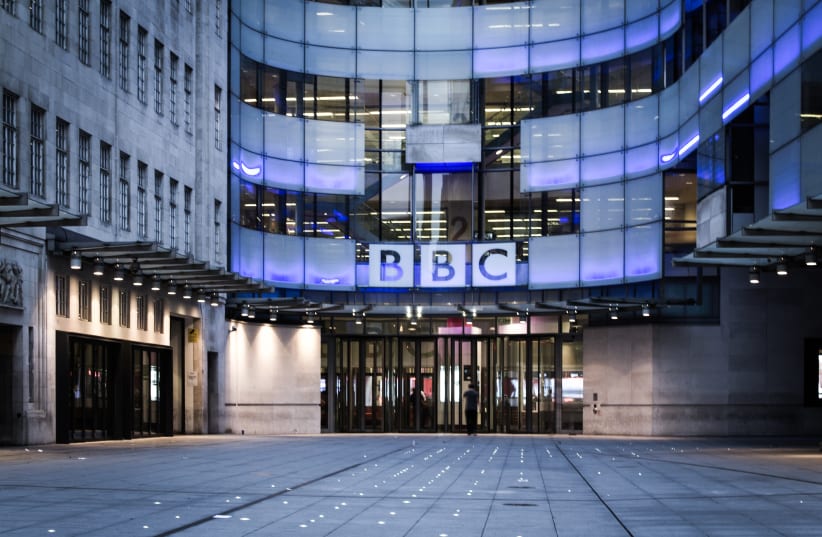
BBC New Broadcasting House in London.(photo credit: Wikimedia Commons)
Several BBC staff members quit the journalists' union after being told to wear the colors of the Palestinian flag, Jewish News reported on Wednesday.
The
National Union of Journalists (NUJ) and the Trades Union Congress (TUC)
reportedly sent messages asking workers to “wear something red, green,
black or a Palestinian keffiyeh.”
One BBC staff member told Jewish News that this “hypocritical and antisemitic”
suggestion was a breach of the BBC’s commitment to impartial reporting,
saying, “BBC journalists, who pride themselves on impartiality and who
fought to keep their NUJ free of politics, are being encouraged to break
the BBC’s editorial guidelines by supporting a political cause.”
In
a message to NUJ members, the union responded, “Clearly, members
working across the BBC and in public service broadcasting have important
duties in relation to impartiality and work within social media
guidelines the NUJ would not wish members to breach.”
TENTS ARE pitched outside the Oxford University Museum of Natural
History, as students occupy parts of British campuses in support of
Palestinians in Gaza, this week. Supporters of genocidal jihadist groups
are spreading mayhem across the Western world, says the writer.
(credit: HOLLIE ADAMS/REUTERS)
According to Jewish News, more members of NUJ are expected to resign following this situation.
Charlotte
Henry, a freelance journalist who resigned, wrote that the union had
become “a hostile environment for Jews, and I can no longer be part of
that.”
The
TUC declined to comment on whether it had previously requested workers
to wear colors representing one side in a conflict. However, it admitted
that it has never asked its members to wear Ukrainian colors during the
ongoing conflict with Russia, Jewish News reported.
The Board of Deputies of British Jews issued a statement directed at both unions.
“Whatever
the stated intent, attempts to bring this issue into the workplace in
such a fashion will undoubtedly add to the belligerent atmosphere which
many Jewish staff have been facing.”
Anti-Israel bias
In September, a report from The Telegraph,
based on research led by British lawyer Trevor Asserson, showed that
the BBC had breached its editorial guidelines for news coverage more
than 1,500 times since the beginning of the Israel-Hamas War.
The
research found that there was a “deeply worrying pattern of bias
against Israel” and that Israel was associated with genocide 14 times
more than the Hamas terror group was throughout the analyzed BBC
coverage.
Further
findings from the research included the BBC’s repeated downplaying of
Hamas terrorism. Conversely, Israel was presented as a “militaristic and
aggressive nation” by the BBC, the report said.
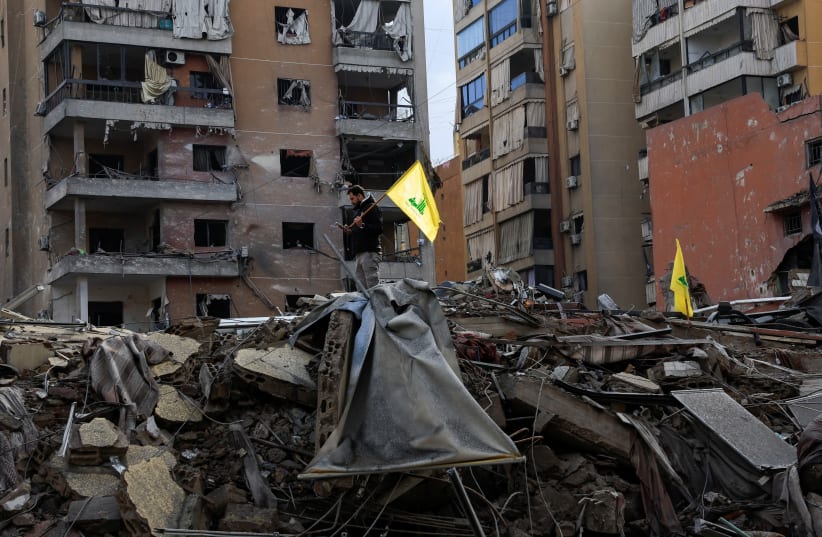
Hezbollah believes the number of its fighters killed during 14 months of hostilities could reach several thousand.
A man carries a Hezbollah flag as he stands on the
rubble of a damaged site in Beirut's southern suburbs, after a ceasefire
between Israel and Hezbollah took effect, in Beirut, Lebanon November
27, 2024.(photo credit: REUTERS/THAIER AL-SUDANI)
With the bodies of its fighters still strewn on the battlefield, Hezbollah
must bury its dead and provide succor to its supporters who bore the
brunt of Israel's offensive, as the first steps on a long and costly
road to recovery, four senior officials said.
Hezbollah believes the number of its fighters killed during 14 months of hostilities could reach several thousand,
with the vast majority killed since Israel went on the offensive in
September, three sources familiar with its operations say, citing
previously unreported internal estimates.
One
source said the Iran-backed group may have lost up to 4,000 people -
well over 10 times the number killed in its month-long 2006 war with
Israel. So far, Lebanese authorities have said some 3,800 people were
killed in the current hostilities, without distinguishing fighters from
civilians.
Hezbollah emerges shaken from top to bottom, its leadership still reeling from the killing of its former leader Sayyed Hassan Nasrallah
and its supporters made homeless en masse by the carpet bombing of
Beirut's southern suburbs and the destruction of entire villages in the
south.
With a
ceasefire taking hold on Wednesday, Hezbollah's agenda includes working
to re-establish its organizational structure fully, probing security
breaches that helped Israel land so many painful blows, and a full
review of the last year including its mistakes in underestimating
Israel's technological capabilities, three other sources familiar with
the group's thinking said.
An Israeli soldier gestures from an Israeli military vehicle, after a
ceasefire was agreed to by Israel and Iran-backed Hezbollah in Lebanon,
near Israel's border with Lebanon in northern Israel, November 27, 2024.
(credit: REUTERS/Ronen Zvulun)
For this story
Reuters spoke to a dozen people who together provided details of some of
the challenges facing Hezbollah as it seeks to pick itself up after the
war. Most asked not to be named to speak about sensitive matters.
Hassan Fadallah, a senior Hezbollah politician, told Reuters the priority will be "the people."
"To shelter them, to remove the rubble, to bid farewell to the martyrs and, in the next phase, to rebuild," he said.
Israel's
campaign has focused largely on Hezbollah's Shi'ite Muslim heartlands,
where its supporters were badly hit. They include people still nursing
casualties from Israel's attack on its mobile communications devices in
September.
"I
have a brother who was martyred, a brother-in-law who was wounded in the
pager attacks, and my neighbors and relatives are all either martyrs,
wounded or missing," said Hawraa, a woman from south Lebanon with family
members who fight for Hezbollah.
"We want to collect our martyrs and bury them ... we want to rebuild
our homes," said Hawraa, who stayed in her village until she was forced
to flee by the Israeli assault in September. She declined to use her
full name, citing safety fears.
The Israeli offensive displaced more than 1 million people, the bulk of them from areas where Hezbollah has sway.
A
senior Lebanese official familiar with Hezbollah thinking said the
group's focus would be squarely on securing their return and rebuilding
their homes: "Hezbollah is like a wounded man. Does a wounded man get up
and fight? A wounded man needs to tend to his wounds."
The
official expected Hezbollah to carry out a wide-ranging policy review
after the war, dealing with all major issues: Israel, its weapons, and
the internal politics of Lebanon, where its weapons have long been a
point of conflict.
Iran,
which established Hezbollah in 1982, has promised to help with
reconstruction. The costs are immense: The World Bank estimates $2.8
billion in damage to housing alone in Lebanon, with 99,000 homes
partially or fully destroyed.
The senior Lebanese official said Tehran has a variety of ways to get funds to Hezbollah, without giving details.
Parliament
Speaker Nabih Berri, a close Hezbollah ally, is urging wealthy Lebanese
Shi'ites in the diaspora to send funds to help the displaced, two
Lebanese officials said.
The officials also expected significant donations to come from Shi'ite religious foundations across the region.
Hezbollah
did not immediately respond to a detailed request for comment for this
story. Iran's foreign ministry did not immediately respond to a request
for comment.
People carry Hezbollah flags at a damaged site in Beirut's southern
suburbs, after a ceasefire between Israel and Hezbollah took effect, in
Beirut, Lebanon November 27, 2024. (credit: REUTERS/Thaier Al-Sudani TPX
IMAGES OF THE DAY)
'The resistance' will continue'
Hezbollah
has indicated it intends to keep its arms, dashing hopes of Lebanese
adversaries who predicted the pressures generated by the war would
finally lead it to hand them to the state. Hezbollah officials have said
the resistance - widely understood to mean its armed status - will
continue.
Hezbollah
opened fire in support of Palestinian ally Hamas on Oct. 8, 2023.
Israel went on the offensive against the group in September, declaring
the aim of securing the return home of 60,000 people evacuated from
homes in the north.
Despite
the resulting devastation, Hezbollah's Fadlallah said the resistance
put up by its fighters in south Lebanon and the group's intensified
rocket salvoes towards the end of the conflict showed Israel had failed.
Israeli
Prime Minister Benjamin Netanyahu says its campaign has set back
Hezbollah decades, eliminated its top leaders, destroyed most of its
rockets, neutralized thousands of fighters, and obliterated its
infrastructure near the border.
A
senior U.S. official said Hezbollah was "extremely weak" at this
moment, both militarily and politically. A Western diplomat echoed that
assessment, saying Israel had the upper hand and had almost dictated the
terms of its withdrawal.
The
ceasefire terms agreed by Israel and Lebanon require Hezbollah to have
no military presence in an area between the Israeli border and the
Litani River, which meets the Mediterranean Sea some 30 km (20 miles)
from the frontier.
Hezbollah,
which approved the deal, has not declared how it intends to help
implement those terms, including whether it actively hands its arms to
Lebanese troops who are deploying into the south, or leaves the weapons
for soldiers to find.
Israel
complains Hezbollah, which is deeply rooted in south Lebanon, never
implemented the same terms when they were agreed to end a previous war
in 2006 war. Israel says the group was preparing for a large-scale
assault into northern Israel, pointing to its military build-up at the
frontier.
Andreas Krieg of King's College in London said Hezbollah had retained considerable capability.
The
performance of its "core infantry fighters in southern Lebanon and
rocket attacks deep into Israeli territory in recent days showed the
group was still very, very capable," he said.
"But
Hezbollah will be very much bogged down in the effort of rebuilding the
infrastructure and also, most importantly, securing the funds to do
so,” he said.
'Repaying the debt'
Hezbollah
has been handing out cash to people affected by the hostilities since
they began, paying $200 a month to civilians who stayed in frontline
villages, and offering more as people were forced to flee the areas,
according to recipients.
Since the start of the escalation in September, Hezbollah has been paying around $300 a month to help displaced families.
The
group has made no secret of the military and financial support it gets
from Iran, which shipped huge sums of cash to in 2006 to aid the
homeless and help rebuild.
Hezbollah
supporters say more will be on the way. One, citing conversations with a
local Hezbollah official, said the group would cover a year of rent for
the homeless in addition to furniture costs.
Addressing
the Lebanese people in an October sermon, Iran's Supreme Leader
Ayatollah Ali Khamenei said "the destruction will be replaced...
repaying the debt to the wounded, bleeding Lebanon is our duty...."
The
World Bank, in a preliminary estimate, put the cost in damage and
losses to Lebanon at $8.5 billion, a bill that cannot be footed by the
government, still suffering the consequences of a catastrophic financial
collapse five years ago.
Gulf
states Qatar, Kuwait, and Saudi Arabia helped pay the $5 billion
reconstruction bill in 2006, the last time Hezbollah and Israel went to
war. But there has been no sign that these Sunni-led Arab states are
ready to do so again.
Hezbollah
conducted a lot of reconstruction work after the 2006 war, financed by
Iran and using its construction wing. The project was directed by Sayyed
Hashem Safieddine, a Hezbollah leader killed by Israel 11 days after
Nasrallah, in a sign of the bigger challenges it will face this time
round.
"For
Hezbollah the priority is to guarantee the loyalty of the Shi’ite
community. The destruction has been enormous and it will impact the
organization," said Mohanand Hage Ali of the Carnegie Middle East
Center.
If this ceasefire is to succeed, Israel needs to make the ground rules clear from the very start.
Vehicles driving south from Lebanon's southern coastal
city Sidon, after a ceasefire between Israel and Iran-backed group
Hezbollah took effect at 4:00 a.m. local time. November 27, 2024.(photo credit: REUTERS/AZIZ TAHER)
It is a promise Israelis have heard often as the IDF
withdrew from territory in the past: If one bullet or one rocket is
fired, the IDF will respond with full force and have full international
legitimacy to do so.
Then-prime
minister Ehud Barak and his ministers said as much when Israel withdrew
completely from Lebanon in 2000, and then-prime minister Ariel Sharon
and his ministers said the same when he pulled Israel out of Gaza in
2005.
But in each instance, Israel did not respond.
Hezbollah
kidnapped three soldiers on October 7, 2000, less than four months
after Israel’s withdrawal from Lebanon, but the pledged full-force
response did not come. Hamas
began firing rockets at Israel within weeks of the Gaza withdrawal, yet
the full might of Israel’s army was not unleashed against the terrorist
organization.
Those
pledges proved little more than empty words, and the failure to uphold
those pledges led to disastrous consequences: the Second Lebanon War and
Hezbollah’s monstrous buildup in Lebanon; Hamas’s Gaza takeover and,
ultimately, the October 7 massacre.
Vehicles drive near damaged buildings in Beirut's southern suburbs,
after a ceasefire between Israel and Hezbollah took effect, Lebanon
November 27, 2024. (credit: MOHAMED AZAKIR/REUTERS)
In
the run-up to the ceasefire with Lebanon that went into effect
Wednesday morning, government officials have been repeating the same
mantra: Any violation and Israel will act firmly and with overwhelming
might.
But will it?
The
ceasefire agreement was less than five hours old when there were
already tests of Israel’s resolve Wednesday: A vehicle carrying
individuals Defense Minister Israel Katz identified as Hezbollah
terrorists entered Kafr Kila, directly across from Metulla. The IDF
fired warning shots to chase them away.
In
another incident, individuals were seen near an Israeli tank in another
southern Lebanon village, and videos appeared online of people
returning to villages in the south, contrary to the agreement, which
precludes this at the moment.
Testing Israel's resolve
All
of this is a test of Israel’s resolve. If this ceasefire is to succeed,
Israel needs to make the ground rules clear from the very start: Unlike
in the past, it will not tolerate violations, even small ones, but will
immediately take decisive action.
As former head of the National Security Council Yaakov Amidror said
on Wednesday, the incidents immediately after the ceasefire took effect
at 4 a.m. were “not a good start.”
“The
IDF should not have fired warning shots but rather shots intended to
kill,” he said, adding that the true test will come when a convoy of
weapons or Hezbollah operatives enters southern Lebanon. “If we do not
address this, we will fail. We must not ignore any minor violation. We
must not concede anything, especially at the beginning.”
Why
not? Because – as recent history makes clear – the beginning sets the
tone for what will come next. If Israel acts in a determined way to show
that this time it is serious and willing to act against any violation,
then perhaps this time the deal can work.
But
if, as in the past, the government decides not to act against clear
violations of agreements, the enemy will see there is no price for not
honoring the agreement and act accordingly.
Following
the incident in Kafr Kila, Katz issued a statement instructing the IDF
to act “decisively and uncompromisingly against such occurrences. Any
identified Hezbollah member approaching restricted areas should be
arrested, and if they pose a threat to IDF forces, they should be hit.”
Resolutely
implementing the agreement serves another function: It may convince
residents of the northern communities, many of whom have expressed
disappointment with the deal and are hesitant to return to their homes,
that the IDF is determined to protect them.
If
they are unconvinced of this, if they see that Hezbollah – in the guise
of innocent civilians – is returning to the border, they may deem it
unsafe to return. Acting forcefully from the very beginning sends a
message not only to the enemy but also to Israelis debating whether to
go back to homes they fled under Hezbollah fire and fear of an invasion
nearly 14 months ago.
This ceasefire agreement
could usher in a new period in the North and for Lebanon, but only if
the agreement is honored, and only if Israel takes consequential action
if it is not. The time to take that consequential action has already
begun.
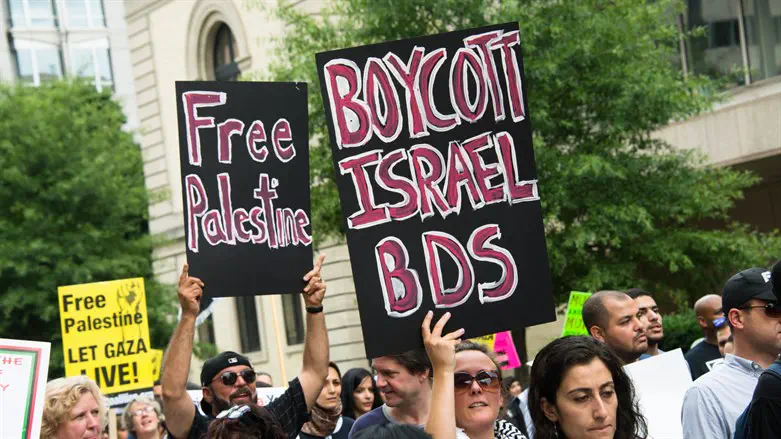
Reps. Virginia Foxx and Josh Gottheimer introduce new legislation which would prohibit colleges and universities from receiving federal student aid if they engage in commercial boycotts dictated by the BDS movement.
BDS protest iStock
New bipartisan legislation in the US would prohibit
colleges and universities from receiving federal student aid if they
engage in commercial boycotts dictated by the anti-Israel Boycott,
Divestment and Sanctions (BDS) movement.
The
legislation was introduced on Tuesday by Education and the Workforce
Committee Chairwoman Virginia Foxx (R-NC) and US Representative Josh
Gottheimer (D-NJ).
The bill, H.R. 10257 or
the Protect Economic Freedom Act, makes those institutions ineligible
for funding under Title IV of the Higher Education Act.
“Enough
is enough. Appeasing the antisemitic mobs on college campuses threatens
the safety of Jewish students and faculty and it undermines the
relationship between the U.S. and one of our strongest allies. If an
institution is going to capitulate to the BDS movement, there will be
consequences – starting with the Protect Economic Freedom Act,” said
Foxx.
“The goal of the antisemitic BDS
movement is to annihilate the democratic State of Israel, America’s
critical ally in the global fight against terror. While students and
faculty are free to speak their minds and disagree on policy issues, we
cannot allow antisemitism to run rampant and risk the safety and
security of Jewish students, staff, faculty, and guests on college
campuses. The new bipartisan Protect Economic Freedom Act will give the
Department of Education a critical new tool to combat the antisemitic
BDS movement on college campuses. Now more than ever, we must take the
necessary steps to protect our Jewish community,” said Gottheimer.
The
Protect Economic Freedom Act would require colleges and universities to
certify that the institution is not engaging in a non-expressive
commercial boycott of Israel, otherwise the institution will forgo its
ability to receive federal student aid.
The
bill mirrors existing laws enforced by the Department of Commerce’s
Bureau of Industry and Security that prohibit US persons from
participating in unsanctioned foreign boycotts. It also directs the US
Department of Education to make publicly available a list of all
institutions that fail to certify.
The legislation comes amid a spike in incidents of antisemitism on US campuses since Hamas’ October 7, 2023 attack on Israel.
The Committee on Education and the Workforce, which Foxx heads, recently released
a 122-page report which detailed what it termed "astonishing
concessions" by officials at numerous schools, including Harvard,
Columbia, Yale, MIT, UCLA, and Rutgers to antisemitic protesters who
disrupted campuses and threatened Jewish students and staff.
In
their statement introducing the anti-BDS legislation, Foxx and
Gottheimer noted, “Throughout the course of the Committee’s
investigation into antisemitism on college campuses, it became clear
that radical, anti-Israel individuals were attempting to coerce
institutions into divesting from and boycotting Israel.”
“One
of the most poignant examples was found at Northwestern University,
where it was discovered that faculty members and Northwestern’s Provost
were willing to appease organizers of illegal encampments by removing
Sabra hummus from campus dining facilities because of the brand’s
perception as an Israeli product. In addition to damaging economic
partnerships, engaging in commercial boycotts undermines the US-Israel
relationship and appeases antisemitic mobs,” the statement added.
Lebanon’s Economy Minister, Amin Salam, says there will be consequences if Hezbollah does not honor the ceasefire agreement.
Israel's border with Lebanon Ayal Margolin/Flash 90
Lebanon’s Economy Minister, Amin Salam, warned on Wednesday that failure by Hezbollah to adhere to the ceasefire agreement could push the country into "very dangerous territory."
Speaking to Sky News, Salam emphasized the fragile state of Lebanon in the aftermath of the recent conflict with Israel.
The
ceasefire, he noted, had "brought some happiness" by halting the
immediate violence, "at least to stop the bleeding." However, he
acknowledged the significant toll the conflict had taken.
"We are looking at major losses," Salam told Sky News, pointing to the economic strain and the immense cost of rebuilding.
When asked about the consequences if Hezbollah did not honor the agreement, Salam was unequivocal.
"The
deal was very clear," he stated. "If this ceasefire is to fail, I think
it will take Lebanon to a very dangerous territory of escalation and of
bringing back the war and will lead to further devastation."
Such
an outcome, he warned, would leave Lebanon in a dire state. "It will be
a place very hard for Lebanon to recover from," Salam concluded.
IDF spokesman Daniel Hagari said on Wednesday that the IDF had enforced several violations by Hezbollah of the ceasefire which had gone into effect at 4:00 a.m.
"Today,
we have enforced violations in the field, eliminating Hezbollah
operatives. We apprehended suspects in the village of Tir Harfah and are
currently interrogating them. Additionally, we will not permit movement
by vehicles to the area during the night. Residents of Lebanon, as you
have seen throughout the war, we do what we say. For your protection, we
call on you not to approach the area where our forces are positioned.
The ceasefire agreement is structured to be gradual, and we will update
you when it is safe to return to the area," Hagari said.
Shocking recent events occurred during pro-Palestinian demonstrations, where chants of "Death to Jews" were heard in public squares.
Rally against antisemitism in Amsterdam(photo credit: c4i)
On Thursday evening, thousands of supporters are gathering at the
Stopera in Amsterdam, waving Israeli and Dutch flags, to demonstrate
solidarity with the Jewish community and speak out against the alarming
surge in antisemitism in the Netherlands. The rally, organized by
Christians for Israel and other pro-Israel organizations, has become a
powerful show of unity and resistance against hatred.
Surge in antisemitism across the Netherlands
In recent months, the Netherlands has witnessed a sharp increase in antisemitic incidents,
particularly following the escalation of the Israel-Hamas conflict.
According to the Center for Information and Documentation on Israel
(CIDI), there have been numerous reports of attacks on Jewish
individuals, graffiti defacing synagogues and Jewish institutions, and
antisemitic chants at protests. Social media platforms have also seen a
disturbing rise in hate speech targeting the Jewish community.
One
of the most shocking recent events occurred during pro-Palestinian
demonstrations, where chants of "Death to Jews" were heard in public
squares—an act that drew widespread condemnation from Dutch officials
and citizens. The situation has left many in the Jewish community
feeling vulnerable, leading to heightened security measures at Jewish
schools, synagogues, and cultural centers.
Rabbi
Binyomin Jacobs, Chief Rabbi of the Netherlands, has been outspoken
about the growing threat: “For many Jews in the Netherlands, wearing a
kippah in public or expressing their identity has become a risk. This
should not be the reality in a country that prides itself on tolerance
and freedom.”
The city of Amsterdam (credit: c4i)
Solidarity in the face of hatred
The
rally at the Stopera is an answer to these rising concerns. Attendees
are carrying Israeli and Dutch flags as a show of solidarity and
defiance against the hate. Signs with messages such as "No to
Antisemitism" and "Support Israel, Support Freedom" are visible
throughout the crowd.
Sebastian
Garner, one of the participants, said: “The recent wave of antisemitism
is horrifying, and it’s not something we can ignore. This rally is a
way for us to say ‘enough is enough.’ We are here for the Jewish
community, and we stand with Israel.”
Paulus
de Beer, holding a sign inviting Israeli Prime Minister Benjamin
Netanyahu to the city of Urk, explained the significance of his message:
“Urk is a city with a long history of standing with Israel and the
Jewish people. In times like these, we want to show that Israel has true
allies here in the Netherlands, and that hate will not go unanswered.”
Symbolic shift in venue sparks debate
The rally was initially scheduled to take place at Dam Square, one of the most iconic locations in Amsterdam,
but Mayor Femke Halsema declined the request, citing concerns about
public order and safety. This decision was met with criticism, with many
viewing it as a missed opportunity for the city to take a firm stand
against antisemitism. The last-minute relocation to the Stopera has not
deterred the crowd, which continues to grow as more people arrive to
show their support.
As
the rally unfolds, the streets of Amsterdam are filled with songs of
hope, speeches of solidarity, and a resounding call to confront the
rising tide of antisemitism in the Netherlands
The pair recently indicated that the relationship could be on the mend, when Trump stated last month that he felt better about the Facebook founder, after he stayed out of the 2024 election and called him after the July 13 shooting.
Mar-a-Lago resort in Palm Beach, Florida.
Getty Images
Facebook creator and Mega owner
Mark Zuckerberg on Wednesday met with President-elect Donald Trump and
members of his incoming administration, in the latest sign the duo are hoping to move forward together.
Trump and Zuckerberg have had a rough relationship over the years,
with Trump slamming the social media owner for donating hundreds of
millions of dollars to help election infrastructure in 2020. Trump has
also claimed Zuckerberg should be in jail for election interference over
the donations, Politico reported.
The pair recently indicated that the relationship could be on the
mend, when Trump stated last month that he felt better about the
Facebook founder, after he stayed out of the 2024 election and called
the former president following the July 13 assassination attempt against Trump.
Trump's new deputy chief-of-staff on Wednesday confirmed
reports that the duo was meeting at Mar-a-Lago in Florida, telling Fox
News that Zuckerberg "has made it very clear about his desire to be a
supporter of and a participant in this change that we’re seeing all
around America, all around the world, this reform movement that Donald
Trump is leading.”
A spokesperson for Meta also confirmed the meeting, according to Politico.
"Mark ... obviously has his own interest and he has his own company
and his own agenda, but he’s made clear he wants to support the national
renewal of America under Trump’s leadership," Miller added.
Misty Severi is an evening news reporter for Just The News. You can follow her on X for more coverage.
Public confidence in universities has sharply declined due to rising costs, administrative bloat, ideological bias, student debt issues, and discrimination concerns.
Universities have suffered a cataclysmic decline in public approval and support.
A Gallup poll taken this year found that only 36 percent of Americans
polled either expressed “a great deal” or “quite a lot” of confidence
in higher education—once the agreed-on touchstone to upward mobility.
Gifting to most universities has been down for two consecutive years.
There is zero intellectual diversity on most university campuses.
Speakers with conservative viewpoints are often either disinvited or shouted down—and worse.
The federally guaranteed student loan program is in shambles. Some
$1.7 trillion in outstanding loans were taken out by half of all college
students.
Nearly a fifth are now not being paid back.
Marriage, child-rearing, and home ownership are all delayed by some
40 million indebted graduates, who can take decades to pay loans back.
The Biden administration demagogued the issue by illegally granting
rolling student loan amnesties to win votes just before both the midterm
and general elections. That proposed debt relief would be covered by
taxpayers, over half of whom never went to college.
The expansion of student loan debt roughly correlates with
universities raising their annual costs higher than the rate of
inflation—largely due to administrative bloat.
Although the Supreme Court recently struck down the practice of using
race and gender to adjudicate applications and hiring, universities are
already seeking ways to circumvent the ruling.
Asian- and white-Americans for decades have been systematically,
overtly, and supposedly with justification, discriminated against by
ignoring or not requiring test scores and downplaying grade point
averages.
Stanford University may be representative of these crises.
In the 2020 election, 94% of Stanford faculty voted for the
Biden-Harris ticket. Four years later, some 96% of all
Stanford-affiliated donations went to Democrats during the 2024 election
season.
Former Stanford law professors Joseph Bankman and Barbara
Fried—parents of mega-Democratic donor and now imprisoned Sam
Bankman-Fried, and recipients of millions in gifts from their felonious
son—were reportedly heavily involved in either bundling large left-wing
campaign donations or offering legal advice to their son’s bankrupt and
Ponzi-like business.
In 2023, a federal judge was shouted down at Stanford Law School, his
lecture aborted and then hijacked—by a Stanford DEI administrator!
Former Trump health advisor and Hoover Institution scholar Scott Atlas in 2020 was censured by the Stanford faculty.
Yet subsequent events supported Atlas’s prescient warning that a
complete lockdown of the country and the shutdown of K-12 schools would
not only not retard the COVID epidemic but would cause far greater
economic, social, cultural, and health damage than the virus itself.
Two recent attempts to lift that censure failed—in part because some
faculty claimed that to do so would empower the Trump reelection bid!
In contrast, Stanford Professor Jeff Hancock, who founded the
“Stanford Social Media Lab,” boasts he researches “how people use
deception with technology.” Yet when liberal Minnesota officials wanted
such “experts” to support their new law banning “deep fake” technology
at election time, they called in the expert deception-detector Hancock.
However, the references Hancock provided to prove his support for the law allegedly never existed.
In fact, the lawyers who challenged his online expertise argued his
sources apparently were invented by artificial intelligence software
like ChatGPT.
Who will police the deception police?
Last academic year, anti-Israel Stanford students with impunity
violated university rules and camped out for months in the free speech
area, shouting and disrupting passersby.
A small group of students occupied and trashed the president’s office and another vandalized historic campus architecture.
After October 7, a Stanford lecturer was suspended for singling out and targeting Jewish students in his classroom.
A Stanford faculty committee on anti-Semitism recently concluded,
“The most existential problem at Stanford is the emergence of a general
atmosphere in which Jewish and Israeli members of the Stanford community
are denied dignity and respect based on their Jewish identities, denied
treatment and protection afforded to other minority groups, and
afforded equal respect and inclusion only if they denounce Israel in
various ways and forms.”
Can out-of-control universities reform?
The incoming Trump administration has floated a variety of tough-love remedies.
They include predicating hundreds of billions of dollars in federal
grants on campuses’ adherence to the Bill of Rights, taxing the income
on universities’ multibillion-dollar endowments, and removing the
federal government from the student loan business.
Recently, there have been a few hopeful signs that campuses are aware of the need to change.
At Stanford, a new president was hired, widely respected for his
singular commitment to disinterested education and freedom of
expression.
The SAT entrance exam is returning to many campuses and is still appreciated as crucial to most universities’ applications.
A number of partisan elite college presidents have resigned in disgrace.
So, hope springs eternal, even if it may be too little, too late.
“Reminder: There is no peace agreement,” wrote Gerald Steinberg, of NGO Monitor. “The goal of the Tehran regime and its proxy terror armies (in this case, Hezbollah) remains the destruction of Israel.”
A view of the U.S. Capitol in Washington, D.C. Photo by Arie Leib Abrams/Flash90.
Although Israel has achieved “enormous
military successes” over the past year against Hezbollah, the Biden
administration “has spent the last four years pathologically obsessed
with undermining Israel and boosting Iran,” stated Sen. Ted Cruz
(R-Texas) after U.S. President Joe Biden announced a ceasefire deal in
Lebanon.
“They are now using the transition period
to the Trump administration and a Republican Congress to try to lock in
those efforts—and to constrain the incoming administration—by
establishing what they believe to be irreversible diplomatic, legal and
military policies,” Cruz added. “However, these and similar international policies are not irreversible.”
The senator added that he is “deeply
disturbed” by reports that “Obama-Biden officials exerted enormous
pressure on our Israeli allies to accept this ceasefire” and by how the
officials “are characterizing Israel’s obligations.”
“This pressure and these statements are
further efforts to undermine Israel and constrain the incoming Trump
administration,” Cruz stated. “Obama-Biden officials pressured our
Israeli allies into accepting the ceasefire by withholding weapons they
needed to defend themselves and counter Hezbollah, and by threatening to
facilitate a further, broader, binding international arms embargo
through the United Nations.”
Those U.S. officials aim to “use Israel’s
acceptance of this ceasefire to ensure that Hezbollah and other Iranian
terrorist groups remain intact across Lebanon, and to limit Israel’s
future freedom of action and self-defense,” Cruz stated.
Several of Cruz’s colleagues in Congress also addressed the agreement.
Sen. Lindsey Graham (R-S.C.) said he is
“very pleased to hear that a ceasefire between Israel and Hezbollah has
been reached regarding the conflict in Lebanon.”
“I appreciate the hard work of the Biden
administration, supported by President Trump, to make this ceasefire a
reality,” Graham said. “This ceasefire will protect Israel from another
Oct. 7 and will give the people of Lebanon a break from the fighting.”
“My hope is that we can soon achieve a ceasefire in Gaza and allow peaceful solutions to replace endless conflict,” he added.
Sen. Ben Cardin (D-Md.), chair of the
Senate Foreign Relations Committee, stated that the agreement “marks a
vital and productive step, but hopefully not the last.”
“Lebanon’s Parliament can and must select a
president free from corruption and Iranian influence,” he added. “The
United States remains committed to ensuring the ceasefire holds with
strong and ongoing support for the Lebanese Armed Forces—the true
defenders of Lebanon’s sovereignty and people—and for Israel’s right to
defend itself against terrorism.”
Sen. Jacky Rosen (D-Nev.) wrote
that “for over a year, Israel has faced ongoing attacks from Hezbollah,
a terrorist organization backed by Iran. Today’s agreement will help
save lives and allow Israel to fully focus on defeating Hamas.”
“It also makes it clear Hamas is isolated and must free the remaining hostages now,” the senator stated.
House Majority Whip Tom Emmer (R-Minn.) wrote
earlier in the day about the ceasefire deal that there was “a clear
message to all Iranian proxies: The Trump administration will not
tolerate violence against Israel. The Middle East cannot continue to be a
breeding ground for terror and chaos.”
Rep. Katie Boyd Britt (R-Ala.) wrote that she supports “the democratically elected government of Israel’s decision to enter this ceasefire deal.”
“I also stand with Israel in her right to
enforce this agreement, including striking Hezbollah terrorists in
Lebanon if necessary,” Britt said. “The United States stands with Israel
today and always.”
Rep. Joe Courtney (D-Conn.) said
that the agreement “is a breakthrough that will save countless innocent
lives and demonstrates that diplomacy can work in the Middle East.”
“Hopefully, his efforts will create
momentum for a ceasefire in Gaza and a lessening of violence in the
entire region,” the congressman said.
‘Pave the way for a more stable future’
U.S. Jewish groups applauded the deal.
The Jewish Federations of North America
welcomed the agreement and said Israel “has long endured the
unacceptable threat of Iran’s proxy Hezbollah amassing heavy weapons
along its northern border, and since Oct. 8, 2023, firing regular
missiles, drones and rockets, forcing over 60,000 people to evacuate
their homes.”
“Throughout this harrowing period, Jewish
Federations have been there to support Israel’s communities, and we will
continue to support them in their needs going forward,” it stated. “We
are hopeful that this agreement will help pave the way for a more stable
future, allow Israel’s citizens to return to their homes, and end the
unacceptable rain of rockets and missiles that have terrorized Israel’s
civilians these past 14 months.”
The American Jewish Committee stated that
“as Israel has done time and time again, it has chosen to agree to a
ceasefire at the risk of huge potential costs.”
“To protect this peace, enforcement from
the Lebanese army, the United Nations Interim Force in Lebanon, and U.S.
Central Command will be paramount,” the AJC stated. “As long as
Hezbollah, funded by the Iranian regime to eradicate Israel, remains on
its border, Israel and her people are under threat.”
It added that “much of this deal is based
on the original tenets of U.N. Security Council Resolution 1701, which
has failed to be enforced since its adoption in 2006.”
“While AJC welcomes the new enforcement
mechanisms in this agreement, we will continue to advocate for a
reassessment of UNIFIL’s mandate and operations,” AJC added. “As
recently as last August, UNIFIL’s mandate was simply renewed without the
necessary adjustments to address the threat posed by Hezbollah. Without
meaningful reforms, UNIFIL will continue to fall short of its mandate.”
AIPAC stated that “this war was a direct
byproduct of Iran arming and funding its terror proxy Hezbollah and the
international community’s failure to enforce Security Council Resolution
1701 after the 2006 war.”
It called on the international community
to “remedy its failures following the 2006 war and ensure Hezbollah
can’t rearm or operate south of the Litani River.”
Mark Mellman, president and CEO of
Democratic Majority for Israel, stated that the “ceasefire achievement
reaffirms our long-standing belief that this is the most pro-Israel
administration in American history.” He added that the agreement
“protects Israel’s security.”
“Reminder: There is no peace agreement.
The goal of the Tehran regime and its proxy terror armies (in this case,
Hezbollah) remains the destruction of Israel,” wrote
Gerald Steinberg, founder and president of NGO Monitor. “In response,
and based on the lessons of the past 14 months, Israel will act with
force and preemptively whenever its survival is threatened.”
The ceasefire with Hezbollah won’t ensure the safety of northern Israel. But could anyone else have resisted U.S. heat for so long and achieved as much?
Israeli Prime Minister Benjamin Netanyahu speaks to
IDF soldiers during a visit to the northern border on May 28, 2024.
Photo by Amos Ben-Gershom/GPO.
There are a good many reasons to worry
that the impending ceasefire with Hezbollah terrorists that Israel has
chosen to accept is a bad bargain. A lot can go wrong, and there are no
assurances that the quiet it promises will last. And yet, the deal that
Prime Minister Benjamin Netanyahu has agreed to is probably the best
Israel can get under the circumstances. Even critics of the decision
must acknowledge that the Jewish state has not come away from the
negotiations empty-handed but has achieved some real gains.
After a year of suffering incessant
attacks on its northern communities that began on Oct. 8—just one day
after the Hamas-led massacres in the south—Israel has finally forced
Hezbollah and Iran to retreat from their determination to keep firing as
long as Hamas is fighting in Gaza. This isolation of Hamas, which
renders their continued efforts to sustain the war on Israel it began on
Oct. 7, 2023, far more precarious, is a victory for the Jewish state.
So, too, is the fact that the last two
months of Israeli attacks on Hezbollah have significantly degraded their
capacity to inflict harm on the region. That’s a defeat for Iran, which
had hoped that the seven-front war on Israel it had incited could go on
indefinitely, weakening the country and its citizens’ resolve. Instead,
they are the ones who have been diminished by military setbacks and
vast losses inflicted on a group whose main purpose is to serve as a
deterrent to attacks on Iran.
Equally important, this is a moment to
consider that the setbacks dealt Hezbollah and Iran, coupled with the
destruction of Hamas’s military capabilities, were only made possible by
the determination and the ability of one man to stand up to U.S.
pressure to abandon the fight for Israel’s security many months ago.
It’s difficult to imagine anyone other than Netanyahu could have stood
his ground against Washington’s pleadings and threats, and have gone on
to achieve an outcome that leaves Israel’s enemies far weaker than they
were when the current conflict began almost 14 months ago.
For all of his faults and his stubborn
refusal to cede power after so many years in office, as well as the fact
that he bears some of the responsibility for the Oct. 7 catastrophe
that happened on his watch, what Netanyahu has done in the year since
then is truly remarkable.
Only someone with his steely determination
and savvy understanding of the tricky dynamics of the U.S.-Israel
relationship could have navigated the long months of war so skillfully.
No possible successor in his own Likud Party or among his opponents in
the Knesset could have stuck to his goals—and do so much harm to Hamas
and Hezbollah in the face of the desire of his country’s sole superpower
ally to force Jerusalem to accept the continued rule of Hamas in Gaza
and avoid direct conflict with Iran’s Lebanese auxiliaries.
Whatever comes next—whether it is a
renewed war with Hezbollah caused by their refusal to keep the ceasefire
or to abide by its terms that demand they withdraw their terrorist
cadres and weapons north of the Litani River, or the bloody continuation
of the mopping up of what’s left of Hamas’s terrorists in
Gaza—Netanyahu’s leadership has been indispensable.
He may ultimately be judged by Israel’s
voters as being too tainted by his association with the worst day in
their country’s history to serve another term. But his service as prime
minister during the last terrible year of intense battle will still
deserve to be remembered with honor. It was a period during which it was
only his insistence on sticking to a goal of eliminating Hamas and
dealing deadly blows to Hezbollah and Iran—while cabinet colleagues,
political foes and military advisers were willing to give in to the
Americans and accept far more disastrous deals—that prevented a
diplomatic and military defeat for Israel.
Reasons to worry
Those who are outraged at the deal with Hezbollah have reason to be concerned.
The Iranian proxy group has never kept its
word about anything, let alone agreements to stop attacking Israel or
to withdraw from the southern part of Lebanon over which it has largely
ruled for a generation. For those who hoped the Israeli offensive that
began in September would only end in the complete defeat of Hezbollah,
the announcement of the agreement is a disappointment. That is
especially true when one thinks of the sacrifices that the soldiers of
the Israel Defense Forces have made to achieve what may only be a
temporary respite to the fighting.
Nor can Israel rely on the United States
or France to take action to guarantee that Hezbollah will not simply
move its terrorist forces and missiles back to Israel’s border as soon
as the IDF withdraws. No matter the provocation, only Israeli action
(which will likely again be demonized and subjected to lawfare attacks
by the international community) can defend the security of the Jewish
state.
What’s more, the tens of thousands of
Israelis who were forced to flee their homes after the Iranian proxy
group began firing on northern Israel last October have no reliable
guarantee that they will be safe if they go back.
On top of all that, it must also be
acknowledged that pressure from the Biden administration, which has
always been more interested in appeasing Iran and forcing Israel to
accept ceasefires with both Hezbollah and Hamas, was part of the
equation that led to this decision.
Will that encourage whoever is in charge
of U.S. foreign policy in the next two months—whether it is a visibly
diminished Biden or someone else—to push for a binding U.N. Security
Council resolution that would impose a ceasefire in the Gaza Strip that
will help what’s left of Hamas to survive and ultimately take back power
there?
Yet despite all of that, those inclined to
view the cessation of war in the north as a defeat for Israel need to
consider how much it has gained in the last several months.
The myth of Hezbollah exploded
Iran and its Lebanese henchmen had counted
on Israel being too intimidated by the prospect of another round of
fighting with a Hezbollah force that had more than 120,000 rockets and
missiles pointed at it. The evisceration of the leadership of the
terrorist group and sustained damage done to its forces and arms caches
confounded those who thought the Jewish state was too weak to achieve
such a result. While Hezbollah and Iran will over time reorganize, rearm
and recoup their losses, they also now know that their hubristic
confidence that they were invincible has been exposed as a myth.
The fact that Hezbollah was forced by its
losses to accept a ceasefire without it being tied to an Israeli
withdrawal from Gaza is also an enormous setback for Iran’s multifront
war strategy.
Though the next two months will remain a
period of extreme danger for Israel, Netanyahu’s decision should also
solidify his relationship with the incoming Trump administration. The
president-elect has been open about his hope that Israel will conclude
its wars in Gaza and Lebanon before he is sworn in on Jan. 20.
A deal that would disarm Hamas, guarantee
it could not come back to power in Gaza and gain the release of the
remaining 101 Israeli hostages still being held by the terrorists may be
unlikely, given the fanaticism of the Islamists even after their
abandonment by their Lebanese allies. Yet by concluding a deal with
Hezbollah, Netanyahu can say he’s done as much as he can to give Trump a
clean slate and be able to further strengthen the U.S. obligation to
back the Jewish state to the hilt if the terrorists violate the accord.
The ceasefire in the north will also
enable the IDF to concentrate on the tough task of mopping up Hamas
guerrillas in Gaza after Netanyahu’s staunch refusal to accept Biden’s
ultimatums to stand down made the destruction of their formal military
forces possible.
Restoring deterrence
Oct. 7 was an enormous blow to Israel’s
ability to deter its enemies and undermined confidence in its reputation
as the “strong horse” in the region that could inspire Arab states to
resist Iran. But the victories that the IDF achieved, albeit at the
terrible price of approximately 900 soldiers and police officers slain
fighting their nation’s genocidal foes, have restored its strategic
position. With Hezbollah weakened and Hamas on the run, as well as with
much of its own air defenses being taken out by Israeli military action,
Tehran is far weaker than it was on Oct. 6, 2023.
None of that will convince those who hate
Netanyahu—and falsely accuse him of undermining democracy and being a
corrupt authoritarian—to admire him. Nor will they stop their incessant
resistance to his government, whereby he is not only blamed for Oct. 7
(a guilt he shares with the entire leadership of the IDF and Israel’s
intelligence establishment) but for Hamas’s refusal to release the
hostages.
The lion’s share of the credit for the
victories the IDF has achieved belongs to the soldiers who paid for them
in blood. But honest observers must also acknowledge that it’s not
likely that any other conceivable Israeli leader would have had the guts
and the stiff spine to fend off a year of American pressure that made
them possible. Certainly not Netanyahu’s political opponents Naftali
Bennett and Yair Lapid, who folded in the face of far less American
pressure in 2021 to give up Israeli natural-gas fields to Hezbollah in a
failed attempt at appeasement. Nor can one imagine anyone else in the
Likud-led coalition government having the knowledge or the resolve that
Netanyahu showed time and again.
The prime minister has been around too
long, behaved too arrogantly and made too many enemies to ever be given
universal praise, no matter what he’s done. But while opinion about him
will always be mixed at best, his post-Oct. 7 stand has been his finest
hour. One can only hope future historians will give him his due for what
he’s accomplished in the last year.
Jonathan S. Tobin is editor-in-chief of JNS (Jewish News Syndicate). Follow him @jonathans_tobin.