Saturday, October 10, 2026

Three Years After Hamas’s October 7 Massacre, New York Mayor Zohran Mamdani Hijacks the Day to Attack Israel - Fred Fleitz


by Fred Fleitz

Three years on, the facts of October 7 have not changed: Hamas and its allies carried out the worst slaughter of Jews since the Holocaust.


On Wednesday, New York City Mayor Zohran Mamdani sparked outrage with a statement that opened with a brief nod to those killed in the October 7, 2023, Hamas terrorist attack but devoted most of its length to accusing Israel of genocide.

The statement began, “This day is profoundly painful for so many New Yorkers. It marks three years since the horrific war crimes of October 7. On that day, Hamas killed more than 1,100 Israelis and abducted 251 others.” Then he turned to Israel-bashing: “The suffering did not begin nor end that day. It instead continued through the Israeli government’s devastating, ongoing genocide in Gaza, in which it has killed more than 74,000 Palestinians—including more than 21,000 children.” Mamdani accused Israel of bombing ambulances and targeting journalists with drone strikes and blocking food aid, charged that American tax dollars were financing Israeli “war crimes,” and closed by demanding an end to “occupation and apartheid.”

Mamdani never called the Hamas attack terrorism. As Anti-Defamation League CEO Jonathan Greenblatt pointed out, he never once used the word “Jews.” He understated the Israeli death toll—roughly 1,200, not “more than 1,100”—while presenting dubious casualty figures from the Hamas-run Gaza Health Ministry as settled fact. And he framed the anniversary of the worst slaughter of Jews since the Holocaust as the opening chapter of an Israeli crime.

Israeli and American officials sharply condemned these smears. Israel’s UN ambassador, Danny Danon, said Mamdani was trying to “hijack” the day and compared the statement to “turning September 11 into a day of mourning for al-Qaeda terrorists.” U.S. Ambassador to Israel Mike Huckabee called it an “outrageous & disgusting rant” on a day that “ought to honor the over 1,200 civilians butchered by Hamas,” and wrote that New York had elected a “jihadist sympathizer.” Israel’s ambassador to Washington, Yechiel Leiter—speaking from the hospital bedside of a son critically injured in a Palestinian car-ramming—said it was “hard to find a sentence in Mamdani’s post that isn’t a lie” and called him “a defender of Palestinian terrorism.” New York’s Israeli consul general, Ofir Akunis, called the message a “disgrace, shame, and insult to the memory of those who were murdered.”

The criticism was not confined to Israelis or Republicans. Democratic Rep. Debbie Wasserman Schultz accused Mamdani of “desecrating the memory of murdered, innocent Jews.” Rep. Josh Gottheimer said he was “blam[ing] the victims.” Rep. Daniel Goldman, who represents parts of Manhattan and Brooklyn, called the message “reprehensible” and noted that Mamdani “asserts as fact hotly disputed allegations.”

This was not a one-off. On the second anniversary last year, then-candidate Mamdani followed the same script, calling October 7 a “horrific war crime” before pivoting to accuse Israel of waging a “genocidal war.” Each year the “war crime” line is there, and each year Mamdani uses it to serve the same purpose: throat-clearing before an indictment of Israel.

Three years on, the facts of October 7 have not changed: Hamas and its allies carried out the worst slaughter of Jews since the Holocaust. Twelve hundred people were murdered in Israel. About 250 were taken hostage. Attackers filmed themselves killing civilians at the Nova music festival and in the kibbutzim, burning families in their homes, raping women and girls, and murdering the elderly and infants.

What has changed is how readily those facts are being pushed aside. Mamdani’s message shows how it is done—acknowledge the atrocity in a single clause, then “contextualize” it until the victims become a preamble and Hamas disappears from the story. That is not a way to honor the victims of the October 7 massacre. It is revisionism, and it speaks with the authority of City Hall in the city with the largest Jewish population outside Israel. New York’s Jews deserved a mayor who could grieve with them for one day without an asterisk. On Wednesday, they learned they do not have one.

But Mamdani is not an outlier. He is a symptom. The October 7 massacre is being buried because it interferes with a long-standing liberal and radical narrative that casts Palestinians as innocent victims and Israelis as oppressors. That narrative cannot survive the record. Palestinian leaders rejected or walked away from land-for-peace offers in 2000, 2001, and 2008, each of which would have created a Palestinian state. Israel withdrew every soldier and settler from Gaza in 2005; within two years Hamas had seized the territory and turned it into a launchpad for rockets and terror tunnels. Hamas’s founding charter calls for the killing of Jews, and its leaders still pledge a Palestine “from the river to the sea”—a single state with no place for a Jewish state or the Jews who live there. On October 7, Hamas showed the world exactly what that means.

A politics that cannot say this plainly—that Hamas committed genocidal terrorism, and that Israel had the right and the duty to defeat it—is not moving toward peace. It is moving toward the next excuse.

* * *

Fred Fleitz is vice chair of the America First Policy Institute Center for American Security. He previously served as chief of staff of the Trump National Security Council.

Source: https://amgreatness.com/2026/10/09/three-years-after-hamass-october-7-massacre-new-york-mayor-zohran-mamdani-hijacks-the-day-to-attack-israel/

Follow Middle East and Terrorism on Twitter

Hamas facing internal unrest as Israel detects plans for renewed attacks, official says - Amir Bohbot


by Amir Bohbot

Asked about the possibility of a large-scale confrontation with Hamas before Israel's October 27 elections, the official assessed the likelihood as low.


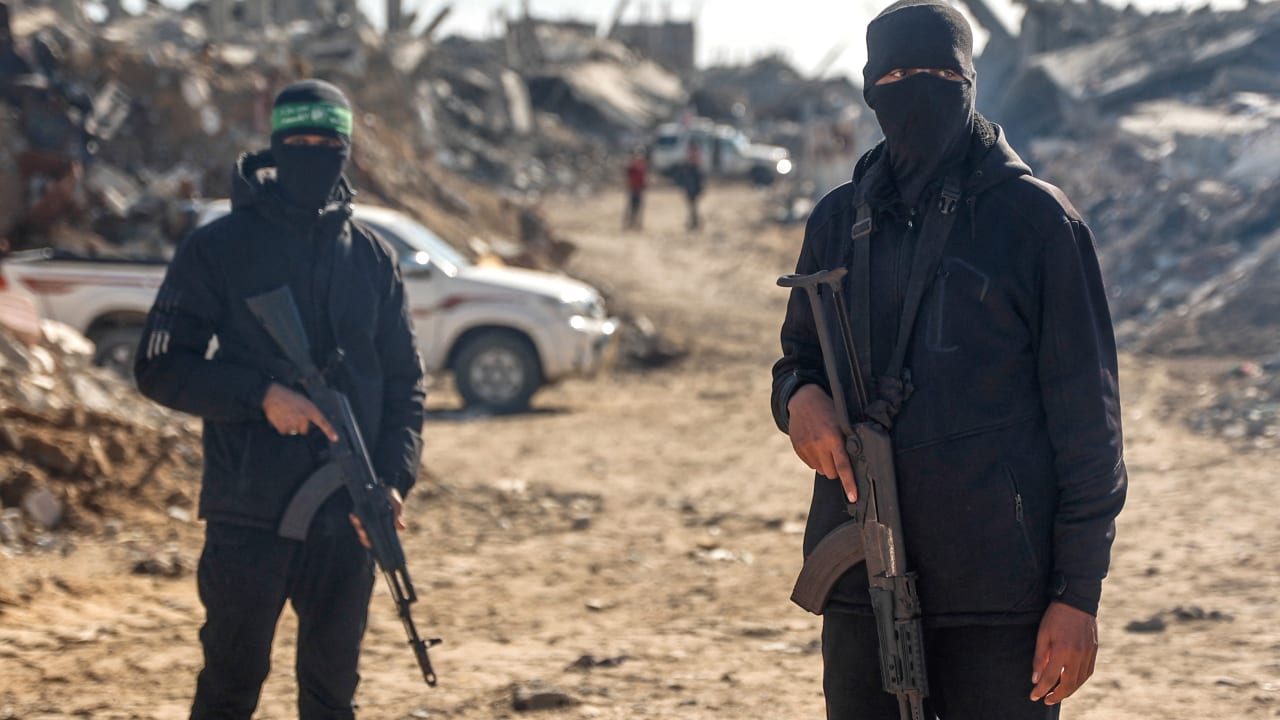
Hamas terrorists as Egyptian workers accompanied by members of the ICRC search for the last two remaining bodies of hostages -an Israeli soldier and a Thai national- from under the rubble of the Jabalia refugee camp, in the Gaza Strip on December 1, 2025; Illustrative.
(photo credit: Omar AL-QATTAA / AFP via Getty Images)


A senior Israeli security official told Walla on Saturday that Hamas is showing signs of preparing for attacks against Israeli forces, amid growing tensions between the terrorist group's leadership abroad, headed by Khalil al-Hayya, and its leadership in the Gaza Strip over its policy toward Israel.

The official said Israeli intelligence had identified indications that Hamas was planning to confront IDF troops along the Yellow Line, which separates areas of Israeli military control from the rest of Gaza, as well as local Palestinian clans that regularly clash with the terrorist group.

"We are identifying offensive intentions in general. To confront the IDF along the Yellow Line and to confront the clans," the official said.

Addressing Hamas's current situation, the official said the group was struggling to rebuild its military capabilities while facing continued Israeli operations and growing internal opposition.

"Hamas is paying the price of defeat every day. On average, three to four targeted eliminations occur every day. Hamas is very concerned about the clans and internal stability. They can't build up their strength, only restore existing weapons. We are not seeing anything coming in from outside. There is very effective threat-removal activity."

Soldiers from the IDF's 7th Armored Brigade operating in the Gaza Strip, January 14, 2026; illustrative.
Soldiers from the IDF's 7th Armored Brigade operating in the Gaza Strip, January 14, 2026; illustrative. (credit: IDF SPOKESPERSON'S UNIT)

The official was referring to IAF operations aimed at disrupting Hamas's efforts to organize attacks against Israel or confront IDF forces along the Yellow Line.

Capture of senior Hamas security official provides intelligence gains

The official also highlighted the September 1 capture of Muin al-Arabid, the head of Hamas's internal security apparatus in Gaza, describing it as a particularly significant operation that has undermined Hamas's confidence in its ability to protect itself against future Israeli operations.

According to the official, al-Arabid initially couldn't speak because of his condition, but his health has since improved. The official also suggested that al-Arabid has begun providing information to Israeli interrogators.

The official said increased investment in intelligence resources, closer cooperation between security agencies, improved intelligence gathering, and the establishment of new operations centers had significantly strengthened Israel's intelligence capabilities, allowing security forces to carry out more targeted killings.

Israeli official sees low likelihood of major Hamas confrontation before elections

Asked about the possibility of a large-scale confrontation with Hamas before Israel's October 27 elections, the official assessed the likelihood as low.

However, he warned that Hamas's apparent unwillingness to disarm could lead to renewed fighting in the foreseeable future.

"Hamas is supposed to hand over its weapons. I don't see that happening. And there is no intention to do so. We need to apply more pressure. Either this will lead to a military campaign of various kinds, or it will lead to Hamas disarming," the official said.

Before the October 7, 2023, attacks, the Shin Bet (Israel Security Agency) and the IDF's Military Intelligence Directorate did not operate human intelligence sources inside the Gaza Strip, leaving them without sources on the ground who could have warned of developments during the night of October 6 and the early hours of October 7, according to the report.

Defense establishment and IDF officials have recently reported significant improvements in Israel's human intelligence capabilities inside Gaza, saying the expanded networks have contributed to major operational successes.


Amir Bohbot

Source: https://www.jpost.com/israel-news/defense-news/article-911249

Follow Middle East and Terrorism on Twitter

Putin Talks Peace. His Missiles Say Otherwise - Pierre Rehov


by Pierre Rehov

A leader preparing to end a war does not reserve for himself both the calendar of diplomacy and unrestricted freedom of fire. Putin, in a single appearance, claimed both, In doing so, he put negotiation where the Kremlin has always kept it, among the instruments of his war.


  • Russian President Vladimir Putin has rediscovered the vocabulary of peace at the precise moment his army is taking Ukraine apart, one bridge and one power station at a time.

  • On September 25, addressing Russian journalists, he said that every proposal for settling the four-and-a-half-year war remained on the table, then attached the condition that empties the offer of content. "We are ready for talks and to wrap them up as soon as possible, but on conditions acceptable for the Russian people," Putin said. Moscow would first assess what served its own interests.

  • US President Donald J. Trump would do well to read that statement as a description of Putin's method. A leader preparing to end a war does not reserve for himself both the calendar of diplomacy and unrestricted freedom of fire. Putin, in a single appearance, claimed both, In doing so, he put negotiation where the Kremlin has always kept it, among the instruments of his war.

  • Washington was asked to hold its fire for the sake of diplomacy; then, in early October, Russia returned to bombing Kyiv's bridges six times in an apparent attempt to cut the capital city in two and sever its supply routes.

  • The error would be to read Putin's presence at the negotiating table as a decision to stop the war. In 1994, Russia signed the Budapest Memorandum, assuring Ukraine that if it gave up its nuclear weapons, Russia would not attack it. Ukraine, tragically, kept its part of the bargain.

  • Eight years of playing at process had cost Putin nothing and had given him time, which is what diplomacy without enforceable consequences reliably gives an aggressor.

  • A further development calls for serious caution. According to reporting published on October 3, the American-Russian discussions have widened to include a redolent multibillion-dollar sale of the international assets, refineries, oil fields and gas stations of Russia's Lukoil, which are currently under American sanctions. Putin raised the transaction himself at the Kremlin on September 5, in his meeting with US envoys Steve Witkoff and Jared Kushner, as proof that Russians could again do business with the United States!

  • So, commercial "normalization" was placed on the table during the same weeks as the bombardment intensified.... [F]or Moscow, prolonging talks is the perfect course, and a settlement can remain one meeting away indefinitely.

  • Russian, Iranian, Chinese, North Korean and Palestinian conduct should be rewarded only after sustained changes in behavior.

  • Ceasefires can exist just for press statements that protect no one and for talks that supply one side with time, money and freedom of action to lengthen the fighting. Putin likely counts on Western impatience, on US presidents who want breakthroughs and on publics who want images of the war off their screens. The law Trump signed on September 18 gives him the means to raise the price of delay. The weeks since Putin's statement supply the reason to use it.

  • Until Russian strikes on Ukraine stop, Putin's offers to talk remain just part of his plan for his war.

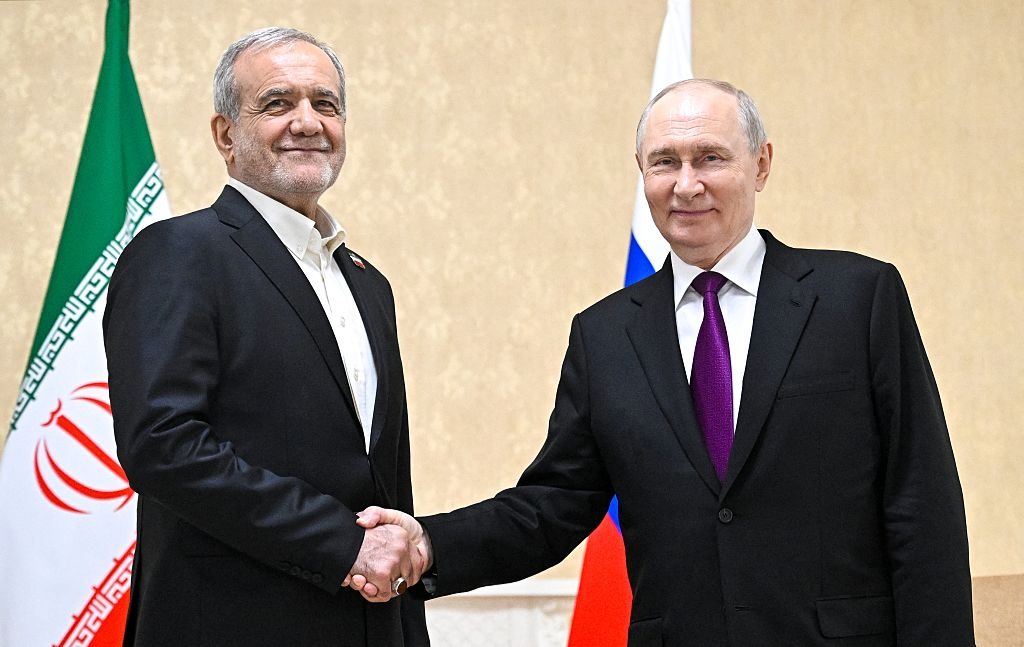
Russian President Vladimir Putin has rediscovered the vocabulary of peace at the precise moment his army is taking Ukraine apart, one bridge and one power station at a time. Pictured: Putin and Iranian President Masoud Pezeshkian shake hands during a meeting in Turkmenbashu, Turkmenistan, on October 8, 2026. (Photo by Sergei Bobylyov/Pool/AFP via Getty Images)

Russian President Vladimir Putin has rediscovered the vocabulary of peace at the precise moment his army is taking Ukraine apart, one bridge and one power station at a time.

On September 25, addressing Russian journalists, he said that every proposal for settling the four-and-a-half-year war remained on the table, then attached the condition that empties the offer of content. "We are ready for talks and to wrap them up as soon as possible, but on conditions acceptable for the Russian people," Putin said. Moscow would first assess what served its own interests.

He added that Russia had been prepared to resume talks after its parliamentary elections, that Ukrainian drone attacks on Moscow had changed the calculation, and that Kyiv would have to be "made to feel" Russian retaliation before anything else could be discussed.

US President Donald J. Trump would do well to read that statement as a description of Putin's method. A leader preparing to end a war does not reserve for himself both the calendar of diplomacy and unrestricted freedom of fire. Putin, in a single appearance, claimed both, In doing so, he put negotiation where the Kremlin has always kept it, among the instruments of his war.

The confirmation came within five days. On September 30, Russia launched its heaviest combined attack on Ukraine's energy system in months. Seven people were killed, among them a 14-year-old in Vyshhorod, north of the capital. The Ukrainian military counted 285 drones incoming, along with ballistic missiles. Emergency power cuts were imposed in Kyiv and three surrounding regions for the first time since the spring, and water pressure fell across the city.

The Russian Defense Ministry announced the strikes on Ukraine's energy facilities without embarrassment. On October 3, hours after another drone attack on a Dnipro crossing, in a city of three million people heading into winter, the Russian Foreign Ministry told foreign nationals and diplomatic staff to leave Ukraine and promised that the strikes on Kyiv and other cities would continue systematically. Putin had said earlier in the week that Ukraine was paying the price for its attacks on Russia and would go on paying it. Kyiv's mayor now speaks of a capital that must put itself on a war footing.

Putin's interest in negotiations seems real, but deserves to be taken only for what it buys him. An open negotiation process allows Putin time to ready harsher attacks for the winter. Like Iran's regime, it gives the appearance of cooperation without actual cooperation, and puts Ukraine under pressure to suspend its long-range strikes on refineries and ports that are doing genuine damage to Russia's revenues.

The Kremlin has made the argument in public. On September 17, the day after the US House of Representatives sent Trump legislation targeting Russia's energy and defense industries, and its shadow fleet of tankers, and authorizing tariffs of up to 100% on buyers of Russian oil, Kremlin spokesman Dmitry Peskov warned that additional American sanctions would complicate the search for a settlement.

Trump signed the bill on September 18, and three days later, the Kremlin spokesman repeated the warning. Washington was asked to hold its fire for the sake of diplomacy; then, in early October, Russia returned to bombing Kyiv's bridges six times in an apparent attempt to cut the capital city in two and sever its supply routes.

The so-called energy truce also showed how the asymmetry works in practice. On September 14, Trump announced that Ukraine and Russia had each agreed to stop hitting the other's energy targets. Ukrainian President Volodymyr Zelensky answered within hours that Ukraine was not convinced that Russia would abide by any agreement and that Kyiv would halt its own strikes once its partners could guarantee that Moscow had stopped attacking Ukraine's electric grid. Moscow never confirmed the arrangement, and 16 days later Ukraine's grid was burning.

None of that should have surprised anyone who had read what three sources close to the Kremlin described in July: Putin rebuked advisers proposing a ceasefire along the existing front, regards capturing the rest of the Donbas as a matter of principle, and is likely to escalate. Peskov's reply at the time was that Russia was ready for a peaceful resolution but had "enough capability to act independently and continue the special military operation." The conjunction "but" did the same work in July as it did on September 25.

None of this argues against talking to Putin. Great powers negotiate with adversaries because they are adversaries, and Trump is well-intended in seeking an end to the war that has become Europe's bloodiest since 1945, drained allied treasuries, killed or wounded roughly 1.4 million Russians and more than half a million Ukrainians, and raised the risk of a widening confrontation. The error would be to read Putin's presence at the negotiating table as a decision to stop the war. In 1994, Russia signed the Budapest Memorandum, assuring Ukraine that if it gave up its nuclear weapons, Russia would not attack it. Ukraine, tragically, kept its part of the bargain.

The Minsk agreements of September 2014 and February 2015 produced ceasefires, monitoring missions and years of communiqués signed under French and German sponsorship. The heavy weapons, however, were never fully withdrawn and the political provisions were never implemented. In February 2022, Putin declared the agreements void, recognized separatist entities within Ukraine and invaded. Eight years of playing at process had cost Putin nothing and had given him time, which is what diplomacy without enforceable consequences reliably gives an aggressor.

A further development calls for serious caution. According to reporting published on October 3, the American-Russian discussions have widened to include a redolent multibillion-dollar sale of the international assets, refineries, oil fields and gas stations of Russia's Lukoil, which are currently under American sanctions. Putin raised the transaction himself at the Kremlin on September 5, in his meeting with US envoys Steve Witkoff and Jared Kushner, as proof that Russians could again do business with the United States!

The sale would need the approval of both governments; nothing has yet been concluded. The Trump administration says it is negotiating terms that would secure a substantial upfront payment for the United States. So, commercial "normalization" was placed on the table during the same weeks as the bombardment intensified. If sanctions relief, restraint on Ukrainian operations and restored relations with Washington can all be obtained by keeping talks alive, then for Moscow, prolonging talks is the perfect course, and a settlement can remain one meeting away indefinitely.

Trump's record as a negotiator was built on leverage; declarations never seem to have impressed him. Money, however, apparently has, such as Saudi and Qatari "investments" in America and a $400 million presidential "flying palace" jet gifted to him by Qatar.

The Abraham Accords came out of a hard reading of interests. Iran's regime, once it faced American force in place of American concern, behaved differently.

Russian, Iranian, Chinese, North Korean and Palestinian conduct should be rewarded only after sustained changes in behavior. Sanctions relief should follow only after a verified halt in escalation or hostilities. Any restraint asked of Ukraine over Russian refineries should follow only after Russia stops targeting Ukrainian bridges, apartment buildings, hospitals and power plants. The Lukoil transaction can wait until after hostilities have measurably declined. Such a policy is neither hostile to Russia nor favorable to war.

Ceasefires can exist just for press statements that protect no one and for talks that supply one side with time, money and freedom of action to lengthen the fighting. Putin likely counts on Western impatience, on US presidents who want breakthroughs and on publics who want images of the war off their screens. The law Trump signed on September 18 gives him the means to raise the price of delay. The weeks since Putin's statement supply the reason to use it.

Until Russian strikes on Ukraine stop, Putin's offers to talk remain just part of his plan for his war.


Pierre Rehov, who holds a law degree from Paris-Assas, is a French reporter, novelist and documentary filmmaker. He is the author of six novels, including "Beyond Red Lines", "The Third Testament" and "Red Eden", translated from French. His latest essay on the aftermath of the October 7 massacre " 7 octobre - La riposte " became a bestseller in France. As a filmmaker, he has produced and directed 17 documentaries, many photographed at high risk in Middle Eastern war zones, and focusing on terrorism, media bias, and the persecution of Christians. His latest documentary, "Pogrom(s)" highlights the context of ancient Jew hatred within Muslim civilization as the main force behind the October 7 massacre.

Source: https://www.gatestoneinstitute.org/22908/putin-talks-peace

Follow Middle East and Terrorism on Twitter

Facts That the Media and Many Politicians Will Not Admit - Majid Rafizadeh


by Majid Rafizadeh

For years, Iran's regime has been closing in on having nuclear weapons. Under then President Barack Obama's 2015 Joint Comprehensive Plan of Action (JCPOA) "nuclear deal" and its sunset clauses, Iran's regime could already legitimately have as many nuclear weapons as it liked – beginning last October.


  • Trump... rescued the Panama Canal from China, liberated Venezuela, peacefully secured Greenland to protect the Western Hemisphere, and especially his ongoing commitment to ensure that the Islamic Republic of Iran will never possess a nuclear weapon. Think for a minute what it otherwise will be able to do to any American (or European) city: Boston, Miami, Washington, New York....

  • For years, Iran's regime has been closing in on having nuclear weapons. Under then President Barack Obama's 2015 Joint Comprehensive Plan of Action (JCPOA) "nuclear deal" and its sunset clauses, Iran's regime could already legitimately have as many nuclear weapons as it liked – beginning last October.

  • A nuclear-armed Iran would have faced little pushback in attempting to wipe not only Israel but also Europe and anyone else off the map. As President Trump put it, if Iran had a nuclear weapon, it would, "without question," use it.

  • President Trump, unlike seven other presidents, did not just talk -- he acted. Through his administration's sustained economic pressure, military operations and a refusal to accept the regime's usual stalling, Iran's nuclear infrastructure has been significantly degraded, with the possibility of more on the way.

  • If you think gasoline is expensive now, he noted, the other party has been trying to eliminate fossil fuels, thereby producing a scarcity that raises prices. – Marc Thiessen, Washington Post columnist, Fox Business Channel, Kudlow, October 7, 2026.

  • Those determined to defeat even the most constructive policies of President Trump -- rather than seeing them as a win for Americans -- appear to see any victory of his as a defeat for themselves, threatening their chances of being elected. They have to reframe his achievements as catastrophes to criticize and oppose.

  • Trump has been neutralizing a potentially nuclear-armed, revolutionary Iran; trying to strengthen the Israel-Arab alignment; and sidelining Iran's terrorist proxies. These accomplishments in just two years represent a triumph in rolling back a nearly half-century threat not only to regional stability but also -- through oil and geographic realignment -- weakening Russia and China, reclaiming Western interests, and rescuing the survival of the Free World.

  • For that, at a minimum, President Trump deserves at least a small, semi-audible thank you rather than unremitting hostility. So: Thank you, Mr. President. Ignore the haters. The stakes — American national security, the survival of Israel and Western civilization, global peace, and the prevention of nuclear catastrophe in the hands of a messianic regime — are too crucial to be bent into distractions.

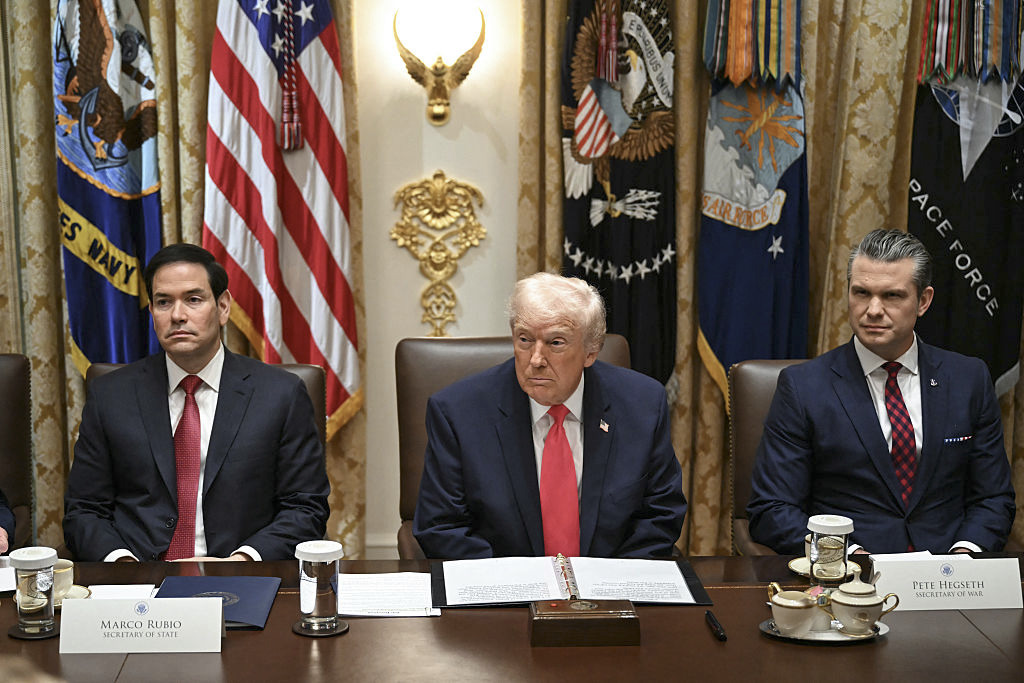
US President Donald Trump has been neutralizing a potentially nuclear-armed, revolutionary Iran; trying to strengthen the Israel-Arab alignment; and sidelining Iran's terrorist proxies. These accomplishments in just two years represent a triumph in rolling back a nearly half-century threat not only to regional stability but also -- through oil and geographic realignment -- weakening Russia and China, reclaiming Western interests, and rescuing the survival of the Free World. Pictured: Trump, alongside Secretary of State Marco Rubio and Secretary of Defense Pete Hegseth, at a cabinet meeting in the White House in Washington, DC on December 2, 2025. (Photo by Andrew Caballero-Reynolds/AFP via Getty Images)

Americans, please ignore the media outlets and the politicians scrambling for votes. Instead, kindly look at a few facts?

President Donald J. Trump has not only been strengthening America; through his basically unyielding policies in the Middle East, the Indo-Pacific and the Western Hemisphere, he has been safeguarding Western civilization, the free world, and ultimately global peace.

First, please consider Trump's having rescued the Panama Canal from China, liberated Venezuela, peacefully secured Greenland to protect the Western hemisphere, and especially his ongoing commitment to ensure that the Islamic Republic of Iran will never possess a nuclear weapon. Think for a minute what it otherwise will be able to do to any American (or European) city: Boston, Miami, Washington, New York....

For years, Iran's regime has been closing in on having nuclear weapons. Under then President Barack Obama's 2015 Joint Comprehensive Plan of Action (JCPOA) "nuclear deal" and its sunset clauses, Iran's regime could already legitimately have as many nuclear weapons as it liked – beginning last October.

Urgent assessments last year appeared that Iran's regime stood less than two weeks away from completing 11 nuclear bombs. This is the same Iranian regime that, since its founding in 1979, has openly been chanting "Death to America" and seeking to "Export the Islamic Revolution," now trying to entrench itself in the US. This is the same Iran that has been successfully establishing a global ummah [nation] under its version of Sharia rule, and create conditions in which, as the Islamic Republic of Iran's founder, Ayatollah Ruhollah Khomeini framed it:

"We shall export our revolution to the whole world. Until the cry 'There is no god but Allah' resounds over the whole world, there will be struggle."

Iran's regime has already targeted and attacked countries not even parties to its main conflict. A nuclear-armed Iran would have faced little pushback in attempting to wipe not only Israel but also Europe and anyone else off the map. As President Trump put it, if Iran had a nuclear weapon, it would, "without question," use it.

President Trump, unlike seven other presidents, did not just talk -- he acted. Through his administration's sustained economic pressure, military operations and a refusal to accept the regime's usual stalling, Iran's nuclear infrastructure has been significantly degraded, with the possibility of more on the way.

Preventing a revolutionary theocracy that chants "Death to America" and "Death to Israel" from obtaining nuclear arms is arguably the most consequential national security achievements of the era. The media that once treated every Iranian advance as inevitable now looks away and reproaches the administration for higher consumer prices that were largely put there by his predecessor. Expecting the opposition party to lower gas prices, according to Washington Post columnist Marc Thiessen, is like expecting the arsonist to put out the fire he started. If you think gasoline is expensive now, he noted, the other party has been trying to eliminate fossil fuels, thereby producing a scarcity that raises prices. [source, Fox Business news, "Kudlow," October 7, 2026]

Second, economic pressure has bitten hard. The Iranian rial has collapsed in value. On free-market rates, the dollar has traded near 2.6 million to 2.7 million rials—among the most devalued currencies on the planet. Compare that to the level when Trump returned to office. Inflation since then in Iran has soared. The regime's response has been: increased internal security measures and checkpoints, apparently reflecting fear that economic despair might spark more unrest. Trump's maximum-pressure approach—sanctions, enforcement, and denial of revenue streams—has starved the regime of the resources it needs to fund its nuclear and terrorist-proxy ambitions as well as to buy domestic quiet.

Third, Iran's once-touted conventional forces have been decimated. Its air force has been effectively eliminated. Its naval assets have collapsed—scores of vessels destroyed or disabled. Air-defense systems have been degraded across wide areas. What remains functional centers largely on drones and ballistic missiles. Rebuilding modern air and naval power requires money, time, technology, and an industrial capacity that a sanctioned, isolated regime does not possess.

Fourth, no previous American president or world leader engineered the degree of practical alignment between Israel, America and key Arab states that have so far continued and expanded under Trump's second term. The Abraham Accords framework—originally forged in his first term—has shown resilience and renewed momentum. UAE-Israel ties in particular have deepened, producing security, economic, and diplomatic cooperation that enrages Tehran. Iranian officials and clerics have denounced these relationships in the strongest terms, as strategic threats to the regime's narrative of permanent Arab-Israeli hostility.

Fifth, Trump's support for Israel has contributed to significant degradation of Hamas and Hezbollah capabilities. Standing with the Israeli people after October 7 and through subsequent campaigns has not been cost-free, but it has constrained Iran's most important regional proxies. A Middle East in which Israel and pragmatic Arab states coordinate more closely against Iranian expansion is a safer region for the United States and its allies. Previous administrations talked about "rebalancing;" this one has actually altered "facts on the ground."

Those determined to defeat even the most constructive policies of President Trump -- rather than seeing them as a win for Americans -- appear to see any victory of his as a defeat for themselves, threatening their chances of being elected. They have to reframe his achievements as catastrophes to criticize and oppose.

In short, Trump has been neutralizing a potentially nuclear-armed, revolutionary Iran; trying to strengthen the Israel-Arab alignment; and sidelining Iran's terrorist proxies. These accomplishments in just two years represent a triumph in rolling back a nearly half-century threat not only to regional stability but also -- through oil and geographic realignment -- weakening Russia and China, reclaiming Western interests, and rescuing the survival of the Free World.

For that, at a minimum, President Trump deserves at least a small, semi-audible thank you rather than unremitting hostility. So: Thank you, Mr. President. Ignore the haters. The stakes — American national security, the survival of Israel and Western civilization, global peace, and the prevention of nuclear catastrophe in the hands of a messianic regime — are too crucial to be bent into distractions.


Dr. Majid Rafizadeh
is a political scientist, Harvard-educated analyst, and board member of Harvard International Review. He has authored several books on the US foreign policy. He can be reached at dr.rafizadeh@post.harvard.edu

Source: https://www.gatestoneinstitute.org/22911/facts-media-politicians-will-not-admit

Follow Middle East and Terrorism on Twitter

Parent rights powerhouse unleashes Super Intelligence surveillance system to monitor school boards - John Solomon


by John Solomon

Program sweeps all 13,000 school boards' agendas every 12 hours, and ranks policies on whether parents should be concerned.


Moms for Liberty, one of America’s most influential parent rights groups, is unleashing a digital surveillance system powered by Super Intelligence to monitor school board agendas across the nation’s 13,000 school districts.

The group unveiled its project, codename M4L AWARE, at its annual meeting in Dallas on Friday, promising parents it would give them advance warning about controversial policies or good news projects before school board members vote on them.

The program “sweeps all 13,000 school districts' agendas every 12 hours, and it ranks everything that's on the agenda one through 10 on if it's concerning, concerning for your First Amendment rights, concerning for curriculum, concerning for transparency, but also one to 10 for positive things,” Tina Descovich, Moms for Liberty chief executive officer, told Just the News.

“We'll be able to identify the school districts that are supporting parental rights, that are choosing the right curriculums, and we'll be able to identify the ones that aren't “ she added. “And that's the best part for us because it winds us up, and we know exactly where to go to send in the troops, the ground game to go show up at the school board meeting.”

Descovich said the project will also empower Moms For Liberty more quickly mobilize lawyers to legally challenge policies that they believe infringe on parents rights.

“We've got so many legal partners here in the room that are willing to stand with us and just sue these school districts left and right when they're violating parental rights,” she explained.

M4L AWARE stands for Agenda Watch Alert Response and Engage, and it harnesses super intelligence to surveil for diversity, equity and inclusion (DEI) teachings, transgenderism, woke curriculum changes and Title IX violations, the group said.

Moms for Liberty rose to prominence during the COVID pandemic and recently celebrated its fifth anniversary with more than 300 national chapters and hundreds of thousands of member moms.

It has launched significant litigation against school boards and also is organizing and get-out-the-vote efforts in the 2026 election in places like Florida, Texas and Georgia. 


John Solomon

Source: https://justthenews.com/politics-policy/education/parent-rights-powerhouse-unleashes-super-intelligence-surveillance-system

Follow Middle East and Terrorism on Twitter

Democrats try to make gas prices an election issue, but collide into their own inflation record - Nicholas Ballasy


by Nicholas Ballasy

Grothman criticized Democrats for opposing oil drilling in Alaska, fracking in North Dakota and shutting down the Keystone XL pipeline.


Wisconsin Republican Rep. Glenn Grothman argues that Democrats in Congress cannot be trusted to enact policies that would lower gas prices, pointing to Biden-era data to support his position.

He said that voters should remember the economic conditions under former President Joe Biden as they head to the polls, arguing that Democratic energy policies have resulted in higher energy prices. Grothman criticized Democrats for opposing oil drilling in Alaska, fracking in North Dakota and the Keystone XL pipeline.

“The reason we have high gas prices is we have a shortage of supply, which always results in the higher cost,” Grothman said during an interview on the "Just the News, No Noise" TV program this week. 

Grothman: "You expect these people to lower the price of gas?" 

Grothman warned that increased government spending could fuel further inflation. Grothman added that Democratic energy policies hampered domestic production under Biden and contributed to driving up costs at the pump. “The Democrat Party is the party that didn't want to drill in Alaska, they didn't want to do any fracking in North Dakota, they didn't want to build the Keystone Pipeline,” Grothman said. “And now you expect these people to lower the price of gas?”

The Wisconsin congressman pointed to California as an example of the consequences of Democratic energy policies, saying gasoline there was selling for $6.40 a gallon, compared with $4.05 a gallon in other areas he referenced. The national average is currently $4.37 per gallon, according to the AAA.

Grothman cautioned that high gasoline prices could persist for years without expanded domestic energy production and additional refining capacity. “You're going to have high gas prices not for the next two months until the [Iran] war is over. You're going to have high gas prices for the next 15 years if we don't start building some refineries around here,” he said.

“If you want to see the day of $2.10 a gallon again, you better vote Republican for more refineries and more oil coming out of the sea and more oil coming out of North Dakota and more oil coming out of Alaska,” Grothman added.

Correlation between government spending and inflation

The conversation turned to inflation, where Grothman blamed the record high inflation under Biden on a surge in federal spending and accused Democrats of pushing policies that could drive prices higher again.

“The reason we had high inflation is high spending, which is what the Democrats are usually known for,” Grothman said. He added that inflation had peaked at 9.1% in June 2022, according to the Consumer Price Index.

According to AAA, gas prices reached $5.016 per gallon under Biden in June 2022.

“It was the highest since like the 1970s or early 1980s on inflation, and you're going to get more of that,” Grothman said. “And what happens when you have spending, spending, spending? You have inflation, inflation, inflation.”

Asked how Republicans could improve their standing with voters in the final three weeks before the election, Grothman urged the party to highlight what he described as achievements by President Donald Trump and the Republican-controlled Congress.

“I just think Republicans have to talk about all that was done, not only by the Congress but by President Trump's administration as well,” he said, citing trade agreements with China, lower prescription drug costs and tax provisions affecting tips, overtime pay and interest on car loans.

Grothman said that the tax changes the GOP made were designed to benefit working Americans rather than wealthy taxpayers. “You're not aiming for some big billionaire when you cut the tax on tips or when you put a deduction for interest on car loans,” he said. “Those are all for the average guy.”

He also touted what he described as improvements in U.S. trade relations and a reduction in the trade deficit with China, crediting Trump and congressional Republicans for the improvements. 

Grothman urged Republicans to counter Democratic criticism by focusing on their economic record and reminding voters of the inflation experienced during Biden's administration. 


Nicholas Ballasy

Source: https://justthenews.com/government/congress/gop-rep-grothman-argues-dems-cant-trusted-lower-gas-prices-inflation-given

Follow Middle East and Terrorism on Twitter

Abbas issues decree to postpone Palestinian election - JNS Staff


by JNS Staff

The legislative vote would have been the first since January 2006, when Hamas defeated Abbas’s Fatah faction.


Palestinian Authority President Mahmoud Abbas addresses the opening session of the Palestinian Central Council in Ramallah, April 23, 2025. Photo by Flash90.
Palestinian Authority chief Mahmoud Abbas addresses the opening session of the Palestinian Central Council in Ramallah, April 23, 2025. Credit: Flash90.

Palestinian Authority chief Mahmoud Abbas on Saturday issued a decree calling for presidential and legislative elections on Sept. 11, 2027, while revoking a previous decree that had scheduled a legislative election for Nov. 28, 2026, the official WAFA news agency reported.

The decree follows a decision by the Executive Committee of the Palestine Liberation Organization and consultations with Palestinian factions and political forces, the report said.

The move “comes amid continued Israeli military attacks, settlement expansion, colonist violence and repeated Israeli incursions across the West Bank, including occupied East Jerusalem,” it added.

“Taken together, these conditions affect the possibility of holding free, fair and inclusive elections on the previous date while ensuring public safety and the ability of Palestinians to exercise their electoral rights freely and securely throughout the Palestinian territories,” continued the report.

The report said the postponement aims to allow for a “comprehensive national dialogue to strengthen Palestinian unity,” preserve the integrity of the “territory and political system,” and ensure the participation of Palestinians across Jerusalem, Judea, Samaria and Gaza, while safeguarding their “political and constitutional rights.”

Israeli Foreign Minister Gideon Sa’ar on Saturday night described Abbas as a “corrupt dictator” who has “once again deceived the international community.

“His attempt to drag Israel into this, falsely claiming that Israel imposed obstacles to holding elections, is yet another ridiculous lie designed to evade responsibility and accountability,” he added.

Sa’ar pointed to other false claims by Abbas regarding reforms that were never implemented, including ending payments to Palestinian terrorists and their families and halting incitement in the Palestinian education system.

“For over twenty years, Abbas has been selling the same thing: lies,” said Sa’ar.

Reuters reported on Friday that Ramallah had decided to postpone the vote, citing an Oct. 8 letter from Palestinian Authority “Vice President” Hussein al-Sheikh to French Foreign Minister Jean-Noël Barrot.

“The anticipated political, security and economic conditions” required to hold the elections “have not materialized,” al-Sheikh wrote.

In response, Sa’ar on Friday noted that the P.A. has not held presidential elections since 2005 or legislative elections since 2006.

“Mahmoud Abbas is fooling the international community by canceling once again promised elections. His reform pledges to end ‘pay-for-slay’ terrorist salaries and hate education remain empty too,” wrote Sa’ar. “They keep deceiving. Consequences? Not for the corrupt PA!”

The November vote would have been the first since January 2006, when Hamas defeated Abbas’s Fatah faction. Following the terrorist group’s victory, a violent internecine war erupted, culminating in Hamas seizing control of the Gaza Strip in June 2007 and leaving Abbas to govern in Ramallah.


JNS Staff

Source: https://www.jns.org/news/world/abbas-issues-decree-to-postpone-palestinian-election

Follow Middle East and Terrorism on Twitter

Made in Israel: A living implant aims to restore movement after paralysis - Shimon Sherman


by Shimon Sherman

Built from a patient’s own cells, the technology is advancing toward its first human trial at Sheba Medical Center in 2027, pending regulatory approval.


Participants playing wheelchair basketball at ADI Negev
Playing wheelchair basketball at ADI Negev-Nahalat Eran. Credit: Courtesy of Jewish National Fund-USA.

Israeli researchers are developing a spinal-cord implant made from the patient’s own living neural tissue that could help repair the damage responsible for paralysis. The technology originated in Professor Tal Dvir’s laboratory at Tel Aviv University and is now being developed by Israeli biotechnology company Matricelf toward human testing.

The goal is to restore connections that a spinal-cord injury can interrupt. The spinal cord carries signals between the brain and the body, including the commands that control voluntary movement. When an accident, fall or battlefield wound damages those pathways, the brain may still issue a command to move a leg, but the signals cannot reach the muscles needed to carry it out.

“The goal is to build a small piece of spinal cord that behaves like the real thing,” Dvir explained in an interview. To achieve that, replacement cells must survive at the injury site and establish useful connections with surrounding tissue. The researchers begin that development outside the body, nurturing the cells before introducing them into the injured area.

Producing each personalized implant takes several months, a process that begins with a blood sample and a small sample of abdominal tissue.

Building a living implant

The blood sample supplies cells that researchers reprogram into stem cells, returning them to a flexible state from which they can develop into many specialized cell types.

The second ingredient comes from fatty tissue associated with the abdominal organs. Researchers separate out the supporting material that surrounds its cells, including collagen and other structural molecules. They then process this material into a hydrogel, a water-rich gel that gives the developing cells a supportive environment in which to grow.

With the stem cells embedded in the gel, controlled laboratory conditions mimic aspects of how the spinal cord develops in an embryo. These conditions guide the cells to become nerve cells, including motor neurons, which carry signals involved in controlling movement. As they develop, the cells extend connections to one another and reshape the surrounding supporting material, forming an interconnected network.

That interaction between cells and their surroundings is central to the approach. Cells transplanted individually must establish connections and organize into tissue within the injured spinal cord, where conditions may be unfavorable to their survival and growth. Preparing the implant in advance allows some of that work to take place under controlled conditions. The resulting graft is intended for the damaged area, where it could connect with surviving nerve tissue.

“The beauty of this gel is that it’s also personalized, just like the cells,” Dvir said in a university update. Using the recipient’s own cells and supporting material aims to reduce the risk that the immune system recognizes the implant as foreign.

Restoring movement

The technological innovation has already demonstrated impressive results in the lab. In a study, published in Advanced Science, mice treated with the engineered tissue walked with better coordination and used their affected hind leg more effectively. Researchers also found evidence of nerve fibers surviving or growing across the damaged area, linking signs of tissue repair with gains in the animals’ ability to move.

“The model animals underwent a rapid rehabilitation process, at the end of which they could walk quite well,” Dvir said in the university’s announcement. Particularly significant were the improvements in animals whose injuries had already become established. Those findings suggested that the approach could support recovery beyond the immediate aftermath of an injury, an essential consideration for developing a treatment for people already living with paralysis.

The experiments involved partial spinal-cord injuries, so they do not establish what recovery would be possible in humans. “There are still many challenges, but we are optimistic,” Dvir observed in an interview with Ynet. The study provided a concrete foundation for that optimism: Laboratory-grown neural tissue had supported both biological repair and measurable improvements in function.

More recent developments have strengthened the program’s path toward clinical testing. In June 2026, Matricelf reported completing an animal safety study with monitoring extending up to 39 weeks after implantation. According to the company, no treatment-related toxicity, tumor formation or spread of the implant to distant tissues was detected. “The results provide strong support for the safety profile of our technology,” Matricelf CEO Gil Hakim said in the announcement.

Matricelf also launched a larger study examining recovery of movement and sensory responses after established injuries, with initial results expected toward the end of 2026. The research is now advancing from the original demonstration toward the evidence needed for its next major step: testing the implant in a patient.

Toward the first patient

In an August update, the Ness Ziona-based company estimated that treatment of a first selected patient could begin at Sheba Medical Center in Ramat Gan in the first half of 2027, provided the remaining scientific and regulatory requirements are met.

The preparations bring tissue engineering into contact with the people who would deliver the treatment. Sheba is developing the manufacturing process, while spinal-cord rehabilitation specialists at Loewenstein Rehabilitation Medical Center in Ra’anana are helping evaluate potential recipients. In September, Matricelf also reported U.S. Food and Drug Administration feedback supporting key elements of its proposed human study, including the patient population and clinical assessments.

The proposed trial would focus on adults with established, complete traumatic injuries in the chest region of the spinal cord. Alongside safety and changes in nerve function, it would assess independence in everyday life. That includes abilities such as dressing, moving between a bed and wheelchair, and managing bladder and bowel function. These are concrete measures of what recovery could mean for a patient.

Walking remains the ultimate ambition. “If this works in humans, and we believe that it will, it can offer all paralyzed people hope that they may walk again,” Dvir’s research team noted. Hakim added that “conditions once considered irreversible will become treatable,” and emphasized the importance of “restoring function rather than managing symptoms.”

Eli Sprecher, CEO of Tel Aviv Sourasky Medical Center, described the effort as bringing together “advanced Israeli science, a world-class clinical manufacturing infrastructure, and real hope for millions of people around the world.” 


Shimon Sherman is a columnist covering global security, Middle Eastern affairs, and geopolitical developments. His reporting provides in-depth analysis on topics such as the resurgence of ISIS, Iran’s nuclear ambitions, judicial reforms in Israel, and the evolving landscape of militant groups in Syria and Iraq. With a focus on investigative journalism and expert interviews, his work offers critical insights into the most pressing issues shaping international relations and security.

Source: https://www.jns.org/feature/made-in-israel-a-living-implant-aims-to-restore-movement-after-paralysis

Follow Middle East and Terrorism on Twitter

Report: US pressured Israel to strike Iran before elections - Israel National News


by Israel National News

Trump administration urged Israel to launch a strike against Iran amid concerns over Tehran's military buildup, asking Israel to bear political risks ahead of elections, journalist Ben Caspit reports.


Donald Trump (L) and Benjamin Netanyahu (R)
Donald Trump (L) and Benjamin Netanyahu (R)                            REUTERS/Kevin Lamarque


The US asked Israel to carry out a strike against Iran before the American midterms, journalist Ben Caspit reported Saturday.

In a post on social media, Caspit revealed, "In talks between Israel and the United States regarding Iran over the past two weeks, I have learned that the Americans actually demanded that Israel carry out a strike against Iran. They were not referring to an American strike, nor to a joint operation, but specifically to an Israeli strike."

"IDF Chief of Staff Eyal Zamir made it clear to the Americans (according to a report by Barak Ravid) that such a strike would most likely lead to the postponement of the elections in Israel.

"As of now, the Americans have backed down from this demand," he added.

Caspit explained, "The American demand came in response to developments in Iran, some of which were reported today in the foreign media, concerning Iran's rapid restoration of its drone and ballistic missile production capabilities."

"However, the Americans wanted Israel, rather than Trump, to bear the political risk ahead of the midterm elections. They believed that Israel would actually want to launch a strike before its own elections, whereas in the United States, a pre-election strike could politically harm the president. Until now, reports have focused on Trump 'considering' resuming strikes against Iran. There have also been fresh reports on the matter.

"However, it is now clear that, at least according to the original plan, Trump essentially instructed Israel to strike Iran before the elections. For now, that initiative has been halted."

Caspit also admitted that, "Prime Minister [Benjamin] Netanyahu's position is not entirely clear to me. Over the past week, his schedule has been described as 'highly security-focused,' and he has held several 'sensitive' discussions and visits."


Israel National News

Source: https://www.israelnationalnews.com/news/434396

Follow Middle East and Terrorism on Twitter

Migrant from Dominican Republic shot by ICE agents had lengthy criminal history - Nicholas Ballasy


by Nicholas Ballasy

Oscar Belgal, 28, is believed to have entered the United States illegally around 2022


The Dominican Republic migrant shot by ICE agents in the Bronx had a criminal history that included an armed robbery conviction, allegations of drug dealing and reported ties to a violent street gang, according to sources and court records.

Oscar Belgal, 28, is believed to have entered the United States illegally around 2022, reports said. 

A year later, he allegedly robbed someone at gunpoint in Fordham Heights. 

Despite being convicted in 2025, he was accused of selling dangerous drugs within months and was also reportedly linked to a violent street gang, the New York Post reported. 

The allegations have raised questions about how Belgal remained on the streets under New York’s bail and sanctuary policies. 


Nicholas Ballasy

Source: https://justthenews.com/government/federal-agencies/migrant-dominican-republic-shot-ice-agents-had-lengthy-criminal-history

Follow Middle East and Terrorism on Twitter

Thursday, October 8, 2026

Marco Rubio effectively ties Trump's vision to Western civilization itself - Monica Showalter


by Monica Showalter

"The speech of the year" - Wall Street Journal


In what the Wall Street Journal's editorial page dubbed "the speech of the year," Secretary of State Marco Rubio laid out that President Trump's vision for America and the world is closely tied to the ideals of ancient Greece, which brought forth the great civilization of the West.

It was extraordinary in its depth and projection.

Imagine a Democrat -- or even Pope Leo --giving a speech like this, standing against the Acropolis itself in Greece, fiercely affirming that the Western civilization brought about by Greece is worth fighting for and dying for: 

The buildup is slow and careful -- describing what Western civilization really is, what it amounts to:

These institutions and ideas – these institutions and ideas were the outward expression of more fundamental qualities we see in the ancient Greeks – qualities that can’t be reduced to any particular political system or theory.

Here, in Athens, we found the first full realization of all the essential traits that would come to define the West: fierce individuality and relentless ambition; daring exploration and invention; a yearning for discovery, for adventure, risk and glory.  An insatiable curiosity about the world and the principles by which it operates, a hunger to know the mysteries of nature and grasp the secrets of the cosmos.  An impatience with the notion of impossibility, chafing at all boundaries and limits, straining to peer into the depths of the unknown.

These were not just the formulas or precepts of a particular school of philosophy.  They were the characteristic of a people – expressed in their traditions, their stories, their imagination; in the qualities they demanded of their citizens; in the things they lived and fought and died for.

To know them is to know ourselves.

What blossomed here in this place was the Western desire to uncover all that ignorance, darkness, and distance had kept hidden from the mind of man.  The Greeks did not just shape history; the Greeks gave us history itself. Much about – much of what we know about many ancient civilizations comes almost entirely from the records of Greek explorers and historians, explorers and historians who didn’t just chronicle the histories of their own people, but ventured outwards to observe and record the sagas of foreign peoples and cultures all across the world.

Where others looked inward, the Greeks were the first to direct their focus outward, to chase the thrill and glory of seeing all that was strange and new.  It was this trait – it was this trait that would push the West to create and build things that others could not, marking us out from so many other cultures and civilizations where stability and subsistence were the highest ends of life.

But it is not just the ambition to explore the unknown that we inherit from the Greeks; it is the conviction that the unknown canbe known.  The confidence that the world can be charted and measured and mapped and understood – and that there is a rational order to the cosmos, governed by certain fundamental laws, laws that men can observe and the mind can come to understand.

This was the foundation of the Western mind: our math, our science, our medicine.  Our philosophy, ethics, and religion.  It paved the way for the gospel of Jesus Christ to find fertile soil in Europe and flourish into the empire of Christendom. It was the foundation of the riches of Christian theology – of Augustine and Aquinas and the whole tradition of natural law.

Then, and without naming names, he cites the leftist forces that have devalued it:

For the Greeks of antiquity, the pursuit of excellence was the very principle of man’s existence.  They organized all of civic life around contest, ambition, competition: in philosophy and poetry, in sculpture and drama, in athletics and art, in war and statecraft.  The classical Greek city was an arena for great men to test and prove themselves, to hone their potential through perpetual struggle – to be the best, the strongest, the most beautiful, straining to inch ever closer to perfection.

Now I know that to modern ears, what I just described, this way of life, may sound odd; it may even sound cruel.  The ideal of many ideologies in our time has, frankly, become a world of perfect safety, devoid of risk or failure, with neither the glory of victory nor the shame of defeat.  Too often these days, we build downwards. We design our standards to ensure no one will lose; we preoccupy ourselves more with the comfort of the worst than the potential of the best.  We hold the most exceptional things among us hostage to the average, the ordinary, the mediocre.

The men who made the Parthenon, they built upwards. They held that the highest and most noble aspiration in life was to surpass all others, to strive to be the best in all things.

Here, too:

Today, too much of the West has forgotten this quality.  Over time, we in the West came to feel ashamed of the very things that made us exceptional.  We felt embarrassed that our achievements set us apart from the rest of the world.  Our prosperity somehow became a source of guilt.  We no longer believed we deserved and had earned our greatness. 

The word “nationalism” became a dirty word.  And so we tore down our monuments; we condemned our own history.  And in too many places, we taught our children to be ashamed of the countries they would inherit.  In the process, we opened our borders and outsourced our industry, and allowed our militaries to wither and to decay. 

He even had a dart for the Bush administration, which derailed itself on belief in this fallacy, or perhaps Pope Leo, with whom he clashed on this matter in May:

Now it’s has become fashionable today to believe that enlightened foreign policy means prioritizing the global community over one’s own people.  And I think here, too, we have much to learn from the men of ancient Greece because they knew that there was nothing selfish or wrong about loyalty to your nation, nor anything selfish or wrong about fighting to defend its interests above all else. 

And all through, there was criticism of Islamism, and its stagnation and tyranny, something he, once again did without naming names. After all, we do have allies we are cultivating in those quarters, not every Muslim is an advocate of Islamism -- Islam actually had a golden age that ended as barbaric and cleristic forces took over, also derived from embracing Greek ideals, which he didn't bring up. Every heard of 'algebra'? That was skillful diplomacy, too.

Naturally, the left hated this speech, affirming who we are and where we need to be going, what our destiny should be. And yes, destiny is a Greek idea, too.

But for the rest of us, it was a tonic, a purpose, something the West-hating left can never match. The Journal added this at the end of its piece:  

Our view is that Americans are aching for this kind of vision and leadership, and they will respond to someone who offers it.

That was very well said. If we don't know who we are and where we are going, all is nothing, and the forces of barbarism, whether on the left, among the globalists, or among the Islamist dark-agers, will do it for us. 

What Rubio shows by this great speech is that he may be our best next president.

Image: Screenshot from U.S. Department of State video, on YouTube

Related Topics: Marco Rubio 


Monica Showalter

Source: https://www.americanthinker.com/blog/2026/10/marco-rubio-effectively-ties-trump-s-vision-to-western-civilization-itself/

Follow Middle East and Terrorism on Twitter

In Michigan, the issue is erasing Jewish interests, not the Jewish vote - Jonathan S. Tobin


by Jonathan S. Tobin

Electing “progressives” like El-Sayed requires more than just normalizing antisemitism and antisemitic candidates. It also means telling Jews to shut up.
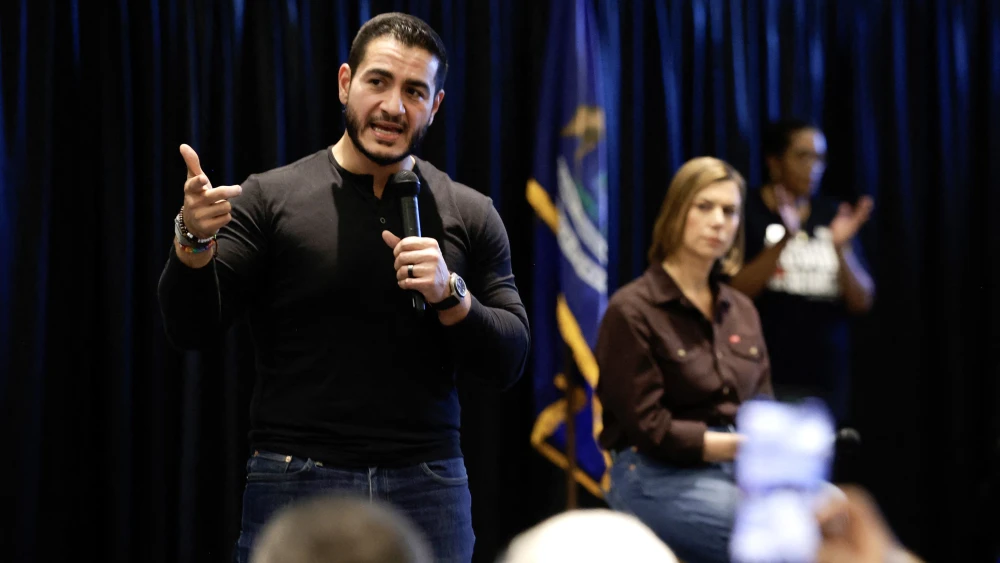
 

Democratic Senate candidate Dr. Abdul El-Sayed speaks at a town hall campaign event with Sen. Elissa Slotkin (D-Mich.) in Warren, Mich., on Oct. 3, 2026. Photo by Jeff Kowalsky/AFP via Getty Images.

Sen. Elissa Slotkin’s (D-Mich.) decision to campaign on behalf of Dr. Abdul El-Sayed, the Democratic candidate for Senate in her state, was, she says, a function of a desire to help someone who would be on what she calls “Team Fight” rather than “Team Flight.” By that, she meant someone who would battle President Donald Trump alongside her in the U.S. Senate, rather than seek compromises with the Republican administration like her more moderate colleague Sen. John Fetterman (D-Pa.).

In taking this stand, she has fallen in line with the rest of her party in backing El-Sayed. But in framing the question as one of “fight” or “flight,” she was deliberately avoiding the historic implications of her choice. One more Democrat in the Senate could give her party control of both houses of Congress, and make it easier for them to impeach and try Trump, regardless of the partisan nature of such a procedure.

Given that even under those circumstances, a conviction and his ouster from office would likely be impossible, the stakes won’t involve the future of the republic as much as handing Democrats the sinecures and power that come from being in the majority.

But electing an open antisemite like El-Sayed would be truly momentous not just for the Jewish community, of which Slotkin is a member, but for its implications for the future of her party and the nation. From that perspective, characterizing the decision as one of “fight” or “flight” is actually quite apt. But the truth is that what she and a host of other Jewish Democrats, including Senate Minority Leader Chuck Schumer and Michigan Attorney General Dana Nessel, are doing is engaging in “flight” rather than fighting to hold the line against antisemitism inside her party at a time when it is surging around the globe.

‘No such thing as Jewish voters?’

What made her decision to join forces with El-Sayed particularly interesting was revealed during a joint interview with him on the MS NOW cable-TV channel.

In it, Slotkin didn’t just play the loyal Democratic soldier swallowing the indignity of endorsing a man who seeks to drive the overwhelming majority of American Jews out of the public square. In doing so, she is supporting someone who embodies the illiberal red-green alliance of leftists and Islamists that is taking control of liberal parties around the world.

When asked about the fact that most Michigan Jews, including the majority who are loyal Democrats and politically liberal, simply won’t go along with electing an antisemite, Slotkin’s reply was succinct.

She said, “There’s no such thing as the Jewish voters, just like there’s no such thing as the Muslim voters or the black voters. People have their own views, and the things that they prioritize are going to drive their vote.”

In a sense, she’s right. Citizens vote as individuals and not as part of groups. And, indeed, most American Jews have not voted in lockstep on issues like Israel, even if the majority of them are supporters of the Jewish state. That is especially true of Jewish Democrats, who have always placed Israel’s security below many domestic concerns, whether it was health-care costs or legalized abortion. It’s something that has particularly frustrated Trump, whose pro-Israel policies and efforts to fight antisemitism in education have not been rewarded by most Jewish voters.

To some extent, that’s also true of other groups, like Muslims and African-Americans, though both of those constituencies have been more likely to treat issues relating to their community’s safety as a priority. By contrast, liberal Jews tend to treat universal concerns as more important than those that personally concern them. As writer Cynthia Ozick famously said, “Universalism is the ultimate Jewish parochialism.”

Tolerating antisemitism

But as Jews in Michigan and elsewhere have come to learn in the three years since the Oct. 7 Hamas-led Palestinian Arab terror attacks on Israeli communities incited an unprecedented increase in antisemitism, El-Sayed’s candidacy is not, strictly speaking, about voters’ views about the Jewish state. It’s about their willingness to tolerate the mainstreaming of Jew-hatred here in the United States.

So, when Slotkin seeks to deny that there is such a thing as “Jewish voters,” she’s signaling something very different from the fact that not all Jews cast votes solely on the basis of a candidate’s views on Israel. Along with other Democrats, both Jewish and non-Jewish, she is seeking to establish something far more important.

For them, party loyalty remains more important than opposition to antisemitism or, as Nessel said last month, the continued existence of the State of Israel. She expanded that idea and said that it was even worth it to “sacrifice the comfort, safety and security and even the very future of our own people” for the sake of a victory for the Democrats.

Slotkin is not quite so explicit in her indifference to the plight of the Jewish people, either in Israel or the United States at a time when antisemitism is raging, especially among the left-wing base of the Democrats. But by declaring that there is no such thing as a Jewish vote, even when it concerns the fight for her people’s survival, Slotkin is actually going further. She is calling for the erasure of Jewish communal interests from the public square, essentially telling Jews who disagree to shut up and fall in line.

While Slotkin, Nessel and Schumer claim that the real issue on the ballot in Michigan is a referendum on Trump, it’s important to point out that although El-Sayed’s implacable hostility to the president is not in question, it wasn’t the issue that carried him to victory in the Democratic primary.

Spreading blood libels

El-Sayed won his party’s nomination not so much by excoriating Trump but by targeting Jewish supporters of Israel, whom he accused of seeking to purchase Congress. He portrayed his moderate Democratic opponent, Rep. Haley Stevens (D-Mich.), as a stooge of the nefarious plot to purchase and manipulate American foreign policy by AIPAC and the Jews.

El-Sayed’s use of that traditional antisemitic trope—as well as his spreading of blood libels against Israelis committing “genocide” in Gaza, or being an “apartheid” and illegitimate “ethno-state” that has no right to exist—should have been a deal-breaker for any decent politician who cares about the way his rise illustrates the mainstreaming of Jew-hatred. So, too, should his refusal to condemn or even acknowledge that the Muslim Brotherhood is an international Islamist terror movement.

But for Jewish Democrats like Schumer, Slotkin and Nessel, elevating someone who holds such views, which they would not hesitate to denounce as beyond the pale if uttered by a Republican who echoed the similar views of a far-right antisemite like former Fox News host and current podcaster Tucker Carlson, to the Senate is not too high a price to pay for increasing their share of power in Washington.

Part of that price means not just denouncing the idea of Jews voting to defend their community. It means declaring that worries about Jewish security being threatened with harassment, intimidation and violence by advocates of the “Free Palestine” movement deserve to be minimized or dismissed altogether.

The evidence of the last three years contradicts that blithe assumption.

A security crisis for Jews

The vast increase in anti-Jewish hate crimes throughout the country, most of which are associated with anti-Zionist and blatantly antisemitic rhetoric and positions, has created a crisis for American Jews unlike any they have ever faced in this country. While not all Americans fully comprehend what is happening, it has not escaped the notice of most Jews that every synagogue, Jewish school and institutional building now requires extraordinary security measures to ensure that advocates for “Free Palestine” and “From the river to the sea” don’t inflict harm on them. Meanwhile, neighboring churches and mosques don’t need such protection.

Yet those who agree with El-Sayed and New York City Mayor Zohran Mamdani that calls to “globalize the intifada”—a demand for terrorism against Jews, wherever they live, and Jewish genocide—are not worthy of condemnation are telling the Jews that their lives and security are unimportant when compared to the chance of adding another Democrat to the Senate.

This isn’t happening in isolation from what has happened elsewhere in American society. In education, the media, publishing, pop culture and the fine arts, Jews and Jewish concerns are increasingly being challenged, marginalized and even erased.

This is all being done in the name of toxic left-wing ideas like critical race theory, intersectionality and settler-colonialism that divide humanity into two impermeable and permanently warring groups: “people of color,” who are always victims no matter what they do, and “white” oppressors, who are always in the wrong. Despite being the most persecuted minority in history—something that continues to this day in the form of the aforementioned surge of antisemitism—Jews are classified by left-wing ideologues as among the latter.

That’s why left-wingers on college campuses or concert stages feel free to falsely accuse the Jews of committing “genocide” while ignoring the fact that the goal of the side they are supporting in the Middle East conflict—Hamas and the Palestinians—is the actual genocide of half of the Jews on the planet who live in Israel. Moreover, they do so from a sense that they are attacking bad people and helping the good guys. They spew Jew-hatred while thinking of themselves as progressive and enlightened humanitarians.

That’s bad enough. But when Jews with leadership roles in our democratic republic tell other Jews to accept antisemitism, they are effectively siding with those who accept this skewed view of the world.

Still, it only works if the Jews who haven’t bought into this insanity, regardless of their political views, insist that Jewish security and antisemitism are not issues on which reasonable people should be required to agree to disagree.

A vote for Jewish survival

There needn’t be such a thing as a “Jewish vote” when it comes to a host of issues on which partisans disagree—from levels of taxation, social issues and foreign policy. But there has to be one when it comes to Jewish survival, both in Israel and the United States. Jews needn’t be fans of Trump, or any Israeli politician or political party. But those with a sliver of self-respect or concern for their fellow Jews and Americans, in general, should regard antisemitism as a litmus test of decency, if not self-interest.

This is not about, as Slotkin insists, the idea that “people want to see a Jewish woman and a Muslim man being able to get along, debate, push and pull each other, and move the state forward.”

What we expect from Jews in politics is recognition that normalizing hate isn’t about moving anything forward. It’s sacrificing a vulnerable minority on the altar of partisan politics. That isn’t progressive or pragmatic. It’s immoral. And we should treat any Jewish politician who makes that exchange as beneath contempt and unfit for the public trust.

The normalization and the mainstreaming of Jew-hatred, such as what we’ve seen with the embrace of El-Sayed, isn’t about what you think about either major party, since neither cannot be entirely trusted on the issue. Yet at a time when security at their houses of worship is outsourced to hired armed guards, the issue of Jewish safety is one on which no Jew can remain neutral or silent.

Erasure of Jewish concerns cannot be tolerated. Decent persons, Jew and non-Jew alike, must never accept the notion that they are obligated to be quiet about this or any issue relating to the safety of their families when threatened by ideologues.

On such grounds, a Jewish vote must exist, but it must also be seen as part of a broader bipartisan faction, albeit one based on zero tolerance for bigotry.

Politicians like Slotkin may be too cynical or tainted by toxic ideology to understand what they are doing and the consequences it will have for all Americans. Nevertheless, they shouldn’t be allowed to get away with telling the Jews to be quiet about threats to their safety any more than if she were telling African-Americans not to oppose politicians who were fine with black genocide. 


Jonathan S. Tobin is editor-in-chief of JNS, a columnist for Newsweek and a contributor to other publications. He covers the American political scene, foreign policy, the U.S.-Israel relationship, Middle East diplomacy, the Jewish world and the arts. He hosts the JNS “Think Twice” podcast, both the weekly video program and the “Jonathan Tobin Daily” program, available on major audio platforms and YouTube. Previously, he was executive editor, then senior online editor and chief political blogger, for Commentary magazine. Before that, he was editor-in-chief of The Jewish Exponent in Philadelphia and editor of the Connecticut Jewish Ledger. He has won 60-plus awards for his columns, commentary, art criticism and other writing. He appears regularly on television, commenting on politics and foreign policy. Born in New York City, he studied history at Columbia University.

Source: https://www.jns.org/opinion/column/jonathan-s-tobin/in-michigan-the-issue-is-erasing-jewish-interests-not-the-jewish-vote

Follow Middle East and Terrorism on Twitter