Saturday, April 11, 2015

Losing Ground in Iraq, ISIS Pushes Farther into Syria - Jonathan Spyer


by Jonathan Spyer

Just prior to its eruption into Iraq last June, ISIS carried out a strategic retreat in northwest Syria. In retrospect, this was clearly a preparation for the push into Iraq.

Originally published under the title, "ISIS Pushes Farther into Syria."


ISIS fighters pose for the camera in the Yarmouk Palestinian refugee camp in suburban Damascus.
The conquest by the Islamic State of the Yarmouk Palestinian refugee camp near Damascus confirms the resilience of the jihadis and is an indicator of their current strategy. Islamic State has lost considerable ground in Iraq, with the recapture of Tikrit constituting its latest setback. IS has no real response to coalition air power, when it is combined with a competent and determined ground force. This was first demonstrated in the organization's defeat at Kobani in January, and it is now becoming apparent in Iraq.

However, Islamic State is responding to this reality in a shrewd and calculated way.

Just prior to its eruption into Iraq last June, ISIS carried out a strategic retreat in northwest Syria. In retrospect, this was clearly a preparation for the push into Iraq. In so doing, the movement demonstrated its ability to concentrate its forces and to plan beyond the merely local and tactical.
ISIS is adept at concentrating its forces and planning beyond the merely local and tactical.
When I interviewed two ISIS fighters in the border town of Kilis in spring, 2014, I asked them about the reasons for this retreat. "If there are powers against me, I have to retreat and protect my back," one of them told me. "And perhaps in the future I will return again."

It now appears that that moment has arrived.

As Islamic State contracts along its easternmost borders in Iraq, it is seeking to expand to its south and west, in Syria. This week witnessed the movement battling against Palestinian militants near Damascus, and handily defeating them to take control of around 90% of the Yarmouk refugee camp. Despite its name, Yarmouk is in fact to all intents and purposes a functioning suburb of the Syrian capital.

Further north, the Islamic State hit at rebel positions near the town of Marea in northern Aleppo province this week. Two car bombs detonated by the movement killed several rebels and injured many more. Heavy clashes followed between IS forces and members of Jabhat al-Nusra, the official franchise of al-Qaeda in the country. Nusra is thought to be supported by Turkey and Qatar.

The battles in Yarmouk and Marea show that the Islamic State remains far from defeat and is still able to go on the offensive.

As ISIS contracts along its easternmost frontier in Iraq, it is seeking to expand to the south and west in Syria.
More specifically, what this shows is that IS has understood the limits of the U.S. and western commitment to the war against them, and is planning accordingly. If the Islamic State were to attempt an assault in an eastward or northern direction, local ground forces plus U.S. airpower would soon stop them. But south and west, because of the different political situation, there will be no western help from above.

To the west, IS is challenging other Islamist and jihadi forces, which are no less anti-western than the Islamic State. Indeed, Nusra is quietly building a parallel de facto jihadi sovereign entity across Idlib and Aleppo provinces. The al-Qaeda franchise recently conquered Idlib city, giving it control over a provincial capital, as IS controls Raqqa city. Nusra has already begun to introduce its own brutal brand of Sharia law into Idlib, including the practice of public executions for a variety of crimes.

In the Damascus area, meanwhile, the Islamic State is battling against a coalition of Palestinian forces supported by the Assad regime. The most significant element among the Palestinians seeking to challenge IS in Yarmouk is Hamas. The Hamas fighters in Yarmouk go under the name of "Aknaf Beit al-Maqdis." They are cooperating with the rebel Jaysh al-Islam in pro-regime forces and of course there will be no western help in that battle either.

Despite setbacks in Iraq, the Islamic State is not being seriously degraded, nor is it anywhere close to being destroyed.
What all this means is that while it is suffering real setbacks in Iraq, the Islamic State is at the present time not being seriously degraded, nor is it anywhere close to being destroyed (the two goals of the west with regard to the jihadis).

Rather, it is continuing to push forward in areas where western air power will not be brought to bear. It is not clear what, if any, will be the western response to this. But it shows the extent to which the western campaign in Iraq remains poorly defined and lacking in clear goals.

The various other protagonists in the single war now raging in Iraq and Syria all have clear objectives.

The Iranians want to preserve their clients in Baghdad and Damascus, and if possible to reunite these countries under their rule. Islamic State and al-Qaeda want to preserve and expand their domains. The Kurds want to hold what they have and maintain their de facto autonomous enclaves in both countries.

All of these are judiciously using the forces available to them to achieve these objectives. Only the western coalition, in a microcosm of more general western Mid-East policy, appears to be flailing, lacking clear goals and beset by confusion. The Islamic State is far from destroyed. And as it is degraded in one area, it is expanding in others.
Jonathan Spyer

Jonathan Spyer is Director of the Rubin Center for Research in International Affairs and a fellow at the Middle East Forum. He is the author of The Transforming Fire: The Rise of the Israel-Islamist Conflict (Continuum, 2011).


Source: http://www.meforum.org/5168/isis-pushes-into-syria

Copyright - Original materials copyright (c) by the authors.

Sweden Surrenders to Saudi Arabia - Ingrid Carlqvist and Lars Hedegaard


by Ingrid Carlqvist and Lars Hedegaard


The Swedish Prime Minister added that Sweden has no intention of ever criticizing Islam. As is customary, Expressen refrained from asking the PM if his comments should be taken as an indication that Sweden would stop criticizing such Islamic practices as torturing bloggers, executing infidels and oppressing women.
It is hard to say what concessions Sweden may have given King Salman in exchange for normalizing relations. Sweden may even have agreed to further the cause of Islam back home by, for example, promising to build new mega-mosques and giving greater influence to local imams.
Sweden's Minister for Culture and Democracy, Alice Bah Kuhnke, has already promised to initiate a "national strategy against Islamophobia" -- meaning any criticism of Islam or mass immigration.
If the Swedish-Saudi deal is as conjectured, Saudi Arabia will have obtained de facto veto power over Sweden's foreign policy -- and perhaps its domestic policies.
From now on, it will be hard to take seriously Sweden's claims to be a humanitarian and feminist superpower.

After weeks of diplomatic wrangling and recrimination, the Saudi government on March 27 announced that it would reinstate its ambassador, Ibrahim bin Saad bin Ibrahim al-Brahim, to Stockholm. The ambassador had been recalled on March 11 as a protest against Swedish Foreign Minister Margot Wallström's criticism of Saudi Arabia's legal practices and treatment of women. In February, she had described conditions in the desert kingdom as "medieval".

The recall of the ambassador came a day after the Swedish government announced that it would discontinue its weapons exports to Saudi Arabia.

The Arab reaction to what they saw as a deliberate denigration of Saudi Arabia and Islam was fury. In a statement, the foreign ministers of The Arab League said: "Arab countries totally reject Wallström's statement as irresponsible and unacceptable. ... Saudi Arabia's Constitution is based on the Shariah that protects the right of people and safeguards their blood, wealth and honor."

Similarly, on March 9, the Saudi cabinet, chaired by the Custodian of the Two Holy Mosques, King Salman, rejected any denunciation of the Saudi judiciary, whose decisions, it noted, are based on Islamic law and "implemented impartially to maintain the country's stability and security."

Sweden makes amends

It is not exactly clear what motivated the Saudi king to resume diplomatic relations with Sweden. What is known is that Foreign Minister Wallström and Prime Minister Stefan Löfven have been quick to stress that is had never been their intention to slight Islam, which they now claim has made great contributions to human civilization, nor the Saudi kingdom.

Three letters to King Salman -- one from Sweden's King Carl XVI Gustaf and two from Prime Minister Löfven – were hand-delivered in Riyadh by Björn von Sydow, a high-ranking emissary of the Swedish government. Their contents are unknown, following a decision by the Swedish foreign office to classify them as secret. This decision came after the foreign office claimed it could not find the letters.

Prime Minister Löfven and Foreign Minister Wallström have said repeatedly that the letters do not contain any apology to Saudi Arabia. According to the daily Expressen, however, Saudi Arabia demanded a number of concessions from Sweden --­ one of them, an apology. It is clearly the impression in the Arab world that Sweden has in fact apologized.

An apology, or not an apology? Sweden's Prime Minister Stefan Löfven (right) and King Carl XVI Gustaf sent personal letters to Saudi Arabia's King Salman (left). Löfven claims that the letters did not contain the apology demanded by Saudi Arabia.

Löfven has a somewhat different, if convoluted, explanation.

On March 28, Expressen quoted Löfven as saying: "We have explained [to the Saudis, ed.] that we regret if there is something that has been perceived as if we have criticized Islam, which we have never done." The Prime Minister added that Sweden has no intention of ever criticizing Islam. He continued: "We have the greatest respect for Islam as a religion."

Löfven was keen to emphasize that "Sweden still stands for human rights. It is immensely important for us to do that. At the same time we also wish to develop cooperation with Saudi Arabia."

As is customary in the Swedish media, Expressen refrained from asking the Prime Minister if his comments should be taken as an indication that Sweden would stop criticizing such Islamic practices as torturing bloggers, executing infidels and oppressing women.

A possible deal

It is hard to say, therefore, what concessions Sweden may have given King Salman in exchange for normalizing relations between the two countries.

The following, however, stands to reason:
  • Saudi Arabia is free to say that Sweden has apologized and Sweden is free to say that it has not.
  • Sweden may continue to claim that it is a champion of human rights in general, but promises to tone down its criticism of abuses in Islamic countries.
  • Sweden will never again criticize sharia practices and never associate such practices with Islam.
  • Sweden may even have agreed to further the cause of Islam back home by, for example, promising to build new mega-mosques and giving greater influence to local imams and representatives of Islamic missionary establishments.
If the latter concession has in fact been made, it will not be hard for the Swedish government to implement it. The Minister for Culture and Democracy, Alice Bah Kuhnke, has already promised to initiate a "national strategy against Islamophobia." In Sweden, "Islamophobia" is interpreted as any criticism of Islam and mass immigration.

If the Swedish-Saudi deal is as conjectured, Saudi Arabia will have obtained de facto veto power over parts of Sweden's foreign policy -- and perhaps its domestic policies.

However one interprets the outcome of the recent diplomatic row, Sweden has suffered an immense loss of credibility. From now on, it will be hard to take seriously Sweden's claims to be a humanitarian and feminist superpower.   

Follow Ingrid Carlqvist on Twitter


Ingrid Carlqvist and Lars Hedegaard are editors-in-chief of Dispatch International.

Source: http://www.gatestoneinstitute.org/5503/sweden-saudi-arabia

Copyright - Original materials copyright (c) by the authors.

Thursday, April 9, 2015


To our readers,

Daily posts will resume, G-d willing, on Saturday night, after the two-day period comprising the second Passover holiday and the Sabbath.

For those who are celebrating Passover, we wish you a joyous and meaningful holiday. We pray that the Almighty will have mercy on His creations and grant peace to all of humanity.

Editor, Middle East and Terrorism

Wednesday, April 8, 2015

Kissinger Slams Obama for Conceding to Iranian 'Nuclear Arsenal' - Ari Yashar, Cynthia Blank


by Ari Yashar, Cynthia Blank


Famous former secretaries of state Kissinger and Shultz break down the nuclear deal, and why it demands US 'soul-searching.'

Joining the outpouring of criticism against the Iranian nuclear framework deal announced last week on Tuesday were legendary former US Secretaries of State Henry Kissinger and George P. Shultz, who warned of the implications of the deal.

In a Wall Street Journal opinion piece, the two veteran diplomats wrote that "debate regarding technical details of the deal has thus far inhibited the soul-searching necessary regarding its deeper implications."

"For 20 years, three presidents of both major parties proclaimed that an Iranian nuclear weapon was contrary to American and global interests - and that they were prepared to use force to prevent it. Yet negotiations that began 12 years ago as an international effort to prevent an Iranian capability to develop a nuclear arsenal are ending with an agreement that concedes this very capability, albeit short of its full capacity in the first ten years," they wrote.

The assessment echoes statements this week by Iranian Revolutionary Guards Commander Maj. Gen. Mohammad Ali Jafari, who celebrated the "diplomatic jihad" victory in forcing the US to change its policy and give up its military option.

Kissinger and Shultz noted that by "mixing shrewd diplomacy with open defiance of U.N. resolutions, Iran has gradually turned the negotiation on its head. Iran’s centrifuges have multiplied from about 100 at the beginning of the negotiation to almost 20,000 today. The threat of war now constrains the West more than Iran."

"While Iran treated the mere fact of its willingness to negotiate as a concession, the West has felt compelled to break every deadlock with a new proposal. In the process, the Iranian program has reached a point officially described as being within two to three months of building a nuclear weapon," they added. "Under the proposed agreement, for 10 years Iran will never be further than one year from a nuclear weapon and, after a decade, will be significantly closer."

The two warned that "the gradual expiration of the framework agreement, beginning in a decade, will enable Iran to become a significant nuclear, industrial and military power after that time - in the scope and sophistication of its nuclear program and its latent capacity to weaponize at a time of its choosing. ...Iran will be in a position to bolster its advanced nuclear technology during the period of the agreement and rapidly deploy more advanced centrifuges...after the agreement expires or is broken."

Top Iranian officials said on Tuesday that they will start using advanced IR-8 centrifuges that are 20-times as effective as standard ones as soon as a deal is reached, meaning they would be able to produce a nuclear arsenal in a rapid timeframe.

For his part, US President Barack Obama admitted in an interview this week that as a result of the deal, Iran will be able to reach a "zero" breakout time by 2028, meaning it could produce nuclear weapons immediately whenever it wanted to. 

Will Iran cheat?

The former secretaries of state noted that "the ultimate significance of the framework will depend on its verifiability and enforceability."

They pointed out there are various versions of the deal floating around and claiming different details, meaning "the so-called framework represents a unilateral American interpretation." 

They also noted how the US changed its goal to a one-year window for nuclear breakout, after shelving original demands to dismantle significant parts of Iran's nuclear program. "The new approach complicates verification and makes it more political because of the vagueness of the criteria," they said.

"Under the new approach, Iran permanently gives up none of its equipment, facilities or fissile product to achieve the proposed constraints. It only places them under temporary restriction and safeguard - amounting in many cases to a seal at the door of a depot or periodic visits by inspectors to declared sites," they wrote. "The physical magnitude of the effort is daunting. Is the International Atomic Energy Agency technically, and in terms of human resources, up to so complex and vast an assignment?"

The two assessed that "in a large country with multiple facilities and ample experience in nuclear concealment, violations will be inherently difficult to detect. ...The experience of Iran’s work on a heavy-water reactor during the 'interim agreement' period - when suspect activity was identified but played down in the interest of a positive negotiating atmosphere - is not encouraging."

"Compounding the difficulty is the unlikelihood that breakout will be a clear-cut event. More likely it will occur, if it does, via the gradual accumulation of ambiguous evasions," they noted. "When inevitable disagreements arise over the scope and intrusiveness of inspections, on what criteria are we prepared to insist and up to what point? If evidence is imperfect, who bears the burden of proof?"

Kissinger and Shultz pointed out that the threat of renewed sanctions which is "the agreement’s primary enforcement mechanism" will be a murky and difficult process to implement, and puts Iran at an advantage, because the deal gives Iran permanent sanctions relief "in exchange for temporary restraints on Iranian conduct."

A nuclear arms race in the Middle East

The two diplomats added that by changing American policy and accepting Iran's nuclear program, the deal poses another threat for the region which is already fraught with internecine violence.

"Some of the chief actors in the Middle East are likely to view the U.S. as willing to concede a nuclear military capability to the country they consider their principal threat," they wrote. "Several will insist on at least an equivalent capability. Saudi Arabia has signaled that it will enter the lists; others are likely to follow. In that sense, the implications of the negotiation are irreversible."

"Do we now envision an interlocking series of rivalries, with each new nuclear program counterbalancing others in the region?," they posed.

"Previous thinking on nuclear strategy also assumed the existence of stable state actors. Among the original nuclear powers, geographic distances and the relatively large size of programs combined with moral revulsion to make surprise attack all but inconceivable. How will these doctrines translate into a region where sponsorship of nonstate proxies is common, the state structure is under assault, and death on behalf of jihad is a kind of fulfillment?"

While there has been talk of an American nuclear umbrella for the Gulf states against Iran, the two argued that there are many issues complicating how and when such protection would be deployed.

Iranian hegemony in the region

Even as they commended the benefits of possibly restoring positive relations with Iran, the seasoned diplomats warned that cooperation with Iran "is not an exercise in good feeling; it presupposes congruent definitions of stability."

"There exists no current evidence that Iran and the U.S. are remotely near such an understanding. Even while combating common enemies, such as ISIS, Iran has declined to embrace common objectives," they said, noting anti-Western sentiment rampant in the Islamic regime.

Noting how Iran has been expanding its power in Yemen, Lebanon, Syria and Iraq, they assessed that "Tehran occupies positions along all of the Middle East’s strategic waterways and encircles archrival Saudi Arabia, an American ally. Unless political restraint is linked to nuclear restraint, an agreement freeing Iran from sanctions risks empowering Iran’s hegemonic efforts."

"Absent the linkage between nuclear and political restraint, America’s traditional allies will conclude that the U.S. has traded temporary nuclear cooperation for acquiescence to Iranian hegemony. They will increasingly look to create their own nuclear balances and, if necessary, call in other powers to sustain their integrity," they wrote.

The two diplomats warned that as Sunni states "gear up to resist a new Shiite empire," the Middle East will be further destabilized, and "the passions of the region allied with weapons of mass destruction may impel deepening American involvement."

Kissinger and Shultz called for the US to produce a "strategic doctrine for the region," calling for Iran to be forced into accepting restraint on its "ability to destabilize the Middle East and challenge the broader international order."

"Until clarity on an American strategic political concept is reached, the projected nuclear agreement will reinforce, not resolve, the world’s challenges in the region," they concluded. "Rather than enabling American disengagement from the Middle East, the nuclear framework is more likely to necessitate deepening involvement there - on complex new terms. History will not do our work for us; it helps only those who seek to help themselves."


Ari Yashar, Cynthia Blank

Source: http://www.israelnationalnews.com/News/News.aspx/193805#.VSV25pOzd-8

Copyright - Original materials copyright (c) by the authors.
SOS: U.S. Missile Defense - Peter Huessy


by Peter Huessy


A few thousand interceptors at home and abroad would significantly strengthen deterrence, not undermine it.
Russia has, over the past six years, repeatedly threatened the use of nuclear weapons against U.S. allies and NATO, as well as a new threat on April 2, if the U.S. armed Ukraine or protected the Baltic states.
The Russian ambassador to Denmark recently threatened to aim Russian nuclear warheads at Danish warships if they deployed missile defense radars.
Such dangers will only be magnified if the number of nuclear powers multiplies, such as if Iran and Sunni states develop nuclear weapons. Iran's Foreign Minister has said that Iran plans to sell "enriched uranium" on the international market, and will be "hopefully making some money" from it.
Such rogue threats might also involve surreptitious missile launches, such as from freighters or submarines, where the state of origin could not be readily identified.
A more serious threat is North Korea's ability to miniaturize a nuclear warhead, allowing it to be placed on a wider range of missile types.
"The threat continues to grow..." — Admiral James Syring, Director, Missile Defense Agency, March 25, 2015.

Congress is now wrestling with the extent to which the U.S. should fix, modernize and expand its missile defenses, including better protecting the American homeland as well as its forces and allies in Europe, Asia and the Middle East.

In particular, this effort would include, but not be limited to: (a) building a third, U.S.-based, missile-defense site; (b) adding14 more interceptors to the two current sites and 30 interceptors now in California and Alaska; (c) completing phases two and three of the European-based Phased Adaptive Approach, (EPAA), designed to meet the threat of Iranian missiles to the U.S. and Europe; (d) adding to the inventory of current interceptors, including the Patriot, the Terminal High Altitude Air Defense (THAAD) and Standard Missiles to protect the Middle East and Asia; and (e) funding new technologies for future missile defenses.[1]

Since the advent of the Strategic Defense Initiative (SDI) in March 1983, critics of missile defense have often successfully scaled back planned missile defenses as well as future technology developments (such as directed energy weapons and space based systems), even as they criticize missile defense for lacking sufficient robustness.

To overcome this perpetual roadblock, and to make sufficient progress toward better protecting the homeland of the U.S. and its allies, the nature of the missile defense debate in Congress needs to change in two fundamental ways.

First, the U.S. and its allies must stop arbitrarily limiting the technology sought to field missile defenses. That change would free American and allied ingenuity to develop better technologies for missile defenses, without artificial barriers. Too often and for too long, ill-informed persons have complained misguidedly that, for example, as "we cannot weaponize space," that is sufficient reason to preclude the development of missile defenses including space-based sensors and interceptors.

Second, the U.S. and its allies would do well to distinguish between two distinct missile defense missions. Traditionally, U.S. theater missile defenses protect U.S. military forces overseas by significantly blunting any attack on U.S. military forces, thus either deterring such a strike in the first place or allowing U.S. forces to operate more effectively.

Equally important, however, is the role of missile defenses in defending the American homeland from missile attacks.

Unfortunately, critics have long argued that given the large size of the Russian and Chinese arsenals of long-range ballistic missiles and nuclear warheads, no American missile defense can be sufficiently effective to protect the U.S. from such a major threat.

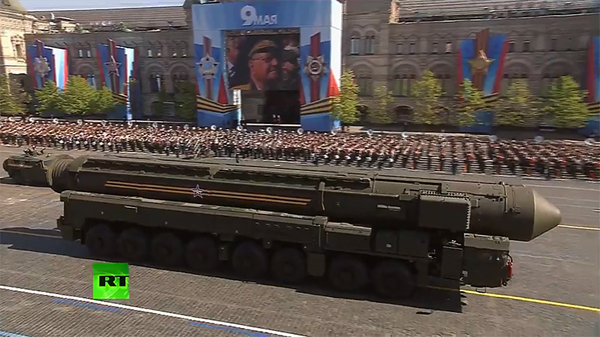
The Russian military displays Topol mobile intercontinental ballistic missiles at the 2014 Moscow Victory Day parade. (Image source: RT video screenshot)

This view has usually been coupled with the contradictory idea that U.S. missile defenses, to protect the American people, have to be so limited as not to worry Russia (or China for that matter). Critics, including the Russian and Chinese governments, argue that U.S. missile defenses, if "too big," would "interfere" with the deterrent capabilities of its adversaries.

In other words, critics argue simultaneously that American missile defenses can never be sufficiently robust to deal with the large arsenals of the Russians and Chinese, but also argue that if "too robust," they will upset the Russians and Chinese to the point that Moscow and Beijing will "forced" to increase their arsenals aimed at the U.S., to overcome U.S. defenses.

One critic has gone so far as to say that American missile defenses, far from being purely a defensive measure, are in fact an aggressive attempt to bully our adversaries. He claims that U.S. policy is to develop "first the shield and then the sword."[2]

In short, the U.S. was being condemned for defending itself.

Contrary to the critics' arguments, an American missile defense inventory of a few thousand interceptors, deployed in a variety of modes at home and abroad, would significantly strengthen deterrence, not undermine it.

A critically worrisome factor today between the United States on the one hand and China and Russia on the other, is that a crisis over Ukraine or the South China Sea could evolve into an open military conflict between the nuclear powers.

In this context, Russia raises the prospect that nuclear-armed missiles might be used, especially in light of Russian President Vladimir Putin's assertion that he seriously considered using nuclear weapons if he were challenged militarily when invading the Crimea and Eastern Ukraine. This statement came on top of serial Russian threats, over the past six years, to use nuclear weapons against U.S. allies and NATO, as well as a new threat on April 2, 2015. On that date, Russian generals threatened a "spectrum of responses from nuclear to non-military" if the U.S. armed Ukraine or protected the Baltic states.

Such dangers will only be magnified if the number of nuclear powers multiplies, such as if Iran and Sunni states develop nuclear weapons. Iran's Foreign Minister, Mohammad Javad Zarif, has already said that Iran plans to sell "enriched uranium" on the international market, and will be "hopefully making some money" from it. How interesting. Wonder to whom?

Nuclear missile strikes by Russia against NATO or the United States would in all likelihood be aimed at the military capability of U.S. and that of its allies. The Russian ambassador to Denmark recently threatened to aim Russian nuclear warheads at Danish warships if they deployed missile defense radars.

In such cases, robust missile defenses deployed by the U.S., NATO and Western friends and allies could seriously complicate Moscow's war aims, making it more difficult for Russia to feel confident that it could achieve its objectives. In short, the U.S. could increase the Kremlin's uncertainty -- thereby strengthening deterrence.

On the other hand, robust missile defenses, whether deployed in Europe or in America, would also have a critical role in dealing with missile attacks aimed at America's and allied population centers.

NATO in 2010 formally strengthened its goal of protecting its military forces and assets, by adding the protection of its civilian populations as a central role of missile defenses in Europe.[3]

Currently, missile threats to U.S. population centers come largely from rogue states such as North Korea, Syria and Iran; they could eventually come from terrorist organizations acting on behalf of such rogue states.

Additionally, such rogue threats might also involve surreptitious missile launches, where the state of origin could not be readily identified. Such missile launches might very well come from submarines, which U.S. adversaries surely see as being a particularly daunting challenge for the U.S., given the vast maritime territory it has to defend along its 12,000 miles of coastline. There, our missile defense needs to be of an extremely high capability.

Any deployed missile defense must be able to shoot down any ballistic missiles and nuclear warheads, from rogue states or anyone else, by intercepting such "limited attacks." If deployed properly, U.S. missile defenses can get multiple shots at an incoming warhead, making the capability of combined or multiple interceptors better than stand-alone interceptors. In this way, the likelihood of being able to shoot down a small number of rogue state or terrorist-launched missiles against the United States approaches 100%.

To date, North Korea has a limited, though dangerous, nuclear arsenal. A more serious threat is North Korea's ability to miniaturize a nuclear warhead, allowing it to be placed on a wider range of missile types and thus expanding the North Korean missile threat -- such as shorter-range missiles launched from an ocean-going freighter.

If Iran joins the nuclear club, its warhead inventory might also initially be limited, but only for a short time; the dangers to the U.S. thereafter would markedly increase.

Thus, the development of missile defenses and sensors capable of finding and shooting down such missiles early in their flight is paramount.

A benefit is that such a capability would reduce quite significantly the area that the United States must defend. Such interceptors could be space- or sea-based, combining Navy assets deployed on land, known as "Navy Ashore" (a system now deployed in Romania, for example).[4]

Advanced research is a critical necessity. Future threats are such that the U.S. may find itself "overmatched," says Admiral James Syring, Director of the Missile Defense Agency. On March 25, 2015, he told the Senate Armed Services Committee, "The threat continues to grow as our potential adversaries acquire a greater number of ballistic missiles, increasing their range, incorporating BMD countermeasures, and making them more complex, survivable, reliable, and accurate." [5]

He further noted that, according to the Defense Intelligence Agency, Iran "is capable of flight-testing an ICBM in 2015." He continued, "Iran has publicly stated it intends to launch a space launch vehicle as early as this year [2015] that could be capable of intercontinental ballistic missile ranges if configured as such... Iran could threaten maritime activity throughout the Persian Gulf and Strait of Hormuz."[6]

On North Korea, the Admiral warned, "In addition to the Taepo Dong 2 space launch vehicle/ICBM, [capable of striking the continental United States] North Korea is developing and has paraded the KN08 road-mobile ICBM and an intermediate-range ballistic missile [IRBM]."

The significance of these developments is that a road-mobile missile is far more difficult to strike before launch, as it can deploy in a much larger area than a fixed, silo-based missile. As for the new IRBM, it also expands the threats the US and its allies are now facing from North Korea.

Given such growing missile threats on America's horizon, the task of building more robust missile defenses would seem to be a "no-brainer."

Polls show the American people overwhelmingly support such missile defenses, and a large majority supports greater defense spending -- a welcome switch from just a year ago.

Congress should approve the Administration's missile defense budget request, especially for adding to our inventory of missiles, as well as sensors and satellites. Critical also will be to add funding for the development of new technologies to provide for the future defense -- at the very least from these well-identified increasing threats -- of the U.S. and its allies.

It is an investment we need to make.

[1] Testimony of Vice Admiral James D. Syring, Director, Missile Defense Agency, March 25, 2015 before the Senate Armed Services Committee.
[2] Joe Cirincione, Newsweek, "The First Star Wars", February 21, 1999.
[3] "The Future of Missile Defense", A NATO Perspective, January 15, 2014.
[4] "EPAA and Aegis Ashore," October 14, 2014, Defense Daily.
[5] Testimony of Vice Admiral James D. Syring, Director, Missile Defense Agency, March 25, 2015 before the Senate Armed Services Committee.
[6] Ibid.


Peter Huessy

Source: http://www.gatestoneinstitute.org/5523/us-missile-defense

Copyright - Original materials copyright (c) by the authors.

The Brutality of Obama and the Left - J. Robert Smith


by J. Robert Smith

Barack Obama is a committed leftist working through his agenda to “transform” America. Washington Republicans do injury to the cause of liberty with timid language. That the president and the left bungle or misstep at times detracts little from their successes. In terms of advancing leftist aims, the Obama presidency is historic. 


Let’s not hear this insipid and misleading talk from Washington Republicans anymore: “Barack Obama is incompetent and naïve.” That better describes them. 

Barack Obama is a committed leftist working through his agenda to “transform” America. Washington Republicans do injury to the cause of liberty with timid language. That the president and the left bungle or misstep at times detracts little from their successes. In terms of advancing leftist aims, the Obama presidency is historic.  

Remaking America didn’t start with Obama. It won’t stop without him, either, unless the left is stopped, period. Split differences with this foe? How so when the left works to erode liberty and pursues policies damaging to national security? We’ve entered days of the starkest differences between the left and us -- days that demand from us hard-eyed appraisals and resolute action. 

The left has been marching through America for decades, destroying traditional America as it goes. Ransacking our institutions. Torching our values and virtues. Shredding constitutional rights and undercutting the rule of law. If it’s possible to ransack, torch, shred, and undercut by enfolding actions in the language and symbols of traditional America, and the language of “compassion,” the vintage left did so. The telling contrast is that today’s left is dropping the cloak. It still pays lip service to compassion (toss in fairness and equality). But the modern left’s approach contains stridency, brazenness – open brutality… more of the naked iron fist. 

Brutality – in service of a cause. Brutality – in the pursuit of power. Leftism and statism go hand-in-hand. Statism and truncheons go… hand-in-hand. Obama isn’t shy about forcing his will on the nation. Ditto the left. Obama imposes his will through executive action. He unfetters federal bureaucracies and agencies. He’s doing so through foreign policy. He did so with help from the last Democratic Congress, which legislated a landmark health care law against majority will. He roughs up Republican Congresses.   

Let’s start with Obama’s dealings with Iran over its nuclear weapons development program. In a trenchant column, Wesley Pruden, the Washington Times’ emeritus editor, stated:
Describing Mr. Obama as an appeaser, in the tradition of Neville Chamberlain caving at a similar nexus of history in 1938, misses the point. Mr. Obama may not be appeasing at all, but enabling. Everything about Barack Obama suggests that he believes America must be cut down to size, that it’s the arrogance of thinking America is something special, the exceptional nation, that is the source of intractable trouble in the world. Once America is brought to heel, men of wisdom, brilliance, kindness, intelligence and good will -- rare men just like himself -- can make the rough places smooth and forge a lasting peace. [Emphasis added]          
If Pruden is correct, the president, along with the rest of the left, wants an enemy to develop nuclear weapons in order to diminish the U.S. Iran is developing ICBMs, too. The implications are stunning. Any deal Obama strikes with Iran will only be about forestalling nuclear weapons attainment.   

The consequences of Obama humbling his own nation: a nuclear armed Iran sparks a Middle Eastern nuclear arms race. (Sunni Saudi Arabia won’t tolerate Shia Iran menacing it.) Iran, with delivery capability, can strike targets in the U.S. Thirty-six years of hatred toward America, and calling for America’s death, by Iran can’t be shrugged off. 
Obama’s Iranian gambit is a type of brutality. It’s violence against U.S. national interests. Doing so imperils Americans.          

Now let’s jump back to ObamaCare. Liz Peek wrote for Foxnews.com in 2013:
Are you afraid of the Obama White House? If you challenge the president’s beloved health care plan, maybe you should be. Consider the fate of William White, the Washington, D.C. Insurance Commissioner, who voiced skepticism about President Obama’s hastily assembled “fix” for the millions losing their insurance policies.
A day after suggesting that the new demands on insurers could destabilize the marketplace and lead to even higher premiums, White was canned.
Telling the truth about ObamaCare is risky.       

We see bullied government officials. Bullied health insurers and providers. Even a stage-four cancer patient, Edie Sunby, who had the nerve to recount in an op-ed that the ACA cost her insurance coverage, was bullied by the White House. Sunby was one of millions of Americans forced out of insurance policies.

There’s the Ferguson, Missouri, racial strife. About that, the executive director of the Fraternal Order of Police, Jim Pasco, had this to say last August:
"I think what he has to do as president and as a constitutional lawyer is remember that there is a process in the United States and the process is being followed, for good or for ill, by the police and by the county and by the city and by the prosecutors’ office […]"
Pasco should know that constitutional processes matter less to Obama and the left than results. The Constitution was declared “living” during the New Deal. It lives as left-wing judges want it to. Increasingly, it lives as the president wants it to.   

Peter Kinder, Missouri’s lieutenant governor, criticized the Obama administration for “[inciting] a mob” in Ferguson recently:
“It’s bad enough the [Ferguson] protesters were behaving that way, but we have a right to expect much more from the attorney general, the head of the Justice Department of the United States, and the president of the United States. And instead, what we got too often from them was incitement of the mob, and, uh, encouraging disorder in Ferguson and disrupting the peaceable going-about of our daily lives in the greater St. Louis region.” [Emphasis added]
Welcome to the new world of leftist brutality, Lieutenant Governor, where cause trumps law and order; where nothing is abstract about the violence that a leftist president and his attorney general are glad to fuel or provoke.      

We can go on, discussing the harm done through the president’s lax borders and amnesty efforts. There’s violence along the nation’s southern border and higher crime in U.S. cities thanks to illegals. Violence being done to the nation’s fabric; injury to the rule of law. All to achieve a political end: to expand and nourish (at taxpayer expense) constituencies for the Democratic Party.

Lastly, Memories Pizza in Walkerton, Indiana. The pizzeria’s owners were threatened and intimidated by leftist and homosexual jackboots and fellow travelers. Threatened because they answered a reporter’s question consistent with their religious beliefs. Where was Obama’s and Holder’s outrage at the violence done to small business owners exercising their rights to conscience and religious freedom?

About Indiana, Memories Pizza, and the Religious Freedom Restoration Act, Clarice Feldman wrote for American Thinker:
They [public accommodation laws] need to be pared back if we are to continue as a free people with the right to free speech, free association, and the freedom to practice our religion. If we don’t, we open the doors to totalitarians that decide what we can do and mobs like the Chinese Red Guards enforcing this week’s cultural fashion.
That’s the point, isn’t it? The left doesn’t really want a free people. It wants power -- power to radically change America. Laws that enable the left to do so are exploited. Laws that don’t are ignored and actions taken to secure the desired end… nowadays, with brutality… more and more.


J. Robert Smith

Source: http://www.americanthinker.com/articles/2015/04/the_brutality_of_obama_and_the_left.html

Copyright - Original materials copyright (c) by the authors.

Israel rejects US attempt to reinterpret Obama’s admission of nuke deal’s flaws - Times of Israel staff and AP


by Times of Israel staff and AP

‘We share his assessment,’ official says, after president acknowledged agreement will give Iran near-zero breakout time in 13-15 years

Israel on Wednesday flatly rejected Obama administration explanations and clarifications of the president’s remarks a day earlier, in which he appeared to acknowledge that Iran would be able to break out to the bomb almost immediately when key provisions of the new nuclear deal expire in 13-15 years.

A senior official in Jerusalem told The Times of Israel that “we share his assessment.”

And the director general of Israel’s Ministry of Intelligence praised the president for telling “the truth” about “a very bad deal.”


In an interview with NPR, Obama, whose top priority at the moment is to sell the framework deal to critics, was pushing back on the charge that the deal being negotiated by US-led world powers fails to eliminate the risk of Tehran breaking out to the bomb, because it allows Iran to keep enriching uranium. He told NPR that Iran will be capped for a decade at 300 kilograms of enriched uranium — not enough to convert to a stockpile of weapons-grade material. He then added: “What is a more relevant fear would be that in Year 13, 14, 15, they have advanced centrifuges that enrich uranium fairly rapidly, and at that point, the breakout times would have shrunk almost down to zero.”


According to State Department acting spokesperson Marie Harf, Obama “was referring to a scenario in which there was no deal. And if you go back and look at the transcript — I know it’s a little confusing, I spoke to the folks at the White House and read it a few times — it’s my understanding he was referring to — even though it was a little muddled in the words — a scenario in which there was no deal.”


State Department spokeswoman Marie Harf (Photo credit: YouTube screen capture)
State Department acting spokesperson
Marie Harf (screen caption: YouTube)

In a briefing Tuesday, Harf noted that some of the restrictions that would be in place during those years have not yet been negotiated. “Part of the negotiations remains what happens to some of those pieces in those further-on years. I don’t have a specific breakout time to put on to those years at this point, but obviously we want as long of a breakout time for as long as possible. So it would not be zero,” Harf said.


Israel, however, rejected this attempt at clarification, with the senior official saying that Israel understood the president to be acknowledging the problematics of the accord.


The official noted, furthermore, that Prime Minister Benjamin Netanyahu — a relentless opponent of the US-backed terms — had highlighted precisely the problem that Obama cited when he addressed both houses of Congress last month.


Prime Minister Benjamin Netanyahu addresses a joint meeting of the United States Congress in the House chamber at the US Capitol in Washington, DC on Tuesday, March 3, 2015, in a speech warning against the then-looming US-backed deal with Iran (Win McNamee/Getty Images/AFP)
Prime Minister Benjamin Netanyahu
addresses a joint meeting of the
United States Congress in the House
chamber at the US Capitol in
Washington, DC, on March 3, 2015,
in a speech warning against the
then-looming US-backed deal with Iran.
(photo credit: Win McNamee/Getty Images/AFP)
In that address on March 3, Netanyahu warned: “Iran could get to the bomb by keeping the deal. Because virtually all the restrictions on Iran’s nuclear program will automatically expire in about a decade… Iran would then be free to build a huge nuclear capacity that could produce many, many nuclear bombs. Iran’s Supreme Leader says that openly. He says Iran plans to have 190,000 centrifuges, not 6,000 or even the 19,000 that Iran has today… With this massive capacity, Iran could make the fuel for an entire nuclear arsenal in a matter of weeks… My long-time friend, John Kerry, the secretary of state, confirmed last week that Iran could legitimately possess that massive centrifuge capacity when the deal expires… The foremost sponsor of global terrorism could be weeks away from having enough enriched uranium for an entire arsenal of nuclear weapons, and this with full international legitimacy.”


Ram Ben-Barak, a former senior Mossad official who now heads Israel’s Ministry of Intelligence, furthermore, praised Obama for his candor in highlighting aspects of what Ben-Barak called “a very bad deal.


“Barack Obama is evidently an honest man, who clearly is incapable of telling a lie. And therefore he told the truth,” Ben-Barak told Army Radio.


“Ask any American or European official who has been involved in the negotiations, ask him if he thinks that at the end of the process Iran wants nuclear weapons,” Ben-Barak went on. “Ask him in a one-on-one conversation, and he’ll tell you yes, that’s for sure.”

  Times of Israel staff and AP   Source: http://www.timesofisrael.com/israel-rejects-us-attempt-to-reinterpret-obamas-warning-of-nuke-deals-flaws/   Copyright - Original materials copyright (c) by the authors.

U.K. May Fire 100 Islamist Educators in "Trojan Horse" Scandal - John Rossomando


by John Rossomando

Last June, the U.K.'s Office for Standards in Education, Children's Services and Skills (Ofsted) found evidence that hardline Islamists had attempted to take control of some state schools.

At least 100 Islamist teachers and teaching assistants implicated in last year's "Trojan Horse" teaching scandal in Birmingham, England may face lifetime teaching bans.

Last June, the U.K.'s Office for Standards in Education, Children's Services and Skills (Ofsted) found evidence that hardline Islamists had attempted to take control of some state schools. The report found that staff and headteachers felt "intimidated," "undermined" or bullied into making changes they opposed.

Some headteachers with records of improving classroom standards were either marginalized or forced out of their jobs. In some cases, teachers faced unfair treatment due to their gender or religious beliefs.

The National College for Teaching and Leadership (NCTL), which oversees teachers in the U.K. and has the authority to ban them, is reviewing 30 cases, but as many as 100 teachers and assistants may be targeted.

The Sunday Times reports that NCTL obtained dossiers on some of those educators from the U.K.'s Department of Education. The dossiers reportedly contain information from the "Trojan Horse" investigation, which found a "co-ordinated, deliberate and sustained action" by a number of individuals who sought to introduce an "intolerant and aggressive Islamic ethos" into selected Birmingham schools.

Abusive practices, such as forcing students at Park View Academy, one of the Birmingham schools targeted by last year's inquiry, to kneel on tiles in "stress positions" were observed by British investigators. NCTL investigators also found that an IT technician at Park View used school equipment to copy a video containing "typical Al-Qaeda footage, in which the individuals had their faces obscured with scarves and were holding guns."

Students found to be dating each other were sent to an "isolation unit, where they work in individual booths of silence." Designated senior students, known as prefects, were told to report romantic relationships between students to senior staff.

More than 50 Park View teachers – called the Park View Brotherhood – exchanged as many as 3,000 messages in a WhatsApp group that included offensive comments about British soldiers and claimed that Lee Rigby's murder and the Boston bombings were hoaxes. The messages also discussed segregating boys and girls.

Britain's home minister Theresa May recently called for stronger measures against Islamic extremism in U.K. schools.

"The allegations relating to schools in Birmingham raise serious questions about the quality of school governance and oversight arrangements," May said. "How did it come to pass, for example, that one of the governors at Park View was the chairman of the educational committee of the Muslim Council of Britain? Is it true that Birmingham city council was warned about these allegations in 2008? Is it true that the Department of Education was warned in 2010? If so, why did nobody act?"


John Rossomando

Source: http://www.investigativeproject.org/4818/uk-may-fire-100-islamist-educators-in-trojan

Copyright - Original materials copyright (c) by the authors.