Saturday, September 19, 2026

CENTCOM: US forces facilitate shipping of 1 billion oil barrels out of Strait of Hormuz - JNS Staff


by JNS Staff

The volume of commodities transiting the strategic waterway has reached a new peak in the last two weeks, said Adm. Brad Cooper.


Vessels transit the Strait of Hormuz
Vessels transit the Strait of Hormuz off the coast of the Iranian port city of Bandar Abbas on Sept. 5, 2026. Photo by Atta Kenare/AFP via Getty Images.


American forces supported the maritime transportation of 1 billion crude oil barrels out of the Strait of Hormuz in the last couple of months, U.S. Central Command chief Adm. Brad Cooper said in a recorded message on Saturday.

“We’ve reached this significant milestone while assisting over 2,000 commercial ship transits through the strait by providing coordinated protection,” Cooper said.

The flow volume of crude oil, liquid natural gas and other cargo in the past two weeks has reached the highest point since the start of the conflict with Iran on Feb. 28, he said.

“Clearly, momentum is building,” the admiral continued, adding that primary transit routes in the choke point have been cleared of mines.

By contrast, Iran has exported zero barrels thanks to CENTCOM’s “ironclad blockade,” he said.

Cooper further stated that coordinated efforts with the countries of the Gulf Cooperation Council (Bahrain, the United Arab Emirates, Saudi Arabia, Kuwait, Oman and Qatar), as well as insurance and shipping companies, to increase the volume of traffic flow through the strait, continue.

He added that CENTCOM is working with partners in the region in forming a “new coalition attack drone unit.”

On Friday, the Islamic Revolutionary Guard Corps claimed to have struck a Togo-flagged vessel in the Strait of Hormuz, according to Iran’s semi-official Mehr news agency, cited by AFP.

The U.K. Maritime Trade Operations (UKMTO) Centre reported the same day that two tankers had been hit by “unknown projectiles” in separate incidents, on Sept. 16 and Sept. 18, while transiting the waterway. The attack on Friday caused fire on one of the ships, which has since been extinguished, the British Royal Navy-sponsored organization said.

Iran prepares mobilization of hundreds of thousands

Meanwhile in Tehran, the Iranian regime organized its biggest rally since the start of the war, assembling on Friday hundreds of thousands of Iranians allegedly willing to receive limited military training, the Associated Press reported.

The march through downtown Tehran was dubbed “Janfaday-e Iran,” or the “ones who sacrifice their lives for Iran,” per AP.

Leading up to the march, state media called on Iranians to join the campaign, saying that these volunteer trainees would function as an added layer to the country’s security apparatus, already comprised by the IRGC and its Basij paramilitary militia, which clamps down on domestic unrest.

Brig. Gen. Hassan Hassanzadeh, commander of the IRGC in Greater Tehran, was quoted by state media as saying that 600,000 volunteers have already registered to the new force, with more than 1 million expected to participate, according to AP.

Some of the marchers could be heard chanting “Death to America” and “Death to Israel,” the report said.

Trump: Tehran not ready for a deal

Meanwhile, U.S. Ambassador to the U.N. Mike Waltz told reporters on Friday that President Donald Trump plans to make the case against a nuclear Iran in his address at the U.N. General Assembly annual meeting on Sept. 22, according to Fox News.

The president will also discuss the ongoing diplomatic efforts in Gaza, Waltz said.

On Thursday, Trump said Iran wants to reach an agreement with Washington but is not yet ready to do so.

“Iran wants to make a deal; they’re not ready, in my opinion,” Trump told ABC11 in North Carolina. “We’re gonna either make a deal that’s good, or we’re not gonna make a deal at all.”

Referencing “Operation Midnight Hammer” that was carried out in June 2025 against three key Iranian nuclear facilities, Trump continued, “If we would not have used our B-2 Bombers we would right now have an Iran with a nuclear weapon; and they would use it.”

Speaking to Axios on Thursday, the American leader suggested that he was approaching a critical junction regarding the Islamic Republic.

“I have a big decision coming up,” he was quoted as saying. “Do I want to go in and annihilate them [the Iranian regime] or do I not? It’s a big decision. Anything could happen with me.”


JNS Staff

Source: https://www.jns.org/news/u-s-news/centcom-us-forces-facilitate-shipping-of-1-billion-oil-barrels-out-of-strait-of-hormuz

Follow Middle East and Terrorism on Twitter

Iran reportedly expands influence on Yemen’s Red Sea coast after Houthi takeover - report - Seth J. Frantzman


by Seth J. Frantzman

The goal of the Houthis is to create a new reality along the Red Sea. They are digging trenches in the mountains to prevent the government forces from retaking the area.


An Iranian radar unit is seen near the Natanz nuclear enrichment facility, on April 9, 2007, 180 miles south of Tehran, Iran; Illustrative.
n Iranian radar unit is seen near the Natanz nuclear enrichment facility, on April 9, 2007, 180 miles south of Tehran, Iran; Illustrative.
(photo credit: Majid Saeedi/Getty Images)


A report at the UAE’s Al-Ain media says that “less than 10 days after the Houthis seized control of Yemen’s west coast, Iran rushed to transform this strategic geographical area into a theater of influence for itself.”

Historically, the UAE and therefore its media outlets have good contacts in Aden and the areas of southern Yemen. The UAE played a key role for years in Yemen, backing the Southern Transitional Council against the Houthis.

Now the report indicates that Iran may be playing a role in the area the Houthis captured on September 11 in Yemen. The Houthis launched a rapid offensive up the coast, capturing Mokha and also the areas along the Bab el-Mandab Strait. This is a strategic area.

“Security and media sources revealed that Iran has deployed radar systems in the commanding heights on the western coast, in addition to using the coastal strip as an outlet for smuggling military equipment from Somalia after field visits by its experts,” the report says. It doesn’t say what type of radar may have been placed nearby.

The report argues that this information “reveals Tehran’s efforts to exploit its Houthi arm to transform the Yemeni coast from Hodeidah to Bab el-Mandab into an advanced line of defense for its regional influence network.”

Fighters loyal to the Houthi authorities, brandish their weapons during a rally to recruit more fighters, in Sanaa on September 10, 2026.
Fighters loyal to the Houthi authorities, brandish their weapons during a rally to recruit more fighters, in Sanaa on September 10, 2026. (credit: Mohammed HUWAIS / AFP via Getty Images)

The Houthis have been increasing attacks on Saudi Arabia since the mid-September offensive. The Iranian-backed militias in Iraq also attacked Saudi Arabia’s East-West pipeline.

In addition to the radar, the Houthis are also involved in smuggling. “Iranian equipment and weapons shipments have recently arrived for the Houthi militias via the western coast.”

Iranian smuggling into Yemen faces challenges

In the past, the Iranians had an easier time smuggling systems into Yemen. Missiles and drone parts arrived by sea. The Iranians recently tried to reopen an air corridor to Yemen in July. The Saudis opposed this. The US has a maritime blockade of Iran. It is unclear how Iran would smuggle items to Yemen.

The sources told Al-Ain that shipments are being unloaded. “After their arrival from the coasts of Somalia, [the shipments] were supervised by Hassan Al-Attas, who is the head of the Fisheries Authority in the Red Sea, based in Hodeidah.”

Al-Ain says that “Attas runs a smuggling network that is a model of an integrated functional hierarchical structure closely linked to the leader Ibrahim Hassan Ismail Al-Madani, while the prominent leader Shaher Al-Qahoum, who trained in Iran, provides it with security cover.”

This type of name-dropping is typical of Al-Ain stories on Yemen. It illustrates the kind of messaging and sourcing behind the report. This is why these reports can matter.

“Al-Attas is also responsible for recruiting fishermen and those with deep maritime experience for the militias, managing smuggling operations from Iran by sea to the shores of Hodeidah, receiving shipments upon arrival, and delivering them to the Houthi militias, as recently reported.”

Houthis intend to create new reality along Red Sea

The goal of the Houthis is to create a new reality along the Red Sea. They are digging trenches in the mountains to prevent the government forces from re-taking the area. They are also increasing activity on the coastline.

“Sources have revealed the installation of radar systems and newly established sites in the highlands overlooking the western coast and the new areas of control.”

The report also says there is activity on Zuqar Island, also known as Jazirat Jebel Zuqar, which means the “Island of Mount Zuaqr,” near the Hanish island chain in the Red Sea.

“These steps come as an outcome of visits and field tours conducted by Iranian experts to vital sites, including Bab el-Mandab, the port and airport of Mokha, during which they met with engineers of the Houthi missile force to establish a new phase of threats to international navigation.” 


Seth J. Frantzman

Source: https://www.jpost.com/middle-east/article-909132

Follow Middle East and Terrorism on Twitter

Houthis claim to have struck Saudi Aramco facility, Riyadh with missiles, drones - Reuters


by Reuters

There was no Saudi confirmation regarding whether or not the Houthis had struck any of the sites they claimed to have targeted.


Large plume of black smoke rises from the fuel storage area at King Khalid International Airport, in Riyadh, Saudi Arabia, September 19, 2026. Picture taken with a mobile phone.
(photo credit: REUTERS/STRINGER)


Yemen's Houthis said they attacked "sensitive" sites in the Saudi capital Riyadh on Saturday with missiles and drones, hours after flames and a large plume of smoke were seen near the city's main airport.

Saudi Arabia had sent alerts overnight warning of potential danger around Riyadh, amid an escalation in attacks by the Houthis in the kingdom.

Reuters video and photographs showed a huge pillar of black smoke rising in the area, with the airport highway, main terminal building and other facilities in the foreground. At one point in the video, flames were visible rising from behind what appeared to be fuel tanks.

The Houthis did not specify what they had targeted in Riyadh, but said they had also attacked an Aramco facility in the Red Sea city of Yanbu, a key Saudi oil export hub.

The Houthis said the operation came as a response to an attack in the Yemeni capital Sanaa.

Houthi fighters stand in front of what they say is a downed Saudi jet, at a location given as Yemen, in this still image from a handout video released on September 16, 2026.
Houthi fighters stand in front of what they say is a downed Saudi jet, at a location given as Yemen, in this still image from a handout video released on September 16, 2026. (credit: Houthi Military Media/Handout via REUTERS)

Saudi coalition reportedly defends civilian targets from missile attack

The Saudi-led military coalition fighting the Houthis said its air defenses had destroyed a missile fired by the Yemeni group toward Riyadh early on Saturday.

In a statement, the coalition also said it had foiled attacks targeting civilians in the Saudi cities of Bish and Farasan in the southwest and Taif in the west, as well as Yanbu on the Red Sea coast. It did not say whether there was any damage.

Saudi civil defense sent the alerts by phone overnight for potential danger of aerial attacks in Riyadh and the city of Al-Kharj east of the capital, before issuing an all-clear on Saturday morning. A Reuters journalist in Riyadh's Olaya area heard booms before the all-clear was sent.

Although some alerts had been issued in Riyadh this year after the start of the US-Iran war, these were the first since the escalation with the Houthis began in July.

Global oil supply threatened

The Houthis, who ⁠control ​the most populous parts of Yemen and much of the north, ​have been launching attacks against Saudi Arabia since declaring a naval blockade against Riyadh in July, with strikes targeting Saudi vessels in the Red ​Sea.

The attacks have targeted Saudi cities, energy infrastructure and shipping, creating new threats to global oil supplies and putting at risk the main alternative Red Sea route for Gulf exports while traffic through the Strait of Hormuz remains blockaded.

Turkish Foreign Minister Hakan Fidan said Saudi Arabia may have military needs due to the ongoing Houthi attacks, and Turkey was ready to help under a trilateral defense pact that also includes Pakistan.

It was unclear what kind of support Turkey might provide, but Fidan, in an interview with broadcaster NTV, said Saudi Arabia's needs could include "some technical issues."

The trilateral agreement signed last month stipulates that an armed attack on any of the three countries would be regarded as an attack on all of them.

On Friday, Houthi military spokesperson Yahya Saree said the group had foiled unspecified "criminal attempts" in the Yemeni capital Sanaa, blaming Saudi Arabia and vowing a response.

The Iran-aligned group, which seized Yemen's entire Red Sea coast in a lightning advance this month, says the Saudi Air Force has conducted hundreds of airstrikes against it ​in recent days.

The fighting between the Houthis and Saudi Arabia has developed as a new theater of conflict in the wider war that began with US and Israeli strikes against Iran at the end of February. US President Donald Trump has rebuffed Saudi requests for direct US military intervention against the Houthis.

Mohsen Rezaei, secretary of Iran's Supreme National Security Council, told Al Jazeera in an interview aired on Saturday that Tehran wanted the war between Saudi Arabia and the Houthis to end, adding that he believed Yemenis also wanted a settlement with Saudi Arabia.

Rezaei also said Iran had conveyed its conditions to mediators for re-engaging in stalled negotiations with the United States, including "ending the war on all fronts."

Consultations were continuing with Qatari and Pakistani mediators, and Tehran was awaiting a response from Trump, Rezaei said.

The UN Security Council, in a statement on Friday, "condemned in the strongest terms continued Houthi attacks against the Kingdom of Saudi Arabia, including attacks impacting civilian and energy infrastructure, which have resulted in the injury of civilians, including women and children."

In the statement, the Security Council also condemned "Houthi military escalation in Yemen."


Reuters

Source: https://www.jpost.com/middle-east/article-909128

Follow Middle East and Terrorism on Twitter

Egypt Should Be Fighting Against the Houthis in Yemen - Adam Turner


by Adam Turner

It is Egypt’s job to protect the Suez Canal – the vital waterway between the Mediterranean and the Red Sea.


“The Houthi rebels effectively completed their rapid push to take control of Yemen’s Red Sea coastline on Friday, tightening their grip on one of the world’s most important shipping routes and delivering a dramatic boost to their backers in Iran.” –NBC News 9/11/2026

The Shia Muslim terror proxy of the Islamic Republic of Iran, the Houthis of Yemen, are tightening their control over the Bab el-Mandeb Strait. This is a big deal, because an average of 8.1 million barrels per day of crude oil and petroleum liquids moved through the Strait during the second quarter of 2026. There is also the non-energy trade. All this international trade then heads to Europe and/or the Americas. An expert Israeli source has warned about the dramatic consequences of the Houthi advance—“They will be able to shoot at whatever they want with anti-tank missiles; they will see the ships with the naked eye.” The source points to a significant gap between the Strait of Hormuz, which currently attracts most of the world’s attention, and the Bab el-Mandeb Strait: “They are at the shortest point; it is worse than Hormuz.”

With Iran also threatening the Strait of Hormuz—however ineffectively—this is bound to have grave repercussions for the world energy market and the international economy.

Which leads me to my big question for Egyptian President Abdel Fattah El-Sisi—“what would you say … you do here, President Sisi?” (For those unfamiliar with the movie comedy Office Space, this scene has become a meme about people who hold down jobs where they do nothing of any real significance.)

It is Egypt’s job to protect the Suez Canal—the vital waterway between the Mediterranean and the Red Sea. In 1954, Egypt signed a treaty with the United Kingdom, the then-colonial power, which stated: “8. The agreement will recognize that the Suez Maritime Canal, which is an integral part of Egypt, is a waterway economically, commercially, and strategically of international importance, and will express the determination of both parties to uphold the 1888 Convention guaranteeing the freedom of navigation of the Canal.” The Houthi interruptions of trade through the Bab el-Mandeb to the Red Sea are, without a doubt, gravely harming the freedom of navigation of the Canal by attempting to close off one side of it.

As a result, Egypt has suffered great harm. Egypt relies on the fees paid by international shipping companies that transit the canal. “According to Egyptian President Abdel-Fattah el-Sissi, Egypt likely lost around $7 billion (€6.15 billion) from a decrease in traffic through the Suez Canal in 2024 alone.”

Egypt is a much stronger power than the Houthis. Egypt is the colossus of the Arab world, with a population of more than 110 million people. Yemen’s population is a comparatively paltry 34 million, with the Houthis making up less than a third of that. The Egyptian army has almost 500,000 active personnel, with another 500,000 reserves. The Houthis have “from 20,000 core militants—composed of tribal forces and former government troops—to up to 350,000 fighters.” Egypt has a capable navy. The Houthis do not. Egypt has a large air force of more than 1,000 aircraft, with almost 250 fighter jets. The Houthis have no jet fighters.

The U.S., which heavily funds the Egyptian government, has made it clear that it is in the U.S. national interest to facilitate trade going through the Bab el-Mandeb Strait. U.S. aid to Egypt is substantial—“Since 1946, the United States has provided Egypt with over $90 billion in bilateral foreign aid (calculated in historical dollars—not adjusted for inflation), with military and economic assistance increasing significantly after 1979.” For decades, the U.S. has provided Egypt with roughly $1.4 billion a year, much of it given to the Egyptian military.

Egypt has a history of fighting in Yemen dating to the 1960s. Under a previous military dictator, President Nasser, Egypt sent troops to assist a faction in Yemen’s civil war. Eventually, Britain, Saudi Arabia, Jordan, and Israel united in support of another faction, and the Egyptians were sent packing. During those years, the U.S. consistently supported the cessation of hostilities, although the Soviet Union, Egypt’s then-patron, did support the Egyptians.

More recently, in 2015, Egypt joined an earlier unsuccessful Saudi-led military campaign against the Houthis.

Considering all this, there is really no reason why Egypt isn’t providing substantial forces to join with the Saudis and the non-Houthi Yemeni forces to deal with the threat of the Houthis. The U.S. should strongly pressure Egypt to do so. Doing so would serve the national interests of both countries and fulfill Egypt’s responsibility.

So, once again, what would you say … you do here, President Sisi, when it comes to the Houthi threat that is harming your nation and impeding world trade through the Suez Canal that you are bound by international treaty to help guarantee? Your patron, the U.S., would surely appreciate you moving against the Houthis rather than continuing to violate your other international commitments by threatening another U.S. ally.

And please move quickly, President Sisi. Time is of the essence. 


Adam Turner

Source: https://amgreatness.com/2026/09/18/egypt-should-be-fighting-against-the-houthis-in-yemen/

Follow Middle East and Terrorism on Twitter

Trump blasts Supreme Court: 'Sad chapter in the life and times of America' - Nicholas Ballasy


by Nicholas Ballasy

Trump named the high court's tariffs decision and birthright citizenship decision in his social media post.


President Trump blasted the Supreme Court on Saturday, arguing its decisions during his second term have resulted in a "sad chapter in the life and times of America."

Trump named the high court's tariffs decision and birthright citizenship decision in his social media post.

"Unfortunately, the United States Supreme Court has lacked the Courage to MAKE AMERICA GREAT AGAIN. Over the last 6 months, with their faulty, political, and ridiculous decisions on TARIFFS and Birthright Citizenship, they have cost the United States of America Trillions of Dollars, and forever damaged the way people become Citizens of our great Country. It has been a sad chapter in the life and times of America, but we will prevail!" Trump wrote on Truth Social. 


Nicholas Ballasy

Source: https://justthenews.com/government/white-house/trump-blasts-supreme-court-sad-chapter-life-and-times-america

Follow Middle East and Terrorism on Twitter

Congressman asks IRS to investigate Islamic Society of North America over El-Sayed campaign activity - Nicholas Ballasy


by Nicholas Ballasy

According to the Middle East Forum’s report, El-Sayed’s campaign operated an exhibitor booth inside the convention hall, where campaign workers promoted his candidacy, solicited donations and recruited volunteers.


Rep. Keith Self, R-Texas, is asking the Internal Revenue Service to investigate whether the Islamic Society of North America violated federal rules governing tax-exempt organizations by reportedly allowing campaign activity for Democratic Senate candidate Abdul El-Sayed at its annual convention.

Self sent a letter Wednesday to Treasury Secretary Scott Bessent, citing a report from the Middle East Forum about El-Sayed’s appearance at the 63rd annual ISNA Convention in Detroit earlier this month.

According to the Middle East Forum’s report, El-Sayed’s campaign operated an exhibitor booth inside the convention hall, where campaign workers promoted his candidacy, solicited donations and recruited volunteers.  


Nicholas Ballasy

Source: https://justthenews.com/index%2Ephp/politics-policy/elections/congressman-asks-irs-investigate-islamic-society-north-america-over-el

Follow Middle East and Terrorism on Twitter

Three Things that Concern Israelis – No, It Is Not Iran, Hamas and Hezbollah - Nils A. Haug


by Nils A. Haug

While many parties in Israel criticize Prime Minister Benjamin Netanyahu for political gain and do their best to unseat him, it is to be hoped that he will once again emerge as prime minister of a new government following the elections.


  • What matters most to Israelis at this time, according to Israel's former ambassador to the United States, Michael Oren, is a domestic matter: that of the forthcoming October elections.

  • While many parties in Israel criticize Prime Minister Benjamin Netanyahu for political gain and do their best to unseat him, it is to be hoped that he will once again emerge as prime minister of a new government following the elections. There does not appear to be a candidate of his stature or experience – or Churchillian determination to protect both Israel and the West.

  • As leader of the coalition government's largest party, Likud, Netanyahu saw that the policy of former Israeli governments towards terrorism from Gaza -- "mowing the lawn" every few years in an effort to contain constant Hamas attacks -- had proved to be a devastating miscalculation.

  • In 1946, Israel's future founding prime minister, David Ben-Gurion, explained to a young Shimon Peres – a future prime minister and president of Israel himself: "A statesman must decide, one way or the other: to go for peace and pay the price, or to make war, knowing what the risks and dangers are."

  • The second socio-political concern is that of applying Israel's compulsory military draft to Haredi ("ultra-Orthodox") men. Israel's Supreme Court, after decades of delay, finally ordered eligible Haredi men to be conscripted in line with those from all other eligible sectors of Israel's population.... The issue continues to divide society.

  • The third concern pertains to the problematic omnipotence of Israel's Supreme Court, in a country where there is no constitution and no enumerated separation of powers.... A crucial doctrine of democracy -- the separation of powers between the three branches of government -- has been disregarded by Israel's Supreme Court, which does not require a plaintiff's standing to hear a case, and makes inroads into the domains of the executive and the legislature (the Knesset).

While many parties in Israel criticize Prime Minister Benjamin Netanyahu for political gain and do their best to unseat him, it is to be hoped that he will once again emerge as prime minister of a new government following the elections. There does not appear to be a candidate of his stature or experience – or Churchillian determination to protect both Israel and the West. Pictured: Netanyahu addresses a session of the Knesset in Jerusalem on June 11, 2025. (Photo by Menahem Kahana/AFP via Getty Images)

Most Americans, particularly Jews in America, might believe that the Israelis' primary concern is the never-ending military confrontations in Iran, Gaza, and Lebanon. Perhaps, perhaps not.

What matters most to Israelis at this time, according to Israel's former ambassador to the United States, Michael Oren, is a domestic matter: that of the forthcoming October elections. These elections will decisively direct the future of the nation, for better or worse.

Israel's turbulent social discord has flared up many times in the recent past, notably in the immediate period before the horrific October 7, 2023 invasion by the terrorist group Hamas. There is evidence that those conflicts gave the impression of internal weakness and military discord to Israel's enemies, Iran, Hamas and Hezbollah. Hamas reportedly viewed the situation as the perfect time to launch their bloodthirsty attack on a nation uninterested in battle. The outcome resulted in the worst slaughter of Jewish civilians since the Holocaust.

There seem to be three more concerns at present among the Israeli public. First, the choice of a future governing party and of the prime minister. While many parties in Israel criticize Prime Minister Benjamin Netanyahu for political gain and do their best to unseat him, it is to be hoped that he will once again emerge as prime minister of a new government following the elections. There does not appear to be a candidate of his stature or experience – or Churchillian determination to protect both Israel and the West.

Any politician who has been in leadership for many years can expect criticism and adverse press, at home and internationally. Contrary to the Biden administration, there is no discernible pressure from the Trump administration for Netanyahu not to win, despite unwarranted comments from time to time. Much can be said about Netanyahu, but one factor is beyond credible dispute: he has for the most part tried to act in the best interests of his nation – whether strengthening Israel's economy into that of a world-class giant, or refusing to buckle to pressure from any U.S. administration, irrespective of the high personal cost.

The Gaza scenario comes to mind here. As leader of the coalition government's largest party, Likud, Netanyahu saw that the policy of former Israeli governments towards terrorism from Gaza -- "mowing the lawn" every few years in an effort to contain constant Hamas attacks -- had proved to be a devastating miscalculation.

The context to this policy can be briefly explained as follows. In 2005, Israel's Prime Minister Ariel Sharon made a controversial decision to exit the Gaza Strip, expelled the thousands of Jews who had been living there, and handed it over to the Palestinian Authority (PA) to manage independently. Hamas soon ousted the Palestinian Authority from power in Gaza – sometimes by throwing its members from high buildings

Since that time, and only when proven necessary to maintain a semblance of order, the Israel Defense Forces (IDF) have hit Hamas through carefully targeted aerial strikes -- with no soldiers actually entering Gaza. This strategy was a massive failure. Hamas simply rebuilt its forces again -- as future developments disclosed in October 2023.

A prime minister only knows what he is told by the intelligence services. General Omar Bradley never told President Harry S. Truman that the Soviet Union had the atom bomb; Bradley apparently did not think that the president "needed" to know. Israel's senior military and intelligence service commanders failed dismally in their task to believe or to act on the warnings they received from their own soldiers, agents and analysts, yet blame for the disaster is unfairly leveled against Netanyahu. Israel's entire establishment -- the IDF, intelligence services, politicians and legacy media -- were equally culpable for the fiasco.

In 1946, Israel's future founding prime minister, David Ben-Gurion, explained to a young Shimon Peres – a future prime minister and president of Israel himself, and an inveterate compromiser for the sake of peace – that the Russian Jewish intellectual and Marxist revolutionary, Leon Trotsky, had been "no statesman." He elaborated that Trotsky's formula for settling issues of conflict had been simply to "walk out of the negotiations, declare the fighting over, and decide nothing."

Ben-Gurion then described what a real statesman would have done:

"A statesman must decide, one way or the other: to go for peace and pay the price, or to make war, knowing what the risks and dangers are."

That is precisely what Netanyahu did after decades of Hamas terrorism, Iranian proxy battles, and a massive military build-up by Hezbollah along Israel's northern border with Lebanon. Netanyahu made hard decisions, generally in the face of opposition from the US, Europe, so-called "human rights" organizations, and Israel's loud opposition, partially backed and funded by the Obama and Biden Administrations. Netanyahu nevertheless achieved his objectives: to secure his people against enemies determined to eliminate them and to preserve the nation for coming generations. Is everything about him perfect? Probably not. Is he a towering wartime leader and statesman? Absolutely.

The second socio-political concern is that of applying Israel's compulsory military draft to Haredi ("ultra-Orthodox") men. Israel's Supreme Court, after decades of delay, finally ordered eligible Haredi men to be conscripted in line with those from all other eligible sectors of Israel's population. Although such a ruling appears fair and just, the vast majority of the Haredi population believes that full-time Torah study for young men takes precedence over military service, while the community's religious and political leaderships demand that even young Haredi men who are not engaged in Torah study should be exempt from IDF service because they believe it poses a threat to the Haredi lifestyle and religious practice.

Although each year hundreds of young Haredi men enter IDF service in defiance of their community's leaders, they represent only about 9% of the annual draft-eligible Haredi cohort, compared to a roughly 88% conscription rate among secular and religious non-Haredi Jewish men. While other young Israeli men spend almost three years of their lives in full-time military service, and may be wounded or killed fighting to defend their nation, 91% of their Haredi peers spend those years studying, working, or even idling.

With the number of 18- to 19-year-old Haredi youths annually becoming eligible for conscription numbering more than 14,000 (and growing), a significant sector of the Haredi community objects, sometimes violently, to the conscription of their men. During mass protests of Haredi men and boys, some of them declare, "we will rather die than be drafted." The issue continues to divide Israeli society.

The third concern pertains to the problematic omnipotence of Israel's Supreme Court, in a country where there is no constitution and no enumerated separation of powers.

In his book, Rogue Justice: The Rise of Judicial Supremacy in Israel, Israeli-American lawyer Yonatan Green has produced a work on "the appropriate balance of power between the Knesset and the Supreme Court," according to commentator Neville Teller.

"Green believes that for some 40 years, power in the State of Israel has been deliberately, consistently, and illegally usurped by the judiciary.... [and] scrutinizes how the Supreme Court has misled itself into unbalancing the proper relationship between the judiciary and the government."

Teller writes of Green's assertion that the Court believes "its power over Israel's governance is absolute and cannot be challenged" --​ indeed a serious situation for the social and political stability of a nation. A crucial doctrine of democracy -- the separation of powers between the three branches of government -- has been disregarded by Israel's Supreme Court, which does not require a plaintiff's standing to hear a case, and makes inroads into the domains of the executive and the legislature (the Knesset).

Whenever Netanyahu's government objects or opposes the Court's unwarranted interference in the executive branch's governance -- aided and abetted by the politically biased Attorney-General Gali Baharav-Miara, in whom the government evidently lacks confidence -- allegations are made by some Israelis that the government is subverting democracy and destroying the country. In reality the reverse is true. Unfortunately, many in Israel's media, as well as its politicians, have stirred up their supporters to demonstrate, sometimes violently, against proposed curtailments to virtually absolute -- unchecked and uncheckable -- judicial authority.

These three concerns, with a starkly polarized electorate, promise little change or compromise. The political area appears split into left and right with no true centrist party to mediate matters. The Haredi conscription situation pits most of the population against a privilege, considered by many unacceptable, afforded to young men well able to defend their nation but unwilling to do so – at a time when IDF conscripts as well as reservists have been giving more than their all in deadly war zones. Meanwhile, the Supreme Court shows no sign of curtailing its authoritarian forays into the mandate given to the Knesset and the executive branch to govern as they see best.

All who value Western civilization and freedom might pray for brave Israel and its defense of our freedoms in the words of the ancient Psalmist:

"For the sake of the house of the Lord our God,
I will seek your good."
— Psalm 122: 6-9


Nils A. Haug
is an author and columnist. A lawyer by profession, he is member of the International Bar Association, the National Association of Scholars, a faculty member at Intercollegiate Studies Institute, the Academy of Philosophy and Letters. Dr Haug's particular field of interest is political theory connected to current events. Among degrees in Philosophy, English Literature, and Law, he holds an M.A. in Jewish Studies (cum laude) and a Ph.D. in Apologetical Theology. He is author of 'Politics, Law, and Disorder in the Garden of Eden – the Quest for Identity'; and 'Enemies of the Innocent – Life, Truth, and Meaning in a Dark Age.'. His work has been published by First Things Journal, The American Mind, Quadrant, Minding the Campus, Gatestone Institute, National Association of Scholars, Document Danmark, World Israel News, Israel Hayom, Jewish News Syndicate, Tribune Juive, Document Danmark, Zwiedzaj Polske,Schlaglicht Israel, Anglican Mainstream, Jewish Journal, The James Wilson Institute, The Australian Jurist, and others.

Source: https://www.gatestoneinstitute.org/22845/things-that-concern-israelis

Follow Middle East and Terrorism on Twitter

Calling Bullsh-t on James Talarico - Spyridon Andrews


by Spyridon Andrews

Jesus is not your campaign surrogate.


I don’t normally comment on political races, but when I see someone who is as fundamentally full of sh-t as James Talarico, I believe it is my duty to say something about it. James Talarico is now the Democratic nominee for the U.S. Senate from Texas, having defeated Jasmine Crockett in the 2026 primary. He has discovered a political instrument more powerful than a Super PAC, more versatile than a focus group, and considerably harder to interview: Jesus Christ. After generations of right-wing Protestant pastors hijacking the message of Jesus and turning him into some kind of political football, you have to hand it to James. After all, he is shameless enough to say, why not me?

Down in the backwater leftist stronghold of Austin, Texas, Talarico is selling progressive politics with a halo. He has shamelessly transformed Jesus into a mouthpiece for leftist progressivism. But that same feeling that we used to get when we watched the PTL Club pervades his aura. I have to hand it to American Protestantism; despite its amazing versatility, it can still make you feel dirty, cheap, and used.

Talarico’s maneuver is a simple one for the simple-minded. He selects biblical passages that he can bastardize and put into the service of leftist progressivism, as if it were a direct command from the Lord Jesus Christ to the White House and the U.S. Senate. Jesus becomes a mouthpiece for the massive expansion of government, open borders and illegal immigration, and NGOs. However, the clarity of his stance rolls into the fog the moment that the fate of an unborn child enters the discussion.

It would be too simple to call him a political whore. But I have to say that hearing him speak makes me nostalgic for Jasmine Crockett. Talarico has shamelessly peddled the God-loves-abortion argument that was vomited out by his professors at the far-left seminary he attended in Austin. Just a quick review of the course catalogue puts the “seminary” in the same political hotbox as any American progressive propaganda center these days. As a survivor of Harvard Divinity School, I can recognize all the usual fluff: Activism and the Old Testament Scriptures, Womanist and Feminist readings of the New Testament, Immigration and the Old Testament, Communication for Ministries of Social Justice. At Austin Presbyterian Theological Seminary, there is not even a pretense to read the Bible through anything other than a Marxist, feminist lens. The historical texts never stood a chance.

The faculty includes Cynthia Rigby, who is a constructive theologian, as in “makes sh-t up.” I studied under a “constructive theologian” named Gordon Kaufman all the way back in 1980, back when “constructing the concept of God was an off-the-wall idea posited by professors desperately trying to be provocative to obtain tenure. Now it’s mainstream. It’s the same old eggheads treating the Christian tradition as oppressive and patriarchal and all the usual crap, using a version of analysis that posits that everything they believe now is wonderful, and everyone else in the entirety of human history is simply not as smart or as evolved as they are. It’s aggressively stupid.

One of the other professors over there is a guy named Gregory Cuéllar, whose books include Resacralizing the Other at the US-Mexico Border: A Borderland Hermeneutic and Empire, the British Museum, and the Making of the Biblical Scholar in the Nineteenth Century: Archival Criticism. His research concerns Global Justice within the framework of border enforcement. What the hell any of this has to do with the actual proclamation of Christ, who was decidedly apolitical and steadfastly refused to get into politics, we’ll never know. But Cuéllar, like his colleague Rigby, seems to like to make stuff up.

What is especially loathsome about these seminaries is that they seem to barely read the printed word and have no real interest in what the Gospels actually say. Their efforts have been directed toward “demythologizing” the gospel (Rudolf Bultmann), finding the secular meaning (Paul van Buren), secularizing the message (Harvey Cox, The Secular City), or drawing a picture of God to their liking, literally conjured up from thin air (God the Problem, Gordon Kaufman). Then there are the feminist wackos like Mary Daly, the “theologian” who despised all men, would not accept men into her classroom, and would only refer to God as “Goddess.” For any serious scholar who actually wants to study Augustine, Aquinas, Athanasius, Luther, or the actual Bible, stay the hell away from a mainstream Protestant seminary. They wouldn’t know a Bible if it fell off the shelf and hit them over the head. They haven’t even lifted their heads out of Das Kapital for the last 75 years.

So this helps explain Talarico, who wandered out of this environment into progressive politics, which is tame by comparison. Talarico is what we would call a “liberation” theologian, which means that he accepts as true all the presuppositions of Karl Marx and Lenin and then mixes in a few Bible passages as necessary. We are all supposed to be one big global community with no borders, with a bunch of bureaucrats running everything, splitting everyone’s candy bars into perfectly equal geometric squares so no one person gets more than another, before they are sent back to live in their climate-controlled cube.

The point they miss is that giving to the poor, loving your neighbor, and loving your enemy does not mean that a nation cannot police its borders from drug cartels and rapists who traffic children. I might even agree, as I have written before, that we should find a way to welcome law-abiding, hard-working families into the country in a way that does not penalize those who played by the rules. 

But there is nothing in the Bible that exhorts us to ensure that federal agencies lose contact with hundreds of thousands of unaccompanied minors at the border, some of whom end up involved in sex trafficking or worse. Moreover, I must have missed the part about the Bible prohibiting showing a government ID when voting.

All of this would be enough to call Talarico a fraud and a demagogue, but his argument on abortion is even more astounding for its duplicity and lack of shame. Talarico has now engaged in an acrobatic sleight of hand that advocates a “double consent” on the part of the woman before giving birth. For Talarico, the original sex act is not consent to give birth. How he arrives at this, f-ck if anyone knows. Perhaps in Austin they are still figuring out whether the act of coitus has anything to do with conceiving a child. I suppose that’s entirely possible. No, even after having sex, now the woman has to consent to have the child. The only one in the whole deal who never has a choice is the kid whose life is up in the air while his mother is determining whether to conceive the child or kill him so she won’t have to miss a month or two of yoga.

How does Talarico come to the conclusion that this is “biblical”? Well, in one of the biggest asshole moves of all time, he decides to pollute the story of the Annunciation of the Virgin—one of Christianity’s most sacred narratives—and turn it into a decision point as to whether or not to have an abortion. Because Mary is informed and delighted that she will bear God’s son, Talarico makes the leap to argue that this reaction demonstrates that she “consented” to have God’s son. Luke 1 does contain Mary’s response—“Let it be with me according to your word”—which Christian traditions frequently understand as assent to a divine blessing. The narrative does not say Mary was choosing between continuing or terminating an existing pregnancy, and such a reading is ridiculous. A “divine right to abortion” isn’t even remotely what is offered in the Gospel of Luke. And this interpretation is so extraordinarily half-cocked that I would bet anyone a Starbucks Venti Latte that he heard this kind of idiotic argument from one of his professors over at the seminary.

We could be cruel and say that Austin Presbyterian Theological Seminary likely contains no learning, no faith, and no serious Christians. But let’s be charitable and say that it has a roving theological imagination that appears to be uniformly one-directional. Finding a conservative in the place is probably even more difficult than finding a conservative in Austin. Or better yet, they are in the business of trying desperately to translate leftist progressive Marxist politics into the Christian vocabulary. Austin Presbyterian Theological Seminary is about as far away from teaching the Christian proclamation of love, life, and sacrifice as the white-shoed preachers who proclaim that the promises of God will make you rich. It is a factory that produces biblically illiterate, historically illiterate arch-leftists who preach a message as alien to Christianity as Mao’s Little Red Book.

I would be remiss if I did not also call out Talarico’s fraudulent claim that he is a champion against billionaire mega-donors and puppet politicians. Despite his claim that it has all been done with $100 donations, there is the little matter of the widely reported $6.2 million his Senate campaign raised in its first 20 days, along with significant outside spending by super PACs supported by wealthy donors. Talarico has accepted donations from the Texas Sands PAC, linked to who else, billionaire arch-abortion advocate and casino owner Miriam Adelson. The Texas Tribune reports that Texas Sands PAC was funded by Adelson; the verified figure is $59,000 from that PAC during Talarico’s 2024 Texas House campaign.

Talarico wants voters to believe that he has rescued Jesus from the Republican Party, but what he really did was recruit Jesus for the Progressive Leftist Democrats, assign him a communications director, and limit his personal appearances to approved campaign stops. Talarico directs Jesus to what desks he wants him to overturn in the Senate, and you can bet it won’t be Chuck Schumer’s. He may be the first candidate in history to turn the Annunciation into an abortion brief, but he won’t be the first candidate who has turned the Gospel into campaign literature. That’s been done before.

This guy is nothing new. He’s just a little sneakier than some of the others.

* * *

This content originally appeared on the Abstract Truth Substack.  


Spyridon Andrews

Source: https://amgreatness.com/2026/09/19/calling-bullsh-t-on-james-talarico/

Follow Middle East and Terrorism on Twitter
Arab MK reveals post-election plan for the Knesset - Israel National News


by Israel National News

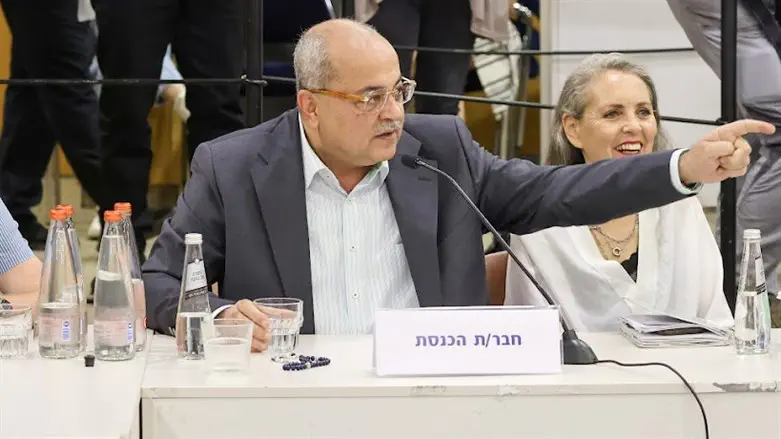
Hadash-Ta’al chairman Ahmed Tibi hints at a series of moves Arab parties could pursue immediately after the election, including an attempt to replace Knesset Speaker Amir Ohana.


Ahmed Tibi
Ahmed Tibi                                                                                                          Knesset TV


Even without an agreement on the formation of a new government, Knesset Member Ahmed Tibi is already pointing to where the first major political battle could take place the day after the election. In an interview with Meet the Press, the Hadash-Ta’al chairman outlined, in part, moves that Arab parties could pursue if opponents of the current government secure a parliamentary majority. At the center of the discussion was the possibility of replacing Knesset Speaker Amir Ohana, along with additional measures Tibi declined to detail at this stage.

“I did not say that I want to be prime minister; the Joint List does not demand that," Tibi said when asked what would happen if, after the election, no majority could be formed to establish a government without the Arab parties. “There are all kinds of things, a range of steps, right after the election, that can change the reality."

“Do you think we will vote for Amir Ohana? We will support the candidate against him, opposite him, for speaker of the Knesset," Tibi said. “You know what the significance is of electing a Knesset speaker right after the election. The story is over. It is total control of the Knesset."

The possibility of the Arab parties recommending a candidate for prime minister to the president also arose during the interview. Tibi suggested that this time, however, Arab parties could go further.

“We united three parties and we reestablished the Joint List. I would have preferred four parties in the Joint List," he said. “But there are two lists: the Joint List and Ra’am. We also united, we also made a surplus agreement, and there is also an increase in the expected voter turnout in Arab society. Today we are at 60% voter turnout."

“Look at what is happening in the oppoition bloc - they’re fighting among themselves. They can’t agree on who will be the prime minister candidate. So the problem is the Jews, not the Arabs. There are polls that say it’s 54, 52, 53, 54 of 60 seats. That means that without a strong Joint List, it’s impossible to change this terrible reality," he said.

Likud quickly seized on Tibi’s remarks, portraying them as evidence that opponents of the government would depend on Arab parties to form an alternative coalition.

“Ahmed Tibi tonight exposed the plan of Eisenkot, Liberman and Yair Golan to establish a left-wing government with the Arab parties and says, ‘Without the Arab parties it’s impossible to replace the government; we will replace the Knesset speaker immediately after the election. A vote for Eisenkot and Liberman puts the keys to the state in the hands of Ahmed Tibi and Mansour Abbas."

Ohana himself also linked Tibi’s comments to the possibility of political cooperation following the election. “MK Tibi is angry because for the first time in many years, he did not get to serve as deputy speaker of the Knesset. Tonight, he revealed his and Eisenkot’s plan for the day after the election: to replace me with a left-wing candidate, on the way to their government together. The Israeli public received more proof tonight that Eisenkot will form a minority government with the support of the Arab parties, if he manages to do so. You have the chance to prevent it."


Israel National News

Source: https://www.israelnationalnews.com/news/433393

Follow Middle East and Terrorism on Twitter

Pentagon releases sixth batch of UFO files - Nicholas Ballasy


by Nicholas Ballasy

The documents include a "military program that commissioned studies of warp drives, wormholes and injuries that researchers linked to possible encounters with unknown craft," CBS News reported.


The Pentagon released another batch of files related to unidentified anomalous phenomena (UAP) or unidentified flying objects (UFOs),

The documents, 71 files in total, include dates from the years 1952 through 2025. The Defense Department provided 67 files and there are 4 from local law enforcement in Colorado. There are redactions in most of the files.

The documents include a "military program that commissioned studies of warp drives, wormholes and injuries that researchers linked to possible encounters with unknown craft," CBS News reported. 


Nicholas Ballasy

Source: https://justthenews.com/government/federal-agencies/pentagon-releases-sixth-batch-ufo-documents

Follow Middle East and Terrorism on Twitter