Thursday, December 29, 2022

Tall Tales: Before George Santos, politicians from Biden to Clinton fibbed about their past - Aaron Kliegman


by Aaron Kliegman

Political history is littered by figures who exaggerated their credentials, or told tall tales about the backgrounds.


Well before Rep.-elect George Santos (R-N.Y.) admitted to fabricating key details of his biography, lying about one's past was a rich political exercise. President Joe Biden got caught boasting about bogus academic credentials, Hillary Clinton made up a sniper attack in Bosnia, and Sen. Elizabeth Warren had to apologize for claiming Native American heritage.

Santos made headlines this week for admitting to the New York Post and WABC radio that he lied on the campaign trail about his education and work experience – specifically about where he attended college and his alleged employment history with high-profile Wall Street firms.

"My sins here are embellishing my resume. I'm sorry," Santos said Monday, confessing he never graduated from any college and "never worked directly" for Goldman Sachs and Citigroup. Santos chalked up his misleading claims to a "poor choice of words."

Santos, the first openly gay non-incumbent Republican elected to the House, has also been accused of lying about his family history and sexual orientation, although he's defended some of those claims from criticism.

Santos has received widespread backlash for his fibs, and a Long Island prosecutor said she intends to investigate whether the soon-to-be-congressman committed any crimes. However, he's hardly alone in padding his resume for political gain.

Here are eight prominent political figures who have done the same:

Joe Biden

Biden is no stranger to embellishing his past accomplishments, stretching the truth if not outright lying on several occasions.

In 1987, for example, then-Sen. Biden claimed in a video filmed by C-SPAN that he ''went to law school on a full academic scholarship – the only one in my class to have a full academic scholarship." Biden also said that he ''ended up in the top half'' of his class and won a prize in an international moot court competition. In college, Biden added, he was ''the outstanding student in the political science department'' and ''graduated with three degrees from college."

Biden later released a statement acknowledging he misstated several of these facts. For example, Biden only received a single B.A. in history and political science and never graduated in the top half of his class in law school.

Thirty-five years later, in May, Biden erroneously stated that he applied to the U.S. Naval Academy.

Beyond academics, Biden has made several other false or misleading claims about his past, such as that he was once arrested in South Africa while trying to see Nelson Mandela. The Washington Post labeled the assertion "ridiculous," and Biden's campaign was forced to concede it never happened.

Hillary Clinton

Two-time failed Democratic presidential candidate Hillary Clinton claimed infamously – and erroneously – in 2008 that she arrived in Bosnia "under sniper fire" and had to run with her head down during a visit there in 1996.

The Washington Post fact checker deemed Clinton's story "simply not credible," describing how "photographs and video of the arrival ceremony, combined with contemporaneous news reports, tell a very different story."

Elizabeth Warren

Warren identified herself as a Native American for almost two decades. In October 2018, Warren released the DNA results showing she had a Native American ancestor six to 10 generations ago. The report showed that if her great-great-great grandmother was Native American, Warren would be 1/32nd Native American, but she could possibly be just 1/1024th if it extends to the 10th generation.

The move, meant to show a connection to a tribe, backfired, outraging Cherokee leaders. In February 2019, Warren apologized for misleadingly calling herself Native American.

Richard Blumenthal

Sen. Richard Blumenthal (D-Conn.) led voters in Connecticut to believe he was a Vietnam veteran when, in fact, he was never deployed to Vietnam.

In 2010, the New York Times revealed that Blumenthal had made misleading statements about his war service since at least 2003, and that the media had reported that he was a Vietnam veteran for at least a decade.

Blumenthal later apologized for lying about his service, saying he regretted claiming he had served "in" Vietnam instead of "during" Vietnam.

Wendy Davis

Wendy Davis, a Democrat who served in the Texas state Senate and ran for governor in 2014, admitted there were inaccuracies in the biography she used to promote her campaign. Davis portrayed her life as a rags-to-riches story from a 19-year-old single mother living in a trailer home to graduating Harvard Law School and serving as a Texas state lawmaker.

However, the Dallas Morning News found several holes in Davis' story. For example, while she lived in a trailer with her daughter and husband until she was divorced at age 20, Davis later got help from her second husband who helped pay for her to attend Texas Christian University and then Harvard.

Gary Miller

Former Rep. Gary Miller (R-Calif.) was another lawmaker to embellish his military service.

Miller said he "served" in the military in 1967, despite never seeing combat or even finishing basic training. He was "honorably discharged" after seven weeks of boot camp.

Mark Kirk

Former Sen. Mark Kirk (R-Ill.) said during the campaign to fill former President Barack Obama's old Senate seat that he won the U.S. Navy Intelligence Officer of the Year Award during the conflict with Serbia in the 1990s. However, Kirk failed to mention the award was not given to an individual but to his entire unit.

"Upon a recent review of my records, I found that an award listed in my official biography was misidentified," Kirk wrote in a blog post. He claimed the award should have been listed as being given to his unit, not himself.

Kirk made a similar misleading statement in 2010, claiming he served "in" Iraq, when he actually was stateside during the Iraq War.

Robert McDonald

Former Veterans Affairs Secretary Robert McDonald, who served in the Obama administration, in 2015 admitted to and apologized for lying about his military record.

McDonald, a U.S. Army veteran, claimed he served in the special forces during his time with the military. However, media reports at the time found he never served in a special operations unit, having instead been assigned to the 82nd Airborne Division.

"I incorrectly stated that I had been in special forces," said McDonald. "That was inaccurate, and I apologize to anyone that was offended by my misstatement."


Aaron Kliegman

Source: https://justthenews.com/accountability/political-ethics/resume-padders-george-santos-these-politicians-lied-about-their

Follow Middle East and Terrorism on Twitter

Bursting the bubble of another PA lie: The Campbell-Bannerman conspiracy - Maurice Hirsch, Adv.


by Maurice Hirsch, Adv.

Prof Dr. Mohsen Mohammad Saleh“In short, I became curious about the issue. In one visit to Britain, I therefore set out to investigate, it but found no trace or source of it!!”

As Palestinian Media Watch has repeatedly exposed, an integral part of the Palestinian Authority’s “narrative” to undermine Israel’s legitimacy is to claim that Jews lack any historical connection to the land of Israel and that the creation of Israel was nothing more than an act of western colonization. To support their historical revision, PA leaders and officials often claim there was a secret plan formulated by British Prime Minister Sir Henry Campbell-Bannerman, to plant “a foreign body in the middle of the people of the Arab nation in order to fragment its solidarity, steal its resources, and prevent its revival.” This according to the PA historical revision is the sole reason for the establishment of the state of Israel. Similar to many other parts of the PA narrative, the claim regarding the Campbell-Bannerman conspiracy is a complete lie lacking any factual or evidentiary basis. In fact, honest Muslim-Arab scholars who have tried to prove this document’s authenticity eventually admitted that no such document exists.

An article written by Prof Dr. Mohsen Mohammad Saleh, who heads the Al-Zaytouna Centre for Studies and Consultations, a Lebanese research institute that “focuses on the Palestinian issue and the conflict with Israel as well as related Palestinian, Arab, Islamic and international developments,” wanted to determine the origins of the so-called “Campbell-Bannerman document”.

Although his goal was to attempt to authenticate the document, Salah was disappointed:

“In short, I became curious about the issue. In one visit to Britain, I therefore set out to investigate, it but found no trace or source of it!!”

[Website of Al-Zaytouna, Political Analysis: Is the “Campbell-Bannerman Document”: Real or Fake?,  Sept. 29, 2017]

In the article, Salah exposes how Dr. Anis Sayegh (who Salah refers to as “one of the leading researchers in modern Palestinian history, and head of the Palestine Liberation Organization (PLO) Research Center between 1966 and 1976”) discovered the origin of the alleged document. According to the account, the document was first referenced after an incidental discussion between an Egyptian named Antoun Canaan (“the first Arab to reference the Campbell-Bannerman document in a published work”) and an unidentified Indian man, sitting next to him on a plane:

In his account, he mentions when he served as chairman of the PLO think tank, that he was keen to reach the “important document,” but could not find a single established source for it in dozens of references and books citing it, including works by reliable writers such as Buhran al-Dajani, Munthir Antabawi, Khairi Hamad, and Shafiq Irshidat. Each of them referenced another in a sort of a circular way.

For this reason, Dr. Anis Sayegh decided to dedicate time to research the document in Britain, spending a whole month in the British National Archives, the British Museum library, and Cambridge University where Campbell-Bannerman had studied and deposited his entire private documents collection. Dr. Sayegh also examined the archives of The Times newspaper covering the period 1904–1907, and found thousands of references to the imperialist colonial conference, but found nothing about the document itself.

After returning empty handed to Beirut, he had the chance to learn that the first Arab to reference the Campbell-Bannerman document in a published work was Antoun Canaan. He went to Egypt where Antoun was living, and met him after some time searching and seeking him out. He was surprised to hear from him that when he travelled from Palestine to London to study law in the mid-1940s, he met in the plane an Indian man sitting next him. The man told him he remembers reading about a colonial conference held in London attended by delegates from several colonial powers to discuss the partition of the Arab nations, prevent their reunification, and the establishment of a Jewish state, but the Indian man did not give Canaan any documented academic material regarding the document.”

[Website of Al-Zaytouna, Political Analysis: Is the “Campbell-Bannerman Document”: Real or Fake?,  Sept. 29, 2017]
While Salah notes “Our failure to secure the document does not prove its non-existence in the same or different form,” he adds, “at the same time we cannot claim something exists, when this is far from being conclusively established.”

Salah concludes the article by equating the alleged Campbell-Bannerman document to the thoroughly discredited “Protocols of the Elders of Zions” and the so-called “promise of Napoléon” in 1798… cited in some Arab and Islamic literature without evidence”:

Thus, the Campbell-Bannerman document is added to the so-called “The Protocols of the Elders of Zions” and the so-called “promise of Napoléon” in 1798, which were also never authenticated, yet are still being cited in some Arab and Islamic literature without evidence.  

[Website of Al-Zaytouna, Political Analysis: Is the “Campbell-Bannerman Document”: Real or Fake?,  Sept. 29, 2017]
The full version of Salah’s article appears below.

While there is clearly no factual or evidential basis to support the existence of the alleged Campbell-Bannerman document, this, in true PA fashion, does not prevent the conspiracy from being repeatedly referenced by the PA and its officials.

In a sermon explaining how the Quran teaches Palestinians to discern their enemies, PA Supreme Shari’ah Judge and Mahmoud Abbas’ Advisor on Religious Affairs and Islamic Relations Mahmoud Al-Habbash, who recently referred to Jews as “grazing herds of humanoids… apes and pigs”, answered the question “How will you know your enemy?” by saying:

“The enemy is the one who trespasses, transgresses, attacks, oppresses, harms, damages… Anyone who does one of these things to us… is an enemy, and we must view him only from this viewpoint… They will spare no effort to attack you in every way and form, and they will ‘extend against you their hands and their tongues with evil.’”

[Official PA TV, Sept. 9, 2022]

Al-Habbash continued:

Who are the ones who ‘extend against you their hands and their tongues with evil,’ and they wish we would abandon our religion, our values, and our principles… who are they?...

Not only those who are imposing the occupation on us directly are enemies. They are enemies, the occupation is an enemy, it has no other name, the occupation is an enemy; but not just the occupation, rather the forefathers of the occupation as well, the founders of the occupation who established it and helped in its establishment more than 100 years ago.

[Official PA TV, Sept. 9, 2022]

Preparing his reference to the Campbell-Bannerman document, Al-Habbash then embellished the incidental story of the unidentified Indian man, into an entire conspiracy about the western counties foreseeing their demise, their replacement by “the civilization to the east and south of the Mediterranean Sea” and their plot to counter that possibility:

“More than 100 years ago, at the start of the 20th century, the colonialist forefathers of the Zionist project convened, the forefathers of the project of ‘Israel,’ which occupies our land and steals our rights. They met and convened and said that their culture – the aggressive imperialist culture of colonialism that is based on materialism, oppression, profit, and cruelty – this civilization, if it can be called that, is about to collapse. And who is the candidate to take its place, to lead the world, and to raise the flag of justice and goodness?

Those who convened, who were prime ministers and ministers of the European colonialist states, and also thinkers, historians, and advisors, they met in London at the start of the 20th century in 1902 or 1903, and said that their culture is about to collapse, and the one who will take its place is the civilization to the east and south of the Mediterranean Sea…

But the oppressive attacking colonialists do not want this. They said: In order to prevent this, we must prevent the progress of this region. We must leave it divided, disintegrated, split, conflicted among itself. We must spread hatred, grudges, and conflicts among them. [We must leave the region] backward, We must prevent the region from progress, the capability of initiative, and the foundations of identity. And more than all of this, we must plant in the heart of this region an isolated entity, a people that is foreign to them and their lands, that will be a friend to us – and they will be the Jews (sic., an abundance of evidence proves Jewish history in Israel). This is what they wanted, they only used the Jews. They used them to realize colonialist desires of expansion, aggression. They and the occupation are two faces, two ugly faces of one coin, two ugly faces of an even uglier coin…

[Official PA TV, Sept. 9, 2022]

Al-Habbas then concluded:

“They are the ones who convened together against us, and then they issued what was known in history as ‘the Balfour Promise’ (i.e., Declaration). They are an enemy. They attacked us, oppressed, stole our rights, gave our well-rooted and permanent rights to those who are not worthy of them, and they deserve none of them… The Quran did not mention Balfour by name, and it did not mention the report- the plot that preceded him, which we noted earlier, and which was known in history as the British Prime Minister [Henry] Campbell-Bannerman plot, or document, or plan. The Quran did not mention the names of these criminals, but it noted their character traits and their descriptions…”

[Official PA TV, Sept. 9, 2022]

This was not the first time Al-Habbash told the invented story, arguing that the goal of implanting the Jews in the Middle East was to leave the residents of the area “divided, backward, and fighting among themselves”:

“More than 100 years ago, a few leaders of the west met in London, in 1905, and discussed the status of Europe, colonialism, and the world. Their conclusion was: Their civilization is about to fall. The culture of the West, the culture of wild capitalism, and the culture of aggression, imperialism, and colonialism, are about to fall. And the [inhabitants of the] area that would inherit its place was the [inhabitants of the] area south and east of the Mediterranean Sea thanks to its advantages of geographic unity, large natural resources, and a unified language and religion, 'and in order to prevent this area from leading the nations, we must leave this area and its residents divided, backward, and fighting among themselves.’”

[Official PA TV, March 15, 2019]

Fatah Revolutionary Council member and regular columnist for the official PA daily, Muwaffaq Matar similarly referred to the alleged conspiracy claiming that the plan was to plant “a pawn on the land of our homeland Palestine as a site of concentration and taking action to prevent the awakening of the Arab nation and its unity”:   

“We in the Palestinian liberation movement are going according to the will and culture of the Palestinian people. We have understood the nature of the fateful ties with our Arab nation and consider its economic, political, and social achievements, power, consolidation, unity, development, and growth and its cultural enlightenment as the strongest component, after our will power, faith, and struggle, in our fight to extract our historical and natural right from the claws of the colonialist states, which decided in the 1905 Campbell[-Bannerman] document to establish a pawn on the land of our homeland Palestine as a site of concentration and taking action to prevent the awakening of the Arab nation and its unity.”

[Official PA daily Al-Hayat Al-Jadida, Nov. 24, 2022]  

Omar Hilmi Al-Ghoul, regular columnist for the official PA daily and former advisor to former PA Prime Minister Salam Fayyad on national affairs has also made repeated references to the alleged conspiracy:

“Zionist fascism is deep-rooted and has existed since the implementation of the Zionist project began in historical Palestine, in other words, more than 100 years ago – dozens of years before the Nazi Holocaust, which has no connection to the results of the Campbell-Bannerman Conference in the years 1905-1907…”

[Official PA daily Al-Hayat Al-Jadida, June 20, 2022]

“It must be emphasized again that the Balfour Promise (i.e., Declaration)… was given for colonialist imperialist reasons that were defined at the 1905-1907 Campbell-Bannerman Conference. This conference consolidated the ideological, colonialist, political, and economic background for establishing a foreign body in the middle of the people of the Arab nation in order to fragment its solidarity, steal its resources, and prevent its revival…

[Official PA daily Al-Hayat Al-Jadida, Nov. 3, 2019]

"The goal of the establishment of the Zionist project and its physical base, the colonialist State of Israel, was to eliminate and erase the Palestinian people from the Arab, regional, and global geopolitics and to leave the Israeli colonialist state that has no historical roots and is foreign to the Arab surroundings and to the Middle East in general. This is an unnatural state with no political and anthropological suitability, which the capitalist West established in order to realize its colonialist goals in the Arab homeland according to the decision of the Campbell-Bannerman Conference, which was strengthened by the ominous Balfour Promise and its historical progress and development.”

[Official PA daily Al-Hayat Al-Jadida, July 13, 2019]

PA TV also interviewed an Egyptologist who also explained how, as part of the Campbell-Bannerman conspiracy theory, Britain planted Jews in Middle East to divide Arabs:

Egyptologist Dr. Wasim Al-Sisi: In 1907, the prime minister of England was a man named Sir Henry Campbell-Banner… He gathered delegations of European states, and said: “There is a very wealthy, fertile, and uneducated region and it is the Middle East region. The most important state is Egypt because of the richness of its civilization. This region, if it develops, they will strangle us [Europe]... We want an entity… that we will plant in this region. Its role is to break them up [the Arab states]. It will not give them the opportunity to align. For if they align and unite, we will be lost. In return for this, we will help this entity and strengthen it, as it is a part of us.”


[Official PA TV, From Cairo, Oct. 8, 2018]

It should be noted, that British Prime Minister Sir Henry Campbell-Bannerman did lead an Imperial Conference, the minutes of which disprove claims of a conspiracy theory to undermine the Middle East.

The following is the full text of the article written by Salah:


The Campbell-Bannerman document has been used as reference by dozens of researchers in the Arab world, since the mid-twentieth century. They consider it a starting point for understanding the background of the emergence of the Jewish Zionist project in Palestine as pursued by the Western imperialist powers. However, the document has “mysterious” origins, and its authenticity has not been verified academically and reliably.

In the past months, I followed, on many levels, the debate surrounding the document. A video spread widely, in Arabic, on social media warning about the content of the document and its dangerous implications.

The “alleged” document states - according to the first part of the Malaf Watha’iq Felastin (Palestine Documents Dossier) published by the Ministry of Culture and National Guidance in Egypt in 1969 (under Gamal Abdel Nasser), p.121 - that a secret “colonial conference” was held in London in 1905-1907, at the initiative of the British Conservative Party. It was attended by prominent historians, sociologists, geographers, agricultural scientists, petroleum experts, and economists. The supposed conference allegedly made a series of recommendations in 1907 to then British Prime Minister Henry Campbell-Bannerman, emphasizing the following:

“Establishing a strong alien human barrier in the land bridge linking Europe to the old world, and both to the Mediterranean, to form - in the region near the Suez Canal - a force hostile to the peoples of the region and friendly to European countries and their interests, is the practical and immediate implementation of the proposed methods and approaches.”

According to the alleged document, this means that “Western experts” see the establishment of an alien entity, namely the subsequent Israel, in the Eastern Mediterranean (especially in Palestine) a way to create a forward base to protect Western interests, weaken the region, and prevent its reunification. Several researchers argued that whether or not the document is fake, this is what has happened in reality.

The author, like other researchers, have encountered this document in otherwise respectable Arab sources and references, used by renowned writers known for their accuracy, and in the Palestine Documents Dossier published by an official Egyptian body supposed to pursue a high level of academic scrutiny. As a result, the author has used this document in his writings and lectures, before becoming aware of the problems it raises.

Around 14 years ago, I met with Munir Shafiq, who urged me to verify the document from original British sources, especially after he learned of my specialization focusing on such documents, with my PhD dissertation relying primarily on unpublished British documents kept in the British National Archives, previously the Public Record Office, which I continued to consult from time to time for my academic work.

Dr. Anis Sayegh, one of the leading researchers in modern Palestinian history, and head of the Palestine Liberation Organization (PLO) Research Center between 1966 and 1976, also drew my attention to the document. He told me of his own experience researching the document and his doubts about its authenticity.

In short, I became curious about the issue. In one visit to Britain, I therefore set out to investigate, it but found no trace or source of it!!

What raised doubts further is that the Palestine Documents Dossier—and other sources - did not provide citations for the document, which has no entry in the British archives, with a date, serial number, and classification under the Foreign Office, Colonial Office, War Office, or the Prime Minister’s Office files (PREM), etc.

Dr. Anis Sayegh’s story with this document is both interesting and bitter. He summarized it in his Arabic memoirs Anis Sayegh on Anis Sayegh, pages 279-281. In his account, he mentions when he served as chairman of the PLO think tank, that he was keen to reach the “important document,” but could not find a single established source for it in dozens of references and books citing it, including works by reliable writers such as Buhran al-Dajani, Munthir Antabawi, Khairi Hamad, and Shafiq Irshidat. Each of them referenced another in a sort of a circular way.

For this reason, Dr. Anis Sayegh decided to dedicate time to research the document in Britain, spending a whole month in the British National Archives, the British Museum library, and Cambridge University where Campbell-Bannerman had studied and deposited his entire private documents collection. Dr. Sayegh also examined the archives of The Times newspaper covering the period 1904–1907, and found thousands of references to the imperialist colonial conference, but found nothing about the document itself.

After returning empty handed to Beirut, he had the chance to learn that the first Arab to reference the Campbell-Bannerman document in a published work was Antoun Canaan. He went to Egypt where Antoun was living, and met him after some time searching and seeking him out. He was surprised to hear from him that when he travelled from Palestine to London to study law in the mid-1940s, he met in the plane an Indian man sitting next him. The man told him he remembers reading about a colonial conference held in London attended by delegates from several colonial powers to discuss the partition of the Arab nations, prevent their reunification, and the establishment of a Jewish state, but the Indian man did not give Canaan any documented academic material regarding the document.

Thus, Dr. Sayegh returned frustrated. Neither the Indian man nor Canaan had examined the original document, and had any academic citation for it. Dr. Sayegh thus decided to bar anymore referencing or quoting of it in studies published by the Palestinian Research Center. As for me, I also decided to do the same, after not having found any evidence authenticating it.

After this overview, we may highlight some remarks and points as follows:

1. The convening of imperialist colonial conferences in that period was a fact. British documents include hundreds of dossiers and entries about them. However, the text of the so-called Campbell-Bannerman document does not exist in those documents.

2. Our failure to secure the document does not prove its non-existence in the same or different form. However, at the same time we cannot claim something exists, when this is far from being conclusively established.

3. The fact that we don’t have the document in our hands denies us the ability - academically speaking - to use it as a reference, especially given its sensitivity and serious implications. Furthermore, the results Dr. Sayegh reached after his extensive research cast serious doubt on its authenticity.

4. According to the research of the author of this article in the British archives for many years, and based on his inquiries to the archivists there, British documents are usually divided into categories:

• Archives to be published: Most of these documents are published after thirty years, with some may be delayed to fifty, seventy five, or even one hundred years.

• Archives preserved without being published.

• Archives that are destroyed.

This means that there is a careful process of prior scrutiny of documents in the archives in which the higher interests of the state and its sensitive secrets are taken into account, as well as the implications of publishing such documents on states, institutions, and individuals, and on enemies and allies. This could allow us to reach the conclusion that some documents may be destroyed if they are seen as prejudicing state high interests or providing damning evidence against it.

5. The British colonialism and colonial powers are generally intelligent, experienced, and careful enough to keep such documents, should they exist, away from researchers because of the damning evidence they contain against their “plotting” as colonial powers. In some cases, instructions regarding this issue may remain verbal and not written in documented texts, or are barred from publication and circulation, a procedure many governments in the present day observe.

6. The course of events on the ground may corroborate the substance of the Campbell-Bannerman document, though it is insufficient to establish its authenticity from an academic point of view. The Balfour Declaration was issued in 1917 after all, and Britain insisted to directly sponsor the growth of the Zionist project in Palestine and the establishment of a Jewish state there. Thus repressing the will of the Palestinian people and their uprisings for 30 years (1917–1948) until the military, political, economic, social and administrative infrastructure of a “Jewish state” was complete.

In 1948, Israel was established in the heart of the Arab and Muslim world. The survival and prosperity of this state, at least from a practical point of view, is linked to the weakness, division, and backwardness of its surroundings. Indeed, projects for genuine unification and revival expressing the will of the peoples of the region and the entire nation are inherently hostile and an existential threat to Israel, which—in the point of view of the people of the area—usurped the “heart” of the Arab and Muslim nation (Palestine) and dispossessed its people.

7. There are documents and writings whose substance corroborate that of the alleged Campbell-Bannerman document. When the founder of the Zionist movement Theodore Herzl met with then British Colonial Secretary Joseph Chamberlain in 1902, Herzl told him the Zionist base in Palestine would be a buffer state, securing British interests. In other words, the Zionist movement understood well that its project could never be successful without the sponsorship and protection of a major power, and had to act in the context of the interests of such a major power.

In the First World War, writings emerged by non-Jewish British figures such as Charles Prestwich Scott, editor of the Manchester Guardian, and Herbert Sidebotham, a prolific writer, calling for the creation of a buffer state in Palestine and claiming the only group suitable for the purpose were the Jewish people.

Generally speaking, the strategic factor was a major cause in the minds of those behind the Balfour Declaration (the Jewish state as a buffer state, forward base, and a communication and transit point…). We may find such strategic references in remarks by Prime Minister David Lloyd George and Lord Curzon, who succeeded Balfour in his post, and others.

Furthermore, Herbert Samuel, the Zionist Jewish minister in the British government headed by Herbert Asquith submitted a secret memo to the cabinet in January 1915, calling for the occupation of Palestine and opening the door to Jewish migration and settlement so that Jews may become a majority there, highlighting the strategic advantages of seizing Palestine.

8. Finally, the Campbell-Bannerman document cannot be cited academically nor journalistically until firm evidence is found of its authenticity, given the implications for credibility and objectivity for using it. Indeed, this would allow those who are against the Palestinian cause to discredit, undermine, mock, and damage the other strong evidence and arguments of pro-Palestine researchers, in a way that far outweighs any benefits from citing the document with good intentions. Particularly so, when there is a large corpus of genuine documents and actual colonial practices on the ground, that expose the extent of colonial support for the Zionist project, and colonial attempts to head off unification and revival projects in the region.

Thus, the Campbell-Bannerman document is added to the so-called “The Protocols of the Elders of Zions” and the so-called “promise of Napoléon” in 1798, which were also never authenticated, yet are still being cited in some Arab and Islamic literature without evidence. The criteria for credibility and objectivity, verification, authentication, and the balances of skepticism and adjustment, for which the Muslims were famous in their history, remain the best “capital” in dealing with such information or documents.

[Website of Al-Zaytouna, Political Analysis: Is the “Campbell-Bannerman Document”: Real or Fake?,  Sept. 29, 2017]

Maurice Hirsch, Adv.

Source: https://palwatch.org/page/32462

Follow Middle East and Terrorism on Twitter

Twitter users applaud, fume as Musk declares Twitter will 'follow the science,' promote 'questioning' - Alexander Hall


by Alexander Hall

Twitter CEO Elon Musk declared that same day that Twitter workers previously had an internal ‘Fauci Fan Club.’


Current Twitter CEO Elon Musk declared that Twitter will promote "reasoned" skepticism of scientific data.

"New Twitter policy is to follow the science, which necessarily includes reasoned questioning of the science," Musk wrote.


Many Twitter users rallied and suggested that the policy promoted actual pursuit of scientific truth.

Evolutionary Behavioral Scientist Gad Saad appeared to sarcastically joke about the dogmatic way scientific experts were treated amid the COVID-19 pandemic. 

Elon Musk's Twitter profile displayed on a phone screen and Twitter logo displayed on a screen are seen in this illustration photo taken in Krakow, Poland on Sept. 15, 2022.

Elon Musk's Twitter profile displayed on a phone screen and Twitter logo displayed on a screen are seen in this illustration photo taken in Krakow, Poland on Sept. 15, 2022.  (Jakub Porzycki/NurPhoto via Getty Images)

I DEPOSED DR. FAUCI FOR SEVEN HOURS. HERE'S WHAT I LEARNED ABOUT ‘SCIENCE’ 

"The science is anything that His Eminence Lord Fauci says it is," Saad quipped. "His Excellency is science."

Musk responded by observing, "Anyone who says that questioning them is questioning science itself cannot be regarded as a scientist."

Judicial Watch president Tom Fitton tweeted, "Bad news for transgender extremism, covid totalitarians, and climate alarmists."


Journalist David Martosko called upon followers to recognize Musk's announcement has massive implications. 

"Isn't it remarkable that this is a departure from what we've seen for many years?" he asked. "I hope it also means it will be acceptable to examine who's funding science and what kind of restrictions that places is on scientists."

Mathematical physicist, economist, and the managing director of Thiel Capital, Eric Weinstein expressed hope that the change could be a major shift across a variety of subjects.

"This. Changes. Everything. If true," he wrote. "Is that a 1000% commitment to biologists that they can stop *lying* about biological sex, healthy reproductive development, ‘herd immunity’, genetic differences between geographically separated populations, horse paste, Wuhan Inst. GoF, etc.?"

Twitter Headquarters building in San Francisco.

Twitter Headquarters building in San Francisco.

RAND PAUL VOWS GOP ‘NOT DONE’ WITH FAUCI ON COVID ORIGINS: ‘HE’S BEEN LYING FROM THE BEGINNING' 

NASA Earth Cartography and Data Visualization lead Joshua Stevens tweeted, "This is fair and reasonable. And if any scientist tells you otherwise, never let them wax poetic about curiosity and wonder ever again."


Some Twitter users appeared to condemn Musk’s statement.

New York Times contributor Wajahat Ali tweeted that Musk’s post was, "Something a really dumb person would tweet."


Journalist Ashton Pittman tweeted, "By ‘reasoned questioning,’ Elon Musk means batsh*t clown car conspiracy theorist drivel."

Elon’s post appeared to be a veiled criticism of dogmatism amid the COVID-19 pandemic, especially toward National Institute of Allergy and Infectious Diseases head Dr. Anthony Fauci.

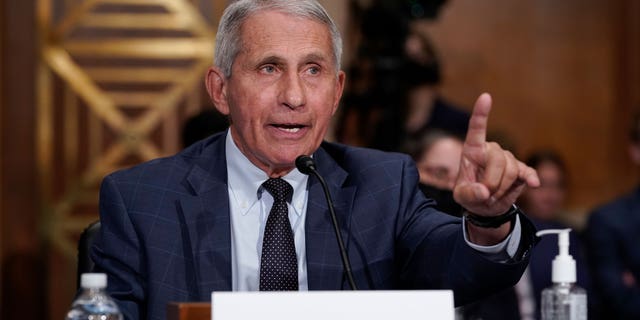
Anthony Fauci, director of the National Institute of Allergy and Infectious Diseases, admitted that the COVID-19 lockdowns were "draconian" but necessary. He said he wants to use his experience to inspire a younger generation od scientists.

Anthony Fauci, director of the National Institute of Allergy and Infectious Diseases, admitted that the COVID-19 lockdowns were "draconian" but necessary. He said he wants to use his experience to inspire a younger generation od scientists.  (Getty Images)

CLICK HERE TO GET THE FOX NEWS APP

That same day, Musk announced that the Twitter platform's staff previously "had an internal Slack channel unironically called ‘Fauci Fan Club.’" This comes amid an ongoing series of "Twitter Files" showing the public the inner workings of Twitter before Musk acquired the platform.

Musk also tweeted a statement that put Fauci's institutional accountability in question.

"Almost no one seems to realize that the head of bioethics at NIH – the person who is supposed to make sure that Fauci behaves ethically – is his

wife," Musk wrote.

Earlier in December, Musk appeared to joke, "My pronouns are Prosecute/Fauci."


Alexander Hall is an associate editor for Fox News Digital. Story tips can be sent to Alexander.hall@fox.com.

Source: https://www.foxnews.com/media/twitter-users-applaud-fume-musk-declares-twitter-follow-science-allow-questioning

Follow Middle East and Terrorism on Twitter

How to Solve Big Tech Censorship: Un-Misread a Landmark Case - John Kline


by John Kline

It's a problem with a complex history

  • Republicans' first order of business this coming 118th Congress must be to introduce a legislative firewall between the White House — and its offshoot federal law enforcement agencies such as the Department of Justice and its offshoot, the FBI — and private social media companies.

  • The dissemination of news and the facilitation of public discourse is central in any democracy that allows genuine participation on the part of its citizens. Open public dialogue is a "public good", or something which, like clean air, benefits everyone equally and greatly.

  • Providers of public goods are generally regulated under common carriage laws. The Communications Act of 1934, for instance, allowed AT&T to enjoy monopolistic power over the public good it provided: the interconnecting of the American people by way of a unified, national standard for telephone communication.

  • In exchange for enjoying monopoly power, and to ensure that public goods truly remain beneficial to the public, special duties or restraints are generally imposed on such companies.

  • With companies such as Compuserve and AOL in mind, Congress sought to hand out special liability relief with the idea of promoting two public goods: an internet characterized by a wide dissemination and diversity of ideas; and an incentive system for platforms to create family-friendly environments.

  • Unfortunately, in the ensuing case law that has been built up in dealing with Section 230 of the 1996 Communications Decency Act, two giant, related problems have emerged, both involving a misreading of a landmark court decision: Zeran v. AOL.

  • The first problem is that what Congress intended when it comes to protecting social media companies from liability tied to defamatory messages posted on their platforms has been greatly expanded and now encompasses virtually any and all decisions regarding "content moderation", such as removing the accounts of epidemiologists with whom Dr. Anthony Fauci, the FBI, CIA, and possibly other federal agencies, might disagree.

  • The second problem is that the "good faith" condition Congress imposed on these companies to ensure against arbitrary or biased content-removal decisions has been completely erased. It is now never applied to social media companies at all.

  • Both problems can be traced to a misunderstanding and incomplete reading of Zeran v. AOL.

  • As a result, as Michigan State University law professor and former Commerce Department telecom official Adam Candeub writes, "social media platforms are now treated like they're above the law."

  • Thankfully, this can be easily changed, even at the regulatory level. Non-discrimination policies need not create a "wild west" scenario. To a large extent, people really do not need moderators to curate what they see on social media. They are free to do that themselves.

  • Removing the distortive "curators", editors, "fact-checkers" and middlemen from the information process -- and reaching people who previously have been sheltered from diverse opinions -- will likely not tear people apart. It might even help to bridge misunderstandings and fill in a few gaps. That, perhaps, is the ultimate public good.

The ongoing 'Twitter Files' revelations show that Republicans' first order of business this coming 118th Congress must be to introduce a legislative firewall between the White House — and its offshoot federal law enforcement agencies such as the Department of Justice and its offshoot, the FBI — and private social media companies. Last summer's revelations of government pressuring social media executives into blocking users not toeing the official line on COVID was as clear an example of unconstitutional "state action" as any. Courts have long ruled the government cannot pressure private entities, as an "agent of government," into censoring what itself cannot.

Facebook's Mark Zuckerberg disclosed to Joe Rogan in August 2022 that the FBI had warned him in October 2020 not to post information about what appeared to be Hunter Biden's laptop. As he stated at the time:

"The background here is that the FBI came to us - some folks on our team - and was like 'hey, just so you know, you should be on high alert. We thought there was a lot of Russian propaganda in the 2016 election, we have it on notice that basically there's about to be some kind of dump that's similar to that.'"

Zuckerberg further said the FBI did not come to Facebook about the Biden laptop story, specifically only that his team thought the story " fit that pattern."

Then came the recent revelation about Twitter's now-former head of "trust and safety," Yoel Roth, getting the exact same FBI treatment regarding the same story. As he stated in a declaration in response to a lawsuit filed by the Tea Party Patriots Foundation against Twitter:

"I was told in these meetings that the intelligence community expected that individuals associated with political campaigns would be subject to hacking attacks and that material obtained through those hacking attacks would likely be disseminated over social media platforms, including Twitter."

This included, Roth stated, "rumors that a hack-and-leak operation would involve Hunter Biden."

Yet courts on COVID-related state-action claims, at least, have greatly disappointed when it comes to reining in the state's attempts to control online behavior. Despite numerous White House and federal agency statements directed at social media platforms on the issue, including threats, three cases have seen such claims dismissed (including one brought by journalist and author Alex Berenson) and only one has been granted discovery requiring the Biden administration to turnover any records of communications with such platforms (the case brought by Missouri and Louisiana). Clearly, free, public dialogue is too important to be left in the hands of the judicial system.

The dissemination of news and the facilitation of public discourse is central in any democracy that allows genuine participation on the part of its citizens. Chinese protesters expressing their anger against strict speech controls in China by holding up blank pieces of paper is certainly a poignant illustration of this.

An older one closer to home is America's second Congress in 1792 deciding to subsidize the postage of newspapers and other information sources; a practice that persists to some degree today, seen, for instance, in the mailers Congress sends out to its constituents. Although the term was not around at the time, Congress clearly recognized that open public dialogue was a "public good", or something which, like clean air, benefits everyone equally and greatly.

Common Carriers

Providers of public goods are generally regulated under common carriage laws. The Communications Act of 1934, for instance, allowed AT&T to enjoy monopolistic power over the public good it provided: the interconnecting of the American people by way of a unified, national standard for telephone communication.

In exchange for enjoying monopoly power, and to ensure that public goods truly remain beneficial to the public, special duties or restraints are generally imposed on such companies. For instance, before a national telephone network was created, Americans needed separate phones to contact friends and family if they used different carriers (AT&T was easily the dominant player, so it had the biggest network). In exchange for the DOJ dropping antitrust claims against AT&T, the company agreed to allow smaller companies to join its network, thus creating a universal line of communication for citizens across the country — again, all for the public good.

As Michigan State University law professor and former Commerce Department telecom official Adam Candeub has written, this is the kind of "carrot" and "stick" bargain at the heart of common carriage law. A powerful monopoly status can be conferred where a public good is beneficial enough, but to ensure that such status is not abused (and the public good stays a public good), some sort of duty or restraint must be established.

Unfortunately, Candeub notes, for other dominant telecommunications companies, such as social media platforms and search engines today, "it is all carrot and no stick." Companies such as Facebook and Google are allowed complete monopoly power to provide what are undoubted (though diminishing) public goods, but with zero restraints or obligations on their part.

Section 230

Way back in 1996, Congress came up with an amendment to the 1934 Communications Act to deal with the then-burgeoning industry of "interactive computer services", at the time, mostly message boards.

With companies such as Compuserve and AOL in mind, Congress sought to hand out special liability relief with the idea of promoting two public goods: an internet characterized by a wide dissemination and diversity of ideas; and an incentive system for platforms to create family-friendly environments.

The amendment they came up with, Section 230 of the 1996 Communications Decency Act, has two key sub-sections. Section 230(a)(1), relieves internet platforms of liability for statements made specifically by third parties. This entails giving companies such as Facebook relief from liability for a defamatory post or other unlawful content made by one of its users. While relevant when it comes to what conservatives criticize most— the politicized removals of messages and whole accounts — it is the next subsection that is most important.

Section 230(c)(a)(2) immunizes a platforms' own efforts to discriminate against certain content. As it says, it allows them to:

"restrict access to or availability of material that the provider or user considers to be obscene, lewd, lascivious, filthy, excessively violent, harassing, or otherwise objectionable, whether or not such material is constitutionally protected."

In doing so, however, it does mandate one qualification: In order to "restrict access" or remove material deemed "obscene", and so on, platforms have to act in "good faith." In other words, Congress here created a "Good Samaritan" clause intended to incentivize positive, pro-social behavior.

Unfortunately, in the ensuing case law that has been built up in dealing with Section 230, two giant problems have emerged, both involving a misreading of a landmark court decision, Zeran v. AOL.

The first problem is that what Congress intended when it comes to protecting social media companies from liability tied to defamatory messages posted on their platforms has been greatly expanded and now encompasses virtually any and all decisions regarding "content moderation", such as removing the accounts of epidemiologists with whom Dr. Anthony Fauci, the FBI, CIA, and possibly other federal agencies, might disagree.

The second problem is that the "good faith" condition Congress imposed on these companies to ensure against arbitrary or biased content-removal decisions has been completely erased. It is now never applied to social media companies at all.

Both problems can be traced to a misunderstanding and incomplete reading of Zeran v. AOL.

Zeran v. AOL

The landmark 1997 case of Zeran v. AOL involved a claim over AOL's refusal to remove a defamatory statement on one of its bulletin boards, specifically that the plaintiff was supposedly selling T-shirts making fun of the 1995 Oklahoma City bombing. While clearly defamatory to the extent it was simply made up, in finding for AOL, the court actually appeared to rule more broadly than necessary.

In its widely-quoted ruling, the court stated in part that all lawsuits are "barred" where they

"seek to hold a service provider liable for its exercise of a publisher's traditional editorial functions—such as deciding whether to publish, withdraw, postpone or alter content..." (author's emphasis).

But this would seem to apply to more than third-party defamatory content and include a platform's full panoply of functions such as removing user-accounts or blocking content its own moderators simply do not like.

The problem is the court did not quite do this.

According to Candeub, what later judges have consistently left out in applying Zeran is the line preceding the above quotation. In it, the court expressly limits the 'barring of lawsuits' only in relation to editorial decisions regarding "third party content." As they wrote in the preceding line:

"section 230 creates a federal immunity to any cause of action that would make service providers liable for information originating with a third-party user of the service." (Author's emphasis).

Contrary to what courts have said, writes Candeub, Zeran does not actually provide blanket protection to a platform from its own speech and behavior. And yet, due to a misquote, below, numerous courts have acted as if it does.

An example of Zeran's misapplication took place in a case involving Yelp!, where the company was sued for allegedly manipulating its review pages, specifically by removing some listings, changing their order of appearance, and so on. The court -- incorrectly -- found that Yelp! was immunized under sub-section 230(c)(1), specifically quoting (or misquoting) the above language from Zeran: "'barring of lawsuits' only in relation to editorial decisions regarding 'third party content.'" But Yelp!'s impugned action did not relate to any content or statements from a third-party's post; it related directly and completely to its own internal, proactive changes.

Again, companies such as Yelp! can, under Section 230, make their very own editorial changes and removal decisions, but only under sub-section (c)(2) which contains the "good faith" standard mentioned above. This, however, was not addressed by the Yelp! court and it did not consider the motives behind the alterations. Instead, it conflated sub-section (c)(2) removal decisions with sub-section (1)(c)'s blanket liability relief for third-party statements. In other words, both here and since, subsection (c)(2) has been rendered pointless. As a result, writes Candeub, "social media platforms are now treated like they're above the law."

Thankfully, this can be easily changed, even at the regulatory level.

In 2015, the Federal Communications Commission (FCC) inserted major internet service providers into its definition of a common carrier; a definition that entails a non-discrimination requirement designed to keep companies from blocking service to non-partner companies — for instance, if Comcast, say, were to block service to a video-streaming competitor Netflix. On its own or in response to judicial action, the FCC can simply include social media platforms and search engines into this same definition. As Candeub writes:

"the question of whether one is discriminatorily terminated from a [social media] network is not a deep technical issue... Rather, it is akin to the discrimination question in civil rights and employment law that courts routinely answer."

With some adjustment, this could be made to strip these companies of their right to exclude and discriminate against users and material (outside of genuinely "obscene" posts such as those containing pornography) and, more broadly, distort the public dialogue. For instance, genuine questions raised by COVID-management critics such as Berenson or signatories of the Great Barrington Declaration could be made available to the public instead of suppressed by authorities such as the National Institutes of Health.

Meanwhile, enforcement could come via the FCC in response to user complaints or by courts through civil litigation.

As for demonstrating racial, religious or political-opinion discrimination (either right or left) on social media, it could be done by showing, for instance, that platforms are allowing one such group to say or do things which an analogous group cannot.

More easily, a complaint might demonstrate it by pointing to explicitly discriminatory policies on the part of such companies. In 2020, for instance, Facebook began policing anti-black speech more heavily than anti-white speech.

Non-discrimination policies need not create a "wild west" scenario. To a large extent, people really do not need moderators to curate what they see on social media. They are free to do that themselves.

Companies including Facebook should welcome such a requirement: it would make the kind of "state action"-based censorship from the White House or any federal agency something they would be legally prohibited from entertaining.

The same applies to Elon Musk, who has so far kowtowed to groups such as the Anti-Defamation League and the federal government possibly out of concern that they and others would pressure advertisers to cut ties with Twitter. If Twitter were actually prohibited from applying disparate censorious treatment against, for instance, "MAGA Republicans", Musk could simply tell the ADL and advertisers that being covered by the FCC's common carriage definition means he cannot pick and choose particular political viewpoints . "Look," he might respond, "I am legally required to keep the public dialogue on my platform free and open."

Keeping people exposed to opposing views would seem essential in curbing the three interrelated evils infecting our politics today: echo chambers, polarization, and the death of debate. If actually given the opportunity to hear and understand the other side on an unfiltered, non-skewed basis, many, if not most, people can at least glance at opposing views -- or at least make the conscious and childish decision to block opinions with which they disagree.

Removing the distortive "curators", editors, "fact-checkers" and middlemen from the information process -- and reaching people who previously have been sheltered from diverse opinions -- will likely not tear people apart. It might even help to bridge misunderstandings and fill in a few gaps. That, perhaps, is the ultimate public good.

 
John Kline, an attorney, also contributes to Heterodox Academy Blog, American Spectator, Chronicles, American Greatness, and LewRockwell.com, among others. (Follow John Kline on Twitter)

Source: https://www.gatestoneinstitute.org/19261/big-tech-censorship

Follow Middle East and Terrorism on Twitter