by Majid Rafizadeh
What distinguishes Trump's position is not rhetoric, but resolve. For years, Western leaders have issued statements of "concern" while avoiding any action that might inconvenience their diplomatic calculations or economic interests. President Trump broke from that spinelessness.
President Donald J. Trump has emerged as the first leader to stand decisively, openly, and courageously with the Iranian people themselves — against the dictatorship, against repression, and in favor of genuine freedom, democracy and peace.
What distinguishes Trump's position is not rhetoric, but resolve. For years, Western leaders have issued statements of "concern" while avoiding any action that might inconvenience their diplomatic calculations or economic interests. President Trump broke from that spinelessness.
More importantly, Trump sent a direct warning to the Iranian regime: if it continues to kill innocent protesters, he will "rescue" them: the United States will not stand idly by. This is the opposite of a call for war; it is deterrence in the service of peace -- a warning designed to prevent bloodshed, signaling to all violent regimes that massacres will not be tolerated or ignored.
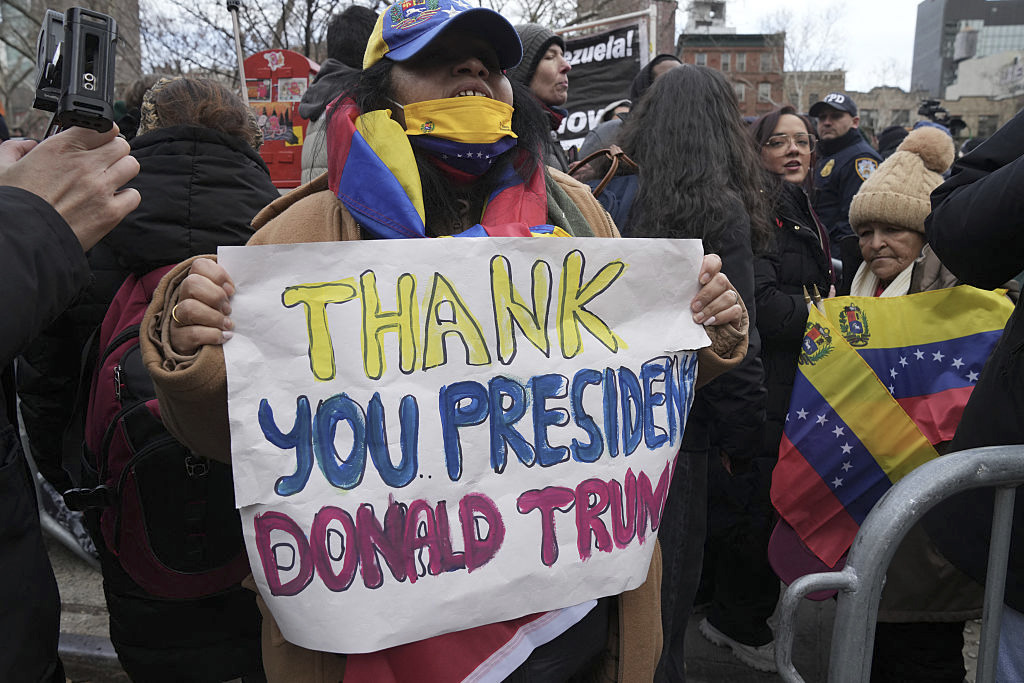
Thank you, President Trump, for standing with the oppressed, for choosing people over tyrants, and for reminding the world that peace is not achieved by silence in the face of evil, but by courage in defense of individual freedom. May the Iranian, Venezuelan, Gazan and Cuban people -- and others held hostage by cutthroat leaders -- achieve their long-denied dream of freedom, democracy, and peace. God bless you, President Trump.
Over the past decade, the Iranian people have turned out again and again against one of the most entrenched and brutal dictatorships in the modern world. From students and workers to women, minorities, and the urban poor, Iranians have poured into the streets demanding dignity, freedom, and a government that represents them rather than ruling them through fear.
These uprisings have been nationwide, sustained and extraordinarily courageous, often carried out in the face of live ammunition, mass arrests, torture and executions. Yet despite the clarity of the Iranian people's demands and the scale of the regime's violence, no European country, no self-described democratic power, and no U.S. administration claiming to champion freedom and human rights has ever stood with them in a meaningful way -- until now.
President Donald J. Trump has emerged as the first leader to stand decisively, openly, and courageously with the Iranian people themselves — against the dictatorship, against repression, and in favor of genuine freedom, democracy and peace.
What distinguishes Trump's position is not rhetoric, but resolve. For years, Western leaders have issued statements of "concern" while avoiding any action that might inconvenience their diplomatic calculations or economic interests. Trump broke from that spinelessness. He made it unmistakably clear that in Iran, the United States stands with the oppressed Iranian people, not with the ruling clerics who have hijacked the country.
More importantly, Trump sent a direct warning to the Iranian regime: if it continues to kill innocent protesters, he will "rescue" them: the United States will not stand idly by. This is the opposite of a call for war; it is deterrence in the service of peace -- a warning designed to prevent bloodshed, signaling to all violent regimes that massacres will not be tolerated or ignored.
This posture represents a moral clarity long absent from international politics. In theory, the United Nations exists explicitly to prevent mass atrocities of civilians through principles such as the "Responsibility to Protect." In practice, the UN has repeatedly failed. When thousands of civilians in Iran and Venezuela were murdered in confrontations with repressive regimes, and thousands of civilians in Ukraine and Israel killed by hostile foreign powers, the international response amounted to little more than press releases and closed-door meetings. No protection was offered, no accountability imposed, and no deterrence established. Trump, by contrast, has stepped into the vacuum left by international institutions. By warning regimes directly, he assumed the role that the global community has refused to play: defending civilians against states that wage war on their own population.
Previous U.S. administrations, during earlier nationwide protests, particularly under the Obama administration, when Iranians desperately looked to the United States for moral leadership, many Iranians openly asked whether President Barack Obama stood with them or with the ruling clerics. The response they received was silence. The administration's priority at the time was negotiating a bogus nuclear agreement and lifting sanctions to enable Iran's nuclear build-up, even if that meant overlooking the bloodshed in Iran's streets. Human rights were subordinated to diplomacy, and the Iranian people were treated as an inconvenience rather than as central actors in their own struggle for freedom. European governments, eager to preserve trade ties and economic engagement while turning a blind eye to repression, followed a similar path. The message to Iranians was that commercial interests mattered more than their lives.
Trump reversed that message. He did not wait weeks or months, or balance his words to appease Iran's regime. He stood immediately and unambiguously with the Iranian people from the very first days of unrest. Speed matters. For protesters risking everything, early international support means the difference between hope and despair. No leader in recent history has responded so directly or forcefully to the Iranian people. For the first time, they heard a powerful voice from the outside saying, clearly and without ambiguity: you are not alone.
Now, if Europe and other Western democracies truly believe in freedom, human rights, and the rule of law, they need to prove it when it is costly, not only when it is convenient. Issuing generic statements while maintaining business as usual with Tehran exposes the most repulsive hypocrisy. The Iranian people see this clearly. European governments need to decide whether they will stand with a people demanding freedom or continue prioritizing trade deals with a regime that survives through torture, repression and mass-executions.
The Iranian regime's survival strategy is brutally consistent. Whenever protests erupt, it responds with overwhelming force. Security services fire on crowds, conduct mass arrests, extract forced confessions, and use torture to instill fear. The year 2025 saw the hangings of more than 1,500 Iranians. The objective is not merely to suppress a particular protest, but to crush the very idea of resistance. That is why words alone are insufficient. A credible deterrent is essential. A clear military warning -- with follow-through -- that mass killings will trigger consequences, can save lives by forcing the regime to reconsider the cost of violence. Such a warning does not escalate conflict; it restrains it by telling regimes that there is a line they cannot cross.
Equally refreshing is Trump's response to communications. One of any brutal regime's most effective tools is its ability to shut down the internet during moments of unrest. By cutting their citizens off from one another and from the outside world, these regimes create an environment in which abuses can occur unseen and unchallenged. Access to the internet in moments like these is a lifeline. It allows protesters to organize, to document atrocities, and to alert the world in real time. Any serious commitment to freedom must include concrete efforts to keep communication channels open.
Supporting democratic change in Iran, Venezuela and elsewhere is a strategic necessity for the West. Many current regimes that pose as friends but are secretly hostile to Western interests -- such as Qatar, Turkey and Pakistan -- actively support terrorists, undermine regional stability, and quietly align themselves with other authoritarian powers against democratic nations. A free and representative Iran, Venezuela, Cuba and Gaza would serve as stabilizing forces in the Middle East, the Western Hemisphere and beyond. Helping people there achieve the governments they seek is an investment in long-term peace and security, not a risk to it.
Trump's stance toward the Iranian and Venezuelan people reveals great leadership in moments of moral clarity. By standing openly with those demanding freedom, by warning violent regimes against killing their own citizens, and by refusing to hide behind empty diplomatic language, he is demonstrating the courage that everyone else lacked. This is what it means to be a true advocate of peace — not one who merely speaks about it, but one who acts to prevent injustice and bloodshed. For that, the Iranian and Venezuelan people have been heard: history will take note.
Thank you, President Trump, for standing with the oppressed, for choosing people over tyrants, and for reminding the world that peace is not achieved by silence in the face of evil, but by courage in defense of individual freedom. May the Iranian, Venezuelan, Gazan and Cuban people -- and others held hostage by cutthroat leaders -- achieve their long-denied dream of freedom, democracy, and peace. God bless you, President Trump.
- Follow Majid Rafizadeh on X (formerly Twitter)
Dr. Majid Rafizadeh is a political scientist,
Harvard-educated analyst, and board member of Harvard International
Review. He has authored several books on the US foreign policy. He can be reached at dr.rafizadeh@post.harvard.edu
Source: https://www.gatestoneinstitute.org/22185/trump-iranian-venezuela

No comments:
Post a Comment