by Lawrence Kadish
The 21st Century has changed the concept of the types and amounts of strategic minerals that will be required to protect the nation's future --and few recognize that need more acutely than Trump.
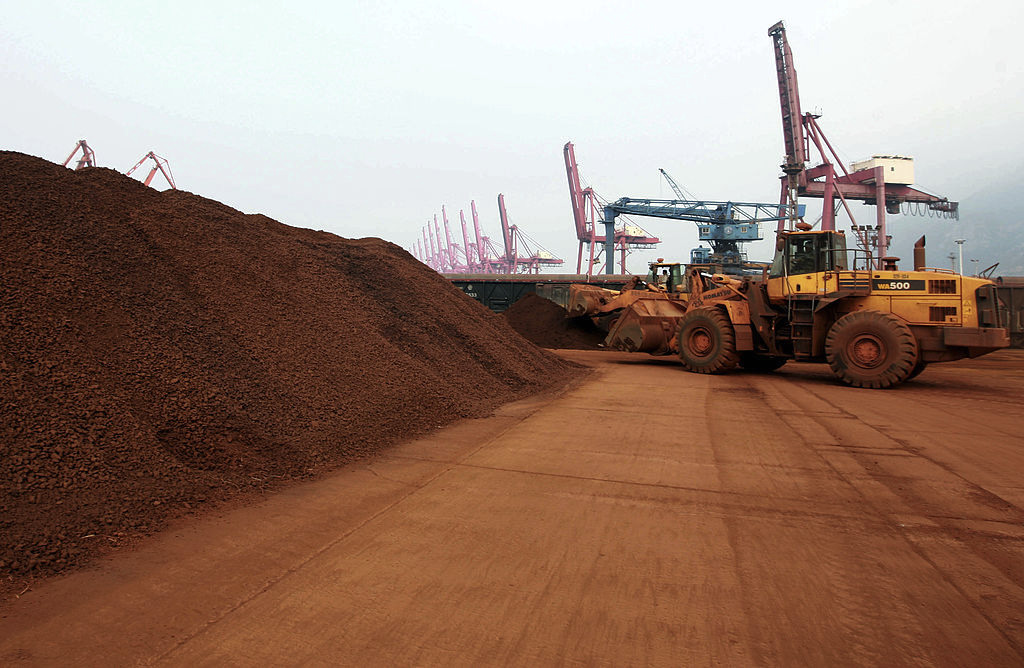 |
| With "Project Vault," President Donald Trump is looking to break China's stranglehold on the supply of critical rare earth elements. Pictured: A front-loader shifts soil containing rare earth elements, to be loaded on ships at a port in Lianyungang, China, on September 5, 2010. (Photo by STR/AFP via Getty Images) |
President Donald Trump is taking an important page from World War II's Manhattan Project, when the United States raced to secure supplies of the rare element uranium needed to create the war-winning atomic bomb. When strategic amounts of the element were found in Africa, deep in mines in the Belgian Congo, a "cover" entity called the Combined Development Trust was created by the U.S. to purchase all supplies and thereby deny Nazi Germany access to the coveted uranium.
The 21st Century has changed the concept of the types and amounts of strategic minerals that will be required to protect the nation's future --and few recognize that need more acutely than Trump.
Today the strategic minerals needed are "rare earths," and Trump is about to launch a strategic stockpile campaign to ensure our national economy is not held hostage by China, which has significant deposits of these vital resources.
Called "Project Vault," his campaign for rare earth elements will combine $1.67 billion in private sector funds with a $10 billion loan from the US Export-Import Bank. Our defense companies currently have sufficient amounts of rare earths for our weapons and aircraft, but the president's campaign is designed to protect our consumer-driven economy beyond his term by stockpiling rare earths for automakers, technology firms and others who require these minerals for such products as smartphones, batteries, and commercial jet engines.
While our historic race for uranium comes to mind, the president's campaign also reflects the wisdom behind our current Strategic Petroleum Reserve. Instead of oil, however, Project Vault will look to acquire and stockpile minerals such as lithium, gallium and cobalt.
The purpose of this unprecedented effort is obvious if one looks at China's track record of holding hostage its vast supplies of rare earths. Trump is looking to break that stranglehold and strategically reduce our dependence on China's supply chain of these critical elements. This is but one step in Trump's responding to China's rare earth threat. He has also invested directly in American companies to boost their mining, production and processing of "rare earths" safely within our borders.
The White House also recognizes that Project Vault has the means to dampen volatile price swings for rare earth commodities. Published accounts of the proposed campaign report that companies that commit to buying a specified amount of minerals at a set price will contractually commit to purchasing the same amount at the same price in the future. This decision reflects Trump's appreciation of how market forces have the potential to derail a plan designed to protect both our nation's economy and national security.
It is expected that later this week will see Project Vault officially unveiled in Washington, D.C., with America's allies at the table to fully appreciate the scope of what is being proposed.
What will become obvious to all is that, once again, the lessons learned by studying America's past are applicable to protecting our future for generations to come.
Lawrence Kadish serves on the Board of Governors of Gatestone Institute.
Source: https://www.gatestoneinstitute.org/22264/project-vault

No comments:
Post a Comment