by Khaled Abu Toameh
In Hamas's view, the establishment of Israel on any of this land is an illegal "Zionist project" and a form of colonial occupation.
Hamas, like Iran, continues to treat the idea of disarmament with a mix of dismissal and rhetorical defiance, effectively signaling that it has no intention of giving up its weapons or altering its dream of eliminating Israel.
For Hamas, disarmament is not a serious proposal. Instead, it is a tool for political theater, a way to manipulate donors and tighten its grip over the Gaza Strip.
In Hamas's view, the establishment of Israel on any of this land is an illegal "Zionist project" and a form of colonial occupation.
When Hamas talks about "resistance" (Arabic: muqawama), it is referring to a comprehensive framework aimed at destroying Israel through a violent jihad (holy war), similar to the Islamic conquest of the Christian Byzantine Empire, or Turkey's 1974 invasion and conquest of northern Cyprus.
According to the Independent Arabia report, some 20,000 Hamas gunmen will be integrated into a new security force in the Gaza Strip and receive salaries with international funding. The new force would be granted the status of an official security apparatus, recognized regionally and internationally.
The "Board of Peace" has also apparently offered "political and legal immunity" to Hamas terrorists, guaranteeing that they will not be prosecuted internationally or by Israel in exchange for their involvement in a local governing council.
If true, this means that the "Board of Peace" views Hamas as a legitimate and acceptable partner in the future management of the Gaza Strip. The mere act of engaging Hamas in such negotiations is beyond problematic. It risks not only legitimizing an Islamist terror group, but also entrenching its authoritarian rule in the Gaza Strip and paving the way for more massacres against Israel.
The idea of integrating Hamas terrorists into the Gaza Strip's new security apparatus is even worse. Such a move sends a message to the Palestinians that participation in terrorism carries no consequences and that terrorists can move directly from violence into official roles without a meaningful process of disarmament.
Legitimizing these terrorists -- as with the Taliban in Afghanistan -- undermines any attempt to establish norms of governance based on law rather than on violence, and can only embolden other terror groups. Without a credible enforcement mechanism -- backed by unified international and regional support -- calls for disarmament remain hallucinatory.
It is hard to see how pro-Hamas countries such as Qatar, Turkey, or Pakistan, all part of the "Board of Peace" -- and two of which, Qatar and Pakistan, have never even recognized Israel -- would seriously participate in any effort to force the Palestinian terror groups to give up their weapons.
Without such pressure, plans for disarmament will continue to be dismissed by Hamas and other Palestinian terror groups. Any plan that assumes these groups will voluntarily lay down their weapons is dangerously unenlightened.
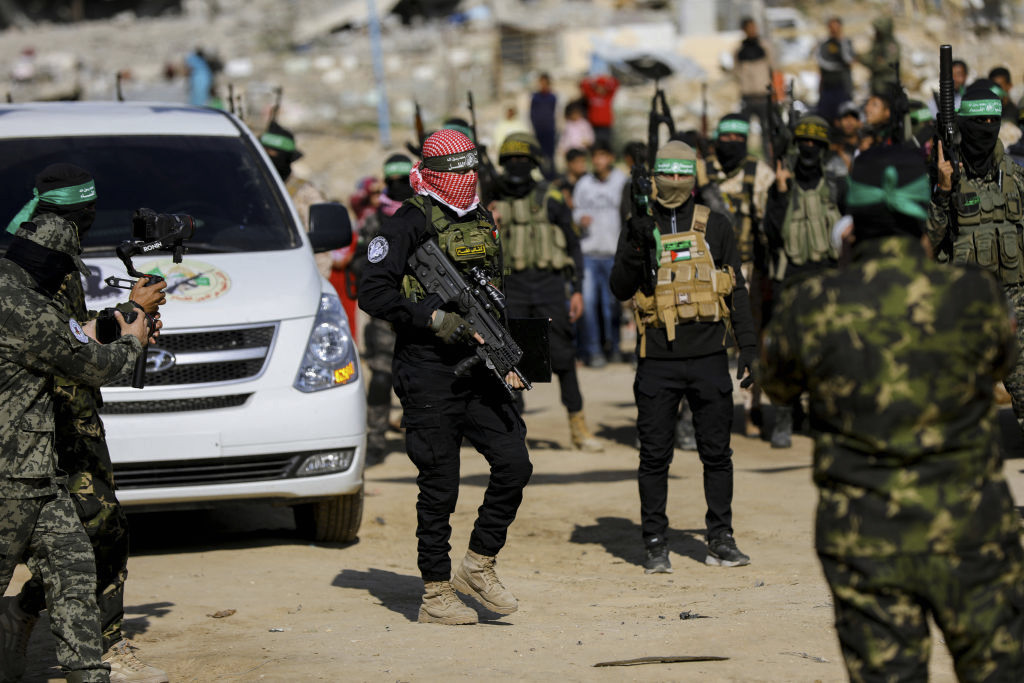
Hamas and other Palestinian terror groups have again rejected demands by US President Donald J. Trump's "Board of Peace" to lay down their weapons. This rejection underscores the determination of terror groups to continue their fight against Israel.
The Palestinian terror groups' refusal to hand over their weapons shows they do not take seriously Trump's repeated threats that they must disarm as part of the October 2025 US-brokered ceasefire and reconstruction plan for the Gaza Strip. Trump made his latest threat in February 2026, when he warned that Hamas would be "harshly met" if they failed to disarm.
Hamas, like Iran, continues to treat the idea of disarmament with a mix of dismissal and rhetorical defiance, effectively signaling that it has no intention of giving up its weapons or altering its dream of eliminating Israel.
For Hamas, disarmament is not a serious proposal. Instead, it is a tool for political theater, a way to manipulate donors and tighten its grip over the Gaza Strip.
The Palestinian terror groups' latest refusal to disarm came after they received a detailed 12-point disarmament plan from the "Board of Peace."
The plan proposes an eight-month timeline:
1. Preparation (days 1-15) – A Palestinian technocratic committee takes security control and begins preparatory steps.
2. Heavy Weaponry (days 16-40) – Israel removes heavy weaponry; international security forces deploy.
3. Infrastructure Destruction (days 31-90) – Destruction of all tunnels and military infrastructure.
4. Full Collection (days 91-250) – Local police forces collect and register all remaining small arms, including rifles and pistols.
A Palestinian official close to the talks between the "Board of Peace" and Hamas said the plan was "unfair," and expected Hamas to seek some "amendments and improvements."
The unnamed official said the plan did not provide guarantees Israel would carry out its obligations. The plan, the official added, would risk causing the war to resume by linking reconstruction and improvements to living conditions to political issues such as disarmament.
Three Palestinian terror groups – Palestinian Islamic Jihad (PIJ), the Popular Front for the Liberation of Palestine (PFLP), and the Democratic Front for the Liberation of Palestine (DFLP) — issued separate statements criticizing the plan. They said it unfairly prioritized disarmament over issues such as reconstruction and Israeli withdrawal.
PIJ wrote in its statement:
"The weapons of the resistance belong to the Palestinian people and constitute a fundamental means to achieve their national goals, foremost among them ending the occupation and establishing an independent state."
Senior Hamas official Ismail al-Sindawi stated that the core of the crisis "lies in the occupation." The weapons of the Palestinian factions, he said, "are a natural consequence of the occupation."
Hamas does not recognize Israel's right to exist inside any borders. It considers all the land from the Jordan River to the Mediterranean Sea as an Islamic wakf (endowment) that belongs to Muslims to hold in trust for Allah by divine right.
In Hamas's view, the establishment of Israel on any of this land is an illegal "Zionist project" and a form of colonial occupation. Hamas's 1988 charter frames the conflict as a religious one, and calls for the "liberation of all of Palestine."
When Hamas talks about "resistance" (Arabic: muqawama), it is referring to a comprehensive framework aimed at destroying Israel through a violent jihad (holy war), similar to the Islamic conquest of the Christian Byzantine Empire, or Turkey's 1974 invasion and conquest of northern Cyprus.
The PFLP emphasized that "resistance is a legitimate right of the Palestinian people." According to the group, "the resistance's weapons have never been a tool for chaos, but rather a means to protect the Palestinian people."
For its part, the DFLP warned that any arrangements concerning weapons must be part of a unified Palestinian position and claimed that Israel "is seeking to achieve political gains through diplomatic pressure after its military failure."
Sheikh Salem al-Sufi, head of the Bedouin Tribes and Clans Council in the Gaza Strip, said that the Palestinian terror groups' weapons represent the "spirit" of the Palestinian people. Relinquishing the weapons, al-Sufi stressed, "is out of the question without achieving security and establishing an independent Palestinian state."
According to a report in the Independent Arabia newspaper, the "Board of Peace" recently presented Hamas with a set of guarantees described as tempting but complex.
The alleged guarantees include granting the terror group an international protection umbrella by deploying an international security force and observers on the border between Israel and the Gaza Strip, as well as a written American commitment that Israel would not launch military operations or assassinations.
According to the Independent Arabia report, some 20,000 Hamas gunmen will be integrated into a new security force in the Gaza Strip and receive salaries with international funding. The new force would be granted the status of an official security apparatus, recognized regionally and internationally.
The "Board of Peace" has also apparently offered "political and legal immunity" to Hamas terrorists, guaranteeing that they will not be prosecuted internationally or by Israel in exchange for their involvement in a local governing council.
If true, this means that the "Board of Peace" views Hamas as a legitimate and acceptable partner in the future management of the Gaza Strip. The mere act of engaging Hamas in such negotiations is beyond problematic. It risks not only legitimizing an Islamist terror group, but also entrenching its authoritarian rule in the Gaza Strip and paving the way for more massacres against Israel.
The idea of integrating Hamas terrorists into the Gaza Strip's new security apparatus is even worse. Such a move sends a message to the Palestinians that participation in terrorism carries no consequences and that terrorists can move directly from violence into official roles without a meaningful process of disarmament.
Legitimizing these terrorists -- as with the Taliban in Afghanistan -- undermines any attempt to establish norms of governance based on law rather than on violence, and can only embolden other terror groups. Without a credible enforcement mechanism -- backed by unified international and regional support -- calls for disarmament remain hallucinatory.
Finally, disarmament requires coordination between the US, key Arab and Islamic states, and European partners to ensure consistent pressure and messaging.
It is hard to see how pro-Hamas countries such as Qatar, Turkey, or Pakistan, all part of the "Board of Peace" -- and two of which, Qatar and Pakistan, have never even recognized Israel -- would seriously participate in any effort to force the Palestinian terror groups to give up their weapons.
The "Board of Peace" will need to apply pressure on the Palestinian terror groups just as a first step toward forcing them to disarm.
The pressure could include cutting off financial and military lifelines through sanctions, tighter monitoring of aid flows, and preventing weapons smuggling into the Gaza Strip. The board also needs to tie reconstruction projects to verifiable steps toward demilitarization. If the terrorists remain defiant, Israel may need to use military force to eliminate all the terror groups in the Gaza Strip.
Without such pressure, plans for disarmament will continue to be dismissed by Hamas and other Palestinian terror groups. Any plan that assumes these groups will voluntarily lay down their weapons is dangerously unenlightened.
- Follow Khaled Abu Toameh on X (formerly Twitter)
Khaled Abu Toameh is an award-winning journalist based in Jerusalem.
Source: https://www.gatestoneinstitute.org/22396/sham-of-disarming-hamas

No comments:
Post a Comment