by Gordon G. Chang
American and Israeli strikes on Iran are finishing off Xi Jinping's most cherished narrative of the "China Dream" of national rejuvenation and dominance.
Xi has been supremely confident that China will dominate the rest of the century... "Change is coming that hasn't happened in 100 years," the Chinese leader told Vladimir Putin after their 40th in-person chat, in Moscow in March 2023. "And we are driving this change together."
Many in Washington and New York policy circles essentially agreed with Xi as they accepted the narrative of America's managed decline.
Not President Donald Trump. In a spectacular move, he extracted Venezuelan President Nicolas Maduro and his wife from Caracas on January 3 and is now in the process of taking down Iran's theocracy.
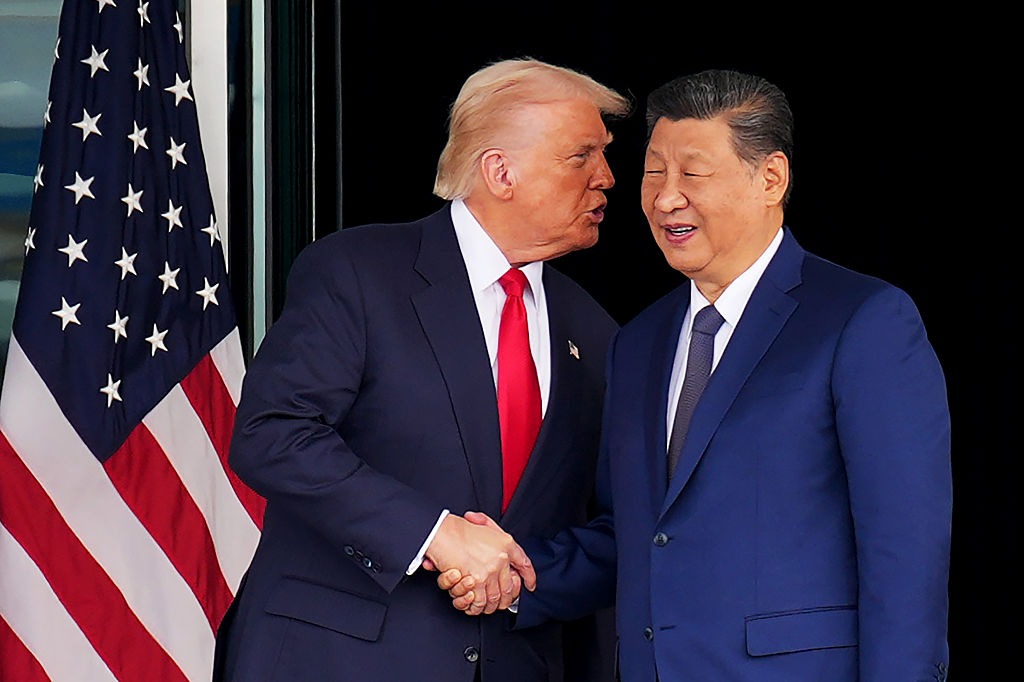
American and Israeli strikes have severely degraded Iran's ability to wage war.
Perhaps more important, they are finishing off Xi Jinping's most cherished narrative of the "China Dream" of national rejuvenation and dominance. In Beijing these days, just about everyone knows China's arrogant leader was wrong about the long-term direction of the United States.
Xi has been supremely confident that China will dominate the rest of the century, and he has not been reluctant to express his belief. "Change is coming that hasn't happened in 100 years," the Chinese leader told Vladimir Putin after their 40th in-person chat, in Moscow in March 2023. "And we are driving this change together."
Xi's favorite phrase of recent years reflected this view: "The East is rising, and the West is declining."
Many in Washington and New York policy circles essentially agreed with Xi as they accepted the narrative of America's managed decline.
Not President Donald Trump. In a spectacular move, he extracted Venezuelan President Nicolás Maduro and his wife from Caracas on January 3 and is now in the process of taking down Iran's theocracy.
These American actions are ending Chinese influence, both in the countries directly affected and elsewhere, in part because Xi was not able to stop the American military actions. Trump's moves have also triggered in the Chinese capital a reassessment of American power.
The South China Morning Post, the Hong Kong newspaper that often reflects Beijing's thinking, reports that the decapitation of the Iranian leadership in the first moments of the ongoing war "highlights America's superior military strength and runs counter to the popular view in China that the United States is in decline."
Now, Chinese analysts are rethinking their views. "Despite numerous issues within its political and social spheres, we absolutely must not underestimate America's capabilities," Zheng Yongnian, a Chinese political scientist and advisor to the Chinese government, declared in an interview published on the website of the Institute of International Affairs, a Chinese institution.
China's state and Communist Party media ramped up their assault on the U.S. with the 2008 global downturn.
The propaganda line recently turned especially nasty, portraying the United States as on the verge of failure. The viral "kill line" meme, for instance, which depicted Americans as caught in irreversible downward spirals, gained currency last year on Chinese social media platforms. The image of great suffering in the U.S. was perhaps a defensive reaction to the pervasive anxiety and gloom in Chinese society, but in any event was a reflection of Xi Jinping's worldview.
Trump's actions in Venezuela and Iran come at the same time as reports of continuing turmoil in Beijing. The disarray is most evident in the People's Liberation Army, which reports directly to the Communist Party through its Central Military Commission, not to the Chinese central government.
Beijing is now abuzz with gossip about the disappearance of military officers from the just concluded "Two Sessions," the annual meetings of the National People's Congress and Chinese People's Political Consultative Conference.
"The U.S. military's overwhelming display of advanced weaponry and seamless operational coordination under President Trump as commander in chief stands in stark contrast to the internal turmoil plaguing all constituent elements of Xi's People's Liberation Army," Charles Burton of the Sinopsis think tank told Gatestone. "More than a hundred senior officers were purged recently, and many of them were conspicuously absent from this month's big gatherings in Beijing."
It was not just the absences that garnered attention. As Burton, a former Canadian diplomat in Beijing and author of The Beaver and the Dragon: How China Out-Maneuvered Canada's Diplomacy, Security, and Sovereignty, said, "Xi's address to the military, imploring unwavering adherence to the 'Central Military Commission chairman responsibility system'—effectively demanding loyalty to himself—carried an unmistakable air of urgency and desperation."
Xi has been removing flag officers for more than a decade, but he has still not been able to form an officer corps loyal to him.
The Central Military Commission, after Xi's continuing purges, now has only two members, down from seven. There is Xi himself and Gen. Zhang Shengmin, a political commissar. In short, there are no operational officers left on the Commission, which means that the chain of command has been effectively severed. There are no warfighters left at the top of the military.
Xi's repeated firings and investigations have, therefore, rendered the Chinese military incapable at this moment of launching major military operations, such as an air-land-sea invasion of the main island of Taiwan.
"Xi's grandiose visions of Chinese supremacy eclipsing U.S. dominance," says Burton, "now look increasingly empty."
- Follow Gordon G. Chang on X (formerly Twitter)
Gordon G. Chang is the author of Plan Red: China's Project to Destroy America, a Gatestone Institute distinguished senior fellow, and a member of its Advisory Board.
Source: https://www.gatestoneinstitute.org/22341/trump-iran-china-dream

No comments:
Post a Comment