by Pierre Rehov
Ideologies do not just dissolve when their representatives adopt the codes of diplomacy. They simply put on suits and ties, prepare to say what Western leaders would like to hear and re-enter the international arena through a legitimacy granted by those who once sought to eradicate them.
Regimes are destabilized but left standing, Jihadist ecosystems are weakened but not dismantled. Recycled figures from the same ideological mold are repackaged as partners. This sadly makes for half-finished wars presented as advisability.
In Syria... Ahmed al-Sharaa, known under his former identity as Abu Mohammad al-Julani — a man once affiliated with Al-Qaeda and long listed with a $10 million American bounty on his head — was welcomed at the White House on November 10, 2025, and, in what was framed as a historic diplomatic opening, publicly described by Trump as a "strong leader."
To then legitimize these terrorists under the convenient fiction of ideological conversion is not merely contradictory; it signals to the entire region that time and patience are sufficient to outlast Western resolve.
Ideologies do not just dissolve when their representatives adopt the codes of diplomacy. They simply put on suits and ties, prepare to say what Western leaders would like to hear and re-enter the international arena through a legitimacy granted by those who once sought to eradicate them. The former head of Romanian Intelligence, Ion Mihai Pacepa, who defected from the Soviet-bloc to the West in 1978, wrote as early as 2003:
"In March 1978 I secretly brought Arafat to Bucharest for final instructions on how to behave in Washington. "You simply have to keep on pretending that you'll break with terrorism and that you'll recognize Israel -- over, and over, and over," Ceausescu told him for the umpteenth time. Ceausescu was euphoric over the prospect that both Arafat and he might be able to snag a Nobel Peace Prize with their fake displays of the olive branch."
The central flaw that continues to undermine Western policy seems to be the illusion that eliminating individuals is equivalent to dismantling the system that produces them.
Trump's position appears divided between two incompatible premises. On one side is a clear recognition that the Iranian regime is intrinsically hostile, driven by an expansionist vision anchored in a theology that elevates martyrdom above compromise and confrontation above coexistence. On the other side is the temptation -- a recurring wish -- to explore engagement with supposedly "less radical" elements within that same system, as though extremism were a matter of degree rather than a defining principle. This ambiguity is a strategic fault line. As long as Iran's Islamic Revolutionary Guard Corps, the clerical hierarchy, and the ideological infrastructure remain intact, any figure presented as moderate operates within boundaries that preclude genuine transformation. What appears as moderation to Western observers instead often functions as tactical adaptation within an unchanged ideological framework.
Half-measures, in this context, represent the most dangerous possible course. They combine the costs of intervention with the failure of restraint: destabilizing adversaries without removing their capacity to rebuild and, in doing so, often strengthening the very dynamics the half-measurists were seeking to contain.
If... the objective is seriously to alter the dynamics that perpetuate a conflict — to dismantle the ideological regimes and frameworks that export instability across the region — then partial measures are indistinguishable from failure.
American voters, particularly before midterm elections, are unlikely to engage with the subtleties of diplomatic maneuvering or the layered complexities of proxy warfare. Their judgment will rest on visible outcomes: on the coherence between declared objectives and tangible results. In that light, a strategy that delivers disruption without resolution risks being perceived not as prudence but as an abdication of purpose, just another American cut-and-run.
There can be no rehabilitation of jihadists under new labels, no reliance on hypothetical "moderates" within revolutionary systems, and no acceptance of partial outcomes as substitutes for structural change. Anything less will ensure that the same threats will persist, reconfigured and reinforced, for the next round of conflict.
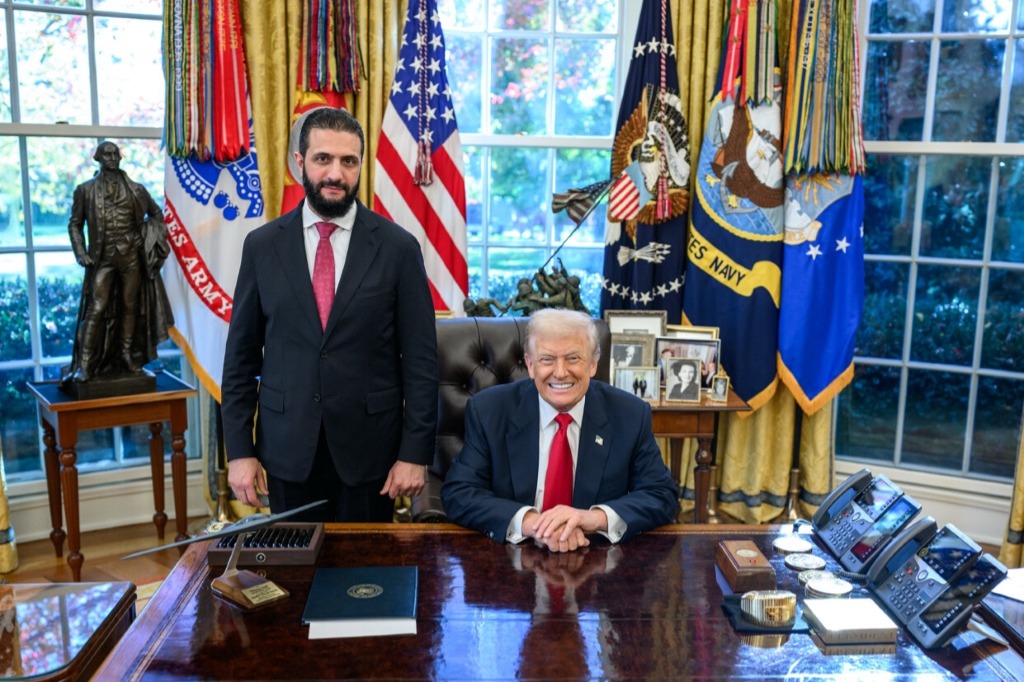
There is, in Washington, a recurring temptation: that the Middle East can be managed, contained, adjusted at the margins through economic pressure, surgical strikes, and the careful selection of supposedly "acceptable" figures drawn from within the very systems that generated the chaos. US President Donald Trump, whose instincts have often broken with this practice, now appears perilously close to reproducing it. The issue is not a lack of clarity— he understands the nature of the threat far better than most Western leaders — but the potential failure of an operation halted midway. Regimes are destabilized but left standing, Jihadist ecosystems are weakened but not dismantled. Recycled figures from the same ideological mold are repackaged as partners. This sadly makes for half-finished wars presented as advisability.
In Syria, for instance, Ahmed al-Sharaa, known under his former identity as Abu Mohammad al-Julani — a man once affiliated with Al-Qaeda and long listed with a $10 million American bounty on his head — was welcomed at the White House on November 10, 2025, and, in what was framed as a historic diplomatic opening, publicly described by Trump as a "strong leader."
To then legitimize these terrorists under the convenient fiction of ideological conversion is not merely contradictory; it signals to the entire region that time and patience are sufficient to outlast Western resolve.
Ideologies do not just dissolve when their representatives adopt the codes of diplomacy. They simply put on suits and ties, prepare to say what Western leaders would like to hear, and re-enter the international arena through a legitimacy granted by those who once sought to eradicate them. Former head of Romanian Intelligence, Ion Mihai Pacepa, who defected from the Soviet bloc to the West in 1978, wrote in 2003:
"In March 1978 I secretly brought Arafat to Bucharest for final instructions on how to behave in Washington. 'You simply have to keep on pretending that you'll break with terrorism and that you'll recognize Israel -- over, and over, and over,' Ceausescu told him for the umpteenth time. Ceausescu was euphoric over the prospect that both Arafat and he might be able to snag a Nobel Peace Prize with their fake displays of the olive branch."
Iran is an even more consequential test. The joint U.S.-Israeli strikes that began on February 28, 2026 and eliminated key figures of Iran's regime, including Supreme Leader Ali Khamenei, constituted a shock that briefly opened the possibility of structural break. What followed, however, was not a collapse but rapid recovery: the regime regenerated itself from within its own ideological core and reaffirmed the same doctrines, the same networks, and the same political objectives.
The central flaw that continues to undermine Western policy seems to be the illusion that eliminating individuals is equivalent to dismantling the system that produces them. A regime built on a mix of clerical authority, revolutionary ideology, and paramilitary enforcement cannot be neutralized through decapitation alone; it must be confronted at its structural foundations, or it will simply regrow, often in a more radicalized form.
Trump's position appears divided between two incompatible premises. On one side is a clear recognition that the Iranian regime is intrinsically hostile, driven by an expansionist vision anchored in a theology that elevates martyrdom above compromise and confrontation above coexistence. On the other side is the temptation -- a recurring wish -- to explore engagement with supposedly "less radical" elements within that same system, as though extremism were a matter of degree rather than a defining principle. This ambiguity is a strategic fault line. As long as Iran's Islamic Revolutionary Guard Corps, the clerical hierarchy, and the ideological infrastructure remain intact, any figure presented as moderate operates within boundaries that preclude genuine transformation. What appears as moderation to Western observers instead often functions as tactical adaptation within an unchanged ideological framework.
Events on the ground have already begun to expose the limits of this approach with unforgiving clarity. Despite the loss of senior leadership, Iran intensified its attacks across the region, expanded missile and drone strikes against American military installations and civilian targets in the Gulf states, and contributed to the disruption of maritime routes with direct consequences to global markets and Western interests, all while targeting Israeli cities with cluster bombs attached to ballistic missiles. Such behavior is the predictable outcome of pressure applied without dismantling a system. Partial confrontation, rather than inducing moderation, reinforced the regime's internal cohesion, and allowed it to mobilize part of its population around a narrative of "resistance" while hardening its strategic posture. The leadership that emerged from such conditions appeared less inclined than ever to engage on terms defined by its adversaries.
At the heart of the West's recurring miscalculation lies a deeper cultural and intellectual gap. American strategic thinking, shaped by Enlightenment rationalism and economic pragmatism, tends to assume that actors ultimately seek stability, prosperity, and survival within a framework of material incentives. This assumption encounters its limits when confronted with systems in which ideological or religious imperatives override material considerations. Within such a framework, sacrifice is not a cost but a form of fulfillment, and death itself can be integrated into a narrative of victory. The classical mechanisms of deterrence lose their force in this environment: the underlying calculus is no longer based on cost-benefit analysis but on a hierarchy of values that places transcendence above survival.
Despite decades of hard evidence, Western policy continues to operate as though these regimes could be integrated into a rational order through negotiation and incremental pressure. In reality, these regimes function as ideological engines whose primary objective is not coexistence but expansion — cultural, religious, and geopolitical. Periods of apparent moderation or openness are not indications of transformation; they are designed to relieve pressure, gain time, or reposition assets without altering the ultimate objective. The notion of a stable equilibrium with such systems or the power base in them rests on a misunderstanding of what they regard as their priorities.
The domestic dimension in the US introduces an additional layer of constraint that further complicates the strategic equation. The political coalition that brought Trump back to power is neither uniformly interventionist nor inclined to support prolonged engagements lacking clear, decisive and preferably fast outcomes. For them, even four weeks was too long.
Recent polling indicates that a substantial majority of Americans, including a significant segment of Republican voters, favor a rapid conclusion to the confrontation with Iran even at the cost of incomplete objectives. The findings appear to reflect growing concerns over potential casualties, escalation, and economic repercussions, or the wish for Trump not to have a success. The view creates a narrow and unforgiving window in which decisive action must either achieve structural results or give way to a gradual erosion of political support, with predictable consequences for any long-term improvement in the situation.
Half-measures, in this context, represent the most dangerous possible course. They combine the costs of intervention with the failure of restraint: destabilizing adversaries without removing their capacity to rebuild and, in doing so, often strengthening the very dynamics the half-measurists were seeking to contain. The result is a cycle in which each round of confrontation produces a more resilient and more ideologically entrenched adversary, while Western credibility diminishes step by step.
The broader international environment only amplifies these risks. European leadership, exemplified by figures such as French President Emmanuel Macron, continues to prioritize de-escalation and negotiated solutions, frequently detached from the radical ideological realities that shape the behavior of regional actors. At the same time, Russia and China exploit Western hesitancy to expand their influence, presenting themselves as "neutral" alternative interlocutors while benefiting from the ambivalence of the United States. The cumulative effect is that a clarity of purpose becomes increasingly rare, and decisive outcomes increasingly elusive.
Israel, operating under the immediate pressure of existential threat, adopts a fundamentally different approach. The question, from Jerusalem's perspective, is not whether the Iranian regime can be managed or contained, but whether its continued existence in its current form is compatible with actual long-term security. This view has been shaped by the proximity to nearly 80 years of bombardments, terrorism and historical experience. Where Washington hesitates, Jerusalem calculates for survival.
Stability in the Middle East cannot be achieved by preserving the structures that generate instability or by pretending that actors steeped since birth in jihadist ideology can be easily rebranded. Stability cannot be secured through partial victories or symbolic demonstrations of force that leave intact the mechanisms of radicalization and expansion.
Trump's instinctive understanding that strength must be asserted and that adversaries must be confronted remains fundamentally sound – yet needs to be carried through to its logical conclusion. The result, as seen in Iraq, Libya, Tunisia and Afghanistan, is not peace but a return to the same strategic starting point under less favorable conditions.
If the objective is merely to delay nuclear proliferation or to manage crises episodically, the current approach may produce short-term appearances of success. If, however, the objective is seriously to alter the dynamics that perpetuate a conflict — to dismantle the ideological regimes and frameworks that export instability across the region — then partial measures are indistinguishable from failure.
American voters, particularly before midterm elections, are unlikely to engage with the subtleties of diplomatic maneuvering or the layered complexities of proxy warfare. Their judgment will rest on visible outcomes: on the coherence between declared objectives and tangible results. In that light, a strategy that delivers disruption without resolution risks being perceived not as prudence but as an abdication of purpose, just another American cut-and-run.
Trump has identified the nature of the threat with uncommon clarity. To translate it into lasting strategic success requires refusing the comforting illusions of only half-hearted, fake success. There can be no rehabilitation of jihadists under new labels, no reliance on hypothetical "moderates" within revolutionary systems, and no acceptance of partial outcomes as substitutes for structural change. Anything less will ensure that the same threats will persist, reconfigured and reinforced, for the next round of conflict.
Pierre Rehov, who holds a law degree from Paris-Assas, is a French reporter, novelist and documentary filmmaker. He is the author of six novels, including "Beyond Red Lines", "The Third Testament" and "Red Eden", translated from French. His latest essay on the aftermath of the October 7 massacre " 7 octobre - La riposte " became a bestseller in France. As a filmmaker, he has produced and directed 17 documentaries, many photographed at high risk in Middle Eastern war zones, and focusing on terrorism, media bias, and the persecution of Christians. His latest documentary, "Pogrom(s)" highlights the context of ancient Jew hatred within Muslim civilization as the main force behind the October 7 massacre.
Source: https://www.gatestoneinstitute.org/22423/trump-middle-east-strategy

No comments:
Post a Comment