Saturday, July 26, 2025

Dems fight Gabbard's disclosure with faulty Senate report that claimed Steele Dossier wasn’t in ICA - Jerry Dunleavy


by Jerry Dunleavy

Cherry-picking from the wrong tree: Obama and other top Democrats are pointing to a faulty Senate report which missed crucial info in effort to ignore declassification revelations, and are pretending that the superseding Ratcliffe report doesn't exist. 

A host of top Democrats including former President Barack Obama, are relying on a 2020 Senate Intelligence Committee report in an effort to defend themselves against new evidence declassified by Trump intelligence chief Tulsi Gabbard. That Senate report is flawed: it includes a since-discredited claim that the Steele Dossier was not used in and did not inform the 2016 U.S. intelligence community assessment.

Last week, Gabbard sent declassified evidence to the Justice Department on what she dubbed a “treasonous conspiracy” related to top U.S. intelligence officials allegedly politicizing intelligence related to Russia and the 2016 election. Obama was joined by the Democratic ranking members of both the Senate and House intelligence committees and by former Obama DNI James Clapper — who helped lead the formulation of the ICA — in pointing to the bipartisan Senate intel panel’s 2020 report to dispute Gabbard’s claims.

The Senate Intelligence Committee concluded in heavily-redacted reports in April and August 2020 that British ex-spy Christopher Steele’s bogus anti-Trump dossier was not used in the body of the ICA and that the dossier's claims were not used to underpin any of the ICA’s findings. That conclusion was debunked by a newly-declassified House Intelligence Committee report and by a recent CIA review, and contradicted by a public House intel report and other declassified records as well.

The Senate committee’s April 2020 report — which focused on the ICA — also wrongly suggested that Obama CIA Director John Brennan had opposed including the dossier in the ICA, while the newly-declassified House report and the recent CIA review both include testimonial evidence that Brennan had in fact fought to include dossier claims in the assessment over the objections from top CIA analysts. CIA Director John Ratcliffe sent a criminal referral on Brennan to the FBI following the CIA "lessons-learned" review earlier in July.

The Senate Intelligence Committee’s fourth volume of its report on Russian meddling and the 2016 election, released in April 2020, was titled “Review of Intelligence Community Assessment.” The report stated that the “Committee found that the information provided by Christopher Steele to FBI was not used in the body of the ICA or to support any of its analytic judgments.” The Senate panel’s fifth volume on Russia, released in August 2020, also asserted that “the dossier material was not used in the ICA and did not contribute to its findings.”

This repeated conclusion is now known to be false.

What we know: Obama directed the tainted 2016 report

The 2016 ICA was written at the direction of President Obama and largely overseen by Brennan, Clapper, and since-fired FBI Director James Comey. It was finished in December 2016, with a publicly declassified version released in early January 2017 and a more extensive classified version declassified and released last week.

Comey and former FBI Deputy Director Andrew McCabe had pushed in December 2016 to include Steele's debunked dossier in the 2016 ICA on alleged Russian meddling. The dossier was included in an annex to the assessment and was directly referred to in the most highly-classified version of the ICA.

But the newly-declassified House report and the recent CIA review sharply criticized Brennan for allegedly joining with these anti-Trump forces in the FBI in pushing to include Steele’s anti-Trump dossier in the 2016 ICA over the objections of Russia experts in the Obama administration's intelligence community.

Steele, a former MI6 agent, was hired in 2016 by the opposition research firm Fusion GPS, which was being paid by Clinton campaign lawyer Marc Elias. The dossier was used by the FBI to obtain FISA warrants against a Trump campaign official, and evidence continues to emerge about how it was included in the ICA on Russia and the 2016 election. The Clinton campaign and Democratic National Committee were later fined by the Federal Elections Committee for failing to disclose that they paid for the Fusion GPS report.

Democrats lash out at Gabbard, insist 2016 and 2020 reports were correct 

A spokesperson for Obama released a statement Tuesday in response to Gabbard’s report from last week, where he sought to deny Gabbard’s claims — pointing to the 2020 Senate report.

“Out of respect for the office of the presidency, our office does not normally dignify the constant nonsense and misinformation flowing out of this White House with a response. But these claims are outrageous enough to merit one,” the Obama statement read

“These bizarre allegations are ridiculous and a weak attempt at distraction. Nothing in the document issued last week undercuts the widely accepted conclusion that Russia worked to influence the 2016 presidential election but did not successfully manipulate any votes. These findings were affirmed in a 2020 report by the bipartisan Senate Intelligence Committee, led by then-Chairman Marco Rubio."

Sen. Mark Warner, D-Va., the vice chairman of the Senate Intelligence Committee now and at the time of the Senate report in question, also pointed to his committee’s 2020 report defending the December 2016 ICA on Russian meddling, and he tweeted last week that “it is sadly not surprising that DNI Gabbard, who promised to depoliticize the intelligence community, is once again weaponizing her position to amplify the president’s election conspiracy theories.”

Warner on Wednesday again tweeted that “the bipartisan, unanimous finding of the Senate Intelligence Committee, after years of painstaking investigation, more than 200 witness interviews, and millions of documents, was that Russia launched a large-scale influence campaign in the 2016 election in order to help then-candidate Donald Trump.”

“It’s a day that ends with ‘y’ and Donald Trump desperately wants to change the subject, so Director Gabbard is rehashing decade-old false claims about the Obama Administration. Few episodes in our nation’s history have been investigated as thoroughly as the Intelligence Community’s warning in 2016 that Russia was interfering in the election,” House Intelligence Committee Ranking Member Jim Himes, D-Conn., tweeted last Friday.

“While everyone has the right to critique the steps that IC leaders took under immense pressure, every legitimate investigation, including the bipartisan Senate Intelligence Committee investigation, found no evidence of politicization and endorsed the findings of the 2016 Intelligence Community Assessment,” he said.

Himes also went on CBS' Face the Nation on Sunday where he said that “the Senate committee, then led by Marco Rubio, a Republican and now Secretary of State, found unanimously that Russia meddled in the election to try to assist Donald Trump.”

Clapper told CNN this week that “I do need to mention that the Senate Intelligence Committee did an exhaustive examination of the totality of Russian engagement in this country, focusing specifically on the intelligence community assessment that we did and released in January of '17, and they endorsed the findings, the tradecraft used to derive those findings, and the confidence levels. And no less than then-Senator Rubio, now-Secretary of State Rubio, who was then, I believe, acting chairman of the Senate Intelligence Committee, made that observation himself in — when that report — redacted version of that report was released."

Invoking Rubio and ignoring truth of Russiagate's genesis

Rubio is indeed the current Secretary of State, but although he was a Senate Intelligence Committee member, he was not leading the Senate committee in April 2020 when the ICA-focused report was released. 

Former Sen. Richard Burr, R-N.C., became the intelligence chairman in January 2015. Warner became the vice chairman in mid-November 2016, after Trump’s victory. Burr stepped aside from the chairmanship and Rubio became acting chair in May 2020 — after the fourth volume had been released but before the fifth and final volume was issued in August 2020.

Other GOP members of the Senate panel back in 2020 have released statements in recent days criticizing the intelligence community in the wake of declassified revelations about the ICA. Sen. Tom Cotton, R-Ark., tweeted last week that “it’s clear that the biggest purveyors of disinformation in the 2016 campaign were Barack Obama, Hillary Clinton, and John Brennan” in response to a tweet from Gabbard about the “Creation of the Russia Hoax.”

Sen. John Cornyn, R-Texas, tweeted on Thursday that he was “urging” Attorney General Pam Bondi “to appoint a special counsel to investigate the extent to which former President Obama, his staff, & administration officials manipulated the U.S. national security apparatus during Russiagate.” 

Cornyn also said that “while we’ve known there was ZERO evidence of collusion” between Trump and Russia, “it’s become more evident that the entire Russia collusion hoax was fabricated by the Obama admin to subvert the will of the American people.”

Rubio, Cotton, and Cornyn released a statement accompanying the release of the fifth volume of the Senate report in August 2020, where the senators said, "The committee found no evidence that then-candidate Donald Trump or his campaign colluded with the Russian government in its efforts to meddle in the election. ... After more than three years of investigation by this Committee, we can now say with no doubt, there was no collusion."

The Obama team, now under legal scrutiny, are hoping that Rubio's earlier imprimatur somehow blesses the tainted reports.

Team Obama's denials about Steele Dossier, 2016 report fall apart 

The recent declassification of the 2020 House Intelligence Committee report revealed that despite repeated denials, the earlier 2016 ICA on Russian election meddling unambiguously relied on the Steele Dossier when crafting the widely-spread narrative that Russian leader Vladimir Putin aspired to help Donald Trump win. That ICA also ignored previously-raised evidence that the Russian leader may have favored (or at least fully expected) a Hillary Clinton victory instead.

The declassified 2020 House report critiqued the “high confidence” assessment by the FBI and the CIA that Putin had “aspired” to help Trump win in 2016, and added that “the judgment that Putin developed ‘a clear preference’ for candidate Trump and ‘aspired to help his chances of victory’ failed to adhere to the agency's standards of analysis. In other words, only recently has the public learned that the report "blessed" by Rubio was, in fact, a house of straw. The newly-declassified report includes strong evidence that the ICA directly cited the Steele Dossier when the ICA argued that Putin had aspired to help Trump win.

The newly-declassified analysis stated that contrary to claims made by the intelligence apparatus both then and now, “the dossier was referenced in the ICA main body text, and further detailed in a two-page CIA annex.”

The flawed ICA stated that “we assess the [Russian] influence campaign aspired to help Trump's chances of victory” in the 2016 election, and the most highly-classified version of the ICA “was followed by four bullets of supporting evidence” — and the declassified House analysis stated that “the fourth bullet referred the reader to a detailed summary and analysis of the dossier.” The ICA stated: “For additional reporting on Russian plans and intentions, please see Annex A: Additional Reporting from an FBI Source on Russian Influence Efforts”, a reference to the Steele Dossier.

Comey, other Obama officials overruled objections to Steele Dossier

The House report stated that “by devoting nearly two pages of ICA text to summarizing the dossier in a high-profile assessment intended for the President and President-elect, the ICA misrepresented both the significance and credibility of the dossier reports.” Margot Cleveland and Mollie Hemingway of The Federalist pointed out that "Senior intelligence officials strenuously fought the demands of former FBI Director James Comey and other Obama intelligence chiefs to include the false and unverified Steele dossier."

According to Cleveland and Hemingway, “Based solely on what we DO know now, my bottom line is this – unless FBI is prepared to provide much better sourcing – I believe this should NOT be included in the paper,” one official wrote, caps and all. 

“Even though the dossier information was unclassified, [...] it was omitted from both the Top Secret version of the ICA released for Congress, and the unclassified, public-release version,” the House report said. “By relegating the dossier text to only the highest classified version of the ICA, the authors were better able to shield the assessment from scrutiny, since access to that ICA version was so limited.”

The declassified House report said that the ICA “misrepresented the unsourced Steele Dossier” as having been reliable intelligence reporting on Russian plans and intentions.

The House report also said that “the ICA referred to the dossier as ‘Russian plans and intentions,’ falsely implying to high-level U.S. policymakers that the dossier had intelligence value for understanding Moscow's influence operations.”

In fact, a now-declassified 2018 House Permanent Select Committee on Intelligence report raised serious credibility problems with the ICA Obama and his subordinated propagated, including findings that "The Intelligence Community Assessment judgments on Putin's strategic intentions did not employ proper analytic tradecraft," and most notably, unambiguous statements that "When asked directly, none of the interviewed witnesses provided evidence of collusion, coordination, or conspiracy between the Trump campaign and the Russian government."

Semantic wordplay: Steele Dossier wasn't "added" but "annexed" to ICA 

The Senate Intelligence Committee’s April 2020 report concluded that the dossier was not included in nor referenced in the ICA, and only that “a summary of this [Steele] material was included in Annex A as a compromise to FBI's insistence that the information was responsive to the presidential tasking.” 

The report includes denials from Clapper and Brennan that the ICA was used to underpin any ICA judgments and claims from the two that they had opposed using the dossier in any way in the ICA. 

This turned out to be false: the recently-revealed evidence shows that Brennan insisted on including the dossier in the ICA. “All individuals the Committee interviewed stated that the Steele material did not in any way inform the analysis in the ICA—including the key judgments—because it was unverified information and had not been disseminated as serialized intelligence reporting,” the Senate report said. “The material was instead included in Annex A of the compartmented ICA.”

“I don’t think you'II find in any of the footnotes in the ICA any reference to the dossier. We thought it important to include a summary description of it, but it was not included as an organic part of the ICA,” Clapper told the Senate panel in 2018. “For our part, particularly the CIA and ODNI, since we could not validate the second and third-order assets, that's why we did not use it as part of the assessment. ... It was not included as an organic part of the assessment.”

Brennan also told the Senate committee in 2018 that top CIA officials were "very concerned about polluting the ICA with this material.” Brennan claimed that the dossier "was not used in any way as far as the judgments in the ICA were concerned."

These claims, detailed and endorsed by the Senate panel, have been proven to be false, and may be the cornerstone of confirmed criminal investigations into Brennan and others.

Years after his testimony before the Senate, Brennan testified before the House Judiciary Committee in May 2023, where he was forced to talk about the ICA and the Steele Dossier. He told lawmakers that the CIA had opposed including the dossier in the ICA. Clapper also testified before the same committee the same month, where he said the dossier was not used in the ICA and that the ICA did not include any reference to the dossier and did not draw upon the anti-Trump document to reach any conclusions.

Those comments could fall within the five-year statute of limitations for possible false statements to Congress.

Brennan pushed for dossier inclusion despite knowing its infirmities

Contradicting the Senate panel’s conclusions, the newly-declassified House analysis provides further detail on how Brennan ensured that the dossier would be included in the ICA, despite objections from Russia experts at the CIA. It is now known that the report stated that “the DCIA [Brennan] rejected requests from CIA professionals that the dossier be kept out of the ICA.”

The report cited a senior intelligence officer present at a meeting with Brennan where “two senior CIA officers — one from Russia operations and the other from Russia analysis — argued with DCIA that the dossier should not be included at all in the ICA, because it failed to meet basic tradecraft standards.”

The same officer said that Brennan refused to remove the reference to the dossier and, when Brennan was confronted with the dossier's significant problems, said that Brennan reportedly replied, "Yes, but doesn't it ring true?"

The blockbuster "lessons learned" review by the CIA's John Ratcliffe revealed that “despite these objections, Brennan showed a preference for narrative consistency over analytical soundness” and that “when confronted with specific flaws in the [Steele] Dossier by the two mission center leaders – one with extensive operational experience and the other with a strong analytic background – he appeared more swayed by the Dossier's general conformity with existing theories than by legitimate tradecraft concerns.” 

Utterly contradicting his congressional testimony, the CIA review memo stated that Brennan ultimately formalized his position in writing, arguing that “my bottomline is that I believe that the information warrants inclusion in the report.”

A whistleblower emerges

The Ratcliffe report concluded that “the decision by agency heads to include the Steele Dossier in the ICA ran counter to fundamental tradecraft principles and ultimately undermined the credibility of a key judgment.”

That review also said that “agency heads decided to include a two-page summary of the Dossier as an annex to the ICA, with a disclaimer that the material was not used ‘to reach the analytic conclusions.’ However, by placing a reference to the annex material in the main body of the ICA as the fourth supporting bullet for the judgment that Putin ‘aspired’ to help Trump win, the ICA implicitly elevated unsubstantiated claims to the status of credible supporting evidence, compromising the analytical integrity of the judgment.”

According to newly-declassified and partially-redacted September 2019 emails first obtained by Just the News, one surprising assertion that the Steele Dossier had played a role in the ICA seemed to originate with top IC election security official Shelby Pierson, who had been appointed the Election Threats Executive (ETE) within the Office of the Director of National Intelligence (ODNI) by then-DNI Dan Coats just a couple of months prior.

The National Intelligence Council’s deputy national intelligence officer for cybersecurity responded to the email with a stunned tone, dismayed that the Steele dossier’s use in the ICA could have been hidden from him. Gabbard’s office said last Friday that this intelligence officer became a whistleblower.

FBI accidentally admits that Steele Dossier was a key basis for faulty ICA

Notably, the Senate Intelligence Committee revealed in its April 2020 report that the FBI committed an “error” when the bureau said that the Steele Dossier had underpinned at least one of the judgments in the ICA. The Senate committee repeatedly prodded the FBI into withdrawing its claim that the dossier had been used to inform the ICA.

The ICA had concluded that the Russian meddling in 2016 "was [the] boldest yet in the U.S.” The support for that conclusion was, in fact, directly lifted from the Steele Dossier.

“The LHM [letterhead memorandum] originally submitted to the Committee was an FBI summary of materials FBI had received from Christopher Steele,” the committee wrote in its April 2020 report. 

“The LHM specifically cites the various ‘company reports’ that are included in the Steele material, which are a compilation of reports all titled (and numbered as) ‘company reports.’ Submission of this memo for footnote 222 appears to have been an FBI error, as the LHM did not support the ICA language cited. 

When the Committee noted this anomaly to the FBI in repeated conversations, as well as noting repeated statements by FBI and CIA that no Steele material was used in the ICA, the FBI withdrew this document.” The Senate panel also referenced the annex which contained Steele Dossier claims, stating that “Annex A represents a summary of information provided to the FBI by Christopher Steele.”

“The second LHM, 'Additional CROWN Reporting for USIC Tasking’ was provided to the Committee as the supporting material for footnote 222. The final citation is an open source reference to an October 31, 2016, piece in Mother Jones,” the committee reported. CROWN was reportedly a codename in the intelligence community for the Steele Dossier.

Overruled: Many intel officers did not have "high confidence" Putin wanted to aid Trump

The December 2016 assessment from the CIA, the FBI, and the NSA concluded with “high confidence” that Putin “ordered an influence campaign in 2016” and that Russia worked to “undermine public faith in the U.S. democratic process, denigrate former Secretary of State [Hillary] Clinton, and harm her electability and potential presidency” and “developed a clear preference for President-elect Trump.”

Admiral Mike Rogers, then the leader of the NSA, diverged from Brennan and Comey's approval, expressing only “moderate confidence” rather than “high confidence” that Putin had “aspired to help” Trump’s election chances in 2016 by “discrediting” Clinton" and publicly contrasting her unfavorably to him.”

The Senate intelligence panel said that “the differing confidence levels on one analytic judgment are justified and properly represented.” However, the report's subheading on internal debate labeled “Confidence Level Debate Over One Judgment”, is followed by more than six pages of almost entirely redacted information.

In contrast, the newly-declassified House report critiqued the “high confidence” assessment by the FBI and the CIA. The declassified report said that “the judgment that Putin developed ‘a clear preference’ for candidate Trump and ‘aspired to help his chances of victory’ did not adhere to the tenets of the Intelligence Community Directive 203, Analytic Standards.”

The newly-declassified report states that the drafters of the ICA had turned their eyes away from evidence suggesting Putin may have been indifferent in the 2016 election, had resigned himself to Clinton winning, may have even preferred a Clinton victory, and held back damaging information on Clinton under the expectation that it would be used to undermine her assured presidency.

Cherry-picking from the wrong tree

"The ICA ignored and selectively quoted reliable intelligence reports that challenged and in some cases undermined judgments that Putin sought to elect Trump," the declassified House report added. "The ICA failed to consider plausible alternative explanations of Putin's intentions indicated by reliable intelligence and observed Russian actions."

Further questioning the reliability of the ICA being used as cover by Team Obama, the report states that "DCIA picked five CIA analysts to write the ICA, and rushed its production in order to publish two weeks before President-elect Trump was sworn-in. Hurried coordination and limited access to the draft reduced opportunities for the IC to discover misquoting of sources and other tradecraft errors."

The FBI opened a “grand conspiracy” case several weeks ago related to the nearly decade-long lawfare efforts against Trump, Just the News previously reported. The Justice Department announced on Wednesday “the formation of a Strike Force to assess the evidence publicized by Director of National Intelligence Tulsi Gabbard and investigate potential next legal steps which might stem from DNI Gabbard’s disclosures.”

It remains to be seen whether the host of revelations, contradictions and apparent falsehoods revealed in these declassifications will lead to criminal charges, despite the poor signal-to-noise ratio of public discourse, which includes claims of distraction, redirecting the focus towards the Epstein debacle, and the coloration in headlines about deflection and retribution.


Jerry Dunleavy

Source: https://justthenews.com/government/federal-agencies/dems-combat-gabbard-declass-pointing-senate-report-which-wrongly

Follow Middle East and Terrorism on Twitter

How Bangladeshi Workers are Powering Global Jihad - Salah Uddin Shoaib Choudhury


by Salah Uddin Shoaib Choudhury

Extremist groups now see an opportunity to dismantle secular governance and establish an Islamic theocracy under interim head of government Muhammad Yunus.


  • Since the 2024 jihadist-backed political shift in Bangladesh, the nation has become fertile ground for Islamic extremism. Extremist groups now see an opportunity to dismantle secular governance and establish an Islamic theocracy under interim head of government Muhammad Yunus. Both ISIS and Al-Qaeda are exploiting this instability to expand their regional footprint.

  • The interim government, led by Yunus, faces multiple crises, including extremist violence, growing sectarian tensions, and rising threats to religious minorities, according to the Jamestown Foundation. Indian strategist Professor Brahma Chellaney described the situation as an "upsurge of radical Islamism" in Bangladesh, exacerbated by systematic attacks on minorities and the empowerment of previously imprisoned jihadists.

  • Compounding these issues, jihadist leaders from Hamas and the Taliban have made high-profile visits to Bangladesh, receiving open support from Islamist groups.

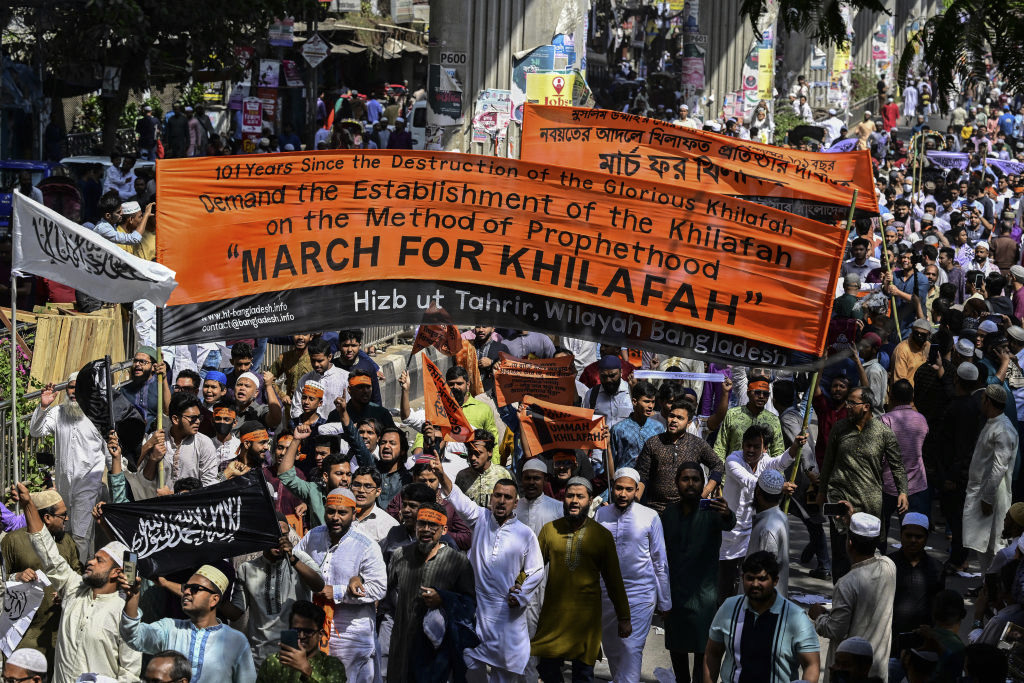
Since the 2024 jihadist-backed political shift in Bangladesh, the nation has become fertile ground for Islamic extremism. Extremist groups now see an opportunity to dismantle secular governance and establish an Islamic theocracy under interim head of government Muhammad Yunus. Both ISIS and Al-Qaeda are exploiting this instability to expand their regional footprint. Pictured: Some of the thousands of members of Bangladesh's banned Islamist militant group, Hizb-ut-Tahrir, who attended the March 7, 2025 "March For Khilafah" in Dhaka, demanding that the country's secular democracy be replaced by an Islamic caliphate. (Photo by Munir Uz Zaman/AFP via Getty Images)

A shocking revelation has emerged implicating Bangladeshi expatriate workers in the covert collection of funds for Islamic State (ISIS), Al Qaeda, and other terrorist outfits.

This development raises urgent concerns across countries with large Bangladeshi migrant populations, including Malaysia, Saudi Arabia, the United Arab Emirates, the United States, and nations in the European Union. Even more alarmingly, many of these workers are not ethnic Bangladeshis, but Rohingyas and "stranded Pakistanis" (Biharis) who obtained Bangladeshi passports through illegal channels.

Recent investigative reports published in The Star of Malaysia, The Straits Times of Singapore, and leading Bangladeshi media confirm that the Royal Malaysian Police, through their Special Branch Counter Terrorism Division (E8), uncovered a group named Gerakan Militan Radical Bangladesh (GMRB). The group was actively raising funds to support ISIS cells in both Syria and Bangladesh.

Datuk Seri Mohd Khalid Ismail, Malaysia's Inspector-General of Police, revealed that GMRB operated recruitment and indoctrination campaigns primarily through communication and social media apps such as WhatsApp and Telegram. The group reportedly has between 100 and 150 members, each contributing RM500 (roughly $118) annually as part of a "membership fee."

"Their members are recruited among Bangladeshi laborers, factory workers, and others. Before being accepted, each member performs the 'bai'ah' - a form of Islamic oath of allegiance," said Ismail, adding that members are carefully vetted before initiation.

Earlier, Malaysian Home Minister Saifuddin Nasution Ismail disclosed that 36 Bangladeshi nationals were arrested in June 2025 for their roles in the radical group. These individuals, inspired by ISIS ideology, aimed to indoctrinate recruits, raise terror funds, and ultimately orchestrate the overthrow of the government of Bangladesh. "Malaysia will not be a haven -- let alone a battlefield -- for any foreign extremist movement," he emphasized.

This is not an isolated incident. Intelligence analysts suggest that similar extremist fundraising and recruitment cells exist in other countries with sizable Bangladeshi communities, including Singapore, Indonesia, Maldives, Bahrain, Oman, Qatar, Saudi Arabia, the United Kingdom, Canada, Australia, and the United States.

Particularly concerning is the role of madrassa-educated expatriates, many of whom have traveled abroad as imams, Islamic teachers, or low-skilled workers. Some are linked to Islamist groups such as Hefazat-e-Islam, Hizb ut-Tahrir, Islamic Constitution Movement, and Ansar Al-Islam – an Al Qaeda franchise in Bangladesh. These individuals collect and transfer funds through illegal hawala channels, evading financial oversight and counterterrorism monitoring.

Adding to the danger is the presence of Rohingya refugees and "stranded Pakistanis" who have fraudulently acquired Bangladeshi passports. Many of them have received ideological and paramilitary training from Pakistan's Inter-Service Intelligence (ISI). They are increasingly active in radicalizing diaspora communities, spreading anti-Hindu, anti-Christian and anti-Semitic narratives, and participating in global jihadist propaganda efforts.

Since the 2024 jihadist-backed political shift in Bangladesh, the nation has become fertile ground for Islamic extremism. Extremist groups now see an opportunity to dismantle secular governance and establish an Islamic theocracy under interim head of government Muhammad Yunus. Both ISIS and Al-Qaeda are exploiting this instability to expand their regional footprint.

On August 20, 2024, Al Qaeda in the Indian Subcontinent (AQIS) released a 14-page manifesto via its propaganda arm As-Sahab Subcontinent. Titled "Bangladesh: The Emerging Hope of Supporting Islam for the Muslim Masses," it called on jihadists to continue their struggle to turn Bangladesh into a regional hub for Islamic rule.

The interim government, led by Yunus, faces multiple crises, including extremist violence, growing sectarian tensions, and rising threats to religious minorities, according to the Jamestown Foundation. Indian strategist Professor Brahma Chellaney described the situation as an "upsurge of radical Islamism" in Bangladesh, exacerbated by systematic attacks on minorities and the empowerment of previously imprisoned jihadists.

In September 2024, members of the European Parliament expressed grave concern over the deteriorating situation in Bangladesh. They specifically cited targeted attacks on the Hindu minority and warned about Bangladesh becoming a sanctuary for armed Islamism. They posed two direct questions to the European Commission:

1. Is the Commission worried about Bangladesh becoming a safe haven for armed Islamism, jeopardizing regional security and global counter-terrorism efforts?

2. Will it condemn the attacks on Bangladesh's Hindu minority and reconsider its support for the interim government?

Compounding these issues, jihadist leaders from Hamas and the Taliban have made high-profile visits to Bangladesh, receiving open support from Islamist groups. On September 7, 2024, the group Al Markazul Islami hosted a major event attended by senior Hamas figures including Sheikh Khaled Quddumi and Khaled Mashaal, along with Pakistani Islamist leaders like Mufti Taqi Usmani and Maulana Fazlur Rahman. The presence of such figures on Bangladeshi soil is deeply concerning to regional security analysts, particularly in India.

Meanwhile, some analysts believe that Western actors, including some within the US government appear to be backing the Arakan Army's armed insurgency against Myanmar's junta. This initiative risks empowering Rohingya militant groups such as ARSA, who are being armed and trained to destabilize not only Myanmar but also parts of Bangladesh and India.

Terror organizations such as ISIS, Al Qaeda, Hamas, Lashkar-e-Taiba, and their regional affiliates are actively trying to leverage this unrest. Their goal is to establish operational bases in Bangladesh using Rohingya recruits and to launch regional and international attacks. Intelligence and media sources suggest that Pakistan's ISI and other foreign actors are financing cyber cells in Europe and the United States to spread jihadist propaganda, targeting Jews, Hindus, Christians, Israel and India.

In light of this escalating threat, it is critical that intelligence and law enforcement agencies across Asia, Europe and North America take proactive measures such as closer monitoring of activities of Bangladeshi expatriates – especially madrassa-educated students and imams in certain mosques and Islamic centers. The covert operations of Bangladeshi expatriates -- especially those of Rohingya and Bihari origin -- should be thoroughly investigated and monitored. Global counterterrorism coordination should immediately prioritize these cells before their networks trigger a regional or international catastrophe.


Salah Uddin Shoaib Choudhury is an award-winning journalist, writer, and Editor of the newspaper Blitz. He specializes in counterterrorism and South Asian geopolitics. Follow him on X: @Salah_Shoaib

Source: https://www.gatestoneinstitute.org/21778/bangladeshi-workers-global-jihad

Follow Middle East and Terrorism on Twitter

Thursday, July 24, 2025

Rubio: Macron’s decision a slap in the face to October 7th victims - Elad Benari


by Elad Benari

US Secretary of State Marco Rubio denounces France's plan to recognize a Palestinian state, calling it "reckless" and stating the move only serves Hamas propaganda.


Marco Rubio
Marco Rubio                                                                                     REUTERS/Craig Hudson

US Secretary of State Marco Rubio denounced French President Emmanuel Macron’s announcement that his country would officially recognize “the State of Palestine”.

“The United States strongly rejects Emmanuel Macron’s plan to recognize a Palestinian state at the UN General Assembly,” Rubio said in a post on X on Thursday night.

“This reckless decision only serves Hamas propaganda and sets back peace. It is a slap in the face to the victims of October 7th,” he added.

Prime Minister Benjamin Netanyahu earlier responded to Macron's announcement and said, "We strongly condemn President Macron’s decision to recognize a Palestinian state next to Tel Aviv in the wake of the October 7 massacre.”

“Such a move rewards terror and risks creating another Iranian proxy, just as Gaza became. A Palestinian state in these conditions would be a launch pad to annihilate Israel — not to live in peace beside it. Let’s be clear: the Palestinians do not seek a state alongside Israel; they seek a state instead of Israel," added Netanyahu.

Hamas, on the other hand, welcomed Macron’s announcement and urged other countries to follow suit.

“We view this as a positive step in the right direction toward achieving justice for the Palestinian people and supporting their legitimate right to self-determination and the establishment of an independent state with Jerusalem as its capital on all the occupied lands. This is a political development that reflects growing international recognition of the justness of the Palestinian cause,” said the murderous terror organization in a statement.

“We call on all countries in the world - especially European nations and those that have not yet recognized the State of Palestine - to follow France’s lead and fully recognize the national rights of our people, foremost among them the right of return, self-determination, and the establishment of an independent and sovereign state,” Hamas added.


Elad Benari

Source: https://www.israelnationalnews.com/news/412225

Follow Middle East and Terrorism on Twitter

2016 intel report said Kremlin preferred GOP over Dems — but actual history tells a different story - Jerry Dunleavy


by Jerry Dunleavy

The Obama-era ICA claimed the Kremlin has a history of preferring Republicans over Democrats, but decades of Moscow history contradicts the narrative that was pushed -- and believed as gospel by the legacy media and public.


The Obama-era intelligence community assessment on Russian meddling in the 2016 election contained a newly-declassified claim that the Kremlin “historically” preferred Republican candidates over Democratic ones — something belied by the actual historical record — while a key architect of that assessment has made the questionable contention that Russian actions that year were “unprecedented.”

These two claims seem to conflict with a lengthy Kremlin record of aggressive active measures targeting numerous U.S. elections over many decades, with the Kremlin typically, although not always, seeking to harm Republicans, albeit with at least one instance of the Kremlin trying to undercut a Democrat who was well known to be a Soviet hawk.

Obama and Clapper assign the ICA report

The report on Assessing Russian Activities and Intentions in Recent U.S. Elections — written at the direction of President Barack Obama and largely overseen by then-Director of National Intelligence James Clapper, then-CIA Director John Brennan, and since-fired FBI Director James Comey — was finished in December 2016, with a publicly declassified version released in early January 2017 and a more extensive classified version declassified and released last week.

The version of the ICA which had been highly classified but which was released this July had a subheading stating that “Putin Ordered Campaign To Influence U.S. Election.” Beneath that subheading, the ICA contended that “the Kremlin has historically preferred Republican over Democratic candidates, judging that Republicans had been less focused on democracy and human rights and were therefore easier to deal with.”

Intelligence experts with experience in Russia disagree. Dan Hoffman, the CIA’s former station chief in Moscow, told Just the News that “I never found that to be true at CIA. Not true. They hate all of us — Republican and Democrat. … They are at war with us — at war with democracy.”

Hoffman repeatedly suggested the claim in the ICA that the Russians had a long history of preferring Republicans over Democrats was baseless.

“During my time at CIA — never saw it, never said it. During all my time briefing policymakers and Congress, it is not something I would have ever said,” Hoffman told Just the News. “I’d like to know where they got that from.”

Biden NSC David Shimer, a leftwing scholar who ended up serving on President Joe Biden’s National Security Council, and served as his Director for Russian Affairs, wrote a 2020 book, Rigged: America, Russia, and One Hundred Years of Covert Electoral Interference, which pushed the idea that the Russians had interfered in the 2016 election to help Trump and criticized Trump’s denials over it. The book also laid out multiple examples of the Kremlin seeking to get Democratic presidential candidates elected in the past.

“There’s a misperception today that foreign electoral interference is somehow a political issue — that if you say election security matters, then you’re a partisan Democrat. History shows that that is just not so,” Shimer told Yale News. “During the Cold War, as I detail in my book, the Soviets sought to destroy the candidacies of Richard Nixon, a Republican, and of Ronald Reagan, a Republican.”

History shows Russians did not favor one party over another

Shimer, contradicting the assessment touted by Obama, Biden and Hillary Clinton, told NPR that "history clarifies that the threat of foreign electoral interference is a threat to our nation, not any one political party” and that “the Soviet Union worked on several occasions to tarnish the campaigns of Richard Nixon and Ronald Reagan, Republicans, long before Russia worked to help a Republican.”

“The KGB interfered in our 1960, 1968, 1976, and 1984 elections, Shimer told the Intelligence Matters podcast. “Russia interfered in our 2016 elections. This is a long running story and that story will continue regardless of whether Donald Trump is active in American politics.”

There is strong evidence that Democrat-turned-Progressive Party presidential candidate Henry Wallace actually colluded with Soviet dictator Joseph Stalin during the 1948 presidential election. 

There is a lengthy record of the Soviets attempting to help Democrats or undercut Republicans, including offering support to failed Democratic Party nominee Adlai Stevenson as part of their efforts to oppose Republican Vice President Richard Nixon in 1960; denigrating Republican nominee Barry Goldwater in his race against Democratic President Lyndon Baines Johnson in 1964; proposing financial assistance to Democratic candidate Hubert Humphrey in his race against Nixon in 1968; and attempting active measures against Republican Ronald Reagan during his unsuccessful primary run in 1976 and his successful reelection in 1984.

The Kremlin also targeted Democratic Senator Henry “Scoop” Jackson — a vocal critic of the Soviet Union — in his unsuccessful presidential primary run.

The two U.S. presidential races immediately preceding 2016 (the ones in 2008 and 2012) also featured strong Russia hawks in then-Sen. John McCain, R-Ariz., and former Gov. and future Sen. Mitt Romney — and no public evidence has ever emerged that Putin wanted these strong critics of his to win either race.

The gang behind Russiagate faces law enforcement investigation

The notoriously false ICA put together by Clapper, Brennan, and Comey — at the direction of Obama and relied upon by legacy media and anti-Trump voters— has come under extreme scrutiny in recent days.

CIA Director John Ratcliffe sent a criminal referral on Brennan to the FBI following a CIA lessons-learned review on the ICA earlier this month. The CIA review alleged the ICA had made use of information found in British ex-spy Christopher Steele’s discredited anti-Trump dossier. Ratcliffe tweeted that “the 2016 IC Assessment was conducted through an atypical & corrupt process.”

DNI Tulsi Gabbard declassified a host of previously-secret information about the ICA, including evidence that the dossier was used in the ICA. Gabbard similarly sent declassified evidence to the Justice Department on what she dubbed a “treasonous conspiracy” related to top U.S. intelligence officials allegedly politicizing intelligence on Russia and the 2016 election.

The most highly-classified version of the ICA — shown only to a small group such as Obama, Trump, and others — has not been declassified nor made public, but portions of it were quoted in a years-old GOP-led House Intelligence Committee report which was declassified this week and first obtained by Just the News.

The House report shed more light on the ICA’s claim about the Kremlin allegedly preferring Republican candidates and criticized the tradecraft which the ICA drafters had used to reach such a conclusion, saying that the ICA's claims about the Kremlin and Republican candidates simply "does not make sense."

“To support the topic sentence, ‘Putin, his advisers, and the Russian Government developed a clear preference for [Trump]’ the ICA quotes information from an ‘established source’ but without clarifying that the ultimate source of the information is unknown,” the House Intelligence Committee wrote in its newly-declassified analysis.

The House report quoted the most highly classified version of the ICA as asserting: "The established source with secondhand access ... noted that several members of Putin's inner circle strongly preferred Republican over Democratic candidates because they judged that Republicans had historically been less focused on democracy and human rights ..."

The declassified House analysis said that “the ICA describes the information in terms that most readers would view as more evidence that President Putin would have a ‘clear preference’ for candidate Trump. But this is only accomplished by omitting key context details.”

Obama's ICA dodges the Kremlin’s long-proven history of meddling

The first key judgment in the version of the ICA released in January 2017, also stated that “Russian efforts to influence the 2016 U.S. presidential election represent the most recent expression of Moscow’s longstanding desire to undermine the U.S.-led liberal democratic order,” with the ICA adding, “but these activities demonstrated a significant escalation in directness, level of activity, and scope of effort compared to previous operations.”

Clapper, the director of national intelligence under Obama at the time, told the Senate in early January 2017 that “I do not think that we have ever encountered a more aggressive or direct campaign to interfere in our election process than we have seen in this case.”

Clapper went on to call Russia’s meddling efforts in 2016 “unprecedented” when speaking with NPR in 2018.

Mark Kramer, the director of the Cold War Studies Program at Harvard University, released an analysis in mid-January 2017 arguing that the Russian efforts in 2016 weren’t actually unprecedented at all.

“Despite the advent of cyberwarfare, the Russian government’s attempts to sway the U.S. election in 2016 were strikingly reminiscent of Soviet ‘active measures’ during the Cold War,” Kramer wrote at the time. “The notion that Russian intelligence services’ actions in 2016 were unprecedented in scale reflects an inadequate understanding of the historical context.”

“The reality is that the two main Soviet intelligence and security agencies — the KGB and GRU (military intelligence) — kept up a vigorous campaign for several decades to meddle in U.S. politics and discredit the United States,” Kramer wrote in January 2017. “The ‘active measures’ used by the KGB and GRU during the Cold War, including disinformation, forgeries of documents and letters, and the spread of propaganda through sympathetic individuals and front organizations, were remarkably similar to the tactics and goals of Russian intelligence agencies in 2016. Even though the World Wide Web and email did not exist during the Cold War, the basic methods used by the KGB and GRU in 2016 were simply adapted for the cyber age.”

The version of the ICA publicly released in January 2017 said that the Russian influence effort "was the boldest yet in the U.S.” “Russia’s effort to influence the 2016 US presidential election represented a significant escalation in directness, level of activity, and scope of effort compared to previous operations aimed at U.S. elections,” the ICA said, adding that “during the Cold War, the Soviet Union used intelligence officers, influence agents, forgeries, and press placements to disparage candidates perceived as hostile to the Kremlin, according to a former KGB archivist.”

ICA ignored long and relevant history contrary to its narrative

The ICA provided no examples at all of the Kremlin targeting Republicans, despite the Kremlin’s long history of doing so. “The Russian Foreign Intelligence Service (SVR) Directorate S (Illegals) officers arrested in the United States in 2010 reported to Moscow about the 2008 election,” the ICA said. “In the 1970s, the KGB recruited a Democratic Party activist who reported information about then-presidential hopeful Jimmy Carter’s campaign and foreign policy plans, according to a former KGB archivist.”

There was no mention of any Soviet or Russian influence efforts aimed at harming Republicans. The further declassified version of the ICA released in July provided a few more details, with key portions still redacted. Again, there was no direct mention of the Kremlin seeking to hurt Republicans, although what remains redacted is not yet known.

“In 2011, U.S.-based Russian officials had a draft plan to influence the 2012 U.S. presidential election, [REDACTED]. The plan advocated exploiting the Citizens United Supreme Court ruling to fund candidates supporting Russian interests, eventually creating a pro-Russia PAC to openly advance Moscow’s agenda,” the ICA said. “SVR officers in San Francisco were tasked to compile information on US firms with ties to Russia, [REDACTED], possibly in support of this plan; we have no information to indicate the plan was implemented.”

The ICA also said that “in 1999, the SVR’s San Francisco base developed a plan to use a contact to promulgate Russian views in US political parties’ campaign platforms and among candidates for the presidential election in 2000, [REDACTED]” and that “in 2008, all Russian consular offices were required to report any information about the likely outcome of the U.S. presidential election, potential cabinet members of the new administration, the impact of the U.S. economy on the election, and the new administration’s policies toward Russia, [REDACTED].”

The USSR supporting liberal Henry Wallace in 1944

Henry Wallace was removed as President Franklin Delano Roosevelt’s vice president and was replaced by Harry Truman in 1944, with Truman becoming president soon after. Wallace was then fired from being Truman’s commerce secretary in 1946 after criticizing the Truman administration’s strong stance against the Soviet Union.

Benn Steil, the author of The World That Wasn’t: Henry Wallace and the Fate of the American Century, wrote a Foreign Affairs article entitled, “A Genuine Case of Collusion. When an American Presidential Candidate Made a Deal With Stalin.”

“He [Wallace] set out to tar Truman as a warmonger, to undermine his foreign policy, and to convince the American public that the nascent Cold War in Asia and Europe might be ended instantly by a Wallace victory,” he wrote. “That meant working secretly with Soviet officials—including the Kremlin dictator himself, Joseph Stalin, from whom Wallace took direction.”

Wallace reportedly “secretly approached the newly appointed Czech ambassador to the UN, Vladimir Houdek, asking for his help in making contact with Houdek’s Soviet counterpart, Andrei Gromyko,” the article said. “Wallace wished to keep the contact hidden. His effort succeeded. … Wallace met secretly with Gromyko at the ambassador’s residence in New York.”

The article stated that “the encounters between Wallace and Gromyko” are found in “Russian archival documents” and “detailed in a cipher cable that Gromyko sent to Moscow.”

The cable reportedly said Wallace told Gromyko that he wished to go to Moscow, leaving open questions of timing and itinerary, and that Wallace explained that he “wanted to come to a definite agreement with … Generalissimo Stalin on all major problems of Soviet-American relations.”

Wallace’s alleged aim, according to Gromyko, was to use his “conversation with comrade Stalin … to make a definitive statement to the American people” and Wallace wanted to show “that in the case of his election [there would be] an agreement with the USSR on such and such important issues.” Gromyko reportedly wrote that Wallace stressed “that his Moscow trip would strengthen his position as a presidential candidate,” but “only if he actually reached an agreement [with Stalin] on important issues.”

Stalin reportedly worried that a “trip may do harm” but that “a statement is useful.” Stalin reportedly believed that it would “better be done by Wallace” and that Stalin would then “state his sympathy.”

Wallace penned “An Open Letter to Premier Stalin From Henry A. Wallace” in May 1948, stating that “The Cold War Must Stop” and “The USA and the USSR must take immediate action to end the cold war.”

“The wartime cooperation between the two great powers can be rebuilt and strengthened in time of peace,” Wallace wrote. “There is no American principle or public interest, and there is no Russian principle or public interest, which would have to be sacrificed to end the cold war and open up the Century of Peace which the Century of the Common Man demands.”

Wallace reportedly read the letter in front of thousands of his supporters at Madison Square Garden in May 1948.

Stalin responded later that month with praise for Wallace.

“I believe that among the political documents of recent times, which have the strengthening of peace, the furthering of international cooperation and the securing of democracy as their aims, the open letter of Henry Wallace, the presidential candidate of the Third Party in the USA, is the most important,” Stalin wrote. “One can be for or against these proposals; but no statesman that has anything to do with the matter of peace and cooperation of nations can ignore this programme, which reflects the hopes and longing of the peoples for the strengthening of peace, and which, without doubt, will find the support of millions of the common people.”

“The FBI, tipped off by a suspicious State Department about possible collusion between Wallace and Moscow, planted agents at the print shop where the open letter had been copied and determined that Wallace had to have had advance knowledge of Soviet public statements,” Steil wrote. “The collusion was thus proved. But neither the FBI nor the Truman administration took action.”

There is also evidence that Wallace’s proposed vice president — Harry Dexter White — was a Soviet agent of influence.

Soviet support for Democrat Adlai Stevenson in opposition to Nixon in 1960

Reports say the Soviet Union allegedly offered direct support to failed Democratic presidential nominee Adlai Stevenson as they sought to keep then-Vice President Richard Nixon out of the Oval Office in 1960.

“Once before, in 1960, the Russians tried — secretly and without success — to intervene in a presidential contest,” historian Bruce W. Dearstyne wrote for History News Network. “They attempted to persuade Adlai Stevenson, the Democratic presidential nominee in 1952 and 1956, to run again and offered to support him.”

The historian wrote that “Soviet ambassador Mikhail A. Menshikov invited Stevenson to the Russian embassy” in January 1960, where “the ambassador plied Stevenson with drinks, caviar, and fruit” and then “launched into an extraordinary monologue, telling Stevenson that the message he was about to deliver came directly from” Soviet leader Nikita Khrushchev personally.

"In Russia, we know well Mr. Stevenson and his views regarding disarmament, nuclear testing, peaceful coexistence, and the conditions of a peaceful world," Menshikov reportedly said. "When we compare all the possible [presidential] candidates in the United States, we feel that Mr. Stevenson is best for mutual understanding and progress toward peace. … We believe that Mr. Stevenson is more of a realist than others and is likely to understand Soviet anxieties and purposes. … Because we know the ideas of Mr. Stevenson, we in our hearts all favor him.”

The Soviet ambassador also reportedly asked, "Could the Soviet press assist Mr. Stevenson's personal success? How should press praise him and if so, for what?" Menshikov also asked if the Soviet press should criticize Stevenson in the hope that it would generate domestic support for the Democrat, and further asked if there were other ways that "we could be of assistance to those forces in the United States which favor friendly relations?" Menshikov reportedly said that Stevenson "will know best what would help him.”

The historian wrote that the Soviet ambassador “went on to make clear that the Russians saw Vice President Nixon, the likely Republican nominee, as being hostile to their interests.” Stevenson was reportedly “appalled” by the Soviet offer and turned it down.

John F. Kennedy went on to be the Democratic presidential nominee that year and narrowly defeated Nixon. Stevenson went on to serve at the United Nations

KGB-backed intel agency targets Goldwater in race against LBJ in 1964

An intelligence agency from a Soviet-backed Warsaw Pact nation reportedly sought to undermine the candidacy of Senator Barry Goldwater, R-Ariz., as he ran against then-President Lyndon Baines Johnson in 1964.

“Well before the election of Ronald Reagan, the KGB and intelligence agencies from countries like Czechoslovakia (now the Czech Republic and Slovakia) in the Warsaw Pact—the Cold War military alliance that included the Soviet Union and countries in Eastern and Central Europe—attempted to influence U.S. politics,” the Center for Strategic and International Studies wrote.

“In the 1960s, for example, the intelligence service from Czechoslovakia ran a propaganda campaign against U.S. Senator Barry Goldwater, the Republican candidate for U.S. president. Moscow was deeply concerned about Goldwater’s anti-Soviet views, and Soviet and Czechoslovak agencies orchestrated a disinformation campaign labeling Goldwater as a racist and a KKK sympathizer. They produced and distributed printed material in the United States and overseas,” the report added.

Ladislav Bittman, the former deputy chief of the Disinformation Department of the Czechoslovak Intelligence Service, reportedly said that “it was sent to many journalists and politicians” and that “I think the result was much more successful in developing countries than here in the United States.”

The Poland-based Warsaw Institute also said that “the Central Committee of the Communist Party of the Soviet Union was asked to approve the action plan to put through a series of active measures to take up a hostile activity against the Republican nominee in some political milieux by using secret channels of communication in foreign press outlets to publish articles fueling a negative attitude of some towards Goldwater.”

The institute said a memo approving the anti-Goldwater effort was signed by Vasili Kuznetsov, first deputy minister of foreign affairs for the USSR, and Vladimir Semichastny, the Chairman of the KGB. The memo “urged officers to forge content painting a negative image of Goldwater so that it could be intercepted by the Democrats to help them build a better reputation in the campaign.”

“The KGB asked the intelligence service from Czechoslovakia to run a propaganda campaign. … Intelligence agencies produced and distributed printed material in the United States and overseas through diplomatic mail,” the institute wrote. “The material contained some content from U.S. dailies and books to which forged information was added and then mailed to government agencies, newspapers, and public figures.”

Johnson crushed Goldwater in the election, where Johnson received 61% of the popular vote, which at the time was the largest share of the popular vote since 1820.

Soviets offered to subsidize Humphrey's campaign against Nixon in 1968

Kramer wrote in his January 2017 critique of the ICA that “in 1968, the Soviet Politburo strongly favored the Democratic candidate, Hubert Humphrey, out of fear that the Republican nominee, Richard Nixon, who had been known as a vehement anti-Communist in the 1950s, would take a harsh stance against the Soviet Union” and that “Soviet leaders ordered their ambassador in Washington, DC, Anatoly Dobrynin, to approach Humphrey with an offer of clandestine funding for his campaign.” Humphrey turned it down.

Anatoly Dobrynin, a former USSR ambassador to the U.S., wrote in his memoir about the alleged Soviet offer to Humphrey to support and subsidize his campaign against Nixon. “During a diplomatic reception in the White House … Hubert Humphrey told me privately that he was inclined to try his luck at the presidential election and was going to announce his candidacy soon. Humphrey said he had always considered U.S.-Soviet relations as a major factor influencing the prospects for war and peace and that he had always tried to improve them,” Dobrynin wrote

“To Moscow, Humphrey certainly was preferable to Richard Nixon, who had founded and built his career on opposing communism and was considered profoundly anti-Soviet.”

“Our leadership was growing seriously concerned that he might win the election,” Dobrynin also wrote. “As a result the top Soviet leaders took an extraordinary step, unprecedented in the history of Soviet-American relations, by secretly offering Humphrey any conceivable help in his election campaign — including financial aid.”

Dobrynin wrote that he personally “received a top-secret instruction” from Andrei Gromyko, then the foreign minister of the Soviet Union, and Dobrynin said that he “did my utmost to dissuade him from embarking on such a dangerous venture, which if discovered certainly would have backfired and ensured Humphrey’s defeat, to say nothing of the real trouble it would have caused for Soviet-American relations.”

Dobrynin wrote that “Humphrey, I must say, was not only a very intelligent, but also a very clever man. He knew at once what was going on. He told me that it was more than enough for him to have Moscow’s good wishes which he highly appreciated … The Politburo always watched American presidential elections closely for their potential effect on Soviet-American relations and usually had a preference but rarely expressed it or took sides by offering diplomatic or other help.”

Humphrey did not, as far as history shows, cooperate with the USSR, and would later lose to Nixon in a tempest-tossed year that saw the murders of RFK, Martin Luther King and riots at the Democratic National Convention in Chicago.

Soviets targeted Democratic hopeful “Scoop” Jackson ahead of 1976

Kramer also wrote in his January 2017 critique of the ICA that “in 1976, the Soviet Union again secretly adopted measures to influence a U.S. presidential election. Early in the year, the KGB warned the Soviet Politburo that Senator Henry ‘Scoop’ Jackson, D-Wash., known for his fierce opposition to the Soviet Union, stood a good chance of gaining the Democratic nomination. Jackson’s victories in the Massachusetts and New York primary elections heightened these concerns.” 

Jackson counted military contractor Boeing as one of his most important constituents, so much so that he was sometimes referred to as "the senator from Boeing."  

“Service A prepared a wide-ranging set of measures to discredit Jackson, especially by falsely portraying him as a homosexual. The KGB sent forged FBI letters to leading U.S. newspapers and journalists claiming that Jackson was a closeted gay,” Kramer wrote. “Even after Jackson’s campaign faltered and he dropped out of the 1976 race, Service A kept up its homophobic war of disinformation against him, hoping to prevent him from ever again becoming a viable presidential candidate.”

The Warsaw Institute similarly wrote that “when the KGB started an extraordinarily wide-ranging search for compromising information, its leadership concluded that Jackson’s reticence about his private life possibly indicated some sexual problems he purportedly had faced” and so “the KGB stated that Jackson was a closet gay.” 

The institute said that the KGB “decided to fabricate it in an active measure codenamed operation ‘Porok’ (Prophet)” and “in 1976, Service A forged an FBI memorandum, dated June 20, 1940, in which J. Edgar Hoover reported to the Assistant Secretary of Justice that Jackson was a homosexual.” The KGB made sure that “photocopies of the forgery were sent to The Chicago Tribune, The Los Angeles Times, The Topeka Capital, and Jimmy Carter’s campaign headquarters” in an effort to undercut Jackson.

The USSR made efforts to hurt Republican Reagan in 1976 and 1984

Kramer further wrote in his January 2017 critique of the ICA that “in 1983, amid severe tensions in U.S.-Soviet relations, the KGB proposed measures to try to undermine Ronald Reagan’s position in the 1984 U.S. election.” 

The Harvard professor added: “But the proposal never got very far because the prolonged illness and eventual death of the Soviet leader Yurii Andropov meant that a wide range of steps were put on hold. Moreover, by 1984 the cables coming in from Ambassador Dobrynin left little doubt that Reagan was going to win in a landslide no matter what the Soviet Union did — a prediction that was amply borne out.”

Walton wrote that “during his unsuccessful bid for the Republican nomination in 1976, the KGB undertook a wide-ranging quest for compromising material on Reagan” and that the Soviets did “plant some anti-Reagan articles in the foreign press outside the U.S.”

The Harvard historian provided further details on the significant Soviet efforts against Reagan. “During his first presidential election campaign, the KGB unsuccessfully attempted to find kompromat (compromising material) on Reagan and forged documents suggesting that he had been an FBI informant in Hollywood in the 1950s; these documents were quickly shown to be falsified,” Walton wrote

“Then, during Reagan’s bid for a second term in 1984, the Moscow Centre instructed its three KGB residencies (stations) in the United States to recruit agents in the headquarters of either party, Democratic or Republican. Any candidate, from either party, would be preferable to Reagan. The KGB tried to galvanize anti-Reagan sentiment in the United States by publicizing slogans such as ‘Reagan Means War,’ and on at least one occasion it orchestrated an anti-Reagan public rally in a major U.S. city, San Francisco—a chilling precedent for Russia’s meddling in 2016.”

“The FBI publicly denounced a Soviet forgery that surfaced in the United States in January 1984. The forgery, dated 1947, purported that Ronald Reagan was working in collusion with the FBI and the House Committee on Un-American Activities concerning Communist infiltration into the Hollywood film world,” the FBI report said. “This forgery was designed to discredit President Reagan by raising the issue of ‘McCarthyism’ during an election year.”

The FBI report, which said that the Soviet Union “relies extensively” on the Communist Party USA and “other front organizations” to support its active measures campaigns, noted that the Communist Party USA “announced in 1984 that nothing was more important than the defeat of President Reagan. They utilized their front organizations and publications to attempt to convince the American public that the reelection of President Reagan would be a grave mistake and would have significant political and economic ramifications.”

CSIS wrote that “Reagan officials — along with U.S. intelligence agencies — were acutely aware of KGB planning and activities to influence the 1984 election.” One classified White House report reportedly concluded, “The Administration is harboring a growing concern about Soviet attempts to intervene in the American election process and the effects this has on the international climate.”

A classified 1982 assessment by the CIA had as its subject “The Soviets and the 1984 U.S. Elections.” That assessment said “It won’t be long before various Soviet activities and proposals are regarded, at least by some, as part of a scheme to tip the 1984 U.S. elections,” the CIA said. “The Soviet grasp of the U.S. political system is better than ever. Hence, the Soviet capacity for influencing [American] votes is higher.”

2008 election — longtime Russia hawk McCain vs. Obama

John McCain, a former Navy pilot who was imprisoned and tortured in a North Vietnamese prison for more than five years, ran against then-Sen. and now-former President Barack Obama in 2008. McCain was a decades-long critic of the Soviet Union and of the Russian government which followed it. Despite the ICA’s claim about the Kremlin historically preferring Republicans, there is no evidence supporting that idea, and little if no reason to think that Putin would have preferred McCain.

McCain’s harsh rhetorical response to Russia’s incursion into Georgia during the 2008 election seemingly forced both the sitting president and his Democratic opponent to issue tougher statements too.

“While virtually every other world leader called for calm in Georgia last Thursday morning, John McCain did something he’s done many times during his career in public life: He condemned Russia,” Ben Smith of Politico wrote in August 2008. “Within hours, Barack Obama sharpened his own statement to include more direct criticism of the regime of Prime Minister Vladimir Putin and President Dmitry Medvedev. Soon after, President Bush and an array of foreign leaders also began to place the full responsibility for the war on Moscow.”

In the first presidential debate between McCain and Obama, McCain accused Obama of “a little bit of naivete” over Russia, saying that Obama “doesn't understand that Russia committed serious aggression against Georgia. And Russia has now become a nation fueled by petro-dollars that is basically a KGB apparatchik-run government. I looked into Mr. Putin's eyes, and I saw three letters, a ‘K,’ a ‘G,’ and a ‘B.’ And their aggression in Georgia is not acceptable behavior.”

By 2003, with Putin now leading Russia, McCain gave a speech declaring that “the United States cannot enjoy a normal relationship, much less a partnership, with a country that increasingly appears to have more in common with its Soviet and Czarist predecessors than with the modern state Vladimir Putin claims to aspire to build.”

The McCain presidential campaign sent out an August 2008 statement titled “McCain Campaign Press Release - John McCain ‘Prescient’ On Russia And Putin” which contained a host of McCain quotes and press clips about the Russia threat. The press release included a link to a video from a GOP primary debate between McCain and Bush from February 2000.

“I know what’s going on in Russia… We know that he was an apparatchik. We know that he was a member of the KGB. … I’m very concerned about Mr. Putin.”

Romney vs. Obama in 2012: “The 1980s are calling…”

Sen. Mitt Romney, R-Utah, sought to sound the alarm about Putin and Russia in the 2012 presidential race after Obama, unaware that the microphones were on, told Russia’s then-President, Dmitry Medvedev, “This is my last election. And after the election, I’ll have more flexibility.” Medvedev said he’d deliver the message to Russia’s then-Prime Minister, Putin.

“Russia, this is, without question, our number-one geopolitical foe,” Romney said in March 2012. “They fight every cause for the world’s worst actors. So the idea that he has more flexibility in mind for Russia is very troubling indeed.”

The Democratic Party in response shared a tweet approvingly quoting Medvedev pushing back on Romney’s comments, where the Putin ally said that ​​"we are in 2012 … not the mid-1970s."

Joe Biden, then Obama’s vice president, derided Romney for those comments a month later. “Gov. Romney is mired in a Cold War mindset,” Biden said at an April 2012 campaign event, calling Romney a “Cold War holdover” with an “apparent determination to take U.S.-Russian relations back to the 1950s.”

Biden was even more dismissive in an interview that month on CBS News' Face the Nation. “He acts like he thinks the Cold War is still on, Russia is still our major adversary. I don’t know where he has been,” Biden scoffed. “We have disagreements with Russia, but they’re united with us on Iran. … They are working closely with us.”

Obama famously knocked Romney on Russia in an October debate, saying, “Gov. Romney, I’m glad you recognize that al-Qaeda is a threat, because a couple of months ago when you were asked what’s the biggest geopolitical threat facing America, you said Russia. And the 1980s are now calling to ask for their foreign policy back, because the Cold War has been over for twenty years.”

Romney held his ground. “Russia, I indicated, is a geopolitical foe. And I said in the same paragraph that Iran is the greatest national security threat that we face,” he said. “I have clear eyes on this. I’m not going to wear rose-colored glasses when it comes to Russia or Mr. Putin.”

Despite the suggestion in the ICA, there is no evidence that Putin preferred Romney over Obama.

It was about creating chaos, not helping Trump or anyone else

Bill Priestap, then the assistant director of the FBI’s counterintelligence division and a key member of the Crossfire Hurricane team, testified to the Senate Intelligence Committee in June 2017.

“I think the primary goal in my mind was to sow discord and to try to delegitimize our free and fair election process,” Priestap said of Russia’s efforts in the 2016 election. “I also think another of their goals, which the entire United States intelligence community stands behind, was to denigrate Secretary Clinton and to try to help then — current President, Trump.”

Priestap was asked if the Kremlin had denigrated a specific candidate and/or tried to help another candidate in previous U.S. elections, and the FBI official replied, “Yes, ma'am, they have.” But when asked which prior elections he was referring to, he didn’t have an answer — despite the Kremlin’s long history of election meddling.

“Oh — I'm sorry,” Priestap said. “I know there — I'm sorry, I can't think of an example off the top of my head, but even though — all the way through the Cold War, up to our most recent election, in my opinion, they have tried to influence all of our elections since then, and this is a common practice.”

Clapper told the Senate Armed Services Committee in early January 2017 that ”the Russians have a long history of interfering in elections, theirs and other people’s — and there is a long history in this country of disinformation.”

“This goes back to the 1960s, you know, the heyday of the Cold War — funding that they would share or provide to candidates they supported, the use of disinformation,” Clapper said. “But I do not think that we have ever encountered a more aggressive or direct campaign to interfere in our election process than we have seen in this case.”

Clapper noted “of course, the cyber dimension and social media and all these other modes of communication that did not exist in the Cold War.”

The Obama intelligence chief then joined an NPR podcast in 2018 where he not only claimed that Russia’s meddling had been “unprecedented” but that he believed it had impacted the 2016 election — something for which the intelligence community has never provided any proof.

More experts disagree with Clapper's characterization and statements to Congress

“Having some understanding of the massive effort, the multi-dimensional effort, aggressive effort, unprecedented, that the Russians embarked on in the run up to our election, to me — and when you consider the election was settled on less than 80,000 votes in three key states and you look at the volume and sophistication of the messages and the messaging that the Russians did — to me it stretches logic and credulity to think all that they did had no impact,” Clapper said.

Calder Walton, the assistant director of the Belfer Center's Intelligence Project at Harvard University, disagreed with this.

“The media frequently labeled the operation ‘unprecedented.’ The social media technologies that Russia deployed in its cyber attack on the United States in 2016 were certainly new, but Russia’s strategy was far from unusual,” Walton wrote. “In fact, the Kremlin has a long history of meddling in U.S. and other Western democratic elections and manufacturing disinformation to discredit and divide the West.”

The newly-public House Intelligence Committee report which was declassified this week criticized the way the most highly-classified and still-secret version of the ICA assessed that Putin preferred Republicans over Democrats.

The House report said this claim about Putin and the Kremlin was among other “substandard reports” contained in the ICA, noting that “CIA professionals originally declined to publish this information when it was acquired and only did so in response to DCIA's [Director Brennan’s] post-election ‘full review’ order.”

The declassified House report revealed, “The information was acquired from the source via a secondhand source in [REDACTED] 2016, but was not published until 19 December 2016. The ultimate source of the information is unknown. … While the established source received it from an identified subsource, the ultimate source of the information is not known, which the ICA failed to clarify.”

“It is unclear if the original source actually had access to Putin's private statements or those of his inner circle, or if this was the subsource's personal opinions of Putin's personal thoughts, if this was a garble or misunderstanding, or if this reflected some other unknown person's opinions,” the declassified House analysis said.

The House report said that the “ICA also misquotes the report to indicate that Putin and his inner circle ‘strongly preferred Republicans.’ … The phrase ‘strongly preferred Republicans’ does not appear in the raw intelligence report.”

Obama's ICA narrative doesn't make sense in light of history

“The unknown subsource said that ‘historically’ the ‘Kremlin had found it easier to reach agreements with U.S. Presidents from the Republican Party’ and that this was because Republicans were ‘less concerned with issues that were unpleasant for Russia such as democracy and human rights.’ The ICA did not take the basic analytic step, however, of comparing the plausibility of the unknown subsource claims to the documented policies of the past three Republican Presidents, all of whom featured democracy and human rights as cornerstones of their foreign policies,” the declassified House analysis said.

The House report said that “it brings to mind” President Reagan's famous quote, “Mr. Gorbachev, tear down this wall” or President George W. Bush's comments on “the axis of evil” — it is a stretch for anyone cognizant of history to claim that Republican presidents such as Reagan and Bush did not care about democracy or human rights.

“The information does not appear to make sense in the historical context, further raising the question of the reliability of the unknown subsource,” the declassified House report said. 

“By both obscuring that the reporting is from an unknown source with unknown access and that the information does not make sense, the ICA leaves the reader unaware of the weakness of the evidence cited to support the major judgment on Putin's intentions.”


Jerry Dunleavy

Source: https://justthenews.com/government/security/2016-ica-claimed-kremlin-historically-preferred-gop-over-dems-history-tells

Follow Middle East and Terrorism on Twitter