The "Middle East and Terrorism" Blog was created in order to supply information about the implication of Arab countries and Iran in terrorism all over the world. Most of the articles in the blog are the result of objective scientific research or articles written by senior journalists.
From the Ethics of the Fathers: "He [Rabbi Tarfon] used to say, it is not incumbent upon you to complete the task, but you are not exempt from undertaking it."
Trump was attending his first White House correspondent’s dinner as chief executive when multiple shots rang out.
President Donald Trump was rushed from the head table at the White
House correspondent's dinner on Saturday night after gunshots rang out,
prompting a massive evacuation of the nation's top leaders from the
annual dinner with journalists. The president said a lone gunman from
California was apprehended, and one Secret Service officer was shot in
his protective vest.
'Quite an evening in D.C. Secret Service and Law Enforcement did a
fantastic job," the president said in a social post after his
evacuation. "They acted quickly and bravely. The shooter has been
apprehended, and I have recommended that we “LET THE SHOW GO ON” but,
will entirely be guided by Law Enforcement."
Trump said the gunman was from California, "He's a sick person, a
very sick person," the president said at a White House news conference
about two and a half hours after the incident. He described the gunman
as a "lone wolf."
Trump posted video on his Truth Social account of the gunman being
quickly subdued near a checkpoint after he ran past the magnetometers.
He said he had already talked to the Secret Service officer who was shot
at close range and the officer was doing well.
The shooting suspect was identified by multiple news organizations,
including The Associated Press, as Cole Tomas Allen, 31, of Torrance,
Calif.
U.S. Attorney Jeanine Pirro said the gunman would be charged with
multiple federal felonies, including two charges related to using a
firearm and assaulting an officer with a dangerous weapon. She added
there will be many more charges filed “based on the information that we
are learning in this very fluid situation.”
Organizers of the dinner canceled the event after the incident, and Trump said it would be rescheduled in the next month.
Attendees reported loud bangs outside the ballroom that sounded like
gunfire just seconds before Trump and other top officials were whisked
away. The incident occurred near a security perimeter where
magnetometers were screening guests.
Secret Service agents removed Trump quickly from the head table while
other security agents rushed to remove other top officials. Officials
could be heard yelling "stay down" as the president was secreted away
and Secret Service officers in tactical gear and carrying rifles
appeared on stage.
The gunman was staying at the same hotel where the dinner was held
and was not wounded. He was carrying a shotgun, a handgun and several
knives, officials said.
“The president and the first lady are safe along (with) all
protectees,” Secret Service spokesperson Anthony Guglielmi said. “One
individual is in custody.”
“The condition of those involved is not yet known, and law enforcement is actively assessing the situation,” he added.
A senior government official told Just the News that Trump,
First Lady, Melania Trump, Vice President JD Vance and his wife were all
safe after the evacuation. FBI Director Kash Patel, who also was in
attendance, was also safe, officials said.
Video footage showed House Speaker Mike Johnson rushing with his security detail out of the hotel.
The episode interrupted Trump's first ever attendance at the journalism dinner as chief executive.
The event occurred at the same hotel where Ronald Reagan was shot in an assassination attempt more than four decades ago,
Longtime CNN anchor Wolf Blitzer was at the checkpoint when the
gunfire broke out, saying he saw gunman and heard several loud shots
before an officer jumped on top of him to protect him,
Being president “is a very dangerous profession. … I can’t imagine that there is any profession that is more dangerous.”
President Donald Trump survived two assassination attempts during the
2024 election, and Saturday night he was whisked away again from
another lethal threat when a heavily armed gunman briefly breached a
security checkpoint at one of Washington's most famous black-tie galas
and exchanged gunfire before being subdued by the Secret Service.
But Trump would not recoil.
First he wanted to return to the White House Correspondents' Dinner
before it was canceled, hoping to send a signal to a nation gripped by
political vitriol and shaken by recent assassinations — from Charlie
Kirk to Minnesota legislators – that “sick people” cannot “change the
fabric” of the United States.
Then he quickly posted on social media a photo of the gunman – a
31-year-old from California armed with a shotgun, a handgun and knives.
The image showed him handcuffed and stripped to his waist after his
attack was foiled. There was no accident in the message: a failed
shooter laid prostate, face-down and now harmless on the ground.
"This thug that attacked our Constitution, they seem to think he was a
lone wolf, and I feel that too" Trump said. "My impression is he was a
lone wolf, whack job. … These are crazy people, and they have to be
dealt with.”
Prosecutors within hours had already charged the man with multiple
federal felonies as they tore through every aspect of his life, trying
to figure how he got from Torrance, Calif., to the nation's capital and
booked a room at the glitzy hotel and what motivated him.
Being president “is a very dangerous profession. … I can’t imagine
that there is any profession that is more dangerous,” a matter-of-fact
Trump told reporters at an extraordinary White House news conference
where he and reporters were still clad in their tuxedos and gowns from
the interrupted gala.
Having cheated death more than once, Trump wants America to know he
is unbowed and that the best way to react to harrowing political
violence is to repudiate it, punish it and then stay the course.
“I want to live because I want to make this country great," the
president said at one point, brushing away a question about personal
safety.
At another point, he added: “It’s not going to deter me from winning the war in Iran."
The incident left a Secret Service officer injured, shot at
point-blank range with a bullet that remarkably embedded in his
protective vest. And it left journalists normally antagonistic to the
president thankful that everyone left the abbreviated gala alive.
The venue for Saturday night's incident is no stranger to political
violence. The Washington Hilton was the same sprawling hotel where
four-plus decades earlier Ronald Reagan was seriously wounded in an
assassination attempt by John Hinckley Jr.
History aside, Trump cast away multiple questions about his own
mortality in the moments after rifle-toting Secret Service agents
whisked him from the stage along with first lady Melania Trump, Vice
President JD Vance and many other Cabinet luminaries.
“I like not to think about it,” Trump said when asked how
assassination attacks impact him. He added: “I think I handle it about
as well as it can be handled. … I do it for the country.”
The president implored the country to respond to the event with a
clear message: “I ask that all Americans commit with their hearts to
resolving our differences peacefully," he said.
Trump expressed gratitude for the law enforcement response, marveling
that the gunman was taken down in a few short seconds after he ran
through the magnetometer about 50 yards and one floor above the
ballroom. He also was thankful the wounded officer would be OK.
“He was wearing a very good bullet-proof vest,” Trump said, adding
that “I just spoke with the officer and he is doing great … We told him
that we love him and respect him.”
Trump said that the Washington Hilton where the night’s event was
being held was “not a particularly secure building” and said threats
like this were part of why the White House needed the new ballroom that
he is constructing.
“We need the ballroom — that’s why the military and the Secret Service are demanding it,” the president said.
The ballroom was filled with nearly every major figure in the Trump
administration, including Vance, FBI Director Kash Patel, Education
Secretary Linda McMahon and White House press secretary Karoline
Leavitt.
Also present was Erika Kirk, the widow of Charlie Kirk.
In the days that follow, every frame of the video footage showing the
gunman dashing past the checkpoint will be analyzed. So too, every
second of the evacuation from the ballroom will be examined for lessons.
And the gunman's life will be turned upside down for any clue about
motive.
"We will be examining this individual's background thoroughly," Patel
said late Saturday night. "That process has already started ... . We
will analyze all evidence immediately to make sure that we safeguard
this country."
The shooting suspect was identified by multiple news organizations,
including The Associated Press, as Cole Tomas Allen, 31, of Torrance.
U.S. Attorney Jeanine Pirro said the gunman would be charged with
multiple federal felonies, including two charges related to using a
firearm and assaulting an officer with a dangerous weapon. She added
there will be many more charges filed “based on the information that we
are learning in this very fluid situation.”
Attendees reported loud bangs outside the ballroom that sounded like
gunfire just seconds before Trump and other top officials were whisked
away.
Secret Service agents removed Trump quickly from the head table while
other security agents rushed to remove other top officials. Officials
could be heard yelling "stay down" as the president was secreted away
and Secret Service officers in tactical gear and carrying rifles
appeared on stage.
The gunman was held and was not wounded.
Video footage showed House Speaker Mike Johnson rushing with his security detail out of the hotel.
The episode interrupted Trump's first ever attendance at the journalism dinner as chief executive.
Longtime CNN anchor Wolf Blitzer was at the checkpoint when the
gunfire broke out, saying he saw the gunman and heard several loud shots
before an officer jumped on top of him to protect him.
Trump said he and his entire Cabinet was safe, and that one shooter was apprehended.
C-SPAN, which was broadcasting the White House correspondent's dinner
Saturday night, posted video footage showing the moment gunshots rang
out at the annual dinner and President Donald Trump was whisked away to
safety,
You can watch it here.
Tweet URL
Wide shot of ballroom as loud bangs are heard and President Trump is evacuated from the White House Correspondents' Association Dinner. #WHCD#WHCA#NerdPrompic.twitter.com/AUy79J9yQd
Mohammad Bagher Ghalibaf was reportedly forced to resign after seeking to include the nuclear issue in the talks.
Iran’s top negotiator and speaker of its parliament, Mohammad Bagher
Ghalibaf, meets Field Marshal Asim Munir, Pakistan’s Chief of Defense
Forces and Army Staff, in Tehran, April 16, 2026. Photo by Hamed
Malekpour/Iranian Parliament Communication Office/Handout via Getty
Images.
Iranian Parliament Speaker Mohammad Bagher Ghalibaf has
stepped down as Tehran’s lead negotiator with the United States amid
internal divisions, Iranian opposition and Israeli media outlets
reported over the weekend.
According to Israel’s Channel 12 News, Ghalibaf cited growing interference from the Islamic Revolutionary Guard Corps in his decision to resign from his role.
Meanwhile, opposition outlet Iran International
quoted unnamed sources as saying Ghalibaf was forced to resign after
being reprimanded for seeking to include the nuclear issue in the talks.
The
report said Saeed Jalili—a hardline politician who was reportedly
denounced by Ghalibaf as “extremist” for his criticism of the talks—was
being considered as Tehran’s new top negotiator.
Iranian Foreign Minister Abbas Araghchi was also seeking to take over the role, sources told Iran International.
According
to the outlet, Iran’s delegation was ready to leave for Islamabad last
week when a message from Supreme Leader Mojtaba Khamenei’s inner circle
ruled out discussing the nuclear program and reprimanded the foreign
minister over having raised the issue in previous negotiations.
Araghchi
reportedly responded by saying that traveling to Pakistan would serve
no purpose, as excluding the nuclear issue would effectively doom any
possibility of progress in the peace talks.
U.S. President Donald Trump on Saturday said he canceled the trip of the American delegation to Islamabad as the Iranian representatives had already left Pakistan.
Explaining
his decision on Truth Social, Trump wrote, “Too much time wasted on
traveling, too much work! Besides which, there is tremendous infighting
and confusion within their ‘leadership.’”
“Nobody knows who is in
charge, including them. Also, we have all the cards, they have none! If
they want to talk, all they have to do is call!!!” the president added.
At the start of the cabinet meeting, Netanyahu addressed the attempted attack on Trump, the murder in Petah Tikva, and the fighting in the north, while announcing new measures.
Netanyahu at Cabinet Meeting Iti Beit-On/GPO
Prime Minister Benjamin
Netanyahu opened this morning’s (Sunday) cabinet meeting with extensive
remarks on current events in Israel and around the world, presenting a
firm stance on internal violence and violations of the ceasefire in the
north.
At the beginning of
his remarks, Netanyahu referred to the attempted assassination of
President Donald Trump: “Like you, my wife and I were shocked to hear
about the repeated attempt to murder President Trump and his wife. We
were relieved that both of them, together with senior members of the
American administration, emerged unharmed. There is no place for
violence - not against political leaders and not against anyone. And
that includes not only the United States - first and foremost it
includes the State of Israel, within our own society."
He
then strongly condemned the murder in Petah Tikva: “I was horrified by
the despicable murder in the pizzeria in Petah Tikva. They took a
beloved child, Benjamin Zelka of blessed memory, and cut his life short.
After that came wild incitement. We cannot accept this. We must stop it
and uproot it while it is still small."
Netanyahu
announced that immediately after the meeting he would meet with the
education minister and the national security minister to examine
enforcement and educational measures in schools and homes: “We must
instill that this is a criminal act and condemn it in the strongest
possible terms."
Netanyahu
rejected criticism that Israel was not acting in Lebanon and clarified
that the IDF is operating forcefully: “It must be understood that
Hezbollah’s violations are effectively dismantling the ceasefire. What
obligates us is Israel’s security, the security of our soldiers, and the
security of our communities. We are acting vigorously according to the
rules we agreed upon with the United States and also with Lebanon."
According
to Netanyahu, Israel has complete freedom of action: “That means
freedom not only to respond to attacks - that is obvious - but also to
thwart immediate threats and emerging threats as well."
He
revealed that over the past two weeks, the IDF Northern Command had
eliminated 46 militants, adding: “We will act with a strong hand and an
outstretched arm. We are not prepared to accept this lawlessness. We
will do what is necessary to restore security to the north."
Senior Israeli officials told The New York Times that President Herzog prefers to promote a plea bargain arrangement and wishes to avoid making a decision at this stage.
Netanyahu and Herzog Yonatan Sindel/Flash90
President Isaac Herzog does
not currently intend to grant a pardon to Prime Minister Benjamin
Netanyahu, according to a report in The New York Times citing senior
Israeli officials.
According
to the report, Herzog believes there are alternatives to granting a
pardon, foremost among them advancing a plea bargain agreement. Sources
familiar with the matter said that the president prefers to pursue that
direction rather than make a direct decision on the issue at this stage.
It
was also reported that Herzog sees his role as a unifying factor in
Israeli society, and therefore does not intend to make a decision on the
pardon at this time.
The
President's Office stated: "As expressed several times in the past,
President Isaac Herzog sees reaching an agreement between the parties in
Prime Minister Netanyahu's cases as a proper and correct solution.
Negotiations for an agreement are a necessary part of the attempt to
bring the parties to an agreement."
"Therefore,
the President believes that it is appropriate first, before discussing
the pardon request itself, to exhaust a process that could lead to the
formation of an agreement between the parties, outside the walls of the
court," it was reported.
The chairman of The Democrats, Yair Golan, attacked the appointment of Shin Bet chief David Zini and called him “unfit." He made clear that if elected, “he will go home."
Yair Golan Tal Gal/Flash90
Yair Golan, chairman of The
Democrats, attacked the appointment of Shin Bet chief David Zini in an
interview on Meet the Press, calling him “unfit" and declaring: “When we
are elected - he will go home."
He
later threatened that the next government would shut down Channel 14.
“Channel 14 is not a news channel. Better than anyone, you know it is a
propaganda channel," he said.
Minister
Amichai Eliyahu responded: “It is sad to see the prophet of doom, the
one who identifies processes and warns that we are becoming a fascist
state, choosing to become the execution contractor when the prophecy
does not come true."
Yehuda
Wald, CEO of the Religious Zionist Party, wrote: “Just a reminder that
in the government Bennett wants to establish with Yair Golan, they will
remove Shin Bet chief David Zini because he wears a kippah and holds
nationalist views. And they will close Channel 14 because it brings a
spirit of courage and faith in the justice of the path.
“As
for the settlers being ‘subhuman,’ the Eli pre-military academy being
‘phalanges,’ dismantling the national Sabbath, and dismantling the
institution of state marriage - you’ve already heard the plans. The
writing is on the wall, friends."
Tamir
Morag, political commentator for Channel 14, responded: “Tonight on
Channel 12, Yair Golan announced that as part of the purge campaign he
would carry out if the ‘change bloc’ wins the elections, he would close
Channel 14. Shame on a channel that repeatedly gives a platform to a
crazy fascist. But you know what? Let them continue like this - we’ll
surpass them even faster."
Continued failed diplomacy is only a deferral of catastrophe.
Cognitive dissonance is in the air once
again. Failed former Obama and Biden national security and foreign
policy apparatchiks, Democrats in Congress, assorted globalists in
Europe, pro-CCP influence peddlers, the European descendants of Neville
Chamberlain, and the legion of legacy media talking heads have been
doing their damnedest to undermine the long-delayed rescue operation of
the Iranian people, who have been held hostage by a theocracy-driven
autocracy since 1979.
And that is exactly what Operation Epic Fury is: the rescue of the
downtrodden and long-oppressed Iranian people from a tyrannical regime.
Epic Fury is setting the conditions for true regime change if the
Iranian people have the collective will to act. This simple fact is
ignored by all of the aforementioned naysayers in their fevered efforts
to “get Trump.”
The rationale for initiating Epic Fury in 2026 is quite clear and is laid out below.
Regarding American Deaths Being “Far Away”
First of all, Iranian-linked American deaths since 1979 have been
trivialized in order to remove this rationale for the campaign by
suggesting geography diminishes responsibility. This misreads both law
and strategy. The 1983 Beirut barracks bombing killed 241 American
servicemembers—a sovereign military operation. The Khobar Towers bombing
in 1996 killed 19 US Air Force personnel. Iranian-supplied EFP
(explosively formed penetrator) IEDs were responsible for hundreds of
American deaths in Iraq after 2003, with the Pentagon explicitly
attributing these weapons to Iranian Revolutionary Guard Corps (IRGC)
supply chains.
The IRGC Quds Force directed these operations. These were not
incidental—they were deliberate acts of war against American military
personnel by a state actor. The “neighbor’s yard” analogy collapses
entirely when the neighbor is actively manufacturing the weapons,
directing the shooter, and publicly celebrating the outcome.
Iran’s Nuclear and Ballistic Missile Threat
The convergence of two existential timelines is ignored by the
naysayers. Iran has significantly advanced uranium enrichment toward
weapons-grade levels, with IAEA inspectors repeatedly denied access.
Simultaneously, Iran’s Shahab and Khorramshahr missile programs—despite
years of official denials—have demonstrated ranges approaching and
potentially exceeding 4,000 km. This brings Western European capitals
within range. Iran’s partnership with Venezuela, which has permitted
Iranian military and intelligence infrastructure on South American soil,
extends the threat vector toward the continental United States.
The combination of a near-nuclear state with demonstrated long-range
delivery capability and established Western Hemisphere footholds is not
theoretical; it is an operational threat matrix that cannot be addressed
through diplomacy that Iran has repeatedly abandoned.
Iran as the World’s Leading State Sponsor of Terrorism
The US State Department has designated Iran the world’s foremost
state sponsor of terrorism continuously since 1984. This is not mere
ideological labeling. Instead, it reflects documented material support
for Hezbollah, Hamas, Palestinian Islamic Jihad, Houthi forces in Yemen,
Kata’ib Hezbollah, and other Iraqi militias and networks operating
across Africa, Latin America, and Southeast Asia. The financial figures
are staggering: hundreds of millions of dollars are provided annually to
Hezbollah alone.
Suggestions from the Obama and Biden people who gave us the
ridiculous pallets of cash and the smoke screen of the JCPOA that
“better policies could defeat Iran financially and politically” ignore
four decades under presidents from both political parties during which
sanctions, diplomacy, and political pressure failed to alter the
regime’s fundamental behavior or its terror financing.
“Death to America” as Operational Policy, Not Rhetoric
In their relentless efforts to attack Israel, some even characterize
Iranian hostility to the US and Israel as rhetorical grievance about
“Baal worship”—a fringe conspiratorial interpretation wholly unsupported
by Iranian state documents, IRGC operational planning, or the regime’s
own stated theology.
Since 1979, “Death to America” has been institutionalized state
policy firmly built into the Islamic Republic’s constitutional
framework, which explicitly designates the United States as the primary
enemy of the Islamic revolution. For many years, Supreme Leader Khamenei
repeatedly reaffirmed this in formal fatwas and state addresses, not as
metaphors but as religious-political directives. His successor(s),
whoever they are, show no signs of moderating these commands. Over a
thousand Americans killed at Iranian or Iranian-proxy hands across 45
years is not simply some sort of rhetorical trick. It is a high body
count.
Iran’s Wartime Actions Against the United States
At least four past Iranian actions constitute acts of war under conventional international law:
1) The 1979 hostage crisis, which involved the seizure of a sovereign
US embassy and the 444-day captivity of 52 American diplomats—a clear
violation of the Vienna Convention and an act of state aggression.
2) The 1983 Beirut barracks bombing—a state-directed mass casualty attack on US military forces.
3) Tanker warfare (1987–88)—Iran mined international shipping lanes
and attacked US-flagged vessels, prompting Operation Praying Mantis.
4) The IED/EFP campaign in Iraq (2003–11)—state-directed lethal
operations against US armed forces, killing and maiming hundreds.
According to Pentagon assessments,
Iranian-supplied munitions to Iranian-backed militias caused at least
603 American deaths and hundreds of wounds (including 861 from EFPs
alone) primarily in Iraq during Operation Iraqi Freedom—with far fewer
documented cases in Afghanistan during Enduring Freedom and none during
Desert Storm. This figure represents roughly one in six US combat deaths
in Iraq and stems from explosively formed penetrators (EFPs) and other
improvised explosive devices (IEDs), as well as rockets, mortars, and
related attacks by groups like Kata’ib Hezbollah.
5) The 2024 direct ballistic missile and drone attacks on
Israel—while not targeting Americans directly, these constituted Iran’s
first open declaration of conventional warfare against a close US treaty
partner, requiring direct US military interception.
Any single one of these actions, committed by a European state, would
have triggered Article 5 NATO responses. Iran has committed all five.
On the Strait of Hormuz
Some naysayers (especially fellow travelers of the Chinese
communists) claim that the petrodollar is a corrupt construct not worth
defending. But the problem posed by the blockage of the Strait of Hormuz
is not about dollar hegemony. Rather, it is about the physical movement
of approximately 20 percent of the world’s total oil supply and roughly
25 percent of global LNG.
Prior to Epic Fury, Iran repeatedly threatened and rehearsed closure
operations, including naval exercises simulating the mining of the
strait and mock attacks on tanker traffic. The IRGC is now putting that
practice into work as Iran has declared the Strait to be “closed” except
for those vessels willing to pay the required toll for passage through
it.
A sustained closure of even 30 days would trigger energy price shocks
affecting every industrialized and developing nation on earth,
collapsing supply chains, destabilizing emerging market currencies, and
producing humanitarian crises entirely unrelated to geopolitics.
Epic Fury is not, contrary to what the Left and even some on the
dissident Right contend, American imperialism; it is the elementary
defense of global economic infrastructure on which billions of people
depend.
Nuclear Deterrence and the 12th Imam Doctrine
Various opponents of Epic Fury assume that if Iran acquires nuclear
weapons, standard MAD (mutually assured destruction) deterrence logic
will contain them—the same logic that stabilized US–Soviet relations.
This assumption is dangerously inapplicable. The Islamic Republic’s
founding theological framework explicitly incorporates apocalyptic
eschatology: the belief that sufficient chaos and conflict can hasten
the return of the Hidden 12th Imam, an event the regime regards as its
supreme political and religious objective.
This is not a fringe theological posture within the IRI. It informed
Khamenei’s public statements and shaped IRGC strategic doctrine (which
they still apparently cling to despite losing most of their leadership).
A regime that depicts martyrdom—including of its own senior
leadership—as a pathway to divine fulfillment cannot be reliably
deterred by the threat of national annihilation. Deterrence requires a
counterpart that values regime survival above ideological objectives.
The IRI’s own doctrine explicitly subordinates survival to a purportedly
divinely appointed eschatological mission.
Regime change via Operation Epic Fury is therefore not simply an
aggressive option. It is the only strategically coherent long-term
solution.
Iranian Operations on US Soil
Epic Fury opponents also downplay this dimension, but it is among the
most compelling justifications for action. The FBI and DOJ have
documented and prosecuted multiple Iranian intelligence operations on
American territory, including:
A 2011 plot to assassinate the Saudi ambassador on US soil using a
Mexican cartel intermediary, directly authorized by the IRGC Quds Force.
A 2022 plot to assassinate former National Security Advisor John Bolton and former Secretary of State Mike Pompeo.
Ongoing cyberespionage campaigns targeting US critical
infrastructure, defense contractors, and federal agencies, attributed
directly to IRGC-affiliated units.
Active attempts to smuggle intelligence assets across the southern border, documented in FBI counterintelligence reporting.
FBI Director Christopher Wray testified before Congress
in 2021 that Iranian-linked networks inside the United States represent
one of the most active foreign threat environments currently monitored.
These are ongoing hostile intelligence operations on sovereign American
soil, not hypothetical threats.
The Iranian People as a Strategic Asset and the Question of Timing
Perhaps the most significant analytical failure is the naysayers’
assumption that military action means “blowing them sky high” and
foreign boots on the ground with no internal counterpart. This analysis
misreads the strategic landscape entirely. Iran is not a cohesive,
unified adversary. Persians constitute less than half the population in a
nation of seven major ethnic groups—namely, Azeris, Kurds, Arabs,
Baloch, Turkmen, and Lurs—many with deep grievances against the Persian
theocratic center.
The 2009 Green Movement,
the 2019 fuel protest crackdown that killed hundreds, and the 2022
Mahsa Amini protests that spread to every major Iranian city demonstrate
that the regime’s internal legitimacy has been severely eroded. Iran’s
youth population, among the most educated and Western-oriented in the
Middle East, has shown a consistent willingness to challenge the regime
at personal risk.
Economic mismanagement, hyperinflation, water scarcity, and energy
poverty have compounded political repression into a comprehensive
legitimacy crisis. Targeted air power that destroys the IRGC’s coercive
infrastructure—the instruments by which the mullahs suppress internal
dissent—creates the precise conditions under which the Iranian people
themselves can be the decisive force.
The timing of Epic Fury is therefore not arbitrary: it reflects the
convergence of an imminent nuclear threshold, a weakened regime, and an
internally mobilized population. This window will not remain open
indefinitely.
The Futility of Negotiating with Iran: The Witkoff Disclosures
The 2025–26 Trump administration negotiations with Iran produced
perhaps the most damning firsthand account ever delivered by an American
envoy of an adversary’s bad faith. In doing so, they validated decades
of skepticism about whether Iran was ever a genuine negotiating partner.
The broader history of negotiating with the IRI confirms what the
Witkoff disclosures made clear. Every major negotiating framework—the
1994 Agreed Framework’s regional analog, the 2015 JCPOA, and the 2025
talks—followed the same pattern: Iran accepts talks under economic
duress, extracts sanctions relief or diplomatic breathing room, refuses
structural disarmament, and resumes or accelerates its program when
pressure eases. The Iranians have used negotiations as a strategic cover
for continuing their development of nuclear weapons. Senior Trump
administration officials have stated that the Iranians never offered to
significantly compromise and that their proposals would have allowed
Iran to continue pursuing a nuclear bomb.
Witkoff stated this in plain terms: “We went in there and tried to
make a fair deal with them. It was very, very clear that it was going to
be impossible, probably by the end of the second meeting, but we then
went back for the third meeting just to give it the last college try.”
The Trump Administration’s Strategic Framing
Trump administration officials and associated media reporting have
framed Operation Epic Fury within a coherent strategic doctrine: that
the Iranian nuclear program has crossed irreversible red lines; that
prior administrations’ reliance on JCPOA-style diplomacy enabled rather
than restrained Iranian weapons development; that the Abraham Accords
created a regional coalition architecture capable of sustaining
post-action stability; and that the cost of inaction—a nuclear-armed
Iran with intercontinental reach and active terror networks on five
continents—vastly exceeds the costs and risks of decisive military
action now.
The preferred alternative expressed by many Trump opponents and those
afflicted by Trump Derangement Syndrome of “financial, political, and
religious” pressure has been the operative US strategy, in various
forms, for 45 years. It has not prevented a single Iranian proxy attack,
has not halted uranium enrichment, and has not moderated the regime’s
fundamental hostility toward the United States. Continuing that approach
while Iran crosses the nuclear threshold is not a coherent or sound
strategy. It is, at best, a deferral of catastrophe.
Concluding Thoughts
President Trump was right to act now. In fact, it was his duty as
president to do so when he recognized the imminent threat that the IRI
posed. Their continued intentions to obtain a nuclear weapons capability
that could threaten the world (and the US directly) were made apparent
during the Witkoff negotiations in Paris.
President Trump is interested in solving generational threats, not
kicking cans down the road for future presidents to deal with, and the
theocracy in Tehran, which has chanted “Death to America” for decades
now, is a festering boil that should have been excised long ago. Trump
deserves our continued support.
About this Series - While not all, or even most, Muslims are involved, persecution of Christians by extremists is growing. The report posits that such persecution is not random but rather systematic, and takes place irrespective of language, ethnicity, or location. It includes incidents that take place during, or are reported on, any given month.
"They want everyone to learn
Islam, and... there are those who refuse, and they get killed." — A
survivor, persecution.org, January 22, 2026, Democratic Republic of the Congo.
"How can we understand that fighters have been operating freely
for over two weeks in the same area, attacking village after village,
without any effective response from the security forces?... The
population feels abandoned to its fate, exposed to massacres while
official speeches multiply without any visible action on the ground." —
barnabasaid.org, January 27, 2026, Democratic Republic of the Congo.
"The night I was abducted, they killed my mother and kidnapped my
older sister and me. The slightest mistakes are severely punished. For
women, they kill their children and throw them into a hole. They would
send me to kill people on my own, and when I refused, I was whipped all
over my body." — persecution.org, January 22, 2026, Democratic Republic of the Congo.
"I was raped by four men successively. I couldn't handle the pain
of four men abusing me successively. I was wounded terribly, my body
was deformed." — Esther, age 11, persecution.org, January 22, 2026, Democratic Republic of the Congo.
ADF uses abduction, forced conversion to Islam, gang rape, and
child soldier recruitment as a deliberate strategy to terrorize and
reduce the Christian population in eastern Congo. — persecution.org,
January 22, 2026, Democratic Republic of the Congo.
"Those victims did not pursue legal action, which appears to have
emboldened him. He showed no hesitation before attempting to burn
Morris alive." — Rakha, morningstarnews.org, January 29, 2026, Pakistan.
"The girl was forced to record a statement claiming she had
willingly converted to Islam and married Ahmad. She also falsely stated
that she was an adult, despite official documentary evidence proving
that she is a minor [13] and below the legal age of marriage under
provincial child marriage laws, which prohibit the marriage of girls
under 16." — Rana Abdul Hameed, lawyer for the family of Maria Shahbaz,
morningstarnews.org, January 15, 2016, Pakistan.
On Jan. 1, the Islamic State West Africa Province (ISWAP)
"released an image of one of the Christian villages in Adamawa State
burning, alongside a statement saying that all Christians in Nigeria are
legitimate targets, and they have an opportunity to 'spare their blood'
by converting to Islam or paying the jizyah tax to ISWAP." —
dailypost.ng, January 1, 2026, Nigeria.
"Iran has an open secret. Persecuting Christians is a booming
business in the Muslim-majority nation, and the country is earning large
sums of money from arresting Christ followers." — persecution.org,
January 22, 2026.
There were many other attacks on churches throughout Italy in the
month of January—including fecal smearing and statue beheadings.
On January 2, the Allied Democratic Forces, which is linked
to the Islamic State, attacked three villages in the Democratic Republic
of Congo, a Christian-majority nation, killing at least 14. Since
December 2024, Islamic State terrorists have claimed the murder of more
than 800 Christians in northeastern DRC. Pictured: Members of the
Congolese Red Cross bury the bodies of victims of a massacre in eastern
Democratic Republic of Congo at Musigiko cemetery in Bukavu on February
20, 2025. (Photo by Luis Tato/AFP via Getty Images)
The following are among the murders and abuses Muslims inflicted on Christians throughout the month of January 2026.
The Muslim Slaughter of Christians
Democratic Republic of Congo (DRC): On Jan. 2, the Allied
Democratic Forces, which is linked to the Islamic State, attacked three
villages in the Christian-majority nation, killing at least 14.
On Jan. 24, Islamic State fighters beheaded five Christians in the village of Musenge, Lubero District. The terrorists celebrated the killings on social media, declaring
"Praise be to God [Allah]" for the beheadings of the five Christians.
In the same attack, Islamic terrorists burned down a church building, a
health center, and 63 homes — nearly the entire village. At least 25 civilians were murdered in the assault. A local community leader asked a question on everyone's mind:
"How can we understand that fighters have been operating
freely for over two weeks in the same area, attacking village after
village, without any effective response from the security forces?... The
population feels abandoned to its fate, exposed to massacres while
official speeches multiply without any visible action on the ground."
Since December 2024, Islamic State terrorists have claimed the murder of more than 800 Christians in northeastern DRC.
According to a Jan. 22 report,
in 2025, the Islamic-linked Allied Democratic Forces (ADF) intensified
their terror against Christian communities by deliberately targeting
children. Militants raid Christian villages, kill parents in front of
their children, and abduct boys and girls. Captured children are taken
to ADF base camps where they are forced to convert to Islam or be
killed. A survivor explained the ADF's demand:
"They want everyone to learn Islam, and ... there are those who refuse, and they get killed."
"The night I was abducted, they killed my mother and
kidnapped my older sister and me. The slightest mistakes are severely
punished. For women, they kill their children and throw them into a
hole. They would send me to kill people on my own, and when I refused, I
was whipped all over my body."
"During the most intense phase of 2025's conflict in
Eastern DRC, a child was raped every 30 minutes. We're not talking about
isolated incidents. We are talking about a systemic crisis. We are
seeing survivors as young as toddlers. It's a weapon of war and a
deliberate tactic of terror."
"Congo is experiencing the most difficult and gruesome
moment in its history. Today, our children are being massacred, our
women are being killed, raped, or raped and then killed. It is one of
the most dramatic crises our country has ever experienced."
According to the report,
ADF uses abduction, forced conversion to Islam, gang rape, and child
soldier recruitment as a deliberate strategy to terrorize and reduce the
Christian population in eastern Congo. Many surviving children carry
deep trauma, guilt over crimes they were forced to commit, and lifelong
physical and psychological scars.
Nigeria: Some of the murders and atrocities Muslims committed against Christians follow:
On Jan. 3, Islamic terrorists attacked a market in Kasuwan Daji, massacring more than 50 people, including a pastor. According
to an eyewitness, the terrorists "pursued him [Reverend Ishaya Bamayi]
after identifying him as a Christian leader and killed him. Bamayi is
survived by his wife, who, residents said, collapsed after receiving
news of his death and remains ill, and their five children." The report adds:
"The attack occurred in broad daylight at the busy rural
market, which draws traders and farmers from surrounding villages.
Survivors said the gunmen arrived in groups on motorcycles, opening fire
indiscriminately and chasing people through market stalls and nearby
farmlands. Several witnesses reported seeing people shot at close range,
while others were abducted and forced onto motorcycles....As night
fell, families searched for missing relatives while others gathered the
bodies of those killed. On Sunday morning, burials took place as
survivors counted the dead and awaited news of those abducted."
On Jan. 5, James Jatau, a Christian ruler and village head of Hurra
in Bassa Local Government Area, Plateau State was ambushed and killed by Muslim Fulani herdsmen, as he returned home from a community gathering.
On Jan. 10, Muslim Fulani "attacked and burned down" four Christian majority villages, according to local resident, Orlaer William:
"Ten Christians have been killed, this I can confirm. The
Fulani militias are still launching more attacks in other nearby
Christian villages as I send this message to you this morning,
Sunday.... No intervention from security services yet, and the Christian
victims are left at the mercy of God."
"When are we going to have peace in Taraba state?" lamented another local, Emmanuel. "Oh God, have mercy on us!"
Between Jan. 1-9, 2026, Muslim Fulani herdsmen killed at least 12 Christians
in multiple ambushes across Plateau State. The worst atrocity occurred
on Jan. 1 in Chugwi village, where armed militants slaughtered seven
Christians at midnight while they were celebrating the New Year. The
Muslims randomly stabbed to death other Christians in what were described
as "brutal and senseless attacks." A local youth council statement
condemned the "wicked" murder of "harmless citizens" and the "continuous
targeting of innocent lives."
Between Jan. 5-12, Fulani herdsmen killed a total of 13 Christians
in Benue State. First, on Jan. 5 and into 6, the Muslim herdsmen killed
nine Christians in Kwande and Guma counties. Then, On Jan. 12, armed
Fulani herdsmen attacked Otobi Akpa village at midnight and shot dead
four Christians while they slept in their homes. Dozens more remain
missing. "The herdsmen's pattern of violence includes, attacking
mourners, ambushing farmers, and inflicting machete cut wounds on
Christian victims," said
one resident. Others described the killings as part of "deliberate and
systematic attacks against Christians," with one stating: "Fulani
herdsmen are killing innocent Christians almost daily."
On Jan. 22, suspected Muslims of the Boko Haram terrorist group raided
Tarfa village in Borno State. They rode in on motorcycles, shooting and
burning houses for more than an hour with no visible security
resistance. According to the village chairman, "Five people were killed, including the EYN pastor. The entire village was burnt down."
Mozambique: According to a Jan. 20 report, in late November
2025, Islamic State-linked militants unleashed terror across northern
Mozambique, killing at least 22 Christians
in coordinated attacks. On Nov. 20 in Primeiro de Maio village,
Muidumbe district, the jihadists moved house to house, killing four
civilians and burning homes. Bodies lay outside abandoned houses as
survivors fled into forests. Attacks continued on Nov. 25 in Memba
district, where militants killed at least four more civilians in Mazua
village. Violence also struck Eráti district villages, with militants
torching homes, crops, and churches.
Survivors described attackers chasing residents and setting fires. In the words of Bishop Alberto Vera:
"This was a week of terror and much suffering. Parents
and their children had to flee... Terror is in the whole district.
People have been killed."
A video shared by activist groups shows the young man opening his car
door to go home when another car suddenly pulls up. An armed jihadist
approaches the driver's side and fires multiple shots at him at close
range, while a second assailant checks the back seat. The attackers then
speed away, leaving Eliah dead inside his car. Sources say
the jihadists spotted a rosary hanging on the windscreen and opened
fire for that reason alone. This execution is the latest in a wave of
targeted killings against Christians since the fall of Bashar al-Assad
and the rise of Hayat Tahrir al-Sham (HTS). At least 71 Christians have
been confirmed killed
by jihadists in the past year, with the real number believed to be much
higher. Syria has now risen to 6th place on Open Doors' 2026 World
Watch List, its highest level of danger for Christians since the Islamic
State occupied large parts of the country.
Muslim Abuse, Hostility, and Violence against Christians
Pakistan: On Jan. 21, a Muslim man set his Catholic neighbor, Zahid Morris, on fire. Attorney Lazar Allah Rakha said:
"The assailant, Ali Azhar, stopped Morris on the street,
verbally abused him, poured petrol over his body, and ignited it. Morris
sustained extensive burn injuries to his face and neck, leaving him in
unimaginable physical pain and deep emotional trauma."
The lawyer described the attack as "shockingly disproportionate" to a
trivial dispute from a week earlier when Morris had questioned Azhar
about staring at him. Rakha added that Azhar had previously attacked and injured two other Christians in the area but faced no legal consequences:
Those victims did not pursue legal action, which appears
to have emboldened him. He showed no hesitation before attempting to
burn Morris alive."
Separately, on Jan. 9, Pakistan's Federal Constitutional Court ordered
police to find and present 13-year-old Christian girl Maria Shahbaz and
her 30-year-old Muslim abductor, Shehryar Ahmad, in court by January
16. This comes six months after Ahmad had abducted the girl on July 29,
2025, forcibly converted her to Islam, and "married" her. Lahore police
at the time had colluded with the suspect, leading a magistrate's court
to dismiss the family's abduction complaint. According to the family's lawyer, Rana Abdul Hameed:
"The girl was forced to record a statement claiming she
had willingly converted to Islam and married Ahmad. She also falsely
stated that she was an adult, despite official documentary evidence
proving that she is a minor and below the legal age of marriage under
provincial child marriage laws, which prohibit the marriage of girls
under 16."
Lower courts in Lahore repeatedly rejected the Christian family's
petitions for her recovery, instead accepting the coerced statement
while ignoring official documents proving she is only 13 and below the
legal marriage age. Such cases follow a common pattern in Pakistan:
young Christian girls are abducted, forcibly converted to Islam, raped
under the guise of Islamic "marriage," and pressured to lie in court
favoring their kidnappers. Judges often return the minors to the
abductors as "legal wives."
Nigeria: According to a Jan. 14 report, a 15-year-old Christian girl went missing
in Kano State on Dec. 1. It was later revealed that she had been
abducted and had since been held by the Kano State Hisbah Board, a
Muslim police force enforcing sharia law. The Hisbah commander, claiming
she wants to convert to Islam, refused to release her. Local police and
village leaders failed to free her. Earlier, three Muslim men had
abducted and held her for a month. A young Muslim man who repeatedly
asked her to marry him allegedly arranged the abduction after she
refused. The family reported the case to police, but officers demanded
money and took no action. A Christian evangelist and former Muslim stated:
"Why did the Muslims and the Hisbah break the law by
snatching a 15-year-old girl and forcefully convert her to Islam? They
must release that girl back to her parents and the church."
In a separate incident, on Jan. 1, the Islamic State West Africa Province (ISWAP) "released
an image of one of the Christian villages in Adamawa State burning,
alongside a statement saying that all Christians in Nigeria are
legitimate targets, and they have an opportunity to 'spare their blood'
by converting to Islam or paying the jizyah tax to ISWAP."
Sudan: On Jan. 8, a Muslim family drove out
a teenage daughter for embracing Christ. The family received the
shocking news on Christmas Day that Amona Ibrahim Kaki, 18, had become
Christian and was reading a Bible. According to the report:
"Her parents reacted with immediate hostility and, in an
attempt to isolate her from the Christian community, confiscated her
mobile phone... The family warned her to renounce Christ and return to
Islam or else they would disown her, expel her from their home and
demand she change her name from that of the family.... After the church
prayed for her, she got well, but her Muslim family thought she was
possessed by a demon."
"She does not know what the coming days hold for her," said
an anonymous relative. Her elder brother was tasked with deciding her
fate: "This has never happened before in our family," the brother is
said to have declared—"she must leave the house before my arrival or else she will see the consequences."
Uganda: According to a Jan. 5 report,
"Five Muslims wielding sharp objects attacked a pastor in eastern
Uganda on Dec. 21, seriously injuring him." Pastor Joseph Kanooni was
attacked around 6 p.m. while alone inside his church compound preparing
for an all-night prayer service. The Muslim men intruded with sticks and
sharp objects, accusing the pastor of "misleading their children" by
encouraging them to attend church. "They attacked me suddenly while I
was working inside the church," Pastor Joseph said
from his hospital bed. "I tried to protect myself, but I was
overwhelmed and later lost consciousness. When I regained awareness, I
found myself receiving treatment in hospital." Church members who later
arrived found him severely wounded behind the church building. He had
deep cuts on his hand and back.
Iran: According to a Jan. 8 report, Nayereh Arjaneh, a Christian convert, began serving a five-year prison sentence "for her faith." She and her husband were arrested after attending a Christian training event in Turkey. She was convicted of "promoting
deviant propaganda contrary to Islamic law" and "providing support to
Zionist Christianity." Arjaneh will serve the full five years, while her
husband, who is undergoing chemotherapy for cancer, received a 3.5-year
sentence that has been temporarily delayed. Hadi Ghaemi of the Center
for Human Rights in Iran said:
"The Iranian authorities are abducting growing numbers of
Christians and throwing absurd national security charges at them in
order to imprison them for years for doing nothing other than peacefully
practicing their faith."
"Iran has an open secret. Persecuting Christians is a
booming business in the Muslim-majority nation, and the country is
earning large sums of money from arresting Christ followers."
Courts impose massive fines and bail amounts — often hundreds of
thousands of dollars — on arrested Christians, financially destroying
poor families. Examples include a house church leader ordered to pay
$109,000 bail and a Christian woman forced to pay $54,000. Many
Christians pay enormous sums only for temporary freedom before
re-arrest. The regime uses bail as another tool to crush Christian
worship.
Muslim Attacks on Christian Churches
Nigeria: On Jan. 18, Muslim herdsmen attacked three churches in Kaduna state, Nigeria, during Sunday worship and kidnapped 177 Christians. One church secretary said:
"We were in church worshipping when Fulani terrorists
emerged from three directions. They were armed with AK-47 rifles and
surrounded the church. They warned that anyone who tried to run would be
shot."
At the third church, the attackers burst in shouting
"Allahu Akbar" and warned worshippers: "Do not run or we would be
killed." The terrorists marched the Christians into the bush toward a
forest known for hostage torture. Eleven later escaped, leaving 166
Christians still in captivity. The Kaduna state government and police
initially denied the mass kidnapping had even happened.
Syria: In the days leading up to New Year's Day, the Interior Ministry announced
that IS militants were preparing "suicide operations and attacks
targeting New Year's celebrations in a number of governorates,
particularly the city of Aleppo, by targeting churches and civilian
gathering spots." This prompted heightened security measures to be
placed around churches of the ancient Christian city. The intelligence
proved timely and correct, as Islamic State militants tried to bomb a
packed church. According to the report:
"An attack on a church in Aleppo, Syria, was foiled on
New Year's Eve by security services. However, a soldier was killed in
the incident, which will likely exacerbate the fears of many Syrian
Christians going into the new year.... [S]ecurity forces noticed a man
acting suspiciously around a church close to Farhat Square. As they
sought to stop him, the man started shooting and detonated a bomb belt,
killing himself and a soldier, and wounding two others... The incident
comes six months after 22 Christians were killed when a suicide bomber
attacked Saint Elias church in Dweila, Damascus. Four weeks later, the
authorities said they had prevented another church attack in the Tartous
area by arresting three suspected terrorists. In November, threatening
messages were left at two churches, one in Maared Saidnaya and the other
in Damascus."
Pakistan: In the early morning hours of Jan 5, a Muslim man broke into and desecrated a church in the Punjab. According to Pastor Masih:
"The accused, later identified as Allah Rakha, a rickshaw
driver and resident of the same village, entered the church after
breaking a window. He vandalized church property, desecrated copies of
the Bible, damaged the sound system and altar objects, and bent the
cross inside the building. "
The best way local Christians could describe the aftermath was by saying that the church looked "as if it had been hit by a sudden storm of hatred." One report notes
that this is the same region that earlier "witnessed the horrific
killing of a Christian couple, Shahzad and his pregnant wife Shamma, who
were brutally murdered by a mob at a brick kiln."
Italy: On Jan. 17, a dark-skinned man — likely a migrant — desecrated
the Chapel of the Blessed Sacrament inside St. Peter's Basilica in
Rome. He knocked over the cross, candlesticks, altar cloths, and the
monstrance containing the Blessed Sacrament. Witnesses described the man throwing everything violently to the ground in an act of unbridled rage.
Instead of focusing on the sacrilege, the rector, Cardinal Mauro
Gambetti, appeared more concerned with preventing tourists from sharing
videos. Orders were given to delete footage, and the chapel was quickly
closed to the public.
There were many other attacks on churches throughout Italy in the
month of January—including fecal smearing and statue beheadings—see here, here, here, here, here, here, here, here, here, here, here, and here.
France: In early January 2026, the Nativity scene inside the
Church of Sainte-Jehanne in Le Passage, France, was vandalized. The
statue of the infant Jesus was decapitated and dismembered, while other figures were smashed. Parishioners called
the act "scandalous", "shameful" and "horrible". The parish priest
described it as "unbearable" and said destroying the figures was "almost
like rejecting something from God that is meant to save us."
Indonesia: According to a Jan. 20 report, a 70-member church congregation was prohibited
from holding Christmas services. The Sukasirna Village government
banned both the scheduled Christmas Eve service and the Christmas Day
service on December 25. The ban was enforced with the involvement of the
Public Order Unit and the local Indonesian Ulema Council. The same
congregation was also barred from holding New Year's Eve services on
December 31, 2025, and New Year's Day services on January 1, 2026. No
alternative place of worship was provided. Under significant pressure
from authorities, Pastor Rudy complied with the directive. He stated
that officials told him "to suspend services because there would be
attacks from extremist groups."
In a separate situation, on Jan. 7, the Surakarta Blessed Family Foundation, an affiliate of the Bethel Indonesia Church, filed
an administrative appeal against the Karanganyar Regency in Central
Java after five of seven Building Construction Approvals for the
Holyland Bukit Doa religious tourism compound were revoked. The permits
for a church building, prayer hill, boarding house, theological school,
and sports hall in the 99-percent Muslim village of Karangturi were
issued on Christmas Eve. Construction reached nearly 80 percent before
being halted due to protests. Muslim groups strongly opposed the
Christian project. A representative of the Karanganyar Islamic Community
Army (LAKIK) stated
in a video: "We call on Muslims everywhere to reject this project
because it will be a religious disaster for the future of the Muslim
community, our children and grandchildren." He argued the site should
only have Islamic development. Dendy Zuhairil Finsa of the Ansor Youth
Movement Legal Aids Institute said
the swift revocation appeared influenced by "pressure from mass
organizations" and lack of government neutrality, after discovering a
LAKIK letter with potential for "acts of intolerance against the right
to worship."
Finally, on Jan. 6, Muslims from the Ahlus Sunnah Defenders group in Bandung, West Java, demonstrated
against a Christian revival worship service held by the Indonesian
Evangelical Reformed Church (GRII) at the FX Sudirman Grand Ballroom.
Carrying banners and using a truck with loudspeakers, the Muslims
targeted the event led by Rev. Stephen Tong. A representative stated
in a video: "Today we took to the streets because Christians under the
leadership of Stephen Tong were holding a 2026 religious service." The
group accused the service of "frequently involving Muslims" and "openly
inviting citizens or the public, not specifically targeting Christians,"
claiming it amounted to provocation and propaganda aimed at converting
Muslims. Another protester shouted that the worship service was an
attempt at converting Muslims to Christianity.
Trump isn’t negotiating with Iran—he’s dismantling its regime piece by piece, leaving a hollow state with nothing left but bluster and collapse.
A famous saying of Anton Chekhov’s has been
making the rounds. “If you say in the first chapter that there is a
rifle hanging on the wall,” Chekhov advised, “in the second or third chapter it absolutely must go off. If it’s not going to be fired, it shouldn’t be hanging there.”
I wonder if the thugs and theocrats who have been plundering Iran for
the last 47 years have read Chekhov. If so, I conclude that they are
slow learners. In January, the Iranian authorities slaughtered more than
40,000 protesters—Iranian citizens, mind you, who were fed up with the
oppressive death cult that has been oppressing Iran since the dour clown
Ayatollah Khomeini waddled off that plane from Paris in Tehran in 1979.
Over the course of about a month this past winter, the US assembled a
huge military presence in the waters around Iran: two aircraft carrier
strike groups and innumerable air assets.
Many observers thought the display was all for show. Notwithstanding Operation Midnight Hammer last
summer, an astonishing precision strike that destroyed Iran’s chief
nuclear facilities at Fordow, Natanz, and Isfahan, many commentators
decided that President Trump was too risk-averse to mount a frontal
assault on Iran. “TACO”—Trump Always Chickens Out—was the acronym of the
moment.
But then, for about six weeks, beginning on February 28, the United
States and Israel systematically decapitated both Iran’s military and
its political and technological leadership, beginning with the Supreme
Leader Ali Khamenei. The list
of people “eliminated” is long (those quotation marks are not
rhetorical but dispositive). As for the country’s war-making capacity,
it was essentially obliterated; its industrial capacity to manufacture
armaments was, too. All that remains of Iran’s navy are a few dozen
speedboats. Their air force was destroyed, likewise their air defenses.
Most of their drones and ballistic missiles were incinerated, along with
most of their launchers. Even as this demolition was proceeding, Ali
Larijani, secretary of the Supreme National Security Council, declared
that “Trump is hysterical and struggling with last final breaths.
Americans are at the end of their rope. Enemy is caught in desperate
swamp. . . . Netanyahu pumped up US to attack, we will exact vengeance.”
I am not sure exactly when Larijani uttered that prognostication, only
that it was before March 17, when he was eliminated by an air strike in
Tehran.
In mid-April, President Trump declared a ceasefire in order to pursue
negotiations. Iran moved to close the Hormuz Strait to allied shipping.
It also said it would exact a “toll” of $2 million for ships passing
through the Strait. President Trump upped the ante by directing the US
Navy to open the Strait to all ships except those en route to
or from Iranian ports. “Saw your bid,” he said, “and raised you two.”
President Trump also directed the US Navy to stop ships from Iran
anywhere on the high seas. Called that hand. No oil. No money. No
economy. Time to bluster, then fold.
The Iranians have been engaged in a Persian version of the Lobster Quadrille, blustering, pretending to negotiate, then walking off in a huff. As I write, Steve Witkoff and Jared Kushner are en route to Islamabad,
Pakistan. They were supposed to be going in order to negotiate with the
Iranians. But, as usual, the Iranians, once negotiations were
announced, are playing hard—not hardball, mind you, but their coquettish
version of hard to get. Iranian Foreign Minister Abbas Araghchi is in
Pakistan. For talks? Yes. Wait, make that No. Witkoff and Kushner went
to negotiate. But Iran’s semi-official Tasnim news agency says that no
talks are slated to take place. Vice President JD Vance is “standing
by,” just in case the negotiations turn out to be serious for once.
In other words, there is a lot of movement at the moment. But the
movement is not confined to Iranians pretending to negotiate and then
retiring to their boudoirs to pout and lay mines. The United States is
also making some moves. In the last couple of days, the USS George H.W. Bush carrier group has joined the carrier groups USS Gerald R. Ford and USS Abraham Lincoln
in the waterways around and within striking distance of Iran. There are
also reports of many air transports laden with additional military
assets arriving in the area. President Trump, taking a page from Mick Jagger, observed that time was on his side in this pas de deux. Iran is losing something on the order of $500 million per day. Unable to move its oil, its entire petroleum industry teeters on the brink of self-inflicted destruction. The IRGC is said to have seized a ship
that “collaborated with the US.” Meanwhile, President Trump has
assembled a rifle, or rather an imposing armory. It is hanging on the
metaphorical wall around Iran. What remains of the Iranian leadership
may posture, bluff, and bluster. Their only real asset at the moment is
their disarray. With whom shall President Trump negotiate? With the
religious leaders? Many reports say the new Supreme Leader, son of the
one who was eliminated on February 28, has also succumbed to his wounds.
Does real power rest in theocratic hands? Or is it with the remnants of
the political leadership? Or is it with the IRGC, the thuggish
“revolutionary guard”? The signals, to indulge in a bit of
understatement, are mixed. In
the event, they didn’t. At the last moment, Kushner and Witkoff got out
of their 17-hour plane ride and JD got to go to the White House
Correspondents Dinner.
In the end, which is to say in the next several days, I suspect that
President Trump will follow Chekhov’s advice. The weapons began to be
put in place weeks ago. The story will not end, I predict, without their
being fired. Victor Davis Hanson put it well when he observed that President Trump is not negotiating. He is “crushing” Iran’s regime.
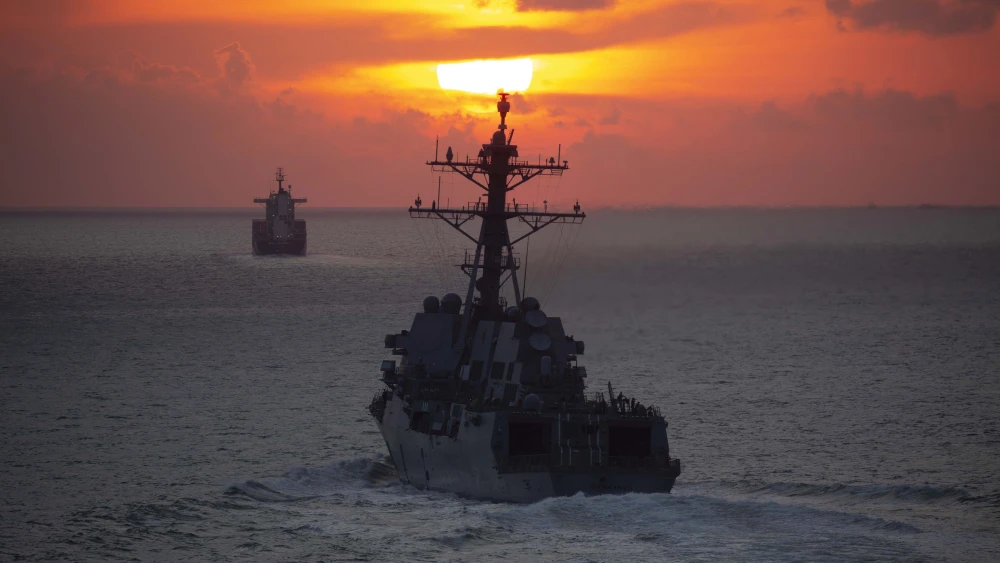
Photo: ARABIAN SEA - APRIL 20: (EDITOR'S
NOTE: This Handout image was provided by a third-party organization and
may not adhere to Getty Images' editorial policy.) In this handout photo
provided by U.S. Central Command, U.S. forces patrol the Arabian Sea
near M/V Touska on April 20, 2026, after firing upon the Iranian-flagged
vessel that the U.S. accused of attempting to violate the U.S. naval
blockade of Iranian ports near the Strait of Hormuz. (Handout Photo by
the U.S. Navy via Getty Images)