by Uzay Bulut
Designate Jamaat-e-Islami Bangladesh a Foreign Terrorist Organization, hold Muhammad Yunus to account.
It is high time for the Trump Administration officially to designate Jamaat-e-Islami Bangladesh a Foreign Terrorist Organization and hold Bangladesh's "interim" leader Muhammad Yunus to account.
Under Yunus's interim administration, Bangladesh has suffered a surge in Islamic radicalization and an alarming rise in attacks on minorities, particularly Hindus.
"The recent events in Bangladesh have resulted in radical Islamic fundamentalists launching an all-out attack on minority communities, particularly the Hindus," reported Insight UK. Other outlets have called the attacks "the Bangladesh Hindu Genocide."
The coalition [of Bangladeshis, Americans, Hindus, Buddhists, and Christians] also suggested linking Bangladesh's participation in United Nations peacekeeping missions to the cessation of internal ethnic and religious persecution. The memorandum also proposed a comprehensive Minority Protection Act, officially to recognize minorities and indigenous groups.
"Jamaat-e-Islami Bangladesh wields an economic power which enables it to act as a parallel state and an economy within the economy.... The main source of Jamaat income is the donations received from individuals and organizations.... These funds were not exclusively allocated for social welfare or religious activities; rather, they were also used to promote militancy and Islamic radicalism. It was noted that Mostaq Ahmed Khan, a former senator of Jamaat-e-Islami, managed to bring in money from a religious extremist group in Turkey. This funding was allegedly utilized to spread militancy and finance terrorism.... Jamaat's principal financial arm is Islami Bank of Bangladesh Ltd. (IBBL)... linked to powerful institutions of the Islamic World, among them is Al Razee Bank of Saudi Arabia." — Preeti Khenta, researcher, Usanas Foundation.
Meanwhile, at least 144 jihadist militants belonging to Ansarullah Bangla Team (ABT), Jama'atul Mujahideen Bangladesh, Hizb-ut-Tahrir and others, most of whom are directly connected to Al Qaeda in the Indian Subcontinent (AQIS) or Islamic State (ISIS), were released from prisons since Yunus was placed into the position of "Chief Advisor" of the interim government, reported Blitz on December 24, 2024.
The release also included Jashimuddin Rahmani, the chief of the ABT, a radical Islamic terror group affiliated with Al Qaeda that is behind the murders of several secular bloggers, writers and rights activists in Bangladesh.
Rahmani was convicted of abetting the murder of secular blogger Ahmed Rajib Haider in 2013. The news website FirstPost reported that the ABT has been attempting to form a jihadi network in India.
Yunus's interim government, regrettably, has a completely different set of rules for non-Muslims and opposition figures in the country.
[Chinmoy Krishna Das, a prominent Hindu monk]'s arrest followed wider crackdowns on religious minorities and protests by ISKCON against reported persecution of Hindus in Bangladesh, with other Hindu priests also detained.
The arrest of [Chinmoy Krishna Das, a prominent Hindu monk] followed wider crackdowns on religious minorities and protests by ISKCON against the persecution of Hindus in Bangladesh, with other Hindu priests also detained.
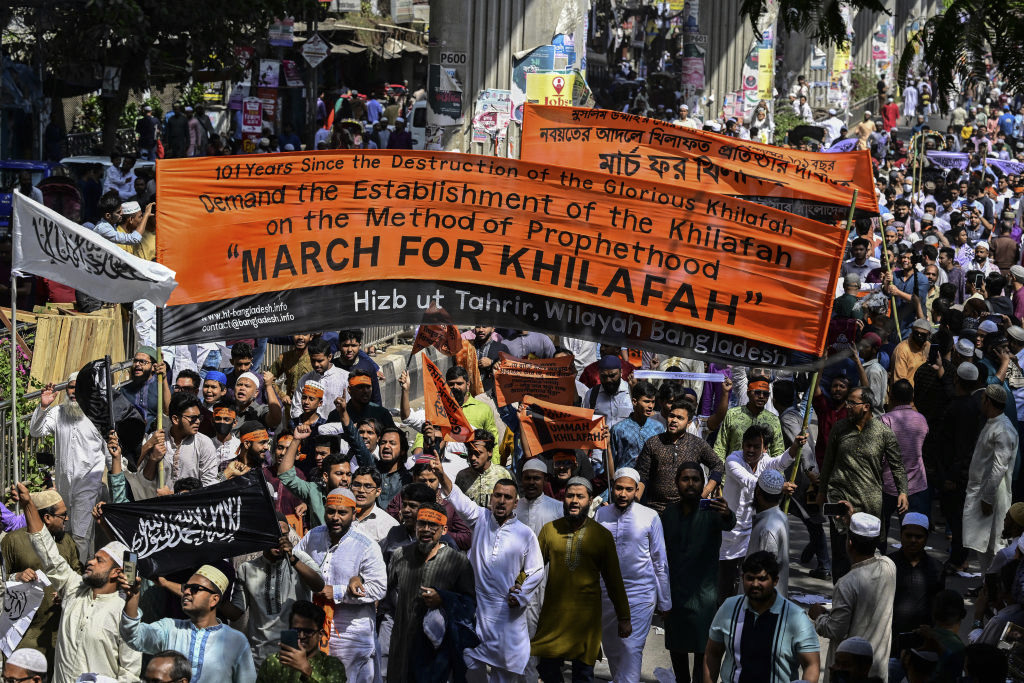
"Groups like Al-Qaeda in the Indian Subcontinent (AQIS) and Islamic State–Khorasan (ISK)... promote radical ideologies and rally support. AQIS has praised what it perceives as resistance to corruption and secularism. ISK has promoted jihad and conflict with India, emphasizing divine rewards for participation. Additionally, Islamic State's Al-Naba magazine called for an Islamic revival in Bangladesh, urging the youth to reject secularism, focus on ideological education, and fight injustice. Bangladesh's vulnerability to radicalization is compounded by local groups like Hizb ut-Tahrir-Bangladesh (HT-B). Despite being banned, HT-B continued to spread its propaganda online, holding multiple rallies and targeting youth, especially in schools and colleges, advocating for the establishment of a caliphate." — Iftekharul Bashar, research fellow at the International Centre for Political Violence and Terrorism Research, December 23, 2024.
Last week, a co-worker of a Hindu man, "a poor labourer," 25-year-old Dipu Chandra Das, falsely accused him of insulting Islam. A group of Muslims seized Das -- while he was under police protection -- falsely accused him of blasphemy, and beat him to death. Then, shouting "Allahu akbar!'," they tied Das's body to a tree and set it on fire.
There was no evidence whatsoever that Das committed blasphemy. According to Dr. Taslima Nasreen, who herself was forced to flee Bangladesh in 1994 over death threats, after she was accused of blasphemy:
"Dipu Chandra Das was the sole breadwinner of his family. With his earnings, his disabled father, mother, wife, and child survived. What will happen to them now? Who will help the relatives? Who will bring the mad murderers to justice? Dipu's family doesn't even have the money to flee to India to escape the jihadists' hands. The poor have no one. They have no country left, not even a religion left."
It is high time for the Trump Administration officially to designate Jamaat-e-Islami Bangladesh a Foreign Terrorist Organization and hold Bangladesh's "interim" leader Muhammad Yunus to account.
An Islamist group last week targeted the office of India's High Commission in Dhaka, the capital of Bangladesh. Footage from the scene shows protesters from a group – also linked to the July-August 2024 uprising in Bangladesh -- pulling away the police barricades.
Amid the deteriorating security situation and the hate speeches targeted at India, the Indian Visa Application Centre in Dhaka was temporarily shut down.
The move came hours after India summoned Bangladesh's High Commissioner in New Delhi, Muhammad Riaz Hamidullah, to issue a formal diplomatic protest over inflammatory anti-India statements from Bangladeshi political leaders and recent threats to India's High Commission in Dhaka.
Meanwhile, an elderly Hindu couple was found brutally murdered, their throats slit, at their home in Bangladesh's city of Rangpur. No criminal case has been filed or arrests made over the murder of the couple, whose two sons serve as police officers. The bodies of 75-year-old Jogesh Chandra Roy and his wife, Suborna Roy, were discovered on December 7 by neighbors after repeated knocks at their door went unanswered.
These attacks appear to be just the latest chapter in a war begun on March 25, 1971, when Pakistan's army began a campaign of genocide against the ethnic Bengali and Hindu communities in then East Pakistan (today's Bangladesh). There followed the 10-month Bangladesh Liberation War and later the 13-day Indo-Pakistan war. Both ended on December 16, 1971, with the surrender of Pakistan.
Pakistan, during the war, directed atrocities. Its army carried out much of the violence, with assistance from political parties and collaborators in East Pakistan such as the Islamist Jamaat-e-Islami (JeI).
Although precise figures are unavailable, approximately three million people were killed and at least 200,000 women raped. By November 1971, 10 million Bengalis, the majority of them Hindus, had fled to India.
Regarding the recent murder of the Hindu couple, Mohammad Ali Arafat, former Minister of Information and Broadcasting in the previous government and a member of the Bangladesh Awami League (AL), said that the recent incidents underscored increasing threats faced by freedom fighters and their families. He warned that under the rule of Bangladesh's "interim" leader, Muhammad Yunus, who is backed by the Jamaat-e-Islami, such attacks and killings have become more frequent.
"Freedom fighters in Bangladesh," said Arafat, who is now in exile, "are... being killed under the rule of Yunus, which is backed by the anti-liberation Islamist group Jamaat-e-Islami."
The Bangladesh Awami League (AL), a political party formed in 1949, led the movement for independence from Pakistan and became the ruling party upon the establishment of the People's Republic of Bangladesh in 1971.
Ujjawal Upadhyay, a researcher based in India, wrote:
"The administration in Bangladesh has always grappled with Islamist organizations even before the liberation war in 1971. A group called Jamaat-e-Islami (JeI) fought alongside the Pakistani Army to weed out various freedom fighters as they perceived them as a hindrance in achieving the caliphate."
Sheikh Hasina, the leader of the Awami League who was Bangladesh's prime minister until her forced resignation and flight on August 5, 2024, witnessed, under her tenure, some leaders of Jamaat-e-Islami tried and given death sentences by a special tribunal for the crimes of genocide, rape and orchestrating the massacre of top intellectuals during the 1971 war.
Three days later, an "interim government," led by the economist and Nobel Peace Prize laureate Muhammad Yunus, was formed with the support of various Islamic radical movements.
What led to Hasina's resignation was widespread student-led protests over the selection criteria for civil service jobs. The protests, which quickly evolved into an anti-government movement in July-August 2024, were swiftly taken over by Islamists, who began lynching and murdering policemen. Scores never reported back to duty. Reports suggest that Bangladesh still does not have a full, functioning police force more than a year later.
Under Yunus's interim administration, Bangladesh has suffered a surge in Islamic radicalization and an alarming rise in attacks on minorities, particularly Hindus.
The Bangladesh Hindu Buddhist Christian Unity Council documented more than 2,000 incidents of violence against minorities from August 4-20, 2024. At roughly the same time, at least 32 Hindus were murdered, and 13 incidents of rape and harassment against women were recorded, as well as 133 attacks on Hindi temples.
On December 29, 2024, a coalition of Bangladeshi-American Hindus, Buddhists, and Christians called on US President Donald J. Trump to intervene and help protect the minority communities in Bangladesh.
"The recent events in Bangladesh have resulted in radical Islamic fundamentalists launching an all-out attack on minority communities, particularly the Hindus," reported Insight UK. Other outlets have called the attacks "the Bangladesh Hindu Genocide."
The coalition warned that Bangladesh risks descending into radicalization, which could have far-reaching effects not only for South Asia but for the rest of the world as well. The coalition also suggested linking Bangladesh's participation in United Nations peacekeeping missions to the cessation of internal ethnic and religious persecution. The memorandum also proposed a comprehensive Minority Protection Act, officially to recognize minorities and indigenous groups.
Minority rights groups have reported that thousands of incidents of communal violence have since taken place in Bangladesh, even as Yunus has insisted that the accounts of anti-Hindu attacks are "exaggerated propaganda."
Sadly, Yunus's interim government has openly enabled the radical groups involved in the persecution of minorities. After taking over, the interim government overturned a ban on the Jamaat-e-Islami. According to researcher Preeti Khenta:
"Jamaat-e-Islami Bangladesh wields an economic power which enables it to act as a parallel state and an economy within the economy. In 2024 audit reports submitted to the Election Commission, the Bangladesh Jamaat-e-Islami recorded the highest income among 29 registered political parties.
"The main source of Jamaat income is the donations received from individuals and organizations. The Criminal Investigation Department (CID) of Bangladesh has revealed that between 2007 and 2018, a total of 620 million Taka in foreign donations was deposited into the account of the Bangladeshi Chashi Kalyan Samity. These funds were not exclusively allocated for social welfare or religious activities; rather, they were also used to promote militancy and Islamic radicalism. It was noted that Mostaq Ahmed Khan, a former senator of Jamaat-e-Islami, managed to bring in money from a religious extremist group in Turkey. This funding was allegedly utilized to spread militancy and finance terrorism in Baniachong Upazila of Habiganj from 2012 to 2016.
"The former Bangladesh Culture Minister Asaduzzaman Nur had already implied the involvement of Islamic fundamentalism behind the collection of huge funds from mosques and Bangladeshi establishments in London.... nearly 10 percent of Jamaat's annual profit in Bangladesh goes towards funding the party's political activities, which can sustain up to 60,000 cadres. The flow of money is expected to persist, as the Jamaat-controlled economy is already showing a growth rate of 9 percent per annum, surpassing the mainstream growth figure of 6 percent.
"Jamaat's principal financial arm is Islami Bank of Bangladesh Ltd. (IBBL), which was founded by Faud Abdullah Al-Khatib, the Saudi Arabian Ambassador to Bangladesh, in 1975. Notably, Mir Quasem Ali, a central executive committee member who was executed in 2016, was the former IBBL director. His involvement highlights that Jamaat-e-Islami was the beneficiary of all the Illegal acts of IBBL. IBBL is linked to powerful institutions of the Islamic World, among them is Al Razee Bank of Saudi Arabia. It is ranked as the third largest bank in South Asia, with 60 percent of its shares held by Saudi individuals and institutions, along with additional holdings from Kuwait, the UAE and Qatar.
"JeI's penetration into Bangladesh's political economy is astounding. In addition to the Islami Bank Bangladesh Limited (IBBL), Jamaat-e-Islami controls 14 other banks that primarily operate in rural areas. This situation highlights the reality of the JIB-led Islamic fundamentalist bloc in Bangladesh."
Meanwhile, at least 144 jihadist militants belonging to Ansarullah Bangla Team (ABT), Jama'atul Mujahideen Bangladesh, Hizb-ut-Tahrir and others, most of whom are directly connected to Al Qaeda in the Indian Subcontinent (AQIS) or Islamic State (ISIS), were released from prisons since Yunus was placed into the position of "Chief Advisor" of the interim government, reported Blitz on December 24, 2024. The release also included Jashimuddin Rahmani, the chief of the ABT, a radical Islamic terror group affiliated with Al Qaeda that is behind the murders of several secular bloggers, writers and rights activists in Bangladesh.
Rahmani was convicted of abetting the murder of secular blogger Ahmed Rajib Haider in 2013. The news website FirstPost reported that the ABT has been attempting to form a jihadi network in India.
Yunus's interim government, regrettably, has a completely different set of rules for non-Muslims and opposition figures in the country. Chinmoy Krishna Das, a prominent Hindu monk -- spokesman for the Bangladesh Sanatan Jagaran Mancha, and formerly of the "International Society for Krishna Consciousness" (ISKCON) Bangladesh -- was arrested on November 25, 2024 on sedition charges. He is accused of disrespecting Bangladesh's national flag during a rally in the city of Chittagong in October.
ISKCON has denounced the arrest, calling Das a "vocal advocate for minority protection". The arrest of Das followed wider crackdowns on religious minorities and protests by ISKCON against the persecution of Hindus in Bangladesh, with other Hindu priests also detained.
On October 28, 2024, radical Islamist groups in major Bangladeshi cities, such as Hefazat-e-Islam and Intifada Bangladesh, took to the streets and demanded a ban on ISKCON. The ABT's Rahmani attacked ISKCON with false claims, saying, "ISKCON is not a Hindu organisation. It is an extremist organisation created by Jews."
Iftekharul Bashar, a research fellow at the International Centre for Political Violence and Terrorism Research, notes:
"Bangladesh is facing an increasing threat of radicalism and terrorism. The political violence and instability of 2024 have worsened the situation, with extremist elements exploiting the security vacuum created by the regime change. Weakened law enforcement and intelligence agencies, along with the rise of armed groups and radical ideologies, pose a serious threat to the country's stability. Bangladesh risks long-term insecurity with broader regional implications without swift and decisive action.
"Following Hasina's recent fall from power, the political upheaval that erupted created a security breakdown. The chaos amidst the mass protests has provided extremists with opportunities to gain ground. Arms and ammunition looted from police stations have made their way into the hands of criminals and extremists. Over 5,800 weapons and 300,000 rounds of ammunition were stolen, and while some have been recovered, many remain unaccounted for, adding to the volatility.
"Groups like Al-Qaeda in the Indian Subcontinent (AQIS) and Islamic State–Khorasan (ISK) have exploited Bangladesh's political turmoil, making strategic statements to promote radical ideologies and rally support. AQIS has praised what it perceives as resistance to corruption and secularism. ISK has promoted jihad and conflict with India, emphasizing divine rewards for participation.
"Additionally, Islamic State's Al-Naba magazine called for an Islamic revival in Bangladesh, urging the youth to reject secularism, focus on ideological education, and fight injustice.
"Bangladesh's vulnerability to radicalization is compounded by local groups like Hizb ut-Tahrir-Bangladesh (HT-B). Despite being banned, HT-B continued to spread its propaganda online, holding multiple rallies and targeting youth, especially in schools and colleges, advocating for the establishment of a caliphate."
After the ousting of Hasina, Yunus's interim government has allowed Islamist radicals, jihadists and terrorists to fill the power vacuum in Bangladesh, leading to a surge in violence against religious minorities, women and secular citizens. Those radicals are now openly threatening India. Before a war breaks out between the two nations and terrorists from Bangladesh further destabilize South Asia, Bangladesh needs to establish a new, moderate, government that will be willing to battle Islamist fundamentalism, militancy and terrorism.
Uzay Bulut, a Turkish journalist, is a Distinguished Senior Fellow at Gatestone Institute.
Source: https://www.gatestoneinstitute.org/22130/bangladesh-hindu-genocide

No comments:
Post a Comment