by Con Coughlin
[W]hile Trump may be celebrating the decision by the UN Security Council to back his Gaza peace plan, he may soon find that turning it into reality may be an impossible task so long as Hamas terrorists remain in Gaza.
"What is the mandate of security forces inside of Gaza? And we hope that it is peacekeeping, because if it's peace enforcing, nobody will want to touch that.... [R]unning around Gaza on patrol with weapons, that's not a situation that any country would like to get involved in." — King Abdullah II of Jordan to the BBC, October 27, 2025.
The same is true for an international force, as the world has been witnessing in Lebanon. For nearly half a century.
It is a measure of the Trump administration's growing desperation to move to the next stage of its Gaza peace plan that it has even approached the legitimate government of war-torn Yemen to deploy troops, even though it has proved totally incapable of defending its own country from Iranian-backed Houthi rebels.
So while Trump may be celebrating the decision by the UN Security Council to back his Gaza peace plan, he may soon find that turning it into reality may be an impossible task so long as Hamas terrorists remain in Gaza.
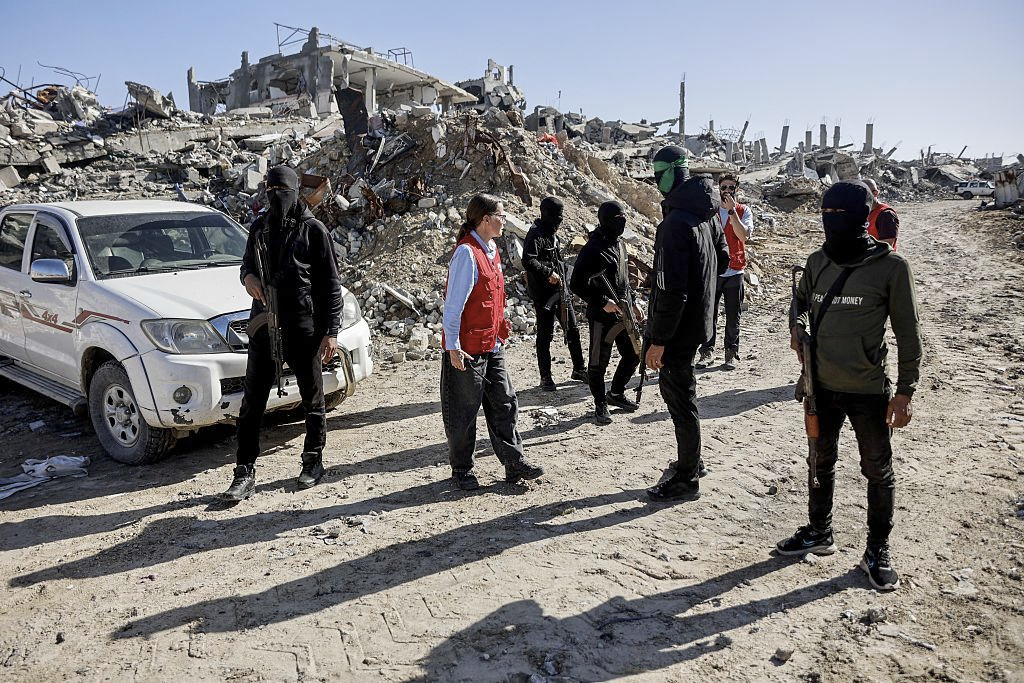
Donald Trump's hopes of establishing a permanent ceasefire in Gaza could be fatally compromised by his efforts to create an International Stabilization Force (ISF) to run the Gaza Strip in place of Hamas terrorists.
As part of Trump's wide-ranging plan to end the Gaza conflict, he has proposed the creation of a multinational force drawn from a number of Arab and Muslim states that will be mandated to maintain security in the enclave for an initial period of two years.
A critical part of the force's mission will be to disarm Hamas terrorists and end their two-decade-long reign of terror in Gaza. During that time, apart from brutalising the local population, they used the opportunity to launch a constant stream of terrorist attacks against Israel, culminating in the invasion of October 7, 2023.
It would be intolerable if Hamas's successor were to do the same.
The creation of Trump's proposed force has taken a significant step forward after the UN Security Council adopted a US-drafted resolution endorsing Trump's 20-point plan for ending the Gaza conflict and establishing an International Stabilization Force. The ISF would be responsible for overseeing the demilitarization of Gaza, including by decommissioning weapons and destroying terrorist infrastructure.
As part of this process, it would be tasked with ensuring the complete disarmament of Hamas.
However, as King Abdullah II of Jordan pointed out to the BBC in October:
"What is the mandate of security forces inside of Gaza? And we hope that it is peacekeeping, because if it's peace enforcing, nobody will want to touch that... [R]unning around Gaza on patrol with weapons, that's not a situation that any country would like to get involved in."
The same is true for an international force, as the world has been witnessing in Lebanon. For nearly half a century.
The resolution's text states that member states can also take part in Trump's plan for establishing a "Board of Peace", which would act as a transitional authority to oversee the reconstruction and economic recovery of post-conflict Gaza.
Trump celebrated the vote as "a moment of true Historic proportion" in a social media post. "The members of the Board, and many more exciting announcements, will be made in the coming weeks," Trump wrote.
Mike Waltz, the US Ambassador to the UN, said the resolution, which includes Trump's 20-point plan as an annex, "charts a possible pathway for Palestinian self-determination... where rockets will give way to olive branches and there is a chance to agree on a political horizon."
"It dismantles Hamas' grip, it ensures Gaza rises free from terror's shadow, prosperous and secure," Waltz told the council ahead of the vote. If only.
The UNSC resolution passed despite criticism from both Russia and China, which have veto powers at the Security Council. The Russian and Chinese delegations complained that the resolution does not give the UN a clear role in the future of Gaza. In the event, both countries abstained from the vote.
Nonetheless, even though Trump's Gaza peace plan now has the UN's formal backing, it is clear that he needs to overcome a number of significant obstacles for it to work, such as the failure of UNIFIL forces to control Hezbollah in Lebanon, and not least the fierce opposition the ISF concept has provoked from Hamas.
Responding to the UN vote, Hamas reiterated its insistence that it will not disarm, arguing that its fight against Israel constituted "legitimate resistance". Hamas also denounced the formation of a "Board of Peace", claiming in a statement that, "The resolution imposes an international guardianship mechanism on the Gaza Strip, which our people and their factions reject."
By contrast, the Palestinian Authority issued a statement welcoming the resolution, and said it is ready to take part in its implementation.
With extreme terrorist groups such as Hamas already condemning Trump's proposals for the next stage of the Gaza ceasefire, the White House may struggle to persuade Arab and Muslim countries to provide the troops needed to establish the multinational force.
Hamas claims that authorising the ISF to implement the complete disarmament of the terrorist organisation makes it a combatant acting on behalf of Israel, a declaration that all but guarantees the multinational force could easily find itself involved in a violent conflict with the Islamist group.
Hamas has already made clear, according to one report, that "The Palestinian people... will not allow any guardianship or the imposition of any external solutions or equations."
"Separately, the Popular Resistance Committees (PRC), a group allied with Hamas, says it considers any attempt to deploy international or other forces in Gaza as 'an aggression' and will deal with it as occupying forces."
Thus, while a number of Muslim-majority countries, including Indonesia, Azerbaijan and Egypt, have indicated their willingness to support the mission, they are wary of making any full commitment.
Although many of their leaders have expressed interest in undertaking a peacekeeping mission in Gaza, they are less enthusiastic about becoming involved in a full-blown war with Hamas.
If that happened, Trump's attempts to end the Gaza conflict will merely have succeeded in launching a new phase of fighting in the war-torn area.
The Trump administration, therefore, is likely to face significant difficulties in its efforts to establish the ISF. Several of Washington's allies, such as the United Arab Emirates and Jordan, have already declined to contribute militarily until there is clarity about the precise nature of the mission.
Turkey, meanwhile, which is willing to involve itself in Gaza, has been ruled out because of its pro-Hamas sympathies.
It is a measure of the Trump administration's growing desperation to move to the next stage of its Gaza peace plan that it has even approached the legitimate government of war-torn Yemen to deploy troops, even though it has proved totally incapable of defending its own country from Iranian-backed Houthi rebels.
So while Trump may be celebrating the decision by the UN Security Council to back his Gaza peace plan, he may soon find that turning it into reality may be an impossible task so long as Hamas terrorists remain in Gaza.
Con Coughlin is the Telegraph's Defence and Foreign Affairs Editor and a Distinguished Senior Fellow at Gatestone Institute.
Source: https://www.gatestoneinstitute.org/22081/trump-gaza-plan-risks-another-war

No comments:
Post a Comment