by Khaled Abu Toameh
One does not need to be an "expert" to understand that Qatar, despite its attempt to present itself as a neutral mediator between Israel and Hamas over the past two years, continues to be affiliated with the extremist ideology of the Muslim Brotherhood and Hamas. Unfortunately, this ideology considers non-Muslims (and Israel) as Enemy No. 1.
The meeting underscores Qatar's apparent eagerness to play a central role in post-war Gaza. As a long-time supporter and funder of the Muslim Brotherhood organization, the Qatari regime's main goal seems to be ensuring that Hamas remains in power in the Gaza Strip. Hamas describes itself as "one of the wings of the Muslim Brotherhood in Palestine."
One does not need to be an "expert" to understand that Qatar, despite its attempt to present itself as a neutral mediator between Israel and Hamas over the past two years, continues to be affiliated with the extremist ideology of the Muslim Brotherhood and Hamas. Unfortunately, this ideology considers non-Muslims (and Israel) as Enemy No. 1.
In his October 19 column in the Qatari government daily Al-Sharq, Ahmad al-Muhammadi, an imam and preacher in Qatar's Waqf Ministry, explained that the enmity between the Muslims and the Jews and Christians is existential and deeply rooted, and presented Islam as the truth and Christianity and Judaism as falsehood and heresy.
He went on to call on Muslims to beware of slogans of tolerance that are aimed at uprooting belief in Islam, and asserted that Islam is "a religion that neither compromises nor reconciles."
"Qatari Shura Council member Essa Al-Nassr said that October 7 was the beginning of the end of the Zionist state, presenting this as a divine promise mentioned in the Quran. He added that there can be no peace with the Jews, because their faith condones 'deception, the violation of agreements and lies' and they are 'slayers of the prophets.'" — MEMRI, September 15, 2025.
Researcher and political analyst Eitan Fischberger recently uncovered a series of posts in which Majed al-Ansari, advisor to the Qatari prime minister and spokesman for Qatar's Foreign Ministry, openly praised suicide bombings and called for Tel Aviv to burn.
In a recent speech, the Emir of Qatar, Tamim bin Hamad al-Thani, said that the five Hamas members Israel killed in an airstrike in Doha last September were "our brothers."
Qatari Education Minister Lowlah al-Khater has called Israel and the West an "ugly, racist, and vile civilization" She described Israel and its Western backers as a "mixture of ugliness, entrenched racism, and vile materialistic civilization."
Saudi Arabia, the United Arab Emirates and Bahrain are said to be "frustrated" by Washington's growing concessions to Qatar, their regional rival and a longtime supporter of the Muslim Brotherhood.
"It's a mistake to rely on Qatar, which backs the Muslim Brotherhood... [Qatar] will undermine deradicalization efforts and try to ensure that Hamas remains in the picture and returns to power in the not-so-distant future." — Unnamed Saudi diplomatic source, Israel Hayom, October 12, 2025.
Bringing Qatar into the Gaza Strip is effectively placing the fox inside a chicken coop. If Qatar is allowed to play a civilian or security role inside the Gaza Strip, this privilege would be seen by many Palestinians as a reward for Hamas and other Islamist terror groups. It will allow the terrorists worldwide to rearm and regroup, and enable Qatar to continue reasserting the policies of the Muslim Brotherhood throughout the Middle East – as well as in the US, where it has already exorbitantly bought influence. That purchase includes "economic commitments worth at least $1.2 trillion" in the US, the $400 million "flying palace" Boeing 747 jet, and "at least $100 billion" pumped into US universities.
Delegations from Qatar, Egypt and Turkey met in Cairo on November 25 to discuss implementation of the second phase of US President Donald J. Trump's plan for ending the war in the Gaza Strip, which erupted with the October 7, 2023 Hamas-led attack on Israel.
According to media reports, the meeting included the heads of the Egyptian and Turkish intelligence agencies, along with the prime minister of Qatar. They discussed "ways to intensify joint effort to ensure the successful implementation of the second phase of the plan," which includes the disarmament of Hamas, the establishment of a transitional Palestinian governance committee, and the deployment of an International Stabilization Force in the Gaza Strip.
The meeting underscores Qatar's apparent eagerness to play a central role in post-war Gaza. As a long-time supporter and funder of the Muslim Brotherhood organization, the Qatari regime's main goal seems to be ensuring that Hamas remains in power in the Gaza Strip. Hamas describes itself as "one of the wings of the Muslim Brotherhood in Palestine."
Qatar is the only Arab country that hosts the entire leadership of Hamas and that has been providing political and financial aid to the terror group since 2007.
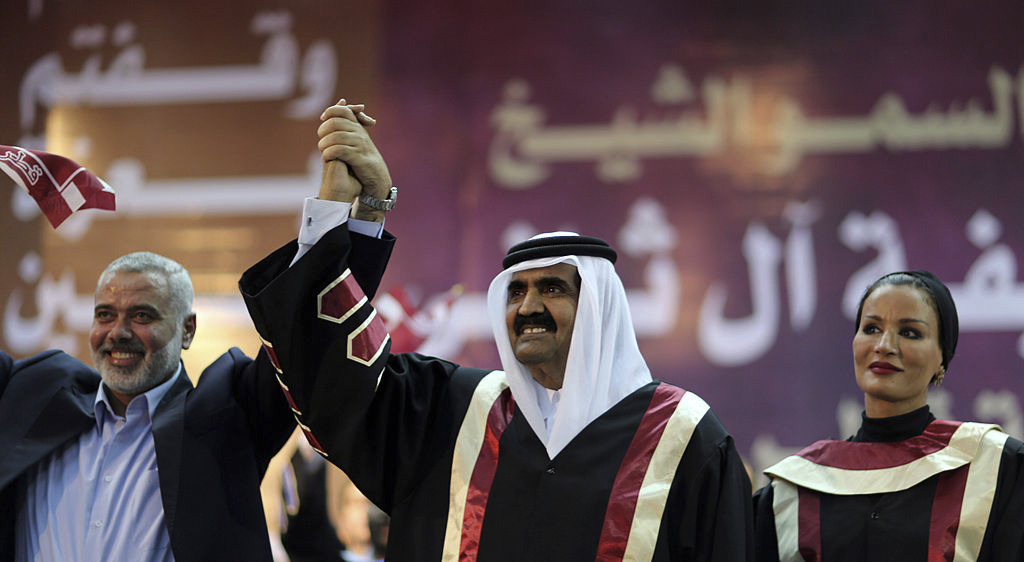
In 2012, former Qatari Emir Sheikh Hamad bin Khalifa Al-Thani was the first leader of a country to visit Gaza under Hamas rule. He pledged $400 million in assistance, and that same year Hamas was permitted to open a political office in Doha.
It is this Qatari (along with Iranian) support that enabled Hamas to stay in power for the past 18 years and launch its October 7, 2023 massacre, which resulted in the murder of some 1,200 Israelis and foreign nationals, the wounding of thousands, and the kidnapping of 251 hostages, the remains of two of whom have yet to be returned by Hamas.
Without Hamas, Qatar would lose a critical means of influence not only in the Palestinian areas but also in the region. The assumption that Qatar could play a role in maintaining peace or launching a process of deep deradicalization in the Gaza Strip is delusional.
One does not need to be an "expert" to understand that Qatar, despite its attempt to present itself as a neutral mediator between Israel and Hamas over the past two years, continues to be affiliated with the extremist ideology of the Muslim Brotherhood and Hamas. Unfortunately, this ideology considers non-Muslims (and Israel) as Enemy No. 1.
In his October 19 column in the Qatari government daily Al-Sharq, Ahmad al-Muhammadi, an imam and preacher in Qatar's Waqf Ministry, explained that the enmity between the Muslims and the Jews and Christians is existential and deeply rooted, and presented Islam as the truth and Christianity and Judaism as falsehood and heresy.
Stating that anyone who thinks this enmity – which he said stems from a variety of reasons involving a combination of faith, interests, history and geography – is transient is deluding himself, he went on to clarify that it would continue as long as Islam exists and "as long as the communities of unbelief persist in their deviation."
He stressed that a devout Muslim "realizes that today's conflict between Islam and its enemies is not just a battle over borders or interests, but a battle over values, ways of action, and the future." He went on to call on Muslims to beware of slogans of tolerance that are aimed at uprooting belief in Islam, and asserted that Islam is "a religion that neither compromises nor reconciles."
Such statements by Qatari officials should not surprise anyone. Since Hamas's October 7 massacre and throughout the Gaza war, Qatar, its media, and institutions affiliated with it have consistently expressed unreserved support for Hamas and for terrorism and armed violence against Israel. This support finds expression on all levels: in statements by officials and religious clerics, in the media and in Qatar's education system.
According to an investigative report by the Middle East Media Research Institute (MEMRI):
"Despite its ostensible role as a mediator between Hamas and Israel, Qatar, which has for years sheltered Hamas leaders within its borders and funded this organization with billions of dollars, has taken a blatantly pro-Hamas and anti-Israel line, as reflected in statements by members of the royal family and by Qatari politicians. Sheikha Moza bint Nasser, the mother of the Qatari Emir and the chair of the Qatar Foundation, implied that Israel had fabricated reports about Hamas' atrocities, and accused Israel of spreading false historical narratives that 'have taken over the collective mind of the world.' After the death of Hamas leader Yahya Sinwar, the architect of the October 7 massacre, Sheikha Moza eulogized him, saying that 'he will live on' while Israel will perish. Shortly after the October 7 massacre, Sheikha Hind, the Emir's sister and CEO of the Qatar Foundation, condemned Israel's 'murder and destruction' in Gaza while making no mention of the atrocities perpetrated by Hamas. Qatari Shura Council member Essa Al-Nassr said that October 7 was the beginning of the end of the Zionist state, presenting this as a divine promise mentioned in the Quran. He added that there can be no peace with the Jews, because their faith condones 'deception, the violation of agreements and lies' and they are 'slayers of the prophets.'
"Al-Jazeera, Qatar's flagship media network, has been operating as a propaganda outlet in the service of Hamas. It expresses unreserved support for this organization, justifying its October 7 attack, showing footage from it obtained from the terrorists' bodycams, and celebrating it as a victory that has brought pride and honor to the Islamic nation. The network has provided an unlimited platform for messages and threats by Hamas' leaders and spokespersons, and for their calls on Muslims worldwide to join the jihad against Israel. To wit, Hamas leader in Gaza Yahya Sinwar described Al-Jazeera as 'the best pulpit that accurately gives voice to our positions...'
"Moreover, it has been shown that some Al-Jazeera reporters took an active part in Hamas' October 7 invasion of Israeli localities, and some even served as Hamas field commanders. On their personal social media accounts and various other online platforms, Al-Jazeera's presenters and reporters are even more explicitly pro-Hamas and anti-Israel. They have openly praised Hamas and its October 7 attack, and expressed hope that this attack presages the complete liberation of Palestine and Israel's demise.
"A similar line is taken by other Qatari media and journalists, which likewise support and glorify Hamas and terror against Israel in general. This is conveyed in reports, opinion pieces, cartoons and even poems published by the various outlets, which describe October 7 as 'a magnificent and historic day' and call for further attacks of this sort, and claim that Israel's demise is a divine promise and is therefore inevitable. The articles also encourage Hamas to continue its missile attacks on Israel and kidnap more Israelis, and oppose the disarming of this organization."
Researcher and political analyst Eitan Fischberger recently uncovered a series of posts in which Majed al-Ansari, advisor to the Qatari prime minister and spokesman for Qatar's Foreign Ministry, openly praised suicide bombings and called for Tel Aviv to burn. In one post, al-Ansari praised the Second Intifada – the 2000-2005 Palestinian terror campaign – against the "Zionist enemy" and its "martyrdom operations" -- a euphemism for terrorist attacks.
In a recent speech, the Emir of Qatar, Tamim bin Hamad al-Thani, said that the five Hamas members Israel killed in an airstrike in Doha last September were "our brothers."
Qatari Education Minister Lowlah al-Khater has called Israel and the West an "ugly, racist, and vile civilization" She described Israel and its Western backers as a "mixture of ugliness, entrenched racism, and vile materialistic civilization."
Qatar poses a threat not only to Israel and the West, but also to many Arabs who are opposed to Islamist terror groups.
Saudi Arabia, the United Arab Emirates and Bahrain are said to be "frustrated" by Washington's growing concessions to Qatar, their regional rival and a longtime supporter of the Muslim Brotherhood. According to an October 12 report in the newspaper Israel Hayom:
"Over the past month, several key moderate Gulf states—Saudi Arabia, the UAE, and Bahrain—have found themselves sidelined. While they support Trump's initiative to end the war, they are unhappy with the major concessions made to Qatar, still their regional rival and a supporter of the Muslim Brotherhood, the Islamist movement that undermines Arab regimes. They are also uneasy about Washington's expanding defense agreements with Doha."
An unnamed Saudi diplomatic source told the newspaper: "It's a mistake to rely on Qatar, which backs the Muslim Brotherhood." He warned that "excessive Qatari involvement in the next stages of the plan and Gaza's reconstruction will cause Trump's plan to collapse," adding:
"Qatar's interests are different, it will undermine deradicalization efforts and try to ensure that Hamas remains in the picture and returns to power in the not-so-distant future."
Bringing Qatar into the Gaza Strip is effectively placing the fox inside a chicken coop. If Qatar is allowed to play a civilian or security role inside the Gaza Strip, this privilege would be seen by many Palestinians as a reward for Hamas and other Islamist terror groups. It will allow the terrorists worldwide to rearm and regroup, and enable Qatar to continue reasserting the policies of the Muslim Brotherhood throughout the Middle East – as well as in the US, where it has already exorbitantly bought influence. That purchase includes "economic commitments worth at least $1.2 trillion" in the US, the $400 million "flying palace" Boeing 747 jet, and "at least $100 billion" pumped into US universities.
- Follow Khaled Abu Toameh on X (formerly Twitter)
Khaled Abu Toameh is an award-winning journalist based in Jerusalem.
Source: https://www.gatestoneinstitute.org/22082/qatar-role-in-gaza

No comments:
Post a Comment