by Debra Nussbaum Cohen
“Wherever anti-Zionism has been normalized, it has led to an increase of hostilities toward Israel and the Jewish people,” Rabbi Ammiel Hirsch told JNS. “I would welcome the mayor waking up one day and understanding that.”
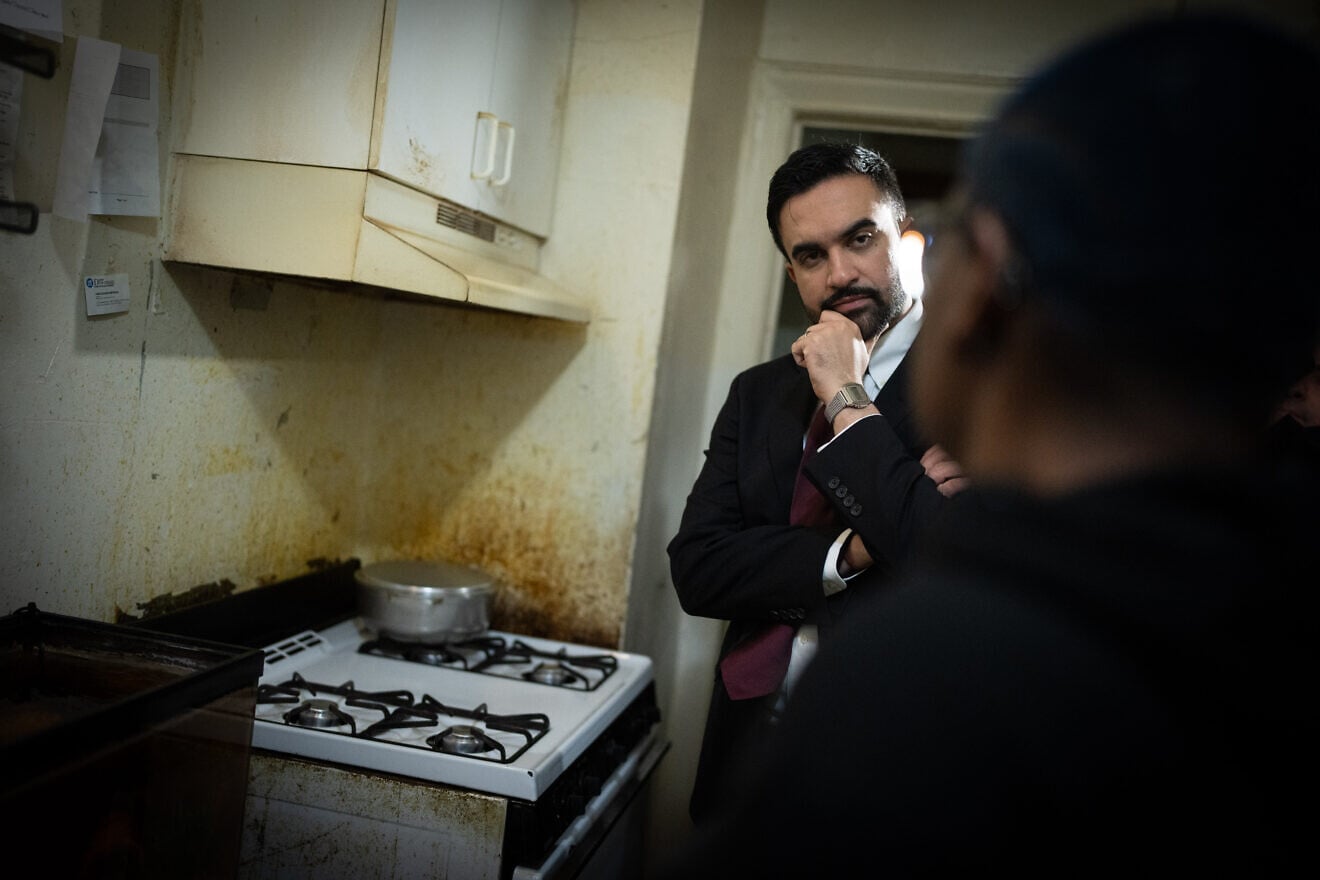
Within moments of Zohran Mamdani’s swearing in as New York City mayor at midnight on Jan. 1, Rabbi Ammiel Hirsch called JNS from Jerusalem, explaining that his worries about the safety of Jewish New Yorkers, due to Mamdani’s longstanding anti-Zionism and pledges to institute anti-Israel municipal policies, continue unabated.
Hirsch, with other rabbis, had two long meetings with the then mayor-elect in the months leading up to the inauguration, as Mamdani actively pursued connections with many of New York’s Jewish leaders. Several of the latter had warned publicly that his views, if put into practice as mayor, would pose dangers for Jewish New Yorkers by leading to more antisemitism, which has already increased dramatically since Oct. 7.
The New York City area is home to about 1.3 million Jews, second only to Israel’s greater Tel Aviv area.
Hirsch published a video in November addressing Mamdani directly.
“You call Zionism, the liberation movement of the Jewish people, a racist project and a colonial enterprise,” the rabbi said in the video. “You support Students for Justice in Palestine and co-founded its Bowdoin College chapter, a group that rejects co-existence and seeks the dismantling of Israel altogether. You have never disavowed these views. The opposite. You’ve doubled down on them.”
“Overwhelmingly, New York Jews support Israel and consider the Jewish state to be an important component of their Jewish identity,” he added in the video.
Hirsch told JNS that “the belief that Israel has no right to exist is an illiberal and intolerant ideology.”
The senior rabbi of the Stephen Wise Free Synagogue on Manhattan’s Upper West Side, which has some 860 member households, is also president of the New York Board of Rabbis, which has more than 800 members representing every denomination of Judaism. Mamdani met with the board’s executive leadership on Dec. 11.
“In every case, in every place, wherever anti-Zionism has been normalized, it has led to an increase of hostilities toward Israel and the Jewish people,” Hirsch told JNS. “I would welcome the mayor waking up one day and understanding that.”
Mamdani’s early appointees and policy choices as mayor are not inspiring confidence among leading New York City rabbis.
In his inauguration address, Mamdani told Jewish New Yorkers, “I will protect you.” He also suggested in an executive order that he intends to keep the Mayor’s Office to Combat Antisemitism, which his predecessor Eric Adams created in May 2025 in the wake of a surge in anti-Jewish hate crimes. The office issued its first annual report on Dec. 30.
But Mamdani also repealed the city’s adoption of the International Holocaust Remembrance Alliance’s working definition of Jew-hatred, which includes most forms of anti-Zionism, and his predecessor’s executive orders barring city officials and entities from boycotting Israel and calling for safe zones free of protesters near synagogues and other houses of worship.
While campaigning, Mamdani pledged to divest the city’s nearly $295 billion in managed pension funds from any investments in Israel and to oust the Technion: Israel Institute of Technology from the city’s Roosevelt Island, where it partners with Cornell University to offer a dual degree master of science program at the jointly-created Cornell Tech campus. He also said he would arrest Israeli Prime Minister Benjamin Netanyahu if the premier came to New York.
The New York City comptroller—and not the mayor—has control over pension investments, and experts say that Mamdani could not arrest Netanyahu in the manner he has pledged to do. Still, Mamdani’s messages have been read by much, though not all, of New York’s Jewish community as aggressively anti-Israel. To most mainstream rabbis, that is the same as antisemitic.
Mamdani is affiliated with the Democratic Socialists of America, which shortly after his victory published a document stating that “Zohran wasn’t afraid to say boldly what his voters and the majority of Americans believe: that Palestine should be free, and that the U.S. shouldn’t be complicit in Israel’s genocide.”
Days before his inauguration, Mamdani appointed attorney Ramzi Kassem as the city’s chief counsel. Kassem, 47, as a student, wrote anti-Israel articles for his campus newspaper and co-founded the City University of New York law school group Creating Law Enforcement Accountability and Responsibility.
With other lawyers from the group, Kassem represented Mahmoud Khalil, a Columbia University graduate detained by immigration authorities for leading the anti-Israel encampment at the university. Khalil was released after a federal judge found his detention unconstitutional, and he subsequently filed a lawsuit against the Trump administration, claiming $20 million in damages.
According to the ADL’s “Mamdani Monitor,” which is tracking appointments, policy decisions and statements by the city’s first Muslim mayor, 20% of the more than 400 appointees to his transition committees were linked to anti-Israel groups or “have a documented history of making anti-Israel statements.”
Mamdani has yet to name a Jewish liaison. Josh Binderman, who served in that role during the mayoral campaign, declined comment to JNS about whether he will stay on.
‘We need to build strong coalitions’
Rabbi Marc Schneier, spiritual leader of the Hampton Synagogue, a Modern Orthodox congregation on Long Island, has been outspoken about his opposition to Mamdani’s mayoralty. Schneier sees the new mayor as part of a Democratic Socialists of America “master plan to bifurcate Israel from the Jewish community,” he told JNS.
“The demonization of Israel and antisemitic tropes like saying that Israel engages in apartheid and genocide only lead to antisemitic attacks,” Schneier said. (Mamdani’s spokeswoman responded to protesters blocking Jews from entering Park East Synagogue in Manhattan, where Schneier’s father is the longtime rabbi, by saying that Jews shouldn’t violate international law by hosting pro-Israel events in shuls.)
Mamdani won the election with just under 51% of the vote. That reportedly included 33% of the Jewish vote, despite strong efforts by some rabbis to persuade congregants to vote for a different candidate. Among voters between 18 and 29, 75% voted for Mamdani, including Jewish young voters, exit polls and analyses indicated.
The most prominent rabbi to support the mayor’s candidacy has been Rabbi Sharon Kleinbaum, senior rabbi emerita of Congregation Beit Simchat Torah, the world’s largest LGBT synagogue.
The Reconstructionist rabbi is also a co-founder of the liberal Zionist group New York Jewish Agenda and director of the Beacon, a project of Union Theological Seminary, which is organizing citizens to advocate for “compassionate democracy.”
“I am a Zionist, and he knows that,” Kleinbaum told JNS of Mamdani. “We have had a lot of discussions about Israel. I do not believe that he is personally antisemitic and am willing to be in discussions with him.”
Kleinbaum backed him publicly during his campaign and spoke at one of his final campaign rallies in the Forest Hills neighborhood of Queens.
She is supporting Mamdani because “he can inspire a new generation to be involved in good government, and New York desperately needs that right now.”
“Jews are safe when there is a strong democracy that protects minorities, and democracy is strong when Jews are safe,” she said. “We need to build strong coalitions. We can’t be isolated as Jews.”
A New York City government official, who spoke anonymously to protect his job, told JNS that vociferous opposition to Mamdani in some quarters is working against Jewish interests. “They’re breaking up their own coalition by being so extreme,” he said.
Mamdani found support in Williamsburg, Brooklyn, among Satmar Chassidim, united in their shared anti-Zionism. In October, he visited two sukkahs in the fervently religious community—each hosted by the leader of a different faction of the famously fractious Satmar community.
In December, Mamdani joined thousands of Satmar men in a Brooklyn armory, where they celebrated the 81st anniversary of their founder, Rabbi Joel Tetlebaum’s escape from Nazi-occupied Europe. Mamdani’s campaign later posted a clip of the event on the mayor’s Facebook page.
The mayor’s Jewish outreach tour has not been enough to assuage the concerns of many leading New York rabbis.
“I used to be very concerned” about the prospect of a Mayor Mamdani, Rabbi Shaul Robinson, senior rabbi of the Manhattan Modern Orthodox congregation Lincoln Square Synagogue, told JNS. “Now I am extremely concerned.”
‘Anti-Zionism central to his candidacy’
Rabbi Elliot Cosgrove, spiritual leader of Park Avenue Synagogue, a prominent Conservative congregation in Manhattan, has been another of Mamdani’s most vocal opponents. Cosgrove is also vice president of the New York Board of Rabbis and rabbinical adviser on interfaith affairs for the Anti-Defamation League.
Cosgrove gave a widely viewed sermon in October, in which he said, “I believe Zohran Mamdani poses a danger to the security of the New York Jewish community.”
“Mamdani’s refusal to condemn slogans like ‘globalize the intifada,’ his denial of Israel’s legitimacy as a Jewish state, his call to arrest Israel’s prime minister should he enter New York and his thrice repeated accusation of genocide” in the recent mayoral debate, he added in the sermon, “for these and so many other statements past, present and unrepentant, he is a danger to the Jewish body politic of New York City.”
Speaking with Mamdani multiple times over the past few months has not allayed his concerns, Cosgrove told JNS.
“It isn’t only the Zionist community, but New York is home to more Israeli expats than any city outside of Israel itself,” he said. “His anti-Zionism was central to his candidacy.”
“We’ll wait and see what he operationalizes,” the rabbi added. “Regardless, it is deeply problematic that his rhetoric gives a green light to those who would intimidate the Jewish community of New York by word and by deed.”
The Hampton Synagogue’s Schneier has longstanding ties with Muslim leadership overseas and in the United States and takes members of his 500-household congregation annually to an Arab or Muslim country. This year it was to Azerbaijan. In previous years, it was Saudi Arabia and Bahrain.
Schneier told JNS that most of the Arab world has endorsed the notion of a two-state solution, or an official Palestinian entity beside Israel, which implicitly recognizes Israel’s right to exist.
“When it comes to supporting Israel and the two-state solution, this is what they believe, while the mayor of the city of New York, with the second largest Jewish population in the world, won’t even accept Israel’s right to exist,” he said. “It’s just twisted. It is sad that so many, including Jews, are falling for this.”
Debra Nussbaum Cohen
Source: https://www.jns.org/nyc-rabbis-alarmed-by-mamdanis-first-actions-appointments-as-mayor/

No comments:
Post a Comment