by Yaakov Lappin
Former national security adviser Jacob Nagel, whose committee shaped the PM’s arms investment plan, tells JNS that "Israel needs independence."
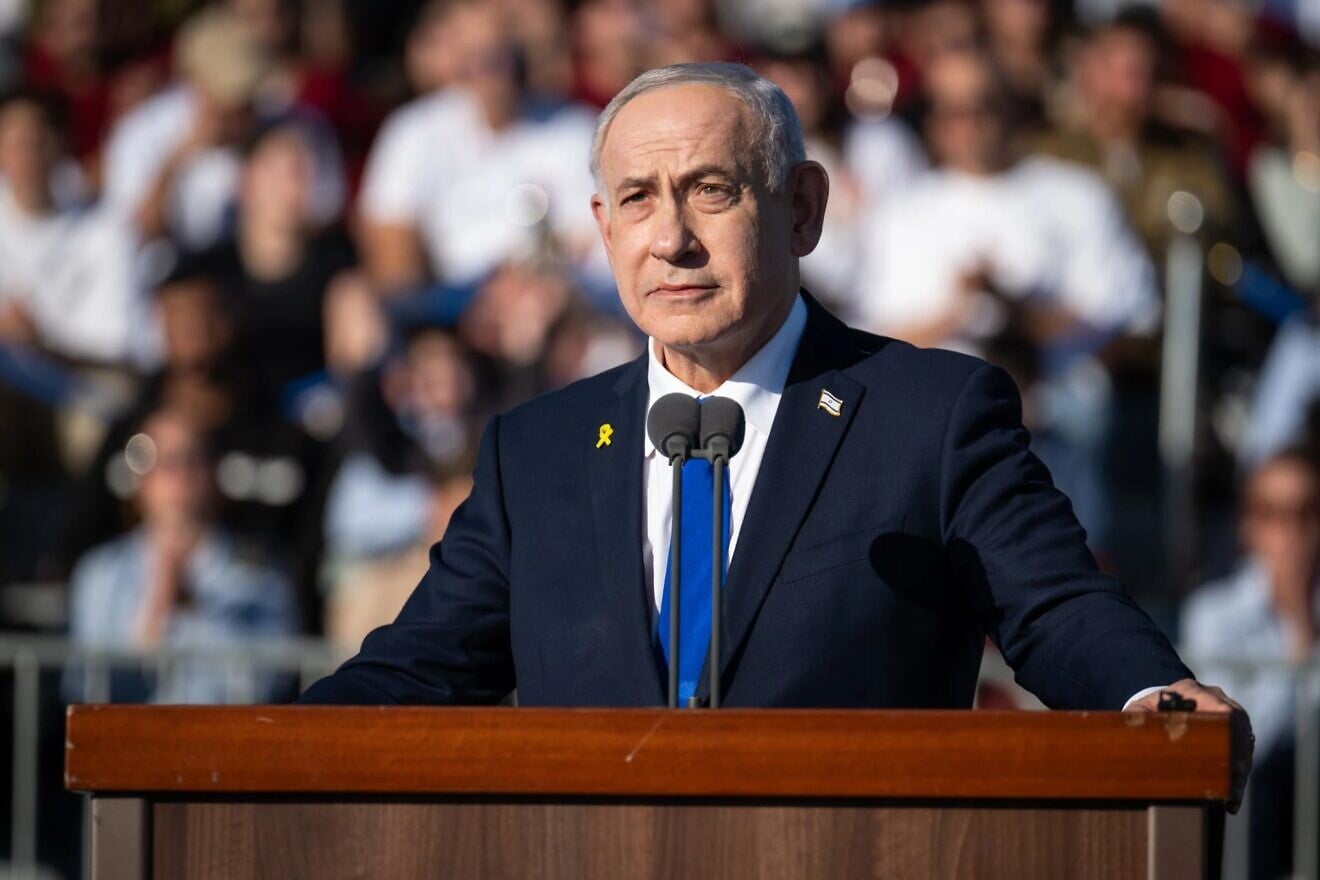
Israeli Prime Minister Benjamin Netanyahu recently committed Israel to a 350 billion-shekel ($110 billion) investment over the next decade to boost independence in critical arms production.
The announcement, detailed during a meeting of defense chiefs at Shin Bet headquarters on Dec. 25, came one day after the prime minister, at an Israeli Air Force graduation ceremony, stated that he had approved, along with the defense minister and finance minister, a sum of 350 billion shekels “over the next decade to build an independent Israeli munitions industry. We want to reduce the dependency on any party, including allies.”
The announcement aligns directly with the results of a report produced by a committee, headed by Brig. Gen. (res.) Professor Jacob Nagel, former head of Israel’s National Security Council, published on Dec. 31, 2024.
The Nagel Committee for Examining the Defense Budget identified Iran as the main enemy Israel must prepare for in the coming years, adding, however, that “our area is characterized by rapid changes and we must be ready for all of them, to one extent or another, with the appropriate caution.”
Nagel, today a senior fellow at the Washington D.C.-based Foundation for Defense of Democracies (FDD) and a former acting national security adviser to Netanyahu, told JNS on Monday that following the recommendations of his committee, the country would focus the building of its defense industrial base “in the areas that Israel needs independence.”
Israel “cannot allow itself to repeatedly end up in a situation where it cannot buy what it needs, whether it’s not sold, or simply because there is no one to buy from due to large global demand,” he said. “In some of the cases, a hybrid [production and import] capability will be built.”
Nagel added that Israel will continue to depend on the United States for the procurement of platforms like fighter jets, though not on armored vehicles or unmanned aerial vehicles. “In the rest of the areas, a parallel, hybrid system will be built,” he stated.
According to the Nagel Committee’s final report, the Israeli security concept must be supported by an independent industrial base built up through investing in 70% offensive capabilities and 30% defensive capabilities, while noting that some aerial platforms can be used for both offense and defense.
This ratio, the report said, would place Israel in a more comfortable position to deal with the main known and developing threats, since the offensive capabilities would offer greater flexibility.
Nagel, writing in Maariv on Dec. 27, explained that the 350 billion-shekel figure included a 250 billion-shekel budgetary addition and 100 billion shekels from independent sources.
He added that the figures, close to the sum his committee had recommended, are based on the assumption that the new forthcoming Memorandum of Understanding (MOU) that defines the next decade’s American defense assistance to Israel would be similar in scope to the previous MOU, which provided Israel with USD 3.8 billion worth of assistance per year (money that must be spent in American defense industries).
Half of this sum has already been earmarked for purchasing new fighter jet squadrons, he stated. While Israel’s Gross National Product of USD 60,000 is higher than Germany, France, and Britain, none of those countries has had to fight a war costing $100 billion, or is threatened by seven fronts, or needs to spend more than 5% of its GNP on defense.
This push for self-sufficiency was accelerated by arms embargoes, full and partial, faced by Israel during the Gaza war, where allies such as the U.K., Canada, and even the U.S., under the Biden administration at times, delayed or reviewed shipments of essential munitions, including essential air-to-ground bombs and D9 armored bulldozers.
Israel’s move occurs during a profound shift in Washington’s own strategic outlook. In November, the White House released its “2025 National Security Strategy,” which outlines U.S. priorities for the coming years, emphasizing a doctrine of burden sharing and transactional realism.
It explicitly states that while Israel’s security remains a core U.S. interest, Washington expects its capable allies to take primary responsibility for their own defense regions.
“We want the world’s most robust industrial base,” the White House strategy document reads, signaling a focus on American domestic renewal while encouraging allies to do the same.
“We want to prevent an adversarial power from dominating the Middle East, its oil and gas supplies, and the chokepoints through which they pass while avoiding the ‘forever wars’ that bogged us down in that region at great cost; and we want to ensure that U.S. technology and U.S. standards—particularly in AI, biotech and quantum computing—drive the world forward,” said the document.
In January 2025, Israel’s Defense Ministry signed two landmark deals with Elbit Systems worth over $275 million to establish a domestic factory for heavy air munitions and a national raw materials plant.
The Defense Ministry said that “these strategic agreements are crucial for enhancing the IDF’s operational endurance and force build-up capabilities. They represent a central lesson learned from the war.”
Yaakov Lappin is an Israel-based military affairs correspondent and analyst. He is
the in-house analyst at the Miryam Institute; a research associate at
the Alma Research and Education Center; and a research associate at the
Begin-Sadat Center for Strategic Studies at Bar-Ilan University. He is a
frequent guest commentator on international television news networks,
including Sky News and i24 News. Lappin is the author of Virtual Caliphate: Exposing the Islamist State on the Internet. Follow him at: www.patreon.com/yaakovlappin.
Source: https://www.jns.org/israel-cant-again-find-itself-unable-to-buy-what-it-needs/

No comments:
Post a Comment