by Salah Uddin Shoaib Choudhury
The party's reaction to Khamenei's death therefore aligns with a broader Brotherhood pattern: portraying Islamist leaders as martyrs, condemning Western military intervention, and mobilizing street sentiment against perceived external aggression.
While Jamaat has often participated in electoral politics, its long-term objective has remained unchanged: the establishment of a theocratic state under Islamic jurisprudence.
Within hours of the news [of Iranian Supreme Guide Ayatollah Ali Khameni's elimination].... Jamaat-e-Islami...[s]enior leaders delivered speeches accusing the United States and Israel of "murder" and calling for mass mobilization.
Even though organizationally separate, the Muslim Brotherhood and Jamaat have maintained ideological synergy and periodic cooperation across South Asia and the Middle East. Both movements frame global politics as a civilizational struggle between Islamic governance and Western liberalism
The party's reaction to Khamenei's death therefore aligns with a broader Brotherhood pattern: portraying Islamist leaders as martyrs, condemning Western military intervention, and mobilizing street sentiment against perceived external aggression.
In Pakistan, Jamaat-e-Islami Pakistan issued statements condemning the US and praising Khamenei. Pakistani Prime Minister Shehbaz Sharif publicly expressed condolences, referring to Khamenei as a "martyr," signaling Islamabad's diplomatic tilt toward Tehran....
In India, Jamaat-e-Islami Hind characterized the US-Israeli strikes as aggression and described Khamenei in reverential terms.
China's engagement with Islamist political actors is not ideological but strategic... that Jamaat's anti-American rhetoric may not merely be reactive but part of a broader geopolitical appraisal.
Historically, some Western policymakers have viewed Islamist parties as "moderate" alternatives to more violent jihadist factions. However, the Brotherhood's track record across the Middle East -- from Egypt to Gaza -- illustrates that participation in elections does not necessarily equate to ideological moderation.
Jamaat's present mobilization over Khamenei underscores that its core worldview remains rooted in a civilizational narrative that positions the United States as an adversary.
Even media outlets such as Al Jazeera have continued narratives sympathetic to Iran.
By framing Khamenei's death as martyrdom and Western aggression, they reinforce their narrative of global Islamic victimhood.
The danger lies not only in street protests but in gradual ideological conditioning. By presenting Iran's theocratic regime as a victim of Western aggression, Jamaat implicitly legitimizes clerical rule and the fusion of religion and state power.
The protests over Khamenei's elimination are not merely about Iran. They are about ideology.
For policymakers in Washington, Brussels, and New Delhi, the lesson should be clear: political Islam movements cannot be evaluated solely through electoral participation, diplomatic engagement or even promises of prosperity. Their doctrinal commitments matter. The events unfolding in Bangladesh demonstrate that beneath tactical flexibility lies an enduring ideological project -- one that continues to view global politics through the lens of religious sovereignty and civilizational struggle for global control.
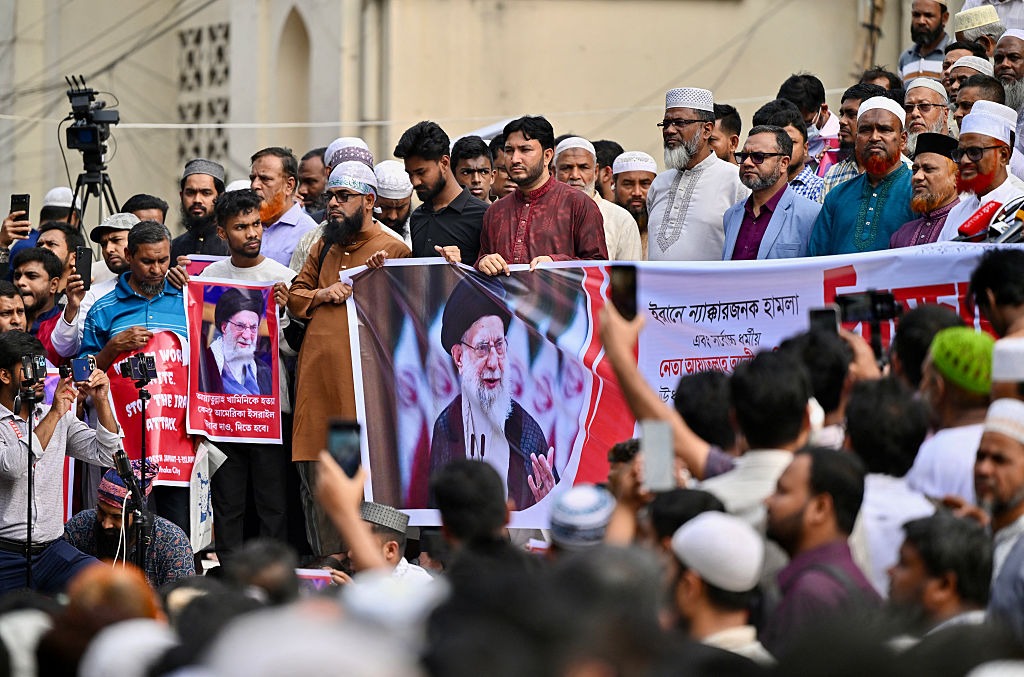
The elimination of Iran's Supreme Leader, Ali Khamenei, in a joint US-Israeli military operation has triggered a predictable wave of outrage against the West across hardline Islamist networks.
In Bangladesh, however, the reaction has revealed something deeper and more consequential: the enduring ideological character of Jamaat-e-Islami, not yet designated as a Foreign Terrorist Organization by the United States, and its strategic alignment with transnational Islamist movements such as the Muslim Brotherhood.
For decades, Jamaat-e-Islami has sought the gradual transformation of Bangladesh into a Sharia-governed Islamic state. Its founders were directly inspired by the ideological framework of Abul A'la Maududi, whose writings paralleled and intersected with the Brotherhood's vision of an Islamic order governed not by popular sovereignty but by divine law. While Jamaat has often participated in electoral politics, its long-term objective has remained unchanged: the establishment of a theocratic state under Islamic jurisprudence.
The events following Khamenei's death have exposed the party's ideological reflexes. Within hours of the news, Jamaat-e-Islami and its affiliated student wings began organizing protest rallies, funeral prayers (Janaza), and processions across major cities and university campuses in Bangladesh. Senior leaders delivered speeches accusing the United States and Israel of "murder" and calling for mass mobilization.
This was not spontaneous grief. It was ideological theater. The spectacle extended beyond Sunni Islamist circles. Members of Bangladesh's Shia community organized a protest procession from the principal Shia religious center in Dhaka, Hussaini Dalan Imambara. During the march, demonstrators chanted slogans condemning the United States. The Imambara has historically maintained connections with Iran's diplomatic mission in Dhaka, underscoring Tehran's long-standing religious and cultural outreach in Bangladesh.
Such mobilization is consistent with Jamaat's ideological lineage. Although Bangladesh is a Sunni-majority nation, the party has demonstrated tactical flexibility in aligning with Shia Iran when strategic interests converge - particularly in opposing the United States and Israel. Ideological differences between Sunni Brotherhood movements and Iran's clerical regime have historically been secondary to shared hostility toward "Western liberalism" and "Zionism".
To understand Jamaat's posture, one must revisit its roots. The Muslim Brotherhood, founded in Egypt in 1928, articulated a revolutionary doctrine that fused religion and state power. It rejected secular nationalism and promoted the restoration of an Islamic polity governed by Sharia. Maududi's Jamaat-e-Islami, established in British India in 1941, developed a framework parallel to that of the Muslim Brotherhood, that called for an "Islamic revolution" through gradual social Islamization and political activism.
Even though organizationally separate, the Muslim Brotherhood and Jamaat have maintained ideological synergy and periodic cooperation across South Asia and the Middle East. Both movements frame global politics as a civilizational struggle between Islamic governance and Western liberalism.
Jamaat-e-Islami Bangladesh has never formally renounced this objective. Its political participation has functioned as a tactical means rather than an ideological transformation. The party's reaction to Khamenei's death therefore aligns with a broader Brotherhood pattern: portraying Islamist leaders as martyrs, condemning Western military intervention, and mobilizing street sentiment against perceived external aggression. Jamaat's branches in neighboring countries followed suit.
In Pakistan, Jamaat-e-Islami Pakistan issued statements condemning the US and praising Khamenei. Pakistani Prime Minister Shehbaz Sharif publicly expressed condolences, referring to Khamenei as a "martyr," signaling Islamabad's diplomatic tilt toward Tehran despite its complex strategic balancing act.
In India, Jamaat-e-Islami Hind characterized the US-Israeli strikes as aggression and described Khamenei in reverential terms. These synchronized reactions reflect a transnational ideological network rather than isolated national responses.
Additionally, after a 2024 upheaval widely described by critics as a "jihadist coup", Jamaat has reportedly strengthened ties with Beijing. In September 2024, China's Ambassador to Bangladesh, Yao Wen, met Jamaat's emir Shafiqur Rahman and described the party as a "well-organized political force". Subsequent exchange visits between Jamaat representatives and Chinese counterparts signaled a deepening relationship.
China's engagement with Islamist political actors is not ideological but strategic. Beijing's priority is influence and leverage, particularly in regions of geopolitical competition. For Jamaat, Chinese recognition offers international legitimacy at a time when relations with Western policymakers appear uncertain. This evolving alignment suggests that Jamaat's anti-American rhetoric may not merely be reactive but part of a broader geopolitical appraisal.
Problematically, weeks before Bangladesh's February 12 general elections, The Washington Post published a report citing an unverified audio clip suggesting that Washington preferred Jamaat-e-Islami in power. Although unconfirmed, the claim fueled speculation about US strategic calculations in South Asia. The Washington Post's affection towards Islamists is not new. After the elimination of Khamenei, it affectionately mentions the murderous Iranian mullah as "avuncular" with "bushy white hair and easy smile".
Historically, some Western policymakers have viewed Islamist parties as "moderate" alternatives to more violent jihadist factions. However, the Brotherhood's track record across the Middle East -- from Egypt to Gaza -- illustrates that participation in elections does not necessarily equate to ideological moderation.
Jamaat's present mobilization over Khamenei underscores that its core worldview remains rooted in a civilizational narrative that positions the United States as an adversary.
The regional response to the strikes on Iran has also revealed troubling patterns. Despite decades of Iranian destabilization across the Middle East -- through proxies such as Hezbollah, Hamas, and Houthi movement -- few Muslim-majority governments have openly criticized Tehran's actions. Even media outlets such as Al Jazeera (such as here and here) have continued narratives sympathetic to Iran.
French President Emmanuel Macron issued a statement emphasizing stability but avoided addressing the Iranian people's decades-long repression. Meanwhile, geopolitical caution appeared to outweigh normative commitments to democratic transformation.
For Islamist movements like Jamaat-e-Islami, this ambiguity provides rhetorical space. By framing Khamenei's death as martyrdom and Western aggression, they reinforce their narrative of global Islamic victimhood.
Bangladesh occupies a sensitive geopolitical position. It is a Muslim-majority democracy with significant economic ties to the West and strategic importance in the Indo-Pacific.
The convergence of Jamaat-e-Islami with more overtly radical groups -- including Hizb-ut-Tahrir, Hefazat-e-Islam, and others -- raises concerns about the normalization of extremist discourse. While these groups differ in tactics, their shared commitment to Sharia governance creates ideological continuity.
The danger lies not only in street protests but in gradual ideological conditioning. By presenting Iran's theocratic regime as a victim of Western aggression, Jamaat implicitly legitimizes clerical rule and the fusion of religion and state power.
The protests over Khamenei's elimination are not merely about Iran. They are about ideology. Jamaat-e-Islami's reaction reflects a worldview shaped by the Muslim Brotherhood's foundational doctrines: rejection of secular governance, hostility toward Western liberalism, and aspiration for a Sharia-based order. Its willingness to align rhetorically with Iran's clerical regime -- despite sectarian differences -- underscores the primacy of ideological convergence over theological division. For policymakers in Washington, Brussels, and New Delhi, the lesson should be clear: political Islam movements cannot be evaluated solely through electoral participation, diplomatic engagement or even promises of prosperity. Their doctrinal commitments matter. The events unfolding in Bangladesh demonstrate that beneath tactical flexibility lies an enduring ideological project -- one that continues to view global politics through the lens of religious sovereignty and civilizational struggle for global control.
Salah Uddin Shoaib Choudhuryis an award-winning journalist, writer, and Editor of the newspaper Blitz. He specializes in counterterrorism and regional geopolitics. Follow him on X: @Salah_Shoaib
Source: https://www.gatestoneinstitute.org/22316/bangladesh-islamic-extremism

No comments:
Post a Comment