by Gordon G. Chang
Beijing has had Canada in its sights for a long time, and it has not limited its threatening activities to the seas.
Russia, despite all the horrible things it does, is not able to challenge Canada without its partner. Carney was quick to name China as the biggest security threat to his country during a federal election debate last April. At Davos, however, he was not willing to talk about China posing a danger to his country.
Carney had it right the first time: Canada's top threat is China.
At the top of the world, Russia and China are close partners.
China is now studying and surveying Arctic waters to help its submarines both navigate and evade detection.
Beijing has had Canada in its sights for a long time, and it has not limited its threatening activities to the seas.
"Canada's underfunding stems from post-Cold War complacency, reliance on the U.S., and prioritization of social programs over military defense." — Charles Burton, Sinopsis think tank, to Gatestone, January 2026.
"Russia is without question a threat in the Arctic," Canadian Prime Minister Mark Carney said this month at the World Economic Forum in Davos. "Without question, Russia does lots of horrible things."
Russia, despite all the horrible things it does, is not able to challenge Canada without its partner. Carney was quick to name China as the biggest security threat to his country during a federal election debate last April. At Davos, however, he was not willing to talk about China posing a danger to his country.
Moreover, his foreign affairs minister was similarly reluctant. Anita Anand in Davos did not name names when reporters asked her to cite the top threat facing Canada.
Carney had it right the first time: Canada's top threat is China.
Before showing up at Davos, Canada's prime minister traveled to Beijing where he agreed to a trade deal and mentioned a "new world order."
He also spoke of a "Canada-China new Strategic Partnership in the spirit of mutual respect, equality, and mutual benefit to bring more positive outcomes to both peoples."
Some say Carney genuinely believes his country should be aligned with China, and others think his trip to the Chinese capital was merely a bargaining tactic to get U.S. President Donald Trump to back down from his increasingly dire-sounding trade threats. In either case, the Canadian leader is soft-pedaling a real danger to Canada, especially in the Arctic.
At the top of the world, Russia and China are close partners.
In 2024, the Chinese and Russian militaries flew planes on patrols near Alaska for the first time. Chinese bombers took off and landed from a Russian airfield.
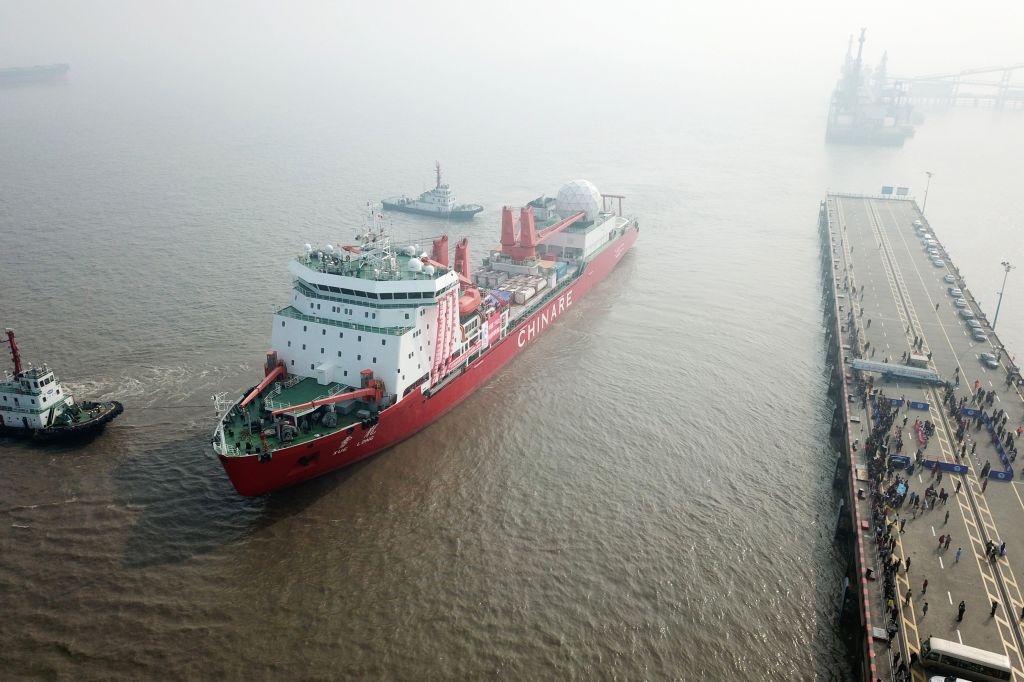
Also for the first time, Chinese research submarines traveled beneath Arctic ice last summer. China is now studying and surveying Arctic waters to help its submarines both navigate and evade detection.
China, within a few years, will be able to send armed submarines to the North Pole. There, they will be close to potential North American targets.
China is also patrolling the Arctic with Coast Guard vessels, which, despite being painted in civilian white, resemble gray-hulled navy frigates.
Beijing has had Canada in its sights for a long time, and it has not limited its threatening activities to the seas.
"While much of the focus on China and the Arctic has been about maritime areas, for years Beijing has worked on developing people-to-people ties on land, for example with Canadian First Nations, which own or control vast tracts of land," Cleo Paskal of the Foundation for Defense of Democracies told Gatestone this month. "The Chinese talked about commonalities, including the possibility of being 'related,' as the first Canadians came across the Bering Strait from Asia."
In the fall of 2008, Paskal reports, more than two dozen First Nations chiefs and representatives traveled to China. According to the delegation head, Chief Calvin Helin, "to be greeted and hosted at the level we were is quite unbelievable and quite historic."
Historic? Yes. Unbelievable? No.
China, in a number of countries, has courted indigenous populations as a way of gaining a foothold and then breaking them apart. Canada is one of the targets.
"Ottawa's neglect of its Arctic peoples is longstanding, which is the sort of situation where China thrives," says Paskal.
It is those people who form the backbone of Canada's defense in its Arctic domains, which comprise 40% of the country's landmass and over 70% of its coastline. There, Ottawa relies on the 5,000-strong Canadian Rangers, a paramilitary unit drawn from Inuit, Dene, Cree, Anishinaabe, Metis, and other local residents in the remote northern and coastal regions.
As Charles Burton of the Sinopsis think tank tells Gatestone, Ottawa provides the Canadian Rangers with only "inadequate equipment for harsh conditions, such as antiquated rifles and snowmobiles for patrols across their massive frozen territory."
"Canada has ranked among the lowest defense spenders in NATO, allocating only about 1.4% of gross domestic product prior to recent pledges," Burton, author of the just-released The Beaver and the Dragon: How China Out-Maneuvered Canada's Diplomacy, Security, and Sovereignty, pointed out. "Canada's underfunding stems from post-Cold War complacency, reliance on the U.S., and prioritization of social programs over military defense."
Canada's primary problem in the Arctic is not inadequate funding; it is obliviousness. Until 2020, the Chinese and Canadian militaries trained together for winter warfare at CFB Petawawa, an army base in Ontario, about 105 miles northwest of Ottawa.
Canada's vast Arctic region remains undefended, and today the country's leaders cannot speak out loud about the source of the threat.
That reluctance is also a problem for America: In much of the Arctic, Canada is America's first line of defense.
- Follow Gordon G. Chang on X (formerly Twitter)
Gordon G. Chang is the author of Plan Red: China's Project to Destroy America, a Gatestone Institute distinguished senior fellow, and a member of its Advisory Board.
Source: https://www.gatestoneinstitute.org/22235/china-canada-arctic

No comments:
Post a Comment