by JNS Staff
The deal allows for "renewed dialogue and cooperation toward a unified Syria," said U.S. envoy Tom Barrack.
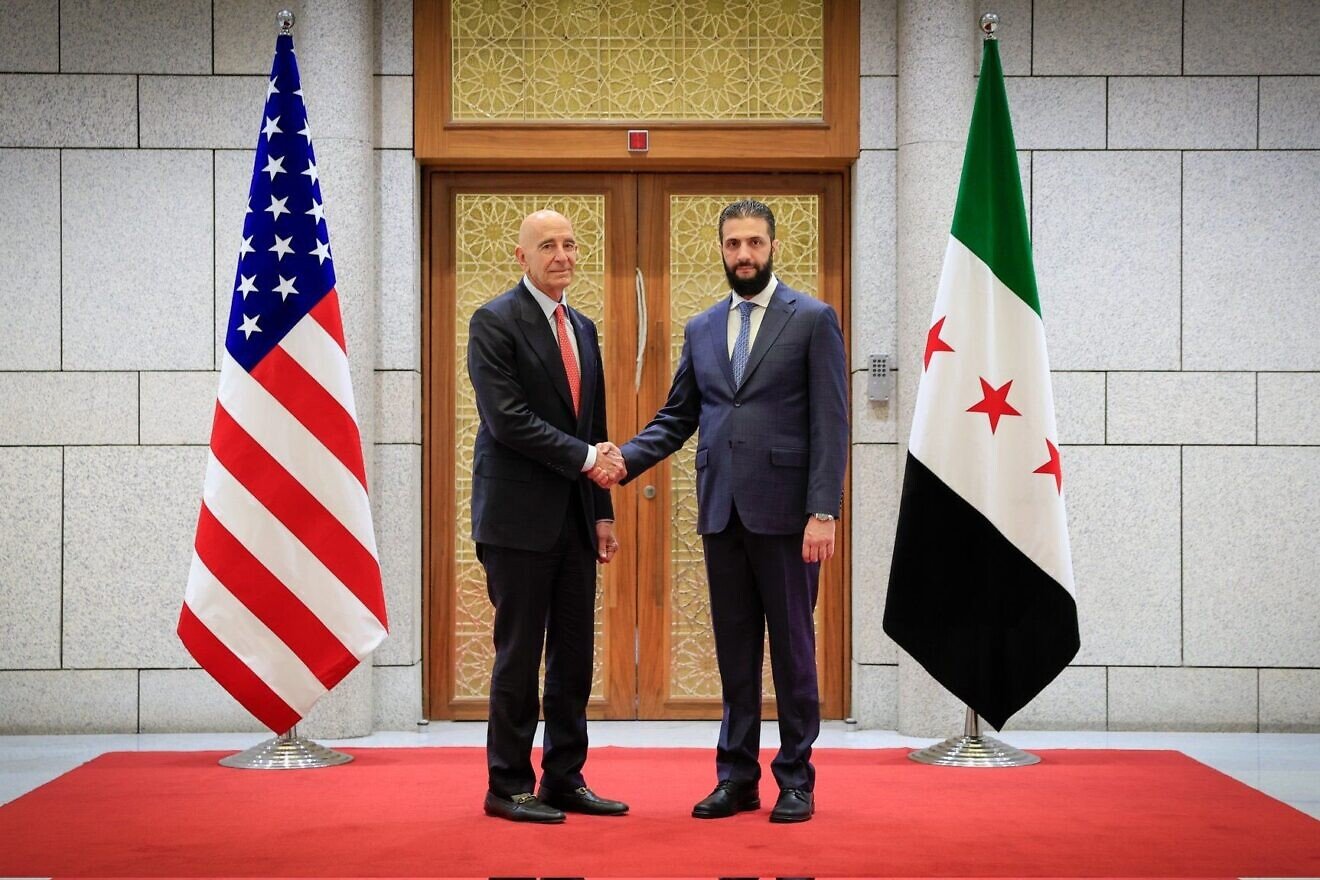 |
Tom
Barrack, U.S. ambassador to Turkey, and Syrian President Ahmed
al-Sharaa at the Syrian Presidential Palace in Damascus, Syria, May
2025. Credit: Ambassador Tom Barrack via Wikimedia Commons. |
U.S. envoy Tom Barrack on Sunday welcomed a truce deal between the Syrian regime and the Kurdish-led Syrian Democratic Forces. The agreement aims to integrate the SDF into Damascus’s armed forces and reassert government authority over parts of the country’s northeast.
The truce between Ahmed Al-Sharaa—Syria’s de facto president, who is also known by his nom de guerre, Abu Mohammad al-Julani—and the Syrian Democratic Forces allows for “renewed dialogue and cooperation toward a unified Syria,” Barrack wrote in a post to X.
“Two great Syrian leaders, driven by the shared vision of liberating their country and people from tyranny, have now come together to forge a brighter future for all Syrians,” continued the envoy’s statement.
With the ceasefire, al-Sharaa “affirmed that the Kurds are an integral part of Syria, and the United States looks forward to the seamless integration of our historic partner in the fight against ISIS,” wrote Barrack.
He noted that the “challenging work” of finalizing details was beginning, adding that Washington would support the parties “at every stage” while pursuing its national security interests, including the defeat of ISIS and advancing President Donald Trump’s 20-point peace plan for Gaza.
“The United States is particularly encouraged by this sustained drive to counter ISIS threats, which will facilitate our long-term Kurdish partners’ full onboarding into a united, inclusive Syria that safeguards the interests and rights of all its citizens—while advancing shared goals of reconciliation and national unity by merging the distinct lanes of interest into one cohesive path forward,” concluded Barrack’s post.
The agreement followed clashes earlier this month between government forces and the SDF forces that escalated into a regime push eastward. The SDF appeared to have pulled back after initial fighting along a tense front line in the eastern Aleppo province.
Syria’s new Sunni Islamist regime, which deposed Bashar Assad in late 2024, has struggled to extend authority across the war-ravaged country.
The two sides reached an agreement in March 2025 to fold the SDF into Syrian state structures, but implementation failed as each accused the other of violating the deal.
Israeli Foreign Minister Gideon Sa’ar on Jan. 6 urged the international community not to remain silent in the wake of clashes between the Syrian government and Kurdish forces in the city of Aleppo.
“The international community in general, and the West in particular, has a debt of honor to the Kurds who fought fiercely and successfully against ISIS,” tweeted Sa’ar.
“The systematic and murderous suppression of the various minorities in Syria contradicts the promises of a ‘new Syria.’ Silence on the part of the international community will lead to an escalation of violence by the Syrian regime,” Jerusalem’s top diplomat warned.
The Trump administration in recent months has tried to broker a renewed security agreement between Jerusalem and Damascus.
After the fall of the Assad regime, the Israel Defense Forces seized control of parts of southern Syria, expanding the buffer zone and maintaining a presence amid ongoing clashes and strikes.
Syria’s regime has demanded a full return to the 1974 Disengagement of Forces Agreement that ended the 1973 Yom Kippur War, and a full Israeli withdrawal.
On Jan. 6, Israel, Syria and the United States announced a “joint fusion mechanism” as an initial step toward security cooperation.
“After a period of several months, the diplomatic dialogue between Israel and Syria resumed with American backing and support,” the Israeli Prime Minister’s Office said, adding: “It was agreed that the dialogue will continue in order to advance common goals and to ensure the safety of the Druze minority in Syria.”
Under the terms of the emerging deal, Jerusalem would pull back from positions established in the Syrian part of the Golan Heights, including the strategic high ground of Mount Hermon, in exchange for promises aimed at reducing cross-border threats, according to an unsourced report by Israel’s Ynet outlet on Monday morning.
The IDF has reportedly warned the political echelon that the proposed terms would curb its freedom of action inside Syria, including limits on airstrikes, hampering efforts to disrupt Iran-backed Hezbollah’s build-up and weapons-smuggling routes through Syria from Iran and Iraq.
Syria is also seeking an end to Israeli humanitarian aid to its Druze minority, which has been subject to repeated attacks from militias allegedly backed by Al-Sharaa’s government, Ynet reported.
Israeli Defense Minister Israel Katz has repeatedly vowed that the military would remain in their positions inside Syrian territory to protect the Jewish state’s northern border communities.
IDF troops will remain in their positions on Mount Hermon and in the security zone “to protect the communities of the Golan and the Galilee from threats emanating from the Syrian side, as the central lesson from the events of October 7,” Katz stated on Aug. 26, 2025, referring to the Hamas-led terrorist invasion of southern Israel on Oct. 7, 2023.
“We will also continue to protect the Druze in Syria,” he said at the time.
JNS Staff
Source: https://www.jns.org/us-welcomes-syria-sdf-deal-aimed-at-integrating-kurds/

No comments:
Post a Comment