by Shimon Sherman
Trump is weighing airstrikes to neutralize the Islamic Republic’s nuclear and ballistic missile programs, and a sustained campaign to topple the regime.
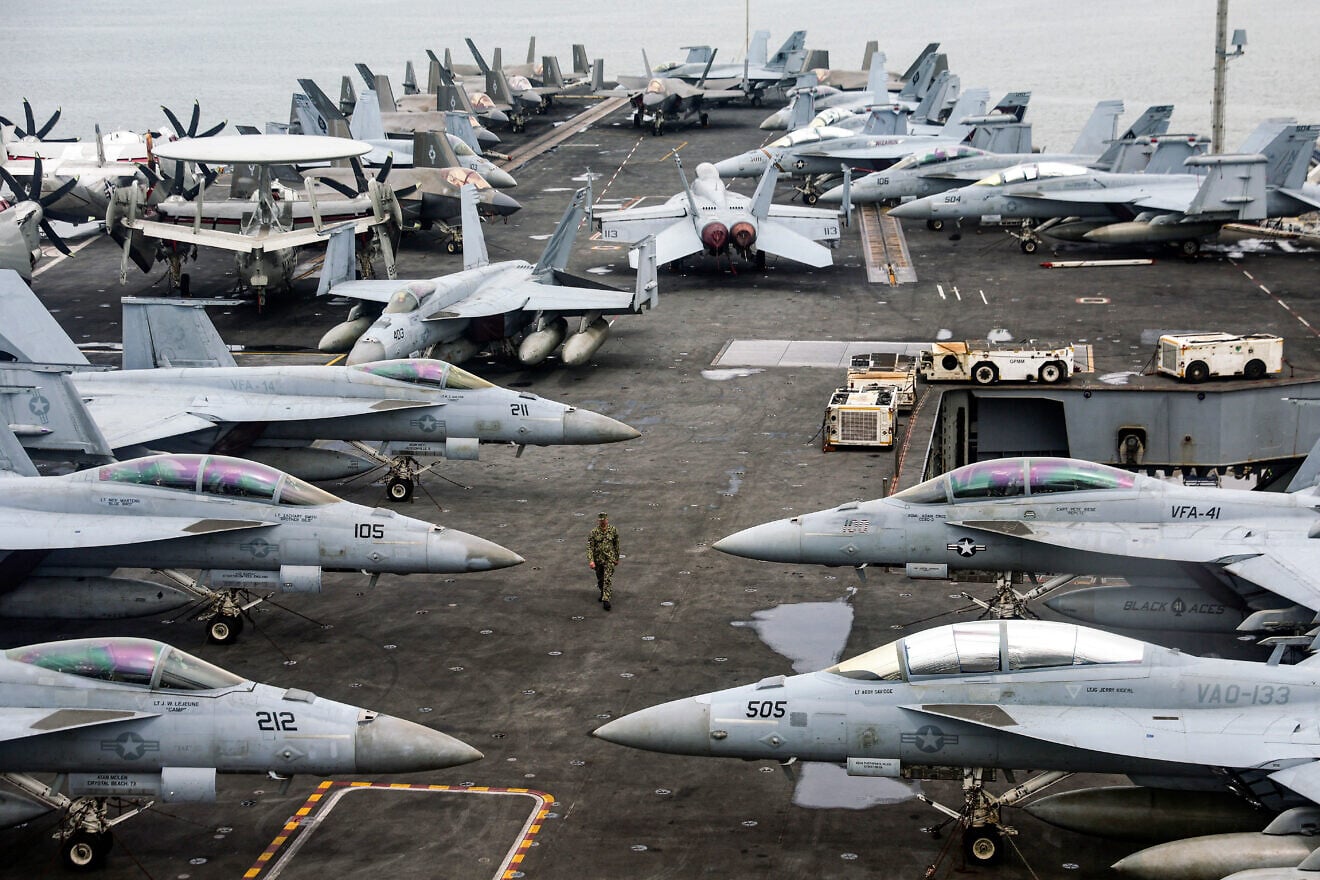
The Middle East has shifted toward the precipice of conflict, as evidenced by a historic U.S. military mobilization. This buildup comes as diplomatic efforts in Geneva disappointed U.S. policymakers, with Vice President JD Vance saying that the Iranians were “unwilling to acknowledge” President Donald Trump’s “red lines.”
On Thursday, Trump issued an ultimatum for a “meaningful” nuclear agreement. “I would think that would be enough time, 10, 15 days, pretty much maximum,” he said. Speaking at the inaugural meeting of the Board of Peace, he warned that if a deal is not reached, “bad things happen.”
White House Press Secretary Karoline Leavitt later emphasized that while “diplomacy was always the president’s first option,” the administration remains prepared to act if negotiations fail to produce a verifiable halt to enrichment.
IDF Maj. (res.) Alexander Grinberg, an expert on Iran at the Jerusalem Institute for Strategy and Security, told JNS, “The chances for a deal are very low. It is clear from the recent behavior that the Iranians are again trying to stretch out the negotiations and get more time.
“This time, no one believes the Iranians, and I think it’s very likely that we’re heading toward a military conflict,” he added.
The US buildup
Unlike the limited scope of the U.S.’s “Operation Midnight Hammer” in June 2025, current contingency planning is configured for a sustained campaign, with two American officials confirming to Reuters that the Pentagon is preparing for “sustained, weeks-long operations against Iran” if so ordered by Trump. To support this, the United States has assembled its largest concentration of air and naval strike power in the Middle East since the 2003 Iraq invasion.
The foundation of this buildup is two aircraft carrier strike groups, both of which Trump ordered to the region in recent weeks.
The USS Abraham Lincoln (CVN-72) arrived in the Arabian Sea on Jan. 26, leading a strike group that includes the guided-missile destroyers USS Frank E. Petersen Jr., USS Michael Murphy and USS Spruance.
This world’s largest aircraft carrier, the USS Gerald R. Ford (CVN-78), which redeployed from the Caribbean with its own complement of four destroyers equipped with Tomahawk cruise missiles and advanced air defense systems, entered the Mediterranean Sea through the Strait of Gibraltar on Friday and is headed eastward.
Maritime security is further bolstered by a surface patrol in the Strait of Hormuz, including the destroyers USS McFaul and USS Mitscher and the littoral combat ships USS Canberra, USS Tulsa and USS Santa Barbara, which are specifically suited for the minesweeping operations necessary to keep the waterway open in case of a sudden mining operation by the Iranians.
Airstrike capabilities have been similarly expanded across the theater, with CBS News and The War Zone reporting the movement of dozens of fourth- and fifth-generation fighter jets. This includes six F-22 Raptors that arrived at RAF Lakenheath in Suffolk, England, on Feb. 17, alongside E-3 AWACS and BACN communication aircraft, which analysts view as the strongest signals of preparation for a major conflict.
These are supported by F-15E Strike Eagles relocated from the U.K. to Muwaffaq Salti Air Base in Jordan and A-10C aircraft detected at regional bases by Chinese satellite imagery in mid-February. Whiteman Air Force Base in Missouri, from where the planes for “Operation Midnight Hammer” were launched, has also seen increased activity.
According to a recent report, the B-2 Spirit stealth bomber fleet is being maintained at “abnormally high readiness” to deliver the 30,000-pound GBU-57 Massive Ordnance Penetrators (MOPs). This bunker-buster is the only conventional weapon capable of penetrating the 80- to 100-meter granite shielding that Iran has used to protect several of its more sensitive sites.
Strike options
According to recent leaks as well as public statements by officials, the U.S. administration is actively weighing three distinct operational courses of action.
• The first option focuses on a sustained weeks-long campaign designed to precipitate the collapse of the Iranian regime by targeting its internal grip on power.
Adm. (ret.) Robert Harward, a former deputy commander of CENTCOM, explained that a campaign of this nature would prioritize targeting the Islamic Revolutionary Guard Corps (IRGC) and the instruments used to suppress the Iranian people.
“Because of what we’ve learned and what we’ve been able to develop technology-wise—be it command, control and targeting—it allows your mass of strikes to be more effective. Where previously you could do 40 or 50 strikes a day, we now can conduct hundreds of strikes a day. That in itself changes the equation completely for the regime.”
Targets for this option include the Tharallah Headquarters on Tehran’s Niayesh Highway, the IRGC’s “operational headquarters,” and the state-run media (IRIB) towers. This contingency would likely come with an attempt to “decapitate the regime” by simultaneously targeting broad swaths of the political and military leadership.
“It is critical to take out the competent political leaders in the IRGC and in the government,” Grinberg observed. “This would be a massive blow to the regime, and it would also reduce the chance of a power struggle with someone unfriendly to the U.S. and Israel coming to power even if the regime falls.”
• The second option is an intense aerial strike focusing on the degradation of military-industrial capabilities, building on the precedent of 2025 to neutralize the technical heart of the Islamic Republic’s nuclear and ballistic missile programs.
Reports from the Critical Threats Project indicate that Israel has requested that the U.S. strike Iran’s ballistic missile production infrastructure, specifically the Parchin and Shahroud complexes, where satellite imagery shows the attempted reconstruction of buildings housing solid-fuel planetary mixers.
“There are likely extensive underground cities that store a large percentage of the Iranian missile arsenal. Those would be an important target in any campaign,” Grinberg noted. “Many of these targets were not destroyed in June because they are buried very deep, and to fully destroy this threat, you would also have to use American B-2s and bunker busters.”
This plan would also aim to destroy the remaining 400 kg. (880 pounds) of enriched uranium, which likely survived the strikes during the June 2025 campaign. This option would not actively seek to topple the regime but rather to achieve concrete tactical goals surrounding the Iranian ballistic and nuclear program.
• A third option represents an asymmetric “stranglehold” using military and economic pressure to force a collapse of the regime or to soften Iran’s negotiating position.
During a recent meeting between Trump and Prime Minister Benjamin Netanyahu, the two sides reportedly agreed to wind up pressure on Iranian oil experts and to target Iran’s “shadow fleet,” which has been used to smuggle sanctioned oil out of the country. This move is designed to maximize the economic distress of a nation already reeling from 60% inflation and 72% food inflation.
Iran’s response
Tehran has responded to the historic U.S. military mobilization by accelerating the fortification of its strategic infrastructure and signaling a shift toward an offensive military doctrine.
According to satellite imagery analyzed by the Institute for Science and International Security (ISIS), Iran is rushing to bury its most sensitive nuclear and missile facilities at extreme depths to withstand American bunker-buster munitions. The most prominent of these sites is the “Pickaxe Mountain” facility south of Natanz, which is being excavated into hard granite at a depth of 80 to 100 meters, a depth Iranian engineers assess will provide immunity against the GBU-57 Massive Ordnance Penetrator.
Simultaneously, satellite photos from January and February reveal a massive logistical operation at the Isfahan nuclear complex to backfill and seal tunnel entrances to defend against airstrikes.
To project strength amid these defensive preparations, the IRGC and the Iranian regular military have conducted a series of high-profile drills.
On Thursday, Iranian naval forces hosted a joint exercise with Russian sailors in the Gulf of Oman and the southern Persian Gulf, rehearsing coordinated air and sea maneuvers to free hijacked vessels. This followed the mid-February “Smart Control of the Strait of Hormuz” exercise, which involved live-fire missile tests and the temporary closure of sections of the vital energy waterway.
These exercises have been accompanied by concrete acts of provocation designed to test U.S. naval reactions. On Feb. 3, a U.S. Navy F-35C launched from the USS Abraham Lincoln shot down an Iranian Shahed-139 drone after it “aggressively approached” the carrier strike group 500 miles off the Iranian coast. Hours later, IRGC fast boats attempted to board the U.S.-flagged tanker Stena Imperative in the Strait of Hormuz before being deterred by the arrival of the destroyer USS McFaul.
Iranian political and military leaders have matched these physical maneuvers with consistent militant rhetoric. Supreme Leader Ayatollah Ali Khamenei warned during the February naval drills that the U.S. Navy could be sunk if it attempts a confrontation. Furthermore, in a recent interview, the chief of staff of the Iranian Armed Forces, Maj. Gen. Abdolrahim Mousavi, warned that Iran is prepared to deliver “vengeful blows” and has shifted its posture toward the offensive.
Tehran’s kinetic retaliation plan relies on a reconstituted arsenal of over 3,000 ballistic missiles capable of striking U.S. bases and allied territory across the region. According to assessments from the Alma Research and Education Center and the Institute for the Study of War, while Israel destroyed nearly half of Iran’s inventory during the June 2025 conflict, the regime has replenished its medium-range stockpile to near pre-war levels.
Potential targets include major U.S. installations such as Al Udeid Air Base in Qatar, the target of an Iranian barrage in 2025, as well as Muwaffaq Salti Air Base in Jordan and facilities in Bahrain, Kuwait and the United Arab Emirates. Regardless of whether Israel participates in a U.S. strike, there is a broad consensus that Israel will also be targeted in an Iranian retaliation.
IRGC commander Hossein Daghighi underscored this priority in a February address to Al Mayadeen television, saying that “Israel will be Iran’s first target if the U.S. attacks,” while warning that the scope of any resulting conflict “will expand” beyond calculation.
Central to this expansion is the activation of the “Ring of Fire,” a network of regional proxies designed to overwhelm allied air defenses through multi-front saturation strikes. The Houthis in Yemen have emerged as the most critical arm of this strategy, maintaining the capability to harass global trade in the Red Sea and launch low-intensity missile and UAV attacks against Israel. On Jan. 26, the group released a brief video of a burning ship captioned with the single word “Soon,” signaling a readiness to resume high-tempo operations as the U.S. carrier groups arrived in theater.
Simultaneously, in Iraq, the paramilitary group Kataib Hezbollah has broken its recent silence; leader Ahmad “Abu Hussein” al-Hamidawi issued a direct warning that any strike on Iranian soil would trigger a “total war” involving militias across the Levant.
While Hezbollah has been less vocal or willing to commit to intervention on Iran’s behalf, recent reports indicate that the IDF is actively preparing for this contingency. In the last few weeks, strikes on Hezbollah targets in Lebanon have markedly increased, indicating an attempt to weaken Hezbollah before more open confrontation emerges in the broader context of a U.S. war with Iran.
Israel preparing for war
According to expert assessments, Israel is likely to join in on any U.S. operation in Iran. Military and political coordination between the United States and Israel has reached a state of unprecedented integration over the past month. Dozens of high level meeting have been reported across the political and military leadership, including recent separate trips by the prime minister, the chief of staff of the IDF and the head of the Mossad to Washington.
According to reporting from Israel Hayom, operational deconfliction protocols have been established between Israel’s Kirya defense headquarters and U.S. CENTCOM to prevent “operational friction” during parallel military operations, including joint target bank development.
In parallel with these developments, the IDF Home Front Command has placed the civilian sector on a war footing. Major medical facilities are executing emergency readiness plans to mitigate the impact of potential Iranian retaliation. Soroka Medical Center in Beersheva, which sustained severe damage from an Iranian missile in 2025, has begun updating its emergency procedures and refining simulations for patient transfers in the event of airstrikes.
Similarly, Wolfson Medical Center in Holon has evacuated its underground areas for immediate patient intake and relocated its pediatric surgery department to the children’s ward to ensure specialized care remains protected.
Civilian defense instructions have been updated to emphasize individual resilience. Col. (res.) Nir Neuman, an officer in the Home Front Command and head of the firefighting system at the Israel Electric Corporation, advised the public via a Maariv podcast to maintain stockpiles in protected spaces of “emergency lighting, batteries and dry food” along with at least a “six-pack of water.”
Neuman emphasized that while strategic facilities and power generation hubs have been fortified, civilian preparedness is a critical component of national security, saying that “resilience is our most important weapon” in the face of the Iranian threat.
Addressing local leaders on Jan. 6, IDF Chief of Staff Lt. Gen. Eyal Zamir underscored this state of readiness, stating that “preparedness for war is our compass” as the military acts to safeguard the security of the state. Public broadcaster KAN reports that the Israeli army remains “prepared and alert” for U.S. kinetic action, while also preparing for the possibility of receiving n American “green light” to independently target Iran’s ballistic missile systems if the 10- to 15-day diplomatic window expires without a deal.
Shimon Sherman is a columnist covering global security, Middle Eastern affairs, and
geopolitical developments. His reporting provides in-depth analysis on
topics such as the resurgence of ISIS, Iran’s nuclear ambitions,
judicial reforms in Israel, and the evolving landscape of militant
groups in Syria and Iraq. With a focus on investigative journalism and
expert interviews, his work offers critical insights into the most
pressing issues shaping international relations and security.
Source: https://www.jns.org/explainer-us-military-buildup-and-scenarios-for-war-with-iran/

No comments:
Post a Comment