Saturday, January 1, 2022

The UN - where anti-Israel prejudice remains supreme - opinion - Mark Regev


by Mark Regev

In facing this undisguised institutionalized prejudice, Israel has a crucial friend in the United States.


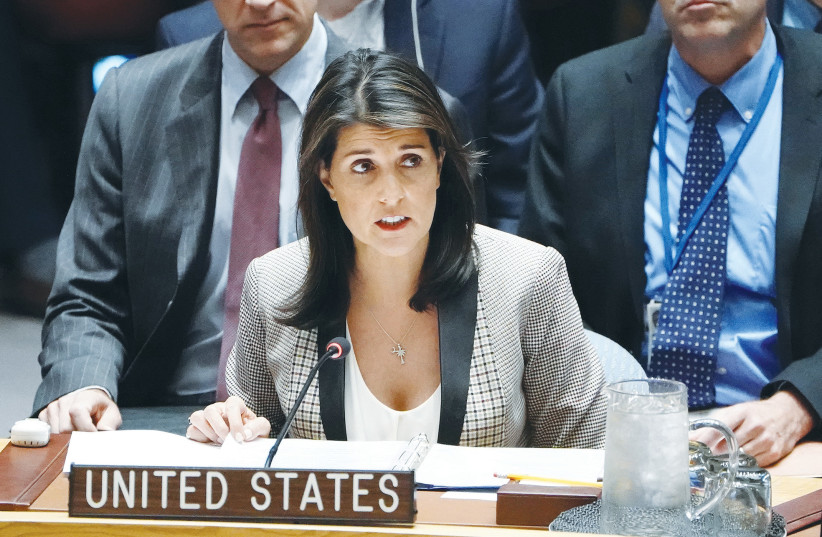
THEN-US ambassador to the United Nations Nikki Haley speaks during a meeting of the United Nations Security Council in 2018. (photo credit: CARLO ALLEGRI/REUTERS)
THEN-US ambassador to the United Nations Nikki Haley speaks during a meeting of the United Nations Security Council in 2018.
(photo credit: CARLO ALLEGRI/REUTERS)

There are clear signs that Arab hostility towards the Jewish state is on the wane. The Abraham Accords normalized Israel’s relations with the United Arab Emirates and Bahrain, an Israeli Defense Minister can make a very public visit to Morocco and even Saudi Arabia allows flights to and from Israel to cross over its territory. But there remains at least one bastion of anti-Israel enmity, the United Nations, where systematic, organizational prejudice against the Jewish state reigns supreme.
 
The opening act: Though not representing a member state, in 1974 Yasser Arafat was issued an extraordinary invitation to address the UN General Assembly (UNGA). His speech included a call for an end to Israel. The Jews, he said, could become citizens in the PLO’s “democratic Palestine.” Extreme content notwithstanding, and the fact that he spoke soon after his PLO massacred 25 hostages in Ma’alot, mostly high school students, Arafat received a standing ovation.
 
Infamously, the following year, the UNGA adopted Resolution 3379 which declared Zionism a “form of racism and racial discrimination”. Although that travesty was officially repealed in 1991, its annulment did not mark the end of the UN’s anti-Israel obsession – far from it.
 
Every year the UNGA routinely passes, with massive majorities, a series of blatant anti-Israel resolutions; in 2021 17 were enacted. Earlier this month, for example, the UNGA called upon Israel to withdraw from the “occupied Syrian Golan,” with delegates voting to hand over the Golan to Bashar Assad’s murderous regime.
 
But the story doesn’t end with these multiple resolutions, as some of them establish UN organs whose sole mission is to further propagate an anti-Israel agenda. The Special Committee to Investigate Practices Affecting the Human Rights of the Palestinian People is one such body. The Committee on the Exercise of the Inalienable Rights of the Palestinian People, which every year organizes the UN’s annual International Day of Solidarity with the Palestinian People, is another.

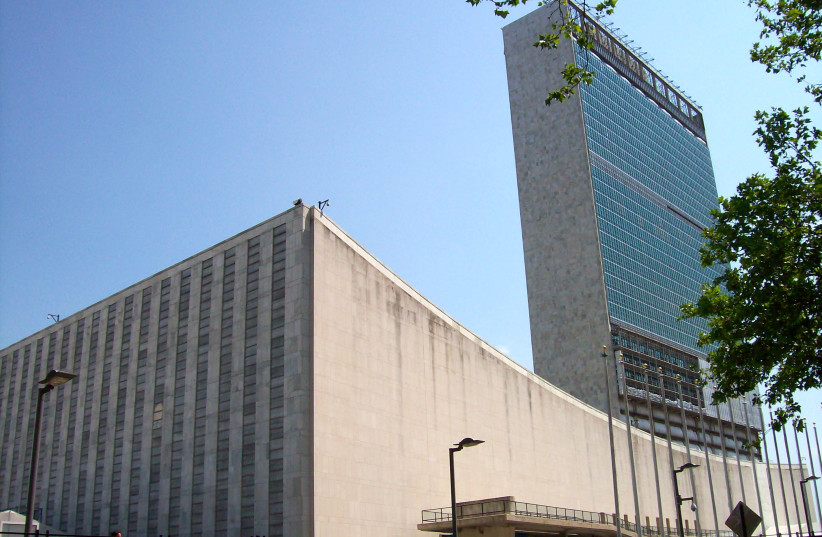
The United Nations. (credit: Wikimedia Commons) 

The United Nations. (credit: Wikimedia Commons)

To augment the work of these committees, the UN secretariat contains a Division for Palestinian Rights, the only part of the Department of Political Affairs devoted to a single conflict. And to ensure the message gets out there is the “special information program on the question of Palestine” in the Department of Global Communications.
 
Numerous UN agencies have also demonstrated anti-Israel prejudice. The UN’s Educational, Scientific and Cultural Organization (UNESCO) has adopted positions that ignore Jewish historic, cultural and religious ties to the Temple Mount and the Western Wall in Jerusalem as well as to the Tomb of the Patriarchs in Hebron.
 
The UN’s Office for Coordination of Humanitarian Affairs (OCHA) partners with organizations connected to the Popular Front for the Liberation of Palestine (designated a terror group by Israel, the US, the EU, Australia, Canada and Japan).
 
The UN’s Relief and Works Agency (UNRWA) has been accused of touting both antisemitism and terrorism. While UNRWA deals with a self-declared list of five million Palestinian refugees, the over one hundred million non-Palestinian displaced people worldwide suffice with the United Nations High Commissioner for Refugees (UNHCR). Although the latter agency helps to resettle refugees, UNRWA works to perpetuate refugee status, endorsing the maximalist Palestinian demand for the “right of return” to pre-1967 Israel.
 
Probably the most egregious example of a UN body plagued by anti-Israel mania is the Human Rights Council (UNHRC) which has a permanent agenda item targeting one country alone, Israel, and has passed more resolutions condemning the Jewish state than against all other countries combined. UNHCR’s repeated kangaroo court “investigations” of Israel are characterized by biased mandates equaled only by the anti-Israel partisanship of its special rapporteurs. The current multi-million dollar “Commission of Inquiry” into last May’s Gaza conflict is no exception.
 
In facing this undisguised institutionalized prejudice, Israel has a crucial friend in the United States. For it is only America that has the motivation and capability to stand up to UN bigotry. America has done so regularly, using its superpower political and financial clout to combat the endemic discrimination of the Jewish state.
 
The US has accomplished this through effective behind the scenes diplomacy, as well as overtly, when it has chosen to leave UN bodies (UNESCO and UNHRC), to cut off funding (UNRWA) and to use its UN Security Council veto to prevent the adoption of discriminatory anti-Israel texts. The latter is of primary importance, for while much of what happens at the UN is declarative, the UNSC has the unique authority to issue binding resolutions.
 
Of course, there have been aberrations when Israel has been disappointed with positions taken by the US. In 1980, the Carter administration abstained on UNSC Resolution 478 denouncing the Knesset’s Basic Law on Jerusalem being Israel’s capital. In 1981, the Reagan administration joined all 15 UNSC members in support of Resolution 487 condemning Israel’s attack on and destruction of Saddam Hussein’s Osirak nuclear reactor. Most recently, in 2016 the United States abstained on UNSC Resolution 2334 castigating Israeli construction over the 1967 lines, including in Jerusalem.
 
That American decision created much friction between Jerusalem and Washington, with the Prime Minister’s Office protesting that the Obama administration failed “to protect Israel against this gang-up at the UN,” and in fact “colluded with it behind the scenes.”
 
And herein lies the bottom line. When America stands up for Israel, it evens out the playing field. But if America does not, it allows the UN’s inherent anti-Israel animosity to monopolize decision-making.
 
Over the years, American UN ambassadors have taken a special pride in defending Israel. From Democrat Daniel Patrick Moynihan to Republican Nikki Haley, US ambassadors to the UN have earned the respect and affection of Israelis and American Jews alike for leading the fight against the singling out of the Jewish state.
 
Even Donald Trump’s many critics can acknowledge that his four-year term excelled in its unwavering support for Israel at the UN. The Biden foreign policy team has pledged to do likewise, stating that “Israel can continue to count on the US to do everything possible to shield it from discriminatory and unbalanced criticism whether at the UNHRC or elsewhere in the UN system.”
 
Undoubtedly there will be demands on the administration to renege on that commitment. American Jews, who overwhelmingly voted for the Biden-Harris ticket, may need to apply countervailing pressure, making the case that in fighting the UN’s anti-Israel prejudice the US is not only standing up for a trusted ally, but, as in all struggles against institutional discrimination, doing the right thing and demonstrating America’s global moral leadership.


Mark Regev, formerly an adviser to the prime minister, is a senior visiting fellow at the INSS. Follow him at @MarkRegev on Twitter.

Source: https://www.jpost.com/opinion/article-690226

Follow Middle East and Terrorism on Twitter

Socialism’s Jewish question: Modern antisemitism explored in new book - Colin Shindler


by Colin Shindler

Book: The European Left and the Jewish Question 1848-1992


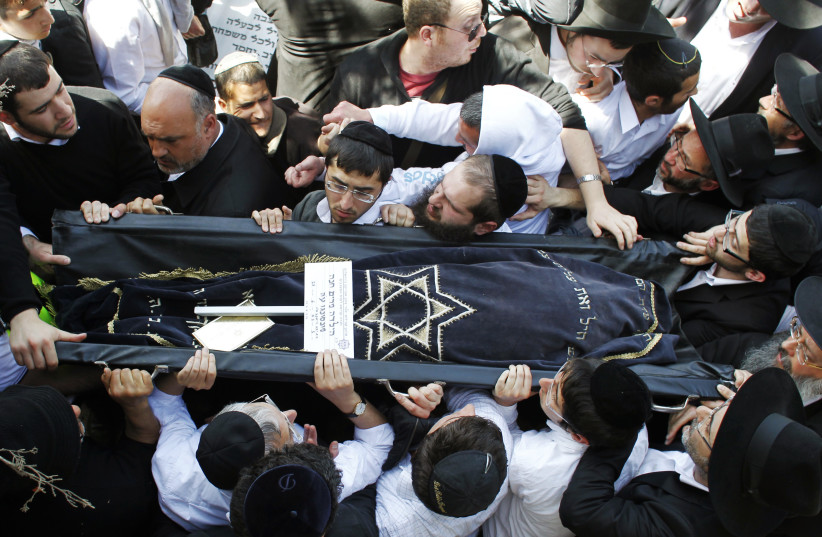
Carrying the body of Miriam Monsonego during a joint Jerusalem funeral for four victims of the 2012 terror murders in Toulouse, France (photo credit: NIR ELIAS/REUTERS)
Carrying the body of Miriam Monsonego during a joint Jerusalem funeral for four victims of the 2012 terror murders in Toulouse, France
(photo credit: NIR ELIAS/REUTERS)

This book of accessible essays by specialists examines the Jewish question, not internally from the perspective of Jews themselves, but externally by European socialist thinkers. 
 
Since Zionism was a singular ideology and did not fit into accepted theory, many socialists such as Lenin dismissed it out of hand. This did not always imply antisemitism but more a blind and political rejection of Zionist ideology.
 
In this detailed tome, French historian Michel Dreyfus pinpoints the affair of his namesake, Alfred Dreyfus, in the early 20th century as a turning point in the relationship between the Left and the Jews. He lists five different forms of antisemitism on the Left. He interestingly describes how pacifism in the 1930s – as a reaction to the slaughter in the trenches during World War I – became “a vector of antisemitism.”
 
In those pre-Shoah days, Jews were seen by some pacifists as pushing for and provoking a war with Hitler. The fires of antisemitism were further stoked when Léon Blum, a Jewish socialist and supporter of Zionism, became prime minister of France.
 
Andrea Pinazzi dissects the views of Antonio Gramsci, the well-known Italian socialist theorist, on the Jewish question through his letters to his sister-in-law. Gramsci comes over as profoundly superficial. He died in Mussolini’s prisons in 1937 just before anti-Jewish legislation was introduced in Italy. Would this have changed Gramsci’s views if he had lived?
 
Another scholar, Marta Nicolo, contrasts Gramsci with the figure of the Jewish Communist Umberto Terracini, who spent 11 years in Mussolini’s prisons and another six in confinement. Yet he opposed the Nazi-Soviet pact, pushed for recognition of Israel in the Italian Parliament in 1948, condemned Saddam’s hanging of Iraqi Jews in 1969 and was a very early campaigner for the emigration of Soviet Jews. And Terracini remained a loyal Communist. 
 
The last part of this book is devoted to “the Israel Question” and covers familiar topics. Gregorio Sorgonà however breaks new ground in describing the influence of Mao’s China on the New Left in the 1960s. After the Soviet-Chinese schism, Beijing regarded both the USSR and the US as imperialist. Mao deemed the Middle East as fertile territory for a new anti-imperialist struggle after Vietnam. Beijing’s Italian followers viewed Fatah as “para-fascist” and only the Democratic Front for the Liberation of Palestine as truly “revolutionary.”
 
As many writers in this book indicate, the Left was never monolithic, but just too many of its component parts were remarkably limited when it came to the Jewish question. Lenin was ignorant of the suffering of the Jewish masses in Tsarist Russia and knew nothing about the socialist Zionism of figures such as Moses Hess, Nachman Syrkin and Ber Borochov. Lenin’s indifference however was superseded by Stalin’s ingrained antisemitism and his chosen instrument of slow death, the Gulag Archipelago.
 
The early writings of Karl Marx are still seen by many as exuding “a contempt for the Jews.” This cemented the link between Jewish landlords and speculators for succeeding generations such as the German New Left a hundred years later. Hartwig von Hundt-Radowsky, was the first to call for the extermination of the Jews in 1819 – just a few years after the defeat of Napoleon at Waterloo.
 
Pierre-Joseph Proudhon, the French socialist philosopher, a 19th century contemporary of Marx, was unapologetically antisemitic. In Russia, Trotsky embraced assimilationism and proclaimed during the October Revolution in 1917 that “I am not a Jew. I am an internationalist.” In French exile many years later, the scales dropped from Trotsky’s eyes and he strongly protested against rising antisemitism and regarded the Jews as a nation.
 
As several contributors to this book remark, socialism took on the form of a quasi-religion. Belief rather than analysis became the centerpiece of endeavor. For many, Jews simply did not count when it came to discrimination. So when the Soviet show trials took place in the 1930s, many on the Left, including critics of Stalin, preferred to look away when anti-Jewish themes pervaded the courtroom.
 
Several authors highlight external factors that have influenced groups on the Left. The Spanish Left imbibed ideas at the altar of historical anti-Judaism during the Inquisition. The Christian Left promoted the vision of a Jesus who identified with the poor – and thereby with the Palestinian refugees.
 
In France during the 1950s, many embraced anti-colonialism and supported the National Liberation Front’s struggle for independence in Algeria – and warmed to Nasser’s backing for it. Decolonization during the 1960s allowed the New Left in Europe to identify more with the nascent Palestinian national movement than with the Israeli one – and this was before the West Bank settlement drive.
 
In an effort to express solidarity with discriminated Muslim minorities in Europe, some on the French Left maintain a mistaken silence about the reactionary politics of the Islamists. And anti-Zionism sometimes tips over into overt antisemitism. There were antisemitic killings in Toulouse, Montauban and Vincennes in recent times. In 2006, Ilan Halimi was killed because he was Jewish – the first antisemitic murder in France since 1945.
 
This volume is unusual because it goes into the origins of contemporary antisemitism and anti-Zionism within the European Left in mainly France and Italy. Pushing the slogans and clichés of campaigners against antisemitism to one side, it looks at the roots of the problem today. Its detailed explanations by scholars will certainly provide food for thought for those who wish to deepen their knowledge.
 

Colin Shindler

Source: https://www.jpost.com/diaspora/antisemitism/article-690217

Follow Middle East and Terrorism on Twitter

With COVID, Democrat bureaucrats finally admit the truth - Irene Heron


by Irene Heron

It turns out they’ve been playing us all along when it comes to COVID cases, hospitalizations, and deaths

If you still doubt that our COVID nightmare is being fully orchestrated by the evilest cabal of miscreants ever assembled in America, look no further than the latest stories that have just come over the wire featuring the almighty Fauci and some of his minions. How convenient for the perps to let the cat out of the bag on a Friday New Year’s Eve when most people are trying to forget the never-ending horror show that was the year of Our Lord 2021 and, therefore, are not paying attention to the News.

In what many are saying should be the end of the COVID Crisis, King Fauci made the most stunning admission of his career, live on MSNBC; namely, that all of the illegal and unconstitutional mandates that are being forced on us are based on fake numbers and phony statistics.

It really is quite incredible as you can see for yourself. The Evil Midget is saying the quiet part out loud: There is a difference between getting hospitalized (or presumably even dying) “with” COVID as opposed to “because” of COVID. Isn’t that what some of us have been saying all along?

But the other important thing is that if you look at the children who are hospitalized, many of them are hospitalized with COVID as opposed to or because of COVID. And what we mean by that—if a child goes in the hospital, they automatically get tested for COVID. And they get counted as a COVID-hospitalized individual. When in fact, they may go in for a broken leg or appendicitis or something like that. So, it’s overcounting the number of children who are, quote, hospitalized with COVID, as opposed to because of COVID.

In other words, we who have the misfortune of living in Blue states like New York are being forced to wear muzzle masks, get injections we don’t want or need, and comply with often conflicting rules and regulations, all of which are based on inaccurate information. After all, Fauci finally admitted the con of conflating “with COVID” with “from COVID” when it comes to COVID case numbers, hospitalizations, and even deaths. All this misinformation has prevented us from even trying to live a halfway normal life. You know, like the lives we had back in 2019.

Image: Fauci (edited in befunky). YouTube screen grab

But it gets better and why not? As Hitler, the biggest liar of all explained, if you tell a lie big enough and often enough people will find it impossible to believe that you’re lying. That is precisely what has happened in the last twenty months or so and continues even as we begin the new year.

When it comes to COVID, it turns out that, once again, the corruptocrats who run New York have learned their lessons well from Master Fauci and have doubled down on their mendacity. They have gotten so bold that they now admit to using overblown claims about the number of children who were ostensibly hospitalized for COVID. You see, they needed to “scare” parents into getting the shots because many of them are now questioning whether it’s a good idea to inject their children with an Emergency Use gene therapy that they probably don’t need based on their age and low levels of transmission.

In a press conference Monday alongside Democratic Gov. Kathy Hochul, Bassett — who came down with the virus last week despite being fully vaccinated against it — effectively acknowledged that the state health department’s misleadingly framed the numbers to scare parents.

“The numbers that we gave on pediatric admissions weren’t intended to make it seem that children were having an epidemic of infection, these were small numbers,” Bassett admitted regarding the alert. “That was based on 50 hospitalizations, and I’ve now given you some larger numbers, but they’re still small numbers.”

“It really was to motivate pediatricians and families to seek the protection of vaccination,” she then stated.

Finally, if we thought that our un-elected Governor would perhaps show us some mercy for being such good and obedient vassals, it turns out that Empress Hochul had other ideas. Despite the admissions of Lord Fauci and her own Health Department consigliere, Hochul declared that CUNY and SUNY students will be required to get their COVID-19 boosters by next semester, and our state’s “Vax or Mask” mandate for businesses is now extended till February 1st.

So, there you have it. The truth bomb we all have been waiting for: The stunning admission that the Wuhan virus isn’t really infecting and killing all those millions of people that we’ve been told as our liberties and freedom have been stripped from us. We have lost so much—our children, grandchildren, aged parents, businesses, jobs, friendships; in short, everything that makes life worth living, and all because federal and Blue state bureaucrats were overcounting the cases and deaths.

Why aren’t there headlines about this? Will there be next week? Will this affect the Supreme Court cases? I don’t know. Let’s just say that I am not going to throw away all my “FJB/Let’s Go Brandon” muzzle masks just yet.

 Irene Heron is a pseudonym.

Source: https://www.americanthinker.com/blog/2022/01/with_covid_democrat_bureaucrats_finally_admit_the_truth.html

Follow Middle East and Terrorism on Twitter

Blow to Hamas: IDF confiscates NIS 2.6 million in cryptocurrency - Israel National News


by Israel National News

Defense Minister Benny Gantz leads a massive operation, seizing virtual wallets of companies in Gaza that are funding terrorist activity.


Cryptocurrency

Defense Minister Benny Gantz (Blue and White) this week signed an order for the seizure of cryptocurrencies in the amount of NIS 2.6 million ($836,467) from the al-Mathaddon exchange company, belonging to the Malach family and linked to Hamas in Gaza, Israel Hayom reported.

The move follows a seizure of other digital wallets, which Gantz started a few months ago. Following the order, about 150 digital wallets of al-Mathaddon were then confiscated.

The company was attempting to send fund to Hamas. According to security sources, the company increased activity after the assassination of terrorist Hamed Ahmed Khudari, also a money changer responsible for funding terrorism.

Gantz said, "We will continue to pursue terrorist funds. The blow to Hamas and the terrorist organization's ability to circumvent the traditional paths for transferring funds, through digital currency, is an important tool in the developing security system. I congratulate all those involved, led by the National Headquarters on Terrorist Economic Counter-Terrorism, on the important work and the creative action," according to Israel Hayom.

The terror-financing network was exposed in a major operation including IDF Intelligence, the National Headquarters on Terrorist Economic Counter, cybercrimes unit, Israel Police's Lahav 443 Major Crimes Unit, and the State Attorney's Office's Cyber Unit, Israel Hayom stated.


Israel National News

Source: https://www.israelnationalnews.com/news/319627

Follow Middle East and Terrorism on Twitter

Germany's New Government: Business as Usual with China - Soeren Kern


by Soeren Kern

Olaf Scholz, who succeeded Angela Merkel as chancellor on December 8, pledged [in a telephone call with China's President Xi Jinping] to strengthen economic ties with China, but he failed to mention human rights or the destruction of democracy in Hong Kong.

  • Olaf Scholz, who succeeded Angela Merkel as chancellor on December 8, pledged [in a telephone call with China's President Xi Jinping] to strengthen economic ties with China, but he failed to mention human rights or the destruction of democracy in Hong Kong.

  • The telephone call will disappoint those who had hoped that Germany's new government would break with the past and take distance from Merkel's policy of appeasing dictators and sacrificing human rights on the altar of financial gain.

  • If Scholz promised to advance bilateral economic relations without linking them to the protection of human rights, it would be a direct violation of Germany's coalition agreement, which pledged to make human rights the centerpiece of German foreign policy.

  • The Merkel government, apparently under pressure from German industry, largely ignored human rights abuses in Xinjiang.

  • China is Germany's biggest trading partner, with €212 billion in goods exchanged in 2020, according to the German Foreign Ministry. More than 5,000 German companies operate in China, according to the German Chamber of Commerce in China.

  • "Did the new German Chancellor pressure the Chinese dictator during their phone call over the Chinese blackmail of Lithuania, EU and NATO ally of Germany? Or does Germany still not care about the strategic reality and is its foreign policy still driven by greed and appeasement?" — Jakub Janda, Director of the Prague-based European Values think tank.

  • "Merkel will be judged harshly by future historians. She has done little to prepare Germany and the European Union for the challenges that the Putin and Xi regime pose to liberal democracies. And Scholz is doubling down on her failed foreign policies vis-a-vis autocracies. It will end in tears." — Andreas Fulda, German political scientist and expert on EU-China relations.
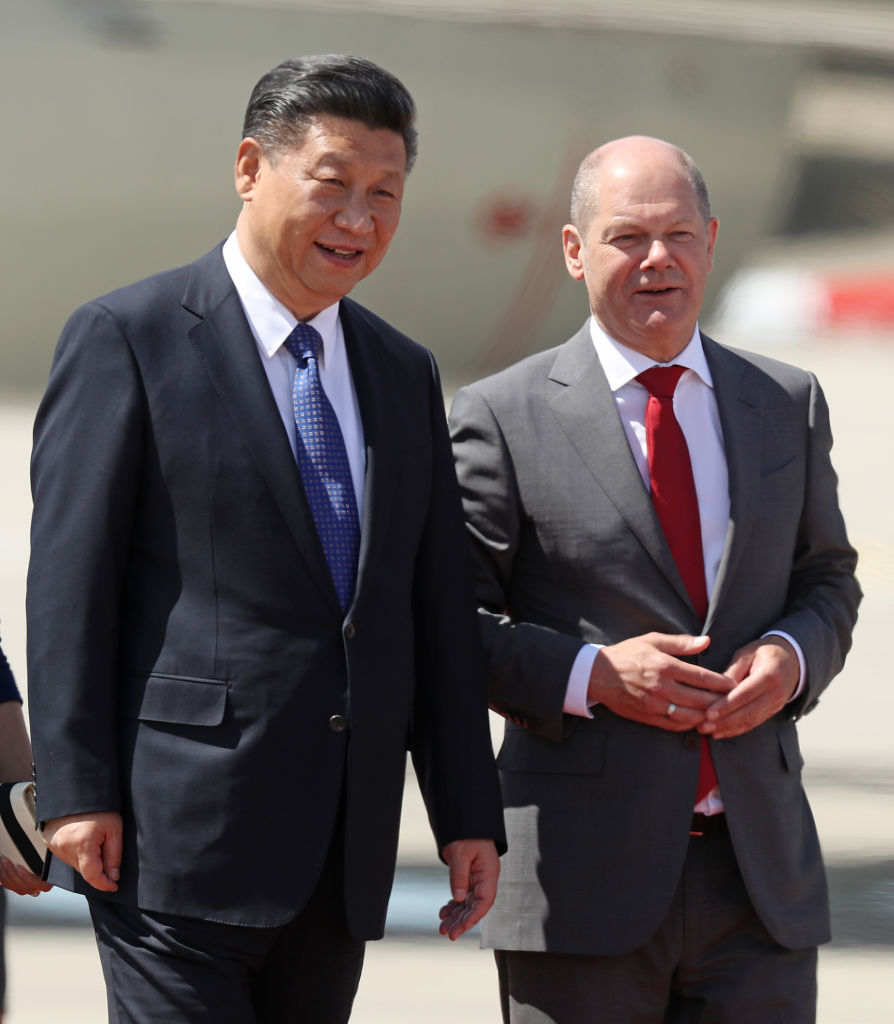
Germany's new chancellor, Olaf Scholz, had his first telephone call with Chinese President Xi Jinping on December 21. Scholz pledged to strengthen economic ties with China, but he failed to mention human rights or the destruction of democracy in Hong Kong. Pictured: Xi (left) chats with Scholz (then mayor of Hamburg) upon Xi's arrival at Hamburg Airport on July 6, 2017. (Photo by Sean Gallup/Getty Images)

Germany's new chancellor, Olaf Scholz, has had his first telephone call with Chinese President Xi Jinping. Scholz, who succeeded Angela Merkel as chancellor on December 8, pledged to strengthen economic ties with China, but he failed to mention human rights or the destruction of democracy in Hong Kong.

The telephone call will disappoint those who had hoped that Germany's new government — a three-way coalition consisting of the center-left Social Democrats (SPD), the environmentalist Greens and the pro-business Free Democrats (FDP) — would break with the past and take distance from Merkel's policy of appeasing dictators and sacrificing human rights on the altar of financial gain.

The call raises the question of who will determine Germany's China policy: Chancellor Scholz (SPD), who advocates for pragmatism and continuity, or Foreign Minister Annalena Baerbock (Greens), who is critical of China and has called for a values-based foreign policy and the implementation of Western ideas of human rights and the rule of law.

A 50-word German readout of the telephone call, which was held on December 21, stated that Scholz and Xi talked about "the deepening of the bilateral relationship and economic relations" and "the development of EU-China relations."

A 950-word readout of the conversation published by China's state-run news agency Xinhua provided additional details, including apparent pledges by Scholz "to inherit and advance Germany-China friendship and cooperation" and "to work with China in the spirit of mutual respect and mutual trust to push for further development of the Germany-China all-round strategic partnership."

The Chinese readout added: "Scholz said that he hopes the EU-China investment agreement will enter into force at an early date, and that Germany is ready to work with China to uphold multilateralism in international affairs."

That statement is problematic in several ways. The European Parliament recently froze the EU-China trade deal, and it is unlikely that the agreement will be ratified anytime soon, regardless of what Scholz may have promised.

Moreover, the Chinese and the Europeans have mutually exclusive understandings of the term multilateralism. Broadly speaking, the Europeans view multilateralism as strengthening existing structures, including the United Nations system, to enforce a global rule-based liberal order enshrined in binding international treaties.

By contrast, China views multilateralism as counterbalancing the dominance of a liberal international order. China-led multilateralism has been described as "an interim arrangement in China's drive to acquire regional and global dominance."

German Coalition Agreement

Both the German and the Chinese readouts of the phone call omit any mention of human rights.

If Scholz promised to advance bilateral economic relations without linking them to the protection of human rights, it would be a direct violation of Germany's coalition agreement, which pledged to make human rights the centerpiece of German foreign policy. Strangely, Foreign Minister Baerbock has not commented on the statements attributed to Chancellor Scholz.

The 178-page coalition agreement was presented with great fanfare in Berlin on November 24 after two months of haggling (negotiators reportedly spent "hours" debating single sentences). It contains eight main sections that focus on a panoply of domestic and foreign policy issues to be pursued over the next four years. Human rights feature prominently:

  • Page 7: "For us, working for peace, freedom, human rights, democracy, the rule of law and sustainability is an indispensable part of a successful and credible foreign policy."
  • Page 130: "We will deepen and re-establish partnerships in our foreign, security and development policy and defend our values of freedom, democracy and human rights."
  • Page 131: "We advocate an EU that protects its values and the rule of law internally and externally and that stands up for them resolutely. As the largest member state, we will assume our special responsibility to serve as an example."
  • Page 135: "The EU's foreign policy engagement is committed to peace, international human rights and conflict prevention."
  • Page 143: "We will make our foreign, security and development policy more value-based and more European. Together with our partners, including from civil society, we will work to preserve our free way of life in Europe and to protect peace and human rights worldwide."
  • Page 143: "Human rights as the most important protective shield for the dignity of the individual form our compass."
  • Page 143: "For us, working for peace, freedom, human rights, democracy, the rule of law and sustainability is an indispensable part of a successful and credible foreign policy for Germany and Europe."
  • Page 146: "Human rights policy encompasses all aspects of state action on both an international and domestic level. In a global environment in which central actors also regularly question the universal validity of human rights, we want to defend and promote them together with our partners."
  • Page 147: "Civil societies — especially journalists, activists, scientists and other human rights defenders — are indispensable for building and maintaining functioning communities. We undertake to strengthen and protect these people and their work in a special way, even in the event of cross-border persecution.... We will create additional positions for human rights work at suitable missions abroad."
  • Page 147: "We will strengthen the European Court of Human Rights and insist on the implementation of its judgments in all member states. The EU sanctions mechanism must be used consistently and better coordinated with our international partners."
  • Page 147: "We will actively help shape the work of the UN Human Rights Council and strengthen the UN High Commissioner for Human Rights. We want to strengthen the work of the UN treaty bodies and special rapporteurs and strive for the ratification of further human rights conventions.... We want to strengthen the protection of human rights in the digital age and make internet freedom and digital human rights a priority for foreign policy."
  • Page 147: "Impunity for human rights violations must end worldwide. That is why we are committed to the work of the International Criminal Court and the ad hoc tribunals of the UN and will work for the further development of international humanitarian law. We support the establishment of further UN-led fact-finding missions as well as the work of UN investigation and monitoring mechanisms to enable future criminal proceedings. In Germany we want to expand our capacities for proceedings under the International Criminal Code."
  • Page 147: "Based on the UN guiding principles of business and human rights, we are committed to a European action plan on business and human rights. We will revise the national action plan on business and human rights in line with the supply chain law."
  • Page 157: "We want and must shape our relations with China in terms of partnership, competition and systemic rivalry. On the basis of human rights and applicable international law, we seek cooperation with China wherever possible. We want fair rules in the increasing competition with China. In order to be able to realize our values ​​and interests in the systemic rivalry with China, we need a comprehensive China strategy in Germany within the framework of the common EU-China policy."
  • Page 157: "We strive for close transatlantic coordination in China policy and seek cooperation with like-minded countries in order to reduce strategic dependencies. Our expectation of Chinese foreign policy is that it will play a responsible role for peace and stability in its neighborhood. We are committed to ensuring that territorial disputes in the South and East China Seas are settled on the basis of international law of the sea. A change in the status quo in the Strait of Taiwan can only take place peacefully and by mutual agreement. As part of the EU's one-China policy, we support the relevant participation of democratic Taiwan in international organizations.... The principle of 'one country — two systems' in Hong Kong must be reasserted."
  • Page 157: "We will clearly address China's human rights violations, especially in Xinjiang."

Xinjiang is a remote autonomous region in northwestern China that is home to approximately 12 million mostly Muslim Uyghurs, a Turkic ethnic group native to the area. Human rights experts say that the Chinese Communist Party has detained at least one million Uyghurs in up to 380 internment camps, where they are subject to torture, mass rapes, forced labor and sterilizations.

Beijing is accused of seeking to forcibly eliminate the Uyghur identity in its quest to create a unitary Chinese state. Uyghurs are the second-largest ethnic group in China after the Han people, who lay claim to the Xinjiang region.

EU-China Investment Deal

The Merkel government, apparently under pressure from German industry, largely ignored human rights abuses in Xinjiang. In December 2020, just hours before the end of Germany's six-month EU presidency, Merkel — together with French President Emmanuel Macron, President of the European Commission Ursula von der Leyen and European Council President Charles Michel (other EU countries were excluded from the negotiations) — hastily concluded the so-called EU-China Comprehensive Agreement on Investment (CAI).

The lopsided agreement, which ostensibly aims to level the economic and financial playing field by providing European companies with improved access to the Chinese market, actually allows China to continue to restrict investment opportunities for European companies in many strategic sectors. The deal also lacks meaningful enforcement mechanisms for issues that the EU claims to care about, such as climate change and human rights, including forced labor.

In March 2021, the European Union, the United Kingdom and Canada, presumably under pressure from the United States, announced (here, here and here) that they had imposed sanctions on Chinese officials accused of Uyghur-related human rights abuses in Xinjiang.

China responded by imposing sanctions (here, here and here) on more than two dozen European, British and Canadian lawmakers, academics and think tanks.

In May 2021, the European Parliament voted overwhelmingly (599 votes in favor, 30 against and 58 abstentions) to halt ratification of the CAI until Beijing lifts sanctions on European lawmakers, academics and think tanks. The move, a rare display of fortitude by an institution notorious for vacillation, reflected a hardening stance in Europe toward the Chinese Communist Party.

If Scholz indeed promised Xi to advance the CAI, as China claims, Germany's new government would be at odds with the European Parliament, the EU's only directly elected institution.

Germany's Overdependence on China

China is Germany's biggest trading partner, with €212 billion in goods exchanged in 2020, according to the German Foreign Ministry. More than 5,000 German companies operate in China, according to the German Chamber of Commerce in China. Some German companies have become so dependent on the Chinese market that they cannot do without it. For instance, China accounted for roughly half of Volkswagen's global car sales during the first nine months of 2021.

On December 20, a day before the Scholz-Xi telephone call, Volkswagen's Chairman of the Board, Herbert Diess, admitted that the company is utterly dependent on China: "We need more cooperation and presence in China, not less! It would be very damaging if Germany or the EU wanted to decouple from China."

Diess wrote the post on LinkedIn, a U.S.-owned social media network. In October, Microsoft announced that it was shutting down LinkedIn in China due to pressure from the Chinese government.

Volkswagen operates a car factory in Xinjiang. During a recent interview with the BBC, Diess claimed that he did not know about the detention of Uyghurs in Xinjiang. When the BBC correspondent explained it to him, Diess responded: "I am not aware of that."

Volkswagen, which was founded by the German Nazi party in 1937 and used forced labor in its factories during World War II, has been accused of using forced Uyghur labor at its plant in Xinjiang.

In an interview with the BBC, Volkswagen's CEO in China, Stephan Wollenstein, defended the company's presence in Xinjiang's capital, Urumqi, where it runs a factory with 600 workers, producing up to 20,000 vehicles a year:

"What happened in the Nazi times was something that happened in our factories where we had forced labor, people producing Volkswagen cars. This certainly is an unacceptable situation. Therefore, we are making sure that none of our production sites have forced labor, and this is something that we specifically checked in Urumqi, and I can assure you, we do not have forced labor."

When asked whether he could be absolutely certain of that claim and give an assurance that none of the Urumqi workforce — of which around 25% is made up of Uyghurs and other minorities — had been in a Chinese detention camp, Wollenstein admitted that he could not.

"We try to control our company-related processes, including the HR process, which, for instance, means the hiring of people in the best possible manner. And this reduces for us the risk that something happens which we do not like and which is not complying to our standards. But I guess we could never reach 100% certainty."

The China Director of Human Rights Watch, Sophie Richardson, called on Diess to allow independent human rights observers to have "unfettered access" to Volkswagen's plant in Xinjiang.

The British historian Timothy Garton Ash noted that Volkswagen cannot afford to criticize the Chinese government. In an opinion article published by the Guardian, he wrote:

"The company has got itself stuck between the rock of Xi Jinping and the hard place of an increasingly outraged western public opinion. The result could be a moral car crash.

"Behind this leading western company that is too dependent on China is a leading western country that is at risk of becoming too dependent on China. Under Angela Merkel, China has risen to be Germany's largest single trading partner....

"In the 2000s, it was still just possible to believe in the possibility of Wandel durch Handel (change through trade). But in the past decade, China has done more trade, become more repressive and exercised more leverage over the west. So, who has changed whom?"

Old habits, especially economically beneficial ones, are hard to break. On December 22, the German-Baltic Chamber of Commerce warned the Lithuanian government that German investors may be forced to close factories in Lithuania if Vilnius does not accede to Chinese demands that it rename a representative office of the Taiwanese government.

On December 1, China blocked all imports from Lithuania and ordered multinational companies to sever ties with the Baltic country or face being shut out of the Chinese market.

The extraordinary sanctions, which amount to a full economic boycott of Lithuania, are in retaliation for the country's decision to allow Taiwan to open a representative office in its capital, Vilnius.

Taiwan has other offices in Europe and the United States, but they use the name of its capital city, Taipei, due to the host countries' preference to avoid any semblance of treating Taiwan as a separate country. Beijing insists that the democratically self-ruled island is a part of the territory of the communist People's Republic of China and has no right to the trappings of a state.

Lithuanian President Gitanas Nausėda says that his country will not capitulate to bullying from China and that he is committed to defending the principles and values of democracy from attack.

On December 17, the Federation of German Industries (Bundesverband der Deutschen Industrie, BDI), a powerful business lobby, lashed out at China:

"The latest measures China has adopted against Lithuania amount to a trade boycott that will impact the whole of the EU. Imports from China, which are needed in German manufacturing facilities in Lithuania, are also being affected, as are exports from Germany to China which contain Lithuanian components.

"In the long term, the escalation by China is a devastating own goal. It shows that China is prepared to decouple economically from 'politically undesirable' partners. It's clear to the BDI that any damage to the value chains that are at the heart of the EU single market, is not to be tolerated."

The BDI also criticized Lithuania for being "out of step" with EU policy: "It remains important to maintain economic relations with China on a high level."

Bewilderment and Consternation

Analysts, lawmakers and other observers who had been hoping that Germany's new government would usher in a change of direction regarding China have expressed disappointment at news of the Scholz-Xi telephone call.

French Asia expert Antoine Bondaz tweeted that the German Chancellery should have published more details about the call:

"I really thought the Germans were smarter... Chancellor Scholz just had his first call with Xi Jinping. And obviously Berlin didn't publish an explicit report, allowing the Chinese to impose their narrative. When will we learn? Europeans are incapable."

The South China Morning Post, a Hong Kong-based English-language newspaper, reported that Xi reminded Scholz that China has been Germany's largest trading partner in each of the past five years:

"Beijing has been increasingly anxious about a possible shift in Berlin from former chancellor Angela Merkel's pro-engagement policy towards Beijing, which could bring Europe's largest economy closer to the US, now locked in a strategic rivalry with China.

"In a reflection of Beijing's eagerness to establish contact with the new German leader, Xi sent a congratulatory message to Scholz less than 10 minutes after his position was confirmed.

"In stark contrast, it was more than two weeks after US President Joe Biden took office before he received a note from Xi, long after his counterparts in Germany and Britain acknowledged his ascension to power."

Jakub Janda, director of the Prague-based European Values think tank, tweeted:

"Did the new German Chancellor pressure the Chinese dictator during their phone call over the Chinese blackmail of Lithuania, EU and NATO ally of Germany? Or does Germany still not care about the strategic reality and is its foreign policy still driven by greed and appeasement?"

The German newsmagazine Spiegel wrote that Xi, by seeking a "direct line" to Scholz, was "taking the lead" against Foreign Minister Baerbock:

"In a telephone conversation with Federal Chancellor Olaf Scholz (SPD), Xi emphasized that both countries should see the development of the other 'as an opportunity.' They should also preserve the 'excellent tradition of high-ranking leadership,' the state media quoted the president as saying.

"The statement can be seen as a concealed knife-jab against Foreign Minister Annalena Baerbock. Xi apparently hopes that Scholz, like former Chancellor Angela Merkel (CDU), will determine German China policy. Baerbock had already announced a tougher course against China at the beginning of December. Both sides should 'stay on course' in the development of the relationship, Xi said now."

The German newsmagazine Focus agreed. It wrote that "between the lines," Xi "took a shot" at Baerbock.

China expert Mareike Ohlberg tweeted:

"I'm not yet ready to give up my optimism about the new federal government's China policy, but Olaf Scholz is making it really difficult."

German political scientist, Andreas Fulda, an expert on EU-China relations, concluded:

"Merkel will be judged harshly by future historians. She has done little to prepare Germany and the European Union for the challenges that the Putin and Xi regime pose to liberal democracies. And Scholz is doubling down on her failed foreign policies vis-a-vis autocracies. It will end in tears."
 

Soeren Kern is a Senior Fellow at the New York-based Gatestone Institute.

Source: https://www.gatestoneinstitute.org/18081/germany-china-business
Follow Middle East and Terrorism on Twitter

Biden Administration Must At Least Help Any Country Trying to Confront Iran's Mullahs - Majid Rafizadeh


by Majid Rafizadeh

If... any real response to Iran's threats will have to wait until 2024, will that be too late to stop at least one of these imminent catastrophes?

  • While the mullahs are using religion to justify their mission of taking over the region, they are more likely attempting to take control of all the oil in the region; they appear to be advancing their hegemonic ambitions to this end.

  • Iran has for decades been encircling the Middle East -- in Syria, Lebanon and Iraq -- by building a squeeze maneuver known as the "Shia Crescent; " it has been trying to unseat the Kingdom of Saudi Arabia through Iran's Houthi proxies in Yemen, and it long ago attached itself to South America's most oil-rich country, Venezuela.

  • Please now imagine how much more destabilizing the Iranian regime would be if it had nuclear weapons, how much easier it would be for the regime to fulfill its constitutional mission of "extending the sovereignty of God's law throughout the world."

  • Biden's legacy now looks as if will add up to surrendering Afghanistan to the Taliban; allowing Iran to acquire nuclear weapons; permitting China to take over Taiwan; enabling Russia to blackmail Europe with the Nord Stream 2 pipeline; failing to deter Russia from seizing Ukraine; harming the poorest Americans by forcing them pay more for everything by shutting off American oil and instead enriching Russia by buying it there at inflated prices; effectively cutting pay to the military and threatening to punish people who work by raising their taxes, all while paying millions of other people not to work; and to top it off, crippling the US military by diverting it from its core mission: winning wars.

  • If... any real response to Iran's threats will have to wait until 2024, will that be too late to stop at least one of these imminent catastrophes?

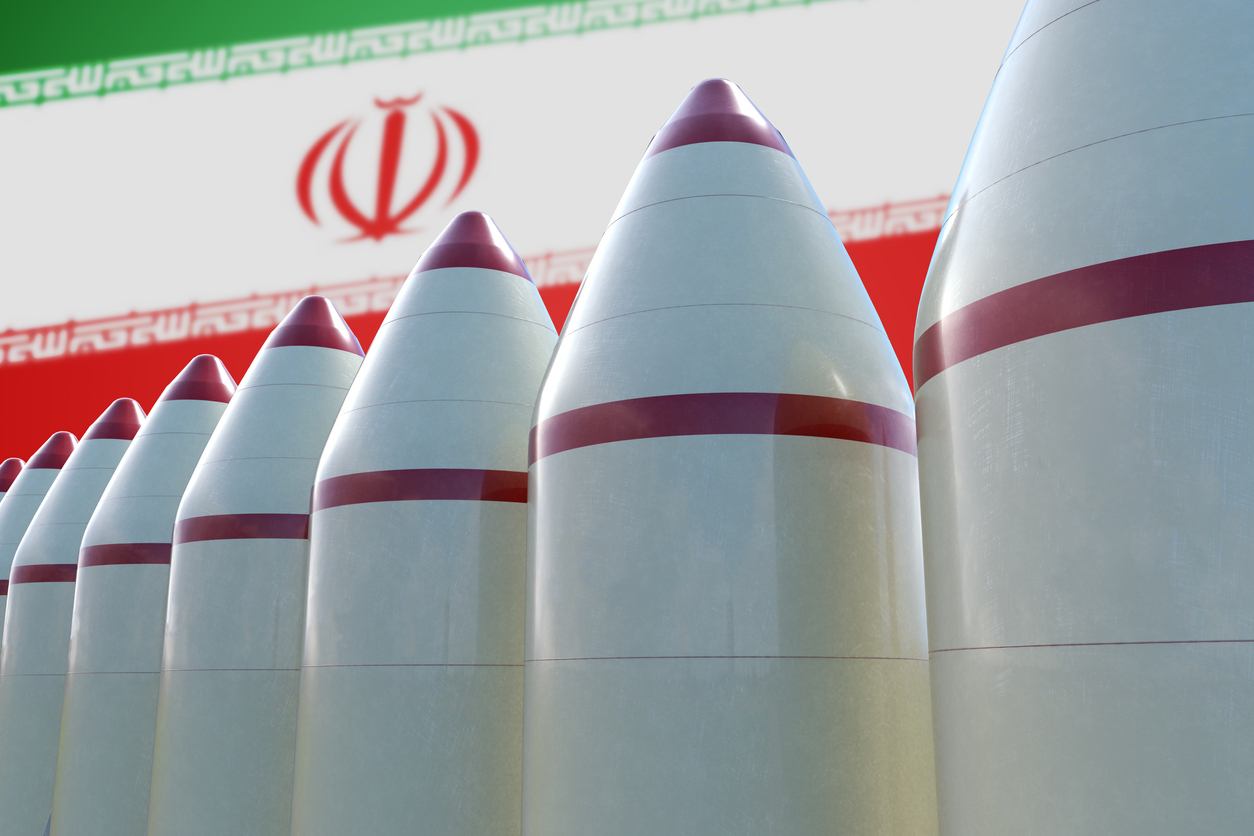
The Iranian regime has made it clear that its mission is to take over the region and create a single community under its version of Islamic leadership. Iran has for decades been encircling the Middle East -- in Syria, Lebanon, Iraq and Yemen -- by building a squeeze maneuver known as the "Shia Crescent." Imagine how much more destabilizing the Iranian regime would be if it had nuclear weapons. (Image source: iStock)

The Iranian regime has made it clear that its mission is to take over the region and create a single community under its version of Islamic leadership. The Islamic Republic's constitution states:

"The Constitution provides the necessary basis for ensuring the continuation of the Revolution at home and abroad. In particular, in the development of international relations, the Constitution will strive with other Islamic and popular movements to prepare the way for the formation of a single world community (in accordance with the Qur'anic verse: This, your community, is a single community, and I am your Lord, so worship Me)."

For the ruling mullahs of Iran, their mission is a form of Jihad that must be accomplished through military force. The mullahs' constitution adds:

"Accordingly, the Army of the Islamic Republic of Iran and the Islamic Revolutionary Guards Corps [IRGC] are to be organized in conformity with this goal, and they will be responsible not only for guarding and preserving the frontiers of the country, but also for fulfilling the ideological mission of jihad in God's way; that is, extending the sovereignty of God's law throughout the world (in accordance with the Qur'anic verse [8:60]: Prepare against them whatever force you are able to muster, and strings of horses, striking fear into the enemy of God and your enemy, and others besides them ". [Emphasis added]

While the mullahs are using religion to justify their mission of taking over the region, they are more likely attempting to take control of all the oil in the region; they appear to be advancing their hegemonic ambitions to this end.

Iran has for decades been encircling the Middle East -- in Syria, Lebanon and Iraq -- by building a squeeze maneuver known as the "Shia Crescent;" it has been trying to unseat the Kingdom of Saudi Arabia through Iran's Houthi proxies in Yemen, and it long ago attached itself to South America's most oil-rich country, Venezuela.

Please now imagine how much more destabilizing the Iranian regime would be if it had nuclear weapons, how much easier it would be for the regime to fulfill its constitutional mission of "extending the sovereignty of God's law throughout the world." The mission would start with getting "the Little Satan," Israel, out of the way, then taking control of the Gulf states, with an eye to eventually encircling the "Great Satan," the United States. In addition, the nuclear weapons will be sold to or fall into the hands of the world's assorted bad actors and terrorist groups.

If the Biden administration does not want to stop the Iranian regime, there are apparently countries in the region that are prepared to prevent the ruling mullahs of Iran from acquiring nuclear weapons to achieve this goal. The Biden administration should at least step in and help those countries.

"We must not see Iran only as Israel's problem and exempt the rest of the world," said Israeli Defense Minister Benny Gantz. When asked whether the Iranian regime should be confronted militarily, he said, "Yes, yes," and added, "and Israel has to do its part."

"We see that Iran is advancing toward the level of enrichment that would allow it, when it wished, to become a threshold state — and we are making every effort to prevent that," he said.

Israel has ordered advanced US-made planes, KC-46 Pegasus aerial refueling tankers, that are critical to strike Iran's nuclear facilities. By using refueling planes, Israeli fighter-bomber jets on long-range missions do not need to make a stop for refueling. As the Times of Israel wrote:

"The [New York Times] report noted that the tankers would be a significant upgrade for Israel and that without them, Jerusalem would need to rely on its aging fleet of refueling planes for a strike on Iran, or make a pit stop in Saudi Arabia or the United Arab Emirates, neither of which would want to be linked to an attack on rival Iran."

Although the sale of eight new KC-46 planes to Israel was approved by the State Department in March 2020 during the former US administration, the Biden administration is refusing to deliver.

Meanwhile, former Secretary of State John Kerry, has reportedly divulged to Iran "HUNDREDS of Israel's covert attacks." Although Kerry has denied that he leaked any secrets to Iran, his denials reportedly "do not add up," and the Biden administration has been refusing to address the issue.

Biden's legacy now looks as if will add up to surrendering Afghanistan to the Taliban; allowing Iran to acquire nuclear weapons; permitting China to take over Taiwan; enabling Russia to blackmail Europe with the Nord Stream 2 pipeline; failing to deter Russia from seizing Ukraine; harming the poorest Americans by forcing them pay more for everything by shutting off American oil and instead enriching Russia by buying it there at inflated prices; effectively cutting pay to the military and threatening to punish people who work by raising their taxes, all while paying millions of other people not to work; and to top it off, crippling the US military by diverting it from its core mission: winning wars.

If, as now published, any real response to Iran's threats will have to wait until 2024, will that be too late to stop at least one of these imminent catastrophes?


Dr. Majid Rafizadeh is a business strategist and advisor, Harvard-educated scholar, political scientist, board member of Harvard International Review, and president of the International American Council on the Middle East. He has authored several books on Islam and US foreign policy. He can be reached at Dr.Rafizadeh@Post.Harvard.Edu

Source: https://www.gatestoneinstitute.org/18084/confront-iran-mullahs

Follow Middle East and Terrorism on Twitter

Two rockets fired from Gaza towards central Israel - Anna Ahronheim


by Anna Ahronheim

Explosions were heard in the Tel Aviv and Rishon Lezion areas.

Two rockets launched from the Hamas-run Gaza Strip fell in the Mediterranean Sea off the coast of central Israel early on Saturday morning.
 
“Earlier this morning, two rocket launches were identified from the Gaza Strip toward the Mediterranean. The rockets fell off the coast of the Tel Aviv metropolitan area. According to protocol, no sirens were sounded and no interception took place,” the IDF Spokesperson’s Unit said in a statement.
 
The rockets were heard in the cities of Tel Aviv, Holon, Bat Yam and Rishon Lezion.
According to reports, one rocket fell near Tel Aviv while the other landed near Palmahim, south of the city. There were no injuries and, despite the smoke seen off the coast, no reports of damage.
 
Army Radio reported that Egypt has sent a message to Israel that the rocket fire was not intentional and IDF Chief of Staff Lt.-Gen. Aviv Kohavi held situational assessments regarding the rocket fire.
 
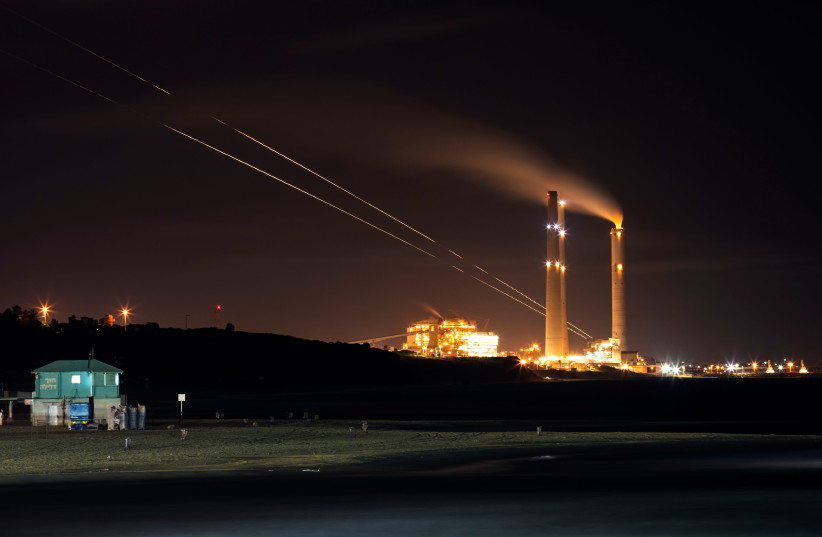
Streaks of lights are seen from Ashkelon as rockets are launched from the Gaza Strip towards Israel May 19, 2021. (credit: AMIR COHEN/REUTERS)Streaks of lights are seen from Ashkelon as rockets are launched from the Gaza Strip towards Israel May 19, 2021. (credit: AMIR COHEN/REUTERS)
 
Prime Minister Naftali Bennett held consultations over Shabbat regarding the rocket fire, according to a political source.
 
Groups in the Gaza Strip said that the two rockets were caused by “weather conditions.”
Hamas has used the excuse of lightning strikes causing rockets to be launched toward Israel, including in November of last year. In that incident, two rockets were fired and landed north of Ashdod and the other struck Palmahim Beach. In response, Israeli jets struck military positions and an underground structure belonging to Hamas.
 
Other incidents where lightning was blamed for rocket fire included one in March 2019 where a rocket made a direct impact on a home in the central town of Mishmeret in the Sharon Plain and injured seven people, as well as another in October 2018 when a home in Beersheba was destroyed after a rocket made a direct hit and another landed off the coast of Israel.
 
All rockets had been aimed towards the Jewish state and were preemptively primed.
 
The rocket launches come as the Israeli military said that this had been the longest period of operational quiet in relation to the four most recent operations in the coastal enclave.
 
In the six months following the 11 days of fighting in May, known as Operation Guardian of the Walls, only five long-range rockets were fired from the Hamas-run coastal enclave toward Israel.
 
In comparison, 22 rockets were fired following Protective Edge in 2014, 196 rockets were fired following Cast Lead in 2009, and 76 were fired following Pillar of Defense in 2012.
 
Despite the relative quiet, it remains tense in southern Israel with Hamas continuing to hold large-scale military drills, firing rockets toward the sea in an attempt to improve their rocket arsenal and threaten Israel.
 
In August, a Border Police officer was shot at point-blank range during a violent protest along the Gaza border fence. He died nine days later.
 
On Wednesday, senior officials from the terrorist group met with Hezbollah officials in the Lebanese capital of Beirut and vowed that they are preparing for a military confrontation with Israel.
 
Later that day, an Israeli civilian doing maintenance work on the newly completed border fence in the northern sector was lightly wounded after he was shot by a sniper.
 
In response, Israeli tanks fired artillery shells towards a Hamas post near Gaza City, wounding several farmers. The IDF also closed roads next to the border fence out of concern over additional attacks and ordered farmers to stay away from land near the border.


Anna Ahronheim

Source: https://www.jpost.com/breaking-news/article-690299

Follow Middle East and Terrorism on Twitter

Islamic Jihad threatens Israel as hunger-striking detainee reported in critical condition - Khaled Abu Toameh


by Khaled Abu Toameh

The detainee, Hisham Abu Hawwash, has been on a hunger strike for 138 days in protest of his administrative detention.


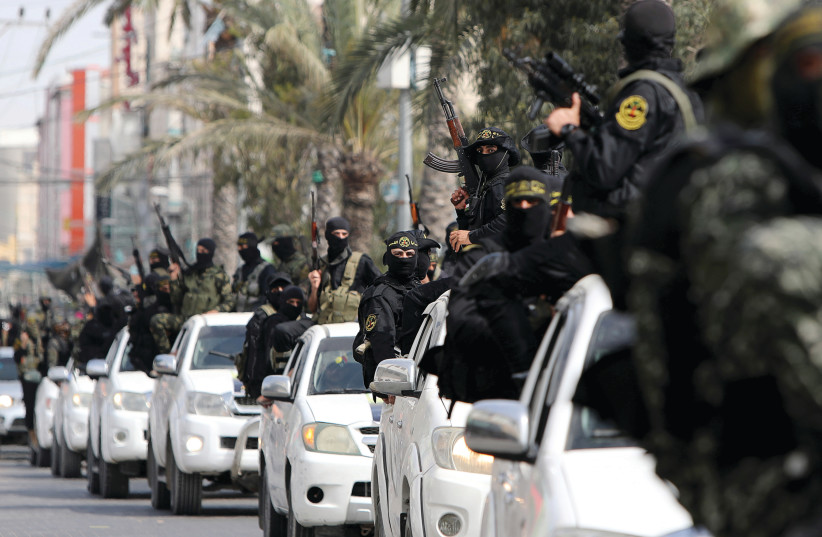
ISLAMIC JIHAD terrorists ride on pickup trucks during a symbolic funeral for Ramadan Shallah, a former leader of their group, in Gaza City on June 7 (photo credit: MOHAMMED SALEM/ REUTERS)
ISLAMIC JIHAD terrorists ride on pickup trucks during a symbolic funeral for Ramadan Shallah, a former leader of their group, in Gaza City on June 7
(photo credit: MOHAMMED SALEM/ REUTERS)

The Palestinian Islamic Jihad (PIJ) organization warned over the weekend that if a Palestinian administrative detainee who is on hunger strike dies it would consider his death an “assassination” by Israel.
 
The detainee, Hisham Abu Hawash, has been on hunger strike for 138 days in protest of his administrative detention. He was recently transferred to the Shamir Medical Center (Assaf Harofeh), where he is reported to be in critical condition. Abu Hawash has been held in administrative detention since October 2020.
 

PIJ Secretary-General Ziyad al-Nakhala threatened that if Abu Hawash dies, his organization would consider the death an assassination and respond accordingly.
 
A PIJ statement issued in the Gaza Strip claimed that Abu Hawash was “being subjected to a process of assassination.”
 
“All options are open and on the table in case the occupation continues its procrastination and evasion of responsibility,” the statement cautioned.
 
Palestinian Islamic Jihad militants take part in the funeral of their comrade in the southern Gaza Strip November 14, 2019 (credit: REUTERS/IBRAHEEM ABU MUSTAFA)Palestinian Islamic Jihad militants take part in the funeral of their comrade in the southern Gaza Strip November 14, 2019 (credit: REUTERS/IBRAHEEM ABU MUSTAFA)
 
A PIJ-affiliated armed group called the Jenin Brigades in the West Bank threatened that Israel would pay a heavy price if the prisoner dies. The group announced a “state of general mobilization” among its members, saying it was ready for retaliation.
 
Palestinian Authority Prime Minister Mohammad Shtayyeh on Saturday called on Israel to release the detainee. “Abu Hawash is in critical condition and we hold the occupation authorities fully responsible for his life,” he said.
 
On Friday, a delegation from the PA Health Ministry visited Abu Hawash at the hospital and found that his health condition was seriously dangerous as he suffers blurry vision, significant muscular atrophy and inability to move and talk, the ministry said in a statement.
 
The ministry said that it had reached out to international human rights organizations to demand that Abu Hawash be moved to a Palestinian hospital after the serious deterioration in his health condition.
 

Khaled Abu Toameh

Source: https://www.jpost.com/arab-israeli-conflict/article-690312

Follow Middle East and Terrorism on Twitter

Thursday, December 30, 2021

Fauci’s Wife Heads Department of Bioethics at NIH - Lloyd Billingsley


by Lloyd Billingsley

Dr. Doom's colossal conflict of interest.


Dr. Anthony Fauci is the highest paid bureaucrat in the entire federal government, and bags a bigger salary than the president of the United States. As head of the National Institute of Allergy and Infectious Diseases (NIAID), a division of the National Institutes of Health (NIH), Dr. Fauci commands a budget of more than $6 billion. Beside all that money, power and prestige, Dr. Fauci holds a strategic advantage.

Christine Grady, Dr. Fauci’s wife, is director of the NIH’s Department of Bioethics and heads the section on human subjects research. The relationship has only become known in recent years, and last February, Michelle Ruiz authored a Vogue feature headlined “For Dr. Anthony Fauci and Dr. Christine Grady, Love Conquers All.”

Back in 1983, Grady was a clinical nurse at NIH when Fauci asked her out to dinner. For the NIAID boss, it was “love at first sight . . . she was intelligent, beautiful, spoke multiple languages, and she had a very wonderful bedside manner.” Fauci and Grady married in 1985 Grady and the pair now form a “a medical power couple leading the fight against the coronavirus.” Nice story, but it wasn’t exactly love at first sight.

Grady served on President Reagan’s HIV/AIDS commission, and as Ruiz explains, “The couple met at the outset of the AIDS epidemic, with Fauci driving research at the NIAID and inviting activists to the table on scientific and medical discussions.” The couple found their true bond in the government response to AIDS.

Christine Grady’s husband earned a medical degree in 1966 but his bio shows no advanced degrees in molecular biology or biochemistry. Fauci believed AIDS was caused by the human immunodeficiency virus, HIV. UC Berkley molecular biologist Peter Duesberg found no evidence that HIV caused AIDS and set forth the case at length in Inventing the AIDs Virus, with a foreword by Nobel laureate Kary Mullis, inventor of the polymerase chain reaction. “We have not been able to find a good reason why most of the people believe that AIDS is caused by a virus called HIV,” wrote Mullis. “There is simply no scientific evidence demonstrating that is true.”

Fauci predicted that AIDS would ravage the entire population but as Michael Fumento showed in The Myth of Heterosexual AIDS, that never happened. AIDS was supposedly an “epidemic,” but from 1981 through 1990, a ballpark figure for the number of quarantines is 10, and no economic shut-down took place.

Christine Grady earned a PhD in philosophy and bioethics from Georgetown but she is not a medical doctor and like her husband holds no advanced degrees in biochemistry or molecular biology. In 1995 Grady authored The Search for an AIDS Vaccine: Ethical Issues in the development and testing of a preventative AIDS vaccine. As the back cover explains, “Grady explores the current wisdom governing research with human subjects” (emphasis added) and “clinical trials are already ongoing.”

Fauci’s remedy of choice for AIDS was the drug AZT (azidothymidine), marketed under the names Zidovudine or Retrovir. The drug has toxic effects but in the summer of 1989 Fauci announced clinical trials of AZT on pregnant mothers with HIV. As Duesberg explained, “a drug that interferes with growth can lead only to physical deformities in babies developing in the womb.” By all indications, nurse and bioethicist Christine Grady was okay with these trials, not the last to test human subjects with AZT and other powerful drugs.

In 1992, Fauci’s NIAID provided funding for the Incarnation Children’s Center (ICC) in New York as an outpatient clinic for HIV-positive children. The city’s Administration for Children’s Services (ACS) offered up children under its care, nearly all of them African American, for secretive drug experimentation. As the BBC’s 2004 Guinea Pig Kids, documented, drugs forced on the children powerful drugs such as AZT, Didanosene and Nevirapene.

As biochemist Dr. David Rasnick explained, the children were going to be miserable and one nurse discovered that some 80 of the children died. The medical establishment attacked the documentary but a 2009 New York Times report showed that children were enrolled without proper consent and many were subjected to medication trials not reviewed by an advisory panel.

In 2014, Valerie Leiter and Sarah Herman of Simmons College found similarities between Fauci’s NIAID-back drug trials and the government’s Tuskegee syphilis study. Since most of the children in the New York trials were black, the authors branded the case a “modern Tuskegee.”  If nurse, bioethicist and mother of three Christine Grady objected to these experiments on unwilling human subjects, nothing has been made public.

In 2012, the NIH named Christine Grady chief of the Department of Bioethics of the National Institutes of Health Clinical Center. Grady came billed as “a strong international voice in human subjects protections,” but no word that Grady had been married to NIAID boss Anthony Fauci for nearly 30 years, and nothing on the conflict of interest in the new arrangement. Since NIH ethics guide NIAID, Grady’s ethical decisions inform her husband’s research and development decisions.

After his wife became NIH bioethics boss, Fauci decided to fund dangerous gain-of-function research at the Wuhan Institute of Virology. No word from Grady about the ethics of making viruses more lethal and more transmissible, at an institute controlled by a Communist dictatorship and not accountable to Americans.

Fauci repeatedly lied about funding that research, but no word from Grady on the ethics of that deception. In early 2020, Fauci opposed President Trump’s ban on travel from China. Fauci recommended the destructive lockdowns that caused untold suffering and loss. No word from Grady about the ethics involved in those decisions.

As Elle reported last June, Christine Grady “identifies, researches, and writes about ethical issues concerning COVID-19 vaccines, resource allocation, and the safety of healthcare workers during the pandemic.” No word from the NIH bioethics boss about the safety of all those millions of human subjects in the general population.

Back in the 1990s, around the time that Grady’s book on AIDS appeared, Kary Mullis charged that Dr. Anthony Fauci “doesn’t understand electron microscopy and he doesn’t understand medicine. He should not be in a position like he’s in.” But he was, and is.

Dr. Fauci has reversed himself many times but the NIAID boss now claims “I represent science.” No word from Grady about that open declaration of megalomania. By all indications, Christine Grady’s husband can say or do just about anything, and the NIH bioethics boss has no problem with it. What could possibly go wrong?


Lloyd Billingsley

Source: https://www.frontpagemag.com/fpm/2021/12/dr-faucis-colossal-conflict-interest-lloyd-billingsley/

Follow Middle East and Terrorism on Twitter