Sunday, February 22, 2026

Explainer: US military buildup and scenarios for war with Iran - Shimon Sherman


​ by Shimon Sherman

Trump is weighing airstrikes to neutralize the Islamic Republic’s nuclear and ballistic missile programs, and a sustained campaign to topple the regime.
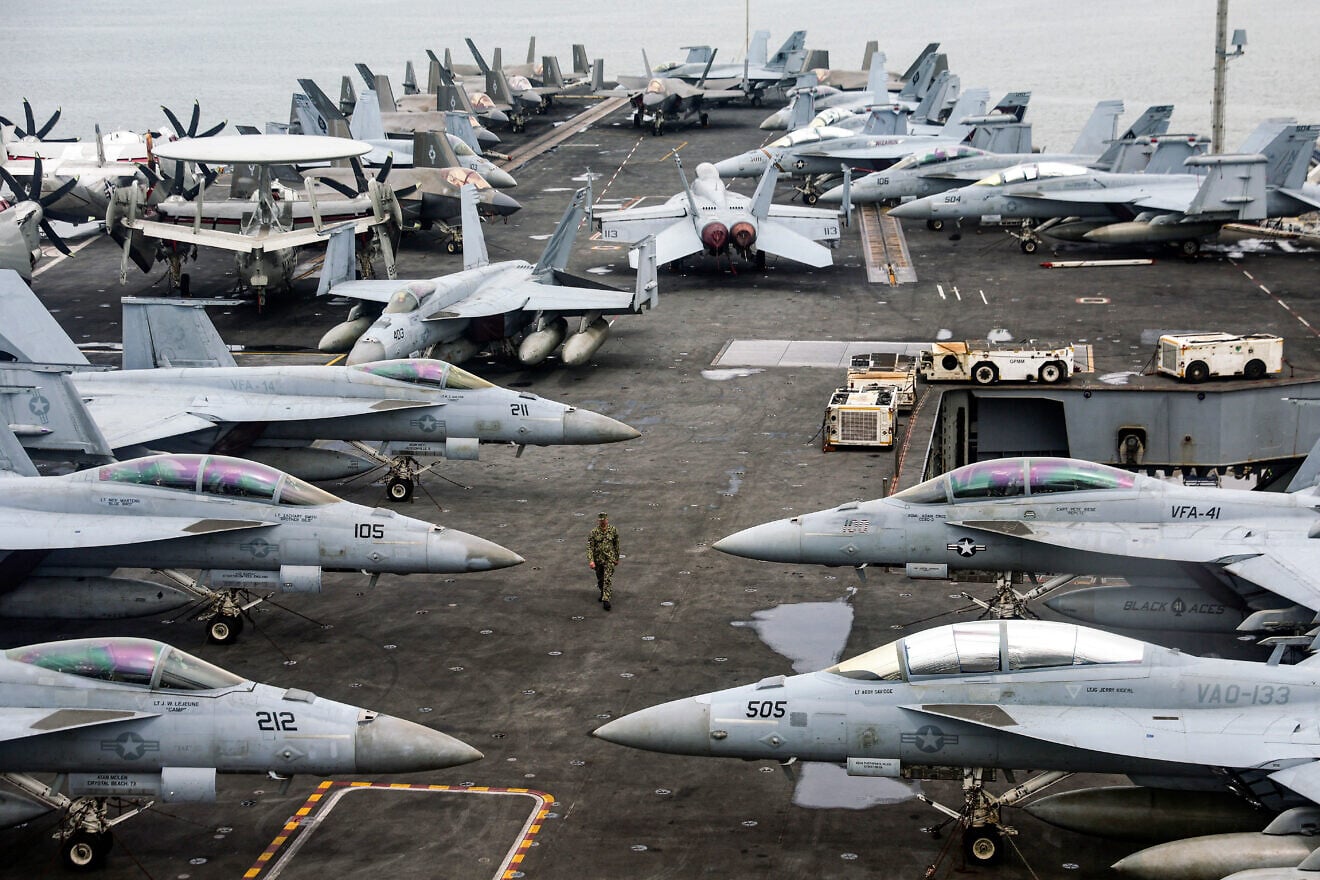
 

A U.S. Navy officer walks past F-18 fighter jets parked on the flight deck of the Nimitz-class aircraft carrier USS “Abraham Lincoln” during a media tour in Port Klang, on the outskirts of Kuala Lumpur, Malaysia, on Nov. 26, 2024. Photo by Fazry Ismail/POOL/AFP via Getty Images.
 

The Middle East has shifted toward the precipice of conflict, as evidenced by a historic U.S. military mobilization. This buildup comes as diplomatic efforts in Geneva disappointed U.S. policymakers, with Vice President JD Vance saying that the Iranians were “unwilling to acknowledge” President Donald Trump’s “red lines.”

On Thursday, Trump issued an ultimatum for a “meaningful” nuclear agreement. “I would think that would be enough time, 10, 15 days, pretty much maximum,” he said. Speaking at the inaugural meeting of the Board of Peace, he warned that if a deal is not reached, “bad things happen.”

White House Press Secretary Karoline Leavitt later emphasized that while “diplomacy was always the president’s first option,” the administration remains prepared to act if negotiations fail to produce a verifiable halt to enrichment.

IDF Maj. (res.) Alexander Grinberg, an expert on Iran at the Jerusalem Institute for Strategy and Security, told JNS, “The chances for a deal are very low. It is clear from the recent behavior that the Iranians are again trying to stretch out the negotiations and get more time.

“This time, no one believes the Iranians, and I think it’s very likely that we’re heading toward a military conflict,” he added.

The US buildup

Unlike the limited scope of the U.S.’s “Operation Midnight Hammer” in June 2025, current contingency planning is configured for a sustained campaign, with two American officials confirming to Reuters that the Pentagon is preparing for “sustained, weeks-long operations against Iran” if so ordered by Trump. To support this, the United States has assembled its largest concentration of air and naval strike power in the Middle East since the 2003 Iraq invasion.

The foundation of this buildup is two aircraft carrier strike groups, both of which Trump ordered to the region in recent weeks.

The USS Abraham Lincoln (CVN-72) arrived in the Arabian Sea on Jan. 26, leading a strike group that includes the guided-missile destroyers USS Frank E. Petersen Jr., USS Michael Murphy and USS Spruance.

This world’s largest aircraft carrier, the USS Gerald R. Ford (CVN-78), which redeployed from the Caribbean with its own complement of four destroyers equipped with Tomahawk cruise missiles and advanced air defense systems, entered the Mediterranean Sea through the Strait of Gibraltar on Friday and is headed eastward.

Maritime security is further bolstered by a surface patrol in the Strait of Hormuz, including the destroyers USS McFaul and USS Mitscher and the littoral combat ships USS Canberra, USS Tulsa and USS Santa Barbara, which are specifically suited for the minesweeping operations necessary to keep the waterway open in case of a sudden mining operation by the Iranians.

Airstrike capabilities have been similarly expanded across the theater, with CBS News and The War Zone reporting the movement of dozens of fourth- and fifth-generation fighter jets. This includes six F-22 Raptors that arrived at RAF Lakenheath in Suffolk, England, on Feb. 17, alongside E-3 AWACS and BACN communication aircraft, which analysts view as the strongest signals of preparation for a major conflict.

These are supported by F-15E Strike Eagles relocated from the U.K. to Muwaffaq Salti Air Base in Jordan and A-10C aircraft detected at regional bases by Chinese satellite imagery in mid-February. Whiteman Air Force Base in Missouri, from where the planes for “Operation Midnight Hammer” were launched, has also seen increased activity.

According to a recent report, the B-2 Spirit stealth bomber fleet is being maintained at “abnormally high readiness” to deliver the 30,000-pound GBU-57 Massive Ordnance Penetrators (MOPs). This bunker-buster is the only conventional weapon capable of penetrating the 80- to 100-meter granite shielding that Iran has used to protect several of its more sensitive sites.

Strike options

According to recent leaks as well as public statements by officials, the U.S. administration is actively weighing three distinct operational courses of action.

• The first option focuses on a sustained weeks-long campaign designed to precipitate the collapse of the Iranian regime by targeting its internal grip on power.

Adm. (ret.) Robert Harward, a former deputy commander of CENTCOM, explained that a campaign of this nature would prioritize targeting the Islamic Revolutionary Guard Corps (IRGC) and the instruments used to suppress the Iranian people.

“Because of what we’ve learned and what we’ve been able to develop technology-wise—be it command, control and targeting—it allows your mass of strikes to be more effective. Where previously you could do 40 or 50 strikes a day, we now can conduct hundreds of strikes a day. That in itself changes the equation completely for the regime.”

Targets for this option include the Tharallah Headquarters on Tehran’s Niayesh Highway, the IRGC’s “operational headquarters,” and the state-run media (IRIB) towers. This contingency would likely come with an attempt to “decapitate the regime” by simultaneously targeting broad swaths of the political and military leadership.

“It is critical to take out the competent political leaders in the IRGC and in the government,” Grinberg observed. “This would be a massive blow to the regime, and it would also reduce the chance of a power struggle with someone unfriendly to the U.S. and Israel coming to power even if the regime falls.”

• The second option is an intense aerial strike focusing on the degradation of military-industrial capabilities, building on the precedent of 2025 to neutralize the technical heart of the Islamic Republic’s nuclear and ballistic missile programs.

Reports from the Critical Threats Project indicate that Israel has requested that the U.S. strike Iran’s ballistic missile production infrastructure, specifically the Parchin and Shahroud complexes, where satellite imagery shows the attempted reconstruction of buildings housing solid-fuel planetary mixers.

“There are likely extensive underground cities that store a large percentage of the Iranian missile arsenal. Those would be an important target in any campaign,” Grinberg noted. “Many of these targets were not destroyed in June because they are buried very deep, and to fully destroy this threat, you would also have to use American B-2s and bunker busters.”

This plan would also aim to destroy the remaining 400 kg. (880 pounds) of enriched uranium, which likely survived the strikes during the June 2025 campaign. This option would not actively seek to topple the regime but rather to achieve concrete tactical goals surrounding the Iranian ballistic and nuclear program.

• A third option represents an asymmetric “stranglehold” using military and economic pressure to force a collapse of the regime or to soften Iran’s negotiating position.

During a recent meeting between Trump and Prime Minister Benjamin Netanyahu, the two sides reportedly agreed to wind up pressure on Iranian oil experts and to target Iran’s “shadow fleet,” which has been used to smuggle sanctioned oil out of the country. This move is designed to maximize the economic distress of a nation already reeling from 60% inflation and 72% food inflation.

Iran’s response

Tehran has responded to the historic U.S. military mobilization by accelerating the fortification of its strategic infrastructure and signaling a shift toward an offensive military doctrine.

According to satellite imagery analyzed by the Institute for Science and International Security (ISIS), Iran is rushing to bury its most sensitive nuclear and missile facilities at extreme depths to withstand American bunker-buster munitions. The most prominent of these sites is the “Pickaxe Mountain” facility south of Natanz, which is being excavated into hard granite at a depth of 80 to 100 meters, a depth Iranian engineers assess will provide immunity against the GBU-57 Massive Ordnance Penetrator.

Simultaneously, satellite photos from January and February reveal a massive logistical operation at the Isfahan nuclear complex to backfill and seal tunnel entrances to defend against airstrikes.

To project strength amid these defensive preparations, the IRGC and the Iranian regular military have conducted a series of high-profile drills.

On Thursday, Iranian naval forces hosted a joint exercise with Russian sailors in the Gulf of Oman and the southern Persian Gulf, rehearsing coordinated air and sea maneuvers to free hijacked vessels. This followed the mid-February “Smart Control of the Strait of Hormuz” exercise, which involved live-fire missile tests and the temporary closure of sections of the vital energy waterway.

These exercises have been accompanied by concrete acts of provocation designed to test U.S. naval reactions. On Feb. 3, a U.S. Navy F-35C launched from the USS Abraham Lincoln shot down an Iranian Shahed-139 drone after it “aggressively approached” the carrier strike group 500 miles off the Iranian coast. Hours later, IRGC fast boats attempted to board the U.S.-flagged tanker Stena Imperative in the Strait of Hormuz before being deterred by the arrival of the destroyer USS McFaul.

Iranian political and military leaders have matched these physical maneuvers with consistent militant rhetoric. Supreme Leader Ayatollah Ali Khamenei warned during the February naval drills that the U.S. Navy could be sunk if it attempts a confrontation. Furthermore, in a recent interview, the chief of staff of the Iranian Armed Forces, Maj. Gen. Abdolrahim Mousavi, warned that Iran is prepared to deliver “vengeful blows” and has shifted its posture toward the offensive.

Tehran’s kinetic retaliation plan relies on a reconstituted arsenal of over 3,000 ballistic missiles capable of striking U.S. bases and allied territory across the region. According to assessments from the Alma Research and Education Center and the Institute for the Study of War, while Israel destroyed nearly half of Iran’s inventory during the June 2025 conflict, the regime has replenished its medium-range stockpile to near pre-war levels.

Potential targets include major U.S. installations such as Al Udeid Air Base in Qatar, the target of an Iranian barrage in 2025, as well as Muwaffaq Salti Air Base in Jordan and facilities in Bahrain, Kuwait and the United Arab Emirates. Regardless of whether Israel participates in a U.S. strike, there is a broad consensus that Israel will also be targeted in an Iranian retaliation.

IRGC commander Hossein Daghighi underscored this priority in a February address to Al Mayadeen television, saying that “Israel will be Iran’s first target if the U.S. attacks,” while warning that the scope of any resulting conflict “will expand” beyond calculation.

Central to this expansion is the activation of the “Ring of Fire,” a network of regional proxies designed to overwhelm allied air defenses through multi-front saturation strikes. The Houthis in Yemen have emerged as the most critical arm of this strategy, maintaining the capability to harass global trade in the Red Sea and launch low-intensity missile and UAV attacks against Israel. On Jan. 26, the group released a brief video of a burning ship captioned with the single word “Soon,” signaling a readiness to resume high-tempo operations as the U.S. carrier groups arrived in theater.

Simultaneously, in Iraq, the paramilitary group Kataib Hezbollah has broken its recent silence; leader Ahmad “Abu Hussein” al-Hamidawi issued a direct warning that any strike on Iranian soil would trigger a “total war” involving militias across the Levant.

While Hezbollah has been less vocal or willing to commit to intervention on Iran’s behalf, recent reports indicate that the IDF is actively preparing for this contingency. In the last few weeks, strikes on Hezbollah targets in Lebanon have markedly increased, indicating an attempt to weaken Hezbollah before more open confrontation emerges in the broader context of a U.S. war with Iran.

Israel preparing for war

According to expert assessments, Israel is likely to join in on any U.S. operation in Iran. Military and political coordination between the United States and Israel has reached a state of unprecedented integration over the past month. Dozens of high level meeting have been reported across the political and military leadership, including recent separate trips by the prime minister, the chief of staff of the IDF and the head of the Mossad to Washington.

According to reporting from Israel Hayom, operational deconfliction protocols have been established between Israel’s Kirya defense headquarters and U.S. CENTCOM to prevent “operational friction” during parallel military operations, including joint target bank development.

In parallel with these developments, the IDF Home Front Command has placed the civilian sector on a war footing. Major medical facilities are executing emergency readiness plans to mitigate the impact of potential Iranian retaliation. Soroka Medical Center in Beersheva, which sustained severe damage from an Iranian missile in 2025, has begun updating its emergency procedures and refining simulations for patient transfers in the event of airstrikes.

Similarly, Wolfson Medical Center in Holon has evacuated its underground areas for immediate patient intake and relocated its pediatric surgery department to the children’s ward to ensure specialized care remains protected.

Civilian defense instructions have been updated to emphasize individual resilience. Col. (res.) Nir Neuman, an officer in the Home Front Command and head of the firefighting system at the Israel Electric Corporation, advised the public via a Maariv podcast to maintain stockpiles in protected spaces of “emergency lighting, batteries and dry food” along with at least a “six-pack of water.”

Neuman emphasized that while strategic facilities and power generation hubs have been fortified, civilian preparedness is a critical component of national security, saying that “resilience is our most important weapon” in the face of the Iranian threat.

Addressing local leaders on Jan. 6, IDF Chief of Staff Lt. Gen. Eyal Zamir underscored this state of readiness, stating that “preparedness for war is our compass” as the military acts to safeguard the security of the state. Public broadcaster KAN reports that the Israeli army remains “prepared and alert” for U.S. kinetic action, while also preparing for the possibility of receiving n American “green light” to independently target Iran’s ballistic missile systems if the 10- to 15-day diplomatic window expires without a deal. 


Shimon Sherman is a columnist covering global security, Middle Eastern affairs, and geopolitical developments. His reporting provides in-depth analysis on topics such as the resurgence of ISIS, Iran’s nuclear ambitions, judicial reforms in Israel, and the evolving landscape of militant groups in Syria and Iraq. With a focus on investigative journalism and expert interviews, his work offers critical insights into the most pressing issues shaping international relations and security.

Source: https://www.jns.org/explainer-us-military-buildup-and-scenarios-for-war-with-iran/

Follow Middle East and Terrorism on Twitter

Erdogan's Sunni Noose: Turkey's Bid to Encircle Israel - Pierre Rehov


​ by Pierre Rehov

Some analysts describe an emerging "Sunni axis," or noose, influenced by Muslim Brotherhood ideology; backed by Turkish military power, financed by Qatar and Saudi Arabia, and designed, by expanding into Gaza, to encircle and finish off Israel.


  • Turkish President Recep Tayyip Erdogan has launched an ambitious diplomatic offensive aimed at unifying the Sunni world under Ankara's leadership. The objective is not merely reconciliation with former rivals. It is the construction of a Sunni diplomatic and strategic "wall," or "noose," around Israel, replacing the Iranian "Shi'ite crescent" with a new configuration of Sunni power.

  • The Turkish-Saudi reconciliation is particularly significant. Following years of tension after the 2018 murder of journalist Jamal Khashoggi in Istanbul, Ankara and Riyadh have now moved decisively toward strategic cooperation.

  • Turkish and Saudi officials increasingly frame Israel as a destabilizing actor in these theaters. The emerging partnership is not merely economic; it reflects coordinated positioning against perceived external threats, with Israel explicitly cited.

  • Turkey and Egypt have now signed a $350 million military framework agreement covering joint weapons production, intelligence sharing, and military exercises. Turkish air defense systems and munitions are slated for delivery, and bilateral trade is projected to reach $15 billion.

  • As the guardian of the Suez Canal and a dominant actor in North Africa, Egypt provides logistical leverage capable of influencing maritime routes critical to Israel's economy.

  • On February 9, 2026, the foreign ministers of Turkey, Egypt, Indonesia, Jordan, Pakistan, Qatar, Saudi Arabia, and the United Arab Emirates issued a joint communiqué condemning what they called "Israeli expansionist policies in occupied territories" and calling for Islamic unity.

  • Some analysts describe an emerging "Sunni axis," or noose, influenced by Muslim Brotherhood ideology; backed by Turkish military power, financed by Qatar and Saudi Arabia, and designed, by expanding into Gaza, to encircle and finish off Israel.

  • The UAE, under the impressive leadership of Sheikh Mohamed ben Zayed al Nahyan, pursues a technocratic, anti-political Islam agenda that diverges sharply from Erdogan's ideological sympathies.... Still, the coalition's ultimate aim, apart from the UAE, unmistakably seems to be "containing" Israel.

  • Recently, Saudi media have featured openly anti-Israel and antisemitic headlines not seen in years. The kingdom appears to be totally aligning itself with anti-Israel countries such as Qatar and Turkey, while "tensions with the UAE explode."

  • Egypt, Israel's chilly peace partner since 1979, has reportedly expanded military infrastructure in the Sinai Peninsula in ways that should, under the supposed peace treaty, raise serious questions.

  • Turkish and Egyptian intelligence services are reportedly coordinating efforts to counter rival influences and restrict Israel's strategic access.

  • Israeli analysts increasingly describe it as the replacement of Iran's Shiite axis with a Sunni bloc influenced by the Muslim Brotherhood.

  • The coalition presents itself as promoting regional peace. Yet "peace" may translate into the vaporization of Israel, especially should a future Israeli government prove more pliable.

  • Erdogan's participation in "stabilization" efforts would significantly expand Turkish influence within the emerging Sunni crescent. Ankara's well-documented support for Muslim Brotherhood networks — which are Hamas's patrons, ideologically and financially – should raise obvious concerns.

  • Netanyahu's insistence that Israel determine which international actors, if any, operate in Gaza, serves multiple strategic purposes. It prevents Turkish entrenchment in Gaza, maintains Israeli control over post-war arrangements, and signals to Washington that Israel views Turkish expansionism as a long-term threat transcending personal or political relationships.

  • Whatever the obstacles, Erdogan's direction seems clear: a militarily and economically anchored Sunni alignment to constrict Israel's strategic space.

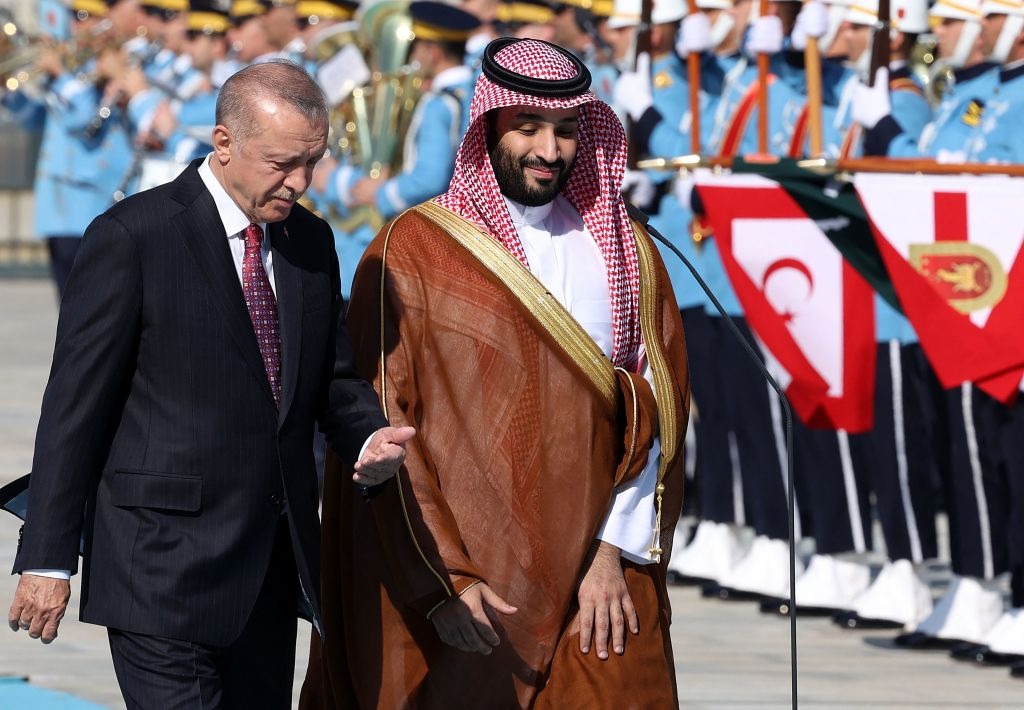
Turkish President Recep Tayyip Erdogan has launched an ambitious diplomatic offensive aimed at unifying the Sunni world under Ankara's leadership. The objective is not merely reconciliation with former rivals. It is the construction of a Sunni diplomatic and strategic "wall," or "noose," around Israel. Pictured: Erdogan welcomes Crown Prince of Saudi Arabia Mohammed bin Salman to Ankara, on June 22, 2022. (Photo by Adem Altan/AFP via Getty Images)

While much of the world's attention remains fixed on Iran and its Shi'ite axis, another geopolitical realignment is taking shape — more quietly, more pragmatically, and potentially just as consequential for the US, Israel and the Middle East.

Turkish President Recep Tayyip Erdogan has launched an ambitious diplomatic offensive aimed at unifying the Sunni world under Ankara's leadership. The objective is not merely reconciliation with former rivals. It is the construction of a Sunni diplomatic and strategic "wall," or "noose," around Israel, replacing the Iranian "Shi'ite crescent" with a new configuration of Sunni power.

In early February 2026, Erdogan embarked on a Middle East tour that signaled a turning point. On February 3, he visited Saudi Arabia. On February 4, Egypt. On February 7, Jordan's King Abdullah II was received in Istanbul. These meetings were not symbolic. They marked the culmination of a "normalization" process that has been unfolding since 2022, as Turkey repaired relations that were damaged by its earlier ideological support for the Muslim Brotherhood and confrontations with Gulf monarchies.

The Turkish-Saudi reconciliation is particularly significant. Following years of tension after the 2018 murder of journalist Jamal Khashoggi in Istanbul, Ankara and Riyadh have now moved decisively toward strategic cooperation. Discussions with Saudi Crown Prince Mohammed bin Salman produced major agreements, including a $2 billion Saudi investment in renewable energy projects in Turkey, targeting 5,000 megawatts of solar capacity. Defense cooperation was expanded to include technology transfers for Turkish drones and air defense systems. Bilateral trade is expected to reach $50 billion.

Erdogan has emphasized "growing strategic trust" in confronting regional instability — from Syria to Gaza. Turkish and Saudi officials increasingly frame Israel as a destabilizing actor in these theaters. The emerging partnership is not merely economic; it reflects coordinated positioning against perceived external threats, with Israel explicitly cited.

Egypt represents an even more dramatic shift. After a decade of hostility — triggered by Turkey's support for the Muslim Brotherhood following the 2013 ouster of Egyptian President Mohamed Morsi — Erdogan's visit to Cairo marked the end of a long freeze. Turkey and Egypt have now signed a $350 million military framework agreement covering joint weapons production, intelligence sharing, and military exercises. Turkish air defense systems and munitions are slated for delivery, and bilateral trade is projected to reach $15 billion.

Strategically, Egypt's participation transforms the coalition's scope. As the guardian of the Suez Canal and a dominant actor in North Africa, Egypt provides logistical leverage capable of influencing maritime routes critical to Israel's economy. Discussions between Erdogan and President Abdel Fattah el-Sisi reportedly included Gaza, Syria, and Africa—regions where both countries share concerns over the influence of Israel and the United Arab Emirates.

Jordan, long a security partner of Israel despite persistent political hostility at home, has also been drawn into closer alignment with Turkey. Joint statements have emphasized peace in Syria and Gaza and highlighted "common concerns" about regional stability. A future Erdogan visit to Amman is under discussion, underscoring Jordan's integration into Ankara's growing network.

On February 9, 2026, the foreign ministers of Turkey, Egypt, Indonesia, Jordan, Pakistan, Qatar, Saudi Arabia, and the United Arab Emirates issued a joint communiqué condemning what they called "Israeli expansionist policies in occupied territories" and calling for Islamic unity. Israeli media outlets such as Ynet interpreted the statement as evidence of a "coalition of interests against Israel," with Turkey playing the unifying role.

Some analysts describe an emerging "Sunni axis," or noose, influenced by Muslim Brotherhood ideology; backed by Turkish military power, financed by Qatar and Saudi Arabia, and designed, by expanding into Gaza, to encircle and finish off Israel. The isolated Turkish-Qatari alignment of 2017–2021 appears to have evolved into a broader strategy of economic and diplomatic influence, channeling of neo-Ottoman ambitions.

A few structural limits do remain. Saudi Arabia acts as the guardian of Sunni Islam's holiest sites and is unlikely to surrender religious leadership to Ankara. Egypt retains unmatched demographic and military weight in the Arab world.

The UAE, under the impressive leadership of Sheikh Mohamed ben Zayed al Nahyan, pursues a technocratic, anti-political Islam agenda that diverges sharply from Erdogan's ideological sympathies. Turkey's continued affinity for the Muslim Brotherhood remains a source of friction. Coordination may be pragmatic, but ideological fusion is far from complete. Still, the coalition's ultimate aim, apart from the UAE, unmistakably seems to be "containing" Israel.

Turkey-Israel relations oscillate between harsh rhetoric and pragmatic cooperation. Erdogan has publicly compared Israeli Prime Minister Benjamin Netanyahu to Hitler and accused Israel of Nazi-like policies. Economic ties, however, persist, and Eastern Mediterranean energy interests have occasionally aligned. Erdogan instrumentalizes the Palestinian cause to bolster his Islamic leadership credentials, even as Ankara avoids direct military confrontation with Israel.

The broader coalition presents more complex dynamics. Saudi Arabia had been in advanced discussions with Washington regarding conditional normalization with Israel. Those talks appear to have stalled or, most probably, collapsed. Recently, Saudi media have featured openly anti-Israel and antisemitic headlines not seen in years. The kingdom appears to be totally aligning itself with anti-Israel countries such as Qatar and Turkey, while "tensions with the UAE explode."

Egypt, Israel's chilly peace partner since 1979, has reportedly expanded military infrastructure in the Sinai Peninsula in ways that should, under the supposed peace treaty, raise serious questions. Jordan continues close coordination with Israel, even as domestic political hostility remains intense.

Would these states risk overt military alignment against Israel? Perhaps not this minute, but Erdogan's strategy does not require immediate war. It requires gradual encirclement. Nowhere is this more evident than in Africa, especially along the Red Sea coast. From Libya to Sudan to Somalia, Turkish and Egyptian intelligence services are reportedly coordinating efforts to counter rival influences and restrict Israel's strategic access.

In Libya, once divided between Turkish-backed Tripoli and Egyptian-supported Marshal Khalifa Haftar, Ankara and Cairo are now aligning to stabilize the country and limit UAE-supported militias perceived as close to Israel. In Sudan, near Egypt's southwestern border, the Sudanese civil war continues. Turkey provides logistical and intelligence support, aligning with Saudi Arabia to potentially threaten Israeli access to the Red Sea.

In Somalia, Egypt has increased its military presence to approximately 10,000 troops after Israel's December 2025 recognition of Somaliland. Turkey maintains its largest overseas military base in Mogadishu, training Somali forces and developing military infrastructure. A Saudi-Somali defense agreement strengthens this axis, positioning it near the Bab el-Mandeb Strait — a chokepoint vital to global trade and Israeli shipping. The stated objective is securing the Red Sea against "foreign military presence." The unstated implication is the containment of Israel.

This evolving configuration represents a transformation of what was once considered the "moderate Sunni camp" — historically aligned with the United States and tolerant, if not friendly, toward Israel — into a broader Islamic coalition capable of exerting diplomatic, economic and military pressure. Israeli analysts increasingly describe it as the replacement of Iran's Shiite axis with a Sunni bloc influenced by the Muslim Brotherhood.

The ultimate goal appears twofold: diplomatic isolation through forums such as the Organization of Islamic Cooperation, where Turkey advocates economic sanctions, and economic leverage via control of energy routes and maritime corridors. The coalition presents itself as promoting regional peace. Yet "peace" may translate into the vaporization of Israel, especially should a future Israeli government prove more pliable.

Against this backdrop, Israeli Prime Minister Benjamin Netanyahu has taken a firm stand. On January 19, 2026, addressing the Knesset, he declared unequivocally that there would be "no Turkish or Qatari soldiers in the Gaza Strip." His veto came days after the White House announced the creation of a U.S.-supervised "Board of Peace" to oversee Gaza reconstruction, reportedly including Turkish and Qatari representatives such as Foreign Minister Hakan Fidan.

Netanyahu did not hesitate to confront President Donald Trump publicly on the issue. He instructed Foreign Minister Gideon Sa'ar to convey Israel's objections directly to Secretary of State Marco Rubio. The disagreement underscored a red line: Israel would determine which international actors, if any, operate in Gaza.

The refusal is consistent with earlier Israeli objections to Turkish military involvement in post-war Gaza planning. Erdogan's participation in "stabilization" efforts would significantly expand Turkish influence within the emerging Sunni crescent. Ankara's well-documented support for Muslim Brotherhood networks — which are Hamas's patrons, ideologically and financially – should raise obvious concerns. Netanyahu's insistence that Israel determine which international actors, if any, operate in Gaza, serves multiple strategic purposes. It prevents Turkish entrenchment in Gaza, maintains Israeli control over post-war arrangements, and signals to Washington that Israel views Turkish expansionism as a long-term threat transcending personal or political relationships.

Meanwhile, the UAE's stance for normalization with Israel may clash with Turkey's drive for dominance. Egypt, having briefly fallen to Muslim Brotherhood rule after the 2011 overthrow of President Hosni Mubarak, remains deeply wary of a Brotherhood resurgence. Riyadh's ambitions for Sunni leadership compete with Ankara's neo-Ottoman vision.

Whatever the obstacles, Erdogan's direction seems clear: a militarily and economically anchored Sunni alignment to constrict Israel's strategic space. While Iran's crescent may be weakening under sanctions and internal strain, another structure is rising in its place. The new structure is not overtly militant. It does not advertise itself as an alliance against Israel. But through energy pacts, defense agreements, intelligence coordination, and multilateral communiqués, it seems clearly to want to reconfigure the regional balance of the Middle East.

The coming years will determine whether this Sunni wall strengthens into a unified front or weakens under competing ambitions. For Israel, complacency is not an option. The encirclement may no longer be Shiite, but Sunni — and diplomatic, at first, rather than immediately military. In geopolitics, the form of pressure matters less than its cumulative effect.


Pierre Rehov, who holds a law degree from Paris-Assas, is a French reporter, novelist and documentary filmmaker. He is the author of six novels, including "Beyond Red Lines", "The Third Testament" and "Red Eden", translated from French. His latest essay on the aftermath of the October 7 massacre " 7 octobre - La riposte " became a bestseller in France. As a filmmaker, he has produced and directed 17 documentaries, many photographed at high risk in Middle Eastern war zones, and focusing on terrorism, media bias, and the persecution of Christians. His latest documentary, "Pogrom(s)" highlights the context of ancient Jew hatred within Muslim civilization as the main force behind the October 7 massacre.

Source: https://www.gatestoneinstitute.org/22292/erdogan-sunni-noose-encircle-israel

Follow Middle East and Terrorism on Twitter

Iran: When Ayatollahs Lampoon the Clergy - Amir Taheri


​ by Amir Taheri

[T]he current wave of attacks on the clergy could come from the "deep state" including the Islamic Revolutionary Guard Corps that may be thinking of a post-Khamenei arrangement in which the turbans move stage left to exit.


  • "Look at our times a handful of imposter clerics
    Having no notion of reason and science
    Having no notion of what man is about
    Desperate like donkeys in search of fodder
    All they care about is eating and fornicating
    Have cast aside notions of shame and honor
    They seek nothing but loot and plunder
    Alien they are to rules of faith."

    — Sanai, 11th century Persian poet, from a samizdat distributed in the "holy" city of Qom, the bastion of Iranian clergy, February 20, 2026, the 40th day of the deaths of thousands of protesters across Iran.

  • Surprisingly, despite unprecedented security deployment, no attempt was made to stop the tract.

  • It quotes an unnamed cleric addressing fellow clerics: "They gave you money to build a school but you built a palace for yourself!" — Editorial in daily Jumhuri Islami, founded in 1979 and owned by "Supreme Guide" Ayatollah Ali Khamenei.

  • Today, however, every village mullah insists on having a luxury tomb, if not a full-blown shrine with ceramic tiles and mirror work.

  • Before the 1979 revolution, the clergy was largely independent of state funds. In 1977, total government "gifts" to a dozen grand ayatollahs in Qom, Tehran and Mashhad were estimated at $3 million.

  • Today, voluntary donations have evaporated, leaving the clergy dependent on a secular authority that uses a clerical vocabulary.

  • Thus the current wave of attacks on the clergy could come from the "deep state" including the Islamic Revolutionary Guard Corps that may be thinking of a post-Khamenei arrangement in which the turbans move stage left to exit.

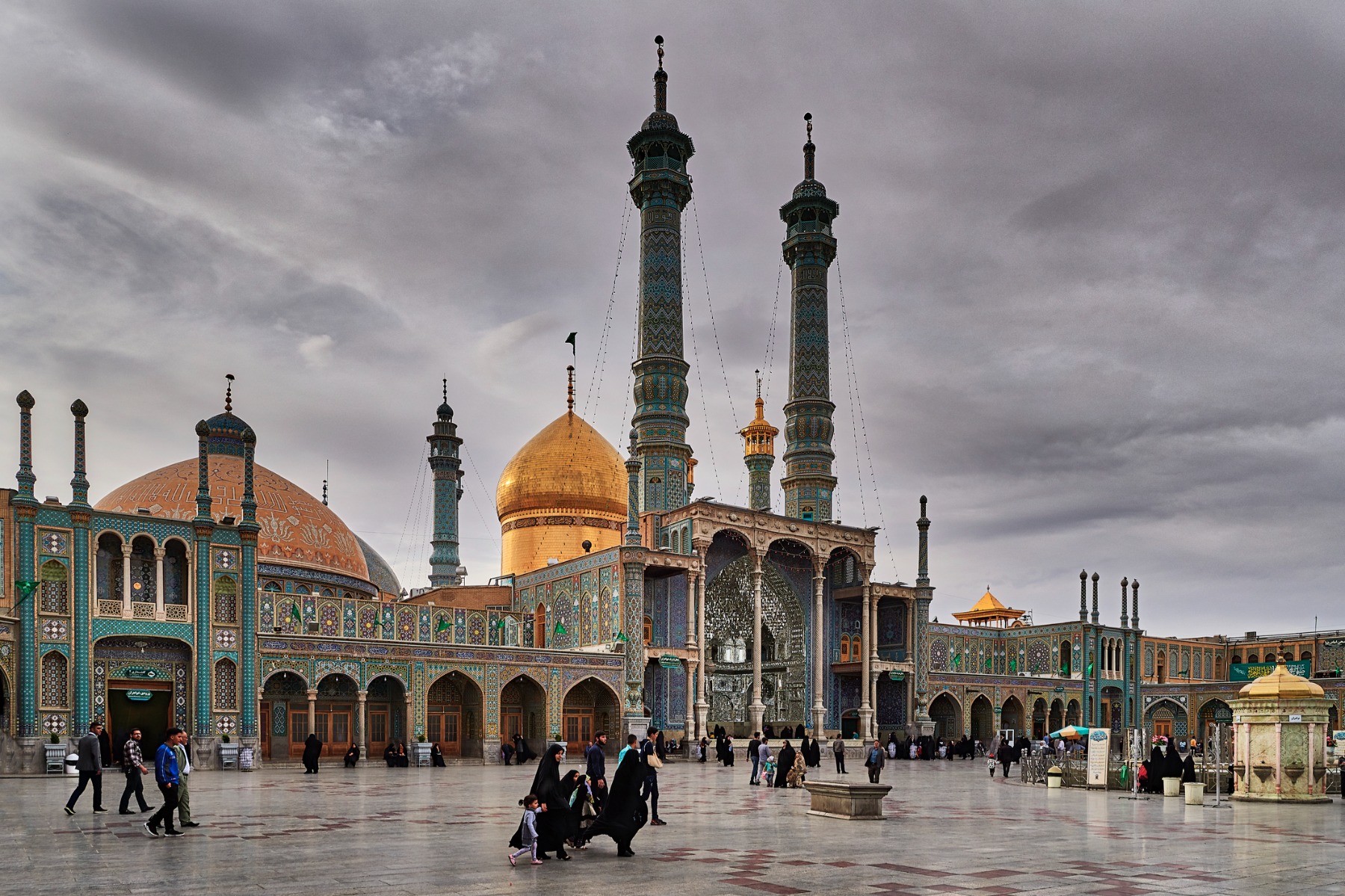
Last Tuesday, as Iranians organized mourning ceremonies on the 40th day of the deaths of thousands of protesters across the nation, a samizdat with a poem lampooning the clergy was distributed in the "holy" city of Qom, the bastion of Iranian clergy. Surprisingly, despite unprecedented security deployment, no attempt was made to stop the tract. Pictured: The Shrine of Fatima Masumeh in Qom, Iran. (Photo by iStock/Getty Images)

Last Tuesday, as Iranians organized mourning ceremonies on the 40th day of the deaths of thousands of protesters across the nation, a samizdat was distributed in the "holy" city of Qom, the bastion of Iranian clergy.

The single-page tract included parts of a poem by Sanai, an 11th century Persian poet lampooning the clergy.

Part of it read:

Look at our times a handful of imposter clerics
Having no notion of reason and science
Having no notion of what man is about
Desperate like donkeys in search of fodder
All they care about is eating and fornicating
Have cast aside notions of shame and honor
They seek nothing but loot and plunder
Alien they are to rules of faith.

Surprisingly, despite unprecedented security deployment, no attempt was made to stop the tract.

Did the authorities want to pass a message to the clergy who have remained silent throughout the most turbulent weeks of the beleaguered republic?

The expectation was that the clergy would do what they have done for half a century: acting as echo chamber for the official narrative of the tragic events.

A sign that the attack on clergy may have had a nod and a wink from "the authorities" came the same day in the official daily Jumhuri Islami ("Islamic Republic") founded in 1979 and owned by "Supreme Guide" Ayatollah Ali Khamenei.

In an editorial, the paper accused the clergy of having lost contact with "real community" and being addicted to mammon's offers.

"Instead of living in small cells of the howzah (theological school) they live in luxurious abodes and enjoy the best possibilities that worldly life can offer," the editorial claimed.

The editorial revealed that the luxury villas and penthouses where some clergy live are theoretically owned by "foundations", "charities" and "research centers" they head, funded by the state.

It quotes an unnamed cleric addressing fellow clerics: "They gave you money to build a school but you built a palace for yourself!"

The editorial laments "the time when clerical life was based on piety, self-abnegation, frugality and modesty." "In those days," it asserts, "the highest-ranking clerics shunned titles such as ayatollahs and signed themselves as al-ahqar [an Arabic term that means the humblest]."

Such grand clerics as Abdul-Karim Haeri of Maybod arguably the highest "maraja al taqlid" (source of imitation) in his time, even insisted that their modest tombstone bear no honorific title.

Today, however, every village mullah insists on having a luxury tomb, if not a full-blown shrine with ceramic tiles and mirror work.

The editorial claims that the clergy have lost the contact they had with the mass of believers because they now depend on government funding, gifts and positions with salaries and perks.

Thus, instead of taking an interest in matters that touch the foundations of society, they focus on "appearances" such as why the government allows some women to play fast and loose with "hijab" or why banks play tricks to circumvent the ban on charging interest.

The article in Ayatollah Khamenei's newspaper concludes by quoting Imam Muhammad Ghazzali the great 12th-century Persian theologian who also lampooned the clergy of his time for deviating from the True Path.

A day after the surprise editorial, it was the turn of IRNA the official news agency, to publish a lengthy interview with Ayatollah Majid Ansari an IRGC senior cleric acting as presidential advisor.

In it he accuses the clergy of having "replaced religion with personal opinions" thus alienating public opinion. "We need to cease imposing our tastes on society, especially on younger people," he says. "People, especially the youth, want to live a normal life and will resist against any barrier we may erect."

Hassan Khalkhali a noted expert on "seminary affairs" claims that "there has emerged in Iran a kind of disaffection between the clergy and the mass of the people for the first time in five centuries, that is to say, since Iran adopted Shiism." He reports that some clerics now feel "unsafe appearing in traditional cloth and turban" and wear jeans and baseball caps in public.

Son of Grand Ayatollah Khalkhali also claims that some clerics are leaving the country mostly to start a new life in Iraq. Last year alone, over 3,000 relocated to Najaf and Karbala.

What is one to make of what looks like an officially sanctioned, if not actually organized, criticism of the clergy? Why would a system built around the clergy sanction such ardent criticism of its core?

No straight answer is possible because Iran today has several layers of clergy.

The most reliable figures put the number of clergy at around 300,000, including some 70,000 students of theology, of whom a third come from 30 foreign countries. Clerics in governmental or semi-official positions number around 50,000.

A further 20,000 clerics are on state payroll through "foundations" "charities" and "research centers" they head. Some 100,000 receive state donations through the National Association of Mosques that administers the estimated 80,000 mosques and 7,000 mausoleums of "holy" men and women.

That leaves around 50,000 to 60,000 clerics who are theoretically self-financing. But even then Khalkhali reports that many of them own businesses managed by their sons or sons-in-law, often benefiting from juicy government contract and "heavy envelope" gifts on feast days. One grand ayatollah owns no fewer than 157 companies engaged in import-export, hospitality, mining and foreign travel services.

Before the 1979 revolution, the clergy was largely independent of state funds. In 1977, total government "gifts" to a dozen grand ayatollahs in Qom, Tehran and Mashhad were estimated at $3 million. The clergy depended on voluntary donations by hundreds of thousands of believers in Iran and abroad who regarded it as an interface if not a counterweight to profane authorities. That created a balance in which the clergy and the government cooperated within limits but remained aware of potential zones of discord.

Ayatollah Khomeini sought a Goldilocks solution by trying to unite the turban and the military cap.

Today, voluntary donations have evaporated, leaving the clergy dependent on a secular authority that uses a clerical vocabulary.

Last month's tragic events provided an occasion for the clergy to reassert its alterity by remaining silent, neither endorsing the protests nor condemning them as the powers-that-be wished.

Thus the current wave of attacks on the clergy could come from the "deep state" including the Islamic Revolutionary Guard Corps that may be thinking of a post-Khamenei arrangement in which the turbans move stage left to exit.

Gatestone Institute would like to thank the author for his kind permission to reprint this article in slightly different form from Asharq Al-Awsat.


Amir Taheri was the executive editor-in-chief of the daily Kayhan in Iran from 1972 to 1979. He has worked at or written for innumerable publications, published eleven books, and has been a columnist for Asharq Al-Awsat since 1987. He graciously serves as Chairman of Gatestone Europe.

Source: https://www.gatestoneinstitute.org/22294/ayatollahs-lampoon-the-clergy

Follow Middle East and Terrorism on Twitter

Armed man shot and killed after ‘unauthorized entry’ into Mar-a-Lago: Secret Service - Ashley Carnahan


​ by Ashley Carnahan

Suspect identified as 21-year-old Austin Tucker Martin of North Carolina


A man in his early 20s was shot and killed early Sunday after allegedly breaching the secure perimeter of President Donald Trump’s Mar-a-Lago estate in Palm Beach, Florida, the U.S. Secret Service announced.

The Secret Service said the incident occurred around 1:30 a.m. when the suspect made an "unauthorized entry" at the property.

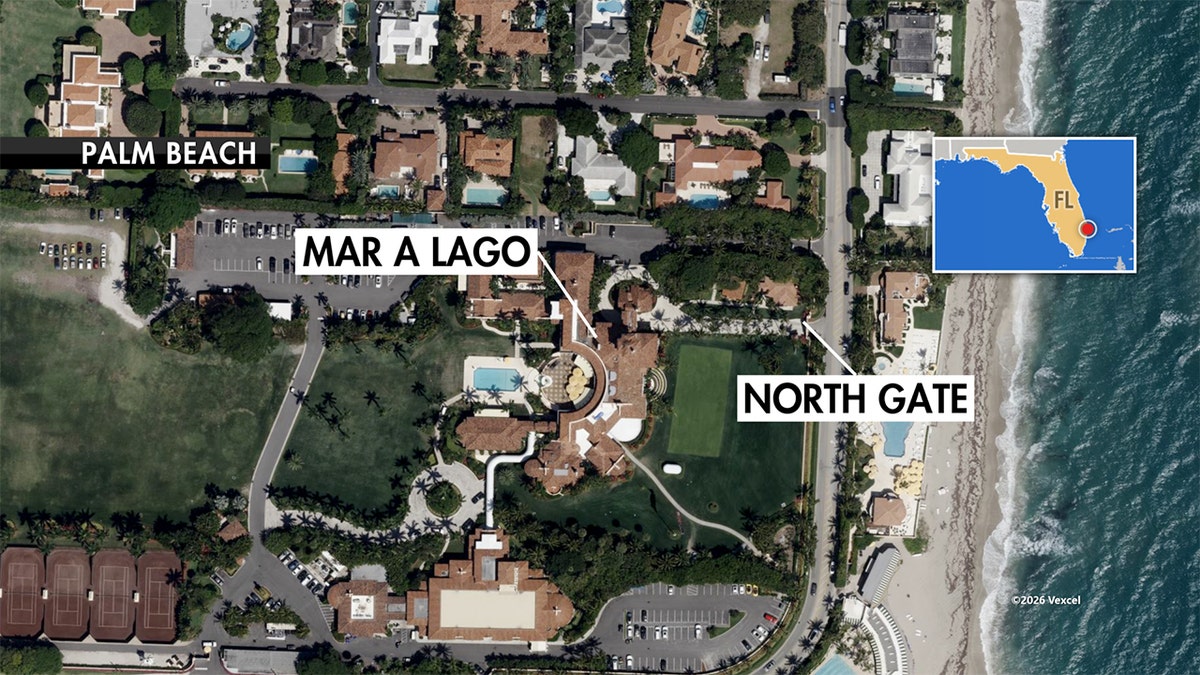
The individual was observed near the north gate carrying what appeared to be a shotgun and a fuel can.

Agents and a deputy from the Palm Beach County Sheriff’s Office (PBSO) confronted the man who was pronounced dead at the scene. 

SECRET SERVICE THWARTS POTENTIAL THREAT NEAR TRUMP'S WHITE HOUSE GROUNDS WITH RAPID RESPONSE

Mar-a-Lago club aerial view showing the main estate buildings, green lawns, and the north gate entrance in Palm Beach.

An aerial view shows the Mar-a-Lago estate and the north gate in Palm Beach, Florida, following reports of a shooting incident, Feb. 22, 2026. (Fox News)

Sheriff Ric Bradshaw confirmed to Fox News that the suspect was 21-year-old Austin Tucker Martin of North Carolina.

No Secret Service or PBSO personnel were injured, and no Secret Service protectees were present at the location during the time of the incident, officials said. Trump was also not in Florida when the shooting occurred.

The FBI, Secret Service and Palm Beach County Sheriff’s Office are investigating, including the man’s background, actions and potential motive, as well as the use of force.

Bradshaw said at a press conference that a deputy and two Secret Service agents on the detail went to investigate after an individual made his way onto the "inner perimeter" of Mar-a-Lago.

BONGINO DETAILS FBI’S ‘ZERO-FAIL MISSION’ AFTER HUNTING STAND FOUND NEAR TRUMP’S AIR FORCE ONE EXIT AREA

A shot of Trump's Mar-a-Lago estate.

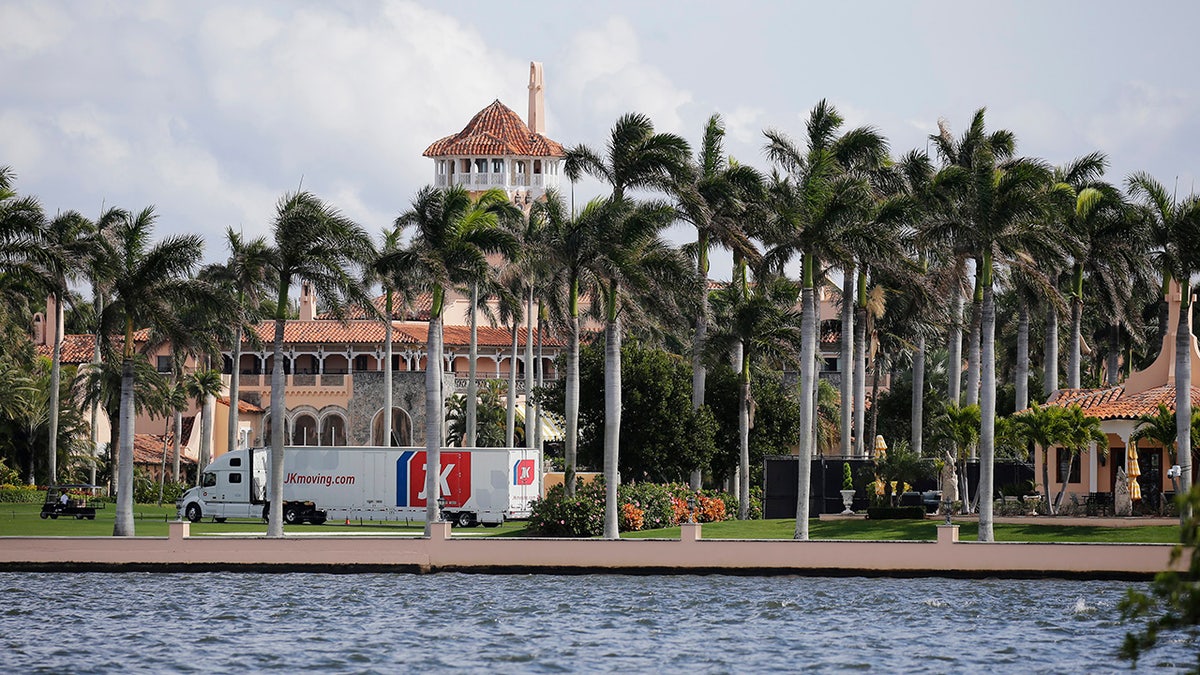
A moving truck is parked outside Mar-a-Lago in Palm Beach, Fla., on Jan. 18, 2021. (Terry Renna/AP)

"They confronted a white male that was carrying a gas can and a shotgun. He was ordered to drop those two pieces of equipment that he had with him – at which time he put down the gas can, raised the shotgun to a shooting position," Bradshaw told reporters. "At that point in time, the deputy and the two Secret Service agents fired their weapons and neutralized the threat."

He said the suspect did not exchange any words with law enforcement officers who instructed the man to "drop the items."

FBI Miami Special Agent in Charge Brett Skiles said the bureau is assisting in the investigation because the shooting occurred in an area under Secret Service protection.

A shutgun sits next to what appears to be a fuel can

The man who was shot and killed after allegedly breaching the secure perimeter at President Donald Trump's Mar-a-Lago estate in Palm Beach, Florida, was observed carrying what appeared to be a shotgun and a fuel can. (Fox News)

He said the FBI’s evidence response team is processing the scene and collecting evidence, and urged residents who live nearby to review their exterior cameras for footage from Saturday night into early Saturday morning. 

"If you see anything that looks suspicious or out of place, please contact us," he told reporters.

FBI Director Kash Patel said in a post on X that his agency "is dedicating all necessary resources in the investigation of this morning’s incident," and "will continue working closely with @SecretService as well our state and federal partners and will provide updates as we are able."


Ashley Carnahan is a writer at Fox News Digital.

Source: https://www.foxnews.com/politics/armed-man-shot-killed-after-unauthorized-entry-mar-a-lago-secret-service

Follow Middle East and Terrorism on Twitter

Illinois official got more than $300K from trucking industry while his agency gave illegal licenses - Steven Richards


​ by Steven Richards

The Chicago Way: Illinois Secretary of State Alexi Giannoulias, a Democrat who is reportedly considering a run for Chicago mayor, is facing scrutiny over his role in improperly issuing CDL licenses after a series of high profile big rig crashes across the country.


The Illinois official whose agency issued potentially thousands of illegal licenses to truckers, received more than $300,000 in donations from the trucking industry in recent years. The Illinois Secretary of State, Alexi Giannoulias, is in a standoff with the Trump Transportation Department over its review of the state’s commercial drivers licenses (CDLs) which found that 1-in-5 licenses issued by Giannoulias’ office were done so illegally. 

Giannoulias, a Democrat who is reportedly considering a run for Chicago mayor, is facing scrutiny over his office’s role in issuing those licenses from the Trump administration after a series of high profile big rig crashes across the country that exposed issues in how states issue non-domiciled CDLs to foreign citizens, or in some cases, to illegal immigrants. 

In Illinois, the U.S. Transportation Department found the Secretary of State’s Office, through the Director of Driver Services, issued illegal CDLs, in some cases, to individuals who have failed to provide evidence of lawful presence, let alone proficiency in managing big rigs.

Big Rig danger

The Insurance Institute for Highway Safety (IIHS) says that trucks often weigh 20–30 times as much as passenger cars and are taller with greater ground clearance, which can result in smaller vehicles underriding trucks in crashes.

Truck braking capability can be a factor in truck crashes. Loaded tractor-trailers require 20-40% more distance than cars to stop, and the discrepancy is greater on wet and slippery roads or with poorly maintained brakes. Truck driver fatigue is also a known crash risk. Drivers of large trucks are allowed by federal hours-of-service regulations to drive up to 11 hours at a stretch. Surveys indicate that many drivers violate the regulations and work longer than permitted.

In response to the audit, the Transportation Department threatened to yank federal highway funding from Illinois if it does not pause issuing non-domiciled CDLs, identify all issued licenses that do not comply with the law, and conduct an internal audit of how it awards such licenses.

Giannoulias has positioned himself as a defender of the state’s trucking and logistics industries, arguing the federal demands are damaging the state’s economy, its truckers, farmers, and others involved in the logistics sector.   

“A strong economy depends on strong logistics,” he said in a statement shared with Just the News earlier this week. “If trucks don’t move, supply chains fail, prices rise, and families feel it in their pocketbooks. We can see the actions by the Trump administration taking their toll on our truckers and our farmers, both of whom are essential to Illinois’ economy.” 

His office also insists that the Illinois Secretary of State has followed all federal guidelines on CDL licenses and suspended issuing them last fall in response to the new rules from the Trump administration, Just the News previously reported.  

More than $300,000 in donations from an industry he regulates

Giannoulias has also received more than $300,000 in donations from those associated with the trucking and logistics industries in the state from 2021 to 2025, according to state campaign finance records reviewed by Just the News

Just the News identified donors in this time period that are associated with transportation companies, semi-truck vendors, and truck driving schools and compiled their donations. The donations may raise additional questions for the Secretary of State in light of his agency’s failure to halt issuing CDLs to illegal, non-domiciled persons during those same years, as the Transportation Department found. 

The secretary’s office did not respond to a request for comment from Just the News about the donations. 

The evidence was uncovered as part of the Transportation Department’s nationwide audit targeting states that issue “non-domiciled CDLs” after a spate of semi-truck crashes across the United States involving illegal immigrant drivers that were issued CDLs by Democrat-run states. Many of these accidents left victims dead. The U.S. Transportation Department reported that last year there were at least 3,996 fatal crashes involving large trucks.

The Illinois audit is the latest in a series of audits that have exposed systemic non-compliance with federal CDL rules, including in California, Pennsylvania, Minnesota and Colorado.

Deadly consequences

The issue came home to Illinois last October, when an illegal immigrant, Borko Stankovic, who was driving under a suspended Illinois CDL previously issued to a family member, swerved into opposing traffic at high speed and slammed into a Subaru sedan, killing the driver.

Though the license was expired in his case and not even being used by the correct individual, the incident was part of a growing pattern of accidents across the United States involving illegal immigrants granted or using expired CDL's, prompting the Transportation Department’s review. 

In Texas in March 2025, Solomun Weldekeal Araya reportedly caused a 17-car pileup on I-35 in Austin. The accident resulted in five fatalities. He was later charged with multiple counts of manslaughter and aggravated assault. The driver was reportedly detained by police after witnesses told law enforcement they saw him trying to leave. Officers reported Araya reportedly mainly spoke Tigrinya, a language spoken in the Horn of Africa, and does not speak English. Araya failed a field sobriety test and law enforcement believed he was under the influence of a drug or controlled substance. A drug test later found no evidence of drugs or alcohol in his system at the time of the crash.

In August, an illegal immigrant driver made an illegal u-turn on the Florida Turnpike in his 18-wheeler truck, causing a crash that left three dead, the Homeland Security Department said. The immigrant was identified as Harjinder Singh, an illegal alien from India.

Before the fatal crash in Florida, Singh reportedly failed his CDL driver’s test 10 times, before finally being granted a license in 2023 in Washington State, according to Fox News. Instructors also noted a lack of English proficiency, with video evidence showing Singh struggled to speak English with police in the wake of the crash. 

The Transportation Department’s audits in other states also uncovered what it says is “systemic non-compliance in issuing non-domiciled CDLs.” In California, the department’s audit found that “more than 25% of non-domiciled CDLs reviewed were improperly issued.” In New York State, it found that more than half of non-domiciled CDLs were issued in violation of federal law. In Colorado, the fraction was 22%

These findings led the administration to pull federal funding until the states remedy the license issuing process to prevent such failures. Secretary Duffy’s agency issued a final rule last week that would prevent foreign drivers from receiving a non-domicile CDL without undergoing a consular and interagency screening. 


Steven Richards

Source: https://justthenews.com/government/local/illinois-official-got-300k-donations-trucking-industry-while-agency-issued-illegal

Follow Middle East and Terrorism on Twitter

Get a glimpse of what's happening in Iran (from Tousi TV), after the 40 days of mourning - Sally Zahav


​ by Sally Zahav

The Iranian people are still taking to the streets with their rage and grief. If the Ayatollahs have taught the Iranians anything, it is to hate Islam. Hear the people drown out the Islamic call to prayer and shout "Down with Hamenei! Down with the dictator".


Sally Zahav 

Source: https://www.youtube.com/watch?v=7CtYUY1fTZY

Follow Middle East and Terrorism on Twitter

Solving the North Korea Mess That Biden Left Trump - Fred Fleitz


​ by Fred Fleitz

Trump reduced the North Korean threat through pressure and diplomacy. Biden’s passivity reversed those gains, deepened hostile alliances, and left a more volatile nuclear standoff.


President Trump’s first-term “Maximum Pressure” policies and aggressive diplomacy significantly lowered tensions with North Korea and set a path toward denuclearization and normalization of relations. Unfortunately, President Biden’s weak foreign policy and neglect of North Korea undermined Trump’s accomplishments and left him with new and complex security challenges to solve with Pyongyang in his second term.

These challenges will gain more attention later this month at North Korea’s 9th Party Congress, when North Korean leader Kim Jong Un will probably reiterate his new policy of an “unlimited drive” to expand North Korea’s nuclear arsenal.

Maximum Pressure Succeeded in Trump’s First Term

U.S.–North Korea relations were at a historic low at the beginning of Trump’s first term, when there were fears of a major war due to a large increase in North Korean missile tests and a sixth nuclear weapons test.

President Trump’s Maximum Pressure campaign, which included tough rhetoric, increased economic sanctions, and diplomacy, substantially reduced the threat from North Korea. Trump held a historic summit with North Korean leader Kim Jong Un in June 2018 and other meetings in Vietnam and at the Korean DMZ. As a result of Trump’s first-term North Korea policies, there have been no North Korean nuclear tests since 2017, and Pyongyang halted long-range missile tests for the rest of Trump’s first term.

Trump’s first-term effort to denuclearize North Korea and normalize relations was interrupted by the COVID-19 pandemic and the 2020 presidential election. Nevertheless, he left Biden a stable U.S.–North Korea relationship and the potential to build on his diplomatic efforts with Pyongyang.

Biden’s Incompetence Caused North Korean Threat to Surge

The threat from North Korea is much higher today because Biden dropped the ball. Biden mocked President Trump’s North Korea policies and tried to ignore the country. The Biden administration named a part-time special envoy for North Korea. There were no U.S.–North Korean talks during the Biden years, and Biden officials showed no interest in high-level meetings with Pyongyang until tensions soared in 2023.

In response to being snubbed by Biden and global perceptions of Biden’s weak leadership, Kim Jong Un appeared to reject diplomacy and return to his country’s former policies of confrontation, threats, and blackmail.

After halting its long-range missile tests in late 2017, North Korea resumed them after the disastrous U.S. withdrawal from Afghanistan in August 2021. North Korea tested a record number of missiles in 2022, including ICBMs, cruise missiles, a possible hypersonic missile, and an intermediate-range ballistic missile fired over Japan.

Worsening the situation, Kim Jong Un moved closer to Russian president Vladimir Putin in late 2022 when he supported Russia’s invasion of Ukraine and began to provide Russia with missiles and artillery shells. North Korea further strengthened its relationship with Russia with two Putin–Kim summits during the Biden years and a mutual defense pact.

Today, North Korea reportedly is supplying Russia with missiles, ammunition, and troops for the Ukraine war in exchange for Russian missile defense systems, satellite and submarine technology, and parts for Soviet-era military and civilian aircraft. Russia may also be providing North Korea with technology and assistance to improve the accuracy of its ICBMs and to build better reentry vehicles for missile warheads.

In addition, North Korea strengthened its relationship with China between 2021 and 2024 and joined a new anti-Western Russia-China-Iran “axis,” driven by the deterioration of America’s global leadership during the Biden years.

The North Korea Challenge for Trump 2.0

President Trump has often said that his North Korean policy was a major foreign policy success of his first term and that he hopes to resume his personal diplomacy with Kim Jong Un. However, due to Biden’s failed national security policies that caused U.S.–North Korea relations to deteriorate, Trump likely will find it difficult to restart diplomacy with North Korea during his second term.

The North Korean–Russian relationship, driven by the war in Ukraine, is the biggest obstacle to resuming U.S.–North Korea negotiations because of the financial, food, and energy support, as well as defense technology, that Russia is providing to North Korea. Because any new U.S.–North Korea agreement would require Pyongyang to halt its support for the Russian war effort in Ukraine—and would not replace the Russian assistance it is receiving in exchange for this support—it is hard to see Kim Jong Un agreeing to a new nuclear deal with the U.S. at this time.

But a Ukraine War peace agreement would not necessarily lead North Korea to easily agree to halt or cut back its nuclear weapons program. After Trump left office, Kim Jong Un significantly hardened his positions and policies toward the U.S. and South Korea. This included declaring in September 2022 that its nuclear weapons program was “irreversible” and permanent. In 2024, North Korea abandoned its long-standing policy of pursuing peaceful Korean reunification and redefined South Korea as a hostile state.

Kim Jong Un is likely to use the Ninth Party Congress to lock in his belligerent policies of the past five years and commit to an “unlimited nuclear buildup” that would expand his already large nuclear arsenal. According to a September 26, 2025, Congressional Research Service report, some experts believe North Korea may have produced enough fissile material for up to 90 warheads and assembled about 50. The report also cited concerns by Secretary of War Pete Hegseth during his January 2025 Senate confirmation hearing that North Korea is improving the miniaturization of its nuclear warheads.

In addition to calling for further advances in North Korea’s missile program, Kim Jong Un will probably call at the Party Congress to further develop its large missile arsenal—which includes ICBMs that can strike the entire continental United States—and new conventional weapons.

How New U.S.–North Korean Diplomacy Can Succeed

Although North Korea is a growing and increasingly intractable threat to regional and global security, there are several strategies the Trump administration could employ to resolve, or at least significantly reduce, this threat.

President Trump could increase the chances of negotiating an agreement to lower tensions with North Korea and halt threats from its nuclear and missile programs by striking a deal to end the war in Ukraine. Trump’s envoys are hard at work on this. I believe Russia’s current support for North Korea is transactional, and Moscow would end this support in exchange for the U.S. and Europe lifting sanctions on Russia. This probably would make Kim Jong Un more willing to negotiate with the U.S.

President Trump should name a high-profile, respected statesman as his special envoy to North Korea, and this person should press hard to hold talks with North Korean officials. This could be a current or former elected or appointed official, such as Senator Bill Hagerty (former Trump ambassador to Japan), former National Security Adviser Robert O’Brien, or CIA Director John Ratcliffe. The special envoy would press for Trump’s objectives in an agreement and arrange a meeting between Secretary of State Marco Rubio and Kim Jong Un. If these meetings were successful, a Trump–Kim summit could be scheduled.

Trump and Kim appeared to get along quite well during their three meetings during Trump’s first term. I also believe Kim Jong Un enjoyed sharing the international spotlight with President Trump. If the special envoy could negotiate a new framework, I believe Trump’s personal diplomacy with Kim could again make progress in improving relations and moving the two countries toward an agreement.

It will be difficult and time-consuming to convince North Korea to denuclearize and give up its ballistic missile program, if this is even possible. Due to President Biden’s policy failures, this will be much harder than it was during Trump’s first term. The first steps will be to freeze these programs, improve relations, and lay the groundwork for a final agreement. President Trump’s strong leadership opens the door, though achieving any of these goals will take time and hard work by his special envoy and other diplomats. Given the seriousness of this threat to regional and global security, this effort should begin as soon as possible.

***


Fred Fleitz previously served as National Security Council chief of staff, a CIA analyst, and a House Intelligence Committee staff member. He is the vice chair of the America First Policy Institute’s Center for American Security. He is the author of “North Korea, Nuclear Brinkmanship and the Oval Office,” to be released by Texas A&M Press on April 7, 2026.

Source: https://amgreatness.com/2026/02/20/solving-the-north-korea-mess-that-biden-left-trump/

Follow Middle East and Terrorism on Twitter

JPMorgan Chase for the first time confirms it closed Trump’s accounts after Jan. 6th Capitol attack - Nicholas Ballasy


​ by Nicholas Ballasy

Trump has sued the bank and its CEO, Jamie Dimon, for $5 billion.


JPMorgan Chase confirmed for the first time that it shut down the bank accounts of President Donald Trump and several of his business entities in the months following the January 6, 2021, Capitol riot. 

The disclosure was made in a court filing as part of the ongoing legal disputes related to “debanking.”

Trump has sued the bank and its CEO, Jamie Dimon, for $5 billion. 

Trump has argued that the account closures were politically motivated and caused significant disruption to his business operations.

“In February 2021, JPMorgan informed Plaintiffs that certain accounts maintained with JPMorgan’s CB and PB would be closed,” wrote JPMorgan’s former chief administrative officer Dan Wilkening in the court filing. 

According to the Associated Press, the “PB” and “CB” represents JPMorgan’s private bank and commercial bank. 


Nicholas Ballasy

Source: https://justthenews.com/government/white-house/jpmorgan-chase-first-time-confirms-it-closed-trumps-accounts-after-jan-6th

Follow Middle East and Terrorism on Twitter

The Left’s Elastic Principles On Judicial Authority - Roger Kimball


​ by Roger Kimball

Democrats cheer or jeer the Court as convenience dictates; their lone consistency is power—pursued relentlessly, defended fiercely, and projected onto opponents.


“A foolish consistency is the hobgoblin of little minds,” Ralph Waldo Emerson wrote. The Democrats might repeat Emerson’s motto, but they go one better. They eschew all forms of consistency—except one. Today, since the Supreme Court just ruled against Trump’s use of the 1977 International Emergency Economic Powers Act to impose tariffs, the Dems are in a festive mood and are happy to praise the Court. No worries, Trump has recourse to many other statutes to pursue his economic policies. That was something the Left began to realize by Friday afternoon, when Trump and Treasury Secretary Scott Bessent set forth their plans for a workaround. Gloom and then anger gripped the liberal talking heads as they realized that their promised victory over Trump was evaporating before their very eyes.

But what I want to call attention to here is the fickleness of the Left’s attitude toward the Court. It was not so long ago, when the Supreme Court repeatedly ruled in favor of Trump, that the Dems talked darkly about packing the Court and setting term limits for justices and otherwise made their displeasure known. Remember Chuck Schumer pontificating from the steps of the Court? “I want to tell you, Gorsuch, I want to tell you, Kavanaugh, you have released the whirlwind, and you will pay the price,” he said. “You won’t know what hit you if you go forward with these awful decisions.” Threat, or warning?

The rule is, if you side with us, we coddle you. Go against our pet projects—climate change, COVID policy, Obamacare, trans-weirdness of any kind, censorship of dis-, mis-, mal-information, etc.—and we try to destroy you.

Which brings me to the one exception to the Dems’ transactional flouting of consistency. When it comes to preserving and extending their own power, they are absolutely, 100 percent consistent. In this respect, they may speak like Emerson; they act according to Hobbes’s dictum that “all mankind” are chivvied by “a perpetual and restless desire of power after power, that ceaseth only in death.”

“Wait, don’t Republicans seek power, too?” Of course they do. But the Dems tend to be much better and single-minded at that game than Republicans. They excel especially in the art of projection: accusing others of bad behavior they themselves are guilty of.

The projection comes in two main versions. Former President Barack Obama gave a mini-masterclass in one version a week or so back in an interview. “The other side,” he said, “does the mean, angry, exclusive, us/them, divisive politics. That’s their home court. Our court is about coming together.” Note how he maintained a straight face throughout. Brilliant.

The other version of projection was on view in Obama’s National Security Advisor Susan Rice’s warning about the “accountability agenda” Democrats would impose upon Trump supporters once the Dems got back into power: “It’s not going to end well for them,” she said in an interview with Preet Bharara. She put companies, law firms, universities, media, and Big Tech on notice that, when they get back into power, Democrats won’t “play by the old rules”; it won’t be a matter of “forgive and forget”; get ready, subpoenas and worse are on the way.

Some wag posted a clip of Obama’s performance next to Rice’s furious incantation. It made for entertaining viewing, not because Rice wasn’t in earnest. I am sure she would do everything in her power to make good on her threats. No, the funny thing is that all the bad things she accuses Trump and his supporters of doing are things the Dems have been doing in spades throughout Obama’s two official terms and especially in his third, covert term, sometimes known as the presidency of Joe Biden. Remember those hundreds upon hundreds of hapless people who were hoovered up and imprisoned following the cabaret of January 6, 2021? Remember how lawyers who worked for Trump were ejected from their law firms and ostracized? Remember how the federal government leaned on social media companies to censor opinions that deviated from the party line? Remember how people who supported Trump were “debanked”—a new coinage for our new Orwellian age? No, the Dems’ “court,” to use Obama’s term, is all about the naked pursuit of power and the untrammeled suppression of dissenting voices.

Is there a silver lining in this unpleasant story? Yes, there are a few. For one thing, both Obama and Rice appear to be blinded by the narrative they are hawking. I am not suggesting that Obama actually believes that his “court” is about “coming together.” No, but he understands that his particular brand of divisiveness requires the rhetoric of unity in order to succeed. It is the glaring obviousness of his hypocrisy that provides the pleasing argentine glow.

With Susan Rice, the source of the aura is a little different. Her extended game of Achtung! was predicated on her belief that, as she repeatedly said, Trump’s agenda was unpopular and that its architect, Trump himself, would soon be neutered so that his followers could be crushed. The problem for her is that Trump is not unpopular. On the contrary, he has been extraordinarily successful. In just a single year, he has accomplished major parts of his announced goals—goals for which he was elected—from sealing the southern border and deporting illegals to revivifying the economy and securing our elections, nurturing the middle class, dismantling DEI, and strengthening the military. He has done all that and more in just a single year. He has three more to go.

Susan Rice let the mask drop. Everyone had a chance to peer into that heart of darkness. We can be in no doubt about what she would do should she get anywhere near the corridors of power again. Fortunately, she is like Barack Obama in her boundless sense of entitlement. Both wear their self-infatuation on their sleeves. Their utter cluelessness about the appeal of Trump and his agenda for millions of voters renders them unable to take an accurate measure of the political realities before them. They put the world on notice about the revenge drama they hope to stage. It was a premature bulletin. Even as I write, Trump’s Department of Justice is picking through mountains of evidence tying them both to conspiracies against a duly elected president. I would not be surprised if Susan Rice gets to see an “accountability agenda” play out much sooner than she bargained for.


Roger Kimball is editor and publisher of The New Criterion and the president and publisher of Encounter Books. He is the author and editor of many books, including The Fortunes of Permanence: Culture and Anarchy in an Age of Amnesia (St. Augustine's Press), The Rape of the Masters (Encounter), Lives of the Mind: The Use and Abuse of Intelligence from Hegel to Wodehouse (Ivan R. Dee), and Art's Prospect: The Challenge of Tradition in an Age of Celebrity (Ivan R. Dee). Most recently, he edited and contributed to Where Next? Western Civilization at the Crossroads (Encounter) and contributed to Against the Great Reset: Eighteen Theses Contra the New World Order (Bombardier).

Source: https://amgreatness.com/2026/02/22/the-lefts-elastic-principles-on-judicial-authority/

Follow Middle East and Terrorism on Twitter